Effects of Multicomponent Exercises on Muscle Strength and Balance in Frail Older: A Systematic Review and Meta-Analysis of Randomized Controlled Trials
Objective
Methods
Results
Conclusions
INTRODUCTION
METHODS
INCLUSION CRITERIA
SEARCH STRATEGY
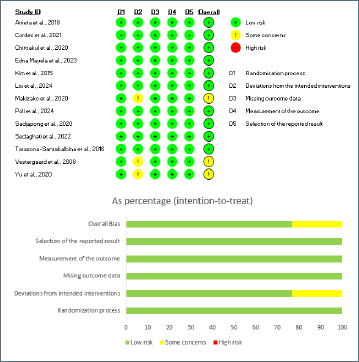
RISK OF BIAS ASSESSMENT
ASSESSMENT OF METHODOLOGICAL QUALITY
DATA EXTRACTION
META-ANALYSIS AND EVIDENCE-LEVEL ASSESSMENT
RESULTS
DISCUSSION
CONCLUSIONS
Conflict of interest statement
Funding
Author contributions
Ethical consideration
History
Figures and tables




| Author-year/country | Age mean (sd) | BMI mean (sd) | Sex | Groups (n) | Intervention | VT | Results |
|---|---|---|---|---|---|---|---|
| Arrieta et al. 25/ Spain | CG: 84.7 (6.1) EG: 85.1 (7.6) | CG: 28.2 (5.3) EG: 28.2 (5.1) | ♂♀ | CG= 47 EG= 45 | EG: Aerobic exercises: 5-15 min (walking); Muscle strength: 45 min; Balance: 10 min CG: No exercise | 45 min x session/ 2 x week/ 36 weeks | Strenght: CG: ↔ handgrip EG: ↔ handgrip Balance: CG: ↓ BBS EG: ↑ BBS |
| Cordes et al. 27/ Germany | CG: 80.12 (11.37) EG: 82.69 (10.26) | EG: 24.93 (6.22) CG: 27.46 (5.88) | ♂♀ | CG= 26 EG= 26 | EG: Warm-up: 5-10 min; Coordination and motor-cognitive exercises: 5–10 min; task-specific exercises for ADL: 10 min; strength and aerobic exercises: 15 min; Cool down: 5-10 min CG: No exercise | 50-55 min x session/ 32 sessions/ 16 weeks | Strenght: CG: ↔ handgrip EG: ↔ handgrip Balance: CG: ↔ DSB EG: ↔ DSB |
| Chittrakul et al. 28/ Thailand | CG: 68.89 (3.86) EG: 69.14 (3.55) | CG: 24.32 (4.36) EG: 24.46 (4.06) | ♂♀ | CG= 36 EG= 36 | EG: Warm-up; Strenght; balance; Reaction time; cooldown. CG: Flexibility exercises | 60 min x session, 3 x week, 12 weeks | Strenght: CG: ↓ Knee extension EG: ↑ Knee extension |
| Edna Mayela et al. 29/ México | CG: 68.90 (5.14) EG: 68.17 (6.25) | CG: 28.07 (4.40) EG: 28.26 (4.11) | ♂♀ | CG= 42 EG= 46 | EG: Warm-up and aerobic: 10 min; Strength, aerobic and balance: 35-45 min; Cooldown: 15 min CG: no exercise | 60-70 min x session, 3 x week, 12 weeks | Balance: CG: ↓ TUG EG: ↑ TUG |
| Kim et al. 30/ Japan | CG: 80.3 (3.3) EG: 81.1 (2.8) | NI | ♀ | CG= 33 EG= 33 | EG: Warm-up: 5 min; Balance and gait training: 20 min; strength: 30 min; Cooldown: 5 min CG: No exercise | 60 min x session, 3 x week, 12 weeks | Strenght: CG: ↔ handgrip EG: ↔ handgrip Balance: CG: ↔ TUG EG: ↑ TUG |
| Liu et al. 32/ China | CG: 75.6 (6.35) EG: 74.2 (4.67) | EG: 24.93 (6.22) CG: 27.46 (5.88) | ♂♀ | CG= 45 EG= 41 | EG: Walking: 10 min; Strenght exercise: 7 exercises, total session time not reported CG: No exercise | 12 weeks | Strenght: CG: ↔ handgrip; ↔ Knee flexion; ↔ Knee extension EG: ↑ handgrip; ↑ Knee flexion; ↑ Knee extension Balance: CG: ↔ TUG EG: ↑ TUG |
| Makizako et al. 31/ Japan | CG: 75.8 (7.3) EG: 74.1 (6.6) | CG: 20.6 (2.1) EG: 20.9 (2.7) | ♂♀ | CG= 36 EG= 36 | EG: Brief warm-up involving stretchin; resistance training: 25-30min; Balance and aerobic exercises: 20-25 min; cool-down: 5 min CG: No exercise | 60 min x session/ 12 weeks | Strenght: CG: ↓ handgrip EG: ↔ handgrip Balance: CG: ↔ TUG EG: ↑ TUG |
| Poli et al. 34/ Italy | CG: 70.77 (6.24) EG: 69.33 (4.59) | CG: 27.88 (6.01) EG: 25.71 (5.53) | ♂♀ | CG= 9 EG= 12 | EG: Aerobic exercises: 15 min; Flexibility: 1-3 sets of 30-60 seconds with 60 seconds rest between sets; 1-3 sets of 10-15 reps with 60-120 seconds rest interval; The Cool down period consisted of breathing and stretching exercises CG: No exercise | 2 x week/ 60 min x session/ 10 weeks | Strenght: CG: ↔ handgrip EG: ↑ handgrip Balance: CG: ↔ TUG EG: ↑ TUG |
| Sadjapong et al. 2/ Thailand | CG: 78.87 (1.32) EG: 76.68 (1.14) | CG: 21.28 (0.69) EG: 21.37 (0.68) | ♂♀ | CG= 32 EG= 32 | EG: Aerobic Training: 10-20 min; Resistance Training with Theraband: 25-30 min; Balance training: 10 min CG: no exercise | 3 x week/ 60 min x session/ 24 weeks | Strenght: CG: ↔ handgrip EG: ↑ handgrip Balance: CG: ↓ TUG EG: ↑ TUG |
| Sedaghati et al. 36/ Iran | CG: 71.07 (2.26) EG: 70.42 (2.70) | CG: 23.59 (1.11) EG: 23.68 (1.21) | ♂♀ | CG= 14 EG= 14 | EG: Warm-up: 5 min; Strength lower extremity: 4-5 exercises, 2 sets x 8-12 rep; Balance: 2-5 exercises; Dual-task (cognitive function): 2–5 of strength exercises; Balance: 2-4 exercises; Cooldown: 5 min CG: no exercise | 3 x week/ 60 min x session/ 8 weeks | Balance: CG: ↓ TUG EG: ↑ TUG |
| Tarazona-Santabalbina et al. 26/ Spain | CG: 80.3 (3.7) EG: 79.7 (3.6) | CG: 30.0 (4.2) EG: 29.9 (5.6) | ♂♀ | CG= 42 EG= 40 | EG: Warm-up: 5 exercises of mobility; Aerobic: 30-40 min; Strength: 9 exercises; Balance: 8 exercises; Cooldown: 5 min CG: no exercise | 65-70 min x session, 5 x week, 24 weeks | Balance: CG: ↔ TUG EG: ↔ TUG |
| Vestergaard et al. 35/ Denmark | CG: 82.7 (3.8) EG: 81.0 (3.3) | NI | ♀ | CG= 25 EG= 25 | EG: Flexibility and dynamic balance: 15 min; strength: 6 min; Aerobic: 5 min CG: No exercise | 30 min x session, 3 x week, 20 weeks | Strenght: CG: ↔ handgrip EG: ↑ handgrip |
| Yu et al. 33/ China | CG: > 50 EG: > 50 | NI | ♂♀ | CG= 61 EG= 66 | EG: Warm-up: 5 min; Aerobic: 25 min; Strenght: 25 min CG: no exercise | 60 minutes x session, 2 x week, 12 weeks | Strenght: CG: ↔ handgrip EG: ↔ handgrip |
| EG: Experimental group; CG: Control Group; NI: Not informed; sd: standard deviatio; TUG: Time Up Go; DSB: Dynamic Siting Balance; BBS: Berg Balance Scale | |||||||
| Study | Study quality | Sub-total (0 to 5) | Study reporting | Sub-total (0 to 10) | Total (0 a 15) | |||||||||||||
|---|---|---|---|---|---|---|---|---|---|---|---|---|---|---|---|---|---|---|
| 1 | 2 | 3 | 4 | 5 | 6a | 6b | 6c | 7 | 8a | 8b | 9 | 10 | 11 | 12 | ||||
| Arrieta et al. 25 | 1 | 1 | 1 | 1 | 0 | 4 | 1 | 1 | 1 | 1 | 1 | 1 | 1 | 1 | 1 | 1 | 10 | 14 |
| Cordes et al. 27 | 1 | 1 | 1 | 1 | 0 | 4 | 1 | 1 | 1 | 1 | 1 | 1 | 1 | 1 | 1 | 1 | 10 | 14 |
| Chittrakul et al. 28 | 1 | 1 | 1 | 1 | 1 | 5 | 1 | 1 | 1 | 1 | 1 | 1 | 1 | 1 | 1 | 1 | 10 | 15 |
| Edna Mayela et al. 29 | 1 | 1 | 1 | 1 | 0 | 4 | 1 | 1 | 1 | 1 | 1 | 1 | 1 | 1 | 1 | 1 | 10 | 14 |
| Kim et al. 30 | 1 | 1 | 1 | 1 | 1 | 5 | 1 | 1 | 1 | 1 | 1 | 1 | 1 | 1 | 1 | 1 | 10 | 15 |
| Liu et al. 32 | 1 | 1 | 1 | 1 | 1 | 5 | 1 | 1 | 1 | 1 | 1 | 1 | 1 | 1 | 1 | 1 | 10 | 15 |
| Makizako et al. 31 | 1 | 1 | 1 | 1 | 0 | 4 | 1 | 1 | 1 | 1 | 1 | 1 | 1 | 1 | 1 | 1 | 10 | 14 |
| Poli et al. 34 | 1 | 1 | 1 | 1 | 1 | 5 | 1 | 1 | 1 | 1 | 1 | 1 | 1 | 1 | 1 | 1 | 10 | 15 |
| Sadjapong et al. 2 | 1 | 1 | 1 | 1 | 1 | 5 | 1 | 1 | 1 | 1 | 1 | 1 | 1 | 1 | 1 | 1 | 10 | 15 |
| Sedaghati et al. 36 | 1 | 1 | 1 | 1 | 0 | 4 | 1 | 1 | 1 | 1 | 1 | 1 | 1 | 1 | 1 | 1 | 10 | 14 |
| Tarazona-Santabalbina et al. 26 | 1 | 1 | 1 | 1 | 1 | 5 | 1 | 1 | 1 | 1 | 1 | 1 | 1 | 1 | 1 | 1 | 10 | 15 |
| Vestergaard et al. 35 | 1 | 1 | 1 | 1 | 0 | 4 | 1 | 1 | 1 | 1 | 1 | 1 | 1 | 1 | 1 | 1 | 10 | 14 |
| Yu et al. 33 | 1 | 1 | 1 | 1 | 1 | 5 | 1 | 1 | 1 | 1 | 1 | 1 | 1 | 1 | 1 | 1 | 10 | 14 |
| Study quality: 1 = specific eligibility criteria; 2 = type of randomization specified; 3 = hidden allocation; 4 = similar groups at baseline; 5 = raters were blinded (at least one main outcome); 6 = outcomes assessed in 85% of participants (6a = 1 point if more than 85% completed; 6b = 1 point if adverse events were reported; 6c = if exercise attendance was reported); 7 = intention-to-treat statistical analysis; 8 = statistical comparison between groups was reported (8a = 1 point if between-group comparisons are reported for the primary outcome variable of interest; 8b = 1 point if statistical comparisons between groups are reported for at least one secondary measure); 9 = point measures and measures of variability for all outcome measures that were reported; 10 = activity monitoring in the control group; 11 = relative exercise intensity remained constant; 12 = exercise volume and energy expenditure were reported. | ||||||||||||||||||
| Certainty assessment | № of patients | Effect | Certainty | Importance | |||||||
|---|---|---|---|---|---|---|---|---|---|---|---|
| № of studies | Study design | Risk of bias | Inconsistency | Indirectness | Imprecision | Other considerations | Exercise | Control | Absolute (95% CI) | ||
| Balance | |||||||||||
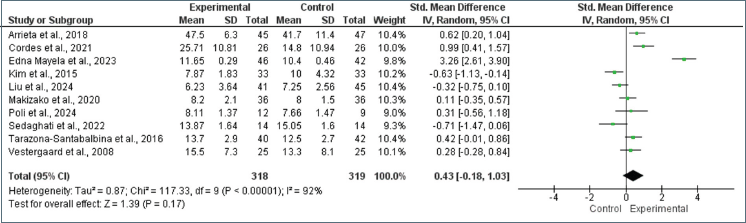
| 10 | Randomised trials | Not serious | Seriousa | Not serious | Not serious | None | 318 | 319 | SMD 0.43 SD higher (0.18 lower to 1.03 higher) | ⊕⊕⊕⊕ Moderatea | IMPORTANT |
| Strenght | |||||||||||
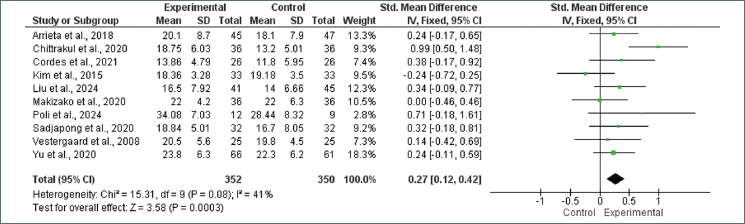
| 10 | Randomised trials | Not serious | Not serious | Not serious | Not serious | None | 352 | 350 | SMD 0.27 SD higher (0.12 higher to 0.42 higher) | ⊕⊕⊕⊕ High | IMPORTANT |
| CI: confidence interval; SMD: standardised mean difference; a. The high heterogeneity was accounted for in the meta-analysis result by using the random-effects model. | |||||||||||
Appendix 1
| Research bases | Search phrases |
|---|---|
| Pubmed | “older”[All Fields] AND “multicomponent exercise”[All Fields] |
| Scielo | “Multicomponent exercise” and older |
| Scopus | (TITLE-ABS-KEY (older) AND TITLE-ABS-KEY (“multicomponent exercise”)) |
| Web of Science | older (All Fields) AND “multicomponent exercise” (All Fields) |
| Science direct | older and “multicomponent exercise” |
| SportDiscus | older and “multicomponente exercise” |
References
- Cadore EL, Rodríguez-Mañas L, Sinclair A, et al. Effects of different exercise interventions on risk of falls, gait ability, and balance in physically frail older adults: a systematic review. Rejuvenation Res 2013;16:105-114. https://doi.org/10.1089/rej.2012.1397 10.1089/rej.2012.1397
- Sadjapong U, Yodkeeree S, Sungkarat S, et al. Multicomponent exercise program reduces frailty and inflammatory biomarkers and improves physical performance in community-dwelling older adults: a randomized controlled trial. Int J Env Res Public Health 2020;17. https://doi.org/10.3390/ijerph17113760 10.3390/ijerph17113760
- Chang SH, Chiang CC, Chien NH. Efficacy of a multicomponent exercise training program intervention in community-dwelling older adults during the COVID-19 pandemic: a cluster randomized controlled trial. Geriatr Nur (Lond) 2023;49:148-156. https://doi.org/10.1016/j.gerinurse.2022.11.019 10.1016/j.gerinurse.2022.11.019
- Linhares DG, Pereira Sallustiano Mallen Da Silva GC, Gama Linhares B, et al. Combat sport in the body composition of the elderly: a systematic review and meta-analysis study. Arch Gerontol Geriatr 2024;117:105200. https://doi.org/10.1016/j.archger.2023.105200 10.1016/j.archger.2023.105200
- Wang H, Huang WY, Zhao Y. Efficacy of exercise on muscle function and physical performance in older adults with sarcopenia: an updated systematic review and meta-analysis. Int J Env Res Public Health 2022;19. https://doi.org/10.3390/ijerph19138212 10.3390/ijerph19138212
- Venegas-Sanabria LC, Cavero-Redondo I, Martínez-Vizcaino V, et al. Effect of multicomponent exercise in cognitive impairment: a systematic review and meta-analysis. BMC Geriatr. 2022;22:617. https://doi.org/10.1186/s12877-022-03302-1 10.1186/s12877-022-03302-1
- Borba-Pinheiro CJ, Gama Linhares D, Lima Dos Santos L, et al. Prescrição de exercício físico para mulheres na pós-menopausa com osteopenia ou osteoporose com base em revisão sistemática de ensaios clínicos randomizados. Retos. 2024;52:647-656.https://doi.org/10.47197/retos.v52.102439 10.47197/retos.v52.102439
- Gomes De Souza Vale R, Gama Linhares D, Santos Meireles A, et al. Effects of physical exercise on the functional autonomy in the older evaluated by the GDLAM protocol: a systematic review with meta-analysis of randomized clinical trials. J Gerontol Geriatr 2024;72:160-171. https://doi.org/10.36150/2499-6564-N746 10.36150/2499-6564-N746
- Linhares DG, Borba-Pinheiro CJ, Castro JBP, et al. Effects of multicomponent exercise training on the health of older women with osteoporosis: a systematic review and meta-analysis. Int J Env Res Public Health 2022;19. https://doi.org/10.3390/ijerph192114195 10.3390/ijerph192114195
- Pizarro-Mena R, Duran-Aguero S, Parra-Soto S, et al. Effects of a structured multicomponent physical exercise intervention on quality of life and biopsychosocial health among chilean older adults from the community with controlled multimorbidity: a pre-post design. Int J Environ Res Public Health 2022;19. https://doi.org/10.3390/ijerph192315842 10.3390/ijerph192315842
- Sáez de Asteasu M, Martínez-Velilla N, Zambom-Ferraresi F, et al. Short-term multicomponent exercise impact on muscle function and structure in hospitalized older at risk of acute sarcopenia. J Cachexia Sarcopenia Muscle 2024;15:2586-2594. https://doi.org/10.1002/jcsm.13602 10.1002/jcsm.13602
- Sánchez-Sánchez JL, Udina C, Medina-Rincón A, et al. Effect of a multicomponent exercise program and cognitive stimulation (VIVIFRAIL-COGN) on falls in frail community older persons with high risk of falls: study protocol for a randomized multicenter control trial. BMC Geriatr 2022;22:612. https://doi.org/10.1186/s12877-022-03214-0 10.1186/s12877-022-03214-0
- Li Y, Gao Y, Hu S, et al. Effects of multicomponent exercise on the muscle strength, muscle endurance and balance of frail older adults: a meta-analysis of randomised controlled trials. J Clin Nurs 2023;32:1795-1805. https://doi.org/10.1111/jocn.16196 10.1111/jocn.16196
- Yang X, Li S, Xu L, et al. Effects of multicomponent exercise on frailty status and physical function in frail older adults: A meta-analysis and systematic review. Exp Gerontol 2024;197:112604. https://doi.org/10.1016/j.exger.2024.112604 10.1016/j.exger.2024.112604
- Meng L, Chen C, Lu Z. Effect of early rehabilitation nursing on motor function, activities of daily living and incidence of shoulder-hand syndrome in stroke patients with hemiplegia. Acta Medica Mediterr 2020;36:3053-3058. https://doi.org/10.19193/0393-6384_2020_5_470 10.19193/0393-6384_2020_5_470
- Moreira NB, Rodacki ALF, Costa SN, et al. Perceptive-cognitive and physical function in prefrail older adults: exergaming versus traditional multicomponent training. Rejuvenation Res 2021;24:28-36. https://doi.org/10.1089/rej.2020.2302 10.1089/rej.2020.2302
- Page MJ, McKenzie JE, Bossuyt PM, et al. The PRISMA 2020 statement: an updated guideline for reporting systematic reviews. BMJ 2021;372:n71. https://doi.org/10.1136/bmj.n71 10.1136/bmj.n71
- Methley AM, Campbell S, Chew-Graham C, et al. PICO, PICOS and SPIDER: a comparison study of specificity and sensitivity in three search tools for qualitative systematic reviews. BMC Health Serv Res 2014;14:579. https://doi.org/10.1186/s12913-014-0579-0 10.1186/s12913-014-0579-0
- Sterne JAC, Savović J, Page MJ, et al. RoB 2: a revised tool for assessing risk of bias in randomised trials. BMJ 2019:l4898. https://doi.org/10.1136/bmj.l4898 10.1136/bmj.l4898
- Smart NA, Waldron M, Ismail H, et al. Validation of a new tool for the assessment of study quality and reporting in exercise training studies: TESTEX. Int J Evid Based Healthc 2015;13:9-18. https://doi.org/10.1097/XEB.0000000000000020 10.1097/XEB.0000000000000020
- Melsen W, Bootsma MCJ, Rovers M, et al. The effects of clinical and statistical heterogeneity on the predictive values of results from meta-analyses. Clin Microbiol Infect 2014;20:123-129. https://doi.org/10.1111/1469-0691.12494 10.1111/1469-0691.12494
- Sterne JAC, Sutton AJ, Ioannidis JPA, et al. Recommendations for examining and interpreting funnel plot asymmetry in meta-analyses of randomised controlled trials. BMJ 2011;343:d4002-d4002. https://doi.org/10.1136/bmj.d4002 10.1136/bmj.d4002
- Cohen J. A power primer. Psychol Bull 1992;112:155-159. https://doi.org/10.1037//0033-2909.112.1.155 10.1037//0033-2909.112.1.155
- Guyatt GH, Oxman AD, Vist G, et al. GRADE guidelines: 4. Rating the quality of evidence – study limitations (risk of bias). J Clin Epidemiol 2011;64:407-415. https://doi.org/10.1016/j.jclinepi.2010.07.017 10.1016/j.jclinepi.2010.07.017
- Arrieta H, Rezola-Pardo C, Zarrazquin I, et al. A multicomponent exercise program improves physical function in long-term nursing home residents: a randomized controlled trial. Exp Gerontol 2018;103:94-100. https://doi.org/10.1016/j.exger.2018.01.008 10.1016/j.exger.2018.01.008
- Tarazona-Santabalbina FJ, Gómez-Cabrera MC, Pérez-Ros P, et al. A multicomponent exercise intervention that reverses frailty and improves cognition, emotion, and social networking in the community-dwelling frail elderly: a randomized clinical trial. J Am Med Dir Assoc 2016;17:426-433. https://doi.org/10.1016/j.jamda.2016.01.019 10.1016/j.jamda.2016.01.019
- Cordes T, Zwingmann K, Rudisch J, et al. Multicomponent exercise to improve motor functions, cognition and well-being for nursing home residents who are unable to walk – A randomized controlled trial. Exp Gerontol 2021;153:111484. https://doi.org/10.1016/j.exger.2021.111484 10.1016/j.exger.2021.111484
- Chittrakul J, Siviroj P, Sungkarat S, et al. Multi-system physical exercise intervention for fall prevention and quality of life in pre-frail older adults: a randomized controlled trial. Int J Environ Res Public Health 2020;17:3102. https://doi.org/10.3390/ijerph17093102 10.3390/ijerph17093102
- Edna Mayela DLVC, Miriam LT, Ana Isabel GG, et al. Effectiveness of an online multicomponent physical exercise intervention on the physical performance of community-dwelling older adults: a randomized controlled trial. Geriatr Nur (Lond) 2023;54:83-93. https://doi.org/10.1016/j.gerinurse.2023.08.018 10.1016/j.gerinurse.2023.08.018
- Kim H, Suzuki T, Kim M, et al. Effects of Exercise and Milk Fat Globule Membrane (MFGM) supplementation on body composition, physical function, and hematological parameters in community-dwelling frail Japanese women: a randomized double blind, placebo-controlled, follow-up trial. Buchowski M, ed. Plos One 2015;10:E0116256. https://doi.org/10.1371/journal.pone.0116256 10.1371/journal.pone.0116256
- Makizako H, Nakai Y, Tomioka K, et al. Effects of a multicomponent exercise program in physical function and muscle mass in sarcopenic/pre-sarcopenic adults. J Clin Med. 2020;9. https://doi.org/10.3390/jcm9051386 10.3390/jcm9051386
- Liu M, Li J, Xu J, et al. Graded progressive home-based resistance combined with aerobic exercise in community-dwelling older adults with sarcopenia: a randomized controlled trial. Clin Interv Aging 2024;19:1581-1595. https://doi.org/10.2147/cia.S473081 10.2147/cia.S473081
- Yu R, Tong C, Ho F, et al. Effects of a multicomponent frailty prevention program in prefrail community-dwelling older persons: a randomized controlled trial. J Am Med Dir Assoc 2020;21:294.E1-294.E10. https://doi.org/10.1016/j.jamda.2019.08.024 10.1016/j.jamda.2019.08.024
- Poli L, Greco G, Cataldi S, et al. Multicomponent versus aerobic exercise intervention: effects on hemodynamic, physical fitness and quality of life in adult and elderly cardiovascular disease patients. A randomized controlled study. Heliyon 2024;10:E36200. https://doi.org/10.1016/j.heliyon.2024.e36200 10.1016/j.heliyon.2024.e36200
- Vestergaard S, Kronborg C, Puggaard L. Home-based video exercise intervention for community-dwelling frail older women: a randomized controlled trial. Aging Clin Exp Res 2008;20:479-486. https://doi.org/10.1007/BF03325155 10.1007/BF03325155
- Sedaghati P, Goudarzian M, Ahmadabadi S, et al. The impact of a multicomponent-functional training with postural correction on functional balance in the elderly with a history of falling. J Exp Orthop 2022;9:23. https://doi.org/10.1186/s40634-022-00459-x 10.1186/s40634-022-00459-x
- Rodrigues F, Jacinto M, Antunes R, et al. Comparing the effects of multicomponent and concurrent exercise protocols on muscle strength in older adults. J Funct Morphol Kinesiol 2023;9. https://doi.org/10.3390/jfmk9010003 10.3390/jfmk9010003
- Rydwik E, Lammes E, Frändin K, et al. Effects of a physical and nutritional intervention program for frail elderly people over age 75. A randomized controlled pilot treatment trial. Aging Clin Exp Res 2008;20:159-170. https://doi.org/10.1007/BF03324763 10.1007/BF03324763
- Gschwind YJ, Kressig RW, Lacroix A, et al. A best practice fall prevention exercise program to improve balance, strength / power, and psychosocial health in older adults: study protocol for a randomized controlled trial. BMC Geriatr 2013;13:105. https://doi.org/10.1186/1471-2318-13-105 10.1186/1471-2318-13-105
- Stanghelle B, Bentzen H, Giangregorio L, et al. Effect of a resistance and balance exercise programme for women with osteoporosis and vertebral fracture: study protocol for a randomized controlled trial. BMC Musculoskelet Disord 2018;19:100. https://doi.org/10.1186/s12891-018-2021-y 10.1186/s12891-018-2021-y
Società Italiana di Gerontologia e Geriatria (SIGG) This is an open access article distributed in accordance with the CC-BY-NC-ND (Creative Commons Attribution-NonCommercial-NoDerivatives 4.0 International) license. The article can be used by giving appropriate credit and mentioning the license, but only for non-commercial purposes and only in the original version. For further information: https://creativecommons.org/licenses/by-nc-nd/4.0/deed.en
Share and Cite
Linhares, D.G.; Monteiro, A.B.M.d.C.; Linhares, B.G.; da Silva, G.C.P.S.M.; dos Santos, L.L.; Cordeiro, L.d.S.; Borba-Pinheiro, C.J.; Vale, R.G.d.S. Effects of Multicomponent Exercises on Muscle Strength and Balance in Frail Older: A Systematic Review and Meta-Analysis of Randomized Controlled Trials. J. Gerontol. Geriatr. 2025, 73, 153-163. https://doi.org/10.36150/2499-6564-N850
Linhares DG, Monteiro ABMdC, Linhares BG, da Silva GCPSM, dos Santos LL, Cordeiro LdS, Borba-Pinheiro CJ, Vale RGdS. Effects of Multicomponent Exercises on Muscle Strength and Balance in Frail Older: A Systematic Review and Meta-Analysis of Randomized Controlled Trials. Journal of Gerontology and Geriatrics. 2025; 73(4):153-163. https://doi.org/10.36150/2499-6564-N850
Chicago/Turabian StyleLinhares, Diego Gama, Ana Beatriz Moreira de Carvalho Monteiro, Bruno Gama Linhares, Giullio Cesar Pereira Sallustiano Mallen da Silva, Luciano Lima dos Santos, Lilliany de Souza Cordeiro, Claudio Joaquim Borba-Pinheiro, and Rodrigo Gomes de Souza Vale. 2025. "Effects of Multicomponent Exercises on Muscle Strength and Balance in Frail Older: A Systematic Review and Meta-Analysis of Randomized Controlled Trials" Journal of Gerontology and Geriatrics 73, no. 4: 153-163. https://doi.org/10.36150/2499-6564-N850
APA StyleLinhares, D. G., Monteiro, A. B. M. d. C., Linhares, B. G., da Silva, G. C. P. S. M., dos Santos, L. L., Cordeiro, L. d. S., Borba-Pinheiro, C. J., & Vale, R. G. d. S. (2025). Effects of Multicomponent Exercises on Muscle Strength and Balance in Frail Older: A Systematic Review and Meta-Analysis of Randomized Controlled Trials. Journal of Gerontology and Geriatrics, 73(4), 153-163. https://doi.org/10.36150/2499-6564-N850