Feeling Healthy Matters: Comparing the Moderating Roles of Multimorbidity and Self-Rated Health in the Link Between Loneliness and Quality of Life

Background and aims
Methods
Results
Conclusions
INTRODUCTION
RATIONALE FOR THE STUDY
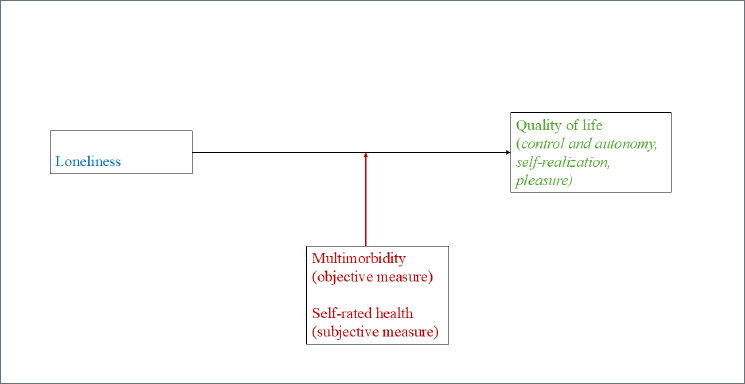
THEORETICAL FRAMEWORK, STUDY OBJECTIVES, AND STUDY HYPOTHESES
- Examine the relationship between loneliness and QoL among community-dwelling middle-aged and older adults;
- Evaluate the moderating effect of multimorbidity on this relationship;
- Assess the moderating role of SRH on this relationship.
MATERIALS AND METHODS
STUDY DESIGN, PARTICIPANTS, AND DATA COLLECTION
KEY VARIABLES AND MEASUREMENTS
QoL (dependent variable)
Loneliness (independent variable)
Objective (multimorbidity) and subjective (SRH) measures of health status (moderator)
Control and demographic variables
DATA PREPARATION AND ANALYTIC STRATEGY
RESULTS
SAMPLE CHARACTERISTICS AND DESCRIPTIONS OF STUDY VARIABLES
BIVARIATE CORRELATIONS AMONG MAIN STUDY VARIABLES
THE MODERATING ROLE OF MULTIMORBIDITY ON THE RELATIONSHIP BETWEEN LONELINESS AND QOL (AND ITS DOMAIN)
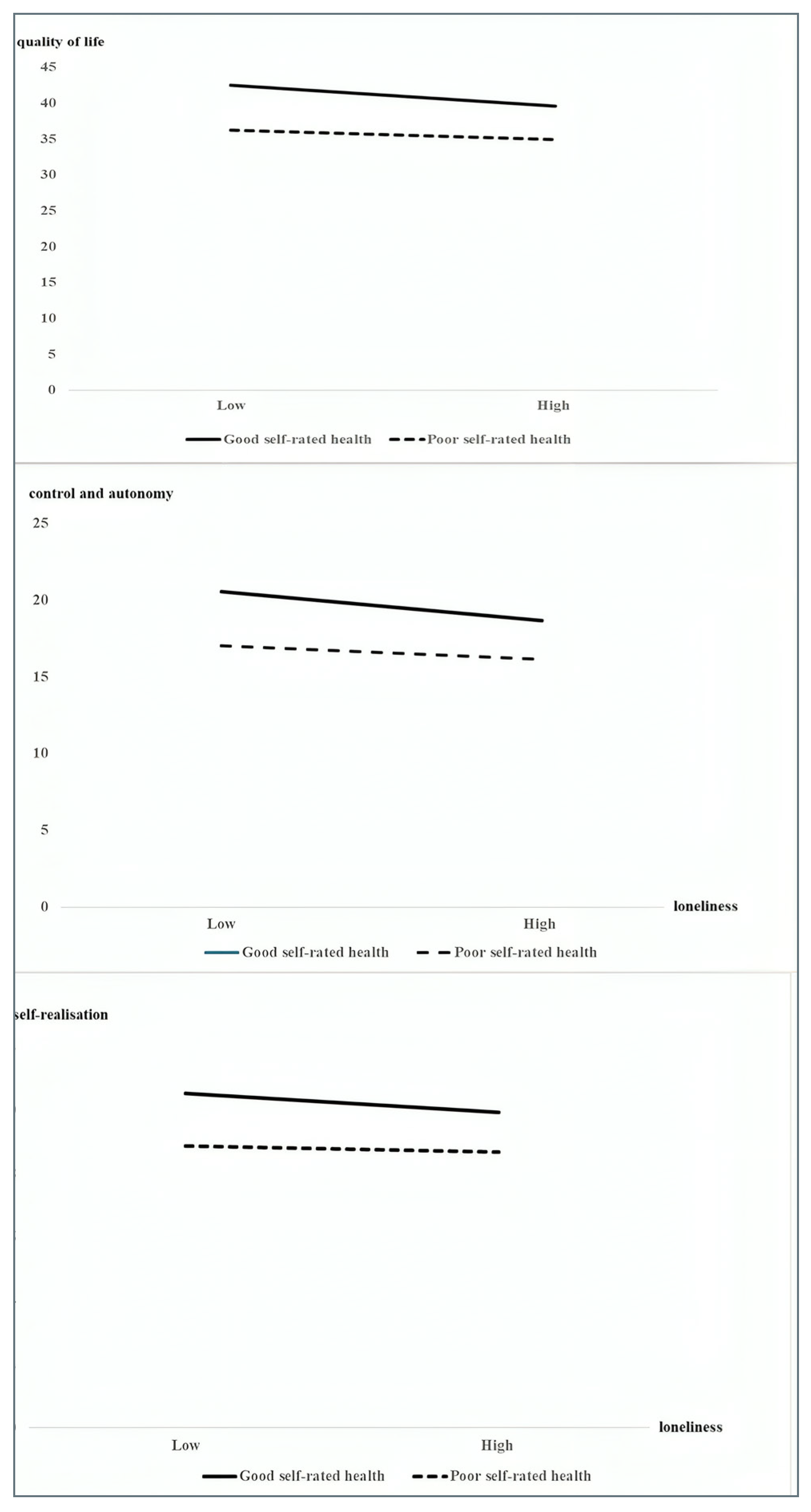
THE MODERATING ROLE OF SRH ON THE RELATIONSHIP BETWEEN LONELINESS AND QOL (AND ITS DOMAIN)
POST-HOC ANALYSIS OF DIFFERENCES IN SIMPLE SLOPES
SENSITIVITY ANALYSIS
DISCUSSION
THEORETICAL IMPLICATIONS
PRACTICAL IMPLICATIONS
LIMITATIONS OF THE STUDY
CONCLUDING REMARKS
Conflict of interest statement
Funding
Author contributions
Ethical consideration
History
Figures and tables



| Mean ± SD or percentage | Gender | Chi square statistics or t-value | p value | |||
|---|---|---|---|---|---|---|
| Male (41%) | Female (59%) | |||||
| Mean ± SD or percentage | Mean ± SD or percentage | |||||
| Age (min, max = 56, 97) | 72.39 ± 6.86 | 72.93 | 72.03 | 2.67 | 0.008a | |
| 6.67 | 6.97 | |||||
| Ethnicity | Bumiputera | 33.10 | 34.40 | 32.20 | 0.92 | 0.339b |
| Non-bumiputera | 66.90 | 65.60 | 67.80 | |||
| Education level | No formal education | 6.20 | 0.90 | 9.80 | 55.19 | < 0.001b |
| Formal education | 93.80 | 99.10 | 90.20 | |||
| Marital status | Married | 70.30 | 89.30 | 57.20 | 199.98 | < 0.001b |
| Non-married | 29.70 | 10.70 | 42.80 | |||
| Multimorbidity status | Yes | 69.80 | 70.90 | 69.10 | 0.62 | 0.432b |
| No | 30.20 | 29.10 | 30.90 | |||
| SRH | “Good” | 90.00 | 90.60 | 89.60 | 0.36 | 0.548b |
| “Poor” | 10.00 | 9.40 | 10.40 | |||
| Loneliness (min, max = 3, 9) | 3.65 ± 1.27 | 3.52 ± 1.12 | 3.74 ± 1.36 | -3.66 | < 0.001a | |
| Total QoL (min, max = 12, 48) | 41.08 ± 5.64 | 41.33 ± 5.51 | 40.90 ± 5.73 | 1.56 | 0.120a | |
| Control and autonomy (min, max = 6, 24) | 19.53 ± 3.43 | 19.54 ± 3.50 | 19.52 ± 3.39 | 0.13 | 0.900a | |
| Self-realization (min, max = 3, 12) | 10.30 ± 1.88 | 10.43 ± 1.85 | 10.21 ± 1.89 | 2.44 | 0.015a | |
| Pleasure (min, max = 3, 12) | 11.25 ± 1.44 | 11.36 ± 1.36 | 11.17 ± 1.49 | 2.67 | 0.008a | |
| a independent sample t-test; b chi-square test; QoL: quality of life; SRH: self-rated health. | ||||||
| 1 | 2 | 3 | 4 | 5 | 6 | 7 | |
|---|---|---|---|---|---|---|---|
| r (p value) | r (p value) | r (p value) | r (p value) | r (p value) | r (p value) | r (p value) | |
| Loneliness | 1 | ||||||
| Multimorbidity (0 = no, 1 = yes) | 0.10 (< 0.001) | 1 | |||||
| SRH (0 = “good”, 1 = “poor”) | 0.22 (< 0.001) | 0.12 (< 0.001) | 1 | ||||
| Total QoL | -0.37 (< 0.001) | -0.14 (< 0.001) | -0.36 (< 0.001) | 1 | |||
| Control and autonomy | -0.36 (< 0.001) | -0.15 (< 0.001) | -0.33 (< 0.001) | 0.89 (< 0.001) | 1 | ||
| Self-realization | -0.25 (< 0.001) | -0.10 (< 0.001) | -0.27 (< 0.001) | 0.81 (< 0.001) | 0.50 (< 0.001) | 1 | |
| Pleasure | -0.25 (< 0.001) | -0.06 (0.024) | -0.26 (< 0.001) | 0.75 (< 0.001) | 0.45 (< 0.001) | 0.68 (< 0.001) | 1 |
| *** p < 0.001; QoL: quality of life; SRH: self-rated health. | |||||||
| Dependent variable = QoL and its domains | Total QoL | Domain 1: control and autonomy | Domain 2: self-realization | Domain 3: pleasure | ||||
|---|---|---|---|---|---|---|---|---|
| B (SE) | p value | B (SE) | p value | B (SE) | p value | B (SE) | p value | |
| Gender (0= male, 1= female) | -0.09 (0.29) | 0.747 | 0.16 (0.18) | 0.381 | -0.15 (0.10) | 0.130 | -0.09 (0.08) | 0.271 |
| Age | -0.09 (0.02) | < 0.001 | -0.03 (0.01) | 0.016 | -0.04 (0.01) | < 0.001 | -0.02 (0.01) | < 0.001 |
| Ethnicity (0= non Bumiputera, 1= Malay and other Bumiputera) | -0.19 (0.28) | 0.498 | -0.09 (0.17) | 0.617 | -0.11 (0.10) | 0.277 | -0.01 (0.07) | 0.933 |
| Marital status (0= married, 1= non-married) | 0.07 (0.31) | 0.837 | 0.04 (0.19) | 0.831 | 0.02 (0.11) | 0.825 | -0.03 (0.08) | 0.752 |
| Education level (0= formal education, 1= no formal education) | -3.0 (0.57) | < 0.001 | -1.10 (0.35) | 0.002 | -0.99 (0.20) | < 0.001 | -0.92 (0.15) | < 0.001 |
| Loneliness | -1.36 (0.22) | < 0.001 | -0.93 (0.14) | < 0.001 | -0.27 (0.08) | 0.001 | -0.17 (0.06) | 0.005 |
| Multimorbidity (0= no, 1= yes) | -1.19 (0.29) | < 0.001 | -0.82 (0.18) | < 0.001 | -0.25 (0.10) | 0.012 | -0.11 (0.08) | 0.168 |
| Interaction (multimorbidity * loneliness) | -0.18 (0.25) | 0.463 | 0.01 (0.15) | 0.968 | -0.09 (0.09) | 0.283 | -0.12 (0.07) | 0.076 |
| ΔR2 after including interaction term (p ΔR2) | < 0.001 (0.463) | < 0.001 (0.968) | 0.001 (0.283) | 0.002 (0.076) | ||||
| 95% CI of interaction term (LLCI, ULCI) | (-0.676, 0.308) | (-0.296, 0.308) | (-0.262, 0.077) | (-0.249, 0.012) | ||||
| ΔR2 = R2 change; B: unstandardized coefficient; SE: standard error; QoL: quality of life; 0: reference group; 1: non-reference group; CI: confidence interval; LLCI: lower-level confidence interval; ULCI: upper-level confidence interval. | ||||||||
| Dependent variable = QoL and its domains | Total QoL | Domain 1: Control and autonomy | Domain 2: Self-realization | Domain 3: Pleasure | ||||
|---|---|---|---|---|---|---|---|---|
| B (SE) | p value | B (SE) | p value | B (SE) | p value | B (SE) | p value | |
| Gender (0=male, 1=female) | < 0.01 (0.31) | 0.999 | 0.22 (0.19) | 0.240 | -0.09 (0.11) | 0.410 | -0.12 (0.08) | 0.168 |
| Age | -0.08 (0.02) | < 0.001 | -0.03 (0.01) | 0.058 | -0.03 (0.01) | < 0.001 | -0.02 (0.01) | 0.001 |
| Ethnicity (0= non bumiputera, 1= Malay and other bumiputera) | -0.23 (0.29) | 0.421 | -0.26 (0.17) | 0.136 | 0.02 (0.10) | 0.838 | 0.01 (0.08) | 0.999 |
| Marital status (0= married, 1= non-married) | 0.38 (0.33) | 0.244 | 0.24 (0.20) | 0.223 | 0.07 (0.12) | 0.579 | 0.03 (0.09) | 0.749 |
| Education level (0= formal education, 1= no formal education) | -2.50 (0.56) | < 0.001 | -0.87 (0.34) | 0.010 | -0.87 (0.20) | < 0.001 | -0.82 (0.15) | < 0.001 |
| Loneliness | -1.52 (0.13) | < 0.001 | -0.97 (0.08) | < 0.001 | -0.31 (0.05) | < 0.001 | -0.24 (0.03) | < 0.001 |
| SRH (0=good, 1=poor) | -5.73 (0.51) | < 0.001 | -3.16 (0.31) | < 0.001 | -1.51 (0.18) | < 0.001 | -0.99 (0.14) | < 0.001 |
| Interaction (SRH * loneliness) | 0.84 (0.29) | 0.003 | 0.52 (0.17) | 0.002 | 0.21 (0.10) | 0.036 | 0.07 (0.08) | 0.347 |
| ΔR2 after including interaction term (p ΔR2) | 0.005 (0.003) | 0.005 (0.002) | 0.003 (0.036) | 0.001 (0.347) | ||||
| 95% CI of interaction term (LLCI, ULCI) | (0.277, 1.398) | (0.184, 0.860) | (0.014, 0.415) | (-0.078, 0.223) | ||||
| f2 effect size (Liu and Yuan (2020)’s 51 benchmark) | 0.007 (small) | 0.007 (small) | 0.004 (very small) | Not applicable as interaction term is not significant | ||||
| ΔR2 = R2 change; B: unstandardized coefficient; SE: standard error; QoL: quality of life; SRH: self-rated health; 0: reference group; 1: non-reference group; CI: confidence interval; LLCI: lower-level confidence interval; ULCI: upper-level confidence interval. | ||||||||
References
- World Health Organization. Ageing and health. The Lancet https://doi.org/10.1016/S0140-6736(09)62177-2 10.1016/S0140-6736(09)62177-2
- Department of Statistics Malaysia. Selected Demographic Estimats Malaysia 2016. Dep Stat Malaysia. Published online 2016. Accessed August 9, 2017. https://www.dosm.gov.my/v1/index.php?r=column/cthemeByCat&cat=397&bul_id=WVVQUnYrZkRwK1k1QXZMbEpuV1hNUT09&menu_id=L0pheU43NWJwRWVSZklWdzQ4TlhUUT09#
- Van Dyck D, Teychenne M, McNaughton SA, et al. Relationship of the perceived social and physical environment with mental health-related quality of life in middle-aged and older adults: mediating effects of physical activity. PLoS One 2015;10. https://doi.org/10.1371/journal.pone.0120475 10.1371/journal.pone.0120475
- Lopez J, Perez-Rojo G, Noriega C, et al. Quality-of-life in older adults: its association with emotional distress and psychological wellbeing. BMC Geriatr 2024;24:1-6. https://doi.org/10.1186/s12877-024-05401-7 10.1186/s12877-024-05401-7
- Yahaya N, Abdullah SS, Momtaz YA, et al. Quality of life of older malaysians living alone. Educ Gerontol 2010;36:893-906. https://doi.org/10.1080/03601271003609009 10.1080/03601271003609009
- Lim SC, Chan YM, Gan WY. Social and health determinants of quality of life of community-dwelling older adults in Malaysia. Int J Environ Res Public Health 2023;20:3977. https://doi.org/10.3390/ijerph20053977 10.3390/ijerph20053977
- Kelley-Gillespie N. An integrated conceptual model of quality of life for older adults based on a synthesis of the literature. Appl Res Qual Life 2009;4:259-282. https://doi.org/10.1007/s11482-009-9075-9 10.1007/s11482-009-9075-9
- Qaisar R, Hussain MA, Karim A, et al. The quality of life in Alzheimer’s disease is not associated with handgrip strength but with activities of daily living–a composite study from 28 European countries. BMC Geriatr 2023;23:1-8. https://doi.org/10.1186/s12877-023-04233-1 10.1186/s12877-023-04233-1
- Dantas BA d. S, de Miranda JMA, Cavalcante ACV, et al. Impact of multidimensional interventions on quality of life and depression among older adults in a primary care setting in brazil: a quasi-experimental study. Brazilian J Psychiatry 2020;42:201-208. https://doi.org/10.1590/1516-4446-2019-0577 10.1590/1516-4446-2019-0577
- Machón M, Larrañaga I, Dorronsoro M, et al. Health-related quality of life and associated factors in functionally independent older people. BMC Geriatr 2017;17:1-9. https://doi.org/10.1186/s12877-016-0410-3 10.1186/s12877-016-0410-3
- Mahmood S, Qudoos M, Ramzan M. Loneliness, need to belong, and quality of life among older adults: a gender based analysis. J Educ Soc Stud 2024;5:247-254. https://doi.org/10.52223/jess.2024.5205 10.52223/jess.2024.5205
- Musich S, Wang SS, Hawkins K, et al. The impact of loneliness on quality of life and patient satisfaction among older, sicker adults. Gerontol Geriatr Med 2015;1:2333721415582119. https://doi.org/10.1177/2333721415582119 10.1177/2333721415582119
- Gautam S, Poudel A, Khatry RA, et al. The mediating role of perceived social support on loneliness and depression in community-dwelling Nepalese older adults. BMC Geriatr 2024;24:854. https://doi.org/10.1186/s12877-024-05461-9 10.1186/s12877-024-05461-9
- Nicolaisen M, Thorsen K. Who are lonely? Loneliness in different age groups (18-81 years old), using two measures of loneliness. Int J Aging Hum Dev 2014;78:229-257. https://doi.org/10.2190/AG.78.3.b 10.2190/AG.78.3.b
- Luhmann M, Hawkley LC. Age differences in loneliness from late adolescence to oldest old age. Dev Psychol 2016;52(6):943-959. https://doi.org/10.1037/dev0000117 10.1037/dev0000117
- Foong HF, Ibrahim R, Hamid TA, et al. The individual and combined effects of social networks and loneliness on life satisfaction among community-dwelling residing older adults: a longitudinal study. Healthcare 2023;11:935. https://doi.org/10.3390/healthcare11070935 10.3390/healthcare11070935
- Lu H, Dong XX, Li DL, et al. Multimorbidity patterns and health-related quality of life among community-dwelling older adults: evidence from a rural town in Suzhou, China. Qual Life Res 2024;33:1335-1346. https://doi.org/10.1007/s11136-024-03608-0 10.1007/s11136-024-03608-0
- Wilk P, Ruiz-Castell M, Stranges S, et al. Relationship between multimorbidity, functional limitation, and quality of life among middle-aged and older adults: findings from the longitudinal analysis of the 2013-2020 Survey of Health, Ageing, and Retirement in Europe (SHARE). Qual Life Res 2024;33:169-181. https://doi.org/10.1007/s11136-023-03508-9 10.1007/s11136-023-03508-9
- Goldman N, Glei DA, Chang MC. The role of clinical risk factors in understanding self-rated health. Ann Epidemiol. 2004;14:49-57. https://doi.org/10.1016/S1047-2797(03)00077-2 10.1016/S1047-2797(03)00077-2
- Cundiff JM, Smith TW, Uchino BN, et al. Subjective social status: Construct validity and associations with psychosocial vulnerability and self-rated health. Int J Behav Med 2013;20:148-158. https://doi.org/10.1007/s12529-011-9206-1 10.1007/s12529-011-9206-1
- Foong HF, Hamid TA, Ibrahim R, et al. The intersectional effects of ethnicity/race and poverty on health among community-dwelling older adults within multi-ethnic Asian populace: a population-based study. BMC Geriatr 2021;21:516. https://doi.org/10.1186/s12877-021-02475-5 10.1186/s12877-021-02475-5
- Sahril N, Chan YM, Chan YY, et al. Poor self-rated health and associated factors among older persons in Malaysia: a population-based study. Int J Environ Res Public Health 2023;20:4342. https://doi.org/10.3390/ijerph20054342 10.3390/ijerph20054342
- Williams-Farrelly M, Schroeder M, Li C, et al. Loneliness and quality of life in older adult primary care patients. Innov Aging 2023;7(Suppl. 1):610-610. https://doi.org/10.1093/geroni/igad104.1993 10.1093/geroni/igad104.1993
- Hajek A, Kretzler B, König HH. Multimorbidity, loneliness, and social isolation. A systematic review. Int J Environ Res Public Health 2020;17:1-12. https://doi.org/10.3390/ijerph17228688 10.3390/ijerph17228688
- Phillips DM, Finkel D, Petkus AJ, et al. Longitudinal analyses indicate bidirectional associations between loneliness and health. Aging Ment Heal 2023;27:1217-1225. https://doi.org/10.1080/13607863.2022.2087210 10.1080/13607863.2022.2087210
- Fees BS, Martin P, Poon LW. A model of loneliness in older adults. Journals Gerontol - Ser B Psychol Sci Soc Sci 1999;54:231-239. https://doi.org/10.1093/geronb/54B.4.P231 10.1093/geronb/54B.4.P231
- Pearlin LI, Lieberman MA, Menaghan EG, et al. The stress process. J Health Soc Behav 1981;22:337-356. https://doi.org/10.2307/2136676 10.2307/2136676
- Lawton MP. A multidimensional view of quality of life in frail elders. In: The concept and measurement of quality of life in the frail elderly. Academic Press 1991:3-27. https://doi.org/10.1016/b978-0-12-101275-5.50005-3 10.1016/b978-0-12-101275-5.50005-3
- Alex D, Khor HM, Chin AV, et al. Cross-sectional analysis of ethnic differences in fall prevalence in urban dwellers aged 55 years and over in the Malaysian Elders Longitudinal Research study. BMJ Open 2018;8:E019579. https://doi.org/10.1136/bmjopen-2017-019579 10.1136/bmjopen-2017-019579
- Shahar S, Omar A, Vanoh D, et al. Approaches in methodology for population-based longitudinal study on neuroprotective model for healthy longevity (TUA) among Malaysian Older Adults. Aging Clin Exp Res 2016;28:1089-1104. https://doi.org/10.1007/s40520-015-0511-4 10.1007/s40520-015-0511-4
- Sooryanarayana R, Choo WY, Hairi NN, et al. The prevalence and correlates of elder abuse and neglect in a rural community of Negeri Sembilan state: baseline findings from the Malaysian Elder Mistreatment Project (MAESTRO), a population-based survey. BMJ Open 2017;7:E017025. https://doi.org/10.1136/bmjopen-2017-017025 10.1136/bmjopen-2017-017025
- Aravindhan K, Mat S, Hamid TA, et al. Development of Virtual Surveys for the COVID-19 Wave of the AGELESS Longitudinal Study in Malaysia. Gerontology 2022;68:551-555. https://doi.org/10.1159/000517946 10.1159/000517946
- Lee SJS, Tan MP, Mat S, et al. Predictive value of the World falls guidelines algorithm within the AGELESS-MELoR cohort. Arch Gerontol Geriatr 2024;125:105523. https://doi.org/10.1016/j.archger.2024.105523 10.1016/j.archger.2024.105523
- Aravindhan K, Morgan K, Mat S, et al. Cognitive frailty and its association with depression, anxiety and stress during the COVID-19 pandemic among older adults in the transforming cognitive frailty into later-life self-sufficiency (AGELESS) study. Psychogeriatrics 2023;23:1071-1082. https://doi.org/10.1111/psyg.13031 10.1111/psyg.13031
- Tan MP, Rosli R, Kumanan S, et al. Digital cognitive phenotyping using a smartphone application among community-dwelling older Malaysians in the transforming cognitive frailty in Later-Life Self-Sufficiency (AGELESS) Study. Alzheimer’s Dement 2023;19:E077810. https://doi.org/10.1002/alz.077810 10.1002/alz.077810
- Hyde M, Wiggins RD, Higgs P, et al. A measure of quality of life in early old age: The theory, development and properties of a needs satisfaction model (CASP-19). Aging Ment Heal 2003;7:186-194. https://doi.org/10.1080/1360786031000101157 10.1080/1360786031000101157
- Wiggins RD, Netuveli G, Hyde M, et al. The evaluation of a self-enumerated scale of quality of life (CASP-19) in the context of research on ageing: A combination of exploratory and confirmatory approaches. Soc Indic Res 2008;89:61-77. https://doi.org/10.1007/s11205-007-9220-5 10.1007/s11205-007-9220-5
- Lai SL, Tey NP. The quality of life of older adults in a multiethnic metropolitan: an analysis of CASP-19. SAGE Open 2021;11. https://doi.org/10.1177/21582440211029910 10.1177/21582440211029910
- Foong HF, Ibrahim R, Abdullah SFZ, et al. Longitudinal relationship between loneliness and cognitive function among unmarried older adults in Malaysia: exploring gender disparities. Psychogeriatrics 2024;24:1313-1323. https://doi.org/10.1111/psyg.13196 10.1111/psyg.13196
- Ando T, Nishimoto Y, Hirata T, et al. Association between multimorbidity, self-rated health and life satisfaction among independent, community-dwelling very old persons in Japan: longitudinal cohort analysis from the Kawasaki Ageing and Well-being Project. BMJ Open 2022;12:E049262. https://doi.org/10.1136/bmjopen-2021-049262 10.1136/bmjopen-2021-049262
- Marengoni A, Angleman S, Melis R, et al. Aging with multimorbidity: a systematic review of the literature. Ageing Res Rev 2011;10:430-439. https://doi.org/10.1016/j.arr.2011.03.003 10.1016/j.arr.2011.03.003
- Violan C, Foguet-Boreu Q, Flores-Mateo G, et al. Prevalence, determinants and patterns of multimorbidity in primary care: a systematic review of observational studies. PLoS One 2014;9:E102149. https://doi.org/10.1371/journal.pone.0102149 10.1371/journal.pone.0102149
- Eriksson I, Undén AL, Elofsson S. Self-rated health. Comparisons between three different measures. Results from a population study. Int J Epidemiol 2001;30:326-333. https://doi.org/10.1093/ije/30.2.326 10.1093/ije/30.2.326
- Quiñones AR, McAvay G, Vander Wyk B, et al. A joint model for disability, self-rated health, and mortality among medicare beneficiaries – differences by chronic disease and race/ethnicity. J Aging Health 2024;36:642-653. https://doi.org/10.1177/08982643231210027 10.1177/08982643231210027
- Idler EL, Benyamini Y. Self-rated health and mortality: a review of twenty-seven community studies. J Health Soc Behav. 1997;38:21-37. https://doi.org/10.2307/2955359 10.2307/2955359
- Emerson E, Milner A, Aitken Z, et al. Exposure to discrimination and subsequent changes in self-rated health: prospective evidence from the UK’s Life Opportunities Survey. Public Health. 2020;185:176-181. https://doi.org/10.1016/j.puhe.2020.04.038 10.1016/j.puhe.2020.04.038
- Aiken LS, West SG. Multiple Regression: testing and interpreting Interactions. CA: Sage 1991.
- Hayes AF. Introduction to mediation, moderation, and conditional process analysis: a regression-based approach. Third Edit. Guilford press 2022.
- Robinson CD, Tomek S, Schumacker RE. Tests of moderation effects: difference in simple slopes versus the interaction term. Mult Linear Regres Viewpoints 2013;39:16-24.
- McCabe CJ, Kim DS, King KM. Improving present practices in the visual display of interactions. Adv methods Pract Psychol Sci 2018;1:147-165. https://doi.org/10.1177/2515245917746792 10.1177/2515245917746792
- Liu H, Yuan KH. New measures of effect size in moderation analysis. Psychol Methods 2020;26:680-700. https://doi.org/10.1037/met0000371 10.1037/met0000371
- Hair JF, Black WC, Babin BJ, et al. Multivariate data analysis. 6th ed. Pearson Prentice Hall. 2006.
- Ahadi B, Hassani B. Loneliness and quality of life in older adults: the mediating role of depression. Ageing Int 2021;46:337-350. https://doi.org/10.1007/s12126-021-09408-y 10.1007/s12126-021-09408-y
- Jiang N, Ye H, Zhao X, et al. The association between social support and the quality of life of older adults in china: the mediating effect of loneliness. Exp Aging Res Published online 2024:1-15. https://doi.org/10.1080/0361073X.2024.2376966 10.1080/0361073X.2024.2376966
- Gentry M, Palmer BW. The timbre of loneliness in later life. Int Psychogeriatrics 2021;33:1233-1236. https://doi.org/10.1017/S1041610221001046 10.1017/S1041610221001046
- Kim J, Keshavjee S, Atun R. Trends, patterns and health consequences of multimorbidity among South Korea adults: Analysis of nationally representative survey data 2007-2016. J Glob Health 2020;10:020426. https://doi.org/10.7189/JOGH.10.020426 10.7189/JOGH.10.020426
- Smith SM, Soubhi H, Fortin M, et al. Managing patients with multimorbidity: systematic review of interventions in primary care and community settings. BMJ 2012;345:E5205. https://doi.org/10.1136/bmj.e5205 10.1136/bmj.e5205
- Cornwell EY, Waite LJ. Social disconnectedness, perceived isolation, and health among older adults. J Health Soc Behav 2009;50:31-48. https://doi.org/10.1177/002214650905000103 10.1177/002214650905000103
- Coyle CE, Dugan E. Social isolation, loneliness and health among older adults. J Aging Health 2012;24:1346-1363. https://doi.org/10.1177/0898264312460275 10.1177/0898264312460275
- Sprangers MAG, Schwartz CE. Integrating response shift into health-related quality of life research: a theoretical model. In: Social science and medicine. Soc Sci Med 1999;48:1507-1515. https://doi.org/10.1016/S0277-9536(99)00045-3 10.1016/S0277-9536(99)00045-3
- Michalos AC. Multiple discrepancies theory (MDT). Soc Indic Res 1985;16:347-413. https://doi.org/10.1007/BF00333288/METRICS 10.1007/BF00333288/METRICS
- Atkinson M, Wishart P, Wasil B, et al. The Self-Perception and Relationships Tool (S-PRT): a novel approach to the measurement of subjective health-related quality of life. Health Qual Life Outcomes 2004;2:36. https://doi.org/10.1186/1477-7525-2-36 10.1186/1477-7525-2-36
- Sánchez-García S, García-Peña C, Ramírez-García E, et al. Decreased autonomy in community-dwelling older adults. Clin Interv Aging 2019;14:2041-2053. https://doi.org/10.2147/CIA.S225479 10.2147/CIA.S225479
- Dawson-Townsend K. Social participation patterns and their associations with health and well-being for older adults. SSM – Popul Hea. 2019;8:100424. https://doi.org/10.1016/j.ssmph.2019.100424 10.1016/j.ssmph.2019.100424
- Vespa A, Spatuzzi R, Fabbietti P, et al. Association between sense of loneliness and quality of life in older adults with multimorbidity. Int J Environ Res Public Health 2023;20:2615. https://doi.org/10.3390/ijerph20032615 10.3390/ijerph20032615
- Richardson CG, Ratner PA. Sense of coherence as a moderator of the effects of stressful life events on health. J Epidemiol Community Health 2005;59:979-984. https://doi.org/10.1136/jech.2005.036756 10.1136/jech.2005.036756
- Kahana E, Kelley-Moore J, Kahana B. Proactive aging: a longitudinal study of stress, resources, agency, and well-being in late life. Aging Ment Heal 2012;16:438-451. https://doi.org/10.1080/13607863.2011.644519 10.1080/13607863.2011.644519
- Gerino E, Rollè L, Sechi C, et al. Loneliness, resilience, mental health, and quality of life in old age: a structural equation model. Front Psychol 2017;8:310944. https://doi.org/10.3389/fpsyg.2017.02003 10.3389/fpsyg.2017.02003
- Hancock KE, Downward P, Sherar LB. Exploring feelings of pleasure and purpose associated with older people’s activities using ecological momentary analysis: an observational study. J Aging Phys Act 2021;29:670-677. https://doi.org/10.1123/JAPA.2020-0253 10.1123/JAPA.2020-0253
- Solway E, Piette J, Kirch M, et al. Loneliness and health among older adults: results from the University of Michigan National poll on healthy aging. Innov Aging 2019;3(Suppl. 1):S600-S601. https://doi.org/10.1093/geroni/igz038.2233 10.1093/geroni/igz038.2233
- Fingerman KL, Ng YT, Huo M, et al. Functional limitations, social integration, and daily activities in late life. Journals Gerontol - Ser B Psychol Sci Soc Sci. 2021;76(10):1937-1947. https://doi.org/10.1093/geronb/gbab014 10.1093/geronb/gbab014
- Kiosses DN, Sachs-Ericsson N. Increasing resilience in older adults. Int Psychogeriatrics 2020;32:157-159. https://doi.org/10.1017/S1041610220000046 10.1017/S1041610220000046
- Hildon Z, Smith G, Netuveli G, et al. Understanding adversity and resilience at older ages. Sociol Heal Illn 2008;30:726-740. https://doi.org/10.1111/j.1467-9566.2008.01087.x 10.1111/j.1467-9566.2008.01087.x
- Hirschman C. The making of race in colonial malaya: political economy and racial ideology. Sociol Forum 1986;1:330-361. http://www.jstor.org/stable/684449
- Chen PCY. Medical systems in Malaysia: cultural bases and differential use. Soc Sci Med 1975;9:171-180. https://doi.org/10.1016/0037-7856(75)90054-2 10.1016/0037-7856(75)90054-2
- Abdullah K, Noor NM, Wok S. The perceptions of women’s roles and progress: a study of Malay Women. Soc Indic Res 2008;89:439-455. https://doi.org/10.1007/s11205-008-9242-7 10.1007/s11205-008-9242-7
- DaVanzo J, Chan A. Living arrangements of older malaysians: Who coresides with their adult children? Demography 1994;31:95-113. https://doi.org/10.2307/2061910 10.2307/2061910
Società Italiana di Gerontologia e Geriatria (SIGG) This is an open access article distributed in accordance with the CC-BY-NC-ND (Creative Commons Attribution-NonCommercial-NoDerivatives 4.0 International) license. The article can be used by giving appropriate credit and mentioning the license, but only for non-commercial purposes and only in the original version. For further information: https://creativecommons.org/licenses/by-nc-nd/4.0/deed.en
Share and Cite
Foong, H.F.; Ibrahim, R.; Bagat, M.F.; Abdullah, S.F.Z.; Lim, S.Y. Feeling Healthy Matters: Comparing the Moderating Roles of Multimorbidity and Self-Rated Health in the Link Between Loneliness and Quality of Life. J. Gerontol. Geriatr. 2025, 73, 129-142. https://doi.org/10.36150/2499-6564-N844
Foong HF, Ibrahim R, Bagat MF, Abdullah SFZ, Lim SY. Feeling Healthy Matters: Comparing the Moderating Roles of Multimorbidity and Self-Rated Health in the Link Between Loneliness and Quality of Life. Journal of Gerontology and Geriatrics. 2025; 73(4):129-142. https://doi.org/10.36150/2499-6564-N844
Chicago/Turabian StyleFoong, Hui Foh, Rahimah Ibrahim, Mohamad Fazdillah Bagat, Siti Farra Zillah Abdullah, and Sook Yee Lim. 2025. "Feeling Healthy Matters: Comparing the Moderating Roles of Multimorbidity and Self-Rated Health in the Link Between Loneliness and Quality of Life" Journal of Gerontology and Geriatrics 73, no. 4: 129-142. https://doi.org/10.36150/2499-6564-N844
APA StyleFoong, H. F., Ibrahim, R., Bagat, M. F., Abdullah, S. F. Z., & Lim, S. Y. (2025). Feeling Healthy Matters: Comparing the Moderating Roles of Multimorbidity and Self-Rated Health in the Link Between Loneliness and Quality of Life. Journal of Gerontology and Geriatrics, 73(4), 129-142. https://doi.org/10.36150/2499-6564-N844