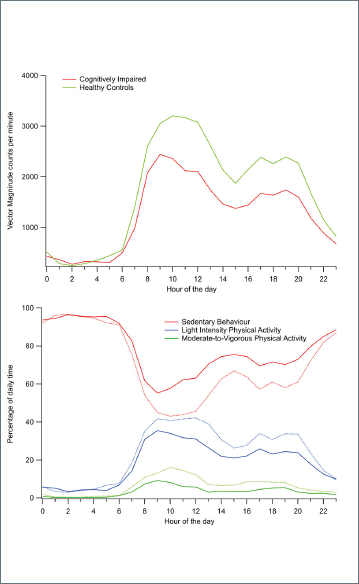
Differential Physical Activity Patterns in Cognitively Impaired vs Healthy Older Adults Using Accelerometers

Objective
Methods
Results
Conclusions
INTRODUCTION
METHODS
PARTICIPANTS
DATA ACQUISITION AND PROCESSING
- vector magnitude counts per minute (VM cpm). This parameter represents the overall magnitude of the movement;
- percentage of time spent performing PA at different intensities, namely sedentary behavior (SB, 0-1.5 metabolic equivalent of task, METs), light-intensity PA (LPA, 1.5-3 METs), and moderate-to-vigorous PA (MVPA, 3-6 METs). This was carried out using the cut-points recently proposed by Migueles , et al. 9. based on experiments in which a group of older adults wore accelerometers while performing various activities of daily living and having their energy expenditure simultaneously measured with portable calorimetry. Of note, these are among the few existing cut-point sets available for accelerometer placement on the non-dominant wrist in older adults;
- steps count.
STATISTICAL ANALYSIS
RESULTS
DISCUSSION
CONCLUSIONS
Conflict of interest statement
Funding
Author contributions
Ethical consideration
History
Figures and tables


| HC | CI | p value | Partial η2 | 95% CI | |
|---|---|---|---|---|---|
| Accelerometric counts per minute | 1746.1 (482.9) | 1312.3 (473.6) | < 0.001 | 0.175 | HC 1584.1, 1907.3 |
| CI 1155.6, 1469.1 | |||||
| Percentage of time spent in: | |||||
| Sedentary behavior (SB) | 68.9 (9.4) | 75.9 (9.5) | 0.002 | 0.124 | HC 65.7, 72.1 |
| CI 72.8, 79.0 | |||||
| Light Physical Activity (LPA) | 25.3 (6.8) | 20.4 (7.6) | 0.006 | 0.103 | HC 22.9, 27.7 |
| CI 18.1, 22.8 | |||||
| Moderate-to-vigorous physical activity (MVPA) | 5.8(4) | 3.6 (2.9) | 0.009 | 0.095 | HC 4.7, 7.0 |
| CI 2.5, 4.8 | |||||
| Daily steps | 11815 (3702) | 8732 (3326) | < 0.001 | 0.165 | HC 10630, 12999 |
| CI 7580, 9884 | |||||
| Wear time (percentage calculated across the 24 h period) | 92.4 (5.6) | 89.6 (8.5) | 0.121 | - | |
References
- Prince M, Bryce R, Albanese E, et al. The global prevalence of dementia: a systematic review and meta-analysis. Alzheimers Dement 2013; 9:63-75. https://doi.org/10.1016/j.jalz.2012.11.007 10.1016/j.jalz.2012.11.007
- Norton S, Matthews FE, Barnes DE, et al. Potential for primary prevention of Alzheimer’s disease: an analysis of population-based data. Lancet Neurol 2014;13:788-794. https://doi.org/10.1016/S1474-4422(14)70136-X 10.1016/S1474-4422(14)70136-X
- Iso-Markku P, Kujala UM, Knittle K, et al. Physical activity as a protective factor for dementia and Alzheimer’s disease: systematic review, meta-analysis and quality assessment of cohort and case-control studies. Br J Sports Med 2022;56:701-709. https://doi.org/10.1136/bjsports-2021-104981 10.1136/bjsports-2021-104981
- Blondell SJ, Hammersley-Mather R Veerman JL. Does physical activity prevent cognitive decline and dementia? A systematic review and meta-analysis of longitudinal studies. BMC Public Health 2014;14:510. https://doi.org/10.1186/1471-2458-14-510 10.1186/1471-2458-14-510
- Farina N, Hughes LJ, Watts A, et al. Use of physical activity questionnaires in people with dementia: a scoping review. J Aging Phys Act 2019;27:413-421. https://doi.org/10.1123/japa.2018-0031 10.1123/japa.2018-0031
- Hegberg N, Dev S, Hayes SM. The relationship between accelerometer-derived metrics of physical activity and cognition among older adults. In: Thomas AK, Gutchess A, eds. The Cambridge handbook of cognitive aging: a life course perspective. Cambridge Handbooks in Psychology. Cambridge University Press 2020:645-665. https://doi.org/10.1017/9781108552684.040 10.1017/9781108552684.040
- Carpinelli Mazzi M, Iavarone A, Russo G, et al. Mini-mental state examination: new normative values on subjects in Southern Italy. Aging Clin Exp Res 2020;32:699-702. https://doi.org/10.1007/s40520-019-01250-2 10.1007/s40520-019-01250-2
- Pau M, Brandas B, Fastame MC. Women have the power: when motor efficiency makes the difference in older individuals of the Sardinian blue zone. Physiol Behav 2025;291:114811. http://doi.org/10.1016/j.physbeh.2025.114811 10.1016/j.physbeh.2025.114811
- Migueles JH, Cadenas-Sanchez C, Alcantara JMA, et al. Calibration and cross-validation of accelerometer cut-points to classify sedentary time and physical activity from hip and non-dominant and dominant wrists in older adults. Sensors (Basel) 2021;21:3326. https://doi.org/10.3390/s21103326 10.3390/s21103326
- Choi L, Liu Z, Matthews CE, Buchowski MS. Validation of accelerometer wear and nonwear time classification algorithm. Med Sci Sports Exerc 2011;43:357-364.
- Ustad A, Sverdrup K, Tangen GG, et al. Daily physical activity in older adults across levels of care: the HUNT Trondheim 70 + study. Eur Rev Aging Phys Act 2024;21:20. https://doi.org/10.1186/s11556-024-00355-6 10.1186/s11556-024-00355-6
- Mc Ardle R, Del Din S, Donaghy P, et al. Factors that influence habitual activity in mild cognitive impairment and dementia. Gerontology 2020;66:197-208. https://doi.org/10.1159/000502288 10.1159/000502288
- Liu ML, Jiang LJ, Wang WX, et al. The relationship between activity level and cognitive function in Chinese community-dwelling elderly. Res Sports Med 2022;30:92-100. https://doi.org/10.1080/15438627.2021.1888096 10.1080/15438627.2021.1888096
- van Alphen HJ, Hortobágyi T, van Heuvelen MJ. Barriers, motivators, and facilitators of physical activity in dementia patients: a systematic review. Arch Gerontol Geriatr 2016;66:109-118. http://doi.org/10.1016/j.archger.2016.05.008 10.1016/j.archger.2016.05.008
- Hobson N, Dupuis SL, Giangregorio LM, et al. Perceived facilitators and barriers to exercise among older adults with mild cognitive impairment and early dementia. J Aging Phys Act 2020;28:208-218. http://doi.org/10.1123/japa.2019-0010 10.1123/japa.2019-0010
- Sartini C, Wannamethee SG, Iliffe S, et al. Diurnal patterns of objectively measured physical activity and sedentary behaviour in older men. BMC Public Health 2015;15:609. https://doi.org/10.1186/s12889-015-1976-y 10.1186/s12889-015-1976-y
Società Italiana di Gerontologia e Geriatria (SIGG) This is an open access article distributed in accordance with the CC-BY-NC-ND (Creative Commons Attribution-NonCommercial-NoDerivatives 4.0 International) license. The article can be used by giving appropriate credit and mentioning the license, but only for non-commercial purposes and only in the original version. For further information: https://creativecommons.org/licenses/by-nc-nd/4.0/deed.en
Share and Cite
Pau, M.; Asoni, G.; Viale, D.; Putzu, V. Differential Physical Activity Patterns in Cognitively Impaired vs Healthy Older Adults Using Accelerometers. J. Gerontol. Geriatr. 2025, 73, 41-45. https://doi.org/10.36150/2499-6564-N872
Pau M, Asoni G, Viale D, Putzu V. Differential Physical Activity Patterns in Cognitively Impaired vs Healthy Older Adults Using Accelerometers. Journal of Gerontology and Geriatrics. 2025; 73(2):41-45. https://doi.org/10.36150/2499-6564-N872
Chicago/Turabian StylePau, Massimiliano, Gesuina Asoni, Daniela Viale, and Valeria Putzu. 2025. "Differential Physical Activity Patterns in Cognitively Impaired vs Healthy Older Adults Using Accelerometers" Journal of Gerontology and Geriatrics 73, no. 2: 41-45. https://doi.org/10.36150/2499-6564-N872
APA StylePau, M., Asoni, G., Viale, D., & Putzu, V. (2025). Differential Physical Activity Patterns in Cognitively Impaired vs Healthy Older Adults Using Accelerometers. Journal of Gerontology and Geriatrics, 73(2), 41-45. https://doi.org/10.36150/2499-6564-N872