
Artificial Intelligence Tools in Pre-Travel Health Consultations: A Scoping Review of Clinical Evidence, Implementation Gaps, and Emerging Opportunities


Abstract
1. Introduction
2. Methods
2.1. Review Design
2.2. Population, Concept, Context (PCC) Framework
2.3. Eligibility Criteria
2.4. Search Strategy
- One direct PubMed/MEDLINE search string combining travel-medicine and AI/LLM concepts.
- Academic and web-indexed search tools applied to the same concept set, including searches restricted to authoritative travel-medicine and clinical AI domains.
- Hand retrieval from Journal of Travel Medicine, Travel Medicine and Infectious Disease, BMC Digital Health, and Communications Medicine for AI-relevant titles within the search window.
2.5. Study Selection and Data Charting
2.6. Quality Appraisal and Certainty Assessment
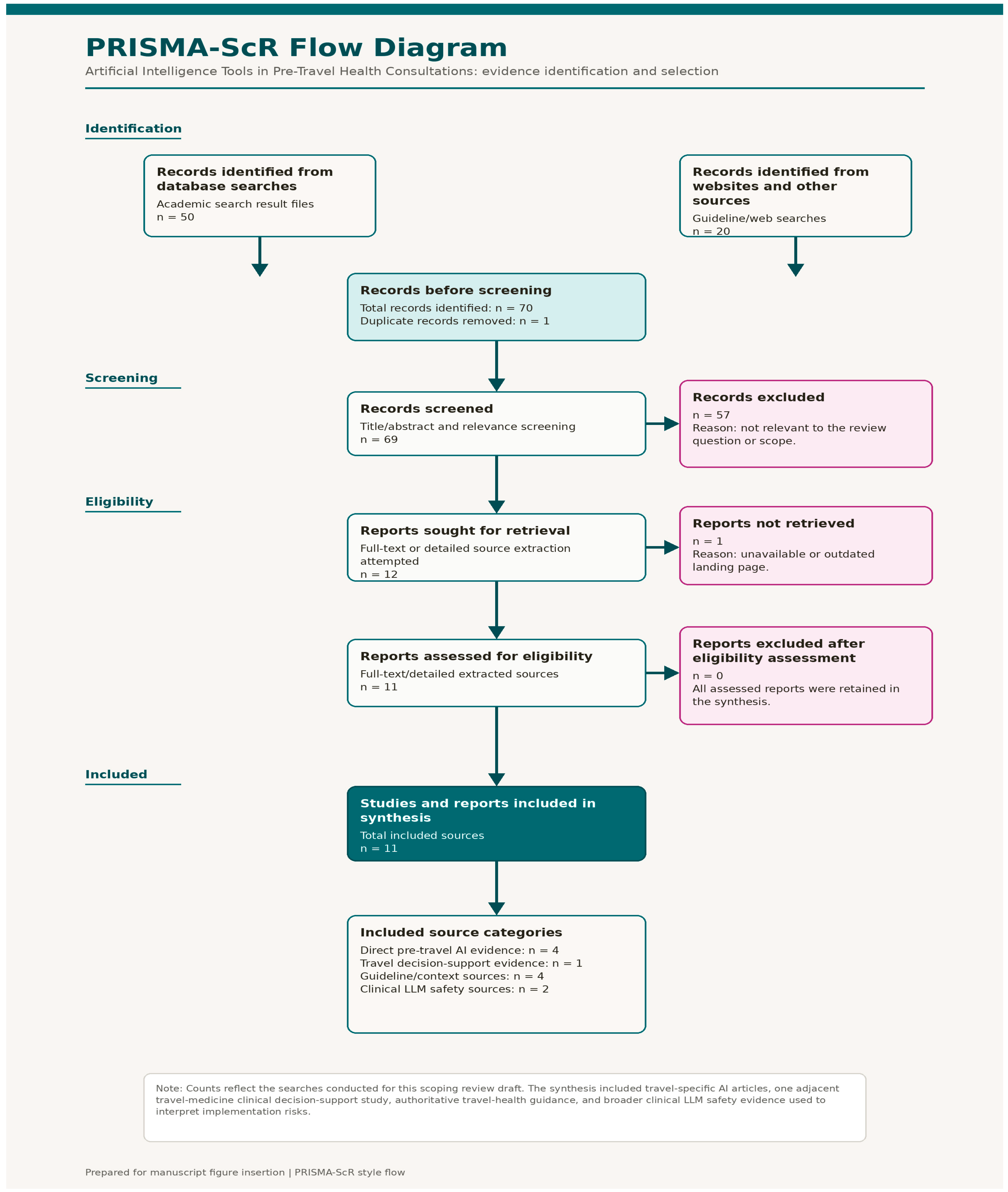
2.7. Study Selection Flow
3. Results
3.1. Confidence in the Evidence Base
- Direct travel-medicine AI evidence (four sources): The ChatGPT pre-travel advice evaluation [23], the Singapore Travel Clinic Assistant implementation [24], the Baglivo decalogue prototype [25], and the Flaherty editorials on supervised generative AI integration and the natural history of AI in travel medicine [9,10]. Heidema et al. is treated as adjacent rather than direct because it concerns AI-supported outbreak surveillance rather than the pre-travel consultation itself [12].
- Adjacent clinical AI evidence (eight sources): Clinical LLM evaluation methods [43]; multi-model hallucination and clinical guideline omission/hallucination assurance analyses [13,34]; clinical documentation hallucination framework [14]; ChatGPT meta-analysis [35]; ChatGPT care-seeking accuracy across model versions [36]; ChatGPT FAQ literature review [44]; and travel-related clinical decision support [30].
- Guideline, regulatory, and methodology evidence (twelve sources): CDC Yellow Book pre-travel guidance and VFR chapter [1,19]; ISTM pre-travel advice [2]; WHO malaria travel guidance [3]; PRISMA-ScR, scoping methodology, MMAT, AMSTAR 2, GRADE [1,17,18,26,27,28,33]; WHO AI ethics and digital health strategy [39,45]; FDA, TGA, and EU AI Act materials [20,21,22,23]; and AI reporting standards CONSORT-AI, SPIRIT-AI, and TRIPOD + AI [29,30,42,43].
- Adjacent implementation, equity, and patient-engagement evidence (ten sources): Clinician adoption of AI [46]; AI in medical education [47]; AI in healthcare overview [8]; VFR uptake studies [4,5]; pre-travel consultation in primary care [6,7]; LLM patient education and chronic-illness chatbot reviews [15,16]; AHRQ healthcare chatbot review [17]; preventive-care chatbot outreach [18]; digital divide and equity [40,41,45]; and retrieval-augmented generation [49].
3.2. Evidence Base Overview
3.3. Evidence Synthesis Table
3.4. Quality and Applicability Appraisal
3.5. What the Evidence Allows and Does Not Allow
3.6. Clinical Safety Risk Taxonomy
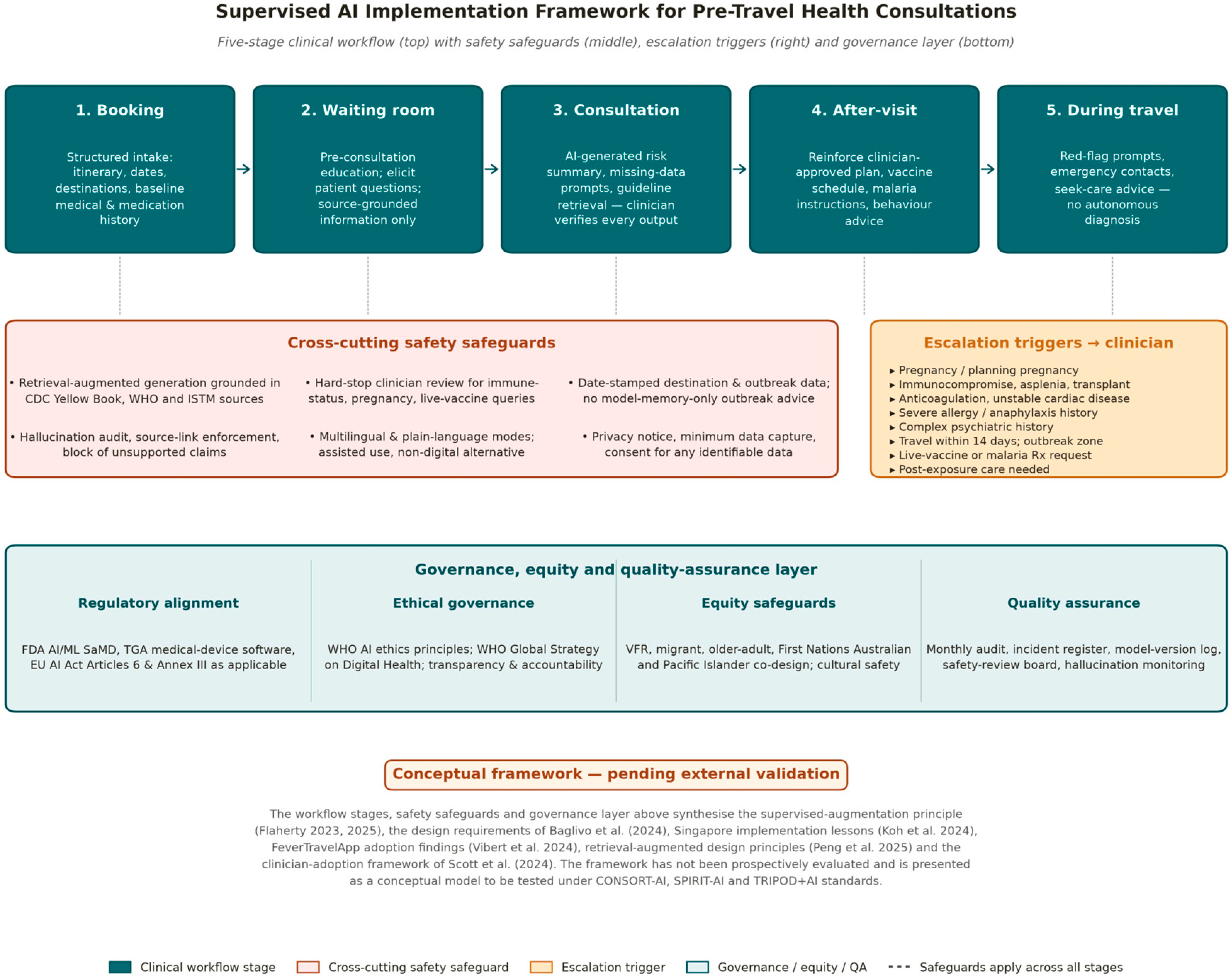
3.7. Implementation Model for Travel Clinics (Interpretive Synthesis; See Also Section 4.9)
3.8. When Not to Use AI as the Primary Interaction (Interpretive Synthesis; See Also Section 4.11)
3.9. Cost-Effectiveness and Implementation Feasibility
3.10. Regulatory Landscape (Interpretive Synthesis; See Also Section 4.10)
3.11. Digital Equity Considerations
3.12. Research Agenda and Priority Matrix (Interpretive Synthesis; See Also Section 4.12)
4. Discussion
4.1. Comparison with Prior Reviews and How This Review Extends Them
4.2. Why the Evidence Base Remains Thin
4.3. Synthesis of Direct and Indirect Evidence
4.4. Safety Considerations
4.5. Implementation Challenges
4.6. Ethical and Equity Issues
4.7. Future Research Priorities
4.8. Practical Message for Travel Medicine Clinicians
4.9. Supervised Implementation Model—Interpretive Synthesis
4.10. Regulatory Landscape—Interpretive Synthesis
4.11. When Not to Use AI as the Primary Interaction—Interpretive Synthesis
4.12. Research Agenda—Interpretive Synthesis
5. Limitations
6. Conclusions
Supplementary Materials
Author Contributions
Funding
Institutional Review Board Statement
Informed Consent Statement
Data Availability Statement
Acknowledgments
Conflicts of Interest
References
- Centers for Disease Control and Prevention. The pre-travel consultation. In CDC Yellow Book 2026: Health Information for International Travel; CDC: Atlanta, GA, USA, 2025. Available online: https://www.cdc.gov/yellow-book/hcp/preparing-international-travelers/the-pre-travel-consultation.html (accessed on 29 June 2026).
- International Society of Travel Medicine. Pre-Travel Health Advice Fact Sheet; ISTM: Alpharetta, GA, USA, 2023; Available online: https://www.istm.org/wp-content/uploads/istm-pre-travel-health-advice-fact-sheet.pdf (accessed on 29 June 2026).
- World Health Organization. International Travel and Health: Module 3—Malaria; WHO: Geneva, Switzerland, 2022; Available online: https://www.who.int/publications/i/item/9789240102286 (accessed on 29 June 2026).
- Seale, H.; Kaur, R.; Mahimbo, A.; MacIntyre, C.R.; Zwar, N.; Smith, M.; Worth, H.; Heywood, A.E. Improving the uptake of pre-travel health advice amongst migrant Australians: Exploring the attitudes of primary care providers and migrant community groups. BMC Infect. Dis. 2016, 16, 213. [Google Scholar] [CrossRef]
- Walz, E.J.; Volkman, H.R.; Adedimeji, A.; Abella, J.; Scott, L.C.; Angelo, K.M.; Kozarsky, P.; Stauffer, W.M. Barriers to malaria prevention among immigrant travelers in the United States who visit friends and relatives in sub-Saharan Africa: A cross-sectional, multi-setting survey of knowledge, attitudes, and practices. J. Travel Med. 2019, 26, tay163. [Google Scholar] [CrossRef] [PubMed]
- Alotaibi, S.; Alfayez, F.; Alsaleem, A.M.; AlZuair, N.M.; Alshalhoub, A.M.; AlDhafyan, S.M.; Aldakhil, A.M.; Alharbi, A.A.; Al Ali, D.M.; Alsalman, A.S. Practices and barriers toward pre-travel care among Saudi international travelers: A cross-sectional multi-region study. Trop. Dis. Travel Med. Vaccines 2024, 10, 13. [Google Scholar] [CrossRef] [PubMed]
- Al-Dahshan, A.; Al-Kubaisi, N.; Selim, N.; Sindi, N.; Al-Naama, N.M.; Al Ali, T.; Alsalihi, N.J.; Ahmed, M.; Chehab, M.A.; Al-Kaabi, S.K. Determinants of pre-travel health consultation amongst international travellers attending primary care setting in Qatar. Trop. Dis. Travel Med. Vaccines 2025, 11, 4. [Google Scholar] [CrossRef] [PubMed]
- Bajwa, J.; Munir, U.; Nori, A.; Williams, B. Artificial intelligence in healthcare: Transforming the practice of medicine. Future Healthc. J. 2021, 8, e188–e194. [Google Scholar] [CrossRef] [PubMed]
- Flaherty, G.T. Learning to safely integrate generative artificial intelligence technology into travel medicine practice. J. Travel Med. 2025, 32, taad149. [Google Scholar] [CrossRef] [PubMed]
- Flaherty, G.T.; Piyaphanee, W. Predicting the natural history of artificial intelligence in travel medicine. J. Travel Med. 2023, 30, taac113. [Google Scholar] [CrossRef] [PubMed]
- Torresi, J.; Leder, K. Defining infections in international travellers through the GeoSentinel surveillance network. Nat. Rev. Microbiol. 2009, 7, 895–901. [Google Scholar] [CrossRef] [PubMed]
- Heidema, S.G.A.; Stoepker, I.V.; Flaherty, G.; Angelo, K.M.; Post, R.A.J.; Miller, C.; Libman, M.; Hamer, D.H.; van den Heuvel, E.R.; Huits, R. From GeoSentinel data to epidemiological insights: A multidisciplinary effort towards artificial intelligence-supported detection of infectious disease outbreaks. J. Travel Med. 2024, 31, taae013. [Google Scholar] [CrossRef] [PubMed]
- Omar, M.; Sorin, V.; Collins, J.D.; Reich, D.; Freeman, R.; Gavin, N.; Charney, A.; Stump, L.; Bragazzi, N.L.; Nadkarni, G.N.; et al. Multi-model assurance analysis showing large language models are highly vulnerable to adversarial hallucination attacks during clinical decision support. Commun. Med. 2025, 5, 330. [Google Scholar] [CrossRef] [PubMed]
- Asgari, E.; Montaña-Brown, N.; Dubois, M.; Khalil, S.; Balloch, J.; Yeung, J.A.; Pimenta, D. A framework to assess clinical safety and hallucination rates of LLMs for medical text summarisation. NPJ Digit. Med. 2025, 8, 274. [Google Scholar] [CrossRef] [PubMed]
- Ford, E.; Curlewis, K.; Wongkoblap, A.; Curcin, V. Public opinions on the use of artificial intelligence in healthcare: A qualitative analysis of Twitter data. JMIR AI 2023, 2, e41728. [Google Scholar] [CrossRef] [PubMed]
- Aydin, S.; Karabacak, M.; Vlachos, V.; Margetis, K. Large language models in patient education: A scoping review of applications in medicine. Front. Med. 2024, 11, 1477898. [Google Scholar] [CrossRef] [PubMed]
- Almagazzachi, A.; Mustafa, A.; Eighaei Sedeh, A.; Vazquez Gonzalez, A.E.; Polianovskaia, A.; Abood, M.; Abaza, A.; Sotelo, A.; Aljaili, A.; Toma, M. Generative artificial intelligence in patient education: ChatGPT takes on hypertension questions. Cureus 2024, 16, e53441. [Google Scholar] [CrossRef] [PubMed]
- Chacko, J.; Yeung, J.A.; Iyer, K.; Marra, A.R.; Salinas, J.L. Chatbot-based digital tools for preventive-care outreach: Systematic review of retrospective evaluations of compliance. JMIR Med. Inform. 2026, 14, e81370. [Google Scholar] [CrossRef] [PubMed]
- Angelo, K.M.; Kozarsky, P.E.; Ryan, E.T.; Chen, L.H.; Sotir, M.J. What proportion of international travellers acquire a travel-related illness? A review of the literature. J. Travel Med. 2017, 24, tax046. [Google Scholar] [CrossRef] [PubMed]
- Liu, X.; Cruz Rivera, S.; Moher, D.; Calvert, M.J.; Denniston, A.K.; SPIRIT-AI and CONSORT-AI Working Group. Reporting guidelines for clinical trial reports for interventions involving artificial intelligence: The CONSORT-AI extension. Nat. Med. 2020, 26, 1364–1374. [Google Scholar] [CrossRef] [PubMed]
- Collins, G.S.; Moons, K.G.M.; Dhiman, P.; Riley, R.D.; Beam, A.L.; Van Calster, B.; Ghassemi, M.; Liu, X.; Reitsma, J.B.; van Smeden, M.; et al. TRIPOD+AI statement: Updated guidance for reporting clinical prediction models that use regression or machine learning methods. BMJ 2024, 385, e078378. [Google Scholar] [CrossRef] [PubMed]
- Vasey, B.; Nagendran, M.; Campbell, B.; Clifton, D.A.; Collins, G.S.; Denaxas, S.; Denniston, A.K.; Faes, L.; Geerts, B.; Ibrahim, M.; et al. Reporting guideline for the early-stage clinical evaluation of decision support systems driven by artificial intelligence: DECIDE-AI. Nat. Med. 2022, 28, 924–933. [Google Scholar] [CrossRef] [PubMed]
- Ngiam, J.N.; Koh, M.C.Y.; Lye, P.; Liong, T.S.; Salada, B.M.A.; Tambyah, P.A.; Oon, J.E.L. Artificial intelligence models for pre-travel consultation and advice: Yea or nay? J. Travel Med. 2024, 31, taad124. [Google Scholar] [CrossRef] [PubMed]
- Koh, M.C.Y.; Ngiam, J.N.; Chan, N.J.H.; Goh, W.; Salada, B.M.A.; Lum, L.H.-W.; Smitasin, N.; Tambyah, P.A.; Archuleta, S.; Ling, J.O.E. Implementation of ChatGPT to enhance pre-travel consultation in a specialist tertiary centre in Singapore. J. Travel Med. 2024, 32, taae099. [Google Scholar] [CrossRef] [PubMed]
- Baglivo, F.; De Angelis, L.; Cruschelli, G.; Rizzo, C. A decalogue for personalized travel health assistance with artificial intelligence-driven chatbots. J. Travel Med. 2024, 31, taae026. [Google Scholar] [CrossRef] [PubMed]
- Tricco, A.C.; Lillie, E.; Zarin, W.; O’Brien, K.K.; Colquhoun, H.; Levac, D.; Moher, D.; Peters, M.D.J.; Horsley, T.; Weeks, L.; et al. PRISMA Extension for Scoping Reviews (PRISMA-ScR): Checklist and Explanation. Ann. Intern. Med. 2018, 169, 467–473. [Google Scholar] [CrossRef] [PubMed]
- Peters, M.D.J.; Marnie, C.; Tricco, A.C.; Pollock, D.; Munn, Z.; Alexander, L.; McInerney, P.; Godfrey, C.M.; Khalil, H. Updated methodological guidance for the conduct of scoping reviews. JBI Evid. Synth. 2020, 18, 2119–2126. [Google Scholar] [CrossRef] [PubMed]
- Arksey, H.; O’Malley, L. Scoping studies: Towards a methodological framework. Int. J. Soc. Res. Methodol. 2005, 8, 19–32. [Google Scholar] [CrossRef]
- Levac, D.; Colquhoun, H.; O’Brien, K.K. Scoping studies: Advancing the methodology. Implement. Sci. 2010, 5, 69. [Google Scholar] [CrossRef] [PubMed]
- Vibert, J.; Bourquin, C.; De Santis, O.; Cobuccio, L.; D’Acremont, V. Influence of the use of a tablet-based clinical decision support algorithm by general practitioners on the consultation process: The example of FeverTravelApp. BMC Digit. Health 2024, 2, 59. [Google Scholar] [CrossRef]
- Vasey, B.; Clifton, D.A.; Collins, G.S.; Denniston, A.K.; Faes, L.; Geerts, B.; Liu, X.; Morgan, L.; Watkinson, P.; McCulloch, P. DECIDE-AI: New reporting guidelines to bridge the development-to-implementation gap in clinical artificial intelligence. Nat. Med. 2021, 27, 186–187. [Google Scholar] [CrossRef] [PubMed]
- Sallam, M.; Al-Salahat, K.; Al-Ajlouni, E. ChatGPT performance in diagnostic clinical microbiology laboratory-oriented case scenarios. Cureus 2023, 15, e50629. [Google Scholar] [CrossRef] [PubMed]
- Cruz Rivera, S.; Liu, X.; Chan, A.-W.; Denniston, A.K.; Calvert, M.J.; SPIRIT-AI and CONSORT-AI Working Group. Guidelines for clinical trial protocols for interventions involving artificial intelligence: The SPIRIT-AI extension. Nat. Med. 2020, 26, 1351–1363. [Google Scholar] [CrossRef] [PubMed]
- van Kessel, R.; Seghers, L.; Anderson, M.; Petch, J.; Denniston, A.K.; Mossialos, E.; Reeves, J.J. Omission and hallucination prevalence of clinical guidelines in diagnostic large language model outputs. BMJ Health Care Inform. 2026, 33, e101959. [Google Scholar] [CrossRef] [PubMed]
- Sallam, M.; Barakat, M.; Sallam, M. A preliminary checklist (METRICS) to standardize the design and reporting of studies on generative artificial intelligence-based models in health care education and practice: Development study involving a literature review. Interact. J. Med. Res. 2024, 13, e54704. [Google Scholar] [CrossRef] [PubMed]
- Kopka, M.; He, L.; Feufel, M.A. Symptom-checker triage accuracy: A systematic review and meta-analysis of general-purpose LLMs, symptom checkers, and physicians. Commun. Med. 2026, 6, 171. [Google Scholar] [CrossRef] [PubMed]
- Ibrahim, H.; Liu, X.; Cruz Rivera, S.; Moher, D.; Chan, A.-W.; Sydes, M.R.; Calvert, M.J.; Denniston, A.K. Reporting guidelines for artificial intelligence in healthcare research. Clin. Exp. Ophthalmol. 2021, 49, 470–476. [Google Scholar] [CrossRef] [PubMed]
- Kung, T.H.; Cheatham, M.; Medenilla, A.; Sillos, C.; De Leon, L.; Elepaño, C.; Madriaga, M.; Aggabao, R.; Diaz-Candido, G.; Maningo, J.; et al. Performance of ChatGPT on USMLE: Potential for AI-assisted medical education using large language models. PLoS Digit. Health 2023, 2, e0000198. [Google Scholar] [CrossRef] [PubMed]
- World Health Organization. Ethics and Governance of Artificial Intelligence for Health: WHO Guidance; WHO: Geneva, Switzerland, 2021; Available online: https://www.who.int/publications/i/item/9789240029200 (accessed on 29 June 2026).
- Hong, Q.N.; Pluye, P.; Fàbregues, S.; Bartlett, G.; Boardman, F.; Cargo, M.; Dagenais, P.; Gagnon, M.-P.; Griffiths, F.; Nicolau, B.; et al. Mixed Methods Appraisal Tool (MMAT) Version 2018; McGill University: Montréal, QC, Canada, 2018; Available online: http://mixedmethodsappraisaltoolpublic.pbworks.com/ (accessed on 29 June 2026).
- Chunara, R.; Zhao, Y.; Chen, J.; Lawrence, K.; Testa, P.A.; Nov, O.; Mann, D.M. Telemedicine and healthcare disparities: A cohort study in a large healthcare system in New York City during COVID-19. J. Am. Med. Inform. Assoc. 2021, 28, 33–41. [Google Scholar] [CrossRef] [PubMed]
- Nouri, S.; Khoong, E.C.; Lyles, C.R.; Karliner, L. Addressing equity in telemedicine for chronic disease management during the COVID-19 pandemic. NEJM Catal. Innov. Care Deliv. 2020, 1, CAT.20.0123. Available online: https://catalyst.nejm.org/doi/full/10.1056/CAT.20.0123 (accessed on 29 June 2026).
- Shool, S.; Adimi, S.; Amleshi, R.S.; Bitaraf, E.; Golpira, R.; Tara, M. A systematic review of large language model evaluations in clinical medicine. BMC Med. Inform. Decis. Mak. 2025, 25, 117. [Google Scholar] [CrossRef] [PubMed]
- Geracitano, J.; Anderson, B.; Coffel, M.; Rosenzweig, M.; Dorn, S.D.; Khairat, S.; Conklin, J. The accuracy of ChatGPT in answering FAQs, making clinical recommendations, and categorizing patient symptoms: A literature review. Adv. Health Inf. Sci. Pract. 2025, 1, VXUL2925. [Google Scholar] [CrossRef] [PubMed]
- World Health Organization. Global Strategy on Digital Health 2020–2025; WHO: Geneva, Switzerland, 2021; Available online: https://www.who.int/publications/i/item/9789240020924 (accessed on 29 June 2026).
- Scott, I.A.; Carter, S.M.; Coiera, E. Exploring stakeholder attitudes towards AI in clinical practice. BMJ Health Care Inform. 2021, 28, e100450. [Google Scholar] [CrossRef] [PubMed]
- Paranjape, K.; Schinkel, M.; Nannan Panday, R.; Car, J.; Nanayakkara, P. Introducing artificial intelligence training in medical education. JMIR Med. Educ. 2019, 5, e16048. [Google Scholar] [CrossRef] [PubMed]
- Ayers, J.W.; Poliak, A.; Dredze, M.; Leas, E.C.; Zhu, Z.; Kelley, J.B.; Faix, D.J.; Goodman, A.M.; Longhurst, C.A.; Hogarth, M.; et al. Comparing physician and artificial intelligence chatbot responses to patient questions posted to a public social media forum. JAMA Intern. Med. 2023, 183, 589–596. [Google Scholar] [CrossRef] [PubMed]
- Ke, Y.H.; Yong, S.T.Y.; Xu, W.; Lie, S.A.; Tan, T.F.; Tan, D.S.W.; Tan, H.J.; Ting, D.S.W.; Liu, N. Retrieval augmented generation for 10 large language models and its generalizability to unseen medical languages. NPJ Digit. Med. 2025, 8, 187. [Google Scholar] [CrossRef] [PubMed]



| PCC Element | Operational Definition | Examples |
|---|---|---|
| Population | International travellers receiving or seeking pre-travel health advice; clinicians providing pre-travel care; and study cohorts within general clinical AI safety research where the findings are mapped to pre-travel decision support | Adult and paediatric international travellers, VFR travellers, migrant travellers, immunocompromised travellers, primary care physicians, travel medicine specialists, simulated patient cohorts in clinical LLM studies |
| Concept | AI tools, large language models, chatbots, retrieval-augmented generation, and clinical decision-support systems applied to pre-travel risk assessment, education, intake, recommendation, escalation, or after-visit reinforcement; clinical AI safety, hallucination, and reporting standards | ChatGPT and GPT-4-based pre-travel assistants, custom GPT prototypes, tablet-based travel CDSS, generative AI educational outputs, RAG architectures, hallucination and accuracy audits |
| Context | International, multilingual, ambulatory pre-travel and travel-related clinical settings; primary care, specialist travel clinics, university-affiliated travel medicine services; relevant guideline, regulatory, and equity contexts | High-, middle-, and low-income settings; United States, Australia, Singapore, Switzerland, Italy, EU; CDC, WHO, ISTM guidance; FDA, TGA, EU AI Act regulatory frameworks |
| Evidence Tier | Description | Sources (n) | Examples (Reference Numbers) | Strength of Inference for Pre-Travel AI |
|---|---|---|---|---|
| Tier 1—Direct travel-medicine AI evidence | Empirical or design studies of AI tools applied to pre-travel health consultations or travel-medicine workflows in which the AI tool is evaluated, prototyped, or implemented. | 4 | Ngiam et al. ChatGPT pre-travel advice evaluation [23]; Koh et al. Singapore Travel Clinic Assistant implementation [24]; Baglivo et al. decalogue and prototype [25]; Flaherty editorials [9,10]. | Supports cautious conclusions about feasibility, acceptability and design principles. Does not support efficacy or safety claims. |
| Tier 2—Adjacent travel-related decision-support evidence | Studies of clinical decision support applied to travel-related presentations but not to the pre-travel consultation itself. | 1 | Vibert et al. FeverTravelApp [30]; with Heidema et al. GeoSentinel-AI outbreak surveillance [12] treated as adjacent rather than direct. | Supports workflow and adoption lessons; does not transfer directly to pre-travel risk advice. |
| Tier 3—General clinical AI safety and accuracy evidence | Empirical studies of LLM accuracy, hallucination, evaluation methods and clinical guideline omission, conducted outside travel medicine. | 7 | Shool et al. systematic review [43]; Collins multi-model assurance [13]; Asgari et al. CREOLA framework [14]; van Kessel et al. guideline omission/hallucination [34]; Bagde et al. meta-analysis [35]; Duong et al. care-seeking accuracy [36]; Geracitano et al. ChatGPT FAQs [44]. | Identifies failure modes and accuracy ranges that plausibly apply to pre-travel AI but require travel-medicine-specific replication. |
| Tier 4—Authoritative guidelines and regulatory texts | Clinical guidance defining the standard pre-travel consultation, plus AI and medical-device regulatory frameworks. | 11 | CDC Yellow Book pre-travel guidance and VFR chapter [1,19]; ISTM fact sheet [2]; WHO malaria guidance [3]; FDA SaMD, TGA, EU AI Act Articles 6 and Annex III, WHO AI ethics and Global Strategy on Digital Health [20,21,22,33,39,45]; CONSORT-AI, SPIRIT-AI, TRIPOD + AI reporting standards [20,31,33,37]. | Reference standards for what AI must support and how it must be evaluated; not evidence of AI performance. |
| Tier 5—Adjacent implementation, equity and patient-engagement evidence | Reviews and analyses of clinical AI adoption, patient education, chatbot effectiveness, pre-travel uptake and digital equity. | 12 | Scott et al. clinician adoption [46]; Paranjape et al. AI in medical education [47]; Bajwa et al. healthcare AI overview [8]; Maguire et al. and Jentes et al. VFR studies [4,5]; Alotaibi et al. and Mboowa et al. primary care travel medicine [6,7]; Aydin et al. patient education LLMs [15]; Kurniawan et al. chronic-illness chatbots [16]; AHRQ healthcare chatbot review [17]; Iyer et al. preventive-care chatbot outreach [18]; digital divide and equity [32,38,48]; Peng et al. retrieval-augmented generation [49]. | Supports plausibility, equity caution and design principles; does not constitute direct travel-medicine AI evidence. |
| Source | Country/Setting | Source Type and Sample | AI/Tool Type | Consultation Task Mapped to CDC Yellow Book Domains [1] | Main Finding | Key Safety Concern | GRADE-Informed Certainty (Reasoning) [42] |
|---|---|---|---|---|---|---|---|
| Ngiam et al. ChatGPT pre-travel advice evaluation [23] | Not patient-setting specific | Scenario-based expert evaluation; no patient sample | General-purpose ChatGPT | General advice, vaccination, malaria prophylaxis, traveller’s diarrhoea, vector avoidance | Readable and often accurate answers to common questions | Generic advice; insufficient itinerary and comorbidity personalisation | Very low (single non-patient study; high indirectness; no comparator) |
| Koh et al. Travel Clinic Assistant [24] | Singapore tertiary pre-travel clinic | Implementation research letter; 26 travellers | Custom GPT-4 assistant | Pre-consultation education, query elicitation, complex traveller education | Acceptable to travellers and physicians; perceived consultation focus and knowledge benefit | Small sample, self-report outcomes, digital literacy barriers, no EHR integration, hallucination risk | Very low (small single-site implementation; subjective outcomes; serious imprecision) |
| Baglivo et al. travel-health chatbot decalogue [25] | Italy/prototype context | Expert framework and pre-alpha custom GPT example | Custom GPT prototype | Personalisation, geolocation, multilingual support, clinic referral, EHR aspiration | Proposed ten design requirements for safe travel-health chatbots | Prototype lacks full privacy, scope control, and EHR safeguards | Very low (framework paper; no empirical outcomes) |
| Flaherty editorial—supervised GenAI integration [9] | International travel medicine | Expert opinion/editorial | Generative AI broadly | Pre-clinic preparation, translation, literacy tailoring, reminders | AI may support preparation and reinforce consultation learning | Must not replace individualised clinician judgement | Very low (expert opinion; non-empirical) |
| Flaherty and Piyaphanee natural-history editorial [10] | International travel medicine | Expert opinion/editorial | AI broadly | Risk personalisation, behaviour prediction, surveillance | Frames AI’s potential trajectory in travel medicine | Non-empirical; aspirational | Very low (expert opinion; non-empirical) |
| Heidema et al. GeoSentinel-AI surveillance [12] | International | Multidisciplinary editorial/perspective | Machine-learning approaches | Outbreak detection adjacent to pre-travel risk | Demonstrates concrete adjacent AI implementation pathway | Non-empirical for pre-travel decisions | Very low (perspective paper; indirect outcomes) |
| Vibert et al. FeverTravelApp [30] | Switzerland; returned traveller fever workflow | Case–control simulated consultations; seven physicians, three simulated patients | Tablet clinical decision-support algorithm | Travel-related risk intake, exposure history, dynamic clinical reasoning | Demonstrates feasibility issues for travel-related CDSS in consultations | Indirect to pre-travel prevention; clinician interaction and adoption matter | Low (small simulation study; indirect to pre-travel) |
| CDC Yellow Book pre-travel consultation guidance [1] | United States guidance | Clinical guidance | Not AI | Gold-standard task taxonomy for pre-travel risk assessment | Defines domains AI must support and not oversimplify | Authoritative reference standard against which AI outputs should be checked; risk that AI outputs may diverge from current guidance | Not applicable (guideline; serves as reference standard) |
| WHO malaria travel guidance [3] | Global guidance | Clinical guidance | Not AI | Malaria geography, chemoprophylaxis, mosquito protection | Defines high-risk domain requiring up-to-date recommendations | Updates frequently; AI tools relying on training-data snapshots may be outdated | Not applicable (guideline; serves as reference standard) |
| ISTM pre-travel health advice [2] | International travel medicine | Professional fact sheet | Not AI | Risk assessment, timing, vaccines, medicines, chronic illness | Reinforces that travel advice extends beyond vaccines | Useful patient-facing standard; AI must not understate timing-of-consultation criticality | Not applicable (guideline; serves as reference standard) |
| Shool et al. LLM evaluation systematic review [43] | General clinical medicine | Systematic review; 761 studies | LLMs | Evaluation standards for clinical AI | Evaluation methods remain heterogeneous | Indirect to travel medicine | Low (systematic review; indirect outcomes) |
| Collins multi-model hallucination assurance [13] | General clinical decision support | Simulation study; multiple models | Multiple LLMs | Safety testing for clinical decision support | LLMs repeated or elaborated false clinical details in 50 to 82 percent of outputs | Directly relevant to hallucination risk | Moderate for general LLM risk; indirect for travel (consistent finding across multiple models) |
| Asgari et al. CREOLA hallucination framework [14] | Clinical documentation | Framework and evaluation study | LLMs | Clinical documentation accuracy | Hallucinations more often “major” than omissions, especially in plan sections | Directly relevant to AI-generated travel advice | Low to moderate (single framework study; high indirectness to travel) |
| van Kessel et al. clinical guideline hallucination analysis [34] | Clinical decision support | Diagnostic LLM systematic analysis | LLMs | Hallucination of authoritative guidelines | Identifies measurable prevalence of fabricated and omitted clinical guideline content | Highly relevant to fabricated travel-vaccine or malaria guidance | Low (single multi-model analysis; indirect to travel) |
| Bagde et al. ChatGPT meta-analysis [35] | Medical and dental research | Systematic review and meta-analysis | ChatGPT | Domain-specific accuracy | Accuracy 18 to 100 percent across specialties; high variability | Indirect; supports specialty-specific benchmarks | Low (high inconsistency; indirectness) |
| Duong et al. care-seeking accuracy [36] | General | Multi-version evaluation; 22 model versions | ChatGPT | Care-seeking advice across urgency levels | Average accuracy ~70 percent; overtriage; increasing variability with newer models | Directly supports conservative governance | Low to moderate (multi-version simulation; indirect to travel) |
| Geracitano et al. ChatGPT FAQ literature review [44] | General | Literature review; nine studies | ChatGPT | FAQ, recommendation, symptom categorisation | Accuracy 20 to 95 percent; not standalone point-of-care | Supports human oversight requirement | Low (small literature review; indirect to travel) |
| Aydin et al. patient-education LLM scoping review [15] | General medicine | Scoping review | LLMs | Patient education and engagement | LLMs may generate education material but face accuracy, readability, and bias challenges | Indirect relevance to pre-travel education | Low (scoping review; indirect outcomes) |
| Kurniawan et al. chronic-illness chatbot review [16] | Chronic disease management | Systematic review | Chatbots | Acceptability and effectiveness | Acceptability promising; efficacy evidence limited; insufficient technical documentation | Mirrors travel-medicine implementation gap | Low (systematic review; indirect to travel) |
| Iyer et al. preventive-care chatbot outreach [18] | US value-based care | Retrospective analysis | Chatbot outreach | Preventive care compliance | Chatbots underperformed phone calls overall but outperformed for diabetes care in 2023 | Selective and context-dependent efficacy | Low (single retrospective analysis; indirect to travel) |
| Peng et al. retrieval-augmented generation [49] | Multilingual medical | Comparative evaluation; 10 LLMs | RAG architectures | Source-grounded medical answer generation | RAG improves accuracy and generalises to unseen medical languages | Supports RAG as design principle | Low to moderate (comparative empirical study; indirect to travel) |
| Source Category | Appraisal Approach | Domain Assessed | Rationale and Main Appraisal Judgement | Implication for Synthesis |
|---|---|---|---|---|
| Singapore Travel Clinic Assistant [24] | MMAT-informed implementation appraisal [40] | Sampling, outcome ascertainment, conflict-of-interest control | Single centre, 26 travellers, qualitative feedback, no comparator; no objective effectiveness outcome; selection bias possible | Useful feasibility signal, not effectiveness evidence |
| ChatGPT pre-travel advice evaluation [23] | Custom accuracy-study appraisal | Scenario coverage, reproducibility, expert benchmarking | Clinically relevant questions and expert comparison; no patient outcomes; no model-version reproducibility; limited scenario diversity | Supports educational potential only |
| Decalogue and editorials [3,4,5,6] | JBI text/opinion-informed appraisal [29] | Domain expertise, logical consistency, relevance | Strong domain expertise and clinical logic but non-empirical and prescriptive rather than evaluative | Useful for implementation principles, not outcome claims |
| FeverTravelApp [30] | MMAT-informed appraisal [40] | Study design, sample size, blinding, comparator | Empirical travel-related CDSS evidence but post-travel and simulated; small physician sample; indirect to pre-travel | Useful for workflow and adoption lessons |
| General clinical LLM systematic review [43] | AMSTAR 2-informed appraisal [41] | PRISMA reporting, search comprehensiveness, risk of bias assessment | Large and relevant review, transparent methods, but indirect to travel medicine; heterogeneity not pooled | Supports need for standardised evaluation |
| Multi-model hallucination, accuracy, and guideline-hallucination studies [12,13,14,20,31,32] | Simulation- and review-study appraisal | Reproducibility, prompt control, clinical reference standard | Strong safety signal for LLM vulnerability and accuracy variability; generally not travel-specific; consistent across models in [13] | Supports conservative governance and human review |
| Patient-education and chatbot reviews [15,16,17,18] | AMSTAR 2-informed appraisal [41] | Search, selection, synthesis transparency | Relevant adjacent evidence; heterogeneous designs and outcomes; limited primary trial data | Supports plausibility of supervised AI use and equity caution |
| Guidelines and authoritative texts [7,8,9,19,39] | JBI text-and-opinion-informed appraisal [29] | Authority, currency, scope | Authoritative guidance from CDC, WHO, ISTM; not designed as evidence appraisal targets but as reference standards | Used as the gold-standard task taxonomy and reference standard, not as outcome evidence |
| AI Failure Mode | Travel Medicine Example | Potential Patient Safety Consequence | Mitigation |
|---|---|---|---|
| False destination risk claim [3,13,34] | Incorrectly states that a specific region has no malaria risk | Omitted chemoprophylaxis or inadequate mosquito precautions | Retrieval-grounded malaria source [3,49], date-stamped destination data, clinician review |
| Outdated outbreak information [11,12,34] | Misses active yellow fever, polio, measles, dengue, or mpox advisory | Unvaccinated or underprepared traveller enters risk zone | Real-time public health feed, source timestamp, no model-memory-only outbreak advice |
| Contraindication miss [1,14] | Recommends live vaccine to immunocompromised traveller | Vaccine-derived illness or serious adverse event | Mandatory immune-status questions and hard-stop clinician review |
| Drug interaction error [1,14] | Ignores psychiatric history or interacting medication when discussing mefloquine | Neuropsychiatric adverse event or poor adherence | Medication reconciliation, contraindication checklist, pharmacist or clinician sign-off |
| False reassurance [13,36] | Tells a splenectomy patient that malaria risk is routine or low | Life-threatening malaria risk underestimated | High-risk condition trigger and escalation to specialist review |
| Incomplete history intake [1,25] | Does not ask about pregnancy, transplant, HIV, anticoagulation, allergy, prior vaccines, or itinerary details | Inappropriate vaccine, medication, or risk counselling | Structured intake before any recommendation |
| Hallucinated authority [13,14,34,44] | Fabricates a guideline, dose, requirement, or clinic policy | Clinician or patient follows non-existent recommendation | Source-linked output only [49]; block unsupported claims |
| Equity failure [4,5,24,32,38,48] | Older-adult or low-literacy traveller cannot use tool | Exclusion of high-risk groups from pre-consultation support | Assisted use, multilingual and plain-language modes, non-digital alternative |
| Overtriage or undertriage [36] | Routes low-acuity question to emergency or vice versa | Resource misuse or delayed care | Calibrated triage thresholds, clinician review of escalations |
| Workflow Stage | What AI Does at This Stage | Triggers That Require Clinician Handover | Required Safeguards and Clinic Policy | Who is Responsible |
|---|---|---|---|---|
| Booking (before the visit) | Captures the traveller’s itinerary, departure date, destinations, planned activities, and baseline medical and medication history [1,25]. | Send to clinician now if the traveller is pregnant, immunosuppressed, a transplant or HIV patient, has had a splenectomy, has a complex multi-country itinerary, or is departing within 14 days. | Display a privacy notice; collect only the minimum data needed; audit weekly that intake forms are complete [39,45]. | Clinic lead |
| Waiting room (just before the consultation) | Delivers general travel-health education and elicits questions the traveller wants to raise with the clinician [9,15,17]. | Stop the AI conversation and route to a clinician if the traveller asks for a vaccine clearance, a medication prescription, a diagnosis, or any high-risk advice. | AI runs in source-grounded education mode only; no prescribing, dispensing, or definitive clinical advice is permitted [49]. | Travel clinician |
| Consultation (with the clinician) | Generates a structured summary of risks, missing data, and relevant guideline prompts to support the clinician’s decision [25,30,46]. | Flag for clinician review if vaccine history is incomplete, immune status is unclear, a drug interaction is possible, or the traveller raises a live-vaccine question. | The clinician must verify every AI recommendation before acting on it; the final plan is the clinician’s, not the model’s [9,14]. | Travel clinician |
| After-visit (follow-up messaging) | Reinforces the clinician-approved plan, vaccine schedule, malaria chemoprophylaxis instructions, and behavioural advice [9,18]. | Reconnect the traveller with the clinic when they report an adverse reaction, fever, new pregnancy, itinerary change, or medication intolerance. | All follow-up content has been pre-approved by a clinician; a documented escalation pathway connects the traveller back to the clinic. | Clinic protocol owner |
| During travel (in-country support) | Provides emergency contact numbers, scheduled reminders, and red-flag warnings while the traveller is abroad [3,9]. | Direct the traveller to seek in-person care for fever after malaria exposure, animal bite, severe diarrhoea, respiratory distress, sexual exposure, or significant injury. | AI must give immediate seek-care advice for any red flag and must never attempt autonomous diagnosis. | Traveller support protocol |
| Quality assurance (ongoing oversight) | Continuously audits AI outputs and user feedback to detect failures over time [13,14,34,43,46]. | Investigate immediately if an audit detects a hallucinated recommendation, an outdated source, an unsafe omission, or an inequitable use pattern. | Run a monthly random-sample audit; maintain an incident register and a model-version log; convene a safety review board [20,33,39]. | Clinical governance committee |
| Jurisdiction | Regulatory Signal | Relevance to Travel-Medicine AI |
|---|---|---|
| United States FDA [33] | FDA describes AI/ML in Software as a Medical Device as requiring lifecycle management and appropriate premarket pathways such as 510(k), De Novo, or premarket approval, depending on intended use | A tool that merely educates may be lower risk, while a tool that drives vaccine or medication recommendations may approach regulated clinical decision support |
| Australia TGA [20] | TGA regulates software when it meets the medical-device definition under section 41BD of the Therapeutic Goods Act 1989, and developers of AI-enabled medical device software may be manufacturers or sponsors | Australian travel clinics should assess intended use, claims, risk class, sponsor obligations, and post-market monitoring before deploying AI decision tools |
| European Union AI Act Article 6 [21] | Article 6 classifies AI as high-risk when it meets product safety conditions or falls within Annex III categories, with exemptions only where it does not pose significant risk to health, safety, or fundamental rights | Travel AI affecting health decisions may require high-risk analysis, especially if it materially influences clinical recommendations |
| European Union AI Act Annex III [22] | Annex III includes systems related to healthcare service eligibility, health insurance risk assessment, emergency healthcare triage, and health-risk assessment in migration/border contexts | A travel-health AI tool handling triage or health-risk classification should be assessed for high-risk obligations and documentation requirements |
| WHO AI ethics guidance [39] | Six consensus principles: Protect autonomy, promote human well-being and safety, ensure transparency and explainability, foster responsibility and accountability, ensure inclusiveness and equity, and promote responsive and sustainable AI | Travel-medicine AI deployment should map governance to these principles |
| WHO Global Strategy on Digital Health [45] | Emphasises equity, scalability, privacy, security, and country readiness as prerequisites for digital health deployment | Travel-medicine AI should be evaluated against these macro-level prerequisites |
| Traveller Characteristic | Risk Category | Required Action |
|---|---|---|
| Pregnancy or planning pregnancy [1,3] | Live-vaccine and antimalarial contraindication risk | Mandatory clinician review; AI restricted to information-gathering |
| Immunocompromised (transplant, advanced HIV, immunosuppressive therapy, asplenia) [1] | Vaccine-derived illness and severe travel infection risk | Mandatory specialist review; AI must not advise on vaccine eligibility |
| Anticoagulation or unstable cardiovascular disease [1] | Drug-interaction and travel-stress risk | Clinician review of medication and itinerary |
| Severe allergy or anaphylaxis history [1] | Vaccine reaction risk | Clinician-led vaccine selection and observation planning |
| Complex psychiatric history [1] | Mefloquine and other neuropsychiatric medication risks | Clinician-led prophylaxis selection |
| Travel within two weeks [2] | Inadequate time for vaccine schedules | Triaged clinician review and accelerated schedule |
| Outbreak-zone travel [3,11,12] | Time-sensitive epidemiology beyond model knowledge | Real-time public health source and clinician review |
| Live vaccine clearance request | Direct contraindication assessment | Clinician-only decision |
| Malaria prophylaxis selection request [3] | Resistance, drug-interaction, comorbidity-specific decision | Clinician-only prescribing |
| Post-exposure care after animal bite, sexual exposure, or needlestick | Time-critical post-exposure prophylaxis | Direct clinician contact, emergency services if needed |
| Severe digital literacy or language barriers [4,5,24,32,38,48] | Equity and comprehension risk | Assisted use and non-digital alternative |
| First Nations Australian or Pacific Islander traveller in absence of culturally adapted content [4,5,19,32,38,48] | Cultural safety and trust | Co-designed clinician pathway; not generic AI as primary interaction |
| Priority | Study or Activity | Rationale | Suggested Outcomes |
|---|---|---|---|
| Immediate | Hallucination audit of travel-medicine chatbots against CDC Yellow Book 2026 [1], WHO malaria guidance [3], and ISTM advice [2] | High urgency and feasible with simulated cases [13,14,34] | Accuracy, harmful omission, hallucination, citation validity, refusal behaviour |
| Immediate | Prospective structured intake trial in one travel clinic [24,25,30] | High feasibility and direct workflow relevance | Consultation time, missing-data rate, clinician satisfaction, patient understanding |
| Near-term | Stepped-wedge trial across multiple travel clinics following CONSORT-AI/SPIRIT-AI [20,33,37] | Tests implementation under real-world variation | Vaccine uptake, malaria prophylaxis appropriateness, advice adherence, safety events |
| Near-term | Equity study in older adults, low-digital-literacy travellers, VFR travellers, First Nations Australians, and Pacific Islander travellers [4,5,19,32,38,48] | Addresses likely access asymmetry | Usability, completion, comprehension, preference, assisted-use need, cultural safety |
| Longer-term | EHR-integrated retrieval-augmented generation system with outbreak-feed integration [11,12,49] | Highest potential but greater regulatory and privacy burden [20,21,22,33] | Recommendation concordance, auditability, privacy incidents, model drift |
| Longer-term | Multilingual validation across common traveller origin languages [49] | Needed for global travel medicine | Translation fidelity, cultural appropriateness, safety equivalence |
| Longer-term | Travel-medicine AI prediction models for risk stratification, reported per TRIPOD + AI [31] | Enables individualised pre-travel risk advice | Discrimination, calibration, fairness, decision-curve utility |
Disclaimer/Publisher’s Note: The statements, opinions and data contained in all publications are solely those of the individual author(s) and contributor(s) and not of MDPI and/or the editor(s). MDPI and/or the editor(s) disclaim responsibility for any injury to people or property resulting from any ideas, methods, instructions or products referred to in the content. |
© 2026 by the authors. Licensee MDPI, Basel, Switzerland. This article is an open access article distributed under the terms and conditions of the Creative Commons Attribution (CC BY) license.
Share and Cite
Qasim, H.S.; Simpson, M.D. Artificial Intelligence Tools in Pre-Travel Health Consultations: A Scoping Review of Clinical Evidence, Implementation Gaps, and Emerging Opportunities. Trop. Med. Infect. Dis. 2026, 11, 186. https://doi.org/10.3390/tropicalmed11070186
Qasim HS, Simpson MD. Artificial Intelligence Tools in Pre-Travel Health Consultations: A Scoping Review of Clinical Evidence, Implementation Gaps, and Emerging Opportunities. Tropical Medicine and Infectious Disease. 2026; 11(7):186. https://doi.org/10.3390/tropicalmed11070186
Chicago/Turabian StyleQasim, Haider Saddam, and Maree Donna Simpson. 2026. "Artificial Intelligence Tools in Pre-Travel Health Consultations: A Scoping Review of Clinical Evidence, Implementation Gaps, and Emerging Opportunities" Tropical Medicine and Infectious Disease 11, no. 7: 186. https://doi.org/10.3390/tropicalmed11070186
APA StyleQasim, H. S., & Simpson, M. D. (2026). Artificial Intelligence Tools in Pre-Travel Health Consultations: A Scoping Review of Clinical Evidence, Implementation Gaps, and Emerging Opportunities. Tropical Medicine and Infectious Disease, 11(7), 186. https://doi.org/10.3390/tropicalmed11070186