
Imported Tungiasis in Greece: Secondary Household Transmission and Transient Mixed Liver Enzyme Elevation


 ,
,  ,
,  , ,
, ,  and
and 
Abstract
1. Introduction
2. Materials and Methods
2.1. Patients and Clinical Evaluation
2.2. Laboratory Investigations
2.3. Household Investigation
2.4. Treatment and Follow-Up
2.5. Molecular Analysis
2.6. Ethical Considerations
3. Results
3.1. Molecular Findings
3.2. Household Investigation
3.3. Treatment Outcome and Follow-Up
4. Discussion
5. Conclusions
Author Contributions
Funding
Institutional Review Board Statement
Informed Consent Statement
Data Availability Statement
Conflicts of Interest
Abbreviations
| COI | Mitochondrial cytochrome oxidase I |
| AST | Aspartate aminotransferase |
| ALT | Alanine aminotransferase |
| ALP | Alkaline phosphatase |
| γGT | Gamma-glutamyl transferase |
References
- Linardi, P.M.; Guimarães, L.R. Sifonápteros do Brasil; Museu de Zoologia USP/Fapesp: São Paulo, Brazil, 2000; 291p. [Google Scholar]
- Pampiglione, S.; Trentini, M.; Fioravanti, M.L.; Onore, G.; Rivasi, F. Su di una nuova specie di pulce penetrante dell’Ecuador e sulla tungiasi, problema di Sanità Pubblica in molti paesi in via di sviluppo [On a new species of sand flea from Ecuador and tungiasis, a problem of Public Health in many developing countries]. Ann. Ig. 2003, 15, 747–752. [Google Scholar] [PubMed]
- Maco, V.; Tantaleán, M.; Gotuzzo, E. Evidence of tungiasis in pre-Hispanic America. Emerg. Infect. Dis. 2011, 17, 855–862. [Google Scholar] [CrossRef] [PubMed]
- Beaucournu, J.C.; Degeilh, B.; Mergey, T.; Muñoz-Leal, S.; González-Acuña, D. Le genre Tunga Jarocki, 1838 (Siphonaptera: Tungidae). I-Taxonomie, phylogénie, écologie, rôle pathogène [The genus Tunga Jarocki, 1838 (Siphonaptera: Tungidae). I: Taxonomy, phylogeny, ecology and pathogenicity]. Parasite 2012, 19, 297–308. [Google Scholar] [CrossRef] [PubMed][Green Version]
- Heukelbach, J. Tungiasis. Rev. Inst. Med. Trop. Sao Paulo 2005, 47, 307–313. [Google Scholar] [CrossRef] [PubMed]
- Feldmeier, H.; Heukelbach, J.; Ugbomoiko, U.S.; Sentongo, E.; Mbabazi, P.; von Samson-Himmelstjerna, G.; Krantz, I. Tungiasis—A neglected disease with many challenges for global public health. PLoS Negl. Trop. Dis. 2014, 8, e3133. [Google Scholar] [CrossRef] [PubMed]
- Elson, L.; Wright, K.; Swift, J.; Feldmeier, H. Control of tungiasis in absence of a roadmap: Grassroots and global approaches. Trop. Med. Infect. Dis. 2017, 2, 33. [Google Scholar] [CrossRef] [PubMed]
- Heukelbach, J.; Feldmeier, H. Ectoparasites—The underestimated realm. Lancet 2004, 363, 889–891. [Google Scholar] [CrossRef] [PubMed]
- Nagy, N.; Abari, E.; D’Haese, J.; Calheiros, C.; Heukelbach, J.; Mencke, N.; Feldmeier, H.; Mehlhorn, H. Investigations on the life cycle and morphology of Tunga penetrans in Brazil. Parasitol. Res. 2007, 101, S233–S242. [Google Scholar] [CrossRef] [PubMed]
- Eisele, M.; Heukelbach, J.; Van Marck, E.; Mehlhorn, H.; Meckes, O.; Franck, S.; Feldmeier, H. Investigations on the biology, epidemiology, pathology and control of Tunga penetrans in Brazil: I. Natural history of tungiasis in man. Parasitol. Res. 2003, 90, 87–99. [Google Scholar] [CrossRef] [PubMed]
- Heukelbach, J.; Gomide, M.; Araújo, F., Jr.; Pinto, N.S.; Santana, R.D.; Brito, J.R.; Feldmeier, H. Cutaneous larva migrans and tungiasis in international travelers exiting Brazil: An airport survey. J. Travel Med. 2007, 14, 374–380. [Google Scholar] [CrossRef] [PubMed]
- Caumes, E.; Carrière, J.; Guermonprez, G.; Bricaire, F.; Danis, M.; Gentilini, M. Dermatoses associated with travel to tropical countries: A prospective study of the diagnosis and management of 269 patients presenting to a tropical disease unit. Clin. Infect. Dis. 1995, 20, 542–548. [Google Scholar] [CrossRef] [PubMed]
- Mutebi, F.; Krücken, J.; Feldmeier, H.; Waiswa, C.; Mencke, N.; Sentongo, E.; von Samson-Himmelstjerna, G. Animal reservoirs of zoonotic tungiasis in endemic rural villages of Uganda. PLoS Negl. Trop. Dis. 2015, 9, e0004126. [Google Scholar] [CrossRef] [PubMed]
- Eisen, R.J.; Gage, K.L. Transmission of flea-borne zoonotic agents. Annu. Rev. Entomol. 2012, 57, 61–82. [Google Scholar] [CrossRef] [PubMed]
- Feldmeier, H.; Eisele, M.; Van Marck, E.; Mehlhorn, H.; Ribeiro, R.; Heukelbach, J. Investigations on the biology, epidemiology, pathology and control of Tunga penetrans in Brazil: IV. Clinical and histopathology. Parasitol. Res. 2004, 94, 275–282. [Google Scholar] [CrossRef] [PubMed]
- Heukelbach, J.; de Oliveira, F.A.; Hesse, G.; Feldmeier, H. Tungiasis: A neglected health problem of poor communities. Trop. Med. Int. Health 2001, 6, 267–272. [Google Scholar] [CrossRef] [PubMed]
- Keita, A.; Pagot, E.; Pommier, P.; Baduel, L.; Heine, J. Efficacy of phoxim 50% E.C. (ByeMite®) for treatment of Dermanyssus gallinae in laying hens under field conditions. Rev. Méd. Vét. 2006, 157, 590–594. [Google Scholar]
- Meyer-Kühling, B.; Pfister, K.; Müller-Lindloff, J.; Heine, J. Field efficacy of phoxim 50% (ByeMite®) against the poultry red mite Dermanyssus gallinae in battery cages stocked with laying hens. Vet. Parasitol. 2007, 147, 289–296. [Google Scholar] [CrossRef] [PubMed]
- Christodoulopoulos, M.A.B.; Lefkaditis, M.; Papakonstantinou, G.I.; Gougoulis, D.A.; Tsekouras, N.; Papatsiros, V.G. Treating scaly leg in backyard poultry: A case study from Greece. Br. Poult. Sci. 2026, 67, 18–24. [Google Scholar] [CrossRef] [PubMed]
- Ibarra-Velarde, F.; Vera-Montenegro, Y.; Ambía Medina, J.; Sánchez-Peralta, K.; Galván, P. Comparison of two pour-on formulations of ivermectin against gastrointestinal worms, fleas and lice in naturally infected stray dogs. Pharmacol. Pharm. 2015, 6, 177–184. [Google Scholar] [CrossRef]
- Sambrook, J.; Russell, D.W. Molecular Cloning: A Laboratory Manual, 3rd ed.; Cold Spring Harbor Laboratory Press: New York, NY, USA, 2001; Volume 1. [Google Scholar]
- Folmer, O.; Black, M.; Hoeh, W.; Lutz, R.; Vrijenhoek, R. DNA primers for amplification of mitochondrial cytochrome c oxidase subunit I from diverse metazoan invertebrates. Mol. Mar. Biol. Biotechnol. 1994, 3, 294–299. [Google Scholar] [PubMed]
- Dialynas, M.; Karakosta, P.; Haniotis, V.; Fanouriakis, A.; Panagiotaki, E.; Maraki, S. Imported human tungiasis in Greece. Travel Med. Infect. Dis. 2009, 7, 375–377. [Google Scholar] [CrossRef] [PubMed]
- Rosmaninho, A.; Vilaça, S.; Costa, V.; Sarmento, A.; Amorim, I.; Selores, M. Tunga penetrans: Painful lesions on the feet—The first imported case from Guinea-Bissau. Case Rep. Med. 2010, 2010, 681302. [Google Scholar] [CrossRef] [PubMed]
- Palicelli, A.; Boldorini, R.; Campisi, P.; Disanto, M.G.; Gatti, L.; Portigliotti, L.; Tosoni, A.; Rivasi, F. Tungiasis in Italy: An imported case of Tunga penetrans and review of the literature. Pathol. Res. Pract. 2016, 212, 475–483. [Google Scholar] [CrossRef] [PubMed]
- Barbosa, M.M.; Barbosa, A.D. Tungiasis. N. Engl. J. Med. 2019, 380, e19. [Google Scholar] [CrossRef] [PubMed]
- Mira, R.; Magalhães, A.L.; Esteves, A.C.; Sobrado, M.S. Imported tungiasis: Case report. Port. J. Dermatol. Venereol. 2024, 82, 138–141. [Google Scholar] [CrossRef]
- Douvali, T.; Zafeiropoulou, T.; Sarris, G.; Panopoulou, A.D.; Antonatou, P.G.; Chasapi, V.; Chryssou, S.E.; Motsios, D.; Molympakis, A.; Piperaki, E.T. A case of tungiasis in a Greek patient: A tropical souvenir. Cureus 2025, 17, e77910. [Google Scholar] [CrossRef] [PubMed]
- Arranz, J.; Taberner, R.; Llambrich, A.; Nadal, C.; Torné, I.; Vila, A.; Parera, E.; Terrasa, F. Four imported cases of tungiasis in Mallorca. Travel Med. Infect. Dis. 2011, 9, 161–164. [Google Scholar] [CrossRef] [PubMed]
- Elson, L.; Thielecke, M.; Fillinger, U.; Feldmeier, H. Infection with tungiasis through interhost movement of adult female sand fleas, Tunga penetrans. Trans. R. Soc. Trop. Med. Hyg. 2022, 116, 85–86. [Google Scholar] [CrossRef] [PubMed]
- Franc, M. Puces et méthodes de lutte [Fleas and methods of control]. Rev. Sci. Tech. 1994, 13, 1019–1037. [Google Scholar] [CrossRef]
- Krasnov, B.R. Functional and Evolutionary Ecology of Fleas: A Model for Ecological Parasitology; Cambridge University Press: Cambridge, UK, 2008. [Google Scholar]
- Semenza, J.C.; Suk, J.E. Vector-borne diseases and climate change: A European perspective. FEMS Microbiol. Lett. 2018, 365, fnx244. [Google Scholar] [CrossRef] [PubMed]
- Carlson, C.J.; Albery, G.F.; Merow, C.; Trisos, C.H.; Zipfel, C.M.; Eskew, E.A.; Olival, K.J.; Ross, N.; Bansal, S. Climate change increases cross-species viral transmission risk. Nature 2022, 607, 555–562. [Google Scholar] [CrossRef] [PubMed]
- Intergovernmental Panel on Climate Change (IPCC). Climate Change 2023: Synthesis Report; IPCC: Geneva, Switzerland, 2023. Available online: https://www.ipcc.ch/report/ar6/syr/ (accessed on 11 June 2026).
- European Chemicals Agency (ECHA). Phoxim. Substance Information. Available online: https://echa.europa.eu/substance-information/-/substanceinfo/100.011.629 (accessed on 11 June 2026).
- Bartilol, B.; Mburu, M.W.; Oware, J.; Andisi, C.; Oyier, I.; Muriu, S.; Elson, L.; Maia, M.; Mwangangi, J.; Githinji, G.; et al. The complete mitochondrial genome of Tunga penetrans and insights into flea phylogeny. bioRxiv 2025. [Google Scholar] [CrossRef]
- Hebert, P.D.; Cywinska, A.; Ball, S.L.; deWaard, J.R. Biological identifications through DNA barcodes. Proc. Biol. Sci. 2003, 270, 313–321. [Google Scholar] [CrossRef] [PubMed]
- Ratnasingham, S.; Hebert, P.D. BOLD: The Barcode of Life Data System. Mol. Ecol. Notes 2007, 7, 355–364. [Google Scholar] [CrossRef] [PubMed]
- Amugune, B.L.; Matharu, A.K.; Ouma, P.; Mutebi, F.; Elson, L.; Fillinger, U.; Krücken, J. Cost-effective PCR-based identification of Tunga penetrans (Siphonaptera) larvae extracted from soil samples containing PCR inhibitor-rich material. Insects 2023, 14, 5. [Google Scholar] [CrossRef]
- Gabay, C.; Kushner, I. Acute-phase proteins and other systemic responses to inflammation. N. Engl. J. Med. 1999, 340, 448–454. [Google Scholar] [CrossRef] [PubMed]
- Tilg, H.; Diehl, A.M. Cytokines in alcoholic and nonalcoholic steatohepatitis. N. Engl. J. Med. 2000, 343, 1467–1476. [Google Scholar] [CrossRef] [PubMed]
- Giannini, E.G.; Testa, R.; Savarino, V. Liver enzyme alteration: A guide for clinicians. Can. Med. Assoc. J. 2005, 172, 367–379. [Google Scholar] [CrossRef] [PubMed]
- Pratt, D.S.; Kaplan, M.M. Evaluation of abnormal liver-enzyme results in asymptomatic patients. N. Engl. J. Med. 2000, 342, 1266–1271. [Google Scholar] [CrossRef] [PubMed]
- Kwo, P.Y.; Cohen, S.M.; Lim, J.K. ACG Clinical Guideline: Evaluation of abnormal liver chemistries. Am. J. Gastroenterol. 2017, 112, 18–35. [Google Scholar] [CrossRef] [PubMed]



| Date | Event |
|---|---|
| 3 June 2023 | Return of seven workers from Tanzania to Greece |
| 6–8 June 2023 | Seven patients presented to the hospital, underwent clinical evaluation, and received treatment |
| 13–17 June 2023 | Application of antiparasitic spray in household environments, as reported by the patients |
| 20–23 June 2023 | Clinical follow-up of the seven patients at the hospital |
| 10 July 2023 | Presentation, clinical evaluation, and treatment of the eighth case (non-traveling household contact) |
| 14 July 2023 | First household visit to premises with outdoor areas; clinical assessment and antiparasitic treatment of companion animals |
| 15 July 2023 | Re-application of antiparasitic spray in the visited household environment |
| 25 July 2023 | Clinical follow-up of the eighth patient at the hospital |
| 28 July 2023 | Second household visit (follow-up) to premises with outdoor areas |
| Patient | Age (Years) | Travel History | Number of Lesions | Anatomical Location(s) |
|---|---|---|---|---|
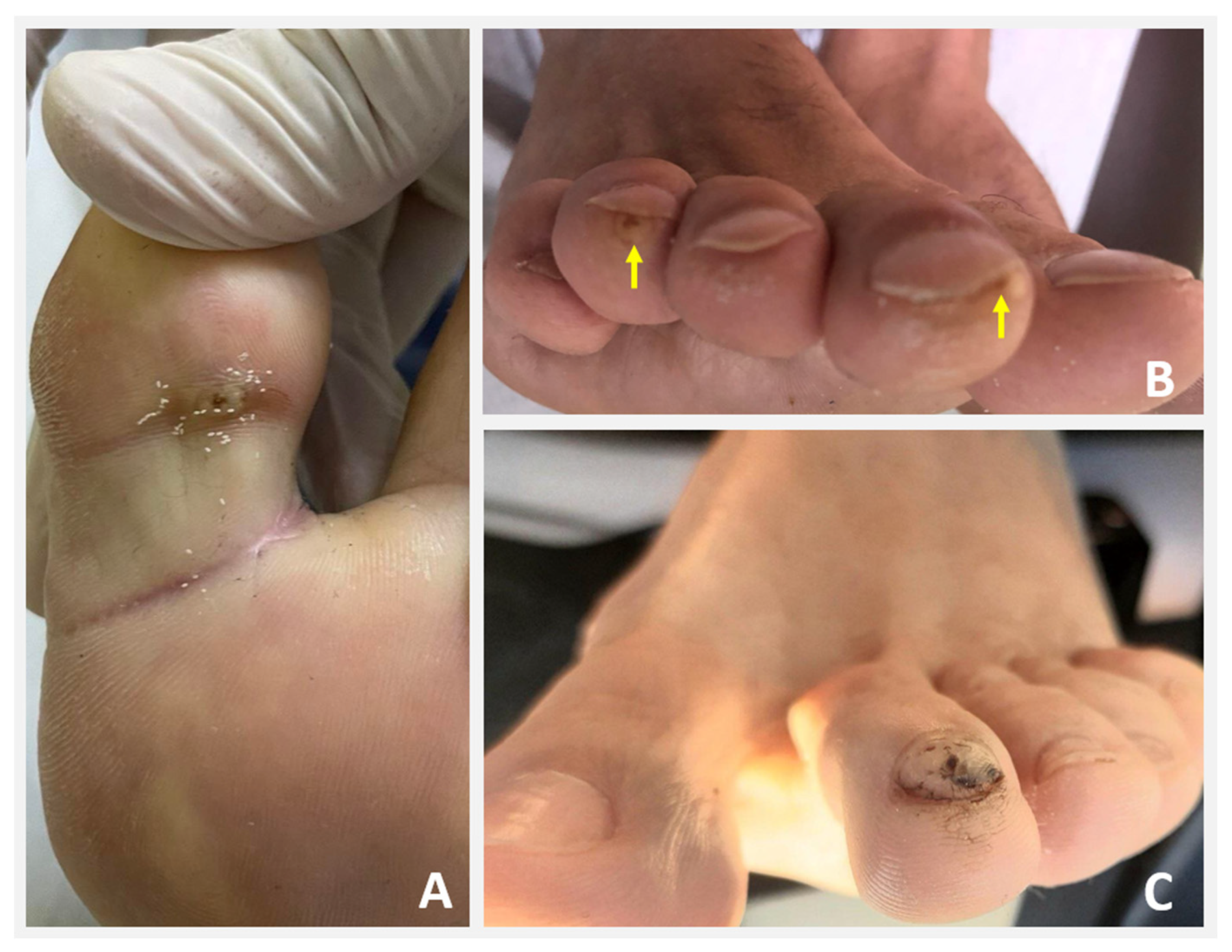
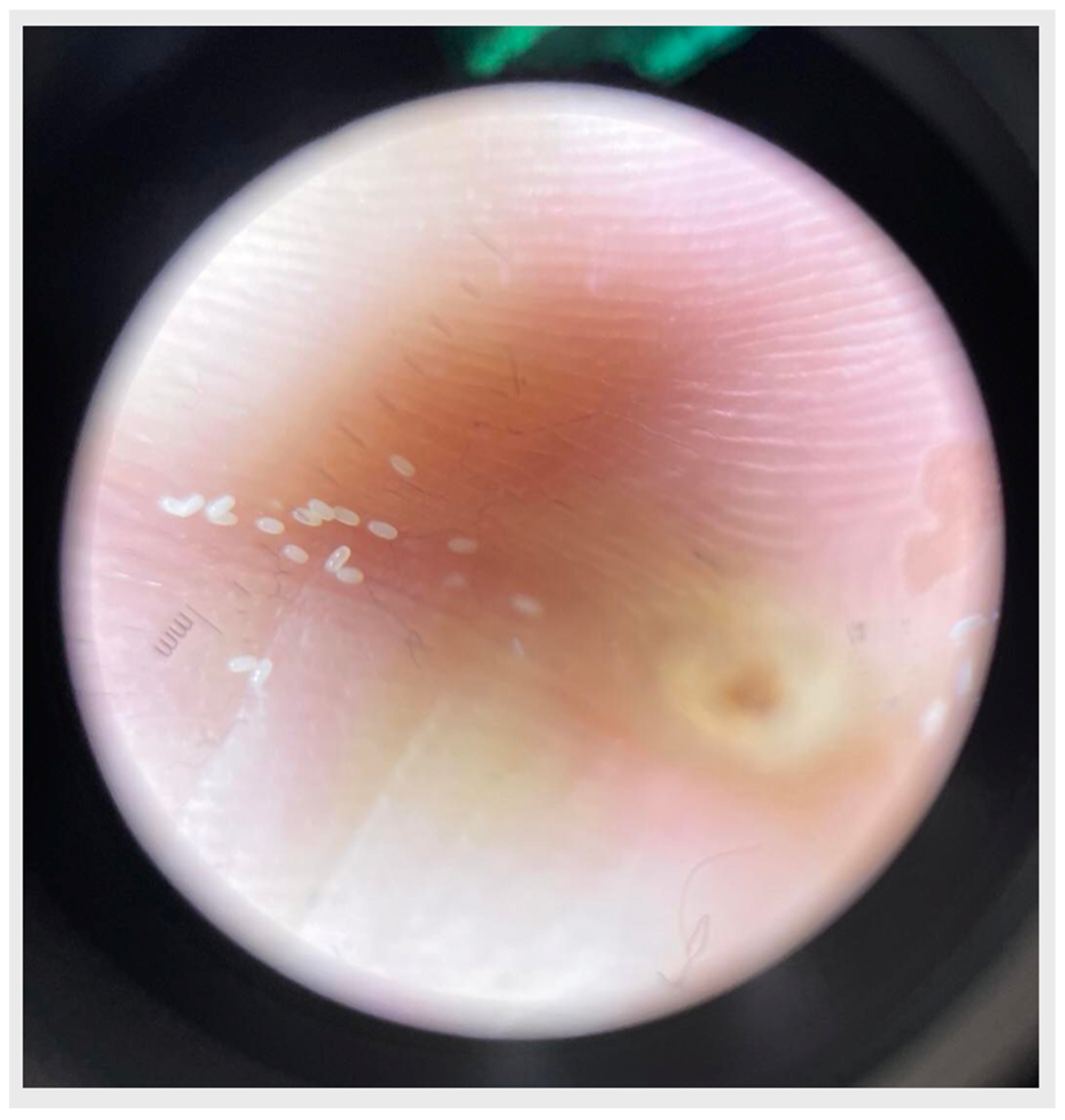
| P1 | 55 | Yes (Tanzania) | 3 | Left hallux (plantar); right foot, 2nd and 4th toes (subungual) |
| P2 | 60 | Yes (Tanzania) | 2 | Plantar surface, right foot |
| P3 | 51 | Yes (Tanzania) | 1 | Left hallux (subungual) |
| P4 | 18 | Yes (Tanzania) | 2 | Plantar region, bilateral feet |
| P5 | 21 | Yes (Tanzania) | 1 | Right foot, periungual region |
| P6 | 45 | Yes (Tanzania) | 2 | Left foot, plantar and periungual regions |
| P7 | 64 | Yes (Tanzania) | 1 | Right hallux (subungual) |
| P8 * | 42 | No | 1 | Left foot, 2nd toe (subungual) |
| Patient | AST (U/L) | ALT (U/L) | ALP (U/L) | γGT (U/L) | ||||
|---|---|---|---|---|---|---|---|---|
| Pre | Post | Pre | Post | Pre | Post | Pre | Post | |
| P1 | 82 | 32 | 96 | 38 | 165 | 114 | 88 | 42 |
| P2 | 68 | 30 | 74 | 35 | 140 | 105 | 52 | 40 |
| P3 | 45 | 28 | 62 | 33 | 120 | 98 | 40 | 35 |
| P4 | 95 | 36 | 110 | 62 | 180 | 120 | 102 | 50 |
| P5 | 38 | 30 | 48 | 34 | 155 | 108 | 60 | 38 |
| P6 | 72 | 34 | 85 | 37 | 135 | 102 | 70 | 41 |
| P7 | 55 | 29 | 60 | 32 | 125 | 100 | 45 | 36 |
| P8 | 50 | 27 | 58 | 34 | 115 | 110 | 85 | 35 |
| Mean (SD) | 63 (20) | 31 (3) | 74 (21) | 38 (10) | 142 (23) | 107 (7) | 68 (22) | 40 (5) |
| Month | Mean Temperature (°C) | Temperature Range (°C) | Mean Relative Humidity (%) | Humidity Range (%) | Precipitation (mm) |
|---|---|---|---|---|---|
| June 2023 | 28–30 | 20–34 | 50–55 | 35–70 | ~10 |
| July 2023 | 31–33 | 24–42 | 40–50 | 25–65 | ~5–8 |
Disclaimer/Publisher’s Note: The statements, opinions and data contained in all publications are solely those of the individual author(s) and contributor(s) and not of MDPI and/or the editor(s). MDPI and/or the editor(s) disclaim responsibility for any injury to people or property resulting from any ideas, methods, instructions or products referred to in the content. |
© 2026 by the authors. Licensee MDPI, Basel, Switzerland. This article is an open access article distributed under the terms and conditions of the Creative Commons Attribution (CC BY) license.
Share and Cite
Fotas, T.; Giantsis, I.A.; Lefkaditis, M.; Pappas, I.S.; Christodoulopoulos, M.A.B.; Zafiriou, E.; Nicolaidou, E.; Katoulis, A.C.; Christodoulopoulos, G. Imported Tungiasis in Greece: Secondary Household Transmission and Transient Mixed Liver Enzyme Elevation. Trop. Med. Infect. Dis. 2026, 11, 169. https://doi.org/10.3390/tropicalmed11060169
Fotas T, Giantsis IA, Lefkaditis M, Pappas IS, Christodoulopoulos MAB, Zafiriou E, Nicolaidou E, Katoulis AC, Christodoulopoulos G. Imported Tungiasis in Greece: Secondary Household Transmission and Transient Mixed Liver Enzyme Elevation. Tropical Medicine and Infectious Disease. 2026; 11(6):169. https://doi.org/10.3390/tropicalmed11060169
Chicago/Turabian StyleFotas, Thomas, Ioannis A. Giantsis, Menelaos Lefkaditis, Ioannis S. Pappas, Mathis A. B. Christodoulopoulos, Efterpi Zafiriou, Electra Nicolaidou, Alexander C. Katoulis, and Georgios Christodoulopoulos. 2026. "Imported Tungiasis in Greece: Secondary Household Transmission and Transient Mixed Liver Enzyme Elevation" Tropical Medicine and Infectious Disease 11, no. 6: 169. https://doi.org/10.3390/tropicalmed11060169
APA StyleFotas, T., Giantsis, I. A., Lefkaditis, M., Pappas, I. S., Christodoulopoulos, M. A. B., Zafiriou, E., Nicolaidou, E., Katoulis, A. C., & Christodoulopoulos, G. (2026). Imported Tungiasis in Greece: Secondary Household Transmission and Transient Mixed Liver Enzyme Elevation. Tropical Medicine and Infectious Disease, 11(6), 169. https://doi.org/10.3390/tropicalmed11060169