
Integrated Approaches to Surveillance of Lymphatic Filariasis and Other Infectious Diseases in the Pacific Islands

 ,
,  , , ,
, , ,  , ,
, ,  add
Show full author list
add
Show full author list
Abstract
1. Introduction

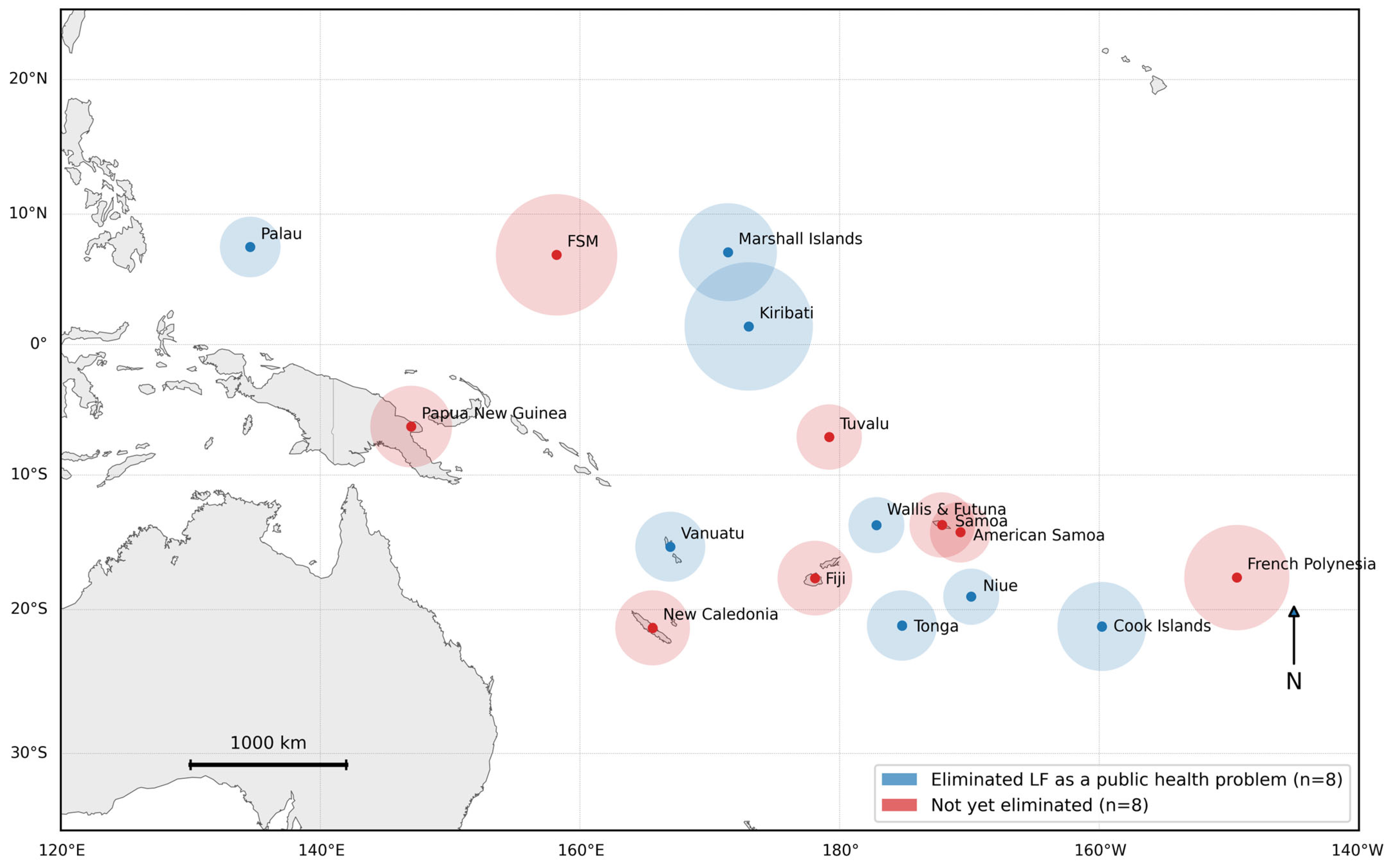
| Pacific Island Country or Territory | Population Est in 2026 | Year Eliminated LF as a Public Health Problem | Year of the Most Recent Published LF Study | Summary of the Most Recent Published Study Findings * | Representative at the Voices and Visions Meeting |
|---|---|---|---|---|---|
| Countries that have eliminated LF as a public health problem | |||||
| Cook Islands % | 15,406 | 2016 | 2013–2014 [8] | A total of 2903 participants from ten islands were tested. Only one individual was Ag-positive for LF, and no additional Ag-positive people were identified across the remaining 11 islands. The national Ag prevalence was estimated as being 0.23%. | Yes |
| Niue ^ | 1543 | 2016 | 2009 [9] | A whole-population survey (n = 1378) reported an overall LF Ag prevalence of 0.5%, with no positive cases detected among six- to seven-year-old children. | Yes |
| Vanuatu ^ | 307,941 | 2016 | 2010–2012 [10] | A total of 4480 school-aged children were screened across three sampling units, with no Ag-positive cases detected. A subsequent transmission assessment survey in one unit identified two Ag-positive children among 933 tested. The resulting national Ag prevalence was estimated at 0.2%. | Yes |
| Wallis and Futuna % | 11,151 | 2018 | 2025 [11] | A cross-sectional study of 353 schoolchildren aged 18 years or younger identified five Ag-positive cases, corresponding to an estimated antigenemia prevalence of nearly 2% in Futuna. The investigation also confirmed a spatial cluster where antigenemia prevalence reached 7.5% (95% CI: 2.1–18.2%). Follow-up assessments detected microfilariae (Mf) in several contact cases. | Yes |
| Palau | 17,976 | 2017 | 2001 [12] | A baseline assessment of 2031 people conducted in 2001 identified nine Ag-positive cases from the same village, giving an Ag prevalence of 0.4%. | No |
| Tonga | 99,283 | 2017 | 2024 [13] | A survey of 1787 participants recruited from 12 communities, 11 primary schools, five high schools, and one outpatient clinic identified 39 Ag-positive cases (2.2%) and five Mf-positive cases (0.3%). The community with the highest burden recorded an Ag prevalence of 4.0% (95% CI: 2.9–5.6%). | Yes |
| Republic of the Marshall Islands | 54,446 | 2017 | 2003 [12] | A 2001 baseline survey of 2003 people across two islands identified 2 Ag-positive cases, an Ag prevalence of 0.1%. In 2002, follow-up blood Ag surveys reported 130 Ag-positive individuals among 294 people on Mejit (44.2%) and 71 positive people among 244 people on Ailuk (29%). By contrast, similar surveys conducted in 2003 found no Ag-positive individuals among the 217 people examined on Wotje Atoll or 318 examined on Ebon Atoll. | No |
| Kiribati ^ | 122,735 | 2019 | 1999–2000 [12] | A baseline assessment A survey found an Ag prevalence of 1.7%. | Yes |
| PICTs that have not yet eliminated lymphatic filariasis as a public health problem | |||||
| American Samoa | 57,085 | 2016 [14,15] | Among 2671 survey participants, 135 tested Ag-positive, giving an overall Ag prevalence of 5.1%. These findings confirmed ongoing LF transmission in previously recognised clusters and hotspots and highlighted new areas that merit further investigation. | No | |
| Fiji | 901,603 | 2007 [16] | A nationwide stratified cluster survey reported an Ag prevalence of 9.5%, ranging from 0.9% in the Western Division to 15.4% in the Eastern Division. Mf prevalence was 1.4%. | Yes | |
| French Polynesia | 280,855 | 2008 [17], 2021 [18] | LF transmission persists in several island groups, including the Society Islands, the Southern Marquesas, and the Gambier Archipelago. A 2008 cross-sectional, stratified three-cluster survey of 1178 people aged ≥2 years reported an ICT-positive prevalence of 11.3% and a Mf prevalence of 10%. Complementing these findings, a molecular xenomonitoring study of 5508 female mosquitoes collected from 420 sampling points on Huahine Island (within the Society Islands) detected LF-positive vectors in 13 of 28 primary sampling units. | Yes | |
| Federated States of Micronesia | 105,987 | 2003 [19] | A survey of 233 participants on Satawal Island found 96 Ag-positive cases (38%), and 55 individuals (22%) with circulating Mf. | No | |
| New Caledonia | 274,330 | 2013 [20] | A survey of 1035 participants identified seven Ag-positive cases. All participants were negative on Mf blood smears and for filarial deoxyribonucleic acid (DNA). The overall Ag prevalence was 0.62% (95% CI: 0.60–0.63). Although this is below the WHO threshold for elimination of LF as a public health problem, the absence of clear epidemiological evidence excluding domestic transmission has led health authorities to consider the possibility of ongoing circulation. | Yes | |
| Papua New Guinea | 9,311,874 | Multiple years [21,22,23,24] | Surveys conducted in East Sepik and Sandaun Provinces between 2013 and 2018 (n = 2854) report Mf prevalence of 24.0% (95% CI: 22.9–26.1) and Ag prevalence of 46.4% (95% CI: 43.5–49.3) at baseline declining to 0% Mf and 29.5% Ag prevalence (CI, 26.9–32.3%) after yearly treatment for 3 years. Surveys conducted in Bogia, Madang Province in 2016–2017 (n = 2382), reported Mf prevalence of 4 × 4% (95% CI: 3.6–5.3) and Ag prevalence of 22.0% (95% CI: 20.2–23.6) at baseline declining to 0 × 4% Mf (CI: 0 × 1–0 × 7) and 16.3% (95% CI: 14.9–17.9) Ag prevalence 12 months after one round of IDA, and further declining to 0 × 2% Mf (95% CI: 0.1–0.5) and 7.5% (95% CI: 6.4–8.7) Ag prevalence at 24 months (after a second round of IDA). A summary of older surveys by Graves et al. [21] reported LF prevalence ranges of 30.4–64.7% between 1983–1992, 30.1–56.9% between 1993–2000, and 7.8–12.8% between 2003–2011. | Yes | |
| Samoa ^ | 200,999 | 2023 [25] | A survey of 623 participants aged five or older from 125 randomly selected households across eight sampling units identified Ag-positive cases in six of the units. The adjusted Ag prevalence was 9.9% (95% CI: 3.5–21.0). | Yes | |
| Tuvalu | 10,778 | 2007 [16] | A whole-population serosurvey identified 973 Ag-positive individuals among 8173 people tested, giving an Ag prevalence of 11.9%. | No | |
2. Results and Discussion
2.1. Theme 1: Context-Specific Approaches to Post-Validation Surveillance
2.2. Theme 2: Integrating LF-PVS with Established Surveys and Routine Health Service Programs
2.3. Theme 3: Regional Coordination and Resourcing to Support PVS
2.4. Theme 4: Promoting Community Participation in PVS
2.5. Theme 5: Leveraging Multiplex Serological Tools for Integrated Surveillance
3. Conclusions
Author Contributions
Funding
Institutional Review Board Statement
Informed Consent Statement
Data Availability Statement
Conflicts of Interest
Abbreviations
| Ab | Antibodies |
| Ag | Antigen |
| CI | Confidence interval |
| COR-NTD | Coalition for Operational Reseach on Neglected Tropical Diseases |
| COVID-19 | Coronavirus-19 |
| ENGAGE | Ending the Neglect through Greater Access and Greater Effectiveness |
| GAELF | Global Alliance to Eliminate Lymphatic Filariasis |
| HERA | Health Research Accelerator (program of The University of Queensland) |
| NHMRC | National Health and Medical Research Council |
| NTD | Neglected-tropical disease |
| LF | Lymphatic filariasis |
| M&E | Monitoring and evaluation |
| MBA | Mulitplex bead assay |
| Mf | Microfilaria |
| NCD | Non-communicable disease |
| PacELF | Pacific Programme to Eliminate Lymphatic Filariasis |
| PICTs | Pacific Island Countries and Territories |
| PVS | Post-validation surveillance |
| SERO-PAC | Serosurveillance Partnership for the Pacific Region |
| STEPs and STEPwise | “STEPs” and “STEPwise” refer to the step-by-step structure of the WHO NCD risk factor survey methodology rather than being an acronym |
| UQ | The University of Queensland |
| WHO | World Health Organization |
References
- Hofstraat, K.; van Brakel, W.H. Social stigma towards neglected tropical diseases: A systematic review. Int. Health 2016, 8, i53–i70. [Google Scholar] [CrossRef] [PubMed]
- Ichimori, K.; Graves, P.M. Overview of PacELF—The Pacific Programme for the Elimination of Lymphatic Filariasis. Trop. Med. Health 2017, 45, 34. [Google Scholar] [CrossRef]
- World Health Organization. Monitoring and Epidemiological Assessment of Mass Drug Administration in the Global Programme to Eliminate Lymphatic Filariasis: A Manual for National Elimination Programmes, 2nd ed.; WHO: Geneva, Switzerland, 2025. [Google Scholar]
- Craig, A.T.; Lawford, H.L.S.; Viali, S.; Tuitama, G.; Lau, C.L. Perspectives on the implementation of post-validation surveillance for lymphatic filariasis in the Pacific Islands: A nominal group technique-based study protocol. PLoS ONE 2024, 19, e0313957. [Google Scholar] [CrossRef]
- Craig, A.T.; Couteaux, C.; Jetton, K.; Nehemia, R.; Sakano, O.; Tong, T.; Bauro, T.; Baraio, T.; Tukai, O.; Takai, J.; et al. Enablers of Post-Validation Surveillance for Lymphatic Filariasis in the Pacific Islands: A Nominal Group Technique and Expert Elicitation, 2025. SSRN 2025. [Google Scholar] [CrossRef]
- Lawford, H.L.S.; Lian, H.; Tukai, O.; Takai, J.; Couteaux, C.; Thein, C.; Jetto, K.; Teanibuaka, T.; Bauro, T.; Nehemia, R.; et al. Barriers and Facilitators to Implementing Post-Validation Surveillance of Lymphatic Filariasis in Pacific Island Countries and Territories: A Conceptual Framework Developed from Qualitative Data. Trop. Med. Infect. Dis. 2026, 18, 11. [Google Scholar] [CrossRef]
- Craig, A.T.; Kaldor, J.; Schierhout, G.; Rosewell, A.E. Surveillance strategies for the detection of disease outbreaks in the Pacific islands: Meta-analysis of published literature, 2010–2019. Trop. Med. Int. Health 2020, 25, 906–918. [Google Scholar] [CrossRef]
- Ave, C.; Kapa, D.R.; Ottesen, E. Elimination of lymphatic filariasis as a public health problem from the Cook Islands. Trop. Med. Health 2018, 46, 12. [Google Scholar] [CrossRef] [PubMed]
- Carlingford, C.N.; Melrose, W.; Mokoia, G.; Graves, P.M.; Ichimori, K.; Capuano, C.; Kim, S.H.; Aratchige, P.; Nosa, M. Elimination of lymphatic filariasis as a public health problem in Niue under PacELF, 1999–2016. Trop. Med. Health 2019, 47, 20. [Google Scholar] [CrossRef]
- Taleo, F.; Taleo, G.; Graves, P.M.; Wood, P.; Kim, S.H.; Ozaki, M.; Joseph, H.; Chu, B.; Pavluck, A.; Yajima, A.; et al. Surveillance efforts after mass drug administration to validate elimination of lymphatic filariasis as a public health problem in Vanuatu. Trop. Med. Health 2017, 45, 18. [Google Scholar] [CrossRef] [PubMed]
- Couteaux, C.; Demaneuf, T.; Bien, L.; Munoz, M.; Worms, B.; Chésimar, S.; Takala, G.; Lie, A.; Jessop, V.; Selemago, M.K. Postelimination Cluster of Lymphatic Filariasis, Futuna, 2024. Emerg. Infect. Dis. 2025, 31, 488. [Google Scholar] [CrossRef]
- World Health Organization. The PacELF Way: Towards the Elimination of Lymphatic Filariasis from the Pacific, 1999–2005; WHO Regional Office for the Western Pacific: Manila, Philippines, 2006. [Google Scholar]
- Lawford, H.L.S.; Tukia, O.; Takai, J.; Sheridan, S.; Ward, S.; Jian, H.; Martin, B.M.; ‘Ofanoa, R.; Lau, C.L. Persistent lymphatic filariasis transmission seven years after validation of elimination as a public health problem: A cross-sectional study in Tonga. Lancet Reg. Health—West. Pac. 2025, 57, 101513. [Google Scholar] [CrossRef] [PubMed]
- Wangdi, K.; Sheel, M.; Fuimaono, S.; Graves, P.M.; Lau, C.L. Lymphatic filariasis in 2016 in American Samoa: Identifying clustering and hotspots using non-spatial and three spatial analytical methods. PLoS Negl. Trop. Dis. 2022, 16, e0010262. [Google Scholar] [CrossRef] [PubMed]
- Cadavid Restrepo, A.M.; Martin, B.M.; Fuimaono, S.; Clements, A.C.A.; Graves, P.M.; Lau, C.L. Spatial predictive risk mapping of lymphatic filariasis residual hotspots in American Samoa using demographic and environmental factors. PLoS Negl. Trop. Dis. 2023, 17, e0010840. [Google Scholar] [CrossRef]
- Manolas, R.K.; Kama, M.; Rainima-Qaniuci, M.; Bechu, V.D.; Tuibeqa, S.; Winston, M.V.; Ram, N.; Naqio, F.; Ichimori, K.; Capuano, C.; et al. Lymphatic filariasis in Fiji: Progress towards elimination, 1997–2007. Trop. Med. Health 2020, 48, 88. [Google Scholar] [CrossRef]
- Mou, Y.; Plichart, C.; Legrand, A.-M.; Mallet, H.-P.; Cerf, N.; Nguyen, L.N. Evaluation de la prévalence de la filariose lymphatique en 2008 en Polynésie française. Bull. Epidémiol. Hebd. 2009, 48, 504–507. [Google Scholar]
- Lannuzel, R.; Lambert, T.; Deen, F.; Tourancheau, H.; Marie, J.; Cheong Sang, M.A.; Mervin, M.; Stoll, B.; Bossin, H.C.; Mathieu-Daudé, F. Detection of potential transmission foci of lymphatic filariasis using molecular xenomonitoring in Huahine, French Polynesia. PLoS Negl. Trop. Dis. 2025, 19, e0013492. [Google Scholar] [CrossRef]
- Pretrick, M.; Melrose, W.; Chaine, J.P.; Canyon, D.; Carron, J.; Graves, P.M.; Bradbury, R.S. Identification and control of an isolated, but intense focus of lymphatic filariasis on Satawal Island, Federated States of Micronesia, in 2003. Trop. Med. Health 2017, 45, 17. [Google Scholar] [CrossRef]
- Daures, M.; Champagnat, J.; Pfannstiel, A.; Ringuenoire, F.; Grangeon, J.P.; Musso, D. Filariasis serosurvey, New Caledonia, South Pacific, 2013. Parasites Vectors 2015, 8, 102. [Google Scholar] [CrossRef]
- Graves, P.M.; Makita, L.; Susapu, M.; Brady, M.A.; Melrose, W.; Capuano, C.; Zhang, Z.; Dapeng, L.; Ozaki, M.; Reeve, D. Lymphatic filariasis in Papua New Guinea: Distribution at district level and impact of mass drug administration, 1980 to 2011. Parasites Vectors 2013, 6, 7. [Google Scholar] [CrossRef]
- Berg Soto, A.; Xu, Z.; Wood, P.; Sanuku, N.; Robinson, L.J.; King, C.L.; Tisch, D.; Susapu, M.; Graves, P.M. Combining different diagnostic studies of lymphatic filariasis for risk mapping in Papua New Guinea: A predictive model from microfilaraemia and antigenaemia prevalence surveys. Trop. Med. Health 2018, 46, 41. [Google Scholar] [CrossRef]
- Laman, M.; Tavul, L.; Karl, S.; Kotty, B.; Kerry, Z.; Kumai, S.; Samuel, A.; Lorry, L.; Timinao, L.; Howard, S.C.; et al. Mass drug administration of ivermectin, diethylcarbamazine, plus albendazole compared with diethylcarbamazine plus albendazole for reduction of lymphatic filariasis endemicity in Papua New Guinea: A cluster-randomised trial. Lancet Infect. Dis. 2022, 22, 1200–1209. [Google Scholar] [CrossRef]
- Payne, M.C.; Sanuku, N.; Mancuso, B.E.; Cheng, Y.C.; Weil, G.J.; Fischer, P.U.; Laman, M.; Robinson, L.J.; Tisch, D.J.; King, C.L. Semi-annual and annual mass drug administration of diethylcarbamazine and albendazole are equally effective regimens for eliminating lymphatic filariasis in Papua New Guinea. PLoS Negl. Trop. Dis. 2025, 19, e0012979. [Google Scholar] [CrossRef]
- Mayfield, H.J.; Sartorius, B.; Sheridan, S.; Howlett, M.; Martin, B.M.; Thomsen, R.; Tofaeono-Pifeleti, R.; Viali, S.; Graves, P.M.; Lau, C.L. Ongoing transmission of lymphatic filariasis in Samoa 4.5 years after one round of triple-drug mass drug administration. PLoS Negl. Trop. Dis. 2024, 18, e0012236. [Google Scholar] [CrossRef] [PubMed]
- Aumua, A.; Fulu-Aiolupotea, S.M.; Suaalii-Sauni, T.; Fadgen, T. Navigating the early impacts of COVID-19: South pacific viewpoints from fiji and samoa. In Democracy, State Capacity and the Governance of COVID-19 in Asia-Oceania; Routledge: London, UK, 2023; pp. 113–130. [Google Scholar]
- Boodoosingh, R.; Ama’ama, S.A.; Schoeffel, P. A perfect storm: The social and institutional contexts of Samoa’s 2019–2020 measles epidemic and the lessons learned for the COVID-19 pandemic. J. Samoan Stud. 2020, 10, 5–10. [Google Scholar] [CrossRef]
- Craig, A.T.; Lawford, H.; Mokoia, G.; Ikimau, M.; Fetaui, P.; Marqardt, T.; Lau, C.L. Integrating post-validation surveillance of lymphatic filariasis with the WHO STEPwise approach to non-communicable disease risk factor surveillance in Niue, a study protocol. PLoS ONE 2025, 20, e0315625. [Google Scholar] [CrossRef] [PubMed]
- Asia Pacific Leaders Malaria Alliance; Papua New Guinea Institute of Medical Research; Elimination Global Institute for Disease Elimination. Integration for Joint Elimination of Malaria and Lymphatic Filariasis. 2024. Available online: https://glideae.org/wp-content/uploads/2025/07/Thematic-Feature.pdf (accessed on 24 November 2025).
- Sheel, M.; Tinessia, A.; Hall, J.; Abdi, I.; Craig, A.T.; Zimmerman, P.-A.; Rockett, R.; Nadeeka, S. Review of the Pacific Public Health Surveillance Network, 2023; SPC: Neumea, New Caledonia, 2025. [Google Scholar]
- Ward, S.; Lawford, H.L.S.; Sartorius, B.; Lau, C.L. Integrated serosurveillance of infectious diseases using multiplex bead assays: A systematic review. Trop. Med. Infect. Dis. 2025, 10, 19. [Google Scholar] [CrossRef]
- Burnet Institute. Serosurveillance Partnership for the Pacific Region (SERO-PAC); Burnet Institute: Melbourne, VIC, Australia, 2025; Available online: https://www.burnet.edu.au/our-work/projects/serosurveillance-partnership-for-the-pacific-region-sero-pac/ (accessed on 24 November 2025).


Disclaimer/Publisher’s Note: The statements, opinions and data contained in all publications are solely those of the individual author(s) and contributor(s) and not of MDPI and/or the editor(s). MDPI and/or the editor(s) disclaim responsibility for any injury to people or property resulting from any ideas, methods, instructions or products referred to in the content. |
© 2026 by the authors. Licensee MDPI, Basel, Switzerland. This article is an open access article distributed under the terms and conditions of the Creative Commons Attribution (CC BY) license.
Share and Cite
Craig, A.T.; Lawford, H.L.S.; Bauro, T.; Couteaux, C.; Volavala, L.; Dupont-Rouzeyrol, M.; Soares, N.G.; Nehemia, R.; Ome-Kaius, M.; Rymill, P.; et al. Integrated Approaches to Surveillance of Lymphatic Filariasis and Other Infectious Diseases in the Pacific Islands. Trop. Med. Infect. Dis. 2026, 11, 54. https://doi.org/10.3390/tropicalmed11020054
Craig AT, Lawford HLS, Bauro T, Couteaux C, Volavala L, Dupont-Rouzeyrol M, Soares NG, Nehemia R, Ome-Kaius M, Rymill P, et al. Integrated Approaches to Surveillance of Lymphatic Filariasis and Other Infectious Diseases in the Pacific Islands. Tropical Medicine and Infectious Disease. 2026; 11(2):54. https://doi.org/10.3390/tropicalmed11020054
Chicago/Turabian StyleCraig, Adam T., Harriet L. S. Lawford, Temea Bauro, Clement Couteaux, Litiana Volavala, Myrielle Dupont-Rouzeyrol, Noel Gama Soares, Roger Nehemia, Maria Ome-Kaius, Prudence Rymill, and et al. 2026. "Integrated Approaches to Surveillance of Lymphatic Filariasis and Other Infectious Diseases in the Pacific Islands" Tropical Medicine and Infectious Disease 11, no. 2: 54. https://doi.org/10.3390/tropicalmed11020054
APA StyleCraig, A. T., Lawford, H. L. S., Bauro, T., Couteaux, C., Volavala, L., Dupont-Rouzeyrol, M., Soares, N. G., Nehemia, R., Ome-Kaius, M., Rymill, P., Taleo, F., Tatui, P., Tukia, ‘O. S., Viali, S., Yohogu, M., Angrisano, F., Robinson, L. J., Saketa, S., Tucker, A., ... Lau, C. L. (2026). Integrated Approaches to Surveillance of Lymphatic Filariasis and Other Infectious Diseases in the Pacific Islands. Tropical Medicine and Infectious Disease, 11(2), 54. https://doi.org/10.3390/tropicalmed11020054