


Error in Figure
In the original publication [1], there was a mistake in Figure 1 as published. The description of Figure 1 is correct, but two arrows between phases 4 and 5 and between phases 5 and 6 are reversed. In the correct paper, the proper Figure 1 is uploaded.
The corrected Figure 1 appears below. The authors state that the scientific conclusions are unaffected. This correction was approved by the Academic Editor. The original publication has also been updated.
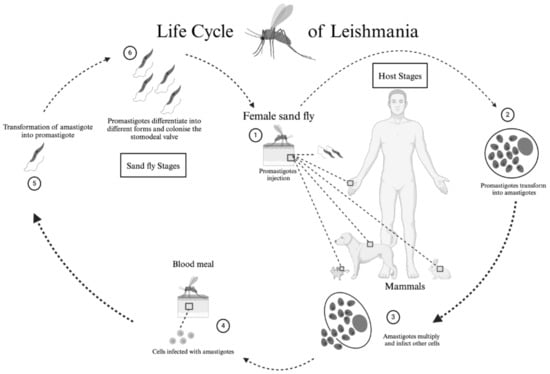
Figure 1.
Life cycle of the Leishmania protozoan parasite. (1) The cycle begins when the sand fly inoculates metacyclic (infective) promastigotes into the vertebrate host during a blood meal, along with the fly’s saliva, midgut microbiota, and extracellular vesicles of the parasite. (2) The promastigotes are phagocytosed by macrophages and other mononuclear cells, transforming into amastigotes. (3) The amastigotes divide and infect other cells. (4) The sand fly, during a subsequent blood meal, ingests the infected cells. (5) In the midgut of the sand fly, the amastigotes transform into promastigotes. (6) The promastigotes differentiate into metacyclic forms and colonise the stomodeal valve. Created in BioRender. Cosma, C. (2024). https://biorender.com/l08n361.
Reference
- Cosma, C.; Maia, C.; Khan, N.; Infantino, M.; Del Riccio, M. Leishmaniasis in Humans and Animals: A One Health Approach for Surveillance, Prevention and Control in a Changing World. Trop. Med. Infect. Dis. 2024, 9, 258. [Google Scholar] [CrossRef] [PubMed]
Disclaimer/Publisher’s Note: The statements, opinions and data contained in all publications are solely those of the individual author(s) and contributor(s) and not of MDPI and/or the editor(s). MDPI and/or the editor(s) disclaim responsibility for any injury to people or property resulting from any ideas, methods, instructions or products referred to in the content. |
© 2025 by the authors. Licensee MDPI, Basel, Switzerland. This article is an open access article distributed under the terms and conditions of the Creative Commons Attribution (CC BY) license (https://creativecommons.org/licenses/by/4.0/).