1. Introduction
Tuberculosis is a severe infectious disease caused by Mycobacterium tuberculosis, primarily affecting the lungs but capable of involving other organs such as lymph nodes, kidneys, the central nervous system, and the spine, in which case it presents as extrapulmonary tuberculosis [
1]. The disease typically begins with progressive symptoms—persistent cough, fever, night sweats, weight loss, lymphadenopathy, and general weakness—and, in advanced stages, may manifest with chest pain and hemoptysis [
2].
Drug-resistant tuberculosis (DR-TB) refers to disease caused by Mycobacterium tuberculosis complex strains that exhibit resistance to one or more antituberculosis medicines, according to the World Health Organization [
3]. This includes resistance to isoniazid and rifampicin, the main first-line agents used in standard treatment regimens [
3].
Globally, DR-TB represents a growing threat to public health, particularly in high-burden countries [
4]. The emergence of new resistant variants has further complicated treatment and contributed to rising mortality [
5]. According to the meta-analysis conducted by Alemu et al. [
4] worldwide mortality attributable to DR-TB average mortality rate of 25.6% (95% CI: 20.9–30.3) during treatment, this is equivalent to 3.75 deaths per 10,000 people infected, which shows that approximately one in four patients with resistant tuberculosis dies before completing therapy. If we analyze these results disaggregated by the type of resistance, a marked difference is observed: MDR-TB had a mortality of 20.2%, while extensively resistant tuberculosis (XDR-TB) reached 43.5%, which represents almost double the risk of death, reflecting a clear relationship between the magnitude of bacterial resistance and lethality.
Aligned with the Sustainable Development Goals, the World Health Organization (WHO) has set the elimination of tuberculosis by 2030 as a global priority. However, in 2023 an estimated 10.8 million new TB cases occurred worldwide, and only two out of five individuals diagnosed with DR-TB were able to access treatment [
6].
From a global epidemiological perspective, tuberculosis remains a structural marker of health inequality. The disease is disproportionately concentrated in low- and lower-middle-income countries, where incidence and mortality rates are several times higher than in high-income regions. This distribution reflects profound social determinants—including overcrowding, low educational attainment, fragile health systems, poor living conditions, and cumulative exposure to environmental and social risks—rather than a purely biological distribution of the pathogen [
7,
8].
In this context, Chen et al. [
9], report that MDR–TB and XDR–TB represented, in 2021, a critical global health burden, with 443,680 and 24,036 incident cases, respectively, mostly in developing regions. These resistant forms drive disproportionate mortality and underscore structural failures in early diagnosis and health system resilience.
Regionally, Eastern Europe, Central Asia, and parts of Africa exhibit the highest concentration of DR-TB, associated with factors such as HIV co-infection, socioeconomic precariousness, incomplete previous TB treatment, diabetes mellitus, and harmful habits including smoking and alcohol consumption. The persistence of these factors complicates timely recovery even when effective therapeutic options exist [
10].
In Latin America, Mexico, despite being classified as a low-burden country, has reported resistance in 14.1% of analyzed strains, with notable discrepancies between phenotypic and genotypic profiles, suggesting non-canonical variants or new mutations [
11]. In Ecuador, where TB burden is also relatively low, 10.9% of tested isolates were multidrug-resistant, some likely introduced from neighboring high-prevalence regions such as Venezuela, emphasizing the need for strengthened molecular surveillance [
12].
In Colombia, the 2022 incidence of DR-TB was 0.67 per 100,000 inhabitants, with a slight increase from the previous year. Although 60% of DR-TB cases were reported as cured, significant challenges persist in clinical management. The COVID-19 pandemic further disrupted TB control, causing delays in diagnosis, interruptions in follow-up, and reduced timely detection, thereby worsening the national DR-TB situation [
13].
Given this scenario, it is essential to understand the territorial distribution of DR-TB within the country. This study aims to analyze the geographic distribution and spatial patterns of DR-TB in Colombia between 2020 and 2023 through spatial analysis techniques oriented toward identifying territorial clusters with high epidemiological burden. This approach supports decision-making, optimizes resource allocation, and strengthens targeted control interventions; particularly in areas with high social and health vulnerability.
2. Materials and Methods
An ecological study with a quantitative approach was conducted using all reported cases of tuberculosis in Colombia between 2020 and 2023. The information was obtained from the Public Health Surveillance System (SIVIGILA) of the National Institute of Health (INS) and downloaded in June 2025. For the analysis, only the records corresponding to the “Drug-resistant tuberculosis” event (code 825) were selected, from which a specific analytical sub-database was constructed.
Sociodemographic variables included age, sex, nationality, and belonging to prioritized population groups (disability, displacement, migration, deprivation of liberty, pregnancy, indigenous population, among others). Ethnicity-related variables were excluded because of conceptual overlap with the prioritized population categories. Likewise, the variables “case type” and “area” were excluded due to their limited analytic relevance within this cohort.
The age variable was initially treated as continuous and subsequently categorized into six intervals (0–14, 15–29, 30–44, 45–59, 60–74, and ≥75 years). This structure follows the categorization used in national INS tuberculosis surveillance reports and WHO epidemiological classifications, ensuring comparability across official monitoring systems. The intervals also correspond to meaningful demographic groups that differ in exposure patterns and clinical presentation.
For the descriptive analysis, a general table was constructed including absolute frequencies, percentages, and 95% confidence intervals. For the spatial component, the official national shapefile of Colombian municipalities was obtained from the GEOPORTAL of the National Administrative Department of Statistics (DANE). The data were aggregated at the departmental level. To ensure consistent denominators, a complete department–year grid (33 departments × 4 years) was constructed and merged with the notification database. Department–year cells without DR-TB reports were assigned a value of zero. Annual departmental rates were calculated using the official DANE population projections as denominators:
The national annual rates were then calculated by adding the cases and population from all 33 departments, resulting in a true population-based national indicator that is consistent across figures and tables. Choropleth maps based on these values were created using a continuous linear color scale. Cumulative departmental rates for 2020–2023 were also calculated by adding cases and populations over four years and computing the corresponding Poisson exact confidence intervals.
To evaluate the association between year of notification and prioritized population groups with the number of DR-TB cases, three Poisson regression models were compared: Model A (Cases~YEAR), Model B (Cases~YEAR + GROUP), and Model C, which incorporated the interaction term between both factors (Cases~YEAR × GROUP). Model selection was based on Akaike (AIC) and Bayesian (BIC) information criteria, as well as likelihood ratio tests (LRT) for nested models. In this analysis, IRRs describe relative changes in the number of notifications between categories (not risk per capita), using 2020 and the size of the general population as a reference.
Model B demonstrated a drastically superior fit compared with Model A (AIC: 184 vs. 6696; BIC: 212 vs. 6704; McFadden R2 = 0.977 vs. 0.0195), and the LRT confirmed a highly significant improvement in explanatory power (Deviance = 6534, p < 0.001). Although Model C produced a marginally higher McFadden R2 (0.983), it yielded worse information criteria (AIC = 213; BIC = 302) and exhibited severe numerical instability, reflected in an infinite dispersion parameter (φ = Inf). Moreover, the LRT comparing Model C with Model B showed no statistically significant improvement (Deviance = 37.5, p = 0.27). Given the absence of meaningful gains in model performance, the instability associated with multiple interaction terms in low-frequency categories, and the marked penalization for complexity reflected in the BIC, Model B was selected as the final specification.
Finally, a Kulldorff-type spatial scan analysis was conducted under a Poisson model using the smerc package in R. Circular scanning windows were centered on each department, and statistical significance was assessed through Monte Carlo simulation. To avoid excessively large or non-informative clusters, the maximum cluster size was restricted to 50% of the population at risk, and only non-overlapping clusters with p < 0.05 were reported.
3. Results
A total of 1694 cases of DR-TB were analyzed. The highest frequencies were observed in the age groups of 30–44 years (26.1%), 15–29 years (24.5%), and 45–59 years (21.8%). The age group of 60–74 years also represented a substantial proportion of cases (17.9%), whereas age extremes contributed markedly fewer notifications: 8.3% in adults aged ≥ 75 years and 1.5% in children under 15 years. Most cases occurred in males (66.9%). Regarding nationality, 94.9% of patients were Colombian and 5.1% were Venezuelan.
In relation to population groups, 88.3% of cases were categorized as belonging to the general population, which is a residual group made up of people who do not fit the requirements for any particular prioritized category. Indigenous people (2.8%), migrants (4.3%), and those deprived of liberty (5.5%) showed lower but noteworthy frequencies. Less than 1% of the total was made up of other groups, such as individuals with mental disorders, pregnant women, victims of violence, people with disabilities, and displaced people.
Table 1 provides complete descriptive data, including percentages, frequencies, and 95% confidence intervals.
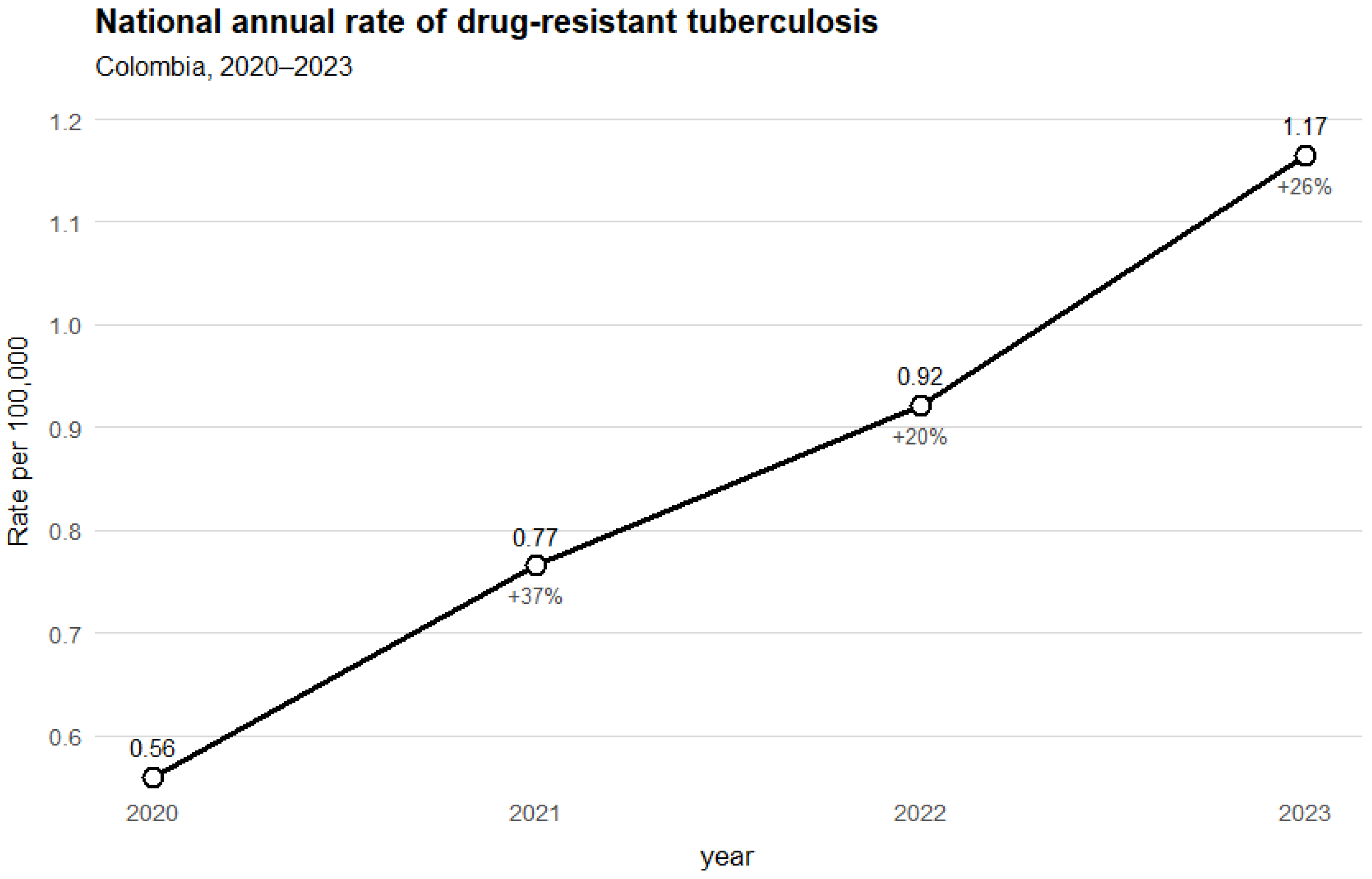
The temporal distribution of drug-resistant TB is presented in
Figure 1. The national rate increased steadily from 0.56 cases per 100,000 inhabitants in 2020 to 1.17 in 2023, with year-on-year variations of +37%, +20%, and +26%, respectively.
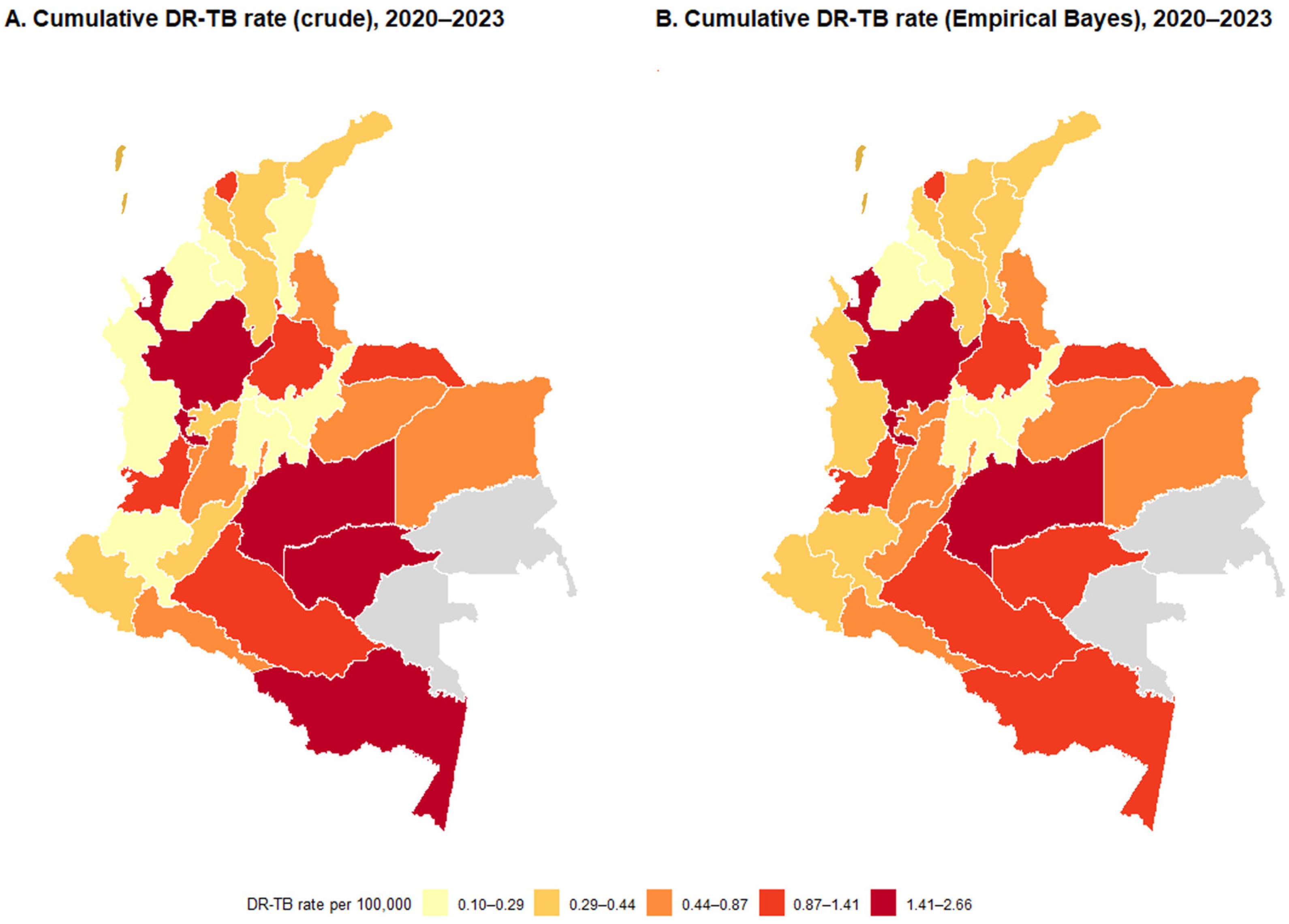
After the general characterization of cases, the spatial distribution of the cumulative DR-TB rate per 100,000 inhabitants for the period 2020–2023 is presented in
Figure 2. The figure includes two panels for comparison: the crude cumulative rate (left) and the empirical Bayesian-stabilized rate (right). A magnified inset shows the San Andrés Archipelago. The scales and cuts are identical for easy comparison.
In addition to
Figure 2,
Table S1 presents the annual DR-TB rates for all Colombian departments from 2020 to 2023, together with their corresponding 95% confidence intervals. The national annual values increased from 0.56 cases per 100,000 inhabitants in 2020 to 1.17 per 100,000 inhabitants in 2023. Considering the full study period, the cumulative national rate reached 0.86 cases per 100,000 inhabitants.
Figure S1 displays the annual departmental maps using consistent scales and breakpoints to facilitate visual comparison across years. Areas shown in gray correspond to territories without available data after the harmonization process.
The cumulative departmental rates reported in
Table S1 show a wide range of values across the country. The highest cumulative rates correspond to Risaralda (0.665 per 100,000 inhabitants), Meta (0.452), Valle del Cauca (0.326), Caquetá (0.298), and Guaviare (0.268). Departments such as Santander, Tolima, Arauca, and Quindío show intermediate cumulative rates, whereas Córdoba, Cundinamarca, La Guajira, César, Boyacá, and Sucre report lower cumulative values.
Table S1 provides the exact annual rates and their confidence intervals for each department.
All prioritized population groups defined by the national surveillance system recorded at least one DR-TB notification between 2020 and 2023. Most notifications correspond to individuals classified within the general population. Among the prioritized groups, the highest number of notifications is observed in persons deprived of liberty, followed by migrants and indigenous populations. Other groups, such as individuals with mental disorders, pregnant women, persons with disabilities, victims of violence, and displaced individuals; show lower annual counts throughout the four-year period.
To evaluate the association between the different variables of interest with the number of cases of drug-resistant tuberculosis, a Poisson regression with main effects was adjusted. The results are expressed as incidence rate ratios (IRR) with 95% CI and
p-values, taking 2020 (year) and general population (group) as references.
Table 2 presents the estimated IRRs for each year category and prioritized groups, along with their confidence intervals and statistical significance.
The selected model showed a progressive and statistically significant increase in DR-TB notifications compared with 2020. For 2021, the IRR was 1.28 (+28%); for 2022, 1.71 (+71%); and for 2023, 2.11 (+111%), indicating a sustained year-on-year rise in reported cases. This pattern is consistent with the upward trend observed in the national annual notification rate.
In terms of prioritized groups, all categories had IRRs significantly below 1 (e.g., migrants: ≈0.05; persons deprived of liberty: ≈0.06; indigenous population: ≈0.02), meaning that their contribution to notifications during the study years was lower than that of the general population. As mentioned earlier, these IRRs should be interpreted with caution because the model does not account for group-specific denominators, which means that variations in notification counts rather than population-adjusted risks are reflected.
The overall performance of the model was adequate, with low information criteria (AIC/BIC) relative to its complexity, a high McFadden pseudo-R2, and only mild overdispersion (φ = 1.44), which does not compromise the interpretation of the main effects. In summary, the model supports a sustained temporal increase in DR-TB notifications and highlights structural differences between groups in their relative contribution to reported cases.
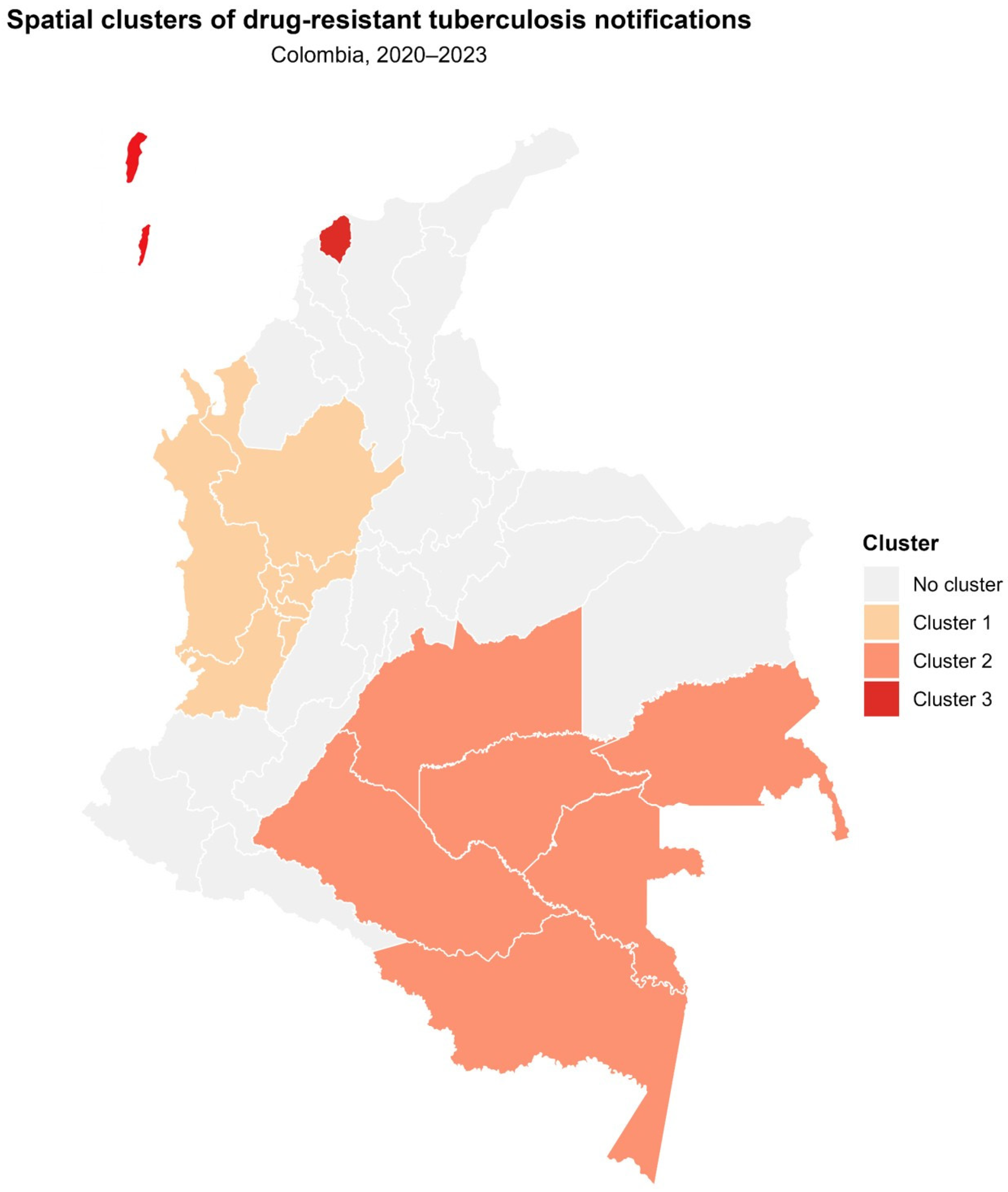
A Kulldorff-type spatial scan using Poisson’s model was applied to detect areas with significant aggregation of DR-TB cases. The departments identified as statistically significant high-risk clusters during the 2020–2023 analysis periods are shown in
Figure 3.
The spatial scan analysis identified three statistically significant clusters of drug-resistant tuberculosis notifications for the 2020–2023 period (
p < 0.05) (
Figure 3).
Cluster 1 comprised six departments: Antioquia, Caldas, Chocó, Quindío, Risaralda, and Valle del Cauca, and accounted for 826 notifications. This cluster showed a relative risk (RR) of 1.44 compared with the national distribution. Cluster 2 encompassed Caquetá, Meta, Amazonas, Guaviare, Vaupés, and Guainía, forming a contiguous area in the south-eastern region of the country. A total of 106 notifications were recorded within this cluster, which presented the highest relative risk among the detected clusters (RR = 1.66). Cluster 3 included Atlántico and San Andrés y Providencia, with 156 notifications during the study period and a relative risk of 1.41.
The remaining 19 departments were not part of statistically significant clusters and collectively contributed 606 notifications, corresponding to a cumulative relative risk of 0.49.
4. Discussion
In Colombia, drug-resistant tuberculosis (DR-TB) notifications increased steadily from 2020 to 2023. The Poisson regression model indicated a year-to-year rise in reported cases relative to 2020, with increments of 28% in 2021, 71% in 2022, and 110% in 2023. The spatial scan analysis identified three statistically significant clusters (p < 0.05): (i) a central–western group comprising Antioquia, Caldas, Chocó, Quindío, Risaralda, and Valle del Cauca; (ii) a south-eastern cluster including Caquetá, Meta, Amazonas, Guaviare, Vaupés, and Guainía; and (iii) a Caribbean cluster formed by Atlántico and San Andrés y Providencia. These clusters corresponded to areas with elevated relative risk during the study period.
The sociodemographic distribution showed the highest concentration of notifications among adults aged 30–44 years, followed by individuals aged 15–29 and 45–59 years. Older adults reported fewer cases overall. Men accounted for 66.9% of notifications, and most cases originated from the general population (88.3%), while the deprived-of-liberty population, migrants, and indigenous groups contributed smaller absolute counts.
The predominance of cases among young and middle-aged adults aligns with reports indicating higher DR-TB burden among populations of productive age, particularly in conditions of social vulnerability [
14]. Although older adults contributed fewer notifications in this study, international evidence shows that they often experience more severe disease and greater lethality [
15].
The marked gender imbalance observed, where men constitute the majority of DR-TB, cases is consistent with studies demonstrating gendered differences in biological susceptibility, exposure patterns, and social determinants [
16]. Peer et al. further demonstrate that the probability of DR-TB is higher in men across the life course, shaped by hormonal transitions, occupational exposures, and gender norms [
17].
The contribution of Venezuelan migrants reflects regional trends documented by PAHO, which describes increased TB risk in displaced populations due to precarious housing, food insecurity, and reduced access to health services [
18]. Systematic reviews similarly highlight elevated TB susceptibility among refugees and migrants [
19], and European evidence suggests that the odds of MDR/RR-TB may be up to threefold higher in-migrant populations compared with non-migrants [
20].
The increasing notifications observed among deprived-of-liberty individuals and indigenous populations are coherent with ecological studies from Brazil, where overcrowding, low schooling, and social marginalization contribute to sustained transmission of DR-TB within correctional facilities [
21]. Global analyses have also emphasized the disproportionate TB burden among Indigenous peoples, attributable to historical inequities, environmental disadvantage, and both geographic and cultural barriers to care [
22,
23].
The sharp post-pandemic rise in DR-TB notifications between 2021 and 2023 mirrors global patterns attributed to the disruption of TB control programs during COVID-19, followed by a rebound in diagnostic activity [
24]. The World Health Organization has reported the highest number of TB notifications in more than three decades following the pandemic [
25]. Similarly, in South Korea, overall TB incidence declined in recent years, yet the proportion of DR-TB cases within total TB notifications increased [
26], reflecting complex post-COVID epidemiological dynamics.
The Poisson regression model showed significant temporal increases and improved model fit after incorporating prioritized population groups. Although IRR values for these groups were <1, this should not be interpreted as lower risk. Instead, these values reflect small population denominators in groups such as deprived-of-liberty individuals, pregnant women, migrants, and Indigenous peoples. Because the model compares absolute counts and not per capita rates, lower IRRs reflect population size rather than epidemiological risk. This does not exclude the possibility of higher proportional burden or underdiagnosis among vulnerable groups, as underscored by Litvinjenko et al. [
27].
The three spatial clusters identified demonstrate that DR-TB transmission in Colombia is geographically focalized, shaped by dynamics related to urbanization, socioeconomic disadvantage, internal migration, environmental conditions, and structural barriers to care. Evidence from South Africa shows that cross-municipality mobility, especially between urban and periurban districts, facilitates TB and DR-TB spread [
28], while hotspots documented in other high-burden settings exhibit similar territorial concentration [
29]. The fact that some departments, such as Risaralda, Meta, and Valle del Cauca, exceed the national adjusted incidence rate reinforces the need for geographically differentiated interventions.
This study has methodological strengths, including the use of a national four-year surveillance dataset, systematic comparison of Poisson model specifications, and advanced spatial analyses through Kulldorff scanning to detect high-risk clusters. These approaches provide robust insights into the spatiotemporal dynamics of DR-TB in Colombia.
However, limitations must be acknowledged. The surveillance data did not include clinical variables (e.g., treatment history, comorbidities), socioeconomic indicators, or group-specific denominators, restricting causal inference and requiring cautious interpretation of IRR measures. As with all routine surveillance systems, underreporting and misclassification are possible. Future research should integrate individual-level clinical, social, and environmental data and improve completeness of reporting to refine the understanding of DR-TB transmission patterns.
5. Conclusions
The results of this study highlight clear geographic heterogeneity in DR-TB notifications in Colombia. Three statistically significant clusters were identified through spatial scanning: a central–western group (Antioquia, Caldas, Chocó, Quindío, Risaralda, and Valle del Cauca), a south-eastern cluster spanning the Amazon and Orinoquía regions (Caquetá, Meta, Amazonas, Guaviare, Vaupés, and Guainía), and a Caribbean cluster consisting of Atlántico and San Andrés y Providencia. These areas presented elevated relative risks compared with the national distribution and warrant strengthened and locally adapted public health actions.
Further research would benefit from mixed-method approaches capable of capturing structural and contextual barriers affecting individuals affected by DR-TB. Future analyses at finer geographic scales may help identify more specific focal patterns, while integrating clinical and sociodemographic information at the individual level could improve understanding of the determinants of resistant TB in Colombia. Evaluating the performance of current DR-TB control strategies within diverse territorial contexts is also recommended.
Author Contributions
Conceptualization, B.P.-P., S.C.-B., F.B.-M. and C.P.-B.; methodology, B.P.-P., S.C.-B., F.B.-M., C.P.-B., J.B.-C. and F.A.-C.; software, B.P.-P., S.C.-B., F.B.-M., C.P.-B., J.B.-C. and F.A.-C.; validation, B.P.-P., S.C.-B., F.B.-M., C.P.-B., J.B.-C. and F.A.-C.; Formal analysis, B.P.-P., S.C.-B., F.B.-M., C.P.-B., J.B.-C. and F.A.-C.; investigation, B.P.-P., S.C.-B., F.B.-M. and C.P.-B.; resources; B.P.-P., S.C.-B., F.B.-M. and C.P.-B.; data curation, B.P.-P., S.C.-B., F.B.-M., C.P.-B., J.B.-C. and F.A.-C.; writing—review and editing, B.P.-P., S.C.-B., F.B.-M., C.P.-B., J.B.-C. and F.A.-C.; project administration, B.P.-P., S.C.-B., F.B.-M., C.P.-B., J.B.-C. and F.A.-C.; funding acquisition J.B.-C. and F.A.-C. All authors have read and agreed to the published version of the manuscript.
Funding
This research has been funded by Dirección General de Investigaciones of Universidad Santiago de Cali under call No. DGI-01-2025.
Institutional Review Board Statement
Not applicable.
Informed Consent Statement
Not applicable.
Data Availability Statement
Acknowledgments
We extend our sincere gratitude to the Universidad Santiago de Cali and the Fundación Universitaria del Área Andina (Pereira campus) for their academic support and institutional collaboration throughout the development of this work. We also thank the Secretaría de Salud de Risaralda, Colombia, for providing essential guidance, data access, and technical assistance that significantly contributed to the successful completion of this study.
Conflicts of Interest
The authors declare no conflicts of interest.
References
- Rahlwes, K.C.; Dias, B.R.S.; Campos, P.C.; Alvarez-Arguedas, S.; Shiloh, M.U. Pathogenicity and virulence of Mycobacterium tuberculosis. Virulence 2023, 14, 2150449. [Google Scholar] [CrossRef] [Scilit]
- Farina, E.; D’Amore, C.; Lancella, L.; Boccuzzi, E.; Ciofi degli Atti, M.L.; Reale, A.; Rossi, P.; Villani, A.; Raponi, M.; Raucci, U. Alert signs and symptoms for the early diagnosis of pulmonary tuberculosis: Analysis of patients followed by a tertiary pediatric hospital. Ital. J. Pediatr. 2022, 48, 90. [Google Scholar] [CrossRef] [Scilit]
- World Health Organization. WHO Consolidated Guidelines on Tuberculosis. Module 4: Treatment—Drug-Resistant Tuberculosis. 2022 Update; World Health Organization: Geneva, Switzerland, 2022; Available online: https://www.who.int/publications/i/item/9789240063129 (accessed on 9 August 2025).
- Cui, K.; Zhao, X.; Liu, W.; Bai, L. Global, regional, and national burden and trends of multidrug-resistant tuberculosis and extensively drug-resistant tuberculosis in adolescents and adults aged 15–49 years from 2010 to 2021: Insights from the Global Burden of Disease Study 2021. BMC Med. 2025, 23, 445. [Google Scholar] [CrossRef] [Scilit] [PubMed]
- Alemu, A.; Bitew, Z.W.; Worku, T.; Gamtesa, D.F.; Alebel, A. Predictors of mortality in patients with drug-resistant tuberculosis: A systematic review and meta-analysis. PLoS ONE 2021, 16, e0253848. [Google Scholar] [CrossRef] [Scilit]
- World Health Organization. Tuberculosis. 2025. Available online: https://www.who.int/es/news-room/fact-sheets/detail/tuberculosis (accessed on 9 August 2025).
- Yang, H.; Ruan, X.; Li, W.; Xiong, J.; Zheng, Y. Global, regional, and national burden of tuberculosis and attributable risk factors for 204 countries and territories, 1990–2021: A systematic analysis for the Global Burden of Diseases 2021 study. BMC Public Health 2024, 24, 3111. [Google Scholar] [CrossRef] [Scilit] [PubMed]
- Xue, Y.; Zhou, J.; Wang, P.; Lan, J.H.; Lian, W.Q.; Fan, Y.Y.; Xu, B.-N.; Yin, J.-P.; Feng, Z.-H.; Zhou, J.; et al. Burden of tuberculosis and its association with socioeconomic development status in 204 countries and territories, 1990–2019. Front. Med. 2022, 9, 905245. [Google Scholar] [CrossRef] [Scilit]
- Chen, Y.; Chen, W.; Cheng, Z.; Chen, Y.; Li, M.; Ma, L.; Zhou, N.; Qian, J.; Zhu, Y.; Liu, C. Global burden of HIV-negative multidrug- and extensively drug-resistant tuberculosis based on Global Burden of Disease Study 2021. Sci. One Health 2024, 3, 100072. [Google Scholar] [CrossRef] [Scilit]
- Salari, N.; Kanjoori, A.H.; Hosseinian-Far, A.; Hasheminezhad, R.; Mansouri, K.; Mohammadi, M. Global prevalence of drug-resistant tuberculosis: A systematic review and meta-analysis. Infect. Dis. Poverty 2023, 12, 57. [Google Scholar] [CrossRef] [Scilit]
- Mejía-Ponce, P.M.; Ramos-González, E.J.; Ramos-García, A.A.; Lara-Ramírez, E.E.; Soriano-Herrera, A.R.; Medellín-Luna, M.F.; Valdez-Salazar, F.; Castro-Garay, C.Y.; Núñez-Contreras, J.J.; De Donato-Capote, M.; et al. Genomic epidemiology analysis of drug-resistant Mycobacterium tuberculosis distributed in Mexico. PLoS ONE 2023, 18, e0292965. [Google Scholar] [CrossRef] [Scilit]
- Castro-Rodriguez, B.; Franco-Sotomayor, G.; Benitez-Medina, J.M.; Cardenas-Franco, G.; Jiménez-Pizarro, N.; Cardenas-Franco, C.; Aguirre-Martinez, J.L.; Orlando, S.A.; de Mendoza, J.H.; Garcia-Bereguiain, M.A. Prevalence, drug resistance, and genotypic diversity of the RDRio subfamily of Mycobacterium tuberculosis in Ecuador: A retrospective analysis for years 2012–2016. Front. Public Health 2024, 12, 1337357. [Google Scholar] [CrossRef] [Scilit] [PubMed]
- Instituto Nacional de Salud. Informe de Evento Tuberculosis, Colombia, 2022. 2022. Available online: https://www.ins.gov.co/buscador-eventos/Informesdeevento/TUBERCULOSIS%20INFORME%202022.pdf (accessed on 19 June 2025).
- Orostica, V.S.; Sandana, S.C. Risk factors and predictors of drug resistance in tuberculosis: A comprehensive analysis of cases in Chile (2014–2018). Rev. Med. Chil. 2023, 151, 999–1009. [Google Scholar]
- Wu, I.L.; Chen, J.; Shiau, R.; Chitnis, A.S.; Jaganath, D. Tuberculosis disease among adults aged 65 years and older: Alameda County, California, 2016–2019. Open Forum Infect. Dis. 2022, 9, ofac575. [Google Scholar] [CrossRef] [Scilit]
- Madaki, S.; Mohammed, Y.; Rogo, L.D.; Yusuf, M.; Bala, Y.G. Age and gender in drug-resistant tuberculosis: A cross-sectional case study at a national tuberculosis reference hospital in Nigeria. J. Glob. Antimicrob. Resist. 2024, 39, 175–183. [Google Scholar] [CrossRef] [Scilit]
- Peer, V.; Schwartz, N.; Green, M.S. Gender differences in tuberculosis incidence rates: A pooled analysis of data from seven high-income countries by age group and time period. Front. Public Health 2023, 10, 997025. [Google Scholar] [CrossRef] [Scilit]
- Organización Panamericana de la Salud. Tuberculosis en las Américas: Informe Regional 2021. 2023. Available online: https://iris.paho.org/handle/10665.2/57001 (accessed on 9 August 2025).
- Meaza, A.; Tola, H.H.; Eshetu, K.; Mindaye, T.; Medhin, G.; Gumi, B. Tuberculosis among refugees and migrant populations: Systematic review. PLoS ONE 2022, 17, e0268696. [Google Scholar] [CrossRef] [Scilit]
- Kunst, H.; Lange, B.; Hovardovska, O.; Bockey, A.; Zenner, D.; Andersen, A.B.; Hargreaves, S.; Pareek, M.; Friedland, J.S.; Wejse, C.; et al. Tuberculosis in adult migrants in Europe: A TBnet consensus statement. Eur. Respir. J. 2025, 65, 2401612. [Google Scholar] [CrossRef] [Scilit] [PubMed]
- Santos, M.S.; Pieri, F.M.; Berra, T.Z.; Scholze, A.R.; Ramos, A.C.V.; de Almeida Crispim, J.; Giacomet, C.L.; Alves, Y.M.; da Costa, F.B.P.; Moura, H.S.D.; et al. Acquired and transmitted multidrug-resistant tuberculosis among the incarcerated population and its determinants in the State of Paraná, Brazil. Int. J. Environ. Res. Public Health 2022, 19, 14895. [Google Scholar] [CrossRef] [Scilit]
- Basta, P.C.; de Sousa Viana, P.V. Determinants of tuberculosis in Indigenous people worldwide. Lancet Glob. Health 2019, 7, e6–e7. [Google Scholar] [CrossRef] [Scilit] [PubMed]
- Villegas Salazar, T.T.; Tegaisa, L.V.; Sarmiento, J.M.H. Tuberculosis in Indigenous Communities of Chocó, Colombia: Epidemiological Analysis and Perspectives to Reduce Its Incidence. 2018. Available online: https://www.amimc.org.mx/wp-content/uploads/2019/04/EIM4w.pdf#page=6 (accessed on 9 August 2025).
- Khojasteh-Kaffash, S.; Habibzadeh, A.; Moghaddam, S.; Afra, F.; Samieefar, N.; Fateh, A. Tuberculosis trends in the post-COVID-19 era: Is it going to be a global concern? Health Sci. Rep. 2025, 8, e70792. [Google Scholar] [CrossRef] [Scilit]
- World Health Organization. Global Tuberculosis Report 2024. 2024. Available online: https://www.who.int/teams/global-programme-on-tuberculosis-and-lung-health/tb-reports/global-tuberculosis-report-2024 (accessed on 9 August 2025).
- Kim, T.H.; Heo, I.R.; Kim, H.C. Resurgence of multidrug-resistant tuberculosis during the COVID-19 pandemic in Korea. Kosin Med. J. 2025, 40, 122–127. [Google Scholar] [CrossRef] [Scilit]
- Litvinjenko, S.; Magwood, O.; Wu, S.; Wei, X. Burden of tuberculosis among vulnerable populations worldwide: An overview of systematic reviews. Lancet Infect. Dis. 2023, 23, 1395–1407. [Google Scholar] [CrossRef] [Scilit] [PubMed]
- Fofana, A.M.; Moultrie, H.; Scott, L.; Jacobson, K.R.; Shapiro, A.N.; Dor, G.; Crankshaw, B.; Da Silva, P.; Jenkins, H.E.; Bor, J.; et al. Cross-municipality migration and spread of tuberculosis in South Africa. Sci. Rep. 2023, 13, 2674. [Google Scholar] [CrossRef] [Scilit] [PubMed]
- Faye, L.M.; Hosu, M.C.; Apalata, T. Drug-resistant tuberculosis hotspots in Oliver Reginald Tambo District Municipality, Eastern Cape, South Africa. Infect. Dis. Rep. 2024, 16, 1197–1213. [Google Scholar] [CrossRef] [Scilit] [PubMed]
| Disclaimer/Publisher’s Note: The statements, opinions and data contained in all publications are solely those of the individual author(s) and contributor(s) and not of MDPI and/or the editor(s). MDPI and/or the editor(s) disclaim responsibility for any injury to people or property resulting from any ideas, methods, instructions or products referred to in the content. |
© 2025 by the authors. Licensee MDPI, Basel, Switzerland. This article is an open access article distributed under the terms and conditions of the Creative Commons Attribution (CC BY) license (https://creativecommons.org/licenses/by/4.0/).



 ,
,