1. Introduction
Urbanization is one of the most significant processes shaping contemporary societies, particularly in Sub-Saharan Africa, where cities are experiencing one of the fastest growth rates in the world [
1,
2]. By 2050, nearly 1.5 billion Africans are projected to live in urban areas [
3]. Despite these projections, most Sub-Saharan African cities face a critical governance paradox: rapid spatial expansion outpaces the institutional capacity needed to guide development, effectively regulate land markets, or ensure the coordinated provision of basic services. This mismatch between the pace of urbanization and governance capability produces what scholars term a ‘policy-practice gap’—the persistent divergence between stated planning intentions and actual local implementation outcomes [
4], where the places experiencing the most aggressive spatial transformations are often the least institutionally equipped to manage them sustainably. As a result, rapid urbanization frequently unfolds outside formal planning control, particularly in contexts of weak institutional capacity. The Greater Maputo Metropolitan Area (AMGM) exemplifies this dynamic. As a socio-spatial artifact, it results from the interplay between mobility patterns, informal and formal markets, and open spaces that generate multiple but poorly integrated centralities [
5]. While these processes contribute to metropolitan vitality, they also exacerbate challenges related to ecological degradation, vulnerability to climate risks, and weak governance capacity.
The governance of metropolitan territories in Africa remains contested: research emphasizes urbanization’s potential to drive transformation through agglomeration and networked economies, while scholars simultaneously highlight structural challenges—fragmented authority, unregulated land markets, and pervasive informality—that reinforce socio-spatial inequality [
6,
7,
8]. Debates also persist on whether policy interventions can effectively redirect urban growth or whether structural socio-economic dynamics will continue to dominate metropolitan transformations [
9]. Recent scholarship further underscores the need for integrated approaches that combine measurement, monitoring, and participatory governance to meaningfully shape urban change in African contexts [
10].
Metropolitan governance in African contexts increasingly involves multiple actor networks beyond state institutions. In Maputo, as in other Sub-Saharan African cities, non-governmental organizations play crucial roles in informal settlement upgrading, particularly in service delivery and community mobilization where state capacity is limited [
11,
12]. The private sector shapes urban development through formal real estate investments and informal land markets, often operating in regulatory gray zones that blur formal-informal boundaries [
13,
14]. International development agencies—including Cities Alliance and UN-Habitat—exert influence through technical assistance, financing mechanisms, and policy framing, often importing models that require contextual adaptation [
15,
16]. Meanwhile, local communities and customary authorities negotiate land access and infrastructure provision through everyday practices that constitute ‘hybrid governance’—arrangements combining state and non-state actors that coexist with, and sometimes supersede, formal planning systems [
17,
18,
19]. These multi-actor dynamics fundamentally shape how urbanization unfolds on the ground: NGOs fill service gaps where municipalities lack capacity; informal land markets provide housing access for 60–80% of urban residents; and customary authorities resolve disputes and legitimate transactions in ways that formal institutions cannot replicate [
13,
20]. Assessing whether national urbanization policies can achieve stated objectives requires understanding whether policy frameworks can effectively coordinate—or will be subverted by—these diverse, often competing, governance practices operating across formal, informal, and hybrid institutional spaces.
Earlier research on the AMGM identified a set of critical spatial dynamics—consolidated urban cores, peri-urban “problem areas,” precarious informal settlements, latent development spaces, and ecologically sensitive areas—and argued that the metropolitan model was unsustainable without spatial containment, requalification, and stronger governance [
5]. Subsequent studies confirm this trajectory: informal settlements now accommodate roughly 86% of Maputo’s population [
21,
22]; peri-urban expansion has accelerated with land consumption outpacing population growth [
23,
24]; and climate vulnerability has deepened with continued occupation of floodplains and wetlands [
16,
25]. Socioeconomic differentiation also shapes spatial outcomes—higher-income groups drive low-density sprawl, while low-income residents densify inner informal areas [
23]. These persistent patterns provide a critical baseline for evaluating whether recent policy reforms have narrowed or perpetuated the governance gap.
In July 2024, Mozambique adopted a new Urbanization Policy positioning urban growth as both a developmental challenge and an opportunity [
26]. The policy emphasizes balanced territorial development, the integration of urban and rural systems, and the need to guide urbanization processes toward greater equity, resilience, and sustainability. Importantly, it acknowledges the structural role of informal settlements and calls for their upgrading and incorporation into the urban fabric. The policy also highlights the need for multi-level coordination and institutional strengthening, recognizing that sustainable urbanization depends on improved governance frameworks capable of articulating metropolitan and local scales. These orientations are particularly relevant for the Greater Maputo Metropolitan Area, where fragmented governance and limited institutional capacity have long hindered the capacity to manage expansion and urban conurbation, protect ecological systems, and integrate informal urbanization into coherent planning strategies.
The 2024 Urbanization Policy also reflects principles associated with contemporary urban scaling approaches, which emphasize aligning governance instruments with the spatial scale of urban expansion. These typically include spatial management tools, coordination mechanisms for cross-jurisdictional infrastructure, and frameworks to articulate national, metropolitan, and local responsibilities. While the Policy incorporates these principles at a conceptual level, the central question for this study is whether such scaling intentions translate into operational metropolitan governance capable of addressing the persistent challenges documented in the AMGM.
This article makes three key contributions. Methodologically, it operationalizes a convergence assessment framework that systematically compares empirical findings with policy principles across four governance dimensions, providing a replicable approach for evaluating policy-practice alignment in data-scarce contexts. Empirically, it offers a longitudinal perspective on metropolitan governance in Mozambique—an understudied context in comparative urban research—by revisiting earlier findings in light of new policy directions, thereby contributing to knowledge on policy learning and institutional change in African cities. Theoretically, it advances understanding of how national urbanization policies translate (or fail to translate) into metropolitan governance conditions of rapid, largely informal urbanization, addressing the multi-level politics that shape institutional coordination and metropolitan reform. These contributions are particularly relevant as African countries develop new urban policies, offering evidence on the critical gap between policy articulation and operational implementation that determines whether urbanization serves developmental goals or entrenches inequality.
2. Background: Urban Governance and Metropolitan Dynamics
Urbanization in Sub-Saharan Africa presents a fundamental governance challenge. While urbanization can catalyze transformation through agglomeration economies and social connectivity [
1,
2,
3,
6,
27], rapid expansion has been accompanied by persistent informality, fragmented land markets, weak infrastructure, and inadequate service provision [
7,
8,
9]. Governance capacity is increasingly recognized as the critical factor shaping these divergent outcomes [
8,
10], especially in metropolitan regions where urbanization extends beyond administrative boundaries and strains existing institutional arrangements.
Urban governance and metropolitan development have gained scholarly attention reflecting both the rapid pace of change and the complexity of governing hybrid and multi-scalar urban systems. Recent studies show how African cities, including Maputo, are theorized within global debates while also contributing original insights into “governance from the South” and everyday urbanism [
28,
29]. This scholarship stresses the hybrid and negotiated nature of urban governance in African contexts, where formal institutions coexist with informal, adaptive practices that shape urban infrastructure, land markets, and service provision. Such insights are directly relevant to Greater Maputo, where state, market, and community actors operate simultaneously across formal and informal domains, producing a governance landscape that is hybrid by necessity rather than exception.
Metropolitan governance has emerged as a crucial scale for addressing challenges that transcend municipal borders, such as land-use coordination, infrastructure, mobility, and ecological management. International reviews show that metropolitan arrangements often hold strong discursive appeal but lack the institutional mandates, resources, and legitimacy needed for effective implementation [
30]. As Brenner [
31] argues the “urban” now operates as an extended, multi-scalar field of relations that overflows administrative borders, requiring governance architectures capable of engaging with flows of people, resources, and ecologies. Cox [
32] emphasizes the politics of scale, noting that metropolitan institutions are inherently contested, shaped by conflicts over authority and legitimacy. These dynamics are evident in the AMGM, where municipalities, provinces, and national agencies each exert fragmented authority over land, infrastructure, and planning, with no established metropolitan body to reconcile competing mandates.
Fricke [
33] demonstrates that metropolitan regions are also discursively constructed, with narratives of competitiveness, cohesion, or sustainability mobilized to justify institutional reforms. More recently, Tomàs and Pyka [
34] synthesize these perspectives, highlighting institutions, legitimacy, actors, and politics as interdependent dimensions of metropolitan governance.
In Mozambique, Nielsen’s notion of “inverse governmentality” provides an especially relevant conceptual lens for understanding peri-urban Maputo. It illustrates how planning practices can inadvertently reproduce ambiguity and informality through selective enforcement and regulatory gaps [
35]. This resonates with earlier research on the AMGM, which identified a fragmented metropolitan structure characterized by consolidated cores, informal and precarious central settlements, sprawling peri-urban “problem areas,” speculative peripheral developments, risk-prone zones, and threatened ecological corridors [
5]. The coexistence of state-led planning, market-driven investment, and popular informal practices produced multiple centralities but little metropolitan cohesion. That research concluded that without urban containment, settlement upgrading, ecological protection, and strengthened governance, the metropolitan trajectory would remain unsustainable.
More recent studies support this assessment. Mottelson [
36], through a grounded case study of Laulane, shows how planning ideals collapse into everyday negotiation with informality, confirming the gap between policy and practice. Likewise, Essien [
37] demonstrates how national-level strategies are often shaped by external actors and remain weakly coordinated across scales, a condition mirrored in Mozambique’s evolving governance landscape.
Together these bodies of work frame the stakes of Mozambique’s 2024 Urbanization Policy [
26], which explicitly emphasizes balanced territorial development, urban–rural integration, equity, resilience, and sustainability. The policy acknowledges the structural role of informal settlements and calls for their upgrading, while stressing the importance of multi-level coordination and institutional strengthening. These orientations directly address long-standing governance deficits in the AMGM. Yet, as international and local scholarship reminds us, principles alone are insufficient: effective metropolitan governance requires operational mechanisms, fiscal instruments, and accountability frameworks capable of aligning diverse urbanization practices with strategic goals. The present study therefore positions the 2024 Urbanization Policy as a critical but still indeterminate opportunity to recalibrate metropolitan governance in Mozambique.
3. Methods and Approach
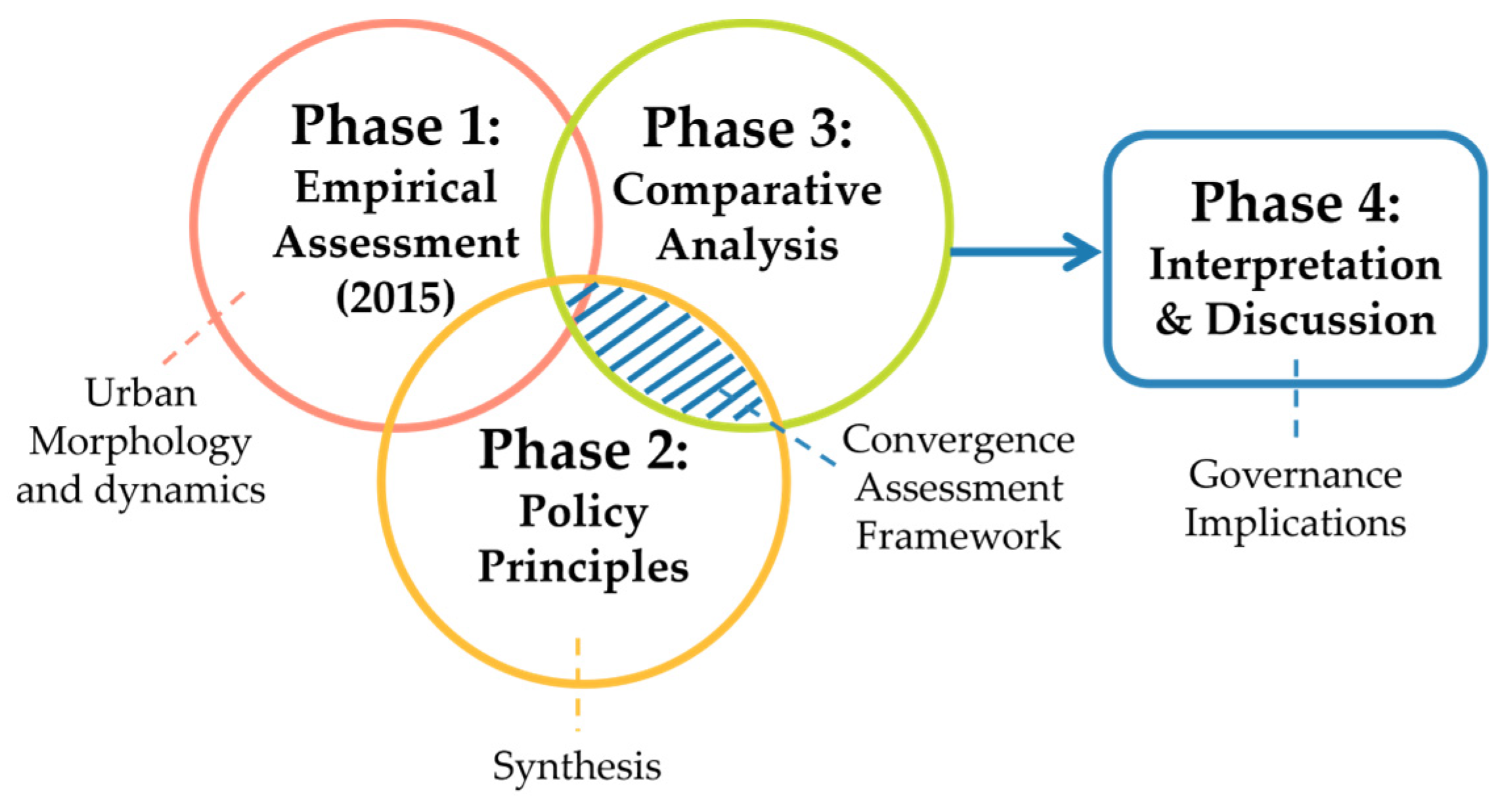
This study adopts a comparative policy analysis design that integrates secondary analysis of longitudinal spatial research with a systematic review of recent policy developments. Rather than conducting new primary fieldwork, it mobilizes earlier metropolitan evidence as a baseline for assessing policy–practice alignment. The approach emphasizes the analytical value of temporal comparison—linking the 2015 empirical baseline, the 2024 Urbanization Policy, and the convergence assessment—to identify continuities, gaps, and shifts in metropolitan governance and spatial management over the past decade (
Figure 1).
To operationalize the comparative policy analysis, the methodological design is structured into four sequential and interlinked phases, each corresponding to a distinct analytical task. Phase 1 synthesizes the empirical metropolitan dynamics documented in the 2015 baseline study, including spatial patterns of expansion, informality, ecological vulnerability, and governance fragmentation. Phase 2 systematically reviews Mozambique’s 2024 Urbanization Policy and related regulatory instruments to identify the principles, orientations, and institutional provisions relevant to metropolitan governance. Phase 3 applies the convergence assessment framework to compare the 2015 empirical findings with the 2024 policy principles across the four analytical dimensions, evaluating the degree of alignment in problem recognition, policy articulation, and operational mechanisms. Phase 4 develops a synthesized interpretation of convergence outcomes, identifying implementation gaps and generating strategic recommendations for metropolitan governance. In
Figure 1, these four phases are depicted schematically: the shaded central area represents the zone of analytical intersection where empirical evidence and policy provisions converge, forming the basis for the comparative interpretation.
3.1. Study Area and Empirical Baseline
The Greater Maputo Metropolitan Area (AMGM,
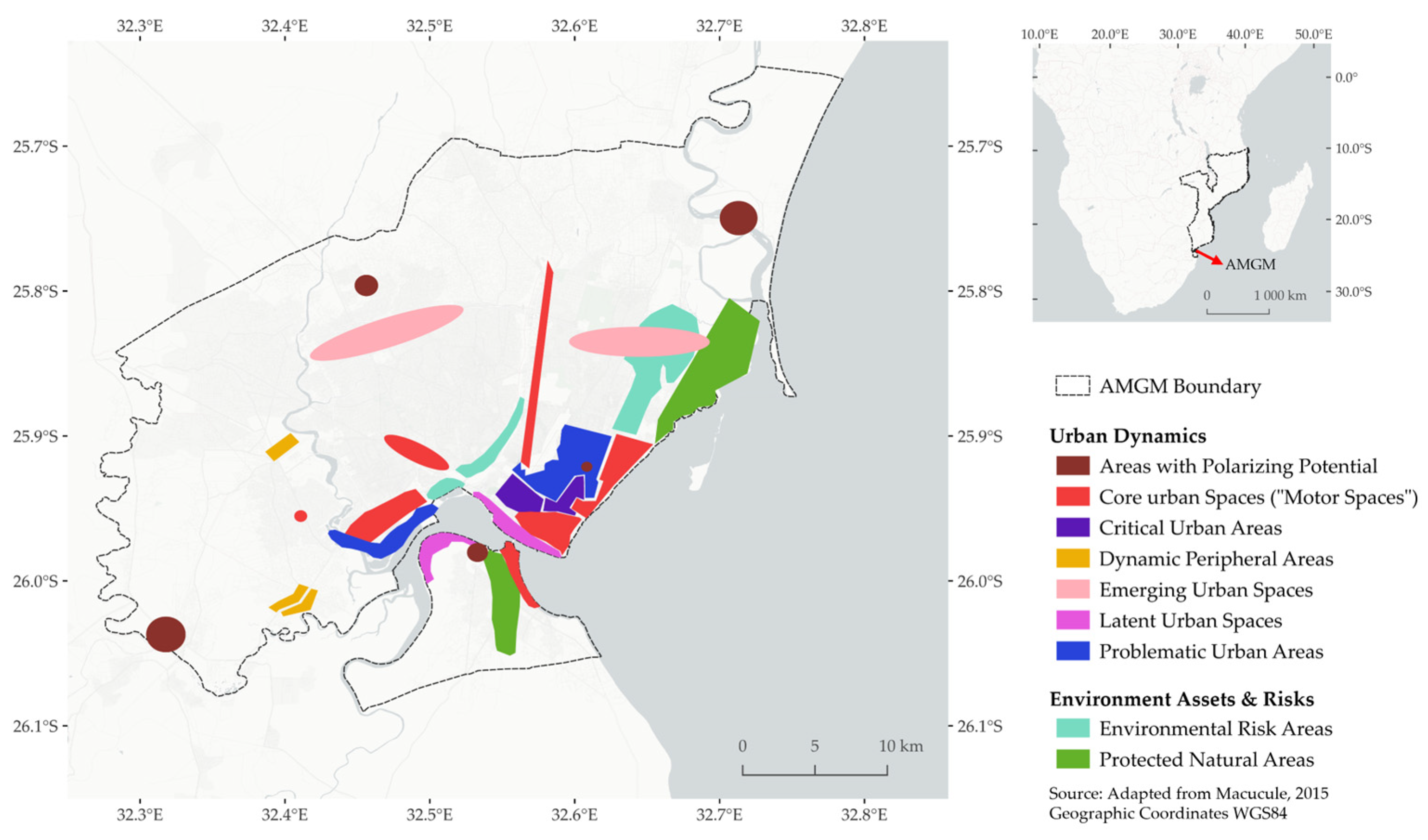
Área Metropolitana do Grande Maputo) constitutes Mozambique’s principal urban region, extending along the southern Mozambican coast and integrating municipalities and adjoining territories that form the functional urban system surrounding the national capital (
Figure 2). Occupying a strategic coastal corridor that connects Maputo to its hinterland, the AMGM exemplifies the multiple spatial logics—formal and informal, planned and spontaneous—that characterize the country’s contemporary urbanization. Consolidated urban cores coexist with dense informal settlements and expansive peri-urban zones where land conversion and construction proceed largely outside formal regulation. Along the EN1 corridor, agricultural land has been rapidly transformed into mixed-use development, generating fragmented settlement patterns and persistent infrastructure deficits. Ecological areas such as the Costa do Sol wetlands, the Infulene Valley, and the mangrove systems of Maputo Bay remain under mounting pressure from urban encroachment, while low-lying floodplains face recurrent flooding that disproportionately affects low-income residents.
Despite strong functional interdependence, metropolitan governance remains institutionally fragmented. Each municipality exercises independent planning and fiscal authority, while strategic infrastructure, water supply, and land administration are largely managed by national agencies. The absence of a metropolitan coordinating body produces significant gaps in policy coherence and service delivery, particularly in transport integration, waste management, and environmental protection.
The empirical foundation of this study derives from doctoral research conducted between 2012 and 2015 [
5], which investigated metropolitan dynamics through a mixed-method approach combining spatial analysis, field surveys, and policy documentation. The research developed a spatial typology that distinguished consolidated cores, critical informal settlements, peri-urban “problem areas,” speculative developments, latent development zones, ecological reserves, and risk-prone areas. This typology—illustrated in
Figure 2—serves as the empirical baseline for assessing whether the spatial and institutional configurations identified a decade ago persist under the new national policy framework.
3.2. Policy Documentary Analysis
A systematic documentary review was conducted of Mozambique’s
Política de Urbanização (Urbanization Policy), approved in July 2024 (Resolução n.º 31/2024) [
26]. The analysis examined the main policy document alongside supporting legislation, sectoral strategies, and implementation guidelines concerning housing, transport, environmental management, and disaster-risk reduction. Complementary materials from international development partners—including Cities Alliance, UN-Habitat, and the World Bank—were reviewed to clarify institutional mandates, financing frameworks, and overall policy coherence.
The review focused on how the 2024 Policy engages with four core dimensions of metropolitan governance:
- (1)
Urban containment and spatial regulation, including the management of expansion and ecological land protection;
- (2)
Informal settlement upgrading and regularization, concerning tenure security, service provision, and integration into formal planning systems;
- (3)
Ecological sustainability and climate resilience, encompassing environmental protection, adaptation and risk management; and
- (4)
Institutional coordination and multi-level governance, referring to mechanisms for inter-municipal collaboration and state–local alignment.
These four dimensions correspond to the governance challenges identified in the 2015 research, enabling a temporal comparison between empirical diagnosis and national policy responses.
3.3. Analytical and Theoretical Framework
To assess alignment between empirical findings and policy provisions, this study applies a convergence assessment framework structured around three analytical dimensions: (i) recognition of metropolitan problems, (ii) articulation of guiding principles, and (iii) establishment of operational mechanisms. Convergence is classified on a four-point ordinal scale ranging from
high (●) to
none (○), indicating the extent to which the 2024 Urbanization Policy incorporates or operationalizes recommendations derived from the 2015 study. Rather than quantifying performance, the framework provides a systematic and transparent basis for comparing policy–practice alignment across the four governance dimensions defined earlier, ensuring consistent and replicable interpretation of policy convergence. The operational criteria applied for each convergence level and analytical component are summarized in
Table 1, which supports the comparative analysis presented in
Section 4.
The method is both comparative and critical. Rather than treating the 2024 Urbanization Policy as a neutral framework, the analysis juxtaposes its stated principles with the challenges documented in Greater Maputo. It identifies both convergences (areas where policy reflects earlier recommendations or addresses persistent problems) and tensions (areas where policy remains declarative, ambiguous, or silent in operational terms). Finally, the article adopts an interpretive theoretical lens informed by contemporary debates on metropolitan governance, urban informality, and the politics of scale [
30,
31,
32,
33,
34,
35]. This framing situates the Maputo case within broader African and global scholarship, ensuring that its insights contribute both to Mozambique’s policy debate and to comparative understandings of metropolitan governance under conditions of rapid urbanization.
4. Results: Revisiting Metropolitan Dynamics in Light of the Urbanization Policy
The reassessment of the Greater Maputo Metropolitan Area (AMGM) against the framework of Mozambique’s Urbanization Policy [
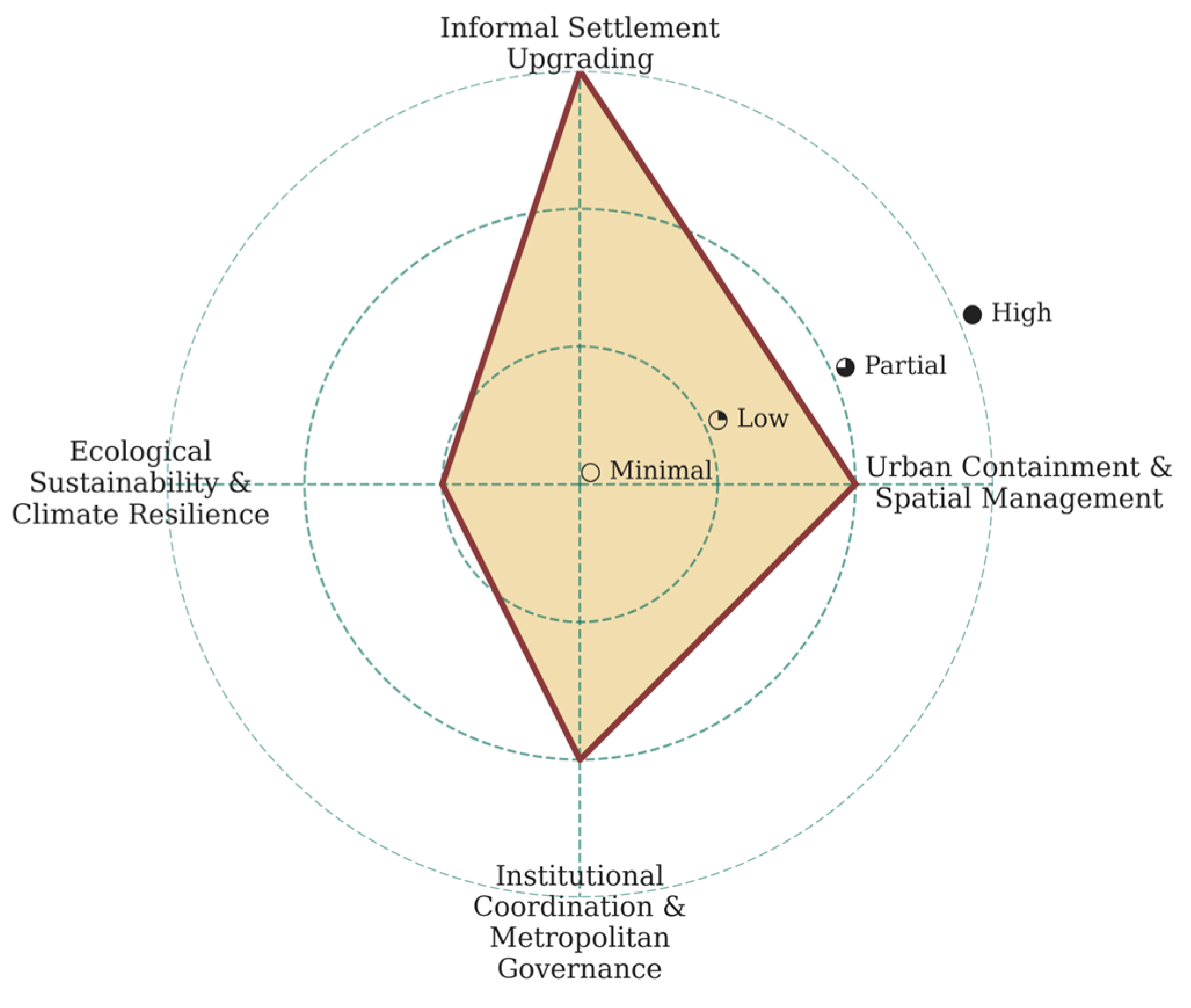
26] reveals a differentiated pattern of alignment. While the policy demonstrates clear recognition of persistent metropolitan challenges, the degree of convergence—understood as the extent to which policy provisions address previously documented spatial and governance issues—varies considerably across the four analytical dimensions. Applying the convergence assessment framework outlined in
Section 3.3., findings indicate high convergence in informal settlement upgrading (where problem recognition, principle articulation, and operational mechanisms coincide), partial convergence in urban containment and institutional coordination (acknowledging problems but lacking enforcement tools), and low convergence in ecological sustainability (general principles without territorial or regulatory specificity). This variation highlights both emerging opportunities and enduring governance gaps in Mozambique’s metropolitan transition (
Table 2).
4.1. Urban Containment and Spatial Management
Long-term spatial analyses [
38] and subsequent studies [
5,
39] converge in showing that Maputo’s unregulated, low-density expansion has progressively converted agricultural and ecological land into peri-urban and speculative developments, underscoring the systemic absence of effective containment mechanisms. Urban containment was therefore proposed as a strategic priority—advocating for densification, ecological corridor protection, and transitional land-use categories to control informal sprawl. The 2024 Policy echoes these concerns by recognizing the challenges of low-density sprawl and by calling for spatial planning instruments capable of balancing urban and rural systems [
26]. However, while it articulates a coherent spatial vision, operational mechanisms remain undefined. No metropolitan-scale instruments, enforcement frameworks, or fiscal incentives are proposed to manage expansion. This reflects a pattern common to many African metropolitan regions, such as Accra and Dar es Salaam, where decentralization reforms have advanced faster than spatial regulation capacity [
3]
4.2. Informal Settlement Upgrading and Regularization
The 2015 study identified “critical urban areas” of high dense informality as a defining feature of AMGM, where precarious housing, insecure tenure, and deficient infrastructure coexisted with proximity to central economic opportunities [
5]. It recommended integrated upgrading, regularization of land tenure, and recognition of informal economies as central to urban life. The new Policy marks a conceptual advance by acknowledging informality as a structural component of urbanization and committing to upgrading rather than eradication [
26]. This represents a convergence with earlier recommendations, aligning with international calls for inclusive urban governance [
10,
30]. Yet, the gap lies in operationalization: the policy lacks clearly assigned mandates, financing strategies, and participatory mechanisms for implementation. Experience from Nairobi and Johannesburg demonstrates that without fiscal devolution and institutional coordination, upgrading remains project-based rather than systemic [
15].
4.3. Ecological Sustainability and Climate Resilience
The previous research stressed the vulnerability of AMGM’s ecological assets, including wetlands, floodplains, and green corridors, which were threatened by both informal occupation and formal speculative development [
5]. It argued for the protection and integration of ecological infrastructures into metropolitan planning as a condition for resilience. The 2024 Urbanization Policy explicitly identifies “resiliência urbana,” risk reduction, and ecological balance as core principles [
26], thereby acknowledging the structural importance of climate adaptation in urban development. However, its policy statements remain broad and lack spatial specificity or enforceable instruments. No explicit mechanisms are identified for metropolitan-scale ecological zoning, floodplain regulation, coastal setback enforcement, or ecosystem restoration, despite these being central metropolitan challenges documented in Greater Maputo, as identified in the 2015 baseline study [
4]. This limited convergence reflects a broader governance challenge in translating climate adaptation and environmental sustainability agendas into operational spatial planning practice.
4.4. Institutional Coordination and Metropolitan Governance
Governance fragmentation remains the core structural constraint. The 2015 research documented parallel administrative systems operating in isolation—municipalities, districts, and central agencies each holding partial authority over land, infrastructure, and fiscal management [
5]. It recommended establishing a metropolitan coordination mechanism to align policies, investments, and spatial planning. The 2024 Policy acknowledges this challenge by stressing multi-level coordination and institutional strengthening [
26]. Yet, the policy stops short of establishing a clear metropolitan governance model, remaining silent on the creation of metropolitan institutions or inter-municipal compacts. This ambiguity reflects a wider international debate: while metropolitan governance is often promoted as a solution, evidence shows that effectiveness depends on political will, fiscal capacity, and legitimacy rather than on formal structures alone [
31,
32,
33,
34] (
Table 2).
4.5. Synthesis: Patterns of Convergence and Underlying Constraints
Across all four dimensions, the analysis reveals a predominantly partial convergence between the metropolitan realities identified in 2015 and the orientations of the 2024 Urbanization Policy. The policy demonstrates clear diagnostic continuity—recognizing the key challenges of sprawl, informality, ecological vulnerability, and fragmented governance—but its translation into enforceable instruments remains limited. This pattern suggests that policy learning has occurred, yet institutional adaptation has not.
Three interrelated factors explain this outcome. First, metropolitan governance remains structurally fragmented: municipalities operate with limited fiscal autonomy while strategic infrastructure and land management are centralized, constraining coordinated implementation. Second, the persistence of informality as both a governance practice and an economic necessity produces a dual system where formal planning coexists with negotiated regulation, complicating enforcement. Third, international frameworks—while influential in shaping discourse—often promote normative principles (resilience, inclusivity, sustainability) without equivalent attention to administrative feasibility or local capacity building.
The result is a metropolitan governance landscape that acknowledges complexity but struggles to act upon it. The 2024 Urbanization Policy constitutes an important institutional milestone, yet its capacity to transform the metropolitan trajectory depends on whether it can move from declarative orientation to operational implementation through fiscal devolution, legal clarity, and multi-actor coordination. These findings reinforce that governance effectiveness in African metropolises is not limited by policy absence but by policy enactment, marking the central challenge for the next decade of urban transformation in Mozambique (
Figure 3).
Comparative evidence from other rapidly urbanizing African city-regions reinforces the broader validity of the convergence patterns identified in Greater Maputo. Across Sub-Saharan Africa, the share of urban residents living in informal settlements remains consistently high—reaching approximately 72% in Dar es Salaam, 65% in Lusaka, 60% in Accra, and more than 80% in Maputo itself [
3,
15]. Rates of land conversion in peri-urban zones also reveal parallel trends: in Dar es Salaam, urban land expanded by 8.5% annually between 2010 and 2020, outpacing population growth by nearly twofold [
3], while Accra and Lusaka show comparable patterns of low-density sprawl driven by informal subdivision and speculative investment [
1]. These trajectories unfold under similar fiscal constraints: in most African cities, less than 15% of total urban revenue is locally generated, limiting the capacity to implement metropolitan-scale planning or infrastructure [
3,
40]. The persistence of these trends suggests that Maputo’s challenges—weak fiscal decentralization, land market informality, and ecological vulnerability—are not unique but characteristic of the broader urban transition in Africa, underscoring the regional relevance of Mozambique’s policy reforms and their potential to inform comparative governance debates.
4.6. Translating Convergence Findings into Governance Strategies
The differentiated convergence patterns discussed above reveal that bridging the policy–practice gap in Greater Maputo requires not only technical planning tools but also institutional realignment and political negotiation.
Table 3 synthesizes these findings into a strategic governance framework that identifies key leverage points for reform across seven dimensions. Rather than prescribing interventions, the framework interprets where and how metropolitan governance could evolve under Mozambique’s current institutional, fiscal, and social conditions. It thus shifts the focus from declarative policy language toward the mechanisms through which convergence may be realized.
Institutional coordination and fiscal governance emerge as critical bottlenecks shaping all other dimensions. The persistent absence of an inter-municipal coordination body constrains policy coherence, resource allocation, and infrastructure planning across the metropolitan scale—reflecting a broader governance dilemma observed in other African city-regions where fragmented authority undermines collective action [
30,
31]. Short-term priorities therefore include establishing collaborative mechanisms among the metropolitan municipalities, supported by shared data platforms and harmonized technical standards. Medium-term consolidation through a formal metropolitan governance entity would anchor coordination in law and finance, transforming inter-municipal cooperation from ad hoc arrangements into enduring institutional capacity.
Land management and spatial regulation remain another area of partial convergence. Harmonization of cadastral and land-use systems is essential for converting policy aspirations for urban containment into enforceable spatial instruments. Such integration would enable a unified metropolitan plan that aligns ecological protection and densification strategies—addressing the entrenched pattern of low-density expansion documented since the 1980s [
38]. Over time, adaptive zoning and spatial monitoring could institutionalize a learning-based model of spatial governance, moving from reactive control to proactive management of urban growth.
In the social and informal settlement dimension, the 2024
Política de Urbanização marks an epistemic shift: informality is recognized as a structural mode of urban production rather than a transitional phase. Translating this recognition into practice demands participatory upgrading models that combine community engagement, fiscal inclusion, and incremental tenure security. Comparative evidence from other African cities suggests that such co-production approaches enhance both legitimacy and implementation efficiency when embedded in metropolitan governance frameworks [
10,
34]. Medium- to long-term strategies should therefore prioritize the integration of informal neighborhoods into formal planning and taxation systems while maintaining social accountability.
Infrastructure, service delivery, and ecological governance form the operational interface through which metropolitan coordination materializes. Short-term interventions should prioritize mobility and waste management systems that cross administrative boundaries, while long-term sustainability depends on adopting circular-economy principles and resilient infrastructure investment mechanisms. However, the weak fiscal autonomy of local governments—identified in both the 2015 study and subsequent policy analysis—continues to limit implementation capacity, underscoring the need for systemic fiscal decentralization.
Finally, the dimensions of monitoring, learning, and knowledge production remain underdeveloped in the 2024 Policy, yet are indispensable for sustaining institutional reform. The establishment of a metropolitan observatory could provide an evidence-based platform for evaluating spatial, environmental, and socio-economic dynamics—an institutional innovation long advocated in both national and international assessments of Maputo’s governance trajectory [
26]. Embedding such adaptive learning mechanisms would allow metropolitan governance to evolve iteratively, aligning policy ambitions with real-world transformations.
Collectively, these governance strategies reinterpret convergence not as a static condition but as a dynamic process of institutional learning and negotiation. The framework presented in
Table 3 therefore extends the analysis beyond descriptive comparison, proposing a conceptual bridge between empirical diagnosis and governance theory. It highlights that sustainable metropolitan transformation in Mozambique depends less on the existence of policy frameworks than on the political, fiscal, and organizational capacities that determine their enactment.
5. Discussion
The reassessment of Greater Maputo Metropolitan Area in light of the
Política de Urbanização [
26] demonstrates how metropolitan governance remains the critical hinge between urban policy principles and the realities of rapidly expanding African cities. The findings show that while the policy acknowledges structural challenges—sprawl, informality, ecological vulnerability, and institutional fragmentation—it does not provide the operational tools required to resolve them. This policy–practice gap reflects a broader pattern observed in metropolitan governance globally, where discursive consensus on the importance of metropolitan coordination contrasts with the difficulties of institutional design, mandate allocation, and political legitimacy [
30,
31,
32].
The case of Maputo exemplifies what Cox [
32] terms the politics of scale: the struggle over which level of government should exercise authority over urban transformation. Municipalities, districts, and the central state all stake claims in the AMGM, but none holds the capacity to articulate a truly metropolitan strategy. As Fricke [
33] argues, metropolitan regions are also discursively constructed. In Mozambique, this tension manifests in a form of “metropolitanism without institutions,” where the discourse of integration exceeds administrative reality. This resonates with Nielsen’s analysis of peri-urban Maputo, where planning itself reproduces ambiguity and informality [
35]. Rather than providing clarity, governance often generates para-legal landscapes that normalize fragmented and precarious urbanization.
A key point of convergence lies in the recognition of informality. Both the 2015 research and the 2024 Policy emphasize the need to integrate informal settlements through upgrading and regularization. This reflects a conceptual shift in African urban policy thinking, away from eradication and toward co-production [
10,
34]. Yet, as international scholarship stresses, upgrading requires not just technical interventions but also participatory mechanisms, fiscal instruments, and legal reforms capable of embedding informality into formal planning systems of urban governance [
7,
34]. Without such institutional innovations, informal settlements risk remaining peripheral to metropolitan visions, despite being central to everyday urban life.
Ecological governance presents another area of tension. The persistence of informal and speculative occupation of wetlands, floodplains, and green corridors reveals the weakness of environmental integration in metropolitan planning. Although the 2024 Policy acknowledges sustainability and resilience, it does not articulate concrete metropolitan strategies such as ecological zoning, greenbelt protection, or metropolitan-scale climate adaptation. This absence mirrors broader critiques that African urban policies often treat ecology as an abstract principle rather than as an actionable governance challenge [
8,
9].
Ultimately, the analysis suggests that Greater Maputo is not an outlier but a paradigmatic case of the contradictions of metropolitan governance in Africa. As Tomàs and Pyka [
34] note, metropolitan governance is a multidimensional field involving institutions, policies, actors, and legitimacy. In Mozambique, each of these dimensions remains underdeveloped: institutions are fragmented, policies remain declarative, actors lack coordinated arenas for negotiation, and legitimacy is undermined by limited public participation. The 2024 Urbanization Policy is an important milestone in recognizing these challenges, but its effectiveness will depend on translating principles into metropolitan governance mechanisms that are financially viable, politically legitimate, and socially inclusive.
Although the analysis is centered on Greater Maputo, the findings carry relevance for metropolitan governance debates across rapidly urbanizing African cities. The pattern observed here—policy frameworks that acknowledge structural challenges but fall short in operational mechanisms—resembles dynamics documented in Accra, Dar es Salaam, and Lusaka, where informal settlement dominance, weak intergovernmental coordination, and ecological vulnerability similarly outpace institutional capacities [
41,
42,
43]. The Maputo case therefore reinforces a broader regional insight: national policies are increasingly ambitious in principle, yet translation into metropolitan instruments, fiscal arrangements, and coordinated implementation remains limited. By demonstrating how convergence between policy and practice is only partial despite progressive framing, the study contributes to comparative discussions of why metropolitan reforms in many African contexts remain discursive rather than transformative.
While this study provides an evidence-based assessment of metropolitan policy–practice convergence, it does not include a systematic analysis of the political economy, corruption, or the role of foreign investment in shaping metropolitan governance in Maputo. These factors are widely recognized as influential in African city-regions, yet robust and comparable data specific to Mozambique remain limited. The analysis therefore focused on dimensions for which empirically grounded or policy-based evidence could be synthesized—namely informality, spatial management, institutional coordination, and ecological sustainability—ensuring that interpretations rest on verifiable sources rather than conjectural attribution of causality. Future research should build on this foundation by integrating political economy perspectives and mixed-method approaches to examine how financing structures, donor interventions, and elite interests influence policy implementation. Longitudinal studies combining spatial analysis, fiscal data, and governance ethnographies would also enhance understanding of the mechanisms through which metropolitan governance frameworks evolve over time.
6. Conclusions
This article revisited research conducted in 2015 on the Greater Maputo Metropolitan Area (AMGM) and critically assessed its findings in light of Mozambique’s
Política de Urbanização [
26]. The analysis shows that many of the metropolitan dynamics identified a decade ago—urban sprawl, the centrality of informal settlements, ecological vulnerability, and fragmented governance—remain highly relevant. The 2024 policy recognizes these challenges and articulates principles of balanced territorial development, urban–rural integration, equity, resilience, and sustainability. Yet, it continues to fall short of providing concrete mechanisms to operationalize metropolitan governance. The persistent gap between policy intent and metropolitan realities reflects the broader difficulty of translating normative policy frameworks into enforceable, multi-scalar governance mechanisms. Three key conclusions can be drawn. First, sustainable metropolitan development in Mozambique requires more than normative policy frameworks: it depends on operational instruments of urban containment, settlement upgrading, and ecological protection that can be enforced across administrative boundaries. Second, informality must be recognized and governed as a structural dimension of urbanization. Advancing inclusive governance therefore requires participatory upgrading strategies, fiscal innovations, and legal instruments that formally integrate informal practices into urban planning, land administration, and taxation systems. Third, metropolitan governance depends on multi-scalar coordination and fiscal legitimacy: without empowered inter-municipal structures, shared financing systems, and transparent decision-making, policies risk remaining declarative.
Table 3 translates these findings into a phased strategic framework, identifying short-, medium-, and long-term priorities for operationalizing metropolitan governance. It highlights the sequencing of institutional reforms, capacity-building efforts, and fiscal strategies necessary to transform policy convergence into actionable change. The framework thus bridges empirical diagnosis with policy design, offering a roadmap for aligning national policy intent with metropolitan implementation.
Beyond the Mozambican case, this study contributes to comparative debates on metropolitan governance in rapidly urbanizing African contexts. It demonstrates the analytical value of longitudinal policy assessment in identifying where governance reforms succeed or falter over time. While the Urbanization Policy marks an important institutional milestone, its long-term impact will depend on sustained political will, resource mobilization, and inter-municipal cooperation.
Future research should expand this analysis by incorporating political economy dimensions and quantitative performance indicators to evaluate how financial structures, donor interventions, and local power dynamics shape policy implementation. Comparative studies across African metropolitan regions could also clarify how governance architectures adapt—or fail to adapt—to the dual pressures of rapid growth and limited state capacity. Such research would deepen understanding of how metropolitan governance can evolve into an effective instrument for equitable and sustainable urban transformation.