1. Introduction
EU Cohesion Policy (ECP) plays an important role in promoting the balanced development of all European regions and all types of territories. Taking an integrated territorial approach to development by supporting territorial strategies and instruments provides the opportunity to simultaneously tackle economic, social, and environmental challenges in an integrated, participatory, and place-based manner [
1]. In the 2014–2020 period, ECP funding for sustainable urban and territorial development was provided mainly through the regional operational programmes in mainland Portugal (Norte, Centro, Alentejo, Lisbon, and Algarve). Within this period, around EUR 2.5 Billion of ECP support was implemented through territorial instruments. Despite these efforts, territorial disparities in Portugal persist and the implementation of territorial instruments in Portugal suffered significant delays in the 2014–2020 period [
2].
In Portugal, the territorial approach under ECP for 2021–2027 has maintained some of the previous structure. However, there have been changes both to the types of territorial instruments mobilised and the territorial focus and investment priorities of each of the instruments. The territorial development approach for 2021–2027 in Portuguese programmes prioritises support to sustainable integrated territorial strategies, focusing on enhancing access to basic services, innovative solutions and urban–rural linkages to enhance the endogenous potential of these areas, taking into account the different needs at functional (urban) area level. This paper analyses these strategies and their potential contribution to reducing social segregation and vulnerability in the Portuguese mainland regions.
In more detail, the paper develops an assessment of 19 Integrated Urban Development (IUD) strategies in Portuguese mainland intermunicipal communities (IMCs) and Metropolitan Areas (MAs) which support the regional strategies/action plans. Under this strategy, a wide range of investments are possible from different ECP objectives (PO1—a Smarter Europe, through digitisation, innovation, support to small and medium-sized businesses, and economic transformation; PO2—a Greener, carbon-free Europe, implementing renewables, energy transition and the fight against climate change, PO4—a more social and inclusive Europe implementing the European Pillar of Social Rights; PO5—a Europe closer to citizens by fostering integrated and sustainable development. Under ECP objective 5, one of the main investment priorities identified is provision of services (health, education, etc.) as well as urban regeneration and rehabilitation. Hence, the selected IUD strategies are analysed to verify how far they can contribute to reducing social segregation and vulnerability in Portuguese mainland IMCs and MAs. Despite growing academic interest in EU Cohesion Policy-funded urban strategies, there is limited empirical evidence on how Integrated Urban Development strategies in Portugal are specifically designed to address social segregation and vulnerability at the intermunicipal scale. This paper addresses this gap by systematically assessing the extent to which the 19 Portuguese IUD strategies for 2021–2027 incorporate measures aimed at reducing social segregation and vulnerability, thereby contributing new empirical evidence to the literature on integrated territorial development and social cohesion.
From a methodological standpoint, the research followed direct and indirect methods to collect the necessary information for all case studies. For the most part, the information was collected via: (i) literature review—consultation of IUD strategies for all case studies; literature revision (books, papers, reports) analysing the implementation of IUD in Portugal and the EU; (ii) field research—field trips to one or two selected case studies, for direct contact with entities involved in the design and implementation of IUD strategies. The analysis covered the following six analytical dimensions which were proposed by Pertoldi et al. [
3]. The analytical framework was selected to validate the relevance and effectiveness of the analysed IUD strategies in achieving the expected results.
A: Strategic Dimension: Assessment of how the design and implementation of the IUD strategy and action plan set clear objectives and develop clear actions that respond to the potential of the area and development needs, while at the same time being aligned with the national and regional spatial planning strategies and programmes;
B: Territorial Focus: Assessment of how far the design and implementation of the IUD strategy and action plan have a clear territorial focus in which challenges and opportunities for development are matched with the appropriate spatial scale and territorial context of the selected intervention area;
C: Governance: Assessment of how the relevant authorities and stakeholders decide to plan, finance, and manage the design and implementation of the IUD strategy and action plan;
D: Cross-Sectoral Integration: Assessment of how the design and potential implementation of the IUD strategy and action plan ensure coherence in policy-making principles and objectives across policy areas and ensures that actors relating to different sectors cooperate to create policies;
E: Funding and Finance: Assessment of how the implementation of the IUD strategy and action plan going to be funded, and if there is a combination of multiple funding sources;
F: Monitoring and Evaluation: Explanation of which monitoring and evaluation procedures are due to be implemented by of the IUD strategy and action plan to assess its relevance, effectiveness, efficiency, and ultimately its main results and impacts (if any).
To operationalise this framework, each of the six dimensions was assessed qualitatively through documentary analysis of the IUD strategies and action plans. For each dimension, a small set of criteria was used to guide this assessment: the Strategic Dimension was examined through the presence and clarity of stated objectives and their explicit alignment with national and regional spatial planning instruments (e.g., the PNPOT and regional programmes); Territorial Focus was examined through whether the strategy identified a clearly delimited intervention area matched to documented territorial challenges and opportunities; Governance was examined through the range of actors formally involved in the strategy’s design (municipal, intermunicipal, regional, national, academic, NGO, and general public) and the mechanisms used for their involvement; Cross-Sectoral Integration was examined through the number and diversity of policy domains (e.g., housing, employment, education, mobility, social services) jointly addressed within the same strategy; Funding and Finance was examined through the diversity of funding sources mobilised and the share of the budget allocated to social segregation and vulnerability-related measures; and Monitoring and Evaluation was examined through the existence, or absence, of formally defined indicators, targets, and institutional responsibilities for tracking implementation. Based on these criteria, each strategy was classified, for each dimension, as displaying a strong, moderate, or weak performance, depending on whether the corresponding criteria were fully, partially, or not addressed in the strategic documents. This qualitative, criteria-based scoring approach follows the logic of the original Pertoldi et al. [
3] framework, adapted here to the Portuguese intermunicipal and metropolitan governance context, namely through the explicit use of national and regional spatial planning instruments (e.g., the PNPOT) as a reference for assessing strategic alignment.
The remainder of the paper is structured as follows. It begins by presenting a literature review of the key concepts of the paper (social segregation and vulnerability). The empirical analysis of the case studies is synthetically presented in the following topic. Theoretical and policy implications are discussed in the conclusions. Against this background, this paper aims to assess the extent to which the design of the 2021–2027 Portuguese IUD strategies incorporates measures oriented towards reducing social segregation and vulnerability, addressing the following research questions: (i) to what extent do the analysed IUD strategies and action plans incorporate policy measures targeting social segregation and vulnerability, and (ii) how do these strategies perform across the six analytical dimensions proposed by Pertoldi et al. [
3]? It should be noted that, since the analysed strategies are still at an early stage of implementation, this paper focuses on their design and programming phase, rather than on an assessment of their implementation or impacts.
2. Theoretical Framework: Territory, Territorialisation, Cohesion Policy, and the Reduction in Social Segregation and Vulnerability
The word territorial, in the context of public policies, entails a conceptual circle, which includes all the relevant analytical dimensions and respective components of territorial development [
2]. Even though it is commonplace to see in EU documents the association of territorial processes/policies with the dimensional triad of economy, society, and environment, territorial development is, more concretely, a process that requires the interrelation between social cohesion, economic competitiveness, spatial planning, environmental sustainability, and territorial governance-related processes. Closely related to this notion is the process of territorialisation, understood as the way in which public policies and institutional actors construct, delimit, and give meaning to a given territory as a scale of intervention, rather than treating it merely as a pre-existing administrative container. Territorialisation therefore implies an active, relational, and often contested process, through which territorial boundaries, identities, and governance arrangements are produced and negotiated by multiple actors across different administrative levels (national, regional, intermunicipal, and local). In this regard, the Portuguese IUD strategies cover all these related development dimensions, as they are designed and delimited in articulation with existing national and regional spatial plans, an aspect addressed in more operational terms in
Section 4.
Achieving the goal of territorial cohesion within the European Union (EU) territory became one of the EU’s formal objectives under the Lisbon Treaty in 2009 [
2]. Although there is no common agreement on the notion of territorial cohesion, the EU treaty embraces a policy rationale on the policy need to foster a harmonious and balanced development of all places. As recent analyses on territorial cohesion trends in the EU territory have shown, however, there are no known examples of achieving territorial cohesion trends in EU Member States in recent decades at the national level. Conversely, studied cases (e.g., Portugal, Spain, Sweden, Finland, Poland) have demonstrated the opposite: at the national level, in recent decades, there have been systematic trends of territorial exclusion rather than territorial cohesion [
2].
Territorial cohesion is a multidimensional concept. Its meaning is thus linked with the selected analytical dimensions and respective components in any proposed definition. According to the Star Model of territorial cohesion, this concept can be understood as “the process of promoting a more cohesive and balanced territory, by: (i) supporting the reduction of socioeconomic territorial imbalances; (ii) promoting environmental sustainability; (iii) reinforcing and improving the territorial cooperation/governance processes; and (iv) reinforcing and establishing a more polycentric urban system” [
4] (p. 10). Here, it identifies a clear urban-related dimension which is vital to fostering a more balanced and harmonious territory by promoting urban morphologic polycentrism, urban connectivity, and compactness.
In this context, EU territorial strategies and instruments have been, since the onset of ECP (e.g., urban community initiative) providing the opportunity to foster integrated, participatory, and place-based approaches to the development of urban areas [
1]. Crucially, these EU urban areas are catalysts for innovation and creativity, as well as engines of territorial development and, by now, represent approximately 70% of the EU inhabitants and two-thirds of the EU’s GDP [
5].
Urban areas are, however, places marked by persistent problems, such as unemployment, environmental pressures, poverty and segregation [
6]. In this light, successful urban development strategies can only be achieved through an integrated approach. This EU goal of integrated territorial and urban development has gained new momentum under the ECP 2014–2020 and 2021–2027 periods. More concretely, the 2021–2027 Common Provisions Regulation requires Member States to analyse their territorial challenges and needs and to address them through programming [
1].
The advantages associated with the implementation of IUS approaches for urban development have been recognized for a long time [
7]. In the same manner, the need to promote a more ‘integrated and sustainable human settlement planning and management in all countries’, is acknowledged by the United Nations 2030 Agenda for Sustainable Development, as a crucial step to improving the quality of life of citizens. Experimented with since the mid-1990s, this policy-integrated approach has been used by several EU policy initiatives [
8]. Among other policy areas, it has become manifest that the integrated urban development policies in Portugal have contemplated improving social domains such as improving the physical and socioeconomic of deprived urban neighbourhoods. This was done initially in the two Portuguese MAs of Lisbon and Porto, and soon after in most urban areas. Undercutting a common assumption of the importance of public policies acting in the domain of social inclusiveness, the following paragraphs summarise selected literature on social vulnerability and segregation.
For Cumberbatch et al. [
9] (p. 506), “vulnerability is the propensity or predisposition of an individual, community, asset or system to be adversely affected by hazards”. Social vulnerability is one dimension of vulnerability and embraces myriad components. For Rufat et al. [
10], these include, for instance: (i) socioeconomic status; (ii) gender and race; (iii) vehicle access and renters; (iv) age; (v) vacant housing; (vi) access and functional needs; (vii) race and ethnicity; and (viii) rental housing cost. Critically, social vulnerability is difficult to quantity and assess since it covers, according to Holand et al., [
11], both individual characteristics (race, age, health, dwelling, income, employment) as well as territorial attributes (robustness of the built environment, urbanisation, population growth, economic vitality, quality of infrastructure). Despite these and many other conceptual approaches to analysing social vulnerability, there is a common understanding of the definitional vagueness of the concepts of social vulnerability [
12].
Sometimes defined as a potential loss to a social group arising from a hazard, social vulnerability is often related to environmental aspects of territorial development [
13]. Indeed, according to Iskandar et al. [
14] climate change should be regarded as a fundamental component of social vulnerability as well, as failure to address climate change could result in increasing levels of social vulnerability across certain territories. Furthermore, Wang et al. [
15] make a case for relating the social vulnerability of local communities and their susceptibility to advanced impacts of natural hazard events. Instead, Yan and Li [
16] link the analysis of social vulnerability with analytical components such as: (i) regional health vulnerability; (ii) disadvantaged groups vulnerability; (iii) social security vulnerability and basic social development pattern; and (iv) population vulnerability and social stratification.
A different approach to measuring social vulnerability is proposed by Tuccillo and Spielman [
17], supported by measuring vulnerability from individual-level indicators. This approach unveils a more intricate and detailed picture of social vulnerabilities. A similar approach is presented by Rickless et al., [
18] denominated place-based vulnerability model, mostly used to analyse the effects of natural hazards on social vulnerability. In turn, Bhanjee & Zhang [
19] develop an analysis correlating social vulnerability with urban planning and sprawl, since rising global urbanisation levels tend to magnify existing or introduce new inequitable, inefficient, and vulnerable social processes.
Alike social vulnerability, the understanding of the concept of social segregation varies from source to source. Broadly speaking, however, social segregation is often regarded with a multilevel lens [
20]. More specifically, social segregation is expressed in terms of a physical divide, and also in terms of symbolic and social background divide [
21]. It is much in vogue that segregation leads to greater social disparities [
22], fuelling what are known as gated communities [
23], and making social segregation as one of the main challenges for society in current times [
24]. In particular, social segregation tends to perpetuate poverty in already places which concentrates poverty in socioeconomically deprived neighbourhoods [
25]. Moreover, segregation, whether by religion social class, or racially driven, tends to have alarming and dangerous consequences for the societies [
26]. There are several causes for social segregation. In European cities, for example, immigration into cities is one of the main causes of this phenomenon, as well as globalisation [
27]. Indeed, in Europe, social inequality looks to have a stronger connection with social-spatial segregation [
28]. This literature can further be complemented with insights from recent research on the socio-spatial dimensions of urban and territorial policy. For instance, equity-focused approaches to territorial vulnerability assessment illustrate how social vulnerability and accessibility indicators can be combined to identify priority areas for policy intervention [
29]. At the EU scale, recent policy evidence on the urban dimension of Cohesion Policy points to persistent challenges of fragmented governance and limited administrative capacity, which constrain cities’ ability to design and deliver integrated, socially inclusive strategies [
30]. In the Portuguese context specifically, evidence also points to the continued reliance on largely static, legal-compliance-oriented monitoring and evaluation practices for territorial public policies, which may limit the ability to track, in a timely manner, the effects of IUD strategies on social segregation and vulnerability [
31].
3. The Urban and Territorial Development Framework in Portugal
By being an EU Member State since 1986, Portugal has benefited from ECP funding since its first programming period (1989–1993). Here, the two Portuguese MAs (Lisbon and Porto) received financial support to rehabilitate socioeconomic deprived urban neighbourhoods [
1]). In the 2014–2020 period, ECP funding for sustainable urban and territorial development was provided mainly through the regional operational programmes in mainland Portugal (Norte, Centro, Alentejo, Lisbon, and Algarve). Within this period, around EUR 2.5 Billion of ECP support is being implemented through territorial instruments, out of which 22 Integrated Territorial Instruments (ITIs), 82 Community-Led Local Development (CLLDs), and 105 Sustainable Urban Development Strategies (SUDS) were supported with around EUR 1.9 Billion from the ERDF and EUR 381.9 Million from the ESF. For the 2021–2027 period, a total EU financing of EUR 3.3 billion from ERDF and ESF+ is planned for territorial instruments in Portugal, of which around EUR 3 billion from ERDF and EUR 300 million from ESF+.
For the 2021–2027 regional programmes, the following urban territorial instruments are planned under specific objective 5.1, drawing funding in some cases from other policy objectives (PO1, PO2, and PO4):
A: ITI CIM and Metropolitan Areas (AM): Supporting the strategies/action plans of the 21 intermunicipal communities and 2 Metropolitan Areas in mainland Portugal. Under this strategy there are a wide range of investments possible from different policy objectives (PO1, PO2, PO4 ESF+, PO5) depending on the regional programme. One of the main investment priorities identified under policy objective 5 is provision of services (education, health, etc.) as well as urban regeneration and rehabilitation.
B: ITI Redes Urbanas: Supporting the strategies/action plans of thematic networks of cities across NUTSII or NUTSIII regions. The networks should be led by a regional urban centre in partnership with at least three or more urban centres, and possibly other relevant territorial entities where relevant (higher education institutions, NGOs, local development associations, etc.). There are three types of themes that could be tackled through these networks: Innovation and Competitiveness focused on culture, Sustainable Cities, and Digitalisation. Depending on the regional programme this ITI draws funding from PO1, PO2, PO4, and PO5.
C: Parcerias para a Coesão Urbana: This instrument is only planned in the Lisbon Regional Programme, and only draws funding from PO5. The focus will be to support strategies/action plans developed by consortiums of local actors, and led by municipalities, that focus on the creation of innovation hubs across neighbourhoods of the Lisbon region. It is also an instrument that could provide an opportunity to promote projects in line with the New European Bauhaus initiative.
D: Urban ITI in the Autonomous Regions: The urban ITIs planned in the autonomous regions of Azores and Madeira follow a different structure to those of the mainland regions. It is relevant to note that this is the first time these two regions will have territorial instruments planned in their programmes. Madeira includes support to two strategies (one ITI in Porto Santo, and one in the Functional urban area of Funchal), whilst the Azores programme includes support to six strategies in the most densely populated municipalities of the region (Ponta Delgada, Angra do Heroísmo, Ribeira Grande, Praia da Vitória, Horta e Lagoa).
In Portugal, at the national level, the development of national spatial planning policies is determined by the resolution of the Council of Ministers n. ° 177/2021. The elaboration of the National Spatial Policy Programme (or Programa Nacional da Política do Ordenamento do Território—PNPOT, in Portuguese—[
32,
33,
34]) is a competence of the National Government in coordination with the Ministry responsible for spatial planning/territorial cohesion. In addition to the PNPOT, there are also Sectoral Programmes (Programas Sectoriais—PS) and Special Programmes (Programas Especiais—PE). Their elaboration is determined by the member of the government with direct competencies in the respective policy field, in articulation with the Ministry responsible for spatial planning/territorial cohesion [
35].
Under Portuguese legislation and good practice, however, the stakeholder engagement, particularly with regard to the question of whether representatives of marginalised groups can be involved in strategy development, is not especially developed.
Created in 2012, the Directorate General of Territory (Direção Geral do Território—DGT) is the national public body responsible for pursuing territorial planning policies, ensuring the consolidation of the territorial planning system and its application, and updating the legal and the regulatory framework which supports it. In sum, the Spatial Planning Programmes and Plans for the national level in Portugal are as follows:
A: The National Spatial Policy Programme—PNPOT: Establishes the main guidelines for the spatial planning process in Portugal and acts as a reference framework that should be considered when designing Sub-national Spatial Policy Programmes.
B: Sectoral Programmes—PS: Establish and justify the goals and options and the sectoral objectives with territorial incidence. By the end of 2022, 27 Sectoral Programmes were being implemented in Portugal. The development of such programmes and strategies cover various sectors of central administration, namely in the fields of prevention and minimization of risks, defence, public security, environment, water resources, conservation of nature and biodiversity, transport, infrastructure, communications, energy and geological resources, culture, health, housing, tourism, agriculture, forests, commerce, and industry and, since 2020, also landscape (Landscape Reordering and Management Programmes).
C: Special Programmes—PEOT: Establish the safeguard regime of the natural values and resources and the compatible management regime aiming at a sustainable use of the territory by establishing concrete actions. In 2017, on the mainland, the process of preparing or reviewing two Coastal Shore Programs, 14 Protected Area Programs, and 4 Public Water Reservoir Programs had begun, with only two Coastal Shore programmes being currently published: Ovar—Marinha Grande; Alcobaça—Cabo Espichel. At the end of 2020, two special programmes and 74 special spatial planning plans were in force. These instruments cover eight sections of the coastline, 25 protected areas, and 43 public water reservoirs, distributed across 58% (162) of the municipalities. In 2020, the Autonomous Region of the Azores (RAA) had 16 special territorial planning plans (10 coastal planning plans, five lagoon river basin planning plans, and one protected area planning plan). Several PEOTs were the subject of assessment reports and consequent amendment processes, namely one POAP (Plan for the Planning of the Protected Landscape of the Vineyard Culture of Pico Island), one POBH (Plans for the Planning of the Hydrographic Basins of Lagoas das Furnas and Sete Cidades), three POOC (Coastal Management Plans for the Islands of São Jorge, Terceira and São Miguel).
As seen, the Sectoral and Special Programmes are very specific in sectoral and environmental policies, without a clear connection with an integrated urban and territorial planning vision for Portugal. Instead, the PNPOT is the top guiding instrument of the Portuguese territorial management system. As such, it establishes the model for organising the national territory and defines objectives and strategic options for territorial development. In essence, the PNPOT constitutes the reference framework for other programmes and territorial plans and acts as a guiding instrument for strategies with potential territorial impacts [
34].
Just like in the first version of the PNPOT [
32], the current updated version (2018) established as a guiding overall strategic vision: the goal of promoting a more cohesive Portuguese territory. However, when analysing the main strategic guidelines of the PNPOT 2.0, there is a clear contradiction in the presented strategic plan, as it recommends the prioritisation of public investment in the two Portuguese mainland metropolitan areas. Even so, the five main territorial challenges for the PNPOT are aligned with a strategic policy goal of promoting territorial cohesion processes:
A: Manage natural resources sustainably: value natural capital; promote the efficiency of regional and urban metabolism; increase socio-ecological resilience.
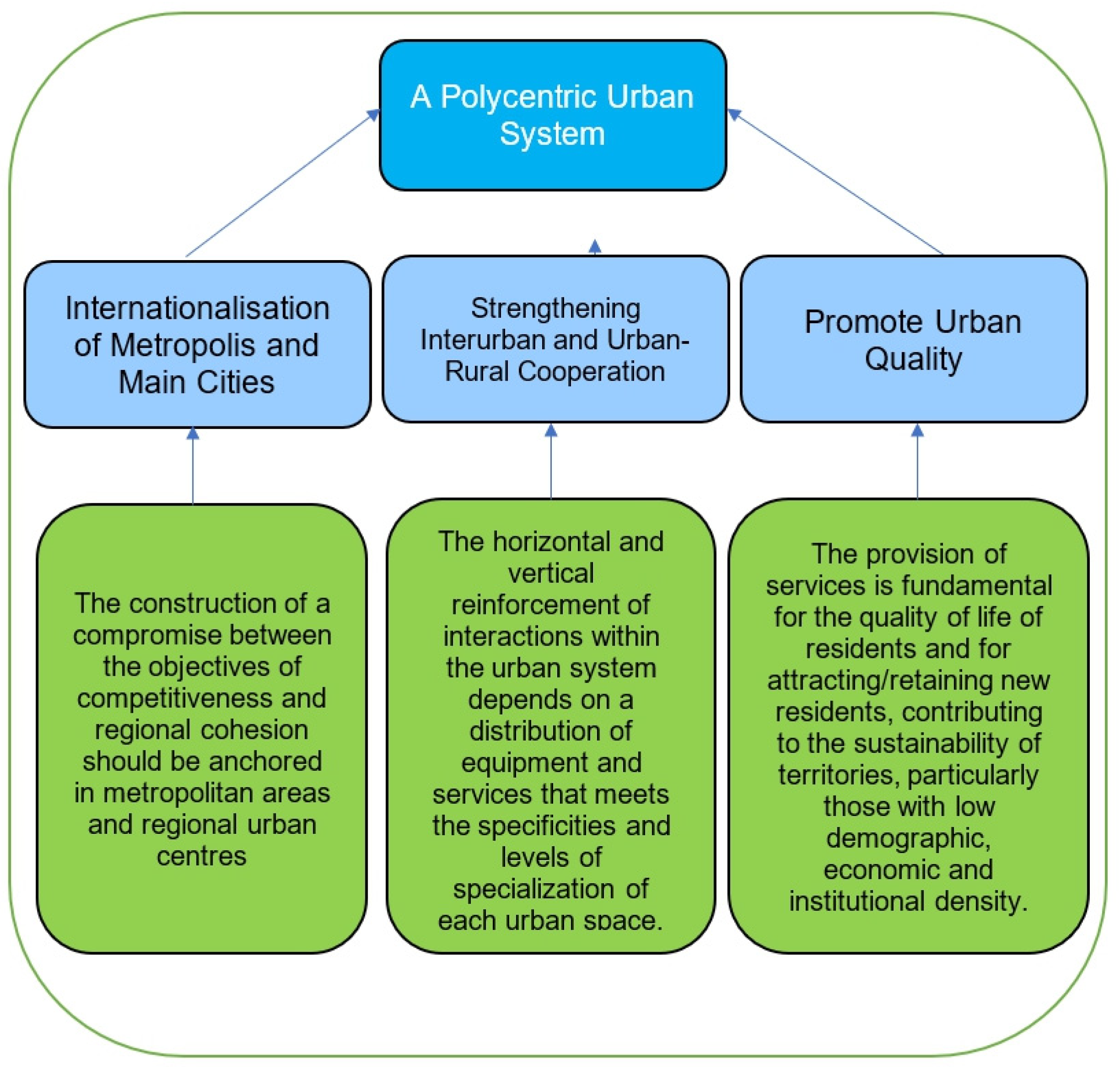
B: Promote a polycentric urban system: affirm metropolises and main cities as engines of internationalization; strengthen interurban and rural–urban cooperation as a cohesion factor; promote urban quality.
C: Promote inclusion and value territorial diversity: increase population attractiveness and social inclusion and reinforce access to services of general interest; boost local and regional potential and rural development considering the dynamics of globalisation; promote cross-border development.
D: Strengthen internal and external connectivity: optimise environmental infrastructure and ecological connectivity; strengthen and integrate accessibility and mobility networks; boost digital networks.
E: Promote territorial governance: strengthen intersectoral and multilevel cooperation; promote territorial-based collaborative networks; increase territorial culture.
4. Integrated Urban Development Approach in 2021–2027 Cohesion Policy Programmes in Portugal and the Reduction in Segregation and Social Vulnerability
In operational terms, the notion of territory used to define and delimit the Portuguese IUD strategies corresponds to the administrative and functional units established by national and regional spatial planning instruments—namely the intermunicipal communities (IMCs), the Metropolitan Areas (MAs), and the functional urban areas identified in the PNPOT and its associated sectoral and regional programmes.
As seen, the PNPOT 2.0 follows the PNPOT 1.0 rationale of proposing a more polycentric urban system for the Portuguese mainland, by strengthening urban–rural cooperation and the role of main cities (
Figure 1). These are to be regarded as engines of internationalization and as anchors of regional development and external affirmation. In a complementary manner, urban subsystems should be boosted to be capable of generating critical masses that favour gains in sustainability and accessibility in relation to services of general interest [
32]. When it comes social development,
Figure 1 reveals the importance that IUD strategies can have to provide social services for improving the quality of life of urban residents.
It should be clarified that, at this stage, the extent to which the analysed IUD strategies mitigate social segregation and vulnerability is assessed through a systematic content analysis of the policy measures and projects financed by each strategy—that is, what each strategy funds and towards which policy areas its investments are explicitly directed—rather than through observed outcomes or impacts on the ground, given that most of the analysed strategies are still at an early stage of implementation (see Introduction). More specifically, this involves verifying whether the financed projects and policy areas are explicitly oriented towards the analytical dimensions of social vulnerability identified in
Section 2, rather than relying solely on the share of each strategy’s budget allocated to these policy areas.
Table 1 summarises the reading of all the selected 19 Portuguese IUS strategies by highlighting the policy areas related to social segregation and vulnerability financed by these strategies. At first glance, it is possible to realise that, on average, only less than 5% of the total IUS strategies’ budget is allocated to tackle social segregation and vulnerability-related policy investment aspects, despite the fact a key pillar of the PNPOT to achieving a more polycentric system is supported by promoting quality of life in urban areas. Even so, the analysed case studies illustrate their importance to finance projects focused on improving the active inclusion of vulnerable social groups, the access to employment, skills, and qualifications for the young and vulnerable social groups, and reinforcing equal access to quality services and social protection, as well as promoting the active inclusion of socially vulnerable groups and social housing (
Table 1).
In the Lisbon MA case, the IUD Action Plan (AML, 2024) was developed based on the Lisbon 2030 Regional Strategy (2020). This strategy [
36] has designed the following vision for the metropolitan territory: A capital, European region, inserted in a framework of routes and international platforms, which prioritises the appreciation of people and of the territory in the construction of a sustainable future, based on competitiveness and innovation, social cohesion, efficient management of resources and natural capital, in culture, in cosmopolitanism, in sustainable mobility and integrated development and polycentric of the territory. This strategy was also structured based on five priority development domains, which identify the set of territorial-based public policies indispensable to promote socioeconomic dynamics, these being: four domains of a thematic nature (environmental and food sustainability and mitigation of natural risks; innovation and competitiveness; sustainable mobility and connectivity; social cohesion and demographic sustainability); and a domain of territorial scope (urban development and transformative change). According to the Lisbon 2030 Regional Strategy, the Social Cohesion and Demographic Sustainability domain has the objective to face structural challenges such as: (i) creating conditions for the population’s participation in the digitalisation process, modernization and productive innovation; (ii) combating poverty and social exclusion; and (iii) facing the challenge of demographic transition.
Moving from a strategic logic to a more operational logic, the IUD AML 2030 Action Plan (2024) mobilises three axes of performance with different intervention focuses: Axis 1. Functional dimension in the provision of services of general interest; Axis 2. System reinforcement urban; Axis 3. Boosting territorial assets. Regarding the reduction in segregation and social vulnerability, AML [
36] (p. 25) states that it aims to encourage active inclusion, with a view to promoting equality of opportunities, non-discrimination and active participation, and improve employability, particularly for disadvantaged groups. The Lisbon region, like other European metropolitan regions, presents a framework of social inequalities and poverty that stands out compared to other national regions. In this document, the Lisbon Metropolitan Area has made a SWOT analysis, and the relevance of socioeconomic inequalities, due to the existence of disadvantaged communities where access to services and jobs are compromised, was one of the weaknesses identified. As evidenced in the territorial diagnosis, the Gini coefficient, which measures inequalities in terms of income, it is superior in the region compared to the country. The size of the migrant population, ethnic minorities and homelessness affirm the need for the issues to be addressed in this objective focus on reducing social vulnerability, focusing on vulnerable groups and in complementarity with social innovation (e.g., in culture). In a more focused understanding, the IUD AML 2030 (2024) favours an active inclusion towards promoting equal opportunities and non-discrimination and active participation to increase the employability of socially deprived groups. Here, migrants, ethnic minorities, and the homeless are particularly targeted by the strategy in the domain of reducing social vulnerability.
In the Alentejo region, there is an overall strategic goal to combat school dropout and failure, improve access to education services supporting infancy, create incentives for birth and parenthood, and innovate social assistance services. In the Centro region, the strategic goals towards mitigating social vulnerability and segregation are aligned with public interventions aiming at innovating public social services fostering quality of life including well-being-related services. In particular, specific measures aimed at supporting the adaptation of responses according to qualification needs, and professional requalification, given the accelerated growth in demand in specific areas of training, encouragement of social innovation projects that enable new responses to the challenges of social cohesion; valuing responses in terms of social action, adaptation and qualification of the offer, especially in the area of social and health policies, to the demographic behaviour of the region; and promoting the integration of health/sports/education policies, enhancement of training, supply, and skills in the field of cultural activities. In the Norte region, the support for social segregation and vulnerability embraces a firm commitment to promoting active, healthy, and successful ageing, aiming to strengthen healthy longevity, enhance well-being, and encourage the social participation of older people, in a logic of intergenerational convergence and solidarity. Moreover, concrete policy actions aim at improving social housing in particular for migrants and socioeconomically deprived households. In addition, there are specific measures aimed at covering the needs of people with disabilities and/or impairments to preventing and combating the discrimination to which these individuals are subject and promoting their training and empowerment, thus expanding their opportunities for economic, cultural, and social participation, which remain limited.
The analysed 19 Portuguese IUD strategies have recently been approved and just started to be implemented. As such, the assessment of their implementation process is quite recent, and it is not yet possible to evaluate their potential impacts in improving social segregation and vulnerability in their target urban neighbourhoods. Even so, the analysis collected sufficient information on the relevance of the investments focused on these social policy measures as well as on the alignment of the IUD strategies with the six analytical dimensions presented in the methodology:
A: Strategic
Dimension: In overall terms, the IUD strategies are sufficiently aligned with the goals of the national and regional spatial plans in developing a more polycentric Portuguese urban system. In the domain of social cohesion, however, the amount of funding allocated is very limited when compared with other policy domains, as can be seen by the Lisbon MA IUD (
Table 2).
B: Territorial Focus: The design and implementation of the IUD strategies and action plans have a clear territorial focus in which challenges and opportunities for development are matched with the appropriate spatial scale and territorial context of the selected intervention area.
C: Governance: The design process of the IUD strategies and action plans was quite positive in forging an intermunicipal strategic development plan atmosphere that involved stakeholders from all territorial administrative levels (national, regional, and local). At the same time, academia and NGOs were part of this process which is a positive aspect. Conversely, there are only a few cases in which the general public participated in the discussion of these strategies. This limited direct involvement of the general public, and in particular of representatives of marginalised and socially vulnerable groups, in the design of the IUD strategies is consistent with the broader pattern of stakeholder participation in Portuguese territorial governance, which tends to privilege consultation among institutional actors (municipalities, intermunicipal communities, regional coordination commissions, and sectoral public bodies) over direct engagement with citizens and civil society organisations representing vulnerable populations (see
Section 3). Even so, national and EU strategic guidance for the 2021–2027 programming period explicitly recommends a more inclusive, participatory approach to the design of integrated territorial strategies, namely through the involvement of local action groups, NGOs, and representatives of the target communities themselves. The relatively limited fulfilment of this recommendation in the analysed IUD strategies therefore points to a gap between the participatory ambitions set out in national and EU policy guidance and their translation into practice.
D: Cross-Sectoral Integration: The design and implementation of the IUD strategies and action plans ensure coherence in policy-making principles and objectives across serval policy areas and ensures that stakeholders relating to different sectors cooperate to create policies in a meaningful manner.
E: Funding and Finance: The implementation of the IUD strategies and action plans are mostly funded by ECP funds.
F: Monitoring and Evaluation: Due to a lack of human resources and existing monitoring and evaluation of local, regional, and intermunicipal departments, the monitoring and evaluation process of the potential impacts of the implementation of the IUD strategy is almost absent in the analysed cases.
As seen in the theoretical overview of the concepts of social segregation and vulnerability, both embrace a multitude of analytical components. In sum, these include policy intervention domains such as social housing, education and skills, infrastructure improvement, and support for socially vulnerable groups. In the case of the analysed Portuguese IUD strategies, all these policy measures are covered. In more detail, the analysis of these strategies identifies the following main policy areas that are to be financed in the domain of social segregation and vulnerability:
Support for active inclusion of vulnerable social groups;
Support for improving access to employment, skills, and qualifications for young and vulnerable social groups;
Support to reinforce the equal access to quality services and social protection,
Support to promote the active inclusion of socially vulnerable groups and social housing.
5. Discussion
The results presented in
Section 4 indicate that, while the analysed IUD strategies incorporate a broad range of policy measures oriented towards social inclusion (e.g., active inclusion of vulnerable groups, access to employment and skills, quality services, and social housing), the financial commitment specifically directed at social segregation and vulnerability remains comparatively limited. This pattern resonates with broader findings in the literature on the urban dimension of EU Cohesion Policy, which similarly points to persistent challenges of fragmented governance and limited administrative capacity constraining cities’ ability to design and deliver integrated, socially inclusive strategies [
30]. It also echoes long-standing concerns in the social segregation literature regarding the gap between the stated ambitions of urban and territorial policies and their actual redistributive reach [
27,
28]. At the same time, the strong alignment identified between the analysed strategies and national and regional spatial planning instruments (
Section 4, strategic dimension) suggests that IUD strategies are not designed in isolation, but are embedded within a broader, multilevel territorial governance architecture—a feature that, according to recent evidence, is not always guaranteed elsewhere in the EU [
30]. The comparatively weak performance identified in the Monitoring and Evaluation dimension (
Section 4) is also consistent with broader evidence on the limited institutionalisation of continuous, evidence-based monitoring and evaluation practices for territorial public policies in Portugal [
31], reinforcing the relevance of strengthening these mechanisms if the potential of IUD strategies to mitigate social segregation and vulnerability is to be properly assessed in future research.
Beyond this descriptive account of the analysed IUD strategies, a more critical reading of the results raises four interrelated questions. First, do these strategies effectively target the right neighbourhoods and territories—that is, do their intervention areas correspond to those actually experiencing the highest levels of social vulnerability and segregation, as identified in
Section 2, or are they primarily shaped by administrative or political considerations? Second, do the analysed strategies include explicit anti-segregation measures—such as social and affordable housing mix requirements, desegregation-oriented school enrolment policies, and targeted mobility investments connecting deprived neighbourhoods to employment and services—or do they mostly address social vulnerability indirectly, through generic social inclusion measures that do not explicitly engage with the spatial dimension of segregation? Third, to what extent do the strategies articulate housing, mobility, education, and access to services in an integrated manner, rather than as a juxtaposition of sectoral measures managed separately, potentially limiting their combined effectiveness in addressing the multidimensional nature of social vulnerability? Fourth, and more broadly, what are the capacity, limits, and transformative potential of the IUD instrument itself to mitigate social segregation, given the comparatively modest share of funding directed at this specific objective (
Section 4), the still incipient monitoring and evaluation mechanisms, and the still-early stage of strategy implementation? Taken together, these questions suggest that, while the analysed Portuguese IUD strategies formally embed a wide array of socially oriented measures, their capacity to produce a substantive, spatially targeted reduction in social segregation remains, at this stage, more a formal commitment than an empirically demonstrated outcome, reinforcing the need for the reinforced monitoring and evaluation mechanisms discussed above.
6. Conclusions
This article develops an initial qualitative analysis of the relevance of 19 Portuguese IUD strategies (2021–2027) to mitigate social segregation and vulnerability in Portuguese urban areas. It builds on a theoretical framework supported by six analytical components, to determine the effectiveness of the analysed strategies: (i) Strategic Dimension; (ii) Territorial Focus; (iii) Governance; (iv) Cross-Sectoral Integration; (v) Funding and Finance; (vi) Monitoring and Evaluation. The information collected revealed that the IUD strategies’ design and implementation effectiveness is sufficiently robust, as these strategies have a clear and adequate alignment with existing local, regional, and national spatial plans. Moreover, their design process triggered a previously non-existent intermunicipal policy co-creation process, which involved stakeholders from private, non-governmental organisations, and academia, leading to a strongly participatory approach process that only excludes private citizens. On the other hand, the analysed IUD strategies suffer from a lack of effective and systematic monitoring and evaluation platforms to assess their main impacts in the medium and long run.
Despite the relatively high potential effectiveness of the Portuguese IUD strategies, a detailed analysis of their main policy intervention areas suggests that their focus from a financial distribution lens is on environmental and physical renovation domains, and not so much on social cohesion. Indeed, policy areas such as adaptation to climate change, sustainable urban mobility, and integrated development of urban areas capture the bulk of the Portuguese IUD strategies. Instead, far less than 10% of the total allocated investment is directly destined to solve social cohesion-related policy issues, in each strategy, which include social segregation and vulnerability. Even so, across the analysed strategies, there are, however, a few policy intervention domains that concretely address social segregation and vulnerability. Indeed, all strategies contemplate projects aiming at supporting the active inclusion of vulnerable social groups, especially in deprived urban neighbourhoods. More concretely, these strategies advance concrete financial support to improve the access to employment, skills, and qualifications for young and vulnerable social groups, as well as the provision of equal access to quality services and social protection and measures aiming to promote the active inclusion of socially vulnerable groups and social housing.
As we are writing this article, the project selection phase of the analysed 19 Portuguese IUD strategies is being implemented. This means that it is currently impossible to verify the effectiveness of these strategies in reducing levels of social segregation and vulnerability in the respective Portuguese urban centres. This means that future research needs to be conducted a few years from now to appropriately assess these impacts, preferably via the use of relevant and sound territorial impact assessment methodologies. It is also expected that, by then, Portuguese local, intermunicipal, and regional authorities will be able to implement effective monitoring and evaluation frameworks that can be systematically used to assess the main impacts of public funding and specifically the reduction in social segregation and vulnerability which could tend to escalate in several Portuguese urban areas (mainly the capital) due to increasing immigration flows.