Assessing LEED-Based Sustainability Practices in Logistics Projects: A Triple Bottom Line Materiality Matrix Approach

 ,
,  ,
,  and
and 
Abstract
1. Introduction
2. Comparative Analysis and Selection of the Decision-Support Framework
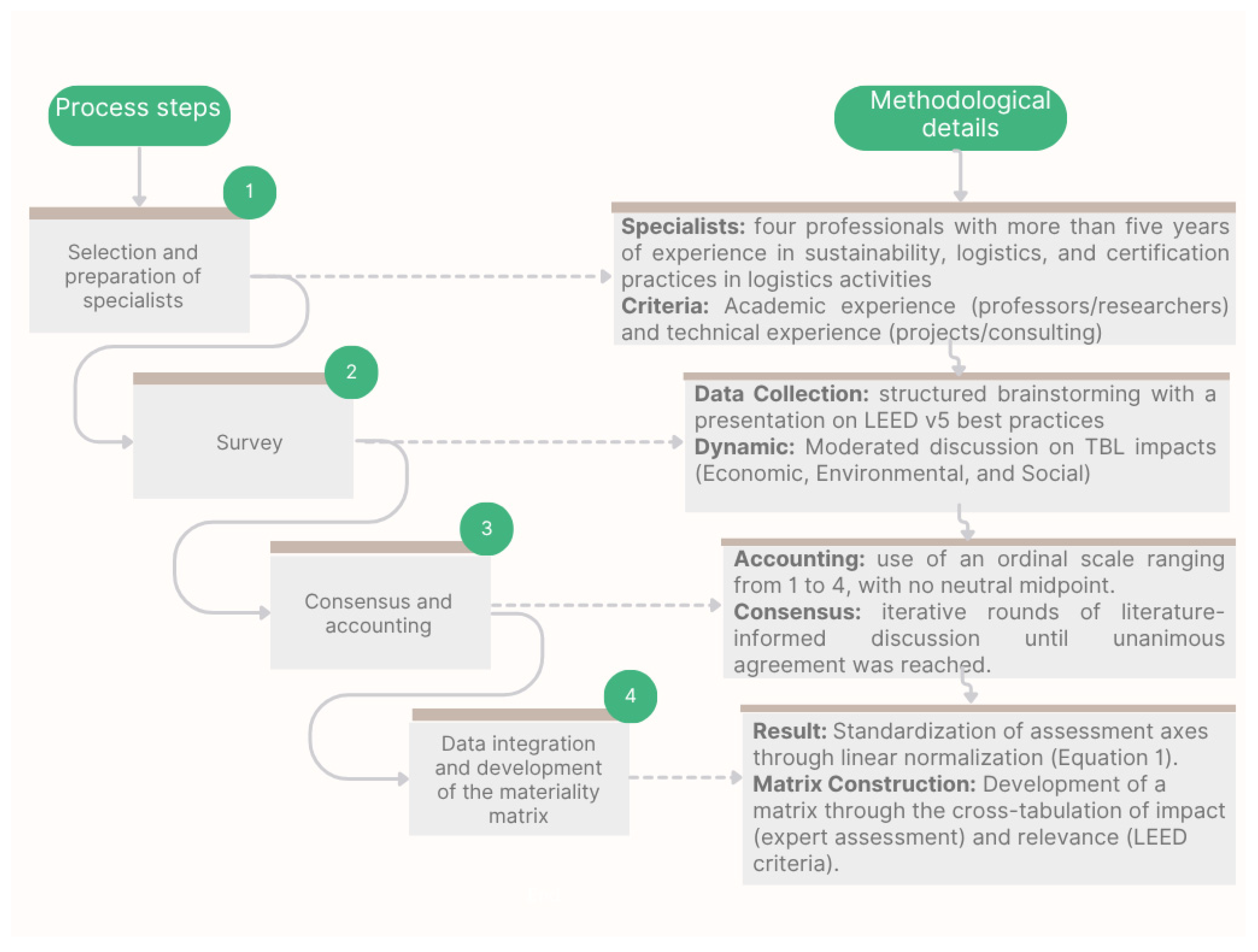
3. Materials and Methods
3.1. Step 1—Identification and Selection of Best Sustainable Practices
3.2. Step 2—Literature Review and Contextualization—TBL Benefits
3.3. Step 3—Building the Materiality Matrix
3.3.1. TBL Impact of Best Practices—Axis X
3.3.2. Relevance of Best Practices for Logistics Stakeholders—Axis Y
3.4. Step 4—Impact Assessment Based on the TBL Model and Relevance to Stakeholders
4. Triple Bottom Line Materiality Matrix—Focusing on LEED Certification
4.1. Step 1—Identification and Selection of Best Sustainable Practices Applied to LEED Certification
- Location and Transportation;
- Sustainable Sites;
- Water Efficiency;
- Energy and Atmosphere;
- Materials and Resources; and
- Indoor Environmental Quality.
4.2. Step 2—Literature Review and Contextualization—LEED
4.2.1. Location and Transportation

| Best Practice | Description | Environmental Benefits | Social Benefits | Economic Benefits |
|---|---|---|---|---|
| Equitable development with choice of locations that stimulate neighborhood development and reduce transportation activity and high priority | It encourages choosing locations that integrate public and active transit (like walking or cycling) to lower transport demand and boost accessibility for workers and the local community. | Reduces vehicle use, transport-related emissions, traffic, and noise impacts [36,37]. | Encourages physical activity and improves public health and social well-being. Reported reductions in noise nuisances reached 37.26% [36,37]. | Boosts urban efficiency and sustainability, cutting infrastructure costs by 37.58% and climate change costs by 21.85% [36,37]. |
| Sensitive Land Protection and Sustainable Site Selection | Promotes development in areas with existing infrastructure to encourage compact, connected land use, reducing environmental impact and improving community compatibility. | Preserving and connecting natural habitats reduces fragmentation and boosts biodiversity, maintaining ecosystem structure and function [36,37]. DHL’s initiatives demonstrate how logistics buildings can support biodiversity by incorporating habitats for insects and other species [38]. | It improves quality of life by fostering healthier, more resilient, and inclusive environments through access to green spaces, integrated urban planning, and reduced visual and community disturbances associated with development [36]. | Optimizing land use, integrating developments with existing infrastructure, and reducing exposure to natural hazards support long-term resilience, economic viability, and the attractiveness of developed areas [36]. |
| Compact and connected development to promote improved population density in the surrounding area and diverse uses | Protects farmland and habitats by promoting development in areas with existing infrastructure, active mobility, and public transit. | Preserving natural areas and rehabilitating brownfields reduce emissions and pollution [39,40], while concentrating activities in logistics hubs preserves agricultural land and reduces habitat fragmentation and ecosystem disturbance [41] | Integrating logistics hubs with transit and active mobility reduces traffic, pollution, and commuting times, while promoting social inclusion, job access, and health [36,41]. | It boosts job access, urban productivity, and property value in existing infrastructure areas while lowering commuting costs. [39,40]. Improves logistics efficiency and reduces pressure on agricultural land through strategic building location [41] |
| Transportation demand management through bicycle facilities and reducing parking space to minimize environmental damage associated with facilities | It promotes bicycle use and transit efficiency while shrinking parking areas, minimizing the environmental impacts of cars. | The integration of bicycle infrastructure reduces emissions, improves environmental quality, and decreases surface runoff from rainwater [42]. | It enhances worker health, fosters inclusion, and makes the corporate environment more accessible and attractive [42]. | It increases property values and reduces health and transportation costs, economically strengthening sustainable enterprises [42]. |
| Use of cleaner energy and low-carbon vehicles | It encourages the adoption of cleaner transportation technologies, including electric vehicles and other low-carbon alternatives, supported by adequate infrastructure. | Proprietary charging infrastructure maximizes EV environmental benefits by ensuring they directly replace fossil fuels, supporting global strategies to cut urban emissions and carbon footprints through consistent electric operation [43,44]. | Reduction in noise and air pollution, improving public health and community well-being [45]. | Own infrastructure directly reduces the operating cost of EVs. Without own charging, the total cost of ownership increases, mainly because installation fees can be prohibitive, including approval, wiring, transformers, and equipment [43]. |
4.2.2. Sustainable Sites
| Best Practice | Description | Environmental Benefits | Social Benefits | Economic Benefits |
|---|---|---|---|---|
| Minimizing site disturbance through environmental assessment of the terrain | It assesses the conditions of the terrain affected by construction activities and preserves existing native vegetation, reducing disturbances and optimizing the use of resources. | Environmental assessment supports the strategic siting of logistics buildings, minimizing land disturbance, habitat fragmentation, and impacts on sensitive ecosystems [46] | Strategic terrain assessment for logistics preserves agricultural livelihoods and local food security while reducing congestion. Furthermore, it improves regional mobility, environmental quality, public health, and community well-being by cutting air, water, and soil pollution [47]. | It lowers costs for soil preparation and stabilization, earthworks, and drainage; reduces the need for rehabilitation; and optimizes the use of materials and energy, resulting in operational savings and efficiency throughout the building’s life cycle [48]. |
| Promote habitat protection or restoration | It preserves existing natural areas and restores degraded areas to provide habitat and promote biodiversity. | Restoring degraded areas for new building construction preserves natural habitats while optimizing the spatial footprint of logistics networks [46]. Strengthens urban resilience to flooding, improves ecosystem services, and protects local ecosystems [49]. | Eco-designed logistics hubs reduce freight-related environmental stressors, which protects public health, minimizes physical and psychological damage, and strengthens community cohesion and safety during extreme weather and climate events [50]. | It reduces damage costs and increases property values by promoting a more resilient urban environment [49]. |
| Provide accessible outdoor space | Create outdoor spaces that encourage interaction with the environment, passive recreation, and physical activity, improving urban quality. | Integrated green spaces and permeable areas enhance worker well-being and reduce the environmental impacts of logistics buildings [46] | Green spaces improve well-being and reduce stress for logistics workers and drivers [46]. | Landscaping in logistics parks helps preserve neighborhood quality and adjacent property values [46]. |
| Promote Rainwater Management | It reduces surface runoff and improves water quality through green infrastructure solutions that replicate the natural water balance. | It absorbs rainwater, reduces surface runoff and accumulation, and improves water quality by filtering pollutants [47]. | It improves the safety and well-being of communities by reducing the risks of flooding and environmental degradation [47]. | It lowers costs for property and infrastructure damage and repairs by reducing the impacts of flooding [47]. |
| Implementation of a project to improve site resilience | Design, build, and maintain sites that are more resilient to climate risks and natural disasters, increasing the ecological and social value of urban areas. | It expands areas of ecological value, increases carbon sequestration, and promotes stormwater retention [50]. | It improves perceived safety, increases living areas and open public spaces, and encourages the use of sidewalks and bike lanes [50]. | Investing in flood-resilient facility design reduces inventory damage costs, safeguards logistics asset values, and lowers water treatment costs, while boosting property values and generating green jobs related to adaptation and resilience [46,50,51]. |
| Adoption of practices to reduce heat islands | Minimizing the effects of microclimates and heat islands on people and habitats through solutions such as green roofs and reflective materials. | It reduces air pollution and GHG emissions by lowering air conditioning demand and conventional energy use, while mitigating urban heat island effects in logistics hubs through enhanced ecological value, natural cooling, reduced surface runoff, and lower land surface temperatures [52,53]. | Mitigating the logistics hub heat island effect lowers the incidence of heatstroke, heat exhaustion, and cardiovascular strain during extreme heatwaves, directly safeguarding vulnerable residents and senior citizens [53] | It reduces energy costs due to lower heat transfer through the building envelope [52]. |
| Adoption of practices to reduce light pollution | Increase access to the night sky and improve visibility by using efficient, low-intensity lighting, such as LEDs. | It reduces CO2 emissions and impacts on sensitive nocturnal ecosystems, contributing to environmental sustainability [54]. | It improves visual comfort and well-being for workers and communities by avoiding excess light and preserving the visibility of the night sky [54]. | It reduces operating costs and electricity consumption, promoting efficiency and savings [54,55]. |
4.2.3. Water Efficiency
| Best Practice | Description | Environmental Benefits | Social Benefits | Economic Benefits |
|---|---|---|---|---|
| Promote building water metering and Reporting | A sustainable management strategy that monitors and records water consumption to identify opportunities for savings and efficiency. | It reduces pressure on local supply systems and improves the health of the urban ecosystem by preventing waste [56]. | It promotes a culture of sustainability, encourages behavioral change, and can support more equitable water distribution, especially in large facilities [56]. | The use of smart meters allows for significant cost savings and greater efficiency in water management [56]. |
| Promote minimum water efficiency by reducing outdoor and indoor water use | Implement water efficiency measures like native plants, smart irrigation, low-flow fixtures, and leak prevention. | It contributes to conserving water resources, preventing erosion and pollution, and relieving urban drainage systems [57]. | It improves social perception of environmental responsibility and user comfort in environments with efficient water infrastructure [57]. | It reduces operational costs for irrigation and maintenance, in addition to improving corporate image and reputation [57]. |
| Promote water metering and leak detection | Focuses on reducing internal consumption and saving water by identifying and preventing leaks. | It contributes to the conservation of drinking water, reduction in water pollution, and mitigation of urban water stress [58]. | Strengthens the company’s environmental image, supports local water security, and promotes a culture of conscious water use [58]. | It reduces water supply and sewage costs, improves the performance of materials such as concrete, and adds long-term value to the building [58]. |
| Maximizing efficiency in water consumption and return in the municipal system/Enhanced Water Efficiency | It reduces the burden on municipal water and wastewater systems by promoting efficiency throughout the building’s entire water cycle. | It reduces natural resource consumption and emissions from water pumping and treatment, contributing to ecosystem preservation [59]. | It improves working conditions and strengthens institutional image by promoting environmental responsibility and commitment [60]. | Lowers operating costs and increases property value, making it more attractive to investors [61]. |
4.2.4. Energy Efficiency and Atmospheric Air
| Best Practice | Description | Environmental Benefits | Social Benefits | Economic Benefits |
|---|---|---|---|---|
| Promote operational carbon planning and decarbonization strategies/Operational Carbon Projection and Decarbonization Plan | It allows stakeholders to visualize how project decisions impact long-term carbon emissions, ensuring low-carbon planning from conception. | It contributes to GHG emission mitigation, promotes energy efficiency, reduces natural resource consumption, and aligns with Net Zero goals. In logistics and warehousing, operational planning enables companies to project and cut emissions by 40% to 50% by 2030 [62,63]. | Strengthens collaborative governance and stakeholder engagement in logistic [24], raises climate awareness, and stimulates the development of technical capabilities and an organizational culture oriented toward sustainability and innovation [62]. | It reduces operating costs and future financial risks, increases the long-term efficiency of logistics buildings, and facilitates access to green financing and sustainability-related incentives [55,64]. |
| Guaranteeing and optimizing minimum energy performance in buildings/Minimum Energy Efficiency | It modernizes systems such as air conditioning, lighting, vertical transportation, and electrical installations, promoting energy efficiency and building resilience. | Enhances building and utility efficiency, reducing GHG emissions and transforming logistics buildings into green warehousing nodes through sustainable system integration [63]. | It increases property values, creates jobs, and reduces operating costs for energy over the building’s lifetime [65]. | Reduces energy costs and improves operational efficiency while increasing property value, creating jobs, and lowering lifecycle operating expenses [63,65]. |
| Project commissioning and performance assurance/Fundamental Commissioning | A set of activities that ensure building systems operate as designed and meet the owner’s goals. | It reduces energy consumption by up to 16% in new buildings and 13% in existing buildings, avoiding significant CO2 emissions and reducing the waste of natural resources [66]. | It promotes significant improvements in thermal comfort, indoor air quality, and system reliability, increasing occupant satisfaction and reducing risks to user health and performance [66]. | Average return on investment of 4.2 years, resulting from reduced operating costs, preventive maintenance, and correction of design flaws [66]. |
| Building energy measurement management/Energy Metering and Reporting | Monitoring and reporting energy consumption, supporting efficient management and identifying savings opportunities. | It contributes to a direct reduction in greenhouse gas emissions by identifying waste and promoting the efficient operation of air conditioning, lighting, and ventilation systems [67]. | It promotes awareness and engagement among occupants, strengthens the organizational culture of energy efficiency, and contributes to more comfortable and productive environments [67]. | Enables operating cost reductions of between 10% and 30% through efficiency and predictive maintenance; improves return on energy investments and increases building value through performance certification [67]. |
| Promote Refrigerant Management/Fundamental Refrigerant Management | It reduces high-GWP greenhouse gas emissions by eliminating harmful substances and preventing leaks. | It reduces direct and indirect GHG emissions, protects the ozone layer, and improves the energy efficiency of equipment [68]. | It creates skilled jobs, strengthens occupational safety, and promotes healthier and more comfortable indoor environments [68]. | It promotes the circular economy through the recovery, recycling, and reuse of refrigerants, reducing replacement and maintenance costs by up to 80% [68]. |
| Electrification of operations | It encourages replacing fossil-fuel equipment with fully electric systems, improving air quality and reducing direct emissions. | Reduction in direct GHG emissions and improvement in local air quality by eliminating fossil fuel combustion, promoting greater energy efficiency with technologies such as heat pumps, and decreasing dependence on fossil fuels [69]. | It improves public health by reducing pollution, combats energy poverty by lowering utility bills, and increases occupant comfort and safety, driving consumer acceptance of sustainable buildings [69]. | It reduces long-term operating costs through lower maintenance and predictable energy pricing, enhances industrial productivity with precise heating, leverages tax incentives, and creates new markets and green jobs [69]. |
| Promote the reduction in Peak Thermal Loads in Buildings | It minimizes extreme heating and cooling requirements in buildings through passive strategies and improvements in thermal envelope. | It decreases greenhouse gas emissions by reducing electricity generation during peak hours, avoiding the use of more carbon-intensive power plants and promoting greater energy efficiency [70,71]. | It improves thermal comfort and energy supply stability, ensuring more stable and safer environments, as well as contributing to the well-being of occupants and the resilience of communities in the face of energy overloads [71,72]. | It reduces operating and demand costs by shifting consumption to off-peak periods, optimizes the use of electrical infrastructure, and delays investments in additional grid capacity, increasing the economic efficiency of buildings [70,72]. |
| Designing buildings with improved energy efficiency/Enhanced Energy Efficiency | It proposes the design of buildings that exceed minimum efficiency standards, significantly reducing energy use. | It reduces energy consumption and associated greenhouse gas emissions and decreases the need for peak generation and dependence on fossil fuels, contributing to lower carbon intensity and climate impact mitigation [73,74]. | It improves thermal comfort and indoor environmental quality, reduces health risks from exposure and pollution, and promotes energy equity by lowering bills and social vulnerability, thereby strengthening community resilience [73,74]. | It reduces operating and demand costs over the life of the building, improves cost-effectiveness in life cycle analyses, defers investments in grid capacity, and increases the profitability and market value of more efficient buildings [73,74]. |
| Promote the use of renewable energy | It encourages installing clean energy systems (solar, wind, heat pumps) to increase self-sufficiency and reduce fossil fuel dependence. | It decreases the concentration of atmospheric pollutants (SO2, NOx, particulate matter), mitigating impacts on the climate and urban ecosystems [75]. | It reduces operating costs and increases resilience to energy price volatility; increases property values and generates stable long-term returns [75]. | It improves air quality and reduces respiratory and cardiovascular health risks, promoting well-being and productivity [75]. |
| Enhanced Commissioning | It extends basic commissioning with ongoing checks and post-occupancy monitoring, ensuring performance over time. | It reduces energy consumption and emissions by correcting inefficiencies in HVAC, lighting, and building envelopes, preventing excessive or sub-optimal equipment operation [76]. | It reduces operating and maintenance costs by optimizing system performance, extends equipment life, reduces operational failures, and allows for the postponement of investments in energy infrastructure [77]. | It improves thermal comfort and indoor air quality, increases occupant satisfaction and productivity, reduces the number of complaints, and strengthens the training of operation and maintenance teams, promoting healthier and safer environments [78]. |
| Demand response management and adoption of interactive grid | It integrates the building into the electrical grid, allowing energy consumption to adjust based on operating conditions and system signals. | It reduces the carbon footprint of the electrical system and increases the integration of renewable sources [79,80]. | It enhances grid reliability, reduces the risk of power outages for the local community, and promotes consumer awareness regarding energy consumption [79,80]. | It reduces energy costs during peak hours, improves reliability, and delays investments in generation and transmission [79,80]. |
| Enhanced Refrigerant Management | Encourages the use of substances with low global warming potential and best control practices. | It reduces direct greenhouse gas emissions by up to 80% by replacing HFCs with low-GWP refrigerants (such as CO2, HFOs, and hydrocarbons), contributing to climate change mitigation and ozone layer protection [68,81]. | It lowers operating and maintenance costs through leak prevention and energy efficiency, while driving innovation, job creation, and competitiveness in sustainable refrigeration [68,81]. | It improves occupational safety and indoor air quality by reducing exposure to toxic and flammable substances, contributes to public health and community well-being, and supports the achievement of global climate goals [81]. |
4.2.5. Materials and Resources
| Best Practice | Description | Environmental Benefits | Social Benefits | Economic Benefits |
|---|---|---|---|---|
| Construction and demolition waste management plan/Planning for Zero Waste Operations | It implements a waste management plan with separation and recovery targets, reducing landfill and incinerator volume through reuse and recycling. | It reduces the volume of waste in landfills, minimizes soil and water contamination, and contributes to the reduction in greenhouse gas emissions by encouraging recycling and reuse of materials and preserving natural resources [82,83]. | It improves health and safety in the workplace, creates jobs associated with the circular economy, and promotes environmental awareness among workers and communities, strengthening sustainable practices in the construction sector [84,85]. | It reduces transportation and disposal costs, generates savings through the reuse of materials, and increases the efficiency of construction processes, stimulating production chains aligned with the circular economy [86,87,88]. |
| Quantification and assessment of embodied carbon in construction | It measures life-cycle greenhouse gas emissions of construction materials to identify carbon sources and guides sustainable design and specification decisions. | It reduces construction climate impact by replacing carbon-intensive materials with low-footprint alternatives, promoting a transition toward carbon neutrality [89,90]. | It promotes innovation and technical training, strengthens public sustainability policies, and raises awareness about the total decarbonization of the building life cycle [90,91,92]. | It optimizes material life cycles, lowers operating and maintenance costs, and increases the transparency and market value of sustainable developments [89,90]. |
| Reuse of materials with reduced impact on the building’s life cycle/Building and Materials Reuse | It incorporates reused materials into new buildings, reducing embodied carbon, keeping resources in circulation, and decreasing the demand for virgin raw materials, preserving natural resources and historical values. | It reduces carbon emissions and raw material consumption, extends the useful life of components, and decreases waste volume, contributing to environmental conservation and climate mitigation [93]. | It improves the quality of life of users by providing healthier and more comfortable environments and encourages sustainable and circular practices in the construction sector [93]. | Despite higher initial costs, it reduces long-term operating and maintenance expenses and increases property value, fostering markets for reused materials [93]. |
| Reducing embodied carbon by reducing the impact of the building’s life cycle/Reduce Embodied Carbon | It monitors and reduces the embodied carbon in key structural, finishing, and landscaping materials in new and renovation projects by adopting low-impact solutions. | The use of concrete with pozzolanic additions, recycled steel, and engineered wood reduces building life cycle emissions up to 40%, contributing to climate neutrality goals [94,95]. | It boosts technical skills and green jobs, raises awareness of sustainability, and strengthens healthier and more resilient urban communities [94]. | It generates savings through efficient use of materials and waste reduction, stimulates innovation, and increases competitiveness in carbon pricing policies [95] |
| Use of Low-Emitting Materials | It uses low-emitting interior materials, such as paints, coatings, adhesives, flooring, and furniture, which reduce pollutants and improve air quality. | It promotes conservation of natural resources, reduces GHG emissions and waste, and encourages the use of recycled, renewable, and lower-environmental-impact materials [96]. | It provides healthier indoor environments, reducing respiratory problems and allergies and increasing the thermal and acoustic comfort of occupants [97]. | It reduces waste and maintenance costs, in addition to optimizing energy performance and material durability [98]. |
| Disclosure and Sustainable Optimization of Building Materials/Building Product Selection and Procurement | It encourages the use of products and materials with transparent information on sustainability (EPD), responsible sourcing, and safe chemical ingredients, rewarding choices with lower impact. | It reduces embodied carbon emissions, promotes the circular economy, and optimizes the production chain with low-impact materials [99,100,101]. | It increases transparency and trust with consumers and promotes the well-being of occupants by using natural and healthy materials [102]. | It generates reduced operating costs, competitive advantage in bidding, and access to markets with strict environmental requirements [101,103,104]. |
| Use of construction and demolition waste/Construction and Demolition Waste Diversion | It maximizes the reuse and recycling of construction and demolition materials, preserving their value and promoting the circular economy. | It reduces soil, water, and air pollution, contributes to the Zero Waste goal, and reduces CO2 emissions by up to 19.7% by replacing raw materials in cement production [105,106]. | It generates local jobs, improves worker health, and contributes to sustainable urban development in densely populated areas [105,106] | It reduces production costs by using recycled aggregates, preserves the value of materials, and encourages waste minimization practices with economic instruments [106]. |
4.2.6. Indoor Environmental Quality
| Best Practice | Description | Environmental Benefits | Social Benefits | Economic Benefits |
|---|---|---|---|---|
| Indoor air quality management plan in construction/ Construction Management | It protects worker and occupant well-being by defining indoor air quality (IAQ) standards during construction, preventing contamination and moisture damage to materials. | It reduces carbon footprint and energy consumption by promoting more efficient and sustainable ventilation and air conditioning systems [82,83]. | It reduces respiratory diseases, allergies, and lung infections, improving the health and well-being of occupants and workers [107]. | It improves operational efficiency and reduces long-term costs through energy optimization and reduction in rework related to poor air quality [86]. |
| Indoor Air Quality Assurance and Optimization/Fundamental Air Quality | It enhances occupant comfort, well-being, and productivity by improving indoor air quality through efficient ventilation, contaminant reduction, and continuous air monitoring. | It contributes to reducing energy consumption and carbon footprint through the use of natural ventilation and high-efficiency systems, aligning with sustainability principles [108]. | It ensures healthier and more productive indoor environments, preventing “Sick Building Syndrome” and promoting equity in health and cognitive performance [108,109]. | It increases occupant productivity and satisfaction, reduces absenteeism and operating costs with corrective maintenance, and optimizes energy performance [108] |
| Environmental Control of Smoke/No Smoking or Vehicle Idling | It minimizes exposure of occupants and users to tobacco smoke, substitutes, cannabis smoke, and vehicle emissions, ensuring healthier indoor and outdoor environments. | It reduces air pollutants and environmental risks associated with secondhand smoke, improving air quality and contributing to cleaner and safer indoor environments [110]. | It reduces the financial and social burden of smoking-related diseases, lowering public health costs and work absenteeism [110]. | It promotes health equity and denormalizes tobacco, creating safer environments and positive role models for children and youth [110]. |
| Promotion of thermal comfort, indoor lighting, natural light, quality views, and acoustic comfort/Occupant Experience | It enhances occupant health, productivity, and satisfaction through a human-centered design that optimizes thermal, lighting, acoustic, and visual comfort while fostering emotional connections to the space. | Optimizing thermal, visual, and acoustic comfort lowers energy consumption and emissions while reducing lighting waste and improving overall building performance [9,111,112,113,114,115,116,117]. | It boosts occupant health, performance, and satisfaction while reducing stress, fatigue, and hearing issues by creating comfortable, accessible, and inclusive environments [111,118,119,120,121]. | It reduces operational and maintenance costs, increases property value, and boosts occupant productivity, leading to financial savings and improved organizational performance [111,114,117,122,123,124]. |
| Adoption of indoor air quality improvement project/Enhanced Air Quality | This consists of designing facilities to improve indoor air quality and better protect the health of building occupants. | Improving indoor air quality reduces pollutant exposure, while effective ventilation filters, conditions, and replaces indoor air to remove contaminants [125]. | Designing for IAQ contributes to safer, healthier, and more comfortable spaces, protecting all occupants from respiratory hazards [126,127]. | Improving IAQ generates financial gains by reducing costs related to health, absenteeism, and lost productivity [126]. |
| Ensuring Accessibility and Inclusive Environments/Providing Accessibility and Inclusion | It aligns with Design for All principles to meet diverse occupant needs, increasing building usability while promoting equity, diversity, and inclusion. | It integrates sustainable, resilient, and biophilic design strategies to improve environmental quality and occupant well-being [128]. | It promotes social inclusion, autonomy, and full participation of people with disabilities, strengthening the sense of belonging and community cohesion [125,128]. | It increases the efficiency and value of projects by optimizing evidence-based design improvements and processes, favoring return on investment [128]. |
| Promote resilient spaces/Resilient Spaces | Implement design features that strengthen the ability of occupants and buildings to adapt to climate variations and extreme events, ensuring comfort, health, and safety. | It reduces exposure to environmental risks and optimizes the building’s thermal and energy performance, contributing to adaptation to climate change [129]. | It protects occupant health during pandemics and extreme conditions, reducing social vulnerabilities by creating safer, more adaptable environments [130]. | It represents a long-term investment that reduces operating and maintenance costs, in addition to adding market value to resilient developments [131]. |
| Indoor Air Quality Assessment/Air Quality Testing and Monitoring | It seeks to monitor and ensure indoor air quality after construction and during occupancy by controlling variables such as CO2, humidity, and temperature. | It improves the environmental performance of the building by reducing pollutants and optimizing energy use through natural ventilation and efficient environmental control [117,132]. | It improves the comfort, health, and well-being of occupants by reducing exposure to pollutants, promoting environmental equity and transparency, and strengthening capacity building and awareness [132,133]. | It reduces productivity losses, increases operational efficiency, and lowers instrumentation and maintenance costs, in addition to promoting affordable monitoring solutions [133,134]. |
4.3. Step 3—Development of the Materiality Matrix—LEED
4.3.1. TBL Impact of Best Practices—X-Axis
4.3.2. Relevance of Best Practices for Logistics Stakeholders—Y-Axis
4.4. Step 4—Impact Assessment Based on the TBL Model and Relevance to Stakeholders
4.4.1. Initial Framework Application Results—Baseline Scenario
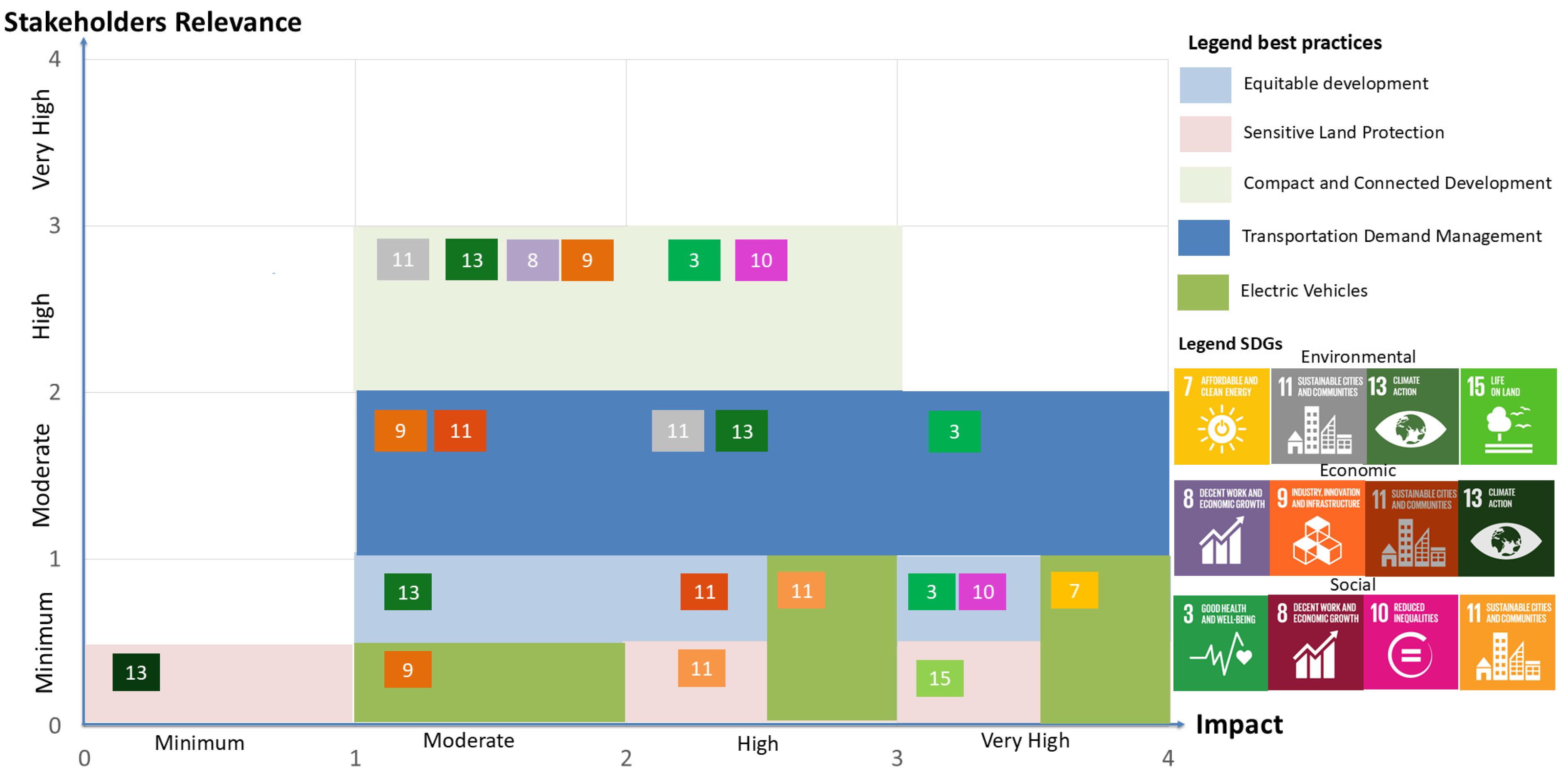
Location and Transportation
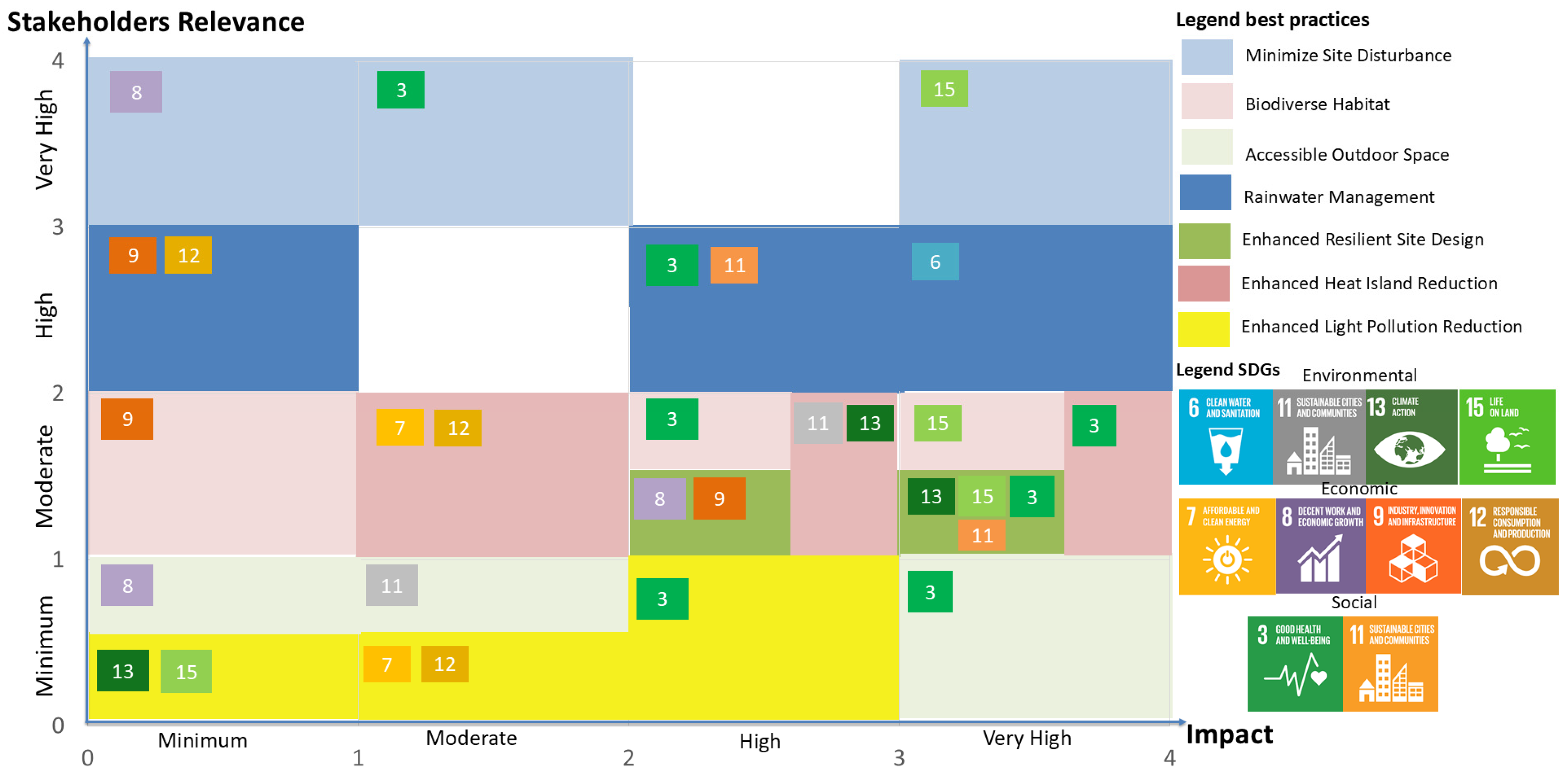
Sustainable Sites
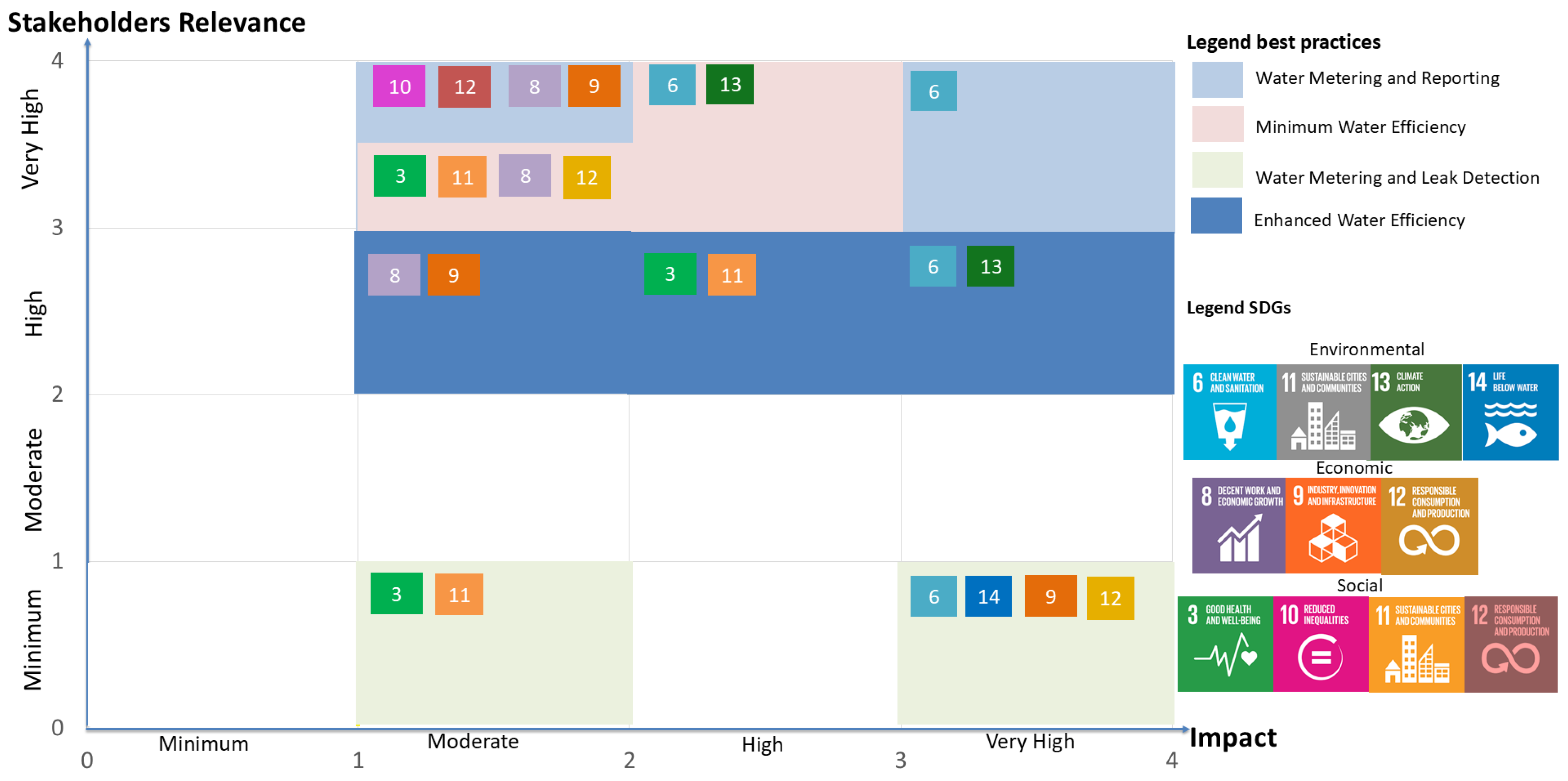
Efficient Use of Water
Energy Efficiency and Atmospheric Air
Materials and Resources
Indoor Environmental Quality
4.4.2. Sensitivity Analysis—Alternative Scenarios
- Ms,c represents the final materiality index of subcategory s under scenario c.
- , , and represent the intrinsic impact scores of subcategory s across the environmental, social, and economic dimensions, respectively.
- , , and correspond to the specific weights assigned to each dimension within scenario c, subject to the unity constraint where the sum of all weights equals one ().
Sensitivity Analysis—Location and Transportation
Sensitivity Analysis—Sustainable Sites
Sensitivity Analysis—Efficient Use of Water
Sensitivity Analysis—Energy Efficiency and Atmospheric Air
Sensitivity Analysis—Materials and Resources
Sensitivity Analysis—Indoor Environmental Quality
5. Final Considerations
Author Contributions
Funding
Institutional Review Board Statement
Informed Consent Statement
Data Availability Statement
Acknowledgments
Conflicts of Interest
Appendix A
| Impact | Denomination | Description |
|---|---|---|
| 1 | Minimal Impact | The practice causes slight and localized changes, with limited effect within the specific scope. |
| 2 | Moderate Impact | The practice generates noticeable yet non-comprehensive improvements, affecting a significant part of the operation. |
| 3 | High Impact | The practice results in major changes, with broad and visible effects across most of the operation. |
| 4 | Very High Impact | The practice leads to substantial transformations, deeply and extensively altering the logistics scope. |
| Relevance Level | Denomination | Description |
|---|---|---|
| 1 | Minimal Relevance | Achievement of minimum scoring. |
| 2 | Moderate Relevance | Intermediate performance, with partial attainment of available points. |
| 3 | High Relevance | Maximum performance within the credit, achieving the total possible points. |
| 4 = Requirement | Very High Relevance | Fulfillment of mandatory prerequisites. |
Appendix B
| Categories | Best Practices/Subcategories | LEED Credits | TBL | |||||||
|---|---|---|---|---|---|---|---|---|---|---|
| Total Credits | Scoring | Relevance to Stakeholders | Environmental | Social | Economic | |||||
| Scoring | Impact | Scoring | Impact | Scoring | Impact | |||||
| Location and Transportation | Equitable development | 0 to 15 | 2 | Minimal | 2 | Moderate | 4 | Very High | 3 | High |
| Sensitive Land Protection | 1 | Minimal | 4 | Very High | 3 | High | 1 | Minimal | ||
| Compact and Connected Development | 6 | High | 2 | Moderate | 3 | High | 2 | Moderate | ||
| Transportation Demand Management | 4 | Moderate | 3 | High | 4 | Very High | 2 | Moderate | ||
| Electric Vehicles | 2 | Minimal | 4 | Very High | 3 | High | 2 | Moderate | ||
| Sustainable Sites | Minimize Site Disturbance | 0 to 11 | Required | Very High | 4 | Very High | 2 | Moderate | 1 | Minimal |
| Biodiverse Habitat | 2 | Moderate | 4 | Very High | 3 | High | 1 | Minimal | ||
| Accessible Outdoor Space | 1 | Minimal | 2 | Moderate | 4 | Very High | 1 | Minimal | ||
| Rainwater Management | 3 | High | 4 | Very High | 3 | High | 1 | Minimal | ||
| Enhanced Resilient Site Design | 2 | Moderate | 4 | Very High | 4 | Very High | 3 | High | ||
| Heat Island Reduction | 2 | Moderate | 3 | High | 4 | Very High | 2 | Moderate | ||
| Light Pollution Reduction | 1 | Minimal | 1 | Minimal | 3 | High | 2 | Moderate | ||
| Water Efficiency | Water Metering and Reporting | 0 to 9 | Required | Very High | 4 | Very High | 2 | Moderate | 2 | Moderate |
| Minimum Water Efficiency | Required | Very High | 3 | High | 2 | Moderate | 2 | Moderate | ||
| Water Metering and Leak Detection | 1 | Minimal | 4 | Very High | 2 | Moderate | 4 | Very High | ||
| Enhanced Water Efficiency | 8 | High | 4 | Very High | 3 | High | 2 | Moderate | ||
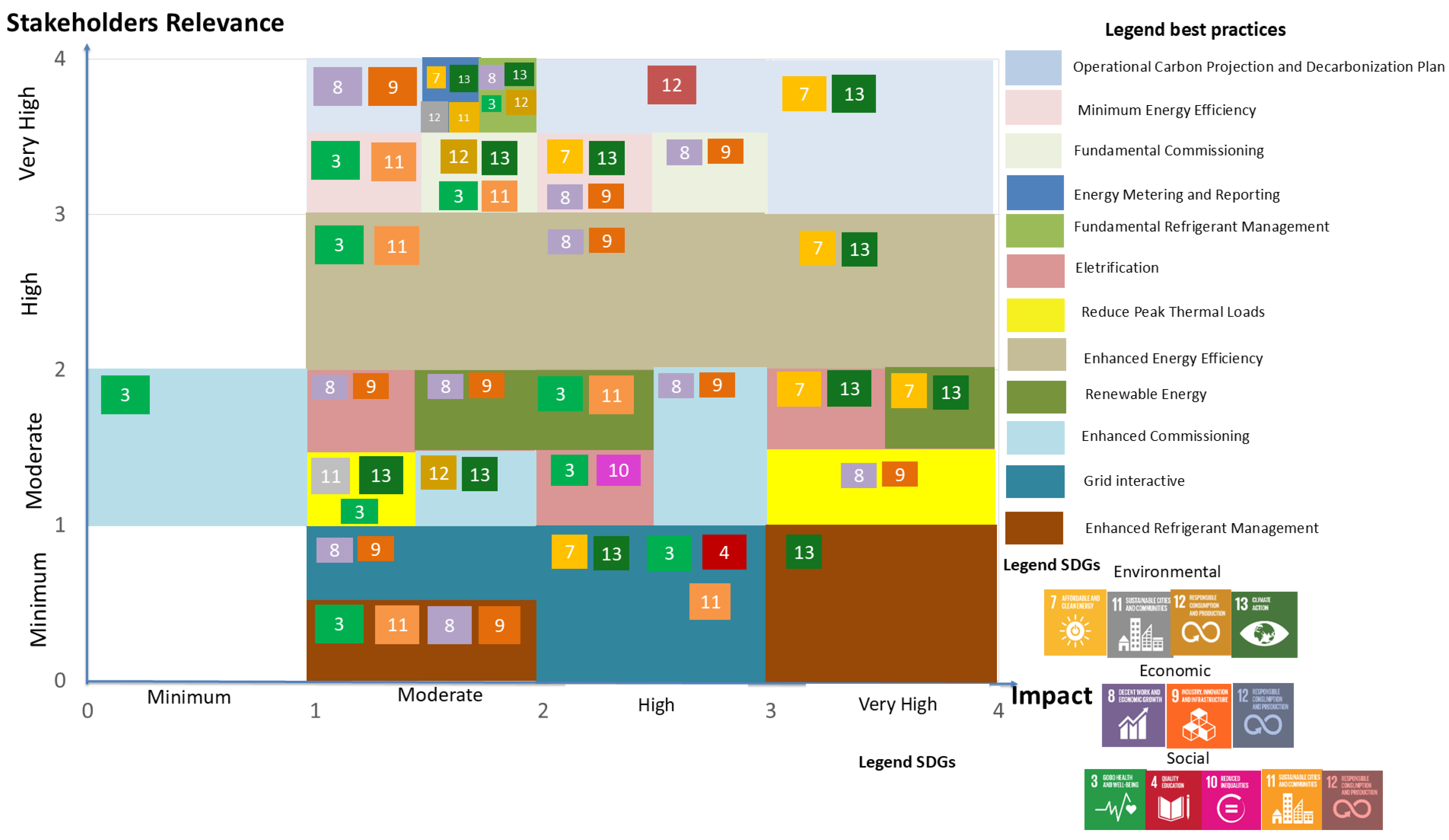
| Energy Efficiency and Atmospheric Air | Operational Carbon Projection and Decarbonization Plan | 0 to 33 | Required | Very High | 4 | Very High | 3 | High | 2 | Moderate |
| Minimum Energy Efficiency | Required | Very High | 3 | High | 2 | Moderate | 3 | High | ||
| Fundamental Commissioning | Required | Very High | 2 | Moderate | 2 | Moderate | 3 | High | ||
| Energy Metering and Reporting | Required | Very High | 2 | Moderate | 2 | Moderate | 2 | Moderate | ||
| Fundamental Refrigerant Management | Required | Very High | 2 | Moderate | 2 | Moderate | 2 | Moderate | ||
| Electrification of operations/Electrification | 5 | Moderate | 4 | Very High | 3 | High | 2 | Moderate | ||
| Reduce Peak Thermal Loads | 5 | Moderate | 2 | Moderate | 2 | Moderate | 4 | Very High | ||
| Enhanced Energy Efficiency | 10 | High | 4 | Very High | 2 | Moderate | 3 | High | ||
| Renewable Energy | 5 | Moderate | 4 | Very High | 3 | High | 2 | Moderate | ||
| Enhanced Commissioning | 4 | Moderate | 2 | Moderate | 1 | Minimal | 3 | High | ||
| Grid interactive | 2 | Minimal | 3 | High | 3 | High | 2 | Moderate | ||
| Enhanced Refrigerant Management | 2 | Minimal | 4 | Very High | 2 | Moderate | 2 | Moderate | ||
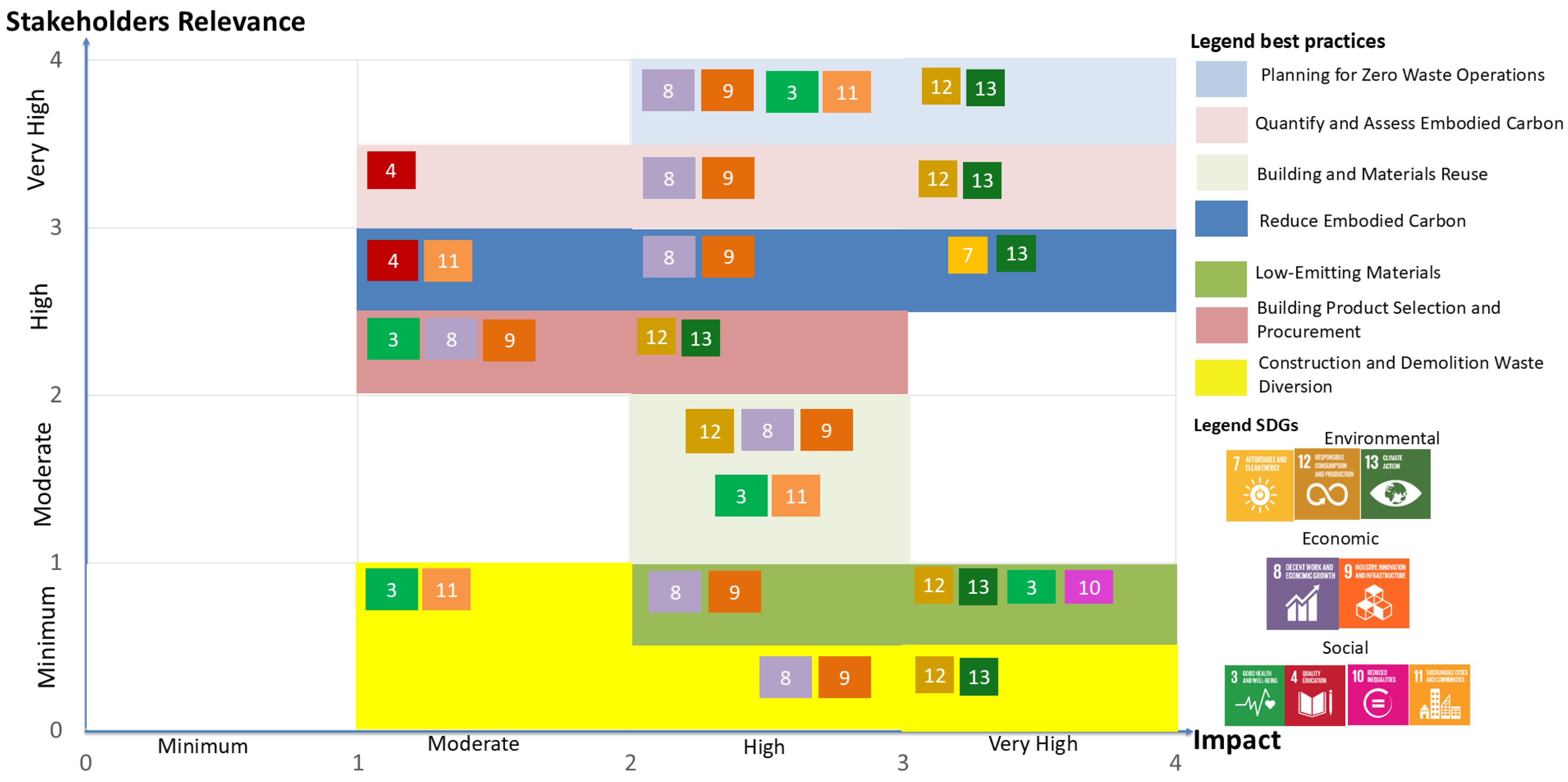
| Materials and Resources | Planning for Zero Waste Operations | 0 to 18 | Requirement | Very High | 4 | Very High | 3 | High | 3 | High |
| Quantify and Assess Embodied Carbon | Requirement | Very High | 4 | Very High | 2 | Moderate | 3 | High | ||
| Building and Materials Reuse | 3 | Moderate | 3 | High | 3 | High | 3 | High | ||
| Reduce Embodied Carbon | 6 | High | 4 | Very High | 2 | Moderate | 3 | High | ||
| Low-Emitting Materials | 2 | Minimal | 4 | Very High | 4 | Very High | 3 | High | ||
| Building Product Selection and Procurement | 5 | High | 3 | High | 2 | Moderate | 2 | Moderate | ||
| Construction and Demolition Waste Diversion | 2 | Minimal | 4 | Very High | 2 | Moderate | 3 | High | ||
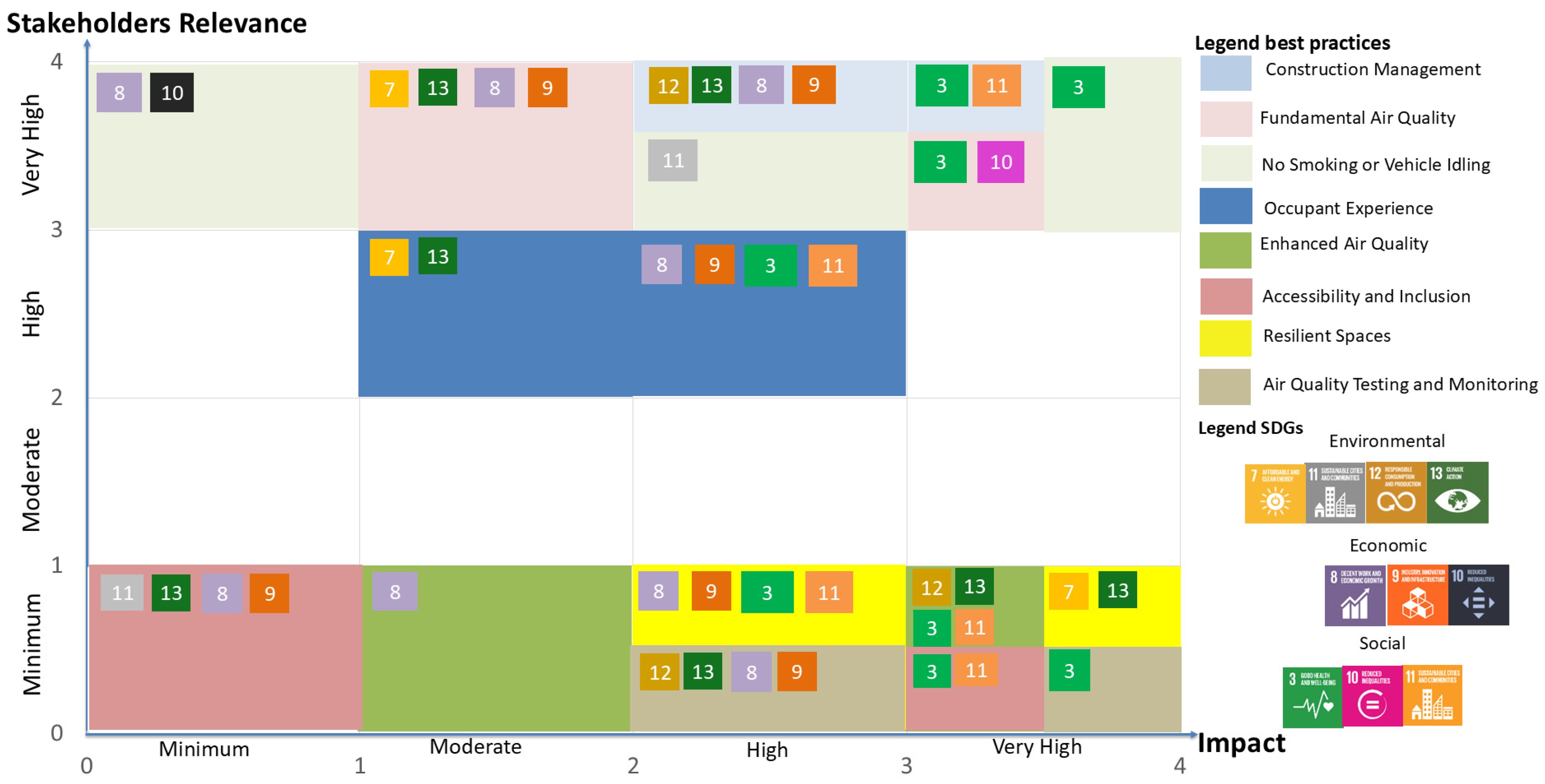
| Indoor Environmental Quality | Construction Management | 0 to 16 | Required | Very High | 3 | High | 4 | Very High | 3 | High |
| Fundamental Air Quality | Required | Very High | 2 | Moderate | 4 | Very High | 2 | Moderate | ||
| No Smoking or Vehicle Idling | Required | Very High | 3 | High | 4 | Very High | 1 | Minimal | ||
| Occupant Experience | 7 | High | 2 | Moderate | 3 | High | 3 | High | ||
| Enhanced Air Quality | 1 | Minimal | 4 | Very High | 4 | Very High | 2 | Moderate | ||
| Accessibility and Inclusion | 1 | Minimal | 1 | Minimal | 4 | Very High | 1 | Minimal | ||
| Resilient Spaces | 2 | Minimal | 4 | Very High | 3 | High | 3 | High | ||
| Air Quality Testing and Monitoring | 2 | Minimal | 3 | High | 4 | Very High | 3 | High | ||
Appendix C
| Categories | Best Practices/Subcategories | Scenarios Alternatives 1 | Scenarios Alternatives 2 | Scenarios Alternatives 3 | Scenarios Alternatives 4 | ||||
|---|---|---|---|---|---|---|---|---|---|
| Impact Materiality | Impact Materiality | Impact Materiality | Impact Materiality | ||||||
| Location and Transportation | Equitable development | 3 | High | 2 | High | 4 | Very High | 3 | High |
| Sensitive Land Protection | 3 | High | 4 | High | 3 | High | 2 | Moderate | |
| Compact and Connected Development | 2 | Moderate | 2 | Moderate | 3 | High | 2 | Moderate | |
| Transportation Demand Management | 3 | High | 3 | High | 4 | Very High | 2 | Moderate | |
| Electric Vehicles | 3 | High | 4 | High | 3 | High | 2 | Moderate | |
| Sustainable Sites | Minimize Site Disturbance | 2 | Moderate | 3 | High | 2 | Moderate | 2 | Moderate |
| Biodiverse Habitat | 3 | High | 4 | High | 3 | High | 2 | Moderate | |
| Accessible Outdoor Space | 2 | Moderate | 2 | Moderate | 3 | High | 2 | Moderate | |
| Rainwater Management | 3 | High | 4 | High | 3 | High | 2 | Moderate | |
| Enhanced Resilient Site Design | 4 | Very High | 4 | Very High | 4 | Very High | 3 | High | |
| Heat Island Reduction | 3 | High | 3 | High | 4 | Very High | 2 | Moderate | |
| Light Pollution Reduction | 2 | Moderate | 1 | Moderate | 3 | High | 2 | Moderate | |
| Water Efficiency | Water Metering and Reporting | 3 | High | 4 | High | 2 | Moderate | 2 | Moderate |
| Minimum Water Efficiency | 2 | Moderate | 3 | High | 2 | Moderate | 2 | Moderate | |
| Water Metering and Leak Detection | 3 | High | 4 | Very High | 3 | High | 4 | Very High | |
| Enhanced Water Efficiency | 3 | High | 4 | High | 3 | High | 2 | Moderate | |
| Energy Efficiency and Atmospheric Air | Operational Carbon Projection and Decarbonization Plan | 3 | High | 4 | High | 3 | High | 2 | Moderate |
| Minimum Energy Efficiency | 3 | High | 3 | High | 2 | Moderate | 3 | High | |
| Fundamental Commissioning | 2 | Moderate | 2 | Moderate | 2 | Moderate | 3 | High | |
| Energy Metering and Reporting | 2 | Moderate | 2 | Moderate | 2 | Moderate | 2 | Moderate | |
| Fundamental Refrigerant Management | 2 | Moderate | 2 | Moderate | 2 | Moderate | 2 | Moderate | |
| Electrification of operations/Electrification | 3 | High | 4 | High | 3 | High | 2 | Moderate | |
| Reduce Peak Thermal Loads | 3 | High | 2 | Moderate | 2 | Moderate | 4 | Very High | |
| Enhanced Energy Efficiency | 3 | High | 4 | High | 2 | Moderate | 3 | High | |
| Renewable Energy | 3 | High | 4 | High | 3 | High | 2 | Moderate | |
| Enhanced Commissioning | 2 | Moderate | 2 | Moderate | 1 | Minimal | 3 | High | |
| Grid interactive | 3 | High | 3 | High | 3 | High | 2 | Moderate | |
| Enhanced Refrigerant Management | 3 | High | 4 | High | 2 | Moderate | 2 | Moderate | |
| Materials and Resources | Planning for Zero Waste Operations | 3 | High | 4 | Very High | 3 | High | 3 | High |
| Quantify and Assess Embodied Carbon | 3 | High | 4 | High | 2 | Moderate | 3 | High | |
| Building and Materials Reuse | 3 | High | 3 | High | 3 | High | 3 | High | |
| Reduce Embodied Carbon | 3 | High | 4 | High | 2 | Moderate | 3 | High | |
| Low-Emitting Materials | 4 | Very High | 4 | Very High | 4 | Very High | 3 | High | |
| Building Product Selection and Procurement | 2 | Moderate | 3 | High | 2 | Moderate | 2 | Moderate | |
| Construction and Demolition Waste Diversion | 3 | High | 4 | High | 2 | Moderate | 3 | High | |
| Indoor Environmental Quality | Construction Management | 3 | High | 3 | High | 4 | Very High | 3 | High |
| Fundamental Air Quality | 3 | High | 2 | Moderate | 4 | Very High | 2 | Moderate | |
| No Smoking or Vehicle Idling | 3 | High | 3 | High | 4 | Very High | 2 | Moderate | |
| Occupant Experience | 3 | High | 2 | Moderate | 3 | High | 3 | High | |
| Enhanced Air Quality | 3 | High | 4 | Very High | 4 | Very High | 3 | High | |
| Accessibility and Inclusion | 2 | Moderate | 1 | Moderate | 3 | High | 1 | Minimal | |
| Resilient Spaces | 3 | High | 4 | Very High | 3 | High | 3 | High | |
| Air Quality Testing and Monitoring | 3 | High | 3 | High | 4 | Very High | 3 | High | |
References
- Deloitte. Sustainable Construction: Designing and Building a Greener Future. 2023. Available online: https://www.deloitte.com/us/en/Industries/energy/articles/delivering-sustainable-construction.html (accessed on 9 December 2025).
- D’Agostino, D.; Cuniberti, B.; Maschio, I. Criteria and Structure of a Harmonised Data Collection for NZEBs Retrofit Buildings in Europe. Energy Procedia 2017, 140, 170–181. [Google Scholar] [CrossRef]
- ITF. Urban Logistics Hubs: Summary and Conclusions; ITF Roundtable Reports; OECD Publishing: Paris, France, 2024. [Google Scholar]
- ITF. Urban Logistics Hubs: Six Case Studies; International Transport Forum: Paris, France, 2024. [Google Scholar]
- Sun, X.; Yu, H.; Solvang, W.D.; Wang, Y.; Wang, K. The Application of Industry 4.0 Technologies in Sustainable Logistics: A Systematic Literature Review (2012–2020) to Explore Future Research Opportunities. Environ. Sci. Pollut. Res. 2022, 29, 9560–9591. [Google Scholar] [CrossRef] [PubMed]
- Ren, R.; Hu, W.; Dong, J.; Sun, B.; Chen, Y.; Chen, Z. A Systematic Literature Review of Green and Sustainable Logistics: Bibliometric Analysis, Research Trend and Knowledge Taxonomy. Int. J. Environ. Res. Public Health 2019, 17, 261. [Google Scholar] [CrossRef] [PubMed]
- Amjed, T.W.; Harrison, N.J. A Model for Sustainable Warehousing: From Theory to Best Practices. In 2013 International DSI and Asia Pacific DSI Conference Proceedings; Decision Sciences Institute: Fresno, TX, USA, 2013; pp. 1892–1919. [Google Scholar]
- Toyinbo, O. Indoor Environmental Quality. In Sustainable Construction Technologies; Elsevier: Amsterdam, The Netherlands, 2019; pp. 107–122. [Google Scholar]
- Malinowska, M.; Rzeczycki, A.; Sowa, M. Roadmap to Sustainable Warehouse. SHS Web Conf. 2018, 57, 1028. [Google Scholar] [CrossRef]
- Geldres-Weiss, V.V.; Gambetta, N.; Massa, N.P.; Geldres-Weiss, S.L. Materiality Matrix Use in Aligning and Determining a Firm’s Sustainable Business Model Archetype and Triple Bottom Line Impact on Stakeholders. Sustainability 2021, 13, 1065. [Google Scholar] [CrossRef]
- Ortar, L. Materiality Matrixes in Sustainability Reporting: An Empirical Examination. SSRN 2018. [Google Scholar] [CrossRef]
- Ensign, P.; Roy, S.; Brzustowski, T. Decisions by Key Office Building Stakeholders to Build or Retrofit Green in Toronto’s Urban Core. Sustainability 2021, 13, 6969. [Google Scholar] [CrossRef]
- Sezer, A.A.; Fredriksson, A. Environmental Impact of Construction Transport and the Effects of Building Certification Schemes. Resour. Conserv. Recycl. 2021, 172, 105688. [Google Scholar] [CrossRef]
- Oloruntobi, O.; Mokhtar, K.; Mohd Rozar, N.; Gohari, A.; Asif, S.; Chuah, L.F. Effective Technologies and Practices for Reducing Pollution in Warehouses—A Review. Clean. Eng. Technol. 2023, 13, 100622. [Google Scholar] [CrossRef]
- Alibakhshi, A.; Saffarian, A.; Hassannayebi, E. Socio-Economical Analysis of a Green Reverse Logistics Network under Uncertainty: A Case Study of Hospital Constructions. Urban Sci. 2024, 8, 171. [Google Scholar] [CrossRef]
- Marcher, C.; Giusti, A.; Matt, D.T. Decision Support in Building Construction: A Systematic Review of Methods and Application Areas. Buildings 2020, 10, 170. [Google Scholar] [CrossRef]
- Taherdoost, H.; Madanchian, M. Decision Making: Models, Processes, Techniques. Cloud Comput. Data Sci. 2023, 5, 1–14. [Google Scholar] [CrossRef]
- Sivasubramanian, D.; Lee, J.G. Decision-Making Framework for Sustainable Construction Products Selection in SMEs. Sustainability 2022, 14, 14264. [Google Scholar] [CrossRef]
- Menichini, T.; Salierno, G. Using Materiality Analysis to Determine Actual and Potential Company Impacts on Sustainable Development. Eur. J. Sustain. Dev. 2023, 12, 90–106. [Google Scholar] [CrossRef]
- Menichini, T.; Salierno, G.; Strollo, N.M. Exploring the Role of Materiality Analysis in Corporate Decision-Making for SDG Prioritization: A Systematic Literature Review. Int. Entrep. Manag. J. 2026, 22, 67. [Google Scholar] [CrossRef]
- Faux, J. Environmental Event Materiality and Decision Making. Manag. Audit. J. 2012, 27, 284–298. [Google Scholar] [CrossRef]
- Calabres, A.; Costa, R.; Levialdi Ghiron, N.; Menichini, T. Materiality analysis in sustainability reporting: A tool for directing corporate sustainability towards emerging economic, environmental and social opportunities. Technol. Econ. Dev. Econ. 2019, 25, 1016–1038. [Google Scholar] [CrossRef]
- Jørgensen, S.; Mjøs, A.; Pedersen, L.J.T. Sustainability Reporting and Approaches to Materiality: Tensions and Potential Resolutions. Sustain. Account. Manag. Policy J. 2022, 13, 341–361. [Google Scholar] [CrossRef]
- Tinnes, E.; Perez, F.; Kandel, M. Decarbonizing Logistics: Charting the Path Ahead; Mckinsey & Company: New York, NY, USA, 2024. [Google Scholar]
- Patil, R.V.; Padhye, P.S.; Vyas, A.M.; Swathi, B.; Deepti, I.C. Triple Bottom Line Approach To Business: Balancing Profit, People And Planet Through Effective Management. Int. J. Environ. Sci. 2025, 11, 5209–5216. [Google Scholar]
- Nica, I.; Chiriță, N.; Georgescu, I. Triple Bottom Line in Sustainable Development: A Comprehensive Bibliometric Analysis. Sustainability 2025, 17, 1932. [Google Scholar] [CrossRef]
- Oll, J.; Spandel, T.; Schiemann, F.; Akkermann, J. The Concept of Materiality in Sustainability Reporting: From Essential Contestation to Research Opportunities. Sustain. Account. Manag. Policy J. 2025, 16, 321–350. [Google Scholar] [CrossRef]
- Sardianou, E.; Stauropoulou, A.; Evangelinos, K.; Nikolaou, I. A Materiality Analysis Framework to Assess Sustainable Development Goals of Banking Sector through Sustainability Reports. Sustain. Prod. Consum. 2021, 27, 1775–1793. [Google Scholar] [CrossRef]
- Sorooshian, S. The Sustainable Development Goals of the United Nations: A Comparative Midterm Research Review. J. Clean. Prod. 2024, 453, 142272. [Google Scholar] [CrossRef]
- Yamane, T.; Kaneko, S. The Sustainable Development Goals as New Business Norms: A Survey Experiment on Stakeholder Preferences. Ecol. Econ. 2022, 191, 107236. [Google Scholar] [CrossRef]
- Siems, E.; Seuring, S.; Schilling, L. Stakeholder Roles in Sustainable Supply Chain Management: A Literature Review. J. Bus. Econ. 2023, 93, 747–775. [Google Scholar] [CrossRef]
- Akarcali, G.Z.; Durmazoğlu, Ş.C.; Çağdaş, G. A Decision Support Mechanism For LEED Building Design & Construction: Transit Stations. In Proceedings of the 6th International Project and Construction Management Conference (IPCMC2020), Istanbul, Turkey, 12–14 November 2020. [Google Scholar]
- Abd-Rabo, L.M.; Hassan, A.M. Aligning Global and Regional Sustainability Frameworks: A Thematic Comparative Analysis of GSAS 2019 and LEED V5 in the Gulf Region. Int. J. Environ. Sci. 2025, 11, 314–330. [Google Scholar] [CrossRef]
- Sanjari-Parizi, M.; Sazvar, Z.; Nayeri, S.; Mehralizade, R. Novel Decision-Making Methods for the Sustainable Warehouse Location Selection Problem Considering the Value Alteration Boundaries and Accumulation of Alternatives. Clean Technol. Environ. Policy 2024, 26, 2977–3002. [Google Scholar] [CrossRef]
- De Lima, O.P.; Santiago, S.B.; Taboada, C.M.R.; Rodríguez, J.L.M.; Rodríguez, M.B.R.; Maduro, M.R.; de Araújo, P.C.D.; de Oliveira Junior, N.J.; Zogahib, A.L.N.; da Silva Lima, J.C. Conceptualization, Definition and Assessment of Internal Logistics through Different Approaches Using Artificial Intelligence. In Operations Management—Emerging Trend in the Digital Era; Petrillo, A., De Felice, F., Lambert-Torres, G., Bonaldi, E., Eds.; IntechOpen: London, UK, 2021. [Google Scholar]
- Al Masri, A.; Özden, Ö.; Kara, C. Green Corridor Development as an Approach for Environmental Sustainability in Jordan. Eur. J. Sustain. Dev. 2019, 8, 418. [Google Scholar] [CrossRef]
- Yao, Z.; Jiang, C.; Zong-Cheng, C.; Shi-Yuan, Z.; Guo-Dong, Z. Construction of Ecological Security PatternBased on Ecological Sensitivity Assessmentin Jining City, China. Pol. J. Environ. Stud. 2022, 31, 5383–5404. [Google Scholar] [CrossRef] [PubMed]
- DHL. The Anatomy of a Carbon-Neutral Building. Available online: https://www.dhl.com/global-en/delivered/responsibility/the-anatomy-of-a-carbon-neutral-building.html (accessed on 1 June 2026).
- Tajani, F.; Morano, P.; Di Liddo, F. Redevelopment Initiatives on Brownfield Sites: An Evaluation Model for the Definition of Sustainable Investments. Buildings 2023, 13, 724. [Google Scholar] [CrossRef]
- Ho, C.Q.; Tirachini, A. Mobility-as-a-Service and the Role of Multimodality in the Sustainability of Urban Mobility in Developing and Developed Countries. Transp. Policy 2024, 145, 161–176. [Google Scholar] [CrossRef]
- Diaconu, D.C.; Peptenatu, D.; Gruia, A.K.; Grecu, A.; Gruia, A.R.; Gruia, M.F.; Drăghici, C.C.; Băloi, A.M.; Alexandrescu, M.B.; Sibinescu, R.B. The Impact of Urban Expansion on Land Use in Emerging Territorial Systems: Case Study Bucharest-Ilfov, Romania. Agriculture 2025, 15, 406. [Google Scholar] [CrossRef]
- Farla, K.; Simmonds, P.; Rosemberg, C.; Rentel, M. Evaluating the Economic and Social Impacts of Cycling Infrastructure: Considerations for an Evaluation Framework; A Report for the Department for Transport; Technopolis: Brighton, UK, 2016. [Google Scholar]
- Hardman, S.; Fleming, K.L.; Khare, E.; Ramadan, M.M. A Perspective on Equity in the Transition to Electric Vehicles. MIT Sci. Policy Rev. 2021, 2, 46–54. [Google Scholar] [CrossRef]
- Häkkinen, T.; Helin, T.; Antuña, C.; Supper, S.; Schiopu, N.; Nibel, S. Land Use as an Aspect of Sustainable Building. Int. J. Sustain. Land Use Urban Plan. 2013, 1, 21–41. [Google Scholar] [CrossRef]
- Brusselaers, N.; Fufa, S.M.; Mommens, K. A Sustainability Assessment Framework for On-Site and Off-Site Construction Logistics. Sustainability 2022, 14, 8573. [Google Scholar] [CrossRef]
- Belmont California. 3.0 Environmental Impact Analysis; Potrero Logistics Center: Beaumont, CA, USA, 2021.
- EPA. Green Streets and Community Open Space. Available online: https://19january2017snapshot.epa.gov/G3/green-streets-and-community-open-space_.html (accessed on 10 December 2025).
- Partonia, P.; Heidarian, S.; Sharifi, M.; Dezvareh, G.; Khodadadi Darban, A. Evaluation of Environmental Impacts of Cleanroom Construction with a Life Cycle Analysis Approach Based on Energy and Material Consumption. Sci. Rep. 2024, 14, 31929. [Google Scholar] [CrossRef] [PubMed]
- Houghton, A.; Castillo-Salgado, C. Health Co-Benefits of Green Building Design Strategies and Community Resilience to Urban Flooding: A Systematic Review of the Evidence. Int. J. Environ. Res. Public Health 2017, 14, 1519. [Google Scholar] [CrossRef] [PubMed]
- Shevela, B.; Kim, J.-H.; Sohn, W.; Durst, N. The Reclamation of an Industrial Site and Design Impacts on Environmental, Social, and Economic Resilience. J. People Plants Environ. 2022, 25, 123–132. [Google Scholar] [CrossRef]
- De Abreu, V.H.S.; Santos, A.S.; Monteiro, T.G.M. Climate Change Impacts on the Road Transport Infrastructure: A Systematic Review on Adaptation Measures. Sustainability 2022, 14, 8864. [Google Scholar] [CrossRef]
- EPA Reduce Heat Islands. Available online: https://www.epa.gov/green-infrastructure/reduce-heat-islands (accessed on 10 December 2025).
- Li, X.; Lambrou, N. Logistics Heat Islands in California’s Inland Empire: A Geographically Weighted Machine Learning Approach. Sustain. Cities Soc. Adv. 2026, 2, 100014. [Google Scholar] [CrossRef]
- Kyba, C.C.M.; Kuester, T.; Sánchez De Miguel, A.; Baugh, K.; Jechow, A.; Hölker, F.; Bennie, J.; Elvidge, C.D.; Gaston, K.J.; Guanter, L. Artificially Lit Surface of Earth at Night Increasing in Radiance and Extent. Sci. Adv. 2017, 3, e1701528. [Google Scholar] [CrossRef] [PubMed]
- Assis, T.F.D.; Abreu, V.H.S.D.; Costa, M.G.D.; D’Agosto, M.D.A. Methodology for Prioritizing Best Practices Applied to the Sustainable Last Mile—The Case of a Brazilian Parcel Delivery Service Company. Sustainability 2022, 14, 3812. [Google Scholar] [CrossRef]
- Costa, D.F.; Soares, A.K. Costs and Impacts of a Smart Metering Program in a Water Distribution System: Case Study in Brasília, Brazil. Environ. Sci. Proc. 2020, 2, 7. [Google Scholar] [CrossRef]
- Mannan, M.; Al-Ghamdi, S.G. Environmental Impact of Water-Use in Buildings: Latest Developments from a Life-Cycle Assessment Perspective. J. Environ. Manag. 2020, 261, 110198. [Google Scholar] [CrossRef] [PubMed]
- Chen, L.; Chen, Z.; Liu, Y.; Lichtfouse, E.; Jiang, Y.; Hua, J.; Osman, A.I.; Farghali, M.; Huang, L.; Zhang, Y.; et al. Benefits and Limitations of Recycled Water Systems in the Building Sector: A Review. Environ. Chem. Lett. 2024, 22, 785–814. [Google Scholar] [CrossRef]
- Alawneh, R.; Mohamed Ghazali, F.E.; Ali, H.; Asif, M. Assessing the Contribution of Water and Energy Efficiency in Green Buildings to Achieve United Nations Sustainable Development Goals in Jordan. Build. Environ. 2018, 146, 119–132. [Google Scholar] [CrossRef]
- Zhao, W.; Peng, P.; Guo, B.; Deng, X.; Wu, W. Comprehensive Social Cultural and Economic Benefits of Green Buildings Based on Improved AHP–FCE Method. Buildings 2023, 13, 311. [Google Scholar] [CrossRef]
- Mushi, F.V.; Nguluma, H.; Kihila, J. Economic Benefits Evaluation of Green Building Adoption in a Developing Region: A Case Study of Tanzania. Front. Eng. Built Environ. 2025, 5, 193–208. [Google Scholar] [CrossRef]
- IPA. Decarbonisation of Operational PFI Projects—Part One. 2023. Available online: https://www.gov.uk/government/publications/decarbonisation-of-operational-pfi-projects/decarbonisation-of-operational-pfi-projects-part-one-developing-a-decarbonisation-plan (accessed on 11 December 2025).
- Perotti, S.; Colicchia, C. Greening Warehouses through Energy Efficiency and Environmental Impact Reduction: A Conceptual Framework Based on a Systematic Literature Review. Int. J. Logist. Manag. 2023, 34, 199–234. [Google Scholar] [CrossRef]
- Jørgensen, B.; Ma, Z. Energy Efficiency and Decarbonization Strategies in Buildings: A Review of Technologies, Policies, and Future Directions. Appl. Sci. 2025, 15, 11660. [Google Scholar] [CrossRef]
- European Comission Energy Performance of Buildings Directive. Aiming to Achieve a Fully Decarbonised Building Stock by 2050, the Revised Energy Performance of Buildings Directive Contributes Directly to the EU’s Energy and Climate Goals. Available online: https://energy.ec.europa.eu/topics/energy-efficiency/energy-performance-buildings/energy-performance-buildings-directive_en (accessed on 12 December 2025).
- Mills, E. Building Commissioning: A Golden Opportunity for Reducing Energy Costs and Greenhouse Gas Emissions in the United States. Energy Effic. 2011, 4, 145–173. [Google Scholar] [CrossRef]
- Ahmad, M.W.; Mourshed, M.; Mundow, D.; Sisinni, M.; Rezgui, Y. Building Energy Metering and Environmental Monitoring—A State-of-the-Art Review and Directions for Future Research. Energy Build. 2016, 120, 85–102. [Google Scholar] [CrossRef]
- Purohit, P.; Chao, T.; Cooke, R.; Dhont, H.; Kaur, R.; Peixoto, R.; Walter-Terrinoni, H.; Woodcock, A. The Importance of Lifecycle Refrigerant Management in Climate and Ozone Protection. Sustainability 2024, 17, 53. [Google Scholar] [CrossRef]
- Nadel, S. Electrification in the Transportation, Buildings, and Industrial Sectors: A Review of Opportunities, Barriers, and Policies. Curr. Sustain. Renew. Energy Rep. 2019, 6, 158–168. [Google Scholar] [CrossRef]
- Turner, W.J.N.; Walker, I.S.; Roux, J. Peak Load Reductions: Electric Load Shifting with Mechanical Pre-Cooling of Residential Buildings with Low Thermal Mass. Energy 2015, 82, 1057–1067. [Google Scholar] [CrossRef]
- Askar, A.H.; Kovács, E.; Bolló, B. Prediction and Optimization of Thermal Loads in Buildings with Different Shapes by Neural Networks and Recent Finite Difference Methods. Buildings 2023, 13, 2862. [Google Scholar] [CrossRef]
- Sehar, F.; Pipattanasomporn, M.; Rahman, S. A Peak-Load Reduction Computing Tool Sensitive to Commercial Building Environmental Preferences. Appl. Energy 2016, 161, 279–289. [Google Scholar] [CrossRef]
- Lops, C.; D’Agostino, V.; Di Loreto, S.; Montelpare, S. Towards Energy Efficiency in Existing Buildings: A Dynamic Simulation Framework for Analysing and Reducing Climate Change Impacts. Sustainability 2025, 17, 6485. [Google Scholar] [CrossRef]
- United Nations Economic Commission for Europe. Promoting Energy Efficiency Standards and Technologies to Enhance Energy Efficiency in Buildings; United Nations Economic Commission for Europe: Geneva, Switzerland, 2022. [Google Scholar]
- MacNaughton, P.; Cao, X.; Buonocore, J.; Cedeno-Laurent, J.; Spengler, J.; Bernstein, A.; Allen, J. Energy Savings, Emission Reductions, and Health Co-Benefits of the Green Building Movement. J. Expo. Sci. Environ. Epidemiol. 2018, 28, 307–318. [Google Scholar] [CrossRef] [PubMed]
- Parrish, K.; Granderson, J.; Mercado, A.; Mathew, P. Improving Energy Efficiency Through Commissioning: Getting Started with Commissioning, Monitoring, and Maintaining Performance; Lawrence Berkeley National Laboratory (LBNL): Berkeley, CA, USA, 2013. [Google Scholar]
- EPA. EPA Building Commissioning Guidelines; EPA: Washington, DC, USA, 2015. [Google Scholar]
- BCA. Existing Building Commissioning Best Practices; BCA: Beaverton, OR, USA, 2011. [Google Scholar]
- Zhang, S.; Li, Y.; Du, E.; Wang, W.; Wang, M.; Feng, H.; Xie, Y.; Chen, Q. Research on Carbon-Reduction-Oriented Demand Response Technology Based on Generalized Nodal Carbon Emission Flow Theory. Energies 2024, 17, 4672. [Google Scholar] [CrossRef]
- EPE. Demand Response: Concepts, Regulatory Aspects and Energy Planning; Empresa de Pesquisa Energética: Rio de Janeiro, Brazil, 2019. [Google Scholar]
- United Nations Environment Programme. Emissions Gap Report 2024: No More Hot Air … Please! United Nations Environment Programme: Nairobi, Kenya, 2024. [Google Scholar]
- Caro, D.; Lodato, C.; Damgaard, A.; Cristóbal, J.; Foster, G.; Flachenecker, F.; Tonini, D. Environmental and Socio-Economic Effects of Construction and Demolition Waste Recycling in the European Union. Sci. Total Environ. 2024, 908, 168295. [Google Scholar] [CrossRef] [PubMed]
- Lee, S.; Chang, H.; Lee, J. Construction and Demolition Waste Management and Its Impacts on the Environment and Human Health: Moving Forward Sustainability Enhancement. Sustain. Cities Soc. 2024, 115, 105855. [Google Scholar] [CrossRef]
- Narcis, N.; Ray, I.; Hosein, G. Construction and Demolition Waste Management Actions and Potential Benefits: A Perspective from Trinidad and Tobago. Buildings 2019, 9, 150. [Google Scholar] [CrossRef]
- Papamichael, I.; Voukkali, I.; Loizia, P.; Zorpas, A.A. Construction and Demolition Waste Framework of Circular Economy: A Mini Review. Waste Manag. Res. 2023, 41, 1728–1740. [Google Scholar] [CrossRef] [PubMed]
- Galan, B.; Dosal, E.; Andrés, A.; Viguri, J. Optimisation of the Construction and Demolition Waste Management Facilities Location in Cantabria (Spain) under Economical and Environmental Criteria. Waste Biomass Valorization 2013, 4, 797–808. [Google Scholar] [CrossRef]
- De Abreu, V.H.S.; Da Costa, M.G.; Da Costa, V.X.; De Assis, T.F.; Santos, A.S.; D’Agosto, M.D.A. The Role of the Circular Economy in Road Transport to Mitigate Climate Change and Reduce Resource Depletion. Sustainability 2022, 14, 8951. [Google Scholar] [CrossRef]
- De Abreu, V.H.S.; De Almeida D’Agosto, M.; Guimarães Marujo, L. Sustainable urban transformation: The connection between electric mobility and smart grid. MIX Sustent. 2024, 10, 31–45. [Google Scholar] [CrossRef]
- Chen, S.; Teng, Y.; Zhang, Y.; Leung, C.K.Y.; Pan, W. Reducing Embodied Carbon in Concrete Materials: A State-of-the-Art Review. Resour. Conserv. Recycl. 2023, 188, 106653. [Google Scholar] [CrossRef]
- Železná, J.; Felicioni, L.; Trubina, N.; Vlasatá, B.; Růžička, J.; Veselka, J. Whole Life Carbon Assessment of Buildings: The Process to Define Czech National Benchmarks. Buildings 2024, 14, 1936. [Google Scholar] [CrossRef]
- Lützkendorf, T.; Balouktsi, M. Embodied Carbon Emissions in Buildings: Explanations, Interpretations, Recommendations. Build. Cities 2022, 3, 964–973. [Google Scholar] [CrossRef]
- De Assis, T.F.; Monteiro, T.G.M.; De Abreu, V.H.S.; D’Agosto, M.D.A.; Santos, A.S. Enabling the Green Bonds Market for Sustainable Transport Projects Based on the Measure/Monitoring, Reporting and Verification Method. In Carbon Footprints of Manufacturing and Transportation Industries; Muthu, S.S., Ed.; Environmental Footprints and Eco-design of Products and Processes; Springer Nature: Singapore, 2022; pp. 1–24. [Google Scholar]
- Biasi, B.P.; Manfredini, C.; Passuello, A.; Ries, R. Avaliação Integrada Ambiental e Econômica Da Etapa de Manutenções Em Edifício Educacional. Ambiente Construído 2025, 25, e145605. [Google Scholar] [CrossRef]
- Häkkinen, T.; Kuittinen, M.; Ruuska, A.; Jung, N. Reducing Embodied Carbon during the Design Process of Buildings. J. Build. Eng. 2015, 4, 1–13. [Google Scholar] [CrossRef]
- Myint, N.N.; Shafique, M. Embodied Carbon Emissions of Buildings: Taking a Step towards Net Zero Buildings. Case Stud. Constr. Mater. 2024, 20, e03024. [Google Scholar] [CrossRef]
- Barbhuiya, S.; Das, B.B.; Adak, D. A Comprehensive Review on Integrating Sustainable Practices and Circular Economy Principles in Concrete Industry. J. Environ. Manag. 2024, 370, 122702. [Google Scholar] [CrossRef] [PubMed]
- Budiawan, W.; Limbong, V.A.Y.; Prastawa, H.; Saputra, D.W.N. Thermal Comfort Challenges in Construction: Evaluating the Role of Clothing Insulation and Physiological Responses. Spektrum Ind. 2025, 23, 1–15. [Google Scholar] [CrossRef]
- Narayanan, V.; Hashemi, A.; Elsharkawy, H.; Newport, D.; Basaly, L. Comparative Assessment of Insulation Materials for Improving Indoor Air Quality in Building Retrofit. Environ. Sci. Sustain. Dev. 2024, 9, 34–47. [Google Scholar] [CrossRef]
- Asdrubali, F.; Grazieschi, G.; Gandola, D.M. The Role of Environmental Product Declarations in the Decarbonization of Building Materials and Components. Energies 2025, 18, 1308. [Google Scholar] [CrossRef]
- Lokesh, B.J.; Pavadeppagol, V.N.; Chaitra, A. Life Cycle Assessment of Green Building Materials. World J. Adv. Res. Rev. 2020, 8, 392–397. [Google Scholar] [CrossRef]
- IGBC. 7 Reasons Why You Should Publish an Environmental Product Declaration Under EPD Ireland. Available online: https://www.igbc.ie/why-you-should-publish-epd/ (accessed on 12 December 2025).
- Umar, U.A.; Khamidi, M.F.; Tukur, H. Sustainable building material for green building construction, conservation and refurbishing. In Proceedings of the Management in Construction Research Association (MiCRA) Postgraduate Conference, Gombak, Malaysia, 6 November 2014. [Google Scholar]
- EcoDesign Agency. What Is the Environmental Product Declaration (EPD) and What Is It For? Available online: https://ecodesignagency.com/faq/what-is-the-environmental-product-declaration-epd/ (accessed on 12 December 2025).
- Yadav, A.; Sachdeva, A.; Garg, R.K.; Qureshi, K.M.; Mewada, B.G.; Almakayeel, N.; Qureshi, M.R.N.M. Unlocking Net-Zero Supply Chain Performance System through Life Cycle Assessment: Empirical Evidence from Rubber Industry. Heliyon 2024, 10, e39944. [Google Scholar] [CrossRef] [PubMed]
- Islam, N.; Sandanayake, M.; Muthukumaran, S.; Navaratna, D. Review on Sustainable Construction and Demolition Waste Management—Challenges and Research Prospects. Sustainability 2024, 16, 3289. [Google Scholar] [CrossRef]
- Kaptan, K.; Cunha, S.; Aguiar, J. A Review of the Utilization of Recycled Powder from Concrete Waste as a Cement Partial Replacement in Cement-Based Materials: Fundamental Properties and Activation Methods. Appl. Sci. 2024, 14, 9775. [Google Scholar] [CrossRef]
- Mokhtariyan Sorkhan, F.; Roumi, S.; Soltanzadeh Zarandi, M.; Ashraf Ganjouei, M.A. The Impact of Indoor Environmental Quality on Occupant Satisfaction in Commercial Buildings: A Comparison of Building Expert Opinions and Residents’ Experiences. Energies 2024, 17, 1473. [Google Scholar] [CrossRef]
- Persily, A.K.; Emmerich, S.J. Indoor Air Quality in Sustainable, Energy Efficient Buildings. HVAC&R Res. 2012, 18, 4–20. [Google Scholar] [CrossRef]
- Haverinen-Shaughnessy, U.; Dudzinska, M.R.; Clinchard, S.; Dimitroulopoulou, S.; Fan, X.; Jacobs, P.; Maula, H.; Staszowska, A.; Toyinbo, O.; Park, J.-H. Towards Equitable and Sustainable Indoor Air Quality Guidelines—A Perspective on Mandating Indoor Air Quality for Public Buildings. Indoor Environ. 2025, 2, 100070. [Google Scholar] [CrossRef] [PubMed]
- Mlinarić, M.; Kastaun, S.; Kotz, D. Exposure to Tobacco Smoking in Vehicles, Indoor, and Outdoor Settings in Germany: Prevalence and Associated Factors. Int. J. Environ. Res. Public Health 2022, 19, 4051. [Google Scholar] [CrossRef] [PubMed]
- Adamczyk, J.; Dylewski, R.; Sobierajewicz, P. Economic and Ecological Benefits of Thermal Insulation of External Partitions Depending on the Temperature in Residential Premises. J. Clean. Prod. 2023, 384, 135622. [Google Scholar] [CrossRef]
- Sharkasi, A.M. Sustainable Warehouse Management. Appl. Sci. Res. Period. 2025, 3, 103–111. [Google Scholar] [CrossRef]
- Alrubaih, M.S.; Zain, M.F.M.; Alghoul, M.A.; Ibrahim, N.L.N.; Shameri, M.A.; Elayeb, O. Research and Development on Aspects of Daylighting Fundamentals. Renew. Sustain. Energy Rev. 2013, 21, 494–505. [Google Scholar] [CrossRef]
- Sharp, F.; Lindsey, D.; Dols, J.; Coker, J. The Use and Environmental Impact of Daylighting. J. Clean. Prod. 2014, 85, 462–471. [Google Scholar] [CrossRef]
- Bashir, F.M.; Dodo, Y.A.; Mohamed, M.A.S.; Norwawi, N.M.; Shannan, N.M.; Afghan, A.A. Effects of Natural Light on Improving the Lighting and Energy Efficiency of Buildings: Toward Low Energy Consumption and CO2 Emission. Int. J. Low-Carbon Technol. 2024, 19, 296–305. [Google Scholar] [CrossRef]
- Arun, M.; Gopan, G. Effects of Natural Light on Improving the Lighting and Energy Efficiency of Buildings: Toward Low Energy Consumption and CO2 Emission. Int. J. Low-Carbon Technol. 2025, 20, 1047–1056. [Google Scholar] [CrossRef]
- Othman, H.; Azari, R.; Guimarães, T. Low-Cost IoT-Based Indoor Air Quality Monitoring. Technol.|Archit. + Des. 2024, 8, 250–270. [Google Scholar] [CrossRef]
- Popović, V.; Kilibarda, M.; Andrejić, M.; Jereb, B.; Dragan, D. A New Sustainable Warehouse Management Approach for Workforce and Activities Scheduling. Sustainability 2021, 13, 2021. [Google Scholar] [CrossRef]
- Shishegar, N.; Boubekri, M. Natural Light and Productivity: Analyzing the Impacts of Daylighting on Students’ and Workers’ Health and Alertness. Int. J. Adv. Chem. Eng. Biol. Sci. 2016, 3, 72–77. [Google Scholar] [CrossRef]
- Zarghami, E.; Fatourehchi, D.; Karamloo, M. Impact of Daylighting Design Strategies on Social Sustainability Through the Built Environment. Sustain. Dev. 2017, 25, 504–527. [Google Scholar] [CrossRef]
- Woo, M.; MacNaughton, P.; Lee, J.; Tinianov, B.; Satish, U.; Boubekri, M. Access to Daylight and Views Improves Physical and Emotional Wellbeing of Office Workers: A Crossover Study. Front. Sustain. Cities 2021, 3, 690055. [Google Scholar] [CrossRef]
- Leslie, R.P. Capturing the Daylight Dividend in Buildings: Why and How? Build. Environ. 2003, 38, 381–385. [Google Scholar] [CrossRef]
- Kousalyadevi, G.; Lavanya, G. Optimal Investigation of Daylighting and Energy Efficiency in Industrial Building Using Energy-Efficient Velux Daylighting Simulation. J. Asian Archit. Build. Eng. 2019, 18, 271–284. [Google Scholar] [CrossRef]
- Jamrozik, A.; Clements, N.; Hasan, S.S.; Zhao, J.; Zhang, R.; Campanella, C.; Loftness, V.; Porter, P.; Ly, S.; Wang, S.; et al. Access to Daylight and View in an Office Improves Cognitive Performance and Satisfaction and Reduces Eyestrain: A Controlled Crossover Study. Build. Environ. 2019, 165, 106379. [Google Scholar] [CrossRef]
- Apostolidou, E.; Fokaides, P.A. Enhancing Accessibility: A Comprehensive Study of Current Apps for Enabling Accessibility of Disabled Individuals in Buildings. Buildings 2023, 13, 2085. [Google Scholar] [CrossRef]
- OSHA. Indoor Air Quality in Commercial and Institutional Buildings; OSHA: Washington, DC, USA, 2011. [Google Scholar]
- Niza, I.L.; Bueno, A.M.; Gameiro Da Silva, M.; Broday, E.E. Air Quality and Ventilation: Exploring Solutions for Healthy and Sustainable Urban Environments in Times of Climate Change. Results Eng. 2024, 24, 103157. [Google Scholar] [CrossRef]
- Zallio, M.; Chivǎran, C.; Clarkson, P.J. Exploring Inclusion, Diversity, Equity, and Accessibility in the Built Environment: A Case Study. Buildings 2024, 14, 3018. [Google Scholar] [CrossRef]
- Apolonio, R.M.; Callejas, I.J.A.; Roseta, F. Evaluation of the Thermal Resilience of Buildings in Overheating in Present and Climate Change Scenarios. Ambient. Constr. 2024, 24, e138380. [Google Scholar] [CrossRef]
- Lingua, C.; Crespi, G.; Becchio, C.; Corgnati, S.P. Designing IAQ-Resilient Post-Pandemic Buildings. Sustainability 2023, 15, 2187. [Google Scholar] [CrossRef]
- Scott, M.; Burns, L.; Lennon, M.; Kinnane, O. Built Environment Climate Resilience and Adaptation: 2019-CCRP-DS.21; EPA Research Report; Online version; Environmental Protection Agency: Wexford, Ireland, 2022.
- Sun, S.; Zheng, X.; Villalba-Díez, J.; Ordieres-Meré, J. Indoor Air-Quality Data-Monitoring System: Long-Term Monitoring Benefits. Sensors 2019, 19, 4157. [Google Scholar] [CrossRef] [PubMed]
- Nasir, I.; Haider, H.; Shafiquzzaman, M.; Alinizzi, M.; Hu, G.; Ghumman, A.R. Investigating the Effects of Occupancy and Natural Ventilation on the Indoor Air Quality of Dormitories in Cold Regions. Buildings 2025, 15, 896. [Google Scholar] [CrossRef]
- Mahdavi, A.; Berger, C.; Bochukova, V.; Bourikas, L.; Hellwig, R.T.; Jin, Q.; Pisello, A.L.; Schweiker, M. Necessary Conditions for Multi-Domain Indoor Environmental Quality Standards. Sustainability 2020, 12, 8439. [Google Scholar] [CrossRef]
- Zolfagharian, S.; Nourbakhsh, M.; Irizarry, J.; Ressang, A.; Gheisari, M. Environmental Impacts Assessment on Construction Sites. In Proceedings of the Construction Research Congress 2012; American Society of Civil Engineers: West Lafayette, IN, USA, 2012; pp. 1750–1759. [Google Scholar]
- Taubken, N.; Feld, T.Y. Impact Measurement and the Concept of Materiality—New Requirements and Approaches for Materiality Assessments. NachhaltigkeitsManagementForum 2018, 26, 87–100. [Google Scholar] [CrossRef]
- Putman, V.L.; Paulus, P.B. Brainstorming, Brainstorming Rules and Decision Making. J. Creat. Behav. 2009, 43, 29–40. [Google Scholar] [CrossRef]
- Wilson, C. Brainstorming. In Brainstorming and Beyond; Elsevier: Amsterdam, The Netherlands, 2013; pp. 1–41. [Google Scholar]
- McDaniel, T.; Süle, E.; Vastag, G. Achieving Sustainable Supply Chains: Applying Group Concept Mapping to Prioritize and Implement Sustainable Management Practices. Logistics 2025, 9, 99. [Google Scholar] [CrossRef]
- Samaranayake, P.; Laosirihongthong, T. Integrating Manufacturing and Reverse Logistics Practices to Enhance Sustainability Performance: Evidence from a Large Manufacturing Context. Int. J. Product. Perform. Manag. 2026, 75, 126–151. [Google Scholar] [CrossRef]
- Koo, M.; Yang, S.-W. Likert-Type Scale. Encyclopedia 2025, 5, 18. [Google Scholar] [CrossRef]
- Chang, L. A Psychometric Evaluation of 4-Point and 6-Point Likert-Type Scales in Relation to Reliability and Validity. Appl. Psychol. Meas. 1994, 18, 205–215. [Google Scholar] [CrossRef]
- Leite Ribeiro, L.M.; Piccinini Scolaro, T.; Ghisi, E. LEED Certification in Building Energy Efficiency: A Review of Its Performance Efficacy and Global Applicability. Sustainability 2025, 17, 1876. [Google Scholar] [CrossRef]
- Montoni LEED Certification: Designing the Sustainable Buildings of the Future 2025. Available online: https://groupemontoni.com/en/blog/leed-certification (accessed on 13 December 2025).
- Indeed Normalization Formula: How to Use It on a Data Set. Available online: https://www.indeed.com/career-advice/career-development/normalization-formula (accessed on 13 December 2025).
- Khosravi, H.; Bahram, M. Prediction of Geopolymer Concrete Compressive Strength Using Artificial Neural Network and Genetic Algorithm. Results Eng. 2025, 27, 105537. [Google Scholar] [CrossRef]
- Hofer, E. Sensitivity Analysis in the Context of Uncertainty Analysis for Computationally Intensive Models. Comput. Phys. Commun. 1999, 117, 21–34. [Google Scholar] [CrossRef]
- Katz, M.H. Multivariable Analysis: A Practical Guide for Clinicians and Public Health Researchers, 4th ed.; Cambridge University Press: Cambridge, UK, 2025. [Google Scholar]
- Borgonovo, E.; Plischke, E. Sensitivity Analysis: A Review of Recent Advances. Eur. J. Oper. Res. 2016, 248, 869–887. [Google Scholar] [CrossRef]
- Markatos, D.N.; Malefaki, S.; Pantelakis, S.G. Sensitivity Analysis of a Hybrid MCDM Model for Sustainability Assessment—An Example from the Aviation Industry. Aerospace 2023, 10, 385. [Google Scholar] [CrossRef]
- Sahabuddin, M.; Khan, I. Multi-Criteria Decision Analysis Methods for Energy Sector’s Sustainability Assessment: Robustness Analysis through Criteria Weight Change. Sustain. Energy Technol. Assess. 2021, 47, 101380. [Google Scholar] [CrossRef]


Disclaimer/Publisher’s Note: The statements, opinions and data contained in all publications are solely those of the individual author(s) and contributor(s) and not of MDPI and/or the editor(s). MDPI and/or the editor(s) disclaim responsibility for any injury to people or property resulting from any ideas, methods, instructions or products referred to in the content. |
© 2026 by the authors. Licensee MDPI, Basel, Switzerland. This article is an open access article distributed under the terms and conditions of the Creative Commons Attribution (CC BY) license.
Share and Cite
Assis, T.F.d.; Abreu, V.H.S.d.; Marujo, L.G.; D’Agosto, M.d.A. Assessing LEED-Based Sustainability Practices in Logistics Projects: A Triple Bottom Line Materiality Matrix Approach. Urban Sci. 2026, 10, 431. https://doi.org/10.3390/urbansci10080431
Assis TFd, Abreu VHSd, Marujo LG, D’Agosto MdA. Assessing LEED-Based Sustainability Practices in Logistics Projects: A Triple Bottom Line Materiality Matrix Approach. Urban Science. 2026; 10(8):431. https://doi.org/10.3390/urbansci10080431
Chicago/Turabian StyleAssis, Tássia Faria de, Victor Hugo Souza de Abreu, Lino Guimarães Marujo, and Marcio de Almeida D’Agosto. 2026. "Assessing LEED-Based Sustainability Practices in Logistics Projects: A Triple Bottom Line Materiality Matrix Approach" Urban Science 10, no. 8: 431. https://doi.org/10.3390/urbansci10080431
APA StyleAssis, T. F. d., Abreu, V. H. S. d., Marujo, L. G., & D’Agosto, M. d. A. (2026). Assessing LEED-Based Sustainability Practices in Logistics Projects: A Triple Bottom Line Materiality Matrix Approach. Urban Science, 10(8), 431. https://doi.org/10.3390/urbansci10080431