1. Introduction
Artificial intelligence (AI) has become one of the most visible dimensions of digital transformation in contemporary public administration. Public institutions increasingly encounter AI-based tools in activities such as drafting and revising documents, summarizing information, translating texts, searching and organizing knowledge, automating repetitive tasks, analyzing data, and supporting internal decision-making processes [
1]. Earlier debates on digital-era governance emphasized that digital transformation in government is not limited to technology adoption, but involves changes in administrative structures, processes, and service delivery models [
2]. More recent work on AI in the public sector highlights both the value-creation potential of AI applications and the challenges associated with their implementation in public organizations [
3,
4].
AI adoption is particularly relevant for public service innovation. Public institutions are expected to improve service quality, responsiveness, accessibility, and efficiency while preserving legality, transparency, fairness, and accountability. In this context, AI tools can support innovation in public services by helping employees process information faster, reduce routine workload, improve administrative outputs, and develop new ways of organizing work. However, the public value of AI depends not only on whether employees use such tools, but also on whether organizations create the conditions for responsible and consistent use.
The public sector also plays an important role in broader digital governance and regional or urban development agendas. Local, regional, and national authorities design and implement development strategies, coordinate stakeholders, manage public services, regulate economic and social activity, and create conditions for sustainable competitiveness. However, this article does not treat territorial innovation capacity as a directly measured empirical outcome. Instead, the article focuses on a more directly observable issue: whether public sector AI adoption in Romania is supported by the individual and organizational readiness needed for responsible public service innovation.
AI adoption in public institutions cannot be understood only as the uptake of new technological tools. Digital transformation in public administration requires organizational, cultural, technological, and skills-related changes, not merely the introduction of digital systems [
5,
6]. AI adoption also raises specific issues of trust, transparency, human oversight, data protection, fairness, and accountability. International policy frameworks emphasize that trustworthy AI requires both innovation-oriented capacity and safeguards for responsible use [
7,
8]. As a result, AI readiness depends on both employee-level capabilities and organizational conditions.
Although previous studies have examined AI adoption in public administration and the role of digital technologies in smart governance, less is known about the gap between employee-level AI readiness and institutional support in public sector organizations, especially in relation to the capacity of these organizations to turn AI experimentation into responsible public service innovation. This is important because public institutions may experiment with AI through motivated employees before developing the organizational capabilities, governance mechanisms, and accountability structures needed to transform individual use into institutional capability. The novelty of this article does not lie in proposing the individual–organizational distinction as a new theoretical dichotomy. Rather, the contribution lies in empirically specifying how this distinction appears in the case of AI adoption in a national public sector context and in showing how different dimensions of readiness are associated with concrete adoption outcomes. The article therefore examines not only whether individual and organizational readiness differ descriptively, but also whether individual competence, practical exposure to AI, workplace support, organizational readiness, trust, and risk perception are associated differently with AI use intention and perceived AI work impact.
This article addresses this gap by examining AI readiness in the Romanian public sector. The empirical analysis draws on the Romanian dataset of the Global Artificial Intelligence Adoption Survey, which includes 353 public sector respondents, of whom 290 reported using at least one AI tool at work. The article focuses on the relationship between individual AI competence, workplace support, organizational AI readiness, trust, risk perception, AI use intention, and perceived AI work impact.
To avoid conceptual ambiguity, the article does not treat public service innovation as a directly observed empirical outcome. The empirical analysis tests individual-level AI adoption outcomes, namely AI use intention and perceived AI work impact. The expression “AI readiness for public service innovation” is therefore used to refer to the individual, workplace, organizational, trust-related, and risk-related conditions under which AI use may become a basis for responsible public service innovation.
The primary argument is that AI adoption in the Romanian public sector is individually driven but institutionally under-supported. Public employees who use AI report high individual competence, strong intention to continue using AI, and positive perceived work impact. At the same time, organizational AI readiness, formal support, transparency mechanisms, and accountability arrangements remain less developed. This gap matters because AI can contribute to public service innovation only if individual experimentation is transformed into institutional capability.
The article addresses three research questions:
RQ1. What is the balance between individual and organizational AI readiness in the Romanian public sector?
RQ2. Does this individual-organizational readiness gap vary across local, regional, and national administrative levels?
RQ3. Which individual and organizational factors are associated with AI use intention and perceived AI work impact?
The article makes three contributions. First, it provides original country-level empirical evidence on AI readiness in the Romanian public sector, a context that remains underrepresented in comparative research on AI adoption in public administration. Second, it refines the individual–organizational readiness distinction by decomposing AI readiness into individual competence and practical exposure, immediate workplace support, broader organizational AI readiness, trust/ethical confidence, and risk perception, and by examining their relative associations with AI use intention and perceived AI work impact. Third, it contributes to the public service innovation literature by showing that the main challenge is not simply whether employees use AI, but whether individual experimentation and positive work-level experience can be translated into institutional capability, governance routines, and responsible public service innovation.
The remainder of the article is structured as follows.
Section 2 reviews the literature and develops the conceptual background.
Section 3 presents the conceptual model.
Section 4 describes the data and methods.
Section 5 reports the empirical results.
Section 6 discusses the findings in relation to public sector digital transformation and public service innovation.
Section 7 outlines policy implications, and
Section 8 concludes.
2. Literature Review and Conceptual Background
2.1. AI Adoption in Public Administration
AI adoption in public administration has attracted growing scholarly attention because AI-based tools can support a wide range of government functions, including information processing, service delivery, predictive analytics, administrative automation, and decision support. Literature reviews on AI in the public sector emphasize that AI applications can generate value across different governmental areas, but also that research remains fragmented and implementation challenges are substantial [
3,
4,
9,
10]. These challenges include not only technical issues, but also organizational capacity, data quality, ethical constraints, legal accountability, and public trust [
11,
12].
The public sector differs from private organizations because technology adoption must be evaluated against public values. Efficiency gains are important, but they cannot be the only criterion for assessing AI adoption. Public institutions must also ensure legality, transparency, fairness, explainability, proportionality, and protection of citizens’ rights [
7,
8,
13]. This makes AI adoption in public administration a socio-technical process rather than a purely technological one. The adoption of AI tools depends on how employees understand and use them, how organizations integrate them into routines, and how governance mechanisms define acceptable and accountable uses [
6,
14].
Previous research also suggests that AI adoption in public administration is uneven and context-dependent. Some applications are relatively low-risk and support internal administrative work, such as summarization, translation, document drafting, or knowledge search. Others may influence decisions, resource allocation, enforcement, or citizen-facing services, and therefore require stronger safeguards [
8,
11]. The distinction between low-risk support tasks and high-impact administrative uses is important because the readiness required for responsible AI adoption increases with the sensitivity of the process.
From this perspective, studying the perceptions of public employees is essential. Employees are not passive recipients of digital transformation. They experiment with tools, identify practical benefits, encounter limitations, and develop informal routines around emerging technologies. Their perceived competence, trust, risk awareness, and experience influence whether AI tools become part of everyday administrative work [
3,
15]. At the same time, employee-level adoption does not automatically imply institutional readiness. Public organizations must provide training, infrastructure, rules, and accountability mechanisms if AI is to be used systematically and responsibly [
6,
14].
2.2. Public Service Innovation and Digital Governance
The link between AI readiness and public service innovation builds on the broader literature on digital transformation, public sector innovation, and smart governance. Public sector innovation refers to the development and implementation of new or improved services, processes, organizational arrangements, or governance practices that create public value [
16]. In the digital age, such innovation is increasingly connected to data infrastructures, digital platforms, automation, analytics, and emerging technologies [
17].
Public authorities are important actors in these processes. They design policies, coordinate stakeholders, regulate markets, manage public services, invest in infrastructure, and create conditions for collaboration. In this sense, public administration is not only a user of digital technology; it is also part of the institutional infrastructure that enables or constrains innovation [
18,
19]. The capacity of public institutions to adopt digital technologies responsibly can therefore influence the quality, responsiveness, and reliability of public services.
In the smart city and smart governance literature, technology is only one component of innovation. Governance capacity, stakeholder collaboration, administrative learning, citizen engagement, and institutional change are equally important [
20,
21]. Smart government research also stresses the integration of digital platforms, data infrastructures, AI, IoT, and organizational arrangements for more responsive and evidence-informed governance [
12,
22]. AI readiness in public institutions can thus be understood as one element of digital governance capacity.
If public administrations can use AI to improve service responsiveness, information management, internal efficiency, and evidence-informed decision-making, AI may contribute to public service innovation [
23,
24]. However, if adoption remains informal, uncoordinated, or weakly governed, its contribution may remain limited. This is consistent with digital transformation research, which emphasizes that technology produces organizational value only when it is embedded in changed processes, capabilities, and governance arrangements [
6,
25].
This article therefore focuses on public service innovation rather than treating territorial innovation capacity as a measured outcome. The empirical focus is on public employees’ AI readiness, organizational support, trust, risk perception, and perceived work impact. The broader relevance for regional and urban governance is discussed only as an implication: public institutions that lack organizational readiness, transparency, and accountability may be less able to use AI as a stable support for service innovation and digital governance.
2.3. Individual Readiness and Organizational Readiness
One important distinction in this article is between individual AI readiness and organizational AI readiness. Individual readiness refers to employees’ perceived ability to understand, learn, and use AI tools effectively [
26]. It also includes their experience with AI tools and their willingness to continue using them. Organizational readiness refers to the extent to which institutions provide the resources, infrastructure, training, support, rules, and governance arrangements needed for AI adoption [
6,
14].
This distinction is important because digital transformation often begins through local experimentation before formal organizational change takes place. In the case of AI, especially generative AI and chatbot-based tools, employees may access and use technologies independently of formal institutional strategies. Such bottom-up adoption can be beneficial because it allows rapid learning and practical experimentation. However, it can also create fragmentation, unequal capabilities, and governance risks [
11,
15].
Digital transformation research in the public sector emphasizes that technology adoption requires changes in skills, organizational culture, processes, and service delivery models [
6]. If institutions do not provide training and guidance, employees may rely on self-learning and informal practices. This can increase the gap between technologically active employees and those who lack confidence, time, or support. In public administration, such gaps matter because they can affect service consistency, compliance, and accountability [
3,
14].
Organizational readiness is therefore not simply a background condition. It is a requirement for transforming individual AI use into institutional capability. An organization may have employees who are competent and motivated, but without clear rules, technical support, leadership, data governance, and accountability mechanisms, AI adoption may remain episodic. This distinction directly informs the empirical analysis of the Romanian case, where the article examines whether AI use is primarily associated with individual-level factors or with institutional support.
2.4. Trust, Risk, Transparency, and Responsible AI Governance
Trust and risk perception are important dimensions of AI adoption in the public sector. Employees may consider AI useful while remaining cautious about accuracy, data protection, bias, transparency, and accountability. This ambivalence is especially relevant in public administration, where AI use may affect citizens, administrative procedures, and institutional legitimacy [
11,
13].
International policy frameworks emphasize that trustworthy AI requires both technical robustness and governance safeguards. The OECD principles on AI highlight inclusive growth, human-centered values, transparency, robustness, safety, accountability, and responsible stewardship [
7]. The European Commission’s approach to AI similarly stresses excellence and trust, with attention to risk management, fundamental rights, and human oversight [
8]. Broader reviews of AI ethics guidelines show a convergence around principles such as transparency, justice and fairness, non-maleficence, responsibility, and privacy, while also emphasizing the difficulty of translating principles into practice [
13,
25].
In practice, responsible AI governance requires more than general ethical principles. It requires operational mechanisms: documenting AI use, verifying outputs, clarifying responsibility, informing citizens where relevant, protecting personal data, and ensuring that human judgment remains fundamental in sensitive processes [
7,
8,
12]. Without such mechanisms, trust in AI may remain limited even among employees who recognize its usefulness.
Risk perception should not be interpreted only as resistance to technology. In the public sector, awareness of risk can also indicate professional caution and sensitivity to public values. Employees who recognize the possibility of hallucinations, incorrect decisions, bias, data misuse, or overdependence on technology may be better positioned to use AI responsibly if organizations provide appropriate guidance [
27]. Therefore, the relationship between risk perception and AI adoption is not necessarily negative. Risks may coexist with positive perceptions of usefulness, especially when employees see AI as a tool that requires verification rather than as an autonomous decision-maker [
3,
11].
Taken together, the literature suggests that AI readiness in public administration depends on the interaction between individual competence, organizational support, trust, risk awareness, and governance mechanisms. This article uses the Romanian public sector dataset to examine this interaction empirically and to discuss its implications for public sector capacity to support responsible public service innovation.
3. Conceptual Model
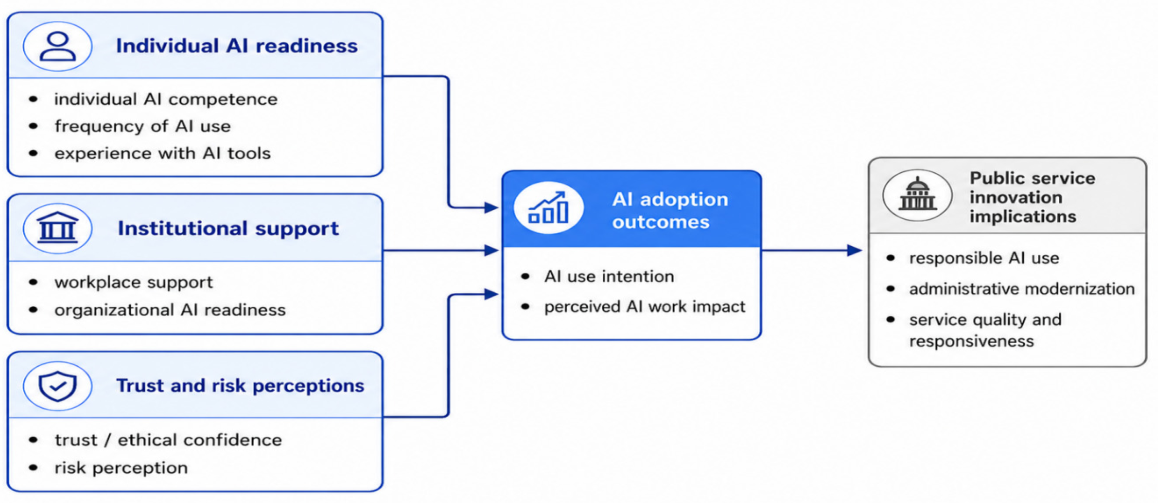
The conceptual model links AI readiness in public administration with the capacity of public institutions to support responsible public service innovation. The model focuses on the relationship between three groups of explanatory factors and two AI adoption outcomes.
The first group refers to individual AI readiness. It includes individual AI competence, frequency of AI use, and experience with AI tools. These variables capture the extent to which public employees are able, willing, and practically exposed to AI use in their work.
The second group refers to institutional support. It includes workplace support and organizational AI readiness. Workplace support captures the immediate social and organizational environment in which employees use AI, while organizational AI readiness captures broader institutional conditions such as resources, infrastructure, training opportunities, support for innovation, and employee involvement in AI implementation.
The third group refers to trust and risk perceptions. Trust/ethical confidence captures whether employees perceive AI tools as reliable, transparent, ethical, fair, accurate, and responsible in handling data. Risk perception captures concerns about dependency, errors, bias, digital divides, discrimination, monitoring, and possible negative effects on public employees and citizens.
These three groups of factors are examined in relation to two outcomes: AI use intention and perceived AI work impact. AI use intention reflects whether employees plan to continue using AI and support its integration into their work. Perceived AI work impact reflects whether employees believe that AI is useful, improves work quality, helps them achieve work-related goals, increases speed, and supports creativity.
The model does not test public service innovation as a separate dependent variable. Rather, public service innovation is used as the broader interpretive frame of the article. The empirical analysis examines whether AI adoption outcomes are mainly associated with individual readiness, institutional support, or trust and risk perceptions. The discussion then considers what this balance implies for the capacity of public organizations to transform AI use into responsible public service innovation.
Figure 1 summarizes the conceptual model guiding the empirical analysis.
The empirical analysis tests associations between the explanatory variables and the two AI adoption outcomes. It does not claim causal effects, because the dataset is cross-sectional. The model is used to organize the analysis of the individual and institutional conditions under which AI adoption may support public service innovation.
4. Data and Methods
4.1. Data Source and Analytical Sample
The empirical analysis uses the Romanian dataset of the Global Artificial Intelligence Adoption Survey. The questionnaire used in the survey was developed within research projects conducted at the Faculty of Public Administration, University of Ljubljana. Its design and theoretical background build on previous and ongoing work on AI adoption in public administration [
4,
10,
28].
The full questionnaire covered several modules, including respondent and organizational characteristics, AI use, frequency and experience of use, perceived usefulness and work impact, learning and training, trust and risk perceptions, workplace and organizational support, organizational readiness, transparency and accountability, and reasons for non-use. The present article uses a reduced set of items from this broader questionnaire, selected to match the article’s focus on individual AI readiness, institutional support, and AI adoption outcomes.
The Romanian dataset includes 353 respondents from the public sector. Participation in the survey was voluntary, and the Romanian sample was based on a non-probabilistic, convenience sampling strategy. Respondents were asked to report the name of the organization where they were currently working, the level of operation of their organization, and the domain in which their organization predominantly operates. These variables allowed to inspect the institutional provenance and diversity of the responses. However, organization names are not reported in this article because the survey data are analyzed and presented only in aggregated form. The questionnaire covered multiple public-sector domains, including defense, economic affairs, education, environmental protection, general public services, health, housing and community amenities, public order and safety, recreation, culture and religion, social protection, and other domains. Nevertheless, the sampling strategy was not designed to ensure proportional representation across all categories of Romanian public institutions. Therefore, the findings should be interpreted as exploratory evidence from a national sample of Romanian public sector employees rather than as statistically representative estimates for the entire Romanian public sector. Based on the routing question regarding AI use, 290 respondents reported using at least one AI tool, 49 reported not using AI, and 14 did not know whether they use AI.
The main analytical sample consists of the 290 AI users, because the attitudinal, organizational readiness, trust, risk, and perceived impact items were answered primarily by this group. Non-users followed a different questionnaire route and answered mainly demographic questions, a specific section on reasons for non-use, and the final open-ended question. Therefore, they are not included in the main regression models of this article. This analytical choice means that the main regression models are conditional on respondents who already reported using at least one AI tool. The study therefore explains variation in AI use intention and perceived AI work impact among AI users, rather than modeling initial adoption versus non-adoption in the full sample. This restriction follows from the questionnaire routing as non-users did not complete the sections measuring AI use intention, perceived AI work impact, individual AI competence, workplace support, organizational AI readiness, trust/ethical confidence, and risk perception. Consequently, the same readiness model cannot be estimated jointly for AI users and non-users.
4.2. Data Screening and Missing Values
Before the analysis, the dataset was screened for routing logic, missing values, and valid responses. The analysis of AI readiness, organizational support, trust, risk perception, and perceived work impact was restricted to AI users because these respondents completed the relevant sections of the questionnaire.
Responses such as “I do not have enough information” or missing answers were treated as missing for the corresponding item. Composite scores were calculated using available valid responses, provided that at least half of the items in the construct had valid answers. The attention check item was not included in any composite construct. Cases with missing values on variables required for a specific analysis were excluded listwise from that analysis.
4.3. Variable Selection and Construct Development
To keep the article analytically focused, the statistical analysis uses a reduced set of variables directly connected to the central argument of the paper: the balance between individual AI readiness and institutional support for AI adoption.
The variables and constructs used in the analysis were selected from the broader English questionnaire and accompanying codebook. They do not represent the full survey instrument, but only the items relevant to the article’s analytical focus. The item codes correspond to the variable names in the English questionnaire, codebook, and Romanian dataset.
Table 1 distinguishes between dependent variables, explanatory constructs, and control variables.
Public service innovation was not operationalized as a separate construct in the statistical analysis. The dependent variables used in the regression models are AI use intention and perceived AI work impact, both measured through individual self-reported perceptions. Therefore, the empirical models test individual perspectives on continued AI use and perceived work-related usefulness, while public service innovation is discussed as the broader organizational and governance implication of these adoption outcomes. All multi-item constructs were measured on a five-point Likert scale. Composite scores were calculated by averaging valid item responses for each construct. A composite score was computed when at least half of the items belonging to the construct had valid responses. Internal consistency was assessed using Cronbach’s alpha based on complete item-level cases for each scale. The two dependent variables used in the regression models are self-reported perceptual outcomes. AI use intention captures respondents’ stated willingness to continue using AI and support its integration into work, while perceived AI work impact captures respondents’ subjective evaluation of the usefulness and work-related benefits of AI. Therefore, these variables should not be interpreted as objectively observed AI use behavior, measured productivity gains, improved service quality, or documented public service innovation outcomes. Because the main analytical sample consists of respondents who already reported using AI at work, the results may partly reflect positive prior experiences, personal motivation to use AI, socially desirable optimism regarding digital transformation, or differences in respondents’ understanding of AI tools.
Frequency of AI use (Q15), experience with AI tools (Q16), and administrative level (Q3) were not treated as multi-item constructs and therefore were not included in the reliability table. They were used as control variables in the regression models to account for differences in actual exposure to AI tools and organizational context. Specifically, frequency of AI use controls for how often respondents use AI, experience with AI tools controls for how respondents evaluate their prior interaction with AI, and administrative level controls for whether respondents work in local, regional, or national public organizations. Administrative level was included through dummy variables for regional and national organizations, with local organizations as the reference category. Respondents classified as “other level” were excluded from the administrative-level comparison and regression dummy coding.
4.4. Statistical Procedures
The statistical analysis followed four steps. First, descriptive statistics were computed for the main constructs. Second, internal consistency was assessed using Cronbach’s alpha. Third, differences between local, regional, and national administrative levels were examined using Kruskal–Wallis tests, because the original items are ordinal and the groups are unbalanced. Fourth, ordinary least squares regression models were estimated for two dependent variables, namely AI use intention and perceived AI work impact. OLS regression was used because the dependent variables are multi-item composite scores calculated as averages of several Likert-type items, rather than single ordinal items. This approach is commonly used in survey-based research when composite indicators show high internal consistency and are treated as approximately continuous. To reduce sensitivity to heteroscedasticity, the models were estimated with HC3 robust standard errors. The interpretation of the regression results is therefore limited to associations between composite indicators and does not imply causal effects. Ordinal regression was not used because the dependent variables are averaged composite scores with multiple observed values, not single ordered categorical responses.
The analysis was conducted in Python 3.13.5. Data preparation and variable construction were performed using pandas 2.2.3 and NumPy 2.3.5. Internal consistency was assessed using Cronbach’s alpha computed from item-level responses. Group comparisons were conducted using SciPy 1.17.0, and OLS regression models were estimated using statsmodels 0.14.6. Variance inflation factors were computed to assess multicollinearity among predictors. Regression models were estimated with HC3 robust standard errors to reduce sensitivity to heteroscedasticity.
To align the analysis with the research questions, each empirical step was connected to a specific analytical purpose, as shown in
Table 2.
5. Results
5.1. Reliability and Descriptive Statistics
The selected constructs show strong internal consistency, with Cronbach’s alpha values ranging from 0.89 to 0.96. This supports the use of composite indicators in the analysis. The very high reliability of organizational AI readiness (α = 0.96) indicates that the items capture a highly coherent dimension of perceived institutional readiness, although it may also suggest some conceptual proximity among the items. Therefore, this construct is interpreted as a broad composite indicator of organizational AI readiness rather than as a set of distinct subdimensions.
Table 3 presents the reliability coefficients, valid composite cases, means, and standard deviations for the main constructs.
All constructs are measured on a 1–5 scale, with higher values indicating stronger agreement with the corresponding construct. Therefore, values above the scale midpoint indicate relatively stronger presence of the measured dimension, while values around or below the midpoint indicate more moderate or weaker presence.
The descriptive results indicate a clear gap between individual readiness and institutional support. Individual AI competence (M = 4.02), AI use intention (M = 4.04), and perceived AI work impact (M = 3.95) are all above the scale midpoint and close to the upper end of the scale. By contrast, organizational AI readiness is lower (M = 2.85), while workplace support is moderate (M = 3.29). Trust/ethical confidence is also moderate (M = 3.24), whereas risk perception is relatively elevated (M = 3.67).
5.2. Administrative-Level Patterns
The second step of the analysis examined whether the individual–organizational readiness gap varies across local, regional, and national administrative levels.
Table 4 presents mean values by administrative level and Kruskal–Wallis test results.
The results show limited differences between administrative levels. In the unadjusted Kruskal–Wallis tests, the only p-value below the conventional 0.05 threshold is observed for trust/ethical confidence in AI (p = 0.012). Descriptively, local-level respondents report the highest mean on this construct, followed by national and regional respondents. However, because seven constructs are compared across administrative levels, this result should be interpreted cautiously as an exploratory finding rather than as strong evidence of an administrative-level difference. Risk perception shows a marginal difference (p = 0.074), but it does not reach conventional levels of statistical significance.
For the main readiness and impact constructs, the differences between local, regional, and national levels are not statistically significant. AI use intention, perceived AI work impact, individual AI competence, workplace support, and organizational AI readiness show broadly similar patterns across administrative levels. However, administrative level is a broad classification and may obscure more specific organizational differences. Differences in AI readiness may also depend on factors such as organizational size, policy domain, service area, leadership support, digital maturity, availability of AI-related guidelines, or the existence of formal AI policies. These factors were not examined as separate grouping variables in the present analysis, because the article focuses on the local-regional-national comparison and on the main readiness-related constructs. Therefore, the finding of limited administrative-level differences should be interpreted cautiously and should not be taken to mean that organizational differences are absent.
5.3. Predictors of AI Use Intention
The third step of the analysis estimated an OLS regression model predicting AI use intention. The model includes individual AI competence, workplace support, organizational AI readiness, trust/ethical confidence, risk perception, frequency of AI use, experience with AI tools, and administrative level controls. Robust HC3 standard errors were used. Frequency of AI use, experience with AI tools, and administrative level are included as control variables. This allows the model to assess whether the main constructs remain associated with AI use intention after accounting for respondents’ actual exposure to AI tools and organizational context. The regression results are reported in
Table 5.
The model explains 67.1% of the variance in AI use intention. The strongest predictor is individual AI competence (β = 0.405, p < 0.001). Frequency of AI use is also a strong positive predictor (β = 0.223, p < 0.001). Trust/ethical confidence (β = 0.182, p = 0.016) and experience with AI tools (β = 0.159, p = 0.020) are also statistically significant positive predictors. Workplace support is marginally significant (β = 0.130, p = 0.089).
Organizational AI readiness is not statistically significant in this model (β = −0.074, p = 0.207). Risk perception is also not significant. Administrative level controls do not show significant associations with AI use intention.
5.4. Predictors of Perceived AI Work Impact
The fourth step of the analysis estimated an OLS regression model predicting perceived AI work impact. The same explanatory variables and controls were included as in the previous model. The regression results for perceived AI work impact are presented in
Table 6.
The model explains 68.5% of the variance in perceived AI work impact. Individual AI competence is again the strongest predictor (β = 0.522, p < 0.001). Workplace support is also a significant positive predictor (β = 0.255, p < 0.001), followed by trust/ethical confidence (β = 0.146, p = 0.021) and frequency of AI use (β = 0.134, p = 0.013).
Organizational AI readiness is not statistically significant, and neither is risk perception. Experience with AI tools is not significant in this model, although it was significant in the model predicting AI use intention. Administrative level controls are close to conventional significance thresholds, but they are not interpreted as statistically significant predictors. Additional diagnostic checks were conducted to assess whether the non-significant coefficient of organizational AI readiness could be explained by multicollinearity, statistical suppression, or restricted variation. Variance inflation factors did not indicate severe multicollinearity among the predictors. The highest VIF was 2.52 in the model predicting AI use intention and 2.52 in the model predicting perceived AI work impact, both below commonly used thresholds for problematic multicollinearity. Organizational AI readiness also showed sufficient variation, with observed values covering the full 1–5 scale and a standard deviation of approximately 1.15 in the regression samples. Organizational AI readiness was positively correlated with workplace support (r = 0.67), but the correlation was moderate to high rather than redundant. The correlations between organizational AI readiness and the two dependent variables were lower (r = 0.31 with AI use intention and r = 0.36 with perceived AI work impact), while individual AI competence showed stronger correlations with both AI use intention (r = 0.66) and perceived AI work impact (r = 0.71). These correlations support the interpretation that the constructs are related but not empirically identical. These diagnostics suggest that the non-significant coefficient should not be attributed primarily to severe multicollinearity or restricted variance. Rather, it indicates that organizational AI readiness does not add significant unique explanatory power in these models once individual competence, workplace support, trust, frequency of use, and experience with AI tools are included.
5.5. Additional Analysis by AI Exposure: Frequency of Use and Experience with AI Tools
Because frequency of AI use and experience with AI tools capture respondents’ practical exposure to AI, and because they show significant associations with at least one of the regression outcomes, an additional descriptive group comparison was conducted. This comparison does not test independent effects in the same way as the regression models do. Instead, it shows how the main constructs vary across groups with different levels of AI exposure. Administrative level was not included in this additional exposure-based comparison because it captures organizational context rather than practical exposure to AI; differences by administrative level were examined separately in
Section 5.2.
Respondents were first grouped by frequency of AI use into three categories: low/occasional users, moderate users, and frequent users. Low/occasional users include respondents who reported using AI rarely or occasionally; moderate users include those who reported using AI several times per month; and frequent users include respondents who reported using AI several times per week or daily. The results of this comparison are shown in
Table 7.
The results show clear differences by frequency of AI use. Frequent users report higher AI use intention, perceived AI work impact, and individual AI competence than respondents who use AI rarely or occasionally. They also report higher workplace support and slightly higher trust/ethical confidence in AI. At the same time, organizational AI readiness does not differ significantly across the three frequency groups.
Respondents were also grouped by their reported experience with AI tools. Three groups were used: weak/neutral experience, good experience, and very good experience. The weak/neutral category combines respondents who reported very weak, weak, or neutral experience with AI tools, due to the small number of respondents in the lowest categories. The results of the comparison by experience with AI tools are presented in
Table 8.
The results show a clear gradient across experience groups. Respondents reporting very good experience with AI tools also report the highest AI use intention, perceived AI work impact, individual AI competence, trust/ethical confidence, and workplace support. Respondents with weak or neutral experience report the lowest means across these dimensions. Risk perception follows the opposite pattern because respondents with weak or neutral experience report the highest risk perception, while those with very good experience report the lowest risk perception.
Organizational AI readiness also differs significantly across experience groups, although the pattern is less linear than for the other constructs. Respondents with good experience report the highest organizational readiness, while those with very good experience report a slightly lower mean.
These group comparisons should be interpreted descriptively. A significant Kruskal–Wallis result indicates that at least one exposure group differs from the others on a given construct, but it does not imply that the grouping variable has an independent effect after accounting for the other predictors included in the regression models.
5.6. Summary of Empirical Findings
Taken together, the results answer the three research questions and provide an additional insight into the role of AI exposure. Regarding RQ1, the analysis shows a clear imbalance between high individual AI readiness and weaker organizational AI readiness. Respondents report high AI use intention, high perceived AI work impact, and high individual AI competence, while organizational AI readiness is lower and workplace support is moderate.
Regarding RQ2, the readiness gap does not vary substantially across administrative levels. In the unadjusted tests, trust/ethical confidence is the only construct with a p-value below the conventional 0.05 threshold, while the other main constructs do not differ significantly between local, regional, and national organizations. This suggests that the individual–institutional readiness gap is a broader pattern rather than a problem confined to one level of government.
Regarding RQ3, AI use intention and perceived AI work impact are associated mainly with individual competence, frequency of use, trust, experience, and workplace support. Organizational AI readiness does not emerge as a significant direct predictor in the regression models after accounting for the other predictors and control variables.
The additional comparisons by frequency of use and experience with AI tools further show that stronger exposure to AI is associated with higher intention, perceived impact, competence, trust, and workplace support. However, organizational AI readiness remains less consistently related to these exposure-based groups, reinforcing the argument that AI adoption is driven primarily by individual and immediate work-level conditions rather than by broader institutional readiness.
6. Discussion
The findings show that AI adoption in the Romanian public sector is characterized by a clear imbalance between individual readiness and institutional support. Public sector employees who use AI report high individual competence, strong intention to continue using AI, and positive perceived work impact. At the same time, organizational AI readiness is comparatively weaker and does not emerge as a significant direct predictor of either AI use intention or perceived AI work impact in the regression models.
This finding contributes to the literature on AI adoption in public administration by providing a more specific empirical account of the readiness gap through which AI adoption may advance at the employee level before it becomes fully institutionalized. The article does not claim that the distinction between individual and organizational readiness is new. Instead, it shows how this distinction operates in the Romanian public sector by comparing individual competence, practical AI exposure, workplace support, organizational AI readiness, trust, and risk perception in relation to two adoption outcomes. Previous studies have emphasized that AI in the public sector creates opportunities for efficiency, automation, decision support, and service improvement, but also that implementation is constrained by organizational, ethical, legal, and governance challenges [
3,
9,
11]. The Romanian case supports this view but adds a more specific insight: public employees may already perceive AI as useful and may be willing to use it, even when broader organizational readiness remains modest.
The strongest predictor of both AI use intention and perceived AI work impact is individual AI competence. This result is consistent with digital transformation research, which stresses that skills, learning, and organizational culture are central to technology adoption in public administration [
6]. However, the findings also suggest that competence is currently developed largely at the individual level. This reinforces the idea that public sector digital transformation cannot be reduced to access to tools; it requires institutional mechanisms that support learning, standardize practices, and reduce unequal adoption across employees.
The additional group comparisons by AI exposure reinforce this interpretation. Respondents who use AI more frequently and those who report better experience with AI tools also report higher AI use intention, perceived work impact, individual competence, trust, and workplace support. This suggests that AI readiness is closely connected to practical exposure and learning through use. However, these comparisons are descriptive and should not be interpreted as causal evidence that exposure alone produces readiness.
Trust/ethical confidence is also positively associated with both AI use intention and perceived work impact. This aligns with responsible AI frameworks that emphasize transparency, fairness, accountability, robustness, and human-centered values as conditions for trustworthy AI adoption [
7,
8,
13]. The result is important because it shows that trust is not only a normative requirement but also an empirical factor associated with AI adoption outcomes. Employees who perceive AI tools as more reliable, ethical, transparent, and responsible are more likely to continue using them and to perceive them as beneficial for work.
At the same time, risk perception does not emerge as a significant negative predictor in the regression models. This does not mean that risks are irrelevant. Rather, it suggests that risk awareness may coexist with positive perceptions of AI usefulness. Public employees may recognize risks such as errors, bias, data misuse, overdependence, digital divides, monitoring, or possible negative effects on citizens and employees while still perceiving AI as useful when it is treated as a tool requiring verification and human judgment. However, this interpretation should remain cautious because the risk perception construct combines several types of concerns, including technical, ethical, organizational, employment-related, and citizen-related risks. The non-significant coefficient may therefore reflect the fact that these risks do not operate in the same direction or with the same intensity. Future research should examine whether different categories of AI-related risk have distinct effects on AI use intention and perceived work impact.
Workplace support is significantly associated with perceived AI work impact and marginally associated with AI use intention. This finding supports the view that technology adoption in public organizations is shaped not only by individual attitudes, but also by the immediate organizational environment [
29]. Even when broader organizational readiness is weak, support from colleagues, supervisors, and the work context can help employees translate AI use into perceived work benefits. This complements the literature on digital transformation by showing the importance of meso-level support between individual experimentation and formal institutional strategy.
One of the most important findings is that organizational AI readiness is not a significant direct predictor in the regression models. This should not be interpreted as evidence that organizational readiness is unimportant. On the contrary, the descriptive results show that organizational readiness is comparatively weak. A plausible interpretation is that AI adoption in the Romanian public sector may be occurring ahead of formal institutional arrangements. In other words, organizational readiness may not yet be sufficiently developed or visible to employees to shape their use intention and perceived impact. This finding extends previous arguments that AI implementation in the public sector requires organizational capacity, governance structures, and accountability mechanisms [
3,
14]. The exposure-based comparisons add an important nuance. Organizational AI readiness does not differ significantly across frequency-of-use groups and shows a less consistent pattern across experience groups than the individual-level constructs. This suggests that more frequent or more positive AI use is not necessarily matched by stronger perceptions of organizational readiness. The result reinforces the interpretation that AI adoption is advancing through individual and immediate work-level conditions faster than through broader institutional arrangements.
The comparison between local, regional, and national administrative levels further supports the interpretation that the readiness gap is systemic. With the exception of trust/ethical confidence, the main constructs do not differ significantly across administrative levels. This suggests that the individual-institutional readiness gap is not limited to one tier of government. The finding is relevant for smart governance and digital public service innovation, where institutional capacity is often discussed in relation to local and regional administrative contexts [
20,
21]. In the Romanian case, however, the challenge appears to cut across administrative levels.
These findings have direct implications for public service innovation and are also consistent with recent work on digital innovation in public sector organizations, which emphasizes that AI and data-driven tools must be understood in relation to publicness, organizational capacity, and governance arrangements, rather than only as technical solutions [
17]. AI can support innovation in public services by improving internal efficiency, assisting information processing, supporting decision-making, reducing routine workload, and enabling new ways of organizing administrative work [
23,
24]. However, the literature on digital transformation emphasizes that technology creates public value only when embedded in organizational processes, capabilities, and governance arrangements [
6,
25]. The Romanian evidence confirms this point: individual experimentation with AI is already visible, but it must be translated into institutional capability if it is to support responsible public service innovation.
Overall, the article adds to existing research by identifying a specific form of AI readiness gap: high individual readiness and practical exposure combined with weaker institutional support. This gap helps explain why AI adoption may spread informally through employees before becoming part of formal public sector innovation strategies. The findings suggest three main points. First, individual competence and practical exposure to AI are central to adoption outcomes. Second, trust and workplace support determine whether AI is perceived as useful and worth continuing. Third, organizational readiness remains weaker and less consistently related to AI exposure and adoption outcomes, creating a governance gap that may limit the capacity of AI to support responsible public service innovation. The main implication is that public organizations should not treat AI adoption as a purely individual or technical matter. To support responsible public service innovation, AI use must be accompanied by training, rules, accountability mechanisms, transparency practices, and organizational learning.
7. Policy Implications
The findings have several implications for public institutions seeking to use AI as a tool for responsible public service innovation. The main implication is that AI adoption should not be treated only as an individual employee practice or as a matter of access to digital tools. The results show that employees may already be willing and able to use AI, but organizational readiness and institutional support remain weaker. Public institutions therefore need to move from informal experimentation toward structured and accountable AI adoption.
First, public institutions should develop clear internal guidelines for AI use. These guidelines should distinguish between low-risk uses, such as drafting, summarization, translation, information search, and internal administrative support, and higher-risk uses that may affect citizens, administrative decisions, or rights. Clear rules can reduce uncertainty among employees and support more consistent use across departments and organizations.
Second, AI training should become part of public sector capacity-building. The findings suggest that individual AI competence is strongly associated with both AI use intention and perceived work impact. However, competence should not depend only on self-learning or informal experimentation. Training programs should address not only technical use, but also verification of AI outputs, data protection, bias, transparency, accountability, and the limits of AI-generated information.
Third, public institutions should create opportunities for guided experimentation with AI tools. The results suggest that more frequent use and better experience with AI are associated with stronger readiness and more positive adoption outcomes. This does not mean that employees should be left to experiment informally without safeguards. Rather, public institutions should provide controlled environments, approved tools, practical use cases, peer learning, and support mechanisms that allow employees to gain experience while respecting data protection, accountability, and ethical requirements.
Fourth, public institutions should strengthen workplace and managerial support for AI adoption. Workplace support is associated with perceived AI work impact, which indicates that the immediate organizational environment matters. Managers, IT staff, legal experts, data protection officers, and public employees should be involved in defining appropriate AI use cases and in supporting employees who experiment with AI tools.
Fifth, organizational AI readiness should be treated as a strategic management issue. Institutions need resources, infrastructure, procedures, and governance arrangements that allow AI to be used responsibly. This includes decisions about approved tools, data handling, documentation, cybersecurity, procurement, and integration with existing work processes. Without such institutional arrangements, AI adoption may remain fragmented and uneven.
Sixth, public institutions should develop accountability and transparency mechanisms for AI-assisted work. This includes clarifying who is responsible for AI-assisted outputs, when AI use should be documented, how AI-generated content should be verified, and when citizens should be informed that AI has been used. These mechanisms are especially important in public administration because institutional legitimacy depends on legality, explainability, and public trust.
Seventh, risk awareness should be integrated into AI governance rather than treated as resistance to innovation. The findings suggest that public employees may recognize AI-related risks while still perceiving AI as useful. This creates an opportunity for responsible adoption: risk-aware employees can contribute to safer use if organizations provide guidance, procedures, and channels for reporting problems.
Finally, AI adoption should be connected to broader public service innovation strategies. AI can support administrative modernization, faster information processing, improved internal workflows, and more responsive services. However, these benefits require institutionalization. Public organizations should therefore treat AI readiness as part of their broader digital transformation agenda, linking employee competence with organizational learning, service redesign, and responsible governance.
8. Conclusions, Research Limitations and Future Directions
The article’s main conclusion is that AI adoption in the Romanian public sector is individually driven and that institutional support appears less developed in the available sample. This conclusion rests on two related but distinct findings. Descriptively, organizational AI readiness has the lowest mean among the main constructs, while individual AI competence, AI use intention, and perceived AI work impact are considerably higher. Inferentially, organizational AI readiness does not show a significant unique association with AI use intention or perceived AI work impact after individual competence, workplace support, trust, frequency of use, and experience with AI tools are included in the regression models. The non-significant coefficient should therefore not be read, by itself, as proof that institutional support is absent. Rather, it suggests that broader organizational readiness is less directly visible in the current models than individual competence, practical exposure, trust, and immediate workplace support. Taken together, the descriptive and inferential results indicate a readiness gap in which AI use appears to advance through employee-level experimentation and work-level support faster than through consolidated institutional arrangements.
The study has several limitations. First, the data are cross-sectional, so the analysis identifies associations rather than causal relationships. Second, the data are based on self-reported perceptions, which may be affected by subjective interpretation, social desirability, or differences in respondents’ understanding of AI tools. Third, the main regression models are restricted to AI users because non-users followed a different questionnaire route and did not answer the items measuring AI use intention, perceived AI work impact, individual AI competence, workplace support, organizational AI readiness, trust/ethical confidence, and risk perception. This creates a conditional analytical sample and means that the main models explain variation among AI users rather than initial adoption versus non-adoption in the full sample. An adoption versus non-adoption model would require a different analytical design and could only use variables available before questionnaire routing, such as demographic, occupational, or organizational background variables. Therefore, such a model would not test the readiness-related relationships addressed in this article. Fourth, the Romanian sample was based on voluntary participation and convenience sampling, which means that respondents with greater interest in AI or stronger exposure to AI tools may be overrepresented. Therefore, the descriptive means should not be interpreted as population-level estimates for the entire Romanian public sector. Fifth, the analysis focuses on Romania as a single-country case, which limits the generalizability of the findings to other administrative contexts.
Future research could extend this analysis in several directions. Comparative studies across countries could examine whether the individual–institutional readiness gap is specific to Romania or reflects a broader pattern in public sector AI adoption. Longitudinal research could assess whether organizational readiness increases as AI adoption matures. Future studies could also examine specific types of public institutions, such as local governments, health institutions, education organizations, or central government agencies. Finally, qualitative research could explore how public employees actually use AI tools in daily work and how organizational rules, managerial support, and professional norms shape responsible AI practices.
Overall, the Romanian case suggests that the next stage of AI adoption in the public sector should not focus only on expanding access to AI tools. The more important challenge is to transform individual experimentation into institutional capability. Only under these conditions can practical exposure to AI become a credible basis for stable, responsible, and institutionally supported public service innovation.