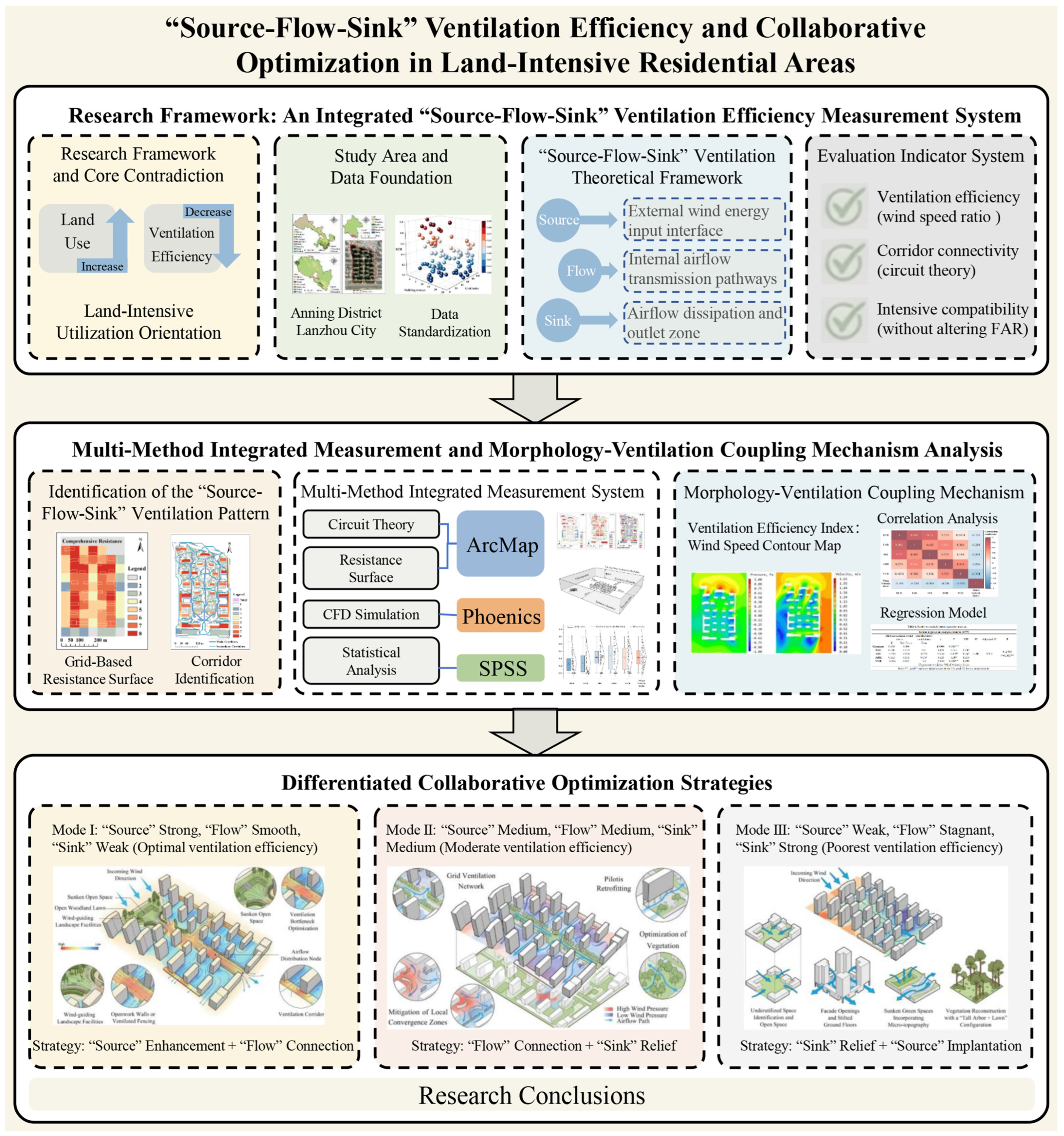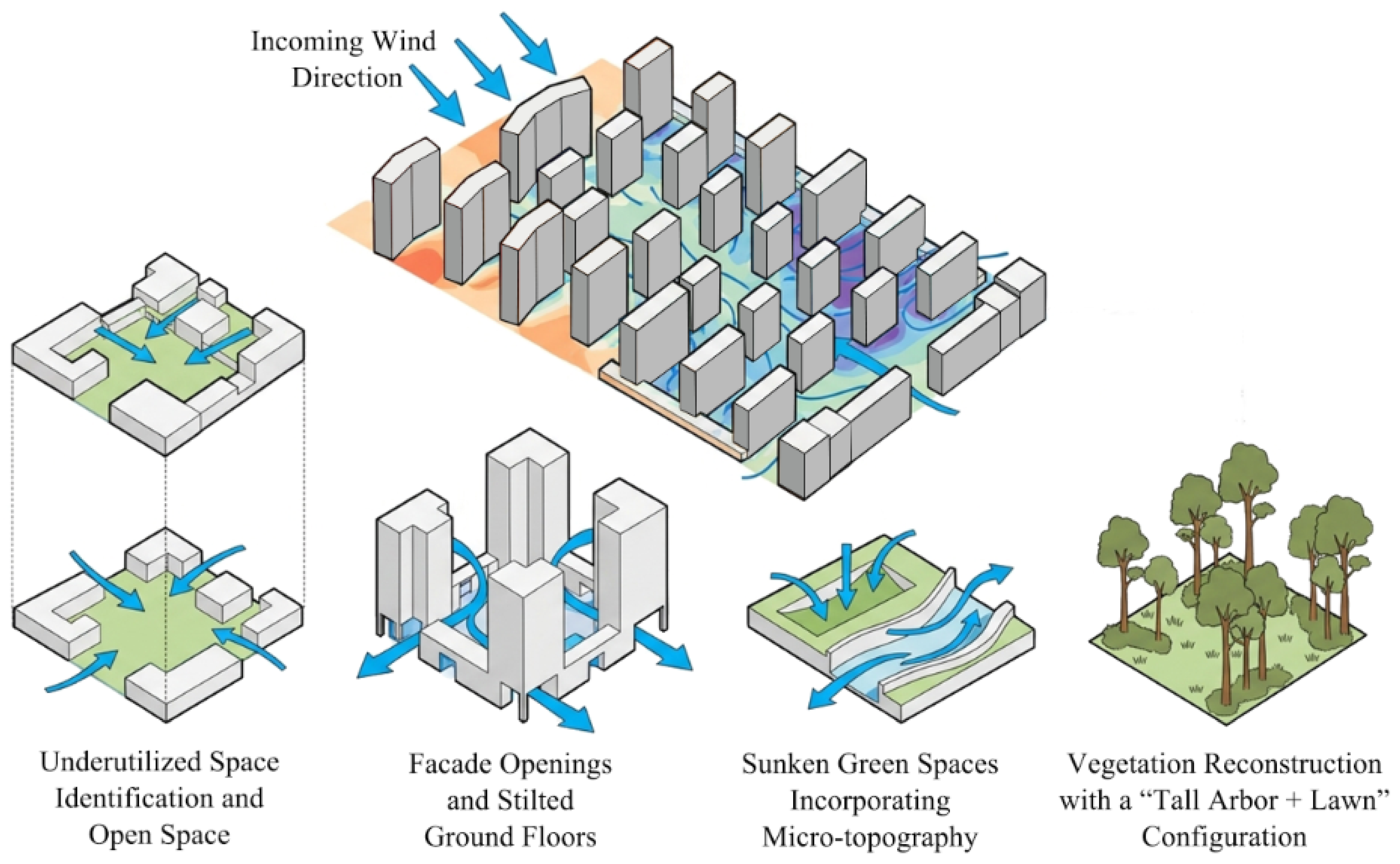
Measurement and Collaborative Optimization of “Source-Flow-Sink” Landscape Ventilation Efficiency in Residential Areas Under the Land-Intensive Mode


Abstract
1. Introduction
2. Materials and Methods
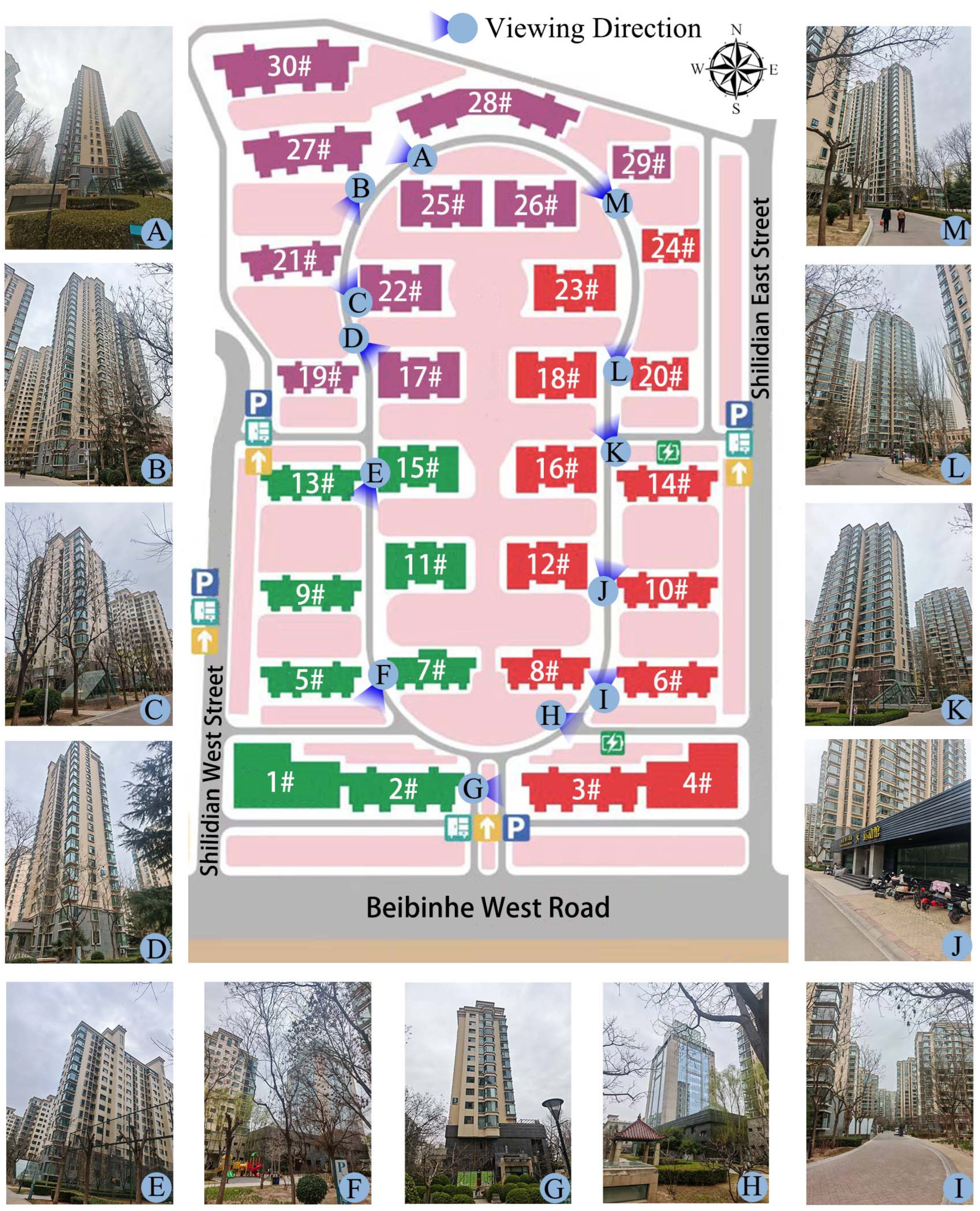
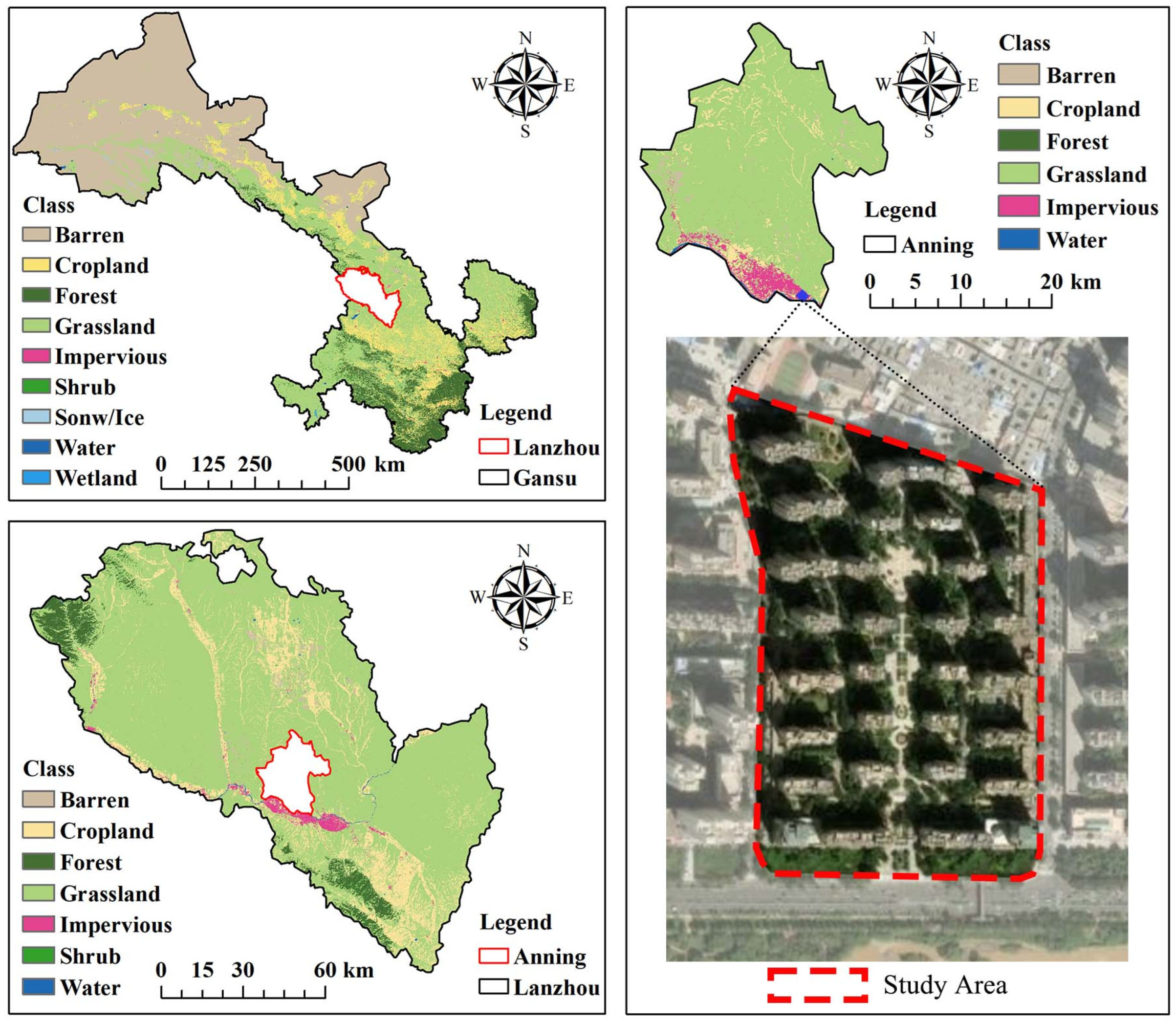
2.1. Overview of the Study Area
2.2. Data Sources and Processing
2.2.1. Data Sources
2.2.2. Data Processing Methods
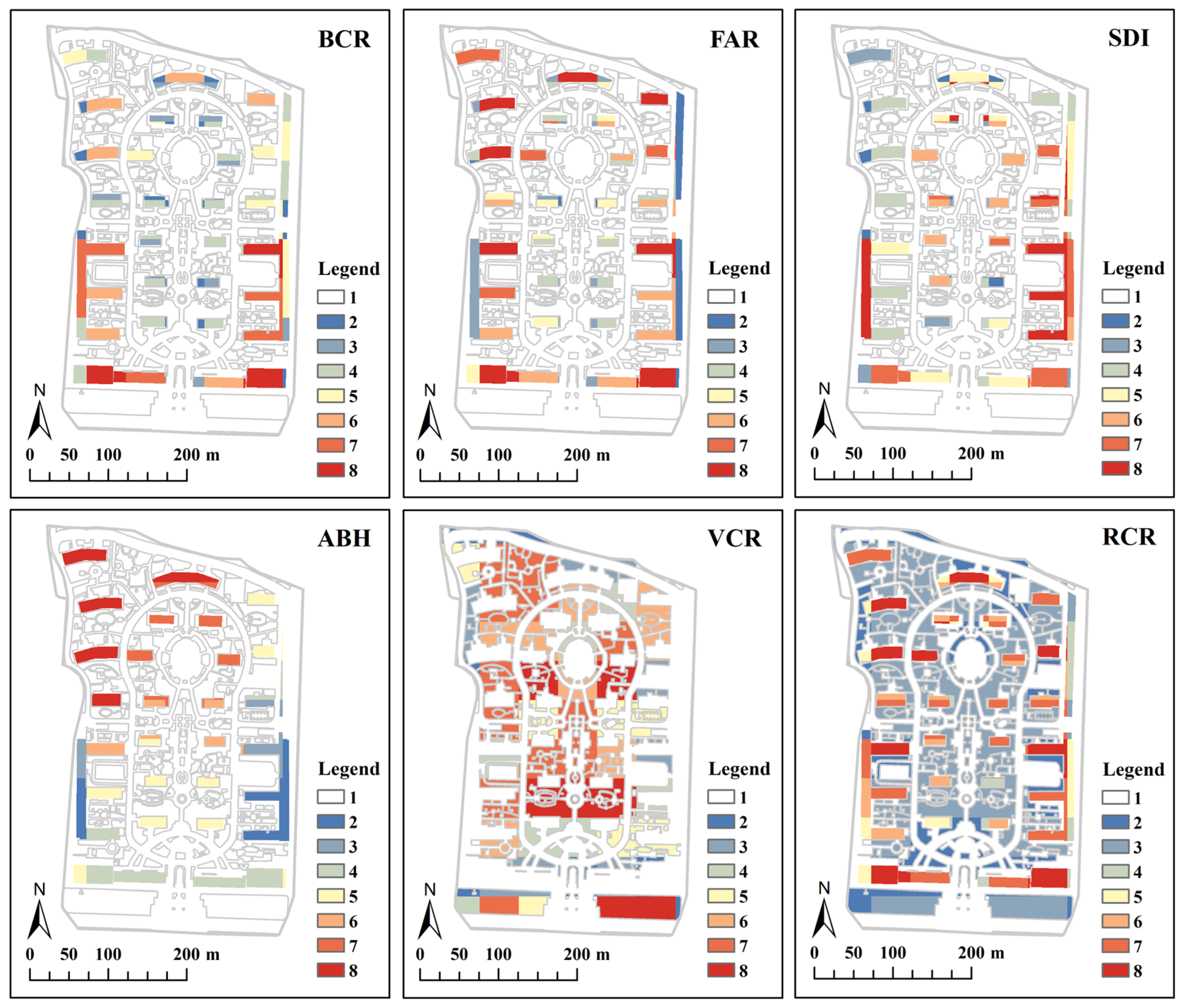
2.3. Spatial Morphology Indicator Selection and Calculation
2.3.1. Indicator Selection
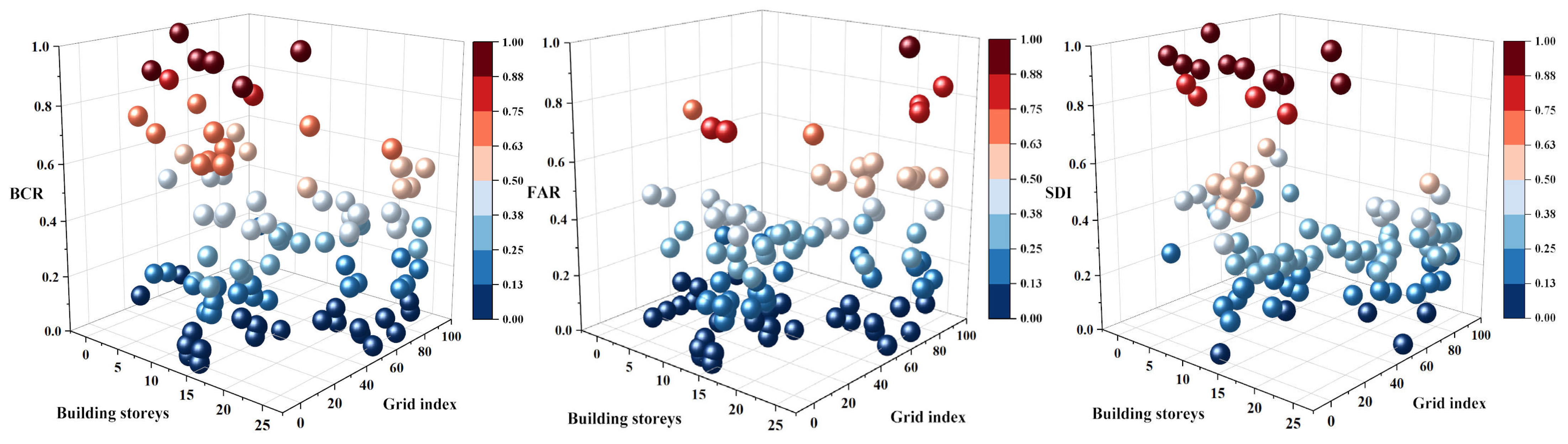
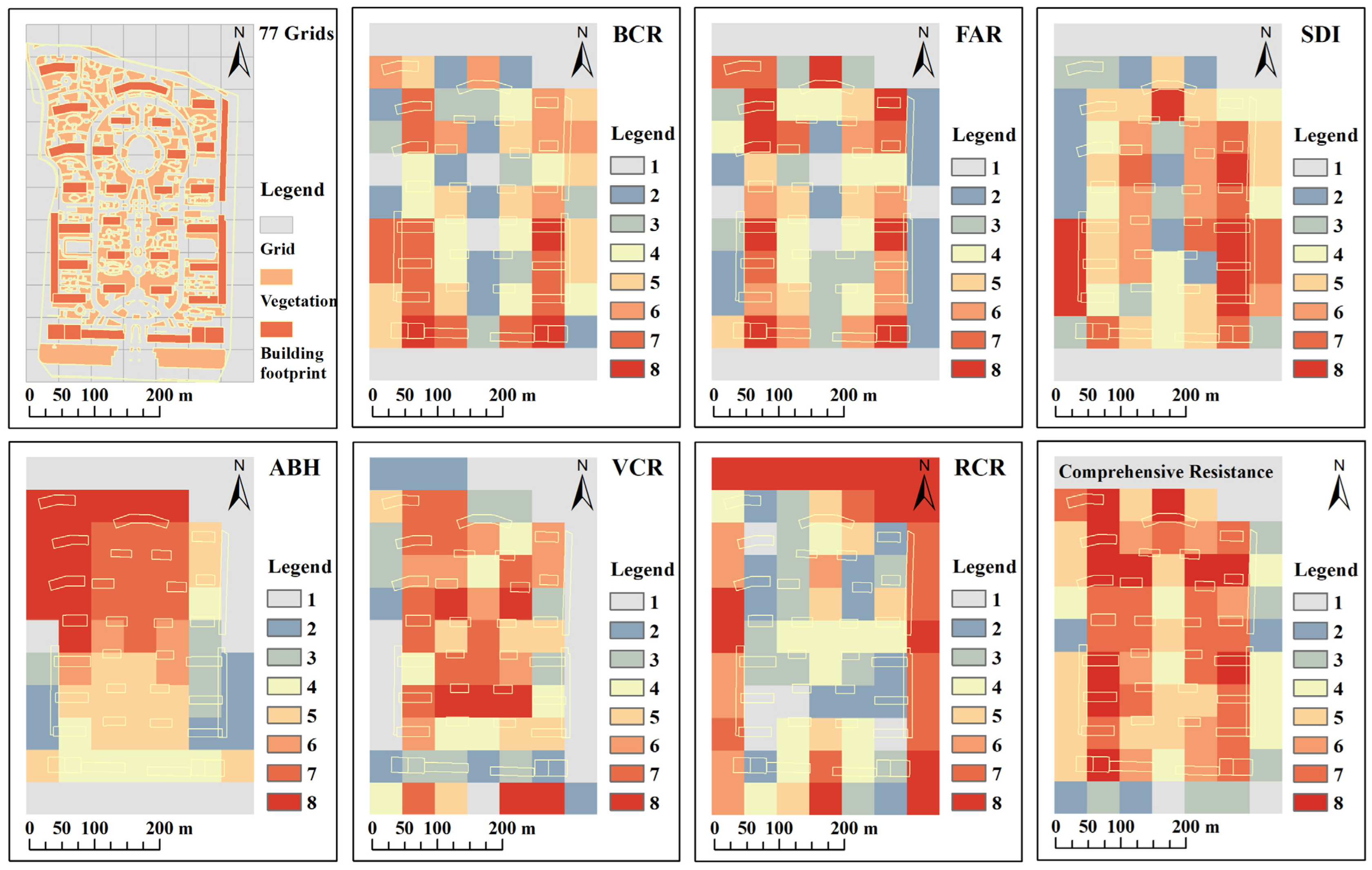
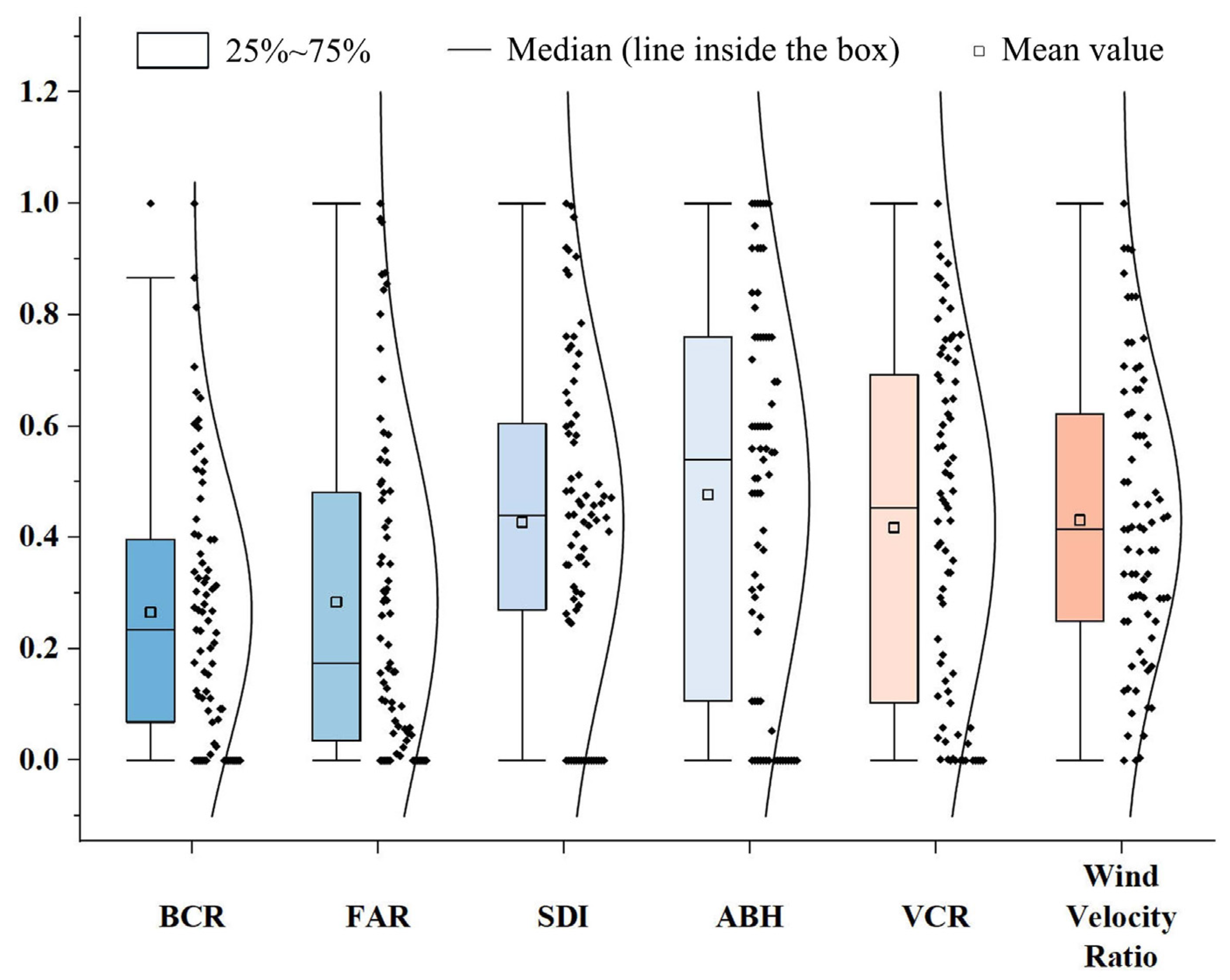
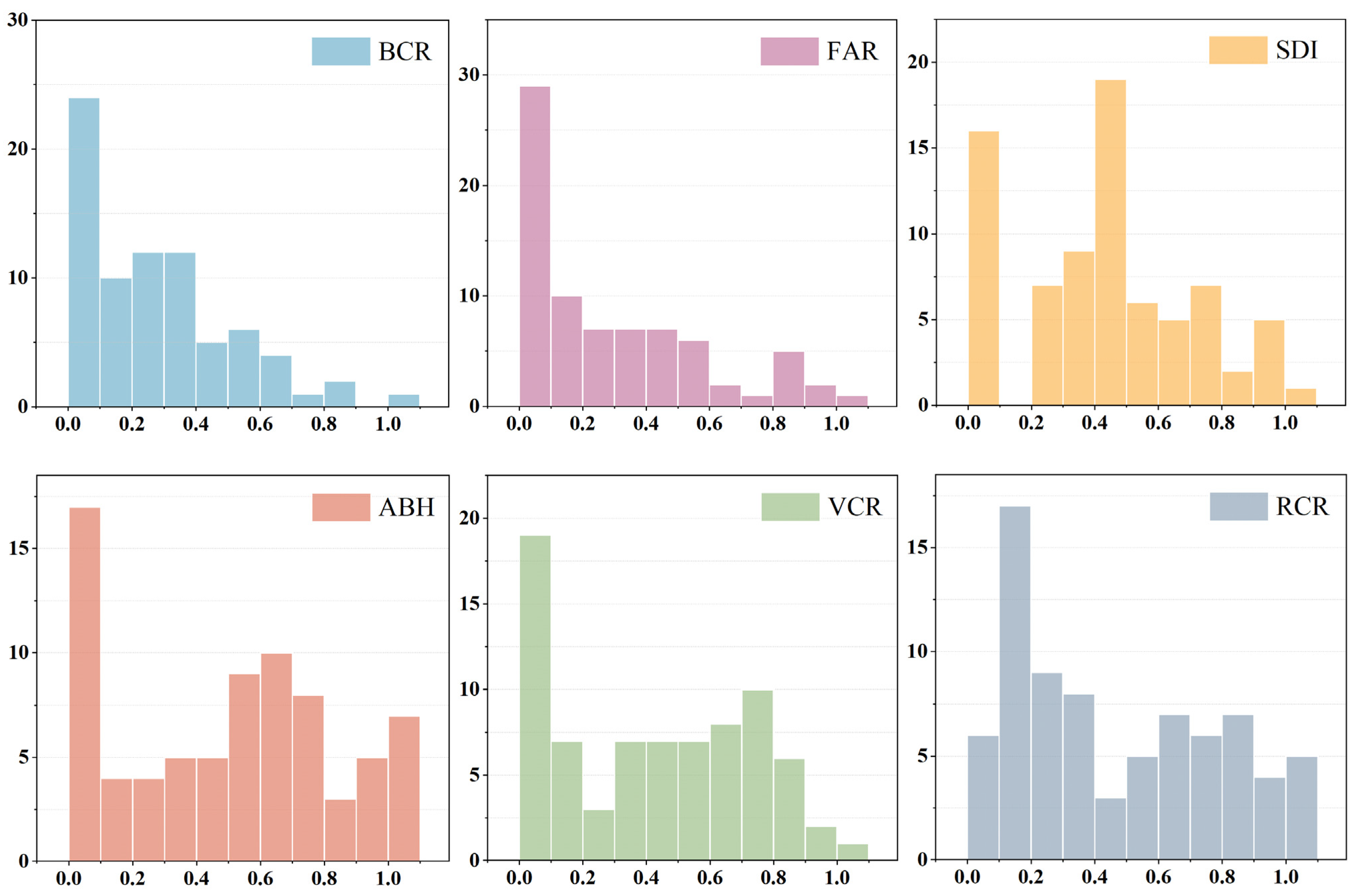
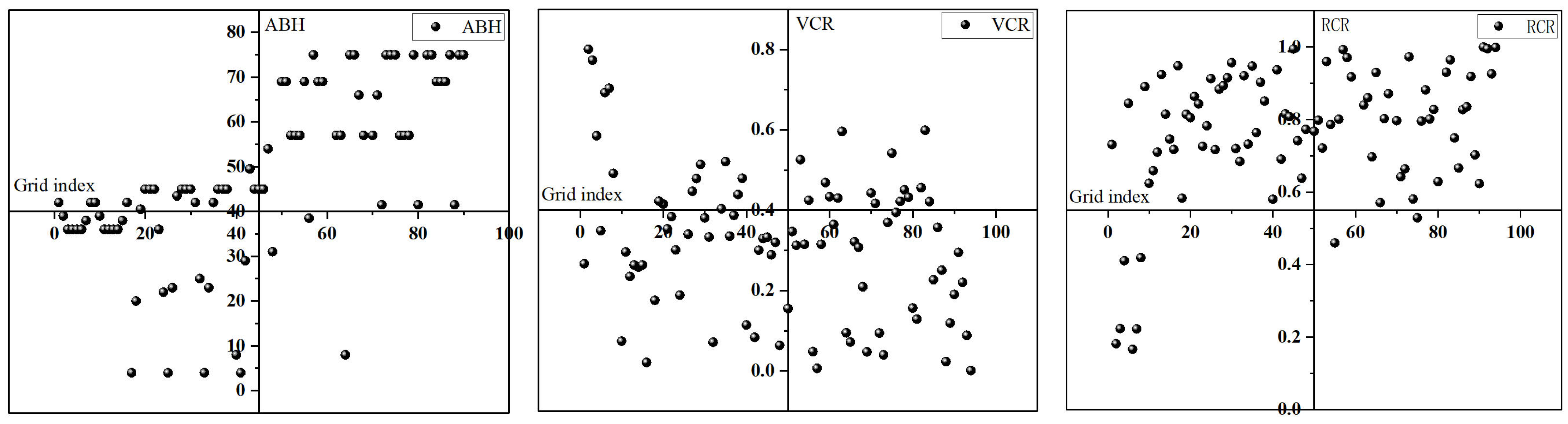
2.3.2. Indicator Calculation Results
2.4. Identification of “Source-Flow-Sink” Based on Circuit Theory
2.4.1. Fundamentals of Circuit Theory
2.4.2. Construction of a Multi-Factor Ventilation Resistance Surface
2.4.3. Identification Method of “Source-Flow-Sink”
2.5. CFD Numerical Simulation of the Wind Environment
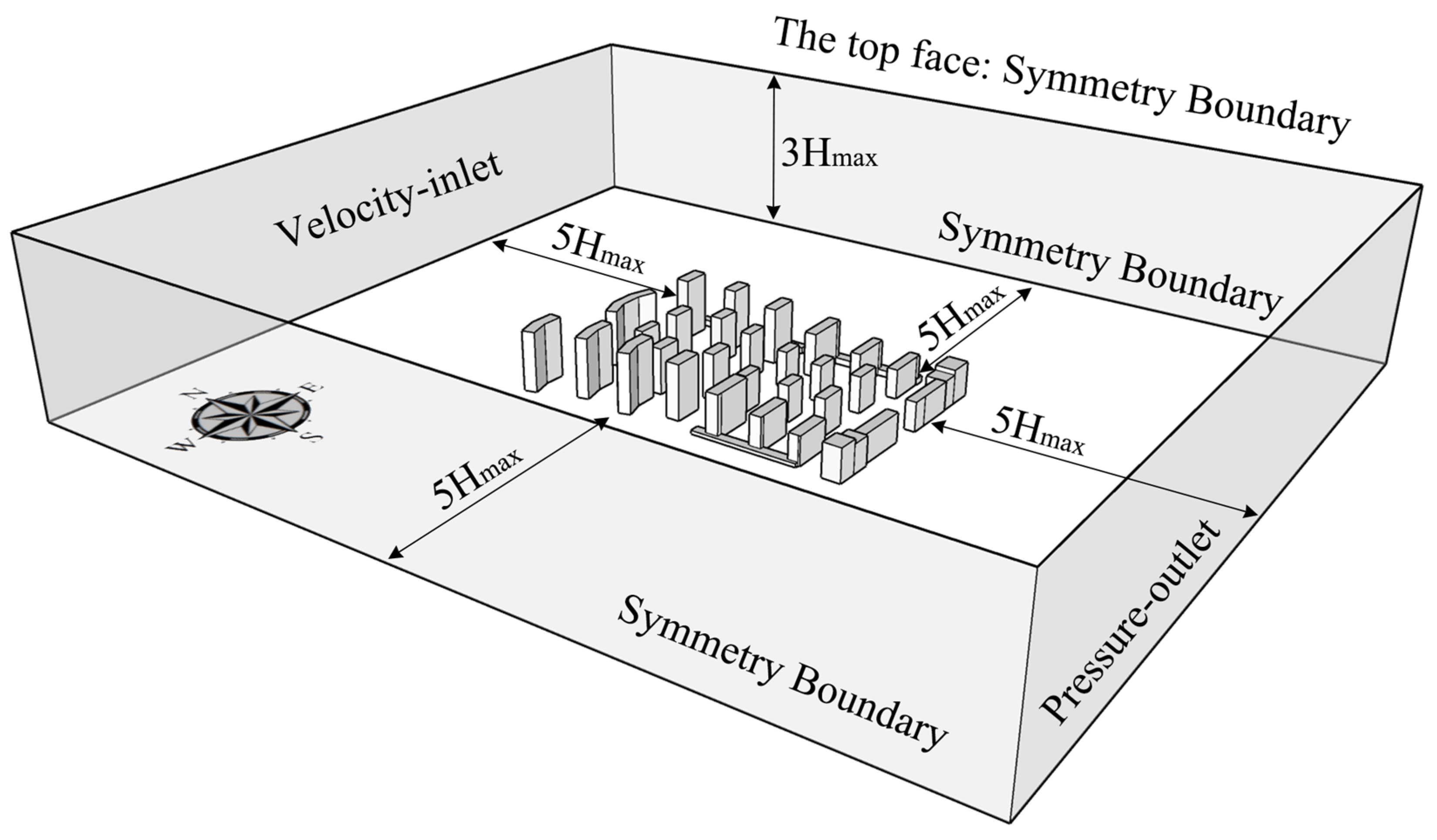
2.5.1. Model Construction and Mesh Generation
2.5.2. Mathematical Model and Boundary Conditions
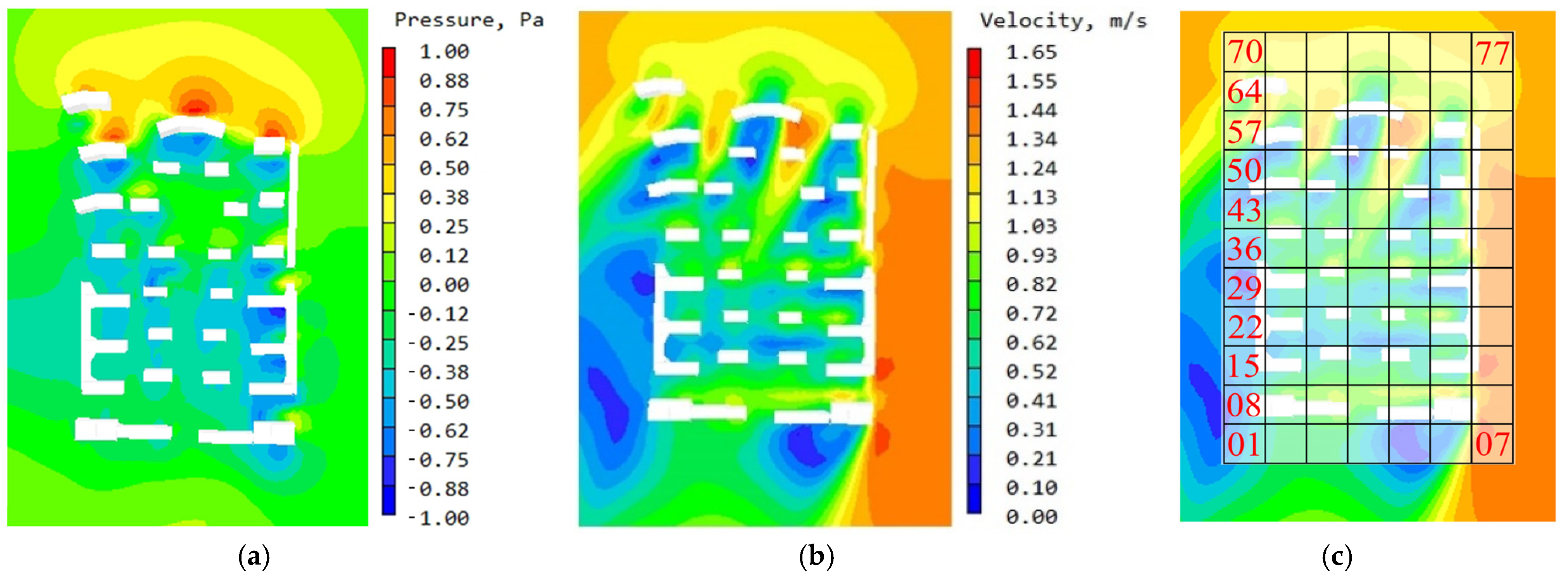
2.6. Quantification of Ventilation Efficiency
2.7. Statistical Analysis Methods
3. Results
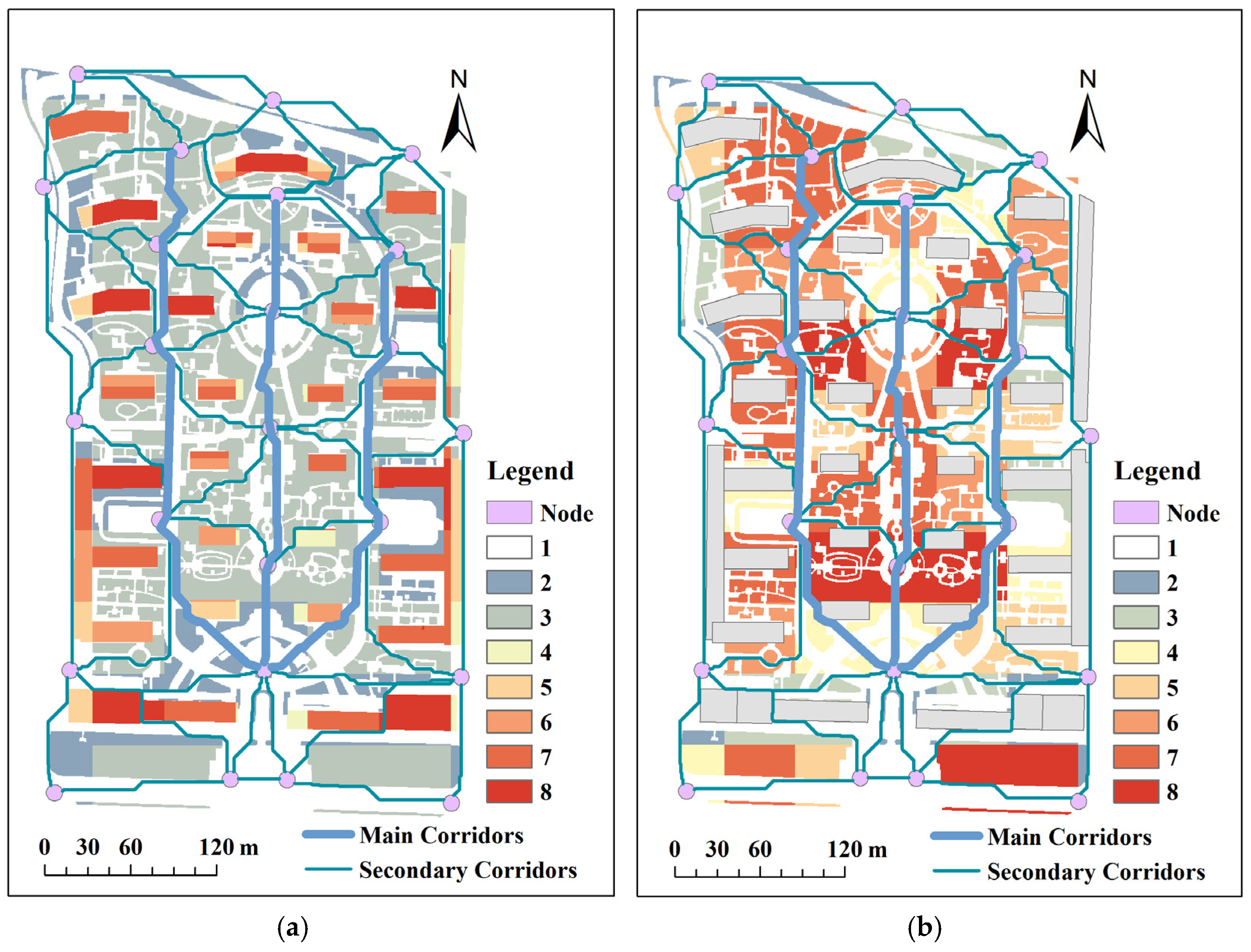
3.1. Identification Results of “Source-Flow-Sink”
3.1.1. Characteristics of the Multi-Factor Resistance Surface
3.1.2. Identification Results of Ventilation Corridors
3.2. CFD Simulation Results and Wind Field Characteristic Analysis
3.3. Coupling Analysis of Morphological Indicators and Ventilation Efficiency
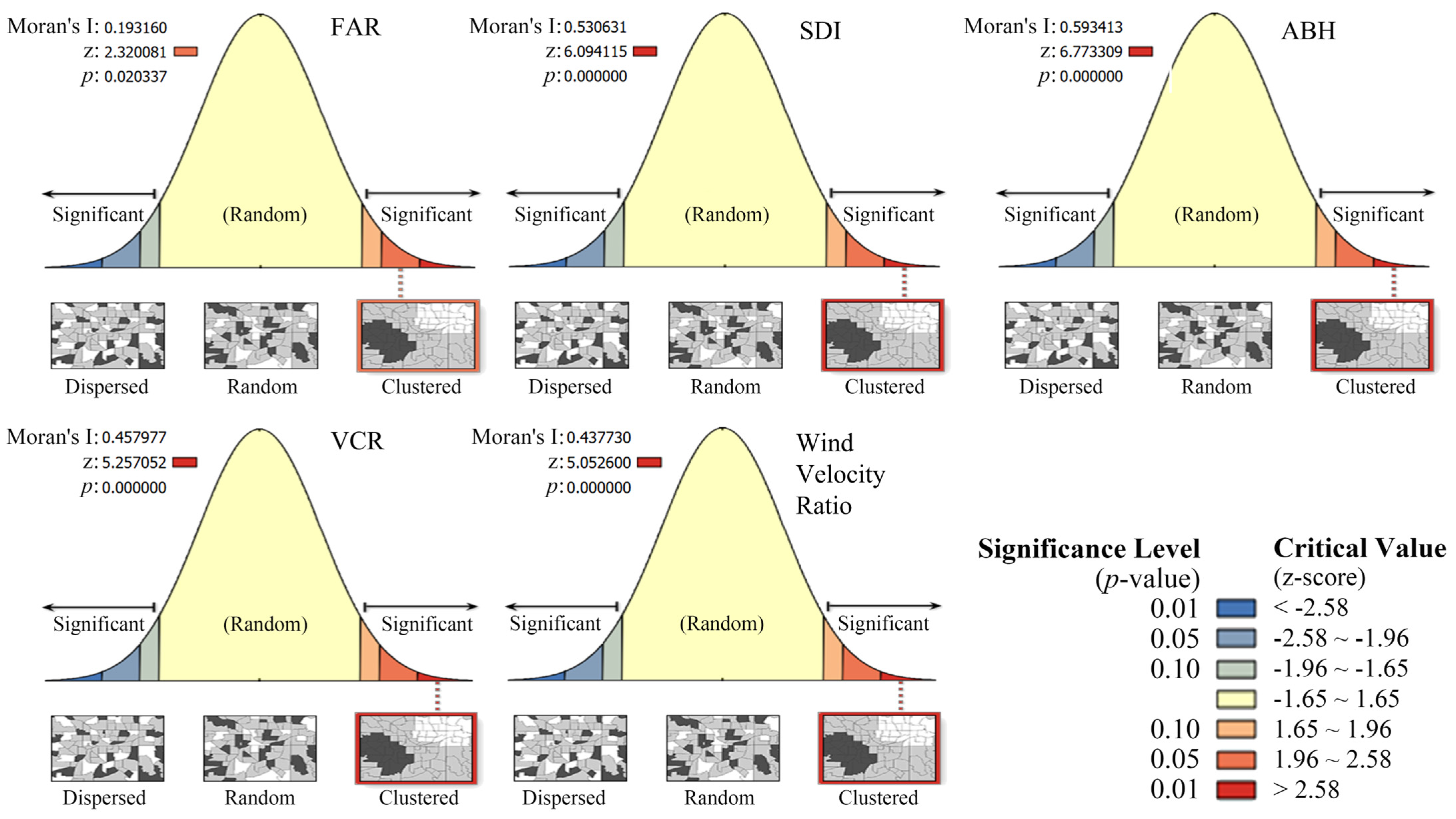
3.3.1. Spatial Autocorrelation Analysis
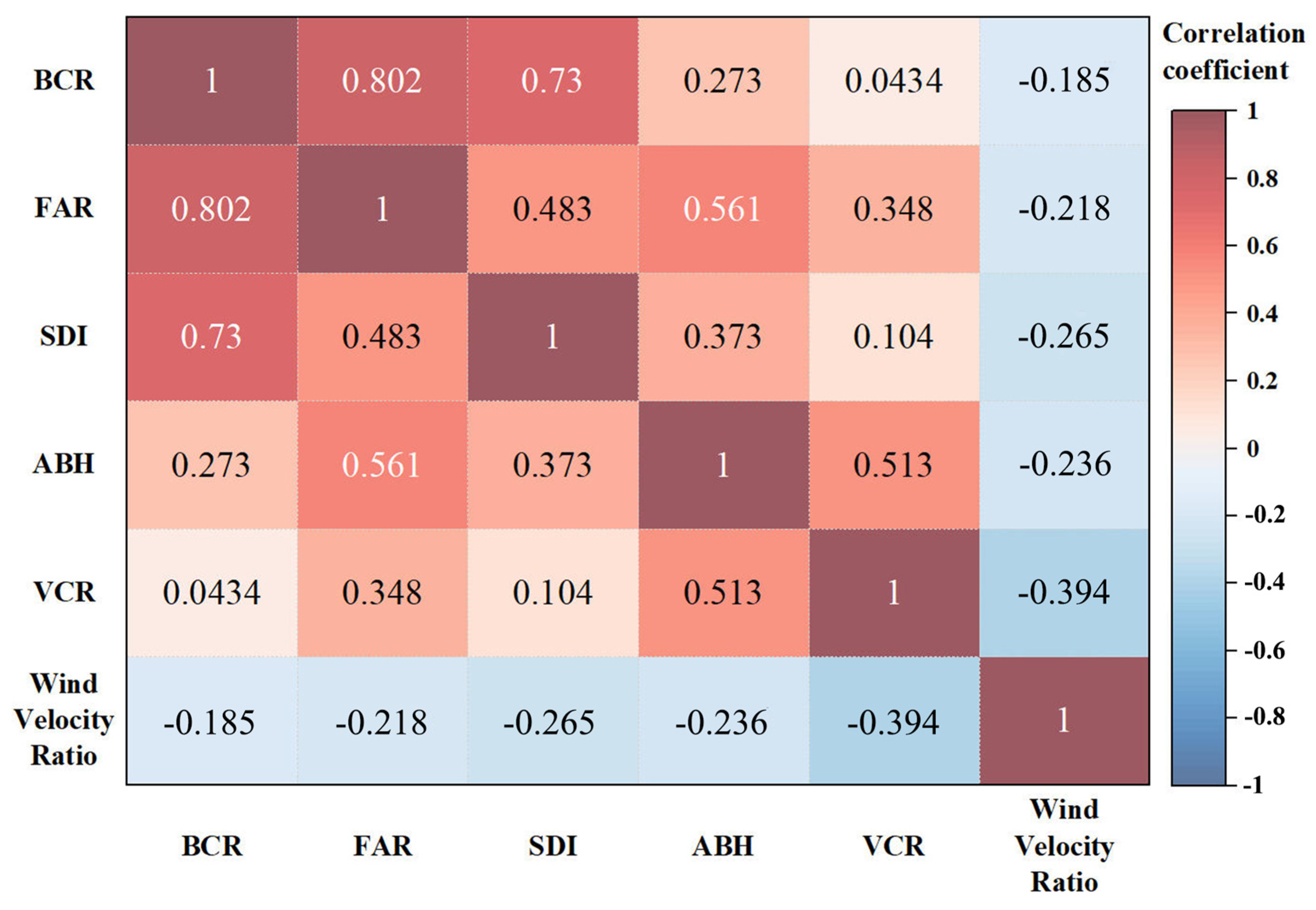
3.3.2. Correlation Analysis
3.3.3. Multiple Linear Regression Analysis
4. Discussion
4.1. Collaborative Optimization Strategies
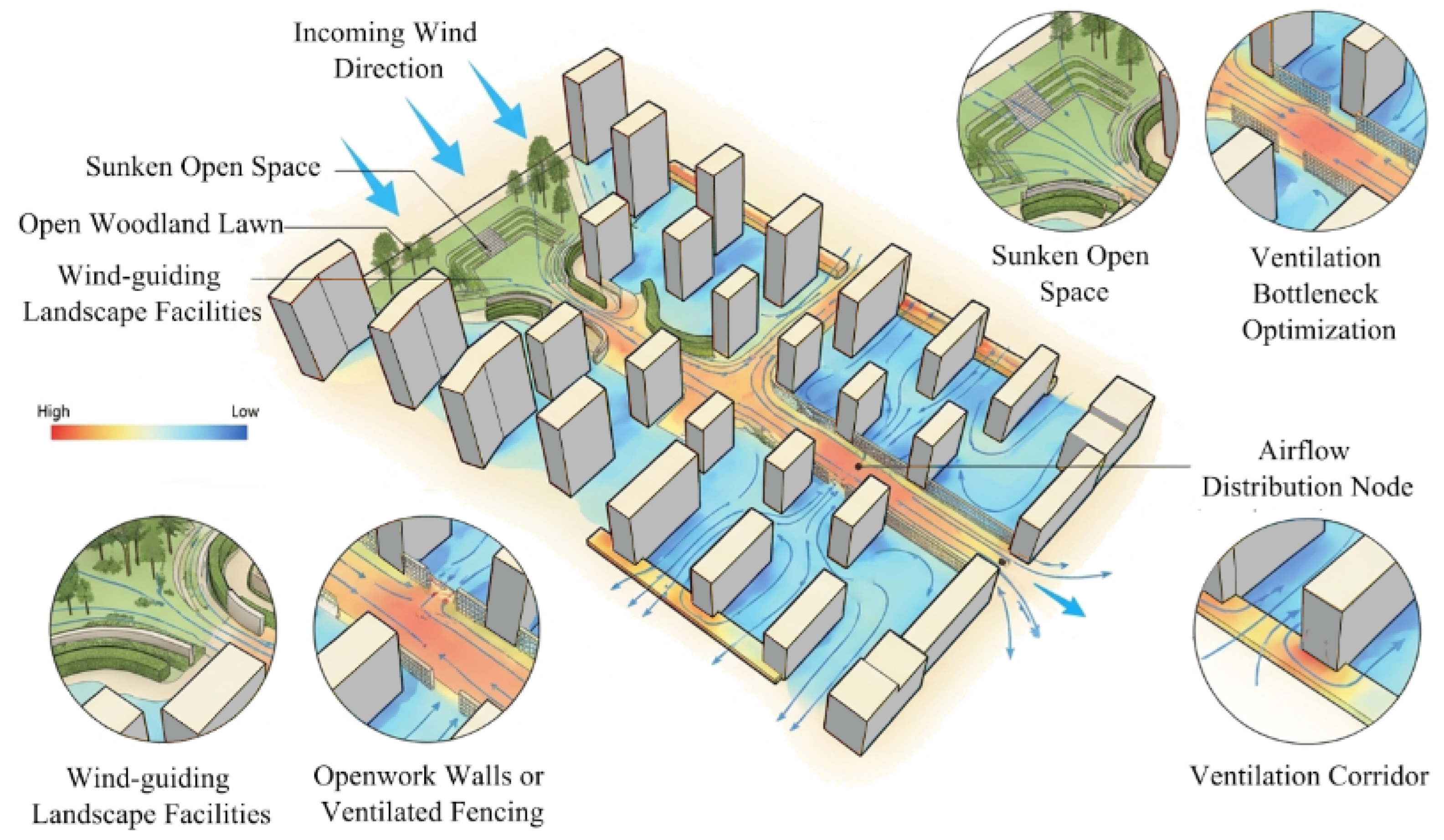
4.1.1. Mode I Optimization Strategy: “Source” Enhancement and “Flow” Connection
- “Source” Enhancement Measures
- 2.
- “Flow” Connection Measures
- 3.
- “Source”–“Flow” Connection Enhancement
4.1.2. Mode II Optimization Strategy: “Flow” Connection and “Sink” Relief
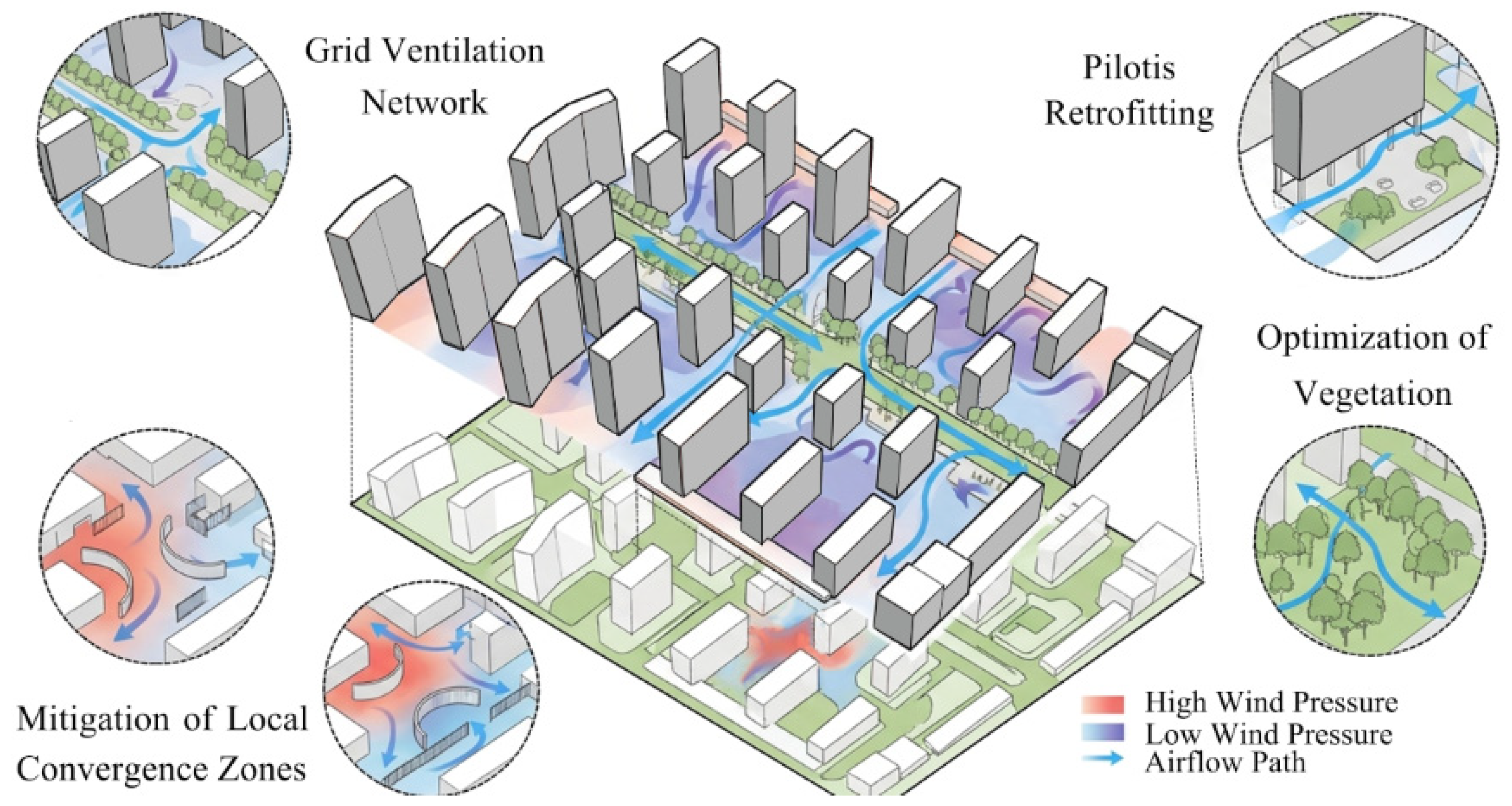
- Corridor network improvement—building a grid-based ventilation system
- 2.
- Elevated ground floor retrofitting
- 3.
- Local “Sink” area relief
- 4.
- Vegetation configuration optimization
4.1.3. Mode III Optimization Strategy: “Sink” Relief and “Source” Implantation
- Identification of inefficient spaces and implantation of open spaces
- 2.
- Interface openings and elevated ground floor retrofitting
- 3.
- Micro-topography and wind-guiding facilities
- 4.
- Vegetation reconstruction
4.2. Limitations and Prospects
5. Conclusions
Supplementary Materials
Author Contributions
Funding
Institutional Review Board Statement
Informed Consent Statement
Data Availability Statement
Conflicts of Interest
References
- Zhang, M.; Li, X.; Lu, Z. Urban Agglomerations Promote the Coordinated Development of Urbanization and Intensive Land Use. Land 2025, 14, 2231. [Google Scholar] [CrossRef]
- Ren, W.; Lu, X.; Wei, L.; Yang, H. Dynamic Evolution and Regional Differences in the Efficiency of Compact Urban Development in Chinese Cities—Based on the Perspective of Compact Land Use. Land 2023, 12, 1837. [Google Scholar] [CrossRef]
- Kim, H.J.; Gil, R.H.; Ko, M.S. Improving Wind Environment in Low-Rise Residential Areas of Bangi-Dong, Seoul: Enhancing Natural Ventilation Performance Through CFD Simulation. Sustainability 2025, 17, 8472. [Google Scholar]
- Fang, H.; Yang, T.; Dai, P. Research on the Coupling of Public Space Morphology and Summer Wind Environment in Qingdao’s Urban Villages. Buildings 2025, 15, 1066. [Google Scholar] [CrossRef]
- Zhang, Q.; Zhou, D.; Xu, D.; Rogora, A. Association between Wind Environment and Spatial Characteristics of High-Rise Residential Buildings in Cold Regions through Field Measurements in Xi’an. Buildings 2023, 13, 2007. [Google Scholar] [CrossRef]
- Cao, P.; Li, T. Optimization Study of Outdoor Activity Space Wind Environment in Residential Areas Based on Spatial Syntax and Computational Fluid Dynamics Simulation. Sustainability 2024, 16, 7322. [Google Scholar] [CrossRef]
- Li, R.; Wang, C.; Gao, N.; Shi, X.; Wu, Y. CFD simulations of the effects of integrated design parameters on wind and thermal environments of above-ground spaces and sunken plazas. Build. Environ. 2026, 293, 114356. [Google Scholar] [CrossRef]
- Chen, X.; Kang, H.; Zhao, J.; Liu, Q. Optimization Design Research of Architectural Layout and Morphology in Multi-Story Dormitory Areas Based on Wind Environment Analysis. Buildings 2025, 15, 1747. [Google Scholar] [CrossRef]
- Yang, J.; Fu, X. The Centre of City: Wind Environment and Spatial Morphology; Springer: Singapore, 2020. [Google Scholar]
- Mittal, H.; Sharma, A.; Gairola, A. Investigation of pedestrian-level wind environment near two high-rise buildings in different arrangements. Adv. Struct. Eng. 2019, 22, 2620–2634. [Google Scholar]
- Ying, X.; Zhu, W.; Hokao, K.; Ge, J. Numerical research of layout effect on wind environment around high-rise buildings. Archit. Sci. Rev. 2013, 56, 272–278. [Google Scholar] [CrossRef]
- Liu, C.; Zhan, M.; Zhao, X.; Wei, J.; Hu, Y.; Li, C.; Chu, Y.; Sun, F. Quantitative Study of Urban Ventilation Corridors’ Impact on the Atmospheric Environment Based on Circuit Theory. Buildings 2026, 16, 329. [Google Scholar] [CrossRef]
- Guo, Q.; Lin, Y.; Zhang, X. Identification and cooling effect analysis of urban ventilation corridors in coastal hilly cities: A case study of Shenzhen. Urban Clim. 2025, 61, 102393. [Google Scholar] [CrossRef]
- Xie, P.; Yang, J.; Sun, W.; Xiao, X.; Xia, J.C. Urban scale ventilation analysis based on neighborhood normalized current model. Sustain. Cities Soc. 2022, 80, 103746. [Google Scholar] [CrossRef]
- Cao, P.; Li, W. Evaluation and optimization of outdoor wind environment in block based on space syntax and CFD simulation. PLoS ONE 2024, 19, 0297683. [Google Scholar] [CrossRef] [PubMed]
- Zhao, H.; Jiang, X.; Cao, Y.; Zhang, H.; Zhen, S.; Jia, R.; Zhang, S. Wind Environment Simulation and Optimization Strategies for Block Spatial Forms in Cold Low Mountainous Areas—A Case Study of Changchun, China. Sustainability 2022, 14, 6643. [Google Scholar]
- Xie, P.; Yang, J.; Wang, H.; Liu, Y.; Liu, Y. A New method of simulating urban ventilation corridors using circuit theory. Sustain. Cities Soc. 2020, 59, 102162. [Google Scholar] [CrossRef]
- Zeng, S.-P.; Yun, Y.-X.; Tian, J. “Coordination” and “join”: Research on the Theory of “Source-Flow-Sink” Ventilated Corridor System Construction and Planning Strategy. Urban Dev. Stud. 2016, 23, 25–31. [Google Scholar]
- Zeng, S.P. Research on the Theory of “Source-Flow-Sink” Ventilated Corridor System Construction and Planning Strategy—The Case of the Center Districts of Tianjin. Ph.D. Thesis, Tianjin University, Tianjin, China, 2016. [Google Scholar]
- Sun, H.; Liu, S.; Peng, Y.; Li, J.; Ji, Y.; Tan, X.; Yan, M.; Zhu, G. Enhancing thermal comfort in subtropical urban residential communities through water bodies: Integrating wind environment and morphology. Sustain. Cities Soc. 2025, 130, 106647. [Google Scholar] [CrossRef]
- Zhu, Y.; Zhang, A.; Bart, D.; Yao, W.; Zeng, N.; Zhou, Y.; Gao, W. Research on the traditional courtyard typology and wind environment comfort—A case study of Qingshan Fishing Village in Qingdao, China. Sustain. Cities Soc. 2025, 130, 106554. [Google Scholar]
- National Meteorological Information Center, China Meteorological Administration. Chinese Standard Weather Data. Available online: http://data.cma.cn (accessed on 7 May 2025).
- Zhen, M.; Zhou, D.; Bian, G.; Yang, Y.; Liu, Y. Wind environment of urban residential blocks: A research review. Archit. Sci. Rev. 2019, 62, 66–73. [Google Scholar]
- Feng, W.; Ding, W.; Fei, M.; Yang, Y.; Zou, W.; Wang, L.; Zhen, M. Effects of traditional block morphology on wind environment at the pedestrian level in cold regions of Xi’an, China. Environ. Dev. Sustain. 2020, 23, 3218–3235. [Google Scholar] [CrossRef]
- Yu, L.; Ye, Y.; Li, L.; Li, C.; Shen, P. Quantifying Residential Neighborhood Layout Impact on Pedestrian Wind Environment: CFD Analysis Across China’s Major Climate Zones. Buildings 2025, 15, 3750. [Google Scholar] [CrossRef]
- Yu, J.; Tang, J.; Li, M. Impact of urban construction on pedestrian level wind environment in complex building group. Indoor Built Environ. 2024, 33, 876–894. [Google Scholar] [CrossRef]
- Wei, D.; Hu, X.; Chen, Y.; Li, B.; Chen, H. An Investigation of the Quantitative Correlation between Urban Spatial Morphology Indicators and Block Wind Environment. Atmosphere 2021, 12, 234. [Google Scholar] [CrossRef]
- Mu, J.; Feng, Y.; Yang, D.; Yang, G. CMIP6 climate change and wind environment impacts on cold-region residential energy and thermal comfort: A case study of Harbin. Energy Sustain. Dev. 2026, 90, 101885. [Google Scholar]
- Zhang, Q.; Dong, R.; Xu, D.; Zhou, D.; Rogora, A. Associations between summer wind environment and urban physical indicators in commercial blocks based on field measurement and simulation in Xi’an. Urban Clim. 2023, 49, 101544. [Google Scholar] [CrossRef]
- Zuo, C.; Liang, C.; Chen, J.; Xi, R.; Zhang, J. Machine Learning-Based Urban Renovation Design for Improving Wind Environment: A Case Study in Xi’an, China. Land 2023, 12, 739. [Google Scholar]
- Guo, B.; Chen, M.; Zhu, X.; Wang, Z.; Li, L.; Pei, L.; Chen, H.; Chen, P.; Guo, T. Exploring the effect of the architecture morphology on urban ventilation at block scale using CFD-GIS and random forest combined method. Sustain. Cities Soc. 2025, 12, 106241. [Google Scholar] [CrossRef]
- Zhang, X.; Xu, C.; Ma, S.; Yang, P.; Luo, S.; Ma, L.; Cai, Y.; Chen, B.; Zhao, W. Optimizing urban wind environment in high-density built-up areas through targeted redevelopment of inefficient land. Build. Environ. 2026, 291, 114265. [Google Scholar] [CrossRef]
- Yang, Y.; Feng, Z.; Zhu, X. Mechanism of Urban Spatial Morphology and Eco-Environmental Risk: A Case Study of Shenzhen, China. Int. J. Environ. Res. 2024, 19, 52. [Google Scholar] [CrossRef]
- Shen, Z.; Liao, C.; Cao, F.; Zhang, Q.; Yang, D.; Zhang, Q.; Shi, Y.; Yang, J. Complex network analysis of urban heat-cold interaction systems for heat island mitigation: Evidence from Fuzhou, China. Sustain. Cities Soc. 2025, 131, 106727. [Google Scholar] [CrossRef]
- Luo, Y.; Yu, X.; Nazeer, M.; Wong, M.S.; Yang, J.; Zhu, R. Estimating multi-scale ventilation corridors in complex 3D urban space: A graph-based least-cost path model. Urban Clim. 2026, 67, 102864. [Google Scholar] [CrossRef]
- Fang, Y.; Zhao, L.; Dou, B.; Li, Y.; Wang, S. Circuit VRC: A circuit theory-based ventilation corridor model for mitigating the urban heat islands. Build. Environ. 2023, 244, 110786. [Google Scholar] [CrossRef]
- Ma, Z.; Zhang, S.; Zhao, S. Study on the Spatial Pattern of Migration Population in Egypt and Its Flow Field Characteristics from the Perspective of “Source-Flow-Sink”. Sustainability 2021, 13, 350. [Google Scholar] [CrossRef]
- Zhu, Z.; Song, Y.; Qin, M. Ecological remediation zoning of territory based on the “Source-Stream-Sink” Coupler: Case study of Liuzhou city, China. IOP Conf. Ser. Earth Environ. Sci. 2020, 510, 032005. [Google Scholar]
- He, J.; Yu, Y.; Sun, L.; Li, C.; Guo, Z.; Lu, Y.; Malik, I.; Wistuba, M. Spatiotemporal evolution of ecosystem services and ecological connectivity optimization in arid Northwest China. J. Arid Land 2026, 18, 406–428. [Google Scholar] [CrossRef]
- Zhu, Z.B.; Yao, L.J.; Wan, Y.N.; Xue, L.Y.; Li, Q.G.; Xu, B.J.; Xu, X.Y.; Yue, B.R. Delineation of territorial space ecological restoration zoning based on the characteristics of ‘source-flow-sink’ of ecosystem services: A case study of Xi’an City, Shaanxi Province, China. Ying Yong Sheng Tai Xue Bao J. Appl. Ecol. 2026, 37, 243–252. [Google Scholar]
- Fan, C.; Chen, J.; Yu, P. Feedback Effects of Air-Conditioning Anthropogenic Heat on Cooling Energy Consumption in Residential Buildings: A CFD–EnergyPlus Co-Simulation Study. Buildings 2026, 16, 1610. [Google Scholar]
- Ji, Z.; Zhang, H.; Shen, L.; Weng, J.; Chun, Q.; Wu, J.; Ying, X. CFD-Based Evaluation of Wind Comfort in High-Density Primary Schools: A Case Study of Planning Layouts in Shenzhen. Buildings 2026, 16, 721. [Google Scholar]
- Liu, R.; Wang, Y.; Zhang, Y.; Peng, Z.; Chen, H.; Li, X.; Li, H.; Li, W. Analysis of the city-scale wind environment and detection of ventilation corridors in high-density metropolitan areas based on CFD method. Urban Clim. 2025, 59, 102274. [Google Scholar]
- GB 50009-2012; Load Code for the Design of Building Structures. China Architecture & Building Press: Beijing, China, 2012; p. 31.
- GB/T 50378-2019; Green Building Evaluation Standard. China Architecture & Building Press: Beijing, China, 2019; pp. 126–127.
- Ying, X.; Ding, G.; Hu, X.; Zhang, Y. Developing planning indicators for outdoor wind environments of high-rise residential buildings. J. Zhejiang Univ. Sci. A 2016, 17, 378–388. [Google Scholar] [CrossRef]
- Ma, T.; Chen, T. Classification and pedestrian-level wind environment assessment among Tianjin’s residential area based on numerical simulation. Urban Clim. 2020, 34, 100702. [Google Scholar] [CrossRef]
- Zhou, Z.; Deng, J.; Wang, P.; Zhou, C.; Xu, Y.; Jiang, W.; Ma, K. Physical Environment Study of Traditional Village Patterns in Jinxi County, Jiangxi Province Based on CFD Simulation. Processes 2022, 10, 2453. [Google Scholar] [CrossRef]
- Wu, S.; Zhang, L.; Han, Z.; Hu, C.; An, D. Research on Microclimate Optimization of Traditional Residential Buildings in Central Anhui Based on Humid and Hot Climate Characteristics and Regional Architectural Features. Buildings 2024, 14, 2323. [Google Scholar] [CrossRef]
- Fang, H.; Yang, Y.; Wang, J.; Ji, X. Study on the adaptation of the outdoor wind environment of Xuzhou rural residence. Sci. Rep. 2025, 15, 23798. [Google Scholar] [CrossRef] [PubMed]
- Dai, P.; Liu, H.; Han, S.; Liu, C.; Fu, G.; Wang, Y. The Carbon Reduction Mechanism and Adaptive Planning Strategies of TOD Block Form Regulation Oriented to Microclimate Effects. Sustainability 2025, 17, 358. [Google Scholar] [CrossRef]
- You, W.; Shen, J.; Ding, W. Improving Wind Environment of Residential Neighborhoods by Understanding the Relationship between Building Layouts and Ventilation Efficiency. Energy Procedia 2017, 105, 4531–4536. [Google Scholar] [CrossRef]
- Gu, K.; Zhao, X.; Cui, Y.; Dong, D.; Zhang, X.X. Research on Evaluation of Ventilation Efficiency and Spatial Optimization in Urban Neighborhoods. Ind. Constr. 2024, 54, 106–116. [Google Scholar] [CrossRef]
- You, W.; Shen, J.; Ding, W. Improving wind environment design based on assessing spatial distribution of ventilation efficiency in regional space. Energy Procedia 2017, 142, 2923–2929. [Google Scholar] [CrossRef]
- Guo, F.; Zhu, P.; Wang, S.; Duan, D.; Jin, Y. Improving Natural Ventilation Performance in a High-Density Urban District: A Building Morphology Method. Procedia Eng. 2017, 205, 952–958. [Google Scholar] [CrossRef]








| Morphological Parameter | Calculation Formula | Meaning | Selection Basis |
|---|---|---|---|
| BCR | Ratio of total building footprint area to site area, where SP is the total building footprint area and SN is the site area. | Reflects the degree of horizontal land intensification. | |
| FAR | Ratio of total floor area to total study area, where SF is the total floor area and SN is the total study area. | Reflects the overall efficiency of land intensification. | |
| SDI | Ratio of the total building boundary perimeter to the fourth root of the total building footprint area, where Lp is the total building boundary perimeter and Sp is the total building footprint area. | Characterizes the balance of building spatial layout in land-intensive development. | |
| ABH | Where Hi is the height of building i and n is the number of buildings in the study area. | Represents the core vertical indicator of vertical land intensification. | |
| VCR | Ratio of green area to total land area within each block, where Sg is the green area and SN is the total study area. | Reflects the allocation level of ecological space in land-intensive utilization. | |
| RCR | Ratio of hard-surfaced pavement area to total study area, where Ss is the hard-surfaced area and SN is the total study area. | Indicates the supply scale of transportation open space in land-intensive utilization. |
| G | A | G | A | G | A | G | A | G | A | G | A | G | A |
|---|---|---|---|---|---|---|---|---|---|---|---|---|---|
| 1 | 0.410 | 12 | 0.775 | 23 | 0.77 | 34 | 0.581 | 45 | 0.474 | 56 | 1.025 | 67 | 0.723 |
| 2 | 0.770 | 13 | 0.825 | 24 | 0.565 | 35 | 1.392 | 46 | 0.836 | 57 | 0.978 | 68 | 1.186 |
| 3 | 0.875 | 14 | 1.395 | 25 | 0.465 | 36 | 0.310 | 47 | 0.455 | 58 | 0.799 | 69 | 1.081 |
| 4 | 0.670 | 15 | 0.360 | 26 | 0.41 | 37 | 0.720 | 48 | 0.372 | 59 | 1.133 | 70 | 0.978 |
| 5 | 0.255 | 16 | 0.415 | 27 | 0.825 | 38 | 0.785 | 49 | 1.076 | 60 | 0.465 | 71 | 1.081 |
| 6 | 0.725 | 17 | 0.565 | 28 | 1.395 | 39 | 0.852 | 50 | 0.528 | 61 | 1.288 | 72 | 1.102 |
| 7 | 1.495 | 18 | 0.670 | 29 | 0.261 | 40 | 0.658 | 51 | 0.565 | 62 | 0.618 | 73 | 1.128 |
| 8 | 0.310 | 19 | 0.775 | 30 | 0.619 | 41 | 0.670 | 52 | 0.723 | 63 | 1.288 | 74 | 1.019 |
| 9 | 0.770 | 20 | 0.925 | 31 | 0.622 | 42 | 1.287 | 53 | 0.616 | 64 | 1.030 | 75 | 0.958 |
| 10 | 0.875 | 21 | 1.340 | 32 | 0.623 | 43 | 0.373 | 54 | 0.795 | 65 | 0.978 | 76 | 1.133 |
| 11 | 0.670 | 22 | 0.255 | 33 | 0.618 | 44 | 0.497 | 55 | 0.616 | 66 | 1.186 | 77 | 1.195 |
| Wind Velocity Ratio | BCR | FAR | SDI | ABH | VCR | |
|---|---|---|---|---|---|---|
| Wind Velocity Ratio | 1 (0.000 ***) | −0.185 (0.108) | −0.218 (0.057 *) | −0.265 (0.020 **) | −0.236 (0.039 **) | −0.394 (0.000 ***) |
| BCR | −0.185 (0.108) | 1 (0.000 ***) | 0.802 (0.000 ***) | 0.73 (0.000 ***) | 0.273 (0.016 **) | 0.043 (0.708) |
| FAR | −0.218 (0.057 *) | 0.802 (0.000 ***) | 1 (0.000 ***) | 0.483 (0.000 ***) | 0.561 (0.000 ***) | 0.348 (0.002 ***) |
| SDI | −0.265 (0.020 **) | 0.73 (0.000 ***) | 0.483 (0.000 ***) | 1 (0.000 ***) | 0.373 (0.001 ***) | 0.104 (0.366) |
| ABH | −0.236 (0.039 **) | 0.273 (0.016 **) | 0.561 (0.000 ***) | 0.373 (0.001 ***) | 1 (0.000 ***) | 0.513 (0.000 ***) |
| VCR | −0.394 (0.000 ***) | 0.043 (0.708) | 0.348 (0.002 ***) | 0.104 (0.366) | 0.513 (0.000 ***) | 1 (0.000 ***) |
| Linear Regression Analysis Results (n = 77) | |||||||||
|---|---|---|---|---|---|---|---|---|---|
| Unstandardized Coefficients | Standardized Coefficients | t | p | VIF | R2 | Adjusted R2 | F | ||
| B | Std. Error | Beta | |||||||
| Constant | 0.639 | 0.058 | - | 10.965 | 0.000 *** | - | 0.208 | 0.164 | F = 4.728 p = 0.002 *** |
| FAR | 0.009 | 0.119 | 0.01 | 0.075 | 0.941 | 1.702 | |||
| SDI | −0.219 | 0.108 | −0.249 | −2.038 | 0.045 ** | 1.362 | |||
| ABH | 0.043 | 0.105 | 0.057 | 0.405 | 0.687 | 1.819 | |||
| VCR | −0.326 | 0.101 | −0.4 | −3.228 | 0.002 *** | 1.399 | |||
| Dependent variable: Wind Velocity Ratio | |||||||||
Disclaimer/Publisher’s Note: The statements, opinions and data contained in all publications are solely those of the individual author(s) and contributor(s) and not of MDPI and/or the editor(s). MDPI and/or the editor(s) disclaim responsibility for any injury to people or property resulting from any ideas, methods, instructions or products referred to in the content. |
© 2026 by the authors. Licensee MDPI, Basel, Switzerland. This article is an open access article distributed under the terms and conditions of the Creative Commons Attribution (CC BY) license.
Share and Cite
Cao, P.; Zhao, C. Measurement and Collaborative Optimization of “Source-Flow-Sink” Landscape Ventilation Efficiency in Residential Areas Under the Land-Intensive Mode. Urban Sci. 2026, 10, 357. https://doi.org/10.3390/urbansci10070357
Cao P, Zhao C. Measurement and Collaborative Optimization of “Source-Flow-Sink” Landscape Ventilation Efficiency in Residential Areas Under the Land-Intensive Mode. Urban Science. 2026; 10(7):357. https://doi.org/10.3390/urbansci10070357
Chicago/Turabian StyleCao, Peng, and Caiyuan Zhao. 2026. "Measurement and Collaborative Optimization of “Source-Flow-Sink” Landscape Ventilation Efficiency in Residential Areas Under the Land-Intensive Mode" Urban Science 10, no. 7: 357. https://doi.org/10.3390/urbansci10070357
APA StyleCao, P., & Zhao, C. (2026). Measurement and Collaborative Optimization of “Source-Flow-Sink” Landscape Ventilation Efficiency in Residential Areas Under the Land-Intensive Mode. Urban Science, 10(7), 357. https://doi.org/10.3390/urbansci10070357