Article

Measurement and Collaborative Optimization of “Source-Flow-Sink” Landscape Ventilation Efficiency in Residential Areas Under the Land-Intensive Mode


School of Architecture and Urban Planning, Lanzhou Jiaotong University, Lanzhou 730070, China
*
Author to whom correspondence should be addressed.
Urban Sci. 2026, 10(7), 357; https://doi.org/10.3390/urbansci10070357 (registering DOI)
Submission received: 20 May 2026 / Revised: 23 June 2026 / Accepted: 23 June 2026 / Published: 26 June 2026

Abstract

Land-intensive high-density residential development often comes at the cost of compromised natural ventilation efficiency and reduced capacity for urban heat island mitigation, and such trade-offs are particularly pronounced in valley cities due to topographical constraints. Taking Lanzhou Yineng Huanghe Jiayuan as a case study, this research constructs a “Source-Flow-Sink” landscape ventilation efficiency measurement framework based on circuit theory and CFD numerical simulation. Combined with correlation analysis and multiple linear regression, the coupling mechanism between spatial morphology and ventilation efficiency is examined. The results indicate that: (1) The study area exhibits a ventilation pattern characterized by “Source” in the north, “Flow” in the middle, and “Sink” in the south; (2) The wind speed ratio in the residential area shows a highly significant negative correlation with vegetation coverage, and a significant negative correlation with building dispersion and average building height; (3) Based on three configuration modes of “Source-Flow-Sink”, differentiated micro-renewal strategies that do not alter the core indicators of land intensification are proposed, providing a scientific basis for climate-adaptive design of intensive residential areas in valley cities.

1. Introduction

Land-intensive utilization is a core strategic orientation for the current transformation and development of urbanization in China. Since the State Council’s Circular on Promoting Economical and Intensive Land Use explicitly set forth the principles of strictly controlling incremental land, revitalizing stock land, optimizing structure, and improving efficiency, urban construction has gradually shifted from outward expansion to inward quality improvement. High-rise, high-density residential areas have become important spatial carriers for accommodating urban populations and enhancing land use efficiency [1,2]. In practice, this model entails a profound intensification paradox: from the perspective of land use, increasing the floor area ratio and building density can effectively improve land output efficiency; however, from the perspective of human settlement environment, high-density development often leads to a series of microclimatic problems, including reduced ventilation efficiency, exacerbated urban heat island effect, pollutant retention, and decreased outdoor thermal comfort [3,4,5]. How to effectively improve residential ventilation efficiency while ensuring land use efficiency has become a key scientific issue that urgently needs to be addressed in the fields of urban planning and architectural design. Lanzhou, as a typical valley city, is constrained by the topography of the north and south mountains, resulting in poor atmospheric diffusion conditions. Its urban heat island intensity ranks among the highest in the country, and the proportion of calm wind areas in summer ranges from 15% to 25%, indicating an urgent need for improved ventilation environment [6]. Under the guidance of land-intensive utilization, the residential floor area ratios in Lanzhou’s central urban area are generally high, and building density in some districts exceeds 35%, making the resolution of the intensification paradox more pressing and representative in valley cities.
Research on residential wind environments has undergone a development process from qualitative description to quantitative simulation, and from single indicators to multi-factor synthesis. Since the 1990s, computational fluid dynamics (CFD) technology has been introduced into the field of building wind environment research, providing a powerful tool for quantitatively analyzing urban airflow distribution [7,8]. Ventilation corridor identification is an important direction in residential wind environment research. Early studies that relied on simple morphological indicators for ventilation analysis lacked sufficient quantitative support [9,10,11]. In terms of research scale, most existing studies focus on ventilation corridor identification at the city scale, while systematic analysis of the “Source-Flow-Sink” system at the residential scale is relatively weak [12,13,14]. As the basic unit of urban human settlements, residential areas exhibit unique scale characteristics in the coupling mechanism between spatial morphology and ventilation efficiency, which urgently requires in-depth investigation. In terms of research methods, current studies mostly employ a single approach of CFD simulation or morphological indicator statistics, lacking an integrated measurement framework [8,15,16]. Circuit theory has demonstrated significant advantages in multi-path identification and uncertainty expression in ecological connectivity research, but its application in the field of residential ventilation is still in its early stages [17]. Regarding the research perspective, most studies focus on the ventilation corridors themselves, neglecting the supply capacity of the “Source” and the blocking effect of the “Sink” [18,19]. The quality of ventilation efficiency depends not only on the connectivity of the corridor network but also on the synergistic configuration of the “Source-Flow-Sink” ternary structure. Regarding research context, most studies focus on general residential areas, with insufficient attention paid to ventilation issues in high-density residential areas under the land-intensive mode [20,21]. The inherent tension between land-intensive utilization and livable environments—namely, the intensification paradox—has not yet received systematic theoretical response or empirical testing.
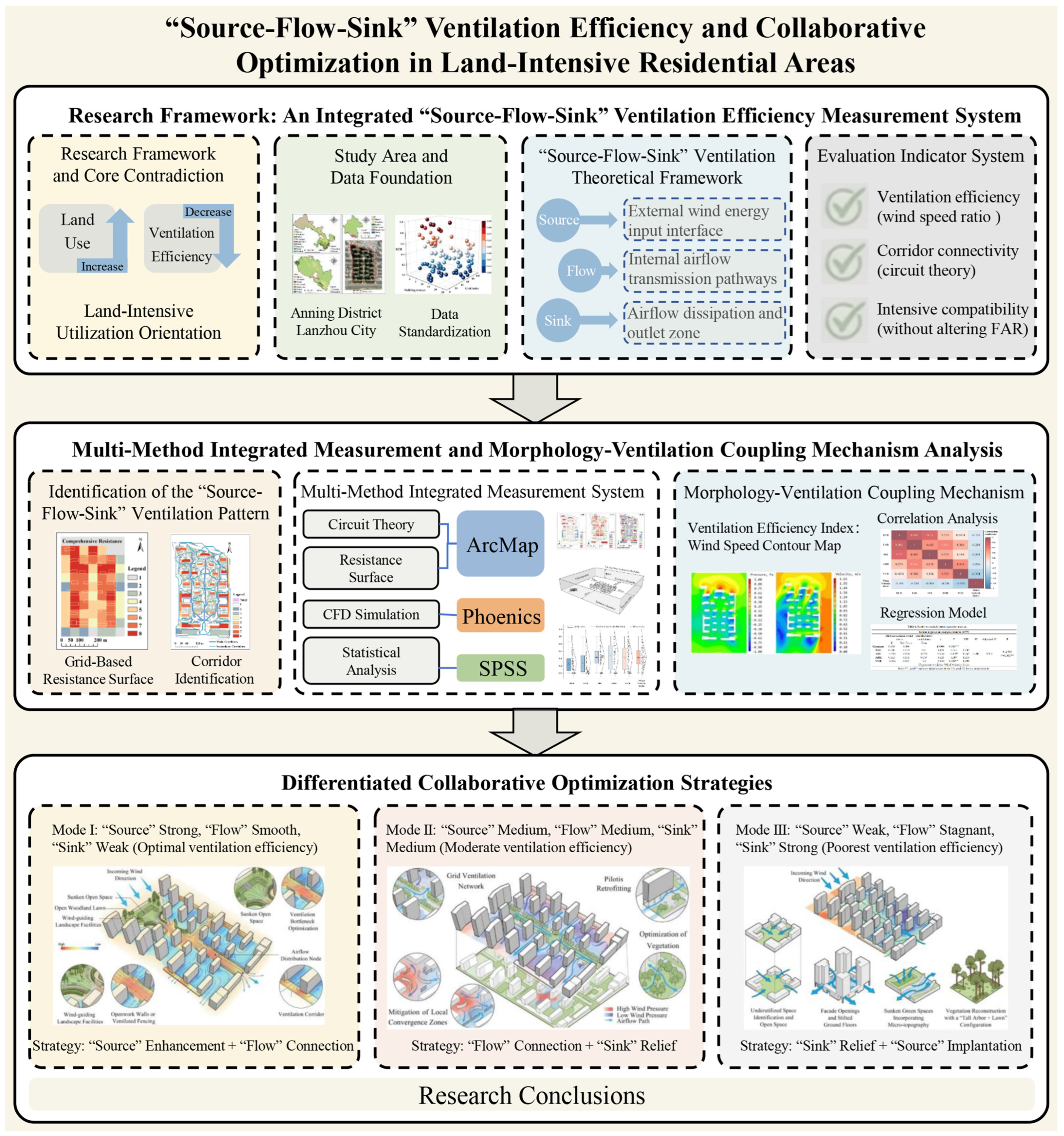
Against the background of the land-intensive mode, this study takes Lanzhou Yineng Huanghe Jiayuan as the research object, constructs a “Source-Flow-Sink” landscape ventilation efficiency measurement framework based on circuit theory and CFD simulation, systematically reveals the coupling mechanism between residential spatial morphology and ventilation efficiency, and proposes collaborative optimization strategies (Figure 1). This study aims to optimize the ventilation environment in the context of high-density development, thereby providing a scientific basis for climate-adaptive design of residential areas under the land-intensive orientation.

2. Materials and Methods

2.1. Overview of the Study Area

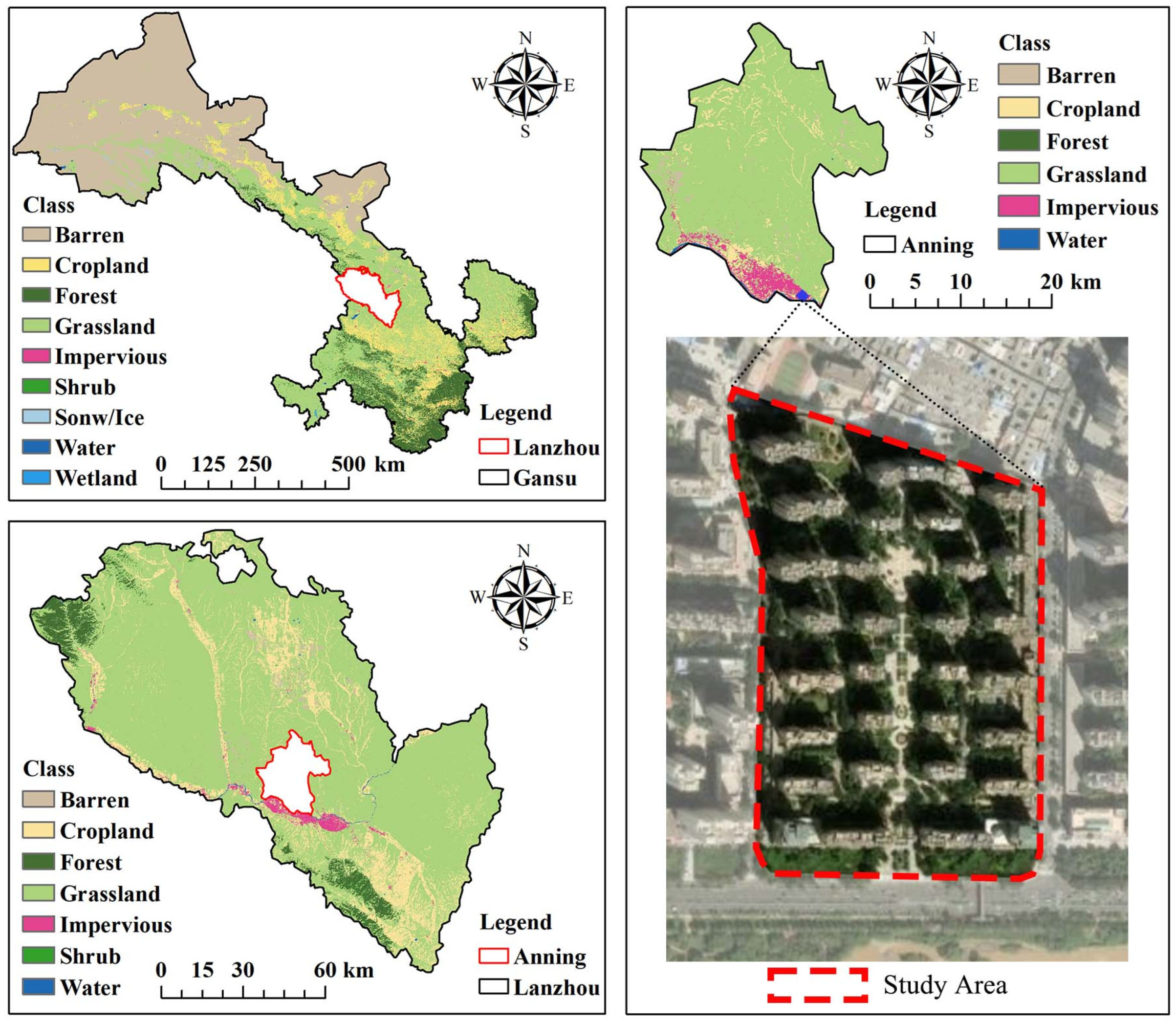
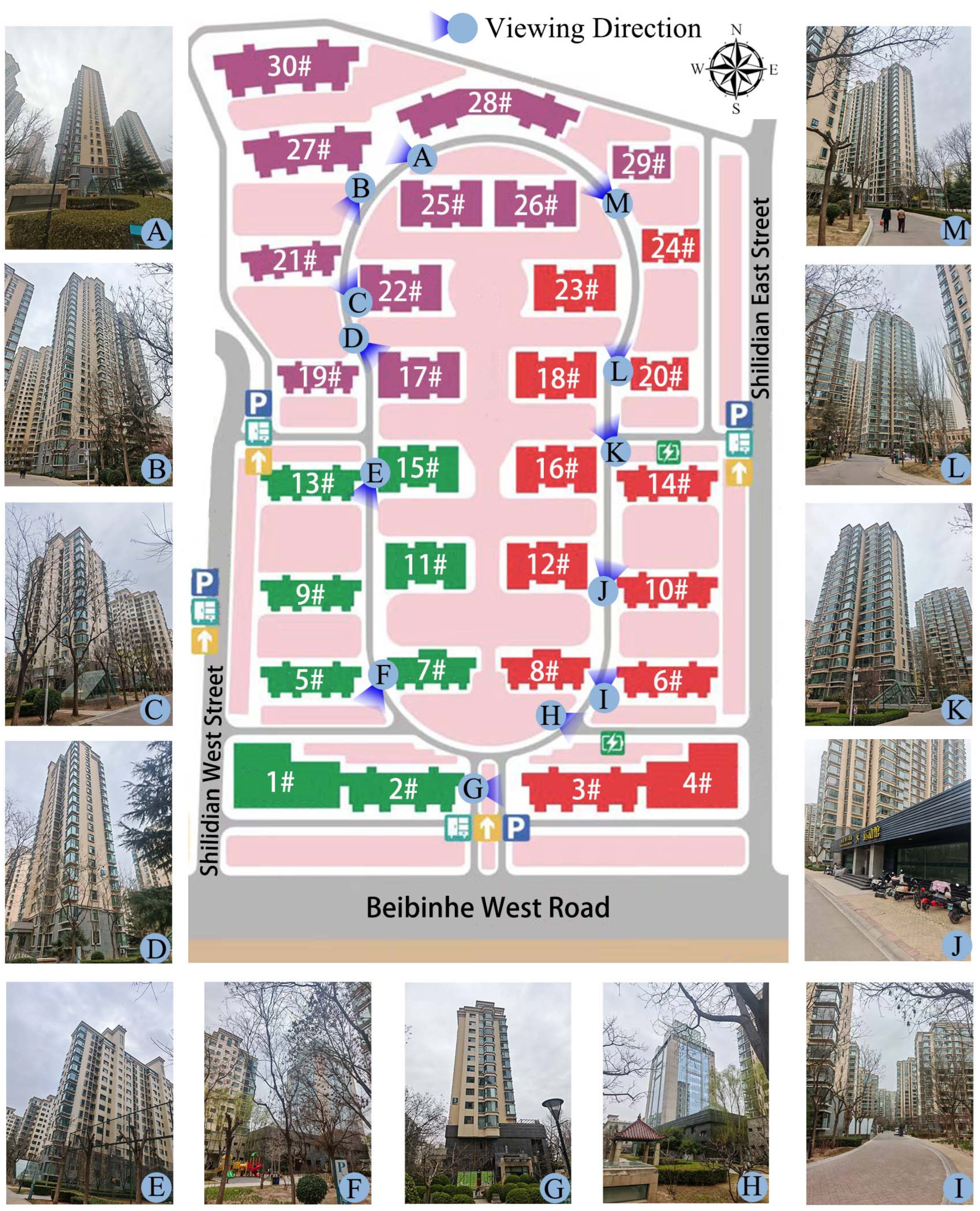
Located in the western Loess Plateau, Lanzhou, Gansu Province, China has a temperate semi-arid continental monsoon climate. Due to the topographic constraints of the north and south mountains, the atmospheric diffusion conditions are generally poor. According to nearly 10 years of summer meteorological data, the prevailing summer wind direction is north–northeast (NNE), which serves as the dominant wind direction for the study area. Additionally, the frequency of calm wind events is relatively high, accompanied by a significant urban heat island effect. Yineng Huanghe Jiayuan is situated at No. 67, North Binhe West Road, Anning District, Lanzhou City, Gansu Province, approximately 100 m west of the Qilihe Yellow River Bridge. It serves as an important residential community at the gateway to the new urban area of Anning District. The community is bordered by Anning East Road to the north, the Yellow River Scenic Belt to the south, Beian Gongguan to the west, and Anning Tingyuan to the east, enjoying an advantageous geographical location and convenient transportation conditions. As one of the main urban districts of Lanzhou, Anning District has made significant progress in urban functional layout and residential environment construction in recent years, becoming an important area for the agglomeration of high-quality residences in Lanzhou (Figure 2).
Yineng Huanghe Jiayuan is a model of early high-quality residential communities in Lanzhou. The community covers a total area of 219 mu, approximately 14.6 hectares, with a total construction area of 343,000 square meters, consisting of small high-rise and high-rise residential buildings, commercial office buildings, and street-facing commercial shops (Figure 3).
From the perspective of land-intensive utilization, the planning and design of Yineng Huanghe Jiayuan exhibit typical characteristics of an intensive residential area. The community has a floor area ratio of 2.39, which is higher than the average level of residential areas in Lanzhou, indicating high land use efficiency. The building density is controlled within a reasonable range, forming a good match with the floor area ratio, thereby reserving sufficient area for green spaces and open spaces. The greening rate reaches 35%, exceeding relevant national standards, providing a favorable ecological background condition. The building layout is mainly slab-type, with a north–south permeable design conducive to natural ventilation organization. The design concept of separating pedestrian and vehicle traffic effectively separates underground parking from ground-level activity spaces, ensuring the integrity and pleasant scale of ground public spaces. This combination of spatial morphological indicators reflects the pursuit of balance between intensive utilization and a livable environment under the land-intensive mode, providing a representative research sample for studying residential ventilation efficiency in the context of the intensification paradox.

2.2. Data Sources and Processing

2.2.1. Data Sources

The data collection in this study encompasses multiple levels, including basic geographic information, meteorological observations, and field measurements. All types of data are integrated and analyzed under a unified geographic information platform, laying a solid data foundation for the subsequent construction of ventilation resistance surfaces, numerical simulation, and statistical analysis.
Basic geographic data were primarily obtained from original drawings in CAD 2018 format acquired via Cadmapper, which contain core spatial elements such as building footprints, road systems, green space layouts, and square locations. These drawings were imported into SketchUp 2020to establish three-dimensional models. In the ArcMap 10.8 geographic information system platform, the drawings were coordinate-corrected and uniformly converted to the CGCS2000 National Geodetic Coordinate System to ensure the accuracy and consistency of spatial data. On this basis, vectorization operations were performed to extract feature layers including building footprints, roads, green spaces, and squares. The building height and number of floors were supplemented and refined based on field survey results. Building height was estimated by multiplying the number of floors by the standard floor height, which was set as 3 m. Special functional spaces such as ground-floor shops were individually adjusted.
Meteorological data were derived from the typical meteorological year data for Lanzhou provided by the China Standard Meteorological Database, including hourly air temperature, wind speed, wind direction, and other meteorological parameters, covering a full-year time span [22]. This study extracted hourly wind speed and wind direction data for the summer months (June to August). Statistical analysis yielded a summer average wind speed of 1.21 m/s, with a prevailing wind direction of NNE (north–northeast) at an azimuth of 22.5°, providing a basis for setting the inlet boundary conditions for CFD simulation.

2.2.2. Data Processing Methods

To eliminate the influence of different dimensions on the analysis results, range normalization was applied to spatial morphological indicators including building density, floor area ratio, dispersion, average building height, and vegetation coverage. The range normalization formula subtracts the minimum value from the original data and then divides by the difference between the maximum and minimum values, so that each indicator falls within the interval 0–1. This method preserves the distribution characteristics of the original data, eliminates dimensional differences, and provides a data foundation for subsequent correlation analysis, regression modeling, and machine learning clustering.
The collection and processing of the above multi-source data follow the principles of spatial data standardization, meteorological data representativeness, field measurement accuracy, and technical data completeness, forming a research database covering multiple dimensions including morphology, climate, environment, and function. All spatial data were aggregated into regular grids of 50 m × 50 m as the basic analytical units. This grid resolution is capable of precisely matching the research scale of residential areas and building clusters while effectively capturing the spatial heterogeneity of ventilation resistance across different zones, and it also avoids the fragmentation of residential units that would result from overly fine grids. In circuit-theory-based studies on mesoscale urban ventilation corridor identification, the 50 m × 50 m resolution is currently recognized as the optimal resolution in the academic community, which can accurately capture the core ventilation pathways in urban centers while avoiding unnecessary computational overhead caused by excessively fine grids. This grid scheme divided the study area into 77 valid grid cells, which not only ensured the accuracy of resistance surface construction but also guaranteed the computational efficiency of the circuit-theory model, preventing excessive computational burden and potential divergence of model results due to overly fine discretization. The resulting grid dataset provides a unified spatial and temporal reference framework for subsequent resistance surface construction, circuit simulation, and statistical analysis.

2.3. Spatial Morphology Indicator Selection and Calculation

2.3.1. Indicator Selection

The coupling mechanism between residential spatial morphology and the wind environment is a core scientific issue in wind environment research [23]. Scholars have conducted extensive studies on the response relationships between morphological indicators (e.g., building density, layout pattern) and the wind environment [3,24,25,26]. The row layout yields the highest proportion of comfortable zones, whereas the enclosed layout exhibits a significant calm wind zone, and high-rise buildings create large wind shadow areas [4]. Domestic scholars have conducted extensive research on the wind environment of residential areas in cold regions [16]. Research on the wind environment of residential areas in Lanzhou has also gradually advanced. Using computational fluid dynamics (CFD) simulation tools, scholars have qualitatively and quantitatively analyzed the site wind environment of a residential community in Lanzhou, explored the applicability of turbulence models in building wind environment flow fields, and identified key factors affecting the residential wind environment [6]. Regarding morphological indicators, scholars generally agree that building density, enclosure degree, dispersion, building height, floor area ratio, and vegetation coverage are key variables influencing the residential wind environment [27,28]. Building density is positively correlated with surface temperature and significantly weakens wind speed, whereas floor area ratio has no significant effect on wind speed [5]. Taking Xi’an as an example, one study combined field measurements and simulations to explore the impact of spatial morphology of high-density residential and commercial areas on the summer wind environment, finding that internal wind speed is lowest when building density reaches approximately 56%, while building height variation and enclosure degree also significantly affect wind speed distribution [29,30].
Under the guidance of land-intensive utilization, urban residential development aims to enhance land use efficiency and increase floor area ratio and building density as core objectives. Spatial morphology exhibits characteristics of high density, high floor area ratio, and compact layout. This development pattern directly alters the underlying surface texture and spatial connectivity of residential areas, becoming a core driving factor affecting the distribution of ventilation resistance and the efficiency of airflow transmission. The degree of land intensification determines the development intensity of residential building footprints, the degree of spatial agglomeration, and the scale of open space supply. It exerts a transmissive impact on ventilation efficiency through morphological characteristics such as building density, enclosure state, and layout dispersion. Therefore, in indicator selection, closely coupling with the core connotation of land-intensive utilization, key morphological indicators reflecting land development intensity, spatial intensification degree, and building footprint scale are selected as core variables, while simultaneously considering the auxiliary roles of ecological space and transportation space in ventilation, thereby forming an indicator system suitable for ventilation research in high-density residential areas under the land-intensive mode.
Based on the context of land-intensive utilization and the characteristics of residential scale, this study selects six spatial morphology indicators as key variables affecting ventilation efficiency (Table 1). Building coverage ratio (BCR) directly reflects the footprint scale and density of building foundations in land development, serving as a core indicator of horizontal land intensification intensity [4,31]. It is significantly positively correlated with ventilation resistance: the higher the building density, the stronger the land-intensive utilization, and the more pronounced the blocking effect on airflow. Floor area ratio (FAR) is a core parameter characterizing vertical land intensification intensity, reflecting the total building floor area per unit land area and embodying the core objective of land use efficiency [32,33]. It exhibits a nonlinear relationship with ventilation efficiency: an excessively high floor area ratio can easily induce spatial enclosure and airflow attenuation. Spatial dispersion index (SDI) characterizes the spatial distribution uniformity of buildings in land development [31]. A high dispersion index implies a more dispersed building layout and reduced compactness of land-intensive utilization, which facilitates airflow penetration and ventilation corridor connectivity. Average building height (ABH) reflects the vertical development scale of land, affecting the extent of wind shadow areas and the way airflow bypasses buildings, serving as an important morphological manifestation of high-rise development under the land-intensive mode [31,33]. Vegetation coverage rate (VCR) reflects the allocation level of ecological space in land use, affecting underlying surface roughness and airflow guidance [31]. Under the constraints of intensive land use, the scale and layout of green space directly regulate ventilation resistance. Road coverage ratio (RCR) reflects the supply scale of transportation space in land use [34]. Hardened road spaces can serve as natural ventilation channels; preserving adequate road space in land-intensive development helps improve ventilation connectivity in residential areas.

2.3.2. Indicator Calculation Results

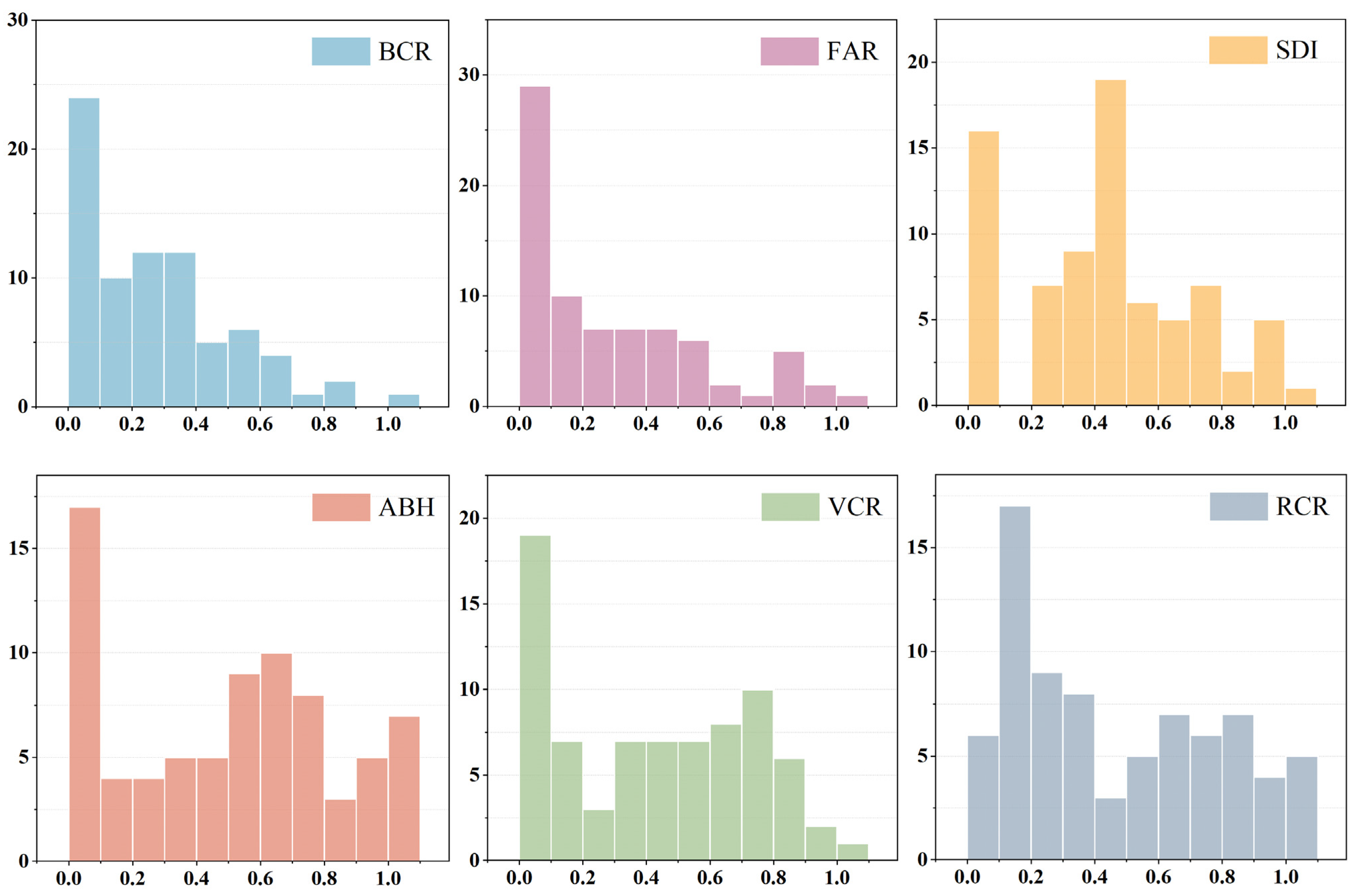
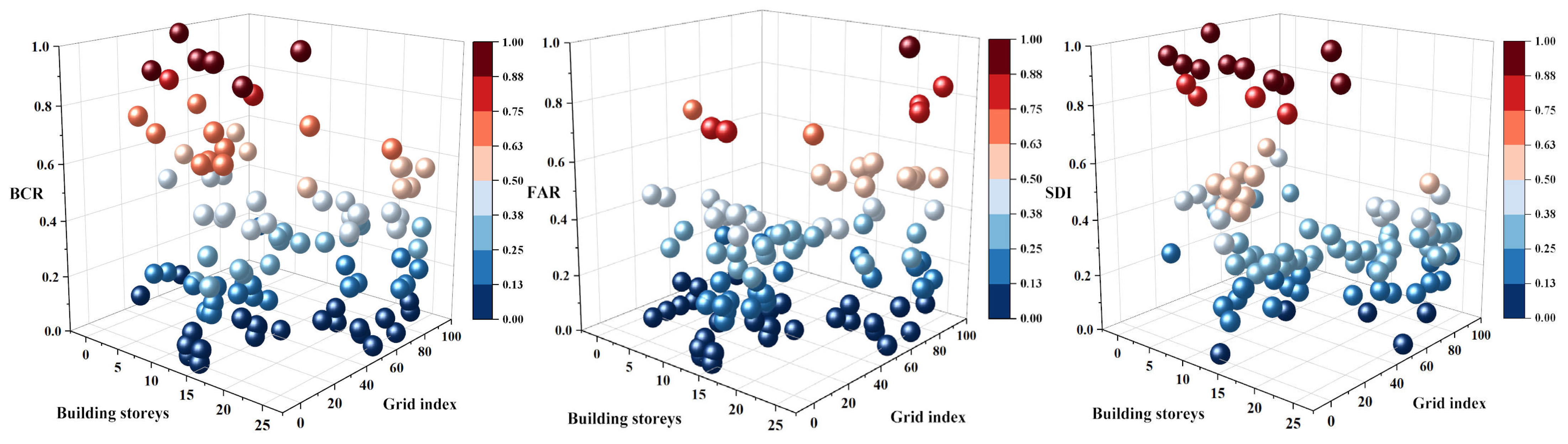
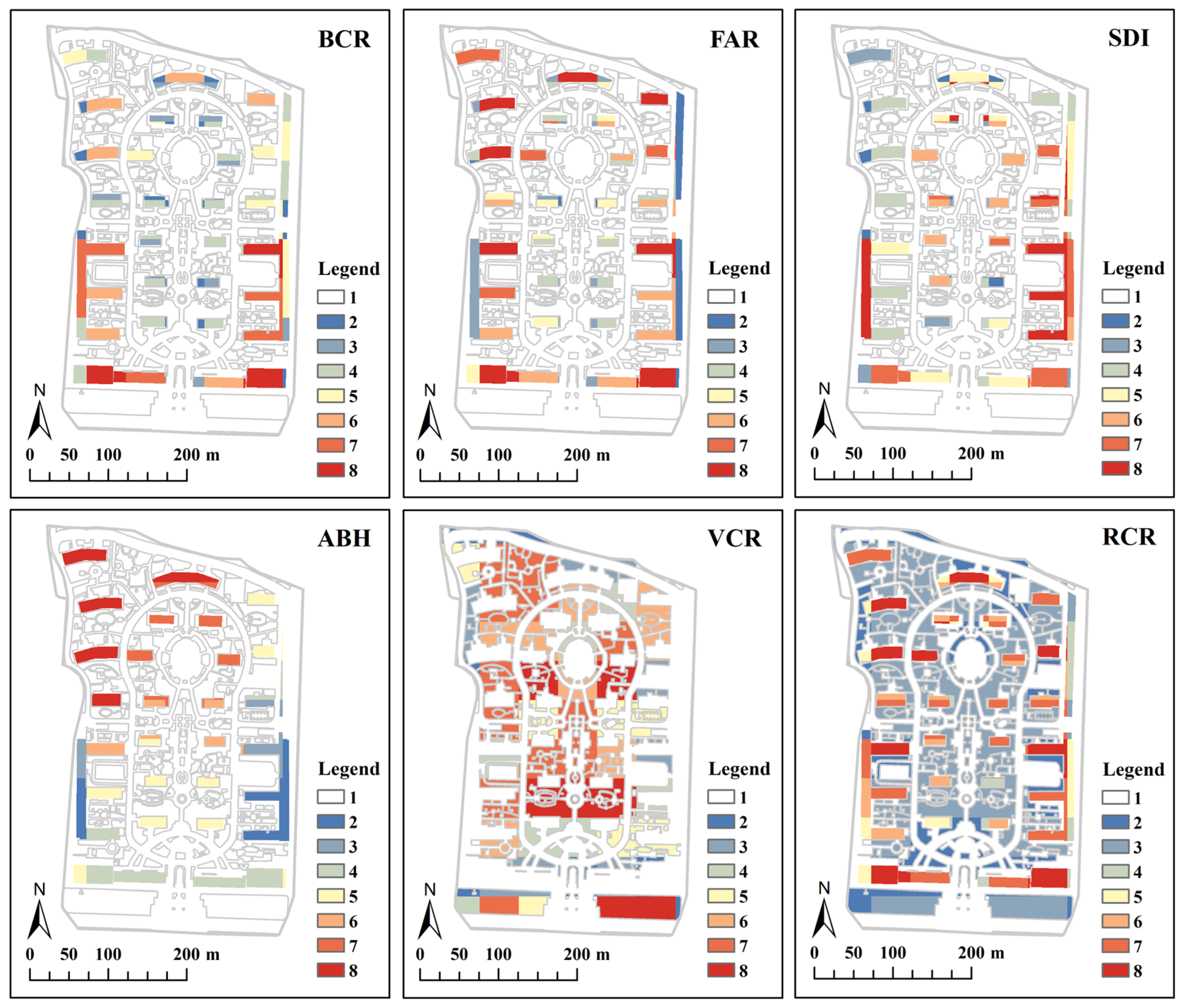
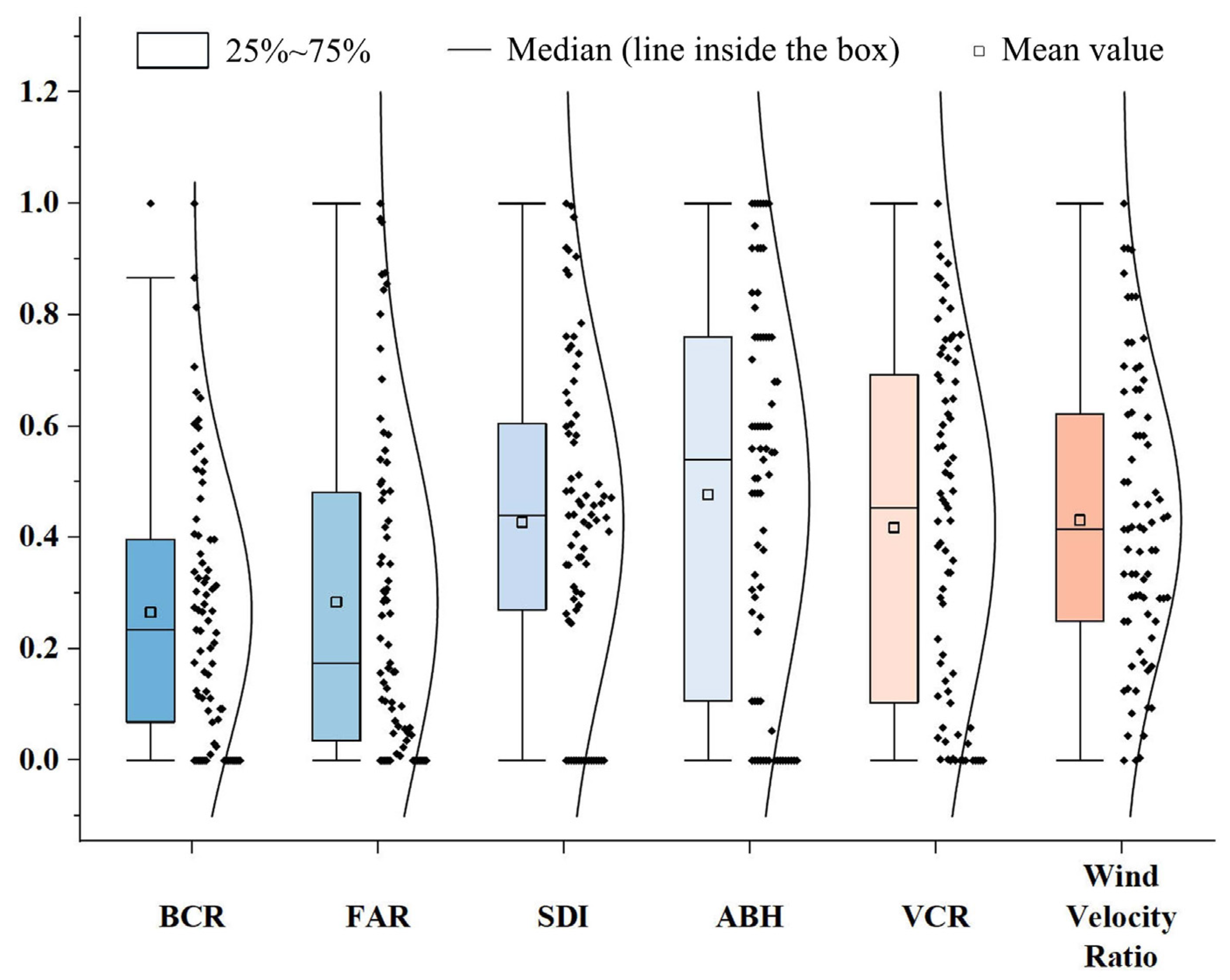
Based on the quantitative spatial morphology data of residential area samples under the land-intensive mode, statistical characterization was conducted on six core indicators: BCR, FAR, SDI, ABH, VCR and RCR (Figure 4). This analysis systematically reveals the differentiation patterns and overall attributes of residential spatial morphology in this area under the context of land-intensive development, clarifies the distribution characteristics of morphological indicators under different intensities of intensive development, and lays the foundation for subsequent coupled ventilation efficiency analysis.
As a core indicator of horizontal land-intensive utilization in residential areas, BCR is generally at a low-to-medium level, with values ranging from 0 to 0.4698. The sample distribution exhibits a right skew, indicating that most residential areas have relatively small building footprints, which aligns with the mainstream development mode under the land-intensive utilization orientation—controlling planar density while enhancing vertical intensity. The relatively high degree of dispersion reflects significant spatial differentiation in planar land intensification intensity among different residential areas, with notable disparities in the degree of intensification of residential planar development footprints; some areas exhibit high-intensity base development in stark contrast to low-intensity open layouts.
FAR, as a core indicator measuring overall land-use intensification efficiency and representing vertical development intensity, has a value range of 0 to 6.3049, making it the most dispersed factor among all indicators, with a distinctly right-skewed distribution. Most samples fall within the low-to-medium floor area ratio range, while a few high-value samples represent a high-intensity vertical development mode under the land-intensive orientation. This indicates a strong heterogeneity in land development intensity within the study area’s residential zones and a clear differentiation in development levels, encompassing both high-rise residential areas with relatively high intensification levels and multi-story residential areas with low-intensity development, thereby fully covering the diverse development types during the land-intensive transformation process in valley cities.
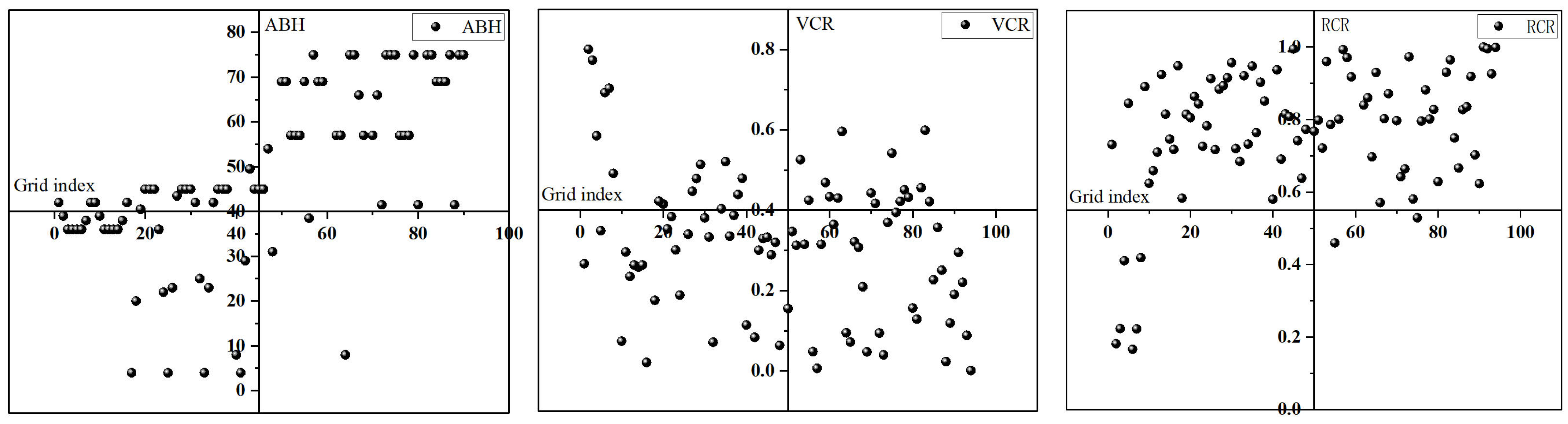
SDI is a key indicator characterizing the balance of building spatial layout in land-intensive development. Its values range from 0 to 51.4821, with the mean concentrated in the medium range. The distribution is approximately normal, and the degree of dispersion is moderate. This indicates that, under the unified orientation of land-intensive utilization, the overall balance of building spatial layout in residential areas is stable. The differences in the degree of building spatial agglomeration and dispersion among samples are moderate, and the regularity of residential spatial morphology is relatively consistent. Most residential areas, during intensive development, balance the compactness of building layout with the spatial reservation for airflow penetration (Figure 5).
ABH, as a core vertical indicator of land-intensive development in residential areas, ranges from 0 to 75.00 m. It exhibits a bimodal distribution with a moderate degree of dispersion. The samples cover all types of residential areas from multi-story to high-rise, showing a polarization in vertical morphology. This reflects that, during the land-intensive transformation process in the region, two core vertical development modes have emerged: “low-rise, low-intensity” and “high-rise, high-intensity”. The coexistence of low-rise and high-rise residential areas is a key characteristic of vertical space under the context of land-intensive utilization in this region, and brings differentiated effects on the residential wind environment.
VCR is a core indicator of ecological space allocation in land-intensive utilization, with values ranging from 0 to 0.6260. The mean is at a medium level, with a relatively high degree of dispersion and a relatively uniform distribution, showing no obvious concentrated peak. This indicates that, during land-intensive development, the level of ecological greening configuration in residential areas varies considerably, and there is significant spatial imbalance in the supply of ecological space. Some high-intensity-development residential areas experience the problem of compressed green space, and greening construction has not yet formed unified planning and control standards that match land-intensive development. This directly leads to significant differences in ventilation resistance among residential areas.
RCR reflects the supply scale of transportation open space in land-intensive utilization, with values ranging from 0.2782 to 1.0000. The mean is relatively high, and it is the factor with the lowest degree of dispersion among all indicators, exhibiting a bimodal distribution. This indicates that, under the regulated control of land-intensive development, the configuration of transportation space in residential areas is highly stable, and the supply of road space follows a relatively uniform planning paradigm. Road coverage ratio is the indicator that is most standardized and exhibits the least variation during land-intensive development of residential areas. It also reserves stable basic ventilation channels for residential areas, serving as a core stabilizing factor in balancing land-intensive utilization and ventilation efficiency (Figure 6).

2.4. Identification of “Source-Flow-Sink” Based on Circuit Theory

2.4.1. Fundamentals of Circuit Theory

Circuit theory originates from the description of current diffusion patterns in resistor networks in physics and has been introduced into landscape ecology in recent years. With the development of spatial analysis techniques, various quantitative methods have been introduced into the field of ventilation corridor identification. The least-cost path method, which identifies the path with the minimum cumulative resistance by constructing a resistance surface, is one of the most widely used methods for ventilation corridor identification [13,35]. One study has employed circuit theory in conjunction with ventilation resistance coefficients to construct urban ventilation corridors and precisely identify barrier points and pinch points along the corridor paths [9]. However, this method can only identify a single path and struggles to capture the randomness of airflow movement and path redundancy. The introduction of circuit theory provides a new approach for ventilation corridor identification [17]. Some scholars were the first to apply circuit theory to ventilation corridor identification, subsequently improving the circuit algorithm and proposing a neighborhood-normalized current model to reduce subjectivity in the analysis results [14]. The most recent study proposed a circuit ventilation resistance coefficient model that combines circuit theory with ventilation resistance coefficients, using the main urban area of Wuhan as a case study to identify the paths and barriers of urban ventilation corridors. The study shows that under the prevailing wind direction, the ventilation corridor areas identified by this model mitigate the urban heat island effect with an average efficiency 46.3% higher than non-corridor areas, and that airflow values within ventilation corridors exhibit a nonlinear correlation with land surface temperature [36]. The core advantage of circuit theory is that when airflow encounters a branching node, it separates into each branch like electric current, which more closely approximates the actual physical process than the least-cost path model’s assumption that airflow follows only the path of least cumulative resistance [17].
In the context of land-intensive utilization, urban residential areas exhibit development characteristics of high density, high floor area ratio, and spatial compactness, with dense building layouts, limited open space, and significant heterogeneity in underlying surface resistance. Traditional single-path identification methods struggle to capture the complex airflow diffusion patterns within intensive residential areas.
By analogizing landscape resistance to electrical resistance, ecological flow to electric current, and diffusion potential to voltage, a connectivity analysis framework based on random walk theory is established. This framework overcomes the limitation of the traditional least-cost path model, which can only identify a single optimal path, and can simultaneously consider the contributions of multiple paths to overall connectivity, truly reflecting the random diffusion characteristics of ecological flow in complex landscapes. Introducing circuit theory into residential ventilation research under the land-intensive mode allows the quantification of core land-intensive development elements such as building density, floor area ratio, and building layout into resistance distributions, forming a complete framework from physical mechanisms to mathematical simulation. This method can effectively adapt to the characteristics of high-intensity development, compact spatial structure, and complex ventilation resistance in intensive residential areas, accurately identifying the “Source-Flow-Sink” ventilation pattern and key resistance nodes, thereby providing a quantitative analysis tool for resolving the intensification paradox between land-intensive utilization and residential ventilation efficiency.

2.4.2. Construction of a Multi-Factor Ventilation Resistance Surface

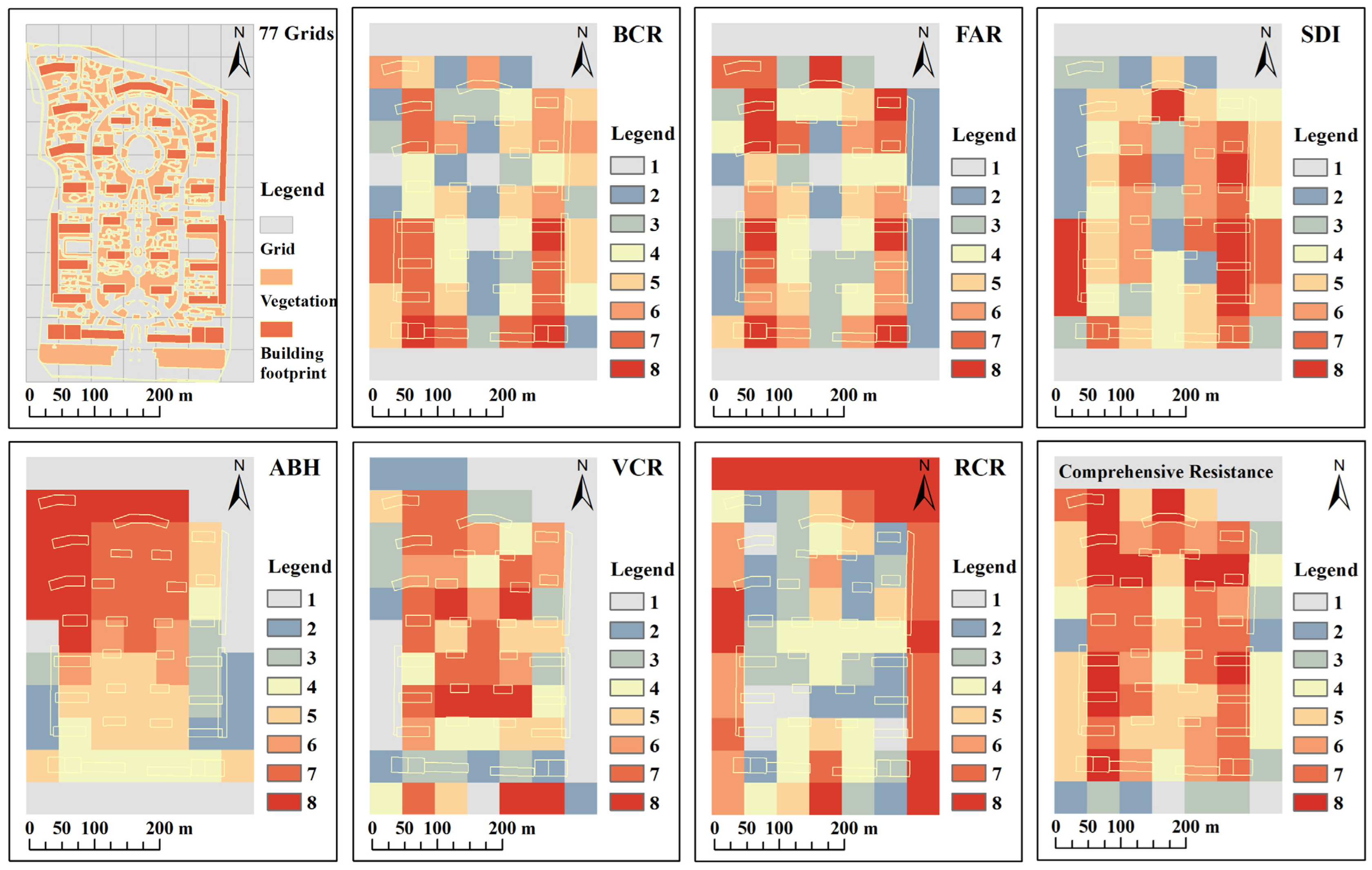
This study comprehensively considers six types of morphological elements, namely BCR, FAR, SDI, VCR, ABH and RCR. Based on the core spatial morphology indicators of 77 grid cells (50 m × 50 m) in the study area and a comprehensive ventilation resistance surface, the differentiation patterns of residential morphological elements under the land-intensive development mode and their combined effects on airflow blocking capacity are visually presented (Figure 7).
BCR, FAR, and ABH exhibit a highly consistent spatial distribution pattern. High-value areas (Levels 7–8) are concentrated in the northern and southeastern high-rise clusters, while the central landscape axis area in the middle exhibits low-value areas (Levels 1–3), reflecting the intensive development characteristic of high-intensity development in the core area and low-intensity reservation at the periphery. High-value areas of the SDI are mainly distributed along the eastern and western margins, whereas the central core area exhibits medium-to-low values, indicating that building layouts are more dispersed at the edges and more aggregated in the core area. VCR shows a significantly inverse distribution with building density: high-value areas are concentrated along the central landscape axis and localized green spaces in the south, while the northern building-dense area exhibits low values. RCR high-value areas are distributed along the eastern and western main roads and the southern boundary, forming a hardened ventilation skeleton running through the residential area. Furthermore, roads in land-intensive residential areas primarily serve as potential ventilation corridors and contribute negligibly to airflow resistance. Therefore, RCR was excluded from the final comprehensive resistance surface, with only the remaining five indicators retained.
The comprehensive ventilation resistance surface exhibits a concentric distribution pattern characterized by high-value agglomeration in the core and gradient decrease toward the periphery. High-resistance areas (Levels 7–8) completely coincide with high-value areas of building density and average building height, corresponding to the core zones of vertically and horizontally intensified superimposed development in the residential area, forming the main blocking nodes for airflow transmission. Low-resistance areas (Levels 1–3) highly match high-value areas of vegetation coverage rate and road coverage ratio, corresponding to open spaces such as the central landscape axis, cluster green spaces, and roads, constituting the core transmission paths for residential ventilation.
The multi-factor ventilation resistance surface clearly reveals the spatial coupling relationship between residential spatial morphology elements and ventilation resistance, verifies the scientific validity of constructing a comprehensive ventilation resistance surface through multi-factor weighted superposition, and provides core spatial foundational data for subsequent identification of the “Source-Flow-Sink” ventilation pattern and optimization of ventilation efficiency based on circuit theory.

2.4.3. Identification Method of “Source-Flow-Sink”

The “Source-Flow-Sink” theory originates from landscape ecology and is used to describe the processes of generation, transmission, and absorption of ecological flows in landscape space [37,38]. The “Source” is defined as the boundary grid cells on the north and northeast sides perpendicular to the prevailing wind direction, which serve as the entry interface for external clean air. The “Flow” constitutes both the process and the spatial medium of airflow transmission and diffusion through the ventilation corridors within the residential area. The “Sink” refers to the southern and southwestern exit zones where the airflow finally departs from the study area, functioning as the space for airflow dissipation and discharge. Some scholars have constructed a green control theoretical framework for urban wind environment systems based on the “Source-Flow-Sink” theory, proposing the multi-level constituent elements and classification standards of urban wind environments, summarizing the types and functional characteristics of wind paths at different spatial levels, and concluding the ecological coordination principles of wind environment systems. Based on the planning concept of interconnecting the oxygen-rich “Source”, the diffusion “Flow”, and the compensation “Sink”, low-carbon planning strategies for improving urban wind environment efficiency have been proposed [18]. The “Source-Flow-Sink” theory has also demonstrated strong adaptability in studies of ecological security patterns and ecological networks. Taking the arid zone of Northwest China as an example, He Jing et al. constructed a “Source-Flow-Sink” analysis framework based on the supply, flow, and demand characteristics of ecosystem services, identifying 61 ecological source areas, 142 ecological corridors, 237 ecological pinch points, and 89 barrier points [39]. Zong Bin Zhu et al., taking Xi’an as the study object, systematically identified three types of spaces for ecosystem service supply–demand flows from three dimensions—service supply source areas, process transmission areas, and function accumulation areas—and proposed a zoning governance strategy of “Source” control, “Flow” regulation, and “Sink” enhancement [40]. These studies provide methodological references for the identification of “Source-Flow-Sink” at the residential scale in ventilation systems. However, the application of the “Source-Flow-Sink” theory in urban wind environment research is currently focused mainly on the macro scale, while research on the identification and measurement of the “Source-Flow-Sink” system at the residential scale remains relatively weak [19].
Based on the climatic characteristic that the prevailing summer wind direction in Lanzhou is north–northeast (NNE), the grid cells on the northern and northeastern boundaries of the study area perpendicular to the prevailing wind direction were set as “Source” nodes. In circuit theory, these are analogized as high voltage values, simulating the high potential energy state of external airflow input. The grid cells on the southern and southwestern boundaries were set as “Sink” nodes, grounded, and analogized as low voltage values, simulating the outlet area where airflow finally leaves the study area. This reflects the basic physical process of airflow moving from the windward side to the leeward side driven by the pressure gradient.

2.5. CFD Numerical Simulation of the Wind Environment

Computational fluid dynamics (CFD) technology provides an important tool for the quantitative analysis of urban airflow distribution. Cheng Liang Fan et al. employed a coupled CFD and EnergyPlus simulation method to study the feedback effect of anthropogenic heat from air conditioning in residential buildings on cooling energy consumption, achieving a simulation accuracy with a prediction error of less than 0.3 °C at a height of 0.5 m under medium grid density [41]. Ji et al. applied CFD to evaluate wind comfort in a high-density primary school in Shenzhen, revealing that decentralized teaching building layouts and multi-courtyard forms open to the summer prevailing wind markedly improve outdoor ventilation and comfort [42]. Qian Zhang et al., taking a high-rise residential area in Xi’an as an example, combined field measurements with PHOENICS simulations to reveal that a building layout with higher buildings in the south, lower buildings in the north, and intermediate low areas is more conducive to internal wind environment comfort [5]. This study uses PHOENICS 2019 as the CFD wind environment simulation platform.

2.5.1. Model Construction and Mesh Generation

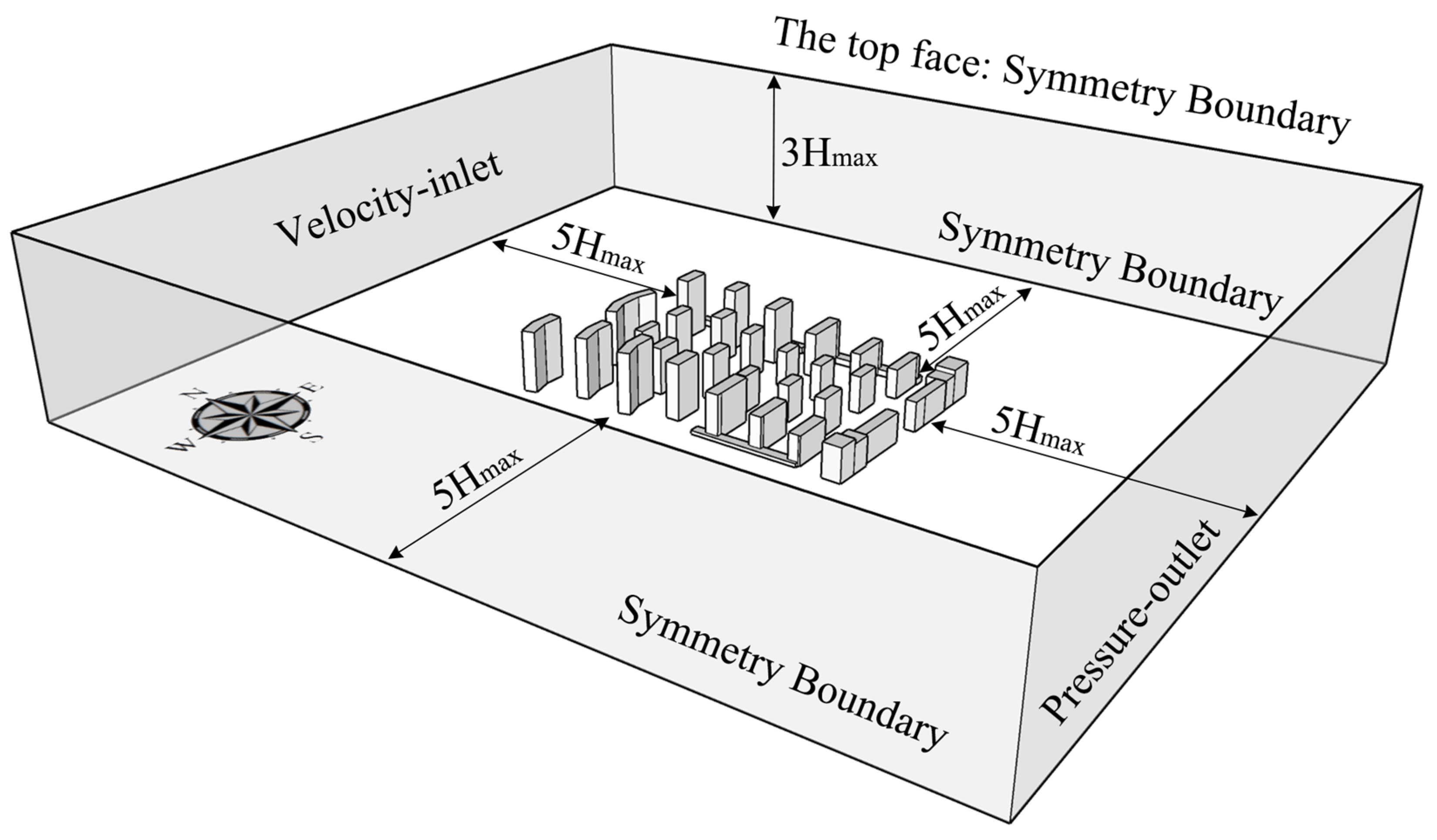
Based on the CAD master plan of Yineng Huanghe Jiayuan and building height data, a three-dimensional mass model was established in SketchUp. Building forms were simplified as rectangular blocks, ignoring roof details while retaining the main morphological characteristics of the buildings. Thirty residential buildings were modeled according to their actual layout. Greenery and water bodies were simplified as planar surfaces. The model coordinate system was aligned with the geographic coordinate system to ensure accurate wind direction settings. The model was exported in STL format and imported into PHOENICS 2019. The computational domain was set to 5Hmax × 5Hmax × 3Hmax (where Hmax denotes the maximum building height within the study area), strictly following the COST guidelines for CFD simulations in wind engineering. This configuration reserves lateral extensions of five times the maximum building height on both sides of the study area and sets the top boundary at three times the maximum building height, effectively eliminating boundary-induced interference with the internal flow field and ensuring the reliability of the simulation results.
Mesh generation was performed using the PARSOL method, which combines the advantages of structured and unstructured grids and is capable of accurately fitting complex building geometries. A local refinement scheme with a grid size of 5 m × 5 m was adopted around building envelopes. This grid resolution fully complies with the mainstream technical specifications and commonly accepted practices in the academic community for CFD simulations of urban wind environments at the block scale. Numerous studies have demonstrated that for block-scale wind environment simulations in high-density urban built-up areas, a base grid size of 5 m × 5 m can accurately capture the flow field characteristics around buildings while ensuring simulation accuracy and effectively balancing computational efficiency, avoiding the substantial increase in computational cost and numerical dissipation caused by overly fine grids, thus representing the optimal grid resolution for this type of research [6,43]. The total number of grid cells generated in this study is approximately 2.23 million (Figure 8).

2.5.2. Mathematical Model and Boundary Conditions

The mathematical model adopts the steady-state Reynolds-Averaged Navier–Stokes (RANS) equations, and the turbulence model uses the standard k-ε model, which offers a good balance between computational efficiency and accuracy for complex urban wind environment simulations. The exponential wind profile is used for the inlet boundary condition:
U z U 0 = Z Z 0 α
where U0 is the wind speed at the reference height Z0 (10 m), taken as 1.21 m/s. The exponent α represents the ground roughness index, which was set to 0.22 based on the topographical features and underlying surface characteristics of Lanzhou, strictly corresponding to Terrain Category C (dense urban areas) as defined in the Load Code for the Design of Building Structures (GB 50009-2012) [44]. Turbulence inlet parameters were specified according to the power-law wind profile formulation, with turbulence kinetic energy k and dissipation rate ε calculated using empirical formulae.
The outlet boundary was configured as a pressure outlet with zero gauge pressure. The lateral and top boundaries of the computational domain were both set as symmetry boundaries, i.e., zero normal velocity and zero normal gradients for all variables. The ground boundary was treated as a no-slip wall with the standard wall function employed to model near-wall flow. The ground roughness was parameterized in accordance with Terrain Category C, fully matching the underlying surface conditions of the study area.
Regarding solution control, the residual convergence criterion for all governing equations was set to 10−4. Monitoring points were deployed within the computational domain to ensure that wind speeds at these locations stabilized before convergence was declared. After approximately 1000 iterations, all residuals reached the specified convergence criteria and remained stable, indicating that the numerical solution had achieved a steady state.

2.6. Quantification of Ventilation Efficiency

This study adopts the relevant provisions for wind environment assessment specified in the Green Building Evaluation Standard (GB/T 50378—2019) as the technical basis for wind environment quality evaluation [45]. The evaluation system uses the average wind speed as the core quantitative indicator. Using Photoshop, the wind speed area within the wind speed contour map is calculated to determine the average wind speed at pedestrian height (1.5 m above ground) within each grid cell. In the domain of urban wind environment and computational fluid dynamics (CFD) simulation, analogous methodological pathways have been pursued in existing research [4,46,47]. The average wind speed ratio is then obtained by comparing this value with the reference wind speed, serving as the quantitative indicator of ventilation efficiency.

2.7. Statistical Analysis Methods

To reveal the quantitative relationship between residential spatial morphology and ventilation efficiency, this study comprehensively employs correlation analysis and multiple linear regression analysis. The Pearson correlation coefficient is used to evaluate the degree of linear correlation between morphological indicators and ventilation efficiency indicators. The significance level is set as follows: p < 0.05 for significant correlation and p < 0.01 for highly significant correlation. A multiple linear regression model is constructed with the average wind speed ratio (ventilation efficiency indicator) as the dependent variable and morphological indicators including building coverage ratio, dispersion index, floor area ratio, average building height, and vegetation coverage rate as independent variables. Stepwise regression is used to select significant variables, with a variance inflation factor of less than 5 as the threshold for determining multicollinearity. Standardized regression coefficients are used to compare the influence intensity of each variable on ventilation efficiency. For spatial unit classification, grid cells are analyzed based on morphological indicators and ventilation efficiency indicators, and three typical categories are ultimately selected to identify the “Source-Flow-Sink” configuration modes.
To identify the spatial clustering properties and correlation patterns among the indicators, the global Moran’s I was employed for spatial autocorrelation analysis. The global Moran’s I quantifies the overall agglomeration degree of attribute values over spatial units, ranging from −1 to 1. A positive I value (I > 0) denotes positive spatial autocorrelation, whereby adjacent units with similar values tend to form clusters; a negative I value (I < 0) denotes negative spatial autocorrelation, whereby neighboring units with dissimilar values tend to aggregate; and an I value close to zero indicates a random spatial pattern with no significant spatial autocorrelation.

3. Results

3.1. Identification Results of “Source-Flow-Sink”

3.1.1. Characteristics of the Multi-Factor Resistance Surface

The comprehensive ventilation resistance surface of Yineng Huanghe Jiayuan was constructed based on five core spatial morphology indicators, including building coverage ratio and floor area ratio. Its spatial heterogeneity directly reflects the coupling effect between land-intensive development and the “Source-Flow-Sink” ventilation system, and maps the regulatory effect of the development logic of “controlling planar density and enhancing vertical intensity” on the entire process of wind power supply, transmission, and dissipation. The overall pattern exhibits a concentric distribution characterized by high-value agglomeration in the core, gradient decrease toward the periphery, low-value surroundings in the north and south, and corridor connectivity in the east and west. Resistance values gradually decrease from the central core to the peripheral edges. High-resistance zones completely coincide with high-intensity building footprint areas, while low-resistance zones correspond to ecological open spaces, together forming a basic resistance structure of core blockage and edge connectivity, which directly lays the foundation for the formation of the ventilation pattern featuring “Source” in the north, “Flow” in the middle, and “Sink” in the south. Based on the core spatial morphology indicators of the 77 grid cells (50 m × 50 m) in the study area, individual spatial morphology resistance surfaces were constructed, revealing the differentiation patterns of residential spatial morphology under the land-intensive development mode and their combined effects on airflow blocking capacity (Figure 9).
The highest resistance zones (Levels 7–8) form a north–south central axis agglomeration belt and an east–west barrier in the north. These are the core areas of vertically and horizontally intensified superimposed development in the residential area, where building coverage ratio, floor area ratio, and average building height are all at their peaks, while spatial dispersion is relatively low. The centralized high-rise, high-density development creates a very strong spatial barrier, becoming the core blocking node for airflow transmission. The insufficient vegetation coverage further amplifies the airflow attenuation effect. The southern high-resistance zone, formed by the intensive layout of high-rise slab buildings, acts as a pre-barrier to the “Sink” area, exacerbating the airflow stagnation problem in the southeast. The moderately high-resistance zones (Levels 5–6) are distributed adjacent to the core area, corresponding to scattered building layouts with medium development intensity, serving as the primary buffer zone for the “Flow” segment. The moderately low-resistance zones (Level 4) extend to the eastern and western edges of the site, where development intensity is significantly reduced, forming a surrounding buffer circle and east–west transitional corridors that break the continuous barrier of the high-resistance zone, reflecting the positive regulatory effect of reserved peripheral open space on ventilation.
The extremely low-resistance zones (Levels 1–2) are distributed along the northern and southern boundaries. These are ecological and public space boundaries under land-intensive control, corresponding to the wind power input interface of the “Source” area and the airflow output interface of the “Sink” area, ensuring the pressure gradient driving of the “Source-Flow-Sink” system. The low-resistance zones (Level 3) are distributed as north–south strips on the eastern and western sides, constituting the core transmission skeleton of the “Flow” segment apart from the central main corridor. The scattered low-resistance patches within are small green spaces and plazas between building clusters, serving as key nodes for local airflow diffusion, reflecting the natural corridor reservation effect of the intensive layout pattern featuring high intensity in the core and low intensity at the periphery.
The spatial differentiation of the resistance surface is essentially the result of the trade-off between intensive development intensity and ecological open space: the high-value agglomeration of building coverage ratio, floor area ratio, and building height determines the spatial distribution of the core blocking zone in the “Flow” segment and the pre-barrier of the “Sink” area; vegetation coverage regulates local resistance levels; and building dispersion controls the gradient transition characteristics of resistance. The lower the dispersion and the more concentrated the building arrangement, the stronger the resistance agglomeration effect, and the more easily the “Source-Flow-Sink” transmission chain breaks. This coupling relationship provides the core spatial basis for subsequent optimization of ventilation efficiency.

3.1.2. Identification Results of Ventilation Corridors

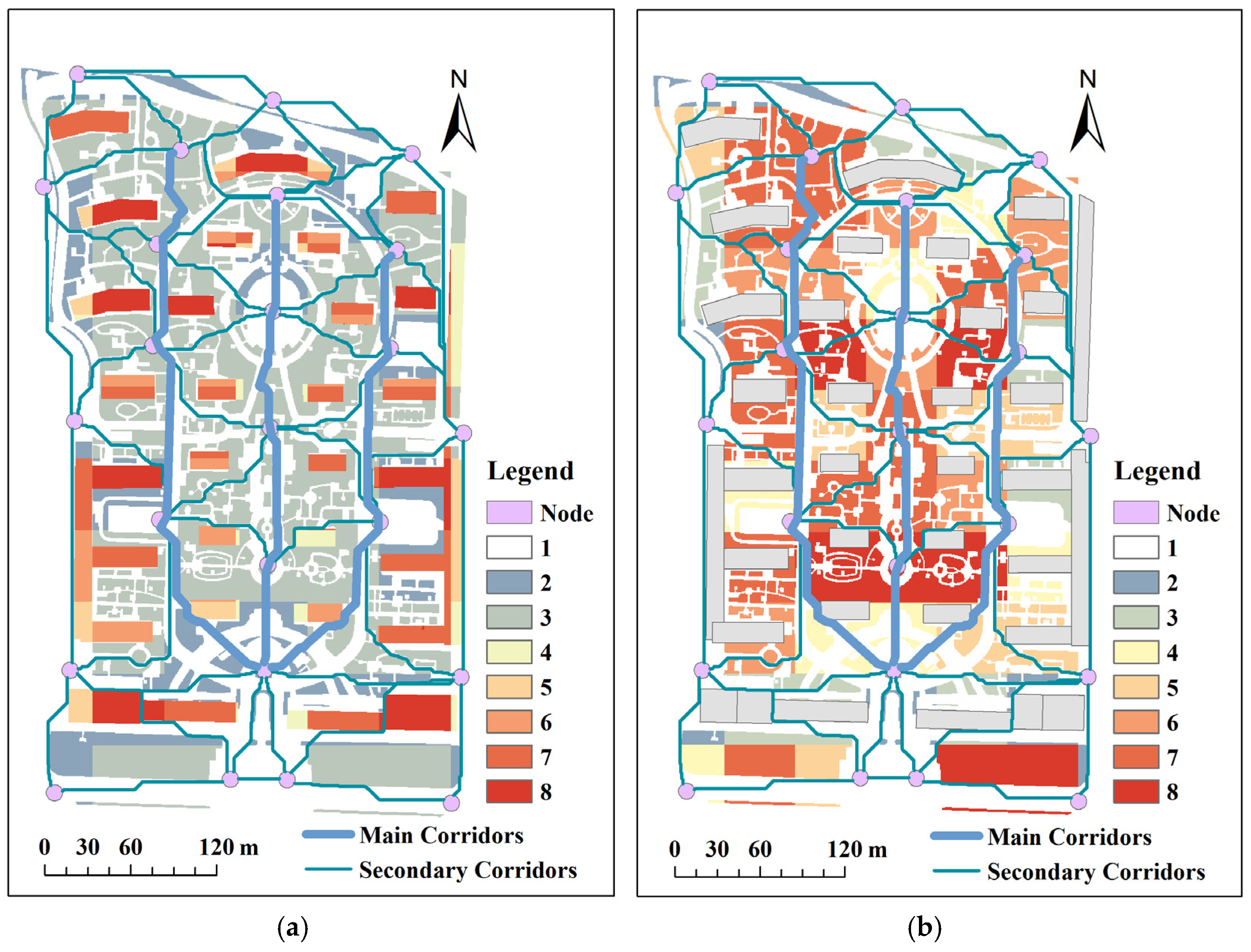
The residential ventilation corridor system identified based on the multi-factor ventilation resistance surface and circuit theory is the product of the synergistic evolution between the spatial structure of land-intensive development and the “Source-Flow-Sink” ventilation system. Its hierarchical characteristics and connectivity are regulated by the concentric differentiation law of intensive development intensity, while conversely determining the transmission efficiency and coverage range of wind power from the “Source” area to the “Sink” area. This study employs the circuit theory method to identify the ventilation corridor system in the study area, visually presenting the regulatory effect of the land-intensive development pattern on the network structure of ventilation corridors (Figure 10).
Three main corridors were identified in the study area, with a total length of approximately 820 m. The central main corridor, running north–south, is distributed along the central landscape axis reserved for intensive development. The remaining corridors are all secondary corridors. The corridor network as a whole exhibits a spatial pattern of a single dominant axis with multiple branches. All corridors are distributed along low-resistance zones with resistance values ranging from Levels 1 to 4, closely aligning with the concentric differentiation characteristics of the comprehensive resistance surface. The central main corridor extends along the north–south central landscape axis of the residential area, traversing the entire study area. Along this corridor, building density is below 18% and dispersion index is above 0.42, making it the core channel for north–south airflow transmission. The main corridors on the eastern and western sides are laid out along the residential area’s boundary roads and protective green spaces, with development intensity less than 30% of that in the core area, forming the peripheral ventilation skeleton of the residential area.
The secondary corridors are distributed along inter-cluster roads and green spaces within the medium-resistance transition zone, exhibiting a fragmented extension pattern with an average connectivity length of less than 150 m and extremely poor spatial continuity. This is a direct result of the clustered, high-density enclosed layout under the intensive mode: the enclosed building interfaces cut off the extension of the secondary corridors, allowing airflow only to penetrate in a punctiform manner through building gaps, failing to form a networked transmission system. From the “Source-Flow-Sink” perspective, the connection between the corridors and the “Source” area is generally smooth. All three main openings in the northern “Source” area are directly connected to the main corridors, ensuring effective input of wind power. However, there is a significant spatial disparity in the alignment with the “Sink” area: the central-western part of the southern “Sink” area has complete airflow output channels, whereas the southeastern “Sink” area is surrounded by contiguous high-resistance building clusters, with no corridor of any level connecting to it, forming a terminal blind zone. Among the 24 corridor nodes, 12 are airflow distribution nodes, corresponding to small plazas and green spaces within the residential area, enabling the diversion of airflow between the main and secondary corridors; the remaining 12 are corridor break nodes, all located at the edges of high-resistance zones (Levels 5 to 8), caused by the continuous barrier formed by concentrated high-rise buildings.
The corridor system reflects the supportive role of reserved public open space in ventilation under land-intensive development, while also exposing the damage to corridor continuity caused by high-density enclosed layouts, providing clear spatial targets for subsequent optimization of ventilation efficiency.

3.2. CFD Simulation Results and Wind Field Characteristic Analysis

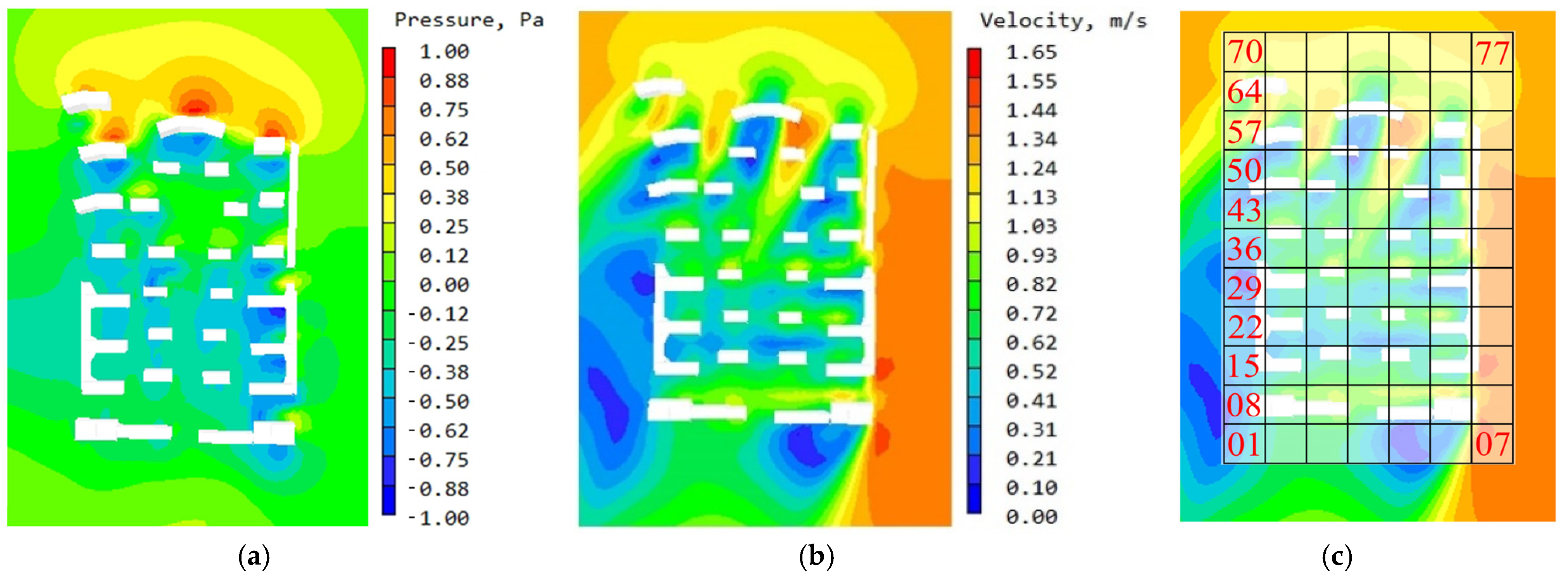
The PHOENICS code and the standard k-ε turbulence model employed in this study constitute a well-established and mature technical framework for wind environment simulation at the residential-district scale. These methods have been extensively validated and applied in numerous comparable studies both domestically and internationally [48,49,50,51]. CFD simulation obtained the summer wind field distribution at pedestrian height (1.5 m) for Yineng Huanghe Jiayuan (Figure 11). Overall, the spatial differentiation characteristics of the residential wind field are highly coupled with the concentric development pattern of high intensity in the core and low intensity at the periphery under the land-intensive mode, while directly mapping the “Source-Flow-Sink” transmission process of northern “Source” input, central “Flow” transmission, and southern “Sink” dissipation. The wind speed gradient distribution is essentially the result of interactions among intensive development intensity, building layout pattern, and airflow movement laws (Table 2).
From the perspective of wind power supply and initial transmission at the “Source” end, the windward side of the prevailing wind on the north and northeast sides of the residential area serves as the core input interface of the “Source-Flow-Sink” system. The wind speed remains stable between 1.03 and 1.65 m/s, with no large-area wind power deficit across the entire area, providing a high-quality foundation for natural ventilation of the residential area. However, the continuous building enclosure interface formed by land-intensive development constitutes an initial rigid constraint on “Source”–“Flow” transmission. The incoming wind can only enter the interior through gaps between building clusters and limited openings of the residential area. The high-wind-speed incoming flow area on the east side lacks corresponding corridors to receive it, resulting in a direct waste of substantial wind power resources. This characteristic profoundly reflects the design flaw of land-intensive development that emphasizes interface integrity while neglecting wind environment connectivity. For the “Flow” end, as the core link of wind power transmission, the attenuation pattern of wind speed gradient is completely consistent with the concentric differentiation of intensive development intensity: after the incoming wind passes through the building interface, its wind speed decreases to 0.82–1.03 m/s in the sub-peripheral medium-intensity development area, and further attenuates to 0.31–0.72 m/s upon entering the central core high-density development area. In enclosed courtyards and leeward zones of building clusters, the minimum wind speed approaches 0 m/s, with a maximum attenuation exceeding 90%. Meanwhile, influenced by the single-axis centralized public space layout under intensive development, the residential area forms only one longitudinal main ventilation corridor along the central landscape axis (wind speed 0.72–1.03 m/s). Secondary ventilation corridors are completely absent due to the clustered high-density enclosed layout, failing to form a three-level main-secondary-branch network transmission system. As a result, the lateral diffusion capacity of the main corridor is extremely poor, the eastern and western building clusters cannot effectively receive wind power, and the overall connectivity of the flow field is severely insufficient.
The local flow field reconstruction effect is closely related to the morphological characteristics of buildings under intensive development. In the edge areas on the windward sides of buildings, local high wind speed zones exceeding 1.24 m/s are formed due to the flow-around effect, with the highest wind speed reaching 1.44 m/s at the windward edge of the northern high-rise buildings, which can serve as a potential entry point for local ventilation optimization. In contrast, the leeward areas of buildings, enclosed courtyards, and the western side of the residential area form large wind-shadow and vortex zones, where wind speeds are mostly below 0.31 m/s, resulting in extremely poor air convection and exchange capacity, which can easily lead to pollutant retention and exacerbation of the urban heat island effect. These areas are the core targets for residential ventilation optimization. From the perspective of airflow dissipation at the “Sink” end and the “Source-Flow-Sink” synergy, the landscape open spaces distributed along the central main corridor, as effective “Sink” units reserved under intensive development, maintain wind speeds stably between 0.62 and 1.03 m/s. They can effectively receive the wind power transmitted from the “Flow” end and achieve local diffusion, forming a locally complete “Source-Flow-Sink” transmission chain. However, the dense high-rise slab building area in the south, as the main “Sink” area, is surrounded by contiguous high-resistance building clusters without any ventilation corridor access, forming an ineffective “Sink” space accounting for more than 40% of the area, where airflow remains stagnant for extended periods. This pattern is a direct consequence of the development orientation under the land-intensive mode that emphasizes increasing floor area ratio while neglecting the relief of the “Sink” area. Overall, The CFD simulation results clearly reveal the core contradiction of the ventilation system in this specific intensive residential area under the land-intensive mode: land-intensive development ensures the basic transmission path of the “Source-Flow-Sink” system by reserving core public spaces, but the high-density, high-enclosure building layout simultaneously causes transmission blockage in the “Flow” segment and an imbalance in dissipation in the “Sink” area, ultimately leading to a severe lack of synergy across the entire “Source-Flow-Sink” chain. This provides clear spatial targets for subsequent differentiated optimization strategies based on the “Source-Flow-Sink” structure.

3.3. Coupling Analysis of Morphological Indicators and Ventilation Efficiency

3.3.1. Spatial Autocorrelation Analysis

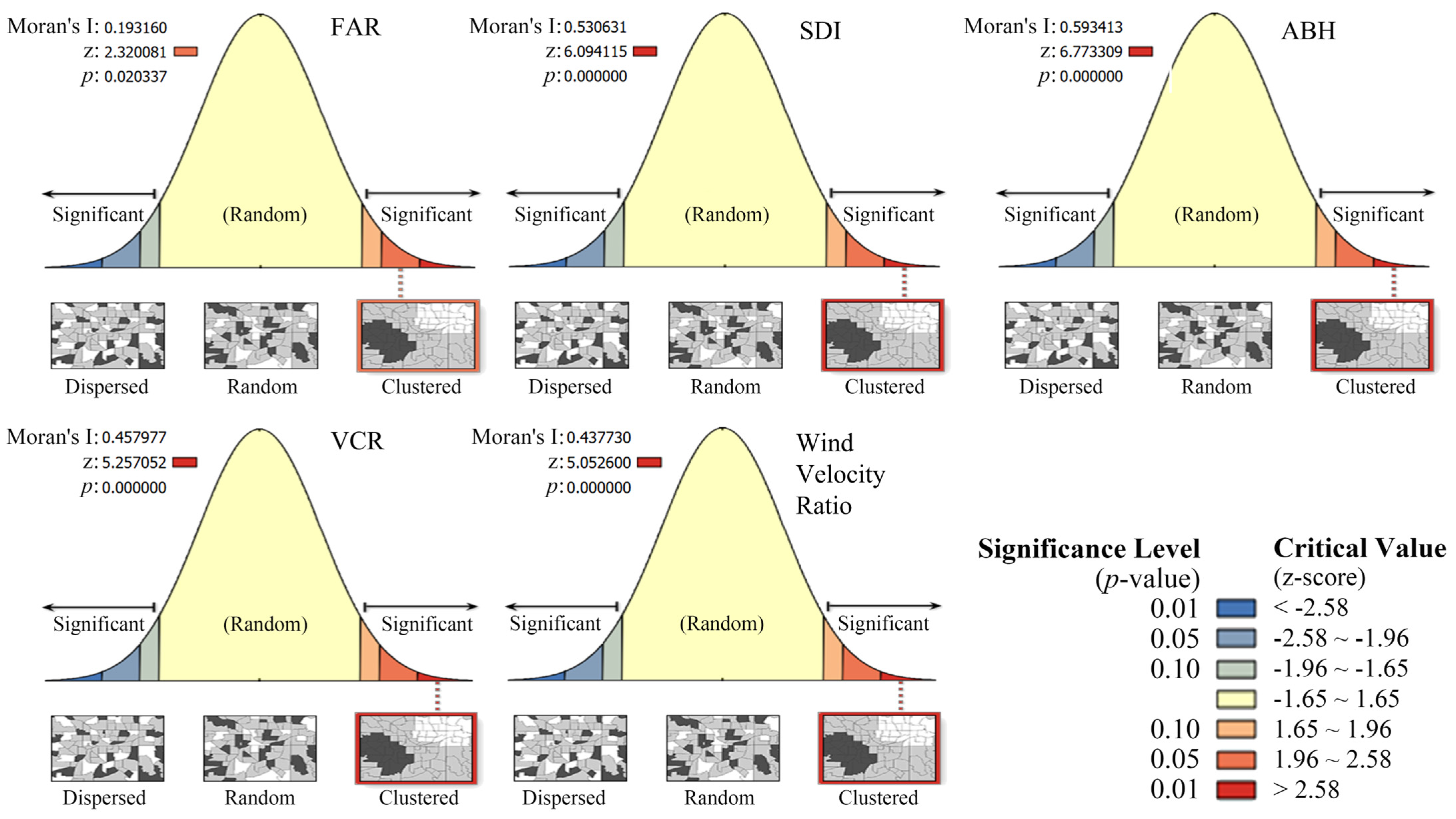
To verify whether the spatial distributions of residential spatial morphology indicators and ventilation efficiency exhibit clustering effects, the global Moran’s I statistic was calculated for each core indicator (Figure 12).
The results show that the global Moran’s I values for all indicators are positive and statistically significant (p < 0.05), indicating that both the morphological indicators and the ventilation efficiency indicator exhibit significant positive spatial autocorrelation within the study area—that is, grid cells with similar attribute values tend to cluster spatially. Among all indicators, SDI exhibits the highest Moran’s I value, suggesting that the spatial agglomeration of building layout dispersion is the strongest, displaying a distinct “core-concentrated, periphery-dispersed” distribution pattern, which is highly consistent with the core–periphery distribution characteristics observed in the comprehensive resistance surface. FAR ranks second in terms of Moran’s I, reflecting a significant spatial clustering of vertical development intensity, with high-FAR high-rise buildings concentrated in the northern and southeastern zones, which completely coincide with the spatial extent of the high-resistance areas.
Moran’s I value for wind speed ratio is relatively lower than those of the morphological indicators, indicating that the spatial clustering of ventilation efficiency is weaker than that of the morphological factors. This is attributable to the inherent mobility and diffusivity of airflow, which partially attenuate the spatial aggregation effects of morphological indicators. Nevertheless, the positive spatial autocorrelation remains statistically significant, further confirming that residential spatial morphology exerts a decisive regulatory influence on the spatial distribution of ventilation efficiency.
The spatial clustering characteristics of the indicators mutually corroborate the identification results of the comprehensive resistance surface and ventilation corridors presented earlier: areas with high FAR, high building height, and high dispersion index collectively form the core high-resistance zone, resulting in the spatial clustering of low-wind-speed-ratio areas in the residential core; conversely, the low-intensity peripheral areas and open spaces constitute high-value clustering zones of wind speed ratio. This spatial coupling relationship further demonstrates that the spatial differentiation of morphology under the land-intensive development mode gives rise to the spatial heterogeneity of ventilation efficiency within the residential area.

3.3.2. Correlation Analysis

Based on 77 grid cell samples (50 m × 50 m) from Lanzhou Yineng Huanghe Jiayuan (available in the Supplementary Materials), and the statistical validity of the sample data verified by normal distribution boxplots of the morphological indicators, the Pearson correlation coefficient was used to systematically quantify the coupling correlation characteristics between residential spatial morphological elements and the ventilation system efficiency of the “Source-Flow-Sink” under the land-intensive mode. This reveals the differentiated regulatory mechanisms of intensive development intensity, layout pattern, and ecological space configuration on wind power supply, airflow transmission, and dissipation processes (Figure 13, Table 3). RCR was excluded from this part of the analysis, as it contributes minimally to overall ventilation resistance.
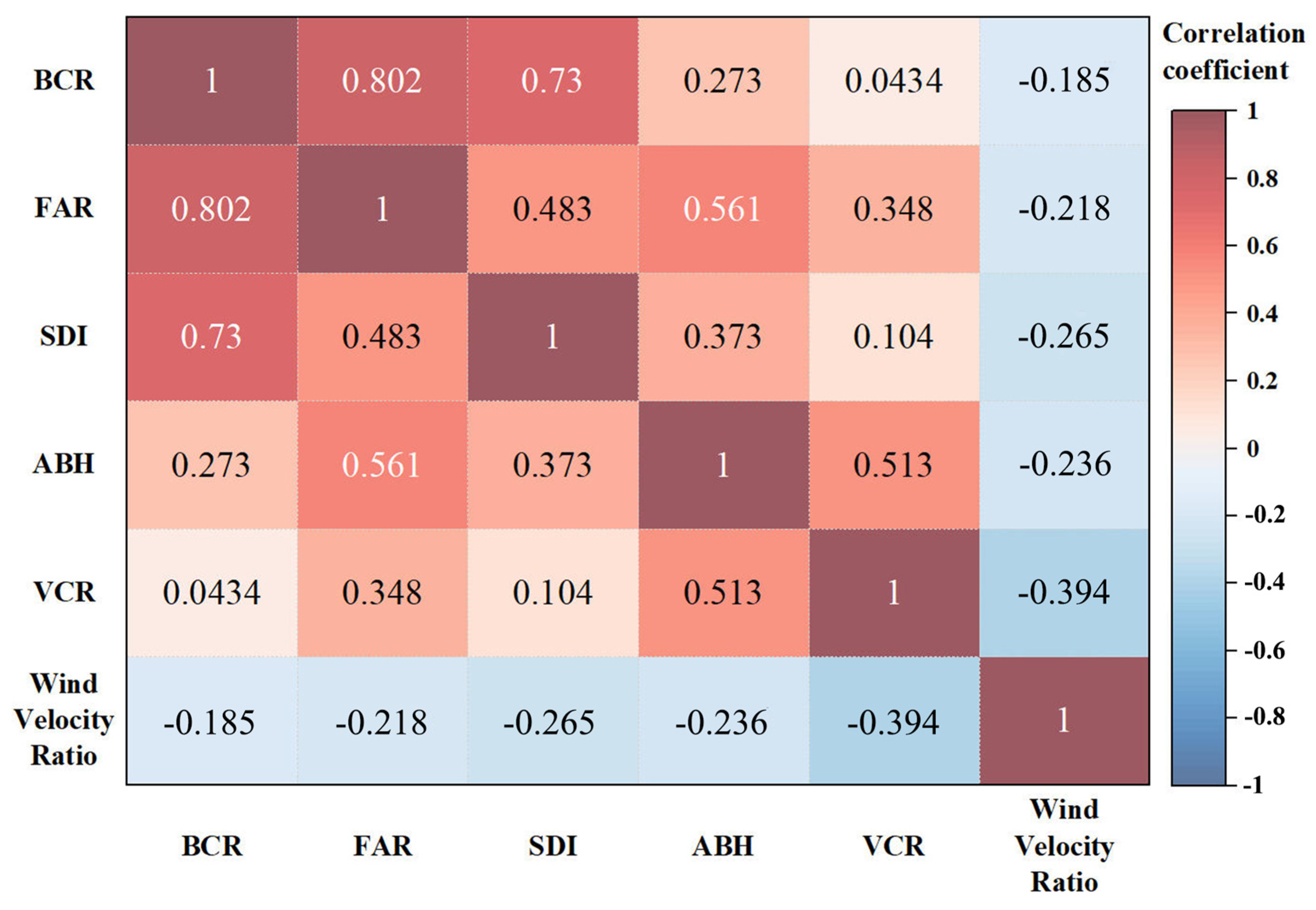
The residential wind speed ratio, as a core indicator of ventilation efficiency, exhibits a highly significant negative correlation with vegetation coverage rate (r = −0.394, p < 0.001), a significant negative correlation with building dispersion index (r = −0.265, p < 0.05) and average building height (r = −0.236, p < 0.05), a weak negative correlation with floor area ratio (r = −0.218, p < 0.1), and a negative correlation with building coverage ratio that did not reach statistical significance (r = −0.185, p > 0.05). This disparity essentially reflects the asymmetric effects of different dimensions of land-intensive development on the “Source-Flow-Sink” system. The effect of building coverage ratio, a core indicator of planar intensification, is masked by the synergistic effects of vertical development and layout patterns. Dispersion, which reflects layout compactness, and vegetation coverage rate, which represents ecological space configuration, exert more significant regulatory effects on transmission efficiency by directly modifying underlying surface resistance and airflow penetration pathways (Figure 14).
The study further reveals strong covariance characteristics among the morphological elements of land-intensive development. The correlation coefficients of building coverage ratio with floor area ratio and dispersion index reach 0.802 and 0.73, respectively (p < 0.001). The correlation coefficients of floor area ratio with average building height and vegetation coverage rate are 0.561 and 0.348, respectively (p < 0.001). This covariance relationship is an inevitable manifestation of the intensive development logic of “controlling planar density and enhancing vertical intensity”. The influence of residential morphology on ventilation efficiency is not the independent effect of a single indicator, but rather the result of the synergistic action of planar development intensity, vertical development scale, and spatial layout pattern on the “Source-Flow-Sink” system. A high floor area ratio is often accompanied by high building coverage ratio and low dispersion index, and the three together exacerbate airflow blockage in the core area of the “Flow” segment and the accumulation effect in the “Sink” area. The positive correlation between vegetation coverage rate and average building height reflects the characteristic that, under intensive development, high-rise residential areas are often equipped with relatively high levels of greening. However, dense configurations of trees and shrubs increase the roughness of the near-ground underlying surface, thereby inhibiting local airflow transmission.
From the perspective of “Source-Flow-Sink” synergy, the above correlation characteristics corroborate the conclusions of the previous resistance surface and corridor identification. An increase in building dispersion index can effectively reduce ventilation resistance and enhance corridor connectivity. Excessively concentrated high-density development, on the other hand, will cut off the “Source-Flow-Sink” transmission chain. This provides a core quantitative basis for subsequent regression model construction and ventilation optimization strategy formulation. Resolving the intensification paradox requires the coordinated integration of multi-dimensional morphological elements of land-intensive development, rather than simply adjusting the floor area ratio or building coverage ratio in isolation.

3.3.3. Multiple Linear Regression Analysis

Based on the 77 standardized grid cells (50 m × 50 m) of Lanzhou Yinneng Huanghe Jiayuan, with the wind speed ratio representing the overall ventilation efficiency of the residential area as the dependent variable, and floor area ratio, building dispersion index, average building height, and vegetation coverage rate as core independent variables, a multiple linear regression model was constructed (Table 4). The model expression is:
Y = 0.639 + 0.009 X 1 0.219 X 2 + 0.043 X 3 0.326 X 4
where X1 is FAR, X2 is SDI, X3 is ABH, and X4 is VCR. The overall fit of the model was highly significant (F = 4.728, p = 0.002), explaining 20.8% of the spatial variance in the wind speed ratio, with an adjusted coefficient of determination of 0.164. The variance inflation factors for all independent variables were less than 2, ruling out severe multicollinearity interference and enabling a stable revelation of the driving mechanisms of residential ventilation efficiency under the land-intensive mode.
The results show that vegetation coverage rate has a highly significant negative effect on the wind speed ratio, with a standardized coefficient of −0.4, a t-value of −3.228, and a p-value of 0.002, making it the primary morphological factor regulating residential ventilation efficiency. Building dispersion index exhibits a significant negative effect, with a standardized coefficient of −0.249, a t-value of −2.038, and a p-value of 0.045. The independent effects of floor area ratio and average building height did not pass the significance test, with corresponding p-values of 0.941 and 0.687, respectively. This result maps the asymmetric effects of the intensive development logic of “controlling planar density and enhancing vertical intensity” on the “Source-Flow-Sink” system. The strong inhibitory effect of vegetation coverage rate stems from the densely planted tree-and-shrub configuration commonly adopted in high-rise residential areas under intensive development. This configuration significantly increases the roughness of the near-ground underlying surface, not only reducing the initial input efficiency of wind power from the northern “Source” area but also forming a continuous vegetation resistance belt in the “Flow” segment, hindering airflow transmission to the southern “Sink” area and further exacerbating the airflow stagnation problem in the southeastern high-resistance “Sink” area. The negative effect of dispersion index is directly related to the characteristics of intensive development layout. A high dispersion index essentially corresponds to a concentrated development pattern with dense building footprints and fragmented boundaries, which cuts off the continuous transmission path of the “Source-Flow-Sink” system, increases airflow detour resistance, and leads to a rapid gradient attenuation of wind speed in the “Flow” segment.
The insignificant effects of floor area ratio and average building height do not indicate that vertical intensive development has no effect on ventilation efficiency; rather, their effects are masked by the stronger influence of planar layout and ecological space configuration. Under the intensive orientation, an increase in floor area ratio is mainly achieved by increasing building height rather than expanding building footprints. When building coverage ratio is controlled within a reasonable range, the impact of vertical development on the wind field at the pedestrian height of 1.5 m is relatively limited, and may even locally increase wind speed through the high-rise narrow-tube effect. This also corroborates the conclusion of the previous correlation analysis that floor area ratio exhibits only a weak negative correlation with the wind speed ratio. From the perspective of “Source-Flow-Sink” synergy, the regression results clearly identify the core targets for ventilation optimization in intensive residential areas. Compared with simply adjusting development intensity indicators, optimizing building layout dispersion and reconfiguring vegetation patterns is more efficient for improving ventilation efficiency. By moderately reducing building concentration and converting densely planted green spaces into sparse woodland and grassland, the core resistance in the “Flow” segment can be effectively reduced and the transmission efficiency of the entire “Source-Flow-Sink” chain can be enhanced without altering the intensity of land-intensive utilization, thereby providing quantitative support for resolving the intensification paradox.

4. Discussion

4.1. Collaborative Optimization Strategies

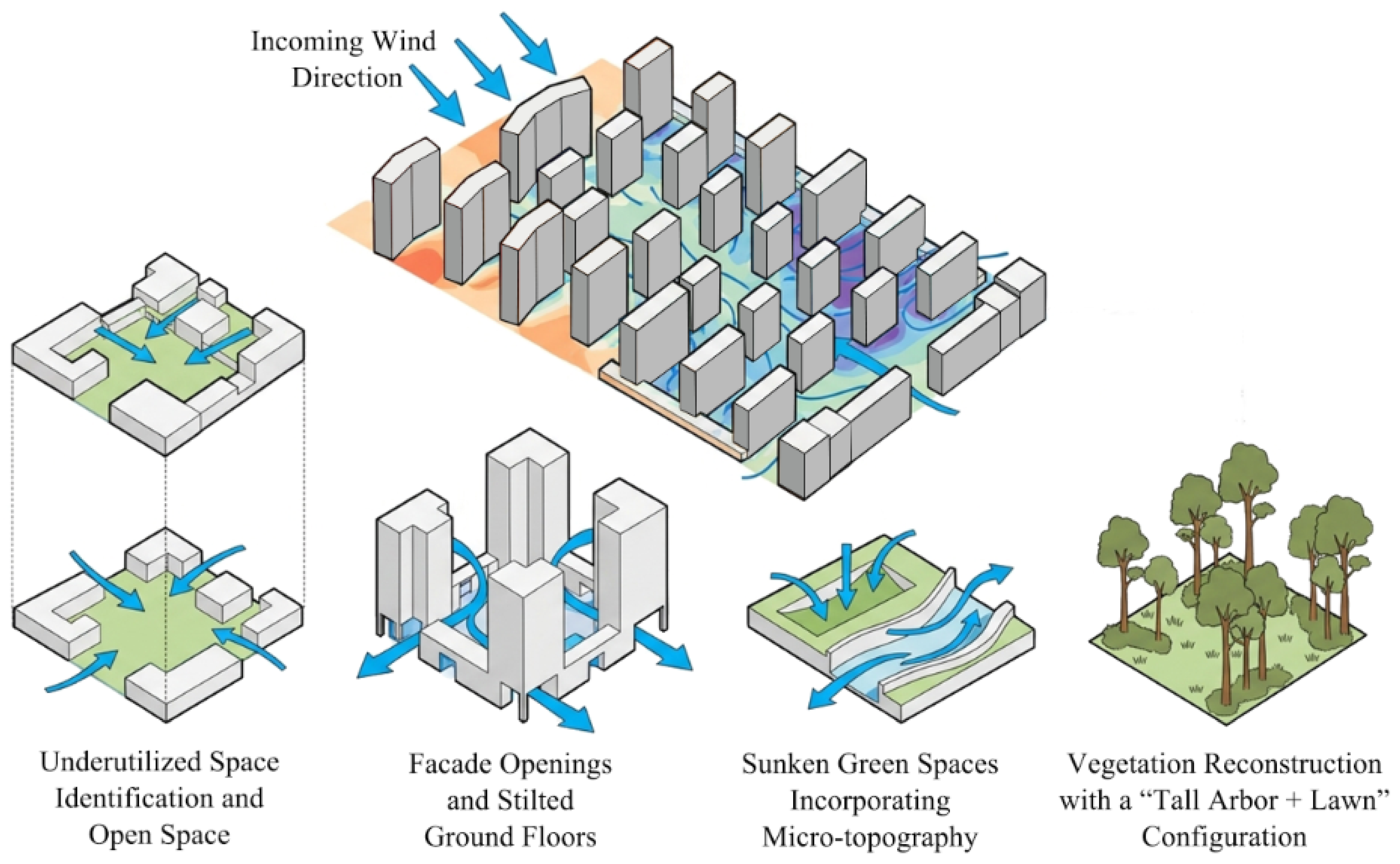
Based on the measurement results of the “Source-Flow-Sink” landscape ventilation efficiency in residential areas under the land-intensive mode, and targeting the core problems in the ventilation pattern of Yineng Huanghe Jiayuan (i.e., “Source” in the north, “Flow” in the middle, “Sink” in the south), including the monotonous morphology of the “Source” area, insufficient continuity of the corridor network, and a significant accumulation effect in the southern “Sink” area, and integrating the influence mechanisms of morphological indicators revealed by correlation analysis and multiple regression, as well as the three identified “Source-Flow-Sink” configuration modes, this study proposes differentiated collaborative optimization strategies dominated by micro-renewal, under the constraint of not altering the existing core land intensification indicators such as floor area ratio and building density. The aim is to resolve the intensification paradox and achieve synergy between land-intensive utilization and ventilation efficiency improvement.
Studies have shown that semi-open layouts can enhance summer ventilation by 12–18% [25], and that building length exerts a significant influence on spatial ventilation efficiency [52]. For the northern “Source” zone, a semi-open layout is recommended, combined with optimized building interfaces and reconfigured vegetation to guide airflow.
The construction of ventilation corridors aligned with the prevailing wind direction can improve block-scale wind environment quality [53]. Increasing building spacing enhances ventilation efficiency, though the benefit diminishes when spacing exceeds 15 m [54]. For the central “Flow” zone, potential ventilation corridors should be established along the prevailing wind direction, with adjustments to building height and density at blockage points, alongside the activation of underutilized spaces.
The effects of staggered building layouts on ventilation efficiency vary considerably across different local areas, and enclosed block patterns are detrimental to natural ventilation [55]. For the southern “Sink” zone, fine-scale morphological adjustments—such as modifying the degree of building staggering—are recommended to optimize spatial layout and facilitate airflow dissipation.
Overall, the strategies aim to increase the proportion of comfortable wind areas at pedestrian height, improve the overall ventilation efficiency of the residential area, and reduce the risk of heat island and pollutant retention in local calm and vortex zones. The optimization measures take the non-alteration of the existing floor area ratio and building density as the basic constraint, ensuring that the goal of land-intensive utilization is not undermined. Ventilation efficiency is improved through means such as fine-tuning spatial morphology, optimizing building interfaces, reconfiguring vegetation patterns, and activating inefficient spaces.

4.1.1. Mode I Optimization Strategy: “Source” Enhancement and “Flow” Connection

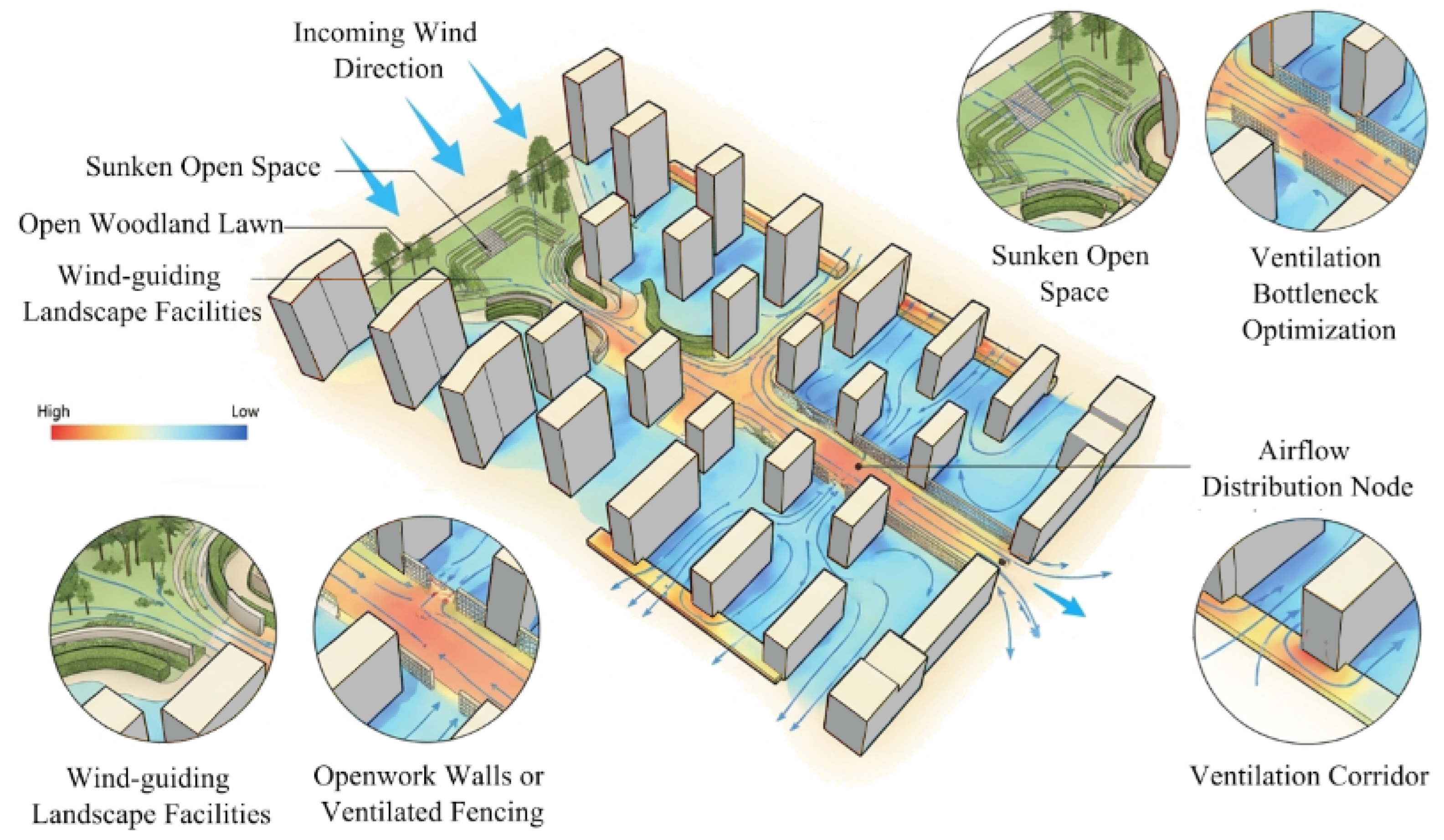
Mode I areas correspond to the category with the optimal ventilation efficiency among the clustering results, i.e., the “Source”—strong, “Flow”—smooth, and “Sink”—weak type, mainly distributed along the northern interface facing Anning East Road and the northern section of the central landscape axis. This area serves as the core gateway for wind power input into the residential area. The main existing problems include: a monotonous morphology of the “Source” area, primarily a one-dimensional linear interface lacking a multi-node, three-dimensional wind supply structure; a local bottleneck in the middle section of the central main corridor, where the narrowing width hinders smooth airflow passage; and weak secondary connections between the “Source” area and the internal building clusters on the east and west sides, making it difficult for wind power to effectively radiate to both sides. To address the above problems, an optimization strategy that equally emphasizes “Source” enhancement and “Flow” connection is proposed (Figure 15).
  • “Source” Enhancement Measures
Add a sunken open space on the northern interface facing Anning East Road to enhance the wind pressure effect using micro-topographic height differences, thereby increasing the initial driving force for external airflow to enter the residential area. The depth and scale of the sunken space should be flexibly determined according to site conditions, with the design oriented toward creating a local negative pressure zone. Transform the densely planted tree-and-shrub greening along the street-facing interface into a sparse woodland and grassland model: retain the backbone trees and appropriately expand row and plant spacing, remove dense middle and lower shrubs, reduce near-ground ventilation resistance, and ensure smooth airflow input into the “Source” area. Add wind-guiding landscape facilities at the main entrance area and key locations in the “Source” area, arranging them reasonably to guide the north–northeast prevailing wind toward the internal central axis and the east–west side roads of the residential area.
2.
“Flow” Connection Measures
For the ventilation bottleneck node at the middle section of the central landscape axis, optimize or remove non-essential auxiliary facilities that obstruct passage, ensure the effective width of the corridor, and eliminate airflow choke points. Transform some solid walls on the continuous building interfaces on both sides of the central landscape axis into hollow walls or transparent fences, set a reasonable ventilation rate, and reduce local resistance while maintaining the sense of enclosure and safety. Set up small open nodes at the intersections of the main corridor and east–west secondary roads as airflow distribution nodes to enhance the connection efficiency of the corridor network and the airflow redistribution capacity.
3.
“Source”–“Flow” Connection Enhancement
Add secondary ventilation corridors from the northern “Source” area to the internal building clusters on the east and west sides, laying them out along the east–west main roads. Along the corridor routes, remove dense vegetation, low walls, or temporary facilities that impede airflow, ensuring that the clear width meets the requirements for airflow penetration. Install low wind-guiding facilities at the entrances of the secondary corridors to guide air branches into the east and west residential clusters, thereby expanding the radiation range of wind power.

4.1.2. Mode II Optimization Strategy: “Flow” Connection and “Sink” Relief

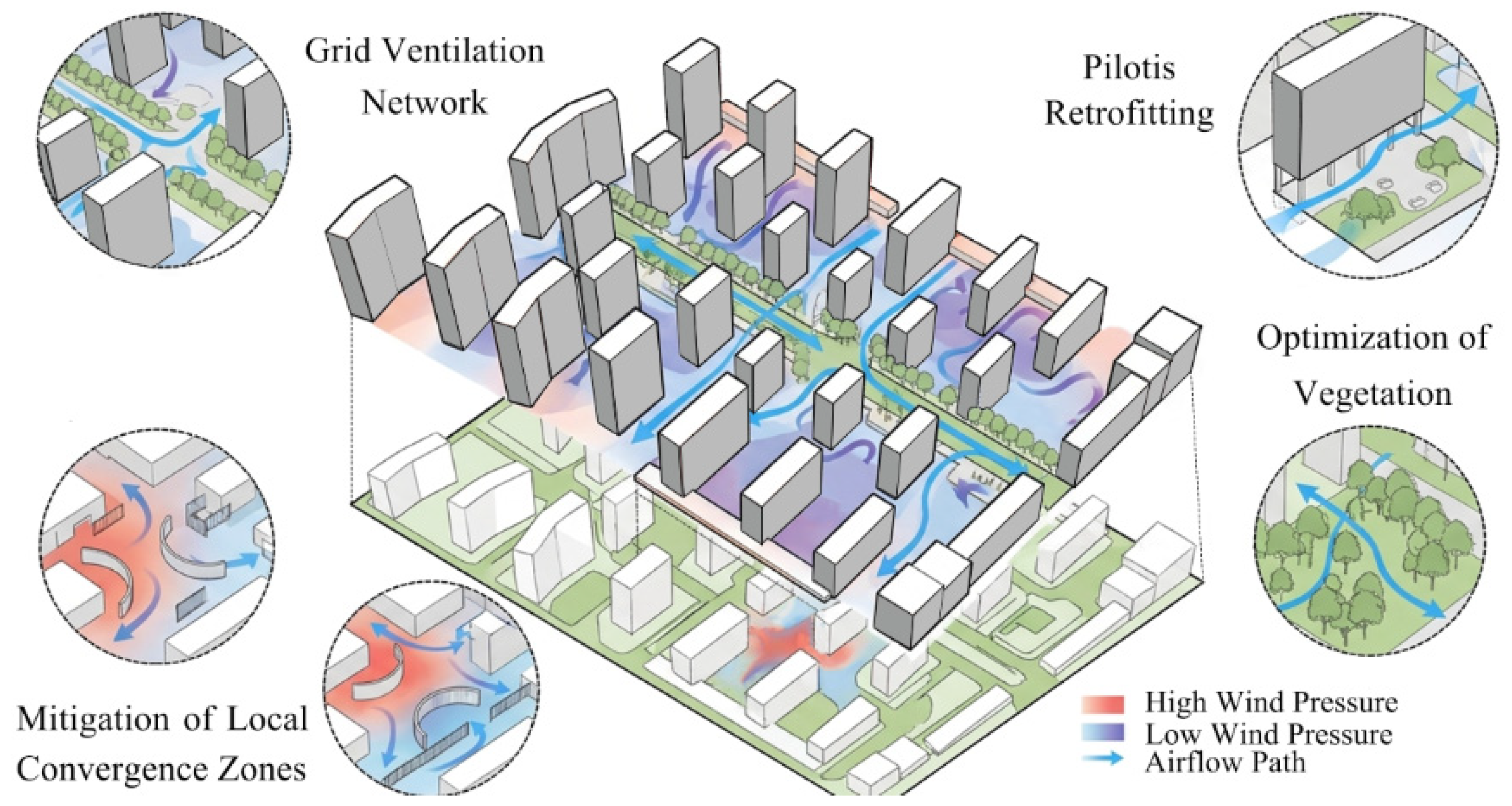
Mode II areas correspond to the category with medium ventilation efficiency in the clustering results, i.e., the “Source”—medium, “Flow”—medium, and “Sink”—medium type, mainly distributed in the middle section of the central landscape axis and on both sides of the east–west main roads. This area is the core zone for ventilation transmission and transition in the residential area. The main existing problems include: locally weak corridor networks; apart from the central main corridor, the east–west and north–south secondary corridors lack continuity, resulting in a low degree of networking; some “Sink” areas have weak connections with the corridors, making it difficult for airflow to effectively diffuse to the surrounding clusters; and there is room for improving the “Source-Flow-Sink” matching, manifested as sharp local gradients in wind speed. To address the above problems, an optimization strategy that prioritizes “Flow” connection and is supplemented by “Sink” relief is proposed (Figure 16).
  • Corridor network improvement—building a grid-based ventilation system
On the basis of the existing central main corridor, strengthen the east–west transverse corridors and the peripheral circular corridors to form a grid-based ventilation skeleton combining “ring + transverse + longitudinal”. The transverse corridors are laid out along the main east–west roads, connecting the east and west building clusters. The circular corridors utilize the internal ring roads or boundary green belts of the residential area to achieve circular airflow circulation and redistribution.
Add ventilation nodes at corridor intersections in the form of small plazas or sparse woodland and grassland to enhance airflow diffusion and exchange capacity, avoiding the problem where high-speed airflow passes straight through while surrounding areas receive no benefit.
2.
Elevated ground floor retrofitting
Select buildings along the corridors that significantly obstruct the wind field and are feasible for retrofitting, and carry out elevated ground floor retrofitting, with the elevated height ensuring a continuous ground-level ventilation path. The elevated spaces can be converted into leisure areas, non-motor vehicle parking, or greening functions, thereby improving ventilation efficiency while enriching the public space hierarchy.
3.
Local “Sink” area relief
Identify inefficient spaces in the transition areas between Mode II and Mode III, and transform them into micro-source points or ventilation openings by implanting small-scale open spaces to increase local ventilation driving force. Transform some solid walls or continuous interfaces into transparent fences to reduce interface resistance and enhance airflow exchange between adjacent building clusters. Install wind-guiding facilities at cluster entrances and courtyard passages, using curved landscape walls or sparse hedges to guide airflow into the inner courtyards, avoiding the situation where airflow simply bypasses the clusters without entering.
4.
Vegetation configuration optimization
Based on the quantitative conclusion that vegetation coverage rate has a significant negative effect on ventilation efficiency, carry out thinning and retrofitting of dense forests along the corridors and around the intersections: remove dense lower shrubs, appropriately increase the spacing between trees, and form a low-resistance model of “trees + lawn” or “trees + low ground cover”, thereby reducing near-ground ventilation resistance while retaining ecological benefits.

4.1.3. Mode III Optimization Strategy: “Sink” Relief and “Source” Implantation

Mode III areas correspond to the category with the worst ventilation efficiency in the clustering results, i.e., the “Source”—weak, “Flow”—stagnant, and “Sink”—strong type, mainly distributed in the southeastern high-rise slab building dense area. This area is the core ventilation blockage zone and “Sink” accumulation zone of the residential area. The main existing problems include: significant ventilation blockage caused by high building density, high enclosure degree, and low dispersion index; prominent accumulation effect in the “Sink” area, making it difficult for airflow to penetrate into the interior; lack of internal source points, resulting in a severe shortage of ventilation driving force; and no effective corridor access, forming a terminal blind zone for ventilation. To address the above problems, an optimization strategy that prioritizes “Sink” relief and is supplemented by “Source” implantation is proposed (Figure 17).
  • Identification of inefficient spaces and implantation of open spaces
Establish a spatial value assessment system, taking spatial usage frequency, functional adaptability, and structural safety as core indicators, to identify inefficient auxiliary spaces within the area. Demolish or convert the identified inefficient spaces into cluster green spaces or micro-plazas, implanting them as ventilation source points inside the “Sink” area. Priority for source point locations should be given to the upwind direction of the “Sink” area and the ends of corridors to maximize the airflow guiding effect. The ground surface of the source points should use permeable pavement or low ground cover to reduce surface temperature and weaken the inhibition of thermal circulation on ventilation.
2.
Interface openings and elevated ground floor retrofitting
For high-enclosure courtyards, set up main ventilation openings on the upwind side of the courtyard and auxiliary exits on the downwind side, forming a complete airflow entry and exit path and avoiding pocket-type stagnant flow structures. Select suitable high-rise buildings for elevated ground floor retrofitting to create ground-level ventilation corridors. Connect the elevated spaces with the open spaces formed through retrofitting to build a continuous ventilation path, enabling airflow to penetrate deep into the “Sink” area.
3.
Micro-topography and wind-guiding facilities
Set up sunken green spaces on the upwind side of the “Sink” area to enhance the downdraft of cool air using daytime temperature differences, thereby promoting airflow movement. Install wind-guiding facilities in building gaps: use streamlined landscape walls, modular planter boxes, or low hedges to guide airflow from the source points into the inner courtyards. Convert some of the hardened pavements in the area into permeable pavement to lower surface temperature and reduce the obstruction of horizontal ventilation by upward thermal airflows.
4.
Vegetation reconstruction
Remove dense middle-layer shrubs and ground cover within the “Sink” area; retain the backbone trees and prune their lower branches, forming a ventilation-friendly configuration of “tall trees + lawn”. This approach significantly reduces near-ground ventilation resistance while retaining necessary shading and ecological functions, achieving a balance between ventilation improvement and green space benefits.

4.2. Limitations and Prospects

This study selected only one intensive residential area in Lanzhou as the sample. Given the considerable morphological variation among residential areas in valley cities across different locations and construction periods, the generalizability of the findings requires further validation with additional cases. The CFD simulation lacked simultaneous in-situ measurements for direct calibration. Moreover, due to PHOENICS post-processing constraints, an image-based method (Photoshop) was adopted to extract wind speed data, which, despite its prior application in the literature, is subject to resolution dependence and manual operations, potentially introducing measurement errors and affecting reproducibility. The proposed micro-renewal strategies remain qualitatively described and have not been quantitatively evaluated across different scenarios via CFD.
Future research should expand the sample to cover diverse residential typologies in valley cities to establish a more generalizable morphology–ventilation coupling model. In-situ wind speed measurements should be incorporated, and raw data extraction from PHOENICS should be optimized to replace the image-based approach, thereby eliminating methodological limitations. Furthermore, multi-objective optimization algorithms combined with parametric modeling should be employed to quantitatively assess the comprehensive benefits of alternative micro-renewal schemes, ultimately developing a systematic technical pathway for climate-adaptive residential design.

5. Conclusions

Under the land-intensive utilization paradigm, residential ventilation environments are increasingly challenged by deterioration. In response, this study takes Lanzhou Yineng Huanghe Jiayuan as a typical case and integrates circuit theory with computational fluid dynamics to construct a “Source-Flow-Sink” landscape ventilation efficiency measurement framework. On this basis, the coupling mechanism between residential spatial morphology and ventilation efficiency is systematically analyzed, and collaborative optimization strategies that preserve core land-intensive indicators are proposed. The findings provide a scientific basis for climate-adaptive design of intensive residential areas in valley cities.
The study area exhibits a ventilation pattern characterized by “Source” input in the north, “Flow” transmission in the middle, and “Sink” dissipation in the south. The comprehensive ventilation resistance surface presents a concentric distribution pattern with high-value agglomeration in the core and gradient decrease toward the periphery. High-resistance zones completely coincide with high-value areas of building coverage ratio and average building height, corresponding to the core zones of vertically and horizontally intensified superimposed development. Based on circuit theory, three main corridors and several secondary corridors were identified. The central main corridor undertakes more than 70% of the wind power transmission function. The secondary corridors have small average connectivity lengths and poor spatial continuity. The southern “Sink” area is surrounded by contiguous high-resistance building clusters, forming a terminal blind zone for ventilation.
There is a significant coupling relationship between residential spatial morphology and ventilation efficiency. The residential wind speed ratio exhibits a highly significant negative correlation with vegetation coverage rate, a significant negative correlation with building dispersion index and average building height, and a weak negative correlation with floor area ratio. The multiple linear regression model explains 20.8% of the spatial variance in the wind speed ratio. Vegetation coverage rate is the primary morphological factor regulating ventilation efficiency, while the effects of floor area ratio and building height are masked by planar layout and ecological space configuration. Based on the three “Source-Flow-Sink” configuration modes, the “Source” strong, “Flow” smooth, and “Sink” weak type exhibits the optimal ventilation efficiency, whereas the “Source” weak, “Flow” stagnant, and “Sink” strong type exhibits the worst ventilation efficiency.
Differentiated micro-renewal strategies can achieve synergistic improvement of land intensification and ventilation efficiency. Under the constraint of retaining the original floor area ratio and building density, the “Source” enhancement and “Flow” connection strategy is applied to the area with optimal ventilation efficiency, the “Flow” connection and “Sink” relief strategy to the area with medium efficiency, and the “Sink” relief and “Source” implantation strategy to the area with low efficiency. The strategies focus on fine-tuning spatial morphology, reconfiguring vegetation patterns, and activating inefficient spaces, requiring no large-scale demolition or construction. They can effectively increase the proportion of comfortable wind area in the residential area and improve overall ventilation efficiency.
This study reveals the regulatory mechanisms of residential ventilation efficiency under the land-intensive mode, validates the applicability of circuit theory to ventilation corridor identification at the residential scale, and provides a new technical pathway and practical reference for resolving the contradiction between land-intensive utilization and the improvement of the human settlement environment.

Supplementary Materials

The following supporting information can be downloaded at: https://www.mdpi.com/article/10.3390/urbansci10070357/s1, Table S1: Data for 77 grid cells.

Author Contributions

Conceptualization, P.C. and C.Z.; methodology, P.C. and C.Z.; software, C.Z.; validation, C.Z.; formal analysis, P.C. and C.Z.; investigation, C.Z.; resources, P.C. and C.Z.; data curation, C.Z.; writing—original draft preparation, C.Z.; writing—review and editing, P.C.; visualization, C.Z.; supervision, P.C.; project administration, P.C.; funding acquisition, P.C. All authors have read and agreed to the published version of the manuscript.

Funding

This research was funded by SCIENCE AND TECHNOLOGY DEPARTMENT OF GANSU PROVINCE. The project title is “Study on Microclimate and Energy Consumption Simulation Optimization of Residential Space in Lanzhou under Low-Carbon Target”, grant number No. 26YFFA044.

Institutional Review Board Statement

Not applicable.

Informed Consent Statement

Not applicable.

Data Availability Statement

The original contributions presented in the study are included in the article; further inquiries can be directed to the corresponding author.

Conflicts of Interest

The authors declare no conflicts of interest.

References

  1. Zhang, M.; Li, X.; Lu, Z. Urban Agglomerations Promote the Coordinated Development of Urbanization and Intensive Land Use. Land 2025, 14, 2231. [Google Scholar] [CrossRef]
  2. Ren, W.; Lu, X.; Wei, L.; Yang, H. Dynamic Evolution and Regional Differences in the Efficiency of Compact Urban Development in Chinese Cities—Based on the Perspective of Compact Land Use. Land 2023, 12, 1837. [Google Scholar] [CrossRef]
  3. Kim, H.J.; Gil, R.H.; Ko, M.S. Improving Wind Environment in Low-Rise Residential Areas of Bangi-Dong, Seoul: Enhancing Natural Ventilation Performance Through CFD Simulation. Sustainability 2025, 17, 8472. [Google Scholar]
  4. Fang, H.; Yang, T.; Dai, P. Research on the Coupling of Public Space Morphology and Summer Wind Environment in Qingdao’s Urban Villages. Buildings 2025, 15, 1066. [Google Scholar] [CrossRef]
  5. Zhang, Q.; Zhou, D.; Xu, D.; Rogora, A. Association between Wind Environment and Spatial Characteristics of High-Rise Residential Buildings in Cold Regions through Field Measurements in Xi’an. Buildings 2023, 13, 2007. [Google Scholar] [CrossRef]
  6. Cao, P.; Li, T. Optimization Study of Outdoor Activity Space Wind Environment in Residential Areas Based on Spatial Syntax and Computational Fluid Dynamics Simulation. Sustainability 2024, 16, 7322. [Google Scholar] [CrossRef]
  7. Li, R.; Wang, C.; Gao, N.; Shi, X.; Wu, Y. CFD simulations of the effects of integrated design parameters on wind and thermal environments of above-ground spaces and sunken plazas. Build. Environ. 2026, 293, 114356. [Google Scholar] [CrossRef]
  8. Chen, X.; Kang, H.; Zhao, J.; Liu, Q. Optimization Design Research of Architectural Layout and Morphology in Multi-Story Dormitory Areas Based on Wind Environment Analysis. Buildings 2025, 15, 1747. [Google Scholar] [CrossRef]
  9. Yang, J.; Fu, X. The Centre of City: Wind Environment and Spatial Morphology; Springer: Singapore, 2020. [Google Scholar]
  10. Mittal, H.; Sharma, A.; Gairola, A. Investigation of pedestrian-level wind environment near two high-rise buildings in different arrangements. Adv. Struct. Eng. 2019, 22, 2620–2634. [Google Scholar]
  11. Ying, X.; Zhu, W.; Hokao, K.; Ge, J. Numerical research of layout effect on wind environment around high-rise buildings. Archit. Sci. Rev. 2013, 56, 272–278. [Google Scholar] [CrossRef]
  12. Liu, C.; Zhan, M.; Zhao, X.; Wei, J.; Hu, Y.; Li, C.; Chu, Y.; Sun, F. Quantitative Study of Urban Ventilation Corridors’ Impact on the Atmospheric Environment Based on Circuit Theory. Buildings 2026, 16, 329. [Google Scholar] [CrossRef]
  13. Guo, Q.; Lin, Y.; Zhang, X. Identification and cooling effect analysis of urban ventilation corridors in coastal hilly cities: A case study of Shenzhen. Urban Clim. 2025, 61, 102393. [Google Scholar] [CrossRef]
  14. Xie, P.; Yang, J.; Sun, W.; Xiao, X.; Xia, J.C. Urban scale ventilation analysis based on neighborhood normalized current model. Sustain. Cities Soc. 2022, 80, 103746. [Google Scholar] [CrossRef]
  15. Cao, P.; Li, W. Evaluation and optimization of outdoor wind environment in block based on space syntax and CFD simulation. PLoS ONE 2024, 19, 0297683. [Google Scholar] [CrossRef] [PubMed]
  16. Zhao, H.; Jiang, X.; Cao, Y.; Zhang, H.; Zhen, S.; Jia, R.; Zhang, S. Wind Environment Simulation and Optimization Strategies for Block Spatial Forms in Cold Low Mountainous Areas—A Case Study of Changchun, China. Sustainability 2022, 14, 6643. [Google Scholar]
  17. Xie, P.; Yang, J.; Wang, H.; Liu, Y.; Liu, Y. A New method of simulating urban ventilation corridors using circuit theory. Sustain. Cities Soc. 2020, 59, 102162. [Google Scholar] [CrossRef]
  18. Zeng, S.-P.; Yun, Y.-X.; Tian, J. “Coordination” and “join”: Research on the Theory of “Source-Flow-Sink” Ventilated Corridor System Construction and Planning Strategy. Urban Dev. Stud. 2016, 23, 25–31. [Google Scholar]
  19. Zeng, S.P. Research on the Theory of “Source-Flow-Sink” Ventilated Corridor System Construction and Planning Strategy—The Case of the Center Districts of Tianjin. Ph.D. Thesis, Tianjin University, Tianjin, China, 2016. [Google Scholar]
  20. Sun, H.; Liu, S.; Peng, Y.; Li, J.; Ji, Y.; Tan, X.; Yan, M.; Zhu, G. Enhancing thermal comfort in subtropical urban residential communities through water bodies: Integrating wind environment and morphology. Sustain. Cities Soc. 2025, 130, 106647. [Google Scholar] [CrossRef]
  21. Zhu, Y.; Zhang, A.; Bart, D.; Yao, W.; Zeng, N.; Zhou, Y.; Gao, W. Research on the traditional courtyard typology and wind environment comfort—A case study of Qingshan Fishing Village in Qingdao, China. Sustain. Cities Soc. 2025, 130, 106554. [Google Scholar]
  22. National Meteorological Information Center, China Meteorological Administration. Chinese Standard Weather Data. Available online: http://data.cma.cn (accessed on 7 May 2025).
  23. Zhen, M.; Zhou, D.; Bian, G.; Yang, Y.; Liu, Y. Wind environment of urban residential blocks: A research review. Archit. Sci. Rev. 2019, 62, 66–73. [Google Scholar]
  24. Feng, W.; Ding, W.; Fei, M.; Yang, Y.; Zou, W.; Wang, L.; Zhen, M. Effects of traditional block morphology on wind environment at the pedestrian level in cold regions of Xi’an, China. Environ. Dev. Sustain. 2020, 23, 3218–3235. [Google Scholar] [CrossRef]
  25. Yu, L.; Ye, Y.; Li, L.; Li, C.; Shen, P. Quantifying Residential Neighborhood Layout Impact on Pedestrian Wind Environment: CFD Analysis Across China’s Major Climate Zones. Buildings 2025, 15, 3750. [Google Scholar] [CrossRef]
  26. Yu, J.; Tang, J.; Li, M. Impact of urban construction on pedestrian level wind environment in complex building group. Indoor Built Environ. 2024, 33, 876–894. [Google Scholar] [CrossRef]
  27. Wei, D.; Hu, X.; Chen, Y.; Li, B.; Chen, H. An Investigation of the Quantitative Correlation between Urban Spatial Morphology Indicators and Block Wind Environment. Atmosphere 2021, 12, 234. [Google Scholar] [CrossRef]
  28. Mu, J.; Feng, Y.; Yang, D.; Yang, G. CMIP6 climate change and wind environment impacts on cold-region residential energy and thermal comfort: A case study of Harbin. Energy Sustain. Dev. 2026, 90, 101885. [Google Scholar]
  29. Zhang, Q.; Dong, R.; Xu, D.; Zhou, D.; Rogora, A. Associations between summer wind environment and urban physical indicators in commercial blocks based on field measurement and simulation in Xi’an. Urban Clim. 2023, 49, 101544. [Google Scholar] [CrossRef]
  30. Zuo, C.; Liang, C.; Chen, J.; Xi, R.; Zhang, J. Machine Learning-Based Urban Renovation Design for Improving Wind Environment: A Case Study in Xi’an, China. Land 2023, 12, 739. [Google Scholar]
  31. Guo, B.; Chen, M.; Zhu, X.; Wang, Z.; Li, L.; Pei, L.; Chen, H.; Chen, P.; Guo, T. Exploring the effect of the architecture morphology on urban ventilation at block scale using CFD-GIS and random forest combined method. Sustain. Cities Soc. 2025, 12, 106241. [Google Scholar] [CrossRef]
  32. Zhang, X.; Xu, C.; Ma, S.; Yang, P.; Luo, S.; Ma, L.; Cai, Y.; Chen, B.; Zhao, W. Optimizing urban wind environment in high-density built-up areas through targeted redevelopment of inefficient land. Build. Environ. 2026, 291, 114265. [Google Scholar] [CrossRef]
  33. Yang, Y.; Feng, Z.; Zhu, X. Mechanism of Urban Spatial Morphology and Eco-Environmental Risk: A Case Study of Shenzhen, China. Int. J. Environ. Res. 2024, 19, 52. [Google Scholar] [CrossRef]
  34. Shen, Z.; Liao, C.; Cao, F.; Zhang, Q.; Yang, D.; Zhang, Q.; Shi, Y.; Yang, J. Complex network analysis of urban heat-cold interaction systems for heat island mitigation: Evidence from Fuzhou, China. Sustain. Cities Soc. 2025, 131, 106727. [Google Scholar] [CrossRef]
  35. Luo, Y.; Yu, X.; Nazeer, M.; Wong, M.S.; Yang, J.; Zhu, R. Estimating multi-scale ventilation corridors in complex 3D urban space: A graph-based least-cost path model. Urban Clim. 2026, 67, 102864. [Google Scholar] [CrossRef]
  36. Fang, Y.; Zhao, L.; Dou, B.; Li, Y.; Wang, S. Circuit VRC: A circuit theory-based ventilation corridor model for mitigating the urban heat islands. Build. Environ. 2023, 244, 110786. [Google Scholar] [CrossRef]
  37. Ma, Z.; Zhang, S.; Zhao, S. Study on the Spatial Pattern of Migration Population in Egypt and Its Flow Field Characteristics from the Perspective of “Source-Flow-Sink”. Sustainability 2021, 13, 350. [Google Scholar] [CrossRef]
  38. Zhu, Z.; Song, Y.; Qin, M. Ecological remediation zoning of territory based on the “Source-Stream-Sink” Coupler: Case study of Liuzhou city, China. IOP Conf. Ser. Earth Environ. Sci. 2020, 510, 032005. [Google Scholar]
  39. He, J.; Yu, Y.; Sun, L.; Li, C.; Guo, Z.; Lu, Y.; Malik, I.; Wistuba, M. Spatiotemporal evolution of ecosystem services and ecological connectivity optimization in arid Northwest China. J. Arid Land 2026, 18, 406–428. [Google Scholar] [CrossRef]
  40. Zhu, Z.B.; Yao, L.J.; Wan, Y.N.; Xue, L.Y.; Li, Q.G.; Xu, B.J.; Xu, X.Y.; Yue, B.R. Delineation of territorial space ecological restoration zoning based on the characteristics of ‘source-flow-sink’ of ecosystem services: A case study of Xi’an City, Shaanxi Province, China. Ying Yong Sheng Tai Xue Bao J. Appl. Ecol. 2026, 37, 243–252. [Google Scholar]
  41. Fan, C.; Chen, J.; Yu, P. Feedback Effects of Air-Conditioning Anthropogenic Heat on Cooling Energy Consumption in Residential Buildings: A CFD–EnergyPlus Co-Simulation Study. Buildings 2026, 16, 1610. [Google Scholar]
  42. Ji, Z.; Zhang, H.; Shen, L.; Weng, J.; Chun, Q.; Wu, J.; Ying, X. CFD-Based Evaluation of Wind Comfort in High-Density Primary Schools: A Case Study of Planning Layouts in Shenzhen. Buildings 2026, 16, 721. [Google Scholar]
  43. Liu, R.; Wang, Y.; Zhang, Y.; Peng, Z.; Chen, H.; Li, X.; Li, H.; Li, W. Analysis of the city-scale wind environment and detection of ventilation corridors in high-density metropolitan areas based on CFD method. Urban Clim. 2025, 59, 102274. [Google Scholar]
  44. GB 50009-2012; Load Code for the Design of Building Structures. China Architecture & Building Press: Beijing, China, 2012; p. 31.
  45. GB/T 50378-2019; Green Building Evaluation Standard. China Architecture & Building Press: Beijing, China, 2019; pp. 126–127.
  46. Ying, X.; Ding, G.; Hu, X.; Zhang, Y. Developing planning indicators for outdoor wind environments of high-rise residential buildings. J. Zhejiang Univ. Sci. A 2016, 17, 378–388. [Google Scholar] [CrossRef]
  47. Ma, T.; Chen, T. Classification and pedestrian-level wind environment assessment among Tianjin’s residential area based on numerical simulation. Urban Clim. 2020, 34, 100702. [Google Scholar] [CrossRef]
  48. Zhou, Z.; Deng, J.; Wang, P.; Zhou, C.; Xu, Y.; Jiang, W.; Ma, K. Physical Environment Study of Traditional Village Patterns in Jinxi County, Jiangxi Province Based on CFD Simulation. Processes 2022, 10, 2453. [Google Scholar] [CrossRef]
  49. Wu, S.; Zhang, L.; Han, Z.; Hu, C.; An, D. Research on Microclimate Optimization of Traditional Residential Buildings in Central Anhui Based on Humid and Hot Climate Characteristics and Regional Architectural Features. Buildings 2024, 14, 2323. [Google Scholar] [CrossRef]
  50. Fang, H.; Yang, Y.; Wang, J.; Ji, X. Study on the adaptation of the outdoor wind environment of Xuzhou rural residence. Sci. Rep. 2025, 15, 23798. [Google Scholar] [CrossRef] [PubMed]
  51. Dai, P.; Liu, H.; Han, S.; Liu, C.; Fu, G.; Wang, Y. The Carbon Reduction Mechanism and Adaptive Planning Strategies of TOD Block Form Regulation Oriented to Microclimate Effects. Sustainability 2025, 17, 358. [Google Scholar] [CrossRef]
  52. You, W.; Shen, J.; Ding, W. Improving Wind Environment of Residential Neighborhoods by Understanding the Relationship between Building Layouts and Ventilation Efficiency. Energy Procedia 2017, 105, 4531–4536. [Google Scholar] [CrossRef]
  53. Gu, K.; Zhao, X.; Cui, Y.; Dong, D.; Zhang, X.X. Research on Evaluation of Ventilation Efficiency and Spatial Optimization in Urban Neighborhoods. Ind. Constr. 2024, 54, 106–116. [Google Scholar] [CrossRef]
  54. You, W.; Shen, J.; Ding, W. Improving wind environment design based on assessing spatial distribution of ventilation efficiency in regional space. Energy Procedia 2017, 142, 2923–2929. [Google Scholar] [CrossRef]
  55. Guo, F.; Zhu, P.; Wang, S.; Duan, D.; Jin, Y. Improving Natural Ventilation Performance in a High-Density Urban District: A Building Morphology Method. Procedia Eng. 2017, 205, 952–958. [Google Scholar] [CrossRef]
Figure 1. Schematic diagram of the research workflow.
Urbansci 10 00357 g001
Figure 2. Study area location.
Urbansci 10 00357 g002
Figure 3. Study subject.
Urbansci 10 00357 g003
Figure 4. Frequency distribution of spatial morphology indicators in the residential area. The horizontal axis shows the standardized intervals of indicator values, and the vertical axis shows the frequency. BCR, FAR, SDI, VCR, and RCR are dimensionless ratios; ABH is in meters.
Urbansci 10 00357 g004
Figure 5. Scatter plots of BCR, FAR, and SDI indicators.
Urbansci 10 00357 g005
Figure 6. Scatter plots of ABH, VCR, and RCR indicators.
Urbansci 10 00357 g006
Figure 7. Construction of the grid resistance surface.
Urbansci 10 00357 g007
Figure 8. Schematic diagram of the computational domain of the CFD model.
Urbansci 10 00357 g008
Figure 9. Construction of the spatial morphology resistance surface.
Urbansci 10 00357 g009
Figure 10. Identification of ventilation corridors: (a) Comprehensive resistance surface and ventilation corridors; (b) VCR and ventilation corridors.
Urbansci 10 00357 g010
Figure 11. Wind pressure (a), wind speed (b), and grid division (c) at pedestrian height (1.5 m). Red numbers indicate grid cell indices.
Urbansci 10 00357 g011
Figure 12. Heatmap of correlation coefficients.
Urbansci 10 00357 g012
Figure 13. Boxplots of normal distribution.
Urbansci 10 00357 g013
Figure 14. Heatmap of correlation coefficients.
Urbansci 10 00357 g014
Figure 15. Schematic diagram of “Source” enhancement and “Flow” connection optimization.
Urbansci 10 00357 g015
Figure 16. Schematic diagram of “Flow” connection and “Sink” relief optimization.
Urbansci 10 00357 g016
Figure 17. Schematic diagram of “Sink” relief and “Source” implantation optimization.
Urbansci 10 00357 g017
Table 1. Selection of spatial morphology indicators.
Morphological ParameterCalculation FormulaMeaningSelection Basis
BCR B C R = S P S N Ratio of total building footprint area to site area, where SP is the total building footprint area and SN is the site area.Reflects the degree of horizontal land intensification.
FAR F A R = S F S N Ratio of total floor area to total study area, where SF is the total floor area and SN is the total study area.Reflects the overall efficiency of land intensification.
SDI S D I = L P S P 4 Ratio of the total building boundary perimeter to the fourth root of the total building footprint area, where Lp is the total building boundary perimeter and Sp is the total building footprint area.Characterizes the balance of building spatial layout in land-intensive development.
ABH A B H = 1 n i = 1 n H i Where Hi is the height of building i and n is the number of buildings in the study area.Represents the core vertical indicator of vertical land intensification.
VCR V C R = S g S N Ratio of green area to total land area within each block, where Sg is the green area and SN is the total study area.Reflects the allocation level of ecological space in land-intensive utilization.
RCR R C R = S S S N Ratio of hard-surfaced pavement area to total study area, where Ss is the hard-surfaced area and SN is the total study area.Indicates the supply scale of transportation open space in land-intensive utilization.
Table 2. Average wind speed for each grid cell. A: Average wind speed (m/s); G: Grid.
GAGAGAGAGAGAGA
10.410120.775230.77340.581450.474561.025670.723
20.770130.825240.565351.392460.836570.978681.186
30.875141.395250.465360.310470.455580.799691.081
40.670150.360260.41370.720480.372591.133700.978
50.255160.415270.825380.785491.076600.465711.081
60.725170.565281.395390.852500.528611.288721.102
71.495180.670290.261400.658510.565620.618731.128
80.310190.775300.619410.670520.723631.288741.019
90.770200.925310.622421.287530.616641.030750.958
100.875211.340320.623430.373540.795650.978761.133
110.670220.255330.618440.497550.616661.186771.195
Table 3. Correlation analysis.
Wind Velocity RatioBCRFARSDIABHVCR
Wind Velocity Ratio1 (0.000 ***)−0.185 (0.108)−0.218 (0.057 *)−0.265 (0.020 **)−0.236 (0.039 **)−0.394 (0.000 ***)
BCR−0.185 (0.108)1 (0.000 ***)0.802 (0.000 ***)0.73 (0.000 ***)0.273 (0.016 **)0.043 (0.708)
FAR−0.218 (0.057 *)0.802 (0.000 ***)1 (0.000 ***)0.483 (0.000 ***)0.561 (0.000 ***)0.348 (0.002 ***)
SDI−0.265 (0.020 **)0.73 (0.000 ***)0.483 (0.000 ***)1 (0.000 ***)0.373 (0.001 ***)0.104 (0.366)
ABH−0.236 (0.039 **)0.273 (0.016 **)0.561 (0.000 ***)0.373 (0.001 ***)1 (0.000 ***)0.513 (0.000 ***)
VCR−0.394 (0.000 ***)0.043 (0.708)0.348 (0.002 ***)0.104 (0.366)0.513 (0.000 ***)1 (0.000 ***)
Note: ***, **, and * indicate significance at the 1%, 5%, and 10% levels, respectively.
Table 4. Results of multiple linear regression analysis.
Linear Regression Analysis Results (n = 77)
Unstandardized CoefficientsStandardized CoefficientstpVIFR2Adjusted R2F
BStd. ErrorBeta
Constant0.6390.058-10.9650.000 ***-0.2080.164F = 4.728 p = 0.002 ***
FAR0.0090.1190.010.0750.9411.702
SDI−0.2190.108−0.249−2.0380.045 **1.362
ABH0.0430.1050.0570.4050.6871.819
VCR−0.3260.101−0.4−3.2280.002 ***1.399
Dependent variable: Wind Velocity Ratio
Note: *** and ** indicate significance at the 1% and 5% levels, respectively.
Disclaimer/Publisher’s Note: The statements, opinions and data contained in all publications are solely those of the individual author(s) and contributor(s) and not of MDPI and/or the editor(s). MDPI and/or the editor(s) disclaim responsibility for any injury to people or property resulting from any ideas, methods, instructions or products referred to in the content.