Article

Schedule-Aware Transit Service Intensity and Urban Equity in the Greater Toronto Area

by
Chiranjib Chaudhuri
Geosapiens Inc., Quebec City, QC G1K 1X2, Canada
Urban Sci. 2026, 10(6), 309; https://doi.org/10.3390/urbansci10060309
Submission received: 16 April 2026 / Revised: 15 May 2026 / Accepted: 22 May 2026 / Published: 2 June 2026

Abstract

Fragmented transit governance across multiple agencies makes measuring service inequality in large metropolitan regions notoriously difficult. This paper maps schedule-aware transit service intensity—an origin-side, supply-focused component of accessibility—across the Greater Toronto Area (GTA) by integrating General Transit Feed Specification (GTFS) data from six providers within an H3 hierarchical hexagonal grid. The measure does not capture destination access, travel time, transfers, fares, reliability, or crowding, and is therefore framed throughout as a service-intensity indicator rather than a full accessibility evaluation. We operationalize the indicator as the number of cumulative scheduled departures per hour reachable within an 800 m walking catchment for three distinct time windows: weekday peak, weekday midday, and Saturday midday. Across 9635 hexagons and 23,026 stops, our results reveal a sharply hierarchical regional network. When weighted by population, 16.4% of GTA residents have no scheduled service within walking distance during the weekday morning peak; the corresponding area-weighted share, reflecting the extensive greenbelt and agricultural fringe, is 70.6%. Only 22.6% of hexagons reach at least 12 departures per hour, while 75.5% of residents meet that threshold. Median service intensity drops from 234.25 departures per hour in the Urban Core to zero beyond the Inner Suburban Ring, and service thins out on weekends, with retention in the outer rings dropping to roughly 75% of weekday levels. Spearman correlations show that service intensity is concentrated in denser, more diverse, and lower-income census-tract contexts, with population density emerging as the strongest hex-level correlate ( ρ = 0.69 ); after Clifford–Richardson correction for spatial autocorrelation (effective n 745 ), the principal CT-level correlations remain statistically significant ( p < 10 15 ), and partial correlations controlling for density indicate that socioeconomic composition retains an independent, if attenuated, association. Under one-tract-one-observation aggregation ( n = 1144 unique tracts), the income gradient strengthens to ρ = 0.74 and becomes co-equal in magnitude with population density ( ρ = 0.74 ), confirming that the hex-level coefficients are not artifacts of pseudo-replication. A population-weighted Gini coefficient of 0.60 confirms substantial distributional inequality. Sensitivity analyses confirm that the Inner-to-Outer Suburban break is robust to alternative ring thresholds (10/25/40 and 20/35/50 km), to exclusion of the four Halton municipalities affected by incomplete local-feed coverage, to H3 resolution at the municipal level, and—in a representative shortest-path network sub-analysis for Pickering (not a full GTA-wide network-distance test)—to use of network rather than Euclidean walking distance. These patterns suggest that a substantial gap exists between where suburban residential growth has occurred and where frequent transit service is available, a pattern with historical roots in the 1996–2006 service–need alignment, though the 2006–2023 trajectory is not directly measured here. The results suggest that the transition zone between the inner and outer suburbs may warrant further investigation as a planning focus, and that cross-agency weekend service coordination merits further analysis as a potential equity dimension. This multi-agency H3 framework establishes a reproducible baseline for monitoring schedule-aware service intensity in polycentric metropolitan areas.

1. Introduction

Transit inequity in large metropolitan areas typically manifests as a gradient: dense inner districts enjoy frequent, all-day service; specific suburban corridors see partial coverage; and peripheral communities are left with sparse or time-limited routes [1,2,3,4]. Capturing this inequality requires understanding not just where stops are located but how frequently vehicles arrive, which agencies operate them, and whether service remains viable outside the weekday commuter peak.
Following Geurs and van Wee [5] and Hansen [6], place-based service availability and opportunity-based destination access are related but distinct concepts [7,8,9,10]. This paper focuses on the former: specifically, a schedule-aware, origin-side measure of transit supply—what we term schedule-aware service intensity—that captures temporal intensity without claiming to measure destination access or generalized travel cost [11]. The indicator belongs to the cumulative-opportunity supply tradition: it is conceptually aligned with the Service Frequency Index used by Currie [12], with the local index of transit availability of Mavoa et al. [13], and with the departures-per-hour family of supply measures discussed by Boisjoly and El-Geneidy [14]. We use the term “schedule-aware” throughout to emphasize the timetable basis of the measure; the more precise descriptor is “schedule-aware service intensity,” since no routing or journey-time calculation is performed.
These challenges are particularly pronounced in the Greater Toronto Area (GTA). As Canada’s largest metropolitan economy, the GTA functions as an integrated regional landscape, yet remains institutionally fragmented [15,16,17]. The TTC anchors the region, GO Transit provides the regional rail backbone, and municipal agencies—MiWay, York Region Transit/Viva, Brampton Transit, and Durham Region Transit—serve expanding suburban centres. Although residents routinely cross municipal boundaries, transit provision remains disjointed in both spatial density and temporal availability.
Prior research suggests that transit accessibility is a fundamental determinant of urban development: frequent service is associated with denser housing, car-light lifestyles, and broader labour-market participation, whereas poor service is linked to constrained opportunity and social exclusion [18,19]. Understanding how supply is distributed is therefore central to evaluating whether peripheral expansion is outrunning the infrastructure required to sustain it.
The GTA is a compelling case because social vulnerability is no longer confined to the inner city. Lower-income households, renters, recent immigrants, and racialized communities are now broadly distributed across Toronto and its surrounding suburbs [1,20]. This spatial diffusion raises a critical question: has high-quality transit evolved to track the region’s social geography, or does it remain concentrated in the historic core? Prior GTA research has documented substantial variation in transit accessibility by neighbourhood and time of day, with service broadly aligned to social need within Toronto but unevenly distributed across the suburban belt [1,15,21,22]. At the national scale, Deboosere and El-Geneidy [23] showed that public-transport accessibility in Canadian metropolitan regions is highly uneven, and methodological reviews have underscored that accessibility results depend strongly on how supply is operationalized and spatial units are defined [14,24,25,26].
Relative to the existing Toronto-region literature, this paper adds three specific elements. First, whereas El-Geneidy et al. [15] and Farber and Grandez [21] examined accessibility with temporal variation and socioeconomic linkages, both relied on partial-agency inventories or administrative spatial units; this paper integrates official GTFS feeds from all six major GTA providers into a single schedule-aware inventory, building on timetable-based network analysis [27] and producing a more complete picture of multi-agency service. Second, the H3 hexagonal grid provides a uniform spatial baseline that avoids the shape irregularity and boundary effects of census tracts or municipal polygons [28,29,30], enabling direct cross-boundary comparison at a consistent spatial grain. Third, the distance-ring zoning centred on Union Station—an operationalization, to our knowledge, not previously applied in GTA transit research—separates the urban–suburban gradient from municipal boundary artifacts and surfaces the Inner-to-Outer Suburban Ring break that municipal-level analyses can obscure.
The paper therefore asks: what spatial pattern of schedule-aware transit service intensity—an origin-side, supply-focused component of accessibility—emerges when the GTA is represented as a uniform H3 grid? How does that pattern vary across distance rings extending from Union Station to the suburban and exurban fringe? And how do socioeconomic gradients in service intensity change when the analysis is performed at census-tract and municipal scales?
Empirically, the paper shows that the GTA exhibits a corridor-and-node structure in which strong service extends into selected inner-suburban centres while large portions of the outer ring and fringe remain weakly served. Methodologically, it demonstrates how multi-agency GTFS, H3 indexing, distance-ring zoning, and CT-level socioeconomic linkage can be combined in a reproducible regional workflow [31], providing a more policy-relevant representation of accessibility than stop counts or proximity-weighted scores alone.

2. Study Area and Data

2.1. Study Area

The study area is the Greater Toronto Area in Ontario, Canada. Operationally, the analysis uses the union of 25 census subdivisions (CSDs) that together define the GTA municipal footprint: Toronto, the Peel municipalities, the York Region municipalities, the Durham Region municipalities, and the Halton municipalities contained within the GTA boundary. The resulting study area covers the full urban core, a large suburban belt, and a substantial exurban fringe. That spatial range is analytically important because transit provision in the GTA—encompassing both the schedule-aware service-intensity surface analysed here and the broader notion of transit accessibility—is structured not only by density but also by the historical layering of municipal transit systems, GO rail corridors, express bus networks, and auto-oriented peripheral development [16,17].
Because employment, housing, and transit investment have diffused outward while fringe municipalities remain extensive and low-density, a municipal-boundary framework masks important inner-ring versus outer-ring differences. The paper therefore uses distance rings from Union Station rather than conventional “urban” and “suburban” municipal categories.
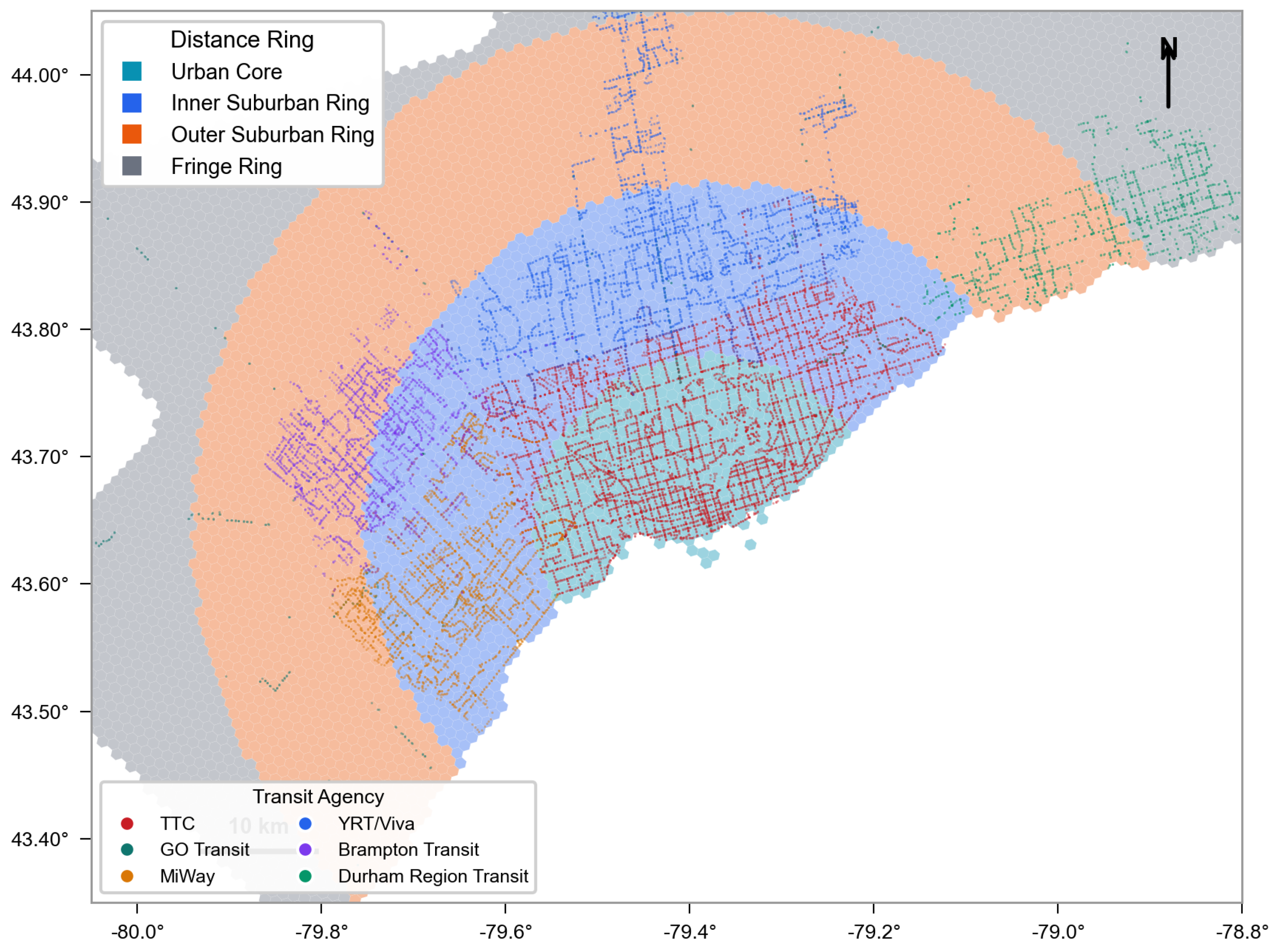
Figure 1 shows the regional extent and stop distribution. The inventory is multi-nodal: Toronto remains the densest service field, but extensive suburban stop networks are visible in York Region, Mississauga, Brampton, and Durham. The question is not whether transit exists outside Toronto, but how strong and temporally durable it is once frequency is considered.

2.2. Official GTFS Feeds

Transit supply was assembled from official GTFS feeds for the six agencies operating scheduled fixed-route service within the GTA: the TTC, GO Transit, MiWay, York Region Transit/Viva, Brampton Transit, and Durham Region Transit. Official feeds provide full stop, route, trip, and schedule tables, avoiding the bias that arises when incomplete inventories exaggerate the largest central operator [31,32].
One limitation concerns Halton Region: no local Halton operator published a GTFS feed at the time of data collection. GO Transit stops within Halton are included, but dedicated local-bus coverage is incomplete. Because Oakville and Burlington operate reasonably extensive local bus systems that are not captured here, the accessibility values reported for all four Halton municipalities (Oakville, Burlington, Halton Hills, Milton) should be interpreted as reflecting GO Transit coverage only, not the full local transit picture. These municipalities are flagged in Table S1 and excluded from the municipal-level correlation analysis to avoid confounding data availability with service absence. Caledon, though also showing near-zero accessibility, is retained because it is served by Brampton Transit routes whose GTFS feed is included; its low values reflect genuinely sparse service rather than missing data.
GTFS feeds represent scheduled service for the Fall 2023 period (October–November 2023 sign-up; see Table S3 for feed metadata). Feeds were downloaded from agency open-data portals between October and December 2023. A representative Wednesday and Saturday were selected from the active service calendars, outside holiday periods and service disruptions. Departures were counted within three two-hour windows—weekday morning peak (07:00–09:00), weekday midday (11:00–13:00), and Saturday midday (11:00–13:00)—and divided by two to yield departures per hour. Stops were clipped to the GTA study area, producing 23,026 stop or station points. Fall 2023 service levels may differ from pre-pandemic baselines, as several GTA agencies had not yet fully restored 2019 service levels; the values reported here reflect a specific post-pandemic snapshot.
Table 1 shows that the TTC remains dominant in both stop count and departures, but YRT/Viva and MiWay add extensive suburban supply that would be invisible in a Toronto-centered inventory.

2.3. Census and Boundary Data

Socioeconomic data were drawn from the Statistics Canada 2021 Census Profile at the census-tract level, the finest geography that captures meaningful intra-municipal variation while remaining stable for regional analysis. The two-year gap between the census (May 2021) and the GTFS data (Fall 2023) is an unavoidable but bounded source of mismatch. No GTA agency executed a system-wide network restructuring between mid-2021 and late-2023: the principal scheduled-service changes were the TTC’s incremental 5-Year Service Plan rollout (2020–2024, primarily route-level frequency adjustments), continued YRT/Viva BRT corridor extensions, and ongoing post-pandemic recovery of suburban routes [17]. The Eglinton Crosstown LRT had not opened during the GTFS window, and the planned Ontario Line and Yonge North Subway Extension were under construction without GTFS impact. At the H3 resolution-8 grain (about 0.74 km2) and within 800 m catchments, route-level adjustments redistribute scheduled departures within hexagons rather than reshape the regional spatial pattern; the 2021 socioeconomic baseline is therefore a defensible reference for the Fall 2023 service surface. Six variables were extracted: median household income, low-income share, renter share, population density, unemployment rate, and visible minority share—chosen because they describe both material disadvantage and contexts associated with greater transit dependence [1,15,20,33].
Boundary data were obtained from Statistics Canada cartographic boundary files. Census subdivisions define the study-area boundary and provide fallback context for fringe cells outside CT geography. In the final dataset, 87.0% of H3 cells intersected a CT; coverage was complete in the Urban Core, Inner Suburban Ring, and Outer Suburban Ring but lower in the Fringe Ring.

3. Methods

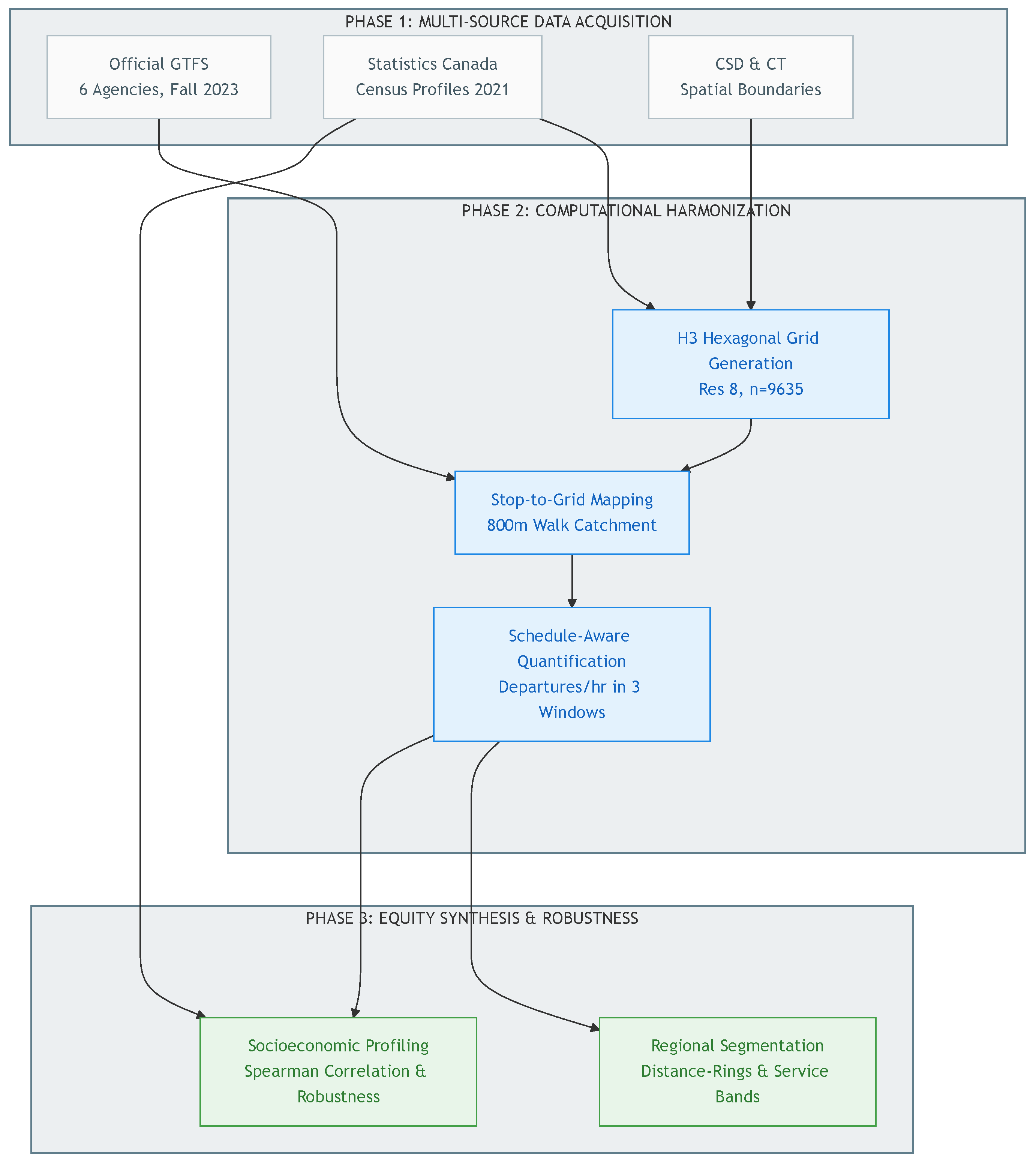
The workflow comprises three phases (Figure 2): data acquisition (multi-agency GTFS, census profiles, spatial boundaries), computational harmonization (H3 grid generation, stop-to-grid mapping via 800 m catchments, schedule-aware accessibility quantification), and equity synthesis (distance-ring segmentation, service-band classification, socioeconomic gradient analysis).

3.1. H3 Grid Construction

The GTA study area was tessellated using the H3 hierarchical hexagonal indexing system at resolution 8. The GTA union polygon was passed to the H3 polyfill routine and every resulting cell converted to a polygon and centroid representation, yielding 9635 hexagons. The principal methodological advantage is that H3 provides a uniform spatial baseline that abstracts accessibility measurement from irregular municipal borders while reducing the directional bias inherent to square rasters [28,29,30]. Each hexagon represents an origin from which local transit service can be reached on foot; the measure therefore captures local transit supply around origins rather than network travel time to destinations.

3.2. Schedule-Aware Service-Intensity Measure

The central indicator in this paper is a schedule-aware count of departures per hour reachable from each H3 cell—an origin-side service-intensity measure rather than a destination-based accessibility measure. For each stop in each GTFS feed, departures were counted for three windows: weekday morning peak, weekday midday, and Saturday midday. These counts were converted to departures per hour. Each hexagon’s service intensity was then calculated by summing all departures per hour from stops lying within a specified catchment radius of the hexagon centroid.
The primary indicator is defined as
A i , w ( r ) = s N i ( r ) f s , w
where A i , w ( r ) is service intensity for hexagon i in time window w and radius r, N i ( r ) is the set of stops within radius r of hexagon i, and f s , w is the scheduled departures per hour observed at stop s in time window w. The primary radius is 800 m, which approximates a broadly accepted walk-access threshold for higher-order and frequent transit [15,34]. Additional 400 m and 1000 m measures were computed for robustness testing.
Summing departures across all routes at each stop and across all stops in the catchment produces a service-intensity construct that intentionally weighs every scheduled departure as an additional boarding opportunity from the rider’s perspective. Whether two adjacent stops both serve a passenger’s intended trip, or whether multiple routes share a single stop, each contributes to local supply: the cumulative count captures spatial redundancy and time-of-day choice in a way that a single-stop or single-route metric cannot. This formulation aligns with the cumulative-opportunity tradition of Currie [12] and with the boarding-opportunity framing of Conway et al. [27]. The validity of the metric does not require that each stop represent an independent route, but that each stop represent an actual boarding event the passenger can use [35,36].
The known cost of this choice is stop-adjacency inflation in dense corridors. Where a single bus route has stops every 200–300 m, a hexagon centroid near such a corridor can have four or five stops from the same route within its 800 m catchment, multiplying that route’s frequency accordingly. In downtown Toronto, where multiple parallel streets carry overlapping routes and busy intersections host several directional stops, the cumulative departure count can overstate the number of distinct services by a factor of two to five. The accessibility values reported here should therefore be interpreted as cumulative boarding-opportunity density within walking distance—how much scheduled service surrounds an origin—rather than the number of distinct lines available. The inflation is strongest in the Urban Core where stop spacing is densest, and weakest in the outer rings where stops are sparse, so removing the differential scaling (i.e., applying route-direction deduplication) compresses the absolute Inner-to-Outer break somewhat—but does not eliminate it, because outer-ring values are anchored at zero in both specifications. The qualitative gradient is therefore robust to the choice of construct (cumulative boarding-opportunity density vs. deduplicated route–direction count), with deduplication providing a more conservative absolute estimate of the Core–Periphery gap.
To make the magnitude of this concern transparent, Table 2 reports the ring-level median accessibility under the primary specification and under a route-direction-deduplicated variant in which each unique (route, direction) pair within an 800 m catchment is counted once, retaining its maximum scheduled frequency across the catchment’s stops. Absolute values in the Urban Core fall by roughly 70% (from 234.25 to 65.50 dep/h), but the spatial hierarchy and ring ordering are preserved; the rank correlation between the original and deduplicated hexagon-level series is ρ = 0.97 (Supplementary Note S5).
All scheduled departures are weighted equally regardless of transit mode. This deliberate choice keeps the measure focused on service intensity rather than passenger utility: mode-specific weighting would require assumptions about speed, capacity, and destination coverage that go beyond a supply-side frequency measure [10,12]. The unweighted departure count provides the most transparent baseline for characterizing regional service intensity.
Spatial nearest-neighbor search on a haversine metric was used to identify all stops within each centroid’s catchment. For each H3 centroid, the analysis records the nearest stop distance, the number of reachable stops and agencies, and total departures per hour in three time windows; the 800 m weekday peak field serves as the primary indicator [27]. Because the measure sums departures rather than counting stops, a hexagon near several high-frequency routes scores much higher than one with the same number of thinly scheduled stops—making it more policy-relevant than a static stop count [35,36], while remaining a supply-side rather than destination-access measure [24,26].

3.3. Service Bands and Temporal Comparison

To make the accessibility values interpretable in planning terms, each hexagon was assigned to one of five service bands based on accessible departures per hour within the 800 m catchment:
  • None: 0 departures per hour;
  • Low: more than 0 but fewer than 4 departures per hour;
  • Moderate: 4 to fewer than 12 departures per hour;
  • High: 12 to fewer than 30 departures per hour; and
  • Very High: 30 or more departures per hour.
These thresholds translate frequency sums into an interpretable hierarchy (Supplementary Note S1) and are anchored in established frequent-service planning conventions: the 4 dep/h threshold aligns with Metrolinx’s frequent-transit definition of 15-min headways or better [17], the 12 dep/h threshold with the TTC’s competitive surface-corridor standard equivalent to 5-min headways [37], and the 30 dep/h marker with TCRP Report 165 “very frequent” tier and the rapid-transit-corridor definition discussed by Walker [38] and Transportation Research Board [39]. Because A i , w ( r ) aggregates departures across multiple stops and routes, the thresholds reflect total boarding-opportunity density rather than the headway of any single route; sensitivity to the exact cutoff is examined in Table S2.
Accessibility was computed separately for the weekday morning peak, weekday midday, and Saturday midday. A weekend retention ratio (Saturday midday/weekday midday) was calculated for hexagons with non-zero weekday midday service. Because cells with no weekday service are excluded, the ratio understates the full extent of weekend inequality.

3.4. Distance-Ring Zoning

Rather than aggregating results by municipal boundary, the paper uses concentric rings centered on Union Station, Toronto’s primary regional transit hub. Haversine distance from each hexagon centroid to Union Station was used to classify cells into four zones:
  • Urban Core: less than 15 km;
  • Inner Suburban Ring: 15–30 km;
  • Outer Suburban Ring: 30–45 km; and
  • Fringe Ring: more than 45 km.
These breaks reflect the GTA’s nested regional structure (Supplementary Note S2): 15 km approximates the City of Toronto and TTC primary coverage; 30 km captures inner suburban municipalities where GO corridors and municipal BRT/Viva operate; and 45 km marks the practical extent of regular GO commuter rail. Ring zoning captures the continuous outward gradient more directly than municipal boundaries and separates compact inner-ring suburbs from spatially extensive fringe territory.

3.5. Socioeconomic Joins

Socioeconomic attributes were attached to H3 cells via centroid-based spatial joins: where a centroid fell within a census tract, the tract profile was assigned; otherwise, census subdivision context was retained. This CT-first approach captures intra-municipal variation that municipal averages flatten, making it possible to assess whether service is aligned with denser, lower-income, more renter-dominated, or more diverse local contexts.

3.6. Correlation Robustness Framework

Associations between service intensity and socioeconomic context were evaluated using Spearman’s rank correlation coefficient (Table S2), chosen because the service-intensity distribution is highly skewed with a large zero mass. The robustness framework has four components: (1) main correlations for CT-linked hexagons using weekday peak intensity at 800 m; (2) sensitivity tests at 400 m, 1000 m, and Saturday midday; (3) tract-level (one-tract-one-observation) Spearman correlations on the 1144 census tracts that intersect the GTA, computed by aggregating hex-level accessibility to tract means before correlating with the original CT socioeconomic variables; and (4) municipal aggregates summarizing both intensity and socioeconomic variables at the municipal level. The tract-level component directly addresses pseudo-replication: each CT contributes exactly one observation rather than being repeated across its constituent hexagons.

Pseudo-Replication, Spatial Dependence, and Effective Sample Size

Hex-level CT-linked correlations carry two well-known statistical limitations. CT attributes are repeated across the hexagons within each tract, inflating the nominal n from approximately 1144 unique tract values to 8379 hex observations; and spatial dependence in the accessibility surface further reduces effective degrees of freedom. We therefore compute Global Moran’s I on the H3 hexagonal grid using queen-contiguity weights derived from the immediate H3 neighbourhood (999 random permutations; Supplementary Note S4), and we apply a Clifford–Richardson correction for the effective sample size when assessing the significance of CT-linked Spearman correlations [40]. Given the observed Moran’s I = 0.84 , the Clifford–Richardson approximation yields an effective sample size of n eff 745 . We report adjusted p-values computed against this effective n as the primary inferential basis for socioeconomic claims; under this correction, all six principal CT-level associations remain statistically significant ( p < 10 15 ), but the magnitude of significance is materially smaller than at the nominal n. Spearman partial correlations controlling for population density were computed using rank regression on OLS residuals [41]. The municipal-level analysis ( n = 19 after exclusions) and the tract-level analysis ( n = 1144 ) serve as additional robustness checks against both pseudo-replication and residual spatial autocorrelation.
Population-weighted measures were also computed by apportioning CT (or CSD) population equally across constituent hexagons, permitting direct comparison between the share of the GTA’s land area and the share of its population without transit service. A population-weighted Gini coefficient and Lorenz curve (Supplementary Figure S1) quantify distributional inequality [42].
All data processing, spatial operations, statistical analyses, and visualization were carried out in Python 3.13.5 (Python Software Foundation, Wilmington, DE, USA) using GeoPandas 1.1, Shapely 2.1, H3-Py 4.4 (Uber Technologies, San Francisco, CA, USA), pandas 2.3, NumPy 2.3, SciPy 1.15, statsmodels 0.14, and matplotlib 3.10.

4. Results

4.1. Regional Service Intensity Under the Multi-Agency GTFS Inventory

Pooling the six official GTFS feeds yields 23,026 active stops and stations within the GTA. The TTC accounts for the largest share, but suburban agencies contribute substantially: YRT/Viva, 4792 stops; MiWay, 3142; Brampton Transit, 2969; Durham Region Transit, 1969; and GO Transit, 731 (Figure 1). The GTA is therefore not a region with transit only in Toronto; it contains multiple service fields of very different strength—a dominant central network, several strong suburban systems, and a large fringe where service exists only in sparse corridors or not at all [12]. The central empirical question is one of service intensity and continuity, not simple stop presence.
Before examining the spatial distribution in detail, Global Moran’s I was computed to test for spatial autocorrelation in the accessibility surface. The result ( I = 0.84 , z = 140.1 , p < 0.001 ; 999 permutations) confirms strong positive spatial autocorrelation: high-accessibility hexagons cluster near other high-accessibility hexagons, and zero-service cells likewise cluster together. This pattern is expected given the corridor-based structure of transit networks, but it also means that any correlation computed at the hexagon level will reflect spatial dependence as well as attribute association.

4.2. Schedule-Aware Service Intensity and Service Bands

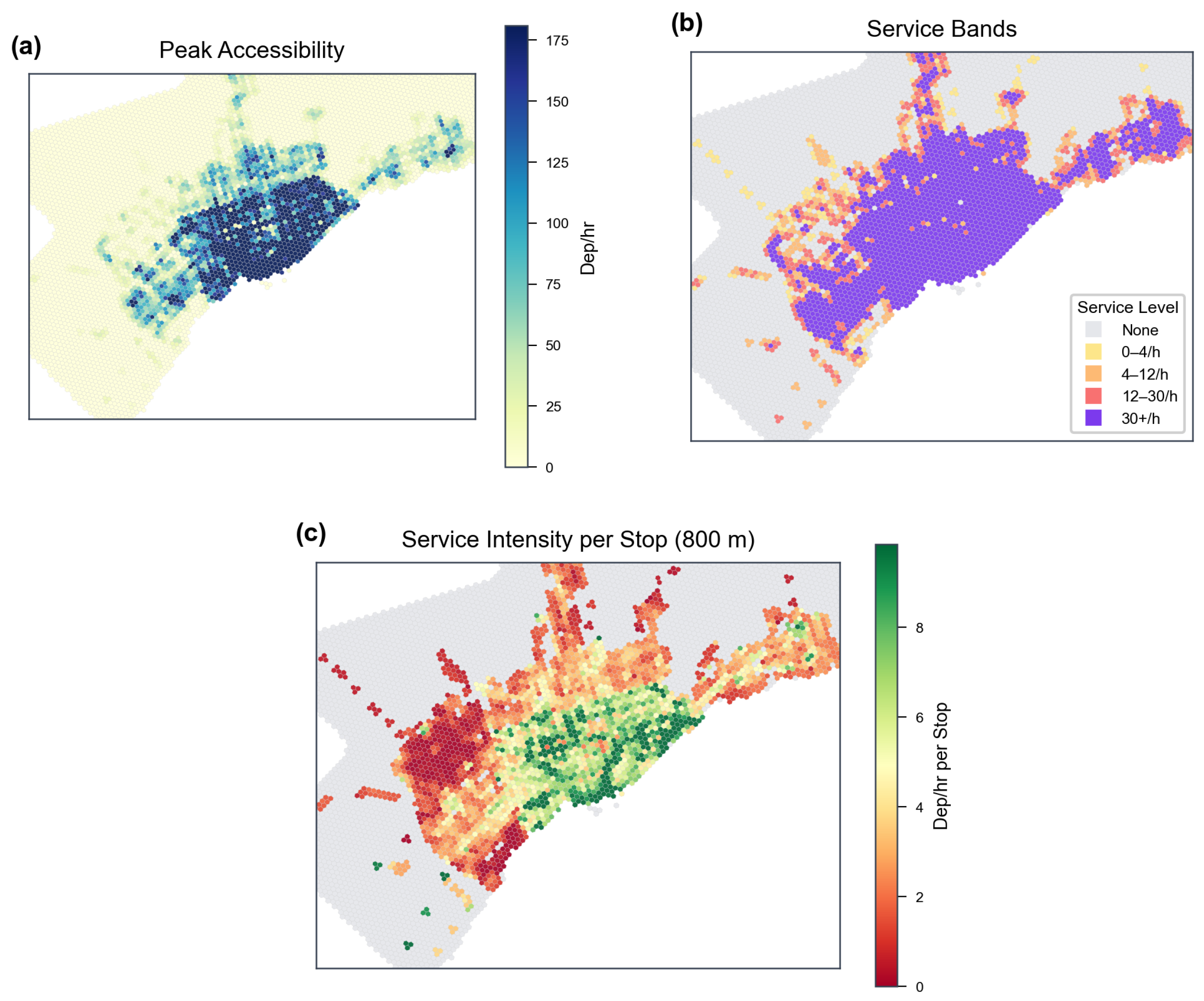
Figure 3 maps the spatial distribution of accessible departures per hour within 800 m of each H3 centroid. The weekday morning peak reveals a steeply concentrated service pattern. Of the 9635 hexagons comprising the study area, 6807 (70.6%) possess zero scheduled departures within a walking catchment. The remaining cells fall into the Low (2.5%), Moderate (4.3%), High (5.1%), and Very High (17.6%) service bands. Ultimately, only 29.4% of the GTA’s spatial grid has any peak-period service within reasonable walking distance, and a mere 22.6% meet a practical urban frequency threshold of at least 12 departures per hour. The departures-per-stop ratio (Figure 3c) reveals where service is concentrated versus thinly spread: the Urban Core and inner-suburban rapid-transit corridors have high intensity per stop, while outer-ring hexagons with service tend to have few departures distributed across sparse stops.
This 70.6% figure is area-weighted. When weighted by population, the zero-service share falls to 16.4% and the share reaching 12+ dep/h rises to 75.5% (Table 3), because the grid covers extensive greenbelt and low-density exurban land. Population-weighted mean accessibility is 121.8 dep/h versus 27.4 area-weighted; in the Fringe Ring, the area-weighted zero-service share is 90.8% but the population-weighted share is 40.2%. A population-weighted perspective thus yields a less severe—but still highly unequal—picture.
The Saturday midday pattern is weaker: the no-service share rises to 74.3% and the Very High share falls from 17.6% to 13.0%, with the strongest Saturday service concentrated in Toronto and a smaller set of suburban corridors. The service-band approach thus reveals a two-step inequality: many locations lack service entirely, and many others lose meaningful frequency outside the weekday peak. The schedule-aware metric also clarifies why stop counts alone are insufficient [12,43]: some municipalities contain many thinly scheduled stops and still have modest accessibility.

4.3. Distance-Ring Gradients

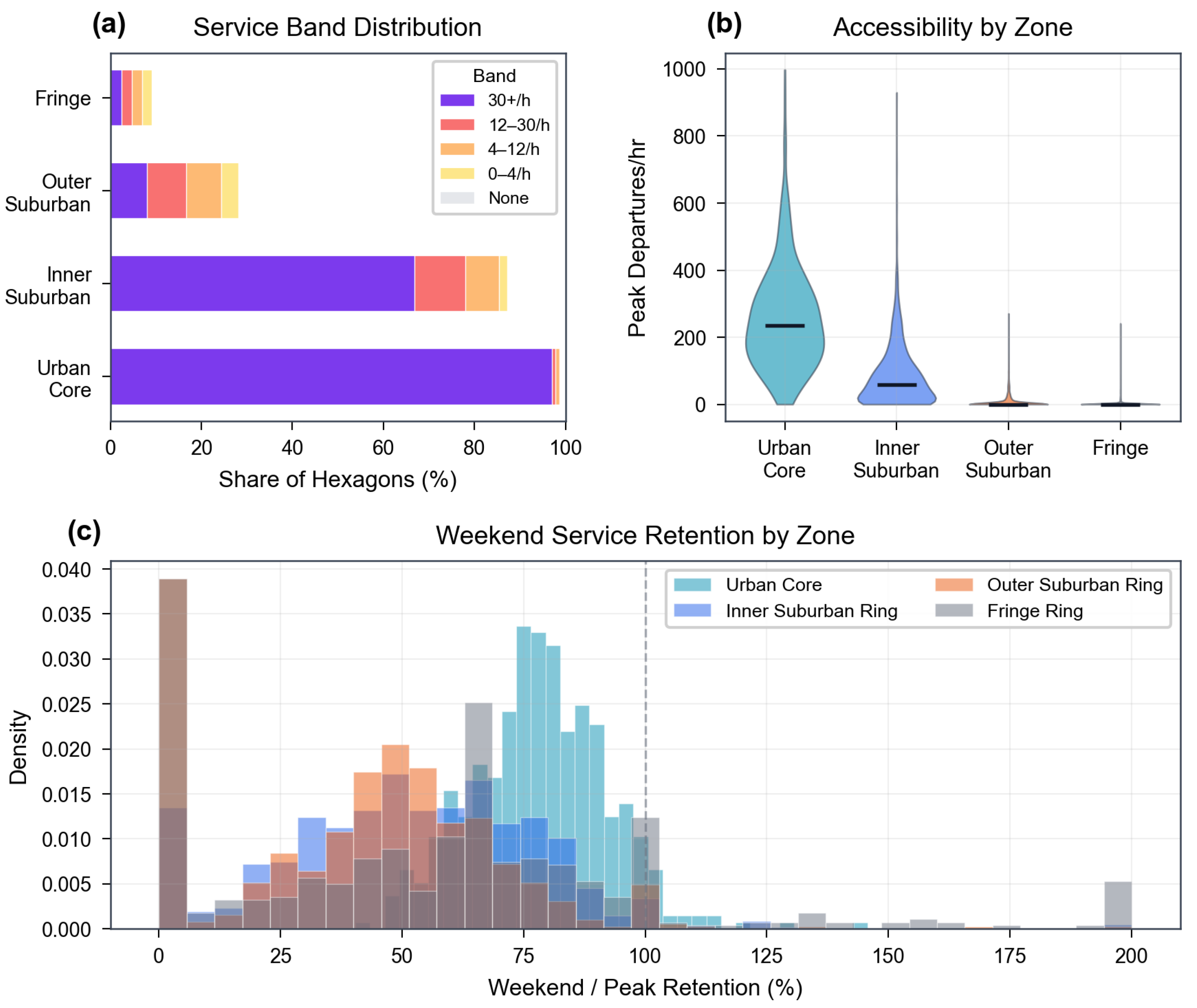
Aggregating these metrics by distance ring sharply reinforces the region’s hierarchical transit architecture. Table 4 details the primary service gradients, which are visualized further in Figure 4.
The Urban Core is the most intensively served zone by a wide margin (median 234.25 dep/h, 97.8% reaching 12+ dep/h), with near-complete weekend retention (0.98). The Inner Suburban Ring is not marginal transit territory: its median of 59.5 dep/h and 78.1% coverage above 12 dep/h indicate a zone of substantial but uneven service structured by arterial corridors and rapid-transit spines. The major break occurs between the Inner and Outer Suburban Rings: in the latter, median peak accessibility falls to zero, only 28.1% of cells record any service, and the Fringe Ring is weaker still (90.8% zero-service, 4.7% reaching 12 dep/h).
Temporal variation sharpens these differences. On Saturday midday, the Inner Suburban Ring’s Very High share drops from 66.8% to 46.4%, the Outer Suburban Ring’s Very High share falls from 8.1% to 3.8%, and the Fringe Ring’s falls from 2.5% to 1.5%. Among cells with weekday midday service, median weekend retention is 85.7% in the Inner Suburban Ring, 74.6% in the Outer Suburban Ring, and 74.8% in the Fringe Ring (the near-identical outer-ring values are genuine, not a rounding artifact; see Supplementary Note S5). Weekend service therefore contracts most clearly outside the core.
The inter-quartile ranges reinforce the hierarchy (Figure 4b): the Urban Core IQR spans 148–334 dep/h, the Inner Suburban Ring 16–118 dep/h, while the Outer Suburban Ring (0–3 dep/h) and Fringe Ring (0–0 dep/h) have IQRs anchored at zero, consistent with corridor-based service that reaches only a minority of outer-ring cells.
Regional inequality is therefore not a simple city-versus-suburb contrast; the major break occurs between the Inner and Outer Suburban Rings, after which service becomes corridor-based and discontinuous.

4.4. Municipal Profiles

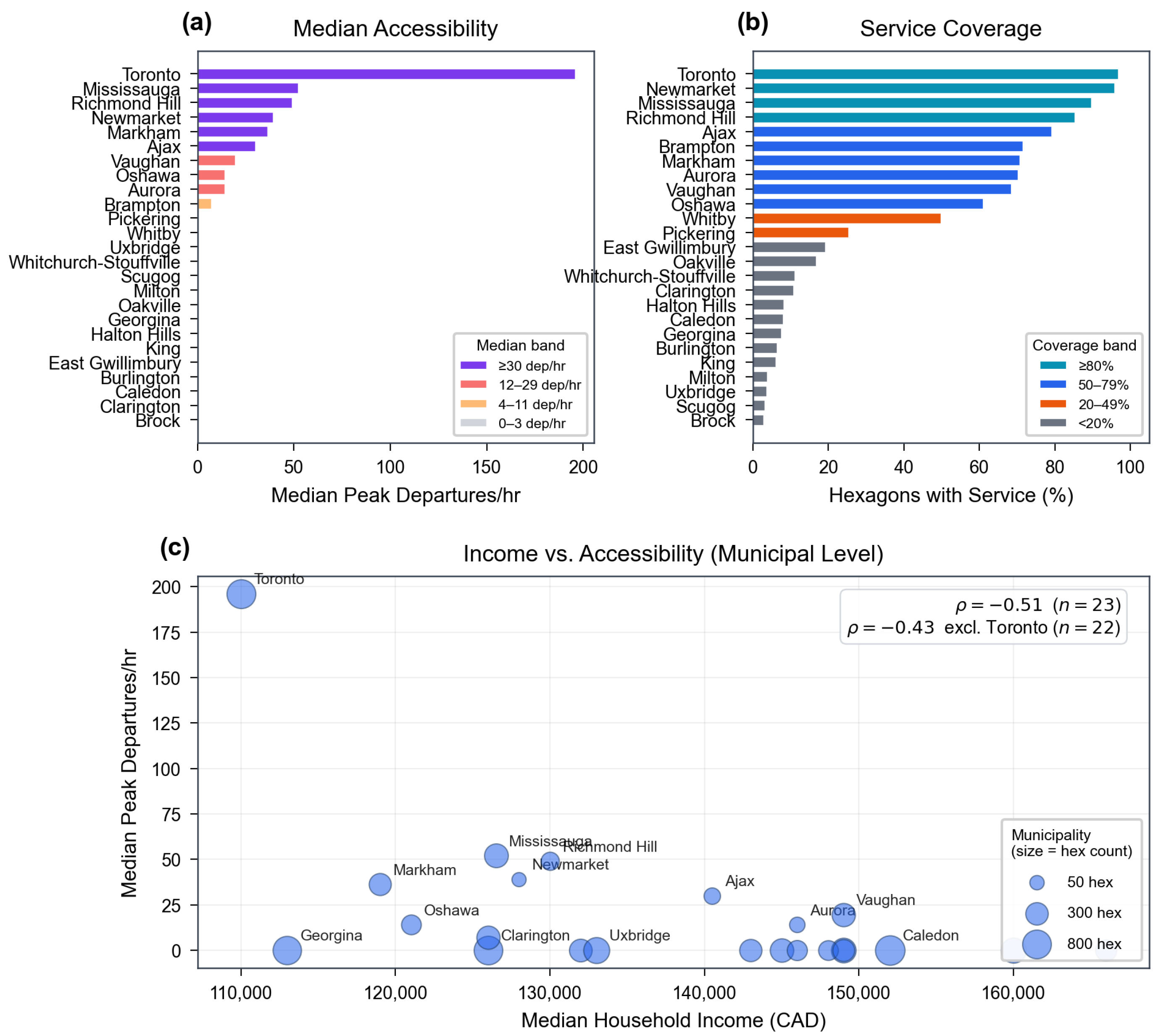
Municipal summaries reinforce the ring analysis (Table S1; Figure 5). Toronto dominates (median 196 dep/h, 95.6% reaching 12+ dep/h, 92.8% Saturday retention). Mississauga is the strongest large suburban municipality (median 52 dep/h, 77.7% at 12+ dep/h), followed by Brampton (median 7 dep/h, 39.9% at 12+ dep/h). York Region municipalities (Richmond Hill, Markham, Vaughan, Newmarket) and Durham municipalities (Ajax, Oshawa, ON, Canada) form a second tier. Outer municipalities have median zero accessibility, and Milton illustrates the fringe condition where service is confined to limited corridors. The pattern supports the ring analysis: strong service persists in Toronto and selected suburban corridors, but much of the outer metropolitan field remains sparse.

4.5. Socioeconomic Gradients and Robustness

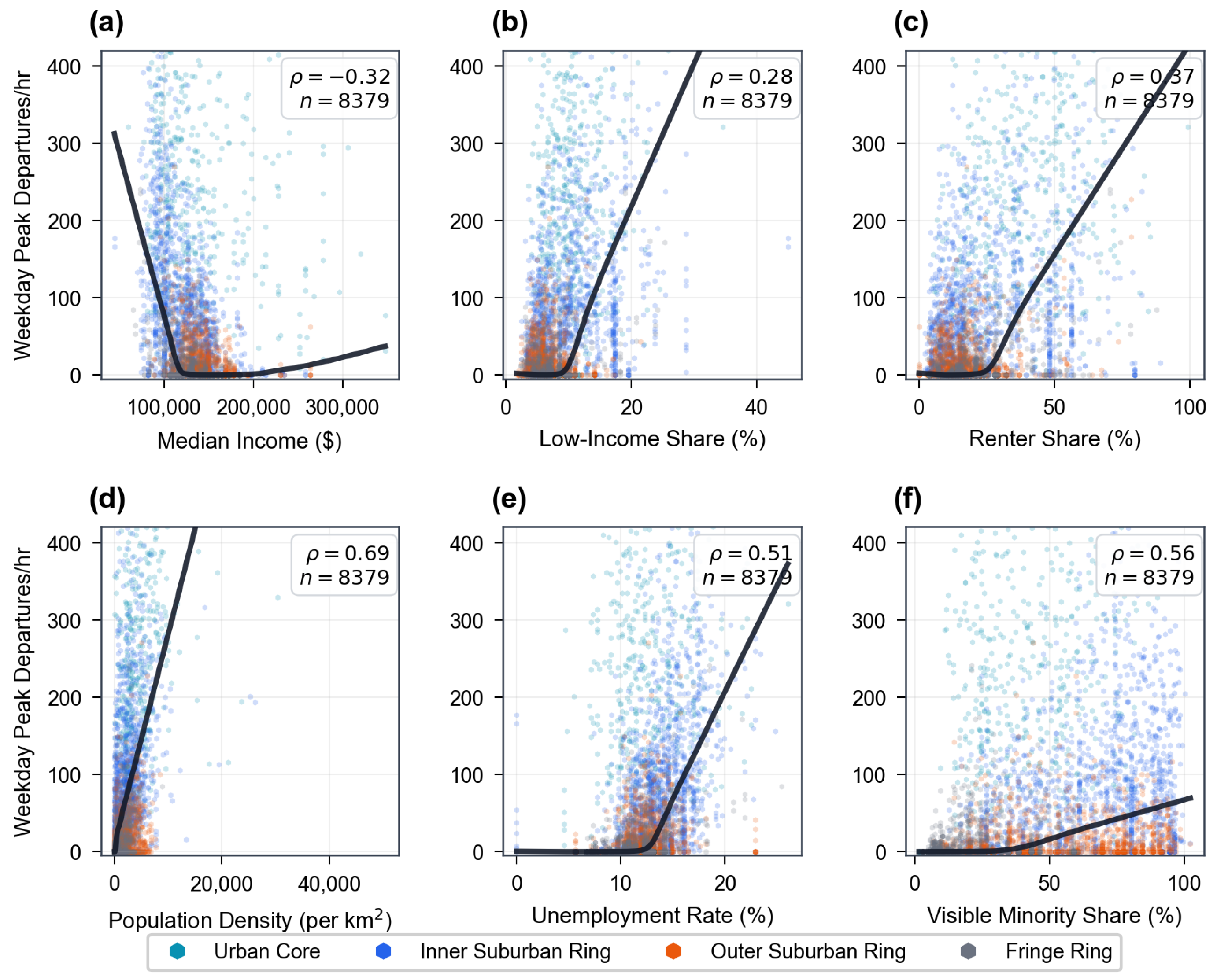
The CT-level socioeconomic analysis identifies clear associations between weekday peak service intensity and local socioeconomic context. In the CT-linked hexagon sample ( n = 8379 ), service intensity at 800 m is negatively associated with median income ( ρ = 0.32 ) and positively associated with low-income share ( ρ = 0.28 ), renter share ( ρ = 0.37 ), population density ( ρ = 0.69 ), unemployment rate ( ρ = 0.51 ), and visible minority share ( ρ = 0.56 ). Strong spatial autocorrelation (Moran’s I = 0.84 , see Section 3) reduces the effective sample size to approximately 745 under the Clifford–Richardson approximation [40]; the corresponding adjusted p-values are all below 10 15 for these six variables (Table S2). Figure 6 shows particularly clear gradients for income and renter share, and population density emerges as the strongest and most stable correlate.
Because hex-level repetition of CT attributes can inflate the nominal sample size, Spearman correlations were also computed at the census-tract level itself ( n = 1144 unique tracts), aggregating hex-level service intensity to tract means before correlating with the original CT socioeconomic variables. The tract-level correlations are stronger in magnitude than their hex-level counterparts—median income ρ = 0.74 ( p < 10 200 ), low-income share ρ = 0.55 , renter share ρ = 0.54 , population density ρ = 0.74 , unemployment ρ = 0.33 , and visible minority share ρ = 0.18 (Table S2). The fact that the income and density gradients strengthen under one-tract-one-observation aggregation indicates that the hex-level coefficients reflect a genuine, statistically robust ecological pattern rather than an artifact of pseudo-replication.
Sensitivity tests using 400 m and 1000 m catchments and Saturday midday accessibility preserve the same directional pattern and rank ordering, with coefficients varying by no more than ± 0.03 from the primary specification (Table S2).
Partial correlations controlling for population density confirm that the income–accessibility relationship is not purely a density artifact ( ρ partial = 0.21 ). Renter share ( ρ partial = 0.24 ), unemployment ( ρ partial = 0.21 ), visible minority share ( ρ partial = 0.24 ), and low-income share ( ρ partial = 0.23 ) all retain meaningful partial associations, though all are substantially reduced from bivariate values (Table S4). Density is the dominant organizing variable, but socioeconomic composition retains an independent, if attenuated, association with accessibility.
The population-weighted Gini coefficient is 0.60, with inequality most extreme in the Fringe and Outer Suburban Rings (both 0.68) and lowest in the Urban Core (0.31); the Inner Suburban Ring falls between (0.47). The Lorenz curve (Supplementary Figure S1) confirms that the most transit-deprived half of the population accounts for a very small share of accessible departures.
Municipal aggregation ( n = 19 ; Halton municipalities, Scugog, and Brock excluded—see Section 2) does not reverse the pattern: density ( ρ = 0.86 , p < 0.001 ), visible minority share ( ρ = 0.75 , p < 0.001 ), and unemployment ( ρ = 0.76 , p < 0.001 ) remain strongly positive. The income–service-intensity coefficient weakens under the revised sample ( ρ = 0.42 , p = 0.071 ), falling below conventional significance partly because the excluded Halton municipalities had high incomes paired with near-zero measured intensity, which had inflated the original coefficient; the direction of association, however, remains negative. Higher service intensity is thus consistently concentrated in denser, more renter-dominated, more diverse, and lower-income parts of the region, with density as the single strongest organizing factor.

4.6. Sensitivity to Study-Area, Threshold, Resolution, and Walking-Distance Assumptions

Four targeted sensitivity analyses examine whether the central Inner-to-Outer Suburban break is robust to defensible alternative specifications (Tables S7–S11, Notes S6–S8). Halton-excluded ring statistics: re-running the area-weighted ring statistics with the four Halton municipalities (Oakville, Burlington, Halton Hills, Milton) excluded leaves the gradient intact—the Outer Suburban Ring’s zero-service share moves from 71.9% to 66.8% and the Fringe Ring from 90.8% to 90.0%, while the Urban Core and Inner Suburban Ring statistics are essentially unchanged (Table S10). Incomplete local-feed coverage in Halton therefore inflates outer-ring zero-service shares modestly but does not generate the Inner-to-Outer break. Alternative ring thresholds: recomputing the ring stratification under (10/25/40 km) and (20/35/50 km) thresholds preserves the major Inner-to-Outer gradient—the share of hexagons reaching at least 12 dep/h drops from 91.2% to 32.8% across the (10/25/40) Inner-to-Outer break and from 54.8% to 11.7% across the (20/35/50) break, compared with 78.1% to 16.6% for the primary 15/30/45 specification (Table S11). H3 cross-resolution check: re-tessellating Mississauga at H3 resolution 7 (about 5.16 km2) and resolution 9 (about 0.105 km2) returns service-band shares of 68.2% and 76.9% reaching 12 dep/h, respectively, against the resolution-8 baseline of 77.7%; the qualitative ranking of areas inside the municipality is preserved at all three resolutions (Table S9, Note S7). Network-distance walking catchment: a literature-based scaling argument (network-to-Euclidean factor 1.4–1.8 in suburban environments [34,43]) implies that 70.5–86.5% of currently-classified “High” Outer-Ring hexagons would drop one or more bands under network-distance reclassification (Table S7), while an empirical shortest-path computation on the Pickering walkable street network—presented here as a representative sub-analysis for one cul-de-sac-dominant outer-suburban municipality ( n = 288 hexagons; approximately 74,200 graph edges) rather than a full GTA-wide network-distance robustness test—reduces the mean weekday peak intensity from 7.91 to 2.92 dep/h and shifts the band assignment in 14.2% of cells, with 12.8% dropping to a lower band (Table S8, Note S6). Because this bias is concentrated in the outer rings, network distances would push the regional gradient further from equality rather than soften it; a GTA-wide empirical network-distance computation remains a worthwhile direction for further work.

5. Discussion

The multi-agency GTFS inventory reveals a GTA transit landscape that is both more structured and more unequal than a Toronto-centric view suggests. The schedule-aware metric separates nominal, thin coverage from genuinely frequent urban service, exposing where regional policy interventions are most needed. Census-tract data confirm that transit-dependent populations are distributed widely across the suburban municipalities, not concentrated in the Toronto core—yet the infrastructure to serve them remains strikingly uneven.
The distinction between area-weighted and population-weighted perspectives is critical for interpreting the headline inequality numbers. The area-weighted 70.6% zero-service rate includes extensive greenbelt, conservation lands, and agricultural fringe where few people live; the population-weighted 16.4% figure better captures the share of residents without service. Neither perspective is correct in isolation: area-weighted metrics are relevant for land-use planning, greenfield development, and future growth corridors, while population-weighted metrics speak to current equity and service-delivery evaluation. Table 3 presents the full comparison by distance ring.
The suburban transit picture warrants closer attention. Several suburban municipalities sustain meaningful scheduled transit networks, refuting the view that the commuter belt is a blank canvas. But suburban service is highly uneven and geographically selective—organized around specific corridors, nodes, and built-up centres. The planning problem is therefore one of incomplete regionalization: not whether suburban transit exists, but where it is strong enough to function as a reliable everyday option.
The GTA’s 70.6% zero-service rate reflects its hybrid character—a dense, well-served core embedded in a large, auto-oriented suburban field where six independent agencies operate with limited coordination—placing it between more compact Canadian regions and sprawling US sunbelt metros [12,23].
The schedule-aware approach produces a more realistic hierarchy than stop proximity alone: the gap between 29.4% with any service and 22.6% reaching 12 dep/h identifies places where transit is nominally present but insufficiently frequent for regular urban use, a distinction that sharpens further on Saturday when marginal service recedes.
Weekend retention ratios (∼0.98 core, ∼0.86 inner ring, ∼0.75 outer rings) indicate that peri-urban inequality is temporal as well as spatial: areas that appear reasonably connected during weekdays often become much less usable on weekends, echoing earlier findings on time-sensitivity in the Toronto region [15].
These findings are broadly consistent with earlier GTA research. Foth et al. [1] found service within Toronto aligned with social need over 1996–2006, and the Urban Core remains well served here; El-Geneidy et al. [15] documented time-of-day shifts, confirmed by the pronounced weekend contraction. The persistence of these gradients over more than a decade suggests that the region’s fundamental accessibility structure has remained stable despite ongoing investment, and that suburban equity remains unresolved.
At the hex-level, population density is the strongest single correlate of service intensity, followed by visible minority share and unemployment—plausible in a region where the densest areas combine higher transit provision with substantial renter, immigrant, and racialized populations. Under one-tract-one-observation aggregation ( n = 1144 ), the magnitude ordering shifts: median income ( ρ = 0.74 ) becomes essentially co-equal in magnitude with population density ( ρ = 0.74 ), suggesting that the income gradient operates partly between tracts at a coarser spatial grain than the hex-level analysis can resolve. The partial correlations confirm that density mediates much of the bivariate hex-level association: once its effect is removed, all socioeconomic associations weaken, though income, renter share, unemployment, and visible minority share retain significant independent associations. The observed co-location of high service intensity with socioeconomic disadvantage may partly reflect residential sorting [44] and supply-driven allocation (agencies serve where ridership potential is highest) rather than equitable planning intent alone. These are area-level ecological associations and do not characterize individual-level outcomes.
The population-weighted Gini of 0.60 places the GTA’s schedule-aware service-intensity inequality in the upper range of values reported for comparable metropolitan regions (where the literature uses broader transit-accessibility constructs). Delbosc and Currie [42] reported Ginis of 0.52–0.68 across Melbourne’s transit modes, and Deboosere and El-Geneidy [23] found substantial inter-metropolitan variation across Canadian cities, with larger, more polycentric regions exhibiting higher inequality. The GTA value is consistent with a region where a well-served core coexists with extensive low-density periphery.
The municipal robustness check confirms that these patterns survive scale reduction: once collapsed to 19 municipalities (excluding Halton and the two smallest fringe CSDs), density, visible minority share, and unemployment remain strongly positive, income remains negative, and low-income share weakens but does not reverse.
The municipal findings suggest that suburban transit investment has created islands and corridors of strong service—but not a uniformly connected metropolitan fabric. Corridor-based investment can substantially improve equity when combined with feeder services and fare integration [45].
These findings align with broader debates on infrastructure concentration: transit provision does not necessarily follow population suburbanization; major infrastructure accumulates where density and existing investment are already strongest [2,16]. The transport-justice [46] and social-exclusion [47] literature suggest that such patterns carry distributional consequences even when they arise from operational efficiency. Because the indicator examined here is origin-side scheduled supply rather than destination-based access, employment accessibility, ridership, fare integration, or actual travel behavior, the planning implications below should be read as directions for further investigation rather than as direct policy prescriptions. The sharp break between the Inner and Outer Suburban Rings suggests that the 30 km transition zone may warrant further regional planning analysis, particularly destination-based and demand-side studies that could assess whether coordinated investment in this band would improve practical access. Weekend thinning, which disproportionately affects peri-urban populations working non-standard schedules [4], indicates that off-peak frequency may warrant further investigation as a planning consideration. Inter-agency fare integration and coordinated scheduling are areas where additional analysis of perceived accessibility—particularly where multiple services already exist but do not operate as a seamless system—could be valuable.
Several limitations apply. (1) The analysis measures schedule-based supply near origins, not travel times to destinations, and does not account for transfer penalties, fares, reliability, or crowding [24,26,32]; in a multi-agency region, inter-system transfers may reduce practical accessibility below what the departures-per-hour metric implies. (2) Walk catchments are Euclidean rather than network-based. The 800 m Euclidean catchment overstates effective walking access most strongly in cul-de-sac suburban environments where stormwater ponds, highways, and discontinuous sidewalks raise network walking distances to 1.4–1.8× the straight-line distance [34,43]. Two complementary sensitivity analyses (Section 4.6, Note S6) quantify this effect: a literature-factor calculation suggests that 70.5–86.5% of currently-classified Outer-Ring “High” hexagons would lose at least one band under network distances, and an empirical shortest-path computation on the Pickering walkable street network—presented as a representative sub-analysis for one outer-suburban municipality rather than a GTA-wide network-distance robustness test—reduces mean weekday peak intensity from 7.91 to 2.92 dep/h with 12.8% of hexagons dropping to a lower band. The bias acts in the direction of understating the outer-ring deficit, so network distances would, if anything, strengthen the paper’s equity thesis. (3) No distance-decay function is applied; the deduplication sensitivity in Table 2 and Note S5 shows that route-level deduplication compresses absolute Urban-Core values but preserves the spatial pattern [6,25]. (4) Temporal and spatial coverage is incomplete: only three time windows are examined (excluding evening, late-night, and Sunday service [14]), and CT coverage thins in the exurban fringe. The Fall 2023 GTFS feeds represent a post-pandemic recovery period in which several agencies had not fully restored pre-pandemic service levels; the TTC had restored approximately 90% of pre-2020 service by Fall 2023, while suburban agencies had recovery trajectories that varied by route. To the extent that the TTC’s recovery lagged its suburban counterparts, the analysis may somewhat understate the TTC’s structural dominance relative to a fully recovered scenario. (5) The H3 resolution-8 grain introduces a modifiable areal unit problem [24]; this was examined directly by re-tessellating Mississauga at H3 resolution 7 and resolution 9 (Note S7), and the qualitative pattern was preserved at both alternatives, although the absolute share of cells reaching 12 dep/h shifts modestly. A GTA-wide cross-resolution analysis would be a useful extension. None of these limitations invalidates the spatial and temporal patterns identified here, but each defines a direction for further work.
The next step is to build on this place-based baseline. A destination-based extension could evaluate access to jobs, health care, and services using full timetable routing [35,48,49]; a reliability extension could compare scheduled and observed service; and a policy extension could test whether municipalities with weak weekend retention concentrate the most service-dependent populations. The Lorenz-curve and Gini-based equity measures follow Delbosc and Currie [42] and Talen and Anselin [50] and could be extended to destination-based accessibility.

6. Conclusions

This study used an H3 hexagonal grid, multi-agency GTFS feeds, and Statistics Canada census boundaries to map schedule-aware transit service intensity across the Greater Toronto Area. The indicator is an origin-side, supply-focused component of accessibility and does not by itself characterize destination access, travel time, transfers, fares, reliability, or crowding. Within those bounds, the GTA is served by a much larger and more differentiated transit network than a Toronto-only stop inventory suggests, but the distribution of meaningful scheduled service remains highly uneven: during the weekday morning peak, 70.6% of hexagons have no service within 800 m and only 22.6% reach at least 12 departures per hour. The distribution is structured most clearly as a distance-ring hierarchy, with strong service fields in the Urban Core and Inner Suburban Ring giving way to predominantly zero-service territory in the outer rings; this hierarchy is robust to alternative ring thresholds, exclusion of Halton municipalities, the choice of H3 resolution, and a network-distance walking-catchment specification (Section 4.6). Weekend service weakens most sharply outside the core, indicating that peri-urban inequality has a temporal as well as spatial component. Higher service intensity co-locates with population density, rental tenure, ethnocultural diversity, and lower household income at the tract level; the income and density gradients strengthen under one-tract-one-observation aggregation, and all six principal CT-level associations remain statistically significant after Clifford–Richardson correction for spatial autocorrelation. These are area-level ecological associations and do not characterize individual outcomes. The strongest single relationship is with population density, indicating that built form and social geography jointly shape where scheduled transit supply accumulates.
A schedule-aware, multi-agency H3 framework offers a substantially clearer account of regional service-intensity inequality than stop counts or proximity-weighted indices, while remaining one input among several for a complete equity assessment. The highest-priority extension is a destination-based accessibility analysis using full timetable routing; real-time reliability comparisons, fare-integration analysis, and network-distance catchments at full GTA scale would further sharpen policy relevance. The population-weighted Gini coefficient of 0.60 provides a baseline against which future distributional progress can be tracked. For the GTA, the descriptive results suggest that further investigation is warranted into where service is frequent, temporally durable, and regionally coherent enough to support everyday life beyond the core, particularly in the Inner-to-Outer Suburban transition zone, where the gap between residential growth and frequent scheduled transit appears largest.


Supplementary Materials

The following supporting information can be downloaded at: https://www.mdpi.com/article/10.3390/urbansci10060309/s1, Table S1: Municipal accessibility and socioeconomic summary; Table S2: Spearman correlation robustness across samples, catchments, and temporal windows; Table S3: General Transit Feed Specification (GTFS) feed metadata; Table S4: Spearman partial correlations controlling for population density; Table S5: Area-weighted versus population-weighted accessibility statistics; Table S6: Original vs. deduplicated median accessibility by distance ring; Table S7: Predicted band-shift under literature-factor network-distance scaling; Table S8: Pickering network-distance vs. Euclidean service intensity (800 m, weekday peak); Table S9: MAUP cross-resolution sensitivity in Mississauga; Table S10: Halton-excluded ring statistics, weekday peak departures-per-hour at 800 m; Table S11: Distance-ring threshold sensitivity, weekday peak departures-per-hour at 800 m; Figure S1: Lorenz curve of population-weighted weekday peak transit service intensity across the GTA; Note S1: Service-band classification rationale; Note S2: Distance-ring justification; Note S3: Data sources and analytical procedure; Note S4: Spatial-autocorrelation and partial-correlation methods; Note S5: Route-direction deduplication sensitivity analysis; Note S6: Euclidean versus network-distance catchment: two complementary sensitivity analyses; Note S7: Modifiable Areal Unit (MAUP) cross-resolution sensitivity for Mississauga; Note S8: Ring-threshold and Halton-exclusion robustness. References [17,34,37,40,41,43] are cited in the Supplementary Materials.

Funding

This research received no external funding.

Institutional Review Board Statement

Not applicable.

Informed Consent Statement

Not applicable.

Data Availability Statement

All primary data used in this study are publicly available (Supplementary Note S3). GTFS feeds were obtained from the open-data portals of the Toronto Transit Commission, Metrolinx (GO Transit), MiWay (City of Mississauga), York Region Transit, Brampton Transit, and Durham Region Transit. Census boundaries and socioeconomic profiles were obtained from Statistics Canada, 2021 Census of Population, distributed under the Statistics Canada Open Licence Agreement. The H3 indexing library is provided by Uber Technologies under the Apache 2.0 licence. The analysis pipeline and processed outputs will be deposited in a public repository upon acceptance.

Acknowledgments

The author gratefully acknowledges the transit agencies of the Greater Toronto Area—the Toronto Transit Commission, Metrolinx, MiWay, York Region Transit/Viva, Brampton Transit, and Durham Region Transit—for making their GTFS data publicly available through their open-data programmes. Statistics Canada’s open census products made the socioeconomic analysis possible.

Conflicts of Interest

Author Chiranjib Chaudhuri was employed by the company Geosapiens Inc. The author declares no conflicts of interest.

References

  1. Foth, N.; Manaugh, K.; El-Geneidy, A.M. Towards Equitable Transit: Examining Transit Accessibility and Social Need in Toronto, Canada, 1996–2006. J. Transp. Geogr. 2013, 29, 1–10. [Google Scholar] [CrossRef]
  2. Jones Allen, D. Lost in the Transit Desert: Race, Transit Access, and Suburban Form; Routledge: New York, NY, USA, 2017. [Google Scholar] [CrossRef]
  3. Grengs, J. Does Public Transit Counteract the Segregation of Carless Households? Measuring Spatial Patterns of Accessibility. Transp. Res. Rec. 2001, 1753, 74–82. [Google Scholar] [CrossRef]
  4. King, D.A.; Smart, M.J.; Manville, M. The Poverty of the Carless: Toward Universal Auto Access. J. Plan. Educ. Res. 2022, 42, 464–481. [Google Scholar] [CrossRef]
  5. Geurs, K.T.; van Wee, B. Accessibility Evaluation of Land-Use and Transport Strategies: Review and Research Directions. J. Transp. Geogr. 2004, 12, 127–140. [Google Scholar] [CrossRef]
  6. Hansen, W.G. How Accessibility Shapes Land Use. J. Am. Inst. Plan. 1959, 25, 73–76. [Google Scholar] [CrossRef]
  7. Handy, S.L.; Niemeier, D.A. Measuring Accessibility: An Exploration of Issues and Alternatives. Environ. Plan. A 1997, 29, 1175–1194. [Google Scholar] [CrossRef]
  8. Páez, A.; Scott, D.M.; Morency, C. Measuring Accessibility: Positive and Normative Implementations of Various Accessibility Indicators. J. Transp. Geogr. 2012, 25, 141–153. [Google Scholar] [CrossRef]
  9. Vickerman, R.W. Accessibility, Attraction, and Potential: A Review of Some Concepts and Their Use in Determining Mobility. Environ. Plan. A 1974, 6, 675–691. [Google Scholar] [CrossRef]
  10. Levinson, D.; Wu, H. Towards a General Theory of Access. J. Transp. Land Use 2020, 13, 129–158. [Google Scholar] [CrossRef]
  11. Owen, A.; Levinson, D.M. Modeling the Commute Mode Share of Transit Using Continuous Accessibility to Jobs. Transp. Res. Part A Policy Pract. 2015, 74, 110–122. [Google Scholar] [CrossRef]
  12. Currie, G. Quantifying Spatial Gaps in Public Transport Supply Based on Social Needs. J. Transp. Geogr. 2010, 18, 31–41. [Google Scholar] [CrossRef]
  13. Mavoa, S.; Witten, K.; McCreanor, T.; O’Sullivan, D. GIS Based Destination Accessibility via Public Transit and Walking in Auckland, New Zealand. J. Transp. Geogr. 2012, 20, 15–22. [Google Scholar] [CrossRef]
  14. Boisjoly, G.; El-Geneidy, A. How to Get There? A Critical Assessment of Accessibility Objectives and Indicators in Metropolitan Transportation Plans. Transp. Policy 2017, 55, 38–50. [Google Scholar] [CrossRef]
  15. El-Geneidy, A.; Buliung, R.; Diab, E.; van Lierop, D.; Langlois, M.; Legrain, A. Non-stop Equity: Assessing Daily Intersections between Transit Accessibility and Social Disparity across the Greater Toronto and Hamilton Area. Environ. Plan. B Plan. Des. 2016, 43, 540–560. [Google Scholar] [CrossRef]
  16. Hertel, S.; Keil, R.; Collens, M. Next Stop: Equity—Routes to Fairer Transit Access in the Greater Toronto and Hamilton Area; Technical Report; City Institute, York University: Toronto, ON, Cananda, 2016. [Google Scholar]
  17. Metrolinx. Regional Transportation Plan for the Greater Toronto and Hamilton Area; Technical Report; Metrolinx: Toronto, ON, Canada, 2022.
  18. Cervero, R. Linking Urban Transport and Land Use in Developing Countries. J. Transp. Land Use 2013, 6, 7–24. [Google Scholar] [CrossRef]
  19. Bertolini, L. Integrating Mobility and Urban Development Agendas: A Manifesto. disP-Plan. Rev. 2012, 48, 16–26. [Google Scholar] [CrossRef]
  20. Palm, M.; Farber, S. Prospects for Public Transit Equity in the Twenty-First Century: Lessons from COVID-19’s Impacts on Canada’s Largest Metropolis. In Urban Mobility; University of Toronto Press: Toronto, ON, Canada, 2024. [Google Scholar] [CrossRef]
  21. Farber, S.; Grandez, M. Transit Accessibility, Land Development, and Socioeconomic Priority: A Typology of Planned Station Catchment Areas in the Greater Toronto and Hamilton Area. J. Transp. Land Use 2017, 10, 879–902. [Google Scholar] [CrossRef]
  22. Farber, S.; Bartholomew, K.; Li, X.; Páez, A.; Habib, K.M.N. Assessing Social Equity in Distance Based Transit Fares Using a Model of Travel Behavior. Transp. Res. A Policy Pract. 2014, 67, 291–303. [Google Scholar] [CrossRef]
  23. Deboosere, R.; El-Geneidy, A. Evaluating Equity and Accessibility to Jobs by Public Transport across Canada. J. Transp. Geogr. 2018, 73, 54–63. [Google Scholar] [CrossRef]
  24. Higgins, C.D.; Palm, M.; DeJohn, A.; Xi, L.; Vaughan, J.; Farber, S.; Widener, M.J.; Miller, E.J. Calculating Place-Based Transit Accessibility: Methods, Tools and Algorithmic Dependence. J. Transp. Land Use 2022, 15, 95–116. [Google Scholar] [CrossRef]
  25. Klar, B.; Lee, J.; Long, J.A.; Diab, E. The Impacts of Accessibility Measure Choice on Public Transit Project Evaluation: A Comparative Study of Cumulative, Gravity-Based, and Hybrid Approaches. J. Transp. Geogr. 2023, 106, 103508. [Google Scholar] [CrossRef]
  26. Malekzadeh, A.; Chung, E. A Review of Transit Accessibility Models: Challenges in Developing Transit Accessibility Models. Int. J. Sustain. Transp. 2020, 14, 733–748. [Google Scholar] [CrossRef]
  27. Conway, M.W.; Byrd, A.; van der Linden, M. Evidence-Based Transit and Land Use Sketch Planning Using Interactive Accessibility Methods on Combined Schedule and Headway-Based Networks. Transp. Res. Rec. 2017, 2653, 45–53. [Google Scholar] [CrossRef]
  28. Burdziej, J. Using Hexagonal Grids and Network Analysis for Spatial Accessibility Assessment in Urban Environments—A Case Study of Public Amenities in Toruń. Misc. Geogr. 2019, 23, 99–110. [Google Scholar] [CrossRef]
  29. Solomon, G. Estimating Urban Areas Using Historical Census Data and the H3 Grid. In Proceedings of the 33rd Annual GISRUK Conference, Bristol, UK, 23–25 April 2025. [Google Scholar] [CrossRef]
  30. Vicente, A.T.d.O.; da Silva, F.S.C. A Multiscale Hexagonal Framework for Urban Walkability Analysis Using Open Geospatial Data. In Proceedings of the IEEE International Conference on Big Data, Macau, China, 8–11 December 2025. [Google Scholar] [CrossRef]
  31. Mishra, S.; Welch, T.F.; Jha, M.K. Performance Indicators for Public Transit Connectivity in Multi-Modal Transportation Networks. Transp. Res. A Policy Pract. 2012, 46, 1066–1085. [Google Scholar] [CrossRef]
  32. Wessel, N.; Farber, S. On the Accuracy of Schedule-Based GTFS for Measuring Accessibility. J. Transp. Land Use 2019, 12, 377–396. [Google Scholar] [CrossRef]
  33. Allen, J.; Farber, S. Sizing Up Transport Poverty: A National Scale Accounting of Low-Income Households Suffering from Inaccessibility in Canada, and What to Do About It. Transp. Policy 2019, 74, 214–223. [Google Scholar] [CrossRef]
  34. El-Geneidy, A.; Grimsrud, M.; Wasfi, R.; Tétreault, P.; Surprenant-Legault, J. New Evidence on Walking Distances to Transit Stops: Identifying Redundancies and Gaps Using Variable Service Areas. Transportation 2014, 41, 193–210. [Google Scholar] [CrossRef]
  35. Neutens, T.; Schwanen, T.; Witlox, F.; De Maeyer, P. Equity of Urban Service Delivery: A Comparison of Different Accessibility Measures. Environ. Plan. A 2010, 42, 1613–1635. [Google Scholar] [CrossRef]
  36. Páez, A.; Mercado, R.G.; Farber, S.; Morency, C.; Roorda, M. Relative Accessibility Deprivation Indicators for Urban Settings: Definitions and Application to Food Deserts in Montreal. Urban Stud. 2010, 47, 1415–1438. [Google Scholar] [CrossRef]
  37. Toronto Transit Commission. Equity Service Policy: Bus Service Standards; Technical Report; TTC: Toronto, ON, Canada, 2019.
  38. Walker, J. Human Transit: How Clearer Thinking About Public Transit Can Enrich Our Communities and Our Lives; Island Press: Washington, DC, USA, 2012. [Google Scholar]
  39. Transportation Research Board. TCRP Report 165: Transit Capacity and Quality of Service Manual, 3rd ed.; Technical Report; Transportation Research Board of the National Academies: Washington, DC, USA, 2013. [Google Scholar] [CrossRef]
  40. Clifford, P.; Richardson, S.; Hémon, D. Assessing the Significance of the Correlation between Two Spatial Processes. Biometrics 1989, 45, 123–134. [Google Scholar] [CrossRef]
  41. Kendall, M.G.; Stuart, A. The Advanced Theory of Statistics, Volume 2: Inference and Relationship, 4th ed.; Griffin: London, UK, 1979. [Google Scholar]
  42. Delbosc, A.; Currie, G. Using Lorenz Curves to Assess Public Transport Equity. J. Transp. Geogr. 2011, 19, 1252–1259. [Google Scholar] [CrossRef]
  43. Benenson, I.; Martens, K.; Rofé, Y.; Kwartler, A. Public Transport versus Private Car GIS-Based Estimation of Accessibility Applied to the Tel Aviv Metropolitan Area. Ann. Reg. Sci. 2011, 47, 499–515. [Google Scholar] [CrossRef]
  44. Pereira, R.H.M.; Schwanen, T.; Banister, D. Distributive Justice and Equity in Transportation. Transp. Rev. 2017, 37, 170–191. [Google Scholar] [CrossRef]
  45. Bocarejo, J.P.; Oviedo, D.R. Transport Accessibility and Social Inequities: A Tool for Identification of Mobility Needs and Evaluation of Transport Investments. J. Transp. Geogr. 2012, 24, 142–154. [Google Scholar] [CrossRef]
  46. Martens, K. Transport Justice: Designing Fair Transportation Systems; Routledge: New York, NY, USA, 2016. [Google Scholar] [CrossRef]
  47. Lucas, K. Transport and Social Exclusion: Where Are We Now? Transp. Policy 2012, 20, 105–113. [Google Scholar] [CrossRef]
  48. Gutiérrez, J. Location, Economic Potential and Daily Accessibility: An Analysis of the Accessibility Impact of the High-Speed Line Madrid–Barcelona–French Border. J. Transp. Geogr. 2001, 9, 229–242. [Google Scholar] [CrossRef]
  49. Lee, J.; Miller, H.J. Measuring the impacts of new public transit services on space-time accessibility: An analysis of transit system redesign and new bus rapid transit in Columbus, Ohio, USA. Appl. Geogr. 2018, 93, 47–63. [Google Scholar] [CrossRef]
  50. Talen, E.; Anselin, L. Assessing Spatial Equity: An Evaluation of Measures of Accessibility to Public Playgrounds. Environ. Plan. A 1998, 30, 595–613. [Google Scholar] [CrossRef]
Figure 1. Study area and transit infrastructure across the Greater Toronto Area. H3 hexagons (resolution 8) are coloured by distance ring from Union Station. Transit stops from six official GTFS feeds are overlaid, with municipal (CSD) boundaries shown for reference.
Urbansci 10 00309 g001
Figure 2. Methodological workflow for the GTA transit service-intensity analysis. Phase 1 (Data Acquisition) assembles official GTFS feeds from six transit agencies, Statistics Canada 2021 census profiles, and CSD/CT spatial boundaries. Phase 2 (Computational Harmonization) executes a sequential pipeline: H3 hexagonal grid generation (resolution 8, n = 9635) → stop-to-grid mapping via 800 m walking catchments → schedule-aware service-intensity quantification (departures per hour in three temporal windows). Phase 3 (Equity Synthesis and Robustness) synthesizes results through distance-ring regional segmentation, service-band classification, and socioeconomic gradient analysis using Spearman correlation. Arrows indicate data-flow dependencies across phases.
Urbansci 10 00309 g002
Figure 3. Schedule-aware transit service intensity across the GTA. (a) Weekday morning peak departures per hour within 800 m of each H3 centroid. (b) Service band classification based on frequency thresholds (see Supplementary Note S1). (c) Service intensity per stop (departures per hour divided by stop count), highlighting where service is concentrated versus thinly spread. All panels use the same geographic extent.
Urbansci 10 00309 g003
Figure 4. Ring-based service gradients by distance from Union Station. (a) Service band distribution across distance rings (stacked horizontal bars). (b) Violin plots of weekday peak departures per hour by zone, showing the full distribution including high-accessibility tails. (c) Weekend-to-weekday service retention ratio distribution by zone (overlaid histograms colour-coded by zone: Urban Core, Inner Suburban Ring, Outer Suburban Ring, Fringe Ring, as shown in the in-panel legend); the vertical dashed line marks 100% retention—i.e., weekend service equal to weekday peak service.
Urbansci 10 00309 g004
Figure 5. Municipal accessibility profiles for GTA municipalities with ≥10 hexagons. (a) Median weekday peak departures per hour (horizontal bars). (b) Share of hexagons with any scheduled service during the weekday peak. (c) Scatter of municipal median income versus median peak accessibility; all municipalities with data are plotted, with bubble size encoding the number of hexagons. Spearman ρ is annotated for the full sample and with Toronto excluded. The formal correlation analysis in the text uses n = 19 (excluding Halton, Scugog, and Brock).
Urbansci 10 00309 g005
Figure 6. Census-tract socioeconomic gradients in weekday peak accessibility (800 m catchment, n = 8379 CT-linked hexagons). Each panel plots one socioeconomic variable against accessible departures per hour, with points colored by distance ring and a LOWESS smoother overlaid. Spearman ρ and sample size are annotated. (a) Median income. (b) Low-income share. (c) Renter share. (d) Population density. (e) Unemployment rate. (f) Visible minority share.
Urbansci 10 00309 g006
Table 1. Official GTFS feeds included in the analysis.
AgencyStops in GTAWeekday Peak dep/hSaturday Midday dep/h
TTC942370,063.053,908.5
GO Transit7311677.0670.0
MiWay31429417.05033.0
YRT/Viva479214,056.55454.0
Brampton Transit29691816.0997.5
Durham Region Transit19695956.53573.0
Total23,026102,986.069,636.0
Table 2. Stop-adjacency robustness: median weekday peak departures per hour (800 m) under the primary specification and a route-direction-deduplicated variant.
ZonePrimary (dep/h)Deduplicated (dep/h)
Urban Core234.2565.50
Inner Suburban Ring59.5024.50
Outer Suburban Ring0.000.00
Fringe Ring0.000.00
Table 3. Area-weighted versus population-weighted accessibility statistics by distance ring.
Zero-Service (%)≥12 dep/h (%)Mean dep/h
ZoneAreaPop.AreaPop.AreaPop.
Overall70.616.422.675.527.4121.8
Urban Core1.30.197.899.7256.5294.3
Inner Suburban Ring12.85.878.188.485.1114.1
Outer Suburban Ring71.936.216.646.37.422.8
Fringe Ring90.840.24.749.82.226.8
Table 4. Accessibility by distance ring.
ZoneHexesMedian Peak dep/hAny Peak Service (%)12+ dep/h (%)Median Weekend Retention
Urban Core460234.2598.7097.830.984
Inner Suburban Ring137259.5087.2478.060.857
Outer Suburban Ring24280.0028.1316.640.746
Fringe Ring53750.009.194.740.748
Disclaimer/Publisher’s Note: The statements, opinions and data contained in all publications are solely those of the individual author(s) and contributor(s) and not of MDPI and/or the editor(s). MDPI and/or the editor(s) disclaim responsibility for any injury to people or property resulting from any ideas, methods, instructions or products referred to in the content.