1. Introduction
Maintaining Egypt’s road infrastructure is crucial to ensuring that economic growth keeps pace with rapid population growth and the rising greenhouse gas emissions driving climate change. In line with the Paris Agreement, which Egypt has signed, the international community has developed a strategy to limit the temperature increase to 1.5 degrees Celsius by 2050, aiming to reduce and eliminate carbon emissions from all sources. Reducing carbon intensity in infrastructure development can no longer be seen as a long-term goal; it has become a necessity for a balanced, sustainable environment [
1].
The global trend toward sustainability and climate regulation has increased in recent years. This has been achieved by reducing carbon emissions through stricter regulations implemented by countries. The European Union has proven that economic growth and carbon emissions can be decoupled, demonstrating that environmental management and prosperity are not mutually exclusive. Nevertheless, reducing carbon emissions is a difficult challenge, as it faces a series of institutional and economic barriers [
2,
3].
One factor affecting infrastructure planning and development in the modern era is the need for sustainability at every stage. Sustainability in the international community has been affected by the growing impact of environmental disasters, including water and air pollution. Therefore, the planning and design of infrastructure projects must be based on an integrated approach that balances different aspects, such as development and flexibility [
4].
Through intensive study of sustainability assessment techniques in infrastructure projects throughout the literature, it was found that most sustainability measurement methods tend to examine only one aspect of sustainability. Therefore, it is necessary to promote initiatives to develop infrastructure that includes all three sustainability goals [
5,
6].
Several previous studies have pointed to challenges that have prevented accurate and comprehensive sustainability assessments of infrastructure. To address these challenges, it is necessary to adopt and integrate the principles of sustainable development comprehensively. These principles have been presented using the three dimensions of sustainability: economic, social, and environmental.
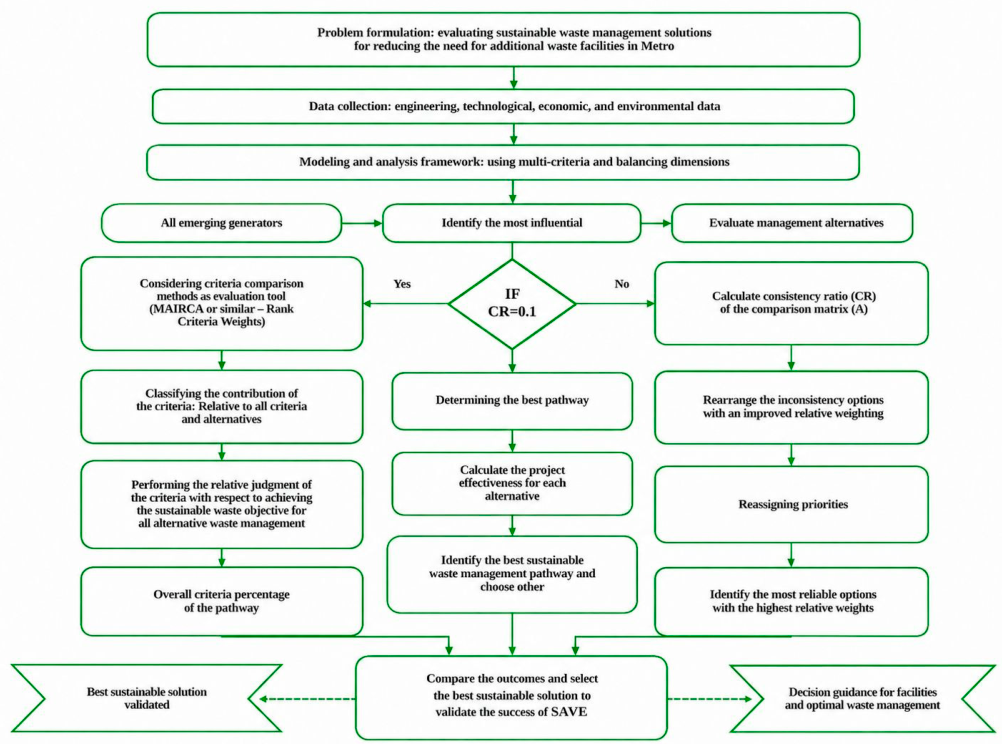
To address this gap, this study develops an integrated decision-support framework—SRMVE (sustainable road maintenance through value engineering)—that links sustainability weighting with lifecycle cost and carbon externality monetization for highway maintenance decision-making in Egypt. The research workflow is summarized as follows: (i) maintenance alternatives are generated and screened using the value engineering job plan; (ii) a three-pillar sustainability hierarchy (economic–environmental–social) with context-relevant sub-criteria is established; (iii) expert judgments are collected and synthesized through group AHP to derive normalized weights; (iv) lifecycle and carbon impacts are quantified and translated into monetized externality costs (via CCS pricing) and integrated into the SRMVE evaluation; and (v) the proposed framework is demonstrated through a real case study and its ranking is compared with the classical AHP sustainability score. The overall methodological sequence is also illustrated in
Figure 1 for the ease of replication.
2. Literature Review
Over the last two decades, research on sustainable infrastructure has increased significantly, reflecting the recognition of the need to integrate environmental, social, and economic considerations. On the one hand, a large number of sustainability measures have been introduced, including a range of indicators for infrastructure projects. On the other hand, multicriteria decision-making (MCDM) techniques, specifically the Analytic Hierarchy Process (AHP), have been used to determine their relative weights [
7]. At the same time, the potential of value engineering (VE) to improve infrastructure project alternatives and reduce lifecycle costs while maintaining performance has been recognized. Recently, there has been interest in carbon management and infrastructure-related measures that aim to integrate greenhouse gas emissions into infrastructure planning.
Although much work is being done in this area, there are still significant gaps, particularly in highway maintenance in developing countries such as Egypt. Most of what is currently available focuses on only one or two aspects of sustainability. There are very few models currently available that integrate AHP-weighted sustainability criteria with VE-generated alternatives and incorporate carbon capture and storage (CCS) economics into the mix. This research therefore works on four main areas: (i) sustainability metrics and evaluation systems for infrastructure and highway schemes, (ii) the usage of AHP and other MCDM techniques in assessment and evaluation for sustainability, (iii) the function of value engineering in improving and making infrastructure interventions economically efficient, and eventually, (iv) methods of carbon management, carbon pricing, and CCS in the built environment. The current state of the research indicates substantial gaps that require, and are consequently addressed in, the development of the comprehensive SRMVE model proposed in this article.
2.1. Sustainability Metrics and Evaluation Systems for Infrastructure and Highway Schemes
Over the past 20 years, the use of sustainability indicators has been one of the most significant means of concretizing the concept of sustainable development in infrastructure planning and management. This approach provides a quantitative view of the economic, environmental, and social components of a project, enabling easy assessment of its performance and sustainability. The authors called the method “SUSAIP,” standing for Sustainability Appraisal in Infrastructure Projects. The method enables a systematic assessment of infrastructure projects based on their sustainability performance [
8].
Ref. [
9] developed the RISE tool to analyze the sustainability of RIDPs throughout their lifespans. The program analyses 34 publications, using 31 indicators and 96 criteria to conduct a thorough study. It categorizes them into three groups: economic problems, social difficulties, and environmental ones. The “Relative Importance Index” assigns scores to the aforementioned indicators, based on expert opinions in transportation. Indicators have been measured from 0 to 100% with five degrees of achievement, so that there should be no misunderstanding of the score given, and all stages of the project development phase, planning, design, construction, operation, maintenance, and end-of-life can provide room for improvement.
Ref. [
10] analyzed eight sustainability rating systems (SRS) applied to road infrastructure: CEEQUAL, Green Roads, Green LITES, Green Pave, I-LAST, INVEST, BE2ST-in Highways, and Environ Vision. Their analysis indicated that 43% of all environmental indicators are weighted indicators, only 15% are economic indicators, and 42% are social indicators. Environmental indicators tend to cover greenhouse gas reduction and resource efficiency, while social indicators address community participation, safety, accessibility, and noise reduction. Economic indicators address life-cycle costs, the use of recycled materials, and durability. The main macro impacts identified within the main categories include materials, resources, energy, emissions, environment, and water. They highlighted some gaps in economic integration. It is worth noting that the main shortcomings, especially for those who have compliance requirements for standards such as ISO 14040 [
11] on life cycle assessment and greenhouse gas reduction.
In the case of developing countries, a list of essential sustainability factors for road development projects was established by [
12]. The factors adopted by the study by employing a Delphi approach in Ghana are: socio-cultural sustainability factors (social well-being and cultural protection), economic sustainability factors (cost effectiveness and resource usage), environmental sustainability factors (damage mitigation and resource protection), and institution-based sustainability factors (governance and policy integration). Other factors established in the study are health and safety, project administration, resource usage, engineered performance, responses to climate change, participation, and stakeholders. The study referred to global assessment methods including CEEQUAL, Envision, and Green Roads.
Infrastructure assessment and planning are essential to keep pace with rapid population growth, ensuring that social and physical infrastructure keeps pace with the urban environment, thereby promoting its sustainability. References [
13,
14,
15] added that the concept of sustainable development in infrastructure has gained great importance, as it is defined as meeting the current goals and needs of a project without compromising the ability to meet future needs, as infrastructure investment generates both positive and negative impacts. As a result, sustainability has been one of the most important challenges facing contemporary infrastructure development programs.
In a systematic review carried out on the sustainability assessment of pavement infra-structure, Ref. [
16], the authors have identified prominent indicators in the areas of environment (for instance, GHG emissions, energy use, natural resource depletion, waste management using the recycled asphalt pavement), economic evaluations (for instance, life cycle costing, profitability of investments, long-term provision of maintenance services), and social areas (for instance, health and safety in construction, social equity, community effects, adherence to labor regulations). The systematic review pronounced in the paper draws attention to the current practices in sustainability assessment studies, including those applying a life cycle perspective that encompasses life cycle assessment, life cycle costing, and social indicators, along with other rating systems like green roads and BREEAM infrastructure. The assessment is made on the lines of triple bottom line sustainability. Noteworthy deficiencies in this systematic review are about the underrepresentation of the social aspect, lack of practicality in the assessment in the case of developing countries, and a lack of comprehensive standardized tools. The paper further proposes development in standardized methods in adherence to the Sustainable Development Goals and use of the triple bottom line accounting methods.
We extended the discourse by proposing 57 potential indicators of variables within 20 categories as being potentially informative of the issue of sustainability assessment from a diverse range of the scientific and technical literature. Ref. [
17] concentrated their analysis on the social implications of infrastructure projects and the capabilities of such projects to provide solutions to ‘societal’ problems, the potential of such projects to increase discrepancies of equity distribution, and the ability to interweave social considerations within economic assessments. Their recommendation reaffirms the need to develop a methodology from the macroeconomic perspective while promoting the extension of indicators of economic evaluation. Their recommendation reaffirms the need to place equal weight on the economic assessment of life cycle sustainability assessment as that of the environmental and social pillars.
There exist various studies that have contributed to the better understanding of factors of sustainability in the context of infrastructure development; ref. [
18] developed a set that consisted of 68 factors, including 20 framework indicators and 48 supplementary indicators for the measurement of progress. Ref. [
19] segregated key performance indicators that are essential for the assessment of the sustainability of infrastructure by using data from the views of the concerned government personnel, the development experts, and the clients. The efforts led to the formulation of 30 indicators representing the views of various stakeholders. On the other hand, Ref. [
20] critically reviewed the existing approaches to the assessment of sustainability and clarified that the assessment of the sustainability of the relevance of the existing tools should always be based on the total cost in the context of the total lifecycle cost assessment of the relevant utility infrastructure.
2.2. The Usage of AHP and Other MCDM Techniques in Assessment and Evaluation for Sustainability
Sustainability assessment always implies the consideration of various and some-times competitive objectives, and for this reason, multicriteria decision-making techniques are always necessary in infrastructure assessment models. A detailed review of about 300 existing studies of multicriteria decisions in infrastructure management was conducted by [
21], and this illustrated the popularity of various models such as Multi-Attribute Utility Theory (MAUT), ELECTRE, the Technique for Order Preference by Similarity to Ideal Solution (TOPSIS), and the Analytic Hierarchy Process (AHP). These models have widely been used in infrastructure issues like maintenance and investment decisions in the event of uncertainty. In addition to this viewpoint, other studies have shown that [
22] have illustrated sustainable road design by considering the use of AHP, TOPSIS methods, and VIKOR methods, among others, to address financial, environmental, and social issues through the lifetime of a road.
Among these, AHP is one of the most popular methods, owing to its simplicity and ability to determine a logical priority vector for criteria, as well as alternatives. The classic formulation proposed by [
23] removed the complexity from large decisions through a hierarchical approach and a consistency index to remove the illogic among expert opinions. Various improvements, such as the development of ANP and combined methods, have broadened the applications of AHP to situations where alternatives and/or criteria influence each other: a scenario that is not infrequent in infrastructure system applications.
More recent applications have reaffirmed the flexibility of the AHP approach in the context of engineering as pertains to sustainability. Recent authors who have highlighted the potential combination of the AHP approach in the evaluation of sustainability within aviation include [
24]. They established the weights, using a pairwise comparison on the SATI scale, which involves the performance criteria associated with engineering aspects, such as mechanical criteria; environmental affectation, such as the amount of CO
2 emissions; economic costs; and considerations associated with society, such as the potential for being recycled. The results were combined using clustering algorithms, along with the Weighted Sum Method, TOPSIS, VIKOR, or COPRAS. They found the results to remain consistent in terms of classification in the design. They preferred the normalization using the min–max scale, which works within the range required and can easily remain within the required scales, unlike the z-standardization scale.
It has been proven that the importance of AHP is to provide a framework to integrate MCDA approaches within a sustainability assessment process, as shown by [
25]. The results obtained showed that AHP constitutes 28.7% of the usage in the general sustainability problems, lifecycle assessments, production processes, and energy planning of the broader set of application areas. Strong points of AHP are structuring the criteria in a hierarchical way, allowing a mathematical method to determine the weights, using pairwise comparisons, and following an additive aggregation procedure to allow for compensation with respect to environmental, economic, and social aspects. Further, AHP enables group decision-making processes by using either arithmetic or geometric means, which allows for the sensitivity test for the impact of variations in the input data.
Ref. [
26] offered a multicriteria decision-making approach tailored for the evaluation of building sustainability in Kazakhstan, emphasizing the key role of (AHP) as being among the most popular tools utilized within the weight assignment within the context of sustainability. This effort confirms previous ones, such as [
27,
28,
29], which have placed a considerable emphasis on the role of AHP within the context of weight assignment within sustainability assessment. Although the approach utilized Stepwise Weight Assessment Ratio Analysis (SWA-RA), which assigns weights through the consensus among the experts on the categories’ weights, as well as the weights of the individual indicators, the effort recognizes the established role of the Analytic Hierarchy Process within the context of structured comparisons aimed at the assignment of numerical weights on the environmental, economic, or societal aspects.
Ref. [
30] shows the applicability of AHP methods; using an MCDM-structured sustainability assessment in an urban setting, this was investigated by the study, focusing primarily on the ability of AHP methods to assign subjective weights to the criteria, which would cover the economic, social, and environmental aspects of sustainability. The ability to conduct pairwise comparisons and develop a hierarchical approach enables AHP methods to provide a flexible and open approach to the assignment of weights to a wide array of indicators and provide a corresponding rank to the alternatives during the sustainability assessment of complex phenomena. The study, however, highlighted the limitations associated with the independent criteria assumption by AHP methods, considering that there could be potential errors associated with the approach’s applicability when the criteria mutually interact, such as the economic and social criteria working in synergy.
2.3. The Function of Value Engineering in Improving and Making Infrastructure
Value engineering (VE) is a function-oriented and systematic approach that focuses on delivering the greatest possible value to the project by improving performance capabilities simultaneously while reducing lifecycle costs. It was originally designed to be used as an effective tool to reduce costs and optimize function within the construction sector. Nonetheless, the years that passed led to the development of this systematic approach towards becoming inclusive of effective overall project-related management practices focusing on quality enhancement and risk mitigation. More recently, the application of value engineering focusing on sustainability within the construction sector has also gained significant popularity [
31].
Also, the potentiality of achieving social value through VE was demonstrated in the article by [
32]. The authors, in their case study of the Thames Tideway Tunnel, provided an example to explain the role of VE in aligning the procurement and construction phases for the benefit of the community. It is a significant aspect because social value has traditionally involved the cost function analysis provided by value.
Regarding the aspect of VE, the research of [
33] targets the application of values of the value of information method in civil engineering. It has been demonstrated that the application of the value of information value creates additional values, which have their definitions based on risk values related to the observation of the structural state and the state of structure safety, which are extended to the aspect of value enhancement.
For instance, the study by [
34] focused on VE in the context of public–private partnerships, emphasizing the significance of VE in realizing efficiencies and securing an effective reduction in costs while having no impact on quality and functionality. Evidently, the study has confirmed the significance of function analysis techniques, among others such as creative problem-solving, in ensuring the maximum obtainable value for money in infrastructure schemes.
Ref. [
35] expanded the application of VE by developing an alternative selection strategy, particularly in the case of mega infrastructure development projects. By applying this strategy within the development of the road’s infrastructure project, the ability associated with attaining the cost, quality, and performance requirements simultaneously became established. By integrating the diverse interests of the participants/strategists and innovative alternatives, there were enormous time and cost savings associated with improved safety and environment considerations.
The importance of VE in ensuring value for money in large infrastructure projects was also stressed in a study by [
36]. The study used case studies to exemplify the role of VE in innovation by its systematic way of carrying out function analysis, thus ensuring a positive impact on project outcomes from infrastructure development in a way that aligns with the demands of all stakeholders.
2.4. Methods of Carbon Management, Carbon Pricing, and CCS in Road Infrastructure
Including carbon management practices in infrastructure planning has been shaped by developments in life cycle assessment tools, especially in the area of road and pavement infrastructure. Recent state-of-the-art journal reviews show that road infrastructure is a major source of CO
2 emissions throughout various stages of the life cycle, which include production, construction, maintenance, traffic operation, and disposal, with different CO
2 “hotspots,” depending on a given work’s project scenario [
37]. Initially, LCA used in roads and pavement focused on the construction stage, with a current emphasis on other stages that include traffic disruption and consequently both direct and indirect emissions attributed to traffic disruptions in maintaining roads, influencing advances that culminate in the design of carbon accounting models that help to quantify and measure different life cycle GHG emissions associated with various approaches with possible long-term low-carbon strategies that include advanced recycling and other advanced pavement technology processes.
Carbon management is also discussed, especially concerning carbon capture and storage technology, apart from roads. Ref. [
38] explains that “regulatory incentives, economic concerns, and CO
2 transportation infrastructure, which encompasses both pipeline and port facilities, can enable carbon capture and storage technology to live up to its full potential.”
At the level of materials and components, Ref. [
39] attempted to analyze the contribution to embodied and operational carbon emissions to the infrastructure usage during a 40-year lifecycle. The result showed that the use of materials such as concrete and asphalt contributed largely to the emissions. It also analyzed the role that the use of different materials had in contributing towards a reduction in overall carbon emissions. With a different perspective, the use of big data analytics in the interactions between pavements and cars to analyze a data-driven perspective on the collective effect of infrastructure usage and car behavior on carbon emissions has been conducted by [
40].
The importance of carbon factors has also been emphasized in previous research undertaken regarding infrastructure design. Ref. [
41] proposed methods that could integrate the carbon footprints created as a result of transportation processes under the framework of managing road infrastructure. Similarly, research undertaken in Ref. [
42] identified carbon emissions that occur as a result of specific processes that are used to manage highways and proposed methods that could result in a decrease in carbon emissions without affecting the functionality of highways.
Coupled with these developments, optimization models related to CCS infrastructure have also been explored. Ref. [
43] introduced a multi-objective optimization model, which included both economic costs and CO
2 impacts, allowing for simultaneous optimization, taking into account both its economic feasibility and CO
2 mitigation. For a European context, Ref. [
44] studied a CO
2 transport infrastructure network that was planned to connect CO
2 sources and storage sites by dedicated CO
2 transport infrastructures. The example cited above presents a strategic perspective on CO
2 transport infrastructure as a CCS system’s important enabler for CO
2 manageability.
3. Research Objective
The existing studies have indicated the existence of gaps in the integration process of the economic aspects of the life cycle assessment of various projects regarding environmental indicators, such as the reduction in greenhouse gas emissions. Considering the gaps, the purpose of the current study is to provide an appropriate framework that enables decision-makers to make well-rounded decisions regarding the strategic planning of the sustainability of highway maintenance projects. The main objective is shifting from cost-oriented approaches to the selection of the optimal methods by balancing the three main aspects: namely, the economic, environmental, and social aspects.
The proposed approach openly incorporates carbon effects throughout the entire life cycle of projects, which also addresses the possible role of carbon capture and storage technologies. The above-stated aim is achieved by determining key performance indicators for evaluating sustainability in various infrastructure projects, and relative weights are assigned for these factors using the Analytic Hierarchy Process approach. The above-mentioned approach ensures that the weighing factors also account for their relative significance, making a comment on their sustainability potential even more transparent.
The suggested framework guarantees a methodical approach for the prioritization of road maintenance alternatives regarding the anticipated sustainability performance by integrating carbon management strategies with multicriteria decision analysis (MCDA) and value engineering (VE) techniques. For improved comprehension and interpretation of the outcomes, the created sustainability grading system enables the presentation of economic, environmental, and social issues to decision-makers on a common scale. The applicability of the suggested approach for the creation of a plan for the start of a sustainable maintenance program for the highways with regard to the current circumstances justifies the significance of the current study’s work.
4. Methodology
A framework was created that could find the best system for maintaining roads in Egypt, where instead of using the Analytical Hierarchy Process (AHP) method, a method combining carbon management, multicriteria decision analysis, and value engineering is used to produce the best sustainable system, called SRMVE. The proposed model was used to compare another method, known as the Analytical Hierarchy Process (AHP), and
Figure 1 shows how it is done. The approach used a systematic procedure that involves a number of major steps: (1) identifying alternatives through VE Technology, (2) choosing sustainability parameters, (3) conducting expert surveys and determining the sample size, (4) carrying out the AHP weighting method, (5) preparing the SRMVE model, and (6) implementing the developed software. The next sections elaborate on all those steps.
4.1. Identifying Alternatives Through VE Technology
To begin with, it was imperative to propose maintenance methods aimed at suppressing energy use, saving resources, and protecting the environment within the framework of sustainability needs. To achieve this end, it was imperative to use value engineering (VE) techniques. The traditional VE job process was followed using six distinct stages: (i) the information phase, (ii) the functional analysis (fA) phase, (iii) the creativity/speculation phase, (iv) the evaluation phase, (v) the development phase, and (vi) the presentation phase. These stages made it possible to evaluate a variety of maintenance approaches that are feasible for execution in Egypt. It was possible to determine the optimum solution. The actual processes involved in executing these approaches, including both benefits and disadvantages, are clearly outlined within
Table 1 and
Table 2.
4.2. Choosing Sustainability Factors
This section represents the second phase of the study, which had the aim to synthesize, from a wide pool of variables that were necessary, the most relevant factors to define sustainability criteria for a wide array of infrastructure projects. These have been selected carefully, based on scientifically proven influences on environmental, economic, and social sustainability. Key indicators include carbon emissions, resource efficiency, project cost, and social equality levels measured against international norms. This is in accordance with studies conducted by several authors, including [
46,
47,
48,
49,
50,
51,
52,
53,
54,
55,
56,
57,
58]. Regarding this, a total of 27 sustainability factors were identified and systematically grouped into three main dimensions: economic, environmental, and social. This will efficiently consider all lifecycle stages of infrastructure projects, from preliminary planning through design and construction to operation, maintenance, and final replacement.
Table 3,
Table 4 and
Table 5 present the full categorization of these factors, which form a structural basis for further assessment and decision-making in terms of sustainability.
4.3. Conducting Expert Surveys and Determining Sample Size
The form was developed using Google Forms and structured to provide a systematic grouping of the identified elements into the three basic pillars: economic, environmental, and social sustainability elements for a total of 27 elements identified earlier. This form consisted of a scale that allowed the participants to rate the level of importance of the elements identified, employing a five-point scale (a scale from one to five was deemed sufficient to obtain an expert opinion, considering the participants have adequate experience and expertise working in the area of infrastructure development. Additionally, the study adopted the strategy of purposeful sampling to provide a proportional representation of employees in the area of road maintenance in the governmental and private sectors.
To strengthen the credibility and reproducibility of the survey, the expert panel (K = 100) was purposefully (criterion-based) selected to ensure representation across the highway maintenance industry chain. Experts were drawn from (i) government/road authorities (owner–operator perspective), (ii) private maintenance and construction enterprises (execution perspective), (iii) engineering consultants/design offices (design and specification perspective), and (iv) academic/research institutions (sustainability, LCC, and carbon assessment perspective). This composition ensures that the derived weights reflect multi-stakeholder priorities spanning planning, design, implementation, and performance/impact evaluation. The detailed distribution of expert backgrounds and proportions is reported in
Table 6.
Sample Size
In order to obtain a representative sample, the sample size for the unidentified population was explained as follows [
59]:
The following is the formula for
where N is the smallest sample size required for the population that is unknown. P is equal to 0.5 times the critical value (standard deviation). For a confidence level of 0.95 [95%], E = accuracy or tolerable margin of error = 0.05 [5%]. Z is the confidence level statistic.
Z = 1.654 if the confidence level is 0.90 [90%].
Z has a value of 1.96 when the confidence level is 0.95 [95%].
Z = 2.58 if the confidence level is 99% (0.99).
Assume that Z = 1.654, E = 0.1 [10%], P = 0.5, and a confidence level of 0.90 [90%]. N = [1.6542 × 0.5 × (1 − 0.5)]/0.12 = 68.4 = 69 samples.
Accordingly, from a scientific standpoint, a sample size of 100 respondents ought to be adequate to produce more trustworthy survey results.
4.4. Carrying out the AHP Weighting Method
AHP is an analytical approach towards decision-making. It involves reducing complex problems into a hierarchical form. Establishing the objective and defining the problem is the first process. At this point, the overall aim or goal, the criteria and sub criteria if needed, and the list of options being pondered are incorporated into the hierarchical model. To identify how important the respective criteria and options are, relative to the goal, comparisons are conducted in pairs. These are usually carried out using the relative Saaty importance matrix. In this study, pairwise comparisons were elicited using a five-level linguistic judgment format (1–5) to simplify the expert input and reduce the cognitive burden. The collected expert codes were then mapped into a reciprocal AHP ratio-scale comparison matrix
prior to eigenvector weight extraction and consistency verification. This approach is consistent with the fact that AHP can employ different judgment scales, provided that the reciprocal matrices are maintained and the consistency is checked, and multiple alternative scales have been discussed in the AHP literature.
Table 7 provides the mapping used in this study. The respective relative weights or priority vectors are therefore deducted from them. This is usually accomplished using geometric meaning. In an AHP analysis, the priority consistency index (consistency ratio) is computed. This determines the logical consistency of the comparisons. A consistency ratio below 0.10 is usually accepted. A further computation within AHP is the global priority of the options. This is accomplished after the consistency is verified. This is carried out throughout the hierarchy.
A significant advantage of AHP is its ability to perform pairwise comparisons to obtain accurate priority ratios, thereby facilitating sound decision-making. In this study, three separate pairwise comparison matrices of size n × n were designed to assess the economic, environmental, and societal pillars of sustainability. The matrix size was determined by the number of variables in a sub-category. Furthermore, a 3 × 3 pairwise comparison matrix was designed to analyze the mutual relationships among the three main sustainability factors. Such a systematic analysis was conducted to provide a comprehensive assessment of the sustainability factors, combining them into a single unit for decision-making. Finally, a sensitivity (robustness) check was conducted to confirm that the final alternative ranking is stable under reasonable variations in the derived weights.
Pairwise comparisons were collected from K = 100 experts, and an individual pairwise comparison matrix was constructed for each expert at each hierarchy level (a matrix for the three main sustainability pillars, and matrices for sub-criteria within each pillar). To obtain a single group judgment matrix, we applied the Aggregation of Individual Judgments (AIJ), using the element-wise geometric mean.
For each hierarchy level, each expert
provides a reciprocal pairwise-comparison matrix
, where
and
. Individual judgments were aggregated using the Aggregation of Individual Judgments (AIJ) via the element-wise geometric mean to obtain a single group matrix
:
The priority vector (weights) was then derived from the aggregated matrix, using the row geometric mean (equivalently used AHP prioritization approach):
Consistency was evaluated in
by estimating
and computing:
The aggregated matrices
were then used to derive the priority vectors (weights), using the same AHP procedure described above, and consistency ratios were computed on the aggregated matrices. This procedure is consistent with group AHP practice, where aggregation is commonly performed using arithmetic or geometric means (this study used the geometric mean to preserve reciprocity).
Table 8 presents the aggregated (group) 3 × 3 pairwise comparison matrix for the three sustainability pillars (economic, environmental, and social), together with the derived priority vector. The entries of this matrix were obtained by aggregating the 100 experts’ pairwise judgments using the geometric mean (AIJ), and the pillar weights (0.52, 0.31, and 0.17) were derived directly from this aggregated matrix after verifying the consistency (CR).
4.5. Preparing SRMVE Model
The lifecycle cost of each alternative is determined after identifying the sustainability parameters and the chosen alternatives. At this point, sustainability is essential, as carbon emissions have a significant negative impact on the environment, particularly by contributing to climate change and global warming. Equation (2) below is used to estimate the total amount of carbon emitted by each choice, using the carbon emissions equation that is related to the strategies [
60]:
CCF › t is the factor of the carbon coefficient (KgC/Kg);
D › The density of the material in Kg/m3;
Q › The amount of substance.
As not all three dimensions could be compared on the same levels, carbon emissions for each maintenance alternative were translated into one of these three sustainability dimensions: economic, environmental, or social. This was enabled by integrating CCS technology, which captures the carbon dioxide produced from material production and stores it deep underground. Since it does not reach the atmosphere, this reduces the climate effects and allows for inclusion of the environmental dimension in project evaluation, using the captured amount.
According to the methodology described by [
61], the cost of CCS was estimated to be
$58 per ton of CO
2. After estimation of the emissions, the cost of the emissions was calculated, which was then added to the total cost of the project. It may be noted that this is a common way to provide a composite cost, which is a mix of economics and environmental aspects, and hence it is easier to compare different projects with distinct cost elements. The cost in relation to CCS was added to the total cost of the projects. Because CCS (or equivalently, carbon pricing used to monetize CO
2 externalities) is the location, the value of 58 USD/tCO
2 is treated as a baseline benchmark, rather than a universal constant. The reported CCUS/CCS costs vary with capture stream concentration, transport distance, and storage conditions; therefore, to ensure robustness, this study additionally evaluates alternative CCS/carbon-price scenarios and performs a one-way sensitivity analysis on the unit CCS cost.
4.6. Software Implementation
A computational model was also developed at the end of the research, using Flutter and Visual Studio to facilitate decision-making regarding road maintenance activities in Egypt. The proposed model offers different road maintenance methods and allows decision-makers to choose the best technique suitable for the situation, according to the road condition. The different available techniques include: (1) traditional techniques used for severe road defects, such as grooving and defects that require the removal of the asphalt layer, (2) full-depth reclamation (FDR) for optimized usage of material, lower costs, and reduced carbon emissions, which is a recent technique, (3) traditional techniques for superficial road defects, and (4) cold in-place recycling (CIR) for superficial road imperfections, which is a recent technique.
For each alternative, the model provides a detailed description of the procedures involved, along with the associated costs per activity, calibrated according to material quantities. Cost data were sourced from 2024 records and adjusted within the program, using an inflation coefficient (as defined in Equation (3)), thereby allowing users to generate accurate cost estimates that account for temporal price variations. This computational framework offers a practical tool for evaluating highway maintenance strategies, integrating both technical and economic considerations to support sustainable infrastructure management [
62].
T C › Total cost of activities project;
i › Inflation coefficient;
n › Number of years.
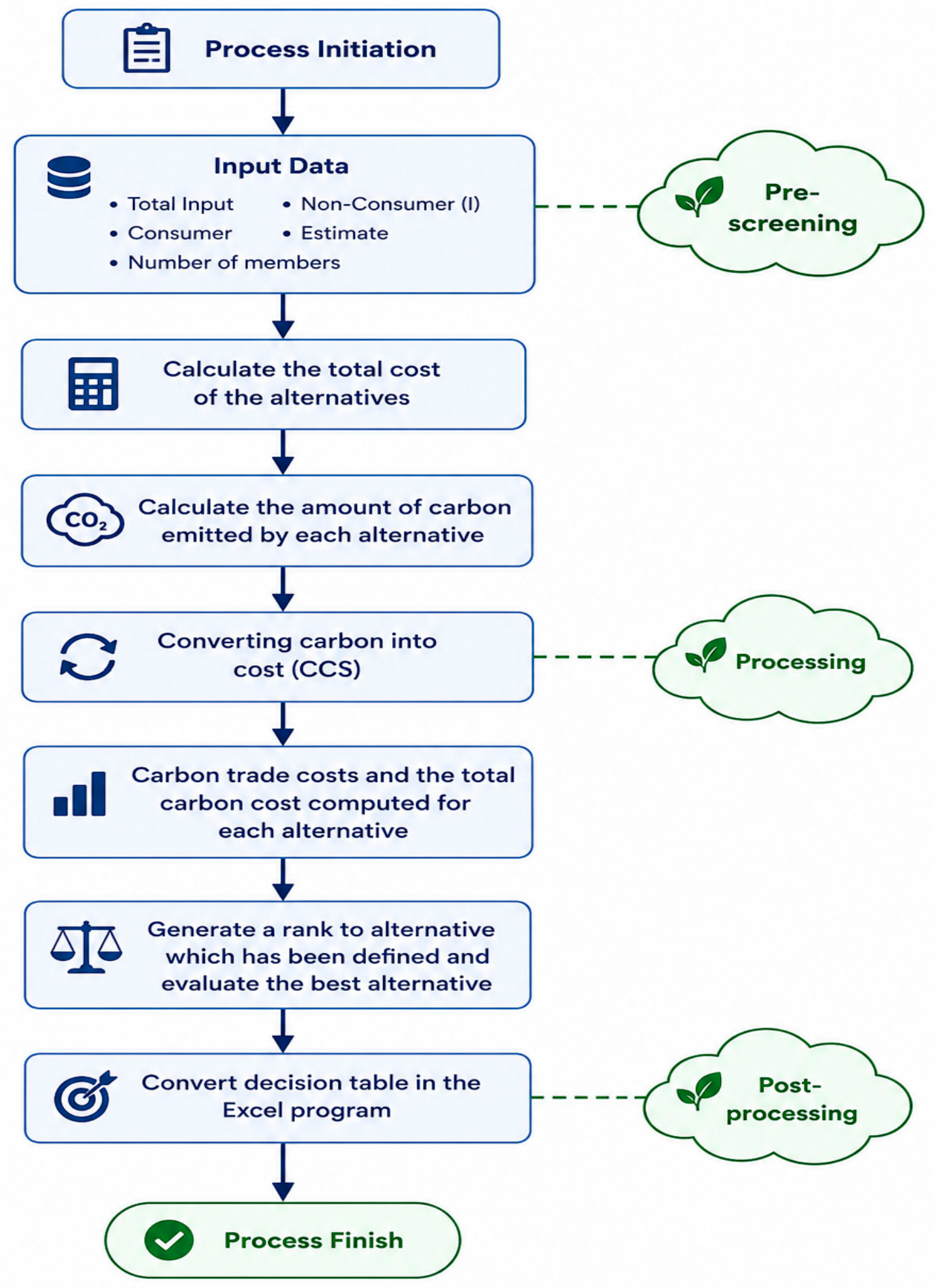
The above-prepared model is able to calculate the carbon emissions volume for each maintenance alternative, then translate such emissions into equivalent costs, along with incorporating these costs into different options. This method ensures that environmental, as well as financial, aspects are assessed concurrently. Another important benefit of preparing this research lies in its implementation through a mobile app, which has improved its ease of use, effectiveness, and speed. By integrating sustainability indicators and value engineering concepts together, SRMVE, as a defined framework, allows us to form an effective mechanism to identify optimal maintenance strategies.
Figure 2, above, displays an example implementation of SRMVE, which enables making balanced decisions on managing highway infrastructure.
5. Case Study and Data
Two maintenance alternatives are evaluated in this case study: Alternative (1)—full-depth reclamation (FDR), which rehabilitates the distressed pavement by in-place processing/reclamation and then placing a new asphalt surface layer; and Alternative (2): conventional hot-mix asphalt repair/reconstruction, which removes the damaged pavement layers and replaces them with new hot asphalt layers, using traditional maintenance practice.
This study focuses on the project that is being monitored by the General Authority for Roads, Bridges, and Land Transportation (GARBLT), which stretches from Sandoub to the eastern entrance of the new Talkha Bridge in Egypt. It is 10 km long and 9 m wide. The road had a number of defects, particularly the presence of rutting, thus making a comparison of two different approaches to this problem necessary. In aiding this comparison, the Analytic Hierarchy Process technique was used to obtain the different weighting vectors for the pillars of the II issues—economic, environmental, and social issues.
Table 9,
Table 10 and
Table 11 present the aggregated group AHP results obtained after combining the 100 experts’ judgments using the geometric-mean aggregation for the first option, whereas
Table 12,
Table 13 and
Table 14 present the analysis for the second option. Consistency ratios were employed as tools to determine the dependability of this analysis. Economic sustainability was accorded a weightage of 0.52, followed by 0.17 on social sustainability, which emphasized the significance of protecting the community, and 0.31 on environmental conservation. The lower relative weight of the social pillar (0.17) reflects the decision context of routine highway maintenance in Egypt, where budgetary and serviceability pressures and monetized carbon impacts tend to dominate. In contrast, many social requirements are treated as baseline safety and compliance obligations, rather than differentiators, among alternatives. The consistency ratios (CR) were computed for the aggregated group pairwise-comparison matrices; the resulting CR values were minimal (in some cases, rounded to 0.00) and remained well below the accepted threshold (CR < 0.10), indicating reliable group judgments.
For clarity and reproducibility,
Table 15 consolidates the normalized AHP priority vectors (local weights) for all sub-criteria (EF1–EF12, EnF1–EnF9, and SF1–SF6) for both alternatives.
Table 14 also provides the mapping between sub-criterion codes and the model input variables (xᵢ, zᵢ, yᵢ) used in Equations (4)–(6) and reports the corresponding global weights computed as (pillar weight × local sub-criterion weight).
5.1. Applying the Approach for Sustainability Assessment
To operationalize the AHP results within SRMVE, the standard AHP additive synthesis (weighted-sum aggregation) is expressed explicitly in Equations (4)–(7), using the priority vectors derived from the aggregated group pairwise comparison matrices (
Table 8,
Table 9,
Table 10,
Table 11,
Table 12 and
Table 13) and summarized in
Table 14. The linear model for economic sustainability evaluation is shown in Formula (4), which combines all the known economic resilience characteristics (x
1, x
2, …, x
12) of the proposed project as input variables. The factors are formulated in a way that encompasses those key qualities of a proposed project, in which it operates, and surrounding financial conditions. The weights determined for the variables gauge their anticipated impact on the proposed project’s economically related factors.
The score is then used to produce an economic sustainability score (X) that ranges between 0 and 100. The lower the score, the more that it indicates that there is low economic sustainability, while a score close to 100 is a good indication that there is good economic viability. The score enables a transparent approach when evaluating infrastructure projects based on their economic aspects, as it is one of the factors that should also be considered when evaluating sustainability.
Economic Sustainability Score
The environmental sustainability assessment model shown in Equation (5) follows the same guidelines. The nine previously developed environmental elements (z
1, z
2, z
1) must be entered into this model. The equation’s environmental sustainability score (Z), which ranges from 0 to 100, evaluates the project’s environmental performance.
is the environmental sustainability score.
Furthermore, using the six input variables that were identified (y
1, y
2, …, y
6), Equation (6) was created as a model for assessing social sustainability. In a similar vein, social sustainability scores (Y) vary from 0 to 100.
is the social sustainability score.
Every infrastructure project’s overall sustainability score, S, is calculated using a thorough model defined by Equation (7). This model combines the three scores—X, Z, and Y—as inputs, weighted by the priority vectors for the environmental, social, and economic pillars, respectively. The project’s anticipated total sustainability performance is summed up by the overall score, S, which ranges from 0 to 100. Several infrastructure implementation plans might be evaluated, ranked, and prioritized by using such a criterion.
It is clear from the results of the AHP application that the second alternative achieves the highest sustainability, so it is the best alternative.
To evaluate whether the final ranking is sensitive to moderate changes in AHP-derived weights (including those that could arise from alternative judgment-scale mappings), a robust check was performed. The results show that Alternative (2) achieves higher pillar scores than Alternative (1) across the economic, environmental, and social dimensions (i.e., , , and ). Consequently, the overall sustainability score, , remains higher for Alternative (2) under any reasonable positive weighting scheme . This confirms that the ranking is robust and not materially affected by moderate variations in the preference-intensity scale or the derived priority vectors.
5.2. SRMVE Model Results
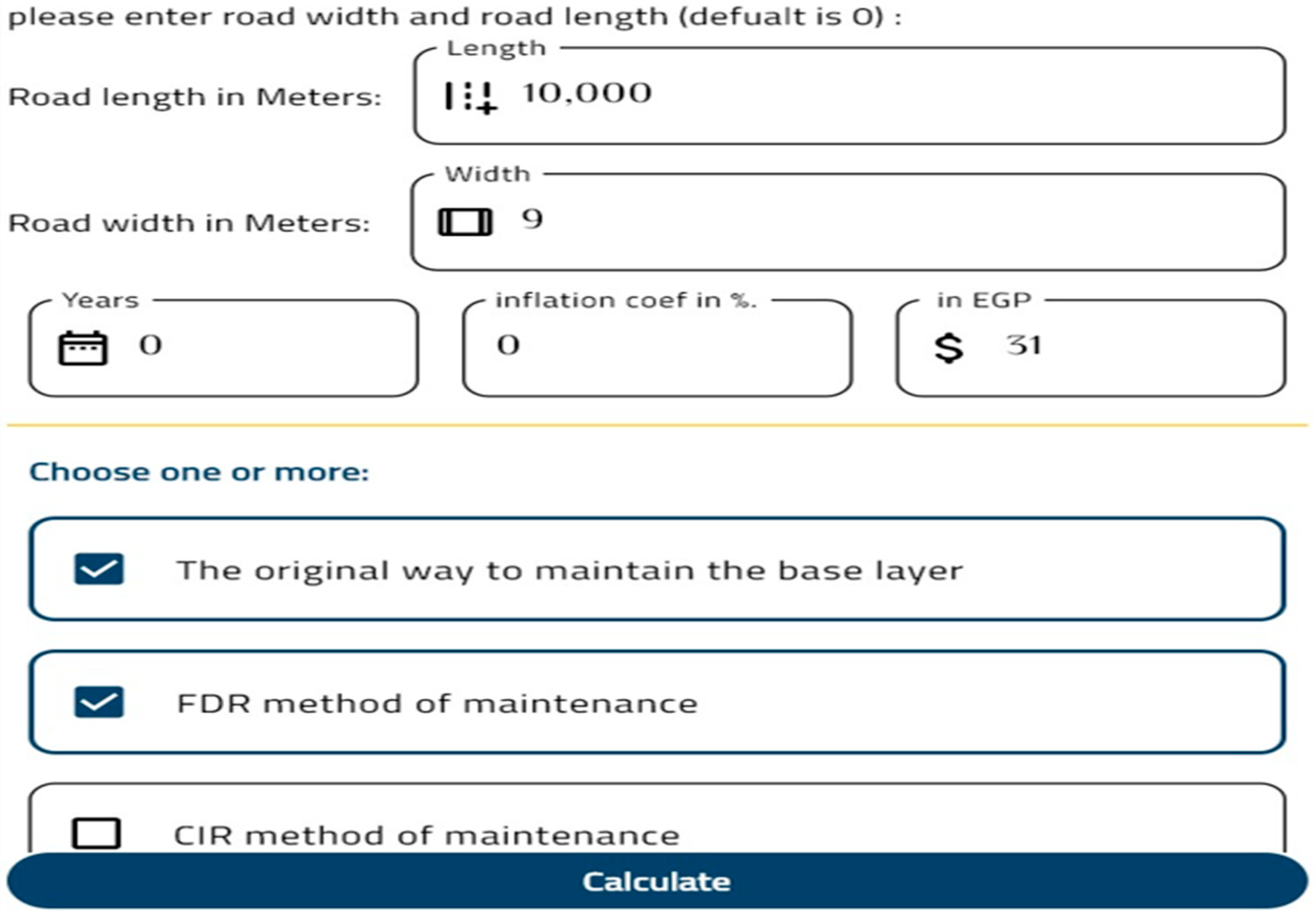
The model was updated with the current USD exchange rate, as well as the road’s width and length. As seen in
Figure 3, the options that were being examined, the traditional approach and full-depth reclamation (FDR)—were detailed.
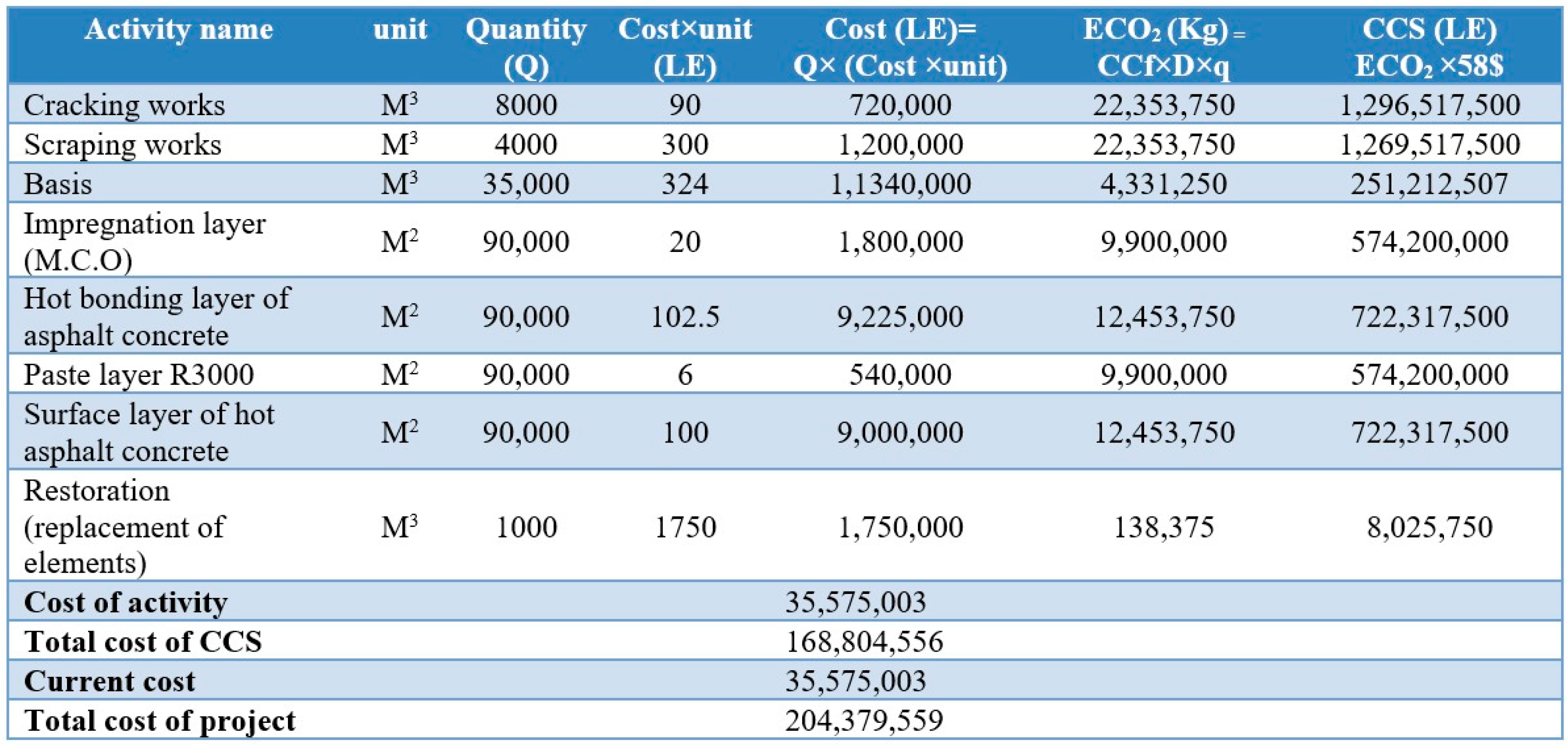
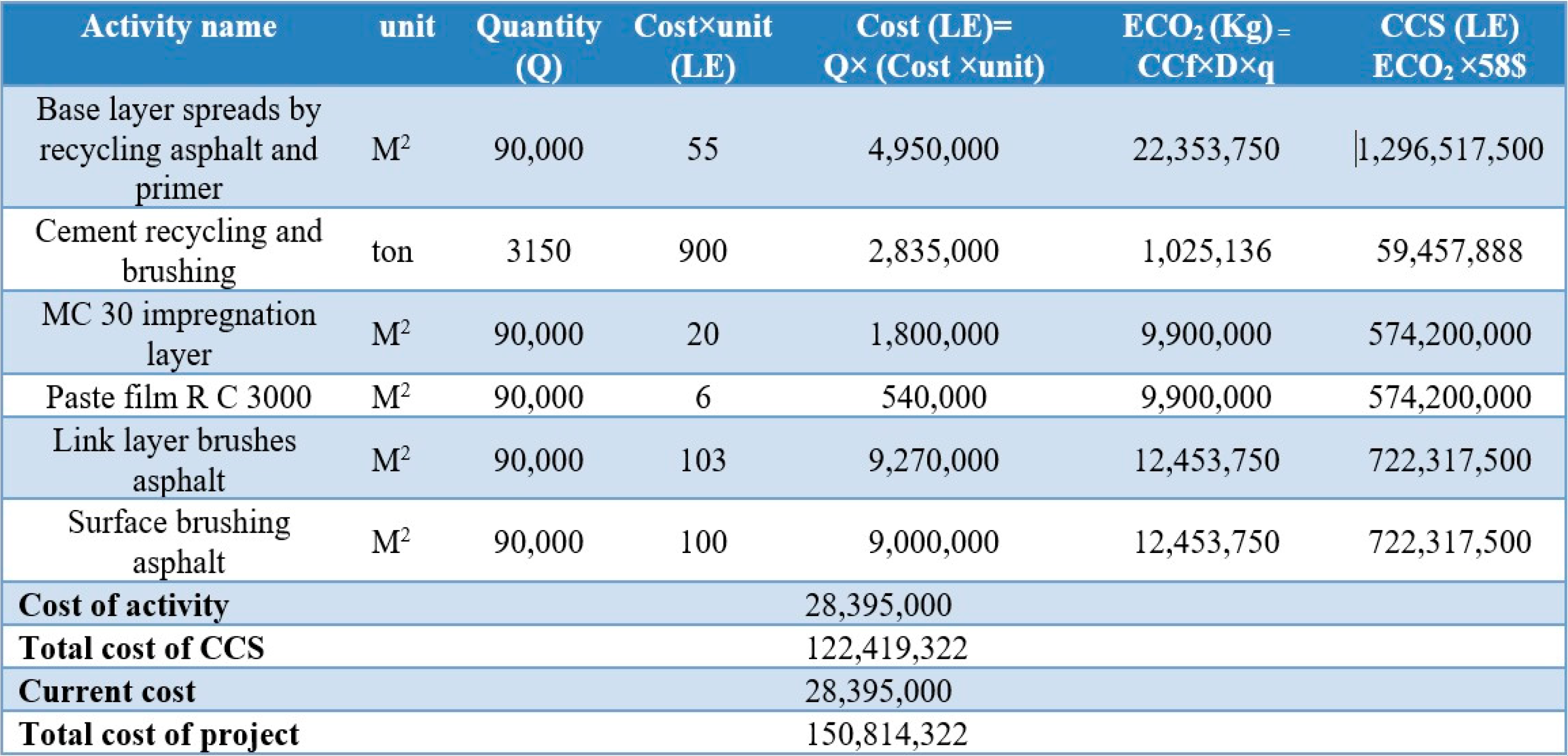
Figure 4 illustrates the maintenance costs for the project, employing the traditional method (designated as the first alternative), while demonstrating the efficacy of the SRMVE model. The computed costs align precisely with those of the actual maintenance operations conducted by the General Authority for Roads, Bridges, and Land Transport (GARBLT). Furthermore, the figure presents the quantity of carbon emissions produced by this approach and quantifies the associated disposal costs through carbon capture and storage (CCS).
Figure 5 illustrates the project costs involved in performing the maintenance using the second alternative, full-depth reclamation (FDR), which acts as a sustainable alternative to the normal technique used in the project. The figure also includes the computation of the project costs, the amount of carbon produced in this project, and disposal costs incurred using carbon capture and storage (CCS).
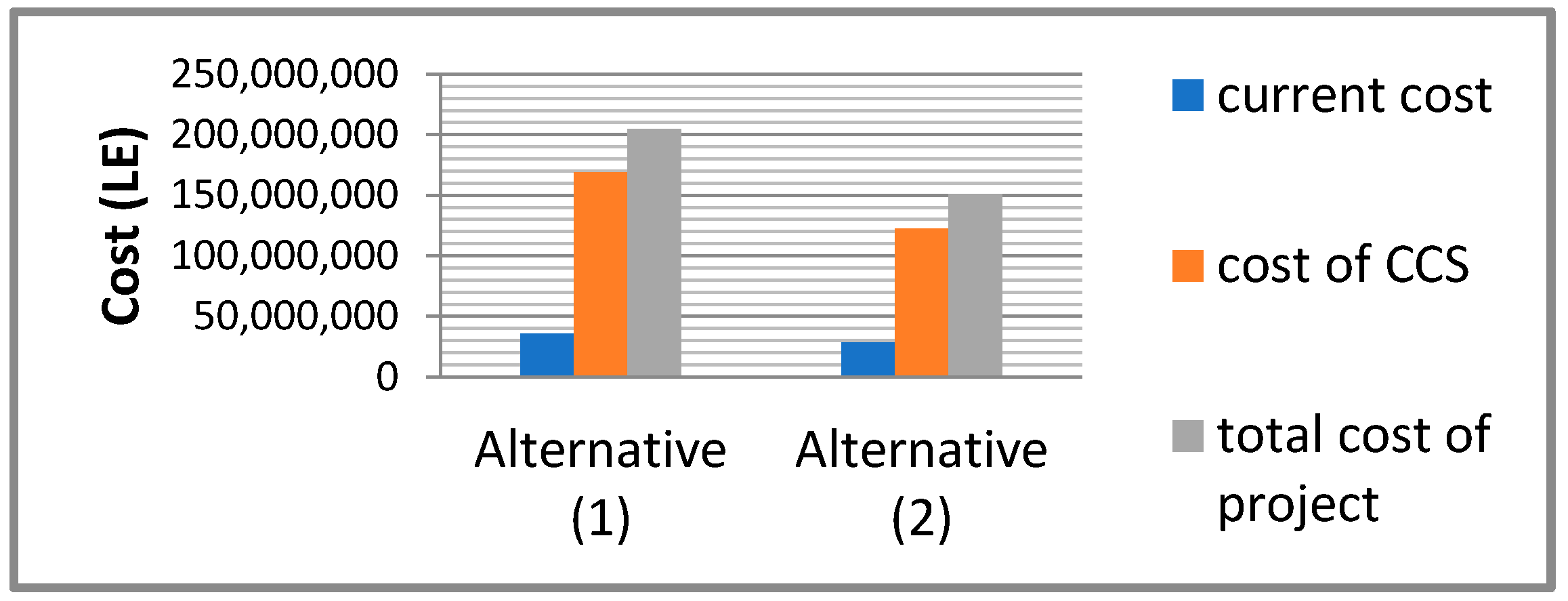
Figure 6 illustrates the comparison of the total lifecycle cost of two road maintenance options: Alternative (1)—the traditional method and Alternative (2)—the full-depth reclamation (FDR) cost estimated in Egyptian Pounds (LE). This comparison considers the cost of expenditure incurred together with the cost of externality of the environment, estimated using carbon emissions and converted into waste that is disposed of by carbon capture and storage (CCS), presented in SRMVE.
When considering the financial expenditure directly, Alternative (1) costs 3,575,002.73 LE, and Alternative (2) costs 28,395,600 LE. Although FDR imposes 7.9 times greater capital expenditure because of the use of high-tech equipment and in situ recycling facilities, differences in environmental factors significantly influence the financial expenditure pattern. When taking into account CCS liabilities, conventional technology imposes 168,804,556 LE of expenditure against 122,143,922 LE incurred because of FDR use. This is because of a 38.2% greater carbon footprint associated with conventional technology, leading to CCS liabilities of 46,660,634 LE extra.
The sum of financial and environmental costs for both alternatives gives the total project costs as 204,379,558.7 LE for Alternative (1) and 150,814,322 LE for Alternative (2). Therefore, the FDR system indicates a cost-saving potential of 26.2%, which amounts to an economic saving of 53,565,236.7 LE, with a cost-saving percentage of FDR over the SRWES system. At this juncture, the SRMVE model indicates the significance of using the in-place material reuse approach in diminishing the embodied carbon content, thus negating the initial project costs with the long-term financial costs associated with the degradation of the environmental element in the future.
5.3. Sensitivity and Scenario Analysis of CCS (Carbon) Unit Cost
To examine the robustness of SRMVE results to the cost, a one-way sensitivity analysis was conducted by varying the unit CCS cost
over a set of policy-relevant scenarios. The monetized carbon externality scales linearly with
; therefore, the total cost can be expressed as follows:
where
is the direct financial expenditure and
is the monetized environmental cost computed using the baseline 58 USD/tCO
2 assumption. Results show that the preferred alternative remains full-depth reclamation (FDR) for CCS/carbon prices above approximately 18 USD/tCO
2 (break-even value for this case study), while the conventional alternative becomes financially preferable only under very low/no carbon pricing.
Table 16 summarizes the one-way sensitivity and multi-scenario analysis performed on the assumed CCS (carbon) unit cost
. The table reports the resulting SRMVE total costs for both alternatives under representative carbon-price scenarios (from zero to high policy cases) and indicates the preferred alternative (minimum total cost) in each scenario. This analysis demonstrates the robustness of the ranking to plausible variation in the CCS/carbon pricing assumption.
6. Discussion
The results of this study validate the integration of value engineering with carbon accounting, offering a robust and quantifiable foundation for sustainable infrastructure procurement. These findings are consistent with global trends in circular pavement management and reinforce policy incentives promoting low-carbon rehabilitation technologies.
The three-pillar structure adopted in this study (economic–environmental–social) is consistent with widely used infrastructure sustainability assessment frameworks that emphasize structured indicator hierarchies and weighted synthesis to support decision-making. Previous work has highlighted the need to define clear, project-relevant sustainability indicators and to apply systematic weighting methods when evaluating infrastructure alternatives, particularly for transportation assets. In this context, our indicator hierarchy and the use of expert-based weighting align with established sustainability indicator frameworks for infrastructure projects.
Studies focused on pavement maintenance sustainability assessment similarly adopt multi-criteria structures and emphasize that maintenance-option selection is strongly influenced by economic feasibility and environmental performance, while the social aspects are often treated through safety and community-impact considerations. Our pillar-weight pattern (economic dominance, followed by environmental and social) aligns with this practical emphasis on pavement maintenance decision-making, and the selection of FDR as the preferable alternative is consistent with the broader direction toward circular pavement management solutions that reduce material consumption and emissions. In addition, our approach extends conventional sustainability ratings by translating carbon impacts into monetized externality costs (through CCS-based accounting), aligning with life-cycle sustainability assessment thinking, where environmental burdens can be expressed in comparable decision units to improve transparency for practitioners.
In the interpretation of pillar weights in the Egyptian maintenance context, the relatively lower pillar weight obtained for social sustainability (0.17) should be interpreted as context- and stakeholder-specific, rather than as an indication that social impacts are unimportant. The expert panel was purposefully sampled from practitioners and decision-makers involved in road maintenance delivery in Egypt, where funding constraints, rapid service-restoration needs, and exposure to costs strongly shape prioritization. Under such conditions, experts tend to assign higher relative importance to economic viability (0.52) and carbon-related environmental impacts (0.31), especially when environmental externalities are monetized through CCS cost integration.
In addition, several social aspects considered in this study (e.g., public/worker safety measures, protection protocols, and accessibility considerations) are often treated as baseline compliance requirements in routine maintenance practice, thereby reducing their discriminating power in pairwise comparisons at the pillar level. Notably, despite the lower pillar weight, the calculated social sustainability scores for both alternatives remain high, indicating that social performance is maintained, even when the pillar-level weight is smaller, in this decision context. Future applications of the framework can recalibrate pillar weights for projects with higher community disruption (e.g., urban corridors, lengthy detours, resettlement impacts) and by expanding the expert panel to include local community and user representatives.
Significantly, the result obtained through the traditional sustainability analysis carried out by the Analytic Hierarchy Process (AHP) compares favorably with the result produced by the proposed SRMVE approach. In fact, both methods have identified full-depth reclamation (FDR) as the most optimal and sustainable approach.
Nevertheless, AHP does have a number of significant drawbacks. It involves very intensive, time-consuming procedures, relies heavily on subjective stakeholder questionnaires, and is also susceptible to inaccuracies due to perceptual bias. In addition, its results, given in the form of dimensionless weights, are often not intuitively meaningful for nonexpert decision-makers.
When handling potential divergence between AHP and SRMVE rankings, while AHP and SRMVE produced the same ranking in the present case study, the framework is designed to remain usable, even if the two approaches lead to different rankings. In such situations, the divergence should be treated as a diagnostic signal, rather than a failure of the approach. First, the AHP component should be reviewed by verifying the aggregation procedure and consistency of the relevant matrices (pillar and sub-criteria levels), and by conducting a sensitivity check on the most influential weights. Second, the SRMVE component should be reviewed by testing the sensitivity of the monetized outputs to key assumptions (e.g., unit rates, inflation adjustment, carbon factors, and CCS price). If the divergence persists, two integration pathways can be applied: (i) SRMVE can be introduced earlier as a quantitative criterion within the AHP hierarchy (e.g., as a life-cycle externality or monetized sustainability criterion), or (ii) a second-stage AHP can be conducted to integrate the outputs of both models by weighting the AHP-based sustainability score and the SRMVE monetized score, according to decision-maker preferences. This treatment is consistent with the established AHP practice for integrating multiple evaluation structures (e.g., benefit–cost style synthesis).
By requiring very few inputs and computational resources, the SRMVE model, on the other hand, solves these two significant shortcomings and provides results in monetized cost units, LE. Because practitioners and policymakers are accustomed to this style, it serves as the foundation for more transparent and understandable decision-making. Several real-world projects have been used to validate the model, and each time it produced sustainability rankings that were exactly the same as those created with AHP. These results demonstrate SRMVE’s strength, effectiveness, and practical excellence as a tool for supporting decisions in sustainable infrastructure management.
7. Conclusions
The objective of this work was to contribute to the sustainability of highway maintenance in the Egyptian context by designing and evaluating an integrated decision support approach that links multicriteria sustainability analysis, value analysis, and carbon management. The motivation of this work is to shift the focus of decision making in highway maintenance away from cost and create a systematic approach that takes into consideration, in an integrated manner, the financial, environmental, and societal aspects, and, specifically, to reflect the cost of carbon using carbon capture and storage to help professionals compare, show trade-offs, and make informed decisions to resolve the concept.
A set of indicators that are important to the sustainability of highway infrastructure was identified, along with their weights, using the Analytic Hierarchy Process on the basis of expert opinion. The proposed indicators and their weights were then integrated with that model (SRMVE). The impact of different maintenance options, along with the associated CCS costs, has now been quantified using that model. The impact has been adjusted for both the effect of inflation and the effect of currency fluctuations. A highly useful software program that aims to help professionals compare, show trade-offs, and make informed decisions resolved the concept.
The SRMVE model’s usefulness was demonstrated when it was applied to a real-world highway maintenance situation in Egypt. The algorithm distinguished clearly between competing maintenance options and selected one that maintained economic efficiency while enhancing overall sustainability performance. Although the total cost was somewhat higher, due to carbon disposal pricing, the selected alternative provided a more favorable balance between direct maintenance investment and long-term environmental externalities once CCS-related carbon costs were added. The robustness of the suggested framework as a decision-support tool was confirmed by comparing the SRMVE results with the AHP-based sustainability scores, which revealed consistent ranking.
Overall, this research adds to the existing knowledge base in the following ways: it proposes a structured set of sustainability indicators customized to highway maintenance in Egyptian conditions; it combines weights derived from AHP with a value engineering CCS-based cost model within a single methodology for the first time; and it operationalizes this methodology via a dedicated practitioner software application. The results draw further attention to how carbon pricing and more comprehensive sustainability criteria can be effectively and simply embedded into routine maintenance prioritization, providing highway agencies with a transparent and accountable basis for making decisions. Future research can be built on this framework by extending the analysis to larger datasets, investigating different infrastructure types, and using probabilistic and lifecycle analyses to further improve the applicability of the developed framework in general.
Compared with existing sustainable highway maintenance evaluation approaches, which often provide either qualitative sustainability scoring or stand-alone multi-criteria rankings without cost–carbon monetization, this study offers several innovations. First, it proposes an integrated decision workflow that connects value engineering for alternative development, sustainability weighting through an AHP-based hierarchy, and monetized evaluation within one coherent procedure for maintenance decision-making. Second, it extends maintenance evaluation through a carbon-oriented approach by translating CO2 impacts into monetized externality costs using CCS-based carbon pricing, thereby enabling direct trade-off comparison in the same units commonly used by practitioners, namely life-cycle cost terms. Third, it establishes a dual-output decision-support structure that reports both sustainability performance through AHP synthesis and monetized sustainability cost through SRMVE, improving interpretability for policy and practice while reducing reliance on dimensionless scores alone. Finally, it supports real implementation by incorporating inflation and currency effects into cost components and by providing a practitioner-oriented computational tool to enable repeatable evaluation across projects.