Article

A High-Speed Scalable 3D GPR Platform for Urban Road Infrastructure Assessment

1
College of Artificial Intelligence, China University of Mining and Technology (Beijing), Beijing 100083, China
2
Guizhou University, Guiyang 550025, China
*
Author to whom correspondence should be addressed.
Urban Sci. 2026, 10(4), 219; https://doi.org/10.3390/urbansci10040219
Submission received: 22 February 2026 / Revised: 8 April 2026 / Accepted: 16 April 2026 / Published: 21 April 2026

Abstract

The rapid inspection of urban road hazards, such as subsurface voids and pipeline damage, demands high efficiency and precision in detection technology. Conventional Ground Penetrating Radar (GPR) systems often face limitations in urban environments, including slow survey speeds, poor channel scalability, and the trade-off between shallow resolution and deep penetration. The proposed system integrates a dual-band antenna array (200 MHz and 400 MHz) to resolve the classical resolution–penetration trade-off, simultaneously capturing high-resolution shallow data and achieving deep subsurface penetration in a single pass. To overcome the sampling rate bottleneck inherent in low-cost microcontrollers, a custom Time-Division Step Multiplexing (TDSM) protocol extends the equivalent sampling period to 0.38 µs across 24 parallel channels while maintaining a 200 kHz pulse repetition rate—enabling real-time data streaming at vehicle speeds up to 70 km/h with 5 cm trace spacing. This capability directly addresses the critical challenge of traffic disruption on urban arterials caused by conventional slow-speed GPR surveys. Complementing this, a master-slave FPGA-MCU hierarchical architecture provides seamless channel scalability from 24 to 36 channels, adapting to diverse swath width requirements without hardware redesign. Laboratory physics model experiments demonstrate a penetration depth exceeding 3 m after convolutional sparse fusion of the dual-band data, covering the typical burial depth of urban utilities. This study provides a deployable high-resolution underground detection solution for rapid urban infrastructure surveys and emergency disease detection by breaking the traditional constraints of channel number, sampling rate, and detection speed, significantly reducing interference with urban main traffic.

1. Introduction

Ground Penetrating Radar (GPR), as an important geophysical non-destructive detection technology, achieves non-invasive detection of underground structures by transmitting and receiving high-frequency electromagnetic wave signals under the ground [1,2]. It plays a key role in road detection, pipeline positioning, and geological exploration [3]. Traditional 2D systems rely on single/point or sparse survey line acquisition, which has inherent limitations such as insufficient spatial coverage and difficulty in 3D interpretation [4]. Therefore, 3D GPR technology has achieved high-resolution and high-efficiency 3D imaging of underground targets through the use of multi-channel antenna arrays and synchronous acquisition systems, becoming an important development direction for modern underground exploration [5].
The performance improvement of 3D ground penetrating radar system mainly focuses on the number of channels, detection depth, resolution, acquisition speed and other core indicators. At present, the time division multiplexing (TDM) control mode is widely used in such systems [6]. In this mode, the receiving antenna needs to continuously wait and process the echo signal, which leads to long waiting time and affects efficiency. In addition, existing systems mostly use single-frequency antenna array [7]. When facing the detection of highway underground anomalies with different depth and resolution requirements, it is often necessary to replace the antenna with different frequencies for multiple detections, which makes the 3D data collected in different frequency bands face significant challenges in the subsequent comparison and processing, seriously restricting the overall efficiency of road damage detection [8,9]. At the same time, the detection speed of the current system is usually less than 36 km/h, which is still difficult to meet the requirements of efficient and fast detection [10,11].
The stepped frequency continuous wave technology represented by the geoscope se-ries of Norway 3D-RADAR company can theoretically avoid antenna replacement through broadband scanning [12,13], but its disadvantages are: the data acquisition efficiency is still limited due to the frequency scanning process, and it is difficult to achieve real high-speed continuous measurement [14,15]; when the vehicle platform moves at high speed, it is extremely difficult to maintain accurate phase coherence between multiple frequency points, which seriously affects the accuracy and stability of deep imaging. The fundamental disadvantage of the optimization of mainstream time-domain pulse systems, such as Mira system from Mala company in Sweden [16,17] and stream series from IDS company in Italy [18,19,20,21], still stems from the TDM architecture itself: they increase the speed to a limit of 36 km/h through optimization, but this is often obtained at the expense of partial channel density or sampling rate. There is an irreconcilable contradiction between detection resolution and acquisition speed. Although modular configuration increases flexibility, it does not change the essence of single-frequency detection, and the data of different frequency arrays cannot be obtained synchronously in one acquisition. As for the initial attempts at multipolarization, such as the dual polarization configuration of zry-td5200 system [22,23], its main disadvantage is the single function: it only enriches the information dimension under a single frequency, does not touch the core challenge of broadband, and the problem of adaptability to different depths has not been solved. Other three-dimensional ground penetrating radars, such as the GER-A900A14RS [24,25], Mobyscan-V [26,27], and ZZ-GPR1200A14RS [28], have problems such as single-frequency array antenna, shallow detection depth and slow detection speed. Although significant progress has been made in existing systems, there is still a prominent trade-off between the number of channels, sampling rate, and collection speed in practical applications, especially in urban road and infrastructure detection scenarios that require high-speed and large-scale surveys. Higher channel numbers and sampling rates often mean more complex system architectures and higher hardware costs, often at the expense of sacrificing vehicle speed, which limits the efficient and scalable application of 3D GPR [29].
In order to solve the bottleneck problems of single frequency, vehicle speed, scalability, etc., mentioned above, this paper proposes a new high-speed and scalable 3D GPR platform based on a master-slave hardware architecture and a time-division step multiplexing control protocol. This platform adopts a flexible architecture with central field programmable gate array (FPGA) scheduling and expandable microcontroller unit (MCU) from node clusters, combined with innovative timing design, effectively breaking through the speed bottleneck of low-cost acquisition hardware. The system integrates 200 MHz and 400 MHz dual-band antenna arrays in a single channel, supporting dual-band data synchronization acquisition and fusion processing. By optimizing the time division step multiplex (TDSM) timing engine, the system achieves continuous high-speed measurement of up to 70 km/h (with a data frame spacing of 5 cm) while maintaining 24 channels of parallel acquisition, and increases the detection depth to over 3 m. In addition, the system has good scalability, with six acquisition channels flexibly expandable for each additional MCU. This solution provides a new technological path to break through the traditional limitations between performance indicators of 3D GPR, and offers a feasible next-generation solution for achieving efficient and high-precision rapid surveys of urban underground spaces.

2. Systems Design

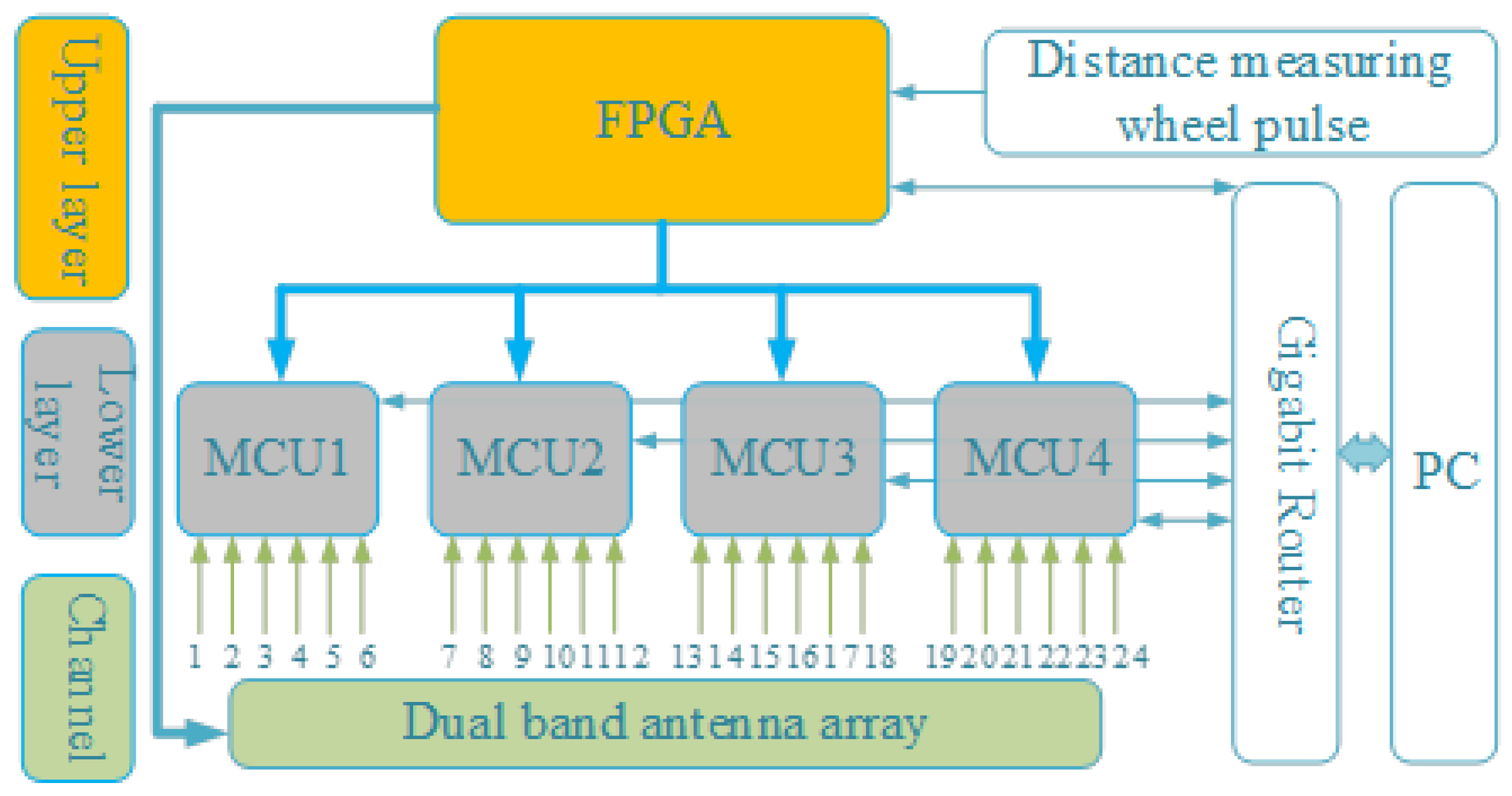
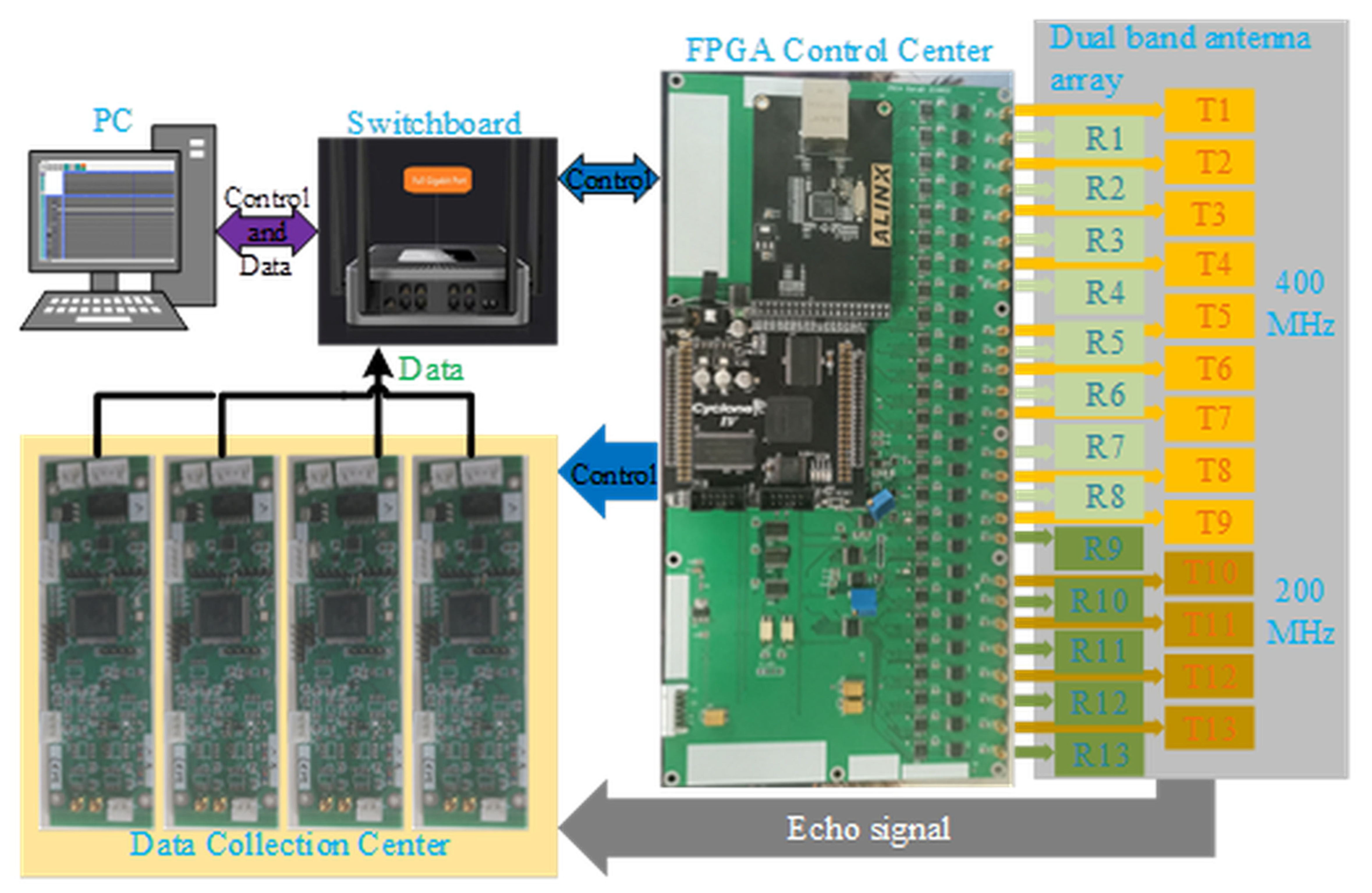
The dual-band 3D GPR system, tailored for urban subsurface exploration, consists of four key components: a dual-band antenna array, an FPGA-based control center, a distributed multi-MCU data acquisition cluster, and PC-based data acquisition software. Leveraging this architecture, we propose a dual-layer data acquisition and control technology designed to meet the complex demands of urban infrastructure surveys, as illustrated in Figure 1. The upper layer utilizes an FPGA as the master controller. Its role is to interpret configuration parameters received from the PC software via a Gigabit router and to precisely generate the control signals and timing for the lower-layer data acquisition. The lower layer is a distributed acquisition cluster comprising multiple MCUs (e.g., four MCUs, each synchronously collecting data from six channels). This layer is responsible for aggregating echo data from the antenna array and transmitting it in real time to the PC software through the Gigabit switch. The defining advantage of this dual-layer architecture lies in its dynamic scalability. By simply increasing the number of MCU nodes in the lower layer, the total channel count can be linearly expanded. This flexibility allows the system to meet the high-precision imaging requirements of various urban road detection scenarios, such as different coverage widths or multi-frequency combinations, effectively overcoming the fixed-channel limitation of conventional 3D GPR systems.

2.1. Upper Layer FPGA Control Design

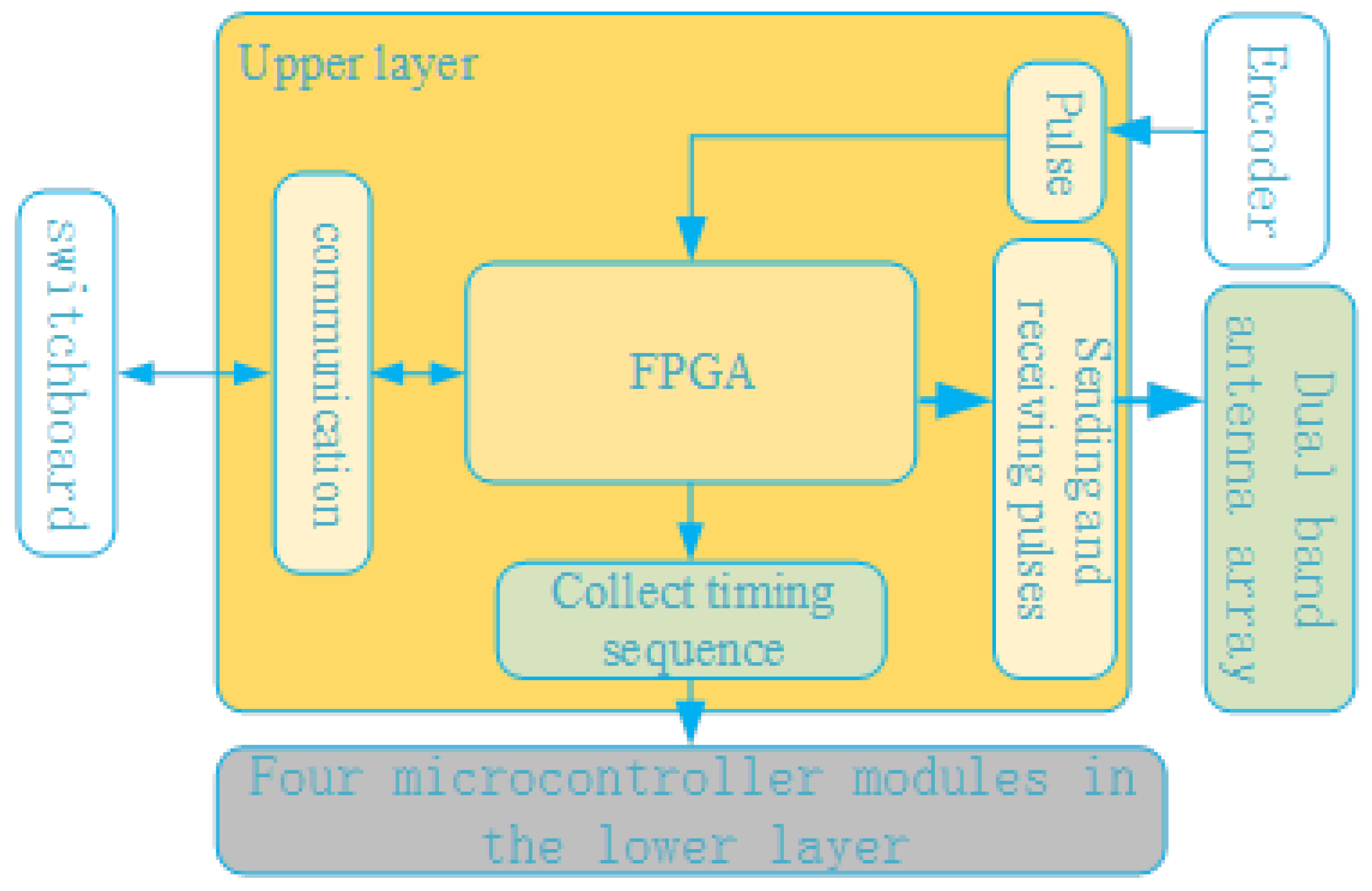
In order to achieve the operation of the dual-band 3D GPR system, the upper FPGA control center mainly needs to complete communication with the data acquisition software, receive ranging wheel pulse information, generate 24 pairs of transmitting and receiving pulses, and synchronously generate acquisition timing for the four MCU modules in the lower layer, as shown in Figure 2.

2.2. Lower Level MCU Data Acquisition Cluster Design

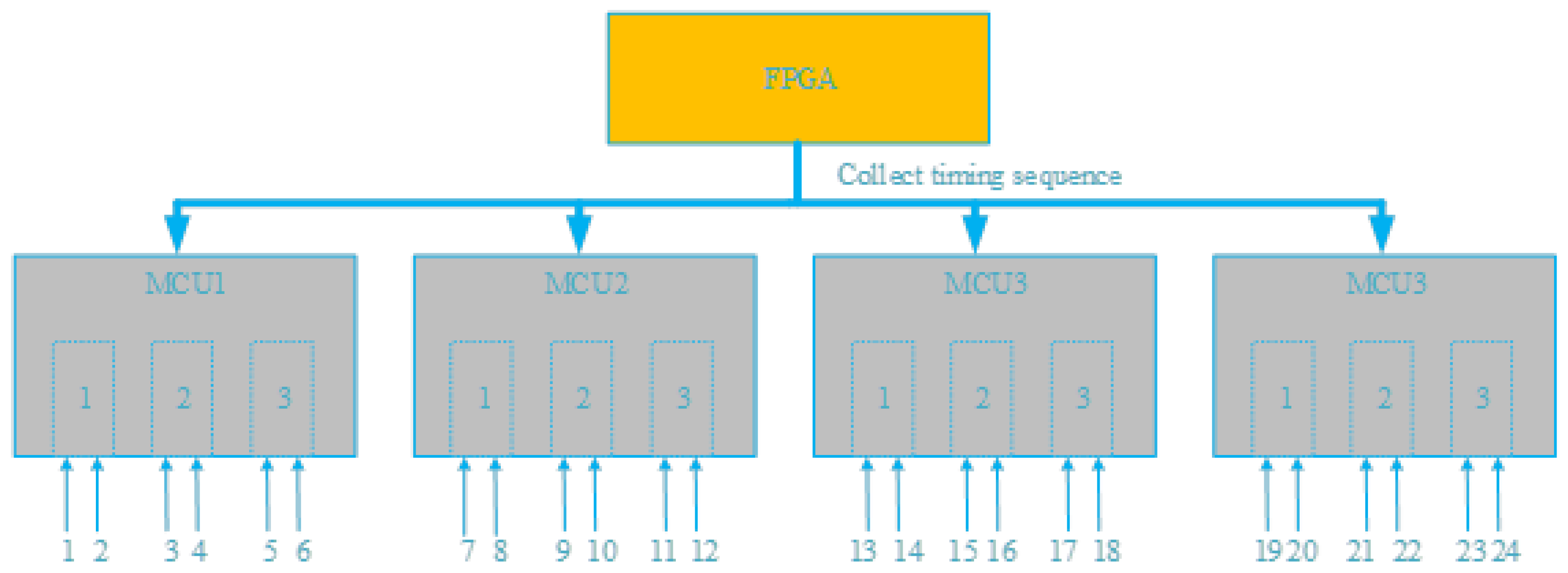
As shown in Figure 3, the lower layer uses four microcontrollers to form a data acquisition cluster, which adopts synchronous acquisition. By increasing the number of microcontrollers in the lower layer, the number of GPR channels can be dynamically expanded by one to six for each additional one. The upper layer FPGA only needs to provide one to six acquisition timing transmission pins to achieve high-precision acquisition requirements for multiple main-frequency 3D GPR. This technology breaks through the limitations of the limited fixed antennas in current 3D GPR.

3. Hardware

3.1. Antenna Array

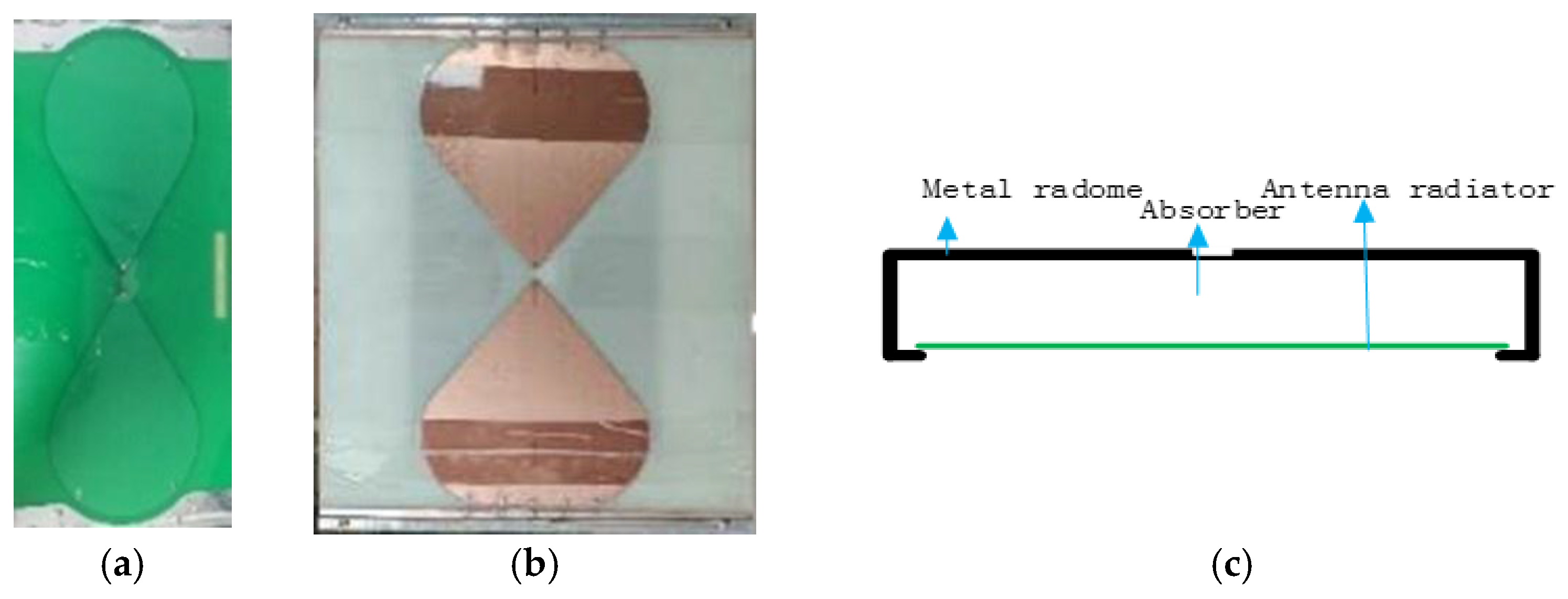
As shown in Table 1, based on the practical application of single-channel GPR systems and the two main technical parameters of 3D GPR, resolution and detection depth, for urban roads, antennas with center frequencies of 200 MHz and 400 MHz are a good choice to achieve detection targets for road subgrade structures and foundations, as well as underground disease detection exceeding 3 m, with good resolution. Their structure is shown in Figure 4.
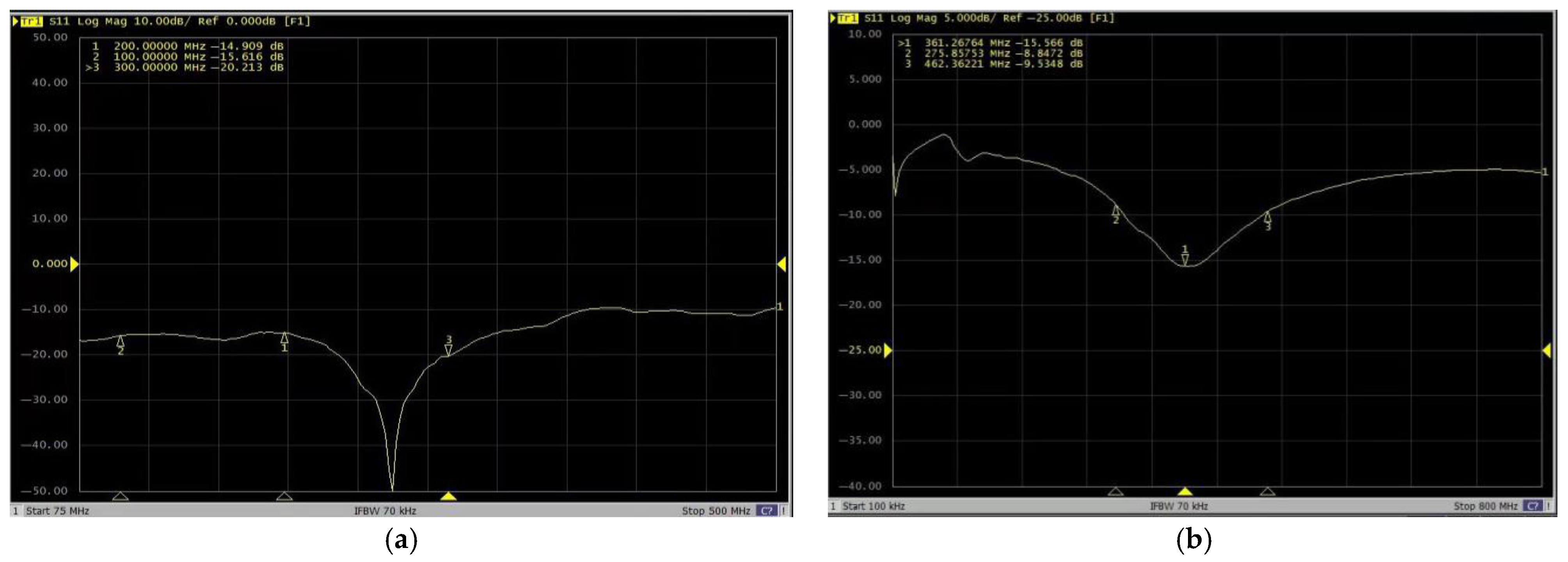
The results of measuring the return loss S11 using a digital serial analyzer are shown in Figure 5. It can be clearly observed that the return loss of the 200 MHz and 400 MHz bowtie antennas is less than −15 dB, proving that the antennas have good impedance matching performance.
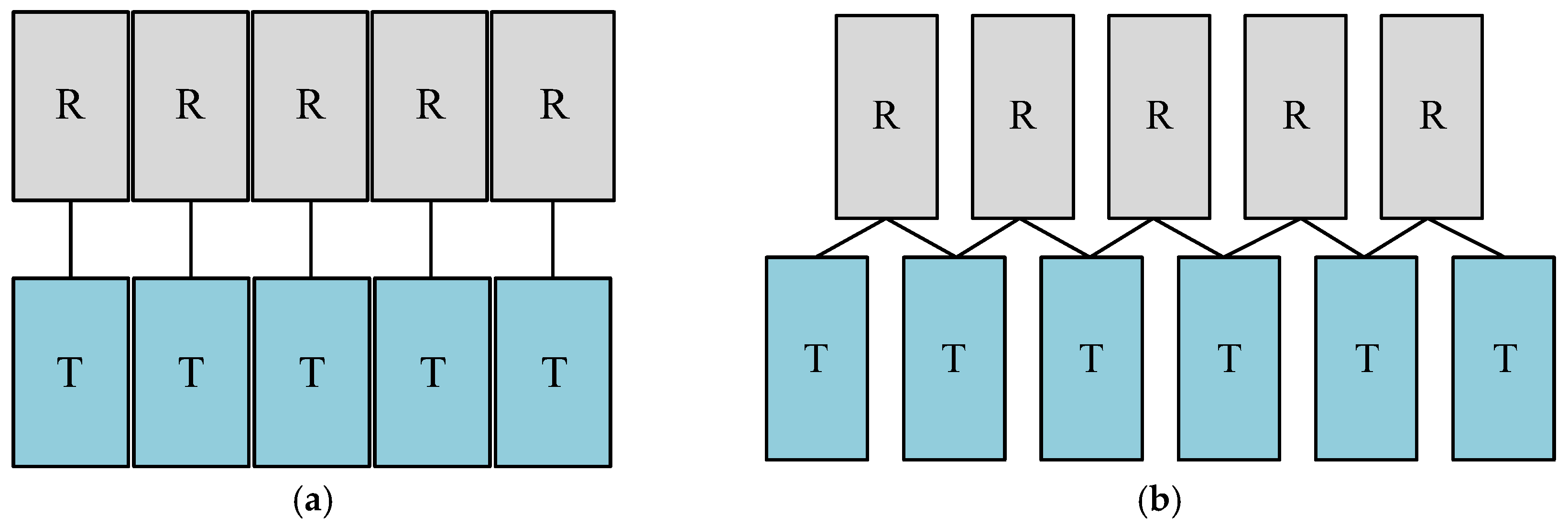
There are two ways to obtain 3D data (C-scan) from GPR. One is to match one transmitting antenna to one receiving antenna, that is, a 1:1 transmitting antenna/receiving antenna; Another type is where multiple transmitting antennas correspond to multiple receiving antennas, that is, an N:N transmitting antenna/receiving antenna [30,31]. The former adopts a one-to-one arrangement, which is a simple arrangement where the transmitting antenna corresponds to the receiving antenna, equivalent to repeating the two-dimensional measurement method at regular intervals, as shown in Figure 6a, where T represents the transmitting antenna and R represents the receiving antenna. N: The N-arrangement is a staggered arrangement of multiple GPR transmitting and receiving antennas, as shown in Figure 6b.
For N:N arrays, sending signals from a single transmitter to multiple receivers has the advantage of increasing the horizontal resolution (number of channels) to more than twice that of a 1:1 array without increasing the number of transmitters. Obviously, the N:N arrangement is better than the 1:1 arrangement.
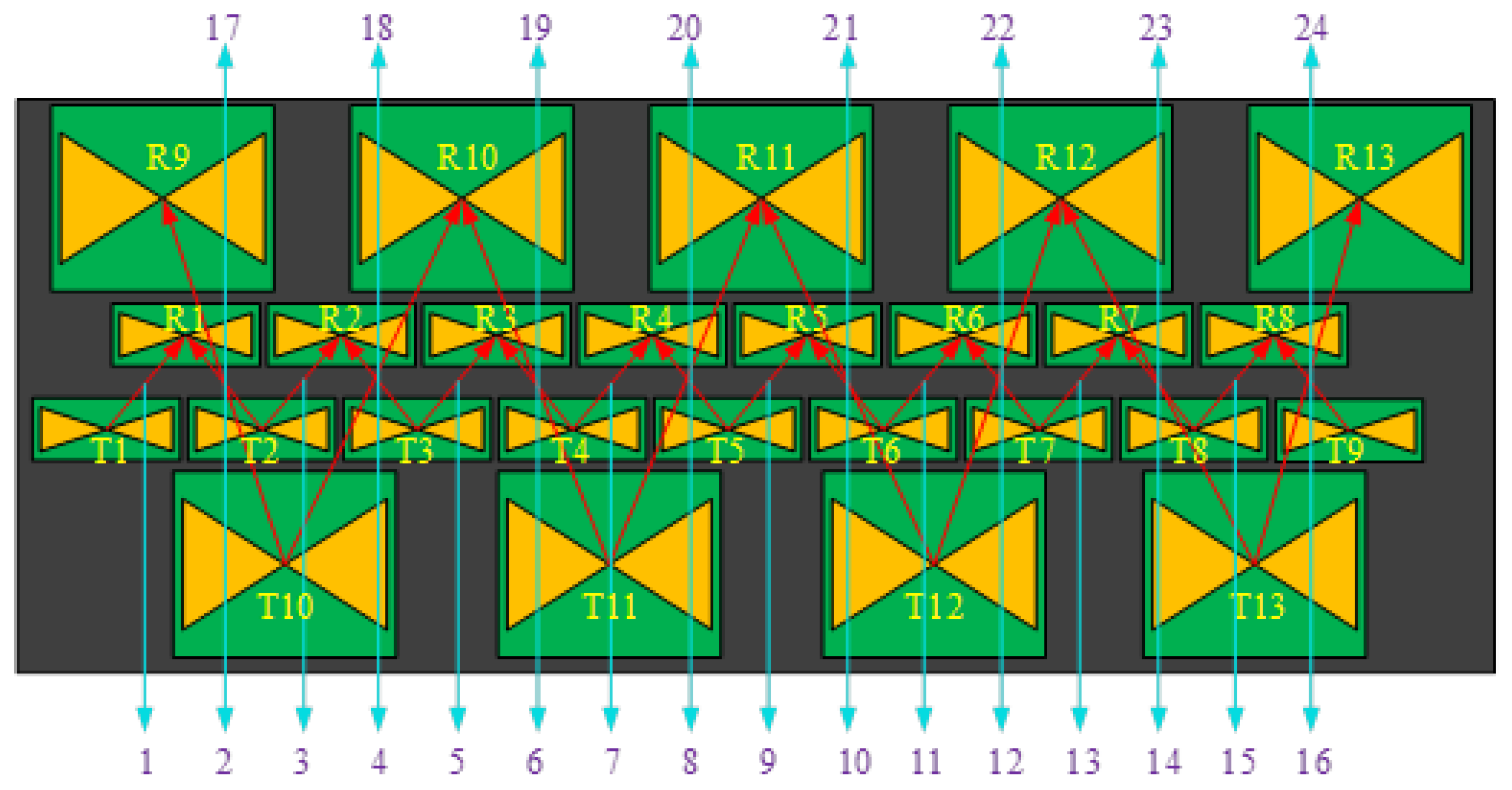
The system strictly follows the requirements of the “Technical Standards for Highway Engineering” and has designed a dual-frequency N:N array antenna layout scheme with a width limit of 3 m, as shown in Figure 7. For the two operating frequency bands of 400 MHz and 200 MHz, nine transmitting antennas and eight receiving antennas (9T8R) are respectively configured as high-frequency antenna units, forming 16 channels, labeled as channels one to 16, and 4T5R low-frequency antenna units, forming eight channels, labeled as channels 17 to 24, for a total of 13T13R antenna units, for a total of 24 channels. This design fully considers the impact of the antenna shielding shell and shielding materials on array performance. Adopting a dual-row N:N array layout architecture and a grounded-coupled TE polarization layout. A 24-channel 3D GPR array system consisting of sixteen 400 MHz channels and eight 200 MHz channels was ultimately constructed using a common offset channel combination method. This design achieves a strict equidistant arrangement of channels within the same frequency band, and ensures spatial consistency of the dual-frequency acquisition center through careful geometric design.

3.2. Control Technology

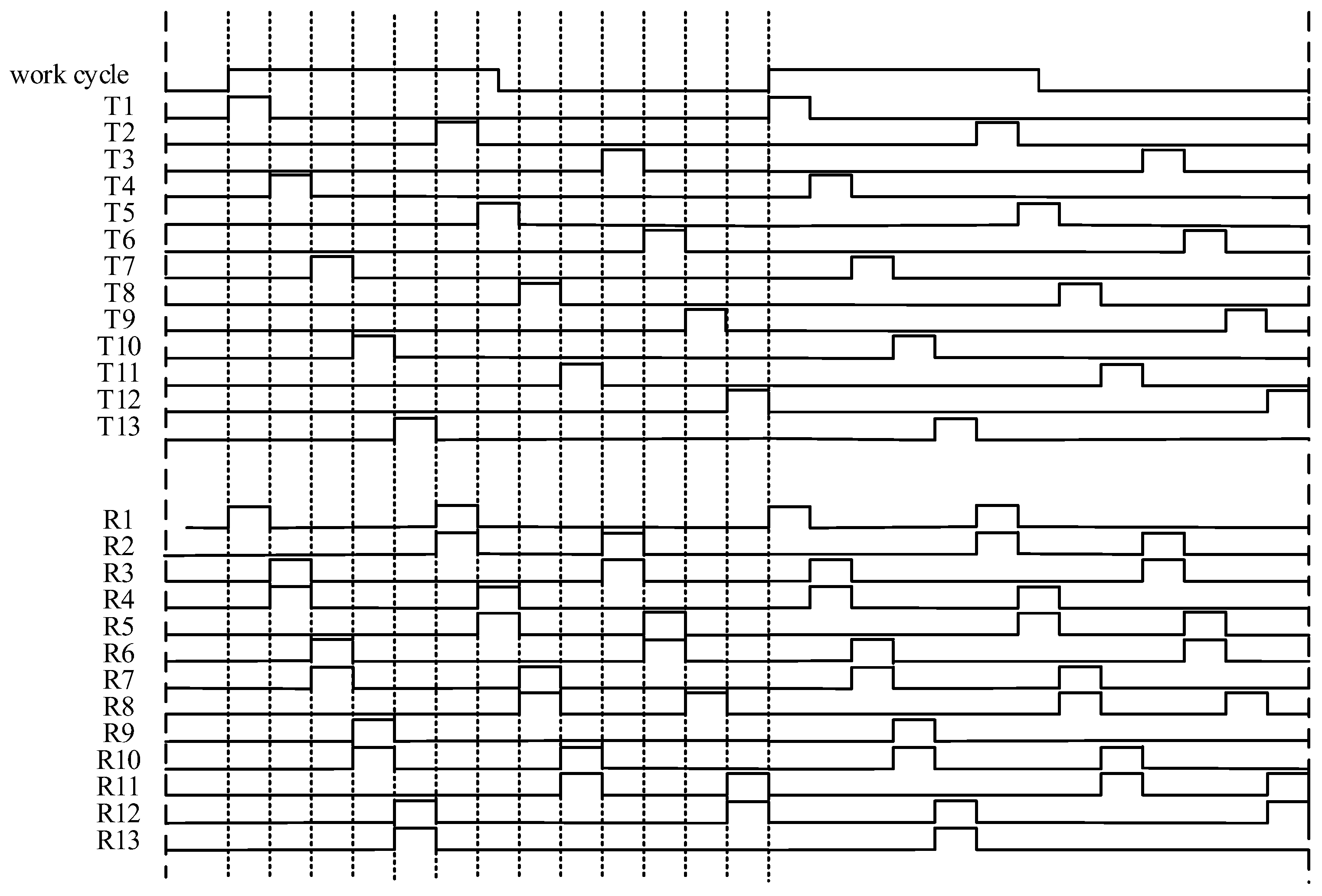
This 3D GPR system utilizes 24-channel sequential equivalent sampling with a 200 kHz working cycle, completing one cycle of equivalent sampling point acquisition across all channels within 5 μs. In TDM mode, each channel operates at a 5 μs/24 = 0.2083 μs cycle (4.8 MHz), exceeding the MCU ADC’s 3.6 MHz limitation. Unlike conventional time-division multiplexing (TDM), which sequentially scans all channels regardless of signal activity, the proposed time-division superposition multiplexing (TDSM) protocol dynamically overlays temporally separated but structurally similar signals, thereby reducing the number of required sampling windows without sacrificing measurement resolution. After improving TDM in this system, the TDSM method was obtained: first implementing a one T2R (the antenna array adopts a one transmitter, two-receiver mode) configuration to extend the channel operating cycle to 0.3846 μs (equivalent to 2.6 MHz), complying with MCU constraints; then employing a staggered switching sequence across 13 transmitters (T1 → T4 → T7 → … → loop) to extend the receiver’s (R) minimum continuous operating interval to 1.1538 μs (0.3846 μs × 3) as shown in Figure 8. Compared to conventional TDM, this optimized TDSM method not only extends channel operating cycles but also reduces receiver switching frequency, effectively alleviating the operational load.
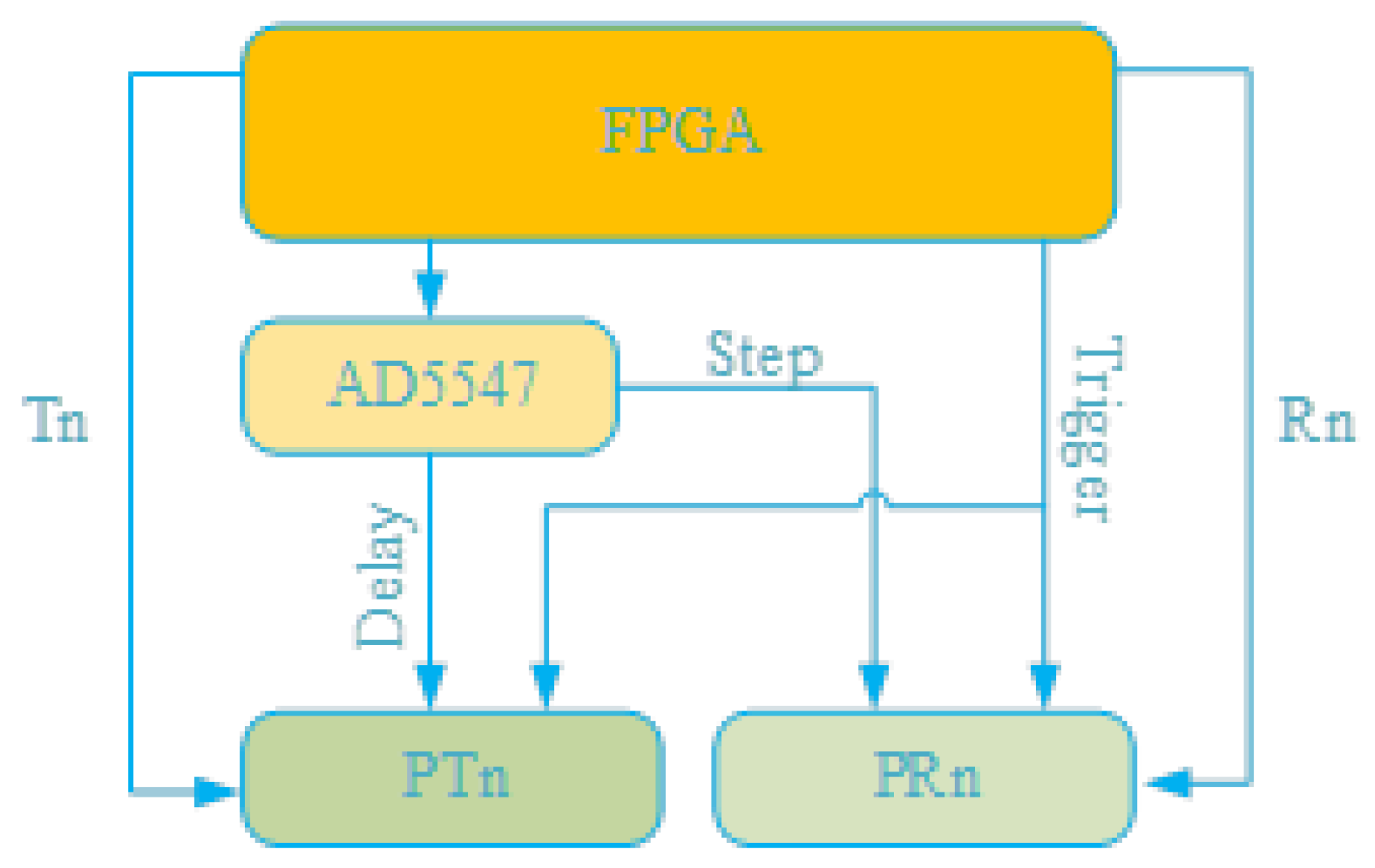
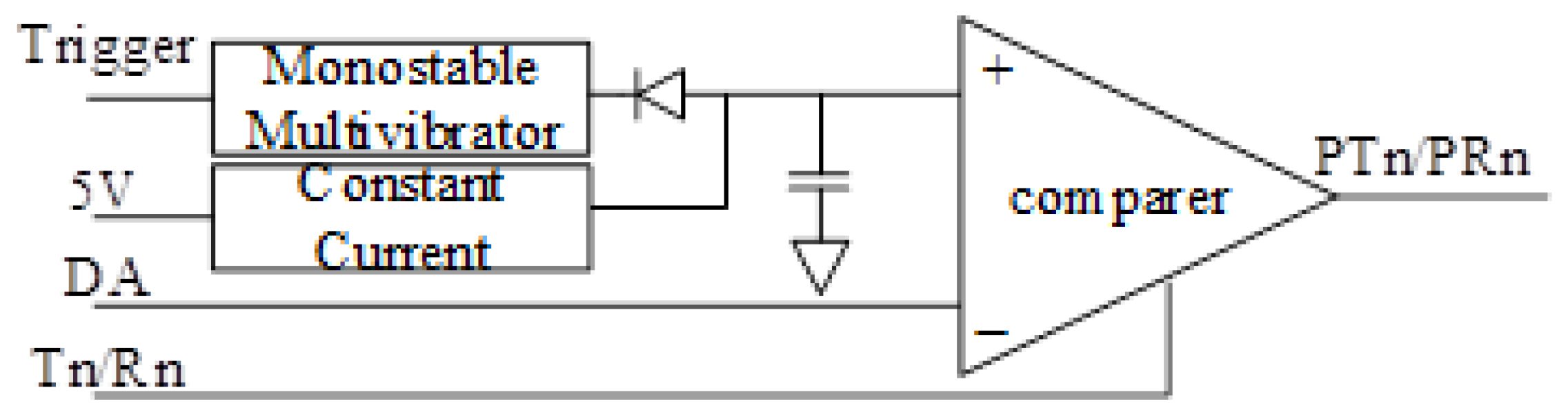
For GPR systems using equivalent sampling methods, a high-precision step delay circuit is extremely important, as it determines the accuracy of the GPR signal acquisition system [32,33]. As shown in Figure 9, a schematic diagram of a channel-pulse pair is generated. The process involves selecting the transmitting antenna switch Tn and synchronously selecting the receiving antenna switch Rn. At the same time, delay, step, and trigger signals are sequentially generated and sent to the transmitting pulse generator and the receiving pulse generator to generate a channel pulse pair, namely the transmitting pulse PTn and the receiving pulse PRn, as shown in Figure 10.
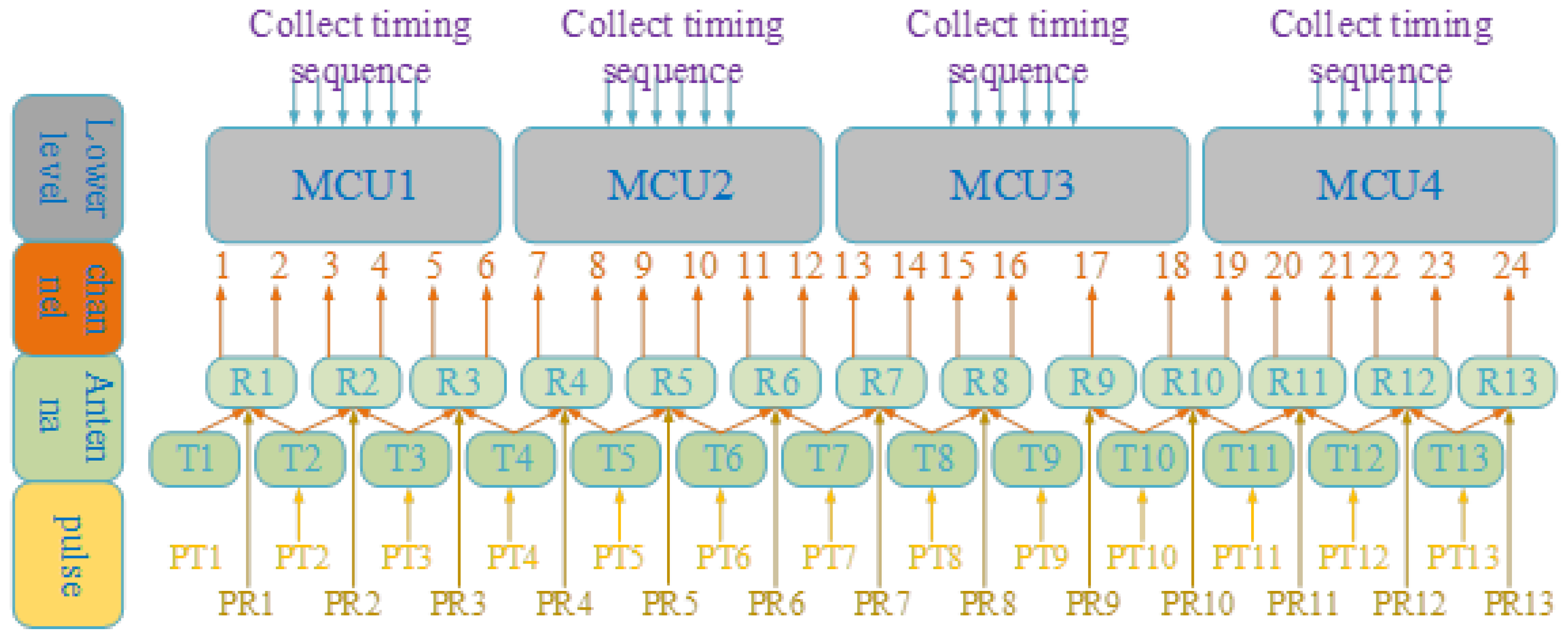
As shown in Figure 11, the designed dual-band 3D GPR system uses TDSM technology to generate transmitting and receiving pulses through the FPGA to select the working antenna and receive the echo signal to the corresponding microcontroller module. The MCU module collects the echo data of the channel according to the corresponding acquisition timing rising edge sent by the FPGA and enters it into the cache. After collecting six channels of data, each MCU module packages these six sets of data and transmits them to the computer software for processing through a port of a gigabit router switch.
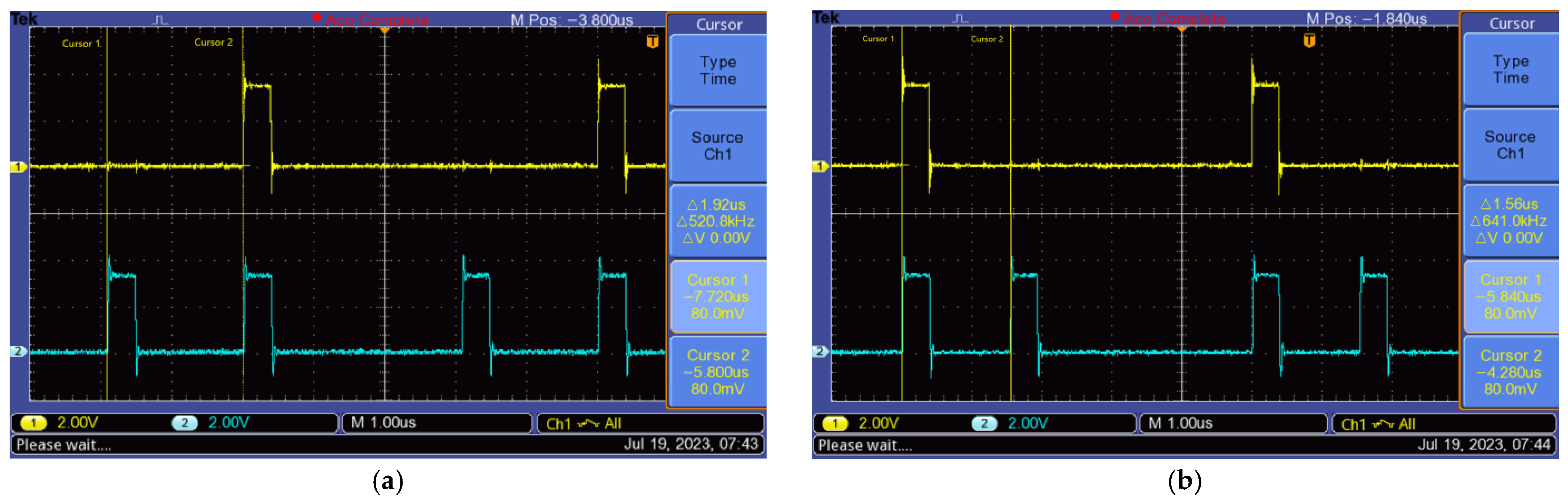
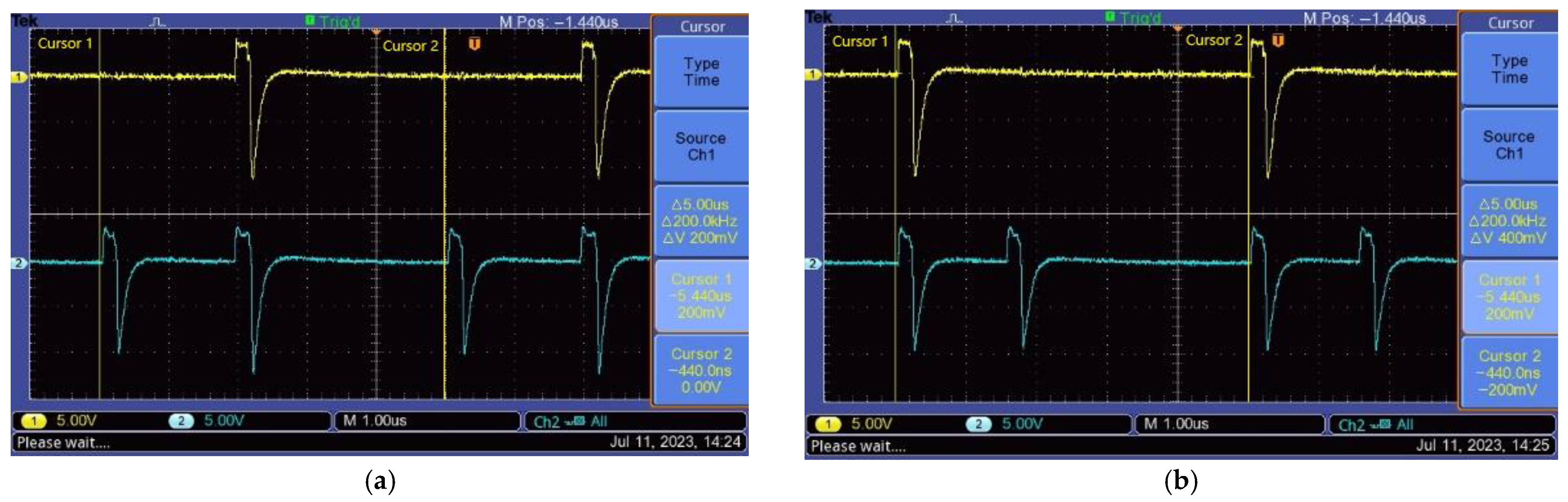
In order to verify the TDSM effect in the switch logic control module, it is necessary to use an oscilloscope to observe the timing relationship of each channel’s output clock. Considering the symmetry of the module and the limitation of the number of oscilloscope channels, select and combine the transmission switch T8 and the reception switch R7/R8, as well as the corresponding transmission pulse PT8 and reception pulse PR7/PR8, and connect them to the oscilloscope (TBS1102B-EDU, Tektronix, Elgin, IL, USA) for observation. The switch timing and pulse wave shown in Figure 12 can be obtained, where the yellow line represents transmission and the blue line represents reception. As shown in Figure 12a,b, combined with the relationship between T8 and R7/R8 in Figure 5, the turn-on time of a single switch can be obtained as 0.387 μs (the average of 1.92 μs/5 = 0.384 μs and 1.56 μs/4 = 0.39 μs). Considering the error between the oscilloscope and the measuring line, this is consistent with the previously calculated theoretical value of 0.3846 μs. Figure 12a shows that the opening interval of the front and rear transmitting antenna switches (selecting R7 and R8) is 1.533 μs (1.92 μs–0.387 μs). Figure 12b shows that the opening interval between the front and rear transmitting antenna switches (selecting R7 and R8) is 1.173 μs (1.56 μs–0.387 μs), which is within the error range of the calculated minimum interval of 1.1538 μs. Figure 13a,b show the channel pulses corresponding to the switch timing, with each pulse having a period of 5 μs, achieving a working frequency of 200 kHz.

3.3. Units

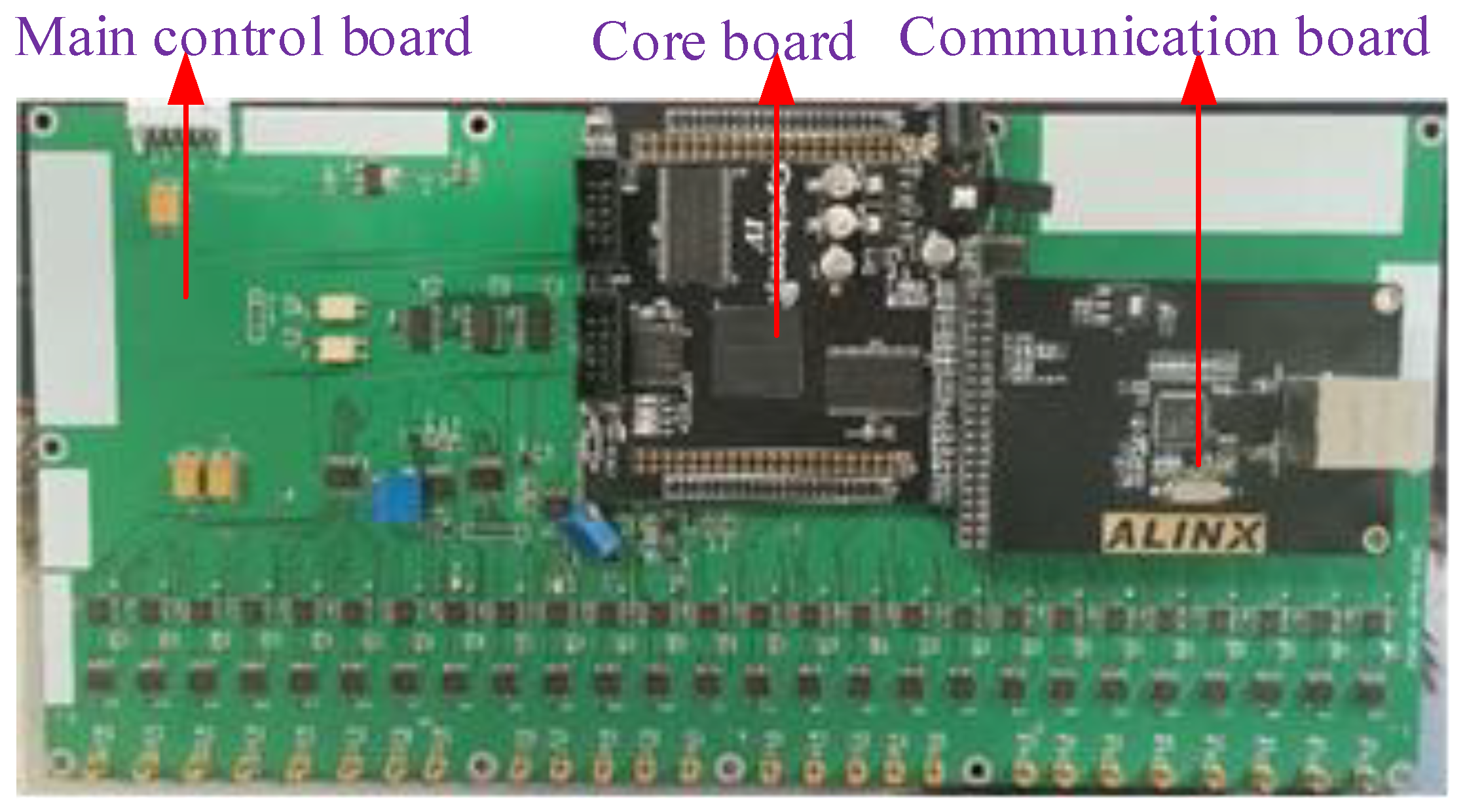
The FPGA control center motherboard of the designed dual-band 3D GPR system consists of an FPGA core board, a communication board, and a self-made new main control board, as shown in Figure 14. The AX415 Cyclone IV core development board and its communication board are made of black gold, and the FPGA chip is Altera product EP4CE15E17C8N (Penang, Malaysia/San Jose, CA, USA), which has low power consumption and strong anti-interference. A new control center main control board for the dual-band 3D GPR has been designed and developed based on a dual-band antenna array, including a DA conversion circuit, a level comparison circuit, a switching circuit, a distance measuring wheel input circuit, and a power supply circuit.
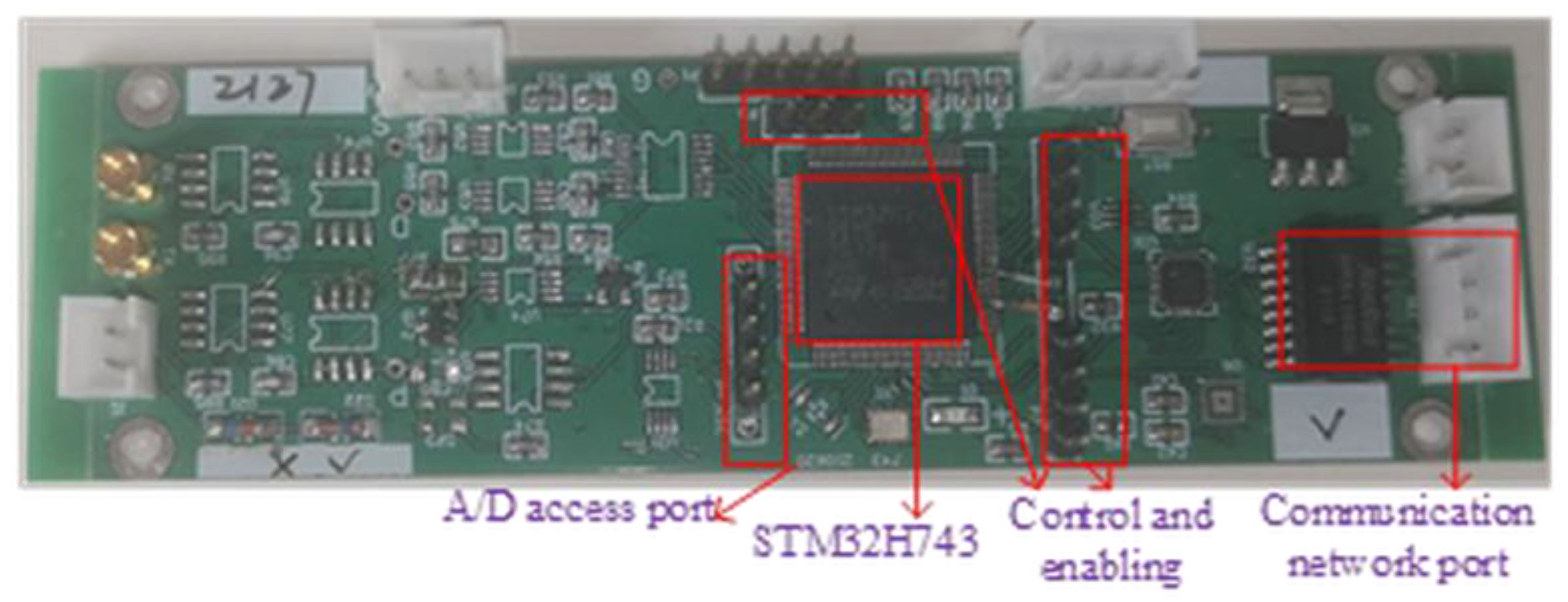
As shown in Figure 15, the acquisition board includes a network communication circuit, an A/D input circuit, and an acquisition control and timing input circuit, mainly responsible for echo data acquisition, as well as the caching and transmission of each channel. The selected MCU integrates three A/D converters, and when the sampling bit is 16 bits, its maximum frequency is 3.6 MHz. After completing data collection for six channels, each MCU will package the data from each channel into independent UDP packets and send them to the PC through a gigabit router for centralized processing by the upper computer software.
According to the system structure, all the unit modules included in this 3D GPR are connected and arranged as shown in Figure 16. The control center, data acquisition center, and dual-band antenna array are assembled and installed in the loading device at the rear of the vehicle. They are connected to the on-board switch via Ethernet cables, and a computer carrying the data acquisition software is installed in the vehicle and also connected to the switch via Ethernet cables, achieving the integration of the 3D GPR system. During the detection process, the operator drives the vehicle to scan the target area and obtain the required GPR data. When the system is triggered, a complete set of 24-channel data containing its location can be collected as early as every 3 milliseconds. Under the requirement of ensuring imaging accuracy, with a sampling interval of 5 cm, the vehicle speed can reach 70 km/h, and the vehicle can be measured on the road at normal speed.

4. Software

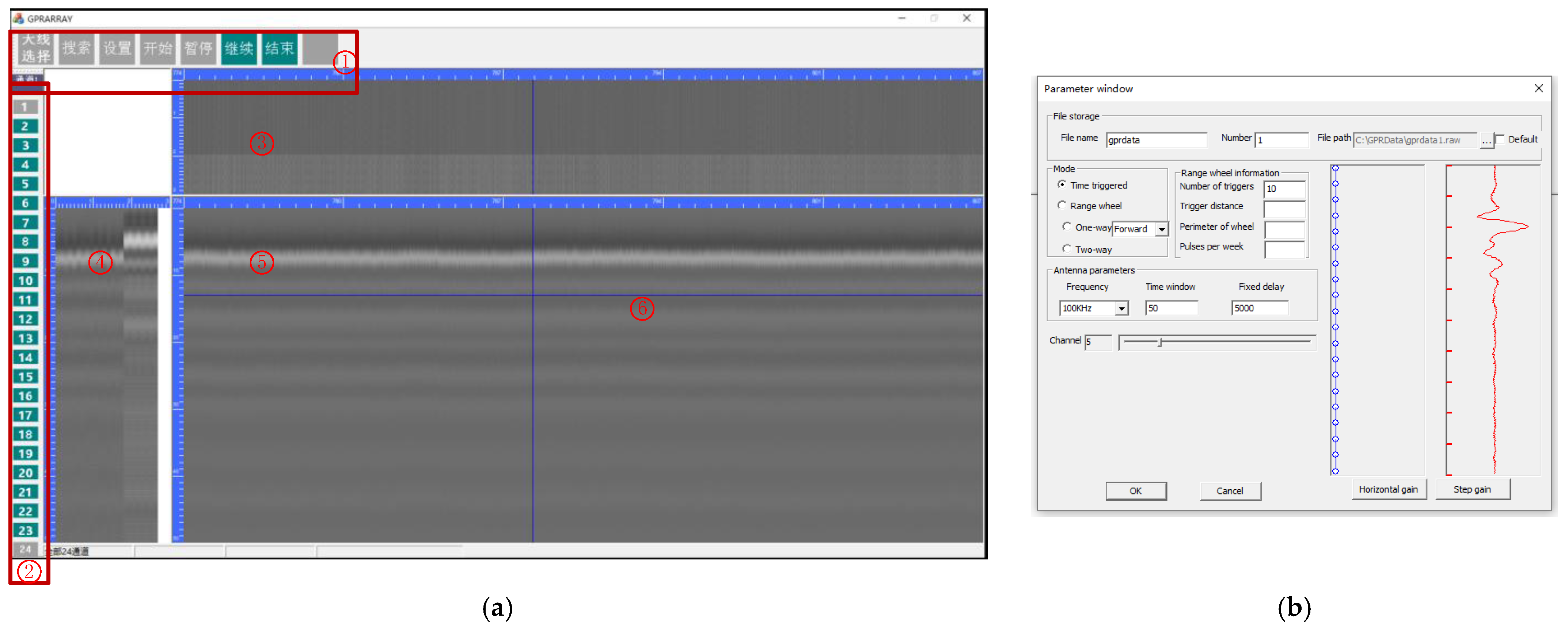
The data acquisition control software includes communication and acquisition control, aiming to achieve and control the configuration of acquisition parameters and data acquisition process for different channels. VC++ programs were designed to configure and manage computers and main control modules, achieving data transmission and storage. The acquisition control and data display interface is shown in Figure 17a, where 1 represents the antenna selection and acquisition control buttons. The antenna array can be selected to turn on all dual-band antenna arrays, only the 400 MHz antenna arrays, or only the 200 MHz antenna arrays. The rest are acquisition control buttons that control the acquisition parameter settings, as well as the processes of starting, pausing, continuing, and ending; 2 represents the channel selection button for selecting the two-dimensional profile displayed in 5; 3 represents the real-time horizontal section display split screen; 4 represents real-time vertical section display split screen; 5 represents the two-dimensional cross-section display split screen of the selected channel in 2; 6 represents the real-time position tangent of the horizontal and vertical sections, and the horizontal line can be moved up and down with the mouse button to select different depths of water-slice sections, which are displayed in real time in 3. The parameter acquisition interface is shown in Figure 17b. Through this interface, all channel acquisition parameters are set, and the parameters are transmitted to the FPGA according to the network port and switch to prepare for data acquisition.
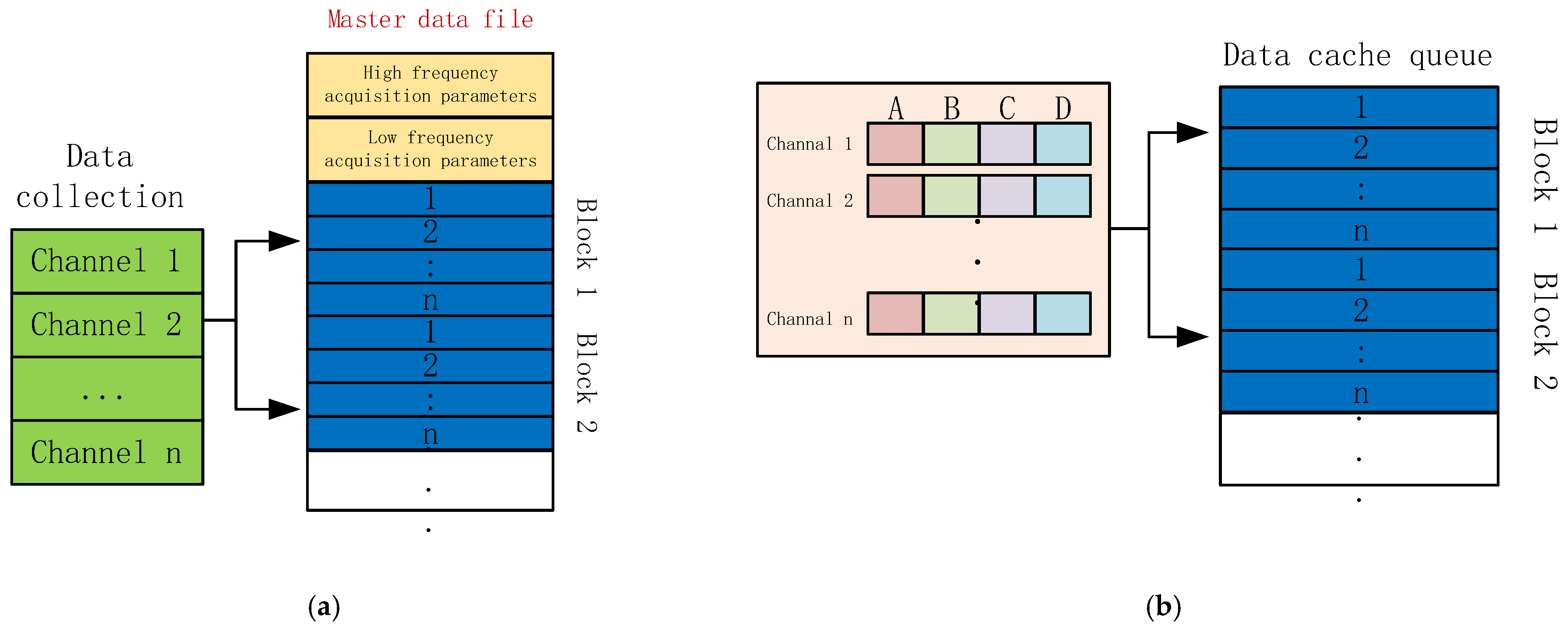
This program has designed two threads, the sampling thread and the drawing thread, to respectively implement data acquisition and real-time data display. Two formats of data files have been created, including the main data file and the auxiliary data file, for storing mine-detection radar data and related auxiliary data (including positioning and video data). The main functions of the sampling thread include storing the interval distance parameters of the measurement wheel in an auxiliary file, storing the head data (acquisition parameters of different frequencies) in the main data file and data acquisition circuit (for AD conversion and storage), and the drawing thread is used to draw the collected data on the view window.
As shown in Figure 18a,b, all collected parameters at different frequencies are used as header data. Firstly, they are transmitted and saved to the main data file through a USB storage device, which will be found on the hard drive. In this way, data blocks composed of sampling data collected from different channels in a collection cycle will be saved until the collection stops. In addition, another data transmission task is configured through the computer bus to provide the necessary information for the drawing thread. A buffer data array is create in the computer memory, designed to have a size of 30, so there are 30 data blocks. Assuming that the size of each data block is equal to the number of channels n, then one data block has n arrays, where each array consists of four vectors, including GPR data, channel number, view number in the view window, and B-scan number. By configuring the computer in multi-threaded mode and adopting the above technology, seamless acquisition, data transmission, and storage of GPR signals with pulse frequencies up to 200 kHz have been achieved without causing data path blockage.

5. Testing and Results

5.1. Model Testing

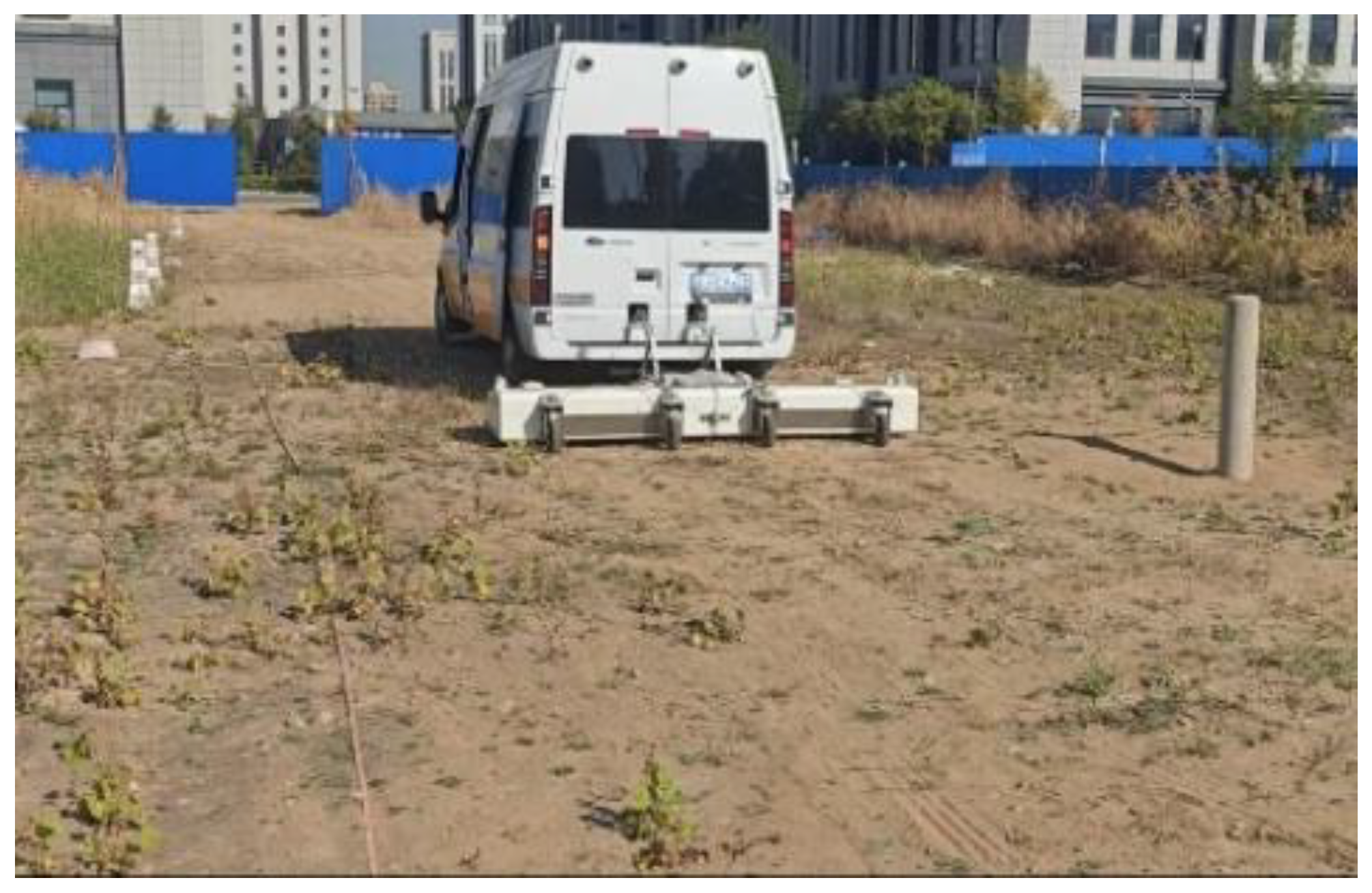
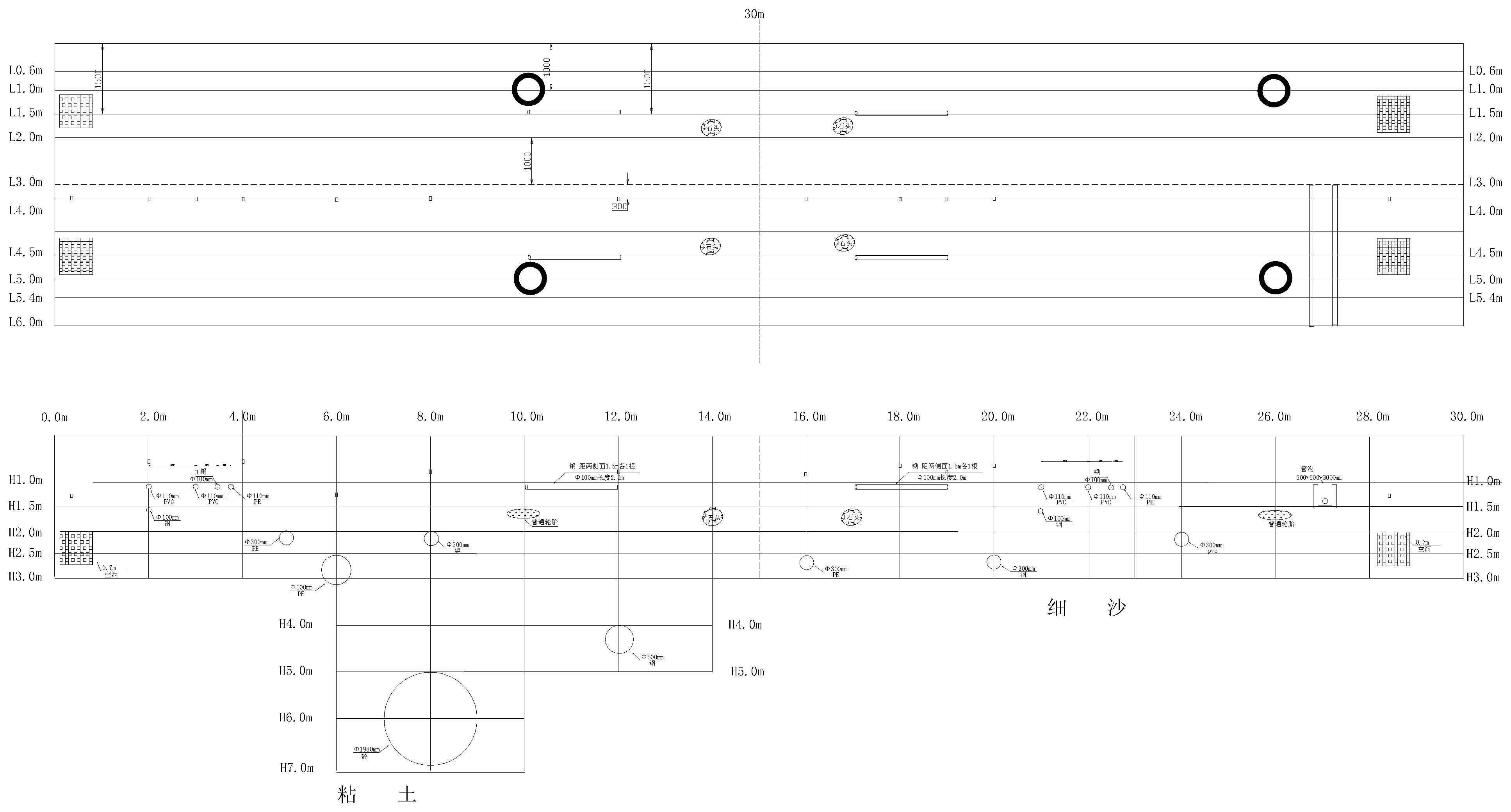
The laboratory physical model is 30 m long, 20 m wide, and 7 m deep, including targets at depths of 3 m and 5 m. The on-site vehicle experiment is shown in Figure 19. The experimental model is shown in Figure 20, with half of the buried medium consisting of clay and the other half consisting of fine sand. The model has rich detectable objects at different depths and of various materials, including pipes of different sizes and materials such as PVC, PE, steel and other materials, as well as tires; models of cavities, stones, and pipe trenches have also been established.

5.2. Model Datasets

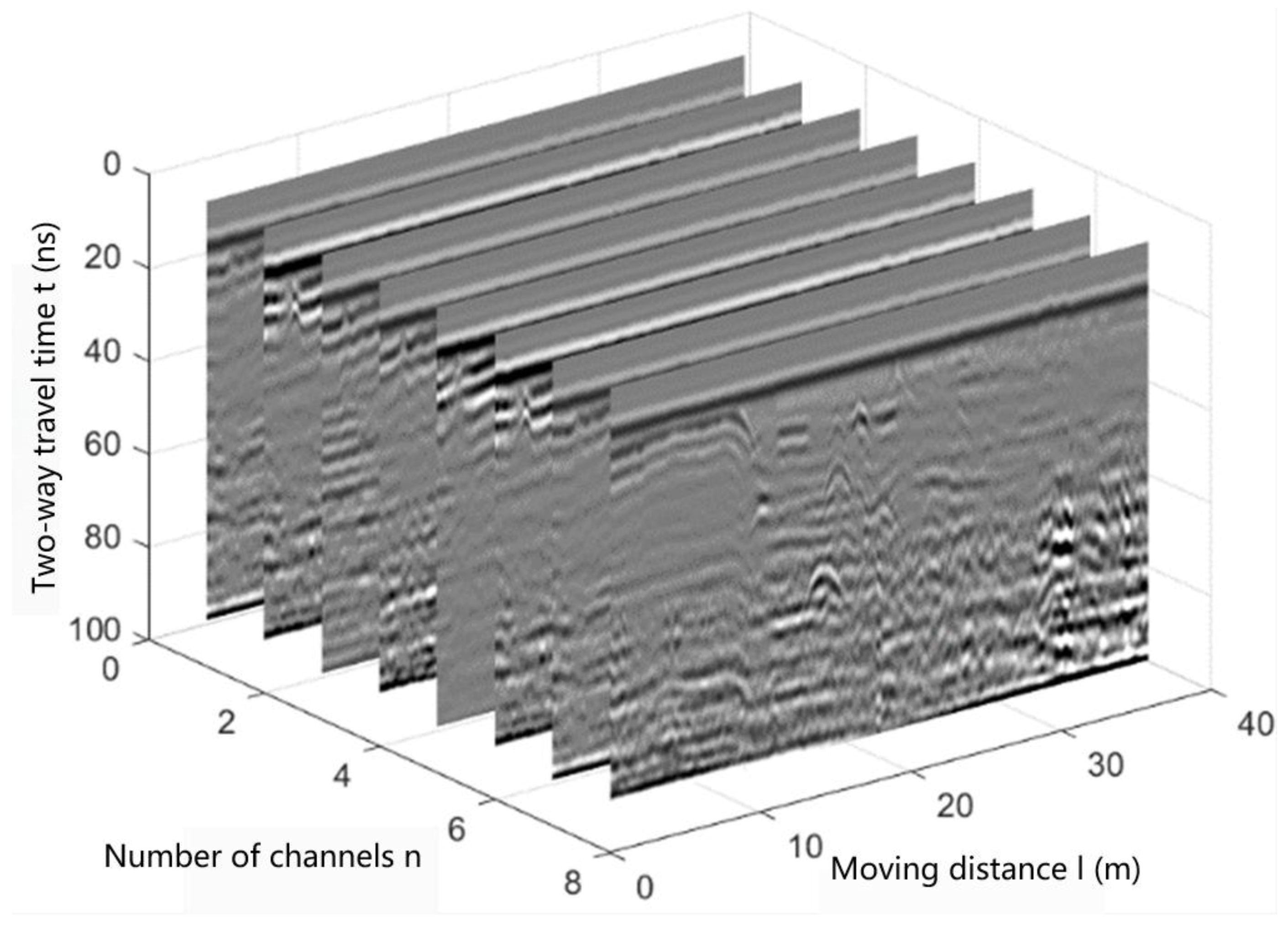
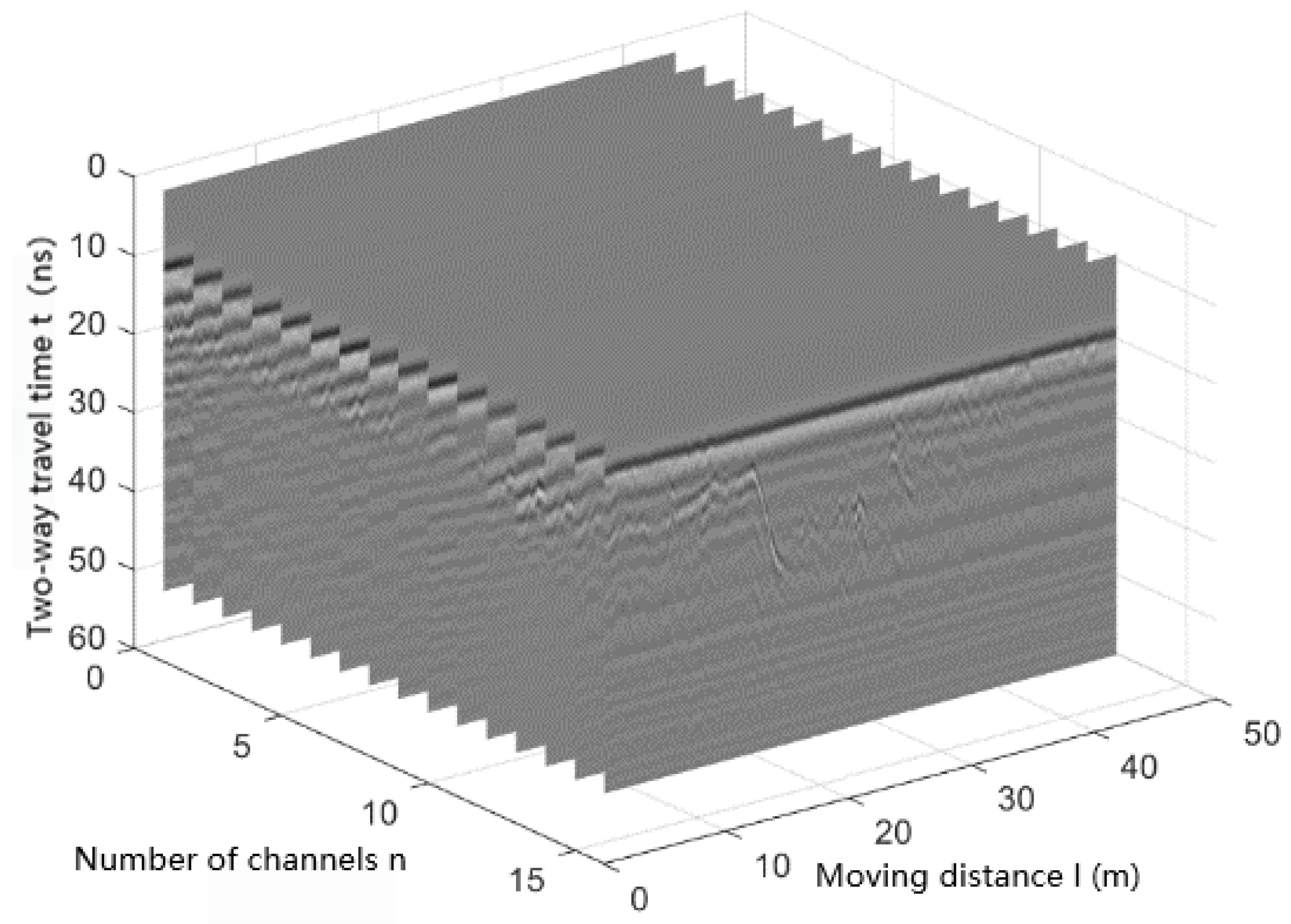
The configuration time window (two-way travel time t) of the high-frequency ground penetrating radar is 50 ns, and that of the low-frequency ground penetrating radar is 90 ns, both using 512 sampling points with a moving data frame spacing of 0.0207 m. An 8-channel low-frequency ground penetrating radar dataset and a 16-channel high-frequency ground penetrating radar dataset were obtained, and signal processing such as filtering and gain was performed on each channel. Different datasets were placed into a 3D coordinate system consisting of the moving distance l, sampling channel n, and two-way travel time t, resulting in the low-frequency ground penetrating radar 3D dataset shown in Figure 21 and the high-frequency ground penetrating radar 3D dataset shown in Figure 22. Based on these 3D datasets, subsequent 3D slicing can be established.

5.3. Fusion

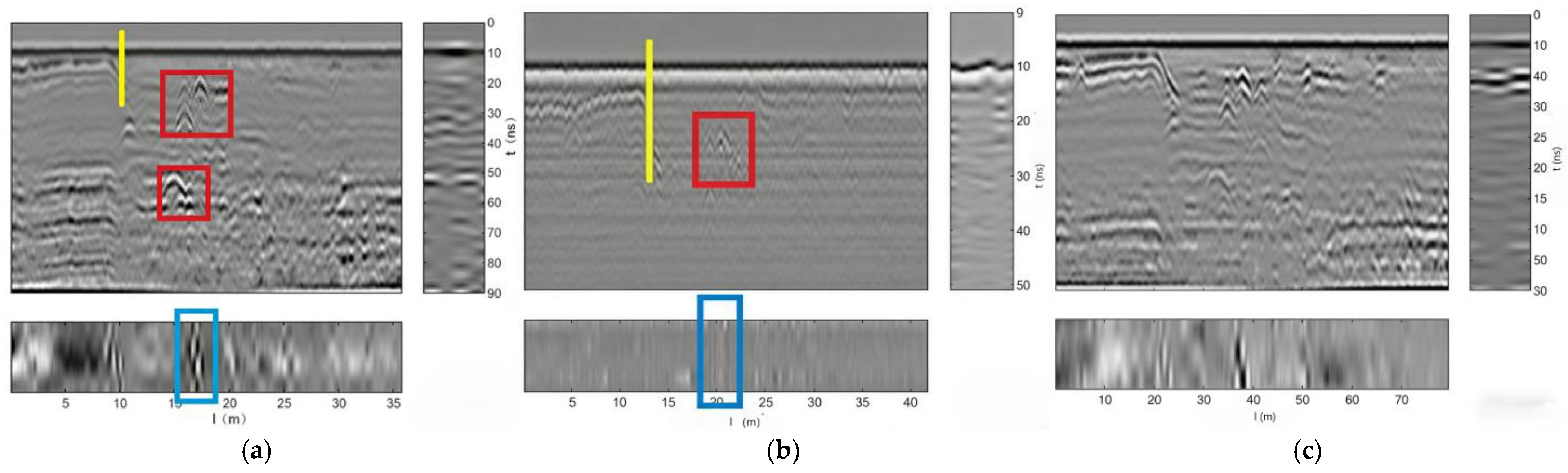
By processing the above dataset in three directions: vertical (in the middle, cutting downwards along the survey line direction), horizontal (in the bottom, cutting horizontally at various depths along the survey line direction), and lateral (in the right, cutting downwards perpendicular to the survey line direction), the low-frequency 3D GPR section shown in Figure 23a and the high-frequency 3D GPR section shown in Figure 23b can be obtained. From the figure, it can be seen that the yellow lines in the vertical profiles of low-frequency and high-frequency GPR indicate a clear boundary between clay and fine sand. The relative dielectric constant of clay is 8–12 higher than that of fine sand, which is 4–6. The penetration ability of GPR signals in clay is poorer, so deeper targets can be detected in fine sand. The red box in the longitudinal section displays multiple hyperbolas detected in sandy soil, consistent with the positions of pipes made of various materials in the model. The GPR data in the blue box of the horizontal section also confirms that it is a pipeline. The red box at the bottom of the longitudinal section of the low-frequency GPR indicates that it has detected deeper objects, while the high-frequency GPR cannot detect them. Moreover, the hyperbolas in the red box of high-frequency GPR are more numerous and clearer than those in the upper red box of the longitudinal section of low-frequency GPR, indicating that the resolution of low-frequency GPR is relatively low. So, the combination of multi-frequency GPR is necessary and complementary, which has more obvious advantages for the clear detection of underground anomalies. According to the layout of the dual frequency array antenna (Figure 7), the low-frequency GPR channel measurement line is almost identical to the high-frequency GPR even channel measurement line, that is, the low-frequency channel 17 measurement line and the high-frequency channel 2 measurement line, the low-frequency channel 18 measurement line and the high-frequency channel 4 measurement line are the same. Therefore, dual-frequency data fusion processing can be directly performed [34]. As shown in Figure 23c, dual frequency GPR data can be fused into a 3D slice image, which can improve shallow resolution while preserving deep information.
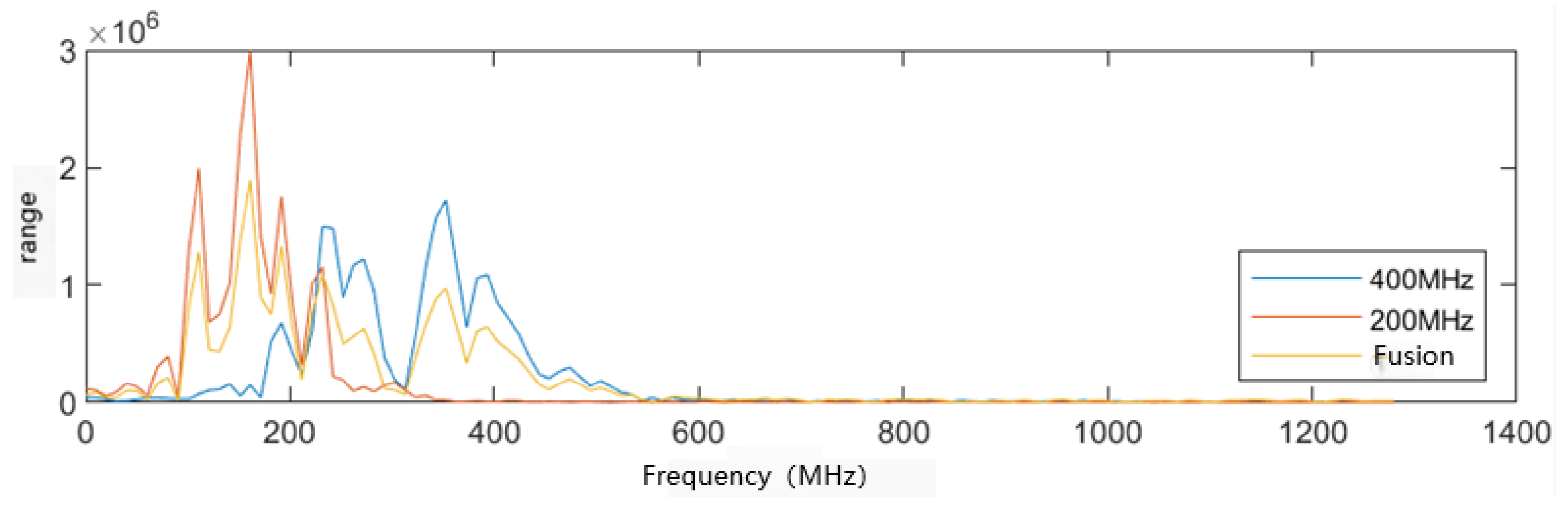
As shown in Figure 24, the measured bandwidth range of GPR data with a center frequency of 200 MHz is 100 MHz~300 MHz, and the measured bandwidth range of GPR data with a center frequency of 400 MHz is 200 MHz~500 MHz. After convolution sparse representation fusion, the bandwidth range of GPR data is 100 MHz~500 MHz, and the data bandwidth is increased by at least about 30% after fusion.

5.4. Speed Test

Assuming the data sampling frequency is f c , the number of data channels N that can be collected during the collection time of each channel t can be obtained from Equations (1) and (2):
t = P / f c
N = t / t
P is the number of sampling points for each data channel. Therefore, when the dual-frequency three-dimensional ground penetrating radar system is designed with a sampling frequency of 200 kHz and a sampling point count of 512, the theoretical calculation of the number of channels that can be collected per second per channel is 390.625.
Based on the measured data in Table 2, the total average number of channels that can be collected per second for each channel is 380.75, slightly lower than the theoretical calculation value of 390.625, with an error of about 2.5%.
The new 3D GPR system is specifically designed for detecting underground road diseases. To demonstrate its performance, the key parameters of the system were compared with other 3D GPR systems used for detecting underground road diseases. As shown in Table 3, the system has two types of center-frequency antennas that can work simultaneously for detection, greatly improving investigation efficiency. It also has a pulse transmission frequency of 200 kHz which can meet a vehicle speed of 70 km/h.

6. Conclusions

A novel high-speed and scalable 3D GPR platform has been proposed, integrating a dual-band antenna array, a time-division step multiplexing control protocol, and a master-slave FPGA-MCU hardware architecture. The system achieves a 200 kHz pulse repetition rate across 24 parallel channels, extends the equivalent sampling period from 0.21 µs to 0.38 µs, and allows real-time data streaming for vehicle speeds up to 70 km/h with 5 cm trajectory spacing. Through convolutional sparse fusion of dual-band data, a detection depth exceeding 3 m has been demonstrated. This architecture effectively overcomes the traditional trade-off between channel count, sampling rate, and measurement speed, offering a practical solution for rapid urban road subsurface detection.
Limitations include the imperfect design of TDSM monitoring windows, potential vulnerability to field noise and interference under high-speed operation, and increased cost/power consumption with channel scaling. Future efforts will focus on optimizing the TDSM protocol, developing robust real-time noise suppression and fusion algorithms, and exploring more cost-effective and energy-efficient hardware designs for broader deployment. Field validation under various environmental conditions will further advance the system toward practical engineering applications. The comprehensive impact of factors such as vehicle vibration, uneven road surface, and electromagnetic interference on data quality in actual urban road environments will continue to be collected in future road experiments. The current FPGA-MCU architecture has production bottlenecks in terms of cost, volume, and power consumption. If it needs to be widely deployed, it will ultimately need to shift to ASIC or highly integrated SoC solutions.

Author Contributions

L.F. contributed to the research idea, methodology, and model design. He also wrote the main portion of the manuscript. F.Y. proposed the correction, conceptualization and validated the whole integration scheme, and was responsible for the proofreading. M.X. assisted in assembling multi-frequency and multi-channel vehicle mounted GPR and conducted underground data collection on roads. Funding support provided by J.N. All authors have read and agreed to the published version of the manuscript.

Funding

This work was funded by [National Key Research and Development Program of China] under Grant [2021YFC3090303]; [National Key Research and Development Program of China] under Grant [2021YFC3090304]; [National Natural Science Foundation] Cooperative project with Shandong University [52427901] and [National Natural Science Foundation] [42264008].

Data Availability Statement

The original contributions presented in this study are included in the article. Further inquiries can be directed to the corresponding author.

Acknowledgments

At the completion of this thesis, I would like to express my sincere gratitude to all those who have helped and supported me. Firstly, I would like to express my sincere gratitude to my advisor Feng YANG for his careful guidance on topic selection, research methods, and paper revision. His rigorous academic attitude and professional knowledge have greatly benefited me. Secondly, I would like to thank Maoxuan XU for providing valuable suggestions in data collection and discussion, as well as my family for their encouragement and tolerance, which enabled me to focus on completing my research. Next, I need to thank Junli NIE for the financial support of National Natural Science. In addition, I would like to thank the Urban Underground Space Safety Research Center of China University of Mining and Technology (Beijing) for providing experimental equipment, which laid the foundation for the research in this article. Finally, I would like to express my sincere gratitude to all the experts who participated in the paper review and defense, and thank you for your valuable time and suggestions.

Conflicts of Interest

The authors declare no conflicts of interest.

References

  1. Solla, M.; Pérez-Gracia, V.; Fontul, S. A Review of GPR Application on Transport Infrastructures: Troubleshooting and Best Practices. Remote Sens. 2021, 13, 672. [Google Scholar] [CrossRef]
  2. Yang, J.; Yang, S.; Yao, Y.; Gao, J.; Wang, S. Three-dimensional orthorectified simulation and ground penetrating radar detection of interlayer bonding condition in asphalt pavements. Meas. Sci. Technol. 2024, 35, 095017. [Google Scholar] [CrossRef]
  3. Huang, Z.; Xu, G.; Zhang, X.; Zang, B.; Yu, H. Three-dimensional ground-penetrating radar-based feature point tensor voting for semi-rigid base asphalt pavement crack detection. Dev. Built Environ. 2025, 21, 100591. [Google Scholar] [CrossRef]
  4. Huang, L.; Jin, Z.; Yao, Z.; Chen, B.; Li, W.; Xiong, X.; Yu, H. Thickness Uniformity Assessment of Epoxy Asphalt Pavement Layer on Steel Bridge Decks Using Three-Dimensional Ground-Penetrating Radar. Buildings 2025, 15, 2138. [Google Scholar] [CrossRef]
  5. Zhou, N.; Tang, J.; Weixiong, L.; Huang, Z.; Xiaoning, Z. Application of clustering algorithms to void recognition by 3D ground penetrating radar. Front. Mater. 2023, 10, 1239263. [Google Scholar] [CrossRef]
  6. Zhang, F.; Sun, G.; Zhou, Y.; Gao, B.; Pan, S. Towards High-Resolution Imaging with Photonics-Based Time Division Multiplexing MIMO Radar. IEEE J. Sel. Top. Quantum Electron. 2022, 28, 6000310. [Google Scholar] [CrossRef]
  7. Zhang, J.; Hu, Q.; Zhou, Y.; Zhao, P.; Duan, X. A Multi-Level Robust Positioning Method for Three-Dimensional Ground Penetrating Radar (3D GPR) Road Underground Imaging in Dense Urban Areas. Remote Sens. 2024, 16, 1559. [Google Scholar] [CrossRef]
  8. Liu, H.; Zheng, J.; Yu, J.; Xiong, C.; Li, W.; Deng, J. Clustering of Asphalt Pavement Maintenance Sections Based on 3D Ground-Penetrating Radar and Principal Component Techniques. Buildings 2023, 13, 1752. [Google Scholar] [CrossRef]
  9. Zhang, W.; Niu, L.; Wang, S.; Han, W.; Ding, L. Study on the interlayer bonding state of an asphalt pavement based on the stacking peak ratio method. Front. Energy Res. 2023, 11, 1277817. [Google Scholar] [CrossRef]
  10. Liu, Y.; Zhang, Z.; Yuan, Y.; Zhu, Y.; Wang, K. Quantitative Evaluation of Internal Pavement Distresses Based on 3D Ground Penetrating Radar. Balt. J. Road Bridge Eng. 2025, 20, 45–69. [Google Scholar] [CrossRef]
  11. Kingsuwannaphong, T.; Bräu, C.; Rial, F.I.; Rümmler, S. Design of a Multi-Channel Full-Polarimetric SFCW GPR Experimental System. In Proceedings of the 2024 International Symposium on Antennas and Propagation (ISAP), Incheon, Republic of Korea, 5–8 November 2024; pp. 1–2. [Google Scholar]
  12. Meng, Y.; Mo, S.; Li, H.; Yan, T.; Lei, J.; Fan, L. Non-destructive prediction techniques for asphalt mixture based on back propagation neural networks. Int. J. Pavement Eng. 2023, 24, 2253965. [Google Scholar] [CrossRef]
  13. Dérobert, X.; Baltazart, V.; Simonin, J.-M.; Todkar, S.S.; Norgeot, C.; Hui, H.-Y. GPR Monitoring of Artificial Debonded Pavement Structures throughout Its Life Cycle during Accelerated Pavement Testing. Remote Sens. 2021, 13, 1474. [Google Scholar] [CrossRef]
  14. Liu, Z.; Wu, W.; Gu, X.; Li, S.; Wang, L.; Zhang, T. Application of Combining YOLO Models and 3D GPR Images in Road Detection and Maintenance. Remote Sens. 2021, 13, 1081. [Google Scholar] [CrossRef]
  15. Yang, J.; Ruan, K.; Gao, J.; Yang, S.; Zhang, L. Pavement Distress Detection Using Three-Dimension Ground Penetrating Radar and Deep Learning. Appl. Sci. 2022, 12, 5738. [Google Scholar] [CrossRef]
  16. Nau, E.; Sandvik, J.; Svendgård, O.; Paasche, K.; Trinks, I. A semi-autonomous driverless geophysical survey system for efficient large-scale high-resolution archaeological prospection. In Proceedings of the 15th International Conference on Archaeological Prospection, Kiel, Germany, 28 March–1 April 2023; pp. 373–375. [Google Scholar]
  17. Trinks, I.; Johansson, B.; Gustafsson, J.; Emilsson, J.; Friborg, J.; Gustafsson, C.; Nissen, J.; Hinterleitner, A. Efficient, large-scale archaeological prospection using a true three-dimensional ground-penetrating Radar Array system. Archaeol. Prospect. 2010, 17, 175–186. [Google Scholar] [CrossRef]
  18. Zou, L.; Li, Y.; Alani, A.M. Utilizing Dual Polarized Array GPR System for Shallow Urban Road Pavement Foundation in Environmental Studies: A Case Study. Remote Sens. 2024, 16, 4396. [Google Scholar] [CrossRef]
  19. Linck, R.; Stele, A.; Schuler, H.M. Evaluation of the benefits for mapping faint archaeological features by using an ultra-dense ground-penetrating-radar antenna array. Archaeol. Prospect. 2022, 29, 637–643. [Google Scholar] [CrossRef]
  20. Gabryś, M.; Ortyl, Ł. Georeferencing of Multi-Channel GPR—Accuracy and Efficiency of Mapping of Underground Utility Networks. Remote Sens. 2020, 12, 2945. [Google Scholar] [CrossRef]
  21. Novo, A.; Dabas, M.; Morelli, G. The STREAM X Multichannel GPR System: First Test at Vieil-Evreux (France) and Comparison with Other Geophysical Data. Archaeol. Prospect. 2012, 19, 179–189. [Google Scholar] [CrossRef]
  22. Liu, H.; Shi, Z.; Li, J.; Liu, C.; Meng, X.; Du, Y.; Chen, J. Detection of road cavities in urban cities by 3D ground-penetrating radar. Geophysics 2021, 86, WA25–WA33. [Google Scholar] [CrossRef]
  23. Pan, J.; Shi, Z.; Meng, X.; Yue, Y.; Lin, C.; Chen, J.; Liu, H.; Cui, J. Reflection characteristics of typical road defects in 3D GPR images for collapse mitigation. J. Appl. Geophys. 2023, 217, 105166. [Google Scholar] [CrossRef]
  24. Zhu, H.; Wei, G.; Ma, D.; Yu, X.; Xu, Z.; Wang, H. 3D digital modelling and identification of pavement typical internal defects based on GPR measured data. Road Mater. Pavement Des. 2024, 25, 2283–2302. [Google Scholar] [CrossRef]
  25. Liang, X.; Yu, X.; Chen, C.; Jin, Y.; Huang, J. Automatic Classification of Pavement Distress Using 3D Ground-Penetrating Radar and Deep Convolutional Neural Network. IEEE Trans. Intell. Transp. Syst. 2022, 23, 22269–22277. [Google Scholar] [CrossRef]
  26. Ling, J.; Qian, R.; Shang, K.; Guo, L.; Zhao, Y.; Liu, D. Research on the Dynamic Monitoring Technology of Road Subgrades with Time-Lapse Full-Coverage 3D Ground Penetrating Radar (GPR). Remote Sens. 2022, 14, 1593. [Google Scholar] [CrossRef]
  27. Shang, K.; Zhang, F.; Song, A.; Ling, J.; Xiao, J.; Zhang, Z.; Qian, R. Fast Segmentation and Dynamic Monitoring of Time-Lapse 3D GPR Data Based on U-Net. Remote Sens. 2022, 14, 4190. [Google Scholar] [CrossRef]
  28. Zhu, H.; Xu, H.; Wei, G.; Yu, X.; Ma, D.; Tang, Y.; Ma, H. Evaluation of grouting effectiveness for Semi-Rigid pavement base layer cracks based on Time-Frequency domain signal characteristics of 3D GPR. Measurement 2024, 237, 115228. [Google Scholar] [CrossRef]
  29. Tsogtbaatar, A.; Saito, R.; Sato, M. 3D Subsurface Imaging by Array Yakumo GPR Equipped with RTK GNSS. In Proceedings of the IGARSS 2022—2022 IEEE International Geoscience and Remote Sensing Symposium, Kuala Lumpur, Malaysia, 17–22 July 2022. [Google Scholar]
  30. Jin-sung, Y.; Minkyo, Y.; Sehwan, P.; Junkyeong, K. Technique for Detecting Subsurface Cavities of Urban Road Using Multichannel Ground-penetrating Radar Equipment. Sens. Mater. 2020, 32, 4413–4427. [Google Scholar] [CrossRef]
  31. Iwasaki, T.; Kuroda, S.; Saito, H.; Tobe, Y.; Suzuki, K.; Fujimaki, H.; Inoue, M. Monitoring Infiltration Process Seamlessly Using Array Ground Penetrating Radar. Agric. Environ. Lett. 2016, 1, 160002. [Google Scholar] [CrossRef]
  32. Ye, S.; Zhou, B.; Fang, G. Design of a Novel Ultrawideband Digital Receiver for Pulse Ground-Penetrating Radar. IEEE Geosci. Remote Sens. Lett. 2011, 8, 656–660. [Google Scholar] [CrossRef]
  33. Feghhi, R.; Winter, R.; Rambabu, K. A High-Performance UWB Gaussian Pulse Generator: Analysis and Design. IEEE Trans. Microw. Theory Tech. 2022, 70, 3257–3268. [Google Scholar] [CrossRef]
  34. Fang, L.; Yang, F.; Fang, Y.; Nie, J. Multi-Frequency GPR Image Fusion Based on Convolutional Sparse Representation to Enhance Road Detection. J. Imaging 2026, 12, 52. [Google Scholar] [CrossRef]
Figure 1. Double-layer 3D GPR control system.
Urbansci 10 00219 g001
Figure 2. Upper-layer FPGA control.
Urbansci 10 00219 g002
Figure 3. Lower-level MCU data acquisition cluster.
Urbansci 10 00219 g003
Figure 4. Single-antenna structure: (a) 400 MHz radiation surface (120 mm × 280 mm), (b) 200 MHz radiation surface (350 mm × 420 mm), and (c) metal shielding box structure.
Urbansci 10 00219 g004
Figure 5. Bowtie antenna echo loss diagram. (a) 200 MHz, (b) 400 MHz.
Urbansci 10 00219 g005
Figure 6. Array of transmitting and receiving antennas. (a) 1:1; (b) N:N.
Urbansci 10 00219 g006
Figure 7. Layout diagram of dual-band antenna array.
Urbansci 10 00219 g007
Figure 8. TDSM timing diagram.
Urbansci 10 00219 g008
Figure 9. Generate a pair of pulse diagrams.
Urbansci 10 00219 g009
Figure 10. Structure diagram of transmitting/receiving pulse generator.
Urbansci 10 00219 g010
Figure 11. Schematic diagram of dual-band 3D GPR pulse combination channel.
Urbansci 10 00219 g011
Figure 12. Switch timing test results: (a) Channel 1: Transmit antenna T8 switch timing; Channel 2: Receive antenna R7 switch timing; and (b) Channel 1: Transmit antenna T8 switch timing; Channel 2: Receive antenna R8 switch timing.
Urbansci 10 00219 g012
Figure 13. Transceiver pulse pair: (a) Channel 1: Transmit antenna pulse; Channel 2: Receive antenna pulse; and (b) Channel 1: Transmit antenna T8 pulse; Channel 2: Receive antenna R7 pulse.
Urbansci 10 00219 g013
Figure 14. 3D GPR control motherboard.
Urbansci 10 00219 g014
Figure 15. MCU module.
Urbansci 10 00219 g015
Figure 16. Integrated layout of 3D GPR.
Urbansci 10 00219 g016
Figure 17. Data acquisition software interface: (a) control and display interface; and (b) parameter setting interface.
Urbansci 10 00219 g017
Figure 18. Storage data format: (a) master data file, and (b) buffer data array.
Urbansci 10 00219 g018
Figure 19. On-site vehicle experiment of the model.
Urbansci 10 00219 g019
Figure 20. Model construction diagram.
Urbansci 10 00219 g020
Figure 21. Dual-band 3D GPR 200 MHz dataset.
Urbansci 10 00219 g021
Figure 22. Dual-band 3D GPR 400 MHz dataset.
Urbansci 10 00219 g022
Figure 23. Three sections of 3D GPR Data. (a) 200 MHz, (b) 400 MHz, (c) fusion.
Urbansci 10 00219 g023
Figure 24. Frequency domain diagram of measured 200 MHz, 400 MHz data and fused data.
Urbansci 10 00219 g024
Table 1. Detection depth and resolution range of antennas with different center frequencies.
Antenna Center FrequencyDetection Depth (m)Detecting TargetsDetecting Target Size
(Horizontal Resolution) (m)
Detecting Target Size
(Vertical Resolution) (m)
1600 MHz0.6~0.8Surface layer thickness and voids0.10~0.120.008~0.016
900 MHz1.0~1.2Roadbed structure0.17~0.190.014~0.028
400 MHz1.0~3.0Roadbed structure and foundation0.26~0.440.031~0.063
200 MHz1.0~5.0Roadbed structure and foundation0.38~0.800.063~0.125
100 MHz1.0~8.0Roadbed structure and foundation0.56~1.440.125~0.250
Table 2. Actual measured average number of channels in channel 1.
Time (s)Number of FramesAverage Frame Rate (Frame/s)
124533377.75
114320392.73
93425380.55
82954369.25
93356372.89
72651378.71
124693391.08
83005375.62
Table 3. Comparison of key parameters of 3D GPR.
TypeNovel 3D GPR SystemStream X
Number of channels (road)2416
Channel expansion1–36 channelsFixed
Pulse frequency200 kHz50 kHz
Acquisition speed70 km/s36 km/h
Frequency of antenna array200 MHz and 400 MHz200 MHz
Maximum sample rate9375 scans/s while 512 samples per scan1450 scans/s while 512 samples per scan
Antenna array layoutCommon offsetDipoles parallel to the forward (vertical polarization) direction
Antenna switching methodTDSMTDM
Disclaimer/Publisher’s Note: The statements, opinions and data contained in all publications are solely those of the individual author(s) and contributor(s) and not of MDPI and/or the editor(s). MDPI and/or the editor(s) disclaim responsibility for any injury to people or property resulting from any ideas, methods, instructions or products referred to in the content.