How Can We Improve Initial Public Response During Emergencies? Recommendations from a Systematic Review of Pre-Incident Information



Abstract
1. Introduction
2. Materials and Methods
- Examine the effect of pre-incident information on levels of public preparedness prior to an emergency or disaster, whether natural or caused by human action;
- Examine the effect of pre-incident information on improving the public ability to take effective protective actions during mass emergencies and disasters;
- Examine factors that improve the efficacy of pre-incident information;
- Include original data, whether qualitative or quantitative;
- Be available in English;
- Be published in a peer-reviewed journal.
- Examined the effect of information provided during or after a disaster or emergency on public behaviour or in response, as the focus of this review is pre-incident information;
- Examined the effect of training or pre-incident information on responder (first responder, healthcare staff, government officials, etc.) disaster preparedness or response, as our concern is information directed at the general public;
- Focused on provision of preparedness information in a warning context rather than on practical preparedness;
- Was unavailable in English;
- Did not contain original data;
- Was not published in peer-reviewed journals (grey literature was excluded from this study).
3. Results
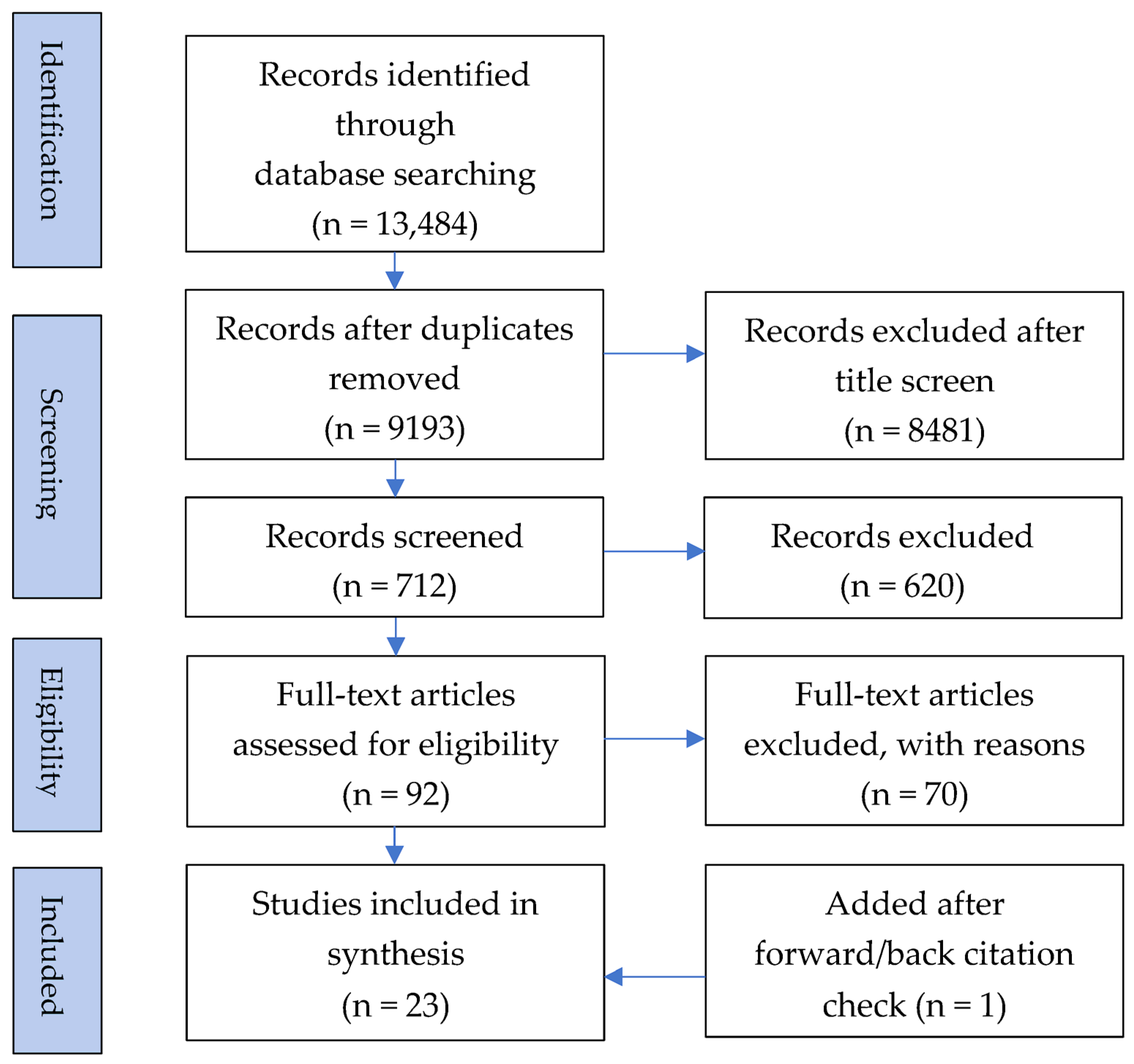
3.1. Selection of Papers for Review
3.2. Overview of Results
- Evidence for the overall effectiveness of public pre-incident education;
- The type of information that is useful for this education;
- The nature and efficacy of the delivery methods used;
- The characteristics of pre-incident information relating to terrorism or human error emergencies compared with that relating to natural hazards.
3.3. Evidence for the Overall Effectiveness of Public Pre-Incident Education
3.4. Type of Pre-Incident Information Used in the Studies
3.5. Methods of Providing Information
3.6. Consideration of Emergencies Related to Natural Hazards Versus Those Resulting from Human Action
4. Discussion
4.1. Is Public Pre-Incident Education Effective?
- Knowledge;
- Intention to take mitigating action;
- Likelihood of actual mitigating action being taken;
- Confidence in taking action;
- Belief that taking action is helpful.
4.2. What Information Should Be Included?
4.3. How Should Information Be Provided?
4.4. Considerations When Developing Information Campaigns for Terrorism and Other Human-Influenced Mass Casualty Incidents
4.5. Implications for Further Study
4.6. Limitations
5. Conclusions
5.1. Recommendations for the Provision of Pre-Incident Information
- Information about the need to prepare and the importance of acting if an incident occurs;
- The need to act quickly if involved or a close bystander to the incident;
- Actions that people can take to mitigate the effects of an incident for themselves and others while maintaining safety precautions;
- A clear message that taking prompt action can save lives and minimise injury.
5.2. Recommendations for Future Research
- Further research should be conducted specifically on the provision of pre-incident information relating to emergencies involving terrorism and other human-influenced events. This will complement the existing larger body of work relating to natural hazard-related disasters.
- Triage of casualties and emergency first aid are immediate actions that, if taken by those on the scene of an emergency, can save lives. Future research should include investigation of pre-incident education in these areas to ascertain whether trained members of the public can be effective zero responders.
- Research should establish the most effective method of delivery of pre-incident information to ensure that members of the public are able to respond to a sudden emergency, including consideration of the information requirements of different demographic groups.
- Further research should be conducted to investigate the retention of information and maintenance of preparedness in the medium term (3+ months) and beyond following an intervention.
- Given the difficulty of testing in a real incident and the resources required for a real-life test scenario, studies reviewing the usefulness of pre-incident information should consider the most accurate testing methodology. Future research should incorporate test scenarios that are as realistic as possible in order to elicit ecologically valid responses from participants, potentially including virtual reality scenarios to elicit a high sense of presence in the scene.
Supplementary Materials
Author Contributions
Funding
Institutional Review Board Statement
Informed Consent Statement
Data Availability Statement
Conflicts of Interest
References
- HM Government. National Risk Register—2025 Edition; HM Government: London, UK, 2025.
- Institute for Economics & Peace. Global Terrorism Index 2024; Institute for Economics & Peace: Sydney, Australia, 2024. [Google Scholar]
- Lomaglio, L.; Ansaloni, L.; Catena, F.; Sartelli, M.; Coccolini, F. Mass Casualty Incident: Definitions and Current Reality. In WSES Handbook of Mass Casualties Incidents Management; Kluger, Y., Coccolini, F., Catena, F., Ansaloni, L., Eds.; Springer International Publishing: Cham, Switzerland, 2020; pp. 1–10. [Google Scholar]
- NHS England. Concept of Operations for the Management of Mass Casualties; N.E. Team, Ed.; NHS: London, UK, 2017.
- Jagiello, R.D.; Hills, T.T. Bad News Has Wings: Dread Risk Mediates Social Amplification in Risk Communication. Risk Anal. 2018, 38, 2193–2207. [Google Scholar] [CrossRef]
- Cocking, C. The role of “zero-responders” during 7/7: Implications for the emergency services. Int. J. Emerg. Serv. 2013, 2, 79–93. [Google Scholar] [CrossRef]
- Carter, H.; Drury, J.; Amlôt, R. Recommendations for improving public engagement with pre-incident information materials for initial response to a chemical, biological, radiological or nuclear (CBRN) incident: A systematic review. Int. J. Disaster Risk Reduct. 2020, 51, 101796. [Google Scholar] [CrossRef]
- Rogers, M.B.; Pearce, J.M. The Psychology of Crisis Communication. In The Handbook of International Crisis Communication Research; Wiley: Hoboken, NJ, USA, 2016; pp. 34–44. [Google Scholar]
- Au-Yeung, T.; Philpot, R.; Stott, C.; Radburn, M.; Drury, J. Spontaneous public response to a marauding knife attack on the London underground: Sociality, coordination and a repertoire of actions evidenced by CCTV footage. Br. J. Soc. Psychol. 2023, 63, 767–791. [Google Scholar] [CrossRef]
- Rapaport, C.; Ashkenazi, I. Better together: Evolving social process between bystanders and first responders is a force multiplier for effective emergency response. Epidemiology 2020, 5, 1–7. [Google Scholar] [CrossRef]
- Philpot, R.; Levine, M. Evacuation Behavior in a Subway Train Emergency: A Video-based Analysis. Environ. Behav. 2022, 54, 383–411. [Google Scholar] [CrossRef]
- NHS. Hazardous Materials (HAZMAT) and Chemical, Biological, Radiological and Nuclear (CBRN); NHS: London, UK, 2022. Available online: https://www.england.nhs.uk/ourwork/eprr/hm/#chemical (accessed on 19 April 2024).
- Hasselqvist-Ax, I.; Riva, G.; Herlitz, J.; Rosenqvist, M.; Hollenberg, J.; Nordberg, P.; Ringh, M.; Jonsson, M.; Axelsson, C.; Lindqvist, J.; et al. Early Cardiopulmonary Resuscitation in Out-of-Hospital Cardiac Arrest. N. Engl. J. Med. 2015, 372, 2307–2315. [Google Scholar] [CrossRef]
- Stop the Bleed. 2019. Available online: https://www.stopthebleed.org/ (accessed on 19 April 2024).
- Chilcott, R.P. Managing mass casualties and decontamination. Environ. Int. 2014, 72, 37–45. [Google Scholar] [CrossRef] [PubMed]
- Fisher, A.D.; Bulger, E.M.; Gestring, M.L. Stop the Bleeding: Educating the Public. JAMA 2018, 320, 589–590. [Google Scholar] [CrossRef] [PubMed]
- Benight, C.C.; Bandura, A. Social cognitive theory of posttraumatic recovery: The role of perceived self-efficacy. Behav. Res. Ther. 2004, 42, 1129–1148. [Google Scholar] [CrossRef] [PubMed]
- Spencer, M.L.; Kindt, M.T.; Stans, M.P. Public Resilience in CBRN Events: Lessons Learned from Seven Cases; Air University, USAF Counterproliferation Center: Montgomery, AL, USA, 2011.
- Hirschel, M.J.; Schulenberg, S.E. Hurricane Katrina’s impact on the Mississippi Gulf Coast: General self-efficacy’s relationship to PTSD prevalence and severity. Psychol. Serv. 2009, 6, 293–303. [Google Scholar] [CrossRef]
- Carter, H.; Weston, D.; Betts, N.; Wilkinson, S.; Amlôt, R. Public perceptions of emergency decontamination: Effects of intervention type and responder management strategy during a focus group study. PLoS ONE 2018, 13, e0195922. [Google Scholar] [CrossRef]
- Hinata, S.; Rohde, H.; Templeton, A. Communicating with the public in emergencies: A systematic review of communication approaches in emergency response. Int. J. Disaster Risk Reduct. 2024, 111, 104719. [Google Scholar] [CrossRef]
- Phillips, J. The First 72 Is on You: Volunteers Learn Disaster Training in Northwest Florida. 2017. Available online: https://weartv.com/news/local/the-first-72-is-on-you-volunteers-learn-disaster-training-in-northwest-florida (accessed on 19 April 2024).
- Choctaw Nation of Oklahoma. First 72 on You. 2025. Available online: https://www.choctawnation.com/about/first-72-on-you/ (accessed on 7 April 2025).
- US Government. Ready. Available online: www.ready.gov (accessed on 7 April 2025).
- Batten, B. The First 72 (and 96 and 120) Are up to You. Naples News, 31 August 2019.
- Ntontis, E.; Drury, J.; Amlôt, R.; Rubin, G.J.; Williams, R. Community resilience and flooding in UK guidance: A critical review of concepts, definitions, and their implications. J. Contingencies Crisis Manag. 2019, 27, 2–13. [Google Scholar] [CrossRef]
- UNDRR. Sendai Framework for Disaster Risk Reduction 2015–2030; United Nations Office for Disaster Risk Reduction: Geneva, Switzerland, 2015. [Google Scholar]
- Carter, H.; Gauntlett, L.; Rubin, G.J.; Russell, D.; Genereux, M.; Lemyre, L.; Blain, P.; Byers, M.; Amlôt, R. Psychosocial and behavioural aspects of early incident response: Outcomes from an international workshop. Glob. Secur. Health Sci. Policy 2018, 3, 28–36. [Google Scholar] [CrossRef]
- UK Government. The UK Government Resilience Framework. 2023. Available online: https://www.gov.uk/government/publications/the-uk-government-resilience-framework/the-uk-government-resilience-framework-html#our-action-plan-communities (accessed on 7 April 2025).
- Counter Terrorism Policing. What You Can Do. 2024. Available online: https://www.counterterrorism.police.uk/what-you-can-do/ (accessed on 19 April 2024).
- British Transport Police. See It. Say It. Sorted. 2024. Available online: https://www.btp.police.uk/police-forces/british-transport-police/areas/campaigns/see-it-say-it-sorted/ (accessed on 19 April 2024).
- UKHSA. What to Do in a Chemical Emergency. 2024. Available online: https://www.gov.uk/government/publications/chemical-emergencies-information-for-the-public/what-to-do-in-a-chemical-emergency (accessed on 7 April 2025).
- Lindekilde, L.; Pearce, J.; Parker, D.; Rogers, B. “Run, Hide, Tell” or “Run, Hide, Fight”? The impact of diverse public guidance about marauding terrorist firearms attacks on behavioral intentions during a scenario-based experiment in the United Kingdom and Denmark. Int. J. Disaster Risk Reduct. 2021, 60, 102278. [Google Scholar] [CrossRef]
- Pearce, J.M.; Lindekilde, L.; Parker, D.; Rogers, M.B. Communicating with the Public About Marauding Terrorist Firearms Attacks: Results from a Survey Experiment on Factors Influencing Intention to “Run, Hide, Tell” in the United Kingdom and Denmark. Risk Anal. 2019, 39, 1675–1694. [Google Scholar] [CrossRef]
- Carter, H.E.; Gauntlett, L.; Amlot, R. Public Perceptions of the “Remove, Remove, Remove” Information Campaign Before and During a Hazardous Materials Incident: A Survey. Health Secur. 2021, 19, 100–107. [Google Scholar] [CrossRef]
- Bleetman, A.; Hildebrand, S. Comparative Study Illustrating Difficulties Educating the Public to Respond to Chemical Terrorism. Prehospital Disaster Med. 2007, 22, 35–41. [Google Scholar] [CrossRef]
- Carter, H.; Weston, D.; Symons, C.; Amlot, R. Public perceptions of pre-incident information campaign materials for the initial response to a chemical incident: The “Remove, Remove, Remove” campaign. Disaster Prev. Manag. Int. J. 2019, 28, 565–584. [Google Scholar] [CrossRef]
- Hodgson, P.; Lee, V.W.; Chan, J.C.; Fong, A.; Tang, C.S.; Chan, L.; Wong, C. Immersive virtual reality (IVR) in higher education: Development and implementation. In Augmented Reality and Virtual Reality: The Power of AR and VR for Business; Springer: Cham, Switzerland, 2019; pp. 161–173. [Google Scholar]
- AlGerafi, M.A.M.; Zhou, Y.; Oubibi, M.; Wijaya, T.T. Unlocking the Potential: A Comprehensive Evaluation of Augmented Reality and Virtual Reality in Education. Electronics 2023, 12, 3953. [Google Scholar] [CrossRef]
- Moher, D.; Barrowman, N.; Daniel, R.; Eccles, M.; Grimshaw, J.; Sampson, M.; Tricco, A.; Tsertsvadze, A. When and how to update systematic reviews. Cochrane Database Syst. Rev. 2008, 2008, MR000023. [Google Scholar] [CrossRef]
- Garner, P.; Hopewell, S.; Chandler, J.; MacLehose, H.; Schunemann, H.J.; Akl, E.A.; Beyene, J.; Chang, S.; Churchill, R.; Dearness, K.; et al. When and how to update systematic reviews: Consensus and checklist. BMJ 2016, 354, i3507. [Google Scholar] [CrossRef]
- Moher, D.; Liberati, A.; Tetzlaff, J.; Altman, D. Preferred Reporting Items for Systematic Reviews and Meta-Analyses: The PRISMA Statement. Ann. Intern. Med. 2009, 151, 264–269. [Google Scholar] [CrossRef]
- Page, M.J.; McKenzie, J.E.; Bossuyt, P.M.; Boutron, I.; Hoffmann, T.C.; Mulrow, C.D.; Shamseer, L.; Tetzlaff, J.M.; Akl, E.A.; Brennan, S.E.; et al. The PRISMA 2020 statement: An updated guideline for reporting systematic reviews. BMJ 2021, 372, 71. [Google Scholar] [CrossRef]
- Hong, Q.N.; Pluye, P.; Fàbregues, S.; Bartlett, G.; Boardman, F.; Cargo, M.; Dagenais, P.; Gagnon, M.-P.; Griffiths, F.; Nicolau, B.; et al. Mixed Methods Appraisal Tool (MMAT), version 2018; Canadian Intellectual Property Office, Industry Canada: Gatineau, QC, Canada, 2018.
- Hong, Q.N.; Gonzalez-Reyes, A.; Pluye, P. Improving the usefulness of a tool for appraising the quality of qualitative, quantitative and mixed methods studies, the Mixed Methods Appraisal Tool (MMAT). J. Eval. Clin. Pract. 2018, 24, 459–467. [Google Scholar] [CrossRef]
- Boyce, N.; Symons, C.; Carter, H.; Majumdar, A. International Platform of Registered Systematic Review and Meta-Analysis Protocols (INPLASY); INPLASY Inc.: Middletown, DE, USA, 2026. [Google Scholar] [CrossRef]
- Amini, R.; Biglari, F.; Khodaveisi, M.; Tapak, L. Effect of education based on the health belief model on earthquake preparedness in women. Int. J. Disaster Risk Reduct. 2021, 52, 101954. [Google Scholar] [CrossRef]
- Banerski, G.; Abramczuk, K.; Biele, C. 3D or not 3D? Evaluation of the effectiveness of 3D-enhanced warning messages for communication in crisis situations. Saf. Sci. 2020, 132, 104961. [Google Scholar] [CrossRef]
- Bhandari, A.K.C.; Rahman, M.; Takahashi, O. Enhancing earthquake preparedness knowledge and practice among Nepalese immigrants residing in Japan. Sci. Rep. 2023, 13, 4468. [Google Scholar] [CrossRef] [PubMed]
- Celik, D.H.; Mencl, F.R.; Debacker, M.; Kurland, L.; Wilber, S.T.; Frey, J.A. Triage Performance of School Personnel Using the SALT System. Prehospital Disaster Med. 2019, 34, 401–406. [Google Scholar] [CrossRef]
- Chittaro, L. Improving Knowledge Retention and Perceived Control through Serious Games: A Study about Assisted Emergency Evacuation. IEEE Trans. Vis. Comput. Graph. 2023, 30, 5339–5349. [Google Scholar] [CrossRef] [PubMed]
- Dennis, A.; Weston, D.; Amlôt, R.; Arnold, A.; Carbon, D.; Carter, H. The role of pre-incident information and responder communication in effective management of casualties, including members of vulnerable groups, during a decontamination field exercise. Int. J. Disaster Risk Reduct. 2023, 94, 103806. [Google Scholar] [CrossRef]
- Elkbuli, A.; McKenney, M.G.; Boneva, D.V.; Hai, S.A. Stop the Bleed Training Outreach Initiatives Targeting High School Students in South Florida: It Takes a Community to Save a Life. J. Am. Coll. Surg. 2019, 229, e243. [Google Scholar] [CrossRef]
- Fatmah, F. Effect of disaster training on knowledge regarding flood risk management amongst families with older people. Jamba-J. Disaster Risk Stud. 2022, 14, 1262. [Google Scholar] [CrossRef] [PubMed]
- Feng, Z.; Gonzalez, V.A.; Mutch, C.; Amor, R.; Cabrera-Guerrero, G. Instructional mechanisms in immersive virtual reality serious games: Earthquake emergency training for children. J. Comput. Assist. Learn. 2021, 37, 542–556. [Google Scholar] [CrossRef]
- Gouda, M.; Yang, Y. Investigating the impact of a community disaster awareness training on subjective disaster preparedness: The case of Myanmar’s Ayeyarwaddy region. Disasters 2023, 47, 1047–1068. [Google Scholar] [CrossRef]
- Heagele, T.N.; Nurse-Clarke, N.J. A Nurse-Led Home Disaster Preparedness Intervention for New Parents. Neonatal Netw. NN 2022, 41, 5–10. [Google Scholar] [CrossRef]
- Hung, K.K.C.; Macdermot, M.K.; Chan, E.Y.Y.; Liu, S.; Huang, Z.; Wong, C.S.; Walline, J.H.; Graham, C.A. Ccouc ethnic minority health project: A case study for health edrm initiatives to improve disaster preparedness in a rural Chinese population. Int. J. Environ. Res. Public Health 2021, 18, 5322. [Google Scholar] [CrossRef]
- Liu, R.; Zhu, R.; Becerik-Gerber, B.; Lucas, G.M.; Southers, E.G. Be prepared: How training and emergency type affect evacuation behaviour. J. Comput. Assist. Learn. 2023, 39, 1493–1509. [Google Scholar] [CrossRef]
- Liu, R.; Becerik-Gerber, B.; Lucas, G.M. Effectiveness of VR-based training on improving occupants’ response and preparedness for active shooter incidents. Saf. Sci. 2023, 164, 106175. [Google Scholar] [CrossRef]
- Mailizar, M.; Johar, R.; Safitri, Y.; Sulastri, S.; Fatimah, S.; Rohaizati, U. Using comics in teaching mathematics to improve junior high school students’ disaster awareness. Jamba-J. Disaster Risk Stud. 2023, 15, 1345. [Google Scholar] [CrossRef]
- Marcus, C.; Pontasch, J.; Duff, J.; Khambadkone, T.; Fink, B.; Jones, C.; Brickman, K.; Rega, P. Developing “Herd Immunity” in a Civilian Community Through Incorporation of “Just-In-Time” Tourniquet Application Training. Prehospital Disaster Med. 2019, 34, 481–485. [Google Scholar] [CrossRef]
- Noviana, E.; Kurniaman, O.; Munjiatun, N.S.; Nirmala, S.D. Why Do Primary School Students Need Disaster Mitigation Knowledge? (Study of the Use of Koase Comics in Primary Schools). Int. J. Sci. Technol. Res. 2019, 8, 216–221. [Google Scholar]
- Salita, C.; Liwanag, R.; Tiongco, R.E.; Kawano, R. Development, implementation, and evaluation of a lay responder disaster training package among school teachers in Angeles City, Philippines: Using Witte’s behavioral model. Public Health 2019, 170, 23–31. [Google Scholar] [CrossRef] [PubMed]
- Schildkraut, J.; Nickerson, A.B. Ready to respond: Effects of lockdown drills and training on school emergency preparedness. Vict. Offenders 2020, 15, 619–638. [Google Scholar] [CrossRef]
- Stephens, K.K.; Powers, C.J.; Robertson, B.W.; Spearing, L.A.; Collier, J.C.; Tich, K.P.; Smith, W.R. Building more resilient communities with a wildfire preparedness drill in the U.S.: Individual and community influences and communication practices. J. Contingencies Crisis Manag. 2023, 31, 26–38. [Google Scholar] [CrossRef]
- Susmini, S.; Feri, J.; Wijaya, S.; Wibowo, W.D.A.; Arifin, H.; Lee, B.O. The Effects of a Disaster Preparedness app on Community Knowledge and Intentional Behavior in Hurricane Risk Areas. Disaster Med. Public Health Prep. 2022, 17, e137. [Google Scholar] [CrossRef]
- White-Lewis, S.; Beach, E.; Zegers, C. Improved Knowledge of Disaster Preparedness in Underrepresented Secondary Students: A Quasi-Experimental Study. J. Sch. Health 2021, 91, 490–498. [Google Scholar] [CrossRef] [PubMed]
- Abt, C. Serious Games; University press of America: Lanham, MD, USA, 1987. [Google Scholar]
- Krath, J.; Schürmann, L.; von Korflesch, H.F.O. Revealing the theoretical basis of gamification: A systematic review and analysis of theory in research on gamification, serious games and game-based learning. Comput. Hum. Behav. 2021, 125, 106963. [Google Scholar] [CrossRef]
- World Health Organization. Emergency and Disaster Risk Management Framework. Available online: https://iris.who.int/bitstream/handle/10665/326106/9789241516181-eng.pdf?sequence=1&isAllowed=y (accessed on 7 April 2025).
- White-Lewis, S.; Berens, C.; Lighter, J.S. The Effect of Immersive Training on Emergency Preparedness for Interdisciplinary College Students: A Single Group Pretest, Posttest. Disaster Med. Public Health Prep. 2022, 16, 2397–2400. [Google Scholar] [CrossRef]
- Feng, Z.; González, V.A.; Amor, R.; Lovreglio, R.; Cabrera-Guerrero, G. Immersive virtual reality serious games for evacuation training and research: A systematic literature review. Comput. Educ. 2018, 127, 252–266. [Google Scholar] [CrossRef]
- Kormos, C.; Gifford, R. The validity of self-report measures of proenvironmental behavior: A meta-analytic review. J. Environ. Psychol. 2014, 40, 359–371. [Google Scholar] [CrossRef]
- Rhodes, R.E.; de Bruijn, G.-J. How big is the physical activity intention–behaviour gap? A meta-analysis using the action control framework. Br. J. Health Psychol. 2013, 18, 296–309. [Google Scholar] [CrossRef] [PubMed]
- Woodman, S.; Bearman, C.; Hayes, P. Understanding skill decay and skill maintenance in first responders. Aust. J. Emerg. Manag. 2021, 36, 44–49. [Google Scholar] [CrossRef]
- Arthur, W., Jr.; Bennett, W., Jr.; Stanush, P.L.; McNelly, T.L. Factors That Influence Skill Decay and Retention: A Quantitative Review and Analysis. Hum. Perform. 1998, 11, 57–101. [Google Scholar] [CrossRef]
- Salas, E.; Tannenbaum, S.I.; Kraiger, K.; Smith-Jentsch, K.A. The Science of Training and Development in Organizations: What Matters in Practice. Psychol. Sci. Public Interest 2012, 13, 74–101. [Google Scholar] [CrossRef]
- Gauntlett, L.; Amlôt, R.; Rubin, G.J. How to inform the public about protective actions in a nuclear or radiological incident: A systematic review. Lancet Psychiatry 2019, 6, 72–80. [Google Scholar] [CrossRef]
- Rubin, G.J.; Chowdhury, A.K.; Amlôt, R. How to communicate with the public about chemical, biological, radiological, or nuclear terrorism: A systematic review of the literature. Biosecurity Bioterrorism Biodefense Strat. Pract. Sci. 2012, 10, 383–395. [Google Scholar] [CrossRef]
- Gwynne, S.; Kuligowski, E.; Boyce, K.; Nilsson, D.; Robbins, A.; Lovreglio, R.; Thomas, J.; Roy-Poirier, A. Enhancing Egress Drills: Preparation and Assessment of Evacuee Performance. Fire Mater. 2017, 43, 613–631. [Google Scholar] [CrossRef]
- Latif, R.K.; Clifford, S.P.; Baker, J.A.; Lenhardt, R.; Haq, M.Z.; Huang, J.; Farah, I.; Businger, J.R. Traumatic hemorrhage and chain of survival. Scand. J. Trauma Resusc. Emerg. Med. 2023, 31, 25. [Google Scholar] [CrossRef]
- Harris, D.J.; Bird, J.M.; Smart, P.A.; Wilson, M.R.; Vine, S.J. A Framework for the Testing and Validation of Simulated Environments in Experimentation and Training. Front. Psychol. 2020, 11, 605. [Google Scholar] [CrossRef]
- Awada, M.; Zhu, R.; Becerik-Gerber, B.; Lucas, G.; Southers, E. An integrated emotional and physiological assessment for VR-based active shooter incident experiments. Adv. Eng. Inform. 2021, 47, 101227. [Google Scholar] [CrossRef]
- Harris, D.; Arthur, T.; Kearse, J.; Olonilua, M.; Hassan, E.; De Burgh, T.; Wilson, M.; Vine, S. Exploring the role of virtual reality in military decision training. Front. Virtual Real. 2023, 4, 1165030. [Google Scholar] [CrossRef]
- Pallavicini, F.; Argenton, L.; Toniazzi, N.; Aceti, L.; Mantovani, F. Virtual Reality Applications for Stress Management Training in the Military. Aerosp. Med. Hum. Perform. 2016, 87, 1021–1030. [Google Scholar] [CrossRef] [PubMed]
- Appleby-Arnold, S.; Brockdorff, N.; Jakovljev, I.; Zdravković, S. Applying cultural values to encourage disaster preparedness: Lessons from a low-hazard country. Int. J. Disaster Risk Reduct. 2018, 31, 37–44. [Google Scholar] [CrossRef]
- Castañeda, J.V.; Bronfman, N.C.; Cisternas, P.C.; Repetto, P.B. Understanding the culture of natural disaster preparedness: Exploring the effect of experience and sociodemographic predictors. Nat. Hazards 2020, 103, 1881–1904. [Google Scholar] [CrossRef]
- Thornton, A.; Lee, P. Publication bias in meta-analysis: Its causes and consequences. J. Clin. Epidemiol. 2000, 53, 207–216. [Google Scholar] [CrossRef]


| Study | Population | Sample Size | Disaster Type | Intervention Type | Preparedness Outcomes | Study Type |
|---|---|---|---|---|---|---|
| Amini 2021 [47], Iran | Women | Intervention n = 60 Control n = 60 | Earthquake | Group lecture, Q&A, discussion, written material using Health Belief Model constructs for experiment group. Control group received health care education, written material | Questionnaire on perceived susceptibility, severity, benefits and self-efficacy in earthquake preparedness | Intervention test |
| Banerski 2020 [48], Poland | General population 18–65 in flood-prone area | Intervention n = 286 Control n = 101 | Flood | Video with three different graphics | Knowledge of risks, confidence in taking protective action | Intervention test |
| Bhandari 2023 [49], Japan | Nepalese immigrants 18+ | n = 165 | Earthquake | Group lecture, demonstration, discussion | Knowledge perception and practice of earthquake preparedness immediately, 2 weeks, 12 weeks after intervention | Intervention test, longitudinal study |
| Carter 2021 [35], UK | 18+ | n = 1000 | CBRN | Given information sheet to read | Perception, understanding, preparedness, willingness and ability to take action | Intervention test uncontrolled study |
| Celik 2019 [50], USA | School personnel | n = 104 | All | 30 min lecture on SALT triage, brief lecture and group demonstration of haemorrhage control and tourniquet application | Ability to triage, ability to apply tourniquet | Intervention test uncontrolled study |
| Chittaro 2023 [51], Italy | Adult | Serious game n = 30 Print material n = 30 | Any, aiding evacuation of people with disabilities | Comparison of serious game vs. training with printed material | Knowledge of and reported willingness to help people with disabilities during evacuation | Intervention test |
| Dennis 2023 [52], Germany | Adult | n = 18 | CBRN | Written pre-incident information, pictograms, decontamination drill | Self-reported confidence and knowledge of actions to take, opinion on help to be given to/expected of others | Intervention test uncontrolled study |
| Elkbuli 2019 [53], USA | High school students | n = 232 | Bleeding after school attack | Stop the Bleed training programme | Knowledge of and comfort/willingness to use a tourniquet in an emergency | Intervention test longitudinal study |
| Fatmah 2022 [54], Indonesia | Families with elderly | n = 30 | Flood | One day group programme. Printed media (leaflets and flipcharts) and visual media (video) | Knowledge of flood risk, preparedness | Intervention test longitudinal study |
| Feng 2021 [55], New Zealand | 11–15-year-old secondary students | n = 125 | Earthquake | Leaflet, serious game | Earthquake drill knowledge and self-efficacy | Test of serious game intervention vs. studying leaflet (no baseline testing) |
| Gouda 2023 [56], Myanmar | Adults | Project n = 91 Control n = 91 | Natural disaster, focus on cyclone | Community disaster awareness training programme including meetings, first aid training, drill, community activity, pamphlet/flyer, visit from expert | Self-reported disaster preparedness and knowledge | Cross-sectional survey after intervention |
| Heagele 2022 [57], USA | Parents of newborn children | n = 68 | All | Booklet on emergency plans and preparedness, checked by nurse then kit provided | Household Emergency Preparedness score | Intervention test uncontrolled study |
| Hung 2021 [58], China | Adults in rural villages | n = 110 | Earthquake, flood | Workshop, group discussion, pictorial presentation | Emergency preparedness knowledge and confidence | Uncontrolled study, intervention, some retest after 7 years |
| Liu 2023 [59], USA | Adult | Intervention n = 54 Control n = 54 | Fire or active shooter | Training video | Perceived self-efficacy and optimal behaviour in emergency interactive video scenario | Intervention test |
| Liu 2023 [60], USA | Adult | Intervention n = 54 Control n = 54 | Active shooter | Training using either video or VR | Perceived self-efficacy and optimal behaviour in emergency interactive video scenario | Intervention test |
| Mailizar 2023 [61], Indonesia | Year 7 (12–13 years) | Intervention n = 61 Control n = 61 | Earthquake, tsunami | Mathematical comic with embedded information | Disaster awareness measure | Intervention test |
| Marcus 2019 [62], USA | Adult (student) | n = 97 | All (tourniquet application) | Face to face training in small groups | Confidence in applying tourniquet | Intervention test uncontrolled study |
| Noviana 2020 [63], Indonesia | Primary school students grade 5 (10–11 years) | n = 72 | Any natural disaster | Information contained in ‘KOASE’ comics given to children for one week | Test of disaster mitigation knowledge | Intervention test uncontrolled study |
| Salita 2019 [64], Philippines | School teachers | n = 45 | All | Lectures, demonstrations | Questionnaire measuring knowledge, attitude, intentions, perceived efficacy | Intervention test uncontrolled study |
| Schildkraut 2020 [65], USA | School staff and pupils | n = 5562 baseline n = 4081 first test n = 4283 | Lockdown drill | Group training with presentations, videos and discussion, Standard Response Protocol Extended (SRP-X) used | Lockdown behaviour in test, expressed perception of safety and preparedness | Intervention test uncontrolled study |
| Stephens 2023 [66], USA | Residents of rural community | n = 70 | Wildfire | Pre-planned evacuation drill | Self-reported perceived susceptibility, preparedness, intent to share preparedness information | Case study (no pre-drill data) |
| Susmini 2022 [67], Indonesia | Community members in hurricane-prone area | Intervention n = 40 Control n = 40 | Hurricane | Two weeks of disaster preparedness phone app (N = 40), information given in meetings (N = 40) | Self-reported intended response to a future hurricane | Intervention test comparing education methods |
| White-Lewis 2021 [68], USA | High school students | Intervention n = 31 Control n = 25 | Any | Lecture, small group rotation through first aid practise and bioterrorism information stations | Emergency preparedness Information Questionnaire | Intervention test |
| Preparedness Outcome | Studies |
|---|---|
| Knowledge | Carter, Gauntlett [35], Amini, Biglari [47], Banerski, Abramczuk [48], Bhandari, Rahman [49], Chittaro [51], Dennis, Weston [52], Elkbuli, McKenney [53], Fatmah [54], Feng, Gonzalez [55], Heagele and Nurse-Clarke [57], Hung, Macdermot [58], Mailizar, Johar [61], Marcus, Pontasch [62], Noviana, Kurniaman [63], Salita, Liwanag [64], Susmini, Feri [67], White-Lewis, Beach [68] |
| Taking action | Bhandari, Rahman [49], Feng, Gonzalez [55], Marcus, Pontasch [62], Celik, Mencl [50], Liu, Zhu [59], Liu, Becerik-Gerber [60], Schildkraut and Nickerson [65], Stephens, Powers [66] |
| Intention/willingness to take action | Carter [37], Banerski, Abramczuk [48], Dennis, Weston [52], Elkbuli, McKenney [53], Fatmah [54], Heagele and Nurse-Clarke [57], Susmini, Feri [67], Stephens, Powers [66] |
| Confidence/perceived self-efficacy | Carter [37], Amini, Biglari [47], Chittaro [51], Dennis, Weston [52], Elkbuli, McKenney [53], Feng, Gonzalez [55], Marcus, Pontasch [62], Salita, Liwanag [64], White-Lewis, Beach [68], Liu, Zhu [59], Liu, Becerik-Gerber [60], Schildkraut and Nickerson [65], Stephens, Powers [66], Gouda and Yang [56] |
| Engagement | Dennis, Weston [52] |
| Perceived usefulness | Carter [37], Dennis, Weston [52], Salita, Liwanag [64] |
| Information Type | Studies |
|---|---|
| Preparedness/protective actions that may be taken | Carter, Gauntlett [35], Amini, Biglari [47], Banerski, Abramczuk [48], Bhandari, Rahman [49], Chittaro [51], Elkbuli, McKenney [53], Fatmah [54], Feng, Gonzalez [55], Heagele and Nurse-Clarke [57], Hung, Macdermot [58], Mailizar, Johar [61], Marcus, Pontasch [62], Noviana, Kurniaman [63], Salita, Liwanag [64], Susmini, Feri [67], White-Lewis, Beach [68], Celik, Mencl [50], Liu, Zhu [59], Liu, Becerik-Gerber [60], Schildkraut and Nickerson [65], Stephens, Powers [66], Gouda and Yang [56] |
| Disaster effects | Amini, Biglari [47], Banerski, Abramczuk [48], Bhandari, Rahman [49], Fatmah [54], Heagele and Nurse-Clarke [57], Mailizar, Johar [61], Noviana, Kurniaman [63], Salita, Liwanag [64], Susmini, Feri [67], Celik, Mencl [50], Gouda and Yang [56] |
| Disaster severity | Amini, Biglari [47], Banerski, Abramczuk [48], Fatmah [54], Heagele and Nurse-Clarke [57], Mailizar, Johar [61], Salita, Liwanag [64], Susmini, Feri [67], Gouda and Yang [56] |
| Disaster likelihood | Banerski, Abramczuk [48], Fatmah [54] |
| Positive effect of taking action | Carter, Gauntlett [35], Amini, Biglari [47], Chittaro [51], Feng, Gonzalez [55], Mailizar, Johar [61], Salita, Liwanag [64], White-Lewis, Beach [68] |
| Self-efficacy | Feng, Gonzalez [55], Heagele and Nurse-Clarke [57], Hung, Macdermot [58], Noviana, Kurniaman [63], Salita, Liwanag [64], Liu, Becerik-Gerber [60] |
| Likely stress during/after incident | Mailizar, Johar [61], Salita, Liwanag [64], White-Lewis, Beach [68], Gouda and Yang [56] |
| Overcoming barriers to action | Amini, Biglari [47], Chittaro [51], Dennis, Weston [52], Salita, Liwanag [64] |
| Preparedness of others | Fatmah [54], Gouda and Yang [56] |
| Sources of further information | Bhandari, Rahman [49], Heagele and Nurse-Clarke [57] |
| Training Method | Studies |
|---|---|
| One-to-one | Heagele and Nurse-Clarke [57], Stephens, Powers [66] |
| Small group | Marcus, Pontasch [62], Salita, Liwanag [64], White-Lewis, Beach [68], Stephens, Powers [66] |
| Large group | Amini, Biglari [47], Banerski, Abramczuk [48], Bhandari, Rahman [49], Elkbuli, McKenney [53], Fatmah [54], Hung, Macdermot [58], Susmini, Feri [67], Schildkraut and Nickerson [65], Gouda and Yang [56] |
| Demonstration/presentation | Bhandari, Rahman [49], Elkbuli, McKenney [53], Hung, Macdermot [58], Marcus, Pontasch [62], Salita, Liwanag [64], White-Lewis, Beach [68], Celik, Mencl [50], Schildkraut and Nickerson [65], Stephens, Powers [66], Gouda and Yang [56] |
| Practise of technique | Elkbuli, McKenney [53], Hung, Macdermot [58], Marcus, Pontasch [62], White-Lewis, Beach [68], Celik, Mencl [62], Gouda and Yang [56] |
| Written material | Carter, Gauntlett [35], Amini, Biglari [47], Bhandari, Rahman [49], Chittaro [51], Dennis, Weston [52], Fatmah [54], Feng, Gonzalez [55], Heagele and Nurse-Clarke [57], Mailizar, Johar [61], Noviana, Kurniaman [63], Stephens, Powers [66] |
| Online app | Susmini, Feri [67] |
| Serious game | Chittaro [51], Liu, Zhu [59], Liu, Becerik-Gerber [60] |
| Virtual Reality | Feng, Gonzalez [55], Liu, Becerik-Gerber [60] |
| Discussion/Q&A | Amini, Biglari [47], Bhandari, Rahman [49], Heagele and Nurse-Clarke [57], Marcus, Pontasch [62], Salita, Liwanag [64], Schildkraut and Nickerson [65], Stephens, Powers [66] |
| Video | Banerski, Abramczuk [48], Fatmah [54], Salita, Liwanag [64], Liu, Zhu [59], Liu, Becerik-Gerber [60] |
Disclaimer/Publisher’s Note: The statements, opinions and data contained in all publications are solely those of the individual author(s) and contributor(s) and not of MDPI and/or the editor(s). MDPI and/or the editor(s) disclaim responsibility for any injury to people or property resulting from any ideas, methods, instructions or products referred to in the content. |
© 2026 by the authors. Licensee MDPI, Basel, Switzerland. This article is an open access article distributed under the terms and conditions of the Creative Commons Attribution (CC BY) license.
Share and Cite
Boyce, N.; Symons, C.; Carter, H.; Majumdar, A. How Can We Improve Initial Public Response During Emergencies? Recommendations from a Systematic Review of Pre-Incident Information. Urban Sci. 2026, 10, 217. https://doi.org/10.3390/urbansci10040217
Boyce N, Symons C, Carter H, Majumdar A. How Can We Improve Initial Public Response During Emergencies? Recommendations from a Systematic Review of Pre-Incident Information. Urban Science. 2026; 10(4):217. https://doi.org/10.3390/urbansci10040217
Chicago/Turabian StyleBoyce, Niki, Charles Symons, Holly Carter, and Arnab Majumdar. 2026. "How Can We Improve Initial Public Response During Emergencies? Recommendations from a Systematic Review of Pre-Incident Information" Urban Science 10, no. 4: 217. https://doi.org/10.3390/urbansci10040217
APA StyleBoyce, N., Symons, C., Carter, H., & Majumdar, A. (2026). How Can We Improve Initial Public Response During Emergencies? Recommendations from a Systematic Review of Pre-Incident Information. Urban Science, 10(4), 217. https://doi.org/10.3390/urbansci10040217