1. Introduction
Demographic change has emerged as a defining force shaping urban development, spatial planning, and sustainability outcomes worldwide. Processes such as population aging, declining fertility, migration, and urbanization fundamentally influence labor markets, housing demand, infrastructure provision, environmental pressures, and the resilience of urban systems. As cities increasingly concentrate population and economic activity, demographic dynamics are no longer merely national-level concerns but critical determinants of urban well-being, social cohesion, and sustainable development [
1,
2,
3].
In recent decades, scholars have emphasized that demographic trends—including depopulation, population aging, and large-scale migration—interact strongly with urban processes, reshaping land-use patterns, service provision, and socio-economic inequalities [
4,
5,
6]. While urbanization can enhance productivity and access to services, it may also intensify demographic vulnerabilities when combined with sustained emigration, shrinking youth cohorts, and uneven spatial population distribution. These dynamics pose particular challenges for cities in small and transition economies, where demographic shifts often occur rapidly and with limited institutional capacity for long-term urban planning.
Armenia provides an important case of these intertwined demographic and urban transformations. As a post-Soviet country experiencing prolonged emigration, declining fertility, and accelerated population aging, Armenia faces demographic pressures that are increasingly concentrated in urban areas. Changes in urban population structure directly affect housing markets, labor supply, social infrastructure, and municipal finances, while migration flows (both outward and inward) reshape urban growth trajectories and regional disparities [
7,
8]. Understanding these processes is essential for designing policies that support sustainable cities, urban resilience, and balanced territorial development. Given Armenia’s relatively high level of urbanization, these demographic processes are expected to translate directly into urban labor market pressures, housing demand shifts, and socio-economic vulnerability.
Despite a growing body of the literature on demographic change, urbanization, and migration, existing research remains fragmented in three key respects. First, demographic assessments often rely on isolated indicators—such as fertility or aging—without integrating health and socio-economic vulnerability into a unified framework relevant to urban systems. Second, few studies explicitly quantify the relative contribution of fertility, mortality, and migration to population change, despite their distinct implications for urban labor markets, housing demand, and service provision. Third, limited attention has been paid to scenario-based analysis that links historical demographic trends with future urban population trajectories, particularly in the context of recent shocks and structural transitions [
9,
10,
11].
This paper addresses these gaps by developing a 20-indicator demographic threat index (DTI) for Armenia (2000–2023) using PCA-derived weights, and by empirically examining the relative influence of fertility, mortality, and net migration on population dynamics. In addition, scenario-based projections are used to assess whether fertility-driven policies alone can stabilize long-term population trends or whether migration plays a more decisive role.
By reframing demographic risks through the lens of urbanization and sustainability, this research contributes to the urban science literature in three ways. First, it provides a multidimensional tool for assessing demographic risks that directly affect urban systems and planning. While forecasting population decline, aging, and migration pressures, the DTI enables urban policymakers and planners to anticipate infrastructure needs, prioritize social and economic interventions, and design resilient, sustainable urban systems. In centralized urban systems the DTI serves as an early-warning tool, linking national demographic trends to specific urban planning actions, thereby supporting evidence-based, forward-looking policy development. Second, it demonstrates the central role of migration in shaping urban demographic outcomes, challenging policy approaches that focus narrowly on fertility incentives. The DTI is a quantitative tool to measure demographic risk, while migration trends transform these risks into spatial pressures on cities. This approach provides a basis for evaluating alternative policy strategies and their potential implications for urban sustainability. Third, it offers scenario-based evidence to support integrated urban, migration, and demographic policies aimed at enhancing long-term urban resilience. Our analysis reinforces the view that migration is the main driver of demographic outcomes in Armenia, often exerting a more immediate and spatially concentrated impact than fertility. While fertility incentives remain important for long-term population sustainability, migration can create short- and medium-term effects on urban areas such as housing demand, labor market shortages, and social security provisions.
Despite existing studies on population trends in Armenia, there is no integrated framework combining composite demographic risk assessment with scenario-based population projections. This study addresses this gap by developing a demographic threat index (DTI) and applying cohort-component projections to evaluate future demographic dynamics.
Building on the identified research gaps, this study not only constructs a composite index of demographic threats but also examines the structural drivers of population change and their implications for long-term dynamics. In particular, the literature suggests that migration, fertility, and mortality exert different effects on population trajectories, yet their relative importance remains insufficiently quantified in transition economies. Furthermore, while composite indices are widely applied, the extent to which statistically derived weights reflect the heterogeneous contribution of demographic and socio-economic factors requires empirical validation. Finally, scenario-based projections provide a framework to assess whether fertility-based policies alone are sufficient to reverse demographic decline, or whether migration plays a more decisive role.
The following research hypotheses are formulated:
H1. Net migration exerts a stronger influence on population change in Armenia than the combined effects of fertility and mortality.
H2. The PCA-based weighting approach reveals heterogeneous contributions of indicators across the three pillars of the demographic threat index.
H3. In the absence of sustained positive net migration, increases in fertility alone are insufficient to stabilize long-term population dynamics.
H4. Higher values of the demographic threat index are associated with increased socio-economic vulnerability and pressures relevant to urban sustainability.
The remainder of the article is organized as follows.
Section 2 reviews the literature on demographic security, urban demographic change, and index-based assessment approaches.
Section 3 gives a background of the problem of demographic security in Armenia.
Section 4 outlines the data and methodology used to construct the demographic threat index and to project the population.
Section 5 presents empirical results, followed by a discussion in
Section 6.
Section 7 concludes with policy implications for sustainable urban development and future research directions.
2. Literature Review
Urban demographic dynamics are not autonomous but are structurally dependent on national-level processes, including fertility, mortality, and migration. Many scholars affirm that national demographic shifts (fertility rate, urbanization, rural-to-urban migration, etc.) as well as social-economic changes (unemployment rate, economic growth, etc.) are the main drivers of urban demographic dynamics and urban development [
12]. Moreover, Carbonaro et al. examined the link between demographic aging, population decline and urban policy [
13]. Burian, Zimmermannová and Macků affirmed that demographic changes, particularly population aging, significantly affected urban policy and urban planning through their influence on spatial distribution of service demand and infrastructure provision [
14]. Hence, a national composite index can serve as a proxy for pressures affecting urban sustainability as the latter is shaped by national demographic risks, especially when rural-to-urban migration processes were observed. However, the urban dynamics are often overlooked and insufficiently addressed [
15,
16] and to fill in this gap we have tried to link national-level demographic risk composite indicator to urban sustainability outcomes. This interaction is smooth, especially in countries with high level of urbanization, such as Armenia, in which national demographic trends are directly transmitted into urban environments. Moreover, DTI captures demographic risks that translate into urban sustainability challenges over time, including labor shortages, population aging, and spatial imbalances. Therefore, the national-level DTI can be recognized as a leading indicator of urban sustainability pressures, despite its inability to fully reflect intra-urban variation.
Many scholars observed the mechanisms through which demographic processes impacted economic outcomes [
17]. Thus, Bloom and Finlay considered demographic changes to be a missing factor in explaining the east Asian growth premium. The authors highlighted the role of the demographic transition while observing the differences in economic growth across east Asian countries through 2005 underscoring the importance of mitigating the negative impact of population aging [
18]. The demographic transition contributed to labor productivity and the growth process through three channels as follows: first, the reduction in population growth that increased the resources per capita; second, the decline of fertility rates that improved human capital formation and labor productivity; and third, low fertility rates caused the increase in working-age population share that improved the productivity [
19].
Pérez Fructuoso with co-authors illustrated population aging as a demographic phenomenon that has social importance. The authors analyzed the aging and structure indicators of Spain and applied quantitative and qualitative methods to explain the possible sociological consequences [
20].
Pasichnyi and Nepytaliuk applied the unbalanced panel data method to assess the impact of demographic factors on economic development for 45 advanced and emerging market economies. Over the period of 1990–2018, the increase in life expectancy negatively impacted the real GDP per capita growth rate, the increase in the working-aged stratum slowed real GDP growth [
21]. The latter was also revealed while making a similar assessment for central Europe and the Baltic states for 2000–2021 [
22].
Gori and Sodini revealed history-driven reasons for some countries with high GDP and low fertility and others with low GDP and high fertility. The authors developed a model to demonstrate fertility fluctuations and explain the upward and downward shifts over the last century in some developed countries [
23]. Ahituv developed an empirical model of the relationship between fertility and economic development and found that a 1% decline in population growth contributed more than 3% to GDP per capita growth [
24]. Bawazir, Aslam and Osman observed the influence of demographic change on economic growth in Middle East countries from 1996 to 2016 revealing that the population growth rate, the middle-aged workers, the senior workers and the old dependency ratio positively impacted economic growth, whereas the youth dependency ratio negatively affected economic growth [
25]. Jafrin et al. used the pooled OLS model based on panel data from 1990 to 2017 in five selected South Asia Association for Regional Cooperation (SAARC) countries and revealed that demographic dividend impacted economic growth [
26]. Azarnert argued that humanitarian aid can foster population growth and adversely affect the recipients’ incentive to invest in human capital [
27].
Many studies provided insights into the relationship between migration and economic development [
28,
29]. Akanbi evaluated the impact of migration on economic growth and human development in 19 selected Sub-Saharan African countries over the period 1990–2013. The authors affirmed that increase in migration negatively impacted human development and economic growth [
30]. Remeikienė and Gasparėnienė assessed the influence of emigration on the origin economy highlighting that despite the positive effects of remittances; however, emigration led to the reduction in the labor force and demographic deteriorations [
31]. Boubtane, Coulibaly and Rault investigated the interaction between immigration and the host country economic conditions in 22 OECD countries for 1987–2009. The authors found immigration positively impacted the host economy, as well as that the migration is affected by host country economic conditions [
32].
From these perspectives, the concept of demographic security has been increasingly used developing its research area. Many scholars discussed demographic processes as essential factors influencing economic and geopolitical security [
33,
34,
35]. LaGraffe observed the interaction between demographic factors and security in the Arab Spring. The author also highlighted the importance of effective policies to mitigate the negative effects of demographic factors such as unemployment and poverty [
36]. Baranowska affirmed that demographic trends are a multifaceted phenomenon that has a significant influence on security and threatens Europe’s social-economic development [
37].
Studies on economic security were closely related to demographic dynamics currently described by aging and declining population in many countries [
38,
39]. The ongoing interconnection between demographic security and security was established revealing a negative influence of demographic insecurity on national security [
40]. According to Bostonova and Ozdoeva demographic processes considerably determined the level of economic security. The authors assessed the influence of demographic threats to the economic security of the North Caucasian Federal District for 2019–2021. They affirmed that the main purpose of demographic security was the provision of the conditions for, on the one hand, neutralizing demographic threats and preventing the arousal of potential issues [
41].
Demographic threat and security are closely related but represent conceptually opposite frameworks. Demographic threat refers to structural and dynamic changes in population size, composition and distribution that undermine a country’s economic sustainability, social stability and national security, whereas demographic security is the maintenance of the size and the structure of the population against demographic threats [
10,
30,
31].
Demographic security was widely defined as a core element of national security that ensures the quantitative and qualitative reproduction of the population [
42]. According to Rybakov et al. [
43], the following two approaches were distinguished in the definition of demographic security among scholars: first, demographic indicators were interpreted as direct determinants of the socio-economic development of the country; second, demographic processes were aimed at preserving the nation, culture and traditions.
Furthermore, demographic security encompasses protecting the state against threats like depopulation, population aging, weakening family structures, and poorly managed migration [
44,
45]. Essentially, it describes a state of demographic conditions that prevent population decline, support socio-economic progress, and safeguard cultural heritage. Key indicators within this framework include replacement-level or higher fertility rates, extended life expectancy, and migration levels sufficient to support economic growth; other demographic, social, and economic factors are often considered less central [
46,
47,
48].
Ultimately, demographic security concerns itself with the security implications of a population’s size, age structure, geographic distribution, and ethnic composition, as well as changes within these conditions and their interrelationships [
49].
The concept of demographic security is closely related to demographic stability, but not similar. Demographic stability was defined as the preservation of balanced qualitative and quantitative characteristics (parameters) of demographic processes that ensured natural population reproduction [
45]. Demographic stability refers to the relatively balanced, consistent and continuous nature of demographic processes over time without serious fluctuations. Demographic stability is also defined “by the rate of decay of fluctuations induced by demographic stochasticity, with its heterogeneity in age-specific birth and death rates” [
50]. Moreover, the stable population was broadly used among demographers referring to a population with a constant or unchanging age distribution, as well as other characteristics such as migration, multiregional populations, etc. [
51]. In this context, demographic processes can be stable but insecure; therefore, demographic security is a broader, threat-oriented and multidimensional phenomenon referring to both resilience to internal and external threats and sustainability of demographic dynamics.
Many scholars examined demographic risks in the context of extensive and rapid urbanization. Jarzebski et al. highlighted demographic risks posed by aging and declining urban populations for long-term urban sustainability [
52]. Slach et al. underscored the interconnection between national demographic risks and urban sustainability outcomes in post-socialist cities. The authors found that urban shrinkage was driven by the growing size of urban area in combination with national demographic risks such as shrinking populations and migration patterns posing challenges for the sustainability of cities [
53]. Therefore, urban shrinkage is widely perceived not just as a local problem but as a phenomenon reflecting national demographic dynamics. Moreover, national demographic processes such as low urbanization levels and migration from rural to urban areas are widely perceived as processes that prevent urban shrinkage [
12]. Kroll and Kabisch affirmed that both shrinking and growing urban regions are affected by demographic trends [
54]. McCann outlined that demographic trends such as aging and population decline shape the capacities of cities and regions. The author found that urban areas facing demographic decline encounter fiscal pressures which reduce the effectiveness of urban policies [
55]. Therefore, it stems from the literature review that urban sustainability resulted from national demographic processes translating national-level demographic risks into urban-level shifts.
While describing demographic processes quantitatively, many scholars used specific indicators or a set of indicators [
56,
57,
58], whereas others applied an index-based approach to assess the demographic security level.
Several studies focused specifically on Ukraine, employing quantitative methods to evaluate demographic security levels for 1991–2022, identifying critical threats and proposing mitigation strategies [
59]. These analyses highlighted the impact of migration and socio-economic factors (such as unemployment and wages) on Ukraine’s demographic situation, revealing a “demographic hole” with potential economic and social consequences [
60].
Researchers have also developed integral indicators for specific regions. Komarova and Kalinina created an index for the Siberian and far eastern federal districts (2000–2019) using mathematical weighting of standardized indicators, categorizing regions by stability levels [
61]. Smachylo proposed a similar integral indicator, incorporating depopulation and average age, and using the method of preferences for weighting [
62]. Grishnova and Kharazishvili developed an index based on core demographic indicators and defined threshold values to identify key threats [
63].
Other studies constructed composite indicators for broader contexts. A composite index-based approach is widely accepted to analyze demographic dynamics such as age structure and population density associated with regional shrinkage [
64]. Hrybinenko et al. used a multidimensional technique for the demographic component of economic security (2000–2018) [
65], while Eremin et al. combined statistical data and expert surveys to evaluate Russia’s demographic security (2000–2021) [
66]. Imideeva et al. analyzed the impact of demographic factors on national security indices in Russia, using regression analysis and integral indices [
2]. Finally, Shkuropadska et al. explored demographic resilience—the ability to recover from shocks—in Visegrad Group countries using a dedicated index [
67].
Thus, the literature review indicates the multi-faceted nature of the notion of demographic security and underscores the importance to apply more comprehensive and multi-dimensional index-based approach to assess the demographic risk level.
Based on the literature review three pillars of integral indices of demographic security were revealed; particularly, “Population change” pillar was discussed including a vast majority of demographic indicators such as depopulation rate, fertility rate, old-age dependency ratio, etc. Moreover, “Population Health” pillar was distinguished containing other groups of demographic indicators such as mortality rate, mortality ratio, life expectancy at birth, etc. Finally, to evaluate the effects of demographic factors female labor force participation rate, poverty rate, GDP per capita, male and youth unemployment rates were grouped in “Socio-Economic Vulnerability” pillar.
The indicators within each pillar were selected reflecting a specific dimension of demographic risk. The selection of the indicator was based on their relevance in the existing literature [
37,
60,
62,
65,
66,
67]. From this perspective, the range of indicators was grounded in capturing specific dimensions of demographic risk which directly or indirectly affected urban development. For instance, population density and urban population were chosen as key indicators of urban pressure revealing the interaction between demographic risk and urban planning.
Grounded in the existing literature the expected direction of each indicator was assigned which helped to provide consistency in the normalization and index construction processes [
4,
5,
17,
18,
23,
24,
35]. Some indicators such as depopulation rate, old-age dependency, infant mortality rate, maternal mortality ration were assumed to increase demographic risk, whereas other indicators such as median total fertility rate and female labor force participation rate were expected to reduce it.
Literature review suggests different approaches to construct a composite index. Among them some international organizations and researchers apply equal weighting while constructing indices for simplicity [
68]. Moore et al. developed the Sociodemographic Risk Index considering each risk factor equal in significance and using equal weights [
69]. As an effective alternative PCA approach is widely used to develop various indices which help to define weights of the variables considering the comparative significance [
70,
71,
72]. Abdrabo et al. applied PCA and AHP techniques to develop urban flood vulnerability index. The authors underscored the reliability and validity of PCA approach [
73]. Stoica et al. developed Index of Urban Strength using PCA integrated with Geographic Information System (GIS) method [
74]. Based on the literature review, PCA approach was also selected for the construction of a composite index.
3. Economic Background
The demographic profile of the Republic of Armenia reflects a growing population risk that requires immediate and targeted policy responses. The total fertility rate, currently 1.89, is projected to decline to 1.7 by 2030, falling below the replacement level of 2.1 and well below the averages of developing countries (2.6) and the global population (2.3). Mortality trends compound this challenge as follows: the crude death rate, 9.37 per 1000 in 2023, is expected to rise to 10.09 by 2030, while the crude birth rate is projected to decline from 11.78 to 10.5 per 1000, compared with the global average of 17 per 1000. The age structure further exacerbates demographic pressures, with the elderly dependency ratio exceeding the global average by 48% and the youth dependency ratio approximately half the global mean. The median age of 36.08 years in 2024, six years above the world average, underscores an aging population. Urbanization is very high: about 64% of population lives in big cities. These trends indicate that Armenia is experiencing pronounced demographic momentum, with implications for population replacement and economic security, signaling an urgent need for strategic interventions to mitigate long-term demographic and socioeconomic risks. The total net migration in the Republic of Armenia has remained consistently negative from 1991 throughout 2025, except for 2022 and 2023, when it temporarily became positive due to the forced displacement of compatriots from Nagorno-Karabakh and subsequent immigration to Armenia. According to the United Nations’ median scenario projections, total net migration is expected to remain negative through 2051.
4. Materials and Methods
Based on an understanding of the main demographic risks and threats to Armenia and the main factors shaping long-term demographic security, the multidimensional demographic threat index (hereinafter DTI) for Armenia was constructed using principal component analysis. PCA is a multivariate statistical method used to reduce the number of variables in a data set into a smaller number of components. The main steps in constructing a PCA-based index include the selection of asset variables, the normalization of the data, the application of PCA for weighting, and the aggregation. The main advantage of this method over more traditional methods is that it addresses many measurement challenges such as recall bias, seasonality and data collection time [
70].
The DTI framework is based on three pillars, each reflecting a distinct aspect of demographic security, including population dynamics, health and socio-economic. Altogether, these three dimensions provide a comprehensive measure of demographic threats of a country. The variables were selected based on their availability and significance covering the period from 2000 to 2023.
The first “Population change” pillar involved the following variables: total fertility rate, old-age dependency ratio, depopulation rate, total net migration, population den-sity, urban population (% of total population), youth population (% of total population), crude rates of marriage and divorce (per 1000 population). The second pillar named “Population Health” included infant mortality rate (per 1000 live births), maternal mortality ratio (modeled estimate, per 100,000 live births), life expectancy at birth, median age of population, sex ratio at birth, and fertile age (15–49) women rate of abortion (per 1000 women). The third pillar named “Socio-economic vulnerability” involved variables such as poverty rate, female labor force participation rate, GDP per capita, PPP (constant 2017 international $), and male and youth unemployment rates.
The main sources of the data were UN Population division data portal, World Bank’s World Development Indicators and Statistical Committee of the Republic of Armenia (
Table 1).
On the first stage of the construction of the DTI, all indicators were oriented so that higher values were equal to a greater demographic threat. So, variables such as total fertility rate, total net migration, youth population, marriage rate, life expectancy at birth, female labor force participation rate and GDP per capita were reversed because they negatively affected the DTI; a high DTI meant high demographic risks.
After reversing, all the 20 variables were normalized using z-score standardization (
) [
78]. For the reversed variables, −Z_ij was calculated.
The determination of components’ weights in the integral index has always been within the scope of research. In the literature review the approach of equal weights for the pillars in the composite index and PCA-derived weights for the indicators within each pillar is broadly accepted considering the comparative significance of indicators within each pillar. It is noteworthy that the DTI was constructed with equal weights given to each of the three pillars to avoid huge score volatility and subjective expert bias [
78]. Moreover, this approach is justified considering that unequal number of indicators included in the pillars affects the composite index disproportionately through variance accumulation. When dealing with a large number of indicators their participation will be overestimated, whereas with a small number of indicators it will be underestimated. Meanwhile this issue does not arise when applying the PCA method to indicators within each pillar, the weights can be based on their comparative significance and applied to the normalized values of indicators within each pillar. Therefore, the application of the PCA approach to the weights of indicators and equal weights for the pillars is more reasonable from a methodological point of view.
Before conducting principal component analysis (PCA), the Kaiser–Meyer–Olkin (KMO) test was performed to assess the sampling adequacy of the variables. KMO values for all variables were greater than 0.5, indicating their suitability for PCA. Additionally, Bartlett’s Test of Sphericity was run to determine if the correlation matrix of the variables significantly differed from an identity matrix. The highly significant
p-values (
p < 0.001) obtained for all pillars confirmed the existence of sufficient intercorrelation among variables (
Table 2).
At the next stage, the PCA approach was applied using R software (version 4.4.1) to construct pillar scores based on the weights of the variables that compose each pillar. To determine the number of components in the pillars, the eigenvalues of the principal components were calculated to understand the variance of each component in the original dataset. Only the components with values greater than one were extracted. At the next stage, Varimax rotation was applied to redistribute the variance among components without changing the total variance and to identify the indicators that contribute most to components.
The pillar scores were computed in accordance with the weights of the indicators composing the principal components. The scores of the pillars composing two principal components were calculated considering the weights of the principal components and the weights of the variables composing the components.
At the final stage, the scores of pillars were normalized through min–max normalization () and the DTI was constructed giving equal weights to the three pillars.
Considering the current trends in fertility, mortality and migration in the Republic of Armenia, cohort-component analysis was conducted to predict changes in population size, simulating population dynamics by age and sex over discrete five-year intervals. The methodology enables different scenario analyses to assess the demographic trajectory under different assumptions.
The cohort-component method is the most commonly used by researchers for the projection of population size. According to the approach the population is segmented into age-sex groups (cohorts) prone to the “risks” of fertility, mortality and migration. The changes over time in each group are calculated separately. Population changes are calculated at specific points in time separated by long intervals. The forecasted period is divided into the same time intervals as the age groups. Births are assumed to be produced by women only. Survival probabilities are involved for each subgroup and survivors are assigned to the same sex but to the next age group. Migration is assumed to be produced for both sexes considering the proportion of male and female migrants.
To forecast the size of Armenia’s population, the baseline population was distributed into 21 age groups, ranging from 0 to 4 up to 100+ years separately for males and females. The baseline year was taken as 2021, because it captures the immediate post-pandemic population dynamics; moreover, it followed the Nagorno-Karabakh war in 2020, reflecting significant demographic shifts resulting from casualties, displacement, and migration. Using 2021 as the starting point ensures that the analysis of cohorts and the construction of the demographic threat index are grounded in the post-conflict demographic reality, providing a robust basis for both trend assessment and policy-relevant recommendations. The source of the data was the UN Population division data portal [
79,
80,
81,
82]. Age-specific fertility rates (ASFRs) for women aged 15–49 were incorporated to calculate the number of births in each projection period. ASFR schedule was adjusted, 18d proportionally, ensuring consistency with desired fertility scenarios (baseline, high, low, and replacement-level). The sex ratio at birth was used to divide newborns into males and females, and survival probabilities for the 0–4 age group were used to account for the infant mortality rate.
For each projection step, the population was advanced by age, multiplying the current population in each age group by the corresponding survival probability. Considering mortality shocks as short-term impacts on survival rates, followed by a gradual return to baseline trends once the immediate crisis subsides, in the analysis mortality rates were fixed across all scenarios.
Total net migration was applied as a total five-year flow, like a shock, and proportionally distributed across the working-age population (ages 15–64), with configurable sex ratios. The proportion of male and female migrants was considered when assessing the impact of migration. The sex distribution of migration was determined based on the sex ratio of migration flows in Armenia according to Statistical Committee of RA for the baseline year. Baseline, high, low and zero migration scenarios were modeled to capture the potential impact of mobility on population size. The lowest indicator for the period 2000–2023, total net migration of −52,780 (year 2000) and the highest indicator of 75,000 (year 2023) were selected as migration shocks for appropriately low and high migration scenarios. The projection was performed iteratively over seven five-year intervals (2021–2051). At each step, the model sequentially applied age advancement using survival probabilities and fertility to generate newborns and migration adjustments.
The process developed a list of age-sex-specific population distributions for each projection year. Total population for each scenario was calculated by summing across all age groups and sexes.
Baseline total fertility rate and zero migration, replacement-level fertility rate and zero migration, high/low (+/−10%) fertility rate and zero migration, high, low and replacement rate migration scenarios were implemented.
The used methodology can be presented as a practical adaptation of the cohort-component analysis employed by the UN and the WB.
5. Results
For the pillar “Population change” two principal components were extracted accounting for 86.96% of the total variance of the original variables in the pillar. The first component had strong correlation with the marriage rate, urban population and population density and it accounted for 70.6% of the total variance. The second component had strong correlation with the old-age dependency ratio, youth population and total net migration and it accounted for 16.36% of the total variance (
Table 3).
For the pillar “Population health” two principal components were extracted accounting for 88.59% of the total variance of the original variables in the pillar. The first component had a strong correlation with the median age of the population, sex ratio at birth, infant mortality rate and abortion rate, so it accounted for 66.35% of the total variance. The second component had a strong correlation with the maternal mortality ratio and life expectancy at birth and accounted for 22.24% of the total variance of the original variables (
Table 4).
For the pillar “Socio-economic vulnerability” one principal component was extracted accounting for 74.34% of the total variance of the original variables in the pillar (
Table 5).
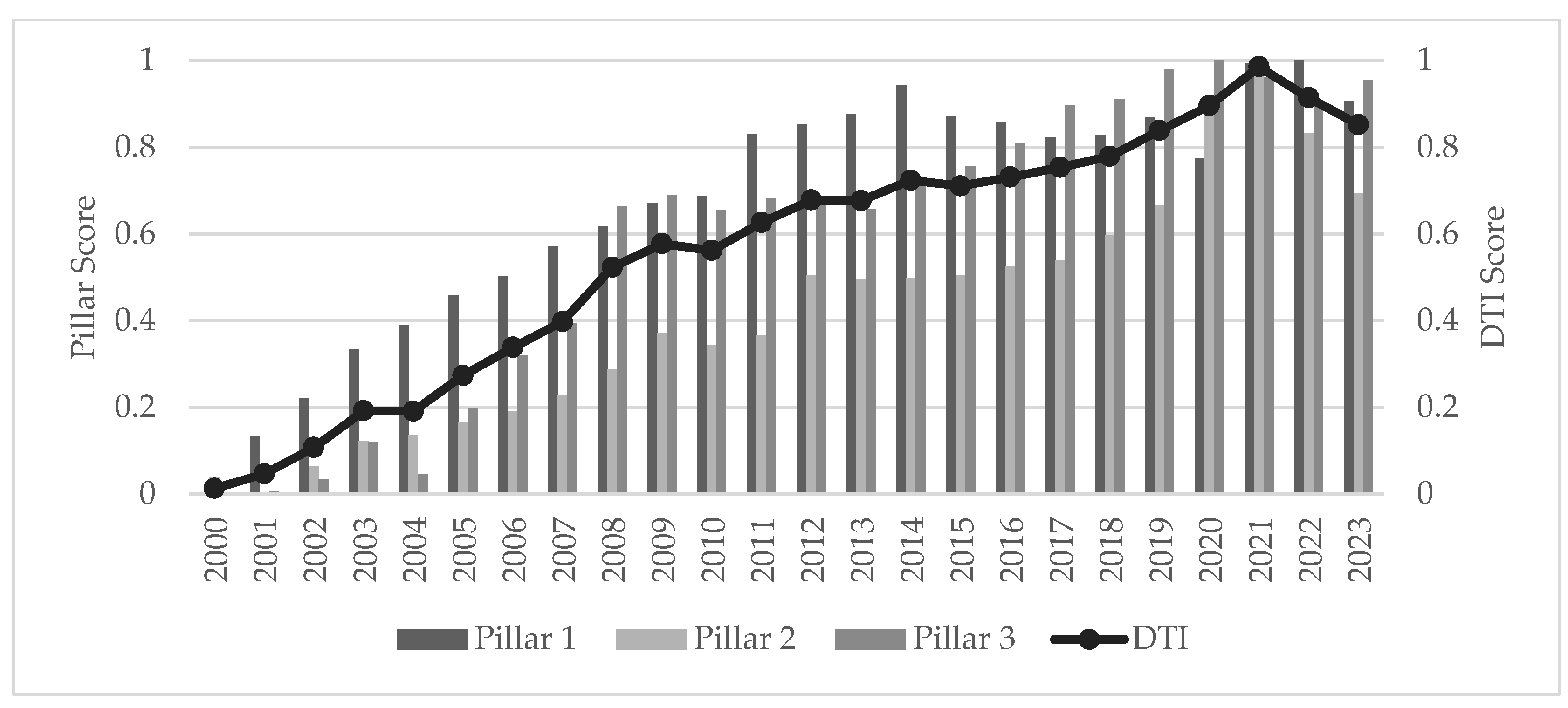
DTI values of Armenia were obtained by aggregating the scores of the pillars into the overall demographic threat index (
Figure 1).
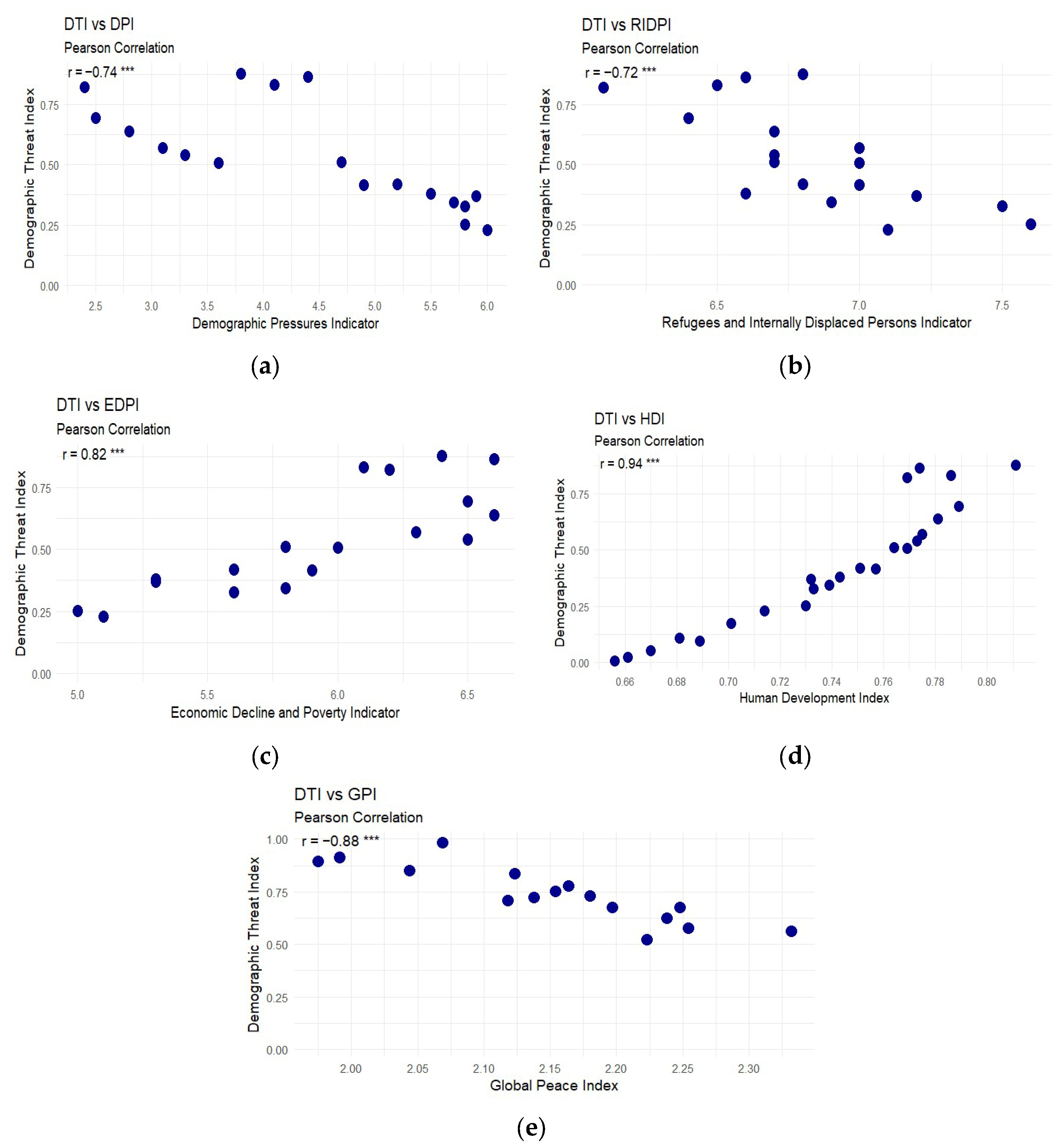
To validate the explanatory power of the developed demographic threat index, its relationships with several established indicators were rigorously examined. These comprised components of the Fragile States Index—specifically, the Demographic Pressures Indicator (DPIs), the Refugees and Internally Displaced Persons Indicator (RIDPIs), and the Economic Decline and Poverty Indicator (EDPI)—alongside the Human Development Index (HDI), published by the UN Population Division, and the Global Peace Index (GPI), published by the Institute for Economics and Peace [
83,
84,
85,
86] (
Figure 2). Strong, statistically significant correlations were observed between the developed demographic threat index and each of these five external indices. Furthermore, robust negative correlations were identified between the developed demographic threat index and the Demographic Pressures Indicator (DPIs), the Refugees and Internally Displaced Persons Indicator (RIDPIs) and the Global Peace Index (GPI) (
Figure 2a,b,d). The negative correlation between DTI and DPI was practically consistent with Armenia’s case, where demographic threats were observed alongside low fertility, population aging and emigration, rather than excessive population growth. The negative correlation between the DTI and the RIDPI reflected that periods with higher refugee inflow and internally displaced populations were associated with temporarily lowered demographic threat in Armenia, as inflows partially offset population decline. The correlation between DTI and GPI was negative. This indicated that emigration, population decline, and aging were accompanied by lower safety in Armenia. Conversely, substantial positive correlations were found between the demographic threat index and the Economic Decline and Poverty Indicator (EDPI) and the Human Development Index (HDI) (
Figure 2c,d). The positive correlation between the DTI and EDPI theoretically unveiled Armenia’s case, in which economic decline and increases in poverty were associated with emigration, low fertility and population aging. The positive relationship between DTI and HDI is typical for developing countries, showing that high-HDI countries face high demographic risks alongside longer life expectancy and population aging.
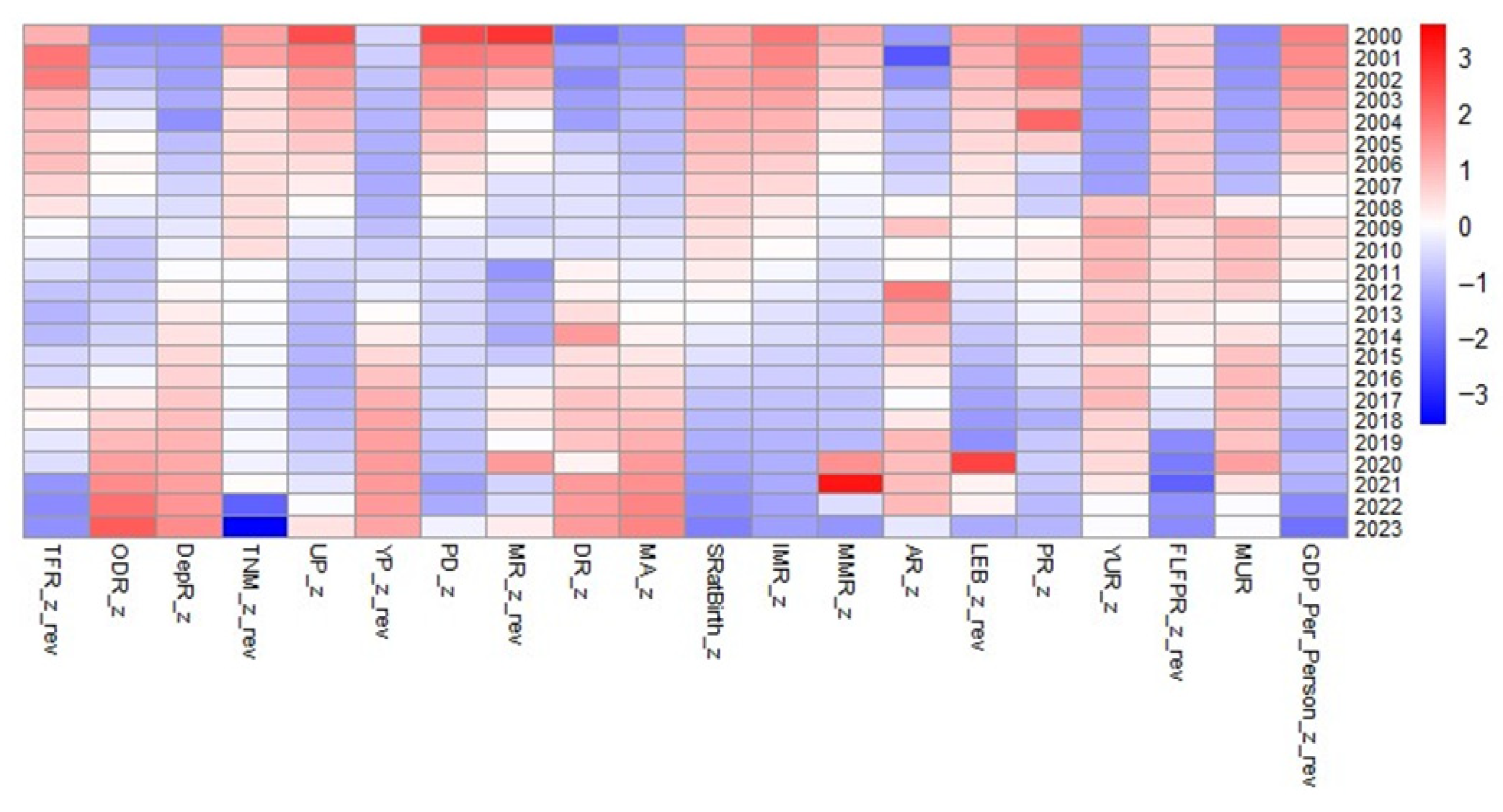
To better understand the influence of various indicators on the changes in Armenia’s demographic threat index (DTI), a heatmap of these indicators across all relevant years was developed (
Figure 3). The analysis presented in
Figure 3 reveals that, as of 2023, the primary factors contributing to the increase in Armenia’s demographic risk include the rising depopulation rate, the old-age dependency ratio, the decreasing proportion of the youth population, the increasing divorce rate, the median age of the population, the rising unemployment rate among both young people and men, and the rate of abortions per 1000 women of reproductive age.
Until 2008, Armenia’s total fertility rate remained below the average, indicating a high level of demographic risk. However, during the period from 2021 to 2023, the fertility rate rose to above-average levels, reflecting a reduction in demographic risk. The aging population is further evidenced by the increase in the old-age dependency ratio, which has been at high risk since 2017.
Throughout the entire observation period, the depopulation rate has consistently increased, exacerbating demographic risks for the country. While Armenia’s total net migration rate was above average until 2010, contributing positively to the demographic profile, it has fluctuated around the average since 2011. Over the past two years, net migration has exceeded the average level for the observed period, leading to a reduction in the DTI.
During the entire period, the share of the urban population has decreased, reducing demographic risks. The reduction in the share of the young population since 2007 has led to an increase in DTI. A gradual increase in the divorce rate, median age, youth and male unemployment rates, as well as the female labor force participation rate, contributed to the growth of the DTI thus increasing demographic vulnerability of the country. Sex ratio at birth has decreased during the observed period contributing to the reduction in the DTI. Infant mortality and maternal mortality rates decreased during 2000–2023 (the maternal mortality ratio exceeded the average in 2020 and 2021), contributing to the reduction in the DTI. Among socio-economic factors, the increase in youth and male unemployment rates negatively affected the DTI in Armenia.
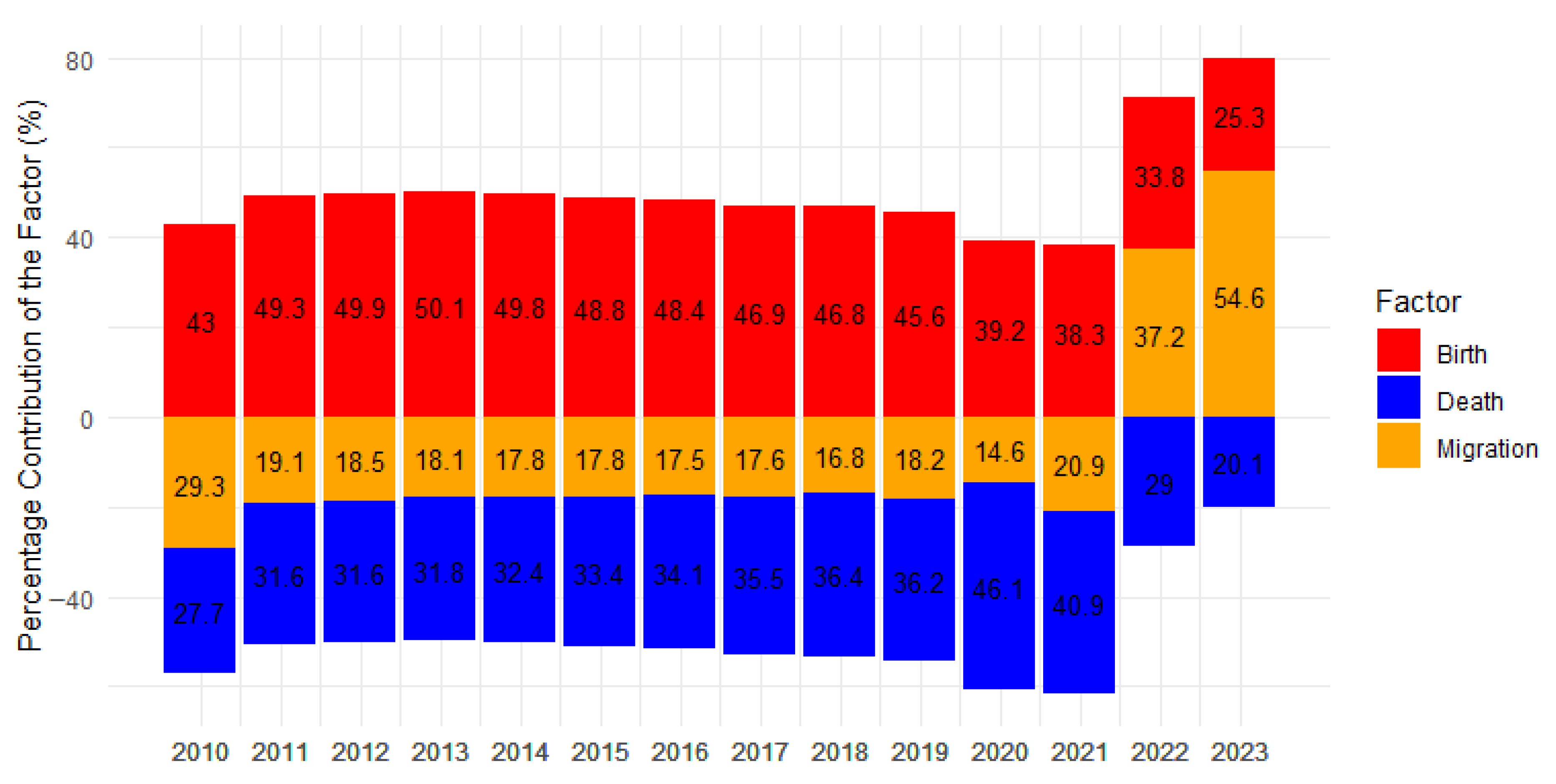
The authors assessed the relative impact of total births, deaths, and net migration on the annual change in the population size of the Republic of Armenia based on data for 2010–2023 (
Figure 4). It was indicated that the strongest driving force for the reduction in the population during 2010–2019 was emigration, showing that despite the relative positive impact of the birth factor exceeded the relative negative impact of deaths, the annual size of the population of Armenia decreased. In 2020, the relative negative impact of the migration factor decreased, but the population size decreased significantly due to the increase in the relative negative impact of the death factor and decrease in the positive impact of the birth factor. In 2021, the accelerated negative impact of migration was accompanied by a low positive contribution of births and a high negative contribution of deaths resulting in a greater decrease in the size of the population than in 2021. In 2022 and 2023, growth of the population size was due to the increase in the relative positive impact of immigration which exceeded the positive impact of births, while the relative negative impact of mortality reduced significantly.
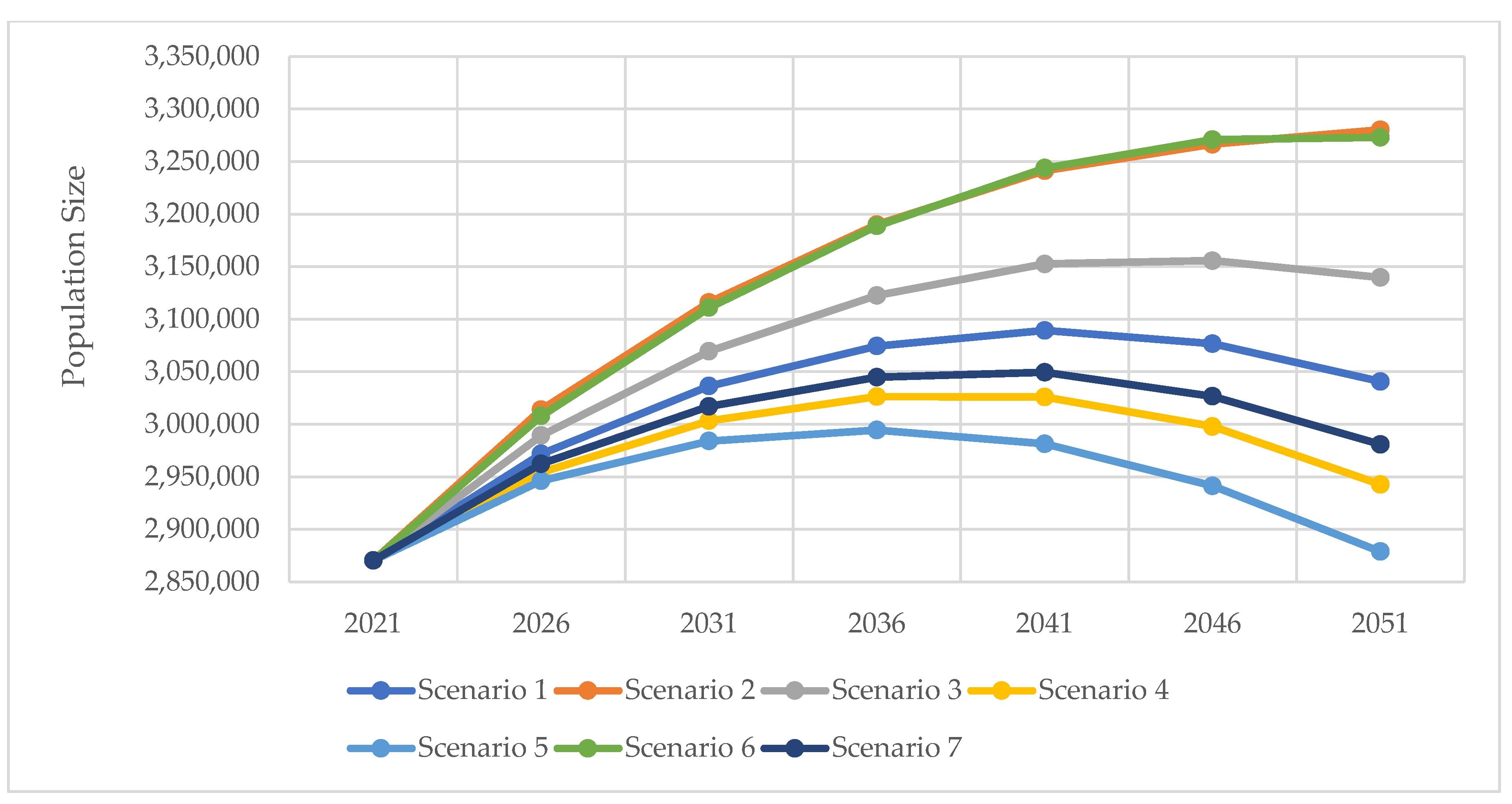
According to the results of the cohort-component analysis (
Figure 5) if the total fertility rate for 2021 remains the same and total net migration equals zero (Scenario 1), the population will peak in 2041, after which it will begin to decline to 3.04 million. The compound annual growth rate of the population is 0.192.
If the total fertility rate in the Republic of Armenia equals replacement rate (2.1), then even in the absence of migration flows (Scenario 2), the population will reach 3.28 million in 2051, which coincides with the UN median scenario forecast. Compound annual growth of the population is 0.446 and this scenario will provide the maximum size of the population in 2051.
In the case of a high total fertility rate, which is 10% above the baseline level, and a zero net migration scenario (Scenario 3), the population size could reach up to 3.16 million in 2046, and over the next 5 years it would decrease to 3.14 million. The gross annual population growth rate in this case is moderate, 0.299%. This means that the increase in the birth rate can stimulate population growth, but its impact cannot be equal to the impact of migration.
In a scenario characterized by a low fertility rate, which is 10% below the baseline level and zero migration (Scenario 4), the population size is projected to reach 2.94 million by 2051. As forecasted, the population will undergo significant demographic changes post-2041, with the elderly cohort becoming the dominant group. Concurrently, the number of women of reproductive age is expected to decline, leading to a subsequent reduction in population size.
In a scenario with low net migration and a baseline fertility rate (Scenario 5), the population in 2051 is expected to decrease to 2.88 million, the lowest across all scenarios. The gross annual population growth rate in this case would be 0.0099%, indicating that increased emigration would contribute to a higher rate of population loss.
If the baseline total fertility rate remains constant until 2051, and net migration is maintained at the 2023 level of 75,000 (Scenario 6), the population is projected to reach 3.273 million by 2051, the highest population size observed during the forecast period. This scenario suggests that high net migration, along with the replacement fertility rate, can sustain stable population growth in the Republic of Armenia. The gross annual population growth rate during the observed period in this scenario would be 0.439%.
Under the baseline fertility rate and net migration assumptions (Scenario 7), the population in 2051 could be approximately 2.98 million. Under this scenario the population would peak at 3.05 million in 2041 and then begin to decline.
The results of the research revealed that demographic threats in Armenia were generally structural rather than cyclical, primarily triggered by enduring emigration, declining fertility, and ongoing population aging. Although short-term recovery was observed in recent years due to migration inflows, the long-term trend remained adverse. Declining population, high level of urban migration flows and increasing urbanization in Yerevan intensified regional disparities and urban system imbalances. Scenario analysis confirmed that without targeted migration policy the demographic pressures would worsen further, generating substantial challenges for urban and economic sustainability.
6. Discussion
Demographic security is increasingly shaped by processes that are inherently urban in nature, including population concentration, migration flows, labor market restructuring, and changing demands for housing and public services. While traditional approaches conceptualize demographic security primarily as a national-level phenomenon [
87], the recent urban science literature emphasizes that demographic risks are first manifested and most acutely experienced within cities and urban regions, where population change directly affects sustainability, resilience, and quality of life [
88,
89].
The approach applied in this study aligns with comprehensive and dynamic frameworks for demographic assessment, integrating demographic, health, and socio-economic dimensions. From an urban science perspective, this multidimensional structure is particularly relevant, as urban systems operate at the intersection of population dynamics, human capital, and socio-economic vulnerability. The inclusion of urban population share, migration, labor market indicators, and population aging allows the demographic threat index (DTI) to capture pressures that directly influence urban infrastructure capacity, service provision, and spatial inequality.
Existing demographic security indices often rely on a limited set of demographic indicators, such as fertility and mortality rates [
63,
65,
90,
91], which provide an incomplete picture of urban demographic stress. In contrast, the present study includes 20 indicators, several of which have explicit urban relevance, such as urban population share, population density, unemployment, poverty, and migration. This broader indicator base improves the index’s ability to reflect urban demographic vulnerability, where demographic change interacts with housing markets, labor absorption capacity, and social infrastructure.
The method for the assessment of the demographic security of RA applied by the authors can be described as comprehensive considering not only pure demographic factors, but also health and socio-economic factors and migration flows. It can be described as an integration of dynamic and comprehensive approaches.
The comprehensive assessment of the security encompasses a broad scope of inquiry and one of its components is the construction of an integral index. Many scholars have developed various integral indicators to assess the economic security level [
92,
93,
94], as well as demographic security of countries and regions [
2,
63,
65]. The construction of demographic security indices consists of the same elements: the pillars of demographic security, a set of indicators are selected to describe the demographic security, and a specific methodology is applied to integrate the normalized indicators into a composite indicator. However, this approach is constrained to a restricted number of indicators and methodology. The limited number of indicators has been used in the construction of demographic security indices excluding some essential components of demographic security. Therefore, we have involved 20 demographic, health, social, economic and cultural indicators to provide a more comprehensive measure.
Researchers employ various methodological approaches to aggregate the normalized indicators into one composite index. The literature review on the construction of indexes indicate that principal component analysis (PCA) is commonly used to define the weights of indicators based on their comparative significance [
72,
95,
96]. However, a vast majority of indices evaluating demographic risks apply equal weighting for simplicity considering the equal importance of each factor [
69]. To fill in this gap demographic threat index was constructed based on PCA approach.
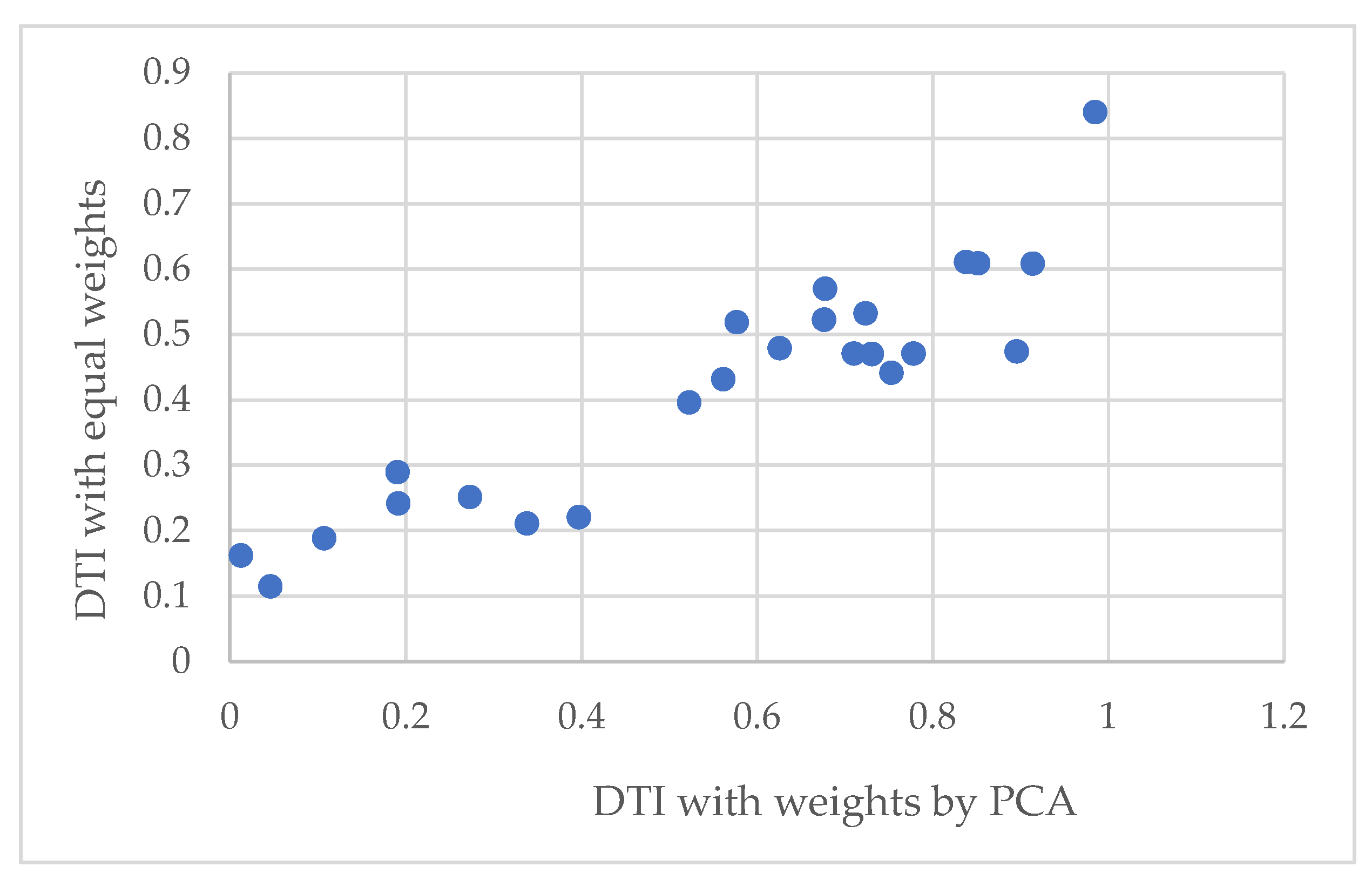
The composite index was tested for its robustness. A sensitivity exercise was conducted comparing the ranking scores of DTI with the weights for the normalized indicators obtained by PCA with an alternative approach of equal weights for the normalized indicators. The results evidenced serious changes; therefore, the index is sensitive to the choice of weighting approach (
Figure 6).
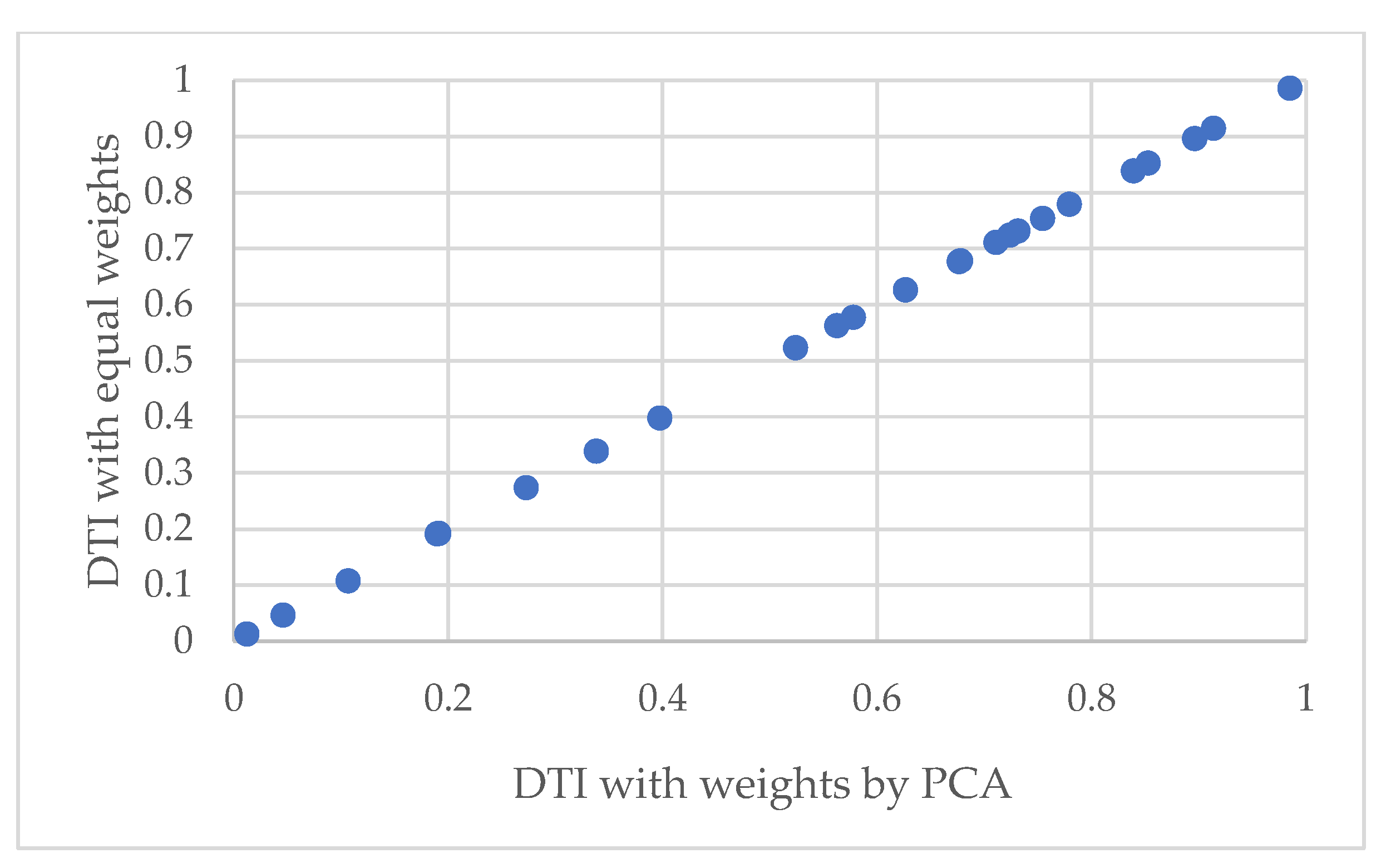
In addition, DTI with equal weights of pillars was compared with an alternative ranking score of DTI with pillars weights obtained through PCA. While comparing these two alternative approaches, a slight difference was observed; therefore, it could not be considered as a methodological concern as for both approaches very similar scores were generated (
Figure 7).
However, it is still not enough to avoid subjectivity and maintain consistency. With the change in the range of indicators and the periods the results of the PCA vary. Therefore, continuous improvements and adjustments of the DTI are required.
The evolution of demographic challenges in the Republic of Armenia between 2000 and 2023 can be systematically categorized into five distinct stages. This analysis identifies key drivers and trends influencing the nation’s demographic landscape, often assessed across the following three principal pillars: population change, population health, and socio-economic vulnerability.
Stage I: Gradual Intensification (2000–2004)
During this initial period, demographic challenges in Armenia were relatively moderate, characterized by a gradual increase in severity. Spitak earthquake, post-Soviet economic and political instability, the Nagorno-Karabakh conflict, and economic blockade resulted in lagged effects on the demographic situation in Armenia. Growing emigration was primarily accompanied by a persistent reduction in the total fertility rate, along with a rising rate of natural population decrease (depopulation coefficient). These factors collectively contributed to overall population decline and an accelerating pace of population aging [
97].
Stage II: Significant Escalation (2004–2009)
This stage witnessed a pronounced increase in demographic risks across all three pillars. Although the total fertility rate experienced a temporary increase, the overarching decline in the population size led to a heightened depopulation coefficient. Towards the end of this period (2008–2009), positive net migration rose, yet the share of the youth population simultaneously decreased, resulting in an elevated old-age dependency ratio. The upward trend within the “Population Health” pillar during this timeframe was predominantly driven by a surge in abortion rates and an increase in the median age of the population. Concurrently, the “Socio-economic Vulnerability” pillar showed substantial growth, largely due to escalating unemployment and poverty rates, exacerbated by a reduction in GDP per capita following the 2008–2009 global economic crisis.
Stage III: Stabilization at a High Level (2009–2015)
The third stage, which coincided with the post-crisis period and recovery of the economy, was marked by the stabilization of demographic risks at an elevated level. The “Population Change” pillar demonstrated a consistent upward trajectory, primarily due to the sustained rates of population decline and a stable, high depopulation coefficient. Similarly, the “Population Health” pillar also exhibited a period of stabilization during these years.
Stage IV: Acute Deterioration (2015–2020)
This period saw a sharp increase in demographic risks, culminating in 2020 when the demographic threat index (DTI) reached 0.8957, indicating numerous significant vulnerabilities. The “Population Change” pillar stabilized within the range of 0.82–0.86 during this stage, with a slight decrease in 2020. Its overall growth was driven by a drastic reduction in the population, a further increase in the depopulation coefficient, a diminishing share of the young population, a rising old-age dependency ratio, increased emigration, a decline in marriage rates, and an increase in divorce rates. The “Population Health” pillar also experienced a sharp ascent, reaching 0.91 in 2020. This was largely influenced by the spread of the COVID-19 pandemic and the impact of the 44-day war. Specifically, maternal mortality, abortion rates, and the median age of the population increased sharply in 2019 and 2020. By 2020, the “Socio-economic Vulnerability” pillar reached its theoretical maximum level of one.
Stage V: Partial Mitigation and Persistent High Risk (2020–2023)
In 2021, all three pillars simultaneously attained their maximum recorded values, pushing the demographic threat index to an unprecedented peak of 0.985 for all observed periods. However, a partial mitigation of demographic risks began in 2022–2023. This amelioration was associated with an increase in population size, a rise in immigration, an increased proportion of the young population, growth in GDP per capita, and a reduction in the poverty rate. Conversely, the “Population Health” pillar continued its upward trend in 2023, driven primarily by increases in the median age and life expectancy at birth. Nevertheless, it is crucial to note that several key indicators such as maternal and infant mortality rates and the abortion rate showed a decline during this period. Although demographic risks in the Republic of Armenia were somewhat attenuated in 2023, they remain at a significantly higher level than in the early 2000s. High demographic threat at this period was triggered by a sharp decrease in the birth rate and high emigration during 1992–2002, as those born during that period would have reached childbearing age in the 2020s.
The five stages of Armenia’s demographic evolution identified in this study can also be interpreted as distinct phases of the urban demographic transition. Early stages reflect delayed urban demographic effects of post-Soviet economic restructuring, characterized by emigration-driven population decline and fertility reduction. Subsequent stages show how these processes translated into urban aging, shrinking youth cohorts, and increased pressure on urban labor markets and social services.
The acute deterioration observed during 2015–2020 coincides with heightened stress on urban systems. Rising unemployment, declining household stability, and health shocks disproportionately affected urban populations, where population density amplified socio-economic and health vulnerabilities. The partial mitigation observed after 2021, driven largely by increased immigration, illustrates the capacity of migration to temporarily stabilize urban demographic structures, slow aging, and alleviate labor shortages—particularly in metropolitan areas.
Our cohort-component analysis projects a continued decrease in Armenia’s population size across all observed scenarios, with the sole exceptions being conditions of replacement-level fertility combined with high net migration. This analysis underscores that, in the absence of replacement-level fertility, substantial positive net migration holds the strongest potential to induce population growth in the Republic of Armenia. Conversely, negative net migration predictably leads to population contraction. Crucially, even under conditions of high and stable birth rates, the demographic outcomes achievable through sustained high positive net migration cannot be replicated. Detailed age and region-specific yearly migration data for Armenia are currently unavailable, which limits our ability to conduct a fully spatialized and age-differentiated analysis. Future work could incorporate more granular age and region-specific migration data, enabling a refined urban-focused assessment of demographic risks.
Our findings are comparable with UNDP forecasts according to which even under constant, high and instant replacement scenarios, the population in Armenia will decrease by 2051. Replacement-level fertility would provide an increase in the size of the population only under the scenario of zero migration. This highlights the critical importance of effectively managing emigration alongside stimulating fertility rates to achieve population stabilization and ensure long-term demographic security in the Republic of Armenia.
One of the most significant findings of this study is the dominant role of net migration in shaping population change, surpassing the combined effects of fertility and mortality. From an urban science perspective, this result highlights migration as a critical mechanism of urban resilience rather than merely a demographic variable. Migration directly influences urban labor supply, housing demand, fiscal capacity, and the adaptability of cities to economic shocks. On the other hand, a sizable lower-skilled immigration can increase the socio-economic vulnerability of Armenia, as has been observed in developed western democracies [
98].
The scenario-based projections demonstrate that even substantial increases in fertility are insufficient to stabilize population size in the absence of positive net migration. This finding has direct implications for urban policy: fertility-oriented measures, while important for long-term demographic balance, do not address short- and medium-term urban challenges such as workforce shortages, housing occupancy, and service utilization. In contrast, managed immigration can rapidly alter urban demographic structures, supporting economic activity and sustaining urban services.
7. Conclusions
This study contributes to the demographic literature in three principal ways. First, it introduces the demographic threat index (DTI), a transparent, PCA-weighted composite metric that integrates population change, population health, and socio-economic vulnerability to operationalize “demographic security” at the national level. Second, by empirically decomposing Armenia’s population change from 2000 to 2023, the paper demonstrates that net migration—rather than the combined effect of fertility and mortality—has been the predominant driver of population dynamics, thereby challenging the predominant policy focus on fertility incentives alone. Third, using scenario modeling through 2023, the study provides direct, policy-relevant evidence that plausible increases in birth rates are unlikely to offset the demographic effects of substantial positive net migration. Together, these contributions provide both a methodological template with small corrections for a homogeneous group of countries facing similar demographic processes and actionable evidence for integrated policy frameworks that prioritize coordinated migration and domestic demographic strategies. The demographic threat index developed by the authors can provide guidance for policymakers to identify a country’s demographic risks, review targets and adjust priorities of the demographic security strategy.
The results of this study suggest that demographic policy cannot be decoupled from urban planning and sustainability strategies. Persistent population aging and youth outmigration increase the dependency burden in cities, affecting transport demand, housing typologies, healthcare infrastructure, and municipal budgets. Urban areas experiencing depopulation face risks of housing vacancy, infrastructure underutilization, and spatial decline, while sudden migration inflows may strain housing markets and public services if not adequately planned.
Integrating demographic risk assessment tools such as the DTI into urban planning processes can support evidence-based decision-making. For instance, cities with rising demographic threat scores may prioritize age-friendly infrastructure, labor market integration of migrants, and adaptive reuse of housing stock. Conversely, periods of migration-driven population growth present opportunities to revitalize urban economies, enhance density efficiency, and support circular urban development models.
The findings of this study have several implications for demographic policy, economic planning, and social security programs in Armenia. First, the integration of a multidimensional demographic threat index (DTI) with cohort-component population projections provides robust evidence for policy interventions targeting demographic resilience. High migration among urban population and concentration in large cities call for differentiated policy approaches that address both regional decline and urban overconcentration. Second, by identifying the high risk of depopulation in Armenia, the government can prioritize investments in infrastructure, higher level of access to healthcare, education and social security programs in the regions affected by population decline. Third, strengthening peripheral areas and secondary cities with improving social life and fostering labor markets will enhance the attractiveness of rural areas leading to structural symmetric development of the country.
However, the study’s limitations include its focus on Armenia’s demographic data from 2000 to 2023, which may constrain the temporal scope and thus limit the ability to capture longer-term trends or the impact of unforeseen events outside this period. Future research can expand and refine the demographic threat index incorporating it with additional socio-demographic and economic indicators such as school enrollment, health quality, households’ income, etc. This will enhance accuracy and multidimensionality of the index. While the study is based on national-level data for Armenia, future research could analyze regional or municipal level DTI which could help to identify local demographic vulnerabilities and support targeted regional policy interventions.
Furthermore, scenario-based projections are highly dependent on assumptions regarding future birth, death, and migration rates; inaccuracies in these assumptions could undermine the reliability of the forecasts. Consequently, future research should aim to expand the temporal scope of the analysis and refine the assumptions underlying scenario-based projections.