Article

Exploratory Analysis of the Migrant Population Distribution in Medium-Sized Cities: A Case Study of Aalborg and Odense


Department of Sustainability and Planning, Faculty of IT and Design, Aalborg University, 2450 Copenhagen, Denmark
*
Author to whom correspondence should be addressed.
Urban Sci. 2026, 10(4), 189; https://doi.org/10.3390/urbansci10040189
Submission received: 15 December 2025 / Revised: 31 January 2026 / Accepted: 24 February 2026 / Published: 1 April 2026
(This article belongs to the Section Urban Planning and Design)

Abstract

Mobility of the migrant population plays a crucial role in shaping urban spaces, neighbourhood change and socio-economic development. While extensive research has been conducted on the spatio-temporal dynamics of migration in large metropolitan areas, there remains a notable lack of understanding of the impact of migration on medium-sized cities, on their internal spatial distribution and socio-spatial differentiation. This study aims to fill this gap by examining the urban settlement patterns of migrants in two medium-sized Danish cities: Aalborg and Odense. The research explores the intra-urban spatial distribution of various migrant groups, considering their origins and residential preferences. Additionally, it analyses the social and structural pull-factor proxies that influence these patterns, including urban housing market dynamics and access to amenities and services. Through an exploratory spatial analysis and data visualisation approach, this study reveals detailed insights into the determinants of migrant settlement. The findings indicate a significant intra-urban concentration of certain migrant groups, especially in the city centres, which often correspond to areas with a higher concentration of essential amenities. By focusing on mid-sized cities and adopting a case-based, comparative methodology through an extensive data visualisation approach, this research enhances urban science knowledge by illuminating underexplored urban contexts and providing a fresh view on the interplay between migration, urban development and spatial planning in medium-sized cities.

1. Medium-Sized Cities as Emerging Destinations

Migration is a global phenomenon that has consistently shaped urban development, creating opportunities and challenges for cities [1,2]. Migration flows are driven by global political and economic changes, prompting governments to anticipate future movements to better understand their underlying causes. This understanding is crucial for effective planning, resource allocation, and managing public services to facilitate migrant integration into local societies [3,4]. A range of scientific studies has documented a significant trend of migration toward larger cities and highly urbanised metropolitan areas. The primary drivers of this urban migration include the pursuit of improved living conditions and access to diverse job opportunities [5,6]. According to reports by OECD [5] and UNHCR [3], a substantial share of migrants tend to reside and aggregate more prominently in densely populated metropolitan districts compared to the native-born population, often concentrating in specific urban areas or dispersing within urban spaces [7,8]. This concentration typically involves individuals with a migration background who prefer to be in proximity to people of the same ethnicity or diaspora [9].
Recent studies, however, revealed a new tendency for mid-sized cities to become increasingly popular destinations for migrants. Their attractiveness is amplified by the lower cost of living and housing compared to larger metropolitan areas [10,11]. Besides, the increasing prevalence of remote work and good transport connectivity has empowered individuals to choose smaller cities for residence while employed in major urban centres [10,12]. This trend has sparked a notable migration to medium-sized cities with robust social infrastructure and a desirable quality of life. Consequently, communities in medium-sized cities face unique challenges as they work to welcome newcomers while preserving local culture and meeting the needs of existing populations. Although the arrival of migrants can positively impact the economy and social dynamics of mid-sized cities with declining workforces, it is important to carefully consider the specific circumstances of each destination city to retain and integrate migrants effectively [13].
Despite this growing trend, research on migration in the context of mid-sized cities remains limited, resulting in a general and insufficient understanding of the factors influencing migrants’ decisions to choose these cities as their destinations. The challenges and opportunities associated with migration to large versus mid-sized cities vary significantly, underscoring the need for a deeper investigation into the determinants driving these migration patterns. As highlighted in urban sociology, a robust theoretical framework exists to explain how migrants distribute themselves in urban spaces [14,15]. For example, studies such as Logan & Alba [16] on spatial assimilation and Portes & Rumbaut [17] on ethnic enclaves report that in larger cities, housing choices are often shaped by affordability and the presence of communities from the same diaspora with similar ethnic and cultural backgrounds. However, it remains unclear whether these factors apply equally to mid-sized cities, where urban density and community structures may differ significantly.
Therefore, the objective of this research is to describe and compare intra-urban settlement patterns of migrant groups in two medium-sized cities, and explore how these patterns are spatially associated with neighbourhood-scale indicators of housing-market conditions, residential development, and accessibility to key urban amenities, addressed through the following research questions:
  • How are different migrant-origin groups distributed across the urban space, and how do these patterns change over time?
  • How are these settlement patterns spatially associated with housing-market conditions and the residential/non-residential structure of the built environment across neighbourhoods?
  • How are migrant settlement patterns spatially associated with accessibility to selected amenities and services, treated here as proxies of potential pull-factor conditions?
By integrating these perspectives, we seek to provide valuable insights into how migrants navigate and transform urban spaces in mid-sized cities. This approach not only deepens our understanding of the spatial and temporal dynamics of migration but also highlights the distinct characteristics of migrant settlement patterns in urban contexts, thereby addressing a critical gap in the existing literature. In contrast to much existing evidence that focuses on large metropolitan areas, this study provides a case-based comparative analysis of two medium-sized cities using gridded register data and ratio-based geospatial visualisation, thus linking observed settlement patterns to neighbourhood proxies (housing markets, amenity accessibility) to generate planning-relevant evidence for medium-sized urban contexts that remain underrepresented in the literature.

2. Literature Review

2.1. Migration Patterns and Emergence of Medium-Sized Cities as Destinations

Migration studies have long documented how urban hierarchies shape destination preferences and settlement outcomes within cities [6,18,19,20]. Much of the empirical evidence continues to focus on large metropolitan regions, where migrants’ residential outcomes are frequently characterised by socio-spatial differentiation and segregation processes [21,22]. Accordingly, intra-urban research has primarily examined how migrant groups form uneven distributions and clustering patterns within the urban fabric of large metropolitan areas, as well as how neighbourhood mobility contributes to these dynamics [9,21,23]. This metropolitan emphasis has also shaped how “city scale” is theorised in migration studies, with calls to compare settlement processes across differently positioned cities within national and transnational urban systems [20]. Recent policy-oriented and governance-focused work highlights the growing relevance of middle and small-sized cities and rural areas as contexts for migrant settlement and integration, rather than treating them solely as spillover areas from high-cost metropolitan areas [5,11,24]. Their appeal is commonly linked to relatively lower living and housing costs while still offering access to employment, educational institutions, and social infrastructure [5,11]. Changes in mobility practices and accessibility conditions may further facilitate residence in smaller and medium-sized cities while maintaining connections to broader labour markets [10,25]. From a governance perspective, these developments underscore that municipal capacity and local integration policies shape settlement outcomes, supporting the need to analyse medium-sized cities as distinct policy contexts rather than scaled-down metropolitan cases [11,20].
Despite this increasing relevance, there remains comparatively limited neighbourhood-scale evidence on intra-urban migrant settlement patterns in medium-sized cities. In particular, it is not well established whether centre–periphery gradients, clustering tendencies, and neighbourhood change patterns documented in large urban areas generalise to medium-sized contexts with different housing-market segmentation and distributions of amenities [21,22,23]. This gap underscores the importance of comparative research linking observed settlement patterns to neighbourhood opportunity structures here represented through housing-market indicators, built-environment configuration, and accessibility to selected amenities and services [25,26].

2.2. Factors Influencing Urban-Bound Migration

To analyse intra-urban migrant settlement patterns, it is useful to distinguish between broader determinants of migration flows, such as labour demand, policy regimes, geopolitical changes, and localized determinants that shape destination selection and neighbourhood-level residential outcomes. Similarly to other studies, we also employ pull factors to characterise destination attributes that attract migrants by offering perceived or actual benefits, often in conjunction with push factors and other broader drivers of migration decision-making [6,18,19].
Pull factors operate at various scales [10,11,12]. At the city scale, they typically include employment and educational opportunities, overall affordability, and the presence of services and institutions that support daily life and social integration. At the intra-urban (neighbourhood) scale, pull factors commonly include housing availability and affordability, the built-environment structure that shapes residential opportunities, the spatial distribution of amenities and services [26], and transport connectivity that enables access to opportunities across the city [25,26]. These factors interact with household resources and constraints and are consistent with empirical research linking housing markets, neighbourhood composition, and mobility processes to patterns of clustering, dispersion and neighbourhood change [9,22,23,27].
In this study, in line with subsequent analyses, we operationalise pull-factor conditions using observable spatial proxies available in both case cities: (a) housing-market conditions through housing price indicators; (b) residential development and the built environment assessed via residential and non-residential indicators; and (c) accessibility to selected amenities and services, including transport connectivity. The relationships identified in this research are interpreted as spatial co-occurrences, consistent with an exploratory approach and the limitations of aggregated spatial data. We also acknowledge that amenity indicators serve as proxies and may not accurately reflect differences in how specific migrant groups value their proximity to particular amenities.

2.3. Methodologies Underpinning the Analyses of the Migration Phenomenon

The visualisation of migration phenomena has been a significant focus of scientific inquiry for decades, explored from various perspectives [7,22,28,29]. Accordingly, this subsection synthesises three methodological strands relevant to this study: advanced geospatial analyses, computational techniques using machine learning and digital trace data, and spatial disaggregation and spatial statistics. Within this literature, some studies examine the spatial distribution of migrants in urban space using spatial analysis methods [30,31], while others also pursue the social and economic factors contributing to the spatial clustering or dispersion of migrant communities in urban settings [7,8,22]. Consequently, this methodological diversity has led to a multitude of effective data visualisation methods using various data sources, enabling the recognition of patterns and knowledge extraction across spatial, temporal, and contextual data characteristics to address a range of questions. For instance, the extensive research published by Kveladze et al. [7] focused on the spatial distribution analyses of immigrant populations in large metropolitan areas, identifying factors influencing their dissemination in Amsterdam and Copenhagen. Through advanced statistical modelling, grid-cell visualisation techniques, and large datasets gathered from official sources, their research uncovered patterns of immigrant settlement that highlighted the interplay between social structures and the urban fabric of metropolitan areas. It is remarkable, though, that their study focused exclusively on large cities, avoiding smaller urban contexts where migration dynamics and influencing factors may differ considerably. Similarly, Niva et al. [32,33] also employed grid cells in a novel machine-learning approach to analyse global net migration trends across 216 countries over 20 years. Their findings emphasised the crucial role of socioeconomic factors over climate-related variables in urban and rural population growth. However, their emphasis on global patterns overlooks the local urban-specific dynamics. Like Niva et al. [32,33], Pezanowski et al. [28] also utilised machine learning and rule-based techniques in the GeoMovement system to extract migration data from textual sources. Their methodology incorporated hexagonal grid cells and movement flows alongside a space-time filtering tool, enabling a detailed representation of global migration dynamics. Although this approach provides a strong framework for capturing global movement, it is not clear whether it can also explore urban areas and the role of local amenities or neighbourhood structures in shaping migrant settlements. Unlike the authors mentioned above, Kveladze et al. [29] extended these methodologies by using social media data to examine migration on a global scale, employing space-time cubes and flow maps to dynamically represent EU migration configurations. However, the reliance on social media data could introduce biases due to unequal digital participation among migrant groups. In another study, Masías et al. [21] adopted a mixed-methods approach that integrated kernel density estimation and non-negative matrix factorisation to examine residential segregation in Berlin. Their work highlighted significant socioeconomic variables that influence urban neighbourhoods. However, since the study is centred on a single large city, its findings may not be easily applicable to smaller urban contexts.
In contrast to data visualisation-focused studies, Schönwälder & Söhn [22] used advanced statistical methods to examine settlement structures and ethnic neighbourhoods in West Germany. Their research revealed diverse residential patterns among immigrants, characterised by a low concentration of co-ethnic groups. These findings prompted hypotheses about the role of housing markets, policies, and discrimination in shaping settlement dynamics. However, their analysis lacked spatial visualisation techniques, which could have enriched their findings. Similarly, Constant et al. [27] also employed statistical analysis alongside choropleth maps to examine ethnic clustering and identity migrant formations using German census and socio-economic panel data. The study clearly demonstrated spatial clustering; however, it overlooked the significant influence of urban amenities on migrant settlement patterns. The influence of the individual residents’ ethnicity and neighbourhood’s ethnic composition on moving in and out of neighbourhoods in the Netherlands was the research focus of Schaake et al. [9]. The authors conducted a statistical analysis of housing data, revealing trends in the settlement patterns of non-Western minorities and native Dutch residents. They observed that non-Western minorities are inclined to move to areas with increasing ethnic populations, while native Dutch residents often choose to relocate away from these neighbourhoods. By employing multinomial logistic regression and general linear regression, the authors highlighted the influence of factors such as ethnicity, education, and income on neighbourhood composition and the processes of spatial assimilation. However, they did not fully examine the temporal aspects of the changes they reported.
Differing from others, Liu et al. [34] conducted a study utilizing spatial analysis methods to investigate the distribution of migrants with diverse educational backgrounds in Shanghai. The authors employed spatial statistics methods of Moran’s I to assess global spatial autocorrelation, along with the Getis-Ord General Gi* to identify local clusters and differentiate patterns of spatial correlation. Through the use of thematic maps and spatial clustering techniques, the authors discovered that migrants with higher education levels were primarily concentrated in central urban areas, while those with lower education levels were more widely dispersed across suburban regions. The proposed methods offer a comprehensive visualization and analysis of spatial settlement patterns, underscoring the influence of education on migration dynamics. The study effectively illustrates the potential of geospatial analyses and spatial statistics in analyzing educational disparities among migrants. However, it neglects to consider other factors, such as access to amenities and transportation infrastructure, that may impact migrant settlement. Besides, the exclusive focus on a single megacity may limit the applicability of its findings to smaller urban contexts.
The studies mentioned above utilise a range of data sources to investigate the spatial and temporal distribution of migrants, with a particular focus on large cities and global trends. For example, Grorgati et al. [31] and Kveladze et al. [7] examined metropolitan areas and highlighted the importance of statistical data alongside visualisation techniques for understanding urban migration, while others [22,27,28,34] emphasise the advantages of integrating statistical analysis with visualisation methods. Building upon these methodologies, our research leverages data from official sources such as the Statistical Office of Denmark to explore the spatial distribution of migrants in both cities, addressing a notable gap in understanding migration dynamics within mid-sized cities. Unlike previous studies, our localized analysis considers regional and city-specific factors, providing new insights into migration patterns. While other studies primarily focus on residential segregation in larger cities [9,21,23]. Our research extends its focus to encompass mid-sized cities, taking into account essential elements such as cultural amenities, housing affordability, and transportation connectivity to better comprehend the reasons driving migration configuration in Aalborg and Odense [35,36,37]. Consequently, we believe that by integrating statistical analysis with advanced visualization techniques, our study can identify correlations between settlement patterns and various socioeconomic features. This approach provides a comprehensive understanding of migration trends in both large and mid-sized cities, while also addressing existing gaps in the literature.

3. Methodology

3.1. Use Case Studies

This research focuses on Odense and Aalborg, two mid-sized cities in Denmark, chosen for their relevance to migration studies in urban contexts. Both cities align with the OECD [5] definition of mid-sized European cities, which categorises urban areas with populations between 100,000 and 250,000. Odense, with 207,688 residents, is the third-largest city in Denmark, while Aalborg, with 222,405 residents, is the fourth largest [38]. As significant economic, cultural, and educational centres, these cities are integral to Denmark’s national and regional urban systems. They exhibit dynamic social and economic landscapes that have been shaped by their historical significance and continue to evolve through ongoing urban development. The selection of Odense and Aalborg is also informed by their geographical distribution across distinct regions of Denmark, enabling a comparative analysis of migration dynamics. Aalborg, located in northern Denmark, has experienced rapid industrial expansion and significant growth in its educational sector, driven by Aalborg University.
In contrast, Odense, situated on Funen Island, has focused on cultural enhancement, education and infrastructure development, including urban regeneration projects to enhance its appeal as a residential and cultural hub. These distinct urban trajectories offer a valuable framework for examining how socioeconomic factors and urban characteristics influence migrant settlement patterns. In addition, both cities demonstrate diverse growth trends and significant integration efforts, reflected in neighbourhood transformations and the increasing presence of immigrant populations. These dynamics make Odense and Aalborg ideal for analysing spatial distribution patterns and understanding the determinants of migrant settlement in mid-sized urban areas.

3.2. Data Acquisition and Processing

The data on migration utilised in this research have been sourced from Statistics Denmark [38] (https://www.dst.dk/da, accessed on 18 January 2023) under restricted access and contain detailed information on migration at a spatial resolution of 100 × 100 m grid cells for the period 2014 to 2020. Due to GDPR regulations and data sensitivity, it was further aggregated to a 1 sq km resolution using individuals’ places of residence. The data processing utilised the Eurostat GISCO grid (2021 NUTS version) and open-source tools, including GeoPandas, Rasterio, and GDAL, ensuring transparency and reproducibility. The dataset was reprojected to the ETRS89 Lambert Azimuthal Equal-Area projection (EPSG: 3035) to minimise spatial distortions. This approach has helped reduce data noise resulting from fine-grained resolution to balance privacy protection and data usability. The insights derived from such sources aim to assist researchers and policy analysts in understanding the complex dynamics of the migration process across the country. As a result, the dataset for Aalborg consists of information on the origin of migrants from 2014 to 2020 organised in groups as follows: EU—European Union, WEU—western EU countries (GE, FR, CH, AT, SE, NO, FL, etc.), EEU—eastern EU countries (PL, CZ, RO, BG, EE, LT, etc.), non-Western (Canada, USA, Australia, Latin America, Ukraine, Belorussia, etc.) and MENAPA (the Middle East including Turkey, North Africa, Pakistan and Afghanistan). In addition, we also gathered data concerning migrants moving into designated grid cells for habitation purposes for the same migrant groups. On the other hand, the dataset for Odense, slightly differs from the Aalborg dataset since it does not include information on non-Western ethnic groups between 2014 and 2020. The resulting dataset for both cities maintains its scientific integrity, despite the initial limitations posed by the sensitivity of detailed information lost during the aggregation process.
In addition to the restricted grid-based dataset covering the years 2014–2020, we used publicly accessible municipal-level statistics, also extracted from Statistics Denmark’s web portal [38], to capture long-term, city-wide demographic and migration trends. These aggregated data spanning 2007–2024 are utilized solely for visualising overall dynamics within the two cities and are not part of the intra-urban grid analysis. Notably, grid-based data for the period 2007–2013 was unavailable and, consequently, could not be included.
To gain a deeper understanding of migration patterns and the factors influencing migrants’ decisions on where to settle, we require more data on geographic features that serve as pull factors. This includes the proximity to educational and socio-cultural amenities, such as schools, universities, theatres, cinemas, sports facilities, restaurants, and different modes of public transportation stops. Part of this information was obtained from the centralised database provided by the Danish data distributor (https://dataforsyningen.dk/, Accessed on 28 June 2025), which is the primary supplier of standardised databases and information across the country. Another part of the information regarding the building infrastructure was obtained from the Danish Building and Housing Register (BBR). The BBR contains comprehensive data on building configuration, gathering detailed information on the building structure, size, location, purpose, construction and renovation dates, and other relevant details about all constructions and houses in Denmark. While this data is not publicly available, it plays a crucial role in analysing the distribution of residential and commercial spaces within grid cells to estimate the allocation of residential housing areas compared to non-residential areas. In addition, this data is correlated with housing market prices sourced from Statistics Denmark to identify potential factors that influence migrants’ choices of residency. As housing prices are associated with postal code areas, we will utilize postal code boundaries for both cities rather than relying on traditional district boundaries to ensure greater spatial precision in the analysis.

3.3. Data Preparation and Visualisation Approach

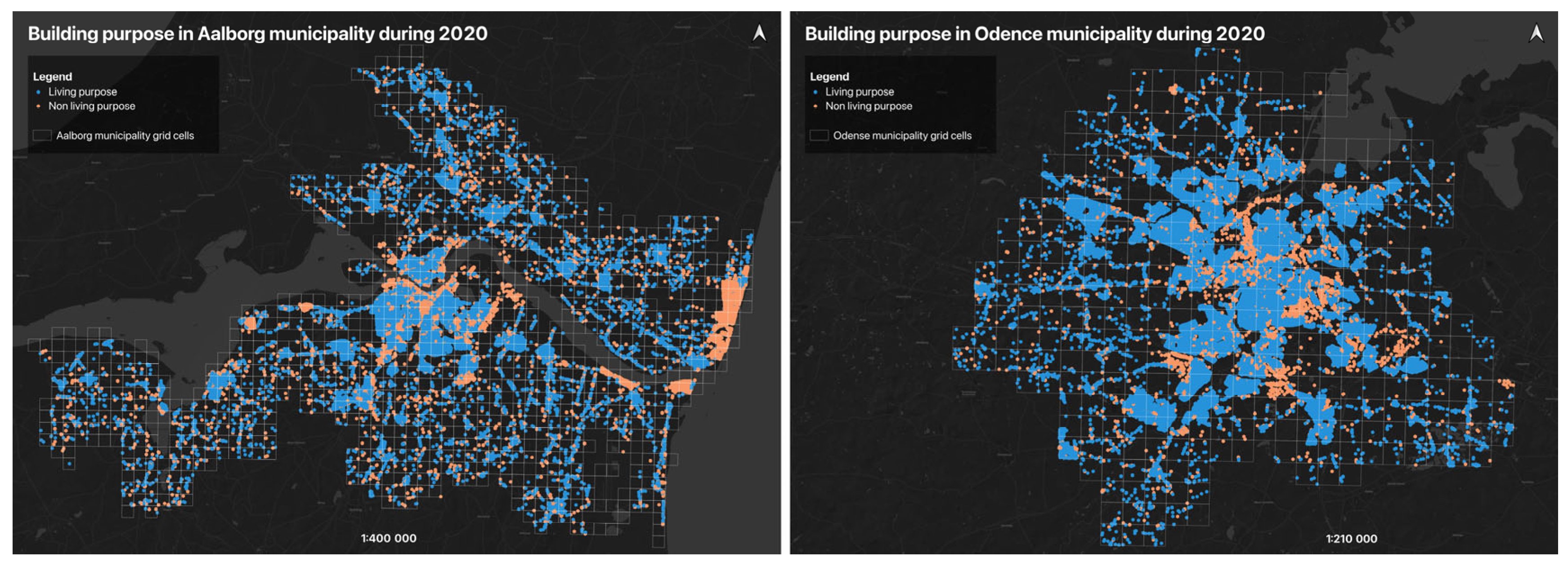
The data generated in grid cells for migrant groups was structured and prepared to calculate various ratios between groups within the grid cells for 2014 and 2020 [39,40]. The information gathered from BBR underwent additional processing to enable relevant analysis. Initially, the functionality of the buildings was categorised into six distinct groups. Subsequently, in alignment with our research focus, the data were further refined and consolidated into two primary categories: buildings designated for residential purposes and those identified as non-residential areas. The resulting data is mapped in Figure 1 and reveals an uneven geographical distribution of the two categories across urban space in both cities. In addition to the migrant group categories, the BBR dataset and housing market price data sourced from Statistics Denmark were also organised into 1 sq km grid cells to ensure spatial proximity among various geographical features examined in this study.
A combination of advanced statistical modelling and geospatial data visualisation techniques to analyse the spatial distribution of various migrant groups in the urban areas of two cities. Our statistical analysis workflows were executed using Python 3.11 libraries (NumPy, pandas, and matplotlib) to simultaneously plot line graphs, box plots, and trend lines. These modelled graphs allowed us to effectively quantify data ranges, identify statistical outliers, and detect temporal patterns to distinguish between increasing and decreasing trends over time, providing invaluable insights into both spatial and temporal variations. We also utilised ratio-based colour coding and proportional symbol techniques for data visualisation, employing Python within QGIS 3.40. This approach allowed us to model and plot the calculated ratios between various migrant groups and the density of cultural amenities, educational facilities, and transport stops on the maps. These visualisations aim to highlight spatial patterns and offer insights into how amenities are distributed in relation to areas where migrants settle. In both cities, housing prices were listed in DDK per square meter for owner-occupied flats and detachable/terraced houses based on the completed transactions within different sub-districts, as Statistics Denmark obtained from StatBank Denmark. These prices were integrated into a spatial analysis framework to investigate the relationships between housing affordability and settlement patterns, to explore spatial relationships systematically using geospatial modelling and visualisation techniques.

4. Exploratory Analytics and Migration Distribution Patterns

This section examines overall migration status and dynamics in Aalborg and Odense to provide context and support the interpretation of the intra-urban analyses reported below. To do so, the following Section 4.1 and Section 4.2 compare the municipal-level total population with the native population and illustrate group-specific temporal dynamics from 2007 to 2024. The objective is to describe overall demographic trends and the contribution of net migration to population change at the municipal level. Subsequently, a harmonised, grid-based intra-urban analysis (2014–2020) is conducted in Section 4.3 and Section 4.4 to examine settlement patterns and their spatial associations with neighbourhood-level pull-factor proxies. All relationships discussed in this section are interpreted as spatial associations rather than causal effects.

4.1. Overall Trends of Population

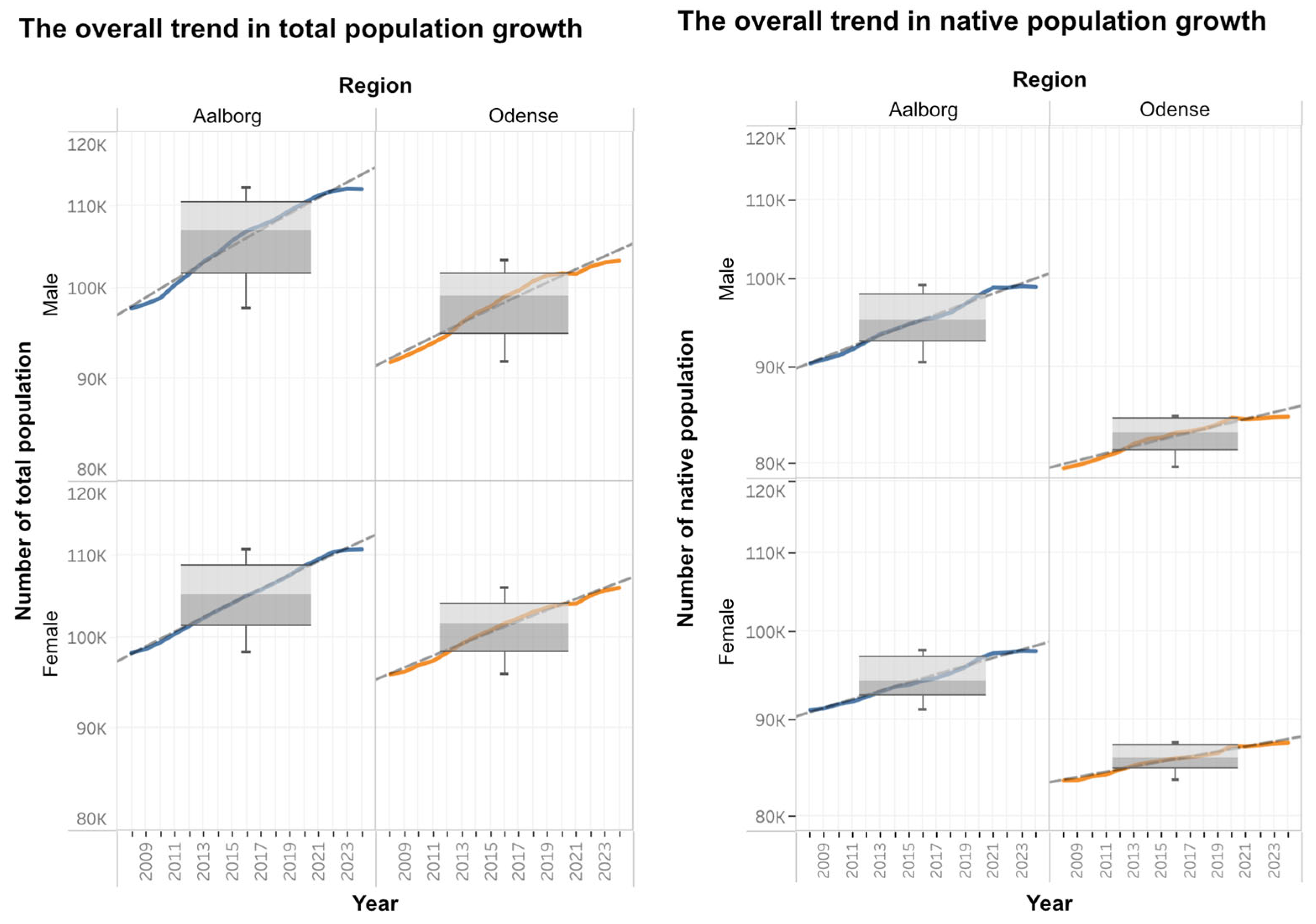
Based on data from Statistics Denmark, Aalborg and Odense exhibited consistent population growth between 2007 and 2024, as illustrated in Figure 2. Despite being Denmark’s third-largest city, Odense’s population is smaller compared to Aalborg’s. Both cities show a gender imbalance, with a higher male population than female population. The trend lines in Figure 2 depict steady population growth in both cities, though Aalborg demonstrates a more pronounced increase. While variations in total population are evident in box plots, the consistent upward trajectory highlights ongoing urban growth. The divergence between total and native population trends indicates that net migration contributes to overall population growth, particularly in Odense. The disparity between the total male population, estimated at around 105,000 residents, and the native male population, 85,000 residents, is consistent with net migration contributing to population change over the period. Likewise, the female population is experiencing growth, although at a slower pace compared to the male population, as reflected by the less steep trend lines.

4.2. Migrant Mobility Patterns

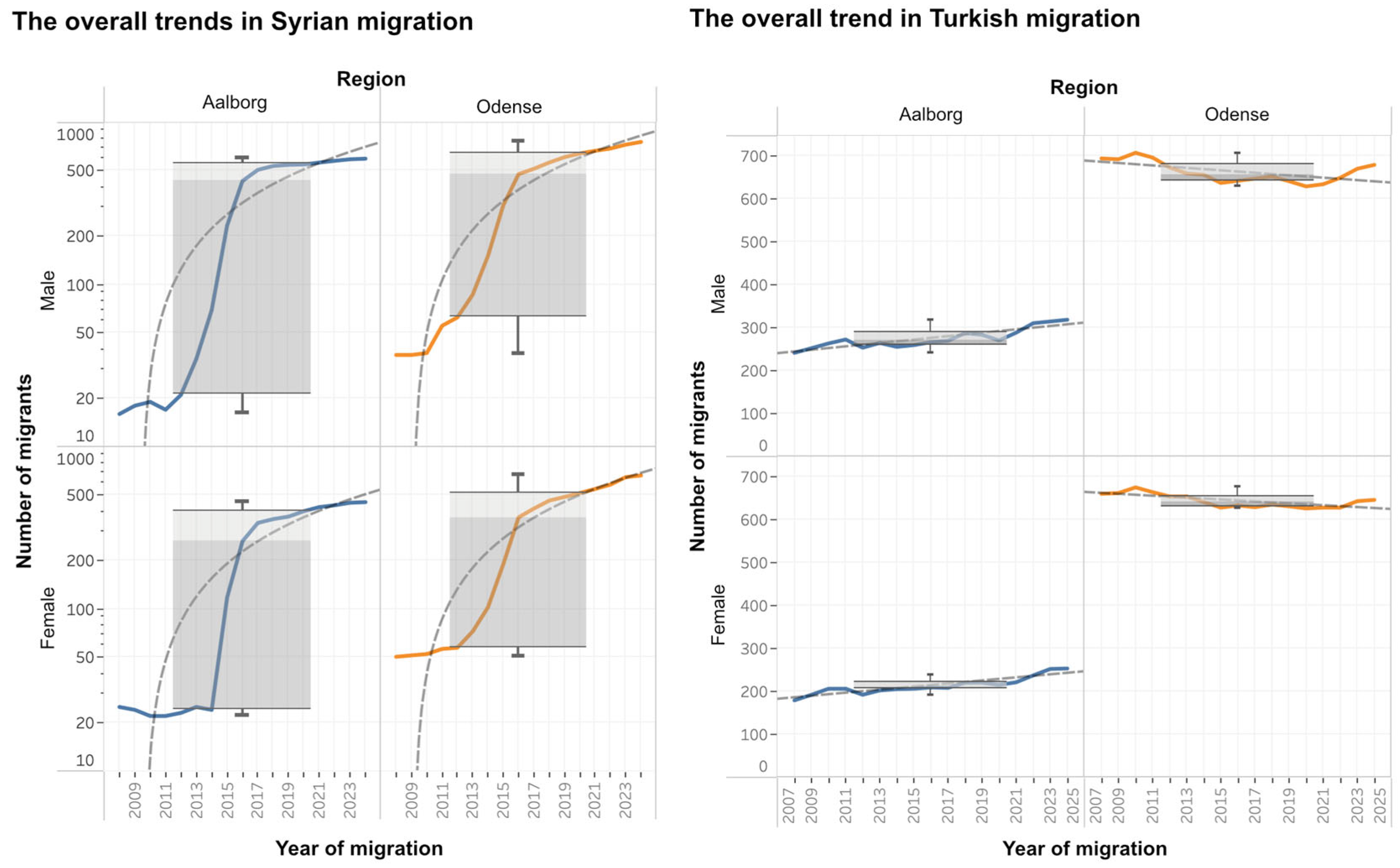
To illustrate group-specific temporal dynamics and potential sensitivity to external shocks, we compare migration trends among Syrian and Turkish-origin populations in both cities. Figure 3 shows a visible increase in Syrian migration counts from 2013, which coincides with the period of the Syrian civil war and refugee movements. This growth continued until 2016–2017, after which it stabilised, consistent with reduced annual increases in subsequent years. Aalborg shows a steeper trend line for Syrian migrants compared to Odense, reflecting faster growth. Gender-specific patterns reveal higher male migration numbers, with lower female migration in Odense compared to Aalborg. Outliers capture the variability in migration data, emphasising fluctuations during peak migration years. In contrast, Turkish migration trends exhibit a more stable, linear pattern over the observed period. Turkish migration numbers have remained consistent across gender groups over the years, reflecting a long-standing migration dynamic with comparatively limited year-to-year fluctuation. The contrasting temporal dynamics illustrate how different migrant groups can exhibit distinct trend profiles over time.
The discussed difference between total and native population growth in both cities is noteworthy, with the total growth line significantly steeper. This pattern is consistent with migration contributing to the observed population increases over the period, while contextual trends motivate the subsequent intra-urban analysis of settlement patterns and their spatial associations (Section 4.3 and Section 4.4). Although the findings discussed in this section are relevant, they can be compared with the global patterns discussed in recent studies by Hartt [10] and Gauci [11].

4.3. Analyses of Migrant Spatial Distribution Patterns

4.3.1. Spatial Distribution in Aalborg

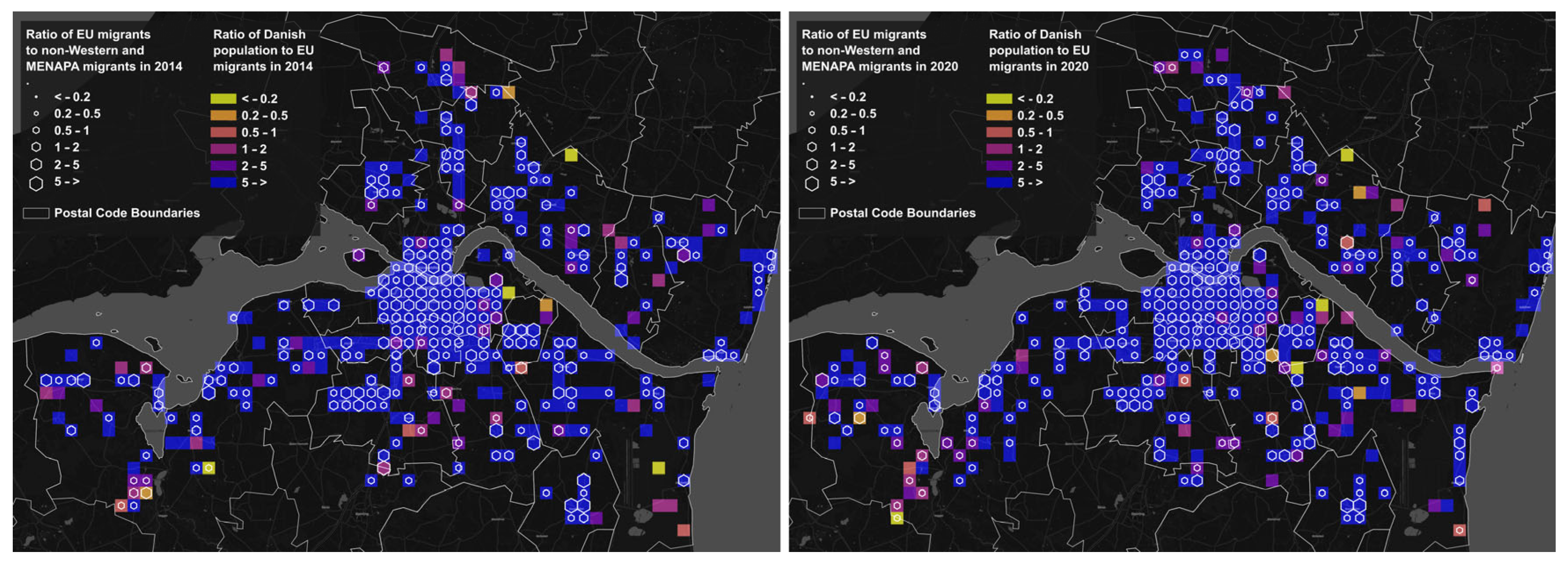
The analysis of spatial distribution patterns has revealed diverse migration dynamics over the six-year period. Figure 4 illustrates the ratios of the Danish population to EU migrants, as well as the ratios of EU migrants to non-Western and MENAPA migrants in Aalborg for the years 2014 and 2020. In 2014, both the Danish population and EU migrants were predominantly concentrated in the city centre, with lower ratios observed in peripheral areas. However, by 2020, this trend had shifted noticeably, with higher ratios extending outward from the urban core. This expansion reflects a broader spatial distribution and a growing presence of EU migrants throughout Aalborg’s urban landscape, suggesting a gradual dispersal from centralised urban areas. Moreover, the outward shift in ratios from 2014 to 2020 indicates increasing dispersion of EU migrants from the urban core; while multiple contextual mechanisms may contribute, we report the change descriptively as a spatial pattern.
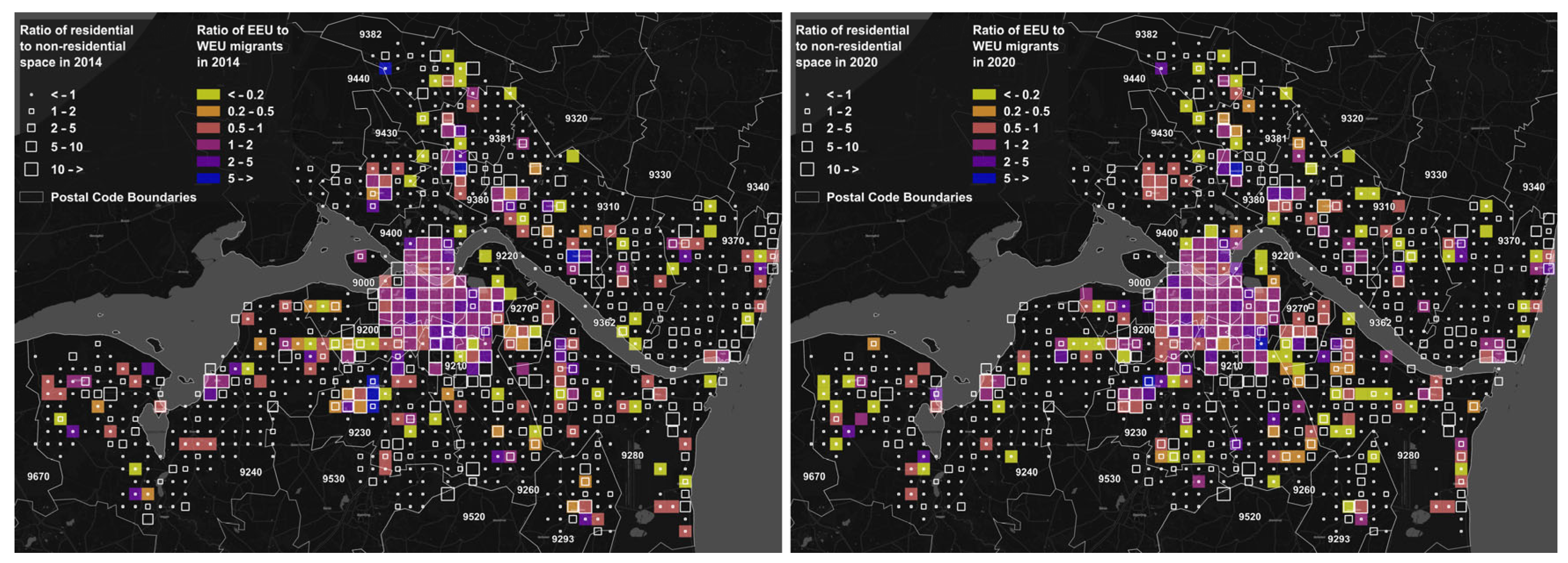
The maps in Figure 5 represent the ratio of migrants from WEU to those from EEU, as well as the proportion of residential versus non-residential areas within grid cells from 2014 to 2020. In 2014, WEU migrants were predominantly concentrated in specific clusters within the central areas of Aalborg and certain peripheral regions, indicating a relatively distinct distribution throughout the municipality. In contrast, EEU migrants displayed a more uneven distribution, with higher concentrations found in various scattered grid cells across the city. This discrepancy indicates different spatial distribution patterns between the two groups during this period.
For the year 2020, the maps illustrate a wider distribution of EEU migrants, with previously low-ratio areas now showing higher ratios, indicating significant demographic shifts. Conversely, the grid cells in the city centre, which had the highest ratios of WEU migrants in 2014, saw a decline in numbers by 2020, even as the overall city centre expanded. The distribution patterns of both migrant groups co-occur with areas characterised by higher residential shares, indicating a spatial association between settlement ratios and the built-environment structure. The rise in EEU migrants relative to WEU migrants may reflect several factors, including the appeal of educational opportunities offered by local universities, improved economic prospects, or EU migration policies that facilitate settlement in specific regions. These spatial trends highlight changes in settlement patterns over time.
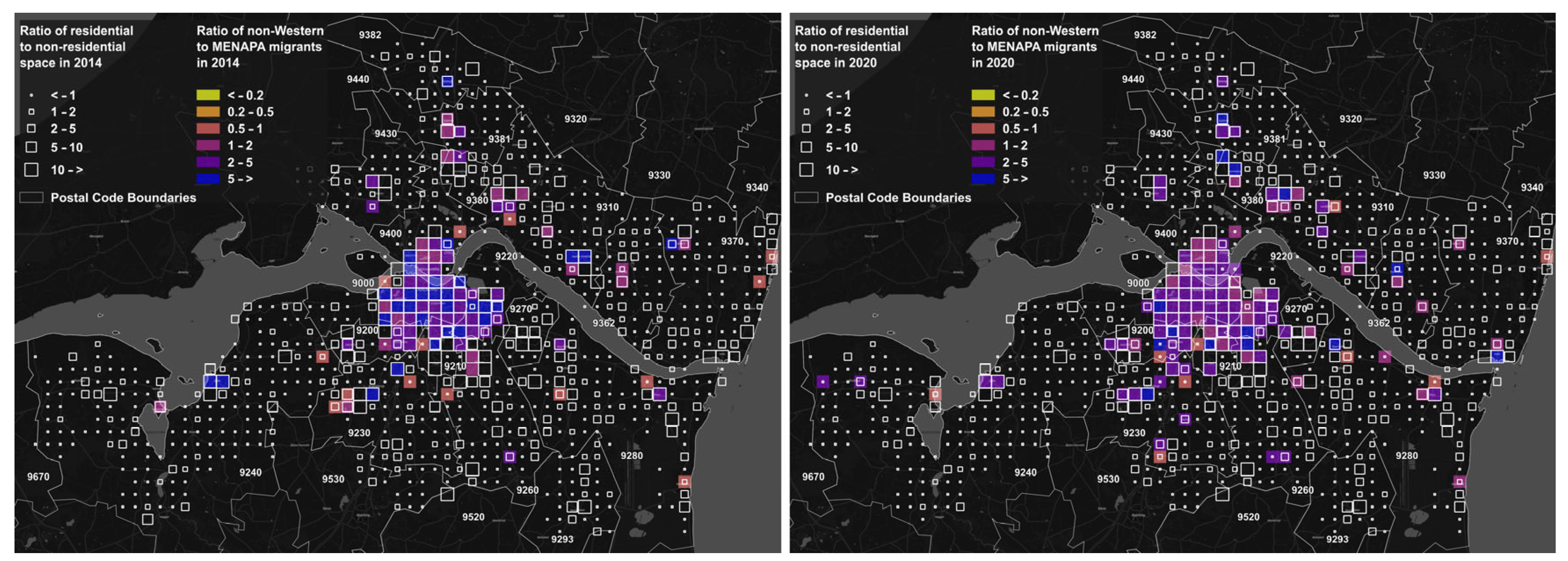
A detailed examination of the maps in Figure 6 shows spatial distribution patterns for non-Western and MENAPA migrants that closely mirror the migration trends of EEU and WEU shown in Figure 5. Both groups demonstrate a significant concentration in the city centre, which aligns with the availability of residential spaces. In 2014, the city centre had notably higher ratios of non-Western migrants compared to MENAPA migrants, while the northern and southern regions of the city exhibited lower and more dispersed ratios. These patterns emphasise a distinct demographic clustering in areas with established residential infrastructure.
On the map plotted for 2020 (Figure 6), we can observe a significant shift towards a more equitable distribution of higher residential ratios, suggesting that non-Western migrants are increasingly dispersing throughout the city. The reduction in areas with lower ratios indicates a demographic transition towards a more balanced settlement pattern as non-Western migrants expand beyond traditional central hubs and into peripheral neighbourhoods. Simultaneously, the maps illustrate the municipality’s transition from lower to higher residential ratios, reflecting a notable increase in residential development. This trend is associated with urban expansion and housing policies aimed at accommodating the city’s growing population, thereby supporting the integration and spatial distribution of migrant groups.
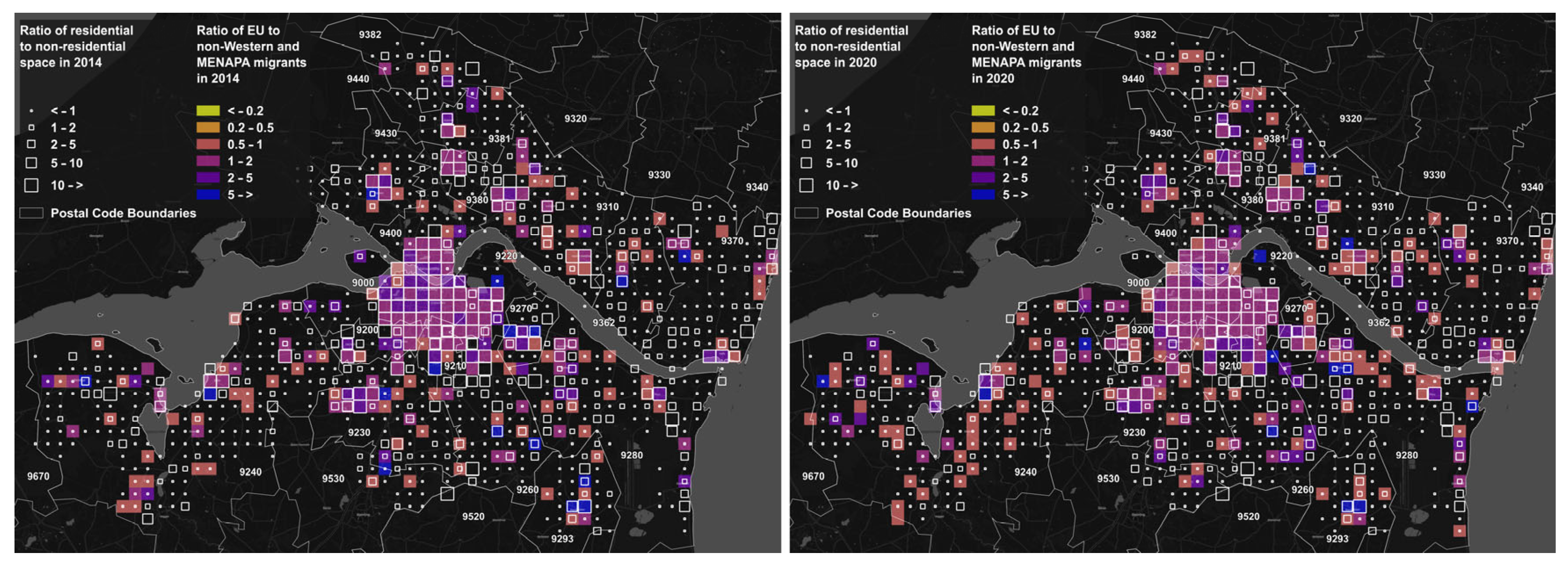
To achieve a deeper understanding of spatial distribution patterns, we compared the EU migrant group with the combined non-Western and MENAPA migrant groups, as illustrated in Figure 7. As anticipated, the city centre remains a primary living area for migrants in both years; however, EU migrants exhibit a more dispersed settlement throughout the municipality. This concentration is consistent with the earlier literature on co-ethnic proximity and spatial clustering [9,17,22,23,27]; however, the present analysis does not directly measure social networks. In contrast, lower ratios are more frequently observed in peripheral areas, which often correspond to regions characterized by a higher proportion of non-residential spaces compared to the city centres. By 2020, the distribution of higher ratios has broadened, indicative of an increasing presence of EU migrants in areas beyond the city centre. Meanwhile, the decline in areas with lower ratios suggests a demographic shift toward a more balanced distribution between the two groups. This evolving trend may be influenced by factors such as housing affordability and rental market conditions, which will be explored in the following section.

4.3.2. Spatial Distribution in Odense

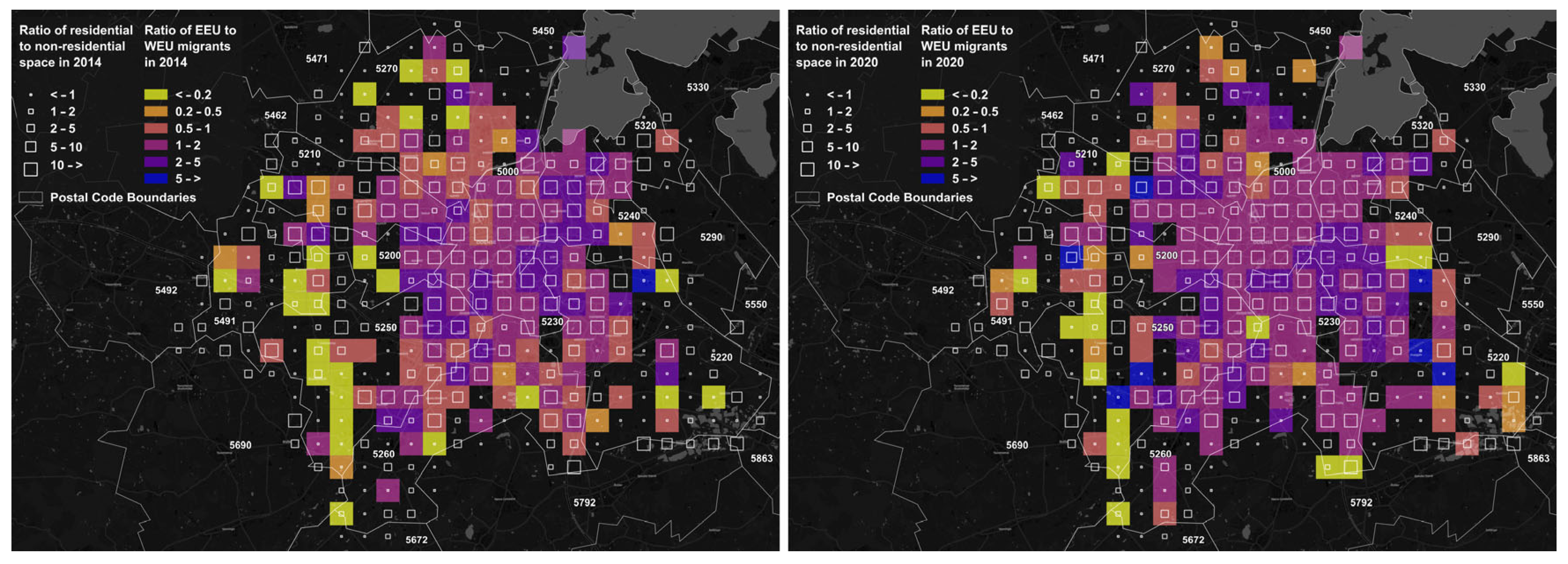
In comparison to Aalborg, the migrant population in Odense is less diverse, which enables a more in-depth analysis of the similarities and differences in migrant distribution between the two cities. Figure 8 illustrates the ratio of EEU to WEU migrants for the years 2014 and 2020, providing insight into the evolving spatial distribution within Odense over time. In 2014, areas with higher ratios predominantly reflected a concentration of WEU migrants, particularly in the city centre, where residential density is at its peak. In contrast, EEU migrants were more widely dispersed throughout the peripheral areas outside the city centre, indicating different spatial distributions between groups, which may relate to differences in housing-market and accessibility conditions (Section 4.4). The map for 2020 illustrates a more widespread distribution of migrant groups, marking a shift toward greater spatial uniformity. This expanded distribution indicates that migrant settlements are increasingly moving outwards of the city centre, with WEU migrants occupying more peripheral areas. Concurrently, regions with a higher proportion of EEU migrants have diminished, suggesting a potential demographic transition or integration into other parts of the city. This evolution in spatial patterns is consistent with urban development trends and underscores the complex interplay between housing availability, economic opportunities, and migrant settlement choices. Together, these factors offer valuable insights into the urbanisation processes shaping Odense’s population landscape. There has been a significant rise in residential development over the past six years, likely driven by factors such as population growth, housing policies, or urban expansion. The trends observed in Odense among EEU and WEU migrants mirror those discussed earlier for Aalborg. This pattern motivates our subsequent examination of housing-market indicators as a potential correlate of intra-urban settlement in the next subsection.
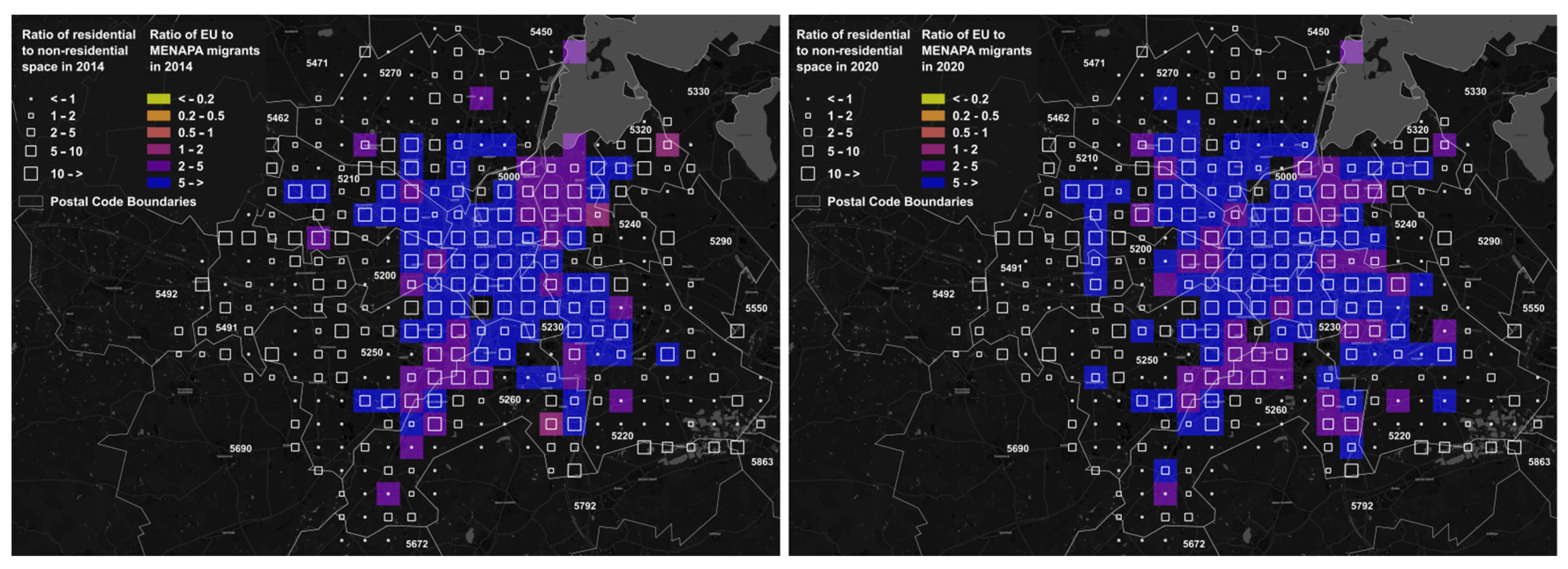
The maps in Figure 9 demonstrate the distinct spatial distribution patterns of EU and MENAPA migrants in Odense. In 2014, EU migrants were primarily concentrated in the city’s central and northeastern regions, coinciding with areas of higher residential density. In contrast, MENAPA migrants had a considerably smaller presence, with lower concentrations dispersed along the periphery. By 2020, the distribution of EU migrants had become more widespread, moving beyond the city centre and indicating enhanced spatial integration. Again, this transformation coincides with changes in the overall distribution of EU migrants over the period. Meanwhile, the already limited presence of MENAPA migrants continued to decline, reflecting a significant demographic shift. These trends suggest a dynamic urban environment influenced by evolving migration patterns and policy changes.
The comparative analysis of the maps for Aalborg and Odense from 2014 to 2020 highlights notable differences in the spatial distribution of migration, despite a shared tendency for migrants to cluster in and around the city centres. Over the six-year period, both cities have undergone significant urban expansion, reflecting considerable demographic changes and urban development. The increase in residential areas suggests a shift in land use policies that prioritise housing development to accommodate growing populations. This trend may be driven by factors such as economic growth, population increase, or urban planning strategies aimed at fostering sustainable development. Although Aalborg and Odense share certain spatial characteristics, Odense distinguishes itself as the more dynamic city in terms of residential growth and patterns of migrant distribution. However, the limited availability of data restricts our ability to draw more definitive conclusions about the broader implications of these trends. Nevertheless, the changes observed highlight the interplay between urban planning, demographic shifts, and migration dynamics, providing valuable insights into the evolving spatial dynamics of mid-sized cities.

4.4. Socio-Economic Influences

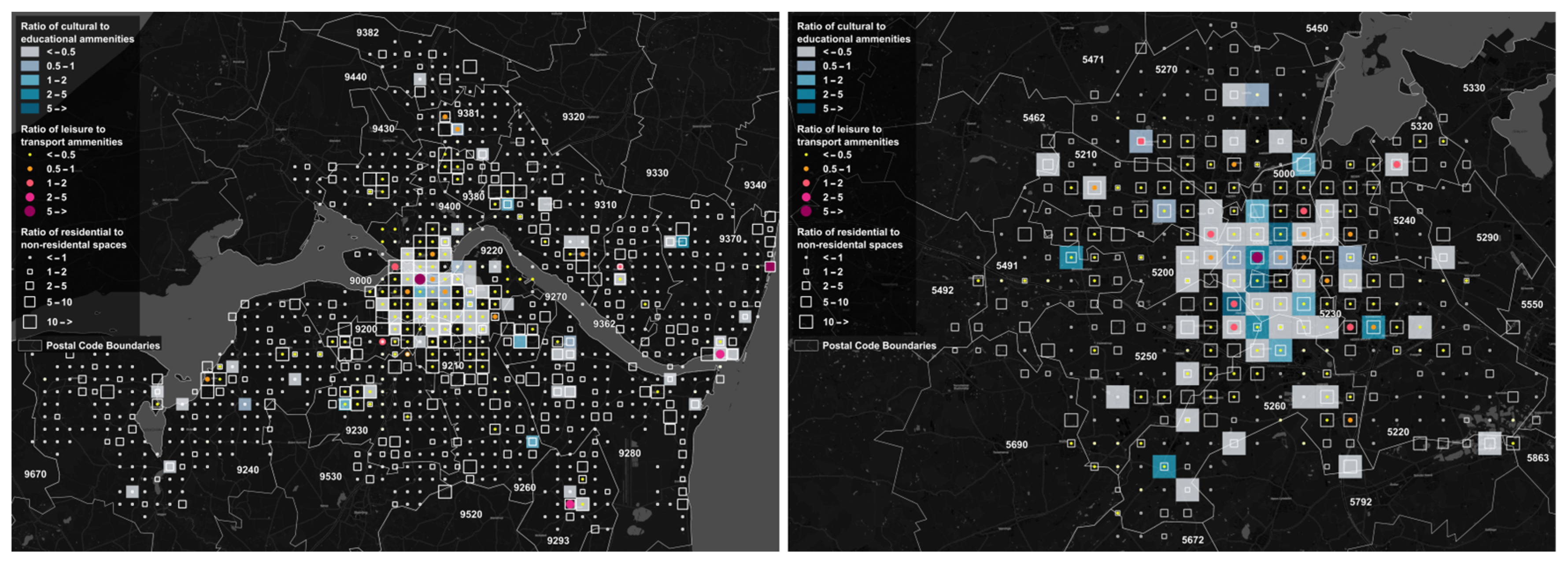
To investigate potential correlates of intra-urban settlement, we compare migrant distribution patterns with neighbourhood-scale pull-factor proxies, including the spatial distribution of amenities, transport connectivity, built-environment structure, and housing-market indicators. Figure 10 illustrates the ratios of cultural to educational amenities and leisure to transportation amenities across both cities, reflecting the distributions of residential areas in 2020. Both cities exhibit a concentration of amenities in their respective city centers, with a noticeable scarcity in peripheral regions. While educational and leisure facilities are dominant in most areas, cultural and transportation amenities are less widespread. Notably, Odense distinguishes itself with a denser and more extensive network of cultural and transportation facilities, particularly in suburban areas, indicating better integration of public transport and enhanced accessibility. Areas with higher densities of selected amenities and higher residential shares tend to coincide with higher migrant settlement ratios, indicating a spatial association between these proxies and settlement patterns. The distribution of educational facilities in the suburban areas of both cities closely corresponds to the locations inhabited by migrant families. This pattern indicates spatial co-location between migrant settlement ratios and selected educational facilities, which may be relevant for service planning. It is remarkable, though, that most of the amenities are located in areas with higher residential density, highlighting their relevance as accessibility proxies in the present exploratory analysis. It is notable that these amenity indicators are spatial accessibility proxies and do not capture measured culturally specific valuations across different migrant groups; therefore, we avoid interpreting these patterns as revealed preferences.
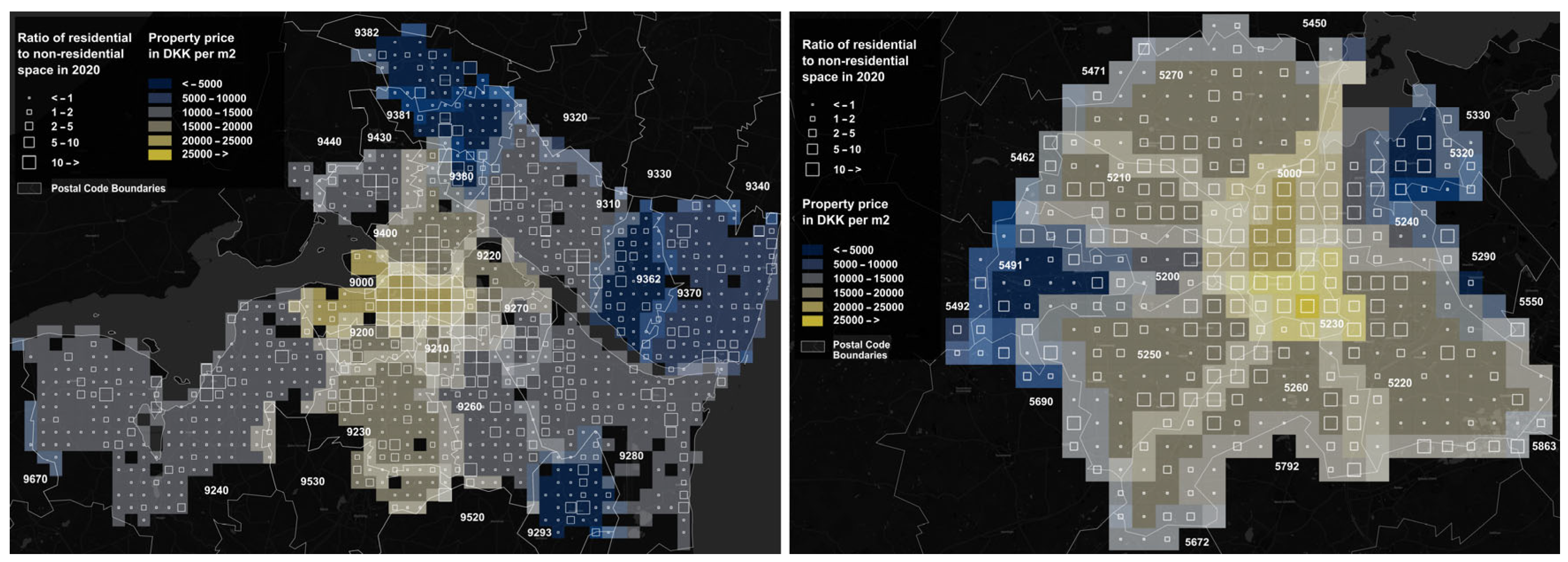
The distribution of the migrant population in urban areas is closely associated with the housing market and its affordability. According to data from Statistics Denmark, housing prices are substantially higher in central areas (Figure 11 and Figure 12), which may constrain homeownership opportunities for some households. We therefore examine whether higher migrant settlement ratios co-occur with lower-priced postal-code areas as an exploratory indicator of a housing-market association.
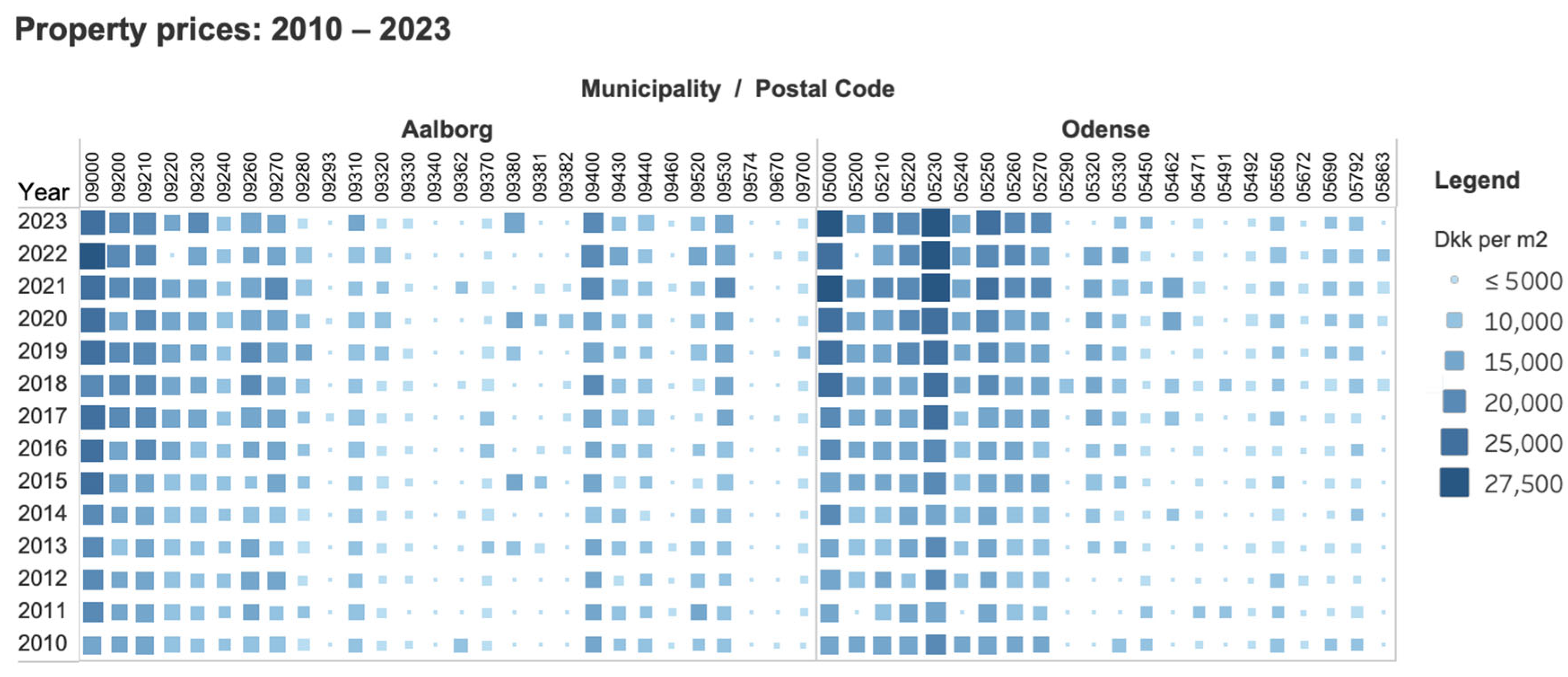
To grasp a deep understanding of the relationship between housing prices, population distribution, and residency choices, we also analysed official housing market data associated with city municipalities’ postal codes. Figure 11 shows the trend of property prices per square meter in Danish Krone (DKK) for both cities from 2010 to 2023, while Figure 12 depicts the spatial distribution of property prices for the same cities in 2020. This visualisation deepens our understanding of the geographical relationships between features and supports exploratory comparison of housing prices with settlement patterns, particularly those with a substantial migrant population. According to Figure 11, from 2010 to 2015, property prices in Aalborg were significantly lower than those in Odense, falling within the ranges of ≤ 5000 DKK per m2 to 10,000 DKK per m2. However, after 2015, there was a noticeable increase, with more areas shifting to higher price ranges.
Figure 12 provides a clearer interpretation of the spatial distribution of property prices, offering a visual foundation for understanding and exploring spatial co-location with residential areas in city centres. Both cities experienced lower property prices in most districts from 2010 to 2015. Post-2016, there was a significant rise in property prices, and by 2022–2023, several postal code areas in Odense reached the highest price category (≥25,000 DKK per m2), although both cities display a rising trend in property prices, indicating an increase in real estate market value. The analysis indicates that the geographical distribution of prices may be associated with the distribution of migration patterns in mid-sized cities. It shows that migration is dispersed across urban areas and may be associated with housing-market conditions and other neighbourhood characteristics.
The results presented in this section assess three categories of pull factors utilising available proxies: (a) housing-market conditions (housing prices), (b) built-environment structure (residential versus non-residential indicators), and (c) amenity and transport accessibility. Other mechanisms that are theoretically relevant and discussed in the literature, such as social networks [17,19], discrimination [16,22], policy implementation differences [11,13], and culturally differentiated valuations of amenities [6,25], are not directly measured within the present datasets. Consequently, these are considered limitations of the current proxy-based analysis and represent priorities for future research that can examine them through more empirically grounded designs, such as individual-level data or mixed-method evidence, to evaluate their potential as driving factors.

5. Discussion and Conclusions

Migration offers significant advantages to both city municipalities and migrants, particularly in addressing demographic challenges in mid-sized cities facing depopulation and an ageing workforce [11,24]. In this regard, this research examined intra-urban migrant settlement patterns in two medium-sized Danish cities, Aalborg and Odense, using municipal-level trend data (2007–2024) and harmonised grid-based analyses (2014–2020), both derived from Statistics Denmark [38]. The results are interpreted as spatial associations rather than causal effects. Accordingly, with respect to RQ1, the grid-based results for spatial distribution and dynamic changes show that migrant settlement patterns are generally characterised by higher concentrations in and around the city centres, alongside evidence of increasing dispersion over time for some groups. Across both cities, EU-origin groups are more widely distributed than non-Western and MENAPA groups, although the relative presence of MENAPA migrants is limited, particularly in Odense. These patterns indicate that medium-sized cities can exhibit centre-oriented settlement configurations that resemble those documented in metropolitan contexts [7,21,22], while also showing city-specific trajectories that likely reflect differences in housing development and local opportunity structures, consistent with calls to compare settlement processes across differently positioned cities within wider urban systems [20].
Associations between housing-market conditions and the configuration of the built environment indicate that settlement ratios for various migrant groups tend to cluster near areas with a higher proportion of residential properties and in neighbourhoods undergoing residential expansion. Housing-market trends, assessed at the postal-code level, show elevated prices in central locations and rising prices over time, which may limit the range of locations accessible to different households. In this exploratory study, these findings are interpreted as evidence of a spatial association between housing-market conditions and residential development patterns, rather than as direct causal factors. This addresses RQ2 and suggests that settlement ratios are spatially associated with neighbourhood-scale housing-market indicators and the structure of the built environment, specifically the residential versus non-residential composition. Regarding accessibility-related pull-factor proxies, amenities, and transport indicators show considerable centrality in both urban areas [25]. Notably, Odense exhibits a wider distribution of cultural and transport-related amenities across suburban areas, consistent with accessibility-focused evidence for Odense [26]. The spatial overlay suggests that migrant settlement ratios more often align with zones of higher residential density and improved access to designated amenities and services. It is important to note that these indicators measure general accessibility and do not reflect culturally specific preferences; consequently, the results should not be interpreted as evidence of revealed preferences. These observations relate to RQ3, which indicated that settlement ratios tend to be spatially associated with selected amenity and transport accessibility proxies, regarded as indicators of broad accessibility patterns rather than group-specific preferences. A key contribution of this study, therefore, is extending methods widely used in large metropolitan contexts to medium-sized cities, where comparable evidence remains limited, particularly at the neighbourhood scale [22]. The observed centre-oriented concentrations and subsequent dispersion identified in this study are consistent with metropolitan-scale analyses, which demonstrate that migrant settlement patterns reflect the interplay between urban structure and socio-economic constraints [21,22]. In addition, clustering in specific areas aligns with mechanisms discussed in the broader segregation and mobility literature, including neighbourhood change and neighbourhood mobility process [9,23], and the role of co-ethnic proximity and enclave formation in classic work on migrant settlement [17], as well as evidence on urban-level settlement concentration patterns [22].
At the same time, medium-sized cities differ from large metropolitan regions in labour-market depth, housing-market segmentation, and the scale and distribution of institutions and amenities. While migration can support local economies and counteract demographic decline, governance research emphasises that retention and integration depend on decision-specific conditions, particularly housing, labour-market access, and local institutional capacity [13]. Our results suggest that local differences may translate into distinctive settlement configurations (a comparatively limited MENAPA group presence and stronger outward dispersion patterns for some groups). These patterns underscore the value of case-based comparative work across medium-sized cities, complementing earlier studies that primarily focus on large urban regions and global-scale flows [7,32,33].
Although the analyses are exploratory, they have clear policy relevance, as observed settlement concentrations and their spatial alignment with housing-market conditions and accessibility proxies suggest several implications for planning. First, municipalities can use this spatial evidence to target integration-related services and social support in neighbourhoods experiencing settlement growth. Second, the co-location of settlement patterns with educational facilities underscores the importance for school and childcare capacity planning. Third, the spatial alignment between settlement ratios and housing-market conditions can inform strategies for affordable housing and for monitoring housing access across neighbourhoods. Finally, findings on transport and amenity accessibility highlight the significance of connectivity between peripheral residential areas and key urban opportunities, thereby advocating integrated transport and land-use planning.
Despite its spatial analytical scope, this study has several limitations that also point to directions for future scholarship. First, the intra-urban analyses rely on aggregated spatial data, which limit inferences about individual decision-making and introduce the potential for ecological bias. Second, the grid-based migration data and origin-group categorisations are constrained by data availability and harmonisation requirements across cities, restricting the temporal window for fully comparable intra-urban analysis. Third, the housing-price data are available at the postal-code scale and therefore provide only an approximate representation of neighbourhood-level market conditions. Fourth, the amenity and transport measures are proxy indicators and do not capture culturally specific valuations or individual preferences, which is particularly relevant when interpreting results for smaller groups such as MENAPA migrants.
Future research could strengthen explanatory power by integrating additional cities, extending time coverage where harmonised data permit, and combining spatial visualisation with formal statistical association models (regression, spatial regression, za1etc). Mixed-methods designs linking spatial patterns to qualitative evidence or survey-based preference data would be especially valuable for interpreting culturally differentiated amenity valuations and the role of social networks, discrimination, and local policy implementation.
In conclusion, this study delivers a comparative, grid-based advanced geospatial analysis to assess migrant settlement patterns in two medium-sized Danish cities and explores their spatial alignment with neighbourhood-scale proxies of housing-market conditions, built-environment structure, and amenity and transport accessibility. The findings indicate predominantly centre-oriented settlement configurations, alongside evidence of increasing dispersion over time among selected origin groups. Settlement ratios further exhibit spatial co-location with residential development and housing-market indicators, and further alignment with general accessibility proxies, interpreted as an exploratory spatial association rather than a causal effect. By extending analytical approaches commonly applied in metropolitan research to medium-sized urban contexts, the study contributes planning-relevant evidence for underexamined city types and establishes a robust foundation for future explanatory and policy-oriented research.

Author Contributions

Conceptualization, I.K. and H.S.H.; methodology, I.K. and H.S.H.; software, H.S.H. and I.K.; validation, I.K. and H.S.H.; formal analysis, I.K. and H.S.H.; investigation, I.K. and H.S.H.; resources, I.K. and H.S.H.; data curation, I.K. and H.S.H.; writing—original draft preparation, I.K. and H.S.H.; writing—review and editing, I.K. and H.S.H.; visualization, I.K. and H.S.H.; supervision, H.S.H. and I.K.; project administration, H.S.H. and I.K. All authors have read and agreed to the published version of the manuscript.

Funding

This research received no external funding.

Institutional Review Board Statement

Not applicable.

Informed Consent Statement

Not applicable.

Data Availability Statement

Open data used in this study are available from Statistics Denmark (DST) and Dataforsyningen: https://www.dst.dk/da and https://dataforsyningen.dk/, accessed on 18 January 2023. Some datasets used in this study are not freely available, as they contain sensitive information and are subject to purchase restrictions imposed by the original data providers; therefore, the authors are not permitted to redistribute them.

Conflicts of Interest

The authors declare no conflicts of interest.

References

  1. WEF (World Economic Forum). Migration and Its Impact on Cities; World Economic Forum: Geneva, Switzerland, 2017; Available online: https://policycommons.net/artifacts/3374009/migration-and-its-impact-on-cities/4172856/ (accessed on 18 October 2023).
  2. Guastella, G.; Oueslati, W.; Pareglio, S. Patterns of Urban Spatial Expansion in European Cities. Sustainability 2019, 11, 2247. [Google Scholar] [CrossRef]
  3. UNHCR (United Nations High Commissioner for Refugees). Global Trends: Forced Displacement in 2020; UNHCR: Geneva, Switzerland, 2020; Available online: https://digitallibrary.un.org/record/3966192?v=pdf&ln=en (accessed on 4 June 2024).
  4. Tjaden, J. Measuring Migration 2.0: A Review of Digital Data Sources. Comp. Migr. Stud. 2021, 9, 59. [Google Scholar] [CrossRef]
  5. OECD. OECD Regions and Cities at a Glance 2022; OECD Publishing: Paris, France, 2022; ISBN 9789264787964. [Google Scholar]
  6. Van Hear, N.; Bakewell, O.; Long, K. Push-Pull plus: Reconsidering the Drivers of Migration. J. Ethn. Migr. Stud. 2018, 44, 927–944. [Google Scholar] [CrossRef]
  7. Kveladze, I.; Georgati, M.; Kessler, C.; Hansen, H.S. Analytics of Historical Human Migration Patterns: Use Cases of Amsterdam and Copenhagen. J. Locat. Based Serv. 2023, 17, 426–446. [Google Scholar] [CrossRef]
  8. Georgati, M.; Keßler, C. Spatially Explicit Population Projections: The Case of Copenhagen, Denmark. Agil. GIScience Ser. 2021, 2, 28. [Google Scholar] [CrossRef]
  9. Schaake, K.; Burgers, J.; Mulder, C.H. Ethnicity at the Individual and Neighborhood Level as an Explanation for Moving out of the Neighborhood. Popul. Res. Policy Rev. 2010, 29, 593–608. [Google Scholar] [CrossRef]
  10. Hartt, M.; Bagchi-Sen, S.; Hollander, J.B. Reflections on the Post-Pandemic Future of Shrinking Cities. Town Plan. Rev. 2024, 95, 391–400. [Google Scholar] [CrossRef]
  11. Gauci, J.-P. Integration of Migrants in Middle and Small Cities and in Rural Areas in Europe; European Committee of the Regions (CIVEX): Brussels, Belgium, 2020; Available online: https://migrationnetwork.un.org/resources/integration-migrants-middle-and-small-cities-and-rural-areas-europe (accessed on 5 July 2024).
  12. Chen, J.; Cui, C. Large City or Small Town: An Empirical Analysis of the Effects of Migration Strategies of Rural Households on Income in China. Appl. Res. Qual. Life 2018, 13, 211–228. [Google Scholar] [CrossRef]
  13. Fonseca, M.L.; McGarrigle, J. The Role of Immigration in the Socio-Spatial Organisation of the Lisbon Metropolitan Area. In The Routledge Handbook of the Governance of Migration and Diversity in Cities; Caponio, T., Scholten, P., Zapata-barrero, R., Eds.; Routledge: Oxfordshire, UK, 2019; pp. 313–328. ISBN 9780815363705. [Google Scholar]
  14. Meyer, W.B.; Esposito, C.R. Burgess and Hoyt in Los Angeles: Testing the Chicago Models in an Automotive-Age American City. Urban Geogr. 2015, 36, 314–325. [Google Scholar] [CrossRef]
  15. Lal, B.B. Park, Robert E. (1864–1944), Ernest W. Burgess (1886–1966), and Urban Social Research. In The Blackwell Encyclopedia of Sociology; Ritzer, G., Ed.; Blackwell Publishing: Oxford, UK, 2007. [Google Scholar] [CrossRef]
  16. Logan, J.; Alba, R. Locational Returns to Human Capital: Minority Access to Suburban Community Resources. Demography 1993, 30, 243–268. [Google Scholar] [CrossRef]
  17. Portes, A.; Rumbaut, R.G. Immigrant America; University of California Press: Oakland, CA, USA, 2024; ISBN 978-0-520-39628-9. [Google Scholar] [CrossRef]
  18. Lee, E.S. A Theory of Migration. Demography 1966, 3, 47–57. [Google Scholar] [CrossRef]
  19. Massey, D.S.; Arango, J.; Hugo, G.; Kouaouci, A.; Pellegrino, A.; Taylor, J.E. Theories of International Migration: A Review and Appraisal. Popul. Dev. Rev. 1993, 19, 431–466. [Google Scholar] [CrossRef]
  20. Glick Schiller, N.; Çaǧlar, A. Towards a Comparative Theory of Locality in Migration Studies: Migrant Incorporation and City Scale. J. Ethn. Migr. Stud. 2009, 35, 177–202. [Google Scholar] [CrossRef]
  21. Masías, H.V.H.; Stier, J.; Navarro, R.P.; Mauricio, A.V. A Novel Methodological Approach for Analyzing the Multifaceted Phenomenon of Residential Segregation: The Case of Berlin. Cities 2023, 141, 104465. [Google Scholar] [CrossRef]
  22. Schönwälder, K.; Söhn, J. Immigrant Settlement Structures in Germany: General Patterns and Urban Levels of Concentration of Major Groups. Urban Stud. 2009, 46, 1439–1460. [Google Scholar] [CrossRef]
  23. Schaake, K.; Burgers, J.; Mulder, C.H. Ethnicity, Education and Income, and Residential Mobility Between Neighbourhoods. J. Ethn. Migr. Stud. 2014, 40, 512–527. [Google Scholar] [CrossRef]
  24. OECD. The Contribution of Migration to Regional Development. In OECD Regional Development Studies; OECD Publishing: Paris, France, 2022. [Google Scholar] [CrossRef]
  25. Geurs, K.T.; van Wee, B. Accessibility Evaluation of Land-Use and Transport Strategies: Review and Research Directions. J. Transp. Geogr. 2004, 12, 127–140. [Google Scholar] [CrossRef]
  26. Kveladze, I. Spatial Accessibility in the Urban Environment of a Medium-Sized City: A Case Study of Public Amenities in Odense, Denmark. Urban Sci. 2025, 9, 407. [Google Scholar] [CrossRef]
  27. Constant, A.F.; Schüller, S.; Zimmermann, K.F. Ethnic Spatial Dispersion and Immigrant Identity. J. Chin. Econ. Bus. Stud. 2023, 22, 205–230. [Google Scholar] [CrossRef]
  28. Pezanowski, S.; Mitra, P.; MacEachren, A.M. Exploring Descriptions of Movement Through Geovisual Analytics. KN J. Cartogr. Geogr. Inf. 2022, 72, 5–27. [Google Scholar] [CrossRef]
  29. Kveladze, I.; Jokinen, J.C.; Tapia, C.; Hansen, H.S. What Can Location-Based Social Media Reveal on Human Migration Patterns in Europe? J. Maps 2024, 20, 2329168. [Google Scholar] [CrossRef]
  30. Borruso, G. Geographical Analysis of Foreign Immigration and Spatial Patterns in Urban Areas: Density Estimation, Spatial Segregation and Diversity Analysis. In Lecture Notes in Computer Science VI; Springer: Berlin/Heidelberg, Germany, 2009; pp. 301–323. [Google Scholar] [CrossRef]
  31. Georgati, M.; Monteiro, J.; Martins, B.; Keßler, C. Spatial Disaggregation of Population Subgroups Leveraging Self-Trained Multi-Output Gradient Boosting Regression Trees. Agil. GIScience Ser. 2022, 3, 5. [Google Scholar] [CrossRef]
  32. Niva, V.; Kallio, M.; Muttarak, R.; Taka, M.; Varis, O.; Kummu, M. Global Migration Is Driven by the Complex Interplay between Environmental and Social Factors. Environ. Res. Lett. 2021, 16, 114019. [Google Scholar] [CrossRef]
  33. Niva, V.; Horton, A.; Virkki, V.; Heino, M.; Kosonen, M.; Kallio, M.; Kinnunen, P.; Abel, G.J.; Muttarak, R.; Taka, M.; et al. World’s Human Migration Patterns in 2000–2019 Unveiled by High-Resolution Data. Nat. Hum. Behav. 2023, 7, 2023–2037. [Google Scholar] [CrossRef]
  34. Liu, Z.; Wilson, B.; Zhu, W. A Study on the Distribution of Migrants with Different Education Levels in Shanghai. In Human-Centered Urban Planning and Design in China: Volume II; GeoJournal Library; Springer: Berlin/Heidelberg, Germany, 2021; Volume 130, pp. 339–358. [Google Scholar] [CrossRef]
  35. Blumenstock, J.E. Inferring Patterns of Internal Migration from Mobile Phone Call Records: Evidence from Rwanda. Inf. Technol. Dev. 2012, 18, 107–125. [Google Scholar] [CrossRef]
  36. Zagheni, E.; Weber, I. You Are Where You E-Mail. In Proceedings of the 4th Annual ACM Web Science Conference; ACM: New York, NY, USA, 2012; pp. 348–351. [Google Scholar] [CrossRef]
  37. State, B.; Weber, I.; Zagheni, E. Studying Inter-National Mobility through IP Geolocation. In Proceedings of the WSDM 2013—Proceedings of the 6th ACM International Conference on Web Search and Data Mining; Association for Computing Machinery: New York, NY, USA, 2013; pp. 265–274. [Google Scholar]
  38. Statistics Denmark Statistics Denmark. Available online: https://www.dst.dk/en/Statistik/emner/borgere/befolkning/befolkningstal (accessed on 18 January 2023).
  39. Cromley, E.K.; McLafferty, S.L. GIS and Public Health, 2nd ed.; The Guilford Press: New York, NY, USA, 2012; ISBN 978-1-60918-750-7. [Google Scholar]
  40. Longley, P.A.; Goodchild, M.F.; Maguire, D.J.; Rhind, D.W. Geographical Information Systems—Principles, Techniques, Management, and Applications, 2nd ed.; John Wiley and Sons: Hoboken, NJ, USA, 2005; ISBN 9780471735458. [Google Scholar]
Figure 1. The maps show an uneven distribution of residential (blue) and non-residential (orange) building types in Aalborg (left) and Odense (right) for the year 2020.
Urbansci 10 00189 g001
Figure 2. The graphs depict total and native population trends (dotted lines) in Aalborg and Odense between 2007 and 2024. The graph highlights data variability, including outliers, as well as minimum, median and maximum values, while distinctive blue and orange lines differentiate the observed migration dynamics in Aalborg and Odense.
Urbansci 10 00189 g002
Figure 3. The graphs illustrate the migration trends (dotted lines) of Syrian and Turkish ethnic groups between 2007 and 2024. The graph highlights data variability, including outliers, as well as minimum, median and maximum values, while distinctive blue and orange lines differentiate the observed migration dynamics in Aalborg and Odense.
Urbansci 10 00189 g003
Figure 4. The maps illustrate the distribution ratio between the native population and migrant groups discussed in this study in Aalborg municipality from 2014 (left) to 2020 (right). The ratio of the Danish population to EU migrants below 1 indicates a higher EU population, whereas a ratio above 1 signifies a larger Danish population. The ratios between EU migrants and non-Western and MENAPA migrants greater than 1 suggest a predominance of EU migrants and less than 1 higher concentration of non-Western and MENAPA migrants.
Urbansci 10 00189 g004
Figure 5. The maps illustrate the distribution of EEU and WEU migrant groups in Aalborg municipality’s urban spaces between 2014 (left) to 2020 (right). The ratios between residential and non-residential spaces indicate that a value greater than 1 signifies a predominance of residential areas, while a value less than 1 indicates a dominance of the non-residential regions. The ratio between EEU and WEU migrants shows that a proportion below 1 signifies a higher EEU population, while a ratio above 1 indicates a higher WEU population.
Urbansci 10 00189 g005
Figure 6. The maps display the ratio between non-Western to MENAPA migrant groups and their distribution in the urban space of Aalborg municipality in 2014 (left) to 2020 (right). The ratio between residential and non-residential spaces indicates the predominance of residential areas above value 1 and the dominance of non-residential spaces below value 1. The ratio between non-Western and MENAPA migrants denotes a MENAPA population below 1 and a non-Western population above 1.
Urbansci 10 00189 g006
Figure 7. The maps display the ratio between EU to non-Western and MENAPA migrant groups and their distribution in the urban space of Aalborg municipality in 2014 (left) to 2020 (right). The ratios between residential and non-residential spaces indicate that a value greater than 1 signifies a predominance of residential areas, while a value less than 1 indicates a dominance of non-residential. Similarly, the ratio between EU to non-western and MENAPA populations shows that a ratio above 1 indicates a higher EU population, while a ratio below 1 indicates a higher non-Western and MENAPA population.
Urbansci 10 00189 g007
Figure 8. The maps illustrate the distribution of EEU to WEU migrant groups in the urban areas of Odense municipality in 2014 (left) to 2020 (right). The ratios between residential and non-residential spaces signify that a value greater than 1 indicates a predominance of residential areas, while a value less than 1 suggests a dominance of non-residential spaces. The ratio between EEU and WEU populations indicates that a ratio below 1 reflects a higher EEU population, whereas a ratio above 1 reflects a higher WEU population.
Urbansci 10 00189 g008
Figure 9. The maps illustrate the distribution of EU and MENAPA migrant groups in the urban areas of Odense municipality in 2014 (left) to 2020 (right). A ratio value greater than 1 between residential and non-residential spaces indicates a predominance of residential areas, whereas a value less than 1 suggests a dominance of non-residential spaces. The ratio between EU and MENAPA migrant groups demonstrates that the grid cells with proportions below 1 have a higher MENAPA population, while a ratio above 1 reflects a higher EU population.
Urbansci 10 00189 g009
Figure 10. The maps illustrate the ratios of cultural to educational amenities and leisure to transportation amenities in relation to the distribution of residential areas in Aalborg (left) and Odense (right). Ratios below 1 indicate a higher presence of educational and transportation amenities, as well as non-residential areas, while ratios above 1 indicate a greater concentration of cultural and leisure activities, as well as higher residential spaces.
Urbansci 10 00189 g010
Figure 11. The graph shows the price trend in the housing market for both municipalities from 2010 to 2023. The postal codes on the horizontal axis of the graph can be referenced to the maps in Figure 12 to find the geographical locations and price distributions of properties in both cities.
Urbansci 10 00189 g011
Figure 12. The maps analyse the property prices across different postal code boundaries within the municipalities of Aalborg (left) and Odense (right), along with the representation of available residential spaces.
Urbansci 10 00189 g012
Disclaimer/Publisher’s Note: The statements, opinions and data contained in all publications are solely those of the individual author(s) and contributor(s) and not of MDPI and/or the editor(s). MDPI and/or the editor(s) disclaim responsibility for any injury to people or property resulting from any ideas, methods, instructions or products referred to in the content.