
Cemeteries and Urban Planning in Vienna



Abstract
1. Introduction
1.1. Crucial Issues Regarding the Significance of Cemeteries in Urban Planning
- Cemetery location planning and the emergence and addressing of land constraints and land use policy issues—e.g., with regard to the zoning of residential areas around cemeteries and the attractiveness or acceptance of these residential areas by (future) residents [36,37]—particularly when cemeteries that were formerly located on the urban periphery have been absorbed into urban areas and now are located in densely built-up areas.
- The need for balanced provision of denominational and interdenominational cemeteries based on intercultural and interracial understanding and tolerance, as well as awareness of the fact that cemeteries can foster intercultural and interracial understanding by providing spaces for diverse communities (including minority faith communities) to practise their mourning and burial traditions [38,39], and dealing with resistance among the population or certain groups of people in the case of the closure or relocation of cemeteries, motivated by emotional and/or religious reasons. Evidence-informed decision-making is therefore identified as central in urban planning regarding cemetery location planning [37].
- The importance of the legal framework in the context of conserving (historical) cemeteries, location selection and cemetery relocation [40].
- Eco-friendly cemetery operation (including renewable energies and efficient water use) and the minimisation of environmental impacts (addressing health protection by considering, e.g., soil contamination and sanitation) [41].
1.2. More Recent Research on Vienna’s Cemeteries
1.3. Aim of the Paper and Research Questions
- Do cemeteries receive consideration in the context of urban planning in Vienna, and if so, in which respect?
- What is the significance of cemeteries for the urban population as perceived by the Vienna urban planning authority and interdenominational as well as denominational cemetery operators?
- What factors have an impact on the persistence of or changes in cemeteries in Vienna, and why?
2. Materials and Methods
2.1. Data Collection
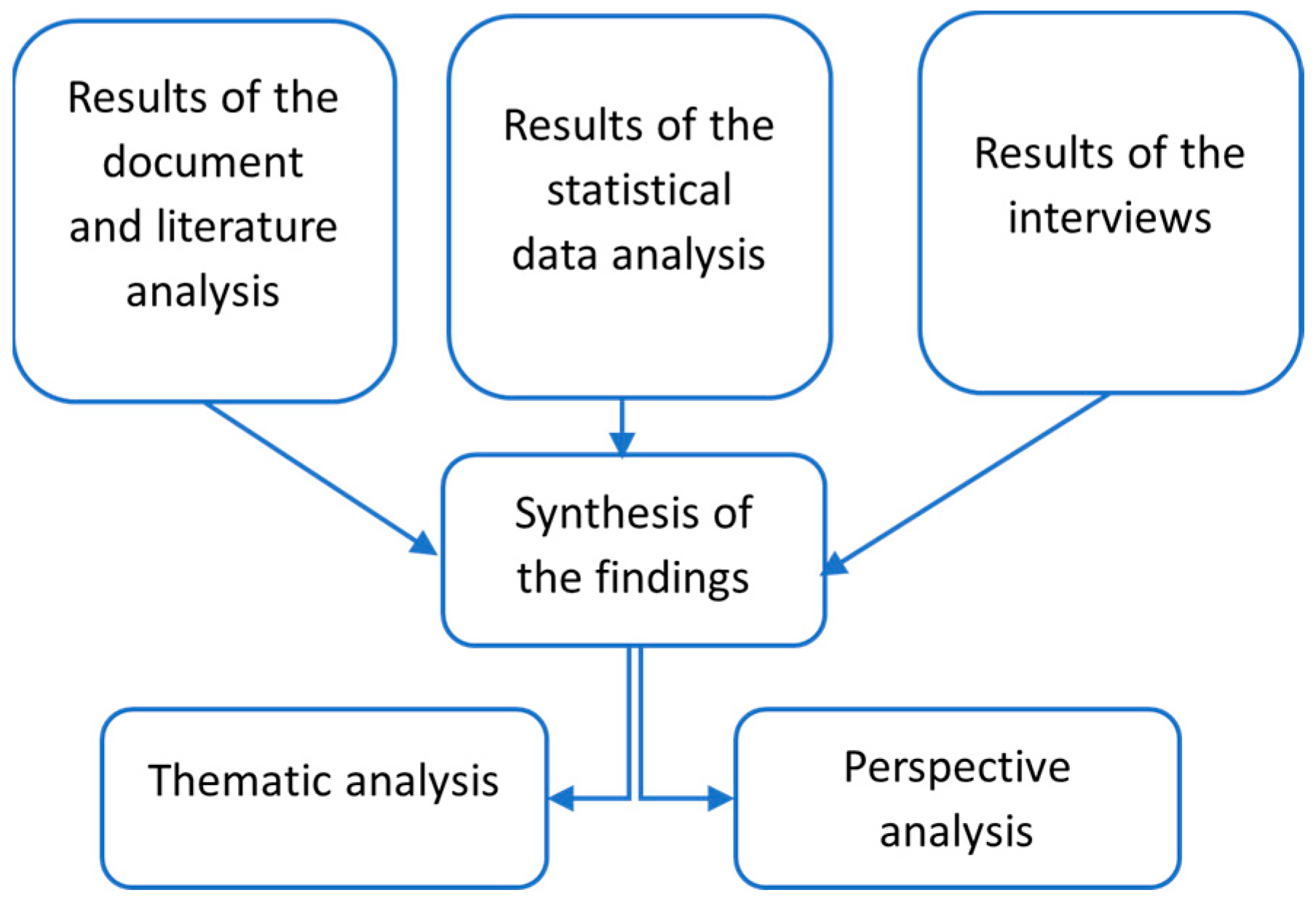
2.2. Synthesis of Findings and Presentation of Results
3. Vienna’s Funeral System and Cemeteries: An Overview
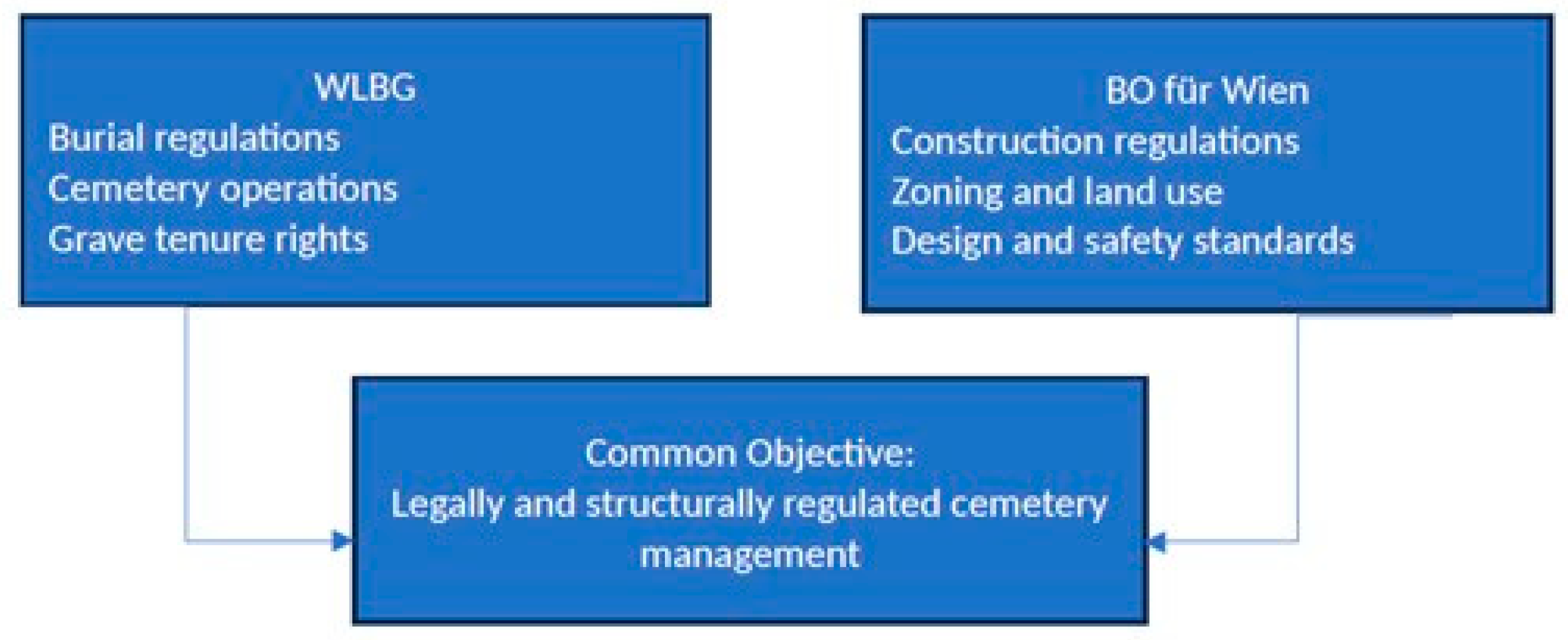
3.1. Legal Framework of the Vienna Funeral System
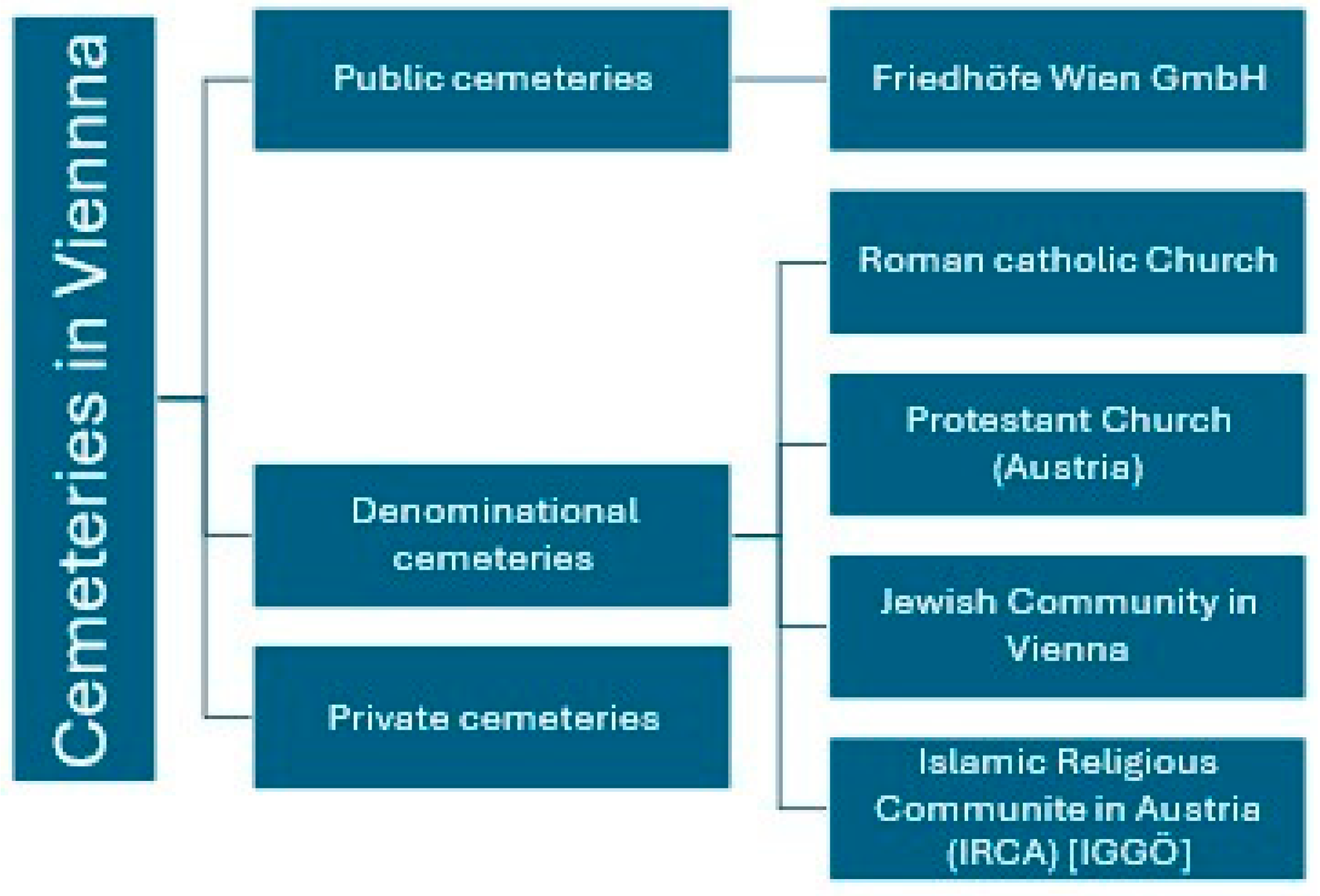
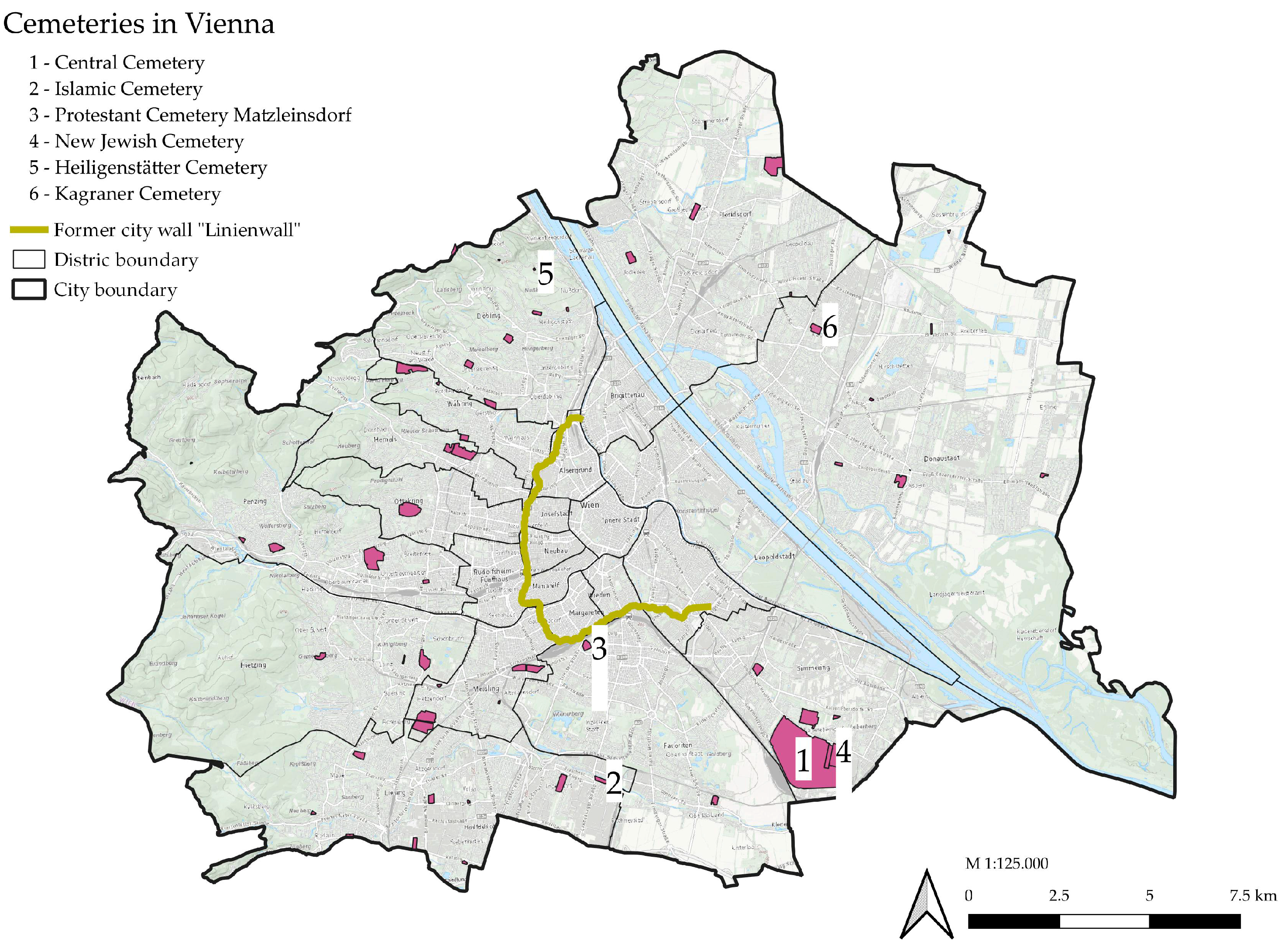
3.2. Structural Data on Vienna’s Cemeteries
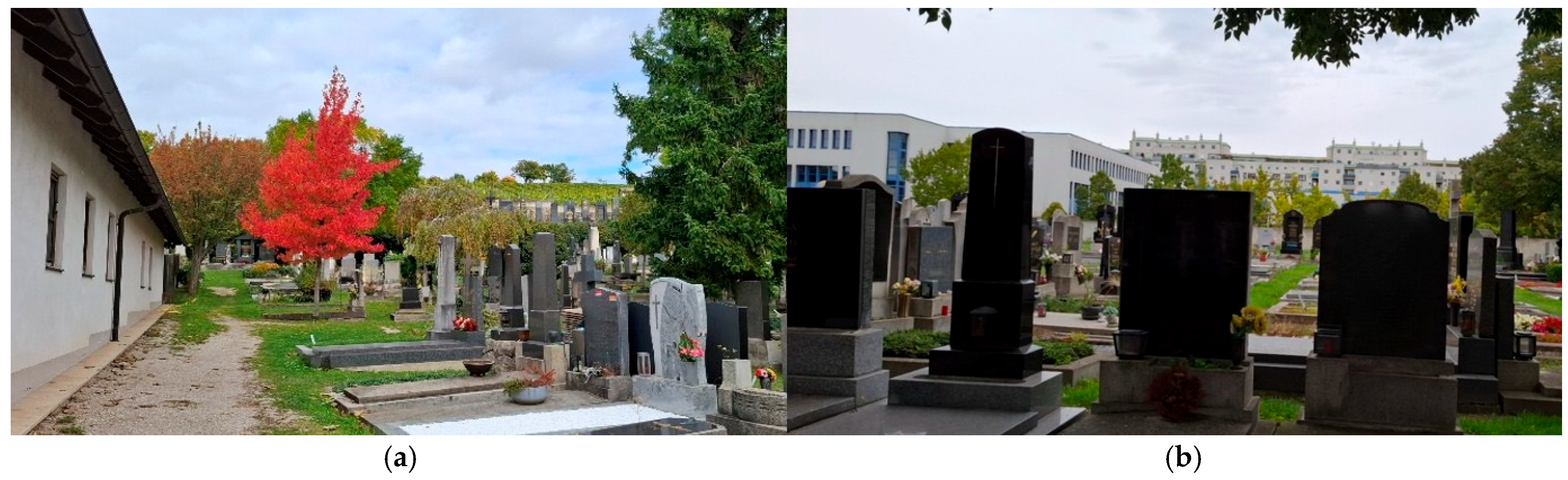
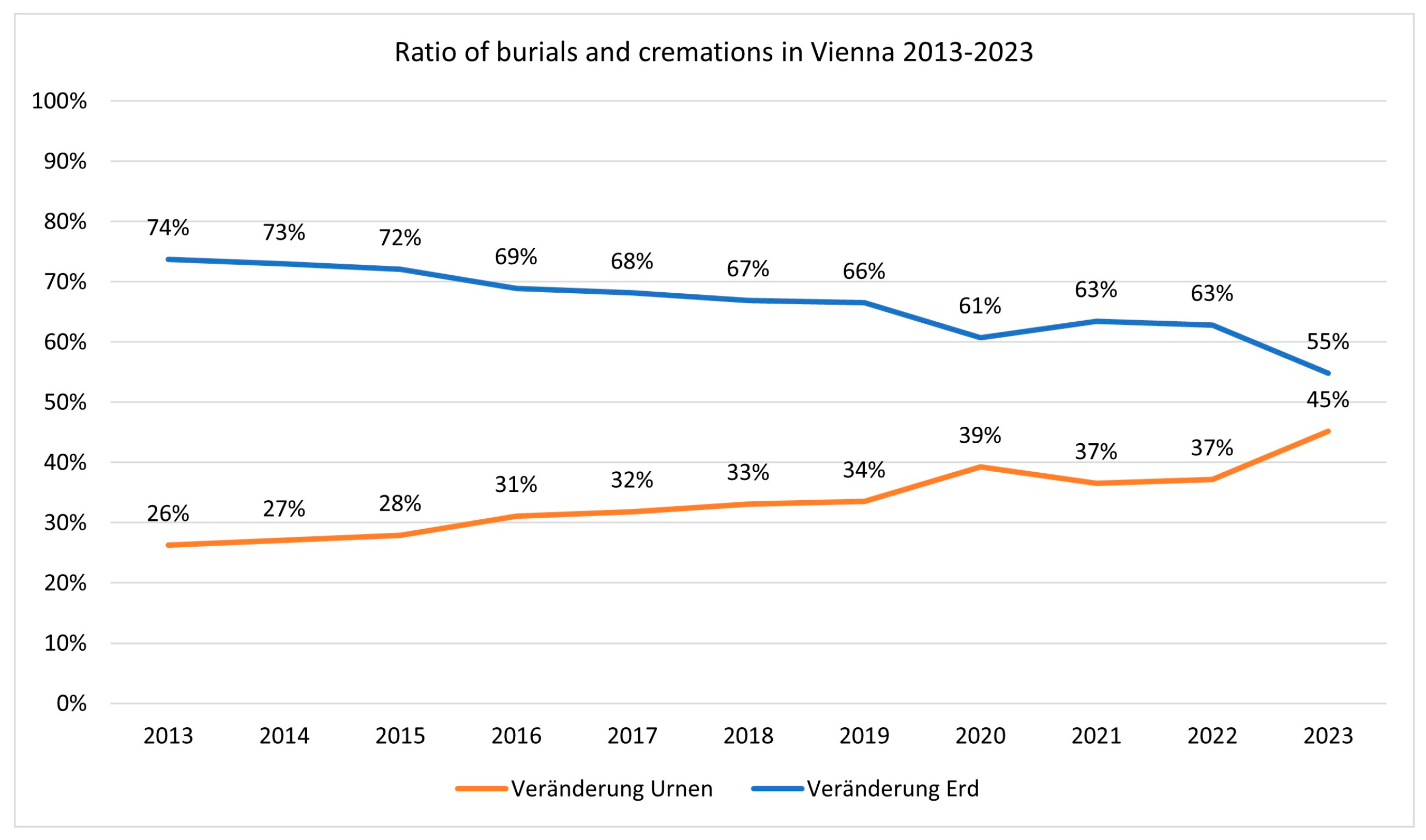
3.3. Demographic Development and Change in Burial Culture
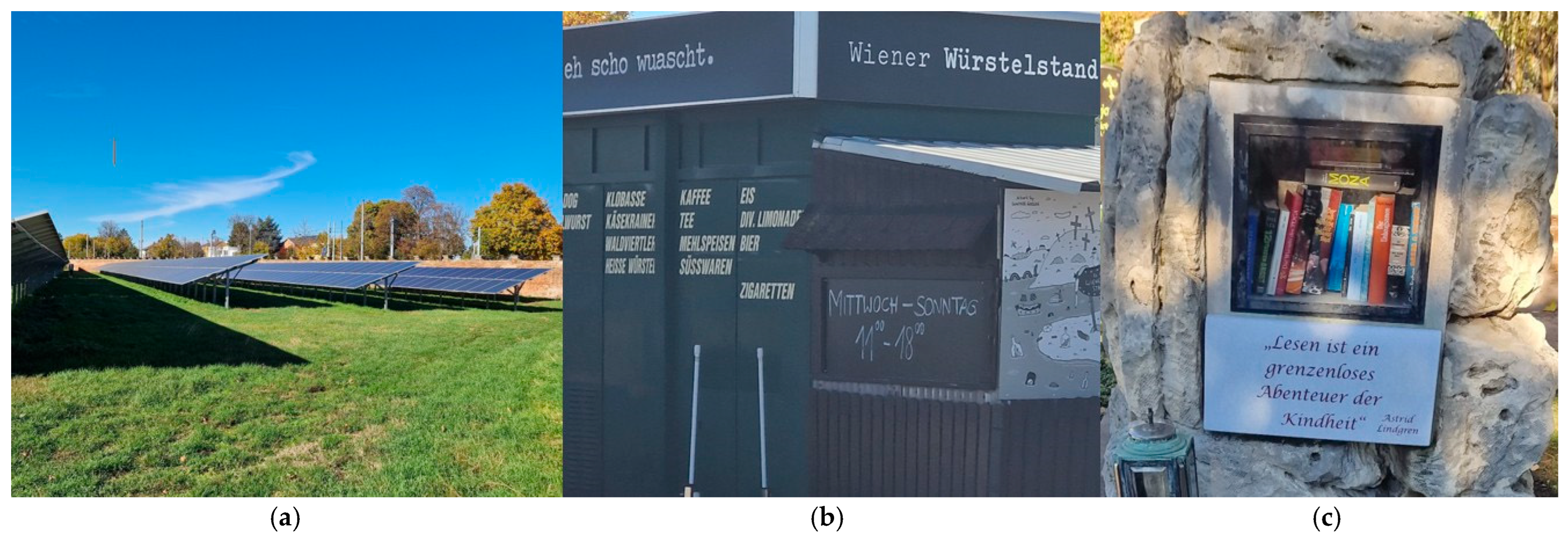
3.4. Multifunctionality and Experimental Practices
4. Results and Discussion
4.1. Current Debate on Cemeteries in Urban Planning
4.2. On the Significance of Cemeteries for the Urban Population
4.3. Drivers of Persistence of or Changes in the Structure of Vienna’s Cemeteries
- Demographics
- Cultural and Religious Factors
- Social Factors
- Regulatory/Planning Factors
- Environmental/Climate Factors
4.4. Consensus and Dissent Among the Stakeholders Surveyed
- The positions are similar between the interdenominational cemetery and the Protestant Cemetery Vienna, and there is no fundamental disagreement on any of the (sub-)themes;
- The representatives of the Jewish and Islamic Cemeteries in Vienna ascribe central importance to the stability of traditional burial practices and emphasise the great significance of the religion for the resting place function of their cemeteries, so multifunctional use—including for recreational purposes—is outside the scope of debate;
- All respondents assume the legal framework governing cemeteries to be stable and, perhaps for this reason, do not consider the legal framework to be relevant to the further development of cemeteries.
5. Limitations and Conclusions
Author Contributions
Funding
Institutional Review Board Statement
Informed Consent Statement
Data Availability Statement
Acknowledgments
Conflicts of Interest
References
- Weeber, R. Unsere Friedhöfe–kulturgeschichtliche und soziologische Aspekte zu ihrer Erhaltung und Weiterentwicklung. Forum Stadt 2025, 52, 45–63. [Google Scholar] [CrossRef] [Scilit]
- Zaremba, C. Possession, performance, and the rhetoric of belonging: Urban cemeteries as spaces of cultural citizenship. Int. J. Cult. Stud. 2025, 28, 778–796. [Google Scholar] [CrossRef] [Scilit]
- Crubézy, É. The recognition of death and grief: An evolutionary perspective. Its relations with the most ancient rituals and burials of humanity. L’Anthropologie 2024, 128, 103280. [Google Scholar] [CrossRef] [Scilit]
- García-Sánchez, R. “Incerta omnia, sola mors certa”. Muerte, sepultura y templo. Scr. Theol. 2019, 51, 573–612. [Google Scholar] [CrossRef] [Scilit]
- Kantemur, Z. Ölü Bedenin Sınırlanan Mekânı: Kayserideki Çerkes Kimlikli Mezarlar. Folklor Edebiyat 2019, 98, 339–351. [Google Scholar] [CrossRef] [Scilit]
- Muzaini, H.; Yeoh, B. Memory-Making ‘from Below’: Rescaling Remembrance at the Kranji War Memorial and Cemetery, Singapore. Environ. Plan. A 2007, 39, 1288–1305. [Google Scholar] [CrossRef] [Scilit]
- Miller, D.S.; Rivera, J.D. Hallowed Ground, Place, and Culture. Space Cult. 2006, 9, 334–350. [Google Scholar] [CrossRef] [Scilit]
- LaRoche, C.J. The African Burial Ground in the Age of Revolution: A Landscape in Transition. In Tales of Gotham, Historical Archaeology, Ethnohistory and Microhistory of New York City; Janowitz, M.F., Dallal, D., Eds.; Springer New York: New York, NY, USA, 2013; pp. 133–158. ISBN 978-1-4614-5271-3. [Google Scholar]
- Deng, H.; Li, M. The morphological evolution of Chinese urban cemeteries from the perspective of fringe belt: A case study of Nanjing. Front. Archit. Res. 2023, 12, 1065–1079. [Google Scholar] [CrossRef] [Scilit]
- Grabalov, P. Invisible public spaces: The role of cemeteries in urban planning and development in Moscow. J. Urban Aff. 2024, 46, 1971–1991. [Google Scholar] [CrossRef] [Scilit]
- Kolnberger, T. Cemeteries and urban form: A historico-geographical approach. Urban Morphol. 2022, 22, 119–139. [Google Scholar] [CrossRef] [Scilit]
- Wang, H.; Deng, H. An analytical study of Chinese urban cemeteries based on urban morphology and spatial vitality: Case studies in Nanjing. Front. Archit. Res. 2025; in press. [CrossRef] [Scilit]
- Davies, P.J.; Bennett, G. Planning, provision and perpetuity of deathscapes—Past and future trends and the impact for city planners. Land Use Policy 2016, 55, 98–107. [Google Scholar] [CrossRef] [Scilit]
- Wei, G.; Han, G.-S.; Lang, X. Cultural heritage site selection characteristics and the impact of the natural environment in Jinan city, China. Sci. Rep. 2024, 14, 31038. [Google Scholar] [CrossRef] [Scilit]
- McClymont, K. ‘That eccentric use of land at the top of the hill’: Cemeteries and stories of the city. Mortality 2016, 21, 378–396. [Google Scholar] [CrossRef] [Scilit]
- Evensen, K.H.; Nordh, H.; Skaar, M. Everyday use of urban cemeteries: A Norwegian case study. Landsc. Urban Plan. 2017, 159, 76–84. [Google Scholar] [CrossRef] [Scilit]
- Nordh, H.; Evensen, K.H.; Skår, M. A peaceful place in the city—A qualitative study of restorative components of the cemetery. Landsc. Urban Plan. 2017, 167, 108–117. [Google Scholar] [CrossRef] [Scilit]
- Swensen, G.; Nordh, H.; Brendalsmo, J. A green space between life and death—A case study of activities in Gamlebyen Cemetery in Oslo, Norway. Nor. Geogr. Tidsskr.—Nor. J. Geogr. 2016, 70, 41–53. [Google Scholar] [CrossRef] [Scilit]
- Santos, A.S.; Marques, T.P. Percurso pelos cemitérios do Porto. Rev. Tur. Desenvolv. 2023, 44, 365–390. [Google Scholar]
- Sallay, Á.; Mikházi, Z.; Gecséné Tar, I.; Takács, K. Cemeteries as a Part of Green Infrastructure and Tourism. Sustainability 2022, 14, 2918. [Google Scholar] [CrossRef] [Scilit]
- Nordh, H.; Evensen, K.H. Qualities and functions ascribed to urban cemeteries across the capital cities of Scandinavia. Urban For. Urban Green. 2018, 33, 80–91. [Google Scholar] [CrossRef] [Scilit]
- Goh, H.C.; Ching, F.E. Acceptable use of Chinese cemeteries in Kuala Lumpur as perceived by the city’s residents. Urban For. Urban Green. 2020, 55, 126837. [Google Scholar] [CrossRef] [Scilit]
- Kjøller, C.P. Managing green spaces of the deceased: Characteristics and dynamics of Danish cemetery administrations. Urban For. Urban Green. 2012, 11, 339–348. [Google Scholar] [CrossRef] [Scilit]
- Rae, R.A. Cemeteries as public urban green space: Management, funding and form. Urban For. Urban Green. 2021, 61, 127078. [Google Scholar] [CrossRef] [Scilit]
- Kowarik, I.; Buchholz, S.; von der Lippe, M.; Seitz, B. Biodiversity functions of urban cemeteries: Evidence from one of the largest Jewish cemeteries in Europe. Urban For. Urban Green. 2016, 19, 68–78. [Google Scholar] [CrossRef] [Scilit]
- McClymont, K.; Sinnett, D. Planning Cemeteries: Their Potential Contribution to Green Infrastructure and Ecosystem Services. Front. Sustain. Cities 2021, 3, 789925. [Google Scholar] [CrossRef] [Scilit]
- Säumel, I.; Butenschön, S.; Kreibig, N. Gardens of life: Multifunctional and ecosystem services of urban cemeteries in Central Europe and beyond—Historical, structural, planning, nature and heritage conservation aspects. Front. Environ. Sci. 2023, 10, 1077565. [Google Scholar] [CrossRef] [Scilit]
- Quinton, J.M.; Duinker, P.N. Beyond burial: Researching and managing cemeteries as urban green spaces, with examples from Canada. Environ. Rev. 2019, 27, 252–262. [Google Scholar] [CrossRef] [Scilit]
- Löki, V.; Deák, B.; Lukács, A.B.; Molnár, V.A. Biodiversity potential of burial places—A review on the flora and fauna of cemeteries and churchyards. Glob. Ecol. Conserv. 2019, 18, e00614. [Google Scholar] [CrossRef] [Scilit]
- Moesch, S.S.; Ladds, Z.; Francis, R.A. Life in the deadlands: Unearthing reasons for visiting and visitor perceptions of wildlife in London’s Magnificent Seven cemeteries. J. Urban Ecol. 2024, 10, juae022. [Google Scholar] [CrossRef] [Scilit]
- Sallay, Á.; Tar, I.G.; Mikházi, Z.; Takács, K.; Furlan, C.; Krippner, U. The Role of Urban Cemeteries in Ecosystem Services and Habitat Protection. Plants 2023, 12, 1269. [Google Scholar] [CrossRef] [Scilit]
- Skår, M.; Nordh, H.; Swensen, G. Green urban cemeteries: More than just parks. J. Urban. Int. Res. Placemaking Urban Sustain. 2018, 11, 362–382. [Google Scholar] [CrossRef] [Scilit]
- Długozima, A.; Kosiacka-Beck, E.; Krzykawska, K. Multiuse Cemetery Paradigm: Cemetery as a multifunctional place of social significance—Reshaping a cemetery in the urban space of Eastern Europe. Cities 2025, 156, 105556. [Google Scholar] [CrossRef] [Scilit]
- Długozima, A.; Kosiacka-Beck, E.; Krzykawska, K. Cemetery as multifaceted space with leisure uses in the urban American and Western European context. Leis. Stud. 2024, 1–18. [Google Scholar] [CrossRef] [Scilit]
- Ocón, D.; Young, W.P. Bridging the nature–cultural heritage gap: Evaluating sustainable entanglements through cemeteries in urban Asia. Sustain Sci 2024, 19, 1641–1660. [Google Scholar] [CrossRef] [Scilit]
- Tudor, C.A.; Iojǎ, I.C.; Hersperger, A.; Pǎtru-Stupariu, I. Is the residential land use incompatible with cemeteries location? Assessing the attitudes of urban residents? Carpathian J. Earth Environ. Sci. 2013, 8, 153–162. [Google Scholar]
- Bennett, G.; Davies, P.J. Urban cemetery planning and the conflicting role of local and regional interests. Land Use Policy 2015, 42, 450–459. [Google Scholar] [CrossRef] [Scilit]
- Westendorp, M.; Kmec, S. Cemeteries as Translocal Contact Zones: Navigating Regulations, Unwritten Rules and Divergent Expectations in Luxembourg City. In Mobilities in Life and Death; Maddrell, A., Kmec, S., Priya Uteng, T., Westendorp, M., Eds.; Springer International Publishing: Cham, Switzerland, 2023; pp. 43–64. ISBN 978-3-031-28283-6. [Google Scholar]
- Swensen, G.; Skår, M. Urban cemeteries’ potential as sites for cultural encounters. Mortality 2019, 24, 333–356. [Google Scholar] [CrossRef] [Scilit]
- Page, J.; Besco, L. Cemeteries as critical social infrastructure: A comparative legal geography. Cities 2025, 160, 105792. [Google Scholar] [CrossRef] [Scilit]
- Carvalho Agostini, A.L.; Manfroi, C.; Pereira, R.; Da Costa, E.M.; Dos Santos, N. Cemetery: More Human, Intelligent, and Sustainable. In Proceedings of the 2024 International Conference on Intelligent Environments (IE), Ljubljana, Slovenia, 17–20 June 2024; pp. 132–138, ISBN 979-8-3503-8679-0. [Google Scholar]
- Hein, V. Zukunft von Friedhöfen Heutige Multifunktionalität Innerstädtischer Friedhofsflächen am Beispiel der Evangelischen Friedhöfe Matzleinsdorf in Wien und Neuer St. Jacobi Friedhof in Berlin Neukölln. Master’s Thesis, Universität Wien, Vienna, Austria, 2023. [Google Scholar]
- Benatti, C. Zwei Bezirke—Zwei Friedhöfe: Ein Quantitativer Vergleich der Biodiversität urbaner Friedhöfe in Wien. Master’s Thesis, Universität Wien, Vienna, Austria, 2025. [Google Scholar]
- Mödritsch, K. Biodiversität am Wiener Zentralfriedhof—Ein Lehrpfad für Schüler*innen der Sekundarstufe I. Master’s Thesis, Universität Wien, Vienna, Austria, 2024. [Google Scholar]
- König, J.M. Der Wiener Zentralfriedhof—Als Habitat und Ort für Naturkontakt und Naturerfahrung. Master’s Thesis, Paris-Lodron-Universität Salzburg, Salzburg, Austria, 2022. [Google Scholar]
- Vandebosch, M. Friedhöfe als Erholungsräume am Beispiel des Wiener Zentralfriedhofs. Master’s Thesis, Universität für Bodenkultur Wien, Vienna, Austria, 2025. [Google Scholar]
- Ochia, R.O. Do Cemeteries Have a Future? Sustainability and Urban Socio-Technical Change at the Viennese Central Cemetery. Master’s Thesis, University of Vienna, Vienna, Austria, 2021. [Google Scholar]
- Magistrat der Stadt Wien, Stadtentwicklung und Stadtplanung. Der Wien-Plan—Stadtentwicklungsplan 2035; Magistrat der Stadt Wien: Vienna, Austria, 2025. [Google Scholar]
- Magistrat der Stadt Wien, Magistratsabteilung 18—Stadtentwicklung und Stadtplanung. Fachkonzept Grün- und Freiraum: Gemeinsam draußen. Werkstattbericht Nr. 144; Magistrat der Stadt Wien: Vienna, Austria, 2015. [Google Scholar]
- Österreichische UNESCO-Kommission. Wissen und Praxis der Bestatter*innen. Available online: https://www.unesco.at/kultur/immaterielles-kulturerbe/oesterreichisches-verzeichnis/detail/article/wissen-und-praxis-der-bestatterinnen (accessed on 24 October 2025).
- Yin, R.K. Case Study Research and Applications. Design and Methods, 6th ed.; SAGE Publications: Los Angeles, CA USA, 2017; ISBN 978-1-5063-3616-9. [Google Scholar]
- Bayerová, T.; Pitthard, V.; Grießer, M.; Grießer-Stermscheg, M. Metal sarcophagi of the Habsburg Imperial Crypt, Church of the Capuchin Friars, in Vienna, Austria: Analysis of surface coatings. Stud. Conserv. 2012, 57, S19–S26. [Google Scholar] [CrossRef] [Scilit]
- Döring, N.; Bortz, J. Forschungsmethoden und Evaluation in den Sozial- und Humanwissenschaften; Springer: Berlin/Heidelberg, Germany, 2016; ISBN 978-3-642-41088-8. [Google Scholar]
- dr. dresing & pehl GmbH. f4transkript. Available online: https://www.audiotranskription.de/f4x/ (accessed on 8 August 2023).
- Dresing, T.; Pehl, T. Praxisbuch Interview, Transkription & Analyse: Anleitungen und Regelsysteme für qualitativ Forschende; 8. Auflage; Eigenverlag: Marburg, Germany, 2018; ISBN 978-3-8185-0489-2. [Google Scholar]
- Kuckartz, U.; Rädiker, S. Qualitative Inhaltsanalyse: Methoden, Praxis, Computerunterstützung: Grundlagentexte Methoden; 5. Auflage; Beltz Juventa: Weinheim, Germany, 2022; ISBN 978-3-7799-6231-1. [Google Scholar]
- Scholles, F. Bewertungs- und Entscheidungsmethoden. In Handwörterbuch der Stadt-und Raumentwicklung; ARL-Akademie für Raumforschung und Landesplanung: Hannover, Germany, 2018; pp. 221–234. [Google Scholar]
- Statistics Austria. Table “Population at Beginning of Year/Quarter”. Available online: https://www.statistik.at/en/statistics/population-and-society/population/population-stock/population-at-beginning-of-year/quarter (accessed on 24 October 2025).
- WLBG—Wiener Leichen- und Bestattungsgesetz; LGBl. Nr. 38/2004 idF LGBl. Nr. 50/2018; Wiener Rathaus: Wien, Austria, 2018.
- Bauer, W.T. Wiener Friedhofsführer: Genaue Beschreibung Sämtlicher Begräbnisstätten nebst einer Geschichte des Wiener Bestattungswesens; Falter Verlag: Wien, Austria, 2004; ISBN 978-3-85439-335-1. [Google Scholar]
- Magistrat der Stadt Wien. Statistisches Jahrbuch der Stadt Wien 2024. Wien in Zahlen; Magistrat der Stadt Wien: Vienna, Austria, 2024. [Google Scholar]
- Magistrat Wien—Magistratsabteilung 23—Wirtschaft, Arbeit und Statistik. Durchschnittliches Alter der Bevölkerung (in Jahren) zu Jahresbeginn seit 2002—Bezirke Wien. Available online: https://www.data.gv.at/katalog/datasets/6fdea17f-9eac-4860-8b35-6108e792e6b1 (accessed on 13 November 2025).
- Mattes, A. Migration und Religion; Verlag der Österreichischen Akademie der Wissenschaften: Wien, Austria, 2022; ISBN 978-3-7001-8887-2. [Google Scholar]
- Friedhöfe Wien GmbH. Friedhofsführungen. Information on the Tours. Available online: https://www.friedhoefewien.at/friedhofsfuehrungen (accessed on 24 October 2025).
- Brandstätter, B.; Dopler, A.; Hofinger, D.; Hoffmann, I.; Kutzenberger, G.; Kutzenberger, H.; McInnes, M.; Meshkova, T.; Rakos, V. Vorkommen und Erhaltungszustand des Feldhamsters (Cricetus cricetus) in Wien. 2020. Available online: https://www.wien.gv.at/pdf/ma22/studien/feldhamster-wien2020.pdf (accessed on 24 October 2025).
- Friedhöfe Wien GmbH. Urban Gardening auf Freien Großflächen. Press Release. Available online: https://www.ots.at/presseaussendung/OTS_20230413_OTS0038/friedhoefe-wien-urban-gardening-auf-freien-grossflaechen (accessed on 24 October 2025).
- Friedhöfe Wien GmbH. Bürger*innen-Solarkraftwerk. Information. Available online: https://www.friedhoefewien.at/b%C3%BCrger*innen-solarkraftwerk (accessed on 24 October 2025).
- Evangelischer Friedhof Matzleinsdorf. Urban Gardening Friedhof Matzleinsdorf. Information. Available online: https://www.lebensraum-friedhof.at/wp-content/uploads/2022/11/FlyerUrbanGardening.pdf (accessed on 24 October 2025).
- Maddrell, A.; Beebeejaun, Y.; Kmec, S.; Wingren, C. Cemeteries and crematoria, forgotten public space in multicultural Europe. An agenda for inclusion and citizenship. Area 2023, 55, 125–133. [Google Scholar] [CrossRef] [Scilit]
- Maddrell, A.; McNally, D.; Beebeejaun, Y.; McClymont, K.; Mathijssen, B. Intersections of (infra)structural violence and cultural inclusion: The geopolitics of minority cemeteries and crematoria provision. Trans. Inst. Br. Geogr. 2021, 46, 675–688. [Google Scholar] [CrossRef] [Scilit]
- Rugg, J. Defining the place of burial: What makes a cemetery a cemetery? Mortality 2000, 5, 259–275. [Google Scholar] [CrossRef] [Scilit]
- Nordh, H.; Stahl Olafsson, A.; Kajosaari, A.; Præstholm, S.; Liu, Y.; Rossi, S.; Gentin, S. Similar spaces, different usage: A comparative study on how residents in the capitals of Finland and Denmark use cemeteries as recreational landscapes. Urban For. Urban Green. 2022, 73, 127598. [Google Scholar] [CrossRef] [Scilit]
- Nordh, H.; Wingren, C.; Uteng, T.P.; Knapskog, M. Disrespectful or socially acceptable?—A nordic case study of cemeteries as recreational landscapes. Landsc. Urban Plan. 2023, 231, 104645. [Google Scholar] [CrossRef] [Scilit]
- Grabalov, P.; Nordh, H. The Future of Urban Cemeteries as Public Spaces: Insights from Oslo and Copenhagen. Plan. Theory Pract. 2022, 23, 81–98. [Google Scholar] [CrossRef] [Scilit]
- Bügelmayer-Blaschek, M.; Schneider, M.; Jung, M. Analyse des Abkühlungspotentials Wiener Friedhöfe auf die Umgebung: Mikroklima-Simulationen für die Friedhöfe Wien. 2023. Available online: https://www.friedhoefewien.at/o/document/ait_endbericht_abkuhlungspotentialfriedhofe-2- (accessed on 24 October 2025).
- Wiener Stadtwerke Holding AG. Förderung der Biodiversität auf Friedhöfen. Sachstandsbericht November 2014; Wiener Stadtwerke Holding AG: Vienna, Austria, 2014. [Google Scholar]
- Woodthorpe, K. Sustaining the contemporary cemetery: Implementing policy alongside conflicting perspectives and purpose. Mortality 2011, 16, 259–276. [Google Scholar] [CrossRef] [Scilit]
- Venne, M. Nachfrageorientierte Strategien zur Nutzung Städtischer Friedhofsflächen; Kasseler Studien zur Sepulkralkultur, Band 16; Arbeitsgemeinschaft Friedhof und Denkma: Kassel, Germany, 2010; ISBN 978-3-924447-45-8. [Google Scholar]
- Klingemann, H. Cemeteries in transformation—A Swiss community conflict study. Urban For. Urban Green. 2022, 76, 127729. [Google Scholar] [CrossRef] [Scilit]
- Wiesinger, R. Friedhöfe und Stadtentwicklung. Raumplanerische Betrachtungen anhand der Stadt Wien. Master’s Thesis, Universität für Bodenkultur Wien, Vienna, Austria, 2024. [Google Scholar]
- Xu, Y.; Ma, R.; Furuya, K. Reimagining Urban Cemeteries: Behavioral Patterns, Perceptions, and Intentions in Tokyo’s Public Burial Landscapes. Land 2025, 14, 1638. [Google Scholar] [CrossRef] [Scilit]



| Institution | Number of Interviewees |
|---|---|
| Department of Urban Development and Urban Planning of the City of Vienna (MA 18) (administration) | 2 |
| Friedhöfe Wien GmbH (administration) | 1 |
| Islamic Cemetery Vienna (administration) | 1 |
| Jewish Cemetery Vienna (administration, clergyman) | 2 |
| Protestant Cemetery Vienna (administration) | 1 |
| Interviewee | Responsibilities | Interests |
|---|---|---|
| Department of Urban Development and Urban Planning of the City of Vienna (MA 18) (administration) | Urban planning | Interdenominational, green spaces, green infrastructure, open-space planning |
| Friedhöfe Wien GmbH (administration) | Operation of 46 cemeteries spread throughout the city of Vienna | Interdenominational, green spaces, preservation and maintenance of existing cemeteries, green infrastructure |
| Islamic Cemetery Vienna (administration) | Operation of old and new Jewish cemeteries throughout Eastern Austria | Focus on the Jewish religion and on management and preservation of Jewish cemeteries |
| Jewish Cemetery Vienna (administration, clergyman) | Operation of their own cemetery | Focus on the Muslim religion and administration of the cemetery |
| Protestant Cemetery Vienna (administration) | Operation of their own cemetery | Preservation of the Protestant Cemetery, for use by all denominations and for leisure and recreational purposes |
| Theme | Sub-Theme | Friedhöfe Wien GmbH | Protestant Cemetery Vienna | Jewish Cemetery Vienna | Islamic Cemery Vienna | Department of Urban Development and Urban Planning of the City of Vienna (MA 18) |
|---|---|---|---|---|---|---|
| Cemeteries as final resting places | Alternative burial choices | ++ | ++ | -- | -- | o |
| Religion and piety | o | + | ++ | ++ | o | |
| Significance of changes in the culture of remembrance and thus of the cemetery The cemetery as a place of integration | ++ + | + + | o o | - ++ | o o | |
| Multifunctionality of cemeteries in the context of culture and values (piety) | Religion and piety | o | + | ++ | ++ | o |
| Multifunctionality of the cemetery Controversies and restrictions | ++ o | ++ o | -- -- | -- - | + o | |
| Cemeteries as green infrastructure and recreation areas | Recreation | ++ | ++ | - | - | + |
| Environmental and climate protection | ++ | ++ | - | + | + | |
| Services and activities | ++ | + | -- | -- | + | |
| Improving reputation and promoting acceptance Accessibility and public utilisation | ++ + | + o | o - | o - | o ++ | |
| Cemetery location in the city area/neighbourhood/district | Park-like characteristics, local recreation area Being a part of the local social infrastructure Being a part of the local green infrastructure | ++ ++ ++ | + + + | - - - | o o + | ++ ++ ++ |
| Cemeteries as a subject of and in urban planning | Green infrastructure and climate change adaptation Societal values as drivers or inhibitors of development Legal framework | ++ o o | ++ + o | - + o | ++ + o | ++ o o |
| Future prospects | Multifunctionality of cemeteries as a key factor in preservation and further development | ++ | ++ | -- | -- | + |
| Multiconfessionality and multiethnicity as changing parameters in the Austrian cemetery culture Changes in the legal framework for cemeteries Changes in ways of mourning and remembrance | ++ o + | + o + | o o o | ++ o o | + o o |
Disclaimer/Publisher’s Note: The statements, opinions and data contained in all publications are solely those of the individual author(s) and contributor(s) and not of MDPI and/or the editor(s). MDPI and/or the editor(s) disclaim responsibility for any injury to people or property resulting from any ideas, methods, instructions or products referred to in the content. |
© 2026 by the authors. Licensee MDPI, Basel, Switzerland. This article is an open access article distributed under the terms and conditions of the Creative Commons Attribution (CC BY) license.
Share and Cite
Wiesinger, R.; Fischer, T. Cemeteries and Urban Planning in Vienna. Urban Sci. 2026, 10, 22. https://doi.org/10.3390/urbansci10010022
Wiesinger R, Fischer T. Cemeteries and Urban Planning in Vienna. Urban Science. 2026; 10(1):22. https://doi.org/10.3390/urbansci10010022
Chicago/Turabian StyleWiesinger, Raimund, and Tatjana Fischer. 2026. "Cemeteries and Urban Planning in Vienna" Urban Science 10, no. 1: 22. https://doi.org/10.3390/urbansci10010022
APA StyleWiesinger, R., & Fischer, T. (2026). Cemeteries and Urban Planning in Vienna. Urban Science, 10(1), 22. https://doi.org/10.3390/urbansci10010022