
Article

Promoting Healthier Cities and Communities Through Quantitative Evaluation of Public Open Space per Inhabitant


by
Dina M. Saadallah
1,* and
Esraa M. Othman
2
1
Department of Architectural Engineering, Faculty of Engineering, Alexandria University, Alexandria 21526, Egypt
2
Department of Geography and Planning, University of Saskatchewan, Saskatoon, SK S7N 5C8, Canada
*
Author to whom correspondence should be addressed.
Urban Sci. 2026, 10(1), 11; https://doi.org/10.3390/urbansci10010011 (registering DOI)
Submission received: 17 November 2025 / Revised: 22 December 2025 / Accepted: 23 December 2025 / Published: 28 December 2025
(This article belongs to the Topic Spatial Decision Support Systems for Urban Sustainability)

Abstract

Public open spaces play a vital role in supporting social connection and leisure among residents, enhancing quality of life while contributing to both economic growth and environmental health. The rapid global urbanization underscores the critical link between urban environments and human health, which demands focusing on sustainable, health-conscious urban planning. Accordingly, Public and green spaces are vital in this context, as recognized by global agendas like the Sustainable Development Goals (SDG) 11.7. This research aims to objectively evaluate the availability of public open spaces (POS) in Alexandria, Egypt. This study will utilize Geographic Information System (GIS) to formulate a methodology that incorporates spatial data analysis for quantifying public open spaces and assessing the proportion of the population with convenient access to these areas, evaluating their coverage, service area isochrones, spatial distribution, and proximity to residential areas. The study will benchmark its findings against global standards to expose critical spatial inequalities within cities of the Global South. The primary aim is to present evidence-based recommendations for sustainable urban public space design, tackling availability and accessibility issues to improve the well-being of Alexandria’s expanding urban population. This research offers a scientific foundation to inform policy and decision-making focused on creating more equitable, healthier, and resilient urban environments.

1. Introduction

Public spaces are crucial for cities as areas accessible to all, enabling community welfare and social interaction [1,2]. Serving as places to connect neighborhoods, enhance livability, and signify substantial public investment. Thus, Key design priorities include walkability, visual appeal, comfort, respect for historical context, and community participation. Nonetheless, obstacles such as privatization, gentrification, and regulatory constraints threaten the inclusivity, functionality, and utility of these places [3].
The quality and condition of urban environments are intrinsically linked to the health and overall quality of life of the worldwide population. The World Cities Report (2022, 2024) offers insights into the future of urbanization and its impact on health, highlighting the necessity for sustainable and health-oriented urban design to support the growing urban population [4,5]. Consequently, emphasizing health and well-being in various contexts is crucial for furthering the global development goal. This necessitates collaborative efforts among policymakers, urban planners, public health experts, citizens, and other stakeholders to fully leverage the potential of cities in enhancing health and well-being.
Urban health issues have appeared as a growing concern in both developed and developing nations [6], with increasing interest in various research fields towards challenges in the global south [7,8,9]. Within this context, public and green spaces are acknowledged as essential methods to alleviate the effects of rapid and unplanned urbanization. Public spaces are recognized as vital for fostering healthy urban environments, as outlined in numerous worldwide agendas and their corresponding objectives and targets. The 2030 Agenda for Sustainable Development emphasizes the significance of public spaces in enhancing health and well-being [10,11]. A collaborative systems-thinking approach is essential for incorporating health into urban planning, effectively addressing intricate policy and decision-making contexts [12]. This inclusive approach guarantees the integration of health considerations into urban strategies.
This research revolves around the urban development framework advocated by the United Nations as outlined in the Sustainable Development Goals (SDGs) [13]. The importance of public spaces is especially highlighted in Goal 11.7: “provide universal access to safe, inclusive, and accessible, green, and public spaces.” This study centers on evaluating the quality of public spaces by reexamining existing assessment indicators and exploring their potential for further improvement. Through adopting a methodology that integrates spatial data analysis to quantify public open spaces and estimate the population’s share with convenient access to them. Assessing the percentage per capita and accessibility of the population to public open spaces to be able to identify the gaps within the city and compare them with international guidelines helps to identify challenges and propose recommendations for sustainable urban public space planning in Alexandria. Despite the rapid growth in population and economic influence of many Global South cities emerging in the twenty-first century, spatial equity considerations have not kept pace with urban expansion, resulting in persistent, structural, and often overlooked disparities.
Since public spaces are the heart of human interaction, the quality, accessibility, and variety of these spaces are key indicators of a city’s livability and its commitment to creating an inclusive, vibrant, and sustainable environment for all.
Public open spaces are vital in defining the character of urban environments and are imperative in addressing critical contemporary urban planning issues, such as flooding and urban heat islands (UHI) [14], while considering the socio-cultural and economic factors. In this regard, cities are responsible for integrating green areas into open spaces to enhance air quality, mitigate climate effects, and improve residents’ well-being [15]. With environmental concerns intensifying globally due to unsustainable consumption, resource depletion, and greenhouse gas emissions, concepts such as green cities, sustainable cities, and eco-cities all seek to integrate environmental, economic, and social sustainability through fair resource utilization, community engagement, and environmental conservation [15]. Globally acknowledged through frameworks such as the UN’s SDG 11 and initiatives like the European Green Deal and WHO’s Healthy Cities, green spaces are vital for sustainable urban development [16,17,18]. Experiencing COVID-19 strongly highlighted the importance of accessible, connected green space networks for mental and physical health [19].
Disparities in access to green spaces across communities constitute a form of spatial and environmental injustice [20]. Cities in the Global South, characterized by low development and high population density, exhibit significantly less green space than anticipated, even when accounting for favorable climates. This situation underscores the compounded challenges related to health and sustainability. Research predominantly spans multiple research hubs in the Global North, while green space data and factors in the Global South are insufficiently studied and inadequately documented [16]. From 2015 to 2025, Nature-based Solutions (a concept that prioritizes the importance of green spaces in urban planning) research output is dominated by developed countries, particularly in Europe, with Italy and the UK leading in publication volume, followed by China and the United States, while developing regions such as Africa and South America remain underrepresented [9]. This also highlights and supports the high relevance of this paper to increase Global South recognition in promoting healthier cities and communities through green space. This evidence gap is shaped by structural challenges such as limited access to high-resolution spatial data, weak institutional capacities for systematic monitoring, and the prevalence of informal and rapidly transforming urban environments that are poorly captured by conventional datasets. The absence of robust and internationally comparable indicators for these contexts limits the ability of planners and policymakers to benchmark performance, identify spatial injustices, and monitor progress toward SDG 11 and related climate and health objectives, thereby reinforcing existing inequalities in global urban sustainability assessments [21].
The quantity of green spaces (coverage) and their spatial distribution (proximity) in relation to population are critical factors; total green cover alone fails to adequately reflect accessibility [22]. Numerous nations and international entities have established quantitative benchmarks to assist urban planners and policymakers in guaranteeing sufficient green space provision in urban areas [19]. These standards delineate the minimum requirements for open spaces and green areas per capita, along with suggested proximity guidelines, such as:
  • According to UN-Habitat, public spaces are grouped into three primary types: streets, open areas, and community facilities. Based on comparative research across cities globally. The recommendation stipulates that 45–50% of urban land should be designated for streets and open public spaces, with 30–35% specifically for streets and sidewalks, and 15–20% for open public spaces, which encompasses both green areas such as parks and hard-surface areas like plazas, squares, and public courtyards [23,24,25].
  • The European Union generally has a standard of 26 m2 per capita [19]. However, European cities set varying targets for minimum urban green space (UGS) provision per capita with German cities, for example, targeting 6–15 m2 per capita [26].
  • In the United States, standards set by the Public Health Bureau and the Department of Housing suggest 18 m2 per capita [19].
  • The World Health Organization (WHO) has set a minimum benchmark of 9 m2 per capita, representing a global minimum target [19,27].
  • The United Nations recommends a standard of 30 m2 of green space per capita [19].
As for accessibility to these spaces by walking, The World Health Organization (WHO) indicated that Inclusiveness is frequently assessed by the percentage of the population living within a walkable distance (400 m) to public spaces. In addition, The European Environment Agency recommends that urban residents should be able to reach green spaces within 1000 m (approximately a 15 min walk). While English Nature, the UK, recommends a maximum walking distance of 300 m to access green spaces [28]. Moreover, the UN-Habitat advises of a 800 m walk [27]. Generally, health benefits increase if people live within 300 m of parks of at least 0.5 hectares, and neighborhoods have substantial green coverage [22,29]. Frequently, Per capita green space in Egyptian communities is measured and compared to WHO minimum standards [30].
This study is guided by the central research question: How adequate is the provision and accessibility of public open spaces in Alexandria, Egypt, in meeting the needs of its urban population, and how can spatial planning be optimized to improve residents’ well-being?
This research pursues several key objectives to address the research question. First, it aims to quantitatively assess the availability and distribution of public open spaces in Alexandria using Geographic Information System (GIS) techniques. Second, it seeks to evaluate the accessibility of these spaces by estimating service areas, isochrones, and proximity relative to the population. Third, the study will benchmark its findings against global standards to expose critical spatial inequalities within cities of the Global South, where this SDG indicator remains insufficiently recognized, systematically measured, and effectively integrated into policy frameworks. Finally, the research aspires to develop evidence-based recommendations for sustainable urban planning and investment in green infrastructure, to enhance equitable access, promoting social interactions, and improving the overall quality of life of Alexandria’s residents.

2. Literature Review

According to [24,31,32], the early research on the development of a comprehensive public space strategy started with qualitative observations. For example, the Garden City by Howard and urban park systems by Olmsted laid the early groundwork for integrating green spaces into cities for livability and environmental health. While later studies adopted quantitative methods, examining factors like land use, urban morphology, social infrastructure, and population dynamics. [19]. Recent studies show a lack of analysis about the impact of per capita urban green space on urban vitality, which is an indicator of the vibrancy and appeal of cities that is intricately connected to the accessibility and quality of open spaces [16,18].

2.1. Urban Open Spaces

Open public spaces facilitate leisure, social interaction, and physical activity, promoting healthy habits and decreasing the prevalence of diseases. Thereby, well-maintained and accessible public spaces can mitigate stress and anxiety, serving as a natural intervention for mental health concerns [33]. A street network viewed as a form of open space, marked by high connectivity and safety, can enhance active mobility and foster interaction among citizens, thereby promoting walking and cycling as low-intensity exercises. Research shows that active transportation significantly benefits public health by reducing the risk of chronic diseases and improving overall fitness [34]. Reduced reliance on motorized transportation also improves air quality. It lowers exposure to air pollutants, contributes to better respiratory health, and reduces the burden of diseases like asthma and chronic obstructive pulmonary disease (COPD) [35]. In this regard, urban plans that invite people to use streets for strolling, relaxing, and spending time outdoors can enhance mental health. This emphasizes the importance of integrating human-centric elements into urban planning to foster inclusive and sustainable environments [36]. Therefore, urban parks, which vary from small pocket parks to extensive regional parks, are essential sanctuaries within urban settings, promoting recreation, relaxation, and connection to nature [29,37]. Generally, these open green spaces are often seen as neglected in urban planning [19], with less than half of Europeans living near public parks, for example [38].
Overall, Egypt’s Vision 2030 includes targets to increase the per capita share of green spaces, aiming to expand parks and sustainable green areas in both existing cities and new developments [39]. Land is often scarce, expensive, or difficult to acquire in existing urban areas [30]. However, major new urban projects like the New Administrative Capital integrate extensive green zones (e.g., Green River Park) into their master plans to enhance livability, biodiversity, and climate resilience. Despite these policies, green spaces in existing settings are not a policy priority, with less funding compared to buildings and roads [30]. According to [30], per capita green space in Cairo dropped from 0.87 m2 in 2017 to 0.74 m2 in 2020, well below the WHO minimum standards.
The Egyptian Law 119/2008 empowers local governments in building decisions and provides a legal basis for green space conservation. Within this law, each city is required to have at least one green area covering over 100 acres or constituting 20% of the city’s open spaces, whichever is less. Functionally, these green areas are expected to include spaces for public gatherings, recreational activities, and essential services to meet the needs of the community. At the city level, Law 119 mandates that green and open areas be provided so that each resident receives at least the minimum per capita share, with at least 50% of these areas accessible to the public free of charge or at low fees. At the district level, parks are designed to ensure that every resident has access to a park within one kilometer of their home. Neighborhood parks must be within 400 m of residents’ homes, cover at least one acre, and constitute at least 30% of the city’s open areas. These standards collectively aim to ensure equitable access to green spaces across Egypt’s urban areas [30].

2.2. Spatial Analysis of Urban Open Spaces

Spatial justice principles in the planning of Green Open Spaces (GOS) are a rising matter of interest in the literature. This ensures that public spaces serve the diverse needs of the community, promoting social inclusion and environmental sustainability [40]. Through qualitative and quantitative research methods, studies identify key barriers such as inadequate infrastructure, safety concerns, and socio-cultural factors that hinder equitable access to public open spaces (POS) for marginalized groups, including women, children, and the elderly. Nevertheless, there is a necessity for context-specific planning and design interventions that address these challenges, promoting inclusive and accessible public spaces that contribute to social cohesion and resilience in fragile urban settings [41]. Developing healthy public spaces requires space evaluations with active community participation. This method aims to understand and address the shared and unique needs of different social groups so that these perspectives are incorporated into the planning, design, management, and everyday use of public areas.
The rapid urbanization expected by 2050, with 68% of the global population living in cities, poses significant challenges to preserving green spaces [19,37,38,42]. On the global level, ref. [16] analyzed 159 capital cities worldwide, where their study stated that:
  • Urban green space is unevenly distributed globally, with the highest in Europe and the lowest in Africa, Asia, and the Middle East.
  • European and North American cities have significantly more green land cover than African and Asian cities.
  • Green space declines with higher population density, especially beyond 300–400 people per 250 × 250 m.
  • Climate is the dominant driver, explaining ~75% of variation in green space; precipitation is especially influential, with greener cities in cooler, wetter climates.
  • Human factors, such as development status and population density, also significantly affect urban green space.
  • UN-Habitat studies have demonstrated that the amount of land allocated to public spaces in developing countries is limited.
A study executed by [38] to evaluate the accessibility to Green Urban Public spaces (GUPSs) across Italy’s 14 metropolitan cities using the UN SDG indicator 11.7.1, which measures the share of built-up urban areas open for public use. Green Urban Public Spaces (GUPSs) were identified using data from OpenStreetMap (OSM) and the Copernicus Urban Atlas (UA). Access points to these GUPSs were identified using OSM nodes tagged as entrances or gates, intersections with street networks, or by placing access points every 100 m along the perimeter if no data existed. In the study, a walkable road network from OSM was used to model routes within a maximum of 10 km, with accessibility evaluated based on the population able to reach a GUPS within 300 or 400 m, following the SDG 11.7.1 guidelines. This methodology allowed for a robust spatial analysis of green space accessibility. Consequently, the study showed that less than one-third of residents in 14 Italian metropolitan cities can access GUPSs within 300 m, with southern cities lagging. Despite data limitations, the research offers valuable tools to support urban green space planning and SDG monitoring, informing policies aimed at improving urban resilience, public health, and equitable access to green infrastructure across Italy and potentially beyond [38].
In Yogyakarta, Indonesia, ref. [43] employs a qualitative approach with purposive sampling to identify what Gen Z favors, such as spaces that offer comfort, privacy, and aesthetic value. Reported preferred activities include socializing, relaxing, and engaging in photography, often facilitated by seating arrangements like benches and mats, as well as natural elements such as vegetation. The study also highlights the role of public spaces that cater to the social and recreational needs of young people in enhancing user experience and inclusivity. Another example of a study conducted in Bilecik city center, Turkey, revealed that although the green space per capita increased to 15.1 m2 in 2017, the distribution of these areas was unequal across neighborhoods, leading to deficiencies in certain regions [15]. However, cities with similar populations can have quite different green space requirements based on land use and density [19].
Recent research documenting how Urban Green Infrastructure (UGI) is being analyzed in the city of Alexandria has been evolving. For example, in 2019, ref. [44] proposes a method using a UGI Priority Index to identify and prioritize urban areas in Alexandria for implementing Urban Green Infrastructure to mitigate flood risks and associated human and economic losses. In 2022, ref. [45] found out that UGI represents 30.34% of the Montazah district, while built-up areas dominate the overall landscape, influencing the vulnerability and functionality of the green matrix in the district. Their analysis was conducted based on using the patch matrix model built from a landscape ecology point of view. In 2023, ref. [46] attempted to examine how urban planning in Alexandria can promote happiness, health, and overall quality of life, with emphasis on mental health and inclusive concepts. However, they reported that the lack of open-access data in the city is a major barrier. In 2025, ref. [47] investigates how urban design interventions such as green spaces and landscape modifications can mitigate urban heat island effects in Alexandria’s public spaces, enhancing outdoor thermal comfort, mental health, and well-being, as demonstrated through user surveys and ENVI-met simulations.

2.3. The X-Minute City Concept

Historically rooted in the principle of proximity [48,49], the X-minute city—an umbrella concept including the 15 min city—emphasizes accessibility, density, diversity, and digitalization to promote sustainable, inclusive, and health-oriented urban living [50]. Closely tied to the neighborhood unit that has long been a key concept in urban planning, evolving from Clarence Perry’s 1920s model. Recent models like the 15 min city reinterpret this legacy by promoting accessible, sustainable, and socially cohesive urban forms [51].
The 15 min city concept represents a contemporary approach in urban planning. This has received broad support from policymakers worldwide [52]. Policies such as the EU’s Nature Restoration Law seek to safeguard these areas; however, they frequently prioritize quantity over quality and accessibility. Assessing green urban public spaces effectively necessitates the integration of spatial data regarding size, location, access points, and population distribution, in accordance with the principles of the “15 min city.” These initiatives align with Sustainable Development Goal 11’s objective of ensuring the inclusion of accessible green spaces in urban planning frameworks [38]. Based on the international guidelines established previously, a guide distance to determine the walking time isochrones in this paper will be within the 300–100 m range, in light of an X-minute city concept alongside with the SDG indicator 11.7.1 training module and the Egyptian Law 119/2008, which prioritize the analysis of the 400 m walk and therefore corresponds to a 5 min city strategy to look forward to [4].

3. Materials and Methods

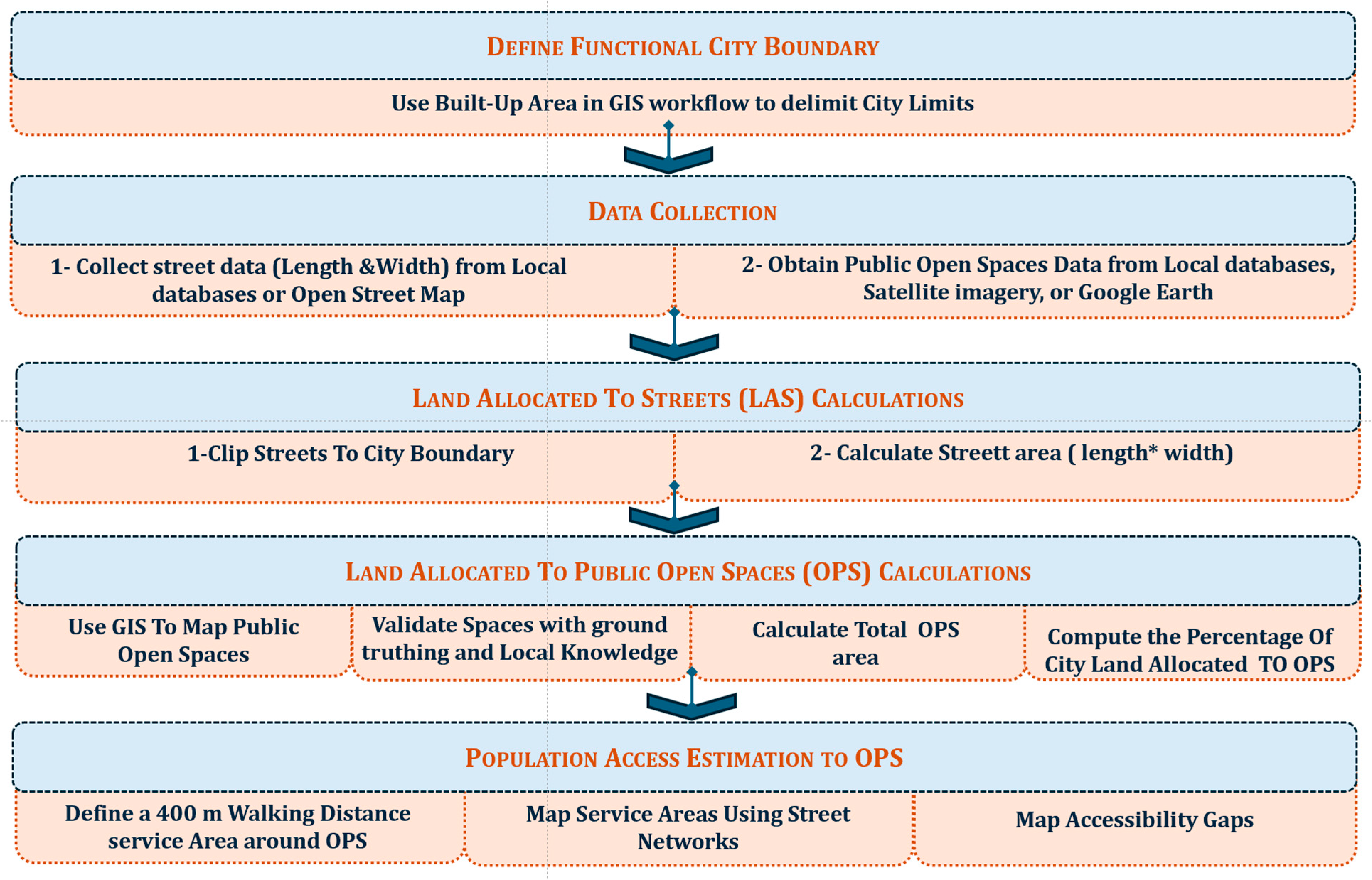
The adopted methodology delineates the systematic process employed to calculate SDG Indicator 11.7.1, which assesses the availability and accessibility of open public spaces in urban environments. This methodology employs spatial data analysis to quantify public open spaces and estimate the proportion of the population with convenient access to these areas, as illustrated in Figure 1.
The computation of SDG Indicator 11.7.1 consists of three primary components: identifying requisite tools and data sources, delineating methods for calculating the area of open public spaces and streets and assessing the population’s access to these areas. Key tools include GIS software (ArcGIS Pro 3.5.4), image processing applications, and proficiency in spatial analysis. The primary data source is the city’s open space and streets database, which may encompass records from land use plans, project documents, and infrastructure inventories. Despite the potential for obsolescence or fragmentation across departments, these records are essential for evaluating public space. Departments are essential for the evaluation of public space.
Accurate measurement of public space availability and the facilitation of inclusive urban planning need reliable data and suitable analytical tools [4]. The process initiates with the delineation of functional city boundaries through the application of GIS tools. Data from streets and OPS information are then gathered from local or global sources. The area appointed for streets is determined by intersecting street data with the city boundary and calculating the area based on length and width measurements. Public open spaces are systematically mapped, validated through local knowledge, and their total area is calculated to learn about the percentage of city land they encompass. Population access is estimated by mapping a 400 m walking distance around OPS using street networks, thereby identifying accessibility gaps. The findings, encompassing land distribution and demographic coverage, are examined and presented via maps and statistical data to monitor Sustainable Development Goals and inform urban planning decisions.
Within Alexandria’s city boundary, targeted keyword searches on Google Maps in 2025 were employed to systematically delineate public open spaces. The search strategy prioritized terms that align with both formal designations and colloquial usage of open spaces in both English and Arabic languages. keywords included “green space,” “city park,” and “urban plaza.” The search included terms such as “community park,” “playground,” “nature reserve,” and “botanical garden” to encompass a wider range of spaces. The keywords consist of a variety of publicly accessible outdoor environments, including recreational fields and natural preserves. Contextual phrases such as “places to relax outdoors,” “free outdoor spaces,” and “walking trails near me” were employed to find areas that are less formally named yet often visited. Google Maps was selected due to its effective spatial indexing of local landmarks, coupled with local datasets obtained from the General Organization of Physical Planning in Egypt (GOPP). This method of data collection and delineation offered a summary of public spaces that are accessible within the study area, appropriate for subsequent analysis.
Measuring internationally comparable indicators of public open and green spaces requires globally consistent and methodologically robust data. While global land cover datasets and street-view imagery offer useful insights, they are limited by accuracy variations, incomplete coverage, and an inability to capture public accessibility at scale. Consequently, recent studies emphasize data fusion approaches that integrate Remote sensing with complementary datasets such as OpenStreetMap, which offer a more accurate and policy-relevant method for identifying publicly accessible green spaces and supporting SDG-aligned monitoring [53]. Accordingly, Google Earth provides high-resolution imagery dated to 2025 was beneficial for the digitization of public spaces, measurement of street widths, and validation of OpenStreetMap data. Community members, NGOs, and local leaders offer crucial insights for identifying unrecorded or altered public spaces and evaluating aspects such as safety, accessibility, and inclusiveness. Open-source datasets, notably OpenStreetMap (OSM), offer essential information regarding street networks, public spaces, and urban infrastructure. Their accessibility and compatibility with GIS contribute to their widespread use [4].
The share of city land allocated to open public spaces (OPS) is calculated using the following formula, which expresses the proportion of total open public space area relative to the entire city area as a percentage [4,52]:
Share   of   city   land   allocated   to   OPS = ( Total   area   covered   by   OPS Total   city   area ) × 100
In estimating the population with access to public open spaces, a standard threshold of a 400 m walking distance (approximately 5 min) is employed for reasonable access. Using this, a service area is mapped along the street network around each public open space, and all people living within these areas are considered to have convenient access [4].

4. Results

4.1. Case Study Area

The dense urban area in Alexandria reflects common urban development patterns or challenges typical of other cities or regions, enhancing the case study’s generalizability. The city serves as the capital of Alexandria Governorate and is divided into 9 main administrative districts: Al Ameriyah, Al Ameriyah Tany, Al Agami, Sharq, Wasat, Gomrok, Garb, Montazah Awal, and Montazah Tany, along with 16 subordinate districts. The urban morphology of Alexandria reflects its long and layered history, blending ancient, colonial, and modern influences. The spatial distribution of green spaces in Alexandria is highly uneven, reflecting several development patterns, and is still quickly changing overtime. This uneven distribution limits accessibility for many residents, particularly in high-density areas, highlighting the need for exploring the situation based on quantitative evidence aspired by this research.
Alexandria extends about 85 km along the coastline on a T-shaped peninsula, situated between the Mediterranean Sea, surrounding lagoons, and former lake areas. The area Alexandria covers is about 2679 km2. Urbanization pressures have led to a gradual decline in important agricultural areas. The city accounts for 40% of the national industrial output, while 60% of the Egyptian foreign trade is managed in the three Alexandrian seaports. As a result, environmental pollution represents one of the city’s most significant challenges [5,54]. Additional challenges include uncontrolled urban expansion, with an annual population increase of up to 150,000 residents, the widespread development of informal settlements lacking adequate infrastructure and utilities, an overburdened public transportation system approaching collapse, and a significant shortage of public open spaces that must be addressed [5,54]. Alexandria’s 2025 population is now estimated at 5,630,050 with a population density of 4800 people per square mile [55].
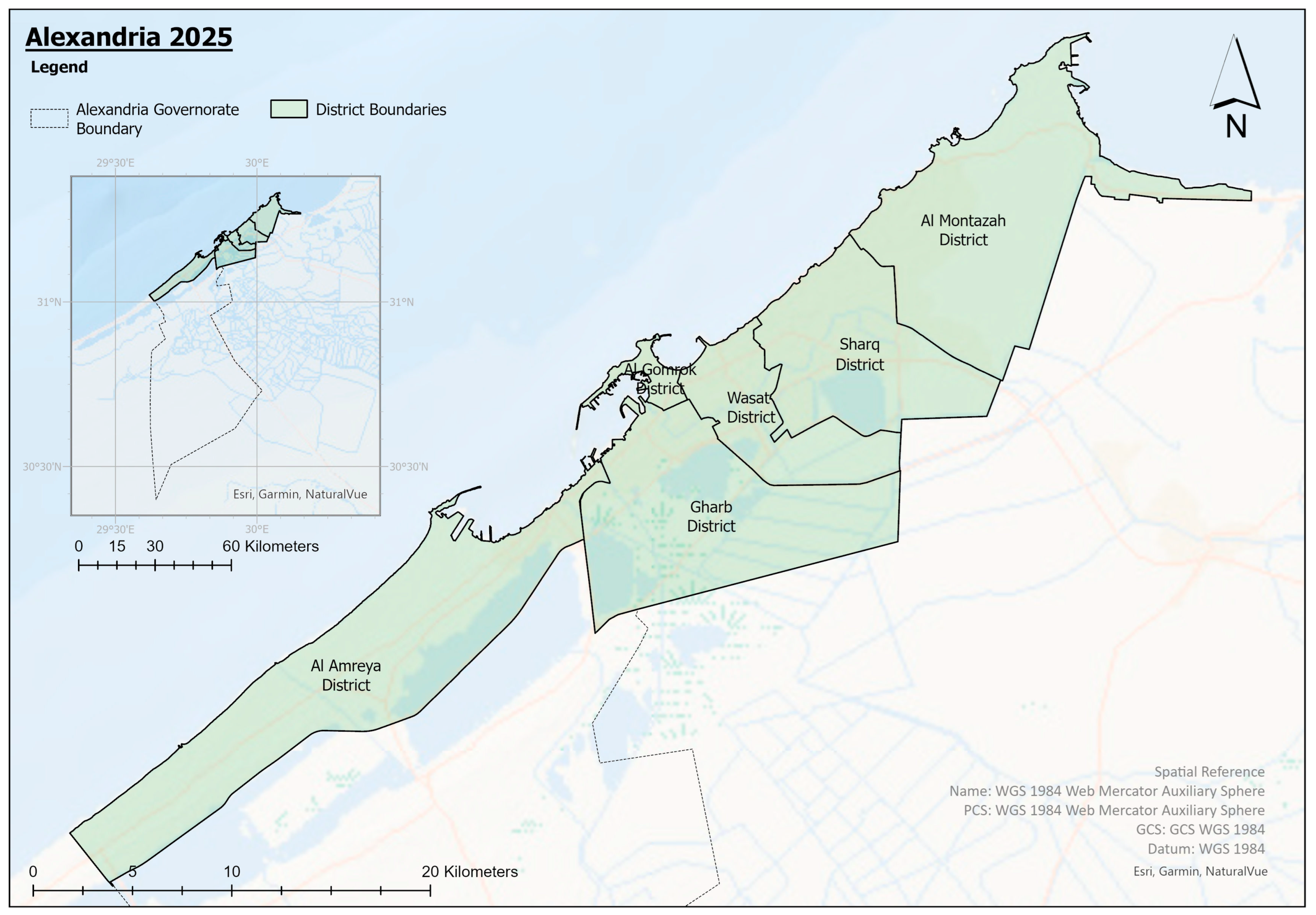
The study area focuses on 7 urban high-density districts: Agamy, Al Montazah Awal and Tany, Al Gomrok, Sharq, Wasat, and Gharb, as shown in Figure 2. While the two remaining districts, Al Ameriyah first and Al Ameriyah second, were excluded from the study because of rural or undeveloped nature and does not contribute meaningfully to an analysis within an urban boundary of the city. These districts are also geographically isolated from the urban core, making it less relevant to urban boundary impacts. Including them would reduce the depth of analysis since the types of public open spaces offered to their communities do not encompass the diversity featured in the other seven districts. Also, in western districts, green spaces in private or restricted areas are not included in the study.

4.2. Land Allocation Calculations

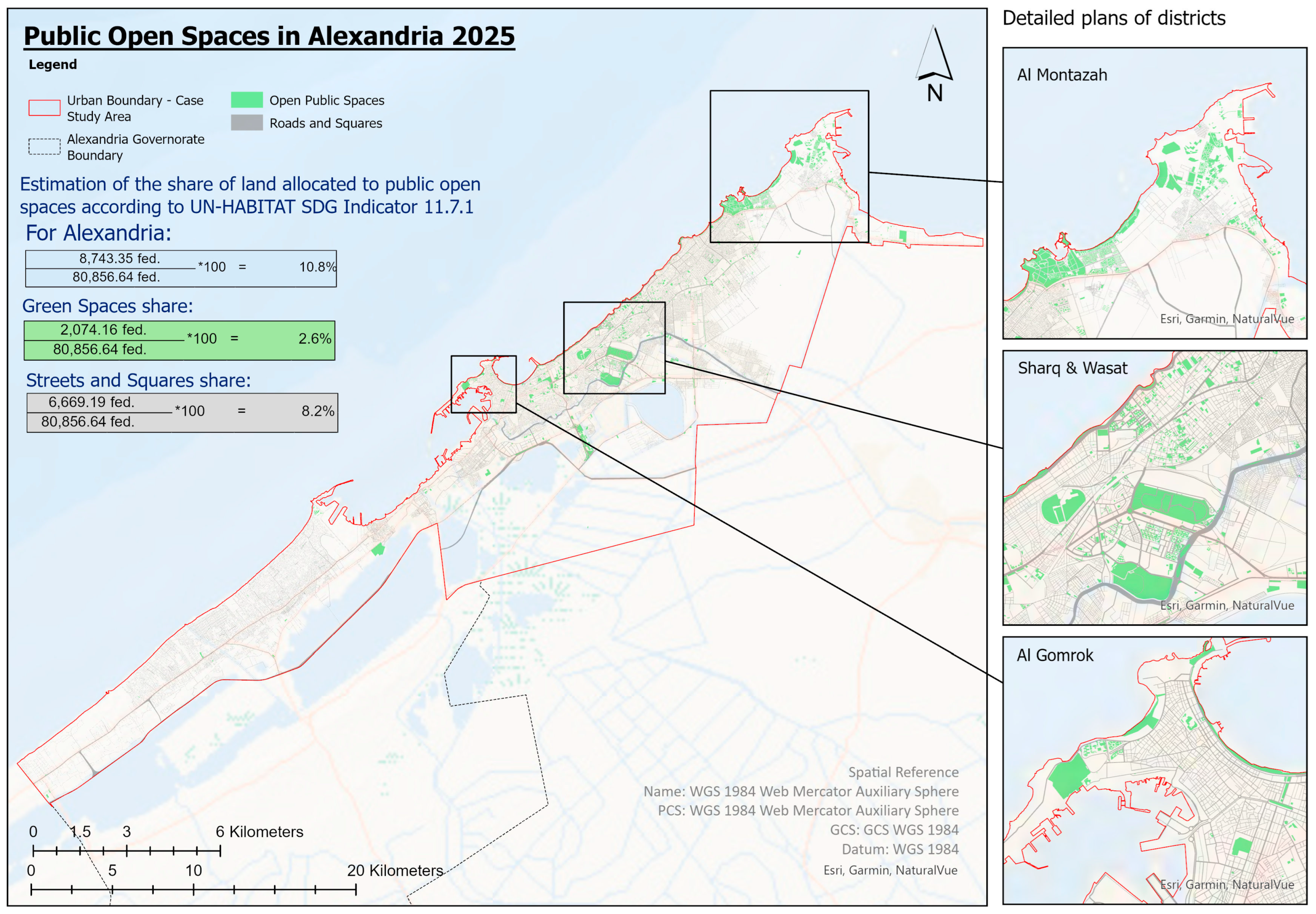
The total area of the urban boundary is 339,593,088 m2, as shown in Figure 3. After excluding the Al Ameriyah districts, the calculations show that only 2.6% green spaces are compared to 10.8% of total open spaces, as illustrated in Table 1. The green open spaces are concentrated in the El Montazah district, app 49.2% of total open spaces in Alexandria, followed by Sharq by 29%, Wasat 10.1%, AL Gomrok 5.3%, and El Agamy by 3.8% and Gharb district by 2.6%. The results raise questions: Do these available open spaces meet international criteria?
None of the public open Spaces meet international benchmarks. As the population approaches 6 million, per capita access to open areas, greenery, and infrastructure decreases—a clear sign that current expansion struggles to keep pace with demographic growth. The extremely low green space per person in Alexandria (~1.45 m2) is a significant concern for environmental resilience, mental health, and quality of life, as indicated in Table 2.

4.3. Access to Green Spaces

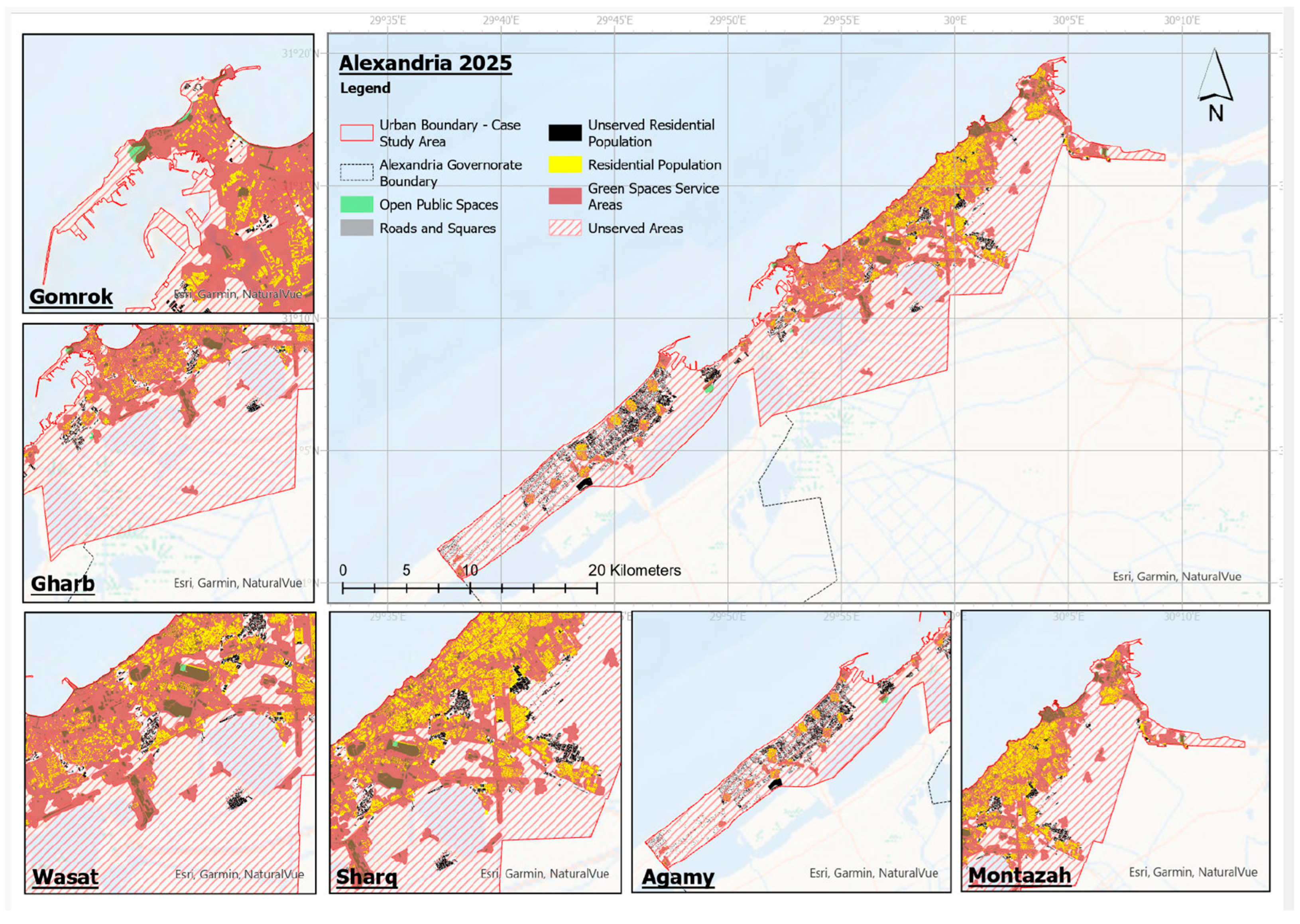
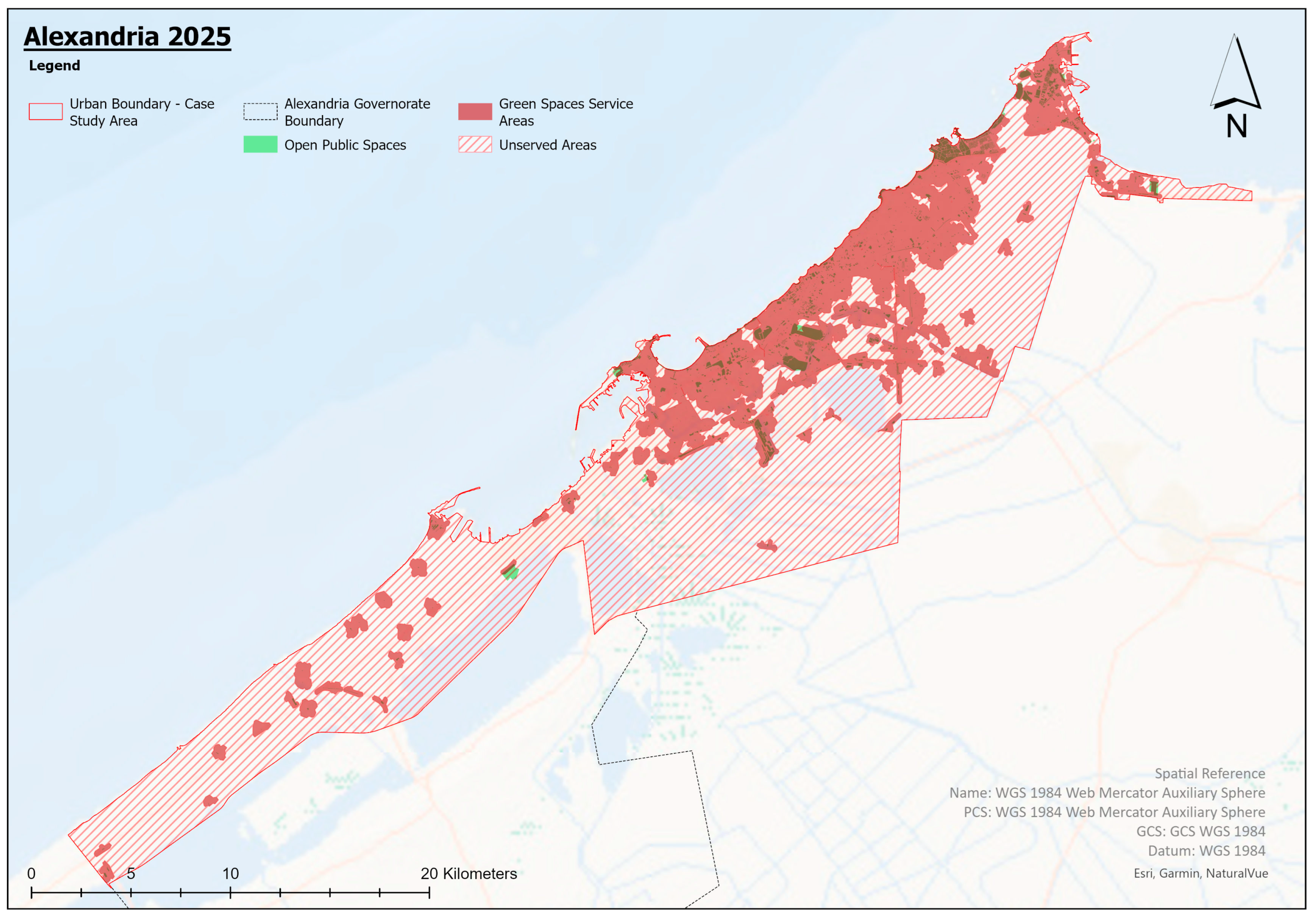
There is an obvious shortage in the overall share of land allocated to open spaces, where green or public open spaces, access to these open spaces is calculated to show the distribution of available green open spaces and the population it serves within 400 m, as emphasized in Figure 4. It was found that the overall green spaces cover 8,710,440 m2, serving an area of 88,729,200 m2, yet leaving 251,158,800 m2 unserved about 73.87% of the total urban area, as shown in Table 3.
Among the districts, Agamy is the largest (5,634,851.2 m2) with the highest unserved rate (91.82%), while Gharb also shows poor coverage with 91.2% unserved. Al Montazah and Sharq perform comparatively better, with green spaces serving over 40% of their areas. Al Gomrok, though the smallest district (4,679,476.6 m2), has the lowest unserved percentage (34.35%). Wasat sits in the mid-range with a 59.34% unserved rate. This variation highlights significant disparities in green space accessibility across the districts.
The proximity analysis shows that most of Alexandria’s urban land is still poorly served by green spaces. The striking variation in unserved rates, particularly the critical failure to provide access in the western districts of Agamy and Gharb, confirms a pattern of spatial inequality that calls for immediate policy intervention to enhance equitable access to public open spaces. The analysis highlights spatial inequities in green space provision, which indicates a lack of spatial justice observed through the following:
  • The districts of Agamy and Gharb show the most critical lack of coverage. Agamy, the largest district, has a massive 91.82% unserved rate, while Gharb closely follows with 91.20% unserved. This illustrates that these western areas are overwhelmingly dominated by the “Unserved Areas” designation, suggesting that residents in these districts experience significant environmental injustice regarding proximity to public green infrastructure.
  • Conversely, Al Gomrok, the smallest district in the city core, shows the highest relative accessibility, with an unserved rate of only 34.35%. The smaller size and dense, central network of streets contribute to this comparatively higher coverage.
  • Sharq, Al Montazah, and Wasat Districts represent intermediate accessibility levels, with unserved rates ranging from 52.08% to 59.34%. While performing better than the peripheral districts, these figures still indicate that more than half of the urban area in these zones lacks convenient walking access to green spaces, underscoring persistent accessibility challenges even in more centrally located regions.

4.4. Analysis and Reporting

The study adopted a five-minute walking distance threshold as the standard measure of accessibility, aligning with internationally recognized urban planning benchmarks that consider a five-minute walk (approximately 400 m) as an acceptable radius for local park access. Due to the unavailability of updated comprehensive spatial datasets that include population records, the delineation and assessment of green space service areas was determined based on residential density and the spatial distribution of public open spaces. This approach allowed for an assessment of the proportion of residential areas served by public green spaces and those located beyond the service boundaries.
The total residential area within the case study covers approximately 42,714,000 m2, of which only 24,725,400 m2 lie within a 5 min walking distance to green spaces, leaving about 17,988,600 m2 (42.12%) unserved. Agamy stands out as the most underserved district, with 84.5% of its residential area (13,123,400 m2) lacking access as illustrated in Figure 5.
In contrast, Al Montazah, Sharq, and Al Gomrok show stronger accessibility, with over 85% of their residential areas (between 7,673,400 m2 to 12,709,200 m2) within reach of green spaces. Wasat has a moderate unserved rate of 32.11%, while Gharb has nearly half (45.16%) of its residential buildings outside service areas as shown in Table 4. This highlights stark spatial disparities in access to green spaces, with outer districts like Agamy and Gharb most affected.
Overall findings indicate that nearly half of the residential population lacks convenient access to public open spaces, suggesting a significant gap in equitable spatial distribution. The relatively high proportion of unserved areas reveals the inadequacy of existing green infrastructure to meet the spatial needs of residents, particularly in districts with high population densities and limited undeveloped land.
A closer examination at the district level highlights pronounced spatial disparities in accessibility to public open spaces. Agamy District shows the most critical deficiency, with 84.50% of its residential area—equivalent to over 13.1 million m2—being still outside the five-minute service radius. This indicates a severe shortfall in accessible green spaces, likely linked to the district’s rapid residential expansion and limited allocation of land for recreational or open space uses.
Conversely, the Al Montazah, Al Gomrok, and Sharq districts show superior accessibility conditions. Al Montazah has 14.48% of its residential area classified as unserved, indicating that a significant part of its urban fabric is situated within the five-minute service zone. Al Gomrok and Sharq exhibit low percentages of unserved areas, at 14.21% and 14.13%, respectively, showing improved integration of public open spaces within the residential environment. The results can be attributed to the historical urban patterns of the districts, characterized by the establishment and maintenance of smaller neighborhood parks and coastal green corridors over time. The Wasat and Gharb districts fall into an intermediate category. Wasat shows that 32.11% of its residential area lies outside the green space service area, while Gharb records 45.16% of unserved residential zones. These moderate accessibility levels suggest the presence of green spaces that are unevenly distributed or insufficiently connected to residential fabric. In such cases, the accessibility challenge may not stem solely from the lack of open spaces but also from urban barriers such as road networks, building densities, or land-use fragmentation. Central and historically planned districts show relatively better access, while peripheral districts, particularly Agamy and Gharb, exhibit severe deficits. These patterns indicate socio-spatial inequities, where disadvantaged areas face compounded environmental and health burdens, consistent with a spatial perspective of justice.

5. Discussion

Urban green open spaces, if poorly planned, may result in spatial injustice or ecological inefficiency [56]. Despite the overall presence of green spaces, which do not meet international standards, the accessibility for residential populations is still uneven, highlighting clear spatial injustices. These two measures of percentage and coverage underline the need for a balanced planning approach that does not overly prioritize one aspect such as proximity at the expense of others, as both are especially important for emphasizing the problem. The study indicated that underserved districts like Agamy are recommended to be considered for targeted interventions that enhance ecological value while also improving equitable access to inform urban planning and policy reform.
The quantitative assessment of public open spaces (POS) in Alexandria, conducted using the rigorous spatial metrics of SDG Indicator 11.7.1, reveals critical deficits in both the fair distribution and availability of green open spaces. The analysis yields two primary observations: a profound quantitative lack of green space compared to international standards, and substantial spatial inequality in accessibility across the city’s administrative districts.

5.1. Deficit in Quantitative Provision

The finding that only 2.6% of the urban boundary is allocated to green spaces is significantly below the UN-HABITAT recommended standard of 15−20% for open public spaces (which includes both green and hard-surface areas), and far below the more ambitious targets set by organizations like the WHO and the European Union for green space provision. Furthermore, the calculated per capita green space is alarmingly low at approximately 1.45 m2 for the projected near-future population of 6 million. This figure falls drastically short of the WHO’s minimum benchmark of 9 m2 per capita and is a clear indicator that Alexandria’s current urban expansion is not meeting demographic growth with adequate infrastructure.
This deficit carries significant implications for urban resilience and public health. As highlighted in the literature, a lack of green space undermines the city’s capacity to mitigate the Urban Heat Island (UHI) effect, manage stormwater, and improve air quality [14,57]. More fundamentally, the shortage directly compromises the mental and physical well-being of residents, limiting opportunities for active mobility, social interaction, and stress reduction [33,34].

5.2. Spatial Inequality in Accessibility

The proximity analysis, which uses the 400 m walking distance threshold, confirms that the distribution of existing green space is inequitable, leading to pronounced spatial injustice. The overall unserved urban area of 73.87% is alarming, but the variation across districts is more telling:
Extreme Disparities: The western districts, notably Agamy (91.82% unserved) and Gharb (91.20% unserved), suffer from the most critical lack of service. These results align with broader global trends that show green space provision declining with higher population density and being lower in cities of the Global South compared to North America and Europe [16]. The severe inaccessibility in these districts suggests that marginalized and peripheral populations are disproportionately affected by environmental injustice [20].
Residential Impact: The analysis of residential accessibility indicates that 42.12% of the residential area is outside the convenient service radius, with Agamy being the most affected, where 84.50% of its residential area is unserved. This is a crucial finding, as it directly relates the lack of physical space to the quality of life and well-being of the population, underscoring that total green coverage alone does not capture functional accessibility [22].
The earlier accessibility observed in the inner district of Al Gomrok (34.35% unserved) suggests that smaller, older, and more centralized urban forms may inherently offer better proximity due to historical planning or denser street networks. Conversely, the high unserved rates in peripheral districts point toward inadequately regulated and unplanned urban sprawl that prioritizes built density over essential public infrastructure.
The findings advocate for a change in thinking in Alexandria’s urban governance, moving beyond mere quantitative growth targets to integrating principles of spatial justice, where planning decisions are deliberately targeted at enhancing ecological value and ensuring fair access in the most underserved districts.

6. Conclusions

This study made three interconnected contributions to urban research focused on the Sustainable Development Goals (SDGs). This study offers the inaugural systematic evaluation of SDG Indicator 11.7.1 in Alexandria, Egypt. This study illustrates the efficacy of a hybrid, GIS-based methodology that is scalable and appropriate for data-scarce contexts in the Global South. This approach utilizes a spatial justice framework to analyze the availability and accessibility of public open spaces, emphasizing that aggregate provision can mask significant intra-urban inequalities.
This research used a quantitative, GIS-based methodology aligned with SDG Indicator 11.7.1 to assess the availability and accessibility of public open spaces in Alexandria, Egypt. The results show that the city faces a severe dual challenge: a critical deficiency in the quantity of open public spaces, especially green space, and a substantial spatial inequity in its distribution. The timely and comprehensive dissemination of information about the existence, characteristics, and accessibility of public open spaces is crucial for developing policies and initiatives for urban management; this seeks to bolster community resilience to extreme climate events and enhance citizens’ quality of life, thereby improving the planning of a healthy city.
Quantitatively, Alexandria’s provision of green space, measured at 1.45 m2 per capita, significantly does not meet international public health and sustainability standards, showing a critical necessity for land reallocation and investment in green infrastructure. The proximity analysis indicates that more than 73% of urban areas and 42% of residential areas do not have convenient 400 m walking access to green spaces. Notably, the western districts of Agamy and Gharb demonstrate significant spatial marginalization, with unserved rates surpassing 91%.
Addressing these deficits requires policy reforms that integrate health considerations into urban planning, prioritizing the creation of small, strategically located green spaces (e.g., pocket parks, urban plazas) in the most underserved neighborhoods. Future efforts must focus on: (1) Targeted Intervention in high-density, low-access districts to remedy the environmental injustice; (2) Policy Implementation to enforce mandatory green space ratios in all new urban developments; and (3) Fostering Community Participation to ensure that new public spaces are inclusive and cater to the diverse needs of Alexandria’s population, thereby enhancing both urban resilience and public well-being. This research provides the essential spatial evidence needed to inform these strategic policies and investment decisions.

Author Contributions

Conceptualization, D.M.S., and E.M.O.; methodology, D.M.S., and E.M.O.; formal analysis, D.M.S., and E.M.O.; investigation, D.M.S., and E.M.O.; validation, D.M.S., and E.M.O.; writing—original draft preparation, D.M.S., and E.M.O.; writing—review and editing, D.M.S., and E.M.O.; visualization, D.M.S., and E.M.O.; supervision, D.M.S.; project administration, D.M.S., and E.M.O.; funding acquisition, D.M.S. All authors have read and agreed to the published version of the manuscript.

Funding

This research was funded by the STDF project “University Community Urban Lab for Interactive Learning and Innovative Societal Solutions (UC-Urban Lab)”, Grant ID 37172.

Institutional Review Board Statement

Not applicable.

Informed Consent Statement

Not applicable.

Data Availability Statement

The data presented in this study are available on request from the corresponding author.

Conflicts of Interest

The authors declare no conflicts of interest. The funders had no role in the design of the study; in the collection, analyses, or interpretation of data; in the writing of the manuscript; or in the decision to publish the results.

References

  1. Vazquez, S.A.; Ostermann, F.O.; Madureira, A.M.P.S.; Pfeffer, K. Using a digital participatory platform to evaluate public space quality. GeoJournal 2025, 90, 145. [Google Scholar] [CrossRef]
  2. Addas, A.; Alserayhi, G. Quantitative evaluation of public open space per inhabitant in the Kingdom of Saudi Arabia: A case study of the city of Jeddah. Sage Open 2020, 10, 2158244020920608. [Google Scholar] [CrossRef]
  3. Sachar, S. Exploring the Future of Public Spaces in Urban Design. Space 2025, 1, 2. [Google Scholar]
  4. UN-Habitat. SDG Indicator 11.7.1 Training Module: Public Space; UN-Habitat: Nairobi, Kenya, 2018. [Google Scholar]
  5. As+P. General Strategic Master Plan Alexandria 2032. 2025. Available online: https://www.as-p.com/projects/general-strategic-master-plan-alexandria-2032-184 (accessed on 10 November 2025).
  6. Perdue, W.C.; Stone, L.A.; Gostin, L.O. The built environment and its relationship to the public’s health: The legal framework. Am. J. Public Health 2003, 93, 1390–1394. [Google Scholar] [CrossRef] [PubMed]
  7. Sclar, E.; Volavka-Close, N. Urban health: An overview. Encycl. Environ. Health 2011, 556–564. [Google Scholar] [CrossRef]
  8. Harpham, T. Urban health in developing countries: What do we know and where do we go? Health Place 2009, 15, 107–116. [Google Scholar] [CrossRef]
  9. Han, D.; Xia, J.; Wu, D. Ecological Resilience and Urban Health: A Global Analysis of Research Hotspots and Trends in Nature-Based Solutions. Forests 2025, 16, 1305. [Google Scholar] [CrossRef]
  10. Colglazier, W. Sustainable development agenda: 2030. Science 2015, 349, 1048–1050. [Google Scholar] [CrossRef]
  11. Palmer, E. Introduction: The 2030 agenda. J. Glob. Ethics 2015, 11, 262–269. [Google Scholar] [CrossRef]
  12. Pineo, H.; Zimmermann, N.; Davies, M. Integrating health into the complex urban planning policy and decision-making context: A systems thinking analysis. Palgrave Commun. 2020, 6, 21. [Google Scholar] [CrossRef]
  13. Naya, R.B.; de la Cal Nicolás, P.; Medina, C.D.; Ezquerra, I.; García-Pérez, S.; Monclús, J. Quality of public space and sustainable development goals: Analysis of nine urban projects in Spanish cities. Front. Archit. Res. 2023, 12, 477–495. [Google Scholar] [CrossRef]
  14. Gill, S.E.; Handley, J.F.; Ennos, A.R.; Pauleit, S. Adapting cities for climate change: The role of the green infrastructure. Built. Environ. 2007, 33, 115–133. [Google Scholar] [CrossRef]
  15. Akkoy, S.; Şahin, M.; Avşar, E. Evaluation of urban green area development in the context of sustainable eco-city perspective: Bilecik (city center) case study. Braz. J. Sci. 2025, 4, 36–50. [Google Scholar] [CrossRef]
  16. Bille, R.A.; Jensen, K.E.; Buitenwerf, R. Global patterns in urban green space are strongly linked to human development and population density. Urban For. Urban Green. 2023, 86, 127980. [Google Scholar] [CrossRef]
  17. Takahashi, F.R.; Izidro, G.; da Silva, M.S.R.; Pezzuto, C.C.; Longo, R.M. Environmental assessment of green areas in the city of Campinas, SP: A study of sustainability and biodiversity. Rev. Gestão Soc. Ambient. 2024, 18, 1–14. [Google Scholar] [CrossRef]
  18. Wu, G.; Yang, D.; Niu, X.; Mi, Z. The Impact of Park Green Space Areas on Urban Vitality: A Case Study of 35 Large and Medium-Sized Cities in China. Land 2024, 13, 1560. [Google Scholar] [CrossRef]
  19. Şenik, B.; Uzun, O. A process approach to the open green space system planning. Landsc. Ecol. Eng. 2022, 18, 203–219. [Google Scholar] [CrossRef]
  20. Chen, Y.; Ge, Y.; Yang, G.; Wu, Z.; Du, Y.; Mao, F.; Liu, S.; Xu, R.; Qu, Z.; Xu, B. Inequalities of urban green space area and ecosystem services along urban center-edge gradients. Landsc. Urban Plan. 2022, 217, 104266. [Google Scholar] [CrossRef]
  21. Khor, N.J.K. World Cities Report 2022: Envisaging the Future of Cities; United Nations Human Settlements Programme (UN-Habitat): Nairobi, Kenya, 2022. [Google Scholar]
  22. Schindler, M.; Le Texier, M.; Caruso, G. How far do people travel to use urban green space? A comparison of three European cities. Appl. Geogr. 2022, 141, 102673. [Google Scholar] [CrossRef]
  23. Citaristi, I. United nations human settlements programme—UN-habitat. In The Europa Directory of International Organizations 2022; Routledge: London, UK, 2022; pp. 240–243. [Google Scholar]
  24. Habitat, U. Healthier Cities and Communities Through Public Spaces; UN Habitat: Nairobi, Kenya, 2025. [Google Scholar]
  25. Rivera, C.; Ståhle, A.; Spacescape, C.; Kamiya, M.; Aguinaga, G.; Siegel, Y. Developing Public Space and Land Values in Cities and Neighbourhoods; UN Habitat: Nairobi, Kenya, 2018. [Google Scholar]
  26. Badiu, D.L.; Iojă, C.I.; Pătroescu, M.; Breuste, J.; Artmann, M.; Niță, M.R.; Grădinaru, S.R.; Hossu, C.A.; Onose, D.A. Is urban green space per capita a valuable target to achieve cities’ sustainability goals? Romania as a case study. Ecol. Indic. 2016, 70, 53–66. [Google Scholar] [CrossRef]
  27. Khan, A.M. Revisiting planning standards for open spaces in urban areas from global and national perspectives. J. Bangladesh Inst. Plan. 2019, 12, 1–20. [Google Scholar] [CrossRef]
  28. Khalil, R. Quantitative evaluation of distribution and accessibility of urban green spaces (Case study: City of Jeddah). Int. J. Geomat. Geosci. 2014, 4, 526–535. [Google Scholar]
  29. Sangwan, A.; Saraswat, A.; Kumar, N.; Pipralia, S.; Kumar, A. Urban green spaces prospects and retrospect’s. In Urban Green Spaces; IntechOpen: London, UK, 2022. [Google Scholar]
  30. Gameel, J.E.; Nour, W.A.; Abouisaadat, A. Monitoring and Documenting Local Legislation Role in Urban Governance to Keep Green Areas in New Cities. J. Eng. Res. 2025, 9, 16. [Google Scholar] [CrossRef]
  31. Rudd, A.; Mutai, J. City-Wide Public Space Strategies: A Compendium of Inspiring Practices; United Nations Human Settlements Programme (UN-Habitat): Nairobi, Kenya, 2019. [Google Scholar]
  32. Habitat, U. City-Wide Public Space Strategies: A Guidebook for City Leaders. 2020. Available online: https://unhabitat.org/city-wide-public-space-strategies-a-guidebook-for-city-leaders (accessed on 12 November 2025).
  33. Ulrich, R.S.; Simons, R.F.; Losito, B.D.; Fiorito, E.; Miles, M.A.; Zelson, M. Stress recovery during exposure to natural and urban environments. J. Environ. Psychol. 1991, 11, 201–230. [Google Scholar] [CrossRef]
  34. Sallis, J.F.; Cerin, E.; Conway, T.L.; Adams, M.A.; Frank, L.D.; Pratt, M.; Salvo, D.; Schipperijn, J.; Smith, G.; Cain, K.L. Physical activity in relation to urban environments in 14 cities worldwide: A cross-sectional study. Lancet 2016, 387, 2207–2217. [Google Scholar] [CrossRef]
  35. Nowak, D.J.; Crane, D.E.; Stevens, J.C. Air pollution removal by urban trees and shrubs in the United States. Urban For. Urban Green. 2006, 4, 115–123. [Google Scholar] [CrossRef]
  36. Abouhassan, M.; Anwar, R.; Elkhateeb, S. Humanizing Public Open Spaces in Jeddah: The Case of Prince Majid Park. Sustainability 2025, 17, 2551. [Google Scholar] [CrossRef]
  37. Castilla, D.G.; Capin, T.; Cabatingan, R.M.; Lacson, D.R.Y.; Lauro, E.K.; Lima, K.A. Urban green spaces and human wellbeing: Assessing the carrying capacity of urban parks and recreation areas in danao city. Int. J. Earth Environ. Sci. 2024, 9, 30–50. [Google Scholar]
  38. Cimini, A.; De Fioravante, P.; Marinosci, I.; Congedo, L.; Cipriano, P.; Dazzi, L.; Marchetti, M.; Scarascia Mugnozza, G.; Munafò, M. Green Urban Public Spaces Accessibility: A Spatial Analysis for the Urban Area of the 14 Italian Metropolitan Cities Based on SDG Methodology. Land 2024, 13, 2174. [Google Scholar] [CrossRef]
  39. Ministry of Planning and Economic Development. The National Agenda for Sustainable Development. In Egypt’s Updated Vision 2030; Ministry of Planning and Economic Development: Cairo, Egypt, 2023. [Google Scholar]
  40. Ramadhan, A.K.; Saputra, E. Green open space planning based on spatial justice in Jakarta: Study of child friendly integrated public spaces/RPTRA and general green open space. J. Placemak. Streetscape Des. 2025, 2, 100–120. [Google Scholar] [CrossRef]
  41. Aweh, M.A.; Sana, D.; Atchrimi, T. Accessibility and Inclusiveness of Public Open Spaces in Fragile Contexts: A Case Study of Kaya, Burkina Faso. Sustainability 2025, 17, 3115. [Google Scholar] [CrossRef]
  42. Li, X.; Ma, X.; Hu, Z.; Li, S. Investigation of urban green space equity at the city level and relevant strategies for improving the provisioning in China. Land Use Policy 2021, 101, 105144. [Google Scholar] [CrossRef]
  43. Almadina, A.; Marcillia, S. Discover inclusivity of open public spaces in gen z perspective, case study: Alun-Alun Kidul Yogyakarta. In IOP Conference Series: Earth and Environmental Science; IOP Publishing: Bristol, UK, 2025. [Google Scholar]
  44. Ibrahim, M.G.; Elboshy, B.; Mahmod, W.E. Integrated approach to assess the urban green infrastructure priorities (Alexandria, Egypt). In Advances in Sustainable and Environmental Hydrology, Hydrogeology, Hydrochemistry and Water Resources; Springer: Cham, Switzerland, 2018. [Google Scholar]
  45. Abdel-Gawad, E.; Ayad, H.M.; Saadallah, D. Delineating and Assessing Urban Green Infrastructure in Cities: Application of the Patch Matrix Model in Alexandria, Egypt. In Mobility, Knowledge and Innovation Hubs in Urban and Regional Development, Proceedings of REAL CORP 2022, 27th International Conference on Urban Development, Regional Planning and Information Society, Vienna, Austria, 14–16 November 2022; CORP–Competence Center of Urban and Regional Planning: Graz, Austria, 2022. [Google Scholar]
  46. Abd-Rabp, L.; Abdelall, M.; El Sayad, Z. Impact of Urban Attributes on Human Happiness and Health in Alexandria as an Egyptian City. In Let it Grow, Let us Plan, Let it Grow, Nature-Based Solutions for Sustainable Resilient Smart Green and Blue Cities, Proceedings of REAL CORP 2023, 28th International Conference on Urban Development, Regional Planning and Information Society, Ljubljana, Slovenia, 18–20 September 2023; CORP–Competence Center of Urban and Regional Planning: Graz, Austria, 2023. [Google Scholar]
  47. Nasr, M.; Ali, S.; Mohamed, A. Adapting Restorative Urban Design, for Open Spaces Towards, Thermal Heat Island, Reaching Human Mental Health and Well-Being, Case Study: Qaitbay Citadel Plaza, Alexandria, Egypt. Future Cities Environ. 2025, 11, 24. [Google Scholar] [CrossRef]
  48. Khavarian-Garmsir, A.R.; Sharifi, A.; Sadeghi, A. The 15-minute city: Urban planning and design efforts toward creating sustainable neighborhoods. Cities 2023, 132, 104101. [Google Scholar] [CrossRef]
  49. Iqbal, A.; Nazir, H.; Qazi, A.W. Exploring the 15-Minutes City Concept: Global Challenges and Opportunities in Diverse Urban Contexts. Urban Sci. 2025, 9, 252. [Google Scholar] [CrossRef]
  50. Sepehri, B.; Sharifi, A. X-minute cities as a growing notion of sustainable urbanism: A literature review. Cities 2025, 161, 105902. [Google Scholar] [CrossRef]
  51. Pozoukidou, G.; Chatziyiannaki, Z. 15-Minute City: Decomposing the New Urban Planning Eutopia. Sustainability 2021, 13, 928. [Google Scholar] [CrossRef]
  52. Diab, E.; Lu, M. 15-Minute City. In International Encyclopedia of Geography: People, the Earth, Environment and Technology; John Wiley & Sons Ltd.: Chichester, UK, 2016; pp. 1–4. [Google Scholar]
  53. Turner, R.; Higgs, C.; Heikinheimo, V.; Hunter, R.; Vargas, J.C.B.; Liu, S.; Resendiz, E.; Boeing, G.; Adlakha, D.; Schifanella, R. Internationally Validated Open Access Indicators of Large Public Urban Green Space for Healthy and Sustainable Cities. Geogr. Anal. 2025, 57, 793–808. [Google Scholar] [CrossRef]
  54. Alexandria Green City Action Plan. 2025. Available online: https://www.ebrdgreencities.com/assets/Alexandria-Green-City-Action-Plan-english.pdf (accessed on 28 October 2025).
  55. Alexandria Population. 2025. Available online: https://worldpopulationreview.com/cities/egypt/alexandria (accessed on 28 October 2025).
  56. Illarionova, O.A.; Klimanova, O.A.; Grechman, E.V. Urban Green Infrastructure of Russian South: Spatial Justice-Ecological Efficiency Nexus. Geogr. Environ. Sustain. 2025, 18, 114–125. [Google Scholar] [CrossRef]
  57. Nowak, D.J. Assessing Urban Forest Effects and Values: Washington, DC’s Urban Forest; United States Department of Agriculture, Forest Service, Northern Research: Madison, WI, USA, 2006; Volume 1. [Google Scholar]
Figure 1. Research Methodology (developed by the author).
Urbansci 10 00011 g001
Figure 2. Map of Case study districts in the Urban Boundary of Alexandria (developed by the author).
Urbansci 10 00011 g002
Figure 3. Map of Open spaces distribution in the Urban Boundary of Alexandria (developed by the author).
Urbansci 10 00011 g003
Figure 4. Map of Service Areas to Green Spaces in the Urban Boundary of Alexandria (developed by the author).
Urbansci 10 00011 g004
Figure 5. Map of Unserved Residential Buildings to access Green Spaces in the Urban Boundary of Alexandria (developed by the author by ArcGIS Pro 3.5.4).
Urbansci 10 00011 g005
Table 1. Areas reported using ArcGIS Pro3.5.4 in the city of Alexandria.
Type of SpacesShare per Person (Mid 2025 CAPMAS Population = 5,630,000)Share per Person (Near Future Estimation Population = 6,000,000)Does it Meet International Standards?
m2m2UNWHO
Total Open Spaces6.516.11NoNo
Green Spaces1.551.45NoNo
Streets and Squares4.964.66NoNo
Table 2. Share per person reported using ArcGIS Pro 3.5.4 in the city of Alexandria and UN-HABITAT guidelines, with comparison with international guidelines.
Type of SpacesAreaPercentages from the Total Urban Boundary (Share)
m2
Total Open Spaces36,622,90010.8%
Green Spaces8,710,4402.6%
Streets and Squares27,931,6808.2%
Total area of Urban Boundary339,593,088
Table 3. Service Areas to access Green Spaces Statistics.
District/Area of FocusDistrict Area (M2)Green Spaces Area (M2)Service Area of Green Spaces (M2)Unserved Urban Area (M2)% of Unserved Areas
Agamy95,651,555.68477,518.127,824,902.4287,826,653.2691.82%
Al Montazah84,941,787.493,428,331.4934,917,966.2050,023,821.2958.89%
Al Gomrok4,678,268.62129,955.493,071,463.461,606,805.1634.35%
Sharq50,870,476.532,618,459.6224,379,545.3226,490,931.2152.08%
Wasat29,596,274.881,082,181.2912,034,489.9517,561,784.9459.34%
Gharb73,863,121.13198,180.686,501,909.8467,361,211.2991.20%
Case Study Area Boundary339,601,484.328,711,483.2088,730,277.19250,871,207.1473.87%
Table 4. Access to Green Spaces Statistics.
As For Effect on Residential PopulationsTotal Area (m2)Areas That Can Access Green Spaces in 5 min (m2)Areas Outside of the Service Areas (m2)% Of Unserved Areas per District
Residential Buildings in Case Study Area42,714,196.9624,724,177.1917,990,019.7742.12%
Agamy15,545,956.212,410,388.7813,135,567.4484.50%
Al Montazah14,859,096.9912,706,937.412,152,159.5914.48%
Al Gomrok451,630.15387,438.9564,191.2014.21%
Sharq7,676,566.656,591,813.971,084,752.6814.13%
Wasat2,386,138.251,619,894.62766,243.6332.11%
Gharb1,742,997.19955,891.94787,105.2445.16%
Disclaimer/Publisher’s Note: The statements, opinions and data contained in all publications are solely those of the individual author(s) and contributor(s) and not of MDPI and/or the editor(s). MDPI and/or the editor(s) disclaim responsibility for any injury to people or property resulting from any ideas, methods, instructions or products referred to in the content.