


Toward a Compost Pharmacopoeia—A Conceptual Framework for Standardisation and Classification of Compost Quality

 ,
, 
 , and
, and 
Abstract
1. Introduction
2. Fragmentation of Compost Standards
2.1. Regional Standards and Regulatory Diversity
2.2. Methodological Inconsistency in Compost Characterisation
2.3. Implications for Data Comparability and Application
3. Limitations of Current Methodologies in Compost Characterisation
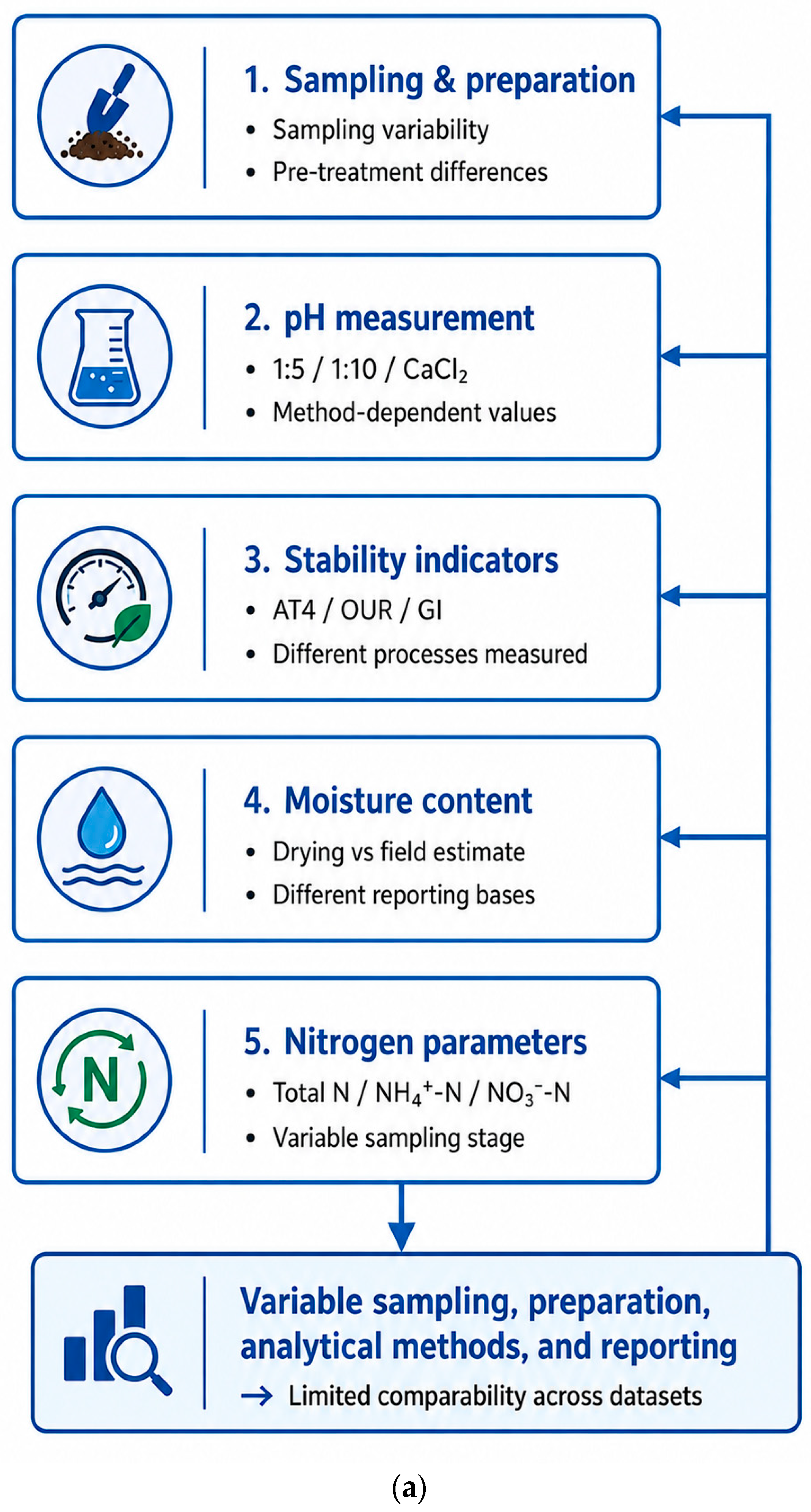
3.1. Variability in Analytical Methods
3.2. Lack of Method Equivalence and Validation
3.3. Implications for Reproducibility
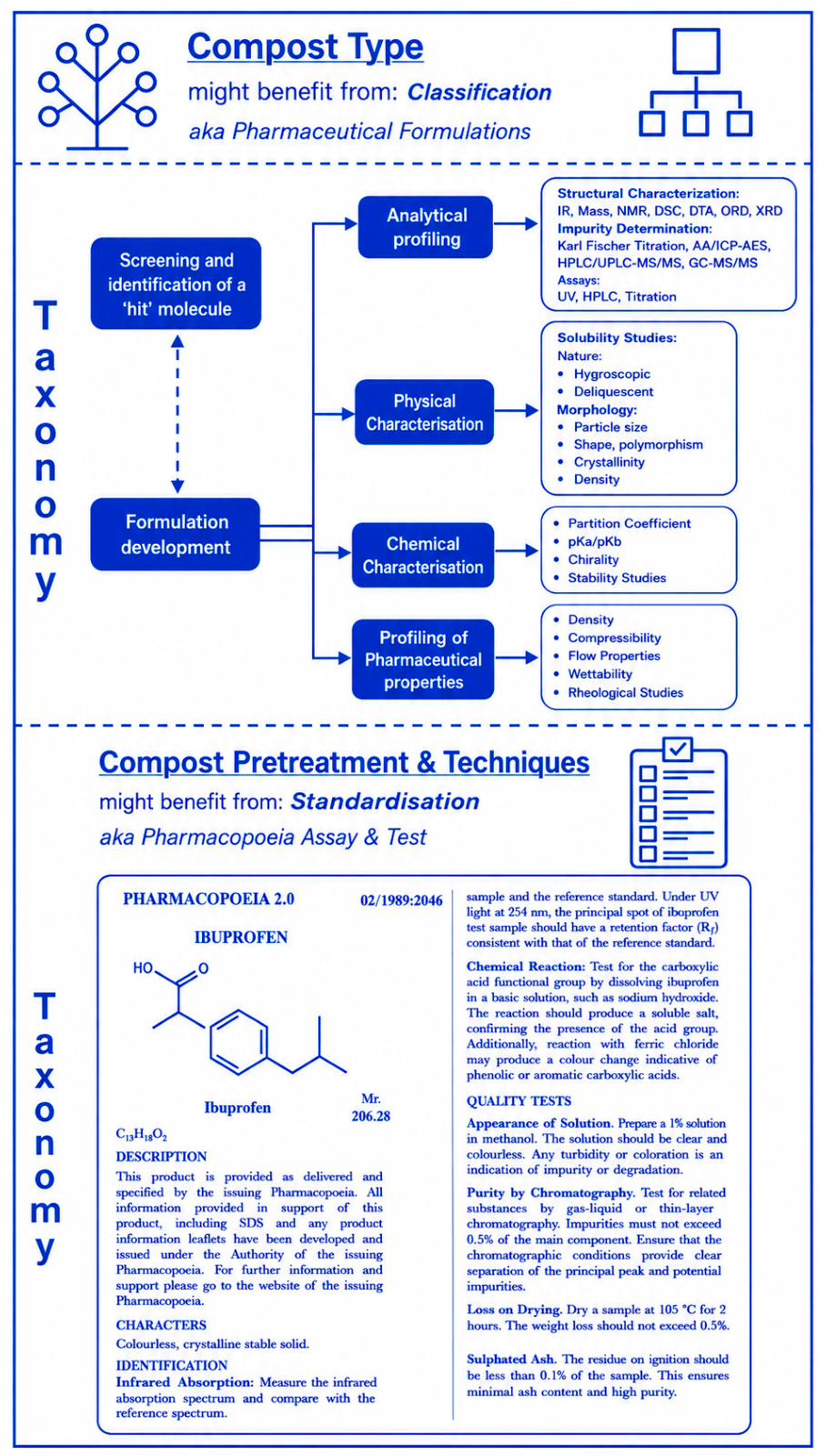
4. The Compost Pharmacopoeia Framework
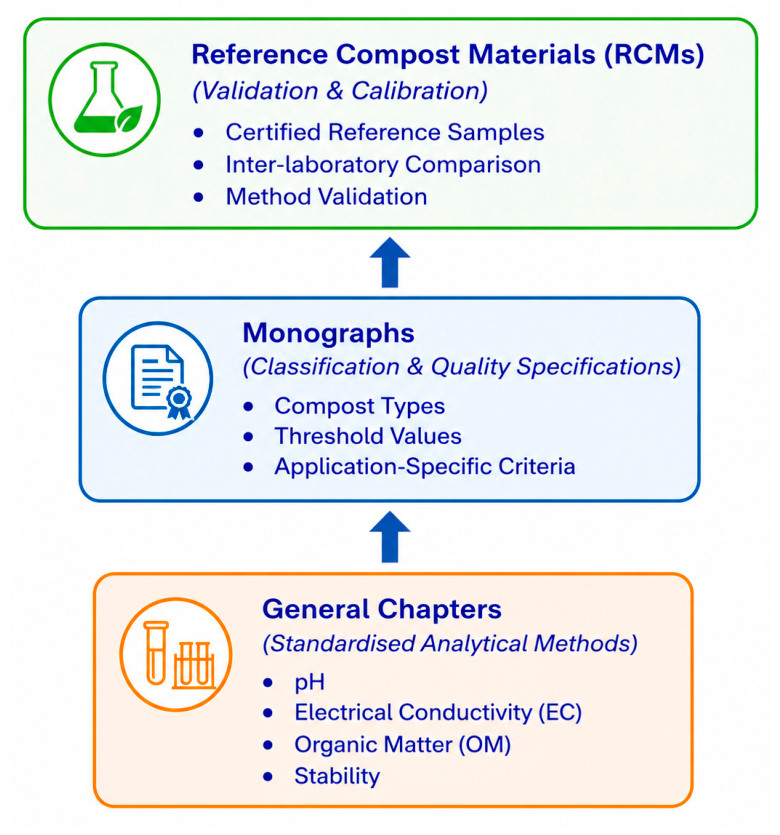
4.1. General Chapters: Sampling, Sample Preparation, and Standardised Analytical Methods
4.2. Monographs: Classification and Quality Specifications
4.3. Reference Compost Materials (RCMs): Validation and Calibration
4.4. Integration of Framework Components
5. Conceptual Application of the Compost Pharmacopoeia Framework
5.1. From Fragmented Standards to Generalised Specification
5.2. Integration Within the CPF Structure
5.3. Mapping Experimental Systems to CPF
5.4. Workflow Integration and Comparative Advantage
5.5. Implications for Research and Standardisation
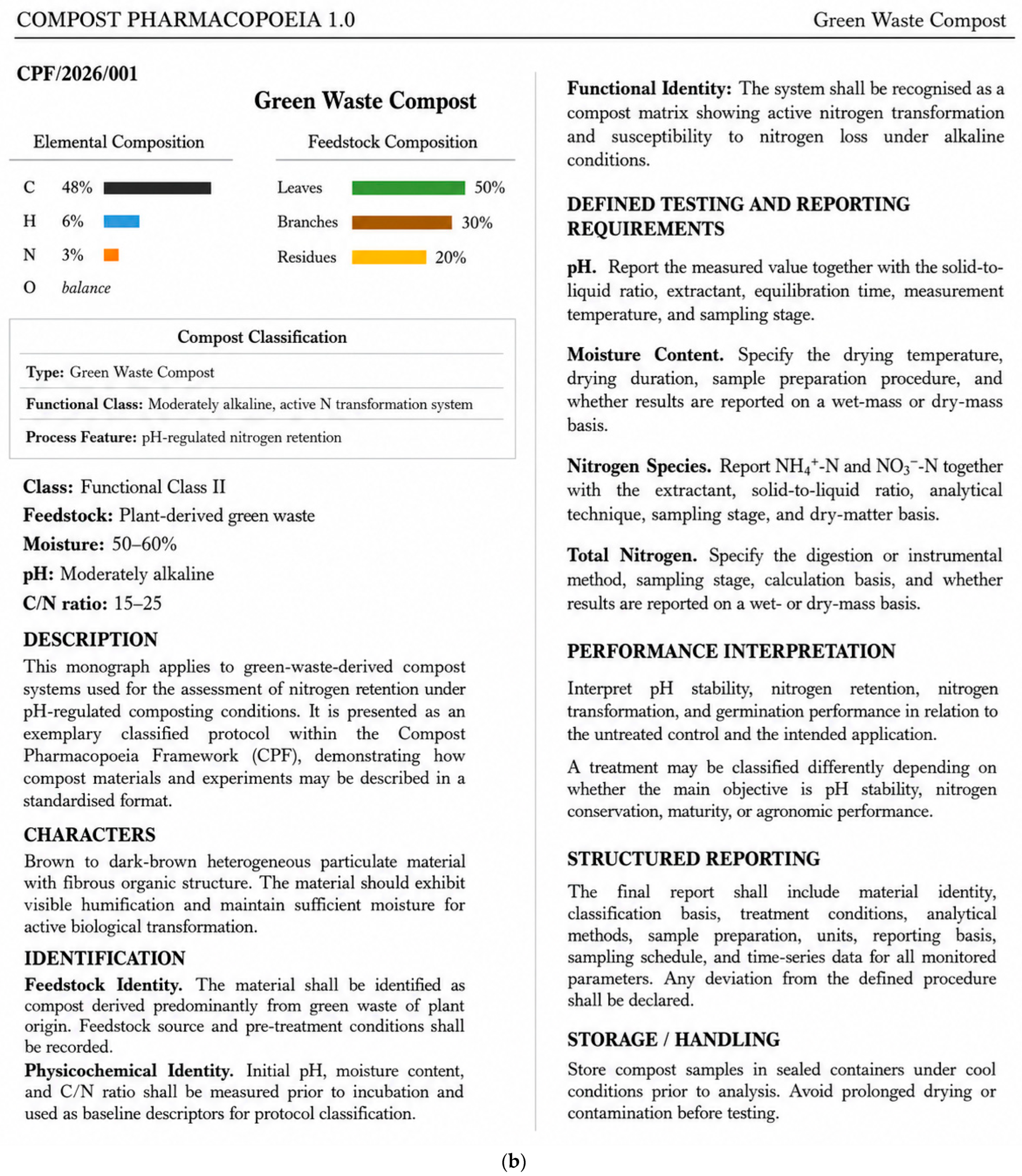
5.6. Example CPF Entry: Green-Waste Compost—pH-Regulated Nitrogen Retention System
5.7. Potential Integration of Decision-Support Systems
6. Discussion
7. Conclusions
Author Contributions
Funding
Data Availability Statement
Acknowledgments
Conflicts of Interest
References
- Otoo, M.; Drechsel, P. Resource Recovery from Waste; Taylor & Francis Group: New York, NY, USA, 2018. [Google Scholar]
- Rashwan, M.A.; Naser Alkoaik, F.; Abdel-Razzak Saleh, H.; Blanqueza Fulleros, R.; Nagy Ibrahim, M. Maturity and stability assessment of composted tomato residues and chicken manure using a rotary drum bioreactor. J. Air Waste Manag. Assoc. 2021, 71, 529–539. [Google Scholar] [CrossRef] [Scilit] [PubMed]
- U.S. Environmental Protection Agency. Environmental Value of Applying Compost; United States Environmental Protection Agency: Washington, DC, USA, 2025.
- Bernal, M.P. An overview of conventional and emerging aspects of compost: Quality indicators for agricultural uses, emerging contaminants and technological innovations. Front. Sustain. Food Syst. 2026, 10, 1785912. [Google Scholar] [CrossRef] [Scilit]
- Bernal, M.P.; Alburquerque, J.A.; Moral, R. Composting of animal manures and chemical criteria for compost maturity assessment: A review. Bioresour. Technol. 2009, 100, 5444–5453. [Google Scholar] [CrossRef] [Scilit] [PubMed]
- Gómez, R.B.; Lima, F.V.; Ferrer, A.S. The use of respiration indices in the composting process: A review. Waste Manag. Res. 2006, 24, 37–47. [Google Scholar] [CrossRef] [Scilit] [PubMed]
- Kong, Y.; Zhang, J.; Yang, Y.; Liu, Y.; Zhang, L.; Wang, G.; Liu, G.; Dang, R.; Li, G.; Yuan, J. Determining the extraction conditions and phytotoxicity threshold for compost maturity evaluation using the seed germination index method. Waste Manag. 2023, 171, 502–511. [Google Scholar] [CrossRef] [Scilit] [PubMed]
- Tsabedze, S.A.; Otieno, B.; Thomas, A.R.; Getahun, S.T. Phytotoxicity and quality in compost: A concise review of Sewage Sludge and Green Waste applications. J. Mater. Cycles Waste Manag. 2025, 27, 4041–4058. [Google Scholar] [CrossRef] [Scilit]
- Brinton, W.F. Compost Quality Standards and Guidelines: An International View; Woods End Research Laboratory Inc.: Mount Vernon, ME, USA, 2000; Volume 10, p. 42. [Google Scholar]
- AS 4454-2012; Composts, Soil Conditioners and Mulches (Including Amendment 1). Standards Australia: Sydney, NSW, Australia, 2012.
- PAS 100:2018; Specification for Composted Materials. British Standards Institution: London, UK, 2018.
- US Composting Council. Seal of Testing Assurance Program; US Composting Council: Raleigh, NC, USA, 2024. [Google Scholar]
- European Parliament and Council of the European Union. Regulation (EU) 2019/1009 of the European Parliament and of the Council Laying Down Rules on the Making Available on the Market of EU Fertilising Products; European Parliament and Council of the European Union: Brussels, Belgium, 2019. [Google Scholar]
- Manea, E.E.; Bumbac, C.; Dinu, L.R.; Bumbac, M.; Nicolescu, C.M. Composting as a sustainable solution for organic solid waste management: Current practices and potential improvements. Sustainability 2024, 16, 6329. [Google Scholar] [CrossRef] [Scilit]
- Noor, R.S.; Shah, A.N.; Tahir, M.B.; Umair, M.; Nawaz, M.; Ali, A.; Ercisli, S.; Abdelsalam, N.R.; Ali, H.M.; Yang, S.H. Recent trends and advances in additive-mediated composting technology for agricultural waste resources: A comprehensive review. ACS Omega 2024, 9, 8632–8653. [Google Scholar] [CrossRef] [Scilit] [PubMed]
- British Pharmacopoeia Commission. How to Use the British Pharmacopoeia; British Pharmacopoeia Commission: London, UK, 2022. [Google Scholar]
- Council of Europe. European Directorate for the Quality of Medicines & HealthCare (EDQM); Council of Europe: Strasbourg, France, 2024. [Google Scholar]
- ISO 10390:2021; Soil, Treated Biowaste and Sludge—Determination of pH. International Organization for Standardization: Geneva, Switzerland, 2021.
- International Organization for Standardization. ISO Technical Committee 282: Water Reuse—Activities and Standardisation Updates; International Organization for Standardization: Geneva, Switzerland, 2023. [Google Scholar]
- Li, X.; Zhang, Y.; Chen, Z. Biological and chemical variability in compost sources requires statistical tolerance ranges. Waste Manag. 2022, 152, 30–42. [Google Scholar] [CrossRef] [Scilit] [PubMed]
- Roy, D.; Gunri, S.K.; Kundu, C.K.; Bandyopadhyay, P.K. Rapid composting of groundnut residues through novel microbial consortium: Evaluating maturity, stability, and microbial activity. Curr. Res. Microb. Sci. 2024, 7, 100277. [Google Scholar] [CrossRef] [Scilit] [PubMed]
- Chen, K.; Khan, N.; Wadewitz, P.; Lamichhane, P.; Ahmed, M.B.; Kwong, P.; Hessel, V. Pros and cons of nitrogen replenishment in compost, augmented by natural acidity regulators, agri-buffering adjuvants, and grease trap waste. Bioresour. Technol. Rep. 2026, 34, 102729. [Google Scholar] [CrossRef] [Scilit]
- Chen, K.; Khan, N.; Ahmed, M.B.; Kwong, P.; Hessel, V. Environmental and Ecosystem Effects, Risk Assessment, and Mitigation Strategies for Advanced Composting. In Compost Science & Utilization; Taylor & Francis Group: Adelaide, AU, Australia, 2026; pp. 1–34. [Google Scholar] [CrossRef] [Scilit]
- Amidon, G.L.; Lennernas, H.; Shah, V.P.; Crison, J.R. A theoretical basis for a biopharmaceutic drug classification: The correlation of in vitro drug product dissolution and in vivo bioavailability. Pharm. Res. 1995, 12, 413–420. [Google Scholar] [CrossRef] [Scilit] [PubMed]
- Khalid, F.; Hasan, S.M.F.; Mushtaque, M.; Noor, R.; Ghayas, S.; Muhammad, I.; Hassan, F. Comparative analysis of BCS based biowaiver protocols to validate equivalence of a multisource product. Afr. J. Pharm. Pharmacol. 2020, 17, 212–220. [Google Scholar] [CrossRef] [Scilit]
- Firoozi, A.A.; Firoozi, A.A.; Oyejobi, D.O.; Avudaiappan, S.; Flores, E.S. Emerging trends in sustainable building materials: Technological innovations, enhanced performance, and future directions. Results Eng. 2024, 24, 103521. [Google Scholar] [CrossRef] [Scilit]
- U.S. Food and Drug Administration. Guidance for Industry: PAT—A Framework for Innovative Pharmaceutical Development, Manufacturing, and Quality Assurance; U.S. Food and Drug Administration: Rockville, MD, USA, 2004.
- International Council for Harmonisation. ICH Harmonised Tripartite Guideline: Pharmaceutical Development Q8(R2); International Council for Harmonisation: Geneva, Switzerland, 2009. [Google Scholar]
- Ojha, A.; Bhargava, S. International council for harmonisation (ICH) guidelines. In Regulatory Affairs in the Pharmaceutical Industry; Elsevier: Amsterdam, The Netherlands, 2022; pp. 47–74. [Google Scholar]
- Houson, I.; Siddique, H.; Chong, M.W.S.; Robertson, M.; Turner, A.J.; Nordon, A.; Osman, A.; Galindo, A.; Dunn, A.S.; Johnston, B.; et al. Quality by digital design in action: A workflow for crystallisation and isolation. Int. J. Pharm. 2025, 686, 126343. [Google Scholar] [CrossRef] [Scilit] [PubMed]
- Stehouwer, R.; Cooperband, L.; Rynk, R.; Biala, J.; Bonhotal, J.; Antler, S.; Lewandowski, T.; Nichols, H. Chapter 15—Compost characteristics and quality. In The Composting Handbook; Rynk, R., Ed.; Academic Press: Cambridge, MA, USA, 2022; pp. 737–775. [Google Scholar]
- Gómez-Brandón, M.; Lazcano, C.; Domínguez, J. The evaluation of stability and maturity during the composting of organic wastes: A review. Waste Manag. Res. 2008, 26, 456–464. [Google Scholar] [CrossRef]
- Aspray, T.J. Physical Contaminant Testing of Composts. BioCycle 2016, 57, 56–58. [Google Scholar]
- Haug, R.T. The Practical Handbook of Compost Engineering; CRC Press: Boca Raton, FL, USA, 1993. [Google Scholar]
- Prasad, M.; Foster, P. Comprehensive evaluation and development of Irish compost and digestate standards for heavy metals, stability and phytotoxicity. Environments 2023, 10, 166. [Google Scholar] [CrossRef] [Scilit]
- ISO 11277:2018; Soil Quality—Determination of Particle Size Distribution in Mineral Soil Material—Method by Sieving and Sedimentation. International Organization for Standardization: Geneva, Switzerland, 2018.
- Oueld Lhaj, M.; Moussadek, R.; Mouhir, L.; Mdarhri Alaoui, M.; Sanad, H.; Iben Halima, O.; Zouahri, A. Assessing the evolution of stability and maturity in co-composting sheep manure with green waste using physico-chemical and biological properties and statistical analyses: A case study of botanique garden in rabat, Morocco. Agronomy 2024, 14, 1573. [Google Scholar] [CrossRef] [Scilit]
- Agnew, J.M.; Leonard, J.J. The Physical Properties of Composts: A Review. Compost. Sci. Util. 2013, 11, 238–264. [Google Scholar]
- US Composting Council. Test Methods for the Examination of Composting and Compost (TMECC); US Composting Council: Bethesda, MD, USA, 2018. [Google Scholar]
- Ministry of Agriculture, Forestry and Fisheries (MAFF). Fertilizer Control Act; Ministry of Agriculture, Forestry and Fisheries (MAFF): Tokyo, Japan, 2012.
- ISO 11465:1993; Soil Quality—Determination of Dry Matter and Water Content on a Mass Basis—Gravimetric Method. International Organization for Standardization: Geneva, Switzerland, 1993.
- European Compost Network. European Compost Network Activities and Quality Assurance Initiatives. Available online: https://www.compostnetwork.info/ (accessed on 6 March 2026).
- International Solid Waste Association. Global Guidelines for Organic Waste Management and Composting Systems. Available online: https://www.iswa.org/ (accessed on 6 March 2026).
- Sullivan, D.M.; Miller, R.O. Compost quality attributes, measurements, and variability. In Compost Utilization in Horticultural Cropping Systems; Stofella, P.J., Kahn, B.A., Eds.; CRC Press: Boca Raton, FL, USA, 2001; pp. 95–120. [Google Scholar]
- National Organic Standards Board. Compost Definition and Practice Standard Update; United States Department of Agriculture (USDA), Agricultural Marketing Service: Washington, DC, USA, 2024. [Google Scholar]
- Ramsey, M.H.; Ellison, S.L.R.; Rostron, P. Measurement Uncertainty Arising from Sampling: A Guide to Methods and Approaches; Eurachem: Bucharest, Romania, 2019. [Google Scholar]
- ISO 16072:2002; Soil Quality—Laboratory Methods for Determination of Microbial Soil Respiration. International Organization for Standardization: Geneva, Switzerland, 2002.
- BS EN 13040:2007; Soil Improvers and Growing Media—Sample Preparation for Chemical and Physical Tests, Determination of Dry Matter Content, Moisture Content and Laboratory Compacted Bulk Density. British Standards Institution: London, UK, 2008. [CrossRef] [Scilit]
- International Organization for Standardization. General Requirements for the Competence of Reference Material Producers; International Organization for Standardization: Geneva, Switzerland, 2016. [Google Scholar]
- International Organization for Standardization. Reference Materials—Approaches for Characterization and Assessment of Homogeneity and Stability; International Organization for Standardization: Geneva, Switzerland, 2024. [Google Scholar]
- Boldrin, A.; Andersen, J.K.; Christensen, T.H.; Favoino, E.; Hogg, D. Composting and compost utilization: Accounting of greenhouse gases and global warming contributions. Waste Manag. Res. 2009, 27, 800–812. [Google Scholar] [CrossRef] [Scilit] [PubMed]
- BS EN 12579:2013; Soil Improvers and Growing Media—Sampling. British Standards Institution: London, UK, 2013.
- ISO 18400-105:2017; Soil Quality—Sampling—Part 105: Packaging, Transport, Storage and Preservation of Samples. International Organization for Standardization: Geneva, Switzerland, 2017.
- ISO/IEC 17043:2023; Conformity Assessment—General Requirements for Proficiency Testing. International Organization for Standardization: Geneva, Switzerland, 2023.
- ISO 19115-1:2014; Geographic Information—Metadata—Part 1: Fundamentals. International Organization for Standardization: Geneva, Switzerland, 2014.
- Vaneeckhaute, C.; Walling, E.; Rivest, S.; Belia, E.; Chartrand, I.; Fortin, F.; Mostafavi, M.A. Towards an integrated decision-support system for sustainable organic waste management (optim-O). npj Urban Sustain. 2021, 1, 27. [Google Scholar] [CrossRef] [Scilit]
- Manono, B. Compost Quality and Application Rate as Drivers of Soil Health, Nutrient Cycling, and Crop Performance: A Critical Review and Practical Rate-Design Framework. Nitrogen 2026, 7, 58. [Google Scholar] [CrossRef] [Scilit]
- Horn, A.L.; Düring, R.-A.; Gäth, S. Comparison of decision support systems for an optimised application of compost and sewage sludge on agricultural land based on heavy metal accumulation in soil. Sci. Total Environ. 2003, 311, 35–48. [Google Scholar] [CrossRef] [Scilit] [PubMed]
- Queensland Department of Environment and Science. Guideline: Best Practice Environmental Management—Environmentally Relevant Activity 53(a) Organic Material Processing by Composting; Queensland Government: Brisbane, QLD, Australia, 2021.
- Huzir, N.; Asmadi, A.; Rosly, M.; Tamunaidu, P.; Amin, A. Composting as a pathway for organic waste valorization: Substrate performance, process strategies, and quality benchmarks. J. Mater. Cycles Waste Manag. 2026, 28, 815–833. [Google Scholar] [CrossRef] [Scilit]
- Gutierrez-Lopez, J.; McGarvey, R.G.; Costello, C.; Hall, D.M. Decision Support Frameworks in Solid Waste Management: A Systematic Review of Multi-Criteria Decision-Making with Sustainability and Social Indicators. Sustainability 2023, 15, 13316. [Google Scholar] [CrossRef] [Scilit]
- Kandaiah, R.; Ravindran, A.; Panneerselvan, L.; Manivannan, A.C.; Kulanthaisamy, M.; Sobhani, Z.; Bhagwat-Russell, G.; Palanisami, T. A comprehensive analysis and risk evaluation of microplastics contamination in Australian commercial plant growth substrates: Unveiling the invisible threat. J. Hazard. Mater. 2024, 480, 136310. [Google Scholar] [CrossRef] [Scilit] [PubMed]
- Nie, K.; McWright, L.; Rothwell, J.G.; Mondragon-Becerra, M.; Malal, H.; Lazcano, C.; Geisseler, D.; Scott, L.; Elliott Campbell, J.; Gomez-Ortega, J.; et al. cMicrobial Food Safety Risk in Finished Soil Amendment: A Statewide Cross-sectional Study of Organic Waste Processing Systems in California. J. Food Prot. 2026, 89, 100844. [Google Scholar] [CrossRef] [Scilit] [PubMed]
- Rentizelas, A.; Georgiou, P.N.; Giannopoulos, D.; Stavrogiannis, C.; Papadakis, T.; Christou, I.T.; Psathas, F.; Anastasopoulos, D. A novel decision support system for designing and assessing phytoremediation-to-biofuel value chains. Biofuels Bioprod. Biorefining 2025, 19, 1014–1029. [Google Scholar] [CrossRef] [Scilit]
- Meyer, S.; Genesio, L.; Vogel, I.; Schmidt, H.-P.; Soja, G.; Someus, E.; Shackley, S.; Verheijen, F.G.; Glaser, B. Biochar standardization and legislation harmonization. J. Environ. Eng. Landsc. Manag. 2017, 25, 175–191. [Google Scholar] [CrossRef] [Scilit]
- Romero-Perdomo, F.; González-Curbelo, M.Á. Integrating multi-criteria techniques in life-cycle tools for the circular bioeconomy transition of agri-food waste biomass: A systematic review. Sustainability 2023, 15, 5026. [Google Scholar] [CrossRef] [Scilit]
- European Environment Agency. Soil Health Dashboard; European Environment Agency: Copenhagen, Denmark, 2023. [Google Scholar]

| Aspect | UK (PAS 100) | Australia (AS 4454) | EU (2019/1009) | USA (STA) | Japan | ISO (Global) | International Harmonisation Initiatives |
|---|---|---|---|---|---|---|---|
| Type | Voluntary | National standard | Regulation | Voluntary | Regulation | International | International/Cross-jurisdiction |
| Main purpose | Quality assurance | Product standard | Market regulation | Product quality | Fertiliser control | Method standardisation | Harmonisation and interoperability |
| Classification | Limited | Basic categories | CMC system | Limited | Fertiliser-based | Not defined | Developing guidance frameworks |
| pH measurement | Defined (varies) | Defined | Not unified | Defined | Defined | ISO 10390 [18] | ISO-aligned |
| Stability test | AT4 | GI | Not consistent | Respiration | Not standardised | Not defined | Under development/not unified |
| Organic matter | Varies | Defined (varies) | Varies | Defined | Defined | ISO-based | Method harmonisation |
| Reporting | Certification | Standard | Regulatory | Programme | Regulatory | Not applicable | Comparative guidance |
| Reference | [11] | [13] | [42] | [43] | [18,44] | [40,41] |
| Category | Parameter | Typical Method(s) | Common Range/Requirement | Functional Role |
|---|---|---|---|---|
| Chemical | pH | ISO 10390 (1:10 extraction) | 6.5–9.5 | Controls NH3 volatilisation and microbial activity |
| Electrical Conductivity (EC) | Aqueous extract | <4–6 mS cm−1 | Indicates salinity and plant compatibility | |
| Organic Matter (OM) | Loss-on-ignition (LOI) | >30–50% | Reflects carbon content and stability | |
| Biological | Stability | AT4/OUR/respiration index | Method-dependent and inconsistently defined (e.g., AT4 < 5–10 mg O2 g−1 DM; OUR < 10–20 mg O2 kg−1 OM h−1 across standards) | Indicates maturity and biodegradation |
| Germination Index (GI) | Seed germination test | >70–90% | Indicates phytotoxicity | |
| Nutrient | Total Nitrogen (TN) | Kjeldahl method | Retention preferred | Determines fertiliser value and N efficiency |
| DSS Module | CPF Input/Indicator | Example Finding from Case Study | DSS Interpretation | Possible Decision Output |
|---|---|---|---|---|
| Process condition screening | Moisture condition | Initial moisture was approximately 50% and was maintained within a composting-supportive range | Process conditions were suitable for microbial activity and aerobic composting | Acceptable process condition |
| pH regulation assessment | pH range and variability | Buffered systems stabilised pH within 8.1–9.1; G6 showed the lowest pH variability, SD = 0.22 | Strong buffering performance and reduced ammonia volatilisation risk | Prefer G6 where pH stability is the primary objective |
| Nitrogen conservation | Total nitrogen loss | Total nitrogen loss remained below 20% across treatments | Nitrogen was largely retained within the composting system | Acceptable nitrogen-retention performance |
| Biological maturity and phytotoxicity | Germination rate and seedling vigour index | G3 showed the highest SVI = 1300; G2 showed SVI = 1250; G5 showed reduced germination rate of 75% | G3 and G2 showed the most favourable germination-related performance under the conditions of the representative case study | Prioritise G2/G3 for further agronomic evaluation; restrict or optimise G5 pending additional assessment |
| Carbon–nitrogen balance | C/N evolution | C/N decreased from approximately 17 to 10–12; G6 showed strong later-stage C/N improvement | Indicates compost maturation and organic matter stabilisation | Prefer G6 where C/N stabilisation is prioritised |
| Integrated treatment ranking | Multi-criteria weighted score | G2 achieved the highest total score = 9; G6 ranked second with score = 7 | G2 provided the best balance across process, nitrogen, and maturity indicators | G2 ranked highest under the selected multi-criteria weighting system; G6 ranked second |
| Risk-based application screening | Germination inhibition and poor integrated score | G5 had the lowest integrated score = −3 and reduced germination | Potential operational or agronomic limitation | Require further optimisation before application |
| Contaminated feedstock screening | Feedstock source, heavy metals, pathogen indicators, persistent contaminants, emerging pollutants | Sewage sludge or poorly traceable organic residues may present elevated contamination risks | High-risk materials require stricter classification and verification before agricultural use | Restrict agricultural application, require further testing, or redirect to non-agricultural use |
Disclaimer/Publisher’s Note: The statements, opinions and data contained in all publications are solely those of the individual author(s) and contributor(s) and not of MDPI and/or the editor(s). MDPI and/or the editor(s) disclaim responsibility for any injury to people or property resulting from any ideas, methods, instructions or products referred to in the content. |
© 2026 by the authors. Licensee MDPI, Basel, Switzerland. This article is an open access article distributed under the terms and conditions of the Creative Commons Attribution (CC BY) license.
Share and Cite
Chen, K.; Khan, N.; Ahmed, M.B.; Wadewitz, P.; Kwong, P.; Hessel, V. Toward a Compost Pharmacopoeia—A Conceptual Framework for Standardisation and Classification of Compost Quality. Sci 2026, 8, 193. https://doi.org/10.3390/sci8080193
Chen K, Khan N, Ahmed MB, Wadewitz P, Kwong P, Hessel V. Toward a Compost Pharmacopoeia—A Conceptual Framework for Standardisation and Classification of Compost Quality. Sci. 2026; 8(8):193. https://doi.org/10.3390/sci8080193
Chicago/Turabian StyleChen, Kun, Naser Khan, Mohammad Boshir Ahmed, Peter Wadewitz, Philip Kwong, and Volker Hessel. 2026. "Toward a Compost Pharmacopoeia—A Conceptual Framework for Standardisation and Classification of Compost Quality" Sci 8, no. 8: 193. https://doi.org/10.3390/sci8080193
APA StyleChen, K., Khan, N., Ahmed, M. B., Wadewitz, P., Kwong, P., & Hessel, V. (2026). Toward a Compost Pharmacopoeia—A Conceptual Framework for Standardisation and Classification of Compost Quality. Sci, 8(8), 193. https://doi.org/10.3390/sci8080193

