Biochar and Sustainable Crop Performance: A Synoptical Review of Its Properties, Agronomic Potential and Constraints

 ,
,  ,
,  ,
,  ,
, 

Abstract
1. Introduction
2. Materials and Methods
2.1. Literature Search Strategy
2.2. Eligibility Criteria
2.3. Study Selection and Data Synthesis
2.4. Data Analysis
3. Biochar Production, Properties, Agronomic Applications, Challenges and Limitations
3.1. Biochar: Production and Properties
3.1.1. Production
Feedstock
Processes
- (a)
- Pyrolysis
- (b)
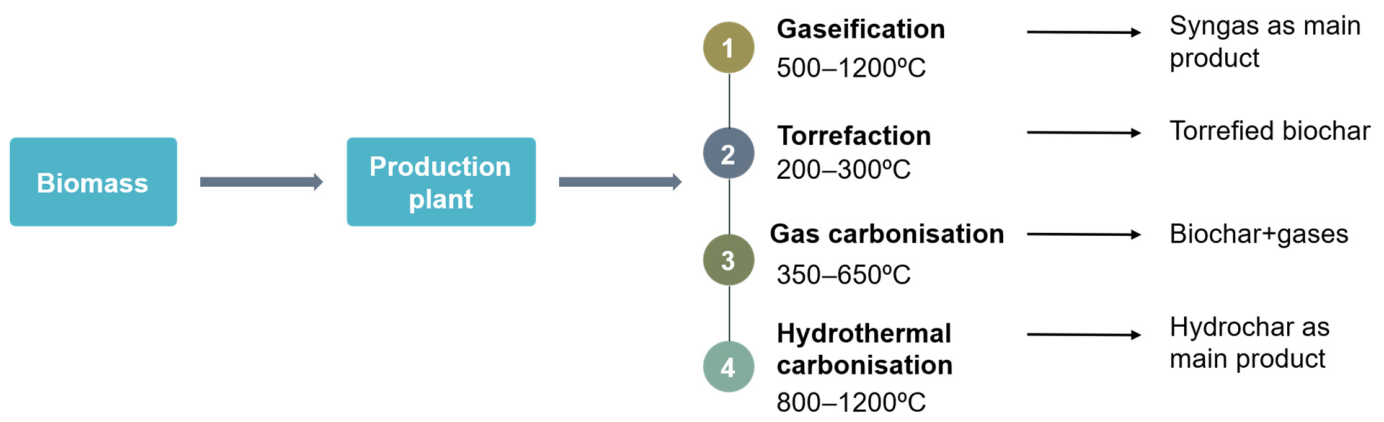
- Other ProcessesIn addition to pyrolysis, several other processes can be used for biochar production, each with its own specific characteristics (Figure 2) [24,33,34,35]:
- Gasification (500–1200 °C)—produces mainly syngas, with a low biochar yield (~10%).
- Torrefaction (200–300 °C)—a mild pretreatment of biomass, with limited impact on biochar production.
- Flash Carbonization (350–650 °C)—a rapid, pressurized process that generates a balanced proportion of biochar and gases.
- Hydrothermal Carbonization (800–1200 °C)—used for wet biomass; produces hydrochar, which is not directly comparable to pyrolysis-derived biochar.

Modifications
- (a)
- Physical Modifications
- (b)
- Chemical Modification
- (c)
- Activation
3.1.2. Properties
Physical Properties
- (a)
- Specific Surface Area—Biochar typically exhibits a surface area ranging from 1.5 to 500 m2/g. This generally increases with higher pyrolysis temperatures, as the release of volatiles and tars opens internal pores within the carbon matrix. However, beyond a critical temperature threshold, micropore collapse may occur, reducing total surface area [19,23,39].
- (b)
- Water Holding Capacity—Water-holding capacity is governed by the combined effects of pore structure and surface chemistry. Increasing pyrolysis temperature generally removes tar residues and improves pore accessibility, favouring water storage within the biochar matrix [47,48]. However, higher temperatures also reduce oxygen- and nitrogen-containing functional groups while increasing aromaticity, thereby decreasing surface wettability [19,49]. Consequently, the overall effect of pyrolysis temperature on water-holding capacity depends on the balance between enhanced pore development and the loss of hydrophilic surface functionalities, as well as on feedstock characteristics.
- (c)
- Structural Stability—Due to its high aromatic carbon content, low solubility and resistance to physical, chemical and biological degradation, biochar is highly stable and can persist in soils for long periods. This long-term persistence contributes to carbon sequestration and improved soil quality [20,23,39].
- (d)
- Porosity and Density—Biochar’s low bulk density and highly porous structure enhance its capacity to retain water and nutrients, particularly in sandy soils. Studies indicate that biochar application can reduce soil bulk density by 3–31% and increase porosity by 14–64%. These effects improve plant water use efficiency and nutrient uptake, promoting more sustainable plant growth [20,23,39].
Chemical Properties
- (a)
- pH—Biochar is generally alkaline due to the presence of ash, carbonates and phosphates formed during pyrolysis. Its pH tends to increase with higher carbonization temperatures as acidic functional groups (such as carboxyls) decompose and organic acids volatilize. For example, poultry manure-derived biochar typically exhibits a higher pH than biochar produced from woody biomass [19]. Thus, biochar pH increases with pyrolysis temperature, reflecting the decomposition of acidic functional groups and the volatilization of organic acids [20,39].
- (b)
- Functional Groups—The surface of biochar is rich in functional groups such as carboxyl, hydroxyl and carbonyl, particularly in biochar produced at lower temperatures. These groups confer adsorption capacity, buffering ability and ion exchange properties. As pyrolysis temperature increases, the number of oxygen-containing functional groups tends to decrease, being replaced by more stable and alkaline groups [19,39].
- (c)
- Cation Exchange Capacity (CEC)—Biochar CEC is closely linked to the presence of oxygen-containing functional groups. At moderate temperatures, retention of these groups can increase CEC, whereas higher pyrolysis temperatures reduce CEC by degrading them. However, the increased presence of alkaline elements such as K, Ca and Mg at higher temperatures may partially compensate for this reduction [19,20,39].
3.2. Biochar Agronomical Applications
3.2.1. Physiochemical Soil Effects
- (a)
- Soil Carbon Dynamics and Stabilization
- (b)
- Soil pH and CEC
- (c)
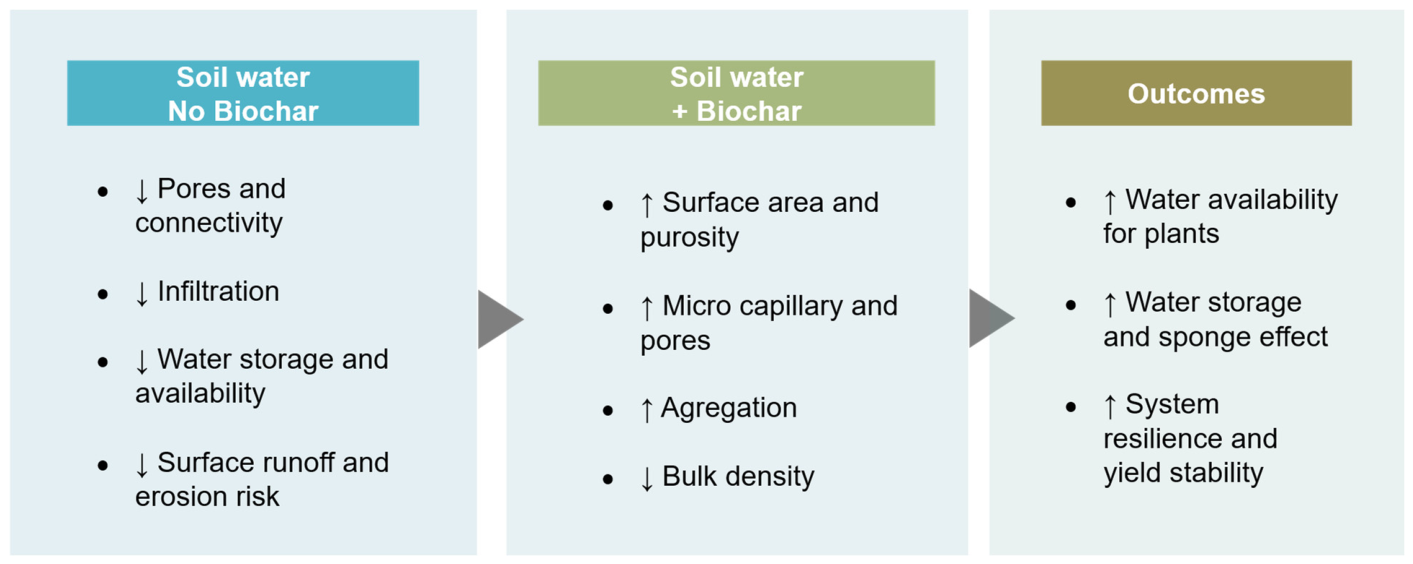
- Soil Moisture and Physical Structure
3.2.2. Biological Effects
- (a)
- Microbial Biomass and Enzyme Activity
- (b)
- Biochar as Microbial Carrier
- (c)
- Disease Suppression and Microbiome Dynamics
- (d)
- Plant-Microbe Interactions
3.2.3. Soil Hydraulics Effect
- (a)
- Water Retention
- (b)
- Erosion Control
3.2.4. Crop Quality and Productivity
- (a)
- Yield and Nutrient Use Efficiency
- (b)
- Feedstock Effects on Yield Response
- (c)
- Stress Mitigation in Crops
- (d)
- Crop Structures Development and Quality
3.2.5. Agronomic Sustainability
- (a)
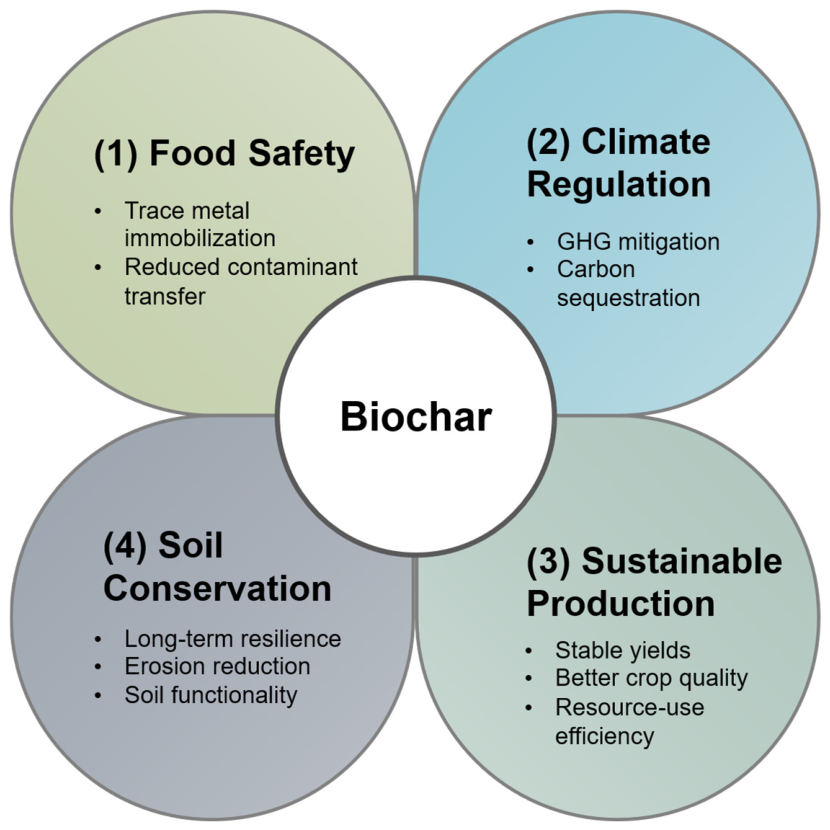
- Trace Metal Immobilization
- (b)
- Greenhouse Gas and Climate Mitigation
- (c)
- Long-term Soil Resilience
3.3. Limitations and Uncertainties
3.3.1. Biochar Response Variability
3.3.2. Application Rates and Management Uncertainty
3.3.3. Standardization
3.3.4. Economic and Technical Constraints
3.3.5. Long-Term Environmental Uncertainties
3.4. Towards Optimized Biochar Deployment
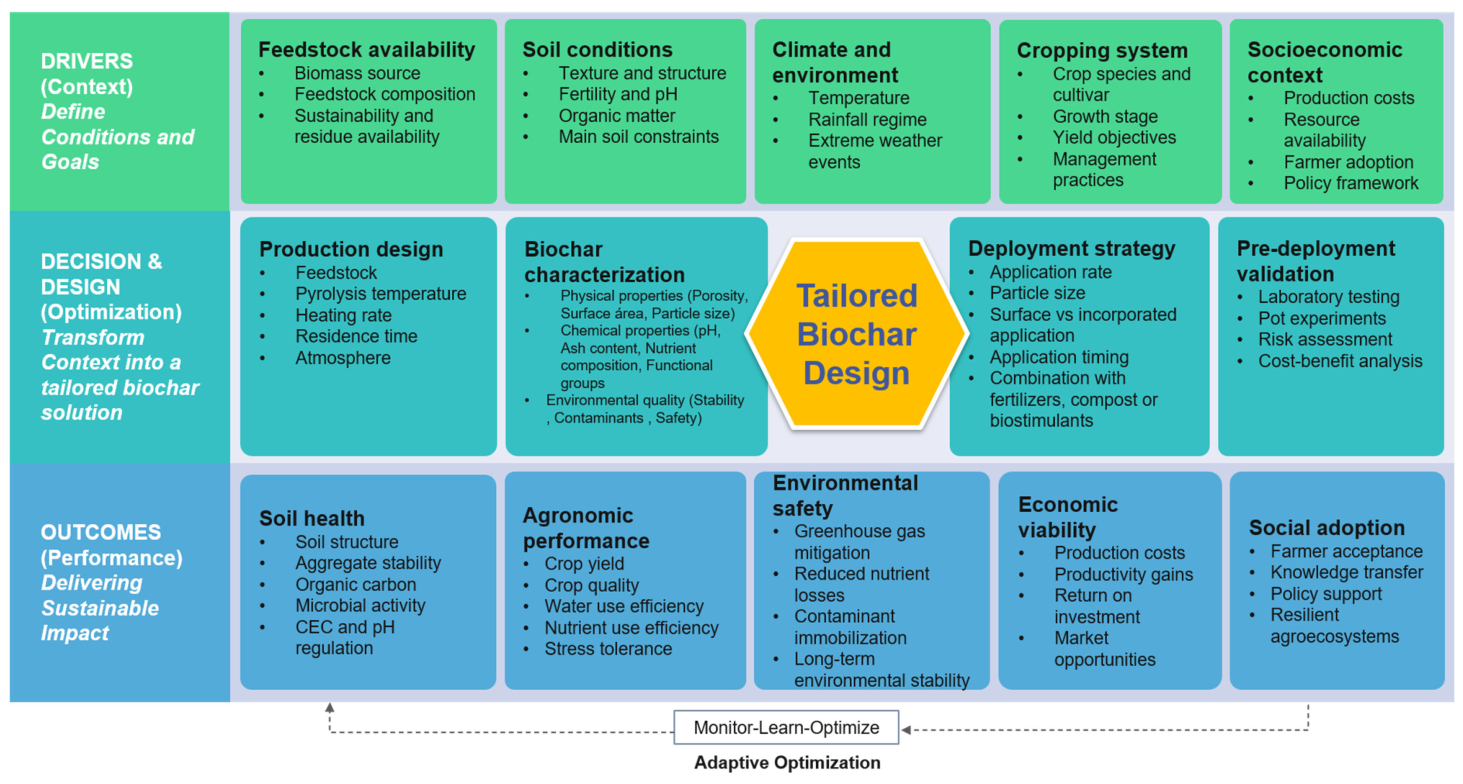
3.4.1. Moving from Generalized Applications to Tailored Biochars
3.4.2. Standardization as a Prerequisite for Reproducibility
3.4.3. Long-Term, Multi-Site Field Validation
3.4.4. Integrating Environmental and Economic Assessments
3.4.5. From Research to Implementation
4. Conclusions
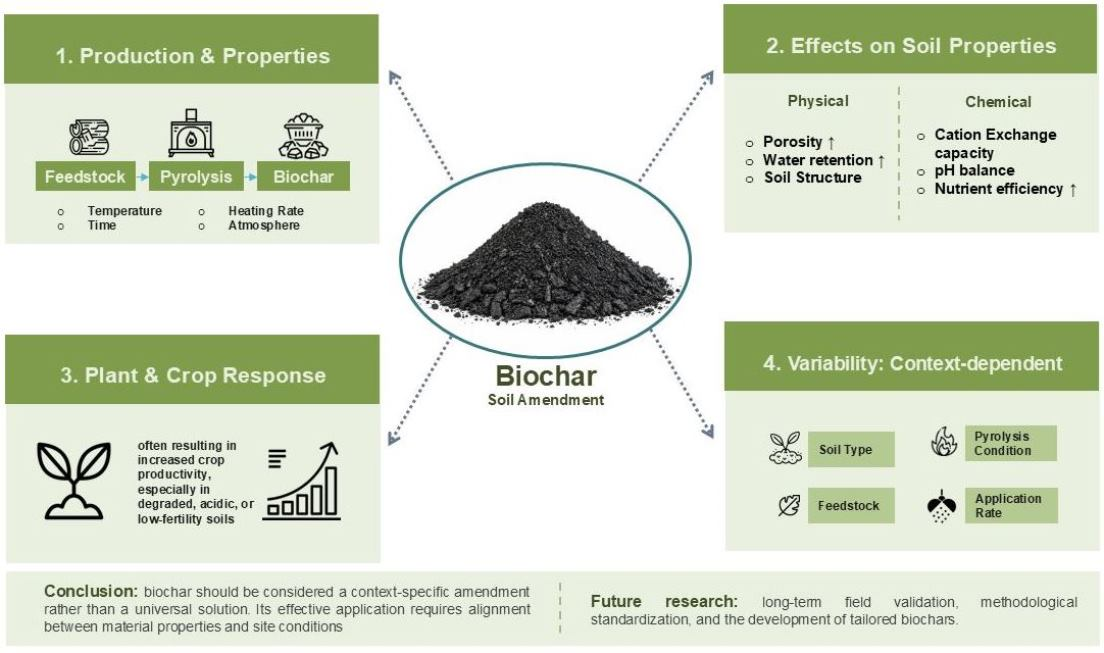
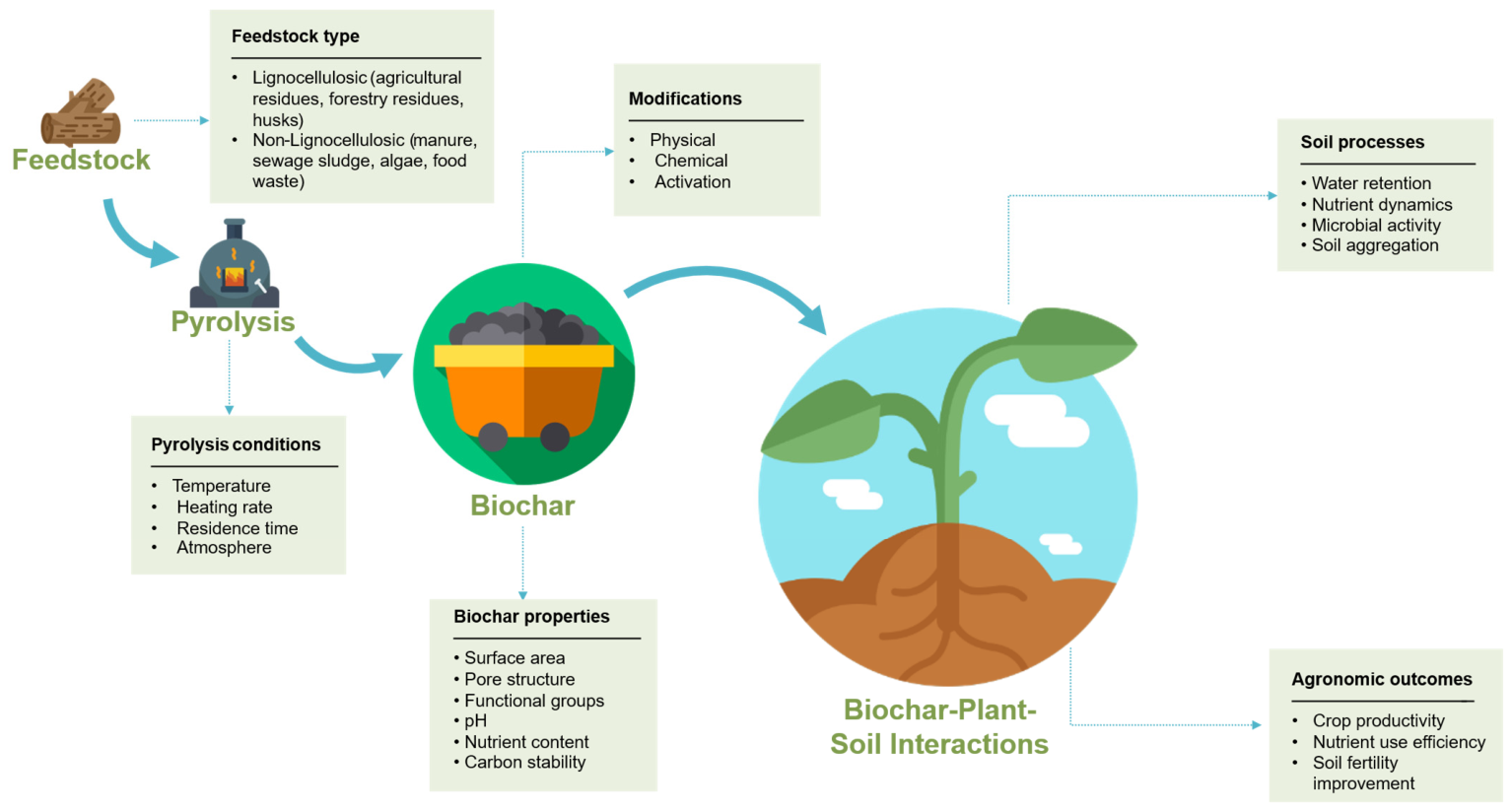
- Feedstock selection and pyrolysis conditions are the primary determinants of biochar functionality, governing its physicochemical properties and subsequent interactions with soil and crops.
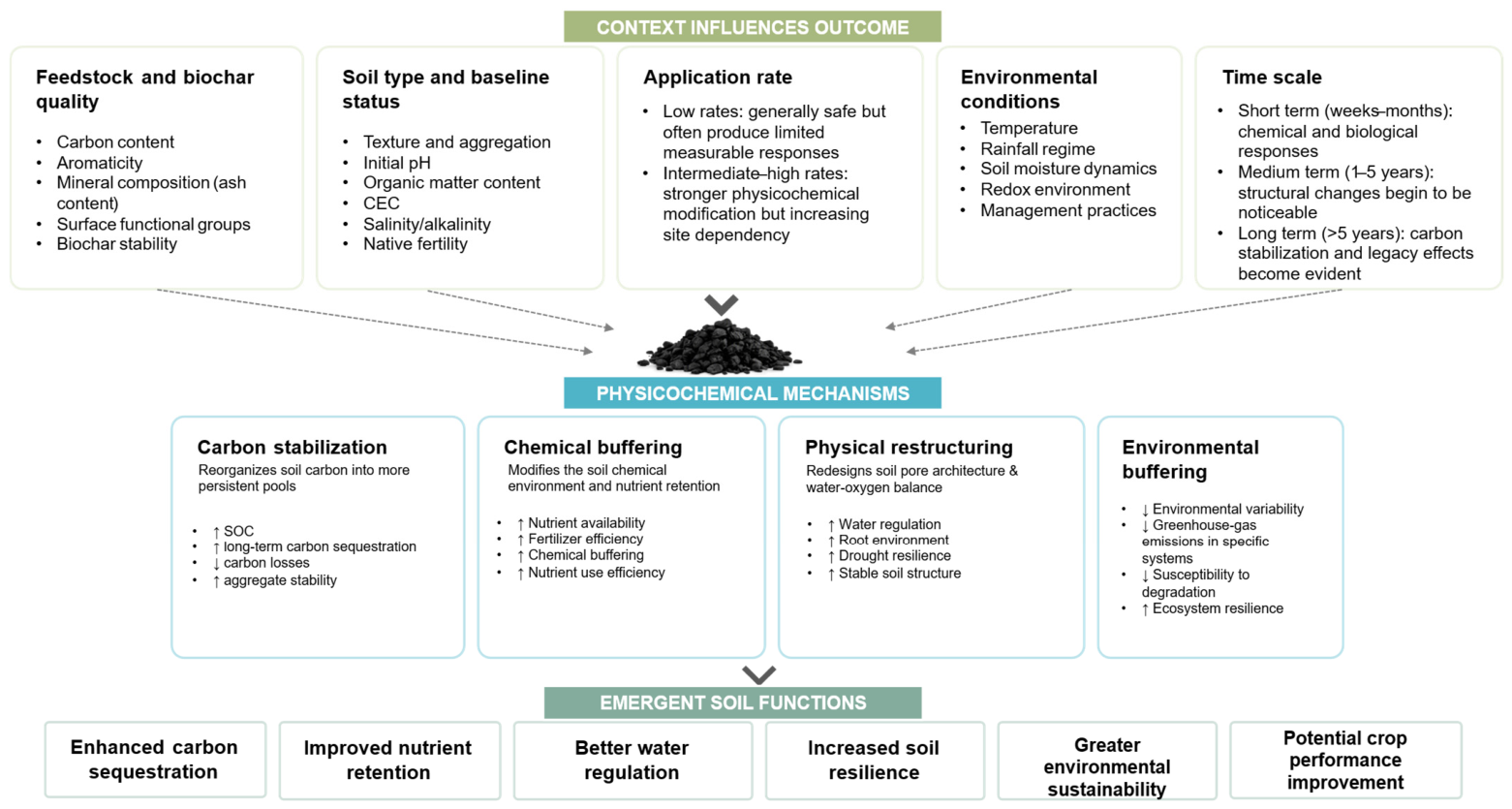
- The agronomic performance of biochar is fundamentally system-dependent, emerging from the interaction between biochar properties, soil characteristics and management practices rather than from any single factor.
- The most consistent benefits are observed in degraded or resource-limited systems, where improvements in nutrient retention, water regulation, carbon stabilization and stress mitigation translate more readily into agronomic gains.
- Current research priorities should shift from demonstrating biochar effectiveness towards optimizing its production, characterization and deployment, supported by standardized methodologies and long-term field validation.
Author Contributions
Funding
Data Availability Statement
Acknowledgments
Conflicts of Interest
References
- Hultgren, A.; Carleton, T.; Delgado, M.; Gergel, D.R.; Greenstone, M.; Houser, T.; Hsiang, S.; Jina, A.; Kopp, R.E.; Malevich, S.B.; et al. Impacts of Climate Change on Global Agriculture Accounting for Adaptation. Nature 2025, 642, 644–652. [Google Scholar] [CrossRef] [Scilit] [PubMed]
- Auer, C.; Reyer, C.P.O.; Adamczak, W.; Aylett, C.; Benzie, M.; Berndt, J.P.; Bresch, D.N.; Bosello, F.; Bressan, G.; Carter, T.R.; et al. Critical Intervention Points for European Adaptation to Cascading Climate Change Impacts. Nat. Clim. Chang. 2025, 15, 1226–1233. [Google Scholar] [CrossRef] [Scilit]
- de Souza, N.R.D.; Solberg, M.K.M.; Hu, X.; Cherubini, F. Environmental Benefits and Changes in Ecosystem Services of Climate-Smart Agriculture Relative to Conventional Agriculture in Norway. J. Environ. Manag. 2025, 377, 124633. [Google Scholar] [CrossRef] [Scilit] [PubMed]
- Kohl, L.; Minarsch, E.-M.L.; Niether, W.; Dix, B.A.; Kammann, C.; Clifton-Brown, J.C.; Gattinger, A. Early Evidence for the Benefits of Biochar in Organic Regenerative Agriculture. Sci. Rep. 2026, 16, 7833. [Google Scholar] [CrossRef] [Scilit] [PubMed]
- Ng, S.; Hinrichsen, O.; Viswanathan, S. Contextual Conditions Define Maximum Energy-Use Threshold in Low-Carbon Controlled Environment Agriculture for Agri-Food Transformation. Nat. Commun. 2026, 17, 880. [Google Scholar] [CrossRef] [Scilit] [PubMed]
- Jones, D.L.; Cooledge, E.C.; Alston, D.; Chadwick, D.R. Agricultural Management Strategies to Actively Promote Subsoil Carbon Storage. Soil Tillage Res. 2026, 256, 106846. [Google Scholar] [CrossRef] [Scilit]
- Zhang, X.; Geng, X.; Zhu, J.; Wang, L.; Ma, W.; Liu, Y.; Sheng, X.; Qi, X.; Chen, Y.; Gao, P.; et al. Sustainable Agronomic and Tillage Strategies for Rice–Wheat Rotation Systems in Saline–Alkali Soils: Lessons, Advances, and Prospects. Field Crops Res. 2026, 337, 110278. [Google Scholar] [CrossRef] [Scilit]
- Junejo, A.R.; Liu, J.; Chen, K.; Dahri, S.H.; Junejo, Y.; Li, H. Biochar for Sustainable and Climate-Resilient Agriculture: The 3Ps Approach. Biomass Bioenergy 2026, 210, 109001. [Google Scholar] [CrossRef] [Scilit]
- Waheed, A.; Xu, H.; Qiao, X.; Aili, A.; Yiremaikebayi, Y.; Haitao, D.; Muhammad, M. Biochar in Sustainable Agriculture and Climate Mitigation: Mechanisms, Challenges, and Applications in the Circular Bioeconomy. Biomass Bioenergy 2025, 193, 107531. [Google Scholar] [CrossRef] [Scilit]
- Wei, Q.; Wei, Q.; Xu, J.; Chen, P.; Li, Z.; Qi, Z. Biochar for Agricultural Soil Carbon Sequestration and CO2 Mitigation: A Bibliometric Analysis of Research Hotspots, Gaps and Climate-Resilient Pathways. Appl. Soil Ecol. 2026, 218, 106672. [Google Scholar] [CrossRef] [Scilit]
- Frank, S.; Augustynczik, A.L.D.; Havlík, P.; Boere, E.; Ermolieva, T.; Fricko, O.; Di Fulvio, F.; Gusti, M.; Krisztin, T.; Lauri, P.; et al. Enhanced Agricultural Carbon Sinks Provide Benefits for Farmers and the Climate. Nat. Food 2024, 5, 742–753. [Google Scholar] [CrossRef] [Scilit] [PubMed]
- Weng, Z.H.; Cowie, A.L. Estimates Vary but Credible Evidence Points to Gigaton-Scale Climate Change Mitigation Potential of Biochar. Commun. Earth Environ. 2025, 6, 259. [Google Scholar] [CrossRef] [Scilit]
- Ogunwa, K.I.; Nnadozie, E.C.; Dube, N.; Oladoye, P.O.; Obayomi, K.S. The Evolving Role of Biochar: Recent Advances and Future Directions—A Review. Biomass Bioenergy 2026, 208, 108844. [Google Scholar] [CrossRef] [Scilit]
- Zubairu, A.M.; Marjanović, J.; Abdulkadir, M.; Eldawwy, N.; Takács, A.; Ocansey, C.M.; Gulyás, M. Conceptual Framework for Restoring Soil Fertility in Arid Borno State, Nigeria with Biochar from Agricultural Wastes. Discov. Sustain. 2025, 7, 7. [Google Scholar] [CrossRef] [Scilit]
- Awogbemi, O.; Kallon, D.V.V.; Ray, R.C. Recent Advancements in Biochar Functionalization from Crop Residues for a Green Future. J. Renew. Mater. 2025, 13, 2191–2233. [Google Scholar] [CrossRef] [Scilit]
- Bo, X.; Zhang, Z.; Wang, J.; Guo, S.; Li, Z.; Lin, H.; Huang, Y.; Han, Z.; Kuzyakov, Y.; Zou, J. Benefits and Limitations of Biochar for Climate-Smart Agriculture: A Review and Case Study from China. Biochar 2023, 5, 77. [Google Scholar] [CrossRef] [Scilit]
- Siddiqui, S. Unlocking the Environmental Potential of Biochar: Production, Applications, and Limitations. Front. Sustain. Food Syst. 2025, 9, 1569941. [Google Scholar] [CrossRef] [Scilit]
- Upadhyay, V.; Choudhary, K.K.; Agrawal, S.B. Use of Biochar as a Sustainable Agronomic Tool, Its Limitations and Impact on Environment: A Review. Discov. Agric. 2024, 2, 20. [Google Scholar] [CrossRef] [Scilit]
- Chen, W.; Meng, J.; Han, X.; Lan, Y.; Zhang, W. Past, Present, and Future of Biochar. Biochar 2019, 1, 75–87. [Google Scholar] [CrossRef] [Scilit]
- Kumar, A.; Bhattacharya, T. Biochar: A Sustainable Solution. Environ. Dev. Sustain. 2021, 23, 6642–6680. [Google Scholar] [CrossRef] [Scilit]
- Ayaz, M.; Feizienė, D.; Tilvikienė, V.; Akhtar, K.; Stulpinaitė, U.; Iqbal, R. Biochar Role in the Sustainability of Agriculture and Environment. Sustainability 2021, 13, 1330. [Google Scholar] [CrossRef] [Scilit]
- Mukherjee, A.; Patra, B.R.; Podder, J.; Dalai, A.K. Synthesis of Biochar From Lignocellulosic Biomass for Diverse Industrial Applications and Energy Harvesting: Effects of Pyrolysis Conditions on the Physicochemical Properties of Biochar. Front. Mater. 2022, 9, 870184. [Google Scholar] [CrossRef] [Scilit]
- Pandey, D.; Daverey, A.; Arunachalam, K. Biochar: Production, Properties and Emerging Role as a Support for Enzyme Immobilization. J. Clean. Prod. 2020, 255, 120267. [Google Scholar] [CrossRef] [Scilit]
- Varkolu, M.; Gundekari, S.; Omvesh; Palla, V.C.S.; Kumar, P.; Bhattacharjee, S.; Vinodkumar, T. Recent Advances in Biochar Production, Characterization, and Environmental Applications. Catalysts 2025, 15, 243. [Google Scholar] [CrossRef] [Scilit]
- Sakhiya, A.K.; Anand, A.; Kaushal, P. Production, Activation, and Applications of Biochar in Recent Times. Biochar 2020, 2, 253–285. [Google Scholar] [CrossRef] [Scilit]
- Kalus, K.; Koziel, J.; Opaliński, S. A Review of Biochar Properties and Their Utilization in Crop Agriculture and Livestock Production. Appl. Sci. 2019, 9, 3494. [Google Scholar] [CrossRef] [Scilit]
- Rani, M.; Abideen, Z.; Munir, N.; Hasnain, M.; Mehdizadeh, M.; Qasim, M.; Radicetti, E. Enhancing Soil Fertility, Nutrient Recovery and Carbon Sequestration: The Role of Biochar, Composted Biochar, and Biochar-Compost Mixtures in Sustainable Agriculture. J. Trace Elem. Miner. 2026, 15, 100276. [Google Scholar] [CrossRef] [Scilit]
- Busari, B.I.; Ezzat, A.O.; Emmanuel, S.S.; Yusuf, R.O.; Iwuozor, K.O.; Emenike, E.C.; Emeghai, J.; Al-Lohedan, H.A.; Adeniyi, A.G. Comparative Structural and Textural Evaluation of Biochar Derived from Devolatilized Agricultural Pods. Bioenerg. Res. 2025, 19, 3. [Google Scholar] [CrossRef] [Scilit]
- Adekanye, T.; Dada, O.; Kolapo, J. Pyrolysis of Maize Cob at Different Temperatures for Biochar Production: Proximate, Ultimate and Spectroscopic Characterisation. Res. Agric. Eng. 2022, 68, 27–34. [Google Scholar] [CrossRef] [Scilit]
- İlay, R. Biochar Production from Various Low-Cost Marine Wastes Using Different Production Methods: Characterization of Biochar and Marine Feedstock for Agricultural Purposes. Mar. Pollut. Bull. 2024, 205, 116623. [Google Scholar] [CrossRef] [Scilit]
- Basika, E.; Komakech, A.J.; Kizito, S.S.; Lee, R.D.; Schwarzböck, T. Slow Co-Pyrolysis of Faecal Sludge and Rice Husks into Biochar. Biomass Bioenergy 2026, 206, 108688. [Google Scholar] [CrossRef] [Scilit]
- Wang, J.; Wang, S. Preparation, Modification and Environmental Application of Biochar: A Review. J. Clean. Prod. 2019, 227, 1002–1022. [Google Scholar] [CrossRef] [Scilit]
- Xie, Y.; Wang, L.; Li, H.; Westholm, L.J.; Carvalho, L.; Thorin, E.; Yu, Z.; Yu, X.; Skreiberg, Ø. A Critical Review on Production, Modification and Utilization of Biochar. J. Anal. Appl. Pyrolysis 2022, 161, 105405. [Google Scholar] [CrossRef] [Scilit]
- Do, P.T.M.; Nguyen, L.X. A Review of Thermochemical Decomposition Techniques for Biochar Production. Environ. Dev. Sustain. 2024. [Google Scholar] [CrossRef] [Scilit]
- Gabhane, J.W.; Bhange, V.P.; Patil, P.D.; Bankar, S.T.; Kumar, S. Recent Trends in Biochar Production Methods and Its Application as a Soil Health Conditioner: A Review. SN Appl. Sci. 2020, 2, 1307. [Google Scholar] [CrossRef] [Scilit]
- Da Silva, J.C.G.; Rodrigues, L.A.M.; Alcântara, J.P.D.; Alves, J.L.F.; Gabriel Filho, J.B.; Pereira, G.A.G.; Mockaitis, G. From Semi-Arid Biomass to Carbon Sequestration: Role of Pyrolysis Atmosphere and Temperature on Agave-Derived Biochar Properties. Biomass Bioenergy 2026, 204, 108430. [Google Scholar] [CrossRef] [Scilit]
- Pinzon-Nuñez, D.A.; Adarme-Duran, C.A.; Vargas-Fiallo, L.; Rodriguez-Lopez, N.; Rios-Reyes, C.A. Biochar as a Waste Management Strategy for Cadmium Contaminated Cocoa Pod Husk Residues. Int. J. Recycl. Org. Waste Agric. 2022, 11, 101–115. [Google Scholar] [CrossRef]
- Huang, W.-H.; Lee, D.-J.; Huang, C. Modification on Biochars for Applications: A Research Update. Bioresour. Technol. 2021, 319, 124100. [Google Scholar] [CrossRef] [Scilit] [PubMed]
- Fakhar, A.; Galgo, S.J.C.; Canatoy, R.C.; Rafique, M.; Sarfraz, R.; Farooque, A.A.; Khan, M.I. Advancing Modified Biochar for Sustainable Agriculture: A Comprehensive Review on Characterization, Analysis, and Soil Performance. Biochar 2025, 7, 8. [Google Scholar] [CrossRef] [Scilit] [PubMed]
- Ali, A.; Ahmad, W.; Munsif, F.; Khan, A.; Nepal, J.; Wójcik-Gront, E.; Ahmad, I.; Khan, M.S.; Ullah, I.; Akbar, S.; et al. Residual Effect of Finely-Ground Biochar Inoculated with Bio-Fertilization Impact on Productivity in a Lentil–Maize Cropping System. Agronomy 2022, 12, 2036. [Google Scholar] [CrossRef] [Scilit]
- Zhou, L.; Tao, H.; Qiliang, Y.; Feng, H.; Siddique, K.H.M.; Jin, T. Biochar Particle Size Shapes Soil Water–Oxygen Conditions and Delays Senescence in Sweet Corn under Mulched Drip Irrigation. Soil Tillage Res. 2026, 258, 107049. [Google Scholar] [CrossRef] [Scilit]
- Raczkiewicz, M.; Akachukwu, D.; Oleszczuk, P. Nanoscale Biochar Outperforms Conventional Biochar in Enhancing Soil Health and Reducing Risks from Polycyclic Aromatic Hydrocarbon-Contaminated Soil. Environ. Res. 2026, 288, 123161. [Google Scholar] [CrossRef] [Scilit] [PubMed]
- Walz, I.L.; Dittmann, M.; Leifeld, J. Recovery and Composition of Biochar after Feeding to Cattle. Biochar 2026, 8, 13. [Google Scholar] [CrossRef] [Scilit]
- Díaz, B.; Sommer-Márquez, A.; Ordoñez, P.E.; Bastardo-González, E.; Ricaurte, M.; Navas-Cárdenas, C. Synthesis Methods, Properties, and Modifications of Biochar-Based Materials for Wastewater Treatment: A Review. Resources 2024, 13, 8. [Google Scholar] [CrossRef] [Scilit]
- Luo, P.; Zhang, W.; Xiao, D.; Hu, J.; Li, N.; Yang, J. Biochar-Based Fertilizers: Advancements, Applications, and Future Directions in Sustainable Agriculture—A Review. Agronomy 2025, 15, 1104. [Google Scholar] [CrossRef] [Scilit]
- Ghassemi-Golezani, K.; Rahimzadeh, S. Biochar Modification and Application to Improve Soil Fertility and Crop Productivity. Agriculture 2022, 68, 45–61. [Google Scholar] [CrossRef] [Scilit]
- Marshall, J.; Muhlack, R.; Morton, B.J.; Dunnigan, L.; Chittleborough, D.; Kwong, C.W. Pyrolysis Temperature Effects on Biochar–Water Interactions and Application for Improved Water Holding Capacity in Vineyard Soils. Soil Syst. 2019, 3, 27. [Google Scholar] [CrossRef] [Scilit]
- Curcio, I.; Gigli, R.; Mormile, F.; Mormile, C. A Comprehensive Review on Biochar, with a Particular Focus on Nano Properties and Applications. Nano Trends 2025, 10, 100117. [Google Scholar] [CrossRef] [Scilit]
- Zhang, H.; Cheng, Y.; Zhong, Y.; Ni, J.; Wei, R.; Chen, W. Roles of Biochars’ Properties in Their Water-Holding Capacity and Bound Water Evaporation: Quantitative Importance and Controlling Mechanism. Biochar 2024, 6, 30. [Google Scholar] [CrossRef] [Scilit]
- Adoko, K.F.; Kombienou, P.D.; Azontondé, H.A.; Cornelis, W. Development of a Pilot Kiln and Characterization of Biochars for Agricultural Use and Carbon Sequestration in Benin. Biomass Bioenergy 2026, 206, 108666. [Google Scholar] [CrossRef] [Scilit]
- Maroušek, J.; Strunecký, O.; Stehel, V. Biochar Farming: Defining Economically Perspective Applications. Clean. Technol. Environ. Policy 2019, 21, 1389–1395. [Google Scholar] [CrossRef] [Scilit]
- Dwibedi, S.K.; Pandey, V.C.; Divyasree, D.; Bajpai, O. Biochar-based Land Development. Land Degrad. Dev. 2022, 33, 1139–1158. [Google Scholar] [CrossRef] [Scilit]
- Li, S.; Tasnady, D. Biochar for Soil Carbon Sequestration: Current Knowledge, Mechanisms, and Future Perspectives. C 2023, 9, 67. [Google Scholar] [CrossRef] [Scilit]
- Yan, S.; Zhang, S.; Yan, P.; Wei, Z.; Niu, X.; Zhang, H. Biochar Application Increased Soil Carbon Sequestration by Altering Organic Carbon Components in Aggregates. Soil Tillage Res. 2026, 255, 106795. [Google Scholar] [CrossRef] [Scilit]
- Inagaki, T.M.; Bøe, F.; Sturite, I.; Budai, A.; Aas, A.; Rasse, D. Root Development as a Driver of Mineral-Associated Organic Matter Formation in Cover Crop Systems of High-Latitude Agriculture. Agric. Ecosyst. Environ. 2026, 396, 109968. [Google Scholar] [CrossRef] [Scilit]
- Gross, A.; Bromm, T.; Polifka, S.; Fischer, D.; Glaser, B. Long-Term Biochar and Soil Organic Carbon Stability—Evidence from Field Experiments in Germany. Sci. Total Environ. 2024, 954, 176340. [Google Scholar] [CrossRef] [Scilit]
- Wang, Y.; Gao, Y.; Zheng, H.; Wang, R.; Ge, Z.; Miao, Z. Biochar Enhances Soil Organic Carbon by Stabilizing Microbial Necromass Carbon in Saline–Alkaline Topsoil. Agronomy 2025, 15, 2472. [Google Scholar] [CrossRef] [Scilit]
- Song, X.; Li, J.; Ning, L.; Xu, C.; Du, W.; Liu, X.; Ding, W.; Hu, F. Linking Functional Groups of Organic Fertilizers to Soil Properties, Crop Productivity, and Yield: Evidence from a Field Experiment. Soil Tillage Res. 2026, 256, 106904. [Google Scholar] [CrossRef] [Scilit]
- Narciso Ferreira, P.H.; Silva, N.V.; Woloche, C.S.; De Sousa, J.E.S.; Da Silva, J.C.G.; Cassiano, G.H.; Pereira, V.H.; Carazzolle, M.F.; Pereira, G.A.G.; De Abreu, L.G.F. Influence of Biochar on Agave Development and on Soil Characteristics from a Brazilian Semi-Arid Region. Biomass Bioenergy 2026, 205, 108497. [Google Scholar] [CrossRef] [Scilit]
- Graziano, S.; Caldara, M.; Gullì, M.; Cornali, S.; Vassura, I.; Coralli, I.; Pagano, L.; Marmiroli, M.; Donati, M.; Bevivino, A.; et al. Improving the Sustainability of Tomato Production with Biochar and Biofertilizers in Emilia-Romagna, Italy. Soil Use Manag. 2025, 41, e70091. [Google Scholar] [CrossRef] [Scilit]
- Wang, S.; Zhang, T.; Jahan, I.; Pan, B.; Cai, Y.; Cai, K. Silicon-Modified Biochar Suppresses Bacterial Wilt and Enhances Rhizosphere Soil Health via Microbiome Modulation and Carbon Sequestration. Plant Soil 2025, 516, 593–610. [Google Scholar] [CrossRef] [Scilit]
- Sofyan, E.T.; Citraresmini, A.; Marganingrum, D.; Mulyono, A.; Djuwansah, R.; Bachtiar, T.; Nurjayati, R.; Rachmawati, V.; Hidawati, H.; Irwandhi, I. Assessment of Silica-Enriched Biochar for Enhancing Soil Fertility and Mitigating Methane Emissions in Acid-Stressed Rice Fields. J. Ecol. Eng. 2025, 26, 148–160. [Google Scholar] [CrossRef] [Scilit] [PubMed]
- Niu, Y.; Chen, Z.; Liu, D.; Ding, W. Contrasting Effects of Biochar and N Fertilization on Soil Heterotrophic and Autotrophic Respiration in a Maize Cropland. Soil Ecol. Lett. 2026, 8, 250374. [Google Scholar] [CrossRef] [Scilit]
- Yanardağ, İ.H. Short-Term Effects of Hemp-Derived Amendments on Soil C and N Turnover and Microbial Efficiency across Three Soil Types. J. Soil Sci. Plant Nutr. 2026, 26, 842–864. [Google Scholar] [CrossRef] [Scilit]
- Pan, Y.; Tan, T.; Ren, R.; Meng, J.; Yu, N.; Jin, X.; Zhang, Y.; Zou, H.; Bolan, N.; Siddique, K.H.M. Soil Organic Carbon Decomposition in Response to Moisture, Microbial Communities, and Biochar Addition in Alfisols. Biochar 2026, 8, 5. [Google Scholar] [CrossRef] [Scilit]
- Blanco-Canqui, H.; Jasa, P. Minimal Impacts of Low Biochar Rate and Cover Crop Mix on a Mollisol after 10 Years. Bioenerg. Res. 2026, 19, 21. [Google Scholar] [CrossRef] [Scilit]
- Abdul-Aziz, A.-L.; Uz, I. Biochar from Agricultural Waste Enhances Rhizosphere Microbial Activity Over Bulk Soil. J. Soil Sci. Plant Nutr. 2026, 26, 2614–2627. [Google Scholar] [CrossRef] [Scilit]
- Da França, R.F.; De Araújo, A.P.; Da Costa, D.P.; Lima, J.R.D.S.; Leite, M.C.D.B.S.; Silva, T.D.G.E.D.; Da Silva, A.S.; Duda, G.P.; Araujo, A.S.F.; Hammecker, C.; et al. Biochar as a Protective Layer Boosts Phosphate-Solubilizing Bacteria Effects on Phosphorus and Microbial Activity in Degraded Soils. Land Degrad. Dev. 2026, 37, 5294–5303. [Google Scholar] [CrossRef] [Scilit]
- Dong, W.; Qin, J.; Chun, J.; Yang, X.; Ou, L.; Zhou, T.; Liu, F.; Xu, Y. Synergistic Effects of Biochar and Arbuscular Mycorrhizal Fungi on Maize Growth: Insights into Nutrient Uptake and Microbial Community Shifts. Ind. Crops Prod. 2026, 239, 122467. [Google Scholar] [CrossRef] [Scilit]
- Neuberger, P.; Romero, C.; Kim, K.; Hao, X.; McAllister, T.A.; Ngo, S.; Li, C.; Gorzelak, M.A. Biochar Is Colonized by Select Arbuscular Mycorrhizal Fungi in Agricultural Soils. Mycorrhiza 2024, 34, 191–201. [Google Scholar] [CrossRef] [Scilit] [PubMed]
- Li, S.; Yang, L.; Jiang, T.; Ahmed, W.; Mei, F.; Zhang, J.; Zhang, T.; Yang, Y.; Peng, X.; Shan, Q.; et al. Unraveling the Role of Pyrolysis Temperature in Biochar-Mediated Modulation of Soil Microbial Communities and Tobacco Bacterial Wilt Disease. Appl. Soil Ecol. 2025, 206, 105845. [Google Scholar] [CrossRef] [Scilit]
- Liu, H.; Li, X.; Lu, S.; Wang, N.; Li, Y.; Zhang, Y.; Qi, G.; Lu, H.; Dong, H.; Wang, H.; et al. Biennial Biochar Application Mitigates N2O Emissions in Saline–Alkali Soils by Modulating Microbial Communities and Metabolic Pathways. Environ. Technol. Innov. 2025, 40, 104475. [Google Scholar] [CrossRef] [Scilit]
- Yang, H.; Kerner, P.; Liang, X.; Struhs, E.; Mirkouei, A.; You, Y. Biochar Amendment Modulates Root Metabolome and Rhizosphere Microbiome of Wheat. Biochar 2025, 7, 46. [Google Scholar] [CrossRef] [Scilit]
- Wei, B.; Peng, Y.; Lin, L.; Zhang, D.; Ma, L.; Jiang, L.; Li, Y.; He, T.; Wang, Z. Drivers of Biochar-Mediated Improvement of Soil Water Retention Capacity Based on Soil Texture: A Meta-Analysis. Geoderma 2023, 437, 116591. [Google Scholar] [CrossRef] [Scilit]
- Kang, M.W.; Yibeltal, M.; Kim, Y.H.; Oh, S.J.; Lee, J.C.; Kwon, E.E.; Lee, S.S. Enhancement of Soil Physical Properties and Soil Water Retention with Biochar-Based Soil Amendments. Sci. Total Environ. 2022, 836, 155746. [Google Scholar] [CrossRef] [Scilit] [PubMed]
- Strunecký, O.; Shreedhar, S.; Kolář, L.; Maroušková, A. Changes in Soil Water Retention Following Biochar Amendment. Energy Sources Part A Recovery Util. Environ. Eff. 2025, 47, 7145–7152. [Google Scholar] [CrossRef] [Scilit]
- Santos, J.A.; Gonzaga, M.I.S.; Dos Santos, W.M.; Da Silva, A.J. Water Retention and Availability in Tropical Soils of Different Textures Amended with Biochar. Catena 2022, 219, 106616. [Google Scholar] [CrossRef] [Scilit]
- Peng, L.; Yin, X.; Zi, R.; Fang, Q.; Han, Z.; Zhao, L. Biochar Delays the Downward Water Infiltration and Improves Soil Moisture Retention on Cultivated Sloping Land in the Karst Region. Soil Tillage Res. 2026, 256, 106839. [Google Scholar] [CrossRef] [Scilit]
- Ullah, M.S.; Malekian, R.; Randhawa, G.S.; Gill, Y.S.; Singh, S.; Esau, T.J.; Zaman, Q.U.; Afzaal, H.; Du, D.L.; Farooque, A.A. The Potential of Biochar Incorporation into Agricultural Soils to Promote Sustainable Agriculture: Insights from Soil Health, Crop Productivity, Greenhouse Gas Emission Mitigation and Feasibility Perspectives—A Critical Review. Rev. Environ. Sci. Biotechnol. 2024, 23, 1105–1130. [Google Scholar] [CrossRef] [Scilit]
- Gholamahmadi, B.; Ferreira, C.S.S.; Gonzalez-Pelayo, O.; Bastos, A.C.; Verheijen, F.G.A. Soil Conservation Benefits of Biochar in Mediterranean Vineyards: Enhancing the Soil Sponge Function and Mitigating Water Erosion. Biochar 2025, 7, 106. [Google Scholar] [CrossRef] [Scilit]
- Shi, G.; Cao, X.; Fu, Q.; Li, T.; Chen, Q. Biochar Alleviated Soybean Continuous Cropping Obstacles by Improving Soil Hydrological Properties and Reducing Erosion: Insights from an 11 Year Field Study on Sloping Farmland. Field Crops Res. 2026, 339, 110348. [Google Scholar] [CrossRef] [Scilit]
- Ivanova, N.; Obaeed, G.L.O.; Sulkarnaev, F.; Buchkina, N.; Gubin, A.; Yurtaev, A. Effect of Biochar Aging in Agricultural Soil on Its Wetting Properties and Surface Structure. Biochar 2023, 5, 75. [Google Scholar] [CrossRef] [Scilit]
- Fei, Y.; Liu, Z.; Yi, J.; She, D.; Qiu, W.; Jiang, L.; Liu, M.; Li, S.; Nie, H.; Li, Q.; et al. Biochar Application Enhances Soil Water Storage in Wet Periods but Intensifies Drought Conditions during Dry Periods in Red Soils. Soil Tillage Res. 2026, 256, 106902. [Google Scholar] [CrossRef] [Scilit]
- Yang, Z.; Liu, P.; Wang, S.; Zhang, B.; Li, H.; Wang, X.; Lv, S.; Li, J.; Abdo, A.I.; Wang, L. Optimum Nitrogen Rate Combined with Biochar Increased Wheat Yield While Improving Lodging Resistance. Eur. J. Agron. 2026, 172, 127849. [Google Scholar] [CrossRef] [Scilit]
- Golla, B.; Dechassa, N.; Mohammed, W.; Gezahegn, A.M. Impact of Biochar and Inorganic Fertilizers Rates on Yield and Yield Components of Maize at Bako Western Ethiopia. J. Agric. Food Res. 2026, 26, 102698. [Google Scholar] [CrossRef] [Scilit]
- Dissanayake, L.; Farrar, M.B.; Omidvar, N.; Joseph, S.; Trubenbacher, K.; Hosen, M.H.; Guo, L.; Liu, W.; Bai, Y.; Xu, Z.; et al. Biochar-Based Fertilizer Is Cost-Effective, Reduces Nutrient Input and Improves Nutrient Use Efficiency Without Decreasing Yield. GCB Bioenergy 2026, 18, e70104. [Google Scholar] [CrossRef] [Scilit]
- Meier, S.; De Souza Campos, P.M.; Palma-Millanao, R.; Rojas, N.; González, M.-E.; Muñoz, S.; Ondrasek, G.; Naser, K.; Hirzel, J.; Seguel, A. Biochar-Based Controlled-Release Ammonium Phosphate Fertilizer: Synthesis and Impact on Soil Nutrient Dynamics, Wheat Growth, and Yield under Controlled Conditions. Environ. Technol. Innov. 2025, 39, 104269. [Google Scholar] [CrossRef] [Scilit]
- Shah, G.A.; Mustafa, M.; Asfour, H.Z.; Shoukat, K.; Yasin, A.; Ali, N.; Niazi, M.B.K.; Ondrasek, G.; Rashid, M.I. Nanobiochar-Coating Regulates N and P Release from DAP Fertilizer in Soil and Improves Maize Crop Productivity. J. Soil. Sci. Plant Nutr. 2024, 24, 6782–6797. [Google Scholar] [CrossRef] [Scilit]
- He, H.; Li, M.; Chen, M.; Zhao, L.; Li, Q.; Hu, Z.; Yang, S. Responses of Greenhouse Gas Emissions, Crop Yields, and Soil Properties to Biochar Application of Three Major Cereal Food Crops: A Global Meta-Analysis of Field Studies. J. Soil. Sci. Plant Nutr. 2025, 26, 609–621. [Google Scholar] [CrossRef] [Scilit]
- Fusco, G.M.; Campana, E.; Ciriello, M.; Nicastro, R.; De Paola, F.; De Tommaso, G.; Carillo, P.; Rouphael, Y.; De Pascale, S. Compost and Biochar Synergy Enhances Photosynthetic Efficiency and Antioxidant Responses in Leafy Vegetables under Sub-Optimal Nutrient Supply. Plant Stress 2026, 19, 101244. [Google Scholar] [CrossRef] [Scilit]
- Udomkun, P.; Rupngam, T.; Müller, J.; Boonupara, T.; Kaewlom, P. Effects of Plant-Waste–Derived Biochars on Soil Properties, Biochemical Composition, and Sensory Quality of Water Spinach (Ipomoea Aquatica Forsk.). J. Agric. Food Res. 2026, 25, 102550. [Google Scholar] [CrossRef] [Scilit]
- Farhangi-Abriz, S.; Torabian, S.; Qin, R.; Noulas, C.; Lu, Y.; Gao, S. Biochar Effects on Yield of Cereal and Legume Crops Using Meta-Analysis. Sci. Total Environ. 2021, 775, 145869. [Google Scholar] [CrossRef] [Scilit]
- Mei, Y.; Kayoumu, M.; He, T.; Cui, X.; Duan, G. Enhancing Salt Tolerance and Growth of Oryza Sativa L. through Biochar-Bacteria Composite Amendment for Potential Application in Coastal Saline Soil Reclamation. Environ. Technol. Innov. 2026, 41, 104667. [Google Scholar] [CrossRef] [Scilit]
- Anwar, T.; Qureshi, H.; El-Beltagi, H.S.; Shokirov, A.; Khudoyberdiyeva, N.; Nurniyazov, A.; Mamarakhimov, O.; Rebouh, N.Y.; Alomran, M.M.; Alsudays, I.M.; et al. Biochar and GA3-Mediated Enhancement of Wheat Performance under Combined Salinity and Drought: Physiological and Biochemical Insights for Resilient Agriculture. Biodegradation 2026, 37, 4. [Google Scholar] [CrossRef] [Scilit] [PubMed]
- Aamer, M.; Zhang, J.; Awan, M.I.; Wei, H.; Nabi, F.; Huang, W.; Liu, Z.; Su, X.; Liu, S.; Elnour, R.O.; et al. Biochar and γ-Aminobutyric Acid Partnership Improves Rice Productivity and Mitigates Sb + Pb Toxicity in Co-Contaminated Soil. BMC Plant Biol. 2025, 26, 94. [Google Scholar] [CrossRef] [Scilit] [PubMed]
- Malik, Z.; Alghanem, S.M.S.; Masood, N.; Rizvi, H.; Waseem, M.; Ali, A.; Alhaithloul, H.A.A.S.; Rizwan, M. Biochar and Montmorillonite in Combination Improved the Plant Growth, Physiology, Yield and Decreased Lead (Pb) Uptake in Wheat (Triticum aestivum L.) Under Pb Stress. J. Soil Sci. Plant Nutr. 2026, 26, 1286–1299. [Google Scholar] [CrossRef] [Scilit]
- Algethami, J.S.; Ibrahim, M.; Javed, W.; Alosaimi, E.H.; Irshad, M.K. Efficacy of Fe-BC in Enhancing Growth, Photosynthesis, Nutrition, and Alleviating the Toxicity of Cd and Cr in Rapeseed (Brassica napus L.): A Tool for Managing the Environment and Attaining Sustainable Agriculture. Environ. Technol. Innov. 2024, 36, 103789. [Google Scholar] [CrossRef] [Scilit]
- Ibrahim, M.; Li, G.; Tang, Y.-T. Biochar Effects Acidic Soil Remediation and Brassica oleracea L. Toxicity—A Case Study in Subtropical Area of China. Environ. Technol. Innov. 2021, 23, 101588. [Google Scholar] [CrossRef] [Scilit]
- Zhang, K.; Tao, R.; Shi, D.; Tong, S.; Chen, L.; Ma, J.; Yan, J.; Li, J.; Yang, R.; Shen, Y. The Role of Biochar Nanoparticles in Reducing Salt Stress in Tomato (Solanum lycopersicum) Plants Grown in Fields. Ind. Crops Prod. 2024, 222, 119775. [Google Scholar] [CrossRef] [Scilit]
- Širić, I.; Alhag, S.K.; Al-Shuraym, L.A.; Mioč, B.; Držaić, V.; Abou Fayssal, S.; Kumar, V.; Singh, J.; Kumar, P.; Singh, R.; et al. Combined Use of TiO2 Nanoparticles and Biochar Produced from Moss (Leucobryum glaucum (Hedw.) Ångstr.) Biomass for Chinese Spinach (Amaranthus dubius L.) Cultivation under Saline Stress. Horticulturae 2023, 9, 1056. [Google Scholar] [CrossRef] [Scilit]
- Simiele, M.; Argentino, O.; Baronti, S.; Scippa, G.S.; Chiatante, D.; Terzaghi, M.; Montagnoli, A. Biochar Enhances Plant Growth, Fruit Yield, and Antioxidant Content of Cherry Tomato (Solanum lycopersicum L.) in a Soilless Substrate. Agriculture 2022, 12, 1135. [Google Scholar] [CrossRef] [Scilit]
- Montoya, D.; Fernández, J.A.; Franco, J.A.; Del Carmen Martínez Ballesta, M. Enriched-biochar Application Increases Broccoli Nutritional and Phytochemical Content without Detrimental Effect on Yield. J. Sci. Food Agric. 2022, 102, 7353–7362. [Google Scholar] [CrossRef] [Scilit] [PubMed]
- Suarez, E.; Diaz-Perez, J.C.; Acharya, N.; Cassity-Duffey, K.; Sintim, H.Y.; McAvoy, T. Biochar Rate and Fertilizer Source Influence Tomato Growth, Mortality, Yield, and Profitability. Horttechnology 2025, 35, 574–583. [Google Scholar] [CrossRef] [Scilit]
- De La Rosa, J.M.; Pérez-Dalí, S.M.; Campos, P.; Sánchez-Martín, Á.; González-Pérez, J.A.; Miller, A.Z. Suitability of Volcanic Ash, Rice Husk Ash, Green Compost and Biochar as Amendments for a Mediterranean Alkaline Soil. Agronomy 2023, 13, 1097. [Google Scholar] [CrossRef] [Scilit]
- Turull, M.; Fontàs, C.; Díez, S. Effect of Different Amendments on Trace Metal Bioavailability in Agricultural Soils and Metal Uptake on Lettuce Evaluated by Diffusive Gradients in Thin Films. Environ. Technol. Innov. 2021, 21, 101319. [Google Scholar] [CrossRef] [Scilit]
- Freitas, A.M.; Nair, V.D.; Harris, W.G. Biochar as Influenced by Feedstock Variability: Implications and Opportunities for Phosphorus Management. Front. Sustain. Food Syst. 2020, 4, 510982. [Google Scholar] [CrossRef] [Scilit]
- John, V.; Braga, A.R.D.O.; Danielli, C.K.A.D.O.; Sousa, H.M.; Danielli, F.E.; De Araujo, R.O.; Marques-dos-Santos, C.S.D.C.; Falcão, N.P.D.S.; Guerra, J.F.C. Characterization of Biochar Produced in a Mobile Handmade Kiln from Small-Sized Waste Biomass for Agronomic and Climate Change Benefits. Agronomy 2024, 14, 1861. [Google Scholar] [CrossRef] [Scilit]
- Lund, V.; Salvador, R.; Eriksen, M.L.; Kjærsgaard, N.C.; Hedegaard, M.; Knudby, T. Biochar—A Versatile Outcome of Various Biomasses—Benefits and Challenges. Eur. J. Sustain. Dev. 2025, 14, 225. [Google Scholar] [CrossRef] [Scilit]
- Zhang, X.; Feng, X.; Chai, N.; Kuzyakov, Y.; Zhang, F.; Li, F.-M. Biochar Effects on Crop Yield Variability. Field Crops Res. 2024, 316, 109518. [Google Scholar] [CrossRef] [Scilit]
- Singh, H.; Northup, B.K.; Rice, C.W.; Prasad, P.V.V. Biochar Applications Influence Soil Physical and Chemical Properties, Microbial Diversity, and Crop Productivity: A Meta-Analysis. Biochar 2022, 4, 8. [Google Scholar] [CrossRef] [Scilit]
- Hoque, M.M.; Saha, B.K.; Scopa, A.; Drosos, M. Biochar in Agriculture: A Review on Sources, Production, and Composites Related to Soil Fertility, Crop Productivity, and Environmental Sustainability. C 2025, 11, 50. [Google Scholar] [CrossRef] [Scilit]
- Yeboah, E.; Asamoah, G.; Ofori, P.; Amoah, B.; Agyeman, K.O.A. Method of Biochar Application Affects Growth, Yield and Nutrient Uptake of Cowpea. Open Agric. 2020, 5, 352–360. [Google Scholar] [CrossRef] [Scilit]
- Chiaramonti, D.; Lotti, G.; Tozzi, F.; Casini, D.; Vaccari, F.P.; Sanei, H.; Luconi, M.; Buffi, M. Is Soil Sampling Appropriate for Quantitative Carbon Accounting for Biochar? An Experimental Investigation to Assess Soil Carbon Accumulation. Biomass Bioenergy 2026, 205, 108537. [Google Scholar] [CrossRef] [Scilit]
- Schmidt, H.; Kammann, C.; Hagemann, N.; Leifeld, J.; Bucheli, T.D.; Sánchez Monedero, M.A.; Cayuela, M.L. Biochar in Agriculture—A Systematic Review of 26 Global Meta-Analyses. GCB Bioenergy 2021, 13, 1708–1730. [Google Scholar] [CrossRef] [Scilit]
- Köves, M.; Madár, V.; Ringer, M.; Kocsis, T. Overview of Traditional and Contemporary Industrial Production Technologies for Biochar along with Quality Standardization Methods. Land 2024, 13, 1388. [Google Scholar] [CrossRef] [Scilit]
- Divyangkumar, N.; Panwar, N.L. Standardization, Certification, and Development of Biochar Based Fertilizer for Sustainable Agriculture: An Overview. Environ. Pollut. Manag. 2024, 1, 186–202. [Google Scholar] [CrossRef] [Scilit]
- John, V.; Braga, A.R.D.O.; Danielli, C.K.A.D.O.; Sousa, H.M.; Danielli, F.E.; Falcão, N.P.D.S.; Guerra, J.; Lasmar, D.J.; Marques-dos-Santos, C.S.C. Investigation, Prospects, and Economic Scenarios for the Use of Biochar in Small-Scale Agriculture in Tropical. Agriculture 2025, 15, 1700. [Google Scholar] [CrossRef] [Scilit]
- Zilberman, D.; Laird, D.; Rainey, C.; Song, J.; Kahn, G. Biochar Supply-Chain and Challenges to Commercialization. GCB Bioenergy 2023, 15, 7–23. [Google Scholar] [CrossRef] [Scilit]
- Ganzi, G.; Pronti, A. Cost–Benefit Analysis of Biochar Production: The Case Study of an Abandoned Rural Site, Borgo Di Perolla, in Tuscany, Italy. Biomass 2026, 6, 19. [Google Scholar] [CrossRef] [Scilit]
- Kumar, A.; Bhattacharya, T.; Shaikh, W.A.; Roy, A.; Chakraborty, S.; Vithanage, M.; Biswas, J.K. Multifaceted Applications of Biochar in Environmental Management: A Bibliometric Profile. Biochar 2023, 5, 11. [Google Scholar] [CrossRef] [Scilit]
- Xiang, L.; Liu, S.; Ye, S.; Yang, H.; Song, B.; Qin, F.; Shen, M.; Tan, C.; Zeng, G.; Tan, X. Potential Hazards of Biochar: The Negative Environmental Impacts of Biochar Applications. J. Hazard. Mater. 2021, 420, 126611. [Google Scholar] [CrossRef] [Scilit] [PubMed]
- Brtnicky, M.; Datta, R.; Holatko, J.; Bielska, L.; Gusiatin, Z.M.; Kucerik, J.; Hammerschmiedt, T.; Danish, S.; Radziemska, M.; Mravcova, L.; et al. A Critical Review of the Possible Adverse Effects of Biochar in the Soil Environment. Sci. Total Environ. 2021, 796, 148756. [Google Scholar] [CrossRef] [Scilit] [PubMed]
- Dong, M.; Jiang, M.; He, L.; Zhang, Z.; Gustave, W.; Vithanage, M.; Niazi, N.K.; Chen, B.; Zhang, X.; Wang, H.; et al. Challenges in Safe Environmental Applications of Biochar: Identifying Risks and Unintended Consequence. Biochar 2025, 7, 12. [Google Scholar] [CrossRef] [Scilit]
- Wang, L.; Deng, J.; Yang, X.; Hou, R.; Hou, D. Role of Biochar toward Carbon Neutrality. Carbon Res. 2023, 2, 2. [Google Scholar] [CrossRef] [Scilit]
- Khan, S.; Irshad, S.; Mehmood, K.; Hasnain, Z.; Nawaz, M.; Rais, A.; Gul, S.; Wahid, M.A.; Hashem, A.; Abd_Allah, E.F.; et al. Biochar Production and Characteristics, Its Impacts on Soil Health, Crop Production, and Yield Enhancement: A Review. Plants 2024, 13, 166. [Google Scholar] [CrossRef] [Scilit] [PubMed]
- Lyu, J.; Zimmerman, A.R. Large Losses of Pyrogenic Carbon (Biochar) and Native Soil Carbon During a 15-Month Field Study in North Florida, USA. Agriculture 2025, 15, 300. [Google Scholar] [CrossRef] [Scilit]
- Schmidt, H.; Abiven, S.; Cowie, A.; Glaser, B.; Joseph, S.; Kammann, C.; Lehmann, J.; Leifeld, J.; Pan, G.; Rasse, D.; et al. Biochar Permanence—A Policy Commentary. GCB Bioenergy 2025, 17, e70092. [Google Scholar] [CrossRef] [Scilit]



| Inclusion Criteria | Exclusion Criteria |
|---|---|
| Peer-reviewed original research articles, systematic reviews and meta-analyses. | Non-peer-reviewed publications (conference abstracts, editorials, theses and reports). |
| Publications in English, published primarily between 2019 and early 2026. | Publications outside the defined scope or superseded by more recent evidence. |
| Studies focusing on biochar production, properties, soil–plant interactions, agronomic performance, sustainability and environmental impacts. | Studies unrelated to agricultural biochar applications or providing insufficient methodological detail. |
| Feedstock Category | Characteristics of Resulting Biochar | Examples |
|---|---|---|
| Woody biomass | High fixed carbon, high aromaticity, low ash content, relatively low nutrient concentration | Wood chips, sawdust, forestry residues [20,23,29] |
| Agricultural residues | Moderate to high carbon content, moderate ash content, alkaline pH, relatively high K concentration | Straw, maize cobs, rice husks, peanut shells, pod residues [23,28,29] |
| Animal manure | High ash content, high nutrient concentration (N, P, K), high electrical conductivity, alkaline pH | Poultry litter, cattle manure [23,24] |
| Sewage sludge/fecal sludge | Rich in nutrients and mineral phases; relatively high surface functionality | Sewage sludge, fecal sludge [24,31] |
| Marine biomass | Rich in macro- and micronutrients (N, P, K, Ca, Mg); composition strongly influenced by pyrolysis temperature | Posidonia oceanica, Halidrys siliquosa, Ulva lactuca [30] |
| Co-pyrolyzed feedstocks | Tailored physicochemical properties through feedstock blending; increased surface area and pore volume | Rice husk + fecal sludge (50:50) [31] |
| Pyrolysis Parameter | Outcomes | Biochar Properties | Implications for Soil and Crop Performance | Source |
|---|---|---|---|---|
| Increasing temperature (300–500 °C) | Biochar yield decreased from 34.3% to 22%, while fixed carbon increased from 47% to 57% | Greater aromaticity, higher carbon condensation, increased structural stability, larger surface area and porosity | Enhanced long-term SOC stabilization, improved aggregate formation, greater water retention and nutrient adsorption, although with reduced production yield | [29] |
| Higher pyrolysis temperatures (550–700 °C) | Progressive decrease in H/C and O/C ratios | Greater aromaticity and carbon recalcitrance | Increased long-term persistence of biochar in soil and greater carbon sequestration potential, but lower biochar production efficiency | [35] |
| CO2 atmosphere (vs. N2) | Increased surface area and porosity | More developed pore architecture without compromising structural stability | Enhanced adsorption capacity and potentially improved nutrient retention and soil amendment performance | [35] |
| High-temperature pyrolysis (≥700 °C) | Cd concentration reduced by >90% and adsorption capacity increased (qm = 21.58 mg g−1) | Lower contaminant content and enhanced sorptive functionality | Reduced contaminant bioavailability, safer application of biochar derived from contaminated biomass and greater potential for soil remediation | [36] |
| Physical Properties | Chemical Properties |
|---|---|
| Specific surface area—1.5–500 m2 g−1; generally increases with pyrolysis temperature until pore collapse occurs. | pH—Typically alkaline; increases with pyrolysis temperature and ash content. |
| Water-holding capacity—Governed by pore structure and surface chemistry; strongly influenced by feedstock and pyrolysis conditions. | Functional groups—Carboxyl, hydroxyl and carbonyl groups regulate adsorption, buffering and ion exchange. |
| Structural stability—High aromatic carbon content provides long-term persistence and carbon sequestration potential. | Cation exchange capacity (CEC)—Controlled by oxygen-containing functional groups and alkaline mineral content. |
| Porosity and bulk density—High porosity and low density improve aeration, infiltration and water storage. | Nutrient content—Feedstock-dependent concentrations of K, Ca, Mg, P and other mineral elements contribute to soil fertility. |
| Biological Process | Main Observed Effects | Main Mechanisms | Key Observations | Source |
|---|---|---|---|---|
| Microbial biomass and enzyme activity | Increased microbial biomass, enzyme activity and nutrient cycling, particularly in the rhizosphere | Improved microhabitats, greater nutrient retention and enhanced root development | Responses are dose-dependent; moderate applications stimulate biological activity, whereas excessive rates may lead to a plateau or decline. Biochar alone often acts as a supporting matrix rather than a direct biological stimulant. | [57,58,65] |
| Biochar as a microbial carrier | Improved survival, colonization and activity of beneficial microorganisms (PSB, AMF); enhanced nutrient acquisition | High porosity and large surface area provide protected habitats and facilitate microbial establishment | Biochar functions as a biological scaffold, particularly in degraded soils. Microbial responses depend on soil type and nutrient regime. | [66,67,68] |
| Disease suppression and microbiome dynamics | Reduced pathogen abundance and disease severity; enrichment of beneficial taxa (e.g., Bacillus spp.); increased microbial network stability | Restructuring of microbial communities and promotion of disease-suppressive microbiomes | Biochar properties strongly influence suppressive capacity. Silicon-modified biochar and high-temperature biochar showed superior performance against Ralstonia solanacearum. | [59,69] |
| Plant–microbe interactions | Improved nitrogen uptake, reduced denitrification, lower N2O emissions, altered rhizosphere microbial diversity and root metabolite profiles | Microbial community restructuring, enhanced root exudation and coordinated metabolomic–microbial interactions | Biochar influences plant performance indirectly through regulation of microbial functional groups and rhizosphere biochemical communication. | [70,71] |
| Long-term biological responses | Limited or no measurable changes in microbial biomass and biological indicators under some field conditions | Low application rates and initially fertile, well-structured soils reduce detectable responses | Long-term benefits are not universal and depend on soil constraints, application rate and experimental duration. | [64] |
| Agronomic Response | Main Observed Effects | Main Influencing Factors | Key Observations | Source |
|---|---|---|---|---|
| Yield and nitrogen use efficiency (NUE) | Increased grain yield, improved NUE, greater lodging resistance and enhanced nutrient uptake | Fertilizer optimization, nutrient availability, biochar–fertilizer interactions | Yield improvements are generally strongest when biochar is combined with optimized fertilization or nutrient-retention strategies rather than applied alone. Biochar-based fertilizers and controlled-release formulations further enhance nutrient synchronization and fertilizer-use efficiency. | [82,83,84,85,86,87] |
| Abiotic stress mitigation | Improved tolerance to salinity, drought and heavy-metal stress; increased photosynthesis, antioxidant activity, nutrient uptake and grain yield | Biochar engineering, microbial inoculants, nanoparticles, plant growth regulators | Biochar performs particularly well under stressful conditions, where improvements are mainly associated with enhanced physiological resilience, ion homeostasis and reduced oxidative damage. | [90,91,92,93,94,95,96,97] |
| Crop development and quality | Increased root growth, leaf area, biomass, flower and fruit production; improved antioxidant compounds, oil/protein quality and reduced fruit disorders | Application rate, cultivation system, complementary amendments | Biochar can improve both yield components and crop quality, although responses are frequently enhanced by organic amendments or optimized management practices. | [57,98,99,100] |
Disclaimer/Publisher’s Note: The statements, opinions and data contained in all publications are solely those of the individual author(s) and contributor(s) and not of MDPI and/or the editor(s). MDPI and/or the editor(s) disclaim responsibility for any injury to people or property resulting from any ideas, methods, instructions or products referred to in the content. |
© 2026 by the authors. Licensee MDPI, Basel, Switzerland. This article is an open access article distributed under the terms and conditions of the Creative Commons Attribution (CC BY) license.
Share and Cite
Correia, Á.C.; Pessoa, C.C.; Legoinha, P.A.; Reboredo, F.H.; Lidon, F.C.; Silva, M.M. Biochar and Sustainable Crop Performance: A Synoptical Review of Its Properties, Agronomic Potential and Constraints. Sci 2026, 8, 179. https://doi.org/10.3390/sci8080179
Correia ÁC, Pessoa CC, Legoinha PA, Reboredo FH, Lidon FC, Silva MM. Biochar and Sustainable Crop Performance: A Synoptical Review of Its Properties, Agronomic Potential and Constraints. Sci. 2026; 8(8):179. https://doi.org/10.3390/sci8080179
Chicago/Turabian StyleCorreia, Ágata Cristiana, Cláudia Campos Pessoa, Paulo Alexandre Legoinha, Fernando Henrique Reboredo, Fernando Cebola Lidon, and Maria Manuela Silva. 2026. "Biochar and Sustainable Crop Performance: A Synoptical Review of Its Properties, Agronomic Potential and Constraints" Sci 8, no. 8: 179. https://doi.org/10.3390/sci8080179
APA StyleCorreia, Á. C., Pessoa, C. C., Legoinha, P. A., Reboredo, F. H., Lidon, F. C., & Silva, M. M. (2026). Biochar and Sustainable Crop Performance: A Synoptical Review of Its Properties, Agronomic Potential and Constraints. Sci, 8(8), 179. https://doi.org/10.3390/sci8080179