1. Introduction
The strategic value of innovation depends not only on what firms develop but also on when they can bring it to market. Early entry may allow firms to preempt rivals, secure scarce resources, establish customer relationships, build reputational advantages, and accumulate market knowledge before competitors respond [
1] In medical device markets, timing also carries broader implications, as regulatory delays can postpone the market entry of new or modified devices. Realizing these advantages, however, requires complementary assets, organizational routines, and commercialization capabilities that translate technological development into market performance [
2].
In many industries, the translation of innovation into commercial value is mediated by formal regulatory institutions. Throughout the paper, institutional refers to the formal regulatory rules, procedures, and authorization mechanisms administered by the FDA, whereas organizational or firm-level refers to the knowledge, capabilities, routines, and strategic choices of submitting firms. Products cannot enter the market simply because they are technologically viable or commercially promising. They must first pass through authorization processes that determine when market entry is permitted. In such approval-mediated industries, time-to-market advantage depends not only on product development speed, technological capability, or market readiness; it also depends on the firm’s ability to navigate regulatory review efficiently.
The medical device industry provides a particularly important setting for examining this issue. For firms seeking to commercialize devices in the United States, FDA clearance is the regulatory threshold at which technical innovation becomes a marketable product. Until clearance is granted, a firm cannot sell the device, generate revenue, scale distribution, or fully realize the strategic value of its innovation. Review duration, therefore, directly affects launch timing, revenue realization, investor expectations, production planning, competitive positioning, and market availability. In markets characterized by rapid technological change and relatively short product cycles, delays of even a few months may materially alter the commercial and practical consequences of innovation.
Existing research has generated substantial insight into the relationship between regulation and innovation. Regulatory institutions may influence entry, compliance costs, industry structure, incentives to innovate, the timing of investment, and firms’ perceived ability to commercialize new technologies [
3,
4,
5,
6,
7,
8]. Much of this literature, however, treats regulation primarily as an external constraint imposed on firms. That view is incomplete in approval-mediated markets. Firms do not merely wait for regulatory decisions. They prepare submissions, select review routes, accumulate experience, learn reviewer expectations, identify suitable predicates, and build routines for responding to regulatory information requests. Regulatory review duration, therefore, reflects not only FDA procedures but also firm-level capabilities and managerial choices.
This paper examines regulatory review duration as a strategically meaningful time-to-market outcome that shapes the transition of medical device innovations from development to market. The analysis focuses on FDA 510(k) review, the primary clearance mechanism for many medical devices in the United States. This setting is well suited to the research question because it combines a common regulatory framework with meaningful variations in submission pathways, review channels, product-space precedent, and accumulated regulatory experience. Devices may proceed through Traditional, Special, or Abbreviated pathways, with some eligible submissions routed to accredited third-party reviewers. These route choices can affect clearance speed, but they may also be endogenous, as firms may select streamlined or third-party options for submissions that are routine, precedent-supported, or otherwise more suitable for faster review.
Thus, we conceptualize regulatory capability as an organizational competence that shapes review duration and, through it, the timing of commercialization in approval-mediated industries. Regulatory capability refers to the accumulated knowledge, routines, and strategic judgment that allow firms to navigate authorization processes more efficiently. It includes familiarity with FDA procedures, experience within product spaces, knowledge of predicate devices and evidentiary expectations, and the capacity to select review routes that fit the product and regulatory contexts. These capabilities may not determine whether a firm innovates technologically, but they may influence when innovation becomes commercially actionable. In industries where authorization is required before market entry, that timing difference is strategically and economically consequential.
Drawing on 97,623 FDA 510(k) submissions from 22,838 firms over the period 1995–2025, our study evaluates how review route choices and accumulated regulatory experience shape review duration. The empirical design combines route-selection modeling with multiple duration specifications to assess whether review channel advantages persist after accounting for the nonrandom assignment of submissions to a third-party review. It also compares broader pathway effects with more granular pathway–channel configurations, allowing the analysis to identify whether timing advantages are concentrated in particular regulatory routes. This approach distinguishes timing differences that reflect observable selection from those that remain after adjusting for systematic route choice.
The results reveal three consistent patterns. First, third-party review is strongly associated with a shorter review duration, and this association persists after accounting for nonrandom selection and within Traditional 510(k) submissions. Second, Special 510(k)s exhibit a consistent timing advantage over Traditional submissions, whereas Abbreviated 510(k)s offer limited benefits unless combined with a third-party review. Third, prior firm FDA experience and product-space experience are systematically associated with faster review outcomes, supporting the interpretation that accumulated regulatory knowledge shapes the timing of technology commercialization.
This paper contributes to research on technology, regulation, and innovation and offers practical implications for firms operating in approval-mediated industries. First, it extends research on time-to-market by examining a setting in which the speed of commercialization is institutionally mediated. Prior research has emphasized the strategic benefits of early market entry but has paid less attention to contexts in which market entry depends on formal authorization. This study shows that in approval-mediated industries, the market availability of new technologies depends not only on the speed of product development but also on the institutional processes that determine when developed technologies can enter the market.
Second, this paper advances understanding of regulated innovation systems by conceptualizing regulatory experience as an organizational competence that shapes the timing of commercialization. Regulatory capability is valuable because it helps firms convert technical development into marketable output more efficiently. This perspective highlights a form of organizational competence that is especially important in technology sectors where formal authorization determines when innovation can reach users.
Third, this paper contributes to research on regulation and innovation by moving beyond the view of regulation as an external constraint. The evidence suggests that regulatory processes are institutional environments in which route choices and accumulated capabilities affect the timing of technology commercialization. Regulation may still impose costs and constraints, but firms vary in how effectively they operate within those institutional conditions.
The practical implication is direct. Regulatory affairs are better understood not as a downstream compliance function detached from innovation, but as an integral part of the process through which regulated technologies move from development to market availability. Firms that integrate regulatory considerations early in product development, build cumulative regulatory knowledge, and make informed route-selection decisions may be better positioned to reduce review delays and improve market-entry timing. In the medical device industry, this also means accelerating the transition from regulatory review to market availability.
The remainder of this paper proceeds as follows.
Section 2 develops the theoretical framework linking time-to-market advantage, regulatory capability, and review route choice.
Section 3 presents the empirical strategy.
Section 4 describes the data and variables.
Section 5 reports the empirical results.
Section 6 discusses the implications for regulated innovation systems.
Section 7 concludes this paper.
2. Theoretical Framework and Hypotheses
2.1. Time-to-Market Advantage in Approval-Mediated Industries
In research on innovation and technology commercialization, time-to-market advantage is typically understood as a function of firms’ ability to develop, produce, and introduce new products quickly. Early entry may confer advantages through preemption, learning, reputational effects, and customer lock-in. These mechanisms generally assume that once development is complete, commercialization can proceed. In approval-mediated industries, however, the transition from development to market is contingent on institutional authorization. Regulatory review, therefore, becomes part of the innovation process through which technological development is converted into market availability.
This distinction introduces an additional stage in the commercialization process. Even after development is complete, market entry may be delayed until regulatory clearance is obtained. As a result, time-to-market reflects not only development speed but also the duration of regulatory review. From an economic perspective, delays in clearance reduce the present value of expected returns by postponing revenue streams, weakening competitive positioning, and potentially allowing rivals to enter with substitute technologies. In medical device markets, such delays also affect the timing with which new or modified technologies reach the market. Firms therefore face a dual timing problem: they must manage both internal development processes and external authorization processes. Recent evidence from regulated medical device markets reinforces this logic, showing that review times vary across device-review routes and can shape market-entry timing, particularly when firms pursue novel or less precedent-supported technologies [
7,
9].
To formalize this intuition, consider a firm submitting a device
for clearance. Let
denote the review duration, measured as the time between the submission and final decision. The expected payoff from commercialization can be expressed as:
where
is the probability of clearance,
is the value of the product upon market entry,
is the cost of submission, and
captures the cost of delay. The term
reflects the economic penalty associated with postponed commercialization. This formulation highlights that firms have strong incentives to reduce the review duration when doing so does not compromise the probability of approval or impose high costs.
2.2. Regulatory Capability as Organizational Competence
A capability-based perspective suggests that firms differ systematically in their ability to navigate complex processes that convert technological development into marketable output. Regulatory review is one such process. Successful navigation of regulatory review requires knowledge of submission requirements, evidentiary standards, procedural rules, predicate-device selection, and reviewer expectations. These forms of knowledge are accumulated through repeated interaction with the regulatory system and are often embedded in organizational routines.
Regulatory capability can therefore be conceptualized as a firm-level competence that shapes review duration and, through it, the timing of commercialization in approval-mediated industries. It includes both general and context-specific forms of experience. General experience reflects familiarity with regulatory procedures and institutional norms, while product-space experience reflects knowledge of category-specific expectations, common predicates, and reviewer practices. Firm–product experience captures repeated exposure to a particular technological domain.
Formally, regulatory capability can be represented as:
where
denotes the firm-level FDA experience,
denotes the product-space experience, and
denotes the firm–product experience. These components may affect the review duration through multiple channels, including improved submission quality, better alignment with regulatory expectations, and more effective responses to information requests. Firms with greater regulatory capability are therefore expected to experience shorter review durations.
2.3. Review Route Choice and Selection into Third-Party Review
Regulatory systems often offer multiple pathways for product review and approval. These pathways differ in documentation requirements, eligibility criteria, and expected review times. Firms must choose among them based on product characteristics, regulatory precedent, and internal capabilities. In the FDA 510(k) system, firms may submit Traditional, Special, or Abbreviated applications and, in some cases, use third-party reviews. More recent work similarly emphasizes that, in highly regulated markets, firms may treat market-entry timing and regulatory access mechanisms as strategic choices rather than purely administrative constraints [
10].
Route choice is strategically important because it may affect review duration. For example, a third-party review may reduce processing time by shifting part of the evaluation to accredited external organizations. Similarly, Special 510(k)s may involve streamlined reviews when the submission meets specific criteria. However, these routes are not randomly assigned. Firms are more likely to select them for routine, lower-risk submissions or submissions supported by clear regulatory precedent.
This introduces a selection problem. If unobserved factors influencing the route choice are correlated with unobserved determinants of review duration, then estimates of route effects may be biased. Formally, if
represents unobserved determinants of route selection and
represents unobserved determinants of review duration, then:
Addressing the selection problem is essential for identifying the conditional relationship between route choice and clearance timing.
2.4. Hypotheses
The theoretical framework generates three testable implications. First, if regulatory capability improves firms’ ability to navigate the review process, accumulated experience should be associated with a shorter review duration. Accordingly, greater regulatory experience is expected to reduce review duration. Second, if a third-party review provides a genuine timing advantage, it should remain associated with a shorter review duration even after accounting for selection into the route. Third, if pathways differ in their procedural requirements, eligibility conditions, and review processes, review duration should vary systematically across pathway–channel configurations rather than only across broad pathway types.
4. Data and Variables
4.1. FDA 510(k) Setting and Data Construction
The empirical analysis draws on comprehensive FDA 510(k) submission data spanning 1995 to 2025. The 510(k) pathway is the primary mechanism through which medical devices obtain clearance for the U.S. market, particularly for products that demonstrate substantial equivalence to previously approved devices. The institutional structure of the 510(k) process makes it well suited to examining variations in regulatory timing, as firms operate under a common regulatory framework while facing meaningful heterogeneity in product categories, review routes, and accumulated experience.
The dataset contains 97,623 submissions filed by 22,838 distinct firms. Each observation corresponds to a submission-level record and includes information on the submission date, decision date, review pathway, review channel, product classification, and firm identity. The data allow the construction of measures of review duration, pathway indicators, and regulatory experience at multiple levels of aggregation. The longitudinal nature of the data also permits the accumulation of experience over time, enabling a dynamic representation of regulatory capability.
Several steps are taken to ensure consistency and comparability across observations. First, submissions with missing, incomplete, or internally inconsistent date information are excluded to ensure that the review duration is measured consistently as the number of days between FDA receipt and the final decision. Second, firm names and identifiers are standardized across submissions to track repeated submissions by the same firm and to construct cumulative measures of prior regulatory experience. Third, product classifications are used to assign submissions to device categories, enabling the product-space experience to capture repeated activity across comparable technological and regulatory areas. Finally, the cleaned submission records are organized at the application level and linked to measures of pathway, review channel, firm experience, and product category. These procedures yield an internally consistent dataset suitable for analyzing both cross-sectional differences in review duration and longitudinal patterns in regulatory timing.
Table 1 summarizes the outcome, regulatory experience measures, submission characteristics, and review route distributions. Panels A and B report submission-level descriptive statistics. The remaining panels report the distribution of pathways, review channels, and pathway–channel configurations. Firm characteristics and experience measures are attached to each submission as of its submission date. Their observation count therefore corresponds to the number of submissions rather than the number of distinct firms.
4.2. Outcome Variable
The primary outcome variable is FDA review duration, defined as the number of calendar days between the FDA’s receipt of a submission and its final decision. The measure captures the time required for a product to move through regulatory review and become eligible for commercialization.
Review duration is highly right-skewed. The average review lasts 130.7 days, with a standard deviation of 112.6 days, while the longest review in the data lasts 3037 days. This dispersion indicates that most submissions clear within a relatively short period, but a small number undergo unusually lengthy reviews. To address this skewness and facilitate interpretation within a linear modeling framework, the empirical analysis uses the natural logarithm of review duration plus one as the dependent variable. This transformation reduces the influence of extreme values while preserving the relative ordering of observations.
Review duration is therefore interpreted as a measure of the timing of commercialization rather than as a purely administrative delay. During this interval, a technically developed product cannot be sold, distributed, or adopted because regulatory clearance has not yet been obtained. Variations in review duration therefore capture both features of the regulatory process and differences in firm-level regulatory capability.
4.3. Review Route Variables
Our analysis focuses on two dimensions of review route choice: pathway type and review channel. Pathway type is captured using indicators for Traditional, Special, and Abbreviated 510(k) submissions, with Traditional 510(k)s serving as the baseline category. Traditional submissions account for 81.18 percent of the data, while Special and Abbreviated 510(k)s account for 16.19 percent and 2.64 percent, respectively. These pathways differ in their documentation requirements, eligibility conditions, and expected review processes.
The review channel is captured by an indicator for third-party review. Under this mechanism, eligible submissions may be reviewed by accredited external organizations rather than directly by the FDA. Third-party review is used in 3.51 percent of submissions, indicating that it is a relatively uncommon but strategically important review channel. It may affect clearance timing by shifting part of the review process outside the standard FDA channel and reducing review bottlenecks for eligible submissions.
In addition to these main effects, we construct route configuration variables that represent mutually exclusive combinations of pathway type and review channel. This approach allows the empirical model to capture whether timing differences arise from pathway type alone, review channel alone, or the specific configuration through which a submission moves through the 510(k)-review process.
4.4. Regulatory Capability Variables
Regulatory capability is measured through three forms of accumulated experience. First, firm-level experience captures the total number of prior FDA submissions made by a firm. This variable reflects general familiarity with regulatory procedures, documentation requirements, and institutional expectations.
Second, product-space experience captures the number of prior submissions within the same product category. This measure reflects category-specific knowledge, including familiarity with predicate devices, evidentiary standards, and reviewer norms. The mean log value of product-space experience is 4.102, indicating that many submissions occur in relatively established product categories.
Third, firm–product experience captures a firm’s repeated submissions within a specific product category. This variable represents the most specialized form of experience, combining firm-level and category-specific knowledge. Its mean log value is 0.787, well below the mean for product-space experience, suggesting that submissions often occur in established product spaces without necessarily reflecting repeated firm-specific activity in the same category.
All experience variables are expressed in logarithmic form to account for diminishing marginal returns to experience. All experience and firm-characteristic variables are measured at the submission level. Each variable records the submitting firm’s status or accumulated knowledge as of the submission date. These measures allow the analysis to distinguish between broad procedural familiarity and more targeted knowledge of specific regulatory contexts.
4.5. Controls and Descriptive Patterns
The empirical models include firm- and submission-level controls that may influence both route choice and review duration. The foreign applicant indicator equals one when the submitting firm is located outside the United States. The repeat applicant indicator equals one when the firm has at least one prior FDA submission. The indicator for any prior firm–product experience equals one if the firm has previously submitted a device under the same FDA product code. This indicator distinguishes firms with no prior category-specific experience from those with any such experience, while the logged firm–product measure captures the amount of prior experience. The rare product segment indicator identifies submissions in product codes that appear only once or infrequently. Time-fixed effects account for changes in FDA review practices, workload, and regulatory conditions over time.
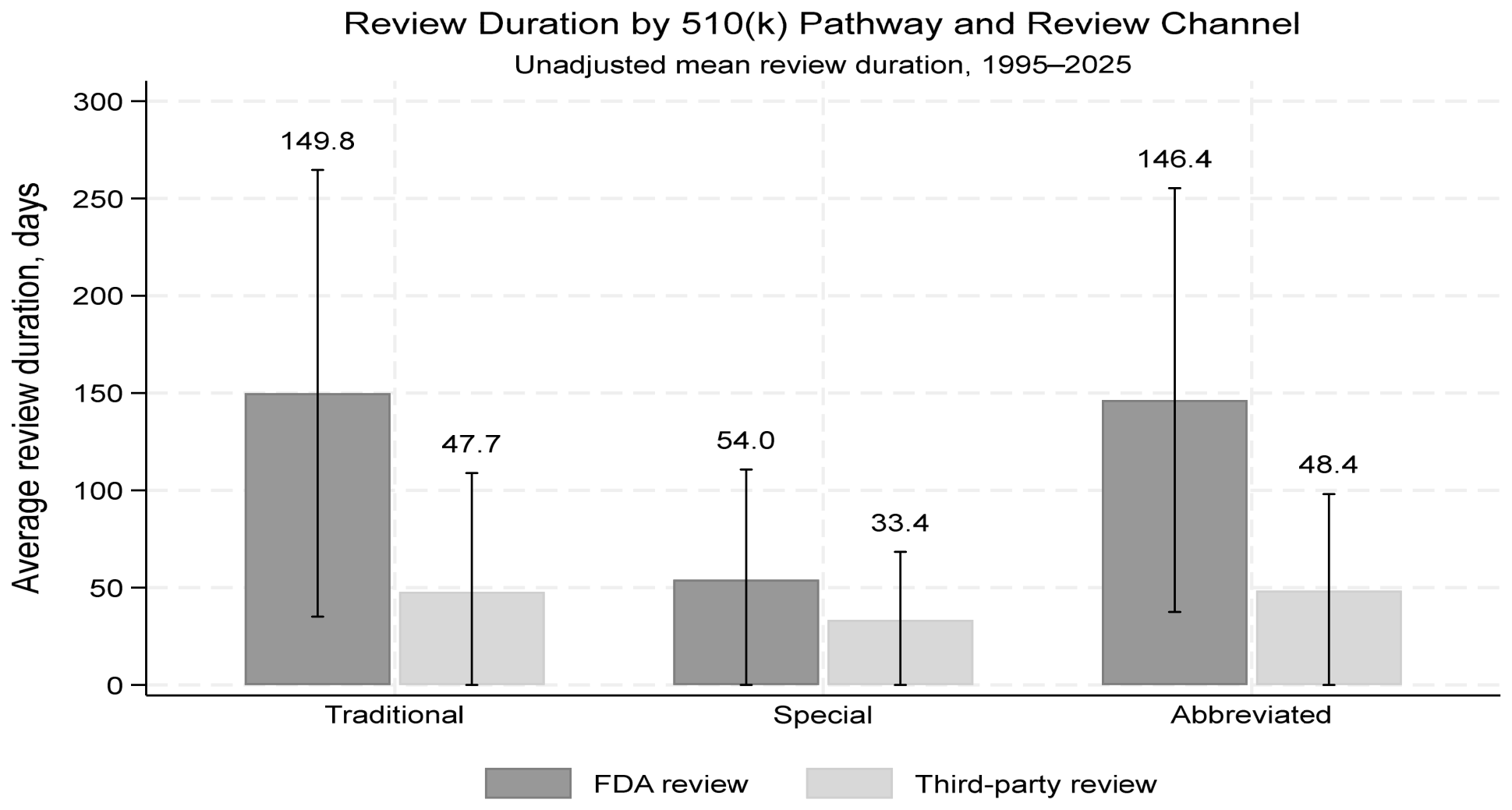
Figure 1 presents the unadjusted mean review duration by pathway and review channel. The error bars show ±1 standard deviation within each group. Third-party review is associated with a lower mean review duration in all three pathways, although the magnitude of the difference varies. The largest gaps occur among Traditional and Abbreviated submissions. The smaller difference for Special submissions is consistent with the already streamlined nature of that pathway. These descriptive patterns do not adjust for selection or other submission characteristics, which are addressed in the regression analysis.
These descriptive patterns motivate the empirical strategy that follows, which models review duration with explicit attention given to route configuration, accumulated regulatory capability, and potential selection into third-party review.
5. Results
5.1. Selection into Third-Party Review
Table 2 reports the logit estimates of selection into third-party review. The dependent variable equals one if a submission is routed through an accredited third-party organization. The specifications progress from a parsimonious pathway-only model to models that add regulatory experience, firm characteristics, submission features, and receipt-period controls.
The results show that third-party reviews are not randomly distributed across submissions. Its use is systematically associated with the pathway type, product-space experience, and period-specific factors. In Column (1), which only includes pathway indicators, the coefficient on Special 510(k) is large, negative, and statistically significant, −2.053 (SE = 0.135), indicating that Special submissions are substantially less likely to use third-party review than Traditional submissions. This pattern remains stable across the specifications. The coefficient is −2.040 (SE = 0.141) in Column (2) and −2.234 (SE = 0.141) in Column (3), suggesting that the limited overlap between Special 510(k)s and third-party review is not explained by observed firm or product characteristics.
Abbreviated 510(k) submissions exhibit a more nuanced pattern. In Columns (1) and (2), the coefficient on Abbreviated 510(k) is small and statistically insignificant, −0.003 (SE = 0.130) and −0.090 (SE = 0.129), respectively. Once receipt-period controls are introduced in Column (3), however, the coefficient becomes negative and statistically significant, −0.358 (SE = 0.130). This shift suggests that temporal variations in pathway use and regulatory practice play an important role in shaping the selection of review routes.
Among the regulatory capability variables, product-space experience emerges as the strongest predictor of third-party review. In the full specification, its coefficient is positive and highly significant, 0.259 (SE = 0.024), indicating that submissions in more established product spaces are more likely to use third-party reviews. By contrast, prior firm FDA experience enters with a smaller negative coefficient, −0.129 (SE = 0.075), significant at the 10 percent level. Prior firm–product experience remains statistically insignificant (−0.043, SE = 0.087), suggesting that general product-space familiarity rather than firm-specific experience within a particular product space is more closely associated with third-party review selection.
Model fit improves as additional controls are included, with the pseudo-R-squared increasing from 0.024 in Column (1) to 0.106 in Column (3). Overall, the results indicate that selection into third-party review is systematic rather than random, reinforcing the need to account for observable selection when estimating the association between review channel and clearance duration.
5.2. Main Review Duration Estimates
Table 3 presents the main estimates of FDA review duration. The dependent variable is the natural logarithm of the number of review days plus 1. Columns (1)–(3) report estimates from the ordinary least squares (OLS), inverse probability weighted (IPW), and control-function specifications, respectively.
The most notable finding is that third-party reviews are strongly associated with shorter review durations. In the baseline OLS specification in Column (1), the coefficient is −1.365 (SE = 0.020). Converting this logged coefficient using implies an approximately 74.5 percent shorter conditional review duration. Given that the dependent variable is and the estimated difference is large, this percentage should be interpreted as an approximate proportional difference rather than an exact reduction in calendar days. The IPW estimate is nearly identical at −1.360 (SE = 0.029). Therefore, observable selection into third-party review does not explain the estimated timing difference.
Column 3 applies a control-function adjustment that addresses residual selection into third-party review beyond the observable balancing captured by the IPW specification. In Column (3), the coefficient on the control-function selection residual is positive and statistically significant, 1.920 (SE = 0.187), indicating that unobserved factors associated with selection into third-party review are also correlated with review duration. Even after this adjustment, the coefficient on third-party review remains negative and statistically significant, −3.273 (SE = 0.187). Under the stronger functional-form assumptions of the control-function model, the exact magnitude of the Column (3) estimate should be interpreted with caution. Nevertheless, the consistently negative and statistically significant coefficient on third-party review across the OLS, inverse-probability-weighted, and control-function specifications supports the conclusion that third-party review is associated with faster clearance.
Pathway effects are also economically and statistically significant. Special 510(k)s exhibit a consistent timing advantage relative to Traditional submissions. The coefficients range from −1.007 (SE = 0.010) to −1.100 (SE = 0.012) across the three specifications. The baseline estimates of −1.018 (SE = 0.010) corresponds to an approximate 63.9 percent reduction in conditional review duration. This result is consistent with the streamlined design of the Special pathway. In contrast, Abbreviated 510(k) submissions show limited timing advantages. The coefficients are small and statistically insignificant in Columns (1) and (2). In Column (3), the coefficient becomes negative and statistically significant, although it remains substantially smaller than the corresponding coefficient for Special 510(k) submissions.
The regulatory capability variables provide further insight. In Column (1), the coefficient on logged prior firm FDA experience is −0.041. A 10 percent increase in prior firm experience is therefore associated with an approximately 0.4 percent reduction in review duration, holding other factors constant. The coefficient on logged product-space experience is −0.057, implying an approximate 0.5 percent reduction for a 10 percent increase in product-space experience. These effects are modest for a small increase in experience but may become meaningful as experience accumulates. Firm–product experience is smaller and less consistently significant. Broader firm and product-space knowledge may therefore matter more than narrowly repeated submissions within the same firm–product combination.
As in the previous specifications, the overall model fit is strong, with R2 values ranging from 0.369 to 0.376. Taken as a whole, the estimates show that clearance timing differs systematically by review route and by the accumulated regulatory capability firms bring to the submission process. These differences are important because review duration is the regulatory interval between product submission and market clearance; therefore, a shorter review duration accelerates the transition from regulatory review to market availability.
5.3. Review Route Configuration Estimates
Table 4 reports estimates for mutually exclusive pathway–channel configurations, with Traditional 510(k) submissions reviewed directly by the FDA serving as the omitted category. The specification allows the timing implications of the review channel to vary across pathways rather than imposing a single average effect of third-party review.
The results sharpen the interpretation of route effects. Traditional submissions reviewed through third-party organizations exhibit substantially shorter review durations, with a coefficient of −1.394 (SE = 0.024) in Column (1). The estimate remains nearly unchanged after adding experience controls (−1.385, SE = 0.020) and firm controls (−1.387, SE = 0.020), confirming that the third-party timing advantage persists within the most common pathway category.
Special 510(k)s reviewed directly by the FDA also show a significant timing advantage relative to Traditional FDA-reviewed submissions. The coefficient is −1.095 (SE = 0.009) in Column (1) and remains large after experience and firm controls are included, −1.023 (SE = 0.010) in Column (3). Special 510(k)s, combined with third-party review, show the largest estimated timing advantage, −1.693 (SE = 0.117) in Column (3). The relatively small number of submissions in this configuration, however, warrants some caution in interpreting the estimate.
Abbreviated submissions reviewed directly by the FDA do not exhibit a statistically significant timing advantage, with coefficients close to zero across specifications. In Column (3), the coefficient is −0.030 (SE = 0.021). In contrast, Abbreviated submissions routed through third-party review have a large and statistically significant negative coefficient of −1.300 (SE = 0.087), indicating that the timing benefit for Abbreviated submissions appears to depend mainly on the review channel rather than the pathway itself.
Overall, these results show that clearance timing depends on the specific pathway–channel configuration rather than pathway designation alone. Special 510(k)s are faster even under direct FDA review, consistent with the streamlined design of that pathway. For Traditional and Abbreviated submissions, however, the greatest time advantages occur when third-party review is used. This pattern suggests that regulatory strategy operates through both pathway selection and channel selection: speed gains depend not only on choosing an eligible pathway, but also on matching submissions to review routes suited to faster clearance. These timing differences matter because pathway–channel configurations shape how quickly medical device innovations move from submission to market availability.
5.4. Robustness Checks
Table 5 reports the main robustness check, restricting the analysis to Traditional 510(k) submissions. This restriction eliminates variations across pathway types and isolates the review channel association within a common procedural framework. The table presents three specifications. Column (1) includes third-party review and decision-year effects. Column (2) adds prior regulatory experience controls. Column (3) further adds firm and submission characteristics. The sequential specification strategy enables assessment of whether the estimated third-party review association remains stable as observable differences among Traditional submissions are progressively accounted for.
The results confirm the main findings. The coefficient on third-party review remains large, negative, and highly significant across all three specifications. It is −1.380 (SE = 0.024) in Column (1), −1.368 (SE = 0.020) in Column (2), and −1.369 (SE = 0.020) in Column (3). The stability of these estimates indicates that the timing advantage associated with third-party review is not driven by compositional differences across major 510(k) pathways.
The regulatory capability variables also retain their expected signs. Prior firm FDA experience is associated with a shorter review duration in Columns (2) and (3), with coefficients of −0.056 (SE = 0.006) and −0.045 (SE = 0.006), respectively. Prior product-space experience is also negative and statistically significant, with coefficients of −0.055 (SE = 0.002) and −0.066 (SE = 0.003). Prior firm–product experience is negative and significant in Column (2), −0.039 (SE = 0.006), but becomes smaller and statistically insignificant once firm controls are added in Column (3), −0.014 (SE = 0.009).
Overall, the table estimates confirm that the core findings are robust to the exclusion of Special and Abbreviated 510(k) submissions. Even within the Traditional pathway, where third-party review is most prevalent, the third-party-review coefficient remains large, negative, and highly statistically significant. The stability of the coefficients across specifications shows that the full-sample results are not an artifact of pathway composition. Instead, the evidence consistently points to a meaningful review channel advantage: submissions routed through third-party review are cleared substantially faster than Traditional submissions reviewed directly by the FDA. This reinforces the interpretation that the choice of review channel is an important component of the timing of commercialization in approval-mediated medical device markets.
Table A1 and
Table A2 provide additional evidence of robustness.
Table A1 tests whether the effect of third-party review differs across foreign applicants, repeat FDA applicants, and submissions with prior firm–product experience. The third-party review coefficient remains large, negative, and highly significant across all specifications, while the interaction terms are small and statistically insignificant. This indicates little evidence that the timing advantage is concentrated among specific groups of firms.
Table A2 tests whether the results are sensitive to alternative controls for changes in FDA review conditions over time, including Medical Device User Fee Amendments (MDUFA) regimes and broader receipt-period categories. The third-party review coefficient remains large, negative, and highly significant across these alternatives, indicating that the main finding is robust to both firm-group heterogeneity and alternative time-control structures. Together, these checks reinforce the interpretation that the third-party timing advantage reflects a broader review channel difference in market clearance timing.
5.5. Cox Proportional Hazards Estimates
Table 6 reports the Cox proportional hazards estimate of time to clearance. This specification complements the logged-duration regressions in
Table 3 and
Table 4 by modeling review duration as a time-to-event process and the rate at which submissions receive clearance at each time point. Unlike the linear models, the Cox framework does not impose a parametric form on the baseline hazard, allowing the clearance rate to vary flexibly over the review period. This provides a useful robustness check and an alternative interpretation of timing effects in terms of clearance rates rather than expected duration.
The results closely mirror the findings from the logged-duration models. Third-party review has a hazard ratio of 4.450. This means that, at a given point in the review process, a third-party-reviewed submission has approximately 4.45 times the conditional clearance rate of a comparable submission reviewed through the standard FDA channel. Equivalently, its instantaneous clearance rate is about 345 percent higher. This does not mean that its review duration is exactly 4.45 times shorter. Rather, it indicates a substantially greater likelihood of clearance at each time point.
The pathway and route configuration estimates reinforce the patterns in
Table 4. Special 510(k) submissions have a hazard ratio of 3.652 in the main pathway model. Their conditional clearance rate is therefore about 3.65 times that of Traditional submissions. The hazard ratio for Abbreviated submissions is 1.029 and is not statistically significant. Their clearance rate does not differ systematically from the Traditional pathway. In the full-configuration model, Traditional third-party, Special third-party, and Abbreviated third-party submissions have hazard ratios of 4.603, 7.250, and 4.885, respectively. These estimates show that the timing advantage depends on the complete pathway–channel configuration, not merely on the pathway designation (the Special third-party estimate should be interpreted cautiously because this configuration contains only 86 submissions).
The Cox estimates also align with the Traditional-only robustness results reported in
Table 5. In that restricted specification, third-party review remains strongly associated with shorter review duration among Traditional 510(k) submissions (−1.369, SE = 0.020). The Cox full-configuration model provides parallel evidence: Traditional 510(k) submissions reviewed through third-party channels have a hazard ratio of 4.603, indicating substantially faster clearance than Traditional submissions reviewed through the standard FDA channel.
Collectively, the Cox proportional hazards results strengthen the main empirical conclusions. The findings show that review route choices are associated not only with shorter expected review durations in the logged-duration models but also with higher clearance rates in the time-to-event framework. This consistency across modeling approaches reinforces the interpretation that regulatory pathway and review channel decisions play an important role in shaping the timing of market clearance for medical device innovations.
6. Discussion
The results show that the commercialization of medical device innovation depends not only on technological development but also on regulatory execution. In the FDA 510(k) setting, commercialization requires more than product readiness; it requires clearance through an institutional process that determines when a device can enter the market. Review duration, therefore, represents a strategically important interval between submission and market availability. The evidence indicates that this interval varies systematically with review channel, pathway configuration, and accumulated regulatory experience. Regulatory review is not simply an external administrative delay imposed uniformly on firms, but a distinct stage of commercialization in which firm choices and capabilities are associated with meaningful differences in timing. This makes review duration a strategically relevant outcome within the innovation system, not merely an administrative measure of regulatory processing.
This interpretation extends conventional arguments concerning innovation and time-to-market. Prior research emphasizes the speed of development, technological capability, and early entry as sources of competitive advantage [
1]. In approval-mediated industries, however, technological readiness does not automatically produce immediate market entry. Firms may complete product development yet differ in how quickly their products become commercially available. The results suggest that a time-to-market advantage in regulated settings reflects both internal development capability and the ability to navigate formal authorization processes efficiently. By documenting systematic differences in clearance timing across review channels, pathways, and levels of prior experience, the analysis highlights regulatory execution as an important component of the commercialization process.
The analysis also clarifies the role of regulatory capability as an organizational competence. Prior firm experience and product-space experience are associated with shorter review durations, suggesting that repeated engagement with the regulatory system builds knowledge that improves regulatory execution. This learning may include greater familiarity with documentation requirements, evidentiary expectations, predicate selection, reviewer concerns, and effective responses during review. The stronger role of product-space experience relative to narrowly defined firm–product repetition suggests that the most relevant knowledge is not confined to repeated submissions for the same device. Instead, regulatory capability appears to operate through broader category-level familiarity with technological areas, evidentiary standards, and review expectations. In this sense, accumulated regulatory knowledge may complement technological capability by helping firms convert developed products into marketable outputs more efficiently [
2].
The pathway results further illuminate the multidimensional nature of regulatory strategy. The finding that Special 510(k) submissions clear faster than Traditional submissions is consistent with the streamlined design of the Special pathway. The Abbreviated pathway produces a different pattern. Abbreviated submissions do not receive a statistically significant timing advantage when reviewed directly by the FDA, but they clear faster when paired with third-party reviews. One possible explanation is that the Abbreviated pathway changes the form in which supporting evidence is organized without eliminating the substantive review work required to establish substantial equivalence. Reliance on guidance documents, special controls, or consensus standards may standardize portions of a submission, but product-specific questions and requests for additional information may remain. The pathway designation alone may therefore provide little timing advantage when under direct FDA review. When paired with third-party review, however, its more standardized evidentiary structure may be better matched to reviewers specializing in eligible and precedent-supported devices. This interpretation is consistent with the observed pattern, although the available data do not directly identify the mechanism.
The results on third-party review and route configurations further show that regulatory strategy operates through both pathway and channel selection. Across the main duration models, selection-adjusted specifications, Traditional-only robustness checks, and Cox proportional hazards estimates, third-party review is consistently associated with shorter clearance times. The timing advantages associated with route choice may therefore depend on its alignment with product characteristics, review channel eligibility, regulatory precedent, and the capabilities firms have developed over time. These findings do not imply that any submission would necessarily clear faster if assigned to third-party review. Rather, they indicate that the specific pathway–channel configuration through which a submission proceeds is systematically related to the timing of market clearance.
More broadly, the results suggest that regulation does more than constrain innovation; it also shapes the organizational and strategic processes through which firms convert developed products into marketable ones. Prior work shows that regulatory institutions shape incentives, entry, and industry structure [
3,
4,
5,
6]. The evidence here is consistent with the view that review processes create settings in which firms’ route choices, accumulated experience, and organizational capabilities are associated with differences in the timing of commercialization. Regulatory capability is not a substitute for technological invention, but it may affect how quickly invention is converted into cleared, marketable products. This distinction is especially relevant in approval-mediated industries, where delays in authorization can affect revenue timing, competitive positioning, and the effective commercial life of new products.
For firms and regulators, the practical implication is that regulatory affairs should be treated as part of technology commercialization rather than merely as a downstream compliance function. Route eligibility, predicate selection, evidentiary support, review channel feasibility, and submission completeness may influence the timing of market entry because the FDA’s 510(k) review depends on substantial equivalence assessment and complete submission materials [
16,
17]. Firms that incorporate regulatory considerations earlier in development may be better positioned to avoid unnecessary delays, improve submission quality, and align product design with clearance requirements. In approval-mediated industries, authorization is not merely the final administrative step before launch; it is part of the institutional process through which medical device innovation reaches the market.
7. Conclusions
This paper examines how review route choices and accumulated regulatory experience shape the timing of FDA 510(k) clearance. In approval-mediated industries, time-to-market depends not only on technological development and market readiness but also on firms’ ability to navigate the regulatory processes that determine when developed products become commercially viable. Using 97,623 FDA 510(k) submissions from 22,838 firms over 1995–2025, the analysis shows that clearance duration varies systematically across review routes, pathway configurations, and levels of regulatory experience.
Third-party review is strongly associated with shorter clearance times, including after selection adjustments and within Traditional 510(k) submissions. Special 510(k)s also clear more quickly than Traditional submissions. Abbreviated submissions offer limited timing advantages unless combined with third-party review. Prior firm and product-space experience are also associated with a shorter review duration. These patterns support the view that accumulated regulatory knowledge and route-selection decisions are important components of the process through which medical device innovations move from development to market availability.
Taken together, the findings show that regulatory execution is part of technology commercialization. Firms engage with the regulatory system through pathway selection, review channel choice, evidentiary strategies, and accumulated learning. These capabilities and choices may influence when an innovation becomes marketable and when the firm can begin to capture its commercial value. The analysis therefore extends the study of innovation timing by showing that in approval-mediated industries, commercialization depends not only on technological development but also on how firms operate within formal authorization systems.
Several limitations should be acknowledged. First, the analysis identifies robust conditional associations rather than definitive causal effects. The IPW models adjust for observed differences, and the control-function models assess residual selection under additional functional-form assumptions. Nevertheless, unobserved factors may influence both route choice and review duration. These factors may include underlying device complexity, the quality and completeness of the initial submission, predicate suitability, the use of external regulatory consultants, reviewer workload, and requests for additional information. Eligibility restrictions may also limit which submissions can use third-party review. The estimates should therefore not be interpreted as showing that assigning any submission to third-party review would necessarily produce the same timing advantage. Second, this study focuses on clearance timing rather than downstream outcomes such as sales growth, market share, product diffusion, clinical adoption, or product safety. Future research could link review duration to post-clearance performance and other market outcomes.
The generalizability of these findings should also be considered carefully. The broader argument that organizational capability can shape the timing of commercialization within formal authorization systems may extend to other approval-mediated industries. However, the magnitudes reported here are specific to the FDA 510(k) framework. They should not be assumed to apply directly to premarket approval devices, pharmaceuticals, diagnostics, non-U.S. medical device systems, or other regulated sectors. Comparative research across pathways and regulatory regimes could identify the conditions under which accumulated regulatory experience and alternative review mechanisms produce similar timing advantages.