
Article

Mechanical Punch Intensity and Its Relationship with Oxygen Uptake and Heart Rate During Repeated Efforts in Elite and Amateur Boxers


1
Faculty of Kinesiology, University of Split, 21000 Split, Croatia
2
Research Center of Physical Education and Exercise, University of Pegaso, 80143 Naples, Italy
*
Author to whom correspondence should be addressed.
Sci 2026, 8(6), 141; https://doi.org/10.3390/sci8060141
Submission received: 20 May 2026 / Revised: 18 June 2026 / Accepted: 21 June 2026 / Published: 22 June 2026
(This article belongs to the Section Sports Science and Medicine)

Abstract

The ability to generate and sustain high punch intensity is a key determinant of boxing performance. However, the relationship between mechanical output and physiological responses during intermittent high-intensity efforts remains insufficiently understood. This pilot study explored associations between mechanical punch intensity and physiological responses in elite and amateur boxers, considering sex and competitive level. Twenty boxers (10 elite and 10 amateurs; 5 males and 5 females per group) were assessed using the inertial sensor-derived Intensity Score to quantify mechanical punch intensity, alongside physiological measurements of heart rate (HR) and oxygen uptake (VO2) during a Repeated Punch Ability Test (RPAT). Data were analyzed using repeated-measures ANOVA and Spearman correlations (p < 0.05). A significant main effect of round was observed for all variables (p < 0.001), with a progressive decline in mechanical punch intensity and stabilization of physiological responses after the first round. Elite boxers showed descriptively higher mechanical punch intensity values than amateurs, particularly in later rounds, but subgroup comparisons should be considered preliminary. Correlation analyses indicated a positive association between mechanical punch intensity and VO2 that appeared to increase from the first to the third round (ρ = 0.398–0.563; p < 0.05), whereas the relationship with HR was weak or negative. No significant correlations were found between HR and VO2. Overall, the findings suggest preliminary patterns in which fatigue and competitive level may be associated with mechanical punch intensity, while VO2 may become more closely related to mechanical output under fatigue. These results should be interpreted as exploratory and non-causal.

1. Introduction

Boxing is a combat sport in which performance depends on the integration of technical, tactical, and physical components, as well as the ability to execute effective offensive and defensive actions during a match [1]. Competitive success is closely associated with sustaining a high fighting pace and repeatedly delivering fast, powerful punches throughout the match [2]. Furthermore, the frequency of technical actions, the use of offensive combinations, and offensive and defensive effectiveness have been identified as key factors distinguishing athletes of different competitive levels [3]. From a physiological perspective, boxing is a high-intensity intermittent sport characterized by repeated explosive actions interspersed with short and often incomplete recovery periods [4]. Evidence from simulated matches and applied settings indicates that boxers must repeatedly perform high-intensity offensive and defensive actions, rapid displacements, and high movement frequencies throughout the bout [5,6]. These actions are generally brief in duration (<10 s) and interspersed with similarly short recovery periods (<30 s) [7], requiring athletes to sustain repeated efforts while maintaining technical effectiveness [8]. In this context, punching actions are intrinsically explosive and characterized by rapid, high-velocity movements. Their effectiveness depends on the ability to generate force within short time intervals [9,10]. Consequently, the ability to produce fast and powerful punches is a fundamental determinant of performance [11]. Among the variables used to assess performance, punch impact force has been identified as one of the most relevant indicators associated with athlete level and overall performance [12,13]. Although boxing is often considered an upper-body-dominant sport, it is more accurately interpreted as a multi-segmental activity involving the entire body. Punch effectiveness derives from the coordinated transfer of energy along the kinetic chain [14,15]. In particular, the lower limbs play a crucial role in force generation and transmission, contributing significantly to punch impact force [16]. Moreover, fatigue of the lower limbs and trunk has been associated with reduced punch force, highlighting the importance of these body segments [17,18]. In recent years, increasing attention has been devoted to the assessment of punch mechanical intensity, which is generally quantified through variables such as impact force, punch velocity, punch power, and composite indices derived from measurement devices [19]. However, methodological heterogeneity among studies and variability in experimental protocols limit an integrated understanding of this construct. Although some studies have examined performance under simulated conditions, evidence regarding punch mechanical intensity during high-intensity intermittent exercise remains limited, despite its closer resemblance to the specific demands of boxing [20]. Boxing also imposes a high physiological load, with elevated heart rate and oxygen consumption values reported both during competition and under simulated conditions [21]. These responses appear to be closely related to exercise intensity [22], suggesting a possible association between physiological load and punch mechanical intensity. However, the integration of these dimensions remains limited, particularly under sport-specific intermittent conditions. Previous studies have also highlighted differences related to competitive level and sex in both mechanical and physiological variables [23,24], yet studies integrating these dimensions within a single experimental design are still lacking. Therefore, an integrated approach is needed to jointly analyze punch mechanical intensity and physiological responses under boxing-specific conditions. In this context, the present pilot study investigated these components during a boxing-specific intermittent protocol (Repeated Punch Ability Test), considering differences related to competitive level and sex, to provide a more comprehensive understanding of boxing performance.

2. Materials and Methods

2.1. Study Participants

This study involved 20 boxers: 10 elite athletes and 10 amateur athletes, with equal sex distribution (10 males and 10 females). Elite boxers were recruited among Olympic-level athletes affiliated with the Italian Boxing Federation (FPI), whereas amateur boxers were regularly registered with the FPI and actively engaged in amateur competitions. All participants were 17 to 32 years old, in good health, regularly involved in a structured training program, and in the pre-competitive or competitive phase of the season. All athletes also had at least five consecutive years of boxing experience to ensure an adequate performance level and sufficient sample homogeneity. Athletes with musculoskeletal injuries or pathological conditions that could have limited physical activity during the 12 months preceding data collection were excluded. Each subgroup (elite females, elite males, amateur females, amateur males) consisted of five participants (n = 5), ensuring balance among groups despite the exploratory nature of the pilot study. This study is part of the research project entitled “Psychophysical perception and body awareness in school and sports contexts through observational and non-invasive tools”, approved by the Ethics Committee of Pegaso Telematic University (Prot./E 004726, dated 15 July 2025). Prior to participation, all subjects received detailed information about the aims and procedures of the study and provided written informed consent in accordance with the Declaration of Helsinki [25].

2.2. Study Design

An observational design with repeated measures was adopted, aimed at the integrated analysis of the mechanical and physiological components associated with boxing performance. The variables were selected according to the aims of the study and their relevance to sport-specific performance. In particular, the mechanical intensity of continuous punches during the Repeated Punch Ability Test (RPAT) and the associated physiological responses (mean heart rate and mean oxygen consumption) were considered. The variables collected during the RPAT were used to describe the mean values for each round, the variations between rounds, and the relationships between the mechanical intensity of continuous punches and the physiological responses.

2.3. Procedures

Data collection in this pilot study was organized into a single testing session involving elite and amateur boxers of both sexes. The session was aimed at evaluating the mechanical intensity of continuous punches, expressed through the mean intensity score, and the physiological responses, particularly mean heart rate and mean oxygen consumption, during the execution of the RPAT. All assessments were conducted in the morning and were preceded by at least 24 h of complete rest in order to ensure standardized conditions. At the beginning of the session, participants’ anthropometric characteristics (height and body mass) were recorded. Subsequently, the athletes performed a specific upper-limb warm-up lasting approximately 3–4 min. At the end of the warm-up, the RPAT was administered.
The RPAT was used to simultaneously assess the mechanical intensity of continuous punches and the associated physiological responses under intermittent conditions specific to boxing. The protocol is currently used by the Italian Boxing Federation as part of athlete performance monitoring and functional evaluation procedures, supporting its ecological applicability within high-performance boxing settings. The protocol consisted of three consecutive 90 s rounds, during which athletes performed six maximal-intensity punching intervals against a punching bag, each lasting 5 s and interspersed with 10 s of passive recovery. Participants were instructed to execute continuous jab and cross punches in order to reproduce conditions as representative of boxing performance as possible.
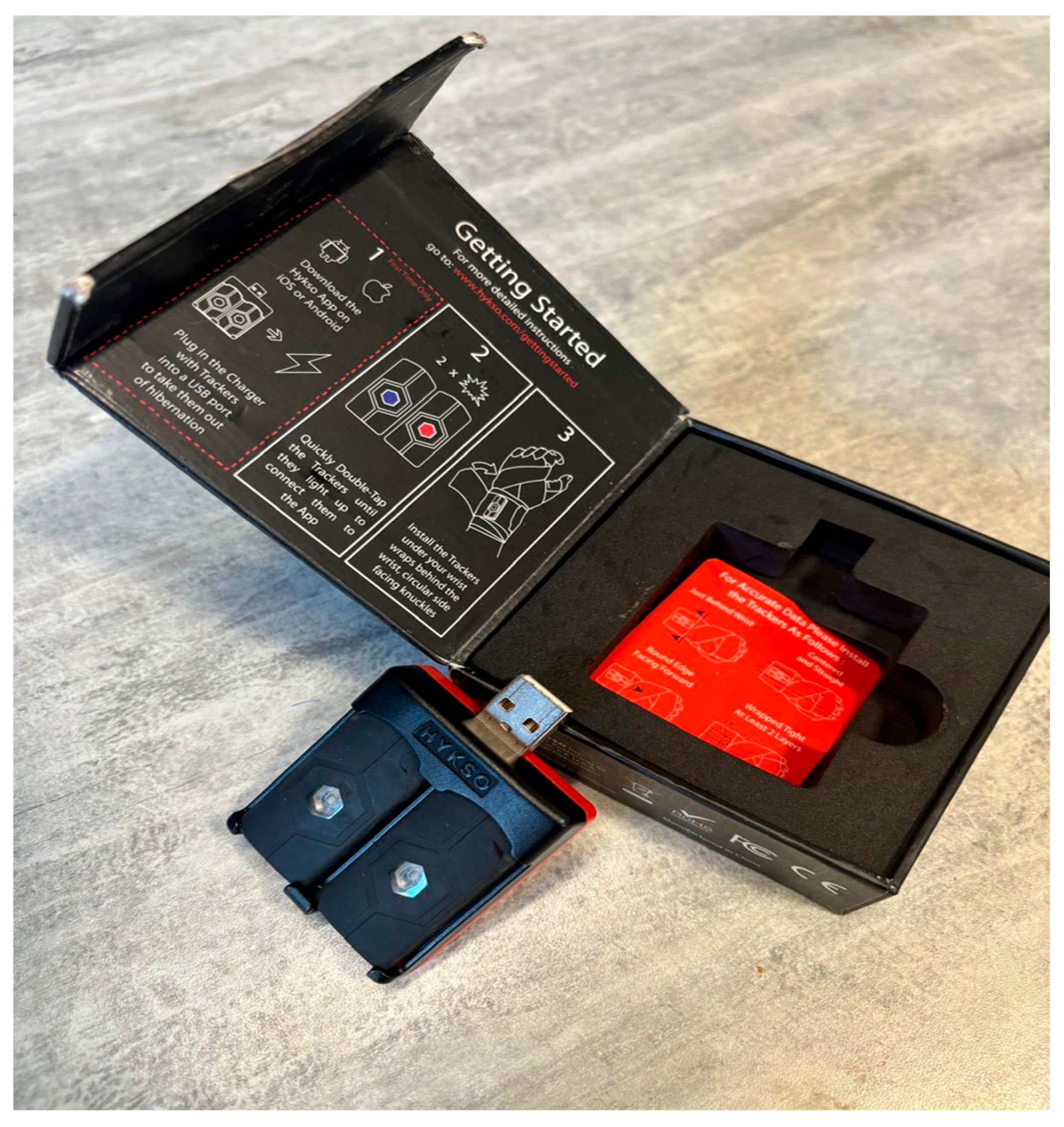
Mechanical intensity was measured using Hykso Punch Tracker inertial sensors (Hykso Inc., Costa Mesa, CA, USA., v1.6 HPT) positioned on both wrists (Figure 1). A previous study reported acceptable test–retest reliability for the fist metrics derived from Hykso under controlled conditions [26].
From these data, the Intensity Score (IS) was derived. The IS is a proprietary composite metric and should not be interpreted as a direct biomechanical measure of punch force or impact expressed in Newtons. According to the manufacturer, it represents an accumulated round-based index intended to reflect overall exertion during punching activity. It is computed from multiple inertial variables recorded by wrist-worn inertial measurement units, including punch velocity, acceleration, punch type, and punch frequency. These variables are combined through an internal weighting algorithm in which higher-velocity and higher-acceleration punches contribute more strongly to the final score; however, the exact computational structure and relative weighting are not publicly disclosed, which limits full reproducibility and external validation. The embedded IMUs collect wrist kinematic data at manufacturer-defined sampling frequencies, although the exact sampling rate is not reported in the technical documentation. Data are processed using proprietary software algorithms to generate IS outputs for each punch. Importantly, the IS should be interpreted as a relative performance indicator of punching activity rather than a direct biomechanical measure of force or mechanical power. At present, independent validation linking IS to gold-standard biomechanical outcomes, such as instrumented punch force measurements or mechanical power outputs, remains limited in the scientific literature, and caution is therefore warranted when using IS as a proxy for mechanical impact. In the present study, IS was averaged across all punches and both wrists within each round to provide an overall estimate of punching intensity. The term “mechanical punch intensity” was used operationally to describe relative output derived from inertial sensor data during boxing-specific movement patterns. No established normative values, performance standards, or validated cut-off thresholds currently exist for IS, so interpretation was restricted to within-subject changes over time, between-group comparisons, and condition-based differences within the experimental design.
Physiological responses were monitored through continuous recording of heart rate (Polar H10) and oxygen consumption (VO2 Master Pro), with data acquisition carried out using the proprietary VO2 Master Manager application (version: 0.14.3) (VO2 Master Health Sensors Inc., Vernon, BC, Canada). Data were expressed as mean values for each round (HR and VO2) in order to describe the physiological load and its variations throughout the protocol. Hand dominance and fighting stance (orthodox vs. southpaw) were recorded for each participant; however, analyses were conducted on aggregated data, and the IS was considered as a global index without distinguishing possible asymmetries between sides. Prior to each session, calibration procedures were performed according to manufacturer instructions, and all data were inspected for artifacts or signal loss, with contaminated segments excluded when identified.
All sessions were conducted under standardized conditions: participants were instructed to avoid caffeine, alcohol, and intense physical activity during the 24 h preceding testing, while all tests were performed at a similar time of day to minimize circadian variability. Environmental conditions, in terms of temperature and humidity, were kept constant throughout the data collection period.

2.4. Data Analysis

Data were analyzed using descriptive and inferential statistics. All variables were expressed as mean ± standard deviation. The normality of data distribution was assessed using the Shapiro–Wilk test, while homogeneity of variances between groups was evaluated through Levene’s test. For the variables recorded during the RPAT, the mean intensity score of continuous punches, mean heart rate (HR), and mean oxygen consumption (VO2) for each round were considered. Differences between rounds were analyzed using mixed repeated-measures analysis of variance (ANOVA), with round as the within-subject factor and sex and competitive level as between-subject factors. In the presence of significant effects, post hoc comparisons with Bonferroni correction were applied. Associations between the mechanical intensity of continuous punches and physiological variables were assessed using Spearman’s correlation coefficients. Given the pilot nature of the study, inferential statistics were used primarily to describe possible patterns and estimate effect magnitudes rather than to support confirmatory hypothesis testing. Correlation strength was interpreted according to standard criteria (ρ < 0.30 weak; 0.30–0.49 moderate; ≥0.50 strong). The significance level was set at p < 0.05. Analyses were conducted using IBM SPSS Statistics (version 25.0, IBM, SPSS Inc., Armonk, NY, USA).

3. Results

Table 1 presents the anthropometric and descriptive characteristics of the participants stratified by competitive level (elite vs. amateur) and sex (female vs. male).
Considering the exploratory nature of this pilot study, the number of punches performed during the RPAT was also quantified. As shown in Table 2, the total number of punches progressively decreased across rounds in all groups, indicating a reduction in punching volume over the course of the protocol. The distribution of punches between the left and right sides was generally balanced, and the total number of punches completed across the RPAT ranged from 79.30 ± 6.58 in elite males to 94.37 ± 9.03 in amateur females.
Table 3 summarizes the mechanical output (Intensity Score, IS), HR response, and oxygen consumption recorded during the three rounds of the Repeated Punch Ability Test (RPAT).
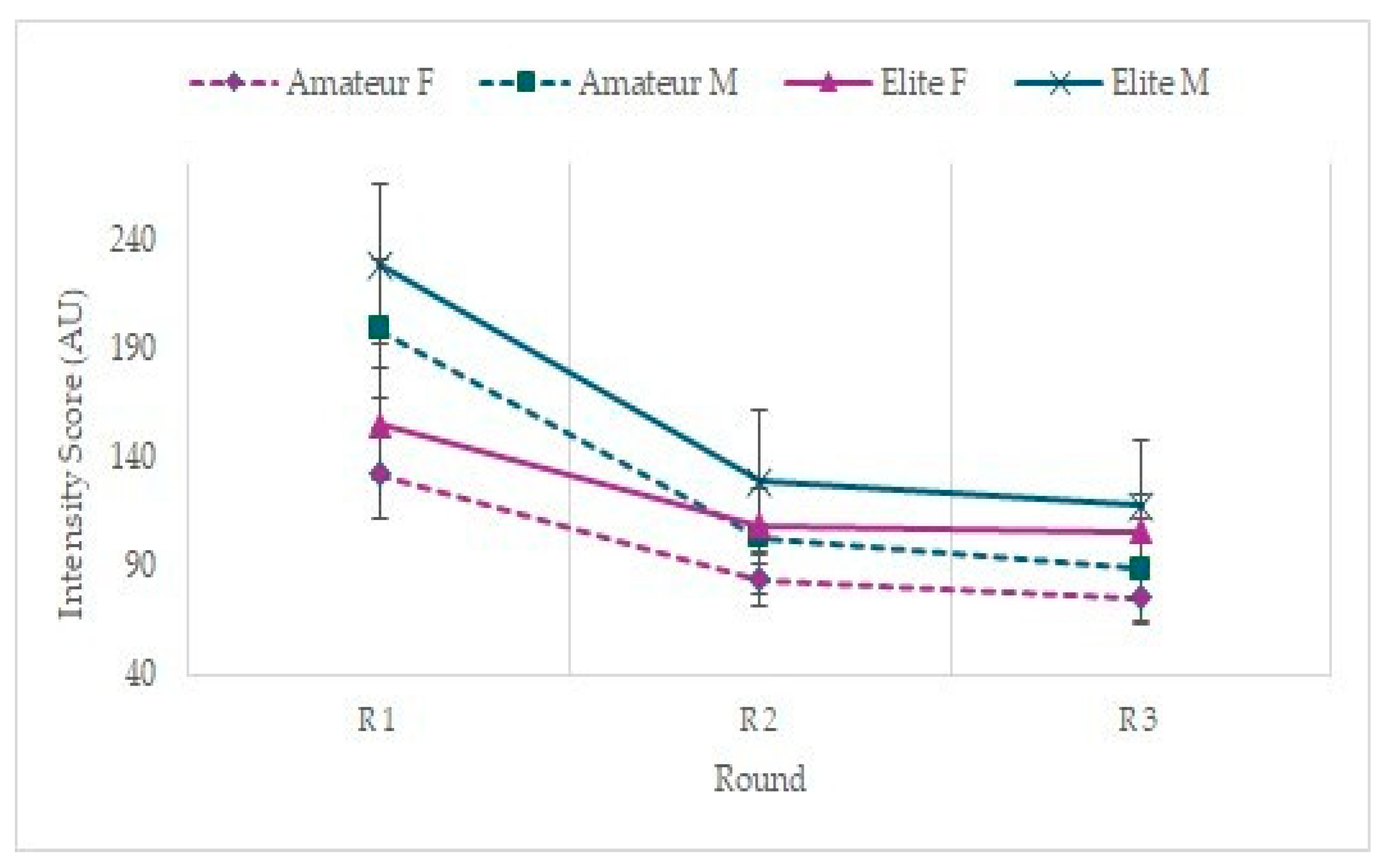
In all groups, the IS progressively decreased from the first to the third round.
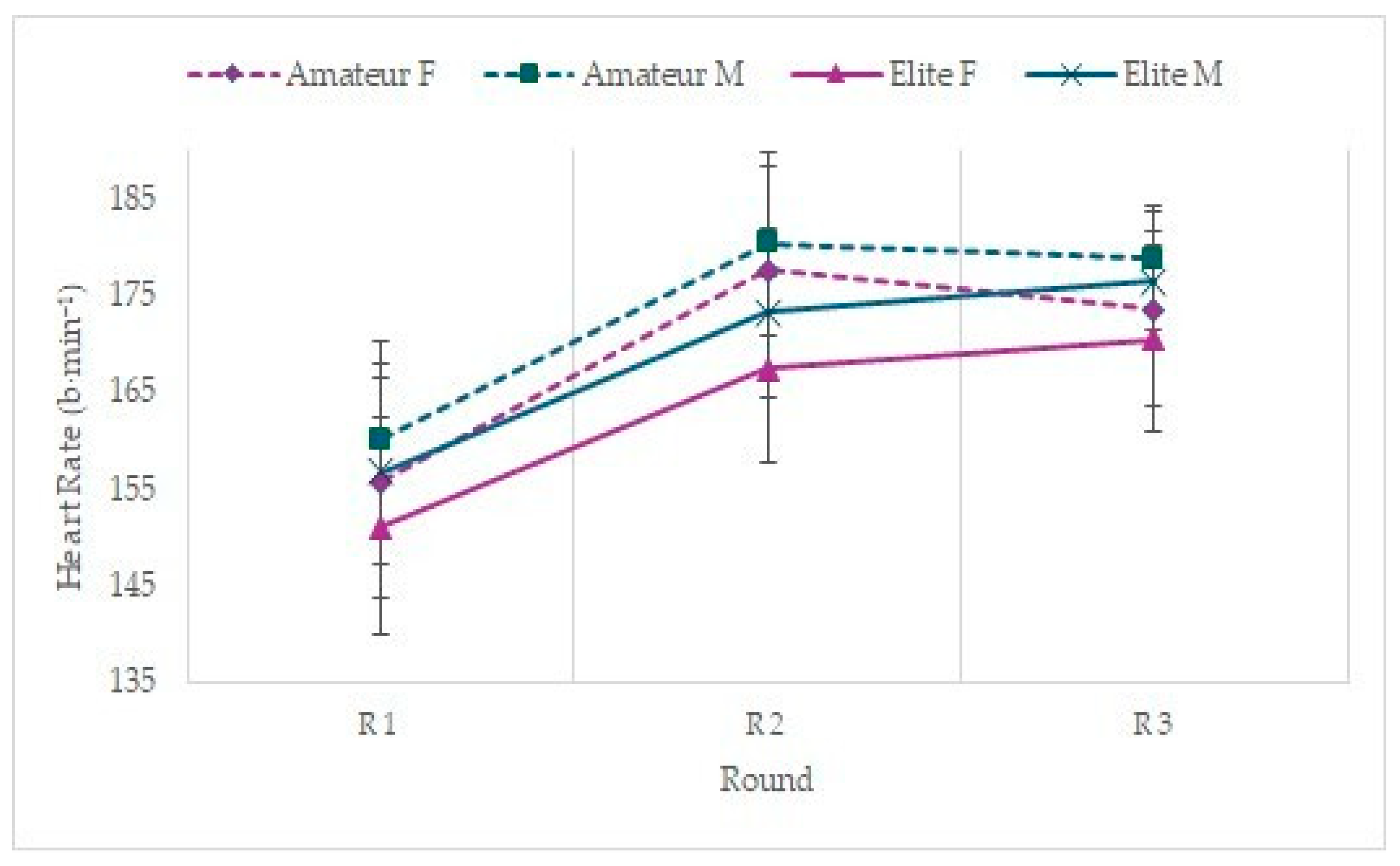
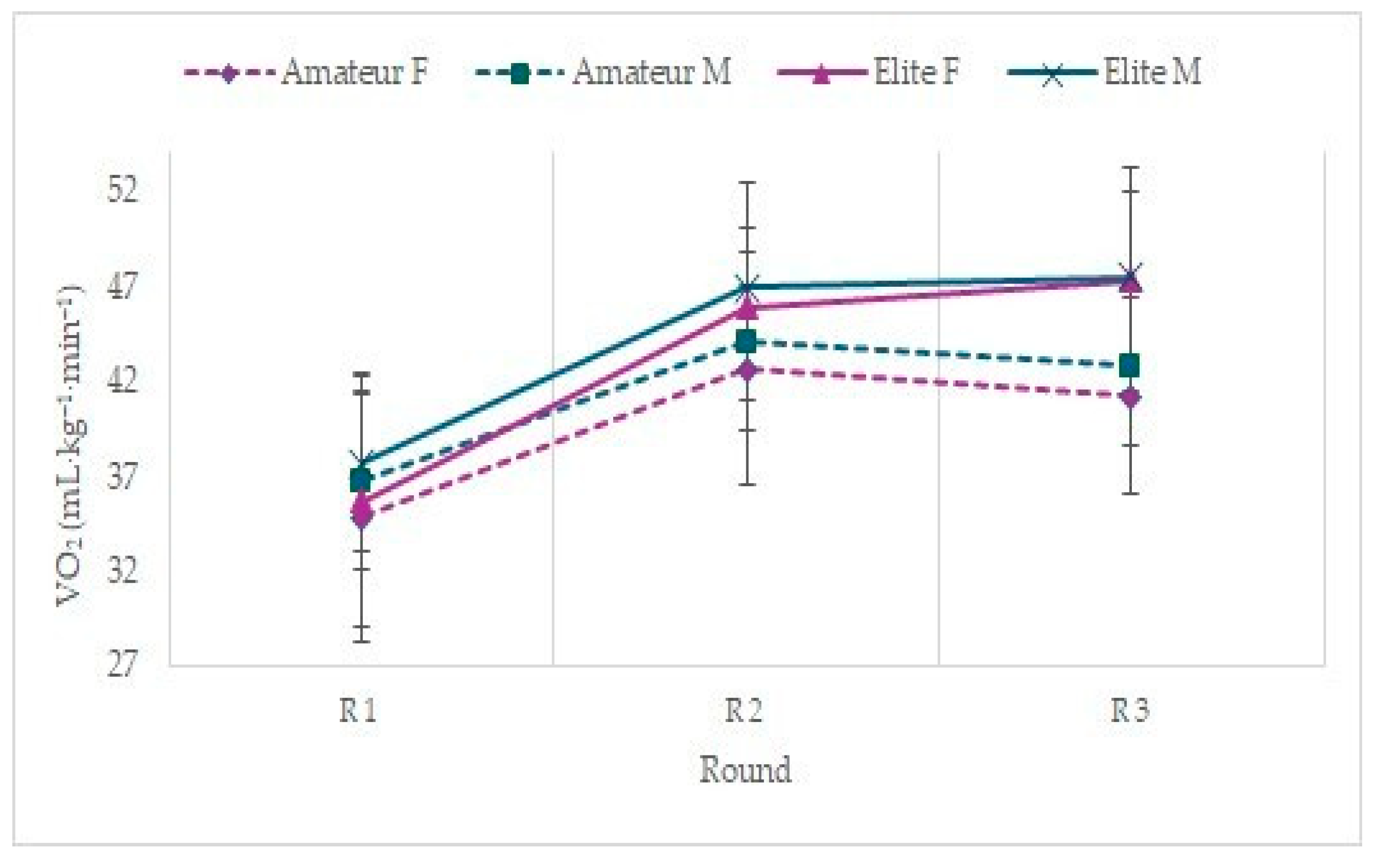
Elite athletes showed descriptively higher IS values compared with amateur athletes across rounds, while male athletes showed higher scores than female athletes; however, these sex- and level-related differences should be interpreted cautiously because each sex-by-level subgroup included only five athletes. HR values increased from the first round and tended to stabilize in the subsequent rounds across all groups. Similarly, VO2 increased after the first round and remained relatively stable between the second and third rounds. To facilitate the interpretation of these descriptive trends and the interaction effects related to competitive level and sex, graphical representations of HR, IS, and VO2 responses across rounds are presented in Figure 2, Figure 3 and Figure 4. As illustrated in Figure 2, amateur athletes appeared to exhibit a more pronounced increase in HR from the first to the second round, whereas elite athletes showed a more moderate and stable response pattern. Figure 3 highlights the progressive decline in IS across rounds, with elite boxers descriptively maintaining higher values than amateurs throughout the protocol. Figure 4 shows the increase in VO2 after the first round and the subsequent stabilization of values, with elite athletes generally displaying higher oxygen consumption during the later rounds. These subgroup patterns should be viewed as exploratory rather than confirmatory.
The results of the repeated-measures ANOVA are reported in Table 4.
A significant main effect of round was observed for all analyzed variables (p < 0.001). For IS, significant effects of sex and competitive level were also found, along with a significant Round × Sex interaction. For HR, a significant Round × Group interaction emerged, whereas no significant main effects of sex or group were observed. Regarding VO2, a significant Round × Group interaction was identified, whereas no significant effects related to sex were detected. Given the small total sample and the very small sex-by-level subgroups, these inferential results should be interpreted as exploratory indicators of possible patterns rather than as definitive evidence of sex or competitive-level differences. Although no significant main effect of group was observed for HR (p = 0.082), the significant Round × Group interaction (p < 0.001) suggests that HR responses may have differed between elite and amateur boxers across rounds. Specifically, amateur athletes appeared to show a more pronounced increase between the first and second rounds, whereas elite athletes exhibited a more moderate and stable pattern. For VO2, the absence of a significant main effect of group (p = 0.052), together with a significant Round × Group interaction (p < 0.001), suggests a possible dynamic pattern across rounds rather than a stable between-group difference. In particular, elite athletes appeared to show a greater increase from the first to the second round and to maintain higher values in the subsequent phases than amateurs. The large F-values and partial eta-squared values should therefore be considered in light of the limited sample size and treated as preliminary effect estimates requiring confirmation in larger studies. Table 5 reports Spearman correlations between IS, HR, and VO2 across the three RPAT rounds.
A significant positive association was observed between IS and VO2 across all rounds, with the strength of the correlation progressively increasing from the first to the third round. This pattern should be interpreted cautiously as an exploratory association and does not imply that higher oxygen uptake caused better maintenance of punch intensity. In contrast, the relationship between IS and HR was not significant in the first round and became significantly negative in the second and third rounds. No significant correlations were observed between HR and VO2 in any round.

4. Discussion

This pilot study investigated the relationships between punch mechanical intensity and physiological responses during a boxing-specific intermittent protocol in elite and amateur boxers, also considering sex. Overall, the findings indicate a progressive decline in Intensity Score across rounds, descriptively higher IS values in elite athletes, and a progressively stronger association between IS and VO2 as rounds progressed. However, because the total sample was small and each sex-by-level subgroup included only five athletes, findings related to sex, competitive level, and interaction effects should be interpreted as preliminary patterns rather than firm conclusions. In contrast, HR appeared weakly or negatively associated with mechanical output under these intermittent conditions. The decline in IS across rounds is consistent with the high-intensity intermittent nature of boxing and supports the view that repeated punching ability may be constrained by accumulating fatigue [1,22]. Because punching performance depends on effective force transfer through the kinetic chain, reductions in IS may reflect a combination of neuromuscular fatigue, reduced movement velocity, and diminished technical efficiency [27,28]. Elite athletes appeared to maintain higher IS values than amateurs, particularly in the later rounds. This descriptive pattern is consistent with previous evidence suggesting superior strength, power, technical efficiency, and fatigue resistance in higher-level boxers [2,29], but it requires confirmation in larger samples. The observed sex-related differences in IS, with higher values in male athletes, may plausibly reflect differences in muscle mass and maximal power production [30], although the present data do not allow mechanistic conclusions. In contrast, physiological responses were less clearly differentiated by sex, suggesting that internal load during this protocol may have been influenced more strongly by exercise intensity and competitive level than by sex alone [23]. A key exploratory result was the progressively stronger association between IS and VO2 across rounds. However, this relationship should be interpreted cautiously. Because the study is cross-sectional and observational, the correlations do not demonstrate that higher VO2 causes better maintenance of punch mechanical intensity, or vice versa. Rather, the findings indicate that these variables became more closely associated as the protocol progressed, possibly because fatigue increased the coupling between mechanical output and whole-body metabolic demand [31,32,33]. Likewise, the weak or negative associations between IS and HR suggest that HR may be less sensitive to round-by-round fluctuations in punching output during intermittent boxing exercise. This may be because HR reflects overall cardiovascular strain, is influenced by autonomic regulation, and responds with slower kinetics than rapid changes in mechanical performance [34,35,36,37]. The absence of significant HR–VO2 correlations across rounds further supports the idea that these physiological indicators capture partly different aspects of internal load during repeated punching efforts.
From an applied perspective, these results may provide useful preliminary indications for coaches and strength and conditioning practitioners. Since punch mechanical intensity progressively declined during repeated efforts, training programs may benefit from emphasizing both explosive strength development and fatigue resistance capacities [38,39]. High-intensity interval training and boxing-specific repeated-effort protocols may represent potentially useful strategies to improve the ability to maintain punch mechanical intensity across rounds [40]. Moreover, the observed association between VO2 and punch mechanical intensity under fatigue conditions suggests that aerobic conditioning may warrant consideration in boxing preparation, despite the explosive nature of the sport. These applied interpretations should be regarded as hypothesis-generating rather than prescriptive, given the observational design and limited sample size. The present study also highlights the practical value of wearable technologies for performance monitoring in combat sports. The use of inertial punch trackers and portable physiological devices enabled an integrated and ecologically valid assessment of boxing-specific performance. Previous studies have demonstrated the validity and reliability of these monitoring systems in combat sport contexts [41,42,43], supporting their potential use for routine athlete monitoring and individualized training prescription. Despite the originality of the present study, several limitations must be acknowledged. First, the relatively small sample size (n = 20) and the very small subgroup sizes (n = 5 for elite males, elite females, amateur males, and amateur females) reduce statistical power, increase the possibility of type II error, and limit the generalizability of the findings. Accordingly, the observed sex- and level-related patterns should be interpreted cautiously and considered preliminary. Second, the cross-sectional design does not allow causal inferences regarding the relationships between punch mechanical intensity and physiological responses. Third, although the RPAT represents a boxing-specific intermittent protocol and reproduces repeated high-intensity punching bouts with brief recovery periods, it remains a constrained simulation rather than a full representation of competitive boxing. In particular, the protocol does not reproduce opponent interaction, decision-making under pressure, defensive actions, footwork variability, clinching, pacing strategies, emotional stress, or the changing tactical demands that characterize official matches. It also standardizes punch selection to repeated jab–cross actions against a bag, thereby reducing the technical variability and contextual unpredictability that may substantially influence both mechanical output and physiological responses in competition. Consequently, the present findings should be interpreted as reflecting performance during a controlled boxing-specific task, rather than during an actual bout. An additional limitation concerns the estimation of punch mechanical intensity using wearable inertial sensors, which does not provide a direct measurement. Consequently, the Intensity Score should be interpreted as an indirect estimate of punching output rather than as a direct measure of impact force or external mechanical work. This issue is particularly relevant because IS is generated by a proprietary algorithm whose exact weighting and computational steps are not publicly disclosed. Although the manufacturer indicates that punch velocity, punch type, and acceleration-related features contribute to the score, the relative contribution of each component remains unknown. Therefore, IS is best interpreted as an internal device-specific index that may be useful for within-device, within-athlete, and within-protocol comparisons, but with more caution when making absolute interpretations or comparing findings across devices and studies. In addition, independent validation work on commercially available punch trackers has shown only moderate associations between Hykso-derived velocity and laboratory-based kinematic measures, while strong agreement with gold-standard force and velocity outcomes has not been demonstrated consistently [40]. Accordingly, the present results should be understood as relationships involving a practical field-based surrogate of punching intensity, not a criterion measure of punching mechanics. Furthermore, additional physiological and neuromuscular variables potentially associated with boxing performance, such as blood lactate concentration, electromyographic activity, muscle oxygenation, perceived fatigue, and biomechanical characteristics of punching technique, were not included in this study. The integration of these variables could provide a more comprehensive understanding of the mechanisms underlying fatigue development and performance regulation during boxing-specific repeated efforts. Finally, differences related to training history, tactical style, weight categories, and individual conditioning status were not specifically controlled and may have influenced the observed responses. Although all testing sessions were conducted in the morning to standardize conditions, potential time-of-day effects on neuromuscular and physiological performance cannot be completely excluded; however, such effects are generally considered small and are likely minimized under consistent testing schedules. The present investigation should be considered a pilot study, designed to explore the feasibility of integrating inertial-based punch tracking with portable physiological measurements during a boxing-specific intermittent protocol and to obtain preliminary effect estimates of the relationships between mechanical and internal load variables rather than confirmatory conclusions. These findings will directly inform the design of future studies by enabling sample size estimation based on observed effect magnitudes, refining the RPAT protocol and sensor-based data collection procedures, and guiding the selection of the most sensitive variables (particularly VO2 and IS coupling under fatigue) for hypothesis-driven testing. In addition, they provide the basis for formulating specific hypotheses to be examined in larger, more homogeneous, and longitudinal study designs incorporating expanded physiological and biomechanical assessments. Therefore, future investigations involving larger and more homogeneous samples, longitudinal designs, and integrated biomechanical and physiological approaches are needed to further clarify the determinants of repeated punching performance in boxing.

5. Conclusions

In this pilot study, the RPAT showed a progressive decline in punch mechanical intensity, suggesting that fatigue may influence sport-specific performance during repeated punching efforts. Elite boxers descriptively maintained higher mechanical output compared with amateur athletes, and the association between IS and VO2 appeared to strengthen in the later rounds, suggesting a possible increasing relationship between aerobic demand and repeated-effort punching performance under fatigue. However, these sex- and competitive-level patterns should be interpreted cautiously because subgroup sizes were very small, and the observational design does not support causal conclusions. In contrast, HR appeared less informative as a proxy of punch mechanical intensity in intermittent contexts. Overall, the integration of mechanical measures via wearable sensors may support exploratory performance monitoring, but larger and adequately powered studies are required before firm practical or inferential conclusions can be drawn.

Author Contributions

Conceptualization, G.P. and G.E.; methodology, G.P.; software, G.E.; validation, I.J. and G.R.; formal analysis, G.E.; investigation, G.P.; resources, G.P.; data curation, G.E.; writing—original draft preparation, G.P.; writing—review and editing, G.E.; visualization, G.R.; supervision, I.J. All authors have read and agreed to the published version of the manuscript.

Funding

This research received no external funding.

Institutional Review Board Statement

The present study is part of the research project entitled “Psychophysical perception and body awareness in school and sports contexts through observational and non-invasive tools”, approved by the Ethics Committee of Pegaso University (Prot./E 004726, dated 15 July 2025). All participants provided written informed consent prior to participation.

Informed Consent Statement

Informed consent was obtained from all subjects involved in the study.

Data Availability Statement

The original contributions presented in this study are included in the article. Further inquiries can be directed to the corresponding author.

Conflicts of Interest

The authors declare no conflicts of interest.

Abbreviations

The following abbreviations are used in this manuscript:
RPATRepeated Punch Ability Test
ISIntensity Score
FPIItalian Boxing Federation
HRHeart Rate

References

  1. Chaabène, H.; Tabben, M.; Mkaouer, B.; Franchini, E.; Negra, Y.; Hammami, M.; Amara, S.; Chaabène, R.B.; Hachana, Y. Amateur boxing: Physical and physiological attributes. Sports Med. 2015, 45, 337–352. [Google Scholar] [CrossRef] [PubMed]
  2. Wilson, D.C.; Ruddock, A.; Ranchordas, M.A.; Thompson, S.W.; Rogerson, D. Physical profile of junior and senior amateur boxers. J. Phys. Educ. Sport 2020, 20, 3452–3459. [Google Scholar] [CrossRef]
  3. Slimani, M.; Davis, P.; Franchini, E.; Moalla, W. Performance aspects and physiological responses in male amateur boxing competitions: A brief review. J. Strength Cond. Res. 2017, 31, 1132–1141. [Google Scholar] [CrossRef] [PubMed]
  4. Franchini, E. High-intensity interval training prescription for combat-sport athletes. Int. J. Sports Physiol. Perform. 2020, 15, 767–776. [Google Scholar] [CrossRef] [PubMed]
  5. Finlay, M.J.; Greig, M.; Page, R.M. Quantifying the physical response to a contemporary amateur boxing simulation. J. Strength Cond. Res. 2018, 32, 1005–1012. [Google Scholar] [CrossRef] [PubMed]
  6. Thomson, E.D.; Lamb, K.L. Reproducibility of the internal load and performance-based responses to simulated amateur boxing. J. Strength Cond. Res. 2017, 31, 3396–3402. [Google Scholar] [CrossRef] [PubMed]
  7. Xu, Q.; Wang, Z.; Liu, L.; Mao, R.; Xi, C.; Shi, G. The relationship between training and competition load characteristics of female boxers—A case study based on collegiate boxers. Front. Psychol. 2025, 16, 1517102. [Google Scholar] [CrossRef] [PubMed]
  8. Usher, A.; Babraj, J. Use of NIRS to explore skeletal muscle oxygenation during different training sessions in professional boxing. Eur. J. Appl. Physiol. 2024, 124, 595–606. [Google Scholar] [CrossRef] [PubMed]
  9. Söyler, M.; Gürkan, A.C.; Kayantaş, İ.; Aydın, S.; Karataş, B.; Eraslan, M.; Şahin, M.; Küçük, H.; Badau, A.; Badau, D. Investigation of the Effects of different plyometric training protocols on punching force and muscle performance in male boxers. Appl. Sci. 2025, 15, 6532. [Google Scholar] [CrossRef]
  10. Turner, A.N.; Baker, E.; Miller, S.C. Increasing the impact force of the rear hand punch. Strength Cond. J. 2011, 33, 2–9. [Google Scholar] [CrossRef]
  11. Loturco, I.; Nakamura, F.Y.; Artioli, G.G.; Kobal, R.; Kitamura, K.; Cal Abad, C.C.; Cruz, I.F.; Romano, F.; Pereira, L.A.; Franchini, E. Strength and power qualities are highly associated with punching impact in elite amateur boxers. J. Strength Cond. Res. 2016, 30, 109–116. [Google Scholar] [CrossRef] [PubMed]
  12. Lenetsky, S.; Harris, N.K.; Brughelli, M. Assessment and contributors of punching forces in combat sports athletes: Implications for strength and conditioning. Strength Cond. J. 2013, 35, 1–7. [Google Scholar] [CrossRef]
  13. Pinto, M.; Crisóstomo, J.; Kirk, C.; Abián-Vicén, J.; Monteiro, L. Influence of anthropometric characteristics and muscle performance on punch impact. Sports 2025, 13, 281. [Google Scholar] [CrossRef] [PubMed]
  14. Lenetsky, S.; Nates, R.J.; Brughelli, M.; Harris, N.K. Is effective mass in combat sports punching above its weight? Hum. Mov. Sci. 2015, 40, 89–97. [Google Scholar] [CrossRef] [PubMed]
  15. Stanley, E.; Thomson, E.; Smith, G.; Lamb, K.L. An analysis of the three-dimensional kinetics and kinematics of maximal effort punches among amateur boxers. Int. J. Perform. Anal. Sport 2018, 18, 835–854. [Google Scholar] [CrossRef]
  16. Pereira, L.A.; Romano, F.; Alves, M.; Mercer, V.P.; Bishop, C.; Franchini, E.; Loturco, I. Variations in power performance and perceptual responses to training in Olympic boxers over a 7-month training period. Int. J. Sports Physiol. Perform. 2023, 18, 414–419. [Google Scholar] [CrossRef] [PubMed]
  17. Dunn, E.C.; Humberstone, C.E.; Franchini, E.; Iredale, K.F.; Blazevich, A.J. The effect of fatiguing lower-body exercise on punch forces in highly trained boxers. Eur. J. Sport Sci. 2022, 22, 964–972. [Google Scholar] [CrossRef] [PubMed]
  18. Satkunskiene, D.; Bruzas, V.; Mickevicius, M.; Snieckus, A.; Kamandulis, S. Impact of leg strength on the force produced during a cross-punch in highly trained amateur boxers. J. Strength Cond. Res. 2024, 38, 1739–1744. [Google Scholar] [CrossRef] [PubMed]
  19. Dunn, E.C.; Humberstone, C.E.; Franchini, E.; Iredale, K.F.; Blazevich, A.J. Relationships between punch impact force and upper- and lower-body muscular strength and power in highly trained amateur boxers. J. Strength Cond. Res. 2022, 36, 1019–1025. [Google Scholar] [PubMed]
  20. Chottidao, M.; Kuo, C.H.; Tsai, S.C.; Hwang, I.S.; Lin, J.J.; Tsai, Y.S. A comparison of plyometric and jump rope training programs for improving punching performance in junior amateur boxers. Front. Bioeng. Biotechnol. 2022, 10, 878527. [Google Scholar] [CrossRef] [PubMed]
  21. Venckunas, T.; Bruzas, V.; Stasiulis, A.; Snieckus, A.; Mockus, P.; Kamandulis, S. Cardiorespiratory responses to specific and nonspecific exercise in high-profile amateur boxers. J. Strength Cond. Res. 2022, 36, 717–722. [Google Scholar] [PubMed]
  22. Thomson, E.D.; Lamb, K.L. Quantification of the physical and physiological load of a boxing-specific simulation protocol. Int. J. Perform. Anal. Sport 2017, 17, 136–148. [Google Scholar] [CrossRef]
  23. Ruddock, A.; James, L.; French, D.; Rogerson, D.; Driller, M.; Hembrough, D. High-intensity conditioning for combat athletes: Practical recommendations. Appl. Sci. 2021, 11, 10658. [Google Scholar] [CrossRef]
  24. Martusciello, F.; Perazzetti, A.; Kaçurri, A.; Bushati, S.; Muçalliu, A.; Tessitore, A. Short-term effects of a structured boxing program on technical skill acquisition in novice female students. J. Funct. Morphol. Kinesiol. 2026, 11, 26. [Google Scholar] [CrossRef] [PubMed]
  25. World Medical Association. World Medical Association Declaration of Helsinki: Ethical principles for medical research involving human subjects. JAMA 2013, 310, 2191–2194. [Google Scholar] [PubMed]
  26. Omcirk, D.; Vetrovsky, T.; Padecky, J.; Malecek, J.; Tufano, J.J. Validity of commercially available punch trackers. J. Strength Cond. Res. 2023, 37, 2273–2281. [Google Scholar] [CrossRef] [PubMed]
  27. Lenetsky, S.; Brughelli, M.; Nates, R.J.; Cross, M.R.; Lormier, A.V. Variability and reliability of punching impact kinetics in untrained participants and experienced boxers. J. Strength Cond. Res. 2018, 32, 1838–1842. [Google Scholar] [CrossRef] [PubMed]
  28. Kacprzak, J.; Mosler, D.; Tsos, A.; Wasik, J. Biomechanics of punching—The impact of effective mass and force transfer on strike performance. Appl. Sci. 2025, 15, 4008. [Google Scholar] [CrossRef]
  29. Franchini, E.; Cormack, S.; Takito, M.Y. Effects of high-intensity interval training on Olympic combat sports athletes’ performance and physiological adaptation: A systematic review. J. Strength Cond. Res. 2019, 33, 242–252. [Google Scholar] [CrossRef] [PubMed]
  30. Beattie, K.; Ruddock, A.D. The role of strength on punch impact force in boxing. J. Strength Cond. Res. 2022, 36, 2957–2969. [Google Scholar] [CrossRef] [PubMed]
  31. Arseneau, E.; Mekary, S.; Léger, L.A. VO2 requirements of boxing exercises. J. Strength Cond. Res. 2011, 25, 348–359. [Google Scholar] [CrossRef] [PubMed]
  32. Giardullo, G.; Di Lascio, G.; Ceruso, R.; Manzi, V.; Raiola, G. Relationship between ankle mobility, elastic strength, and rate of force development in kata and kumite karate disciplines. Sci 2025, 7, 151. [Google Scholar] [CrossRef]
  33. Ghosh, A.K. Heart rate, oxygen consumption and blood lactate responses during specific training in amateur boxing. Int. J. Appl. Sports Sci. 2010, 22, 1–12. [Google Scholar]
  34. de Lira, C.A.; Peixinho-Pena, L.F.; Vancini, R.L.; Fachina, R.J.G.; de Almeida, A.A.; Andrade, M.d.S.; da Silva, A.C. Heart rate response during a simulated Olympic boxing match is predominantly above ventilatory threshold 2: A cross-sectional study. J. Sports Med. 2013, 4, 175–182. [Google Scholar] [CrossRef]
  35. El-Ashker, S.; Chaabene, H.; Negra, Y.; Prieske, O.; Granacher, U. Cardio-respiratory endurance responses following a simulated 3 × 3 minutes amateur boxing contest in elite level boxers. Sports 2018, 6, 119. [Google Scholar] [CrossRef] [PubMed]
  36. Giardullo, G.; Ceruso, R.; Di Lascio, G.; Taleb, M.; Esposito, G.; D’Elia, F. Comparison of traditional and ecological dynamical training approaches in Brazilian jiu-jitsu: Effects on force development, reactivity, and distress perception. Front. Psychol. 2026, 17, 1794709. [Google Scholar] [CrossRef] [PubMed]
  37. Souissi, A.; Haddad, M.; Dergaa, I.; Saad, H.B.; Chamari, K. A new perspective on cardiovascular drift during prolonged exercise. Life Sci. 2021, 287, 120109. [Google Scholar] [CrossRef] [PubMed]
  38. Wu, C.M.; Ho, J.Y.; Wang, W.Y.; Cai, Z.Y. Foot cooling between interval bouts enhances repeated lower limb power performance: The role of delaying fatigue. J. Hum. Kinet. 2023, 86, 107. [Google Scholar] [CrossRef] [PubMed]
  39. Raiola, G.; Esposito, G.; Aliberti, S.; D’Elia, F.; D’Isanto, T. Physical exercise and psychophysical learnings on basic strength development. Methods Protoc. 2025, 8, 40. [Google Scholar] [CrossRef] [PubMed]
  40. Yue, F.; Wang, Y.; Yang, H.; Zhang, X. Effects of high-intensity interval training on aerobic and anaerobic capacity in Olympic combat sports: A systematic review and meta-analysis. Front. Physiol. 2025, 16, 1576676. [Google Scholar] [CrossRef] [PubMed]
  41. Di Domenico, F.; Esposito, G.; Aliberti, S.; Ceruso, R.; Raiola, G. Comparative effects of high-intensity interval training and low-intensity steady-state exercise on anthropometric outcomes and psychophysical well-being: A pilot study. J. Funct. Morphol. Kinesiol. 2026, 11, 88. [Google Scholar] [CrossRef] [PubMed]
  42. Schaffarczyk, M.; Baumeister, J.; Reer, R.; Pfeiffer, M. Validity of the Polar H10 sensor for heart rate variability analysis during resting state and incremental exercise in recreational men. Sensors 2022, 22, 6536. [Google Scholar] [CrossRef] [PubMed]
  43. Thiessen, J.S.; Guluzade, N.A.; Faricier, R.; Keir, D.A. (Re)assessment of the COSMED Quark CPET and VO2Master Pro systems for measuring pulmonary gas exchange and ventilation. Scand. J. Med. Sci. Sports 2025, 35, e70019. [Google Scholar] [CrossRef] [PubMed]
Figure 1. Hykso Punch Tracker inertial measurement unit (IMU) system.
Sci 08 00141 g001
Figure 2. Changes in HR across rounds by gender and competitive level.
Sci 08 00141 g002
Figure 3. Changes in IS across rounds by gender and competitive level.
Sci 08 00141 g003
Figure 4. Changes in VO2 max across rounds by gender and competitive level.
Sci 08 00141 g004
Table 1. Participants characteristics.
GroupSexAge (Years)Height (cm)Weight (kg)BMI
AmateursF25.0 ± 4.2165.5 ± 7.160.1 ± 7.321.9 ± 2.1
AmateursM22.2 ± 4.1176.3 ± 8.468.9 ± 22.523.3 ± 3.3
EliteF25.9 ± 3.6167.7 ± 6.461.2 ± 6.621.3 ± 2.5
EliteM26.6 ± 3.4177.6 ± 8.673.2 ± 11.424.1 ± 2.7
Table 2. Number of punches during the RPAT (mean ± SD).
GroupSexTotal R1Total R2Total R3Left R1Left R2Left R3Right R1Right R2Right R3Total RPAT
AmateurF33.78 ± 2.4030.47 ± 3.4430.12 ± 3.4116.82 ± 1.2815.27 ± 1.7615.09 ± 1.6416.96 ± 1.1615.20 ± 1.7115.03 ± 1.8094.37 ± 9.03
AmateurM33.47 ± 2.7329.51 ± 3.1029.06 ± 2.7816.74 ± 1.1614.81 ± 1.4314.70 ± 1.5016.73 ± 1.6014.70 ± 1.7114.36 ± 1.3592.04 ± 8.08
EliteF30.88 ± 2.6328.48 ± 3.4828.00 ± 3.5715.39 ± 1.4114.29 ± 1.7914.05 ± 1.7415.48 ± 1.2614.20 ± 1.7313.96 ± 1.8687.36 ± 9.50
EliteM28.48 ± 2.2125.85 ± 2.5224.97 ± 2.3214.28 ± 0.9513.00 ± 1.1612.65 ± 1.2514.20 ± 1.2812.85 ± 1.3812.32 ± 1.1379.30 ± 6.58
Note. Total R1–R3 represent the average number of punches performed during each RPAT round. Left and Right indicate punches recorded by the left- and right-wrist sensors, respectively. Total RPAT represents the sum of punches performed across the three rounds.
Table 3. Mechanical and physiological responses during RPAT.
GroupSexIS R1IS R2IS R3HR R1HR R2HR R3VO2 R1VO2 R2VO2 R3
AmateurF132.2 ± 21.183.55 ± 12.4874.78 ± 12.08155.76 ± 12.08177.51 ± 10.67173.53 ± 10.1334.86 ± 6.6242.64 ± 6.1641.19 ± 5.20
AmateurM198.2 ± 31.73103.05 ± 26.8387.95 ± 23.29160.09 ± 10.04180.31 ± 9.38178.74 ± 5.5336.73 ± 4.6344.04 ± 3.0742.77 ± 4.12
EliteF154.98 ± 25.02108.56 ± 17.22105.71 ± 16.61151.13 ± 11.23167.38 ± 9.61170.47 ± 9.6935.71 ± 6.6245.90 ± 6.4847.33 ± 5.87
EliteM227.95 ± 36.85128.07 ± 33.27117.33 ± 30.45156.80 ± 9.57173.21 ± 8.69176.42 ± 5.0937.71 ± 4.7046.96 ± 3.1647.48 ± 4.45
Note. IS = Intensity Score (arbitrary units, AU), derived from inertial sensor-based composite index (acceleration, velocity, and punch frequency); HR = Heart Rate (beats per minute, b·min−1); VO2 = Oxygen consumption (mL·kg−1·min−1).
Table 4. Results of repeated-measures ANOVA.
VariableEffectFpη2p
Intensity Score
(AU)
Round705.060.0010.951
Round × Sex75.350.0010.677
Round × Group0.5940.5550.016
Sex19.780.0010.355
Group13.03<0.0010.266
Heart Rate
(b·min−1)
Round444.39<0.0010.925
Round × Sex0.440.6430.012
Round × Group9.36<0.0010.206
Sex1.800.1880.048
Group3.200.0820.082
VO2
(mL·kg−1·min−1)
Round193.689<0.0010.843
Round × Sex0.2320.7940.006
Round × Group10.650<0.0010.228
Sex0.2560.6160.007
Group4.0530.0520.101
Table 5. Spearman correlations between intensity score, HR, and oxygen consumption across rounds.
RoundVariablesρp
R1IS—HR−0.0290.860
R1IS—VO20.3980.011
R1HR—VO2−0.0600.713
R2IS—HR−0.4040.010
R2IS—VO20.4360.005
R2HR—VO2−0.1580.331
R3IS—HR−0.3430.031
R3IS—VO20.5630.001
R3HR—VO2−0.1690.296
Note. ρ = Spearman’s rank correlation coefficient.
Disclaimer/Publisher’s Note: The statements, opinions and data contained in all publications are solely those of the individual author(s) and contributor(s) and not of MDPI and/or the editor(s). MDPI and/or the editor(s) disclaim responsibility for any injury to people or property resulting from any ideas, methods, instructions or products referred to in the content.