Review

Liver Fibrosis: Current Treatments, Bottlenecks, and Future Prospects for Translational Medicine


by
Dileep G. Nair
1,2,* and
Ralf Weiskirchen
1,*
1
Institute of Molecular Pathobiochemistry, Experimental Gene Therapy and Clinical Chemistry (IFMPEGKC), RWTH University Hospital Aachen, D-52074 Aachen, Germany
2
LivMira Therapeutics Inc., San Diego, CA 92129, USA
*
Authors to whom correspondence should be addressed.
Submission received: 23 October 2025 / Revised: 26 December 2025 / Accepted: 6 January 2026 / Published: 7 January 2026

Abstract

Liver fibrosis is a common pathological result of chronic hepatic injury caused by various factors, such as viral hepatitis, alcohol-induced liver disease, and metabolic dysfunction-associated steatohepatitis (MASH). It is characterized by an excessive deposition of extracellular matrix, which disrupts the architecture of the liver and can lead to cirrhosis, liver failure, and hepatocellular carcinoma. Globally, nearly 10% of the population has significant fibrosis, with its prevalence increasing with age, obesity, and metabolic syndrome. Despite its significant clinical impact, early detection of liver fibrosis is still limited due to insufficient diagnostic technologies and low public awareness. The increasing burden of MASH emphasizes the urgent need for scalable therapeutic strategies. Currently, liver transplantation is the only definitive treatment, but it is limited by donor shortages and the need for lifelong immunosuppression. However, fibrosis is now recognized as a dynamic and potentially reversible process if the underlying cause is addressed. This shift in understanding has prompted efforts to develop pharmacological agents that target hepatic stellate cell activation, immune system interactions, and metabolic dysfunction. Advances in organoid platforms, multi-omics, and non-invasive diagnostics are accelerating translational research in this area. This review aims to synthesize current knowledge about the molecular drivers of fibrosis, bottlenecks in the current anti-fibrotic drug discovery process, and emerging therapeutic approaches to inform precision medicine strategies and reduce the global burden of chronic liver disease.

1. Introduction

Liver fibrosis represents the final common pathological response to chronic hepatic injury originating from diverse etiologies, including viral hepatitis, alcoholic liver disease (ALD), and metabolic dysfunction-associated steatohepatitis (MASH) [1]. This condition is characterized by the excessive deposition of extracellular matrix (ECM), culminating in cirrhosis and subsequent organ failure, making it a major global cause of morbidity and mortality [1].
The shifting etiological landscape, particularly the rise in MASH as a dominant driver of hepatic fibrosis, underscores the urgent need for scalable, cost-effective, and mechanistically targeted therapeutic strategies. While liver transplantation (LT) remains the only definitive treatment for end-stage liver disease, its application is constrained by donor organ shortages, surgical complications, high costs, and the requirement for lifelong immunosuppression [2]. Moreover, LT does not address the underlying pathophysiological mechanisms driving fibrosis, nor is it feasible as a population-level solution given the rising incidence of chronic liver disease worldwide.
Recent advances in hepatic biology have reframed fibrosis as a dynamic and potentially reversible process, contingent upon the cessation of the inciting injury and modulation of fibrogenic signaling pathways. This paradigm shift has catalyzed a wave of translational research aimed at identifying molecular targets capable of halting or reversing fibrotic progression. Central to this effort is the elucidation of hepatic stellate cell (HSC) activation, a key event in fibrogenesis [3]. Upon liver injury, quiescent HSCs transdifferentiate into myofibroblast-like cells that secrete ECM proteins and perpetuate inflammation via cytokine and chemokine release. Targeting HSC activation, survival, and ECM production has emerged as a promising therapeutic avenue, with several agents in preclinical and early clinical development [4].
The lack of effective pharmacotherapies highlights the critical and urgent need for effective pharmacological interventions capable of arresting or reversing the fibrotic process. An important biological premise guiding research is that fibrosis, resulting from a sustained wound-healing response, is dynamic; even advanced stages of scarring are potentially reversible if the underlying chronic injury is successfully eliminated [5].
This review focuses on current knowledge on the pathogenesis, diagnosis, and treatment of liver fibrosis, with an emphasis on translational strategies with the potential to impact clinical practice. It highlights the need for multidisciplinary collaboration across hepatology, immunology, microbiome science, and tissue bioengineering to develop scalable solutions. By leveraging human-relevant models, multi-omics platforms, and Artificial Intelligence (AI)-enhanced analytics, the field is moving toward a precision medicine paradigm capable of addressing the global burden of chronic liver disease. Ultimately, the goal is to shift the clinical trajectory from reactive transplantation to proactive intervention, enabling early detection, targeted therapy, and reversal of fibrosis before irreversible damage occurs.

2. Cellular and Molecular Mechanisms Driving Fibrogenesis

The persistent accumulation of ECM that defines liver fibrosis is orchestrated by a complex interplay of cell–cell interactions, paracrine signaling, and dysregulated transcriptional networks. HSCs, immune populations, and endothelial cells contribute to a fibrogenic microenvironment through cytokine release, matrix remodeling enzymes, and profibrotic signaling cascades such as transforming growth factor-β (TGF-β) and platelet-derived growth factor (PDGF) [6,7]. Understanding these interconnected pathways is critical for identifying therapeutic targets that can disrupt the cycle of activation, inflammation, and ECM deposition. Consequently, precision targeting of these mechanisms forms the foundation of next-generation anti-fibrotic drug development strategies.

2.1. The Central Role of Fibrogenic Cells

A central event in the progression of liver fibrosis is the activation of quiescent HSCs, which undergo differentiation into proliferative, contractile myofibroblast-like cells [8]. These activated cells serve as the predominant source of pathological ECM accumulation, driving architectural distortion and functional decline. The cellular and molecular mechanisms underlying this transition remain an area of active investigation, given their therapeutic relevance. Notably, strategies aimed at re-establishing HSC quiescence are increasingly recognized as critical for promoting fibrosis resolution and restoring hepatic homeostasis.
Recognizing the cellular heterogeneity within the hepatic fibrogenic compartment is critical for understanding fibrosis progression and therapeutic targeting. While HSCs are the principal contributors to myofibroblast populations in most liver injuries, portal fibroblasts (PFs) play a prominent role in cholestatic and biliary pathologies [5]. Also, circulating precursors such as fibrocytes derived from hematopoietic stem cells and bone marrow-derived mesenchymal cells show significant roles. This diversity in cellular origin underscores a key challenge: therapeutic strategies that exclusively target HSCs may be insufficient, as alternative sources like PFs or circulating cells could sustain fibrogenesis and limit treatment efficacy [5]. Notably, although epithelial–mesenchymal transition (EMT) has been proposed as a potential contributor, current evidence suggests it is unlikely to represent a significant source of fibrogenic cells in the liver. In addition to hepatocytes and stellate cells, several non-parenchymal cell types play critical roles in the orchestration of hepatic fibrogenesis. Liver sinusoidal endothelial cells (LSECs), upon injury, contribute to HSC activation by secreting fibronectin, TGF-β, and PDGF, thereby promoting a pro-fibrotic microenvironment [9]. Conversely, restoration of LSEC differentiation including the re-establishment of fenestrations and normal vascular phenotype has been shown to support HSC quiescence and facilitate fibrosis resolution [10]. Hepatocyte death, whether induced by alcohol, MASH, or regulated necroptosis involving RIPK1, RIPK3, and MLKL, leads to the release of damage-associated molecular patterns (DAMPs) [11]. These DAMPs initiate inflammatory cascades that further stimulate HSC activation and perpetuate fibrotic remodeling.

2.2. Fibrogenic Signaling in HSCs: Complexity, Crosstalk, and Clinical Implications

The activation and proliferation of HSCs are regulated by a complex and often redundant network of signaling pathways that converge to drive fibrogenesis. Among these, the TGF-β/Smad axis remains one of the most potent and well-characterized fibrogenic cascades [12]. Following liver injury, TGF-β promotes fibrosis primarily through Smad2/3-mediated transcriptional activation, while Smad7 serves as a natural inhibitor of this pathway [13]. Upstream regulators such as Rab31 have been shown to enhance fibrotic progression by facilitating endocytosis of the TGF-β receptor II complex, thereby amplifying Smad signaling.
Mitogenic and survival pathways also play a critical role in HSC proliferation and migration. PDGF activates downstream RAS-MAPK and PI3K-AKT/PKB pathways, while cell cycle progression is tightly regulated by Cyclin E1 and its partner kinase Cdk2. PDGF, also a key member in intestinal fibrosis was explored for controlling Crohn’s disease development and inflammatory bowel disease [14,15]. Preclinical studies have demonstrated that targeting Cyclin E1 via siRNA or pharmacological Cdk inhibition can effectively suppress fibrotic activity. Additional pathways, including Wnt, NF-κB, and AMPK—further modulate HSC activation and survival.
However, therapeutic targeting of survival pathways such as HGF/c-Met and Keap1/Nrf2 presents a significant challenge due to their dual roles in liver regeneration and oncogenesis [16]. While these pathways may offer anti-fibrotic benefits, their aberrant activation is implicated in hepatocellular carcinoma (HCC), necessitating careful safety evaluation during drug development.

2.3. Macrophage Plasticity and Immune Crosstalk in Liver Fibrosis

The hepatic immune microenvironment plays a crucial role in both the progression and resolution of liver fibrosis, with macrophages, particularly Kupffer cells and monocyte-derived macrophages, serving as central regulators. These cells exhibit remarkable functional plasticity, capable of driving fibrogenesis or facilitating tissue repair depending on their activation state and surrounding cues [17].
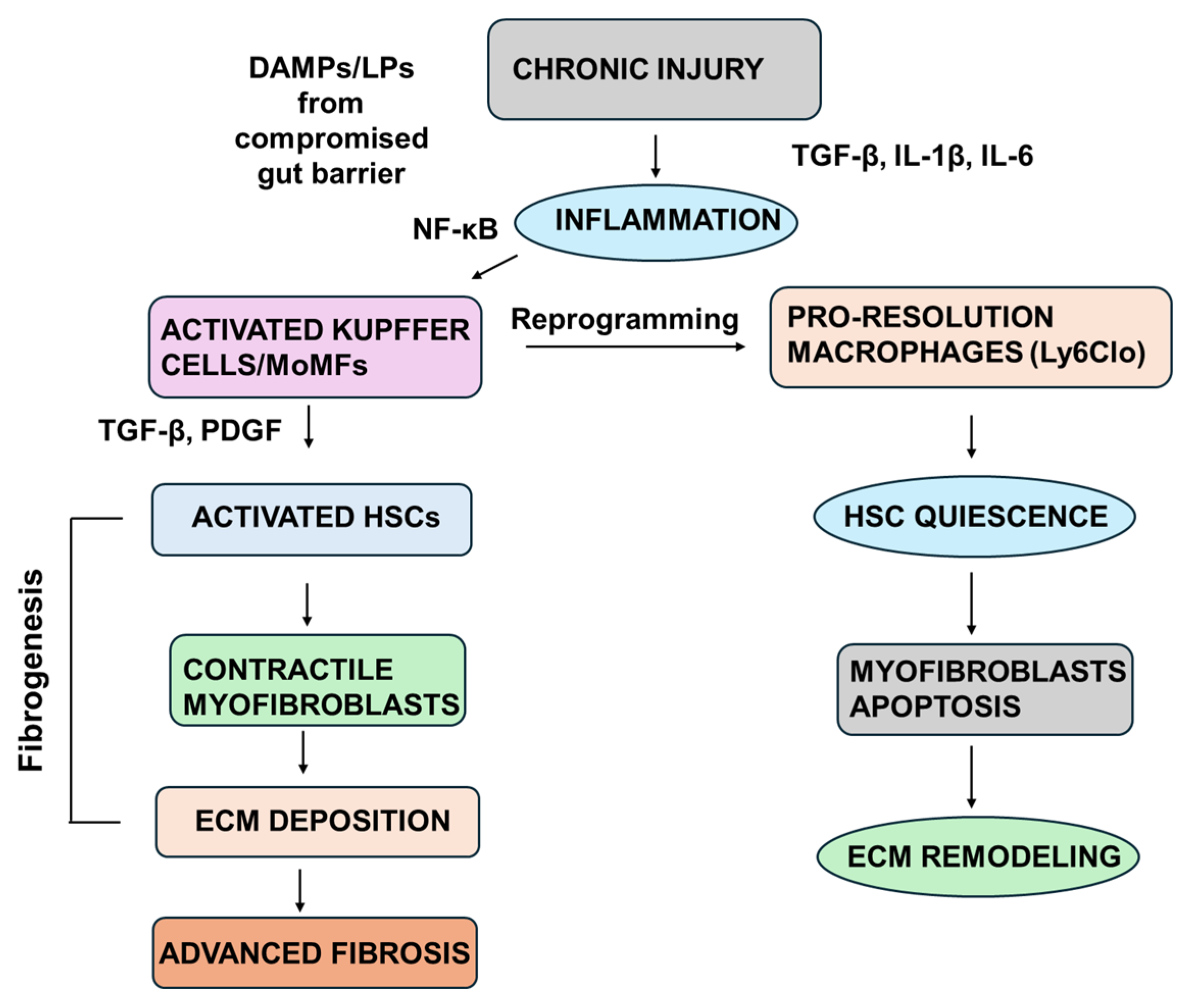
During the early phase of liver injury, macrophages adopt a pro-fibrotic phenotype, releasing cytokines such as TGF-β and PDGF that activate HSCs and support their survival through pathways like NF-κB signaling (Figure 1). This activation is often triggered by DAMPs released from injured hepatocytes, as well as microbial products like lipopolysaccharide (LPS) that translocate from the gut due to increased intestinal permeability in MASH. These signals engage Toll-like receptors (TLRs), amplifying inflammatory responses.
In contrast, macrophages can transition to a restorative phenotype during the resolution phase. This shift is marked by the secretion of anti-inflammatory mediators such as IL-10, clearance of apoptotic cells, and promotion of tissue repair. Notably, the low Ly-6C macrophage subset contributes to fibrosis regression by inducing apoptosis or (re)-quiescence of activated HSCs, partly through TRAIL expression [18].
Beyond intrahepatic immune crosstalk, recent research has emphasized the role of the spleen as a crucial extrahepatic regulator of fibrogenic inflammation. This has led to the development of the concept of a functional “spleen-liver axis” in chronic liver disease, particularly in MASLD/MASH. In mouse models of steatohepatitis and fibrosis, it was observed that CD11b + CD43 hi Ly6Clo splenocyte-derived macrophages migrate from the spleen to the injured liver, where they worsen fibrotic remodeling by enhancing pro-inflammatory and pro-fibrogenic signaling [19]. This directly connects splenic myeloid reservoirs to the progression of liver scarring. These macrophages play a role in activating HSC and sustaining chronic inflammation through the production of cytokines and chemokines, placing the spleen as an upstream regulator of the hepatic macrophage population. Additional evidence in obesity-related fatty liver disease shows that the spleen–liver axis also involves the coordinated increase in myeloid-derived suppressor cells (MDSCs) and natural killer T (NKT) cells. Correlation analyses have demonstrated a strong positive relationship between splenic and hepatic MDSC/NKT populations, indicating that changes in splenic immune function are transmitted to the liver and contribute to systemic and intrahepatic inflammation [20]. These findings suggest that modifying splenic immune responses, either by targeting specific splenocyte subsets or their migration to the liver, could serve as an additional immunotherapeutic approach in treating liver fibrosis. This approach would complement strategies focused on reprogramming intrahepatic macrophages.
As a result, emerging immunomodulatory therapies are increasingly focused on reprogramming macrophage phenotypes rather than broad immunosuppression, aiming to harness their intrinsic capacity for repair and resolution.

3. Current Status of Anti-Fibrotic Therapy for MASH

The therapeutic landscape for MASH underwent a pivotal shift in 2024 with the FDA’s accelerated approval of the first agents directly targeting MASH-related fibrosis. These approvals validate the clinical efficacy of upstream metabolic modulation as a strategy for reversing hepatic scarring and restoring liver architecture (Table 1).
Overall, metabolic or hormonal approaches demonstrate the highest clinical translation based on the current approvals of drugs targeting THR and GLP-1R. Direct anti-fibrotic mechanisms, such as Gal-3 inhibitor, and ATX inhibitor have proven to be more challenging due to late-stage failures and mixed results (Table 1). These may require further exploration and development to bring about anti-fibrotic drugs with potential beneficial fibrogenesis reversing functions. Section 3 and Section 4 mainly discuss general anti-fibrotic strategies and bottlenecks with an emphasis on MASH.

3.1. FDA-Approved Therapies for MASH-Associated Fibrosis

3.1.1. Resmetirom (RezdiffraTM)

Resmetirom (RezdiffraTM, Madrigal Pharmaceuticals, West Conshohocken, PA, USA) is an orally administered, selective thyroid hormone receptor-β (THR-β) agonist. It acts by enhancing hepatic fat metabolism and mitigating lipotoxicity, key drivers of inflammation and fibrogenesis [24]. In March 2024, RezdiffraTM received FDA Accelerated Approval for adults with noncirrhotic MASH and moderate-to-advanced fibrosis (F2–F3), based on Phase 3 data demonstrating both fibrosis regression and MASH resolution [23]. This milestone establishes a mechanistic paradigm wherein correcting metabolic dysfunction yields structural reversal of liver damage [28].

3.1.2. Semaglutide (Wegovy®)

A glucagon-like peptide-1 receptor (GLP-1R) agonist, Semaglutide (Wegovy®, Novo Nordisk, Bagsværd, Denmark) exerts systemic metabolic benefits primarily through significant weight reduction and glycemic control. These effects translate into secondary, but clinically meaningful improvements in hepatic inflammation and fibrosis [24]. Semaglutide was similarly granted FDA Accelerated Approval for MASH patients with F2–F3 fibrosis, reinforcing the therapeutic value of metabolic reprogramming in fibrotic liver disease.

3.2. Emerging Antifibrotic Mechanisms in Late-Stage Clinical Development

Despite recent regulatory breakthroughs, the antifibrotic pipeline continues to explore mechanistically distinct targets with high translational promise. These advanced-stage candidates reflect a strategic shift toward multi-modal interventions capable of addressing both hepatic fibrosis and its systemic drivers.

3.2.1. Autotaxin Inhibitors

Autotaxin (ATX) catalyzes the production of lysophosphatidic acid (LPA), a potent fibrogenic lipid mediator secreted by hepatocytes [29]. Inhibition of ATX, exemplified by agents like CBT-295, has shown pleiotropic benefits in preclinical models, including suppression of pro-inflammatory cytokines (e.g., TGF-β, TNF-α), reduction in bile duct proliferation and collagen deposition, and improvement in hepatic encephalopathy [30]. These multi-axis effects make ATX inhibition an attractive therapeutic strategy [25]. However, the Phase 3 failure of ZiritaxestatTM by Galapagos NV, Mechelen, Belgium in collaboration with Gilead Sciences, Foster City, CA, USA underscores the translational challenges in converting mechanistic promise into clinical efficacy.

3.2.2. Galectin-3 Inhibitors

Galectin-3 (Gal-3) plays a central role in MASH-associated fibrosis, particularly through its regulation of pro-fibrotic macrophage activity [31]. BelapectinTM (GR-MD-02). Galectin Therapeutics, Norcross, GA, USA has demonstrated a favorable safety profile, including in patients with late-stage cirrhosis. While subgroup analyses suggest potential benefit, robust efficacy remains to be confirmed through larger, stratified trials. Gal-3 inhibition remains a compelling avenue for immunomodulatory antifibrotic therapy [27].

3.2.3. Farnesoid X Receptor Agonists

Farnesoid X Receptor (FXR) is a nuclear receptor critical for bile acid homeostasis and metabolic regulation. Agonists such as Cilofexor (GS-9674, Gilead Sciences, Foster City, CA, USA) have shown reductions in hepatic steatosis and serum bile acid levels in NASH patients, supporting a regulatory approach to fibrosis mitigation. FXR activation may also influence lipid metabolism and inflammatory signaling, offering a dual benefit in metabolic liver disease [26].

3.3. Strategic Lessons from Late-Stage Antifibrotic Trial Failures

The discontinuation of promising antifibrotic agents such as Pamrevlumab (FD-3019, FibroGen, San Francisco, CA, USA) and Ziritaxestat in Phase 3 trials underscores critical gaps in trial design and translational strategy [30]. Despite encouraging Phase 2 data, both agents failed to demonstrate efficacy in larger, more diverse patient cohorts-highlighting the risks of overreliance on surrogate endpoints and underpowered early-stage studies. Ziritaxestat, an autotaxin inhibitor, was terminated due to lack of efficacy and a concerning mortality signal, while Pamrevlumab, a monoclonal antibody targeting connective tissue growth factor, failed amid challenges integrating background therapies and endpoint sensitivity [32]. These failures emphasize the need for robust patient stratification, validated predictive biomarkers, personalized advanced in vitro screening models, and composite endpoints that reflect clinically meaningful disease modification. Moreover, the approval of agents like Resmetirom has raised the regulatory bar, requiring future candidates to demonstrate added efficacy or superior tolerability relative to emerging standards of care.
One of the major reasons for Phase III trial failures is that early trials often enroll small and selected cohorts based on surrogate or short-term endpoints that do not represent long-term clinical benefits. Another reason is the lack of clinically validated biomarkers that are analytically reproducible. Further investment is needed in fibrosis biomarkers before using them for critical decision making. Patient diversity, disease heterogeneity, genetics, and parallel antifibrotic therapies can mask the effects of drugs or result in drug interactions. Relying on single surrogates may result in missing clinically relevant details. However, when designing an early-stage trial, combining imaging, efficient biomarkers, and personalized reports in an adaptive trial design setting may be beneficial. Critical analysis of the failures of previous fibrotic drugs will help to further refine the design for successful outcomes.

3.4. Bottlenecks and Challenges in Translational Research for Liver Fibrosis

Despite the increasing understanding of the mechanisms behind fibrogenesis and fibrosis regression, the translation of potential antifibrotic treatments into approved therapies continues to face challenges due to ongoing issues with disease modeling, diagnostic accuracy, and regulatory compliance. These obstacles impede the prioritization of compounds, the design of clinical studies, and the validation of biomarkers, particularly in the case of MASH-related fibrosis. Nevertheless, advancements in disease modeling, improved diagnostic techniques, and the development of non-invasive tests (NITs) offer promising opportunities for early detection and treatment.

3.4.1. Deficiencies in Disease Modeling

Preclinical platforms often fail to replicate the cellular complexity and dynamic remodeling observed in human liver fibrosis. Advanced systems such as liver organoids and precision-cut liver slices (PCLS) offer improved 3D architecture and multicellular fidelity compared to traditional co-cultures. However, they are limited by a short lifespan, donor variability, and high technical complexity [33]. Inclusion of microfluidics using micro physiological system (MPS) models will enable models with fluidic shear stress, spatiotemporal regulation of multicellular architecture, and vascularization relevant to pathophysiology [33]. However, these complexities may reduce throughput and reproducibility, hindering their utility for large-scale compound screening and mechanistic validation. Additionally, the lack of standardized readouts across platforms complicates cross-study comparisons and regulatory acceptance.

3.4.2. Diagnostic and Prognostic Limitations

Liver biopsy remains the histological gold standard for staging fibrosis and assessing therapeutic efficacy, particularly in MASH. However, its invasiveness, sampling variability, and interpretive subjectivity, often requiring multiple expert readers, pose ethical and logistical challenges [34]. These factors contribute to high screen failure rates and slow trial enrollment, especially in early-stage disease where histological progression is subtle. Recent advances in computed tomography (CT) and magnetic resonance tomography (MRI) which include biomechanical properties like blood flow, sheer stress, and fluidic properties, may guide towards early diagnosis of fibrogenesis aiding reversal [34].

3.4.3. Performance Gaps in Non-Invasive Tests

Although NITs reduce patient burden, their diagnostic limitations undermine trial efficiency and patient stratification. Simple Serum Markers such as FIB-4 and APRI are cost-effective and useful for excluding advanced fibrosis, but lack liver specificity and perform poorly in distinguishing intermediate stages (F2 vs. F3), the critical window for therapeutic intervention [35]. Complex Serum Panels like ELF and PRO-C3/ADAPT offer improved accuracy, but face barriers to widespread adoption due to cost, proprietary restrictions, and limited global availability [36]. Similarly, Elastography Techniques measure liver stiffness but suffer from overlapping stiffness ranges and confounding factors such as inflammation, cholestasis, and congestion [36].
These limitations compromise the ability to accurately stage F2/F3 fibrosis, leading to heterogeneous trial cohorts and diluted efficacy signals. To overcome this, the field must pivot toward dynamic biomarkers that reflect disease activity and therapeutic response, rather than static fibrosis staging. Multi-omics approaches, integrating transcriptomic, proteomic, and metabolomic data, offer promising avenues for developing predictive and prognostic tools. Additionally, NITs can be used for data enrichment and seria monitoring, not as primary endpoints. Combining multiple NITs, such as imaging and circulating biomarkers may reduce misclassification. Engaging regulators early to align acceptable NITs and qualification criteria can be helpful. With emerging AI applications in diagnosis, biomarker stratification, and patient data characterization, clinical trials can evolve to be more meaningful.

4. Future Prospects

The next frontier in antifibrotic research aims to go beyond simply haltering progression and instead focus on actively reversing liver fibrosis. This shift is being driven by advancements in precision pharmacology, regenerative medicine, gene editing technologies, and innovative clinical trial designs. Together, these approaches seek to redefine the potential for curing MASH-related fibrosis by targeting both the molecular causes and structural consequences of chronic liver injury.

4.1. Targeted Pharmacology and Immunomodulation

Next-generation pharmacological strategies are increasingly focused on highly specific modulation of fibrogenic signaling pathways. These strategies include antagonists of pro-inflammatory cytokines (e.g., TNF-α, IL-1β), chemokine receptor blockers, and selective modulators of the TGF-β axis, which is a master regulator of fibrosis. AI-driven drug discovery platforms now play a central role in identifying novel intracellular targets by integrating transcriptomic, proteomic, and metabolomic datasets. For example, Traf2 and Nck-interacting kinase (TNIK) inhibition, identified through AI-guided screening, has entered Phase II trials for fibrosis reversal [37].
In parallel, immunomodulatory approaches such as macrophage reprogramming are gaining momentum. This strategy aims to suppress the recruitment of pro-inflammatory macrophages and induce their phenotypic switch toward a reparative, anti-fibrotic state. By leveraging the liver’s innate immune plasticity, macrophage reprogramming offers a promising avenue for restoring tissue homeostasis and promoting scar resolution.

4.2. Regenerative and Cell-Based Therapies

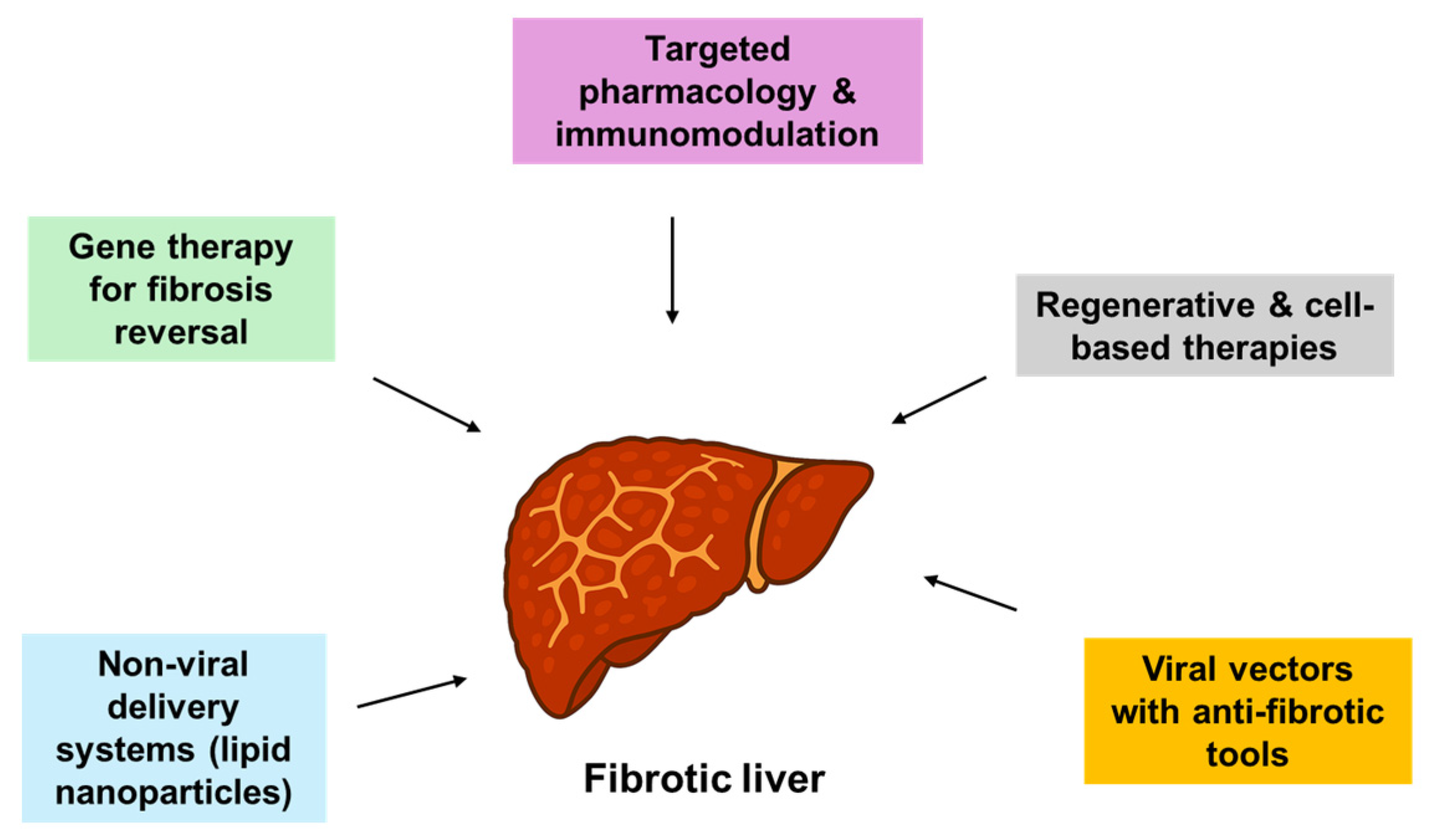
Regenerative medicine offers transformative potential for reversing advanced fibrosis through ECM remodeling and myofibroblast clearance. Among the most studied platforms are technologies that are based on mesenchymal stem cells (MSC), MSC-derived exosomes (MSC-Exos), as well as gene therapy and gene-editing methods that can be based on viral vectors or non-viral delivery systems [37] (Figure 2).

4.2.1. Mesenchymal Stem Cells

Mesenchymal stem cells (MSCs) possess the capacity for hepatogenic differentiation and exert anti-inflammatory, antioxidant, and immunomodulatory effects. They inhibit the activation of HSCs and promote the resolution of fibrosis through the apoptosis of myofibroblasts and the degradation of ECM components [38].

4.2.2. MSC-Derived Exosomes

These nanoscale vesicles are increasingly preferred over whole-cell therapies due to their lower immunogenicity and reduced risk of tumorigenesis [39]. MSC-Exos deliver therapeutic microRNAs and proteins that modulate autophagy, polarize macrophages towards repair phenotypes, and regulate fibrogenic signals such as TGF-β. However, clinical translation is challenged by variability in exosome composition, lack of standardized manufacturing protocols, and scalability concerns. Recent efforts in exosome engineering such as parental cell modification and direct exosome functionalization aim to enhance therapeutic payload consistency and improve in vivo stability, bringing these platforms closer to clinical applicability.

4.3. Gene Therapy and Editing for Fibrosis Reversal

Gene editing technologies, particularly CRISPR-Cas9, offer curative potential by enabling precise disruption or correction of fibrogenic gene networks. This approach could eliminate the need for liver transplantation in select populations by permanently silencing pathological pathways.

4.3.1. Viral Vectors

While effective in delivering gene editing tools, recombinant adeno-associated viruses (rAAVs) pose risks including immunogenicity, hepatotoxicity from high dosing, and oncogenesis due to genome integration [40]. These safety concerns have limited their widespread adoption.

4.3.2. Non-Viral Delivery Systems:

Lipid nanoparticles (LNPs), particularly those conjugated with apolipoprotein E, provide a safer, non-integrating alternative [41]. LNPs allow for targeted delivery to hepatocytes, scalable manufacturing, and reduced risk of off-target effects. Platforms like “Repair Drive” have shown selective expansion of accurately edited hepatocytes in preclinical models, providing a framework for regenerative gene therapy in liver disease.

4.4. Innovative Trial Design for Translational Acceleration

In order to efficiently assess the growing pipeline of targeted and combination therapies, it is crucial to utilize innovative clinical trial designs.

4.4.1. Adaptive Platform Trials

These multi-arm, multi-stage frameworks allow for the simultaneous testing of diverse agents and mechanisms, improving trial efficiency and reducing attrition. They are particularly suited for heterogeneous diseases like MASH, where multiple pathways may be therapeutically relevant.

4.4.2. Real-World Data Integration

By incorporating electronic health records and administrative databases, researchers can construct external control arms. This helps reduce the need for placebo groups and addresses ethical concerns in trials where effective standard-of-care treatments already exist.

4.4.3. Digital Endpoints and Telemedicine

Remote monitoring tools and digital biomarkers help to broaden recruitment efforts, enhance patient retention, and ensure that trial results can be applied to a wider range of populations. These technologies are particularly beneficial in chronic liver disease, where geographical and socioeconomic obstacles frequently hinder participation in trials.

4.5. Advanced in Vitro Fibrosis Models and High Throughput Screening Technologies

Advanced in vitro fibrosis models have significantly improved the study of liver fibrosis by allowing for more physiologically relevant simulations than traditional two-dimensional (2D) cultures [42]. Primary HSCs are still considered the gold standard in fibrosis modeling due to their role in ECM remodeling and expression of fibrotic markers. However, maintaining their quiescent phenotype is challenging and results in limited proliferative capacity [43]. To address these challenges, advanced three-dimensional (3D) culture systems, such as organoids, bioprinted constructs, and microfluidic liver-on-chip platforms, provide a more accurate representation of the liver microenvironment by facilitating multicellular interactions, ECM dynamics, and mechanical stimuli necessary for inducing and resolving fibrosis [44]. Nawroth and colleagues reported that MPS models equipped with biomimetic hepatic sinusoids and bile canaliculi can be used to model alcohol-associated liver disease [45]. This model includes physiological levels of glucose, insulin, and cortisol to mimic in vivo conditions. These 3D models further support advanced multiplexed analyses such as transcriptomics and proteomics, which aid in mechanistic understanding and therapeutic validation [34]. Additionally, integration with high-throughput screening (HTS) and AI-driven assay design enhances rapid, reproducible identification and prioritization of anti-fibrotic compounds through multi-dimensional data analysis and phenotypic profiling. Despite their promise, challenges remain regarding standardization, reproducibility, and comprehensive modeling of liver architecture, including vascularization and immune cell diversity [46]. Continued development and consensus protocols for these models are expected to improve translational research outcomes for fibrosis biomarker discovery, drug screening, and personalized medicine applications.

4.6. Potential Combination Therapies

Since liver fibrosis is a complex process involving multi-pathways, future therapeutic strategies are imperative. This includes combination therapies that can simultaneously modulate metabolic dysfunction, chronic inflammation, and pro-fibrotic remodeling [45]. Recent advancements in treating MASH and related fibrotic liver diseases highlight the rationale for combining metabolic agents (such as FXR agonists, ACC inhibitors GLP-1 receptor agonists, or thyroid hormone receptor-β agonists) with anti-inflammatory or anti-fibrotic drugs to achieve superior responses compared to monotherapy [34]. More precise and mechanism-driven regimen design may help to bring about more efficient combination therapies.

5. Conclusions

Recent accelerated approvals for MASH therapies have redefined the treatment paradigm for liver fibrosis, validating metabolic modulation as a viable path to disease reversal [47]. This progress highlights the importance of halting chronic injury at its source to enable fibrosis resolution. Moving forward, research must prioritize three strategic imperatives: (1) Precision Medicine, which requires dynamic biomarkers for mechanism-specific patient stratification, (2) Multi-Targeted Strategies, which address the intertwined drivers of inflammation, metabolism, and ECM remodeling, and (3) Curative Modalities, including MSC-derived exosomes and gene-editing platforms [39]. The establishment of advanced in vitro screening platforms closely mimicking liver fibrosis and the incorporation of AI/ML technologies may help to develop effective drugs faster [33]. Overcoming delivery challenges, particularly through non-viral systems like lipid nanoparticles, is essential for clinical translation. Coupled with adaptive trial designs and non-invasive surrogate endpoints, these innovations can accelerate the development of safe, effective, and transformative therapies for chronic liver diseases.

Author Contributions

Conceptualization, D.G.N. and R.W.; formal analysis, D.G.N. and R.W.; resources, R.W.; data curation, D.G.N. and R.W.; writing—original draft preparation, D.G.N. and R.W.; writing—review and editing, D.G.N. and R.W.; visualization, D.G.N.; supervision, R.W. All authors have read and agreed to the published version of the manuscript.

Funding

This research received no external funding.

Institutional Review Board Statement

Not applicable.

Informed Consent Statement

Not applicable.

Data Availability Statement

For this article no new data was generated.

Conflicts of Interest

D.G.N. was employed by the company LivMira Therapeutics Inc. R.W. declares that the research was conducted without any commercial or financial relationships that could be seen as a potential conflict of interest.

Abbreviations

The following abbreviations are used in this manuscript:
AIArtificial intelligence
ALDAlcoholic liver disease
ATXAutotaxin
DAMP(s)Damage-associated molecular pattern(s)
ECMExtracellular matrix
EMTEpithelial–mesenchymal transition
FXRFarnesoid X receptor
GLP-1RGlucagon-like peptide-1 receptor
HCCHepatocellular carcinoma
HSC(s)Hepatic stellate cell(s)
HTSHigh-throughput screening
LNP(s)Lipid nanoparticle(s)
LPALysophosphatidic acid
LPSLipopolysaccharide
LTLiver transplantation
MASHMetabolic dysfunction-associated steatohepatitis
MSC(s)Mesenchymal stem cell(s)
MSC-ExosMSC-derived exosomes
NIT(s)Non-invasive test(s)
PCLSPrecision-cut liver slices
PDGFPlatelet-derived growth factor
PF(s)Portal fibroblast(s)
rAAVsRecombinant adeno-associated viruses
TGF-βTransforming growth factor-β
THR-βThyroid hormone receptor-β
TLR(s)Toll-like receptor(s)

References

  1. Zhang, J.; Liu, Q.; He, J.; Li, Y. Novel Therapeutic Targets in Liver Fibrosis. Front. Mol. Biosci. 2021, 8, 766855. [Google Scholar] [CrossRef] [PubMed]
  2. Nasir, S.A.; Mangla, A.; Taneja, V.; Berger, T.; Pandya, D.; Gupta, V.; Lim, J.K. Advances in Novel Drug Therapy for Metabolic Dysfunction-Associated Steatohepatitis Cirrhosis. J. Transl. Gastroenterol. 2025, 3, 9–17. [Google Scholar] [CrossRef]
  3. Mostafa, S.; Shetab Boushehri, M.A.; Ezzat, A.A.; Weiskirchen, R.; Lamprecht, A.; Mansour, S.; Tammam, S.N. Targeted Delivery of Anti-TGF-β 1 -SiRNA Using PDGFR-β Peptide-Modified Chitosan Nanoparticles for the Treatment of Liver Fibrosis. Mol. Pharm. 2025, 22, 6741–6758. [Google Scholar] [CrossRef] [PubMed]
  4. Turning Our Focus to Liver Fibrosis. Nat. Rev. Gastroenterol. Hepatol. 2023, 20, 625. [CrossRef]
  5. Elpek, G.Ö. Cellular and Molecular Mechanisms in the Pathogenesis of Liver Fibrosis: An Update. World J. Gastroenterol. 2014, 20, 7260–7276. [Google Scholar] [CrossRef]
  6. Liedtke, C.; Nevzorova, Y.A.; Luedde, T.; Zimmermann, H.; Kroy, D.; Strnad, P.; Berres, M.-L.; Bernhagen, J.; Tacke, F.; Nattermann, J.; et al. Liver Fibrosis—From Mechanisms of Injury to Modulation of Disease. Front. Med. 2022, 8, 814496. [Google Scholar] [CrossRef]
  7. Nair, D.G.; Weiskirchen, R. Recent Advances in Liver Tissue Engineering as an Alternative and Complementary Approach for Liver Transplantation. Curr. Issues Mol. Biol. 2023, 46, 262–278. [Google Scholar] [CrossRef]
  8. Schon, H.-T.; Bartneck, M.; Borkham-Kamphorst, E.; Nattermann, J.; Lammers, T.; Tacke, F.; Weiskirchen, R. Pharmacological Intervention in Hepatic Stellate Cell Activation and Hepatic Fibrosis. Front. Pharmacol. 2016, 7, 33. [Google Scholar] [CrossRef]
  9. Puri, M.; Sonawane, S. Liver Sinusoidal Endothelial Cells in the Regulation of Immune Responses and Fibrosis in Metabolic Dysfunction-Associated Fatty Liver Disease. Int. J. Mol. Sci. 2025, 26, 3988. [Google Scholar] [CrossRef]
  10. Shetty, S.; Lalor, P.F.; Adams, D.H. Liver Sinusoidal Endothelial Cells—Gatekeepers of Hepatic Immunity. Nat. Rev. Gastroenterol. Hepatol. 2018, 15, 555–567. [Google Scholar] [CrossRef]
  11. Lu, J.-L.; Yu, C.-X.; Song, L.-J. Programmed Cell Death in Hepatic Fibrosis: Current and Perspectives. Cell Death Discov. 2023, 9, 449. [Google Scholar] [CrossRef]
  12. Weiskirchen, R.; Tacke, F. Liver Fibrosis: From Pathogenesis to Novel Therapies. Dig. Dis. 2016, 34, 410–422. [Google Scholar] [CrossRef] [PubMed]
  13. Dewidar, B.; Meyer, C.; Dooley, S.; Meindl-Beinker, N. TGF-β in Hepatic Stellate Cell Activation and Liver Fibrogenesis—Updated 2019. Cells 2019, 8, 1419. [Google Scholar] [CrossRef] [PubMed]
  14. Kumagai, S.; Ohtani, H.; Nagai, T.; Funa, K.; Hiwatashi, N.; Shimosegawa, T.; Nagura, H. Platelet-derived growth factor and its receptors are expressed in areas of both active inflammation and active fibrosis in inflammatory bowel disease. Tohoku J. Exp. Med. 2001, 195, 21–33. [Google Scholar] [CrossRef] [PubMed]
  15. Fang, Z.; Qu, S.; Ji, X.; Zheng, C.; Mo, J.; Xu, J.; Zhang, J.; Shen, H. Correlation between PDGF-BB and M1-type macrophage in inflammatory bowel disease: A case-control study. BMC Gastroenterol. 2024, 24, 417. [Google Scholar] [CrossRef]
  16. Zhang, Y.; Ren, L.; Tian, Y.; Guo, X.; Wei, F.; Zhang, Y. Signaling Pathways That Activate Hepatic Stellate Cells during Liver Fibrosis. Front. Med. 2024, 11, 1454980. [Google Scholar] [CrossRef]
  17. Zheng, Q.-F.; Bai, L.; Duan, Z.-P.; Han, Y.-P.; Zheng, S.-J.; Chen, Y.; Li, J.-S. M2-like Kupffer Cells in Fibrotic Liver May Protect against Acute Insult. World J. Gastroenterol. 2017, 23, 3655–3663. [Google Scholar] [CrossRef]
  18. Ma, X.; Qiu, J.; Zou, S.; Tan, L.; Miao, T. The Role of Macrophages in Liver Fibrosis: Composition, Heterogeneity, and Therapeutic Strategies. Front. Immunol. 2024, 15, 1494250. [Google Scholar] [CrossRef]
  19. Zhang, S.; Wan, D.; Zhu, M.; Wang, G.; Zhang, X.; Huang, N.; Zhang, J.; Zhang, C.; Shang, Q.; Zhang, C.; et al. CD11b+CD43hiLy6Clo splenocyte-derived macrophages exacerbate liver fibrosis via spleen–liver axis. Hepatology 2023, 77, 1612–1629. [Google Scholar] [CrossRef]
  20. Brummer, C.; Singer, K.; Renner, K.; Bruss, C.; Hellerbrand, C.; Dorn, C.; Reichelt-Wurm, S.; Gronwald, W.; Pukrop, T.; Herr, W.; et al. The spleen-liver axis supports obesity-induced systemic and fatty liver inflammation via MDSC and NKT cell enrichment. Mol. Cell Endocrinol. 2025, 601, 112518. [Google Scholar] [CrossRef]
  21. ClinicalTrials.gov. A Phase 3 Study Evaluating Efficacy and Safety of Lanifibranor Followed by an Active Treatment Extension in Adult Patients with (NASH) and Fibrosis Stages F2 and F3 (NATiV3) (NATiV3). Available online: https://Clinicaltrials.Gov/Study/NCT04849728 (accessed on 26 December 2025).
  22. Ratziu, V.; de Guevara, L.; Safadi, R.; Poordad, F.; Fuster, F.; Flores-Figueroa, J.; Arrese, M.; Fracanzani, A.L.; Ben Bashat, D.; Lackner, K.; et al. Aramchol in Patients with Nonalcoholic Steatohepatitis: A Randomized, Double-Blind, Placebo-Controlled Phase 2b Trial. Nat. Med. 2021, 27, 1825–1835. [Google Scholar] [CrossRef] [PubMed]
  23. Azam, M.M.; Mukhtar, S.; Haris, M.; Laique, F.; Amir, S.; Mohiuddin, M.; Giri, B. FDA’s Approval of Resmetirom (Rezdiffra): A Breakthrough in MASH Management. Explor. Drug Sci. 2024, 2, 867–874. [Google Scholar] [CrossRef]
  24. Sanyal, A.J.; Newsome, P.N.; Kliers, I.; Østergaard, L.H.; Long, M.T.; Kjær, M.S.; Cali, A.M.G.; Bugianesi, E.; Rinella, M.E.; Roden, M.; et al. Phase 3 Trial of Semaglutide in Metabolic Dysfunction–Associated Steatohepatitis. N. Engl. J. Med. 2025, 392, 2089–2099. [Google Scholar] [CrossRef] [PubMed]
  25. Roy, S.; Chakrabarti, M.; Mondal, T.; Das, T.K.; Sarkar, T.; Datta, S.; Kundu, M.; Banerjee, M.; Kulkarni, O.P. Effect of an Autotaxin Inhibitor, 2-(4-Chlorophenyl)-7-Methyl-8-Pentylimidazo [1,2-a] Pyrimidin-5(8H)-One (CBT-295), on Bile Duct Ligation-Induced Chronic Liver Disease and Associated Hepatic Encephalopathy in Rats. ACS Pharmacol. Transl. Sci. 2024, 7, 2662–2676. [Google Scholar] [CrossRef]
  26. Tan, Z.; Sun, H.; Xue, T.; Gan, C.; Liu, H.; Xie, Y.; Yao, Y.; Ye, T. Liver Fibrosis: Therapeutic Targets and Advances in Drug Therapy. Front. Cell Dev. Biol. 2021, 9, 730176. [Google Scholar] [CrossRef]
  27. Zhao, L.; Tang, H.; Cheng, Z. Pharmacotherapy of Liver Fibrosis and Hepatitis: Recent Advances. Pharmaceuticals 2024, 17, 1724. [Google Scholar] [CrossRef]
  28. Le, P.; Kaya, E.; Phan, A.; Yilmaz, Y.; Alkhouri, N. Resmetirom-Eligible Population among US Adults: An Estimation Analysis Based on NHANES 2017-March 2020. Hepatol. Commun. 2025, 9, e0755. [Google Scholar] [CrossRef]
  29. Ninou, I.; Magkrioti, C.; Aidinis, V. Autotaxin in Pathophysiology and Pulmonary Fibrosis. Front. Med. 2018, 5, 180. [Google Scholar] [CrossRef]
  30. Qiu, H.; Song, E.; Hu, Y.; Li, T.; Ku, K.C.; Wang, C.; Cheung, B.M.Y.; Cheong, L.Y.; Wang, Q.; Wu, X.; et al. Hepatocyte-Secreted Autotaxin Exacerbates Nonalcoholic Fatty Liver Disease Through Autocrine Inhibition of the PPARα/FGF21 Axis. Cell Mol. Gastroenterol. Hepatol. 2022, 14, 1003–1023. [Google Scholar] [CrossRef]
  31. Kram, M. Galectin-3 Inhibition as a Potential Therapeutic Target in Non-Alcoholic Steatohepatitis Liver Fibrosis. World J. Hepatol. 2023, 15, 201–207. [Google Scholar] [CrossRef]
  32. Raghu, G.; Richeldi, L.; Fernández Pérez, E.R.; De Salvo, M.C.; Silva, R.S.; Song, J.W.; Ogura, T.; Xu, Z.J.; Belloli, E.A.; Zhang, X.; et al. Pamrevlumab for Idiopathic Pulmonary Fibrosis: The ZEPHYRUS-1 Randomized Clinical Trial. JAMA 2024, 332, 380–389. [Google Scholar] [CrossRef] [PubMed]
  33. Nair, D.G.; Weiskirchen, R. Advanced In Vitro Models for Preclinical Drug Safety: Recent Progress and Prospects. Curr. Issues Mol. Biol. 2024, 47, 7. [Google Scholar] [CrossRef] [PubMed]
  34. Castera, L.; Friedrich-Rust, M.; Loomba, R. Noninvasive Assessment of Liver Disease in Patients With Nonalcoholic Fatty Liver Disease. Gastroenterology 2019, 156, 1264–1281.e4. [Google Scholar] [CrossRef] [PubMed]
  35. Frączek, J.; Sowa, A.; Agopsowicz, P.; Migacz, M.; Dylińska-Kala, K.; Holecki, M. Non-Invasive Tests as a Replacement for Liver Biopsy in the Assessment of MASLD. Medicina 2025, 61, 736. [Google Scholar] [CrossRef]
  36. Berzigotti, A.; Tsochatzis, E.; Boursier, J.; Castera, L.; Cazzagon, N.; Friedrich-Rust, M.; Petta, S.; Thiele, M. EASL Clinical Practice Guidelines on Non-Invasive Tests for Evaluation of Liver Disease Severity and Prognosis—2021 Update. J. Hepatol. 2021, 75, 659–689. [Google Scholar] [CrossRef]
  37. Didamoony, M.A.; Soubh, A.A.; Ahmed, L.A. Cutting-Edge Insights into Liver Fibrosis: Advanced Therapeutic Strategies and Future Perspectives Using Engineered Mesenchymal Stem Cell-Derived Exosomes. Drug Deliv. Transl. Res. 2025, 15, 2608–2623. [Google Scholar] [CrossRef]
  38. Wang, X.; Wang, Y.; Lu, W.; Qu, J.; Zhang, Y.; Ye, J. Effectiveness and Mechanisms of Mesenchymal Stem Cell Therapy in Preclinical Animal Models of Hepatic Fibrosis: A Systematic Review and Meta-Analysis. Front. Bioeng. Biotechnol. 2024, 12, 1424253. [Google Scholar] [CrossRef]
  39. Li, L.; Liu, Y.; Wang, K.; Mo, J.; Weng, Z.; Jiang, H.; Jin, C. Stem Cell Exosomes: New Hope and Future Potential for Relieving Liver Fibrosis. Clin. Mol. Hepatol. 2025, 31, 333–349. [Google Scholar] [CrossRef]
  40. Ferriero, R.; Bruno, G.; Padula, A.; Pisano, S.; Boffa, I.; Gargaro, M.; Imperatore, T.; Battipaglia, M.; Vivenzio, S.; Perna, C.; et al. Impact of Liver Fibrosis on AAV-Mediated Gene Transfer to Mouse Hepatocytes. Nat. Commun. 2025, 16, 2118. [Google Scholar] [CrossRef]
  41. Wang, J.; Ding, Y.; Chong, K.; Cui, M.; Cao, Z.; Tang, C.; Tian, Z.; Hu, Y.; Zhao, Y.; Jiang, S. Recent Advances in Lipid Nanoparticles and Their Safety Concerns for mRNA Delivery. Vaccines 2024, 12, 1148. [Google Scholar] [CrossRef]
  42. Lee, Y.-S.; Seki, E. In Vivo and In Vitro Models to Study Liver Fibrosis: Mechanisms and Limitations. Cell Mol. Gastroenterol. Hepatol. 2023, 16, 355–367. [Google Scholar] [CrossRef]
  43. Rezvani, M. Human Liver Immunology: From in Vitro Models to New Insights. Cell Mol. Immunol. 2025, 22, 1226–1236. [Google Scholar] [CrossRef]
  44. Navik, U.; Singh, S.K.; Khurana, A.; Weiskirchen, R. Revolutionizing Liver Fibrosis Research: The Promise of 3D Organoid Models in Understanding and Treating Chronic Liver Disease. Expert Rev. Gastroenterol. Hepatol. 2025, 19, 105–110. [Google Scholar] [CrossRef]
  45. Nawroth, J.C.; Petropolis, D.B.; Manatakis, D.V.; Maulana, T.I.; Burchett, G.; Schlünder, K.; Witt, A.; Shukla, A.; Kodella, K.; Ronxhi, J.; et al. Modeling Alcohol-Associated Liver Disease in a Human Liver-Chip. Cell Rep. 2021, 36, 109393. [Google Scholar] [CrossRef]
  46. Ros-Tarraga, P.; Villanueva-Badenas, E.; Sanchez-Gonzalez, E.; Gallego-Ferrer, G.; Donato, M.T.; Tolosa, L. Challenges of in Vitro Modelling of Liver Fibrosis. Front. Cell Dev. Biol. 2025, 13, 1567916. [Google Scholar] [CrossRef]
  47. Chi, K.Y.; Kim, G.; Son, J.S.; Han, J.; Kim, J.-H. Recent Advances in Three-Dimensional In Vitro Models for Studies of Liver Fibrosis. Tissue Eng. Regen. Med. 2025, 22, 593–609. [Google Scholar] [CrossRef]
Figure 1. Schematic overview of the progression and resolution of liver fibrosis. Chronic injury to hepatocytes and compromised gut barrier function result in the release of DAMPs/LPS, which activate Kupffer cells and monocyte-derived macrophages (MoMFs). These macrophages then adopt a pro-fibrotic phenotype, secreting transforming growth factor-β (TGF-β) and platelet-derived growth factor (PDGF). Along with dysfunction of liver sinusoidal endothelial cells, this leads to the activation of hepatic stellate cells (HSCs) and transdifferentiation into contractile myofibroblasts (MFBs). MFBs deposit extracellular matrix (ECM), promoting fibrosis. The resolution phase involves a transition to restorative macrophages, such as resolution-promoting Ly6c Lo monocytes (Ly6Clo), facilitating ECM remodeling, MFB apoptosis, and reversion of HSCs to a quiescent state.
Sci 08 00009 g001
Figure 2. Technologies with the potential to target fibrosis. Advances in cell and gene therapies, regenerative medicine, and targeted pharmacology approaches, along with advancements in in vitro modeling, may help bring about novel and effective therapies for liver fibrosis.
Sci 08 00009 g002
Table 1. Approved therapies and therapies currently in Phase 2/3 clinical trials, including those that have failed to show translational effects 1.
AgentMechanisms of ActionTarget Disease &
Fibrosis Stage
Clinical Status
LanifibranorPPAR agonistMASH and advanced fibrosisPhase III trial ongoing [21]
AramcholSCD1 modulatorMASHPhase III trial ongoing [22]
RezdiffraTM (Resmetirom)Selective THR agonistMASH
(F2–F3, non-cirrhotic)
FDA accelerated approval
(March 2024) [23]
Wegovy® (Semaglutide)GLP-1R agonistMASH (F2–F3, moderate-to-advanced fibrosis)FDA approved
(accelerated pathway) [24]
ZiritaxestatATX inhibitorMASH/idiopathic pulmonary fibrosisPhase III trial failed, due to insufficient target engagement [25]
CilofexorFXR agonistMASHPhase II trial failed due to endpoint sensitivity, heterogeneous population. Cilofexor + Firosocostat are currently being evaluated [26]
Belapectin TM (GR-MD-02)Gal-3 inhibitorMASH/chronic liver diseasesPhase IIb/III trials did not achieve its primary endpoint due to inadequate biomarker lineage [27]
1 Abbreviations used: ATX, autotaxin; FXR, farnesoid X receptor; Gal-3, Galectin-3; GLP-1R, glucagon-like peptide-1 receptor; MASH, metabolic dysfunction-associated steatosis; THR, thyroid hormone receptor; PPAR, Peroxisome proliferator-activated receptor; SCD1, Stearoyl-CoA Desaturase-1.
Disclaimer/Publisher’s Note: The statements, opinions and data contained in all publications are solely those of the individual author(s) and contributor(s) and not of MDPI and/or the editor(s). MDPI and/or the editor(s) disclaim responsibility for any injury to people or property resulting from any ideas, methods, instructions or products referred to in the content.