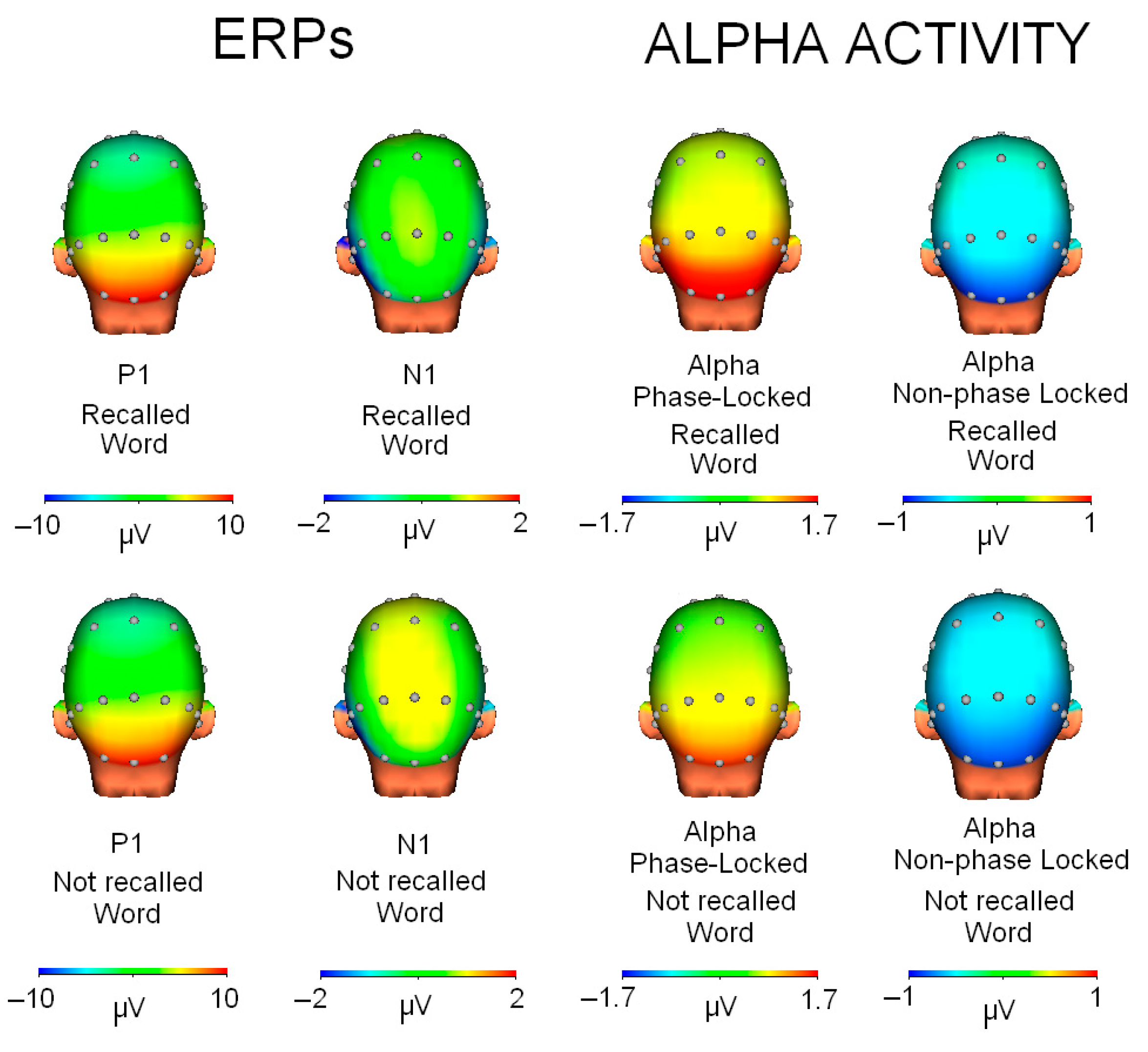

Simultaneous Analysis of Early Components P1 and N1 and Phase and Non-Phase Alpha Activities Associated with Word Recall

 , and
, and Abstract
Share and Cite
Vazquez-Marrufo, M.; Navarro-Martos, R.; Narbona-Gonzalez, N.; Martin-Clemente, R. Simultaneous Analysis of Early Components P1 and N1 and Phase and Non-Phase Alpha Activities Associated with Word Recall. Sci 2025, 7, 84. https://doi.org/10.3390/sci7020084
Vazquez-Marrufo M, Navarro-Martos R, Narbona-Gonzalez N, Martin-Clemente R. Simultaneous Analysis of Early Components P1 and N1 and Phase and Non-Phase Alpha Activities Associated with Word Recall. Sci. 2025; 7(2):84. https://doi.org/10.3390/sci7020084
Chicago/Turabian StyleVazquez-Marrufo, Manuel, Remedios Navarro-Martos, Natividad Narbona-Gonzalez, and Ruben Martin-Clemente. 2025. "Simultaneous Analysis of Early Components P1 and N1 and Phase and Non-Phase Alpha Activities Associated with Word Recall" Sci 7, no. 2: 84. https://doi.org/10.3390/sci7020084
APA StyleVazquez-Marrufo, M., Navarro-Martos, R., Narbona-Gonzalez, N., & Martin-Clemente, R. (2025). Simultaneous Analysis of Early Components P1 and N1 and Phase and Non-Phase Alpha Activities Associated with Word Recall. Sci, 7(2), 84. https://doi.org/10.3390/sci7020084