1. Introduction
Multiphoton ionization driven by femtosecond laser pulses is a central tool for investigating atomic and molecular dynamics with high temporal resolution. In particular, bichromatic excitation schemes enable control over ionization pathways and access to interference between competing multiphoton channels in both atoms and molecules through quantum-path interference [
1,
2,
3,
4]. These experiments therefore require femtosecond light sources that provide independent control over spectral composition and relative timing of multiple pulse components, which remains challenging in conventional broadband amplification schemes.
A variety of approaches have been developed for generating tailored femtosecond waveforms with controlled spectral and temporal structure. Common strategies include Fourier-domain pulse shaping using spatial light modulators, nonlinear frequency conversion schemes such as second-harmonic or sum-frequency generation, and multi-channel architectures based on independent optical parametric amplifiers [
5,
6,
7,
8]. While these techniques provide significant flexibility, they are often limited in either pulse energy, spectral bandwidth, or the ability to independently and continuously tune multiple pulse components with precise temporal control. In particular, achieving stable two-color operation with simultaneous spectral programmability and adjustable inter-pulse delay remains experimentally challenging in high-repetition-rate systems.
To address these limitations, we implement a chirped-seed noncollinear optical parametric amplifier (NOPA) scheme [
9], enabling independent control over the spectral composition and relative timing of two amplified pulse components. The seed pulse is deliberately temporally stretched by introducing a controlled amount of dispersion prior to amplification, resulting in a strongly chirped pulse with a duration of approximately 1 ps. Due to the intrinsic time–frequency mapping of the chirped seed [
8,
10], different spectral components interact with the pump at different temporal delays within the NOPA gain window. Consequently, the central wavelength and bandwidth of the amplified output can be continuously tuned by adjusting the relative delay between pump and seed pulses. Here we demonstrate that this architecture simultaneously affords precise control over the inter-pulse delay between two independently tunable spectral components, making it well-suited for bichromatic strong-field experiments requiring both spectral selectivity and precise temporal control.
The underlying amplification concept employed in this work—chirped-seed noncollinear optical parametric amplification with delay-dependent spectral selection—has previously been used in our group as a stable femtosecond light source for photoelectron momentum spectroscopy experiments based on COLTRIMS [
11,
12,
13]. In those studies, the laser system served primarily as a robust excitation source for investigations of circular and magnetic dichroism [
14,
15,
16,
17] as well as magnetic wavepacket dynamics [
18], without a dedicated focus on the underlying laser architecture or its tunability. In contrast, the present work concentrates on the technical implementation and systematic characterization of the laser system itself, with particular emphasis on controlled two-color pulse generation and independent tuning of spectral and temporal degrees of freedom.
2. Experimental Setup
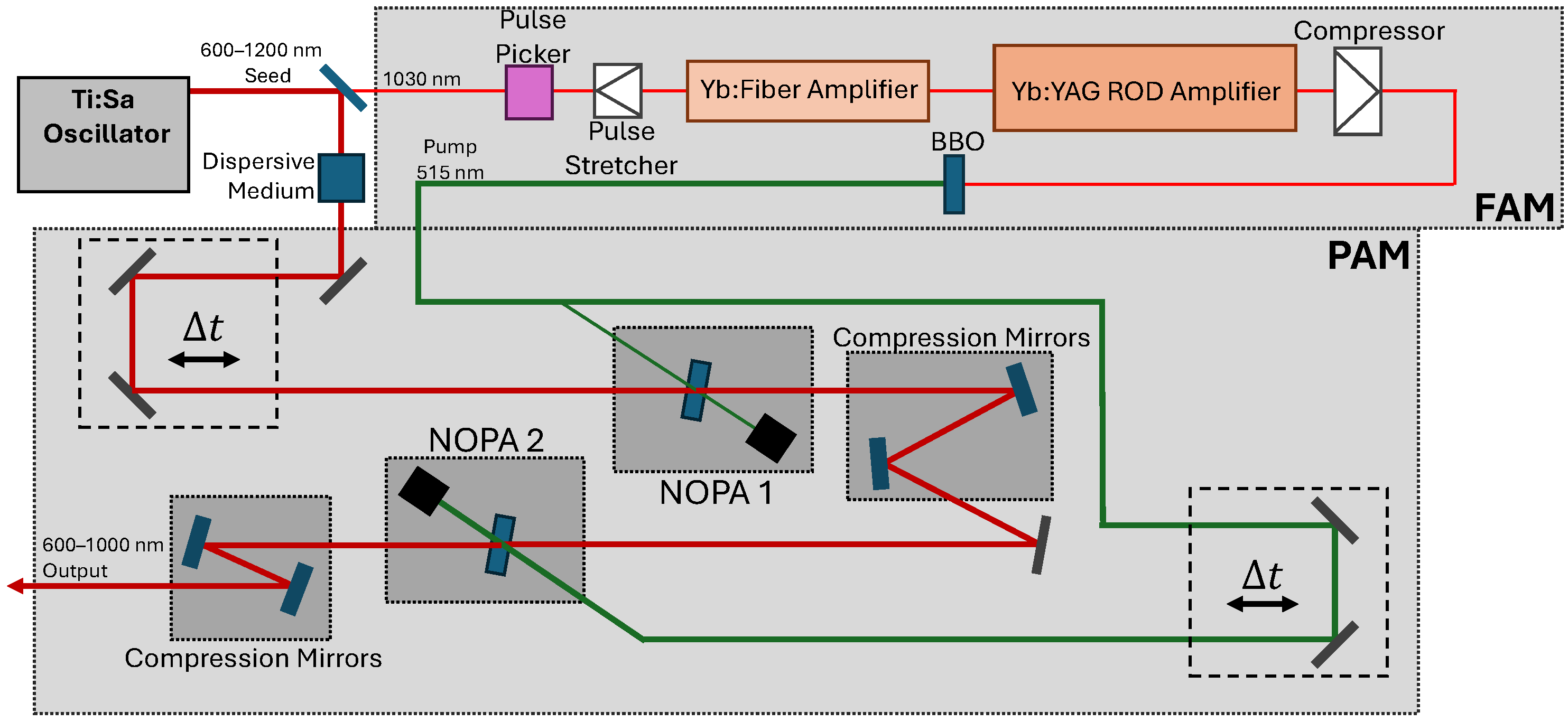
The laser system used in this study is based on a commercially available femtosecond optical parametric chirped-pulse amplifier (OPCPA) platform (Laser Quantum, similar to the model described in [
9]). A schematic overview of the system is shown in
Figure 1. In the following, we describe the main components of the system and highlight the modifications introduced for chirped-seed operation and two-color pulse generation.
2.1. Original Configuration
The system is seeded by a Ti:sapphire oscillator delivering broadband pulses spanning approximately 600–1200 nm, with a pulse duration of ∼5 fs, pulse energy of ∼2.5 nJ, and a repetition rate of 80 MHz.
A fraction of the oscillator output in the infrared (approximately 1020–1060 nm) is used to generate the pump for the parametric amplification stages. This beam is amplified in a multi-stage fiber amplifier module (FAM), followed by repetition rate reduction to 200 kHz using pulse pickers. Subsequent amplification in a rod-type amplifier and compression yields pulses of 150–200 fs duration. These pulses are frequency-doubled in a second-harmonic generation (SHG) crystal to produce pump pulses at 515 nm with energies of up to 90 μJ and an average power of approximately 18 W.
The core of the laser system is the parametric amplifier module (PAM), in which the seed and pump pulses are spatially and temporally overlapped in two type-I BBO crystals of 2 mm thickness. These stages operate in a noncollinear optical parametric amplification (NOPA) configuration [
8,
19], transferring energy from the pump to the seed while preserving the seed’s temporal structure. The seed beam passes sequentially through both stages (hereafter referred to as NOPA stage 1 and NOPA stage 2), while the pump beam is split by a thin-film polarizer. Approximately 20% of the pump power is directed to the first stage and 80% to the second. This ratio can be adjusted using a half-wave plate placed before the polarizer.
Both NOPA stages are arranged in a walk-off-compensated noncollinear geometry [
19], with an angle of approximately
between the pump beam and the optical axis of the BBO crystal, and an angle of approximately
between the seed and pump beams at the crystal. A small chirp is introduced in the seed beam after the first NOPA stage and is compensated by two reflections from a pair of double-chirped mirrors before entering the second stage. After the second stage, additional chirped mirror pairs and fused silica wedges are used to optimize pulse compression and achieve the shortest possible pulse duration.
It is worth noting that the seed beam, before the first NOPA stage, and the pump beam, for the second NOPA stage, pass through delay stages consisting of pairs of 45° mirrors mounted on motorized translation stages. These delay stages allow independent adjustment of the temporal overlap between the seed and pump pulses in the two NOPA stages. The position of the first delay stage plays a key role in maintaining stable operation. Long-term stability is ensured by the active stabilization scheme of the commercial OPCPA platform, which continuously compensates pump–seed timing drifts via feedback from an additional amplification stage. In combination with the common-seed architecture and passive delay control, this results in stable operation of the generated output spectrum over extended acquisition times without significant intensity and spectral drifts under typical operating conditions.
In the standard configuration, the system delivers an output beam with an average power of up to 3 W, a central wavelength around 780 nm, pulse durations as short as 8 fs, a repetition rate of 200 kHz, a pulse energy of up to 17 μJ, and a beam diameter of 1.2 mm.
2.2. Modified Operation
In the present study, the commercial system was modified to enable selective amplification of narrow spectral regions of the broadband seed pulse. To this end, a dispersive element was introduced into the seed beam path immediately before the parametric amplifier module (PAM), as illustrated in
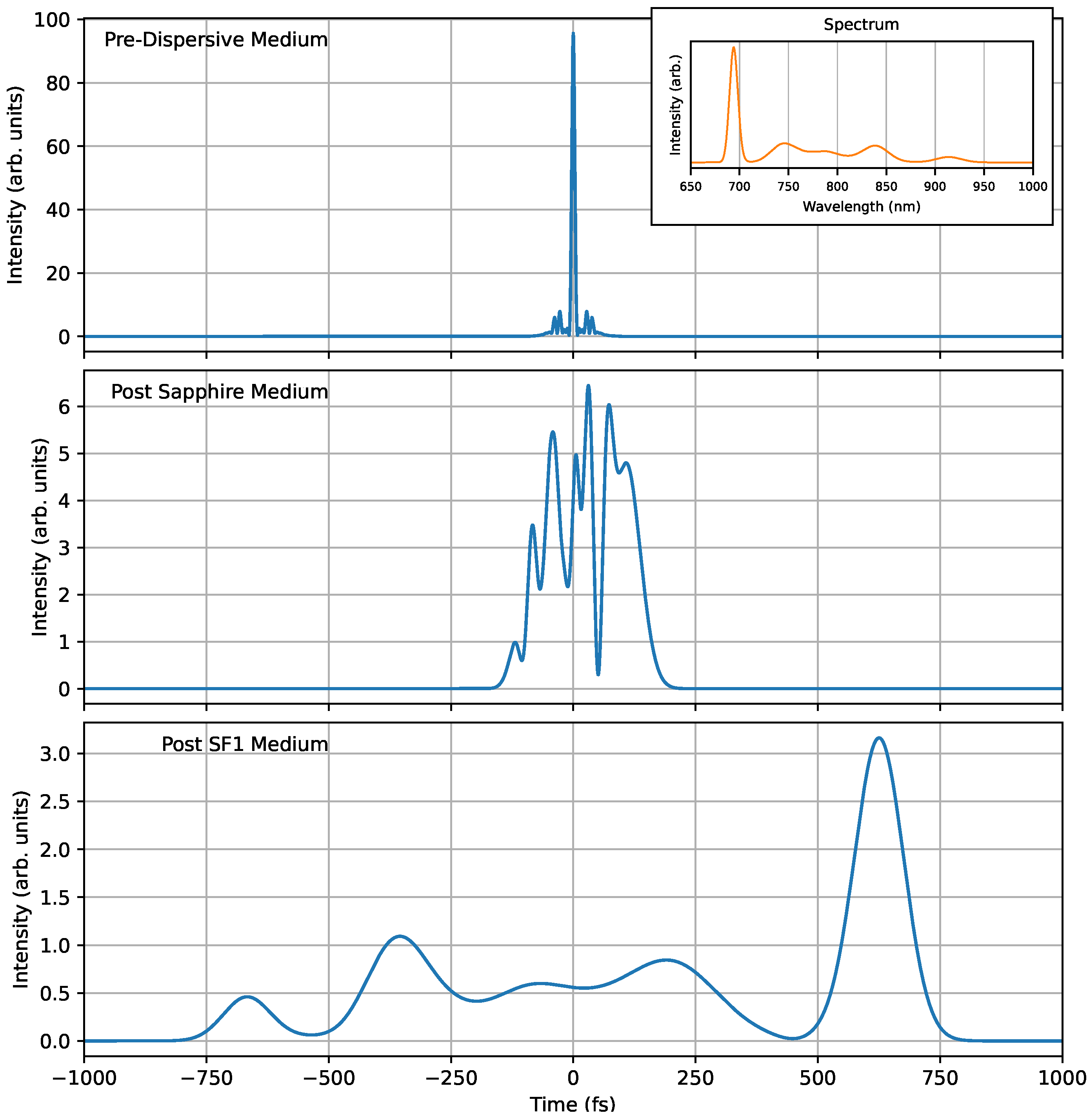
Figure 1. This induces a significant chirp, causing different wavelength components of the seed pulse to arrive at the NOPA crystals at different times. Consequently, the seed pulse is stretched from a few femtoseconds to several hundred femtoseconds or even more than 1 ps, depending on the dispersive element employed (
Table 1). The temporal overlap between the stretched seed pulse and the much shorter pump pulse then acts as an adjustable temporal gate, such that only a limited spectral portion of the chirped seed pulse is amplified for a given pump–seed delay. This enables delay-dependent spectral selection during parametric amplification [
8].
In initial tests, a 5 mm thick sapphire window was employed at an incidence angle of approximately 47.5° relative to the surface normal, close to the Brewster angle. This minimizes reflective losses while increasing the effective optical path length (to approximately 5.51 mm). A drawback of this configuration is the introduction of angular dispersion (spatial chirp), resulting in a slight spatial variation of the spectral content across the beam profile.
In subsequent experiments, a polarizing beam splitter (PBS) cube (Thorlabs PBS122) was used as an alternative dispersive medium. The PBS, made of N-SF1 glass with a thickness of 12.7 mm, introduces significantly larger group delay dispersion compared to the sapphire window, resulting in stronger temporal stretching of the seed pulse (see
Figure 2). This enhances the achievable spectral selectivity while maintaining compatibility with post-amplification pulse compression.
Because different spectral components of the chirped seed pulse arrive at the NOPA crystals at different times, adjusting the pump–seed delay determines which spectral region experiences amplification. The two motorized delay stages therefore provide independent control over the spectral output of the two NOPA stages. By selecting identical delay settings, both stages can amplify the same spectral region, resulting in a single-color output with increased pulse energy. Alternatively, different delay settings can be chosen to amplify distinct spectral regions of the seed pulse, enabling the generation of two-color pulse pairs with independently adjustable spectral separation and relative timing.
The achievable spectral selectivity is determined by the temporal separation of the spectral components within the chirped seed pulse. In the case of weak stretching, neighboring wavelengths remain only partially separated in time, and the finite pump pulse overlaps a relatively broad spectral region. Increasing the seed pulse duration enhances the time–frequency mapping and reduces this overlap, allowing the pump pulse to address a narrower spectral interval. The substantially larger dispersion provided by the PBS therefore leads to improved spectral discrimination and more reproducible spectral profiles compared to the sapphire-based configuration.
The use of a common chirped seed pulse for both amplification stages provides an additional advantage in terms of stability. Since the two spectral components originate from the same seed pulse, no active synchronization between independent laser sources is required. Instead, the relative delay is determined solely by passive optical elements and mechanical translation stages, resulting in an intrinsically stable timing relationship between the generated colors. The associated timing uncertainty is therefore expected to be negligible on the timescale of the 40–60 fs pulse durations produced by the system. Furthermore, because the pump laser and amplification architecture remain unchanged, the shot-to-shot pulse energy stability is expected to be identical to that of the underlying commercial OPCPA platform. Long-term spectral stability is maintained by the active pump–seed timing stabilization of the commercial system, which ensures a stable spectral selection for a fixed delay setting.
3. Results
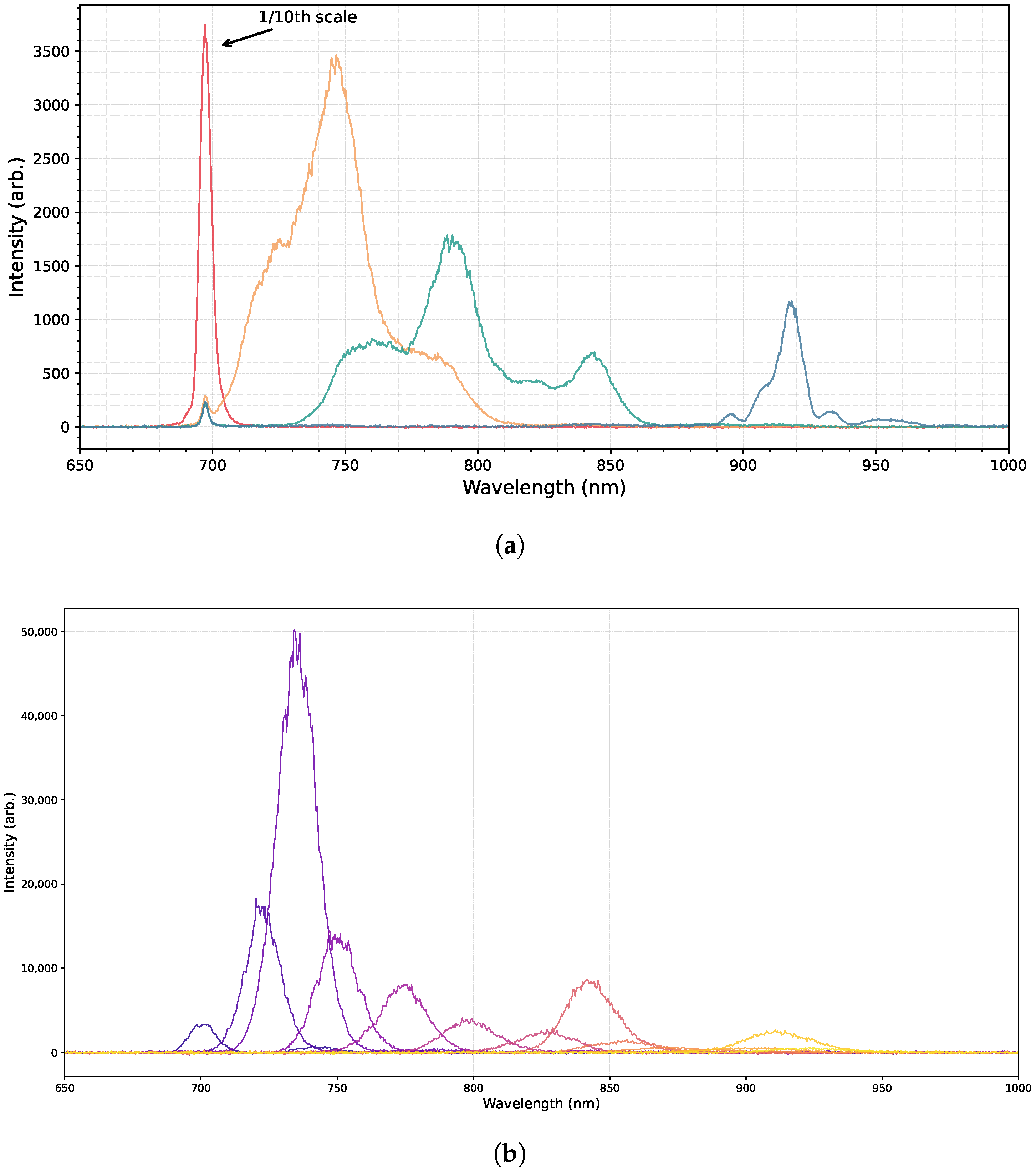
The sapphire window introduces sufficient group delay dispersion (GDD) to enable frequency-selective amplification of the seed pulse, as shown in
Figure 3a. However, the resulting spectra remain relatively broad and often exhibit irregular line shapes that are strongly influenced by the spectral structure of the seed pulse. Consequently, the resulting spectral features exhibit highly variable bandwidths, with FWHM values in some cases exceeding 40 nm. This behavior is attributed to the limited temporal stretching of the seed pulse, which leads to incomplete time–frequency separation and thus reduced spectral selectivity during the parametric amplification process. As a result, only modest spectral discrimination is achieved.
In contrast, the PBS-based configuration produces clearly defined and significantly narrower spectral peaks, as shown in
Figure 3b. The resulting spectra exhibit reproducible FWHM bandwidths of approximately 20–25 nm across the accessible tuning range. This improvement arises from the substantially larger group delay dispersion introduced by the SF1 glass. This does not merely increase the pulse duration; it also increases the temporal separation between neighboring spectral components. As a result, the finite pump pulse samples a narrower spectral region of the chirped seed, leading to improved wavelength selectivity and more reproducible spectral profiles.
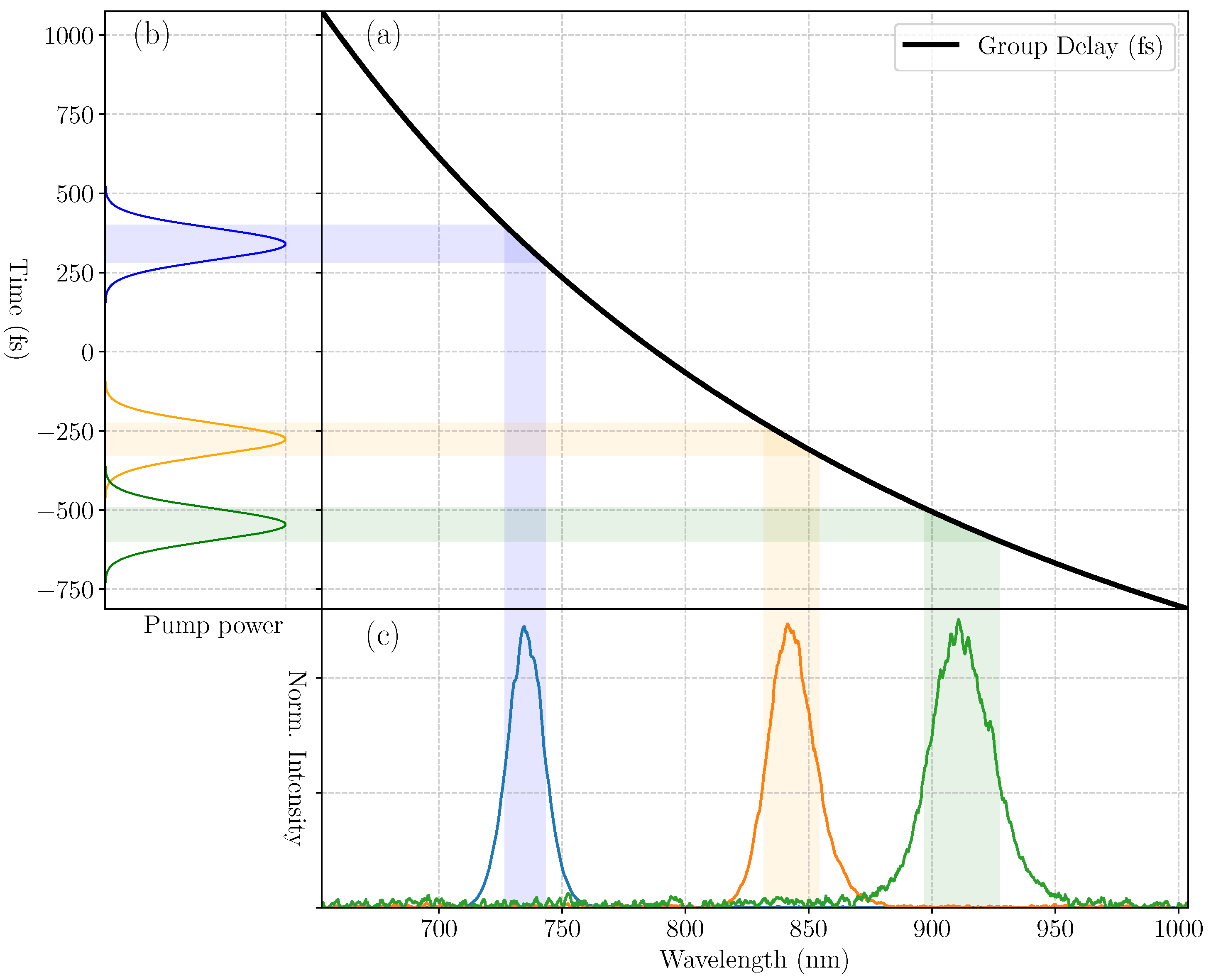
The underlying mechanism of this delay-dependent spectral selection is illustrated in
Figure 4. The group delay introduced by the SF1 medium maps the broadband seed spectrum onto the temporal domain (
Figure 4a). By adjusting the relative delay between pump and seed pulses (
Figure 4b), different temporal slices of the chirped seed are selectively amplified within the NOPA gain window. The corresponding measured spectra (
Figure 4c) confirm this time–frequency mapping and demonstrate continuous spectral tuning via pump–seed delay.
Taken together, the measurements demonstrate that the spectral output of the OPCPA can be controlled reproducibly through adjustment of the pump–seed delay in the presence of a strongly chirped seed pulse. The larger dispersion provided by the SF1-based configuration results in improved time–frequency separation and therefore substantially enhanced spectral selectivity compared to the sapphire-based implementation. This enables flexible generation of narrow-band spectral components across a broad tuning range while preserving compatibility with subsequent pulse compression.
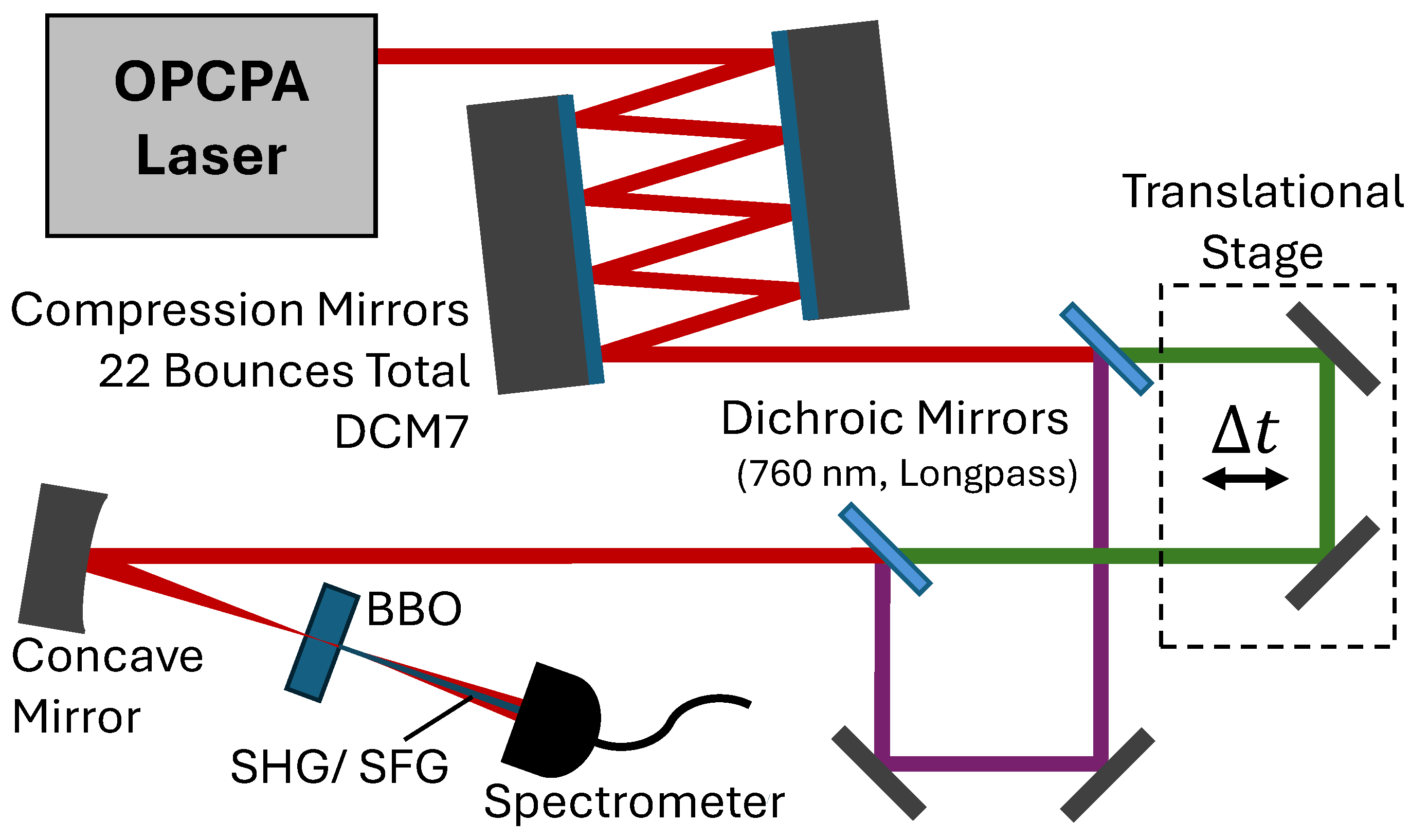
To verify the generation and temporal controllability of the two-color output, cross-correlation measurements were performed using a two-arm interferometric setup [
20] (see
Figure 5). The two spectral components were separated using a dichroic mirror and recombined after introducing a variable delay. Nonlinear mixing in a BBO crystal produced second-harmonic (SHG) and sum-frequency generation (SFG) signals, which were spectrally resolved.
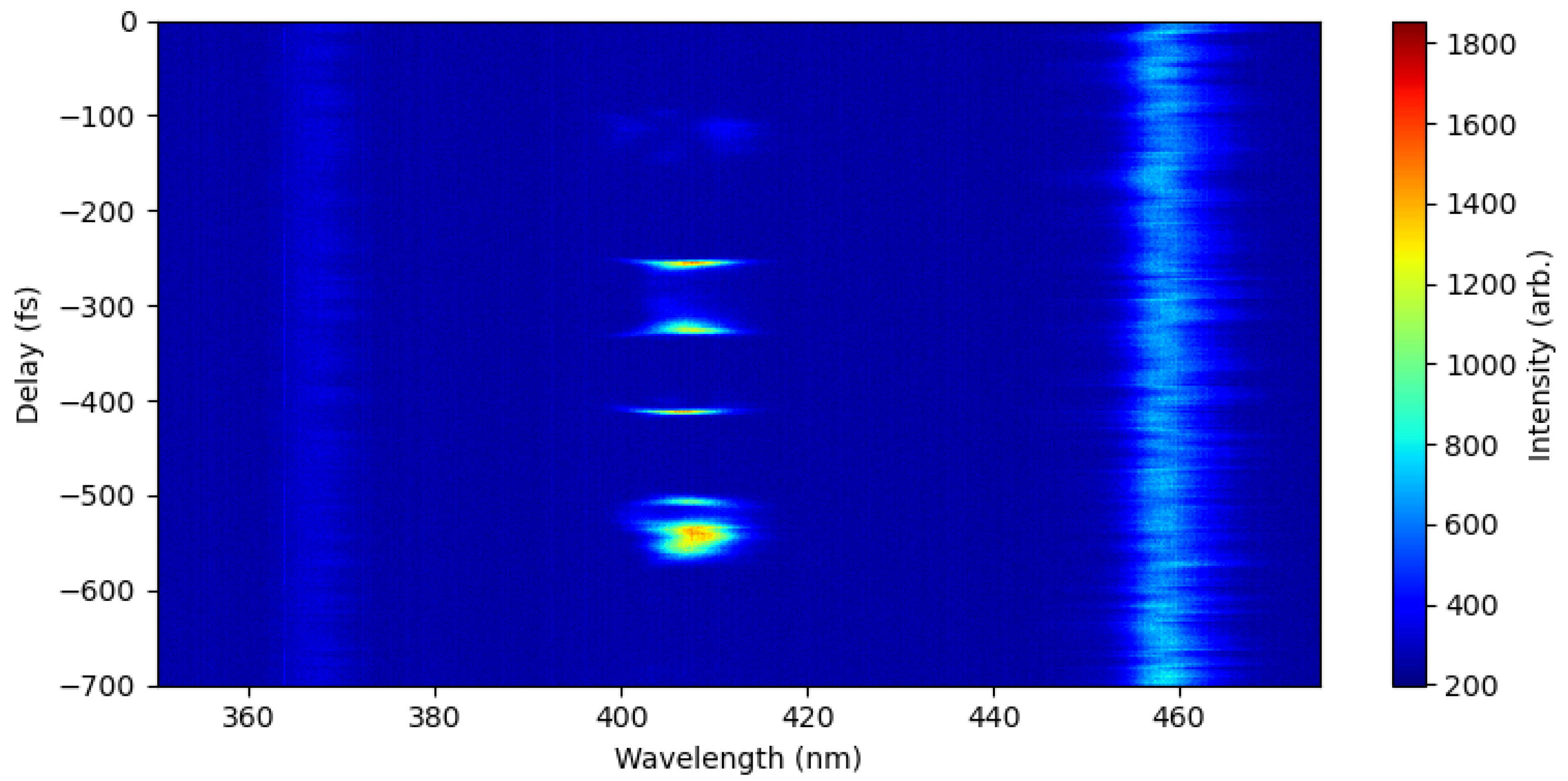
Distinct SHG signals are observed at 365 nm and 460 nm, corresponding to the 730 nm and 920 nm components (
Figure 6), respectively, while SFG at 410 nm appears only under temporal overlap conditions. This confirms the simultaneous generation and independent temporal control of the two spectral components. The cross-correlation trace exhibits a main peak with a duration on the order of ∼60 fs.
For the measured spectral bandwidths of approximately 20 nm (FWHM), the Fourier-transform-limited pulse durations are on the order of ∼40–60 fs, depending on the central wavelength of the respective spectral component. The observed cross-correlation width is therefore consistent with near-transform-limited pulses within experimental uncertainty, noting that the measurement reflects the convolution of both pulse durations and may include residual dispersion. In addition to the main feature, a series of satellite peaks with significantly shorter apparent durations is observed.
The origin of this multi-peak structure was investigated further. Notably, the temporal spacing and relative amplitude of the satellite peaks were found to be largely independent of the selected wavelengths and of the number of reflections on the chirped mirrors, suggesting that they do not arise from the intrinsic pulse structure or compression conditions. If the satellite peaks originated from secondary pulse replicas generated within the OPCPA itself, their relative timing and amplitude would be expected to vary as the spectral content and compression settings change. The absence of such behavior indicates that the observed structure is not directly linked to the pulse generation process. This observation instead points to the cross-correlation setup itself as the source of the additional temporal features. In particular, the use of dichroic beam splitters (Thorlabs DMLP760) for spectral separation and recombination introduces dispersive and partially reflective interfaces that may generate weak pulse replicas.
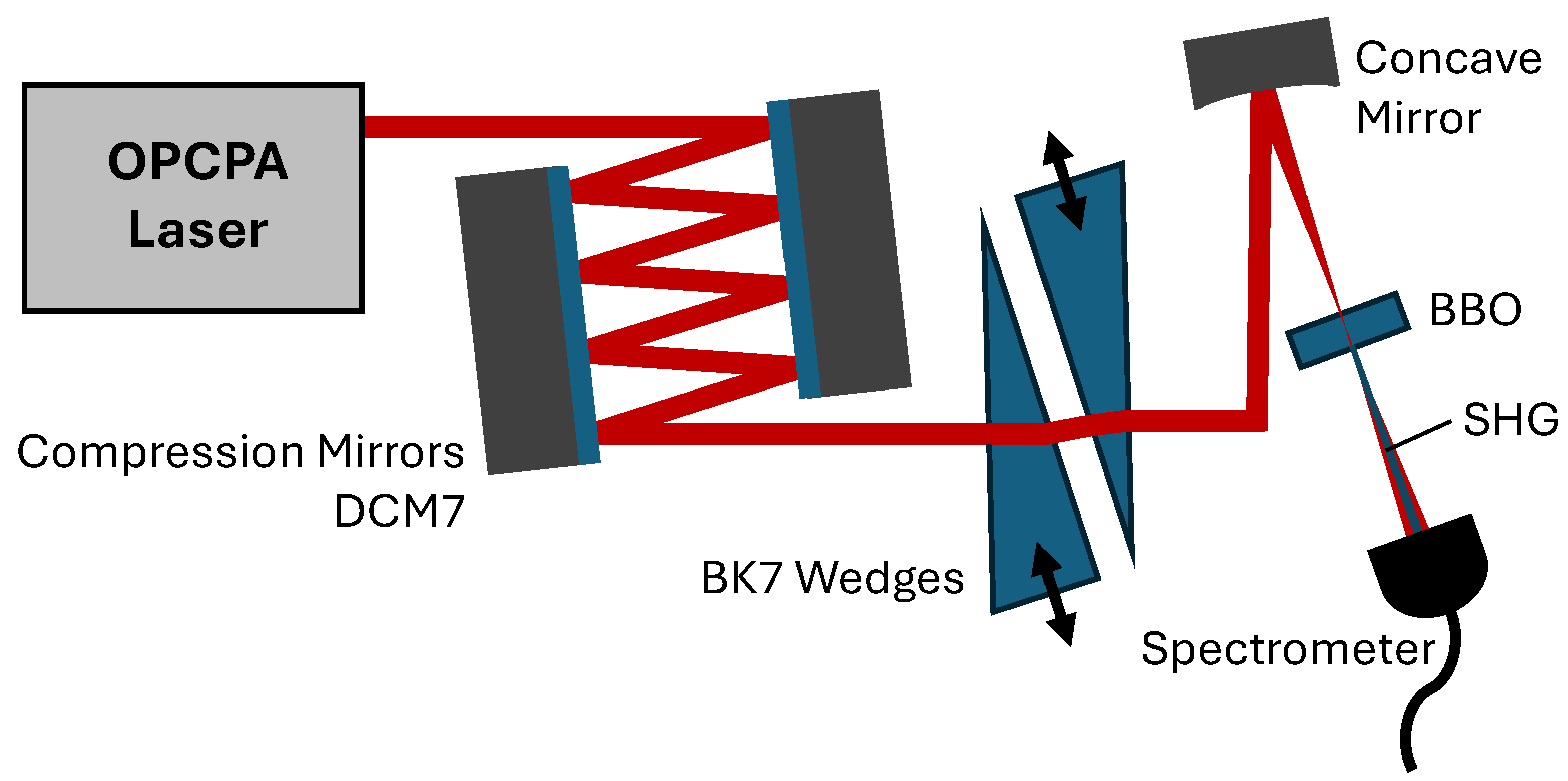
To test this hypothesis, independent pulse characterization was performed using a dispersion-scan (D-scan) technique [
21], as shown in
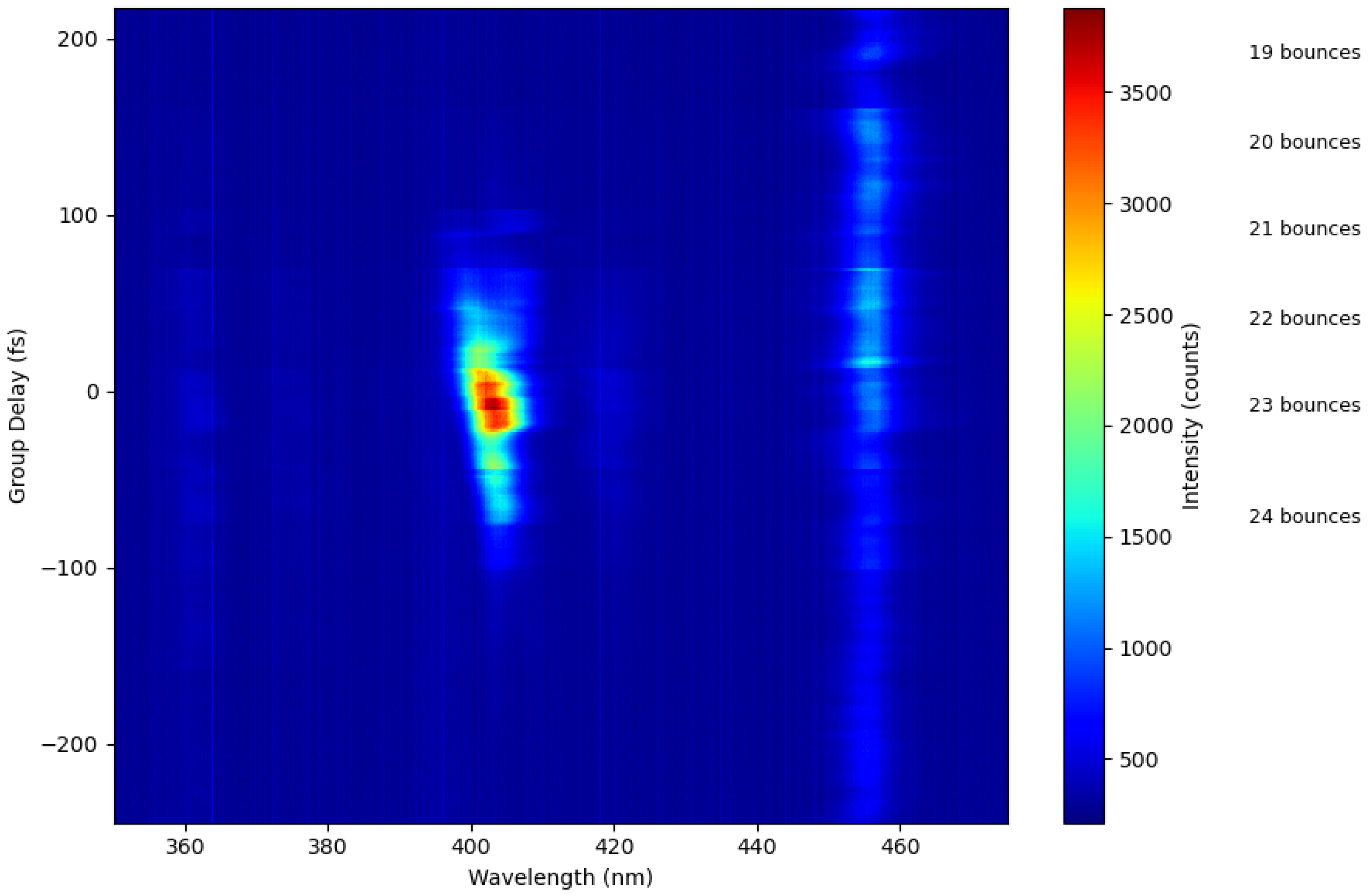
Figure 7. In this approach, the OPCPA output is analyzed without beam splitting or recombination. The pulses were compressed using chirped mirrors and subsequently propagated through a pair of BK7 wedges to introduce a variable amount of dispersion. The resulting second-harmonic spectra were recorded as a function of inserted glass thickness, thereby scanning the wavelength-dependent group delay and effectively varying the relative timing of different spectral components within the pulse. To extend the accessible dispersion range, the number of reflections on the chirped mirrors was varied between successive wedge scans. The retrieved D-scan traces (
Figure 8) yield a pulse duration of approximately 60 fs within experimental uncertainty. Notably, no satellite features are observed in the D-scan traces, despite the fact that this technique is sensitive to pulse replicas and higher-order temporal structure. Since the D-scan measurement probes the laser output directly without beam splitting or recombination, the absence of corresponding features provides strong evidence that the multi-peak structure observed in the cross-correlation measurement is not intrinsic to the OPCPA output. Instead, the additional peaks must be introduced by optical components located within the cross-correlator prior to the nonlinear interaction.
A possible source of these artifacts is the dichroic mirrors used for spectral separation and recombination, which may introduce weak secondary reflections and dispersion effects due to their multilayer coating structure. The comparatively narrow width of the individual peaks is attributed to the large frequency separation between the two spectral components, which leads to a rapidly varying temporal modulation in the nonlinear signal. Consequently, the cross-correlation trace reflects both the pulse envelope and interference between the two frequency components. Replacement of these optics with low-dispersion or ultrafast-optimized beam splitters is expected to suppress these artifacts in future implementations.
As a further characterization of the two-color OPCPA output, a cross-correlation measurement was performed using a cold target recoil ion momentum spectrometer (COLTRIMS) [
13,
22] in place of the optical detection scheme discussed above. In this configuration, ionization of trapped lithium atoms served as the nonlinear detection process. Neutral lithium is a particularly suitable target because of its low ionization potential, allowing efficient ionization through the absorption of only a few photons in the wavelength range accessible to the OPCPA system. Furthermore, the well-known electronic structure of lithium facilitates the interpretation of the resulting photoelectron spectra and provides a convenient benchmark for evaluating the temporal overlap of the two spectral components. The atoms were confined in an all-optical trap, as described in Ref. [
23], with a valence electron prepared in either the
ground state or the
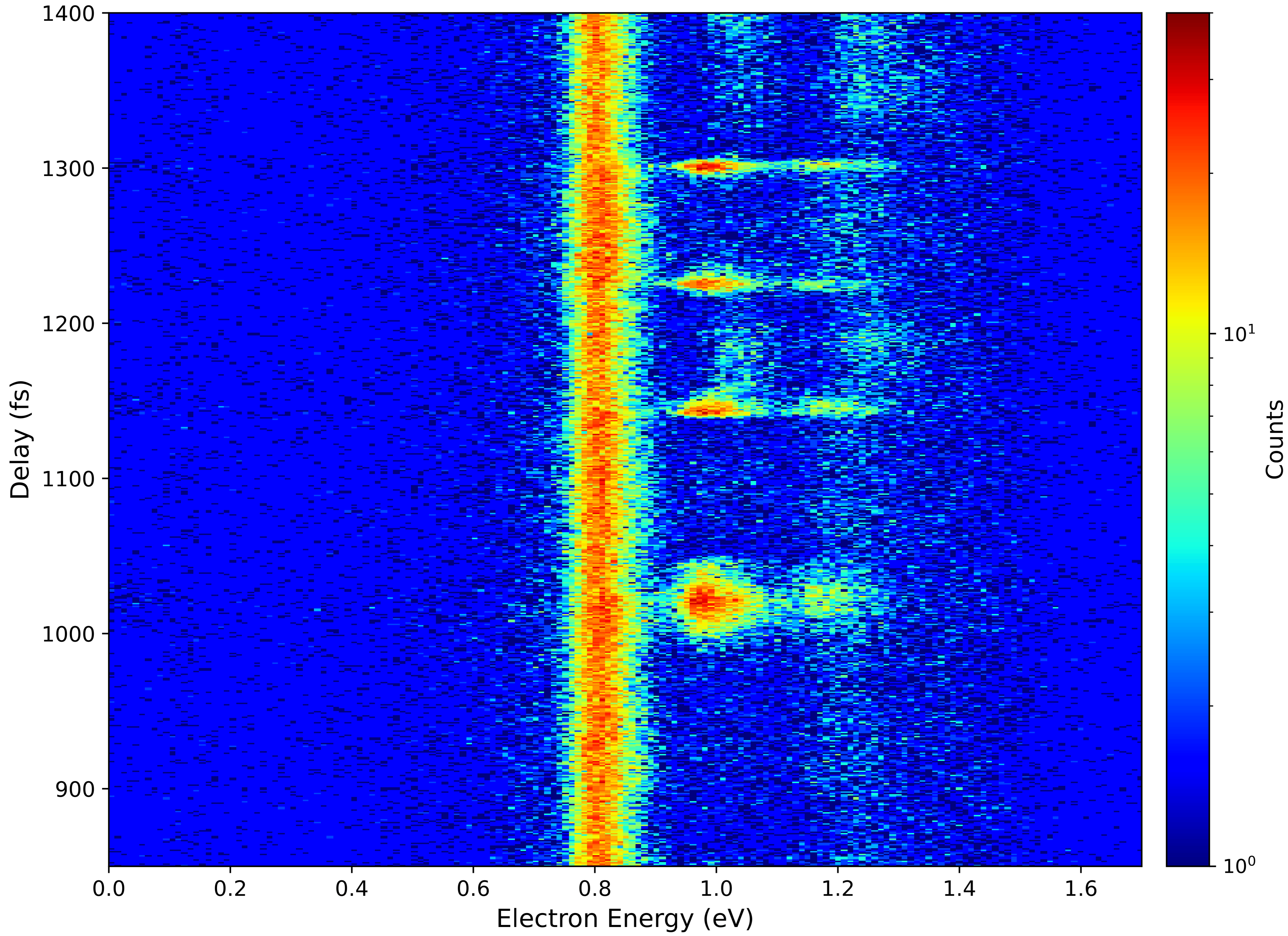
excited state. The OPCPA output was tuned to produce two spectral components centered at 735 nm (45 mW) and 840 nm (65 mW). COLTRIMS enables coincident measurement of the photoelectron momentum and kinetic energy for each ionization event, allowing delay-dependent photoelectron spectra to be recorded as a function of the relative timing between the two colors. Because multiphoton ionization depends nonlinearly on the instantaneous electric field, photoelectron channels involving photons from both spectral components are expected to be enhanced only when the pulses overlap temporally. The atomic response therefore provides an independent probe of the relative timing between the two colors and complements the purely optical cross-correlation measurements discussed above.
The resulting electron energy spectra, shown in
Figure 9, exhibit a pronounced structure that closely resembles the nonlinear signal observed in the optical cross-correlation measurements (
Figure 6). The observed spectral features can be understood in terms of multiphoton ionization pathways involving different combinations of 735 nm and 840 nm photons. The 0.8 eV feature is consistent with ionization from the
state via absorption of three 840 nm photons. The peak at 0.98 eV arises from mixed pathways involving two 840 nm photons and one 735 nm photon, while the 1.22 eV feature is consistent with absorption of one 840 nm photon and two 735 nm photons. The requirement of temporal overlap between the two colors for the appearance of the latter features further supports their assignment to bichromatic ionization channels.
The observed peak positions are therefore consistent with the expected energy balance obtained from the known lithium energy levels and the photon energies of the driving fields. The assignment relies only on energy conservation and does not require adjustable parameters. While this agreement provides strong support for the identification of the dominant ionization pathways, a quantitative description of the relative peak intensities, angular distributions, and delay-dependent modulation of the signals would require dedicated calculations of the corresponding multiphoton transition amplitudes. Such calculations are beyond the scope of the present work, whose primary objective is the characterization of the two-color OPCPA source and the demonstration of its application in a COLTRIMS-based atomic physics experiment.
Overall, the presented measurements demonstrate controlled generation and characterization of a two-color femtosecond field with independently tunable spectral components and adjustable relative delay. The combination of optical cross-correlation, dispersion-scan characterization, and COLTRIMS-based ionization measurements provides a consistent picture of the pulse structure and its interaction with matter. Importantly, the observed agreement between optical nonlinear signals and strong-field ionization response highlights the robustness of the two-color OPCPA scheme for bichromatic excitation experiments. These results establish the basis for its application in time-resolved studies of atomic and molecular dynamics in the multiphoton regime.