Article

Pressure-Driven Phase Transition in InPO4: The Elastic Response of CrVO4-Type, Scheelite, and Zircon Polymorphs


by
Jesus E. Aviles-Coronado
1,
Pricila Betbirai Romero-Vázquez
2 and
Sinhué López-Moreno
3,4,*
1
División de Materiales Avanzados, IPICYT, Camino a la Presa de San José 2055 Col. Lomas 4a Sección, San Luis Potosí 78126, Mexico
2
División de Mecatrónica, Tecnológico Nacional de México—Instituto Tecnológico Superior de Zacapoaxtla, Zacapoaxtla 73680, Puebla, Mexico
3
División de Materiales Avanzados-IPICYT/SECIHTI, Camino a la Presa de San José 2055 Col. Lomas 4a Sección, San Luis Potosí 78126, Mexico
4
Grupo de Ciencia e Ingeniería Computacionales—Centro Nacional de Supercómputo, IPICYT, Camino a la Presa de San José 2055 Col. Lomas 4a Sección, San Luis Potosí 78216, Mexico
*
Author to whom correspondence should be addressed.
Quantum Beam Sci. 2026, 10(2), 14; https://doi.org/10.3390/qubs10020014 (registering DOI)
Submission received: 12 April 2026 / Revised: 2 June 2026 / Accepted: 9 June 2026 / Published: 15 June 2026
(This article belongs to the Section Structure and Dynamics of Functional Materials)

Abstract

In this work, we present a theoretical study of InPO4 under pressure. Total-energy calculations based on density functional theory were performed to explore the crystal structure of InPO4 in light of the recent X-ray diffraction characterization of this compound under pressure. A phase coexistence was observed above 10 GPa, involving the ambient-pressure CrVO4-type structure and the high-pressure scheelite and zircon phases. Therefore, the previously performed analysis of InPO4 behavior under pressure is extended by simulating X-ray spectra and interplanar distances for the three polymorphs. In addition, the elastic behavior of the three phases is analyzed to assess the elastic stability of InPO4 under pressure and to compute the mechanical properties and elastic anisotropy. Our findings significantly extend previous experimental results on the compressibility of InPO4, which were limited to the ambient-pressure phase. Moreover, our results unambiguously reveal a marked difference in the elastic properties of the scheelite and zircon phases under pressure, showing that the zircon phase is elastically unstable at high pressures. This suggests that the reported coexistence of phases may result from kinetic barriers or from non-hydrostatic conditions within the diamond anvil cell caused by the pressure-transmitting medium.

1. Introduction

One of the main characteristics of the ABO4 compounds is their remarkable structural versatility, as they can crystallize in a wide range of crystal structures. Their polymorphism is determined by several physical and chemical parameters, among which the ionic radii of the cations and the anion ( r A , r B , r O ), the atomic nature of the elements that constitute the system, and the coordination number of the cations with oxygen are particularly important [1]. Thus, many of these compounds crystallize in specific structures, such as the zircon [2], scheelite [3], fergusonite [4], wolframite [5], and CrVO4-type [6] structures, among others. The common thread among these structures is captured by Bastide’s diagram [1], in which the structures of the compounds ABO4 are arranged according to the aspect ratios of their ionic radii [(x, y): ( r A / r O , r B / r O )]. In addition, the north-east rule in Bastide’s diagram helps predict the pressure-driven phase transition in ABO4 compounds [7].
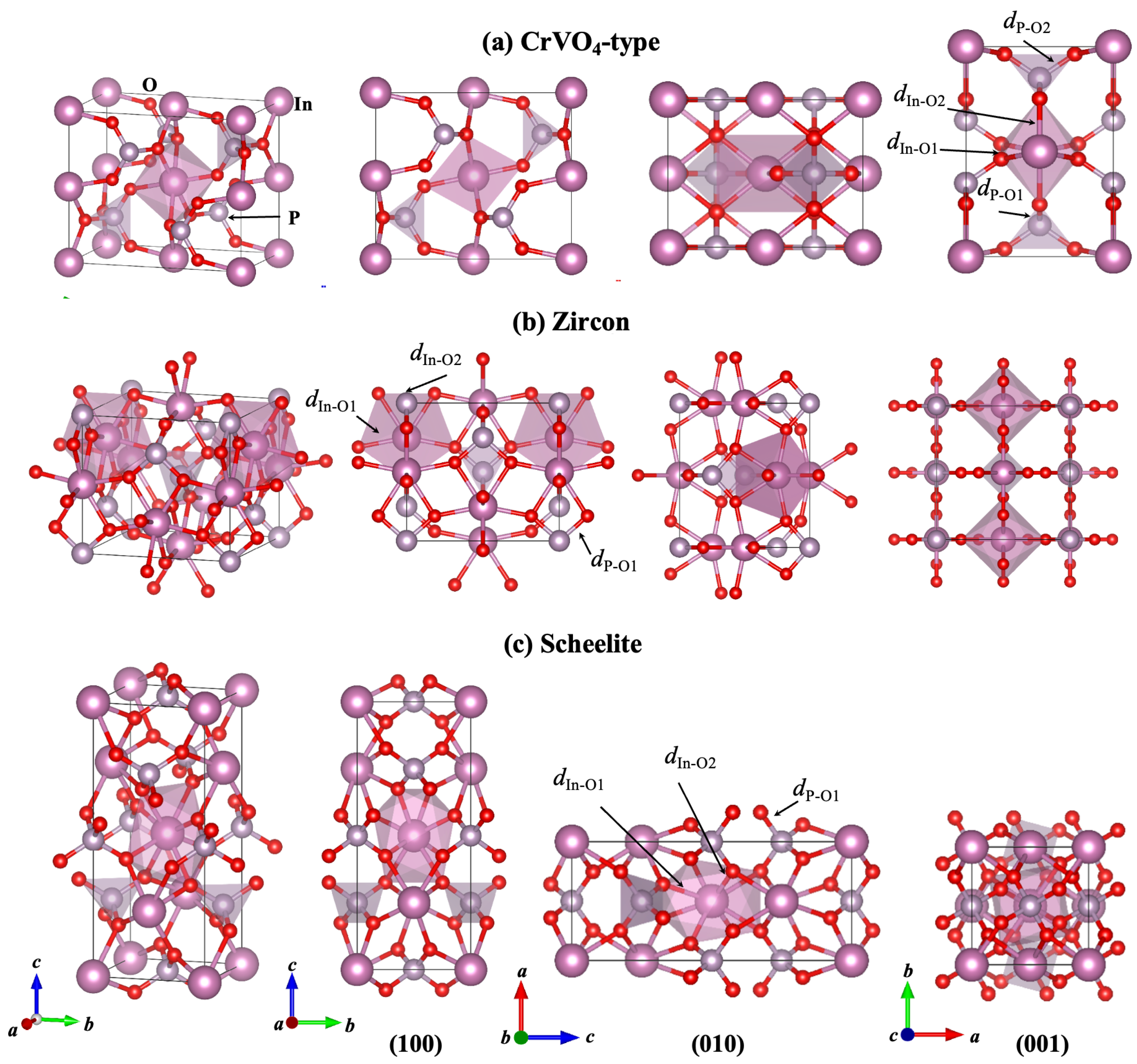
Among the structures mentioned, the orthorhombic CrVO4-type structure [Space Group (SG): C m c m , No. 63, Z = 4] is a characteristic polymorph of vanadates AVO4 [8], phosphates APO4 [9], chromates ACrO4, sulfates ASO4, and selenates ASeO4 [10]. Within this structure, there are four non-equivalent Wyckoff positions (WP): cation A occupies 4a (0, 0, 0), cation B occupies 4c (0, y, 1/4), and oxygen atoms are distributed among 8f (0, y, z) and 8g (x, y, 1/4). The crystal structure consists of chains of AO6 octahedra nearly aligned with the z axis; these distorted octahedra have two non-equivalent bond distances ( d A O 1 in the equator and d A O 2 at the apex). These chains coexist with BO4-distorted tetrahedra, which also exhibit two non-equivalent bond distances ( d B O 1 , d B O 2 ). According to the literature, the phosphates that crystallize in the CrVO4-type structure at ambient pressure are TiPO4, VPO4, CrPO4, InPO4, and TlPO4 [10]. The CrVO4-type crystal structure of InPO4 is shown in Figure 1a, which details the connections between polyhedra and the internal interatomic distances.
Indium phosphate was recently studied under pressure; experiments were conducted using synchrotron-based angle-dispersive X-ray diffraction and Raman scattering in a Mao-Bell-type diamond anvil cell (DAC) up to 31.5 GPa [12]. It was reported that the CrVO4-type structure remains stable up to 10 GPa; beyond 12.3 GPa, the Raman spectra and X-ray diffraction patterns showed signatures of a structural phase transition, with CrVO4-type, scheelite (SG: I41/a, No. 88, Z = 4), and zircon (SG: I41/amd, No. 141, Z = 4) phases coexisting up to the highest pressure reached in the DAC. Phase coexistence has been previously observed in ABO4 compounds, such as FeVO4 [13]. However, subsequent studies did not observe this phase coexistence [14].
For InPO4, the observed tetragonal phases consist of InO8 dodecahedra and PO4 tetrahedra. In zircon, the WPs for In, P, and O are 4b (0, 0.25, 0.375), 4a (0, 0.75, 0.125), and 16h (0, y, z), respectively. Figure 1b shows that the structure is formed by alternating edge-sharing InO8 dodecahedra and PO4 tetrahedra, which form chains parallel to the c axis. In the scheelite structure, the WPs for In, P, and O are 4b (0, 0.25, 0.625), 4a (0, 0.25, 0.125), and 16f (x, y, z), respectively. According to Figure 1b, the InO8 units share edges and corners with other InO8 units and with PO4 tetrahedra. According to Figure 1b,c, there is only one P–O interatomic distance ( d P O ) and two In–O interatomic bond distances ( d In O ) in the tetragonal structures.
According to the north-east rule of the Bastide diagram, the CrVO4-type structure could undergo a pressure-driven phase transition to the zircon phase and subsequently to a scheelite phase [1,10]. A previous first-principles study investigated the structural and vibrational changes of InPO4 and TiPO4 under pressure and reported such a phase transition [9]. Another theoretical report observed the same behavior for TiSiO4 [15]. Therefore, the experimental results for InPO4 [12] are of utmost importance, since many ABO4 compounds with a CrVO4-type structure undergo pressure-induced phase transitions to a monoclinic structure [6,16,17,18]. Furthermore, the new results offer an opportunity to examine the mechanical properties of this compound more thoroughly, beyond the bulk modulus.
In this work, we explore the structural changes in InPO4 using first-principles calculations up to 20 GPa, a pressure range that corresponds to nearly hydrostatic behavior [19,20,21] for the pressure-transmitting medium (4:1 methanol-ethanol mixture) used in the experiments within the DAC performed in Ref. [12]. Given the reported experimental results, we analyze the CrVO4-type structure up to 10 GPa and the high-pressure phases between 10 and 22 GPa, comparing our results with available experimental data. In addition, we analyze the elastic and mechanical properties, including anisotropic elasticity, to gain a deeper understanding of InPO4 at high pressures. The evolution of the mechanical properties is examined by taking into account the experimental results obtained from the equation of state (EOS) of the low-pressure phase with CrVO4-type structure [12].
The paper is organized as follows: the computational details are presented in the next section. The results for the crystal structure, elastic constants, mechanical properties, and elastic anisotropy are reported in Section 3.1, Section 3.2, Section 3.3, and Section 3.4, respectively. Finally, a summary and the conclusions are provided in Section 4.

2. Computational Details

First-principles calculations were performed within the framework of the density functional theory (DFT) [22] and the projector-augmented wave (PAW) [23,24] method as implemented in the Vienna Ab initio Simulation Package (VASP) [25]. We have considered 13 valence electrons for In (5 s 2 4 d 10 5 p 1 ), five for P (3 s 2 3 p 3 ), and six for O (2 s 2 2 p 4 ) atoms in the PAW pseudo-potential. A plane-wave energy cutoff of 520 eV was used to ensure a high precision in our calculations. The exchange-correlation energy has been described within the generalized-gradient approximation (GGA) in the Perdew–Burke–Ernzerhof for solids (PBEsol) formulation [26].
The self-consistent calculations were performed with the Monkhorst–Pack scheme for the Brillouin-zone (BZ) integrations [27] with meshes 4 × 3 × 3, 4 × 4 × 4, and 4 × 4 × 2, corresponding to sets of 36, 40, and 32 special k-points in the irreducible BZ for the CrVO4-type, zircon, and scheelite phases, respectively. In the relaxed equilibrium configuration, the forces are less than one meV/Å per atom in each Cartesian direction. The calculations of the elastic constants have been performed with k-point meshes 8 × 6 × 6, 8 × 8 × 8, and 8 × 8 × 4, a plane-wave energy cutoff of 570 eV, and a POTIM parameter of 0.010. Highly converged results for forces are required to obtain the elastic constants under pressure [28]. The elastic tensor has been determined by performing six finite distortions of the lattice and deriving the elastic constants from the strain–stress relationship [29]. The processing of the elastic constant data calculated with VASP was performed using the VASPKIT program [30]. Our computed X-ray diffraction patterns were generated with the VESTA program [11] using the experimental λ wavelength ( λ = 0.6125 Å). The simulated X-ray peak intensities are displayed on a relative scale from 0 to 100, where the most intense peak of each phase is set to 100 arbitrary units. The relative peak intensities are proportional to the square of the structure factor: I | F h k l | 2 .

3. Results and Discussion

3.1. Crystal Structure

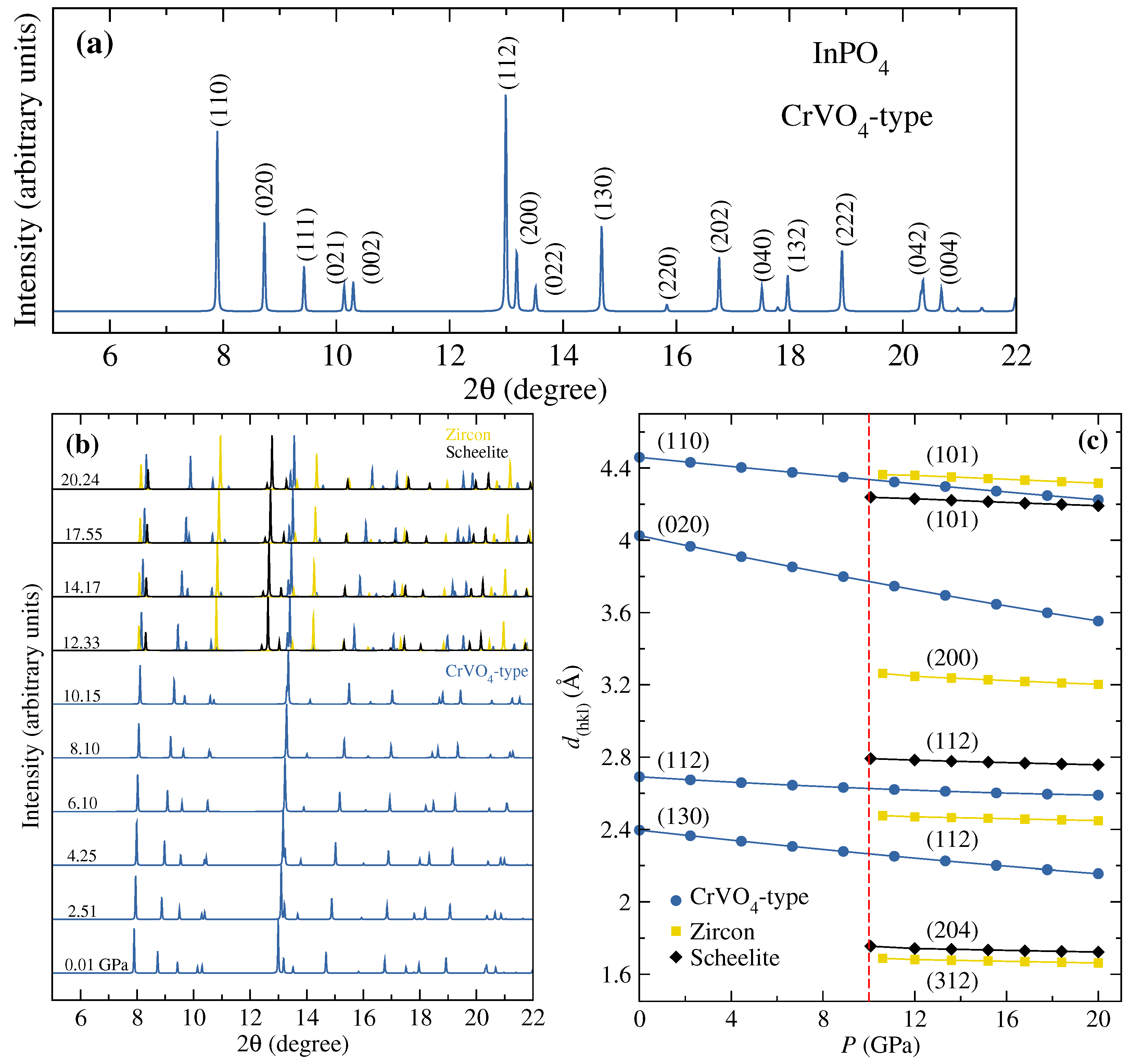
The theoretically calculated X-ray diffraction (XRD) patterns of InPO4 in the orthorhombic CrVO4-type structure at ambient pressure are shown in Figure 2a. The simulated diffraction pattern reproduces the relative peak positions and intensities reported experimentally for this phase [12]. Our computed lattice parameters [9] are a = 5.3355 Å, b = 8.0454 Å, and c = 6.8255 Å (V = 293 Å3), which are in good agreement with the experimental values a = 5.3212(10) Å, b = 8.0096(8) Å, and c = 6.7955(12) Å (V = 289.62 Å3) [12]. The differences between the theoretical and experimental results are less than 1% (≈1%), confirming the reliability of the structural description of InPO4 used in this work.
As shown in Figure 2a, the most intense reflections occur at approximately 7.89, 8.73, 13.11, and 14.68 2 θ degrees, which can be indexed to the (110), (020), (112), and (130) crystallographic lattice planes, respectively, characteristic of the orthorhombic CrVO4-type structure of InPO4 at ambient pressure. These results are in excellent agreement with the Rietveld-refined X-ray diffraction pattern reported by Dwivedi et al. for InPO4 obtained using synchrotron radiation with a wavelength of λ = 0.6125 Å [12].
As pressure increases from atmospheric pressure to ≈20 GPa, a systematic evolution of the diffraction peaks is observed. These changes are characterized primarily by a continuous shift of the reflections toward higher 2 θ angles, indicating a progressive reduction in the interplanar spacings d h k l . This behavior is consistent with the reduction of the lattice parameters induced by external pressure [9,12].
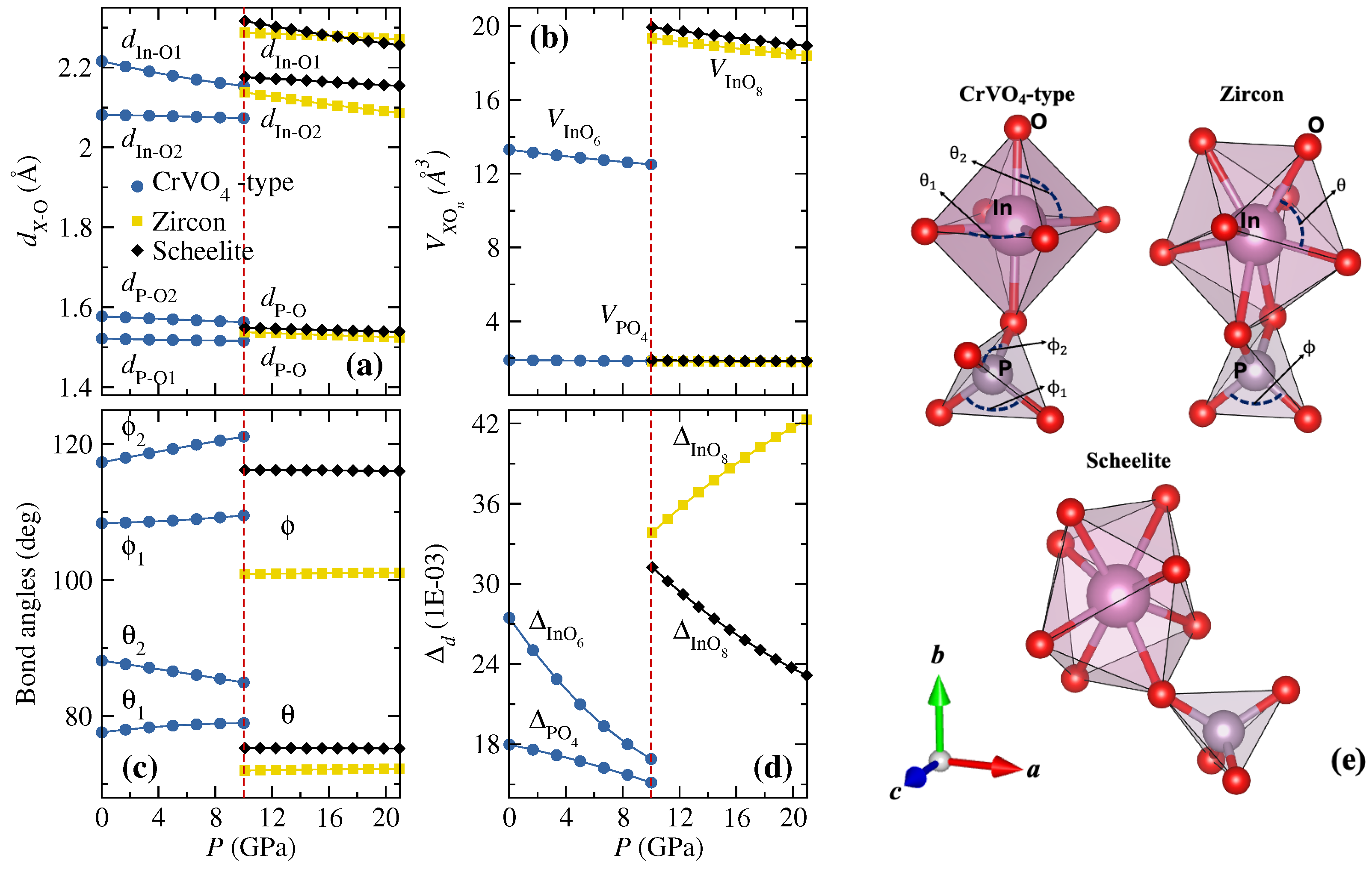
Throughout the entire pressure range investigated, the characteristic diffraction peaks of the CrVO4-type structure persist, with no new reflections appearing or existing ones abruptly disappearing. This suggests that the orthorhombic structure of InPO4 remains stable over the pressure range studied. However, slight variations in the relative intensities of some peaks are observed, which may be associated with anisotropic changes in the lattice parameters and internal atomic positions under compression. The change in internal parameters with pressure is shown in Figure 3, indicating that the most significant changes in the crystal structure are associated with the In-O polyhedra across the three polymorphs. In particular, despite slight changes in the interatomic distances of the PO4 tetrahedron ( d P O n ), its polyhedral volume ( V PO 4 ) remains almost constant, due to changes in its internal angles ( θ n and ϕ n ), which are reflected in the distortion parameter ( Δ d ).
The evolution of the interplanar distances d h k l with pressure for the most intense peaks is shown in Figure 2c. The most pronounced changes in the experimental results for InPO4 occur for the (110) and (112) lattice planes [12]. A shift in these interplanar distances was already observed in the orthorhombic phase III of CrVO4 under pressure, but over a shorter pressure range [6]. In the CrVO4-type structure of InVO4, the most relevant changes under pressure were observed for the (020), (112), and (130) lattice planes [16].
Given the phase coexistence above 12 GPa observed in the experiments [12], Figure 2b shows the simulated X-ray diffraction patterns of the zircon and scheelite phases up to 20.24 GPa. Figure 2c shows the interplanar distance d h k l of the most representative planes of both phases as a function of pressure. As clearly shown, the change in d h k l is most significant for the CrVO4-type structure, which is due to the fact that the elastic constants and mechanical properties of this phase are smaller than those of zircon and scheelite.
In the experimental results from Ref. [12], the h k l indices for the Bragg reflections are not reported, making it difficult to analyze our data in relation to those results. Furthermore, to our knowledge, there are no experimental X-ray diffraction studies of other phosphates that exhibit a pressure-driven phase transition from CrVO4-type to zircon or scheelite and could be used to correlate with our results. However, to support our results, we compare the scheelite X-ray diffraction pattern of InPO4 with that of SrWO4 [31], which is one of the most studied scheelite wolframates [1]. To compare our simulated X-ray diffraction pattern, we used the wavelength λ = 1.5406 Å employed in Ref. [31] and found good agreement with the relative positions of the diffraction peaks of scheelite SrWO4. The most intense reflections occur at 8.31, 12.63, and 20.16 2 θ degrees for the (101), (112), and (204) crystallographic lattice planes at 12 GPa, respectively. As in scheelite compounds, the most significant changes occur along the [001] direction because the crystal is better packed in the x y plane.
The same procedure was successfully applied to the zircon phase by comparing our simulated X-ray diffraction pattern with experimental X-ray characterization of zircon NdVO4 at a wavelength λ = 0.6199 Å [32]. In this case, the most intense reflections occur at 8.07, 10.81, 14.24, and 20.96 2 θ degrees for the (101), (200), (112), and (312) crystallographic lattice planes at 12.33 GPa, respectively. In this case, the structural changes are more pronounced in the lattice parameter a, as will be seen in the following section.

3.2. Elastic Constants

The elastic behavior of the orthorhombic CrVO4-type polymorph of InPO4 is described by nine independent elastic constants ( c 11 , c 22 , c 33 , c 44 , c 55 , c 66 , c 12 , c 13 , c 23 ) [33]. c 11 , c 22 , and c 33 are associated with longitudinal compression, c 12 , c 13 , and c 23 with transverse expansion, and c 44 , c 55 , and c 66 with pure shear [34]). The computed elastic constants and their pressure coefficients for InPO4 in the CrVO4-type structure (at atmospheric pressure), zircon (at 12.3 GPa), and scheelite (at 13 GPa) phases are presented in Table 1. Taken together, these c i j describe the stability and anisotropic response of the crystal to external stresses and indicate which planes and directions are more prone to deformation. Therefore, we assess the stability of the system using the criteria for orthorhombic systems, which require the following: c 11 > 0 , c 11 c 22 > c 12 2 , c 11 c 22 c 33 + 2 c 12 c 13 c 23 c 11 c 23 2 c 22 c 13 2 c 33 c 12 2 > 0 , c 44 > 0 , c 55 > 0 , and c 66 > 0 [35]. Our results in Table 1 for the CrVO4-type structure at atmospheric pressure confirm that these conditions are satisfied.
At ambient pressure, the relation c 11 > c 33 > c 22 is observed, indicating that the x axis is the most resistant to longitudinal compression. This trend was also observed in the CrVO4-type structure of FeVO4 [18]. This behavior aligns with trends in the structural parameters and reflects differences in the crystal lattice’s packing efficiency [9,12]. The transverse expansion constants indicate that c 13 > c 12 > c 23 , meaning the z axis is more prone to deformation under [010] stress. Regarding the shear elastic constants, c 55 > c 44 > c 66 , indicating that the x y plane is the most susceptible to deformation.
Under hydrostatic pressure, the extended stability criteria for the orthorhombic CrVO4-type structure are as follows [36]: c ˜ 11 > 0 , c ˜ 11 c ˜ 22 > c ˜ 12 2 , c ˜ 11 c ˜ 22 c ˜ 33 + 2 c ˜ 12 c ˜ 13 c ˜ 23 c ˜ 11 c ˜ 23 2 c ˜ 22 c ˜ 13 2 c ˜ 33 c ˜ 12 2 > 0 , c ˜ 44 > 0 , c ˜ 55 > 0 , and c ˜ 66 > 0 . Here, c ˜ i i = c i i P (i = 1, …, 6), c ˜ 12 = c 12 + P , c ˜ 13 = c 13 + P , and c ˜ 23 = c 23 + P . According to the c i j values in Table 1 at 10.15 GPa, the CrVO4-type structure satisfies the stability criterion, indicating elastic stability under pressure. Previous results on the phonon spectrum of InPO4 also show that the CrVO4-type structure is dynamically stable from atmospheric pressure [9] up to 10 GPa (not published).
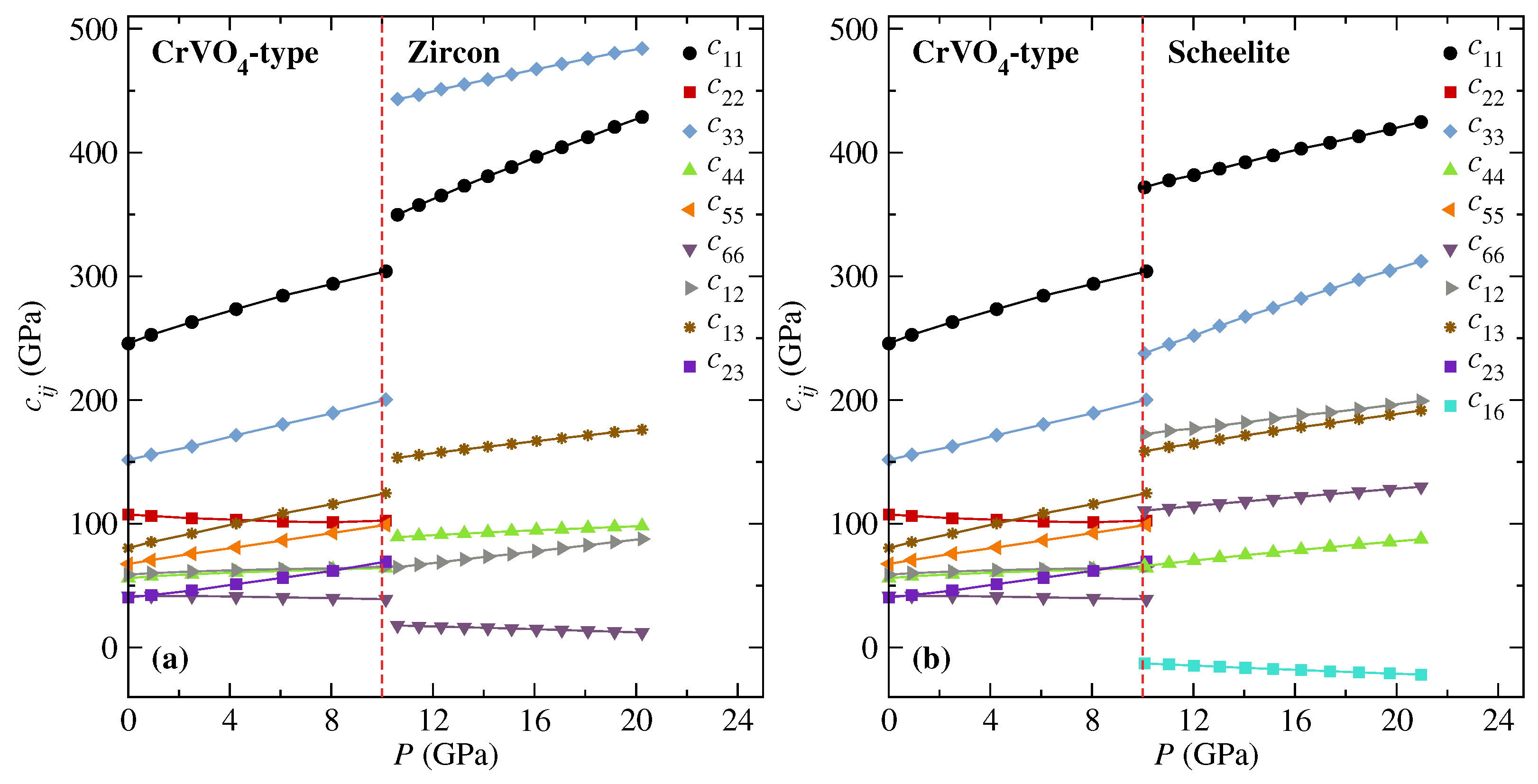
According to Table 1 and Figure 4, the longitudinal compression elastic constants, c 11 and c 33 , show the largest increases with pressure, reflecting improved packing efficiency. In contrast, the decrease in c 22 aligns with the high sensitivity of the lattice parameter b to the notable reduction in the equatorial distance d In O 1 relative to the apical distance in the InO6 polyhedra, see Figure 1a and Figure 3a. For the transverse compression constants, although all exhibit positive pressure coefficients, c 13 and c 23 show significantly larger pressure coefficients than c 12 , reinforcing the idea that the y axis controls a large part of the mechanical anisotropy of the CrVO4-type structure under pressure. On the other hand, although the PO4 tetrahedra do not undergo such pronounced deformations, they display significant angular variations that enable the rotation of the octahedra, indirectly contributing to the strong anisotropy observed along the y axis [9], which ultimately leads to the pressure-induced phase transition [12].
As shown in Figure 4, the elastic constants of the tetragonal zircon and scheelite high-pressure phases were computed between 10 and 22 GPa. The tetragonal high-pressure phases belong to different Laue classes: 4 / m for scheelite and 4 / m m m for zircon. Both structures have the same six elastic constants ( c 11 , c 33 , c 44 , c 66 , c 12 , and c 13 ), but scheelite, due to its Laue class, has a seventh elastic constant, c 16 , which indicates coupling between strain and shear stresses. The significance of the first six elastic constants is similar to that of the CrVO4-type structure, with the difference that in these phases c 11 = c 22 , c 44 = c 55 , and c 13 = c 23 [34]. Table 1 presents the calculated values for the zircon (12.33 GPa) and scheelite (13.03 GPa) phases, together with their pressure coefficients.
The elastic stability criteria for zircon under pressure require that [36]: c ˜ 44 > 0 , c ˜ 66 > 0 , c ˜ 11 | c ˜ 12 | > 0 , and c ˜ 33 ( c ˜ 11 + c ˜ 12 ) 2 c ˜ 13 2 > 0 . Based on the c i j and d c i j / d P values in Table 1, the zircon phase is elastically stable up to 15.2 GPa; beyond this pressure, the stability condition c ˜ 66 > 0 is no longer satisfied. These results may be related to the small slope of one acoustic phonon branch along the M- Γ path in zircon’s phonon spectrum at low pressures. Under conditions of non-coexistence of phases, the zircon phase is stable only at low pressures and within a relatively small pressure range [9].
It is observed that c 33 > c 11 in the zircon phase, indicating that the z axis is the most resistant to longitudinal compression. Nevertheless, when examining the pressure coefficients, the [100] direction emerges as the most prominent. For the c i j elastic constants, c 13 is much larger than c 12 . However, both show similar pressure coefficients, indicating that the pressure’s effect on the y and z axes is nearly the same for transverse expansion. The shear elastic constant c 44 > c 66 across the entire pressure range considered.
For scheelite under pressure, the stability criteria require [36]: c ˜ 44 > 0 , c ˜ 11 | c ˜ 12 | > 0 , c ˜ 33 ( c ˜ 11 + c ˜ 12 ) 2 c ˜ 13 2 > 0 , and c ˜ 66 ( c ˜ 11 c ˜ 12 ) 2 c 16 2 > 0 . Based on the results in Table 1, these conditions are satisfied across the pressure range considered. We also observe that c 11 > c 33 , indicating that the x axis is the most resistant to longitudinal compression, because the scheelite phase is more compact in the x y plane than along the [001] direction [28]. This behavior is also reflected in the higher value of c 12 compared to c 13 , indicating that the scheelite phase is more resistant to deformation along the [010] direction than along the [001] direction when stress is applied along the x axis. The fact that c 66 > c 44 reflects the material’s strength in the x y plane.

3.3. Mechanical Properties

The bulk (B) and shear (G) modulus were computed using the Hill average [28], which is the arithmetic mean of the Voigt (V) [37] and Reuss (R) [38] bounds. The bulk modulus in the Voigt and Reuss methods is computed as follows: 9 B V = ( c 11 + c 22 + c 33 ) + 2 ( c 12 + c 13 + c 23 ) , and B R 1 = ( s 11 + s 22 + s 33 ) + 2 ( s 12 + 2 s 13 + 2 s 23 ) , respectively. The shear modulus is obtained with the following equations: 15 G V = ( c 11 + c 22 + c 33 ) ( c 12 + c 13 + c 23 ) + 3 ( c 44 + c 55 + c 66 ) , and 15 G R 1 = 4( s 11 + s 22 + s 33 ) − 4( s 12 + s 13 + s 23 ) + 3( s 44 + s 55 + s 66 ), respectively, while B = ( B V + B R ) / 2 and G = ( G V + G R ) / 2 in the Hill average. The Young’s modulus, E, is computed with E = 9 B G / ( 3 B + G ) , and Poisson’s ratio, ν , with ν = ( 3 B 2 G ) / ( 6 B + 2 G ) . The Vickers hardness is obtained with the Tian [39] approximation: H V = 0.92 k 1.137 G 0.708 , where k is the inverse of the Pugh’s ratio ( B / G ), k = G / B .
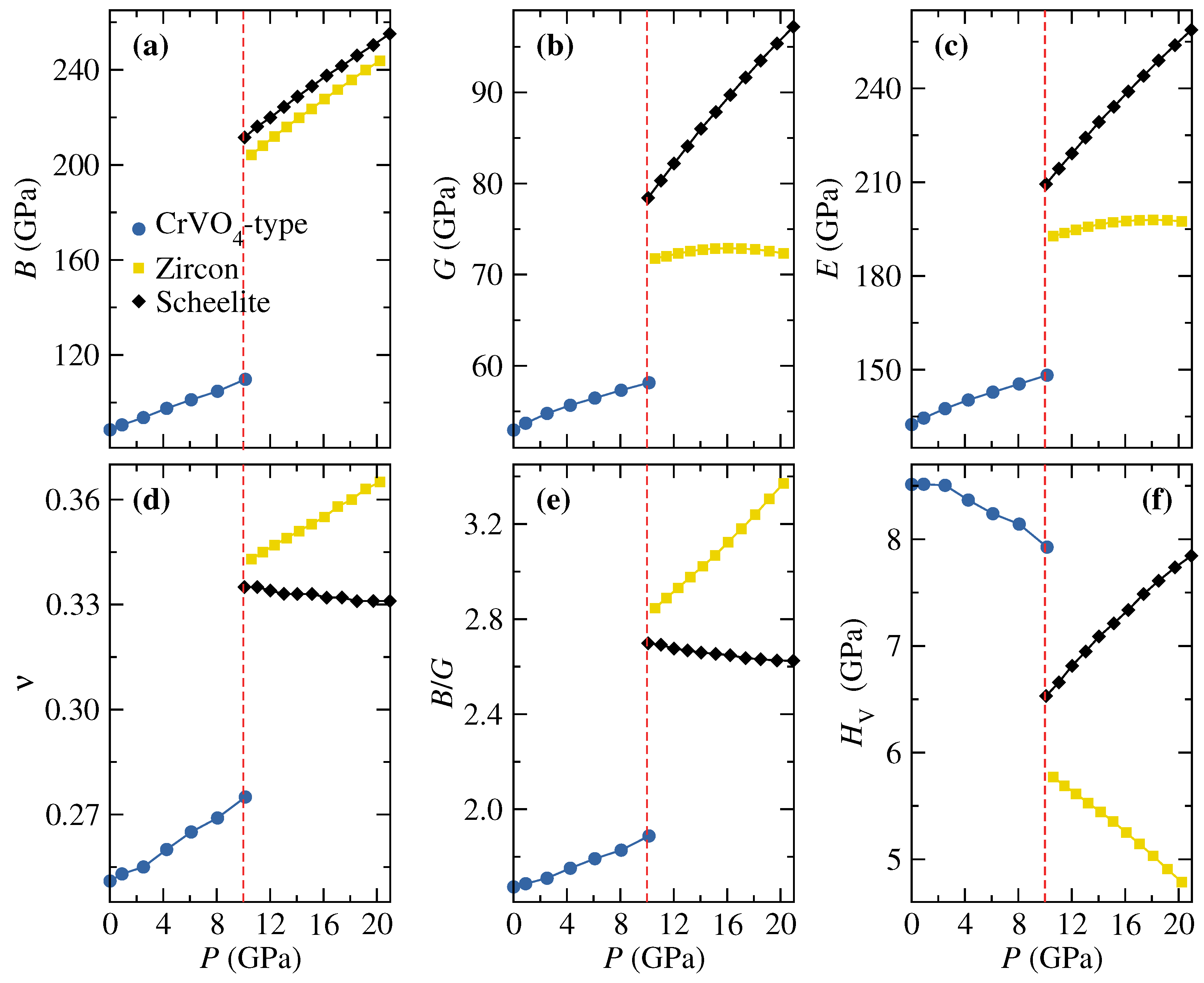
In the experimental results, the bulk modulus was determined by fitting the measured P V data to the third-order Birch-Murnaghan EOS [12]. The reported value was B = 97 ± 6 GPa, with its pressure derivative B = 7 ± 3. This is the largest value reported for phosphates with a CrVO4-type structure, namely TiPO4 (72.93 GPa), VPO4 (79.16 GPa), and TlPO4 (53.57 GPa) [9]. Note that B increases with the atomic number of the A cation within a period and decreases from one period to another for the same family in the periodic table. Such behavior has been observed in other ABO4 compounds, including scheelites [28,40] and wolframites, with some variations [5,41,42]. The result obtained from the Hill procedure at ambient pressure is B = 88.56 GPa, close to the lower limit of the experimental values. According to Figure 5a, the bulk modulus increases with pressure, indicating a progressive improvement in the crystal structure’s packing efficiency. This hardening is particularly pronounced in the high-pressure phases (almost twice the value of the low-pressure phase at 10 GPa), with a slightly higher value in scheelite than in zircon, as expected given their locations on the Bastide diagram [1].
Figure 5b shows that the CrVO4-type phase of InPO4 has a shear modulus of G = 53 GPa at atmospheric pressure, which is small compared with diamond (G = 533(3) GPa [43]). However, it is larger than that of more than 20 scheelite ABO4 compounds [44]. In comparison with other compounds with a CrVO4-type structure, it is similar to FeVO4 (G = 52.58 GPa) [28] but larger than TlVO4 (G = 25.13 GPa) [17]. It was observed that G increases with pressure, reaching a maximum of 58.13 GPa at 10.15 GPa, a 10% increase, which is half that of scheelite in the same pressure range. By contrast, the behavior of zircon is completely different because G depends on c 66 , which has a negative pressure coefficient. Therefore, the softening of G above 16.1 GPa reveals that the zircon structure does not satisfy the extended stability criteria above this pressure, since c ˜ 66 < 0 . These findings reinforce the notion that the zircon phase is not stable at such high pressures. The remaining mechanical properties (E, ν , B / G , and H V ) depend on the relation between B and G, so the softening of G above 16.1 GPa will affect these properties. In particular, E follows a similar trend to G.
The Poisson’s ratio ( ν ) of ceramics and semiconductors typically ranges from 0.25 to 0.35 under atmospheric conditions [45]. Covalent materials usually have ν around 0.1, while ionic ones typically have ν = 0.25 [46]. The CrVO4-type structure of InPO4 has ν = 0.251 at atmospheric pressure, which lies at the lower limit associated with its ionic character. Since ν measures the resistance of a material to volume change (B) relative to the resistance to shape change (G) [45], it is closely related to Pugh’s ratio ( B / G ). A high B / G is associated with ductility, whereas a low B / G is associated with brittleness, with B / G = 1.75 as the critical value separating brittle and ductile materials [47]. Our results indicate that the CrVO4-type structure has a value of 1.673 at ambient pressure, which increases with pressure and even reaches more than twice this value in the scheelite phase at high pressures. The trends in Figure 5e indicate that the ductility of InPO4 increases with pressure for the CrVO4-type and scheelite phases, changing the brittle nature of InPO4 at atmospheric pressure. In contrast, the zircon phase exhibits the opposite behavior, decreasing its ductility with pressure.
The Vickers hardness ( H V ) is inversely related to Pugh’s ratio in Tian’s model [39]. As a result, H V varies inversely with B / G ; see Figure 5f. ABO4 compounds are not characterized by high Vickers hardness; a clear example is the scheelite compounds, which have H V values below 11 GPa at atmospheric pressure [44]. By comparison, many other compounds have higher H V [48], with diamond having H V = 96 GPa [49]. Despite this, InPO4 has a larger H V value than many other ABO4 compounds at atmospheric pressure [44], see Figure 5f. Even at 10 GPa, the Vickers hardness of the scheelite phase of InPO4 is higher than that of 25 other scheelites at ambient pressure [44], whose hardness will decrease at 10 GPa. The Vickers hardness results are consistent with those observed for the other mechanical properties: lower H V values correspond to greater resistance to volume change relative to resistance to shape change. Diamond is the best example of the opposite behavior, with a lower B value [439.2(9) GPa] than G [533(3) GPa] [43].

3.4. Elastic Anisotropy

Deformations in the crystal lattice can lead to imperfections like vacancies, interstitial sites, and dislocations. When deformation reaches the microfracture stage, twinning, stacking faults, or other imperfections may form. These all lead to a broadening of the diffraction lines. Therefore, elastic anisotropy has significant implications for engineering science and crystal physics because it often causes microcrack formation in materials [50]. Note that this broadening does not appear in the simulated X-ray spectra of Figure 2. To address this behavior, DFT calculations could be performed using a supercell approach, with a crystal structure n times the size of the conventional cell to account for structural defects [51]. An alternative method would involve artificial intelligence for a specific application, such as data-driven and machine-learning approaches [52]. However, both options are beyond the scope of this study.
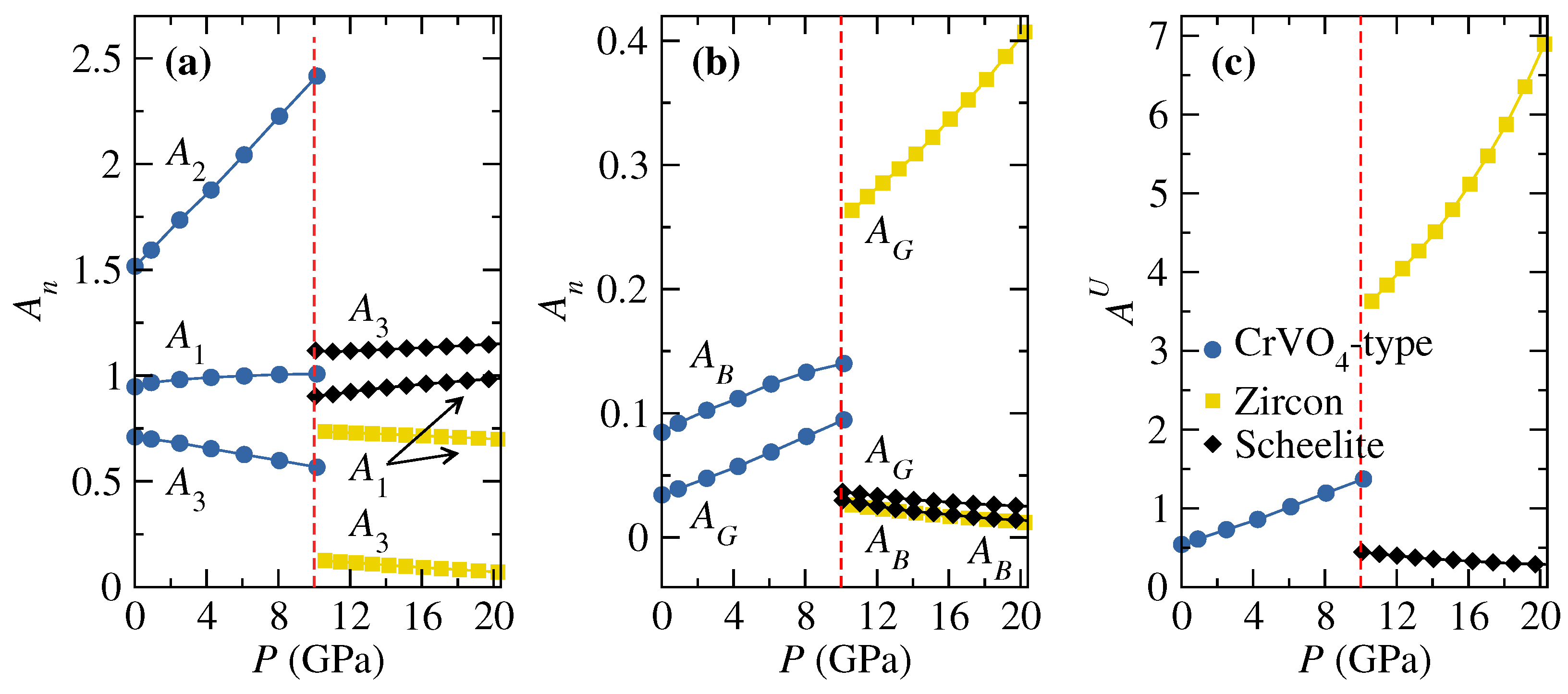
In this work, we analyzed several anisotropic factors that quantify the degree of anisotropy in atomic bonding across different crystallographic planes. For orthorhombic systems, there are three shear anisotropic factors: A 1 for the (100) shear plane between the [011] and [010] directions, A 1 = 4 c 44 / ( c 11 + c 33 2 c 13 ) ; A 2 for the (010) shear plane between the [101] and [001] directions, A 2 = 4 c 55 / ( c 22 + c 33 2 c 23 ; and A 3 for the (001) shear plane between the [110] and [010] directions, A 3 = 4 c 66 / ( c 11 + c 22 2 c 12 ) . The shear anisotropic factors A 1 , A 2 , and A 3 must equal one for isotropic crystals; any deviation from unity measures the degree of elastic anisotropy. According to Figure 6a, the most significant change under pressure occurs in the A 2 shear anisotropic factor for the CrVO4-type structure and in A 3 for zircon, with A 2 showing the largest pressure dependence. The change in A 2 is related to the low resistance to compression of the CrVO4-type structure in the [010] direction. In the scheelite phase, A 1 and A 3 are close to the ideal value of 1. Such behavior indicates that the anisotropy related to the shear anisotropic factors would decrease significantly after a phase transition to CrVO4-type → scheelite, which would stabilize the InPO4 at high pressures.
Other important anisotropic factors include the universal anisotropy index, A U [53], and the percentage of elastic anisotropy in B, A B , and in G, A G [54]. These indices can be calculated as follows: A U = 5 G V G R + B V B R 6 , A B = B V B R B V + B R , and A G = G V G R G V + G R . For isotropic crystals, A B = A G = A U = 0 ; any deviation indicates increased anisotropy. Figure 6c shows that A B > A G for the orthorhombic structure, whereas the opposite behavior is observed in the high-pressure phases. The results show that A G and A B for scheelite are very small at the transition pressure and decrease with increasing pressure, whereas A G for zircon is much higher than for scheelite. These results arise from differences between the bulk and shear moduli obtained using the Voigt and Reuss methods.
According to the literature, A U generalizes the Zener anisotropy index to account for contributions from shear and bulk simultaneously [53]. Results in Figure 6c show behavior similar to that in Figure 6b, with A U increasing with pressure in the CrVO4-type phase. After the phase transition, the high-pressure phases follow different trends: A U is smaller in scheelite and decreases with pressure, whereas it is larger in zircon and increases with pressure. Thus, the A U results also suggest that InPO4 could not be stable in the zircon phase at high pressures. Therefore, the high-pressure phase of InPO4 is most likely the scheelite.

4. Conclusions

We have performed first-principles calculations to investigate the structural parameters and mechanical properties of InPO4 polymorphs under pressure. Our results consistently indicate that the phase coexistence observed at high pressures in experiments on InPO4 is unlikely. From our perspective, this may result from one of two factors, or a combination of both: (i) the findings with the DAC might be influenced by the sample itself, the pressure intervals during measurements, or non-hydrostatic conditions caused by the pressure-transmitting medium; and ( i i ) the existence of kinetic barriers that hinder phase transitions, which can only be overcome at high pressures and temperatures. Meanwhile, our results for elastic and mechanical properties, as well as elastic anisotropy, reinforce previously published results on the dynamic stability of InPO4 under pressure, which indicate a higher probability that the high-pressure phase of InPO4 is scheelite rather than zircon.
We hope that these results will motivate the scientific community to conduct further experimental studies of InPO4 under pressure, broadening the discussion of this compound and helping elucidate the behavior of orthorhombic phosphates under pressure, much of which remains to be discovered.

Author Contributions

Methodology, J.E.A.-C. and S.L.-M.; calculations, J.E.A.-C. and S.L.-M.; writing—original draft preparation, J.E.A.-C., P.B.R.-V., and S.L.-M.; supervision, S.L.-M.; discussion, S.L.-M.; writing—review and editing, J.E.A.-C., P.B.R.-V., and S.L.-M. All authors have read and agreed to the published version of the manuscript.

Funding

S.L.-M. thanks SECIHTI of Mexico for financial support through the program “Programa de Investigadoras e Investigadores por México, project 519”.

Institutional Review Board Statement

Not applicable.

Informed Consent Statement

Not applicable.

Data Availability Statement

All relevant data that support the findings of this study are available from the corresponding authors upon request.

Acknowledgments

The authors gratefully acknowledge the computing time granted by LANCAD and SECIHTI on the supercomputer Miztli at LSVP DGTIC UNAM. The IPICYT Supercomputing National Center for Education & Research, TKII-R2026-SLM, is also acknowledged.

Conflicts of Interest

The authors declare no conflicts of interest.

References

  1. Errandonea, D.; Manjon, F. Pressure effects on the structural and electronic properties of ABX4 scintillating crystals. Prog. Mater. Sci. 2008, 53, 711–773. [Google Scholar] [CrossRef]
  2. Errandonea, D.; Lacomba-Perales, R.; Ruiz-Fuertes, J.; Segura, A.; Achary, S.N.; Tyagi, A.K. High-pressure structural investigation of several zircon-type orthovanadates. Phys. Rev. Condens. Matter Mater. Phys. 2009, 79, 184104. [Google Scholar] [CrossRef]
  3. Errandonea, D.; Pellicer-Porres, J.; Manjón, F.J.; Segura, A.; Ferrer-Roca, C.; Kumar, R.; Tschauner, O.; Rodríguez-Hernández, P.; López-Solano, J.; Radescu, S. High-pressure structural study of the scheelite tungstates CaWO4 and SrWO4. Phys. Rev. Condens. Matter Mater. Phys. 2005, 72, 174106. [Google Scholar] [CrossRef]
  4. De Los Reyes, M.; Aughterson, R.D.; Gregg, D.J.; Middleburgh, S.C.; Zaluzec, N.J.; Huai, P.; Ren, C.; Lumpkin, G.R. Ion beam irradiation of ABO4 compounds with the fergusonite, monazite, scheelite, and zircon structures. J. Am. Ceram. Soc. 2020, 103, 5502–5514. [Google Scholar] [CrossRef]
  5. Errandonea, D.; Ruiz-Fuertes, J. A Brief Review of the Effects of Pressure on Wolframite-Type Oxides. Crystals 2018, 8, 71. [Google Scholar] [CrossRef]
  6. Botella, P.; López-Moreno, S.; Errandonea, D.; Manjón, F.J.; Sans, J.A.; Vie, D.; Vomiero, A. High-pressure characterization of multifunctional CrVO4. J. Phys. Condens. Matter 2020, 32, 385403. [Google Scholar] [CrossRef]
  7. Manjón, F.J.; Errandonea, D.; López-Solano, J.; Rodríguez-Hernández, P.; Radescu, S.; Mujica, A.; Muñoz, A.; Garro, N.; Pellicer-Porres, J.; Segura, A.; et al. Crystal stability and pressure-induced phase transitions in scheelite AWO4 (A = Ca, Sr, Ba, Pb, Eu) binary oxides. II: Towards a systematic understanding. Phys. Status Solidi (B) 2007, 244, 295–302. [Google Scholar] [CrossRef]
  8. Errandonea, D.; Garg, A.B. Recent progress on the characterization of the high-pressure behaviour of AVO4 orthovanadates. Prog. Mater. Sci. 2018, 97, 123–169. [Google Scholar] [CrossRef]
  9. López-Moreno, S.; Errandonea, D. Ab initio prediction of pressure-induced structural phase transitions of CrVO4-type orthophosphates. Phys. Rev. B 2012, 86, 104112. [Google Scholar] [CrossRef]
  10. Baran, E. Materials belonging to the CrVO4 structure type: Preparation, crystal chemistry and physicochemical properties. J. Mater. Sci. 1998, 33, 2479–2497. [Google Scholar] [CrossRef]
  11. Momma, K.; Izumi, F. VESTA3 for three-dimensional visualization of crystal, volumetric and morphology data. J. Appl. Crystallogr. 2011, 44, 1272–1276. [Google Scholar] [CrossRef]
  12. Dwivedi, A.; Kaiwart, R.; Varma, M.; Velaga, S.; Poswal, H. High-pressure structural investigations on InPO4. J. Solid State Chem. 2020, 282, 121065. [Google Scholar] [CrossRef]
  13. López-Moreno, S.; Errandonea, D.; Pellicer-Porres, J.; Martínez-García, D.; Patwe, S.J.; Achary, S.N.; Tyagi, A.K.; Rodríguez-Hernández, P.; Muñoz, A.; Popescu, C. Stability of FeVO4 under Pressure: An X-ray Diffraction and First-Principles Study. Inorg. Chem. 2018, 57, 7860–7876. [Google Scholar] [CrossRef] [PubMed]
  14. López-Moreno, S.; Sánchez-Martín, J.; Bandiello, E.; Bettinelli, M.; Bull, C.L.; Ridley, C.J.; Errandonea, D. The effect of pressure on the band-gap energy in FePO4 and FeVO4. J. Phys. Chem. Solids 2023, 183, 111604. [Google Scholar] [CrossRef]
  15. Gracia, L.; Beltrán, A.; Errandonea, D. Characterization of the TiSiO4 structure and its pressure-induced phase transformations: Density functional theory study. Phys. Rev. B 2009, 80, 094105. [Google Scholar] [CrossRef]
  16. Errandonea, D.; Gomis, O.; García-Domene, B.; Pellicer-Porres, J.; Katari, V.; Achary, S.N.; Tyagi, A.K.; Popescu, C. New polymorph of InVO4: A high-pressure structure with six-coordinated vanadium. Inorg. Chem. 2013, 52, 12790–12798. [Google Scholar] [CrossRef]
  17. Ouahrani, T.; Muñoz, A.; Franco, R.; Boufatah, R.; Bedrane, Z.; Errandonea, D. High-pressure properties of thallium orthovanadate from density-functional theory calculations. J. Alloys Comp. 2024, 978, 173483. [Google Scholar] [CrossRef]
  18. Romero-Vázquez, P.B.; López-Moreno, S.; Errandonea, D. Stability of FeVO4-II under Pressure: A First-Principles Study. Crystals 2022, 12, 1835. [Google Scholar] [CrossRef]
  19. Piermarini, G.J.; Block, S.; Barnett, J. Hydrostatic limits in liquids and solids to 100 kbar. J. Appl. Phys. 1973, 44, 5377–5382. [Google Scholar] [CrossRef]
  20. Yousuf, M. Chapter 7—Diamond Anvil Cells in High-Pressure Studies of Semiconductors. In High Pressure in Semiconductor Physics II; Semiconductors and Semimetals; Suski, T., Paul, W., Eds.; Elsevier: Amsterdam, The Netherlands, 1998; Volume 55, pp. 381–436. [Google Scholar] [CrossRef]
  21. Klotz, S.; Chervin, J.C.; Munsch, P.; Le Marchand, G. Hydrostatic limits of 11 pressure transmitting media. J. Phys. D Appl. Phys. 2009, 42, 075413. [Google Scholar] [CrossRef]
  22. Jones, R.O. Density functional theory: Its origins, rise to prominence, and future. Rev. Mod. Phys. 2015, 87, 897–923. [Google Scholar] [CrossRef]
  23. Blöchl, P.E. Projector augmented-wave method. Phys. Rev. B 1994, 50, 17953–17979. [Google Scholar] [CrossRef]
  24. Kresse, G.; Joubert, D. From ultrasoft pseudopotentials to the projector augmented-wave method. Phys. Rev. B 1999, 59, 1758–1775. [Google Scholar] [CrossRef]
  25. Kresse, G.; Furthmüller, J. Efficient iterative schemes for ab initio total-energy calculations using a plane-wave basis set. Phys. Rev. B 1996, 54, 11169–11186. [Google Scholar] [CrossRef]
  26. Csonka, G.I.; Perdew, J.P.; Ruzsinszky, A.; Philipsen, P.H.T.; Lebègue, S.; Paier, J.; Vydrov, O.A.; Ángyán, J.G. Assessing the performance of recent density functionals for bulk solids. Phys. Rev. B 2009, 79, 155107. [Google Scholar] [CrossRef]
  27. Monkhorst, H.J.; Pack, J.D. Special points for Brillouin-zone integrations. Phys. Rev. B 1976, 13, 5188–5192. [Google Scholar] [CrossRef]
  28. Romero-Vázquez, P.B.; López-Moreno, S.; Errandonea, D. First-principles study of ATcO4 pertechnetates. J. Phys. Chem. Solids 2022, 171, 110979. [Google Scholar] [CrossRef]
  29. Le Page, Y.; Saxe, P. Symmetry-general least-squares extraction of elastic data for strained materials from ab initio calculations of stress. Phys. Rev. B 2002, 65, 104104. [Google Scholar] [CrossRef]
  30. Wang, V.; Xu, N.; Liu, J.C.; Tang, G.; Geng, W.T. VASPKIT: A user-friendly interface facilitating high-throughput computing and analysis using VASP code. Comput. Phys. Commun. 2021, 267, 108033. [Google Scholar] [CrossRef]
  31. Sczancoski, J.; Cavalcante, L.; Joya, M.; Espinosa, J.; Pizani, P.; Varela, J.; Longo, E. Synthesis, growth process and photoluminescence properties of SrWO4 powders. J. Colloid Interface Sci. 2009, 330, 227–236. [Google Scholar] [CrossRef]
  32. Marqueno, T.; Monteseguro, V.; Cova, F.; Errandonea, D.; Santamaria-Perez, D.; Bandiello, E.; Bettinelli, M. High-pressure phase transformations in NdVO4 under hydrostatic, conditions: A structural powder x-ray diffraction study. J. Phys. Condens. Matter 2019, 31, 235401. [Google Scholar] [CrossRef] [PubMed]
  33. Singh, S.; Lang, L.; Dovale-Farelo, V.; Herath, U.; Tavadze, P.; Coudert, F.X.; Romero, A.H. MechElastic: A Python library for analysis of mechanical and elastic properties of bulk and 2D materials. Comput. Phys. Commun. 2021, 267, 108068. [Google Scholar] [CrossRef]
  34. Nye, J.F. Physical Properties of Crystals: Their Representation by Tensors and Matrices; Oxford University Press: Oxford, UK, 1985. [Google Scholar]
  35. Mouhat, F.; Coudert, F.X. Necessary and sufficient elastic stability conditions in various crystal systems. Phys. Rev. B 2014, 90, 224104. [Google Scholar] [CrossRef]
  36. Gao, J.; Liu, Q.J.; Tang, B. Elastic stability criteria of seven crystal systems and their application under pressure: Taking carbon as an example. J. Appl. Phys. 2023, 133, 135901. [Google Scholar] [CrossRef]
  37. Voigt, W. Lehrbuch Kristallphysik; Springer: Berlin/Heidelberg, Germany, 1928. [Google Scholar] [CrossRef]
  38. Reuss, A. Berechnung der Fliebgrenze von Mischkristallen auf Grund der Plastizitatsbedingung für Einkristalle. Angew. Appl. Math. Mech. 1929, 9, 49–58. [Google Scholar] [CrossRef]
  39. Tian, Y.; Xu, B.; Zhao, Z. Microscopic theory of hardness and design of novel superhard crystals. Int. J. Refract. Met. Hard Mater. 2012, 33, 93–106. [Google Scholar] [CrossRef]
  40. Maddileti, S.; Mukherjee, S.; Muñoz, A.; Errandonea, D.; Kennedy, B.J.; Vaitheeswaran, G. Lattice dynamics and vibrational properties of scheelite-type alkali-metal perrhenates. J. Phys. Condens. Matter 2024, 36, 505402. [Google Scholar] [CrossRef]
  41. Bandiello, E.; Rodríguez-Hernández, P.; Munoz, A.; Buenestado, M.B.; Popescu, C.; Errandonea, D. Electronic properties and high-pressure behavior of wolframite-type CoWO4. Mater. Adv. 2021, 2, 5955–5966. [Google Scholar] [CrossRef]
  42. Ye, M.; Zhou, Y.; Shao, T.; Liu, H.; Tao, Q.; Wang, X.; Tang, R.; Yue, H.; Li, Y.; Zhu, P. Effects of High Pressure on the Bandgap and the d–d Crystal Field Transitions in Wolframite NiWO4. J. Phys. Chem. C 2023, 127, 6543–6551. [Google Scholar] [CrossRef]
  43. Hu, Q.; Li, B.; Gao, X.; Bi, Y.; Su, L.; Mao, H.K. Ultrasound elasticity of diamond at gigapascal pressures. Proc. Natl. Acad. Sci. USA 2021, 118, e2118490118. [Google Scholar] [CrossRef]
  44. Liu, Y.; Jia, D.; Zhou, Y.; Zhou, Y.; Zhao, J.; Li, Q.; Liu, B. Discovery of O4 scheelites with the extra low thermal conductivity through high-throughput calculations. J. Mater. 2020, 6, 702–711. [Google Scholar] [CrossRef]
  45. Greaves, G.N.; Greer, A.; Lakes, R.S.; Rouxel, T. Poisson’s ratio and modern materials. Nat. Mater. 2011, 10, 823–837. [Google Scholar] [CrossRef] [PubMed]
  46. Ozisik, H.; Deligoz, E.; Colakoglu, K.; Ateser, E. The first principles studies of the MgB7 compound: Hard material. Intermetallics 2013, 39, 84–88. [Google Scholar] [CrossRef]
  47. Benmakhlouf, A.; Errandonea, D.; Bouhemadou, A.; Bentabet, A.; Maabed, S.; Bouchenafa, M.; Bin-Omran, S. Ab initio study of the mechanical and electronic properties of scheelite-type XWO4 (X = Ca, Sr, Ba) compounds. Int. J. Mod. Phys. B 2017, 31, 1750086. [Google Scholar] [CrossRef]
  48. Mazhnik, E.; Oganov, A.R. A model of hardness and fracture toughness of solids. J. Appl. Phys. 2019, 126, 125109. [Google Scholar] [CrossRef]
  49. Chen, X.Q.; Niu, H.; Li, D.; Li, Y. Modeling hardness of polycrystalline materials and bulk metallic glasses. Intermetallics 2011, 19, 1275–1281. [Google Scholar] [CrossRef]
  50. Tvergaard, V.; Hutchinson, J.W. Microcracking in Ceramics Induced by Thermal Expansion or Elastic Anisotropy. J. Am. Ceram. Soc. 1988, 71, 157–166. [Google Scholar] [CrossRef]
  51. Hine, N.D.M.; Frensch, K.; Foulkes, W.M.C.; Finnis, M.W. Supercell size scaling of density functional theory formation energies of charged defects. Phys. Rev. B 2009, 79, 024112. [Google Scholar] [CrossRef]
  52. Mannodi-Kanakkithodi, A.; Huang, M.; Gorai, P.; Kavanagh, S.R. Accelerating point-defect simulations using data-driven and machine learning approaches. MRS Bull. 2026, 51, 600. [Google Scholar] [CrossRef]
  53. Ranganathan, S.I.; Ostoja-Starzewski, M. Universal elastic anisotropy index. Phys. Rev. Lett. 2008, 101, 055504. [Google Scholar] [CrossRef]
  54. Kube, C.M. Elastic anisotropy of crystals. AIP Adv. 2016, 6, 095209. [Google Scholar] [CrossRef]
Figure 1. Crystal structures of InPO4 in the (a) CrVO4-type, (b) zircon, and (c) scheelite structures. In, P, and O atoms are shown in purple, gray, and red, respectively. We use the VESTA (version 3.90.5a) [11] software to build the structures.
Qubs 10 00014 g001
Figure 2. Simulated X-ray diffraction spectra of InPO4 in (a) the orthorhombic structure at atmospheric pressure and (b) the three experimentally observed polymorphs (CrVO4-type in blue, zircon in yellow, and scheelite in gray). (c) Principal interplanar distances of the three phases as a function of pressure.
Qubs 10 00014 g002
Figure 3. Evolution of the internal parameters of InPO4 polymorphs with pressure: (a) interatomic bond distances ( d X O ), (b) polyhedral volumes ( V X O n ), (c) bond angles ( θ n and ϕ n ), (d) distortion parameter ( Δ d ), and (e) internal polyedra of each phase indicating the measured angles. The interatomic distances d X O appear in Figure 1.
Qubs 10 00014 g003
Figure 4. Evolution of the elastic constants c i j of InPO4 with pressure for the CrVO4-type structure with (a) zircon and (b) scheelite polymorphs.
Qubs 10 00014 g004
Figure 5. Evolution of the mechanical properties of InPO4 polymorphs with pressure: (a) bulk modulus (B), (b) shear modulus (G), (c) Young’s modulus (E), (d) Poisson’s ratio ( ν ), (e) Pugh’s ratio ( B / G ), and (f) Vickers hardness ( H V ). B, G, E, and H V are in GPa; ν and B / G are dimensionless.
Qubs 10 00014 g005
Figure 6. Evolution of the elastic anisotropy of InPO4 polymorphs with pressure: (a) shear anisotropy factors ( A n ), (b) percentage anisotropy in the bulk ( A B ) and shear ( A G ) modulus, and (c) universal anisotropy ( A U ).
Qubs 10 00014 g006
Table 1. Elastic constants, c i j (in GPa), of InPO4 for the CrVO4-type structure, zircon, and scheelite at the specified pressure, P (in GPa). Pressure coefficients, d c i j / d P , for each c i j appear in brackets.
c 11 c 12 c 13 c 16 c 22 c 23 c 33 c 44 c 55 c 66 P
CrVO4-type245.7458.9280.43 107.5440.43151.6455.9867.6141.820.01
304.1265.53124.75 102.6269.44200.3464.2499.1039.0710.15
( d c i j / d P )(5.73)(0.60)(4.35) (−0.55)(2.84)(4.79)(0.78)(3.08)(−0.27)
Zircon365.2168.99157.91 451.1691.20 16.8912.33
( d c i j / d P )(8.09)(2.35)(2.33) (4.27)(0.89) (−0.59)
Scheelite386.95179.39168.20−15.49 259.8672.45 116.2213.03
( d c i j / d P )(4.77)(2.47)(2.99)(0.81) (6.74)(1.92) (1.74)
Disclaimer/Publisher’s Note: The statements, opinions and data contained in all publications are solely those of the individual author(s) and contributor(s) and not of MDPI and/or the editor(s). MDPI and/or the editor(s) disclaim responsibility for any injury to people or property resulting from any ideas, methods, instructions or products referred to in the content.