1. Introduction
As national railway networks continue to be improved, more and more projects encounter areas subject to seasonal frost. As a result of the presence of groundwater, when the temperature drops below the freezing point of the soil, the water in the unfrozen area of the subgrade moves toward frozen fringe and then freezes. Ice begins to accumulate due to the gradient of the soil’s water potential, and this leads to what is known as frost heave in the subgrade [
1,
2]. In silty areas, where there are high levels of groundwater and fine soil particles, the frost heave caused by the combined action of ice accumulation and the capillary effect in the subgrade can be particularly significant. This can seriously affect the safe operation of railways in these areas [
3,
4,
5]. Methods for inhibiting the frost heave of subgrades in seasonally frosty areas include water isolation, soil replacement, improvement of the subgrade’s compaction quality, and the establishment of isolation layers [
6,
7,
8]. One notable approach to water isolation is well-point dewatering, which can bring the capillary zone below the frozen depth of the subgrade by rapidly reducing the groundwater level. This eliminates the possible influence of groundwater and capillary water and thus reduces the likelihood of frost heave [
9,
10].
Well-point dewatering has been a topic of widespread research, most of which focuses on engineering tests and applications. With regard to the potential drop in groundwater depth, Zhou [
11] studied changes in pore water pressure during the dropping process to determine a way of estimating the time required for the groundwater to fall to a reasonable level. Nie [
12] conducted dewatering tests with single wells and single rows of wells in a saturated silty area and found that the depth in the drop of the groundwater level increased in line with increases in the depth of the wells themselves. Shaqour [
13] improved an original well-point dewatering system in a wastewater treatment plant in Kuwait by increasing the number of pumping wells, resulting in a significant drop in the height of the groundwater.
Another potential issue is groundwater seepage and its potential impact on the groundwater drop curve. Zhang [
14] therefore analyzed variations in the groundwater seepage field during single well and group well pumping and proposed a new approach to groundwater removal, involving the use of open-cut foundation pits. Drawing upon Darcy’s law, Huang [
15] analyzed the one-dimensional steady seepage of unsaturated soil during vacuum well-point dewatering and concluded that vacuum pressure can significantly improve the drainage capacity of unsaturated soils. Shen [
16] found that during the freezing process, freezing alters the seepage paths and hydraulic gradients of groundwater, thereby affecting the dynamic drawdown curve of the groundwater level.
The effect of well-point dewatering on foundations has also been studied. Wei [
17], for instance, evaluated the effect of “well-point dewatering + dynamic tamping” on the reinforcement of deep soft soil foundations with high degrees of saturation by using both in-situ tests and laboratory tests. They established that the reinforcement effect of well-point dewatering is superior to using just dynamic tamping. Zhang [
18] carried out on-site monitoring of groundwater levels and pore water pressure during consolidated tests involving well-point dewatering. This confirmed the feasibility of well point-dewatering for treating coastal shallow soft soil foundations. Through a combination of theoretical calculations and numerical simulation, Yu [
19] analyzed the effect of using “well-point dewatering + grouting” as a composite measure for handling the problems of tunnel foundation subsidence and mud pumping, to good effect. Furthermore, Zhang [
20] found that changes in the groundwater level induced by well-point dewatering alter the effective stress state of the foundation soil, which may in turn affect the particle-crushing behavior of the filler.
Well-point dewatering is already widely used in engineering practice, but there are few studies of the actual dewatering mechanism and how to calculate variations in the groundwater seepage field resulting from well-point dewatering. There is a particular lack of quantitative analyses of groundwater level changes under different pumping parameters. Generally, theoretical research in this area is far behind engineering practice.
Focusing upon a silty subgrade with a high groundwater level present in the route of the Shenmu–Shuozhou heavy-load railway in China, this paper establishes a method for calculating dynamic changes in the groundwater level when pumping water using group wells. Theoretical analysis is used to determine the parameters that have the greatest influence on frost heave. A dynamic groundwater seepage model is presented that was run using Visual MODFLOW Flex 9.0 software to analyze variations in groundwater levels associated with different pumping well parameters. The inhibition effect of well-point dewatering on frost heave in silty subgrades is thus determined, and an optimal treatment plan for the frozen section of the Shenmu–Shuozhou railway is put forward.
2. Theoretical Analysis
2.1. Effect of Group Wells
The drop in the height of the groundwater level at each position within the range of influence of a group of wells should be the superposition of the groundwater level drops caused by all the wells pumping at the same or different flow rates [
21].
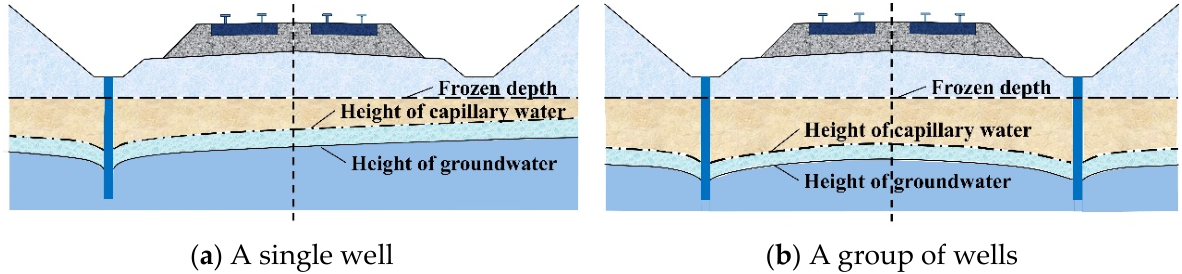
A funnel-shaped groundwater drop curve will form around a single well pumping water, with the funnel’s center being at the position of the well, as shown in
Figure 1a. The closer one goes to the pumping well, the lower the groundwater level. The range of influence of a pumping well after the groundwater drop curve has reached a stable level is called the pumping influence radius,
, the formula for which is [
22]:
where
s is the value of the drop in groundwater level (m);
k is the permeability coefficient (m/s); and
H0 is the depth of the aquifer (m).
When
wells pump water at the same time, the pumping wells interfere with one another, so the groundwater drop curve for a group of wells is formed by the superposition of the groundwater drop curves for each single well, as shown in
Figure 1b. Assuming that A is any position within the range of influence of a group of wells, the formula for calculating the groundwater level,
H, of A is [
23]:
where
are the influence radii of each pumping well (m);
are the pumping volumes for each pumping well (m
3); and
are the distances from A to each pumping well (m).
When the pumping volume and influence radius of each pumping well are equal, Equation (2) can be simplified as follows:
Substituting Equation (1) into Equation (3), we get
If a group of wells are arranged along a railway to lower the groundwater level, when the pumping volume and influence radius of a single well are equal, Equation (4) indicates that changing the layout spacing along the route direction (referred to as “layout spacing”) and the layout mode vertically to the direction of the route (referred to as “layout mode”) will result in the number of pumping wells and the distance between each of them being changed. This will lead to different drops in the groundwater level and differences in the extent to which the subgrade frost heave will be inhibited. The differences in hydraulic performance and burial positions of phreatic water and confined water can mean that pumping different types of groundwater can have different effects [
24]; different heights of pumping well in the same aquifer can also affect the groundwater level. Thus, different types of pumping well will have different effects on the drop in level.
The type of pumping well, the layout mode, and the layout spacing are therefore all selected as influencing parameters here when studying the effect of well-point dewatering on mechanisms governing variations in the groundwater level and how this affects the inhibition of subgrade frost heave.
2.2. Safe Height of Groundwater
The principle goal when inhibiting the frost heave in a subgrade using well-point dewatering is to drop the groundwater level to a safe height and maintain a safe distance between the capillary zone and the frozen layer. The formula for obtaining the safe groundwater height is
where
is the safe height of the groundwater level (m);
is the height of the subgrade’s surface (m);
is the depth to which it is frozen (m);
is the capillary rising height (m); and
is the safe distance between the capillary zone and the frozen layer (m). According to the Code for Design of Railway Earth Structure (TB 10001-2016) [
25], the subgrade shoulder elevation shall be at least 0.5 m higher than the sum of the highest groundwater level, the capillary rise height, and the harmful frost heave depth. Therefore, a safety distance of 0.5 m is adopted in this study.
3. Description of the Research Area and Experiment
3.1. Research Area
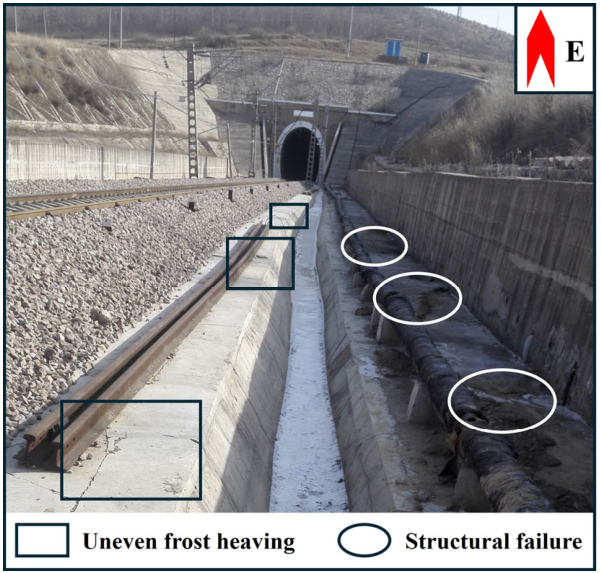
Located in the northwest of China, the Shenmu–Shuozhou heavy load railway experiences low temperatures over extended periods, with seasonally frozen soil being widely distributed along its route. The statistics for frost damage show that the annual average number of occurrences of frost-related damage to the Shenshuo railway is about 360, covering a cumulative length of about 3 km, mainly manifested as uneven frost heave and thaw deformation of the subgrade [
26]. The frost heave is especially problematic between the railway mileage-indicator points of K222+700 and K223+300, with the maximum frost heave deformation reaching 60 mm (see
Figure 2). The area was therefore selected as the research area.
3.1.1. Geological Characteristics of the Research Area
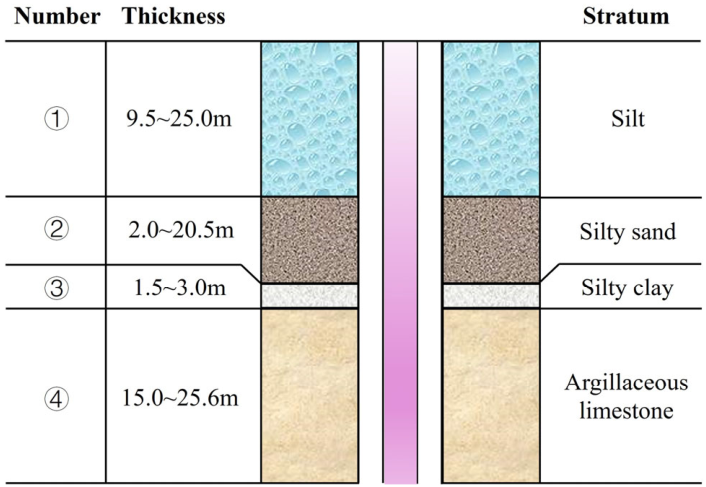
The stratum in the research area can be divided into four vertical layers, according to the soil’s properties. The characteristics of each layer are shown in
Figure 3. The physical and mechanical parameters of the soil in each layer are shown in
Table 1.
3.1.2. Hydrological Characteristics of the Research Area
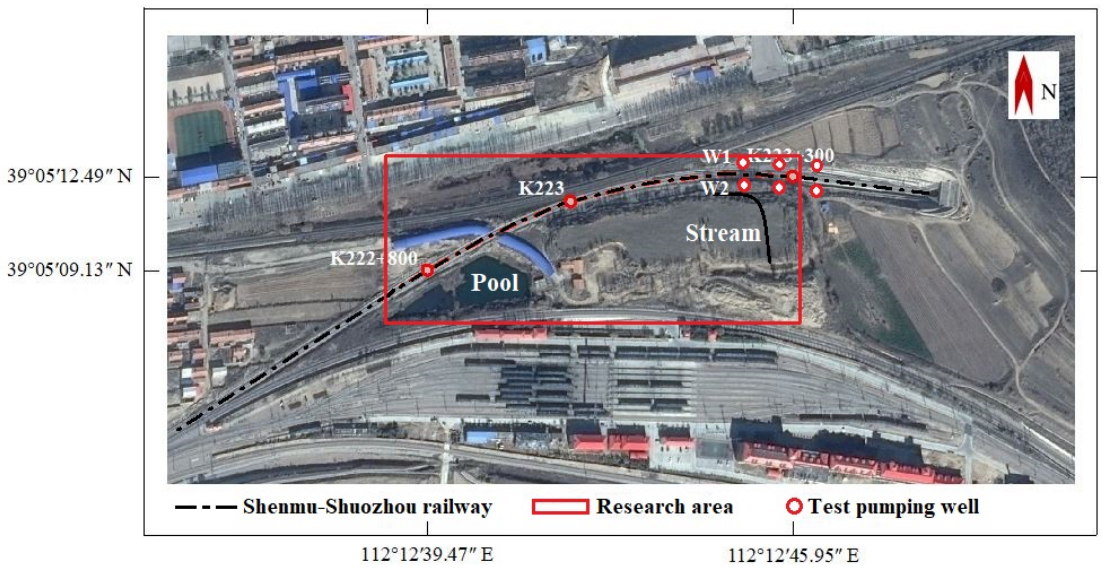
The research area is located at the transition of a road and a tunnel, with abundant surface water and a complex surrounding environment (see
Figure 4). There is a large pool between K222+700 and K222+950, with an average depth of 3.8 m and a maximum width of 65 m, that contains water all year round. Groundwater flows out at K223+280 and forms a stream, which flows westward along the route and gradually infiltrates into the ground before it stops flowing. The recharge of these two water sources causes a high groundwater level in the area, which was surveyed to have a depth of 0.2~0.4 m, flowing from the south to the north side of the railway line. The annual average temperature in this region is 4.6 °C, with the average temperature in January being the lowest, at −10.5 °C. The very low temperatures and high groundwater level in winter lead to serious freezing damage in the area.
Previous surveys have found that the average annual precipitation in the research area is 481.3 mm, with a frozen depth of 2.2 m [
27,
28]. The capillary rising height of the subgrade filler, according to laboratory measurements, is 1.7 m. In order to alleviate the frost damage in this area, the maintenance department has arranged six test pumping wells on both sides of the subgrade near the tunnel exit with a layout spacing of 24 m, as shown in
Figure 4. Among them, W1 and W2 are the two pumping wells close to the stream.
3.2. Model and Test
Based on Darcy’s seepage law of unsaturated soils, a three-dimensional dynamic seepage model of groundwater in the research area was established, using Visual MODFLOW Flex software. Relative heights were used to describe the model and groundwater level, with the bottom of the model being taken as the reference, where the height was set to 0 m.
3.2.1. Model Determination and Validation
A numerical model was established for the area within the rectangular frame shown in
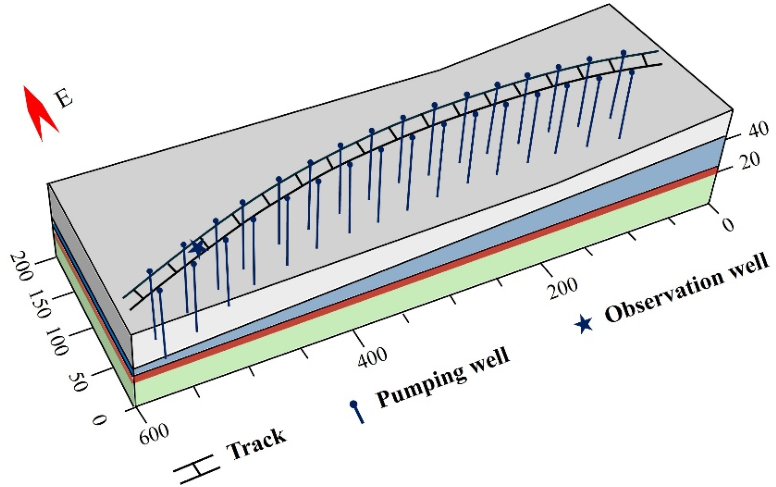
Figure 4, with a size of 600 m long and 200 m wide. It was divided into four soil layers from top to bottom, with each layer’s thickness and material properties being constructed strictly according to the survey results reported in
Section 3.1.1 (see
Figure 5). The maximum height of the model was 60 m, and the minimum height was 43.67 m. The pool, stream, and precipitation recharge in the model were set according to the survey results reported in
Section 3.1.2.
The pumping wells were arranged at various defined spacings along the route, 0.7 m outside the subgrade side trench, with a pumping rate of 800 m
3/d (again, see
Figure 5). As the hydraulic conductivity of Layer ③ was extremely low, it can be regarded as an impermeable stratum. Layers ① and ② were therefore regarded as a phreatic aquifer, and Layer ④ was regarded as a confined aquifer. Depending on the type and height of groundwater being pumped, the pumping wells were set as being of four types: a partially penetrating well in a phreatic aquifer (referred to as a “PP-Well”); a fully penetrating well in a phreatic aquifer (referred to as an “FP-Well”); a partially penetrating well in a confined aquifer (referred to as a “PC-Well”); and a fully penetrating well in a confined aquifer (referred to as an “FC-Well”). At the beginning of the simulation, well-point dewatering was used to lower the groundwater level. Calculation of the subgrade frost heave was performed once the groundwater had reached a stable level.
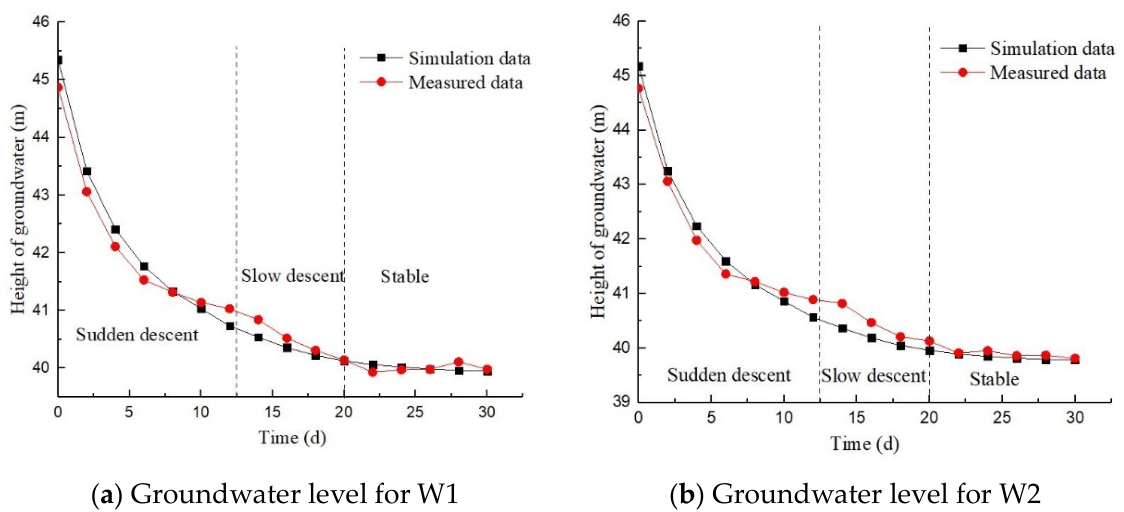
The measured groundwater level data for W1 and W2 were selected for comparison with the model’s calculated data, as shown in
Figure 6. The height of groundwater can be divided into three stages: sudden descent, slow descent, stable, with the boundaries between these stages indicated by the dotted lines in the figure (the same interpretation applies to dotted lines in subsequent analyses). The calculated results were in close agreement with the measurements. The groundwater levels for W1 and W2 tended to stabilize after 20 to 22 days of pumping. After 30 days of pumping, the calculated groundwater level at W1 was 39.91 m, which is 0.07 m lower than the measured value of 39.98 m, and at W2, it was 39.73 m, which is 0.08 m lower than the measured value of 39.81 m. These differences are within an acceptable range. The dynamic groundwater seepage model was therefore considered accurate.
3.2.2. Test Plan
The parameters worked with in this paper are the type of pumping well type, the layout mode, and the layout spacing. According to previous engineering practice, the layout spacing for well-point dewatering systems designed to lower groundwater levels should be 20 m–40 m, depending on whether a single row or double row of pumping wells is arranged on both sides of the subgrade. The test plan is shown in
Table 2.
4. Results Analysis and Plan Optimization
The groundwater level observation well in the model (referred to as “OW”) was located at the center of the subgrade, at K222+790, as shown in
Figure 5. The frost heave at OW is serious because of the high groundwater level resulting from it being close to the pool. So, the change in groundwater level at OW was considered indicative of the overall dewatering effect and frost heave inhibition. As the subgrade surface height, frozen depth, capillary rising height, and safe distance at OW are 45.64 m, 2.2 m, 1.7 m, and 0.5 m, respectively, the safe height of the groundwater should be 41.24 m, according to Equation (5). The frost heave and frozen depth were used to analyze the degree of frost heave [
29].
4.1. Type of Pumping Well
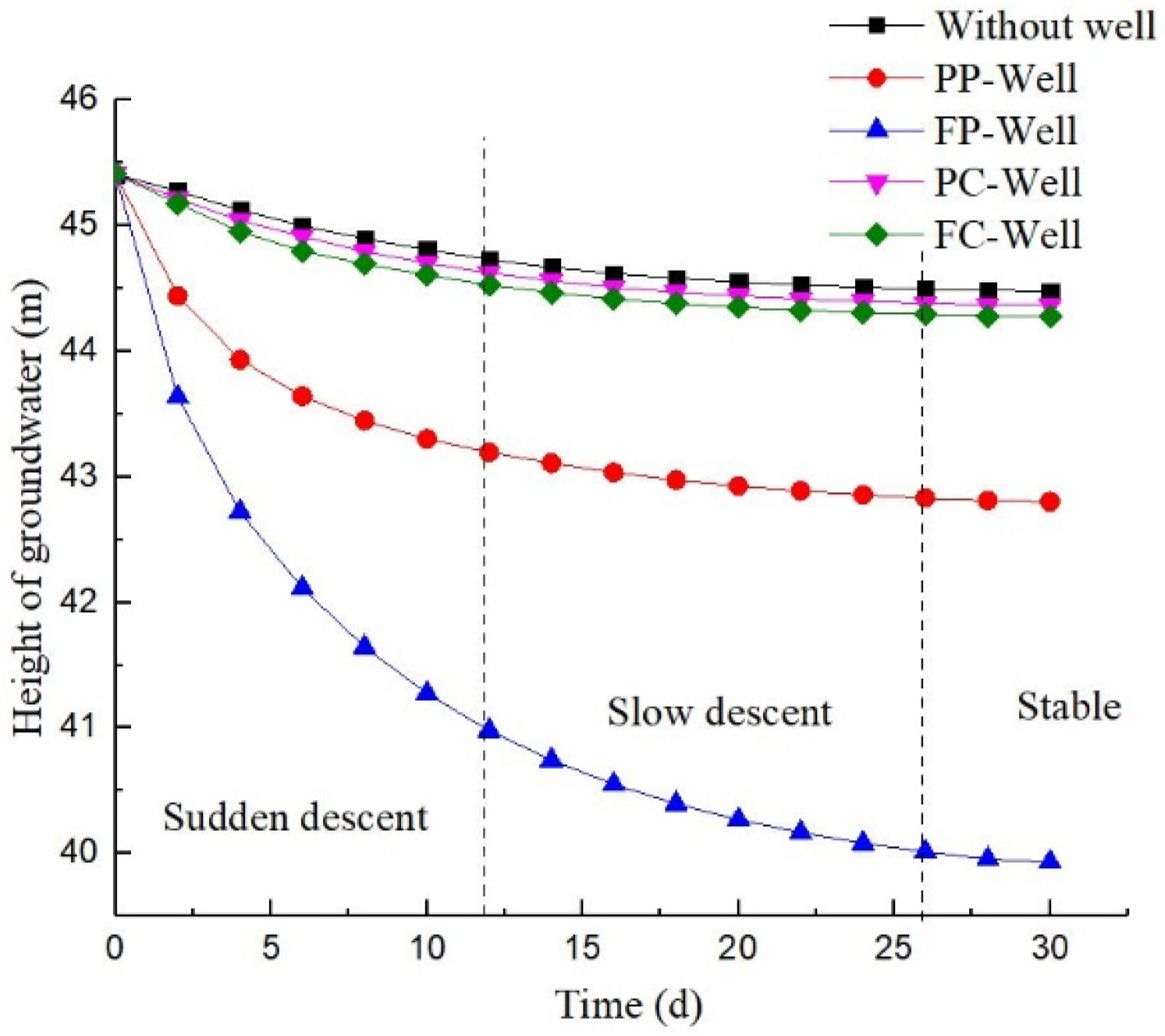
Figure 7 shows the changes in the groundwater level for a double row of wells arranged with a layout spacing of 24 m. The drop in the level of groundwater and associated processes can be characterized in three ways: sudden descent, slow descent, and stable. Given the very low hydraulic conductivity (3.5 × 10
−8 m/s) of Layer ③, which acts as an aquitard, pumping confined water has almost no effect on the level of phreatic water in this specific hydrogeological setting. So, compared with a PP-Well, the groundwater level using an FP-Well drops significantly, and the time required to reach stability is longer. The groundwater level had decreased by 2.87 m when it stabilized. The impermeable layer made it difficult for the groundwater in the confined aquifer to recharge the phreatic aquifer. Changes in the groundwater level in the phreatic aquifer are therefore consistent with there being no pumping when using a PC-Well or FC-Well. As a PP-Well does not penetrate through the entire phreatic aquifer, the phreatic water in the deepest positions cannot be extracted, so the drop in height of the groundwater is small, only 1.68 m.
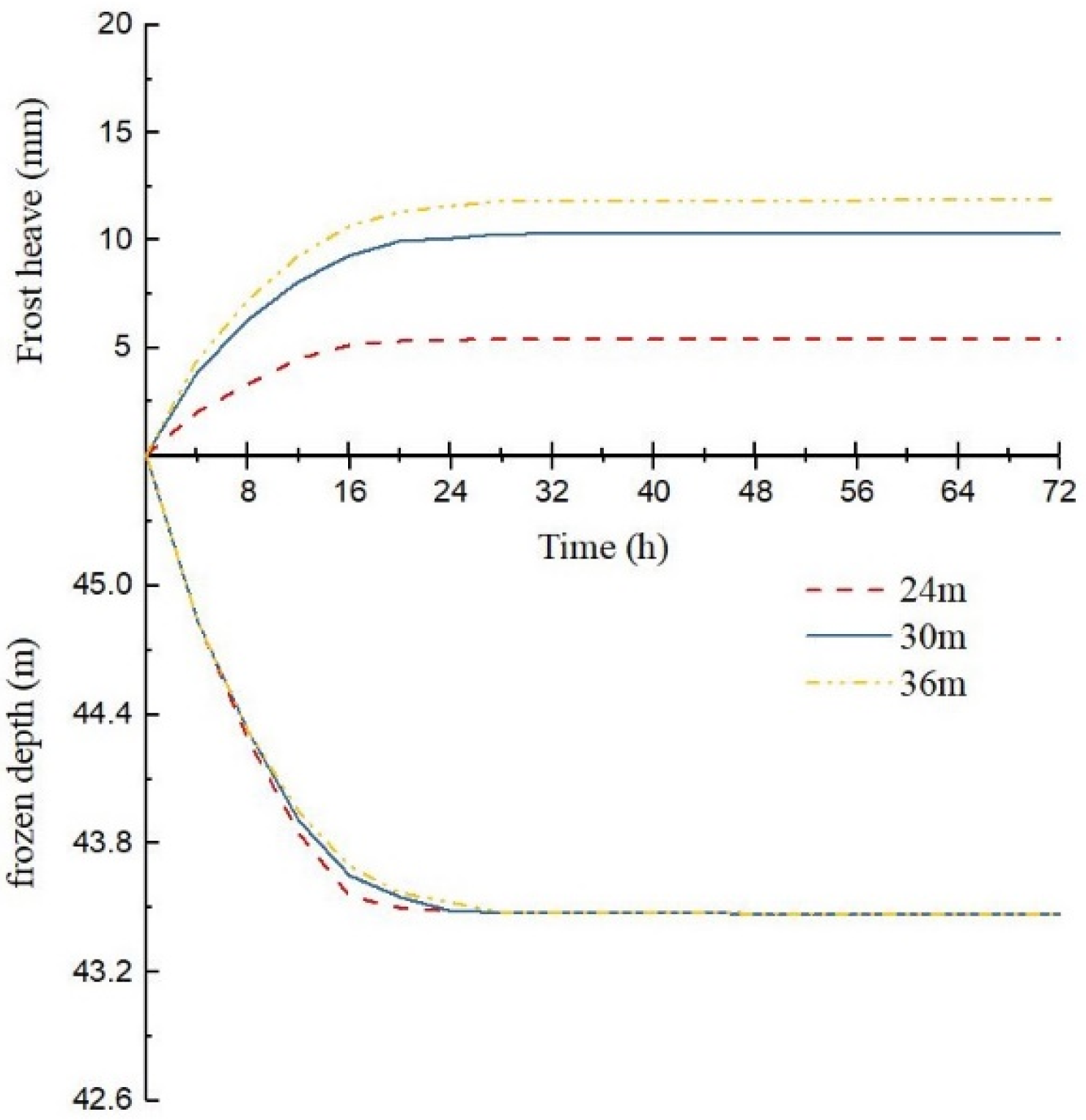
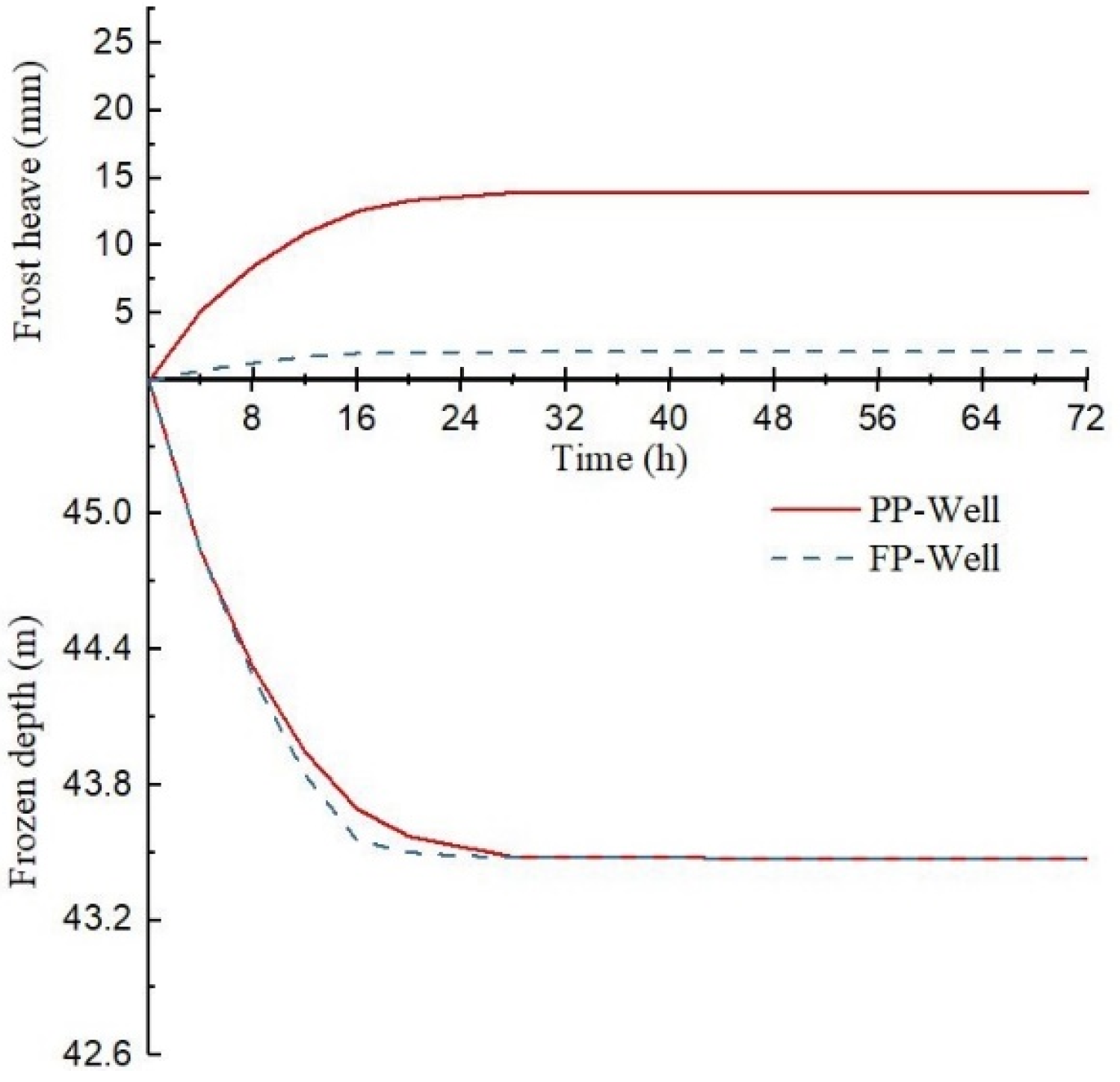
As there was no frost heave when the FP-Wells were arranged in double rows with a layout spacing of 24 m or 30 m, the layout spacing of 36 m was selected to study the effect of pumping well type on the inhibition of subgrade frost heave.
Figure 8 shows the frost heave curve for a double row of pumping wells with a layout spacing of 36 m. In this condition, the groundwater height using a PP-Well and an FP-Well was 43.51 m and 41.59 m, respectively. This did not take the level below the safe height, so the subgrade still experienced frost heave.
It can be seen from
Figure 8 that the subgrade frost heave when using an FP-Well was less than when using a PP-Well. When compared with an FP-Well, it takes longer for the frost heave and the frozen depth to reach stability when using a PP-Well. The frost heave for the PP-Well reached 14.01 mm after 25 h of testing, which was an increase of 11.83 mm. It can be concluded from this that FP-Wells are better at inhibiting subgrade frost heave than PP-Wells.
Table 3 shows the value of the drops in groundwater level and subgrade frost heave for a double row of pumping wells with a layout spacing of 30 m. The groundwater level using the PC-Well and FC-Well barely dropped at all, so these two types of pumping well cannot play a role in inhibiting frost heave. The groundwater level for the PP-Well exhibited definite drops, but there was still a large amount of frost heave. The best dewatering and frost heave inhibition effects were found in the FP-Well, making it the best choice of pumping well at OW.
4.2. Pumping Well Layout Mode
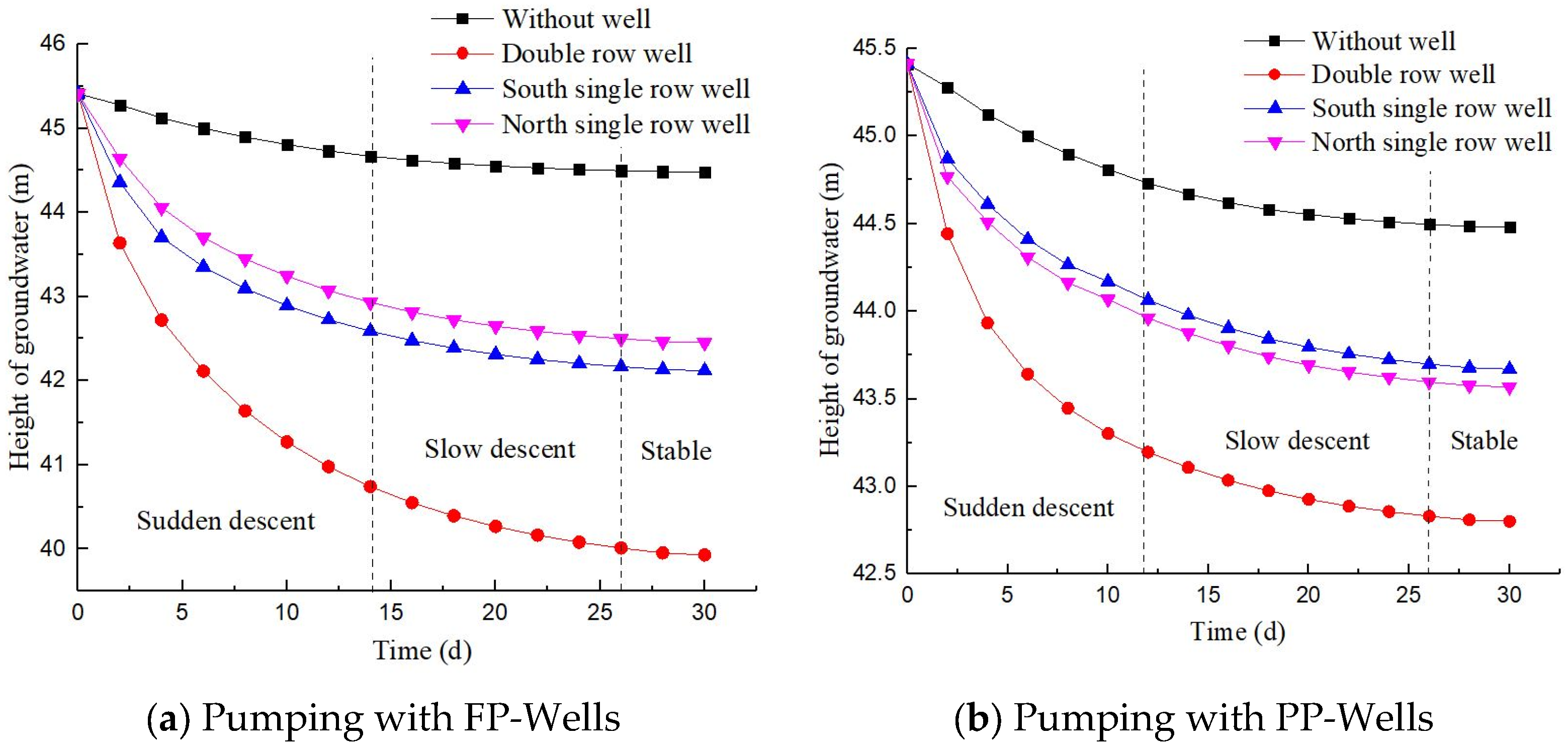
Figure 9 shows the change in the groundwater level when the layout spacing is 24 m. It can be seen from
Figure 9a that the groundwater level dropped the most and took the longest to reach stability when a double row of wells was pumping. There was little difference in the drop in groundwater between there being a single row of wells to the south and to the north. When a double row of wells was adopted, it took 26 days to reach stability, with a height of 39.93 m. The single rows of wells to the south and north took 20 days to reach stability, with a height of 42.12 m and 42.45 m, respectively. The total drop in height for the two single rows of wells was 0.16 m lower than it was when a double row of wells was used. The same pattern was visible when PP-Wells were used.
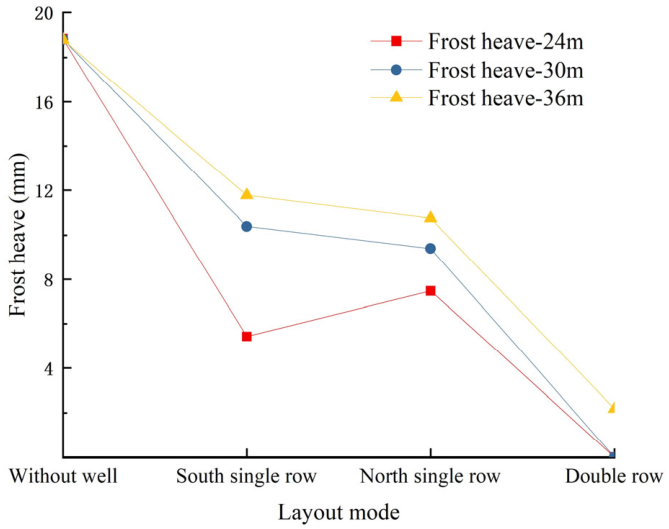
Figure 10 shows the frost heave when an FP-Well was used. Using both a single row of wells and a double row was able to inhibit frost heave. The frost heave was smaller for a double row of wells than it was for a single row of wells after stabilization. Having a single row of wells to the south or the north had a similar effect. When the layout spacing was 36 m, the frost heave for the double row of wells, single row to the south, and single row to the north decreased by 16.61 mm, 7.02 mm, and 8.04 mm, respectively, when compared to having no pumping taking place. The effect of a double row of wells in inhibiting frost was generally better than that of single row of wells. The same pattern was visible when the layout spacing was 24 m and 30 m.
Table 4 shows the values for the drop in groundwater level and subgrade frost heave for different FP-Well layouts. The dewatering effect and frost heave inhibition were best for a double row of wells, with them being able to bring the groundwater to a safe level and offset the likelihood of frost heave in the subgrade. Thus, a double row of wells provides the most effective layout mode at OW.
4.3. Pumping Well Layout Spacing
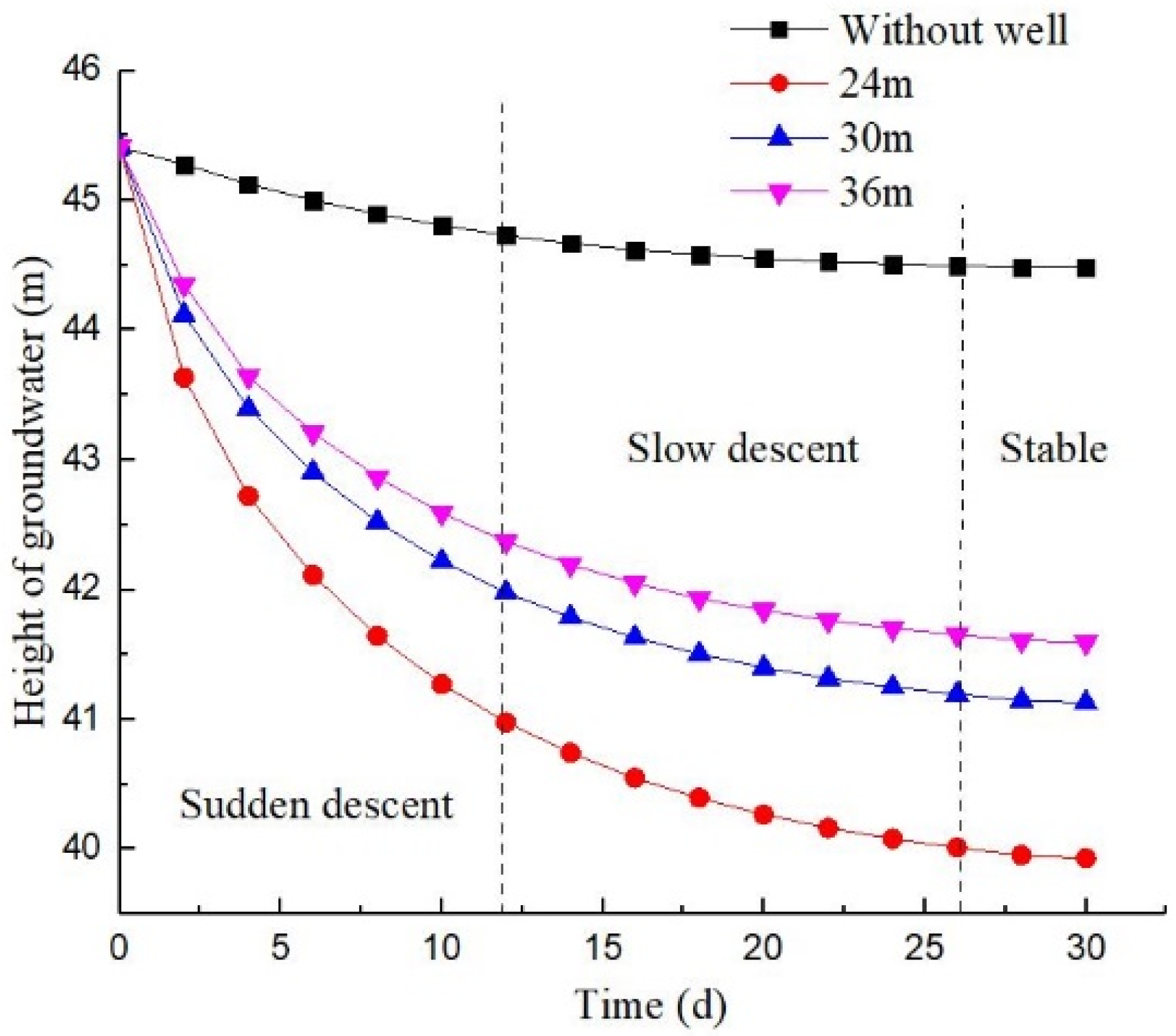
Figure 11 shows the changes in groundwater level for a double row of FP-Wells according to differences in their spacing. As the spacing decreased, the drop and dewatering rate increased, but the time taken to reach stability also increased. When a layout spacing of 36 m was adopted, the stable groundwater level was 2.87 m lower, which was 16.1% and 57.5% less than when the layout spacing was 30 m and 24 m, respectively. The distance from any position within the range of influence of the group of wells to each pumping well is reduced as the layout spacing is reduced, so the stable groundwater height at that position will drop in line with Equation (4).
As there was no frost heave when the FP-Wells were arranged in double rows with a layout spacing of 24 m or 30 m, the single row of wells to the south was selected to study the effect of the layout spacing on the inhibition of subgrade frost heave.
Figure 12 shows the frost heave for a single row of FP-Wells. As the layout spacing increased, the subgrade frost heave increased, and the time required to reach stability increased. When compared with a layout spacing of 24 m, the frost heave for spacings of 30 m and 36 m increased by 5.92 mm and 6.46 mm, respectively. The smaller the layout spacing of pumping wells, the better the effect of well-point dewatering in inhibiting frost heave in the subgrade. However, when the wells are closer together, this reduces the stability of the subgrade and can cause the subgrade to collapse. Thus, to obtain an effective balance, a larger layout spacing needs to be selected, so long as it can meet the basic requirement of eliminating frost heave.
4.4. Plan Optimization
Reducing the spacing of the wells enhances the dewatering effect and frost heave inhibition, but also reduces the strength and stability of the subgrade. However, field practice with a 24 m spacing in the research area has shown no collapse, and the calculated hydraulic gradients for 24 m, 30 m, and 36 m spacings (0.32, 0.28, and 0.24) are all below the critical value of 0.5 specified in the Code for Design of Railway Earth Structure (TB 10001-2016) [
25]. Therefore, the right balance needs to be struck between the stability requirements and the frost-heave inhibition requirements.
From the above analysis, it can be seen that a double row arrangement of FP-Wells is the most ideal provision for well-point dewatering. All preferred spacings are based on a double row arrangement of FP-Wells. The safe groundwater level at each mileage point is calculated by Equation (5). A larger layout spacing needs to be selected, assuming that it meets the requirement of eliminating frost heave.
The stable groundwater level and frost heave for different railway mileage points within the research area are shown in
Table 5. To use well-point dewatering to lower the groundwater level and inhibit frost heave in the silty subgrades underlying the Shenmu–Shuozhou railway, a layout spacing of 30 m needs to be selected between the mileage points K222+700 and K222+865, K223+045 and K223+135, and K223+225 and K223+300. A spacing of 36 m is needed between K222+865 and K223+045 and a spacing of 24 m between K223+135 and K223+225.
5. Discussion
In the research area, the lowest average temperature in January reaches −10.5 °C, which poses potential challenges for well-point dewatering systems, such as pipe freezing and pump failure. However, several practical anti-freezing measures can ensure the feasibility of the system. First, insulation materials (e.g., polyurethane foam or electric heat tracing tape) can be wrapped around exposed pipes and pumps to prevent heat loss. Second, temporary thermal shelters can be erected around the pump station and key pipeline sections to maintain a favorable ambient temperature. Third, intermittent pumping with a continuous water circulation mode can be adopted to prevent water from stagnating and freezing in the pipes. Fourth, low-temperature resistant pumps and the addition of antifreeze agents (e.g., propylene glycol) to the pumped water can further reduce the risk of freezing. These measures have been successfully applied in other cold-region engineering projects. Therefore, with proper anti-freezing precautions, well-point dewatering remains a practical and effective method for inhibiting frost heave in the Shenmu–Shuozhou railway subgrade.
A suitable well-point dewatering system can significantly reduce groundwater levels and ensure frost heave inhibition. However, the pumping wells can reduce the stability of the subgrade, leading to its potential collapse and affecting a railway’s safe operation. Shen [
27,
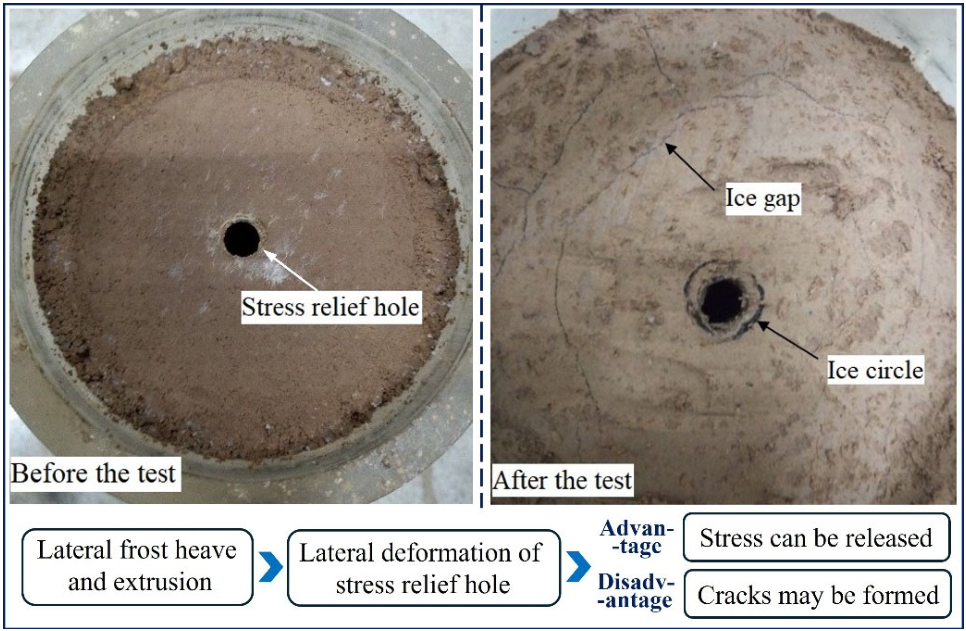
30] undertook relevant experimental research by setting up a stress relief hole in a soil sample for a frost heave test. After the test, the volume of the hole had decreased as a result of frost heave, and cracks had appeared around it (see
Figure 13). It is therefore conceivable that when a well-point dewatering system is arranged along the side ditch of a railway’s subgrade, the lateral extrusion caused by train load may result in pumping well deformation and decrease the stability of the subgrade.
To improve subgrade stability during well-point dewatering, Zhou [
31] compared two potential ways of using a pile-anchor support structure in the foundation pit. The first method involved maintaining the groundwater level below the bottom surface of the foundation pit, but above its sliding surface. The second method was to maintain the groundwater level below the sliding surface. The results of this study showed that the second method could significantly improve subgrade stability.
Research regarding the influence of well-point dewatering on subgrade stability chiefly concentrates on engineering practice, and there are few studies that focus on understanding the underlying mechanism or how to control it, so further research is needed. A limitation of this study is the lack of quantitative analysis of the impact of well spacing on subgrade stability. Future research will focus on establishing quantitative relationships between dewatering parameters and subgrade stability using numerical simulation and field monitoring. As a general measure, the construction of pumping wells should strictly follow the relevant construction standards, maintain high levels of construction quality, and seek to minimize the possible impact of the wells on the stability of the subgrade.
6. Conclusions
(1) A suitably appointed well-point dewatering system can rapidly lower groundwater levels and have a significant effect on frost heave inhibition.
(2) Due to the low-permeability aquitard, pumping confined water has almost no effect on phreatic water levels. The dewatering effect of a PP-Well is related to its depth. By using an FP-Well, the groundwater level can be reduced significantly, with the frost heave being only 0 to 0.156 times that of a PP-Well, suggesting an FP-Well is more suitable. When the effect of a single row of wells and a double row of wells is compared, the drop in groundwater levels induced by a double row is 92~117% better, with a reduction of subgrade frost heave of 5.4~10.4 mm. Thus, a double row of wells provides the most effective layout.
(3) With a decrease in the layout spacing, the drop height and dewatering rate increase, and the subgrade frost heave decreases. However, a closer spacing can reduce the stability of the subgrade, so a larger layout spacing is required.
(4) When using well-point dewatering to inhibit frost heave in the silty subgrade underlying the Shenmu–Shuozhou railway, FP-Wells should be arranged in double rows along the route, with a spacing of 30 m apart between the railway mileage points K222+700 and K222+865, K223+045 and K223+135, and K223+225 and K223+300; 36 m apart between K222+865 and K223+045; and 24 m apart between K223+135 and K223+225.
Author Contributions
Conceptualization, T.T. and K.W.; Methodology, T.T. and K.W.; Software, L.W.; Investigation, X.L. and Y.H.; Resources, T.T. and K.W.; Data curation, X.L. and YH.; Writing—original draft, T.T.; Writing—review & editing, K.W. and X.L.; Visualization, L.W.; Supervision, K.W.; Project administration, X.L.; funding acquisition, T.T. and K.W. All authors have read and agreed to the published version of the manuscript.
Funding
This research was funded by the GuangDong Basic and Applied Basic Research Foundation (Grant No. 2026A1515010925), the National Natural Science Foundation of China (NSFC) (Grant No. 42172291), and the China Postdoctoral Science Foundation (Grant No. 2025M783296). And The APC was funded by the GuangDong Basic and Applied Basic Research Foundation (Grant No. 2026A1515010925).
Data Availability Statement
The raw data supporting the conclusions of this article will be made available by the authors on request.
Acknowledgments
This research was financially supported by the GuangDong Basic and Applied Basic Research Foundation (Grant No. 2026A1515010925), the National Natural Science Foundation of China (NSFC) (Grant No. 42172291), and the China Postdoctoral Science Foundation (Grant No. 2025M783296).
Conflicts of Interest
The authors declare no conflict of interest.
References
- Tang, T.; Wang, K.; Zhang, G.; Shen, Y.; Liu, X.; Liu, Y.; Han, Y. Hydro-thermo-mechanical evolution of foundation pits during horizontal freezing and thawing: From in situ tests to prediction methods. Transp. Geotech. 2026, 59, 101973. [Google Scholar]
- Zhang, Z.; Li, M.; Wu, Q.; Wang, X.; Jin, H.; Chen, H.; Ma, D.; Zhang, Z. Degradation and local growth of “Xing’an-Baikal” permafrost responding to climate warming and the consequences. Earth-Sci. Rev. 2024, 255, 104865. [Google Scholar] [CrossRef]
- Zhang, Z.-T.; Wang, Y.-H.; Zhang, J.-Q.; Liu, Z.; Gao, W.-H. A new gradation equation for coarse-grained subgrade fillers and its applicability based on the fractal theory. Geomech. Geophys. Geo-Energy Geo-Resour. 2025, 11, 20. [Google Scholar] [CrossRef]
- Zhang, X.; Zhang, M.; Pei, W.; Lu, J. Experimental study of the hydro-thermal characteristics and frost heave behavior of a saturated silt within a closed freezing system. Appl. Therm. Eng. 2018, 129, 1447–1454. [Google Scholar] [CrossRef]
- Wang, Y.; Wang, D.; Ma, W.; Wen, Z.; Chen, S.; Xu, X. Laboratory observation and analysis of frost heave progression in clay from the Qinghai-Tibet Plateau. Appl. Therm. Eng. 2018, 131, 381–389. [Google Scholar] [CrossRef]
- Wang, K.; Tang, T.; Li, S.; Tian, S.; Zhang, L.; Liu, S.; Ling, X. Water migration in frozen high-speed railway subgrades under traffic vibration: Piston suction versus mud pumping and pot cover effect. Transp. Geotech. 2026, 58, 101914. [Google Scholar] [CrossRef]
- Tang, T.; Shen, Y.; Chen, M.; Liu, X.; Liu, Y.; Guo, J. Characteristics of matric suction in unequal sized quartz silt during horizontal freezing. Bull. Eng. Geol. Environ. 2022, 81, 327. [Google Scholar] [CrossRef]
- Tai, B.; Liu, J.; Wang, T.; Shen, Y.; Li, X. Numerical modelling of anti-frost heave measures of high-speed railway subgrade in cold regions. Cold Reg. Sci. Technol. 2017, 141, 28–35. [Google Scholar] [CrossRef]
- Liu, W.; Cao, W.; Yan, H.; Ye, T.; Jia, W. Experimental and numerical studies of controlling thermal cracks in mass concrete foundation by circulating water. Appl. Sci. 2016, 6, 110. [Google Scholar] [CrossRef]
- Zhang, Z.-T.; Gao, W.-H. Effect of different test methods on the disintegration behaviour of soft rock and the evolution model of disintegration breakage under cyclic wetting and drying. Eng. Geol. 2020, 279, 105888. [Google Scholar] [CrossRef]
- Zhou, Y.Z.; Zhu, H.W.; Cai, D.G.; Yan, H.Y.; Li, Z.G.; Yao, J.P. Numerical analysis on regulation scheme for subgrade frost heaving of high-speed railway by well point dewatering in seasonal frozen soil region. China Railw. Sci. 2016, 37, 9–14. [Google Scholar]
- Nie, Q.K.; Wang, Y.H.; Bai, B.; Jia, X.; Wang, Z. Research on the vacuum well-point dewatering and the transport of soil particles in silty clay ground. Chin. J. Undergr. Space Eng. 2015, 11, 1572–1580. [Google Scholar]
- Shaqour, F.M.; Hasan, S.E. Groundwater control for construction purposes: A case study from Kuwait. Environ. Geol. 2008, 53, 1603–1612. [Google Scholar]
- Zhang, L.; Zhou, X.; Pan, Y.; Zeng, B.; Zhu, D.; Jiang, H. Design of groundwater extraction in open cut foundation pit and simplified calculation of ground subsidence due to dewatering in sandy pebble soil strata. Adv. Mech. Eng. 2020, 143, 1046937. [Google Scholar]
- Huang, F.; Lyu, J.; Wang, G.; Liu, H. One-dimensional vacuum steady seepage model of unsaturated soil and finite difference solution. Math. Probl. Eng. 2017, 137, 137. [Google Scholar]
- Shen, Y.; Tang, T.; Wang, D.; Chen, M.; Liu, Y.; Wang, Y. Nonzero angle between the directions of matric suction and gravity during horizontal freezing. Acta Geotech. 2024, 19, 821–831. [Google Scholar]
- Wei, J.; Men, Y.; Zhu, F.; Le, H.; Fan, H. The reinforcement effects of deep soft soil foundation with high degree of saturation under dynamic compaction. Adv. Mech. Eng. 2018, 10, 1687814018782633. [Google Scholar] [CrossRef]
- Zhang, Y.; Zhao, Y.Y.; Gao, W.L. Experimental study of foundation treatment with vacuum well-point dewatering. Rock. Soil Mech. 2014, 35, 2667–2672. [Google Scholar]
- Yu, H.B. Study on the treatment scheme for diseases in tunnel base by well point dewatering under the condition of heavy axle load train on existing railway. China Railw. Sci. 2013, 34, 54–59. [Google Scholar]
- Zhang, Z.-T.; Liu, A.; Zhou, P.; Zhao, C.; Deng, X.-J.; Zhang, C.; Huang, W. Evolution of particle crushing of coal gangue coarse-grained subgrade filler using large-scale triaxial compression. Case Stud. Constr. Mater. 2025, 23, e05334. [Google Scholar] [CrossRef]
- Indraratna, B.; Redana, I.W. Plane-strain modeling of smear effects associated with vertical drains. Geotech. Geoenvironmental Eng. 1997, 123, 474–478. [Google Scholar] [CrossRef]
- Qin, M.; Yang, J.; Bai, Y.; Bai, Y. The subsidence–distance relationship for land subsidence induced by groundwater abstraction. Hydrogeol. J. 2025, 33, 205–217. [Google Scholar]
- Pang, M.; Du, E.; Zheng, C. A data-driven approach to exploring the causal relationships between distributed pumping activities and aquifer drawdown. Sci. Total Environ. 2023, 870, 161998. [Google Scholar] [CrossRef] [PubMed]
- Massmann, J.; Freeze, R.A.; Smith, L.; Sperling, T.; James, B. Hydrogeological decision analysis: 2. Application to ground-water contamination. Ground Water 1991, 29, 536–548. [Google Scholar] [CrossRef]
- TB 10001-2016; Code for Design of Railway Earth Structure. China Railway Publishing House: Beijing, China, 2016.
- Shen, Y.P.; Tang, T.X.; Liu, J.K.; Tian, Y.H.; Cai, X.P. Study on controlling frost heave by mixing salt with low liquid limit silt fillers. J. China Railw. Soc. 2018, 40, 93–99. [Google Scholar]
- Shen, Y.; Tang, T.; Zuo, R.; Tian, Y.; Zhang, Z.; Wang, Y. The effect and parameter analysis of stress release holes on decreasing frost heaves in seasonal frost Areas. Cold Reg. Sci. Technol. 2020, 169, 102898. [Google Scholar] [CrossRef]
- Zhang, Z.-T.; Gao, W.-H.; Wang, X.; Zhang, J.-Q.; Tang, X.-Y. Degradation-induced evolution of particle roundness and its effect on the shear behaviour of railway ballast. Transp. Geotech. 2020, 24, 100388. [Google Scholar] [CrossRef]
- Jin, H.W.; Lee, J.; Ryu, B.H.; Shin, Y.; Jang, Y.E. Experimental assessment of the effect of frozen fringe thickness on frost heave. Geomech. Eng. 2019, 19, 193–199. [Google Scholar] [CrossRef]
- Shen, Y.; Liu, X.; Zuo, R.; Tang, T.; Tian, Y.; Wang, Y. Effect of frost heave on a silt column filled with rubber-asphalt-fiber. Cold Reg. Sci. Technol. 2019, 174, 102991. [Google Scholar]
- Zhou, Y.; Wang, Z.Z. Comparative analysis of two kinds of well dewatering methods in support structure of piles with anchor cables. J. Lanzhou Univ. Technol. 2016, 42, 115–120. [Google Scholar]
Figure 1.
Groundwater drop curves.
Figure 1.
Groundwater drop curves.
Figure 2.
Frost heave-related damage in the research area.
Figure 2.
Frost heave-related damage in the research area.
Figure 3.
Distribution and characteristics of the soil layers.
Figure 3.
Distribution and characteristics of the soil layers.
Figure 4.
Overhead view of the research area.
Figure 4.
Overhead view of the research area.
Figure 5.
Dynamic groundwater seepage model (unit: m).
Figure 5.
Dynamic groundwater seepage model (unit: m).
Figure 6.
Comparison of calculated and measured groundwater levels.
Figure 6.
Comparison of calculated and measured groundwater levels.
Figure 7.
Changes in groundwater level according to type of pumping well (D = 24 m, double row wells).
Figure 7.
Changes in groundwater level according to type of pumping well (D = 24 m, double row wells).
Figure 8.
Subgrade frost heave in relation to type of well (D = 36 m, double row wells).
Figure 8.
Subgrade frost heave in relation to type of well (D = 36 m, double row wells).
Figure 9.
Changes in groundwater level according to layout mode (D = 24 m).
Figure 9.
Changes in groundwater level according to layout mode (D = 24 m).
Figure 10.
Subgrade frost heave in relation to layout mode (FP-Well).
Figure 10.
Subgrade frost heave in relation to layout mode (FP-Well).
Figure 11.
Changes in groundwater level according to layout spacing (double row of FP-Wells).
Figure 11.
Changes in groundwater level according to layout spacing (double row of FP-Wells).
Figure 12.
Subgrade frost heave in relation to spacing (single row of FP-Wells to the south).
Figure 12.
Subgrade frost heave in relation to spacing (single row of FP-Wells to the south).
Figure 13.
Changes in a stress relief hole as a result of frost heave.
Figure 13.
Changes in a stress relief hole as a result of frost heave.
Table 1.
Physical and mechanical parameters of the soil layers.
Table 1.
Physical and mechanical parameters of the soil layers.
| Number | Soil Layer | Density
(g/cm3) | Hydraulic Conductivity
(m/s) | Cohesion
(kPa) | Internal Friction Angle
(°) | Specific Heat Capacity
J/(kg × K) | Thermal Conductivity
w/(m × K) |
|---|
| ① | Silt | 1.76 | 4.8 × 10⁻⁶ | 22.2 | 18.2 | 1.40 | 1.62 |
| ② | Silty sand | 1.73 | 8.2 × 10⁻⁶ | 17.0 | 26.0 | 1.50 | 1.68 |
| ③ | Silty clay | 1.71 | 3.5 × 10⁻⁸ | 22.4 | 13.0 | 1.42 | 1.64 |
| ④ | Argillaceous limestone | 1.95 | 9.5 × 10⁻⁶ | 11.3 | 30.3 | 1.61 | 1.54 |
Table 2.
Well-point dewatering test plan.
Table 2.
Well-point dewatering test plan.
| Type | Layout Mode | Layout Spacing
D (m) |
|---|
PP-Well
FP-Well
PC-Well
FC-Well | Single row to the south
Single row to the north
Double row of wells | 24
30
36 |
Table 3.
Drops in groundwater level and subgrade frost heave results for different types of pumping well.
Table 3.
Drops in groundwater level and subgrade frost heave results for different types of pumping well.
| Layout Spacing (m) | Layout Mode | Type | Stable Level (m) | Drop Height (m) | Frost Heave (mm) | Fulfils Requirements |
|---|
| No pumping | 44.49 | 0 | 18.81 | No |
| 30 | Double row | PP-Well | 43.36 | 1.13 | 13.09 | No |
| 30 | Double row | FP-Well | 41.13 | 3.36 | 0 | Yes |
| 30 | Double row | PC-Well | 44.38 | 0.11 | 18.67 | No |
| 30 | Double row | FC-Well | 44.33 | 0.16 | 18.64 | No |
Table 4.
Drops in groundwater level and subgrade frost heave results for different layout modes.
Table 4.
Drops in groundwater level and subgrade frost heave results for different layout modes.
| Layout Spacing (m) | Type | Layout Mode | Stable Level (m) | Drop Height (m) | Frost Heave (mm) | Fulfills Requirements? |
|---|
| No pumping | 44.49 | 0 | 18.81 | No |
| 24 | FP-Well | Double row | 39.93 | 4.56 | 0 | Yes |
| 24 | FP-Well | South single row | 42.12 | 2.37 | 5.43 | No |
| 24 | FP-Well | North single row | 42.45 | 2.04 | 7.48 | No |
| 30 | FP-Well | Double row | 41.13 | 3.36 | 0 | Yes |
| 30 | FP-Well | South single row | 42.92 | 1.57 | 10.39 | No |
| 30 | FP-Well | North single row | 42.76 | 1.73 | 9.40 | No |
Table 5.
Stable groundwater level and frost heave at different railway mileage points.
Table 5.
Stable groundwater level and frost heave at different railway mileage points.
| Railway Mileage | Safe Level (m) | Layout Spacing-24 m | Layout Spacing-30 m | Layout Spacing-36 m | Preferable Spacing (m) |
|---|
| Stable Level (m) | Frost Heave (mm) | Stable Level (m) | Frost Heave (mm) | Stable Level (m) | Frost Heave (mm) |
|---|
| K222+730 | 41.95 | 40.78 | 0 | 41.90 | 0 | 42.17 | 1.36 | 24, 30 |
| K222+850 | 40.94 | 39.02 | 0 | 40.34 | 0 | 40.94 | 0.02 | 24, 30 |
| K222+880 | 40.91 | 38.57 | 0 | 40.09 | 0 | 40.90 | 0 | 24, 30, 36 |
| K223+030 | 40.61 | 38.81 | 0 | 40.24 | 0 | 40.44 | 0 | 24, 30, 36 |
| K223+060 | 40.67 | 39.44 | 0 | 40.34 | 0 | 41.05 | 2.36 | 24, 30 |
| K223+120 | 40.74 | 39.39 | 0 | 40.67 | 0 | 41.15 | 2.50 | 24, 30 |
| K223+150 | 40.79 | 39.66 | 0 | 40.82 | 0.17 | 41.34 | 3.38 | 24 |
| K223+210 | 40.98 | 40.13 | 0 | 41.02 | 0.27 | 41.15 | 1.06 | 24 |
| K223+240 | 41.08 | 39.87 | 0 | 41.00 | 0 | 41.60 | 3.20 | 24, 30 |
| K223+270 | 41.21 | 39.87 | 0 | 40.96 | 0 | 41.66 | 2.76 | 24, 30 |
| Disclaimer/Publisher’s Note: The statements, opinions and data contained in all publications are solely those of the individual author(s) and contributor(s) and not of MDPI and/or the editor(s). MDPI and/or the editor(s) disclaim responsibility for any injury to people or property resulting from any ideas, methods, instructions or products referred to in the content. |