
NDT-Based Condition Assessment and Structural Safety Evaluation of a Reinforced Cement Concrete Water Tank in a Coastal Region: A Case Study

Abstract
1. Introduction
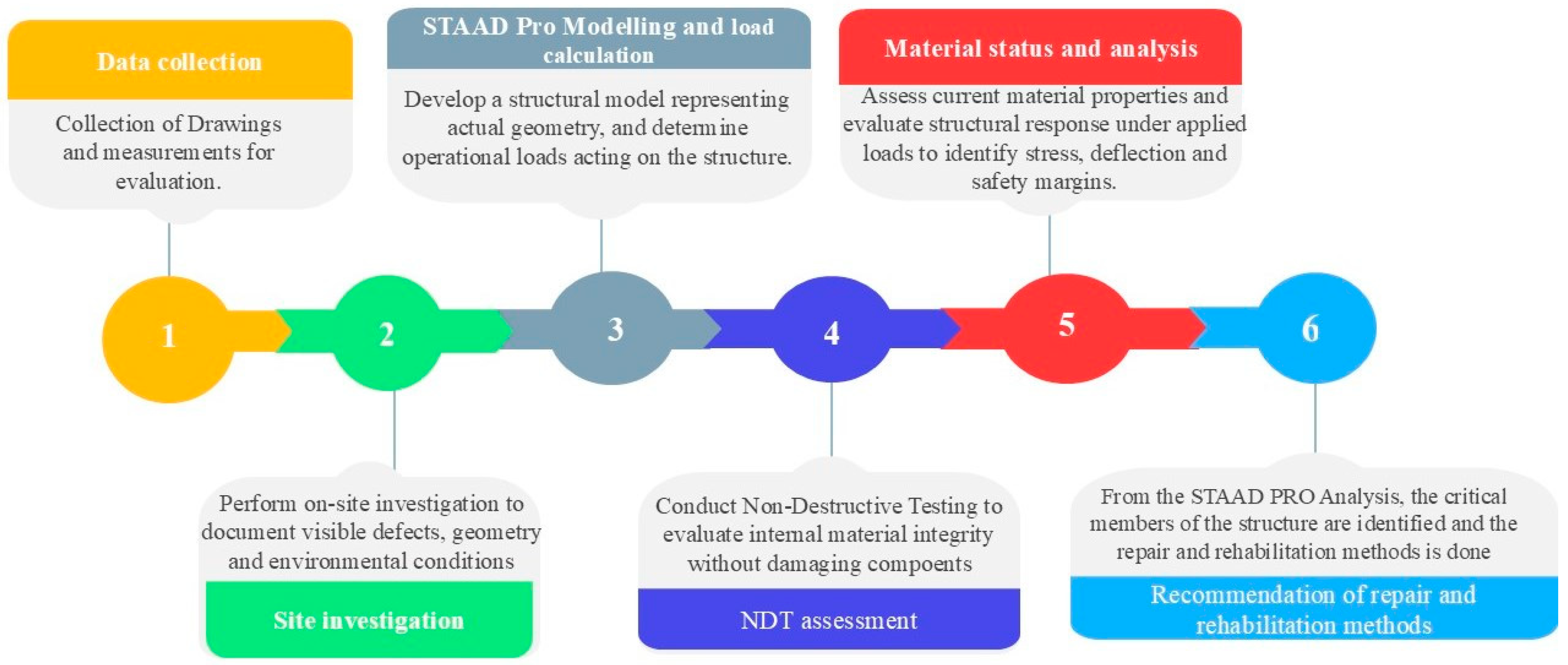
2. Methodology
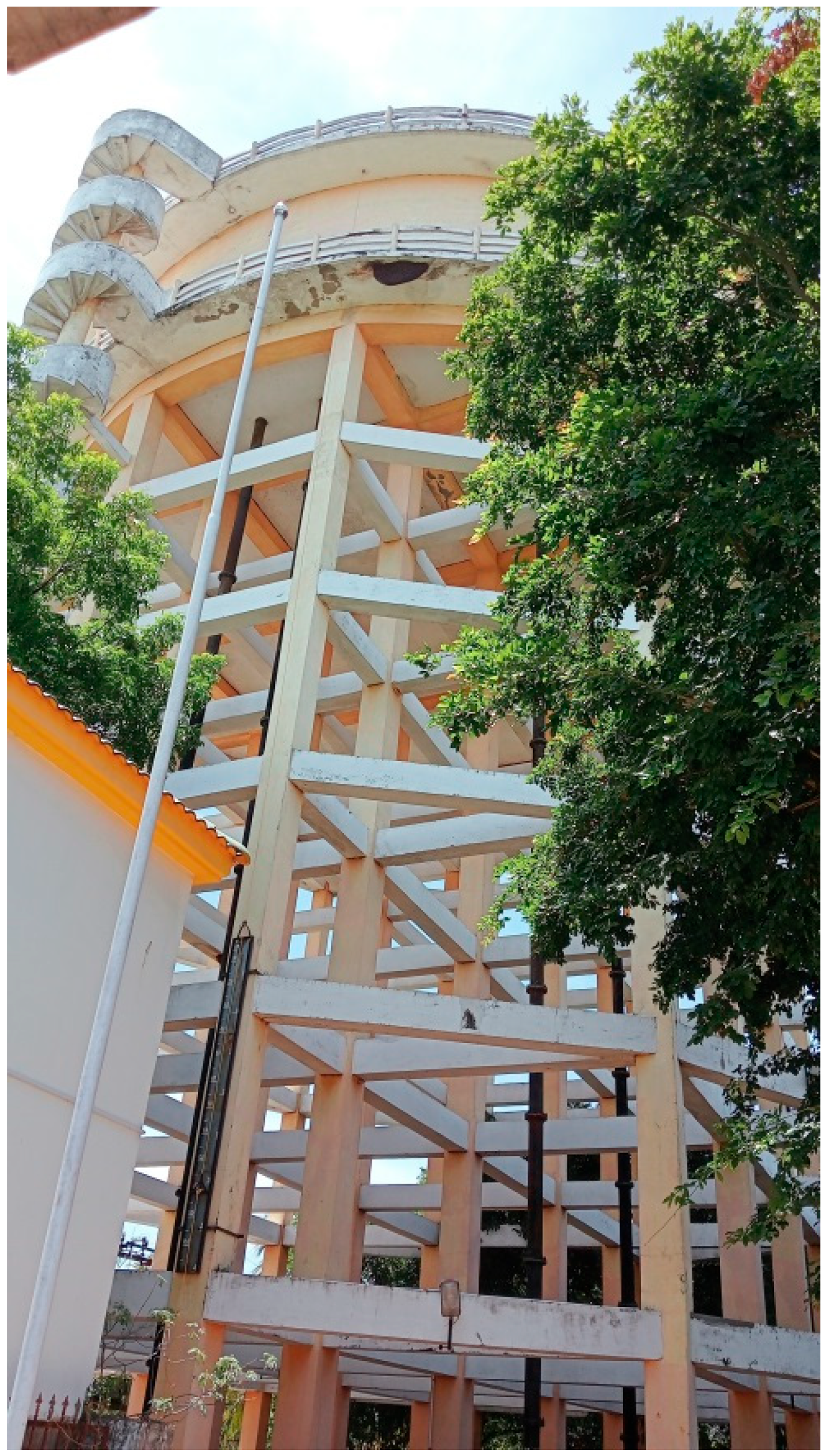
2.1. Study Area and Case Study Description
2.2. Visual Inspection
2.3. Non-Destructive Testing (NDT) Methods
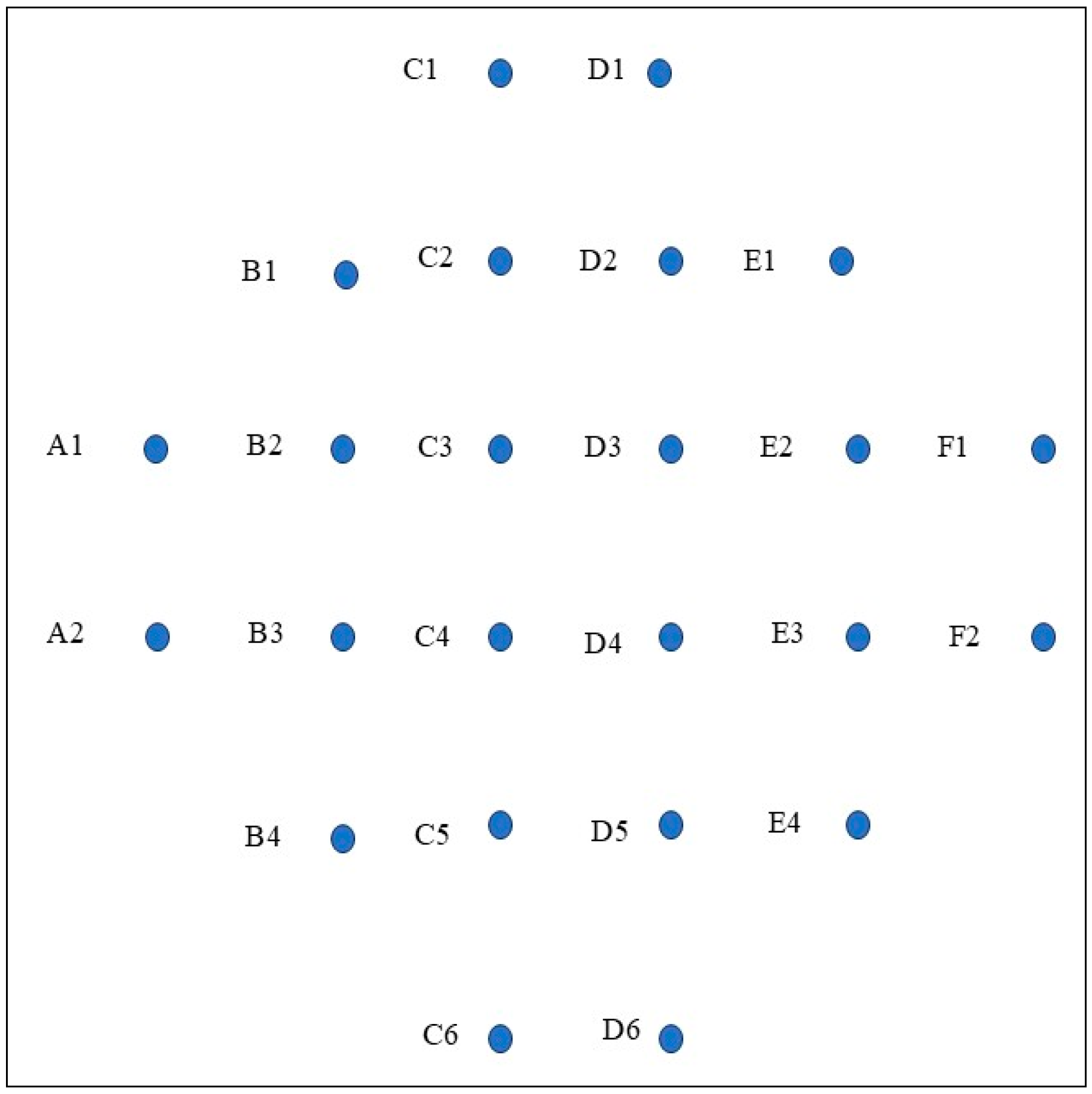
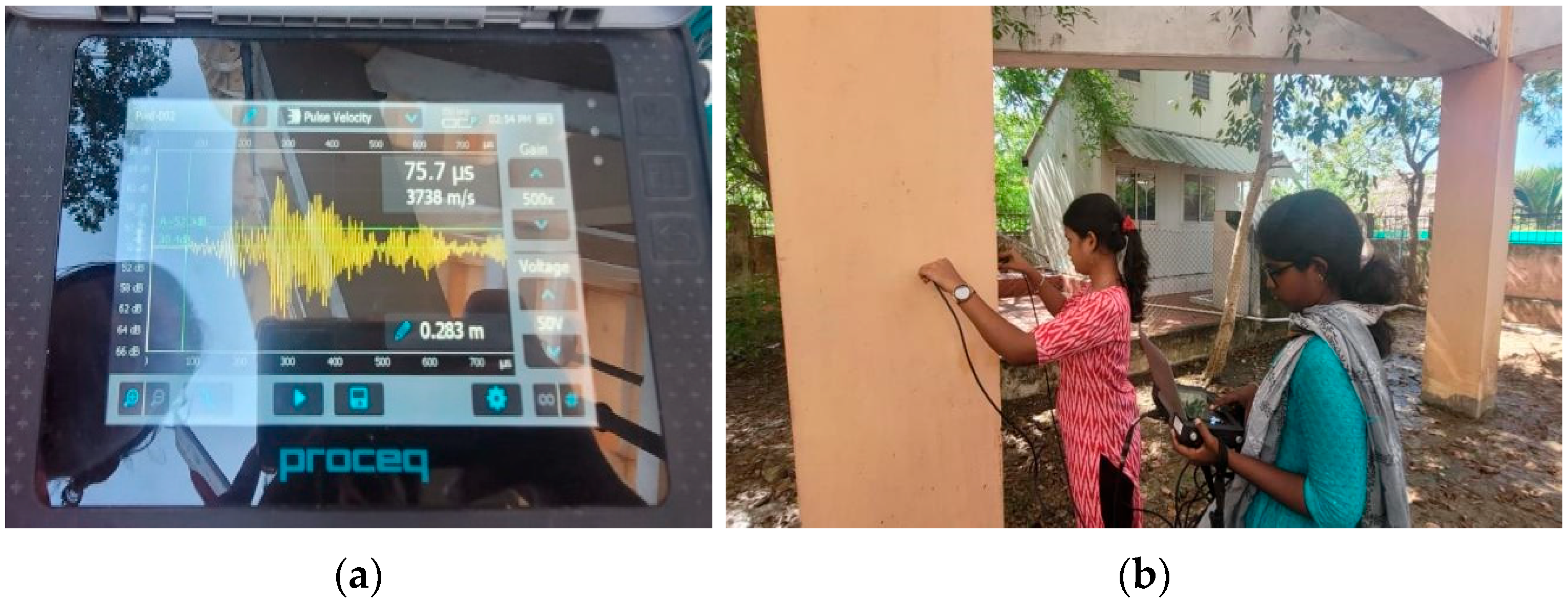
2.3.1. Ultra-Sonic Pulse Velocity (UPV) Test
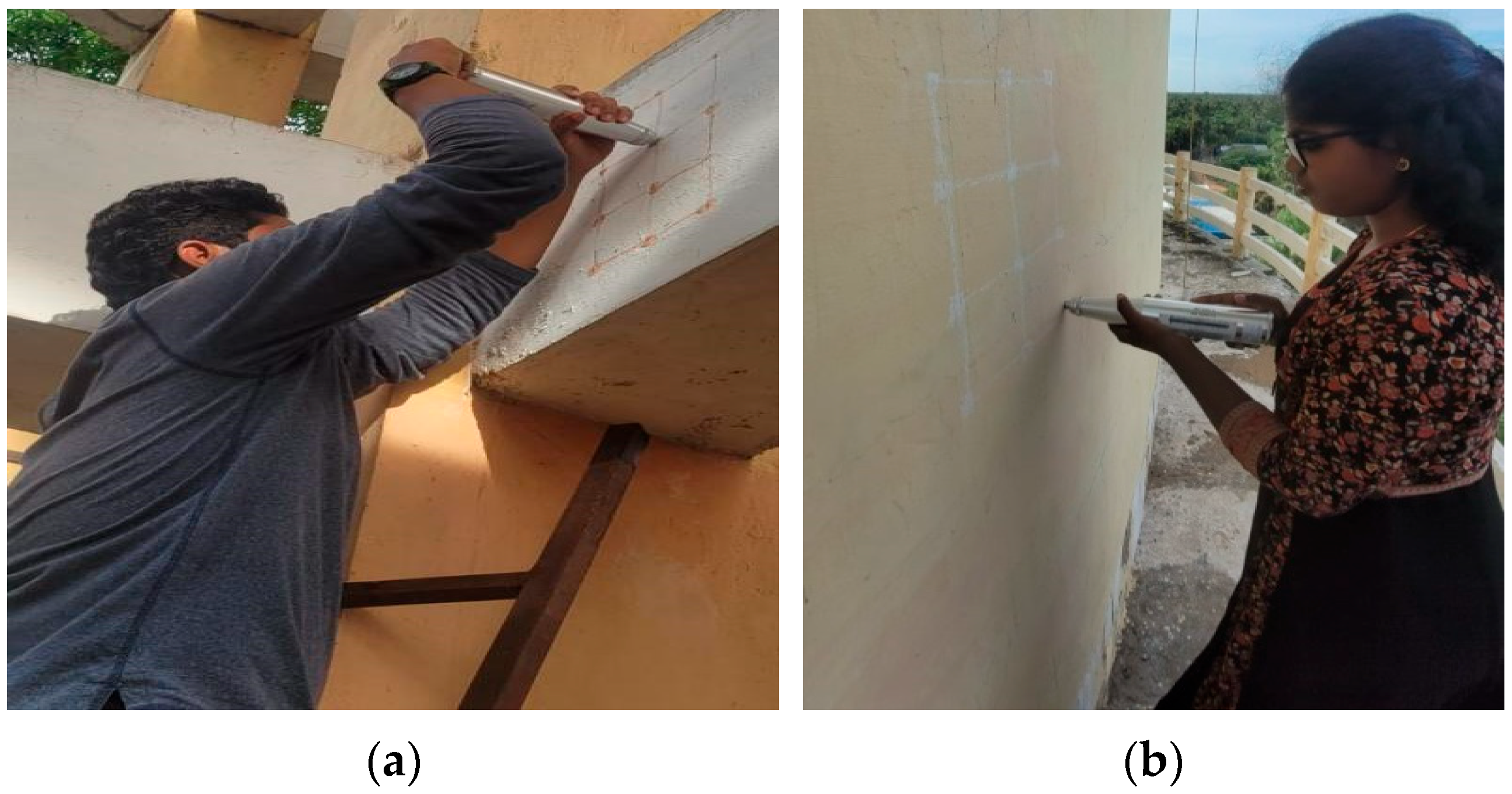
2.3.2. Schmidt Rebound Hammer Test
2.4. Structural Analysis Using STAAD Pro
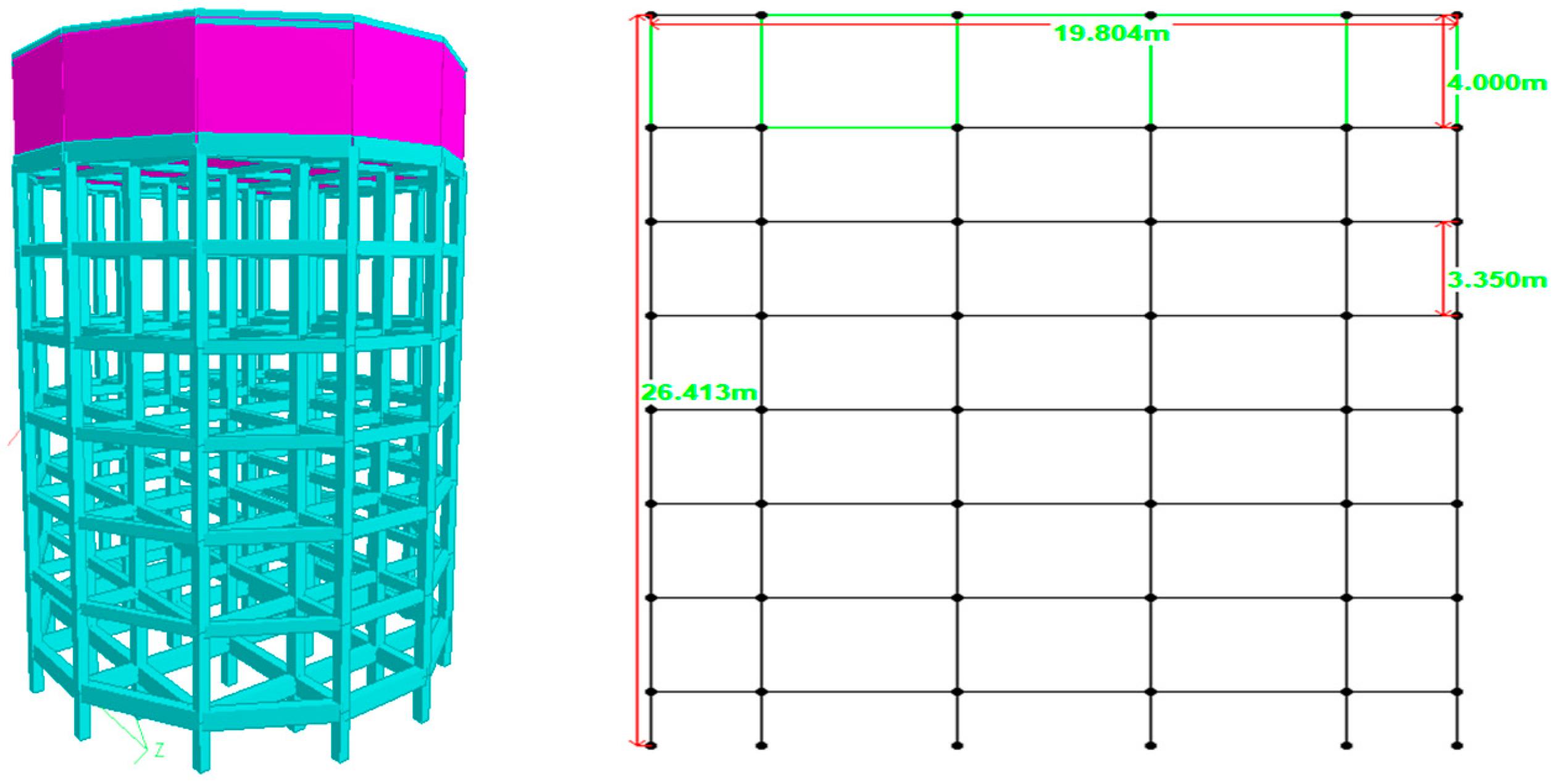
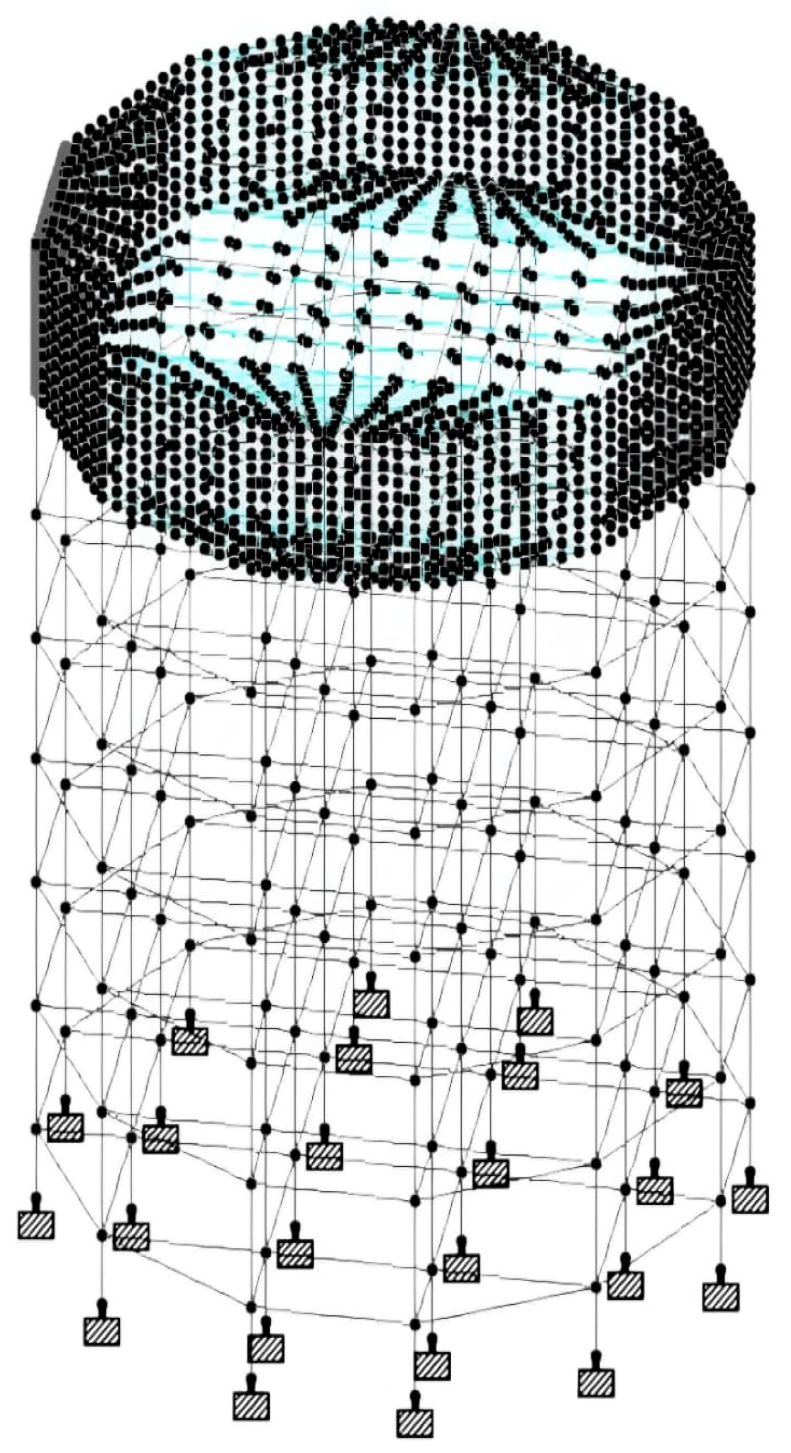
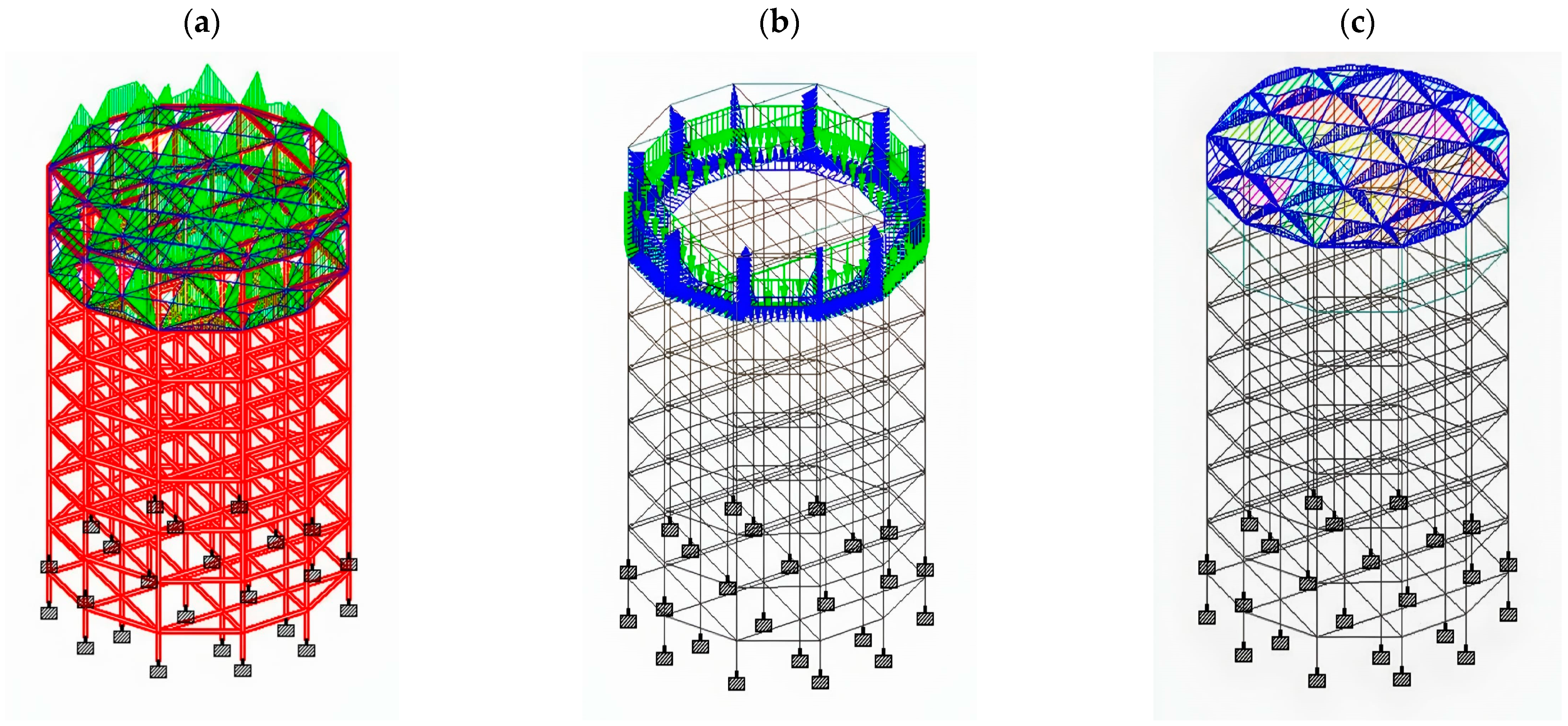
2.4.1. Geometric Modelling
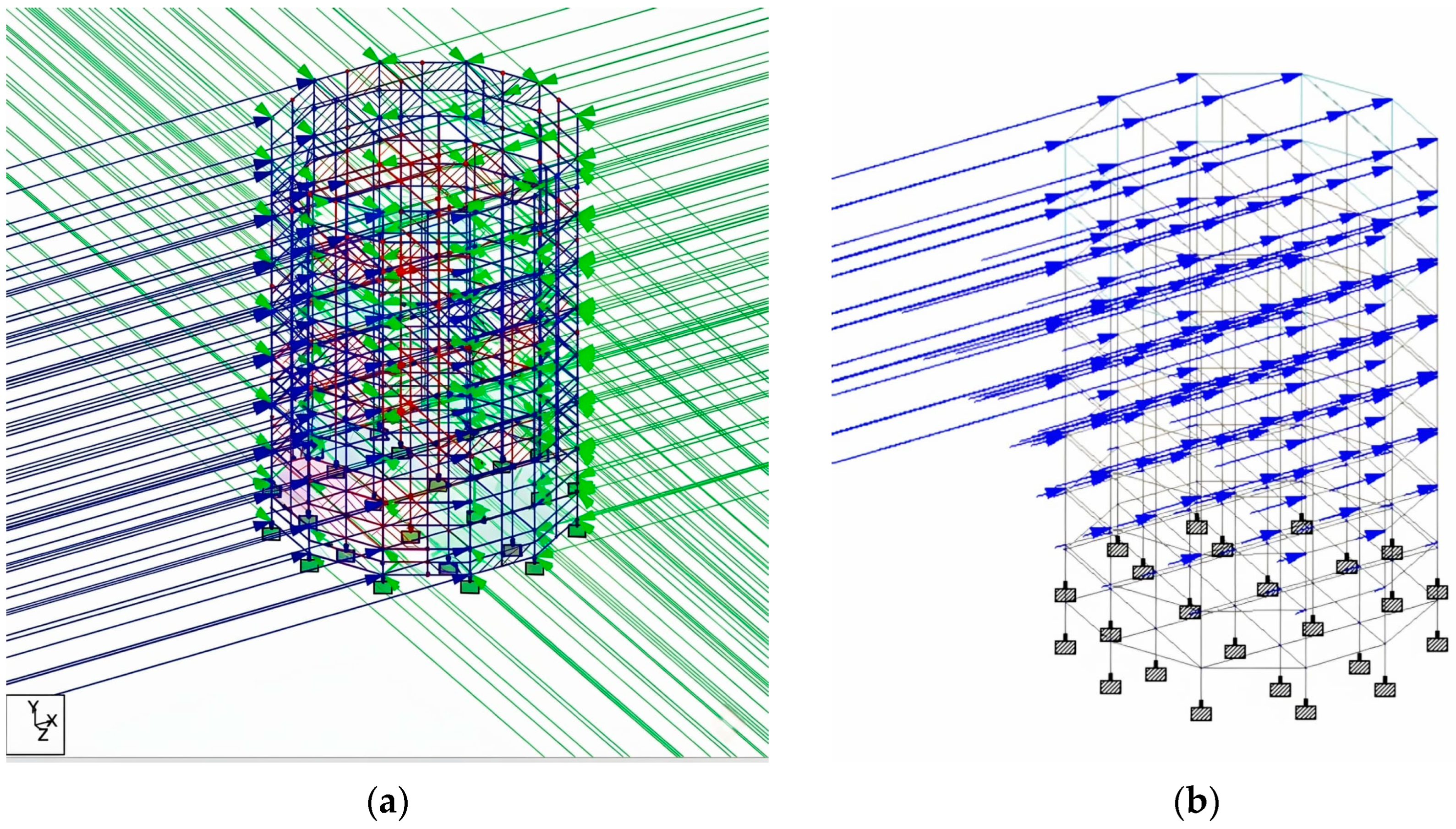
2.4.2. Structural Loading and Boundary Conditions
3. Results
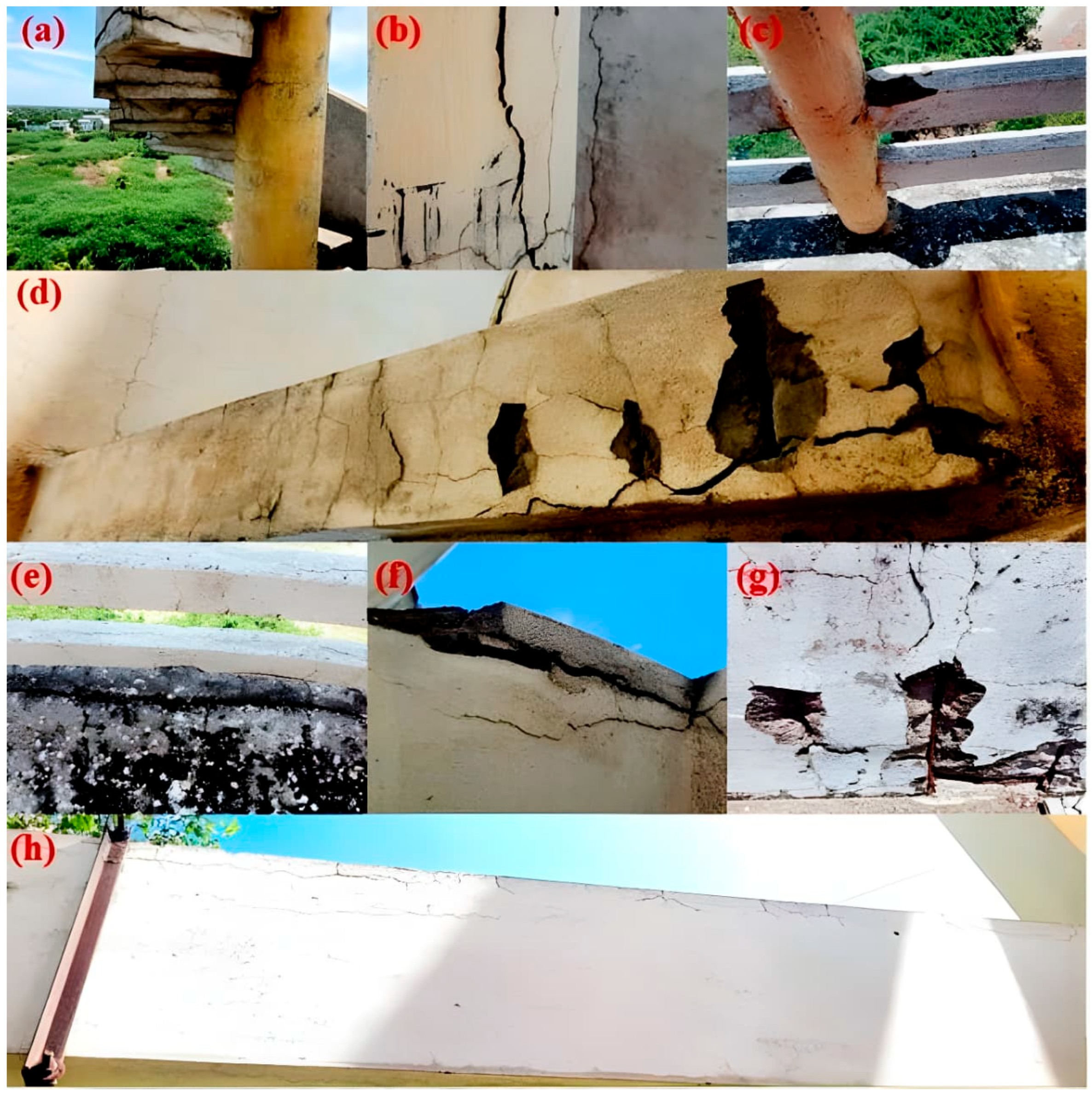
3.1. Findings from Visual Inspection
3.2. Interpretation of NDT Results
3.3. Structural Analysis Results
4. Discussion
- Localized Concrete Restoration: The removal of spalled or lower-quality concrete, treating exposed reinforcement, and repairing the section with polymer-modified mortar, thereby restoring the protective cover.
- The exposed slabs, stairs, and surfaces of the tank can be waterproofed to reduce the loss of long-term durability.
- Structural cracks can be sealed and rehabilitated using epoxy injection and flexible sealant to prevent further moisture penetration and deterioration of concrete.
- The edges of the deteriorated stairs and other access elements can be repaired to restore surface integrity.
- Vulnerable reinforcement zones can be cleaned and treated with corrosion protection measures such as passivation and protective coatings.
- Observed biological growth and surface contaminants must be removed, and the protective coatings can be applied to avoid degradation due to environmental actions.
- The drainage management system can be improved to prevent water stagnation around the structural elements.
- Post-repair concrete quality verification can be done for the confirmation of the concrete’s bond integrity and material performance.
5. Conclusions
- Visual inspection revealed physical signs of deterioration, including cracks, spalling, exposed reinforcement, vegetation growth, and damaged staircases and guardrails.
- The visual inspection observations were supported by NDT results, which confirmed localized variations in concrete quality.
- The rebound hammer test results showed that the measured compressive strength of beams was lower than that of columns, ranging from 12 to 31 MPa. The compressive strength of columns ranges from 22 to 43 MPa. The observed difference in compressive strength values indicates the effects of localized changes in surface hardness and deterioration in specific structural members.
- From the UPV test results, the UPV values range from 1782 to 4404 m/s, indicating variations in the internal quality of the concrete. UPV test results highlight localized variation and deterioration in concrete, necessitating further structural evaluation of members exhibiting doubtful concrete quality.
- The induced stress in the tank’s structural elements was determined and compared with the in situ compressive strength obtained from NDT results. From the comparison, it was found that all structural elements were safe and had higher safety margins. However, this study also identified specific areas, such as stair beams, guardrails, and wall surfaces, that require localized repair and rehabilitation.
- Recommendations include patch repairs, epoxy grouting, corrosion-resistant coatings, recasting of damaged elements, and application of waterproof protective layers.
Author Contributions
Funding
Data Availability Statement
Acknowledgments
Conflicts of Interest
Abbreviations
| RCC | Reinforced Cement Concrete; |
| NDT | Non-Destructive Testing; |
| UPV | Ultrasonic Pulse Velocity; |
| AAR | Alkali-Aggregate Reaction; |
| DEF | Delayed Ettringite Formation; |
| SSI | Soil–Structure Interaction; |
| PWD | Public Works Department; |
| FEM | Finite Element Method. |
References
- Dilena, M.; Dell’Oste, M.F.; Gubana, A.; Morassi, A.; Polentarutti, F.; Puntel, E. Structural Survey of Old Reinforced Concrete Elevated Water Tanks in an Earthquake-Prone Area. Eng. Struct. 2021, 234, 111947. [Google Scholar] [CrossRef]
- Sollero, M.; Bolorino, H. Investigation and Diagnosis of a Reinforced Concrete Reservoir with Intense Crack Formation from Several Sources. J. Build. Pathol. Rehabil. 2016, 1, 6. [Google Scholar] [CrossRef]
- Shahanawaz, G.; Nirupama, P.N.; Raghavendra, T. Structural Health Assessment of Overhead Water Tank—A Case Study. J. Build. Pathol. Rehabil. 2024, 9, 136. [Google Scholar] [CrossRef]
- Ranasinghe, K.; De Silva, S. Combined Use of Non-Destructive Tests, Visual Inspection and Service Life Prediction to Ensure the Reliability of Reinforced Concrete. J. Natl. Sci. Found. Sri Lanka 2022, 50, 371–386. [Google Scholar] [CrossRef]
- Ma, J.; Yang, Q.; Peng, X.; Xia, K. Review on Durability Deterioration and Mitigation of Concrete Structures. Coatings 2025, 15, 982. [Google Scholar] [CrossRef]
- Krentowski, J.R. Assessment of Destructive Impact of Different Factors on Concrete Structures Durability. Materials 2022, 15, 225. [Google Scholar] [CrossRef] [PubMed]
- Czarnecki, L.; Geryło, R.; Kuczyński, K. Concrete Repair Durability. Materials 2020, 13, 4535. [Google Scholar] [CrossRef]
- Bahreini, F.; Hammad, A. Developing an Ontology for Concrete Surface Defects to Enhance Inspection, Diagnosis and Repair Information Modeling. Infrastructures 2024, 9, 220. [Google Scholar] [CrossRef]
- Semko, O.; Vynnykov, Y.; Filonenko, O.; Yurin, O.; Ilchenko, T.; Hranko, O.; Semko, V.; Salles, A.; Mateus, R.; Bragança, L.; et al. To the Issue of Assessment of the Technical Condition of Underground Structures of Buildings. Sustainability 2025, 17, 2264. [Google Scholar] [CrossRef]
- Uddin Mohammed, T.; Otsuki, N.; Hamada, H. Corrosion of Steel Bars in Cracked Concrete under Marine Environment. J. Mater. Civ. Eng. 2003, 15, 460–469. [Google Scholar] [CrossRef]
- Chmielewski, R.; Kruszka, L.; Muzolf, P. The Selection of Methods for Strengthening of the Reinforced-Concrete Structure of the Open Tank. Case Stud. Constr. Mater. 2020, 12, e00343. [Google Scholar] [CrossRef]
- Sbartaï, Z.M.; Breysse, D.; Larget, M.; Balayssac, J.P. Combining NDT Techniques for Improved Evaluation of Concrete Properties. Cem. Concr. Compos. 2012, 34, 725–733. [Google Scholar] [CrossRef]
- Venkatesh, P.; Alapati, M. Condition Assessment of Existing Concrete Building Using Non-Destructive Testing Methods for Effective Repair and Restoration—A Case Study. Civ. Eng. J. 2017, 3, 841–855. [Google Scholar] [CrossRef]
- Chaudhari, G.V.; Swamy, R.M. An Experimental Study of Corrosion in RCC Structures: Prevention, Repair, and Maintenance. Int. J. Mod. Dev. Eng. Sci. 2022, 1, 15–20. [Google Scholar]
- Sangoju, B.; Ramanjaneyulu, K.; Sasmal, S.; Srinivas, V.; Sivasubramanian, K. NDT for Condition Assessment of IDCT RC Walls and Repair Measures for Long Term Durability. Constr. Build. Mater. 2019, 218, 270–283. [Google Scholar] [CrossRef]
- Gupta, N.; Gupta, A. Condition Assessment of the Structural Elements of a Reinforced Concrete Structure Using Non-Destructive Techniques. IOP Conf. Ser. Mater. Sci. Eng. 2021, 1116, 012164. [Google Scholar] [CrossRef]
- Aravalli, N.; Sale, V.; Lute, V. NDT-Based Condition Assessment and Repair Technique for an RCC Building with Wind Turbines Mounted on the Rooftop: A Case Study. Asian J. Civ. Eng. 2024, 25, 281–294. [Google Scholar] [CrossRef]
- Sangiorgio, V.; Uva, G.; Adam, J.M.; Scarcelli, L. Failure Analysis of Reinforced Concrete Elevated Storage Tanks. Eng. Fail. Anal. 2020, 115, 104637. [Google Scholar] [CrossRef]
- Nayak, M.C.B.; Thakare, S.B. Investigation of Corrosion Status in Elevated Water Tank by Using Non-Destructive Techniques in Baramati Region. In Proceedings of the International Conference on Construction Real Estate, Infrastructure and Project Management, NICMAR, Pune, India, 10–11 November 2017. [Google Scholar]
- Bhadauria, S.S.; Gupta, D.M.C. In Situ Performance Testing of Deteriorating Water Tanks for Durability Assessment. J. Perform. Constr. Facil. 2007, 21, 234–239. [Google Scholar] [CrossRef]
- Dutta, S.C.; Dutta, S.; Roy, R. Dynamic Behavior of R/C Elevated Tanks with Soil-Structure Interaction. Eng. Struct. 2009, 31, 2617–2629. [Google Scholar] [CrossRef]
- Verma, S.K.; Bhadauria, S.S.; Akhtar, S. Review of Nondestructive Testing Methods for Condition Monitoring of Concrete Structures. J. Constr. Eng. 2013, 2013, 834572. [Google Scholar] [CrossRef]
- Yurt, Ü.; Bayraktar, H. Towards Innovative and Sustainable Building Materials: Effect of Alkali Activator Concentration on the Performance of Waste Brick Powder-Based Geopolymer Composites. Environ. Res. 2025, 283, 122109. [Google Scholar] [CrossRef] [PubMed]
- Kaur, N.; Golla, D.; Goel, R.; Kumar, P. Field Investigations on Distressed Highly Skewed Multi-Cell Reinforced Concrete Bridge. J. Civ. Struct. Health Monit. 2023, 13, 1517–1535. [Google Scholar] [CrossRef]
- Al-Sibahy, A.; Edwards, R. Structural Evaluation for the Historic Palace of King Ghazi and Mechanism of Its Rehabilitation. Case Stud. Constr. Mater. 2020, 13, e00371. [Google Scholar] [CrossRef]
- IS 13311-1; Method of Non-Destructive Testing of Concret, Part 1: Ultrasonic Pulse Velocity. Bureau of Indian Standards (BIS): New Delhi, India, 1992.
- Basarkar, S.S.; Dasgupta, T.; Khatavkar, A. A Case Study of Foundation Reuse for Sustainable Construction. Indian Geotech. J. 2025, 55, 471–484. [Google Scholar] [CrossRef]
- Panedpojaman, P.; Tonnayopas, D. Rebound Hammer Test to Estimate Compressive Strength of Heat Exposed Concrete. Constr. Build. Mater. 2018, 172, 387–395. [Google Scholar] [CrossRef]
- IS 13311-2; Method of Non-Destructive Testing of Concret-Methods of Test, Part 2: Rebound Hammer. Bureau of Indian Standards (BIS): New Delhi, India, 1992.
- Ahmad, E.; Khatua, L.; Sethi, K.C.; Villagómez-Galindo, M.; Upadhyay, A.; Pathak, K. Comparative Seismic Analysis of Symmetrical and Asymmetrical G + 7 Structures Using STAAD.Pro: Insights into Performance and Material Efficiency. Asian J. Civ. Eng. 2025, 26, 1495–1509. [Google Scholar] [CrossRef]
- IS 456; Plain and Reinforced Concrete—Code of Practice. Bureau of Indian Standards (BIS): New Delhi, India, 2000; pp. 1–144.
- IS 875-3; Code of Practice for Design Loads (Other than Earthquake) for Buildings and Structures, Part 3: Wind Loads [CED 37: Structural Safety]. Bureau of Indian Standards (BIS): New Delhi, India, 1987.
- IS 1893-1; Criteria for Earthquake Resistant Design of Structures, Part 1: General Provisions and Buildings. Bureau of Indian Standards (BIS): New Delhi, India, 2002.





| Parameter | Description |
|---|---|
| Tank capacity | 10 lakh L |
| Sump capacity | 5.5 lakh L |
| Location | Thirunallar, Karaikal, Puducherry, India |
| Operating hours | 5:30 AM–9 AM & 1 PM–2:30 PM |
| Water supply | 5:30 AM–8 AM & 4 PM–6 PM |
| Chlorine | 100 L/day |
| Supply regions | Thirunallar surroundings, Nellai, Agala Vaikal |
| SI No. | Data | Dimension (mm) | Numbers |
|---|---|---|---|
| 1 | Column C1 | 450 mm 450 mm | 72 |
| 2 | Column C2 | 500 mm 500 mm | 72 |
| 3 | Staging beams | 340 mm 450 mm | 264 |
| 4 | Tank base beam | 450 mm 700 mm | 44 |
| 5 | Roof level beam | 300 mm 450 mm | 21 |
| 6 | Tank base slab | 300 mm | 21 |
| 7 | Tank roof slab | 130 mm | 21 |
| Parameters | Description | Standard Requirement |
|---|---|---|
| Design Code | IS 456:2000 (plain and reinforced concrete—code of practice) | - |
| Grade of Concrete | M30 | As per IS 456:2000, minimum concrete grade for reinforced concrete structures is typically M20. |
| Grade of Steel | Fe 415 | Conforming to reinforcement grades specified in IS 456:2000. |
| Clear cover for reinforcement |
| Minimum cover specified in IS 456:2000 depending on exposure conditions and structural element. |
| Maximum diameter of main reinforcement |
| Reinforcement limits based on detailing provisions of IS 456:2000. |
| Maximum diameter of secondary reinforcement |
| As per detailing recommendations in IS 456:2000. |
| SI No. | Structural Component | Dimensions (mm) |
|---|---|---|
| 1 | Columns (on the outer side) | 500 mm × 500 mm |
| 2 | Columns (on the inner side) | 450 mm × 450 mm |
| 3 | Staging beams | 340 mm × 450 mm |
| 4 | Periphery Beam | 700 mm × 450 mm |
| 5 | Columns inside the tank | 300mm × 300 mm |
| 6 | Tank base beam | 450 mm × 700 mm |
| 7 | Roof level beam | 300 mm × 450 mm |
| 8 | Tank base slab thickness | 300 mm |
| 9 | Tank roof slab thickness | 130 mm |
| Column | Avg. Rebound No. | Mean Compressive Strength (N/mm2) | Column | Avg. Rebound No. | Mean Compressive Strength (N/mm2) |
|---|---|---|---|---|---|
| A1 | 30.5 | 26 ± 1.32 | D1 | 35 | 34 ± 1.30 |
| A2 | 28.5 | 24 ± 1.50 | D2 | 40 | 43 ± 1.20 |
| B1 | 33 | 30 ± 1.42 | D3 | 34.5 | 33 ± 1.12 |
| B2 | 35 | 34 ± 1.40 | D4 | 34 | 32 ± 1.35 |
| B3 | 34.5 | 33 ± 1.52 | D5 | 30 | 26 ± 1.40 |
| B4 | 34.5 | 33 ± 1.40 | D6 | 39 | 41 ± 1.50 |
| C1 | 32 | 29 ± 1.35 | E1 | 31 | 27 ± 1.22 |
| C2 | 33.5 | 31 ± 1.82 | E2 | 28 | 22 ± 1.80 |
| C3 | 37 | 37 ± 1.75 | E3 | 31 | 27 ± 1.20 |
| C4 | 35 | 34 ± 1.38 | E4 | 36 | 36 ± 1.30 |
| C5 | 34 | 32 ± 2.00 | F1 | 31 | 27 ± 1.42 |
| C6 | 39 | 41 ± 1.24 | F2 | 35 | 34 ± 1.20 |
| Beam | Mean Rebound No. | Mean Compressive Strength (N/mm2) | Beam | Mean Rebound No. | Mean Compressive Strength (N/mm2) |
|---|---|---|---|---|---|
| A1-A2 | 36 | 27 ± 2.20 | D5-D6 | 37.5 | 30 ± 1.88 |
| A1-B1 | 33 | 22 ± 1.32 | D5-E4 | 27 | 12 ± 1.92 |
| A1-B2 | 32 | 20 ± 2.0 | D5-C5 | 31.5 | 19 ± 2.44 |
| A2-B3 | 31 | 18 ± 2.32 | D5-D4 | 36 | 27 ± 1.96 |
| A2-B4 | 37 | 29 ± 2.40 | D6-E4 | 38 | 30 ± 1.80 |
| B4-B3 | 34 | 24 ± 1.50 | D6-C6 | 33 | 22 ± 176 |
| B3-C4 | 33 | 22 ± 1.45 | B1-B2 | 32.5 | 21 ± 2.25 |
| C4-C3 | 38 | 31 ± 1.65 | B2-B3 | 32.5 | 21 ± 2.16 |
| C4-D4 | 33 | 22 ± 1.70 | B2-C3 | 34 | 24 ± 2.00 |
| C2-D2 | 34 | 24 ± 2.40 | B1-C1 | 29 | 15 ± 2.35 |
| D2-D3 | 35 | 25 ± 1.50 | B1-C2 | 34 | 24 ±2.60 |
| D2-E1 | 32 | 20 ± 1.80 | C1-C2 | 38 | 31 ± 192 |
| E2-F1 | 31 | 18 ± 2.50 | C2-C3 | 31 | 18 ± 2.56 |
| E2-E1 | 31 | 18 ± 2.30 | C6-B4 | 27 | 12 ± 2.60 |
| E2-D3 | 33 | 22 ± 1.50 | C6-C5 | 34 | 24 ± 2.12 |
| E2-E3 | 36 | 27 ± 1.32 | C5-B4 | 35.5 | 26 ± 1.86 |
| E3-D4 | 36 | 27 ± 2.40 | D3-D4 | 34 | 24 ± 1.80 |
| E3-F2 | 33 | 22 ± 2.30 | D3-C3 | 38 | 31 ± 1.96 |
| E3-E2 | 36 | 27 ± 1.86 | C5-D5 | 31 | 18 ± 2.58 |
| E3-E4 | 33.5 | 23 ± 1.80 |
| Member | Method of Transmission | Path Length (m) | Time (µs) | Velocity (m/s) | Concrete Quality |
|---|---|---|---|---|---|
| A1 | Semi-direct | 0.283 | 75.7 | 3738 | Good |
| A2 | Semi-direct | 0.283 | 82 | 3451 | Medium |
| D5 | Semi-direct | 0.283 | 78 | 3628 | Good |
| E2 | Semi-direct | 0.244 | 55.4 | 4404 | Good |
| C6-B4 | Direct | 0.38 | 213.3 | 1782 | Doubtful |
| B1-C1 | Semi-direct | 0.283 | 105 | 2695 | Doubtful |
| E2-E1 | Semi-direct | 0.238 | 87 | 2736 | Doubtful |
| Column | Induced Stress (N/mm2) | In Situ Concrete Strength (N/mm2) | Strength–Stress Ratio | Remarks |
|---|---|---|---|---|
| A1 | 7.211 | 26 | 3.606 | Safe |
| A2 | 5.603 | 24 | 4.283 | Safe |
| B1 | 2.418 | 30 | 12.407 | Safe |
| B2 | 9.807 | 34 | 3.467 | Safe |
| B3 | 9.655 | 33 | 3.418 | Safe |
| B4 | 5.66 | 33 | 5.830 | Safe |
| C1 | 10.384 | 29 | 2.793 | Safe |
| C2 | 8.461 | 31 | 3.664 | Safe |
| C3 | 9.058 | 37 | 4.085 | Safe |
| C4 | 9.158 | 34 | 3.713 | Safe |
| C5 | 9.766 | 32 | 3.277 | Safe |
| C6 | 6.161 | 41 | 6.655 | Safe |
| D1 | 10.389 | 34 | 3.273 | Safe |
| D2 | 8.578 | 43 | 5.013 | Safe |
| D3 | 8.972 | 33 | 3.678 | Safe |
| D4 | 9.11 | 32 | 3.513 | Safe |
| D5 | 10.067 | 26 | 2.583 | Safe |
| D6 | 10.384 | 41 | 3.948 | Safe |
| E1 | 10.213 | 27 | 2.644 | Safe |
| E2 | 8.611 | 22 | 2.555 | Safe |
| E3 | 8.556 | 27 | 3.156 | Safe |
| E4 | 9.032 | 36 | 3.986 | Safe |
| F1 | 10.447 | 27 | 2.584 | Safe |
| F2 | 10.585 | 34 | 3.212 | Safe |
| Beam | Beam | Induced Stress (N/mm2) | In Situ Concrete Strength (N/mm2) | Strength–Stress Ratio | Remarks |
|---|---|---|---|---|---|
| A1-A2 | B1 | 2.032 | 27 | 13.287 | Safe |
| A1-B1 | B2 | 2.145 | 22 | 10.256 | Safe |
| A1-B2 | B3 | 3.646 | 20 | 5.485 | Safe |
| A2-B3 | B4 | 3.645 | 18 | 4.938 | Safe |
| A2-B4 | B5 | 2.145 | 29 | 13.520 | Safe |
| B4-B3 | B6 | 2.048 | 24 | 11.719 | Safe |
| B3-C4 | B7 | 2.582 | 22 | 8.521 | Safe |
| C4-C3 | B8 | 2.002 | 31 | 15.485 | Safe |
| C4-D4 | B9 | 3.565 | 22 | 6.171 | Safe |
| C2-D2 | B10 | 3.578 | 24 | 6.708 | Safe |
| D2-D3 | B11 | 2.004 | 25 | 12.475 | Safe |
| D2-E1 | B12 | 2.575 | 20 | 7.767 | Safe |
| E2-F1 | B13 | 3.641 | 18 | 4.944 | Safe |
| E2-E1 | B14 | 2.023 | 18 | 8.898 | Safe |
| E2-D3 | B15 | 3.581 | 22 | 6.144 | Safe |
| E2-E3 | B16 | 2.008 | 27 | 13.446 | Safe |
| E3-D4 | B17 | 3.579 | 27 | 7.544 | Safe |
| E3-F2 | B18 | 4.374 | 22 | 5.030 | Safe |
| E3-E2 | B19 | 2.975 | 27 | 9.076 | Safe |
| E3-E4 | B20 | 2.85 | 23 | 8.070 | Safe |
| D5-D6 | B21 | 3.721 | 30 | 8.062 | Safe |
| D5-E4 | B22 | 3.44 | 12 | 3.488 | Safe |
| D5-C5 | B23 | 3.853 | 19 | 4.931 | Safe |
| D5-D4 | B24 | 2.875 | 27 | 9.391 | Safe |
| D6-C6 | B25 | 2.431 | 30 | 12.341 | Safe |
| B1-B2 | B26 | 3.387 | 22 | 6.495 | Safe |
| B2-B3 | B27 | 2.936 | 21 | 7.153 | Safe |
| B2-C3 | B28 | 2.961 | 21 | 7.092 | Safe |
| B1-C1 | B29 | 3.891 | 24 | 6.168 | Safe |
| B1-C2 | B30 | 2.211 | 15 | 6.784 | Safe |
| C1-C2 | B31 | 3.585 | 24 | 6.695 | Safe |
| C2-C3 | B32 | 3.925 | 31 | 7.898 | Safe |
| C6-B4 | B33 | 2.962 | 18 | 6.077 | Safe |
| C6-C5 | B34 | 2.431 | 12 | 4.936 | Safe |
| C5-B4 | B35 | 3.139 | 24 | 7.646 | Safe |
| D3-D4 | B36 | 3.524 | 26 | 7.378 | Safe |
| D3-C3 | B37 | 2.875 | 24 | 8.348 | Safe |
| C5-D5 | B38 | 3.78 | 31 | 8.201 | Safe |
Disclaimer/Publisher’s Note: The statements, opinions and data contained in all publications are solely those of the individual author(s) and contributor(s) and not of MDPI and/or the editor(s). MDPI and/or the editor(s) disclaim responsibility for any injury to people or property resulting from any ideas, methods, instructions or products referred to in the content. |
© 2026 by the authors. Licensee MDPI, Basel, Switzerland. This article is an open access article distributed under the terms and conditions of the Creative Commons Attribution (CC BY) license.
Share and Cite
Nidhi, M.; Jagatheesan, P.; Philip, S. NDT-Based Condition Assessment and Structural Safety Evaluation of a Reinforced Cement Concrete Water Tank in a Coastal Region: A Case Study. Infrastructures 2026, 11, 121. https://doi.org/10.3390/infrastructures11040121
Nidhi M, Jagatheesan P, Philip S. NDT-Based Condition Assessment and Structural Safety Evaluation of a Reinforced Cement Concrete Water Tank in a Coastal Region: A Case Study. Infrastructures. 2026; 11(4):121. https://doi.org/10.3390/infrastructures11040121
Chicago/Turabian StyleNidhi, Marakkath, Praveena Jagatheesan, and Shimol Philip. 2026. "NDT-Based Condition Assessment and Structural Safety Evaluation of a Reinforced Cement Concrete Water Tank in a Coastal Region: A Case Study" Infrastructures 11, no. 4: 121. https://doi.org/10.3390/infrastructures11040121
APA StyleNidhi, M., Jagatheesan, P., & Philip, S. (2026). NDT-Based Condition Assessment and Structural Safety Evaluation of a Reinforced Cement Concrete Water Tank in a Coastal Region: A Case Study. Infrastructures, 11(4), 121. https://doi.org/10.3390/infrastructures11040121