
Design of a Low-Cost and Low-Power LoRa-Based IoT System for Rockfall and Landslide Monitoring


Abstract
1. Introduction
- Slide on housing, leading to the destruction of houses in the city of Esposende, Portugal, in 2022 [1].
- Landslide at the quarry’s brink, leading to the collapse of a municipal road, carrying away vehicles and resulting in five deaths in the city of Borba, Portugal, in 2018 [1].
- Landslide on the A9 highway. No fatalities or injuries, but traffic disruption for weeks in the Lisbon Metropolitan Area in 2010 [1].
- Numerous landslides caused damage to homes and roads, and four fatalities in the Lisbon Metropolitan Area, the city of Régua, and the city of Santa Marta de Penaguião in 2001, among many other incidents that have taken place and continue to happen nowadays [1].
- Landslides in Serra da Estrela, Portugal, in 2022 that cleared the way for trees, cars, and lampposts and damaged a vast range of infrastructures [2].
2. State of the Art and Related Works
2.1. State of the Art
2.2. Related Works
3. Materials and Methods
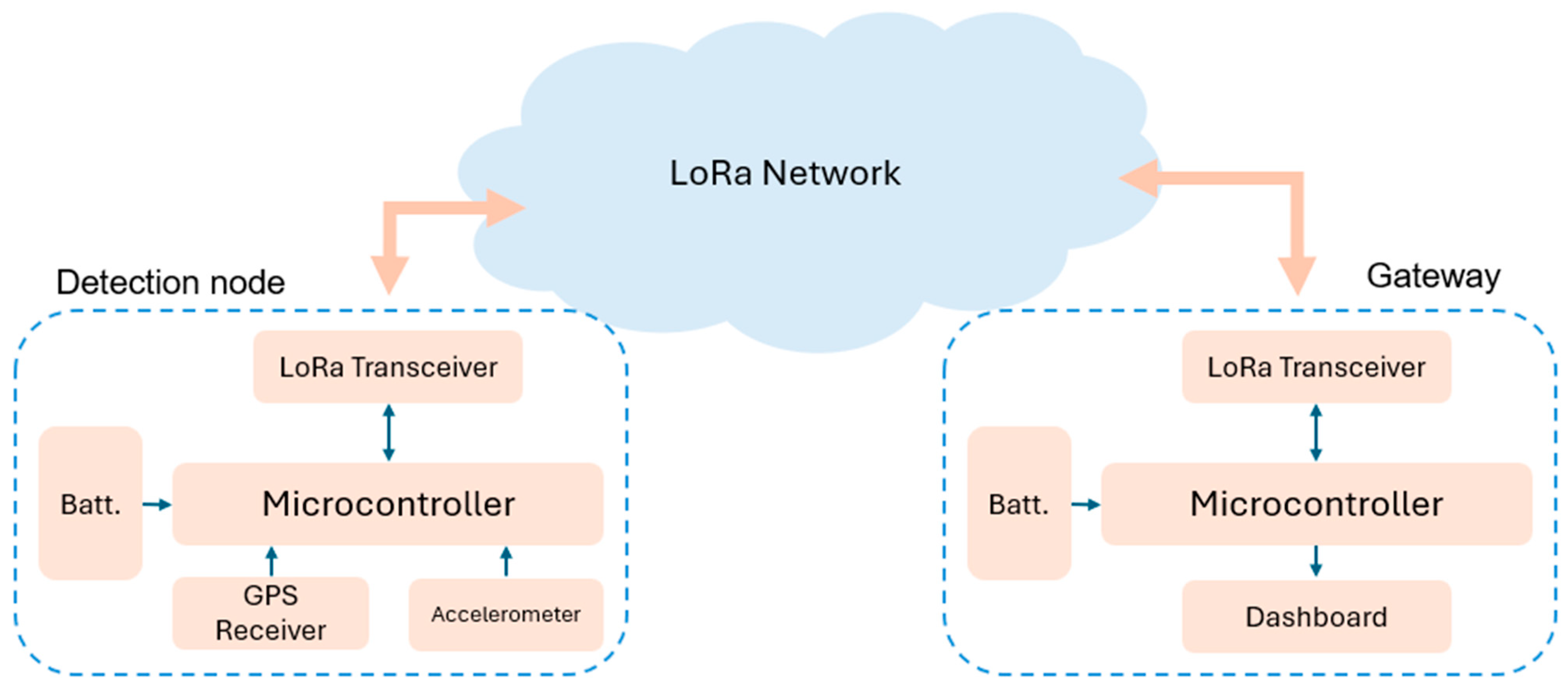
3.1. System Implementation and Hardware Setup
3.1.1. Controllers
3.1.2. Sensors
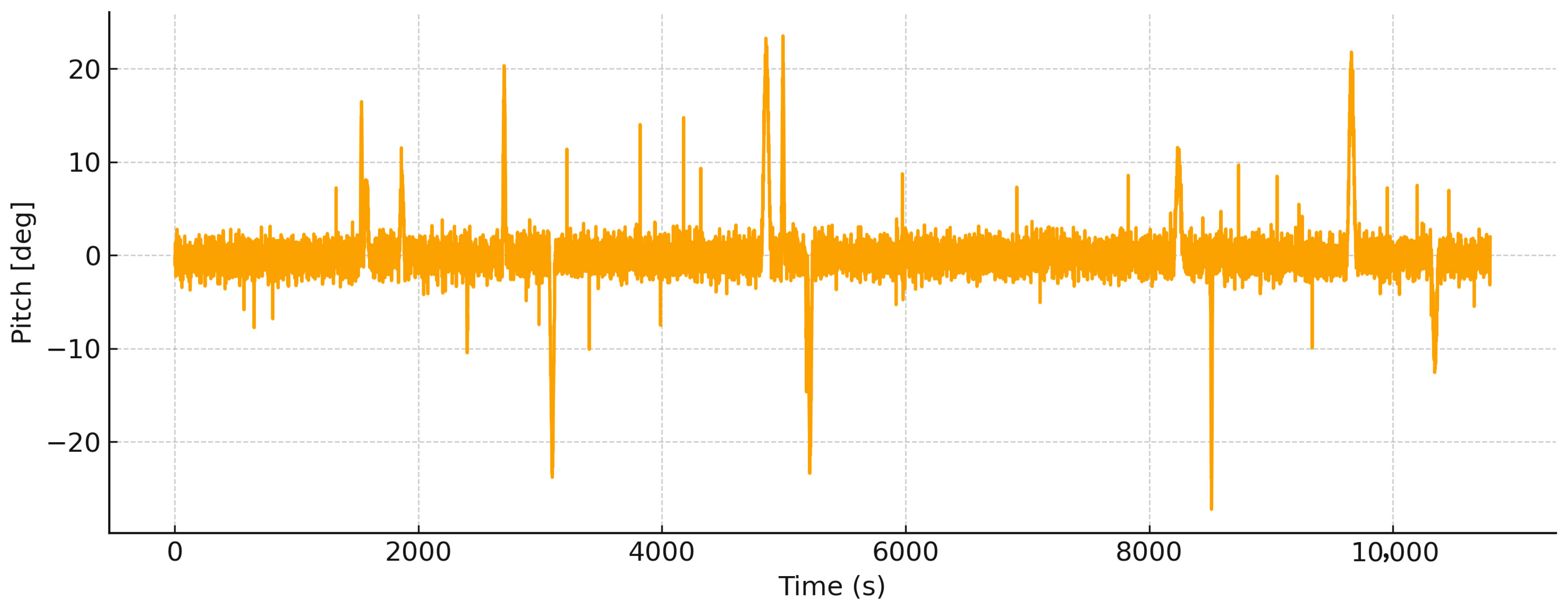
- Dynamic acceleration interference: Elevation or lowering of the device due to, e.g., vibrations, working on machinery that generates seismic activity, or sudden mechanical shocks are situations that may cause tilt to be falsely read as a temporary shift in the gravity vector. Low-pass filtering (e.g., cutoff frequency below 5 Hz) can be helpful in capturing only the quasi-static gravitational component, hence avoiding this problem.
- Temperature drift and bias offset: The output of the ADXL335, among other factors, is also influenced by temperature, and it may even go unnoticed. In this instance, periodic calibration procedures, direct or indirect, and the application of temperature compensation curves are all strategies utilized to ensure that the orientation is accurate.
- Non-orthogonality and scale factor mismatch: It is common for the specification tolerances to cause slight differences between the axes that are supposed to be orthogonal, thus necessitating matrix-based calibration to remedy the situation.
- Resolution and quantization limits: The ADC resolution (usually 10–12 bits) has a limiting effect on the minimum tilt variation that can be detected; this range for well-calibrated systems is often between 0.5° to 1.0°.
- Environmental coupling: The mechanical connection between the sensor and the surface being monitored is not ideal and therefore can either reduce or change the way tilt propagates. So, for the readings to be trustworthy, proper clamping and structural integration are obligatory.
- Kalman filtering or complementary filtering for dynamic smoothing.
- Several redundant sensors, to ensure the validity of inclination readings.
- Both threshold-based and machine learning-based anomaly detection are used to pinpoint the angular deviations that are most likely associated with mass movement events.
3.1.3. LoRa Transceivers
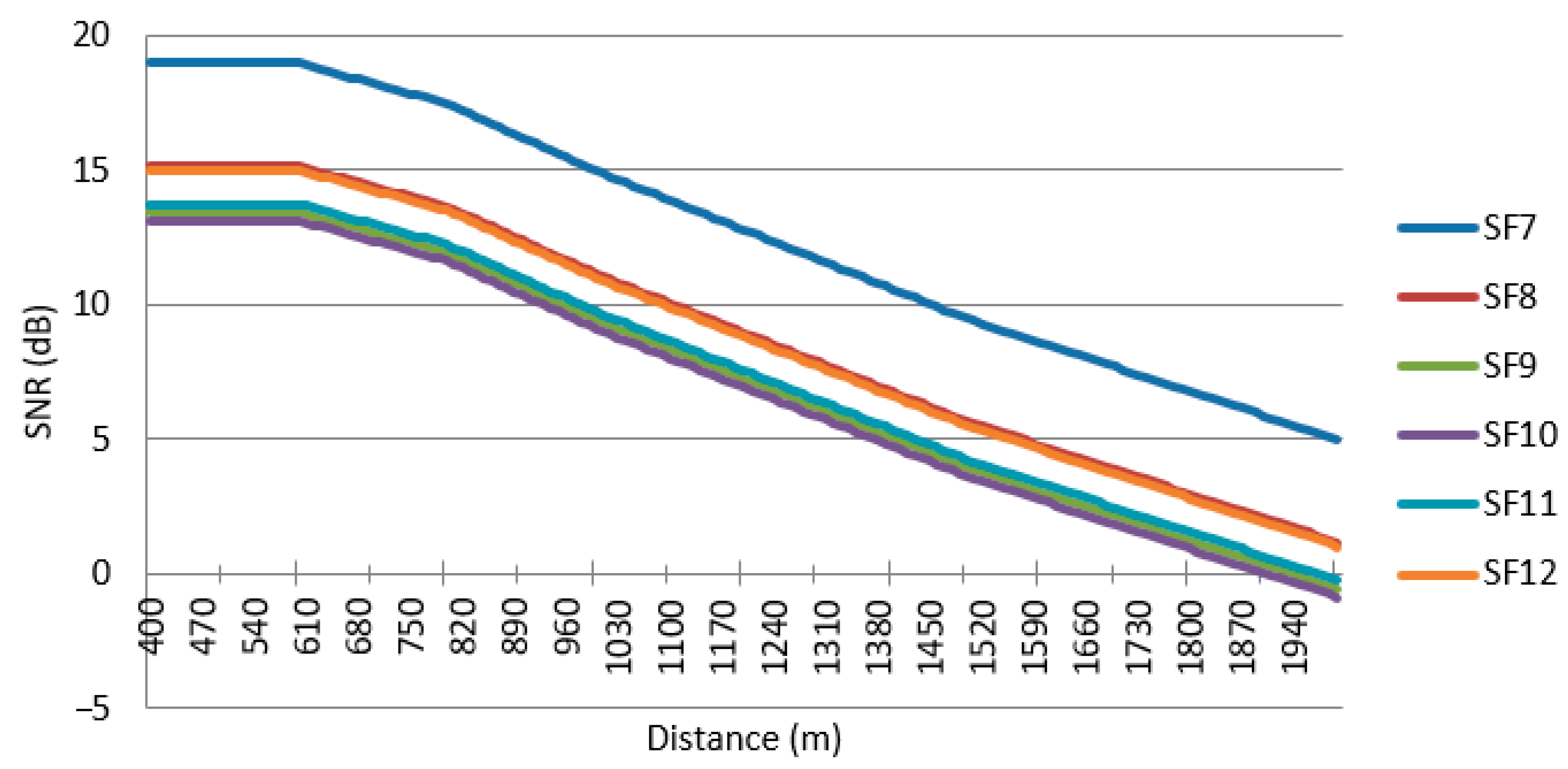
- Lower SF → Faster transmission → Higher bit rate → Shorter range;
- Higher SF → Slower transmission → Improved sensitivity → Longer range.
- —nominal bit rate (bits/s).
- —spreading factor (7–12, depending on channel conditions).
- —modulation bandwidth (Hz).
- —coding rate (4/5, 4/6, 4/7 or 4/8).
- PL—payload size (bytes).
- H—header mode (0 = explicit, 1 = implicit).
- DE—low-data-rate optimization (1 for SF11/SF12, 0 otherwise).
- Header and Header Cyclic Redundancy Check (CRC): Define payload size and coding rate, occupying 2 bytes.
- Payload: Sensor data or application information (e.g., latitude, longitude, Inclination on X-axis (degrees), inclination on Y-axis (degrees), inclination on Z-axis (degrees); we used 35 bytes.
- CRC Payload (optional): Used for integrity verification.
3.1.4. Power Supply
3.1.5. Monitoring System—Dashboard
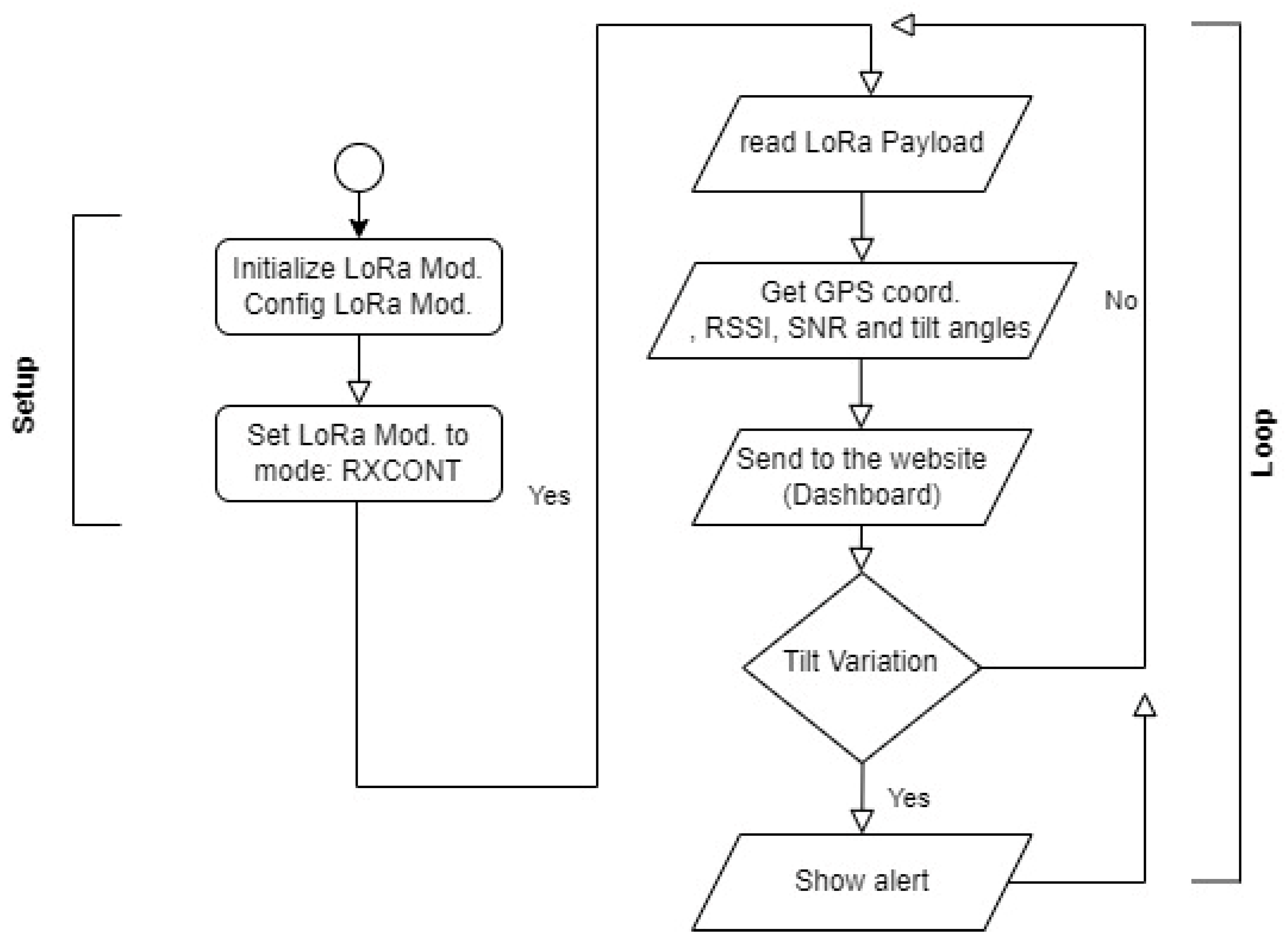
3.2. Algorithms Developed
| Algorithm 1: IoT detection node |
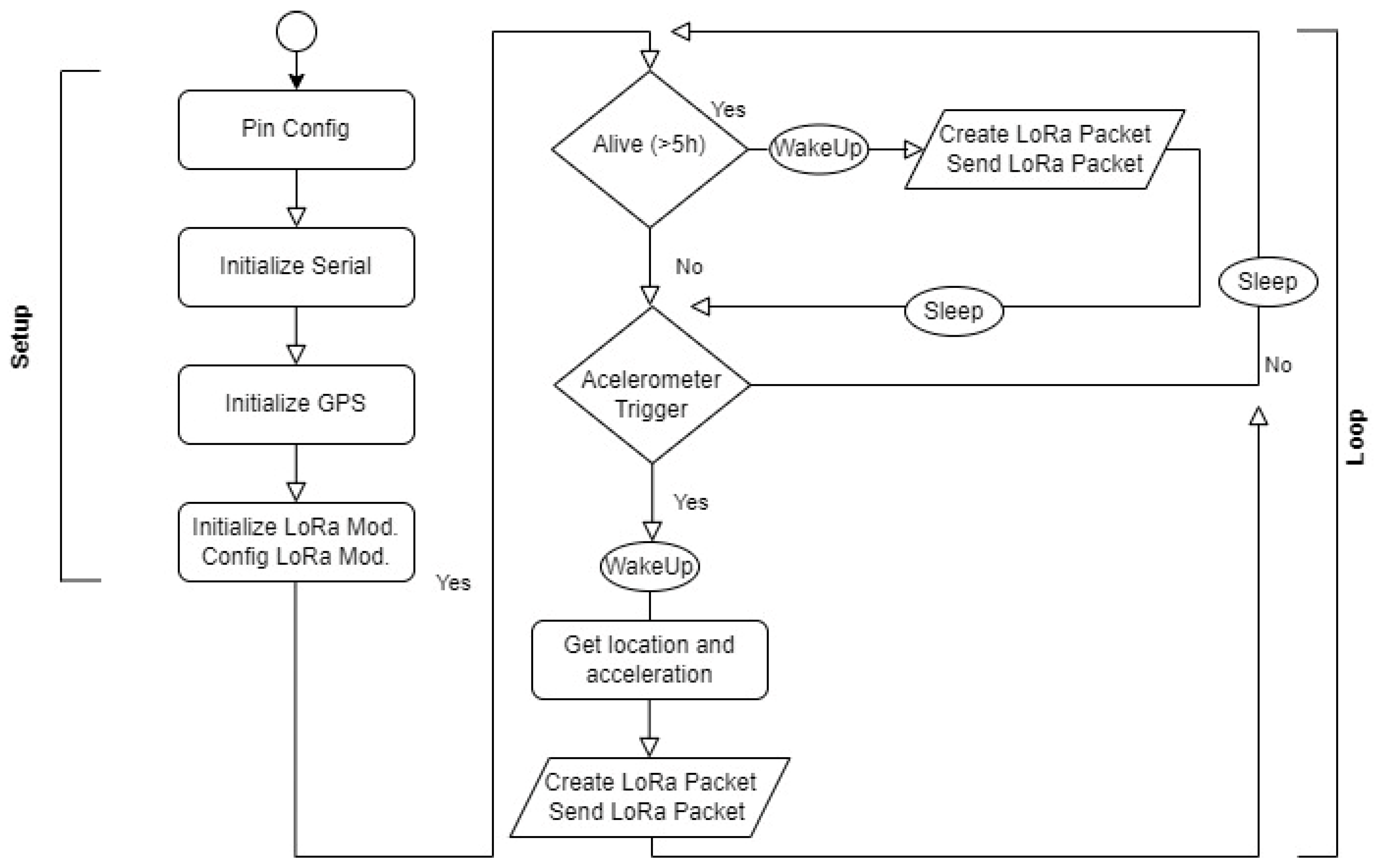
| BEGIN INITIALIZE serial interfaces (USB, GPS) INITIALIZE LoRa radio with frequency, SF, BW, CR INITIALIZE ADXL335 accelerometer input pins REMOVE tilt values saved in power resume memory LOOP once per wake cycle: READ GPS data from NEO-6M COMPUTE average ADC readings (X, Y, Z) CONVERT ADC values to acceleration (g) CALCULATE tilt angles INC_X, INC_Y, INC_Z IF (tilt values changed OR timer elapsed): FORMAT message: “LAT:<lat>,LNG:<lng>,INC_X:<x>,INC_Y:<y>,INC_Z:<z>” TRANSMIT packet via LoRa STORE last tilt and GPS values in real-time clock memory ENDIF ENTER deep sleep for predefined interval END LOOP END |
| Algorithm 2: Gateway |
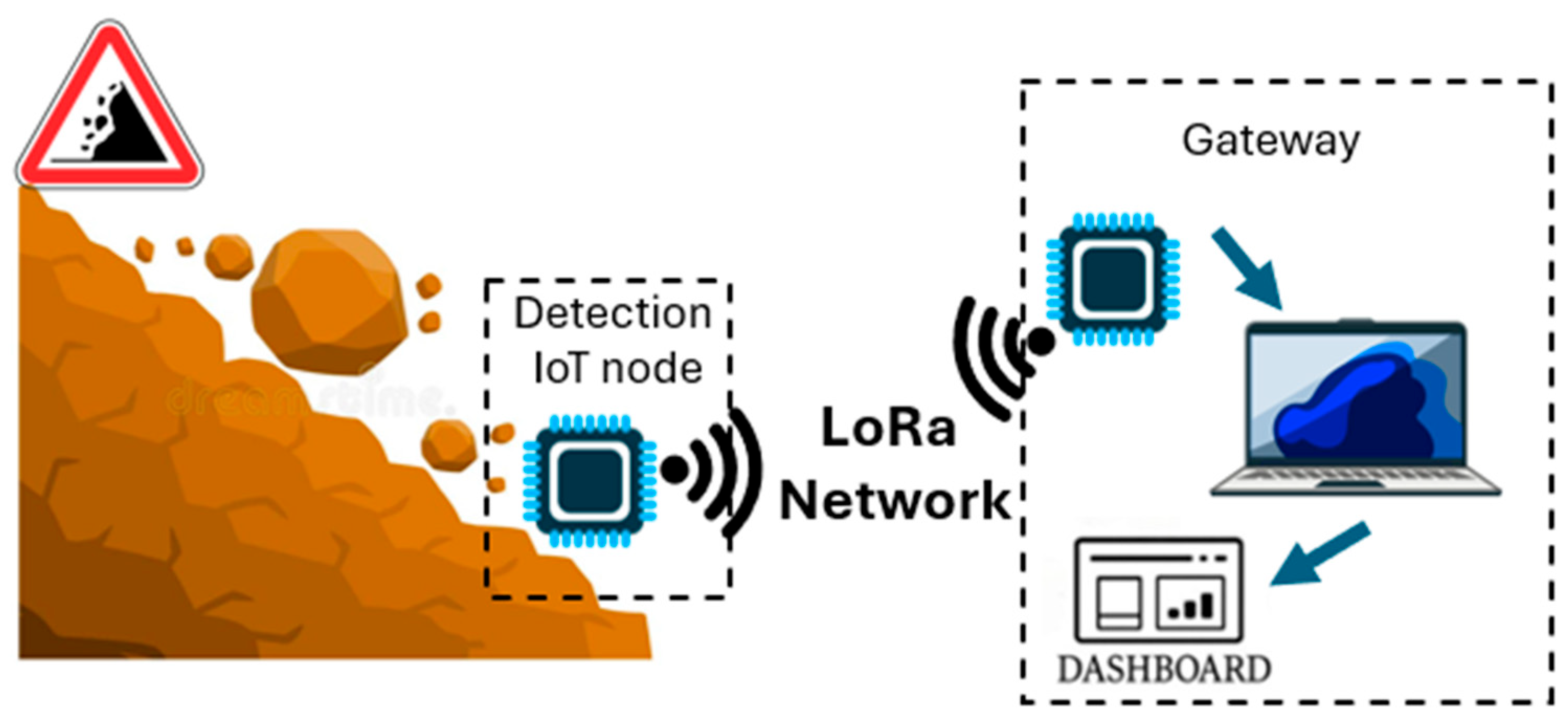
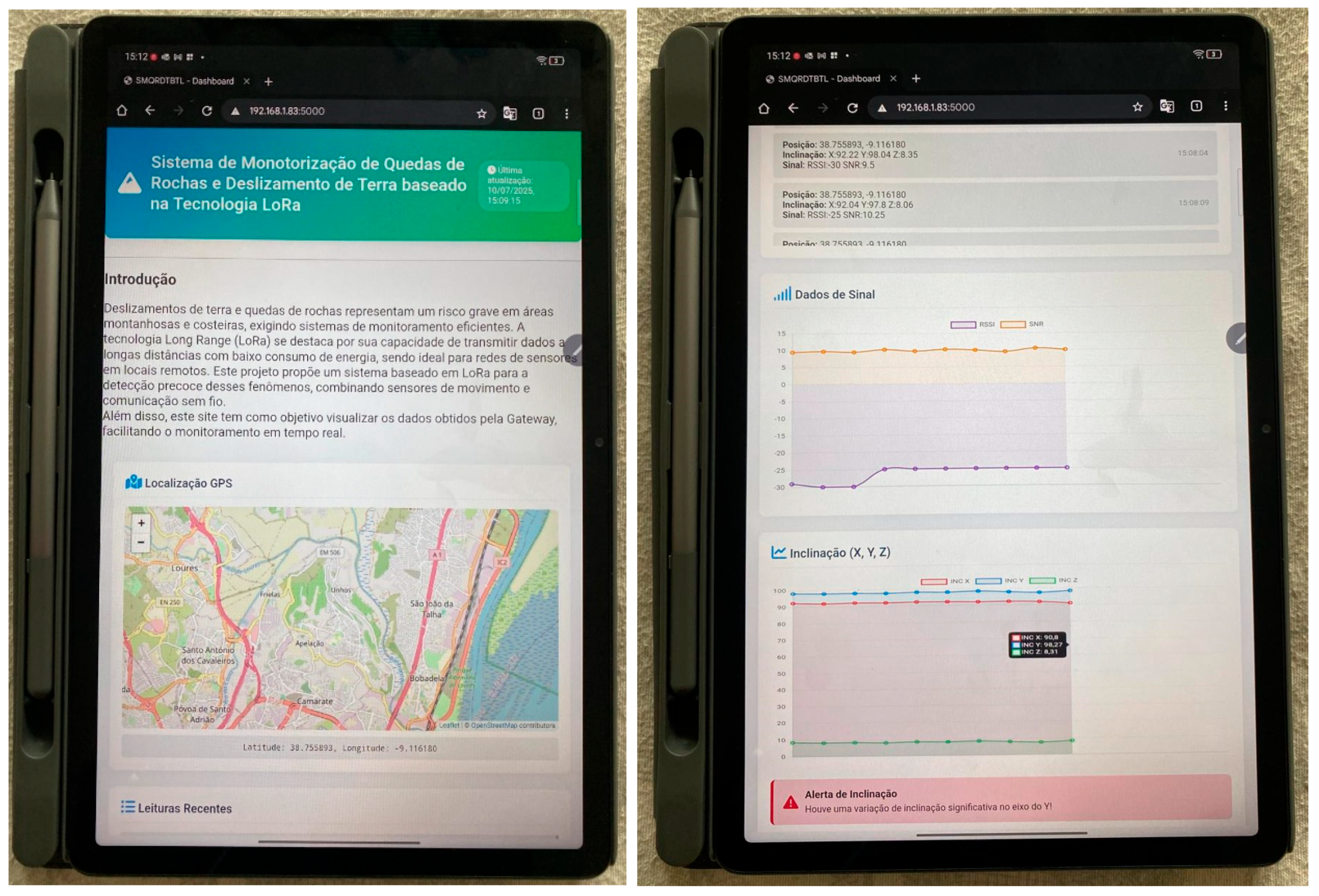
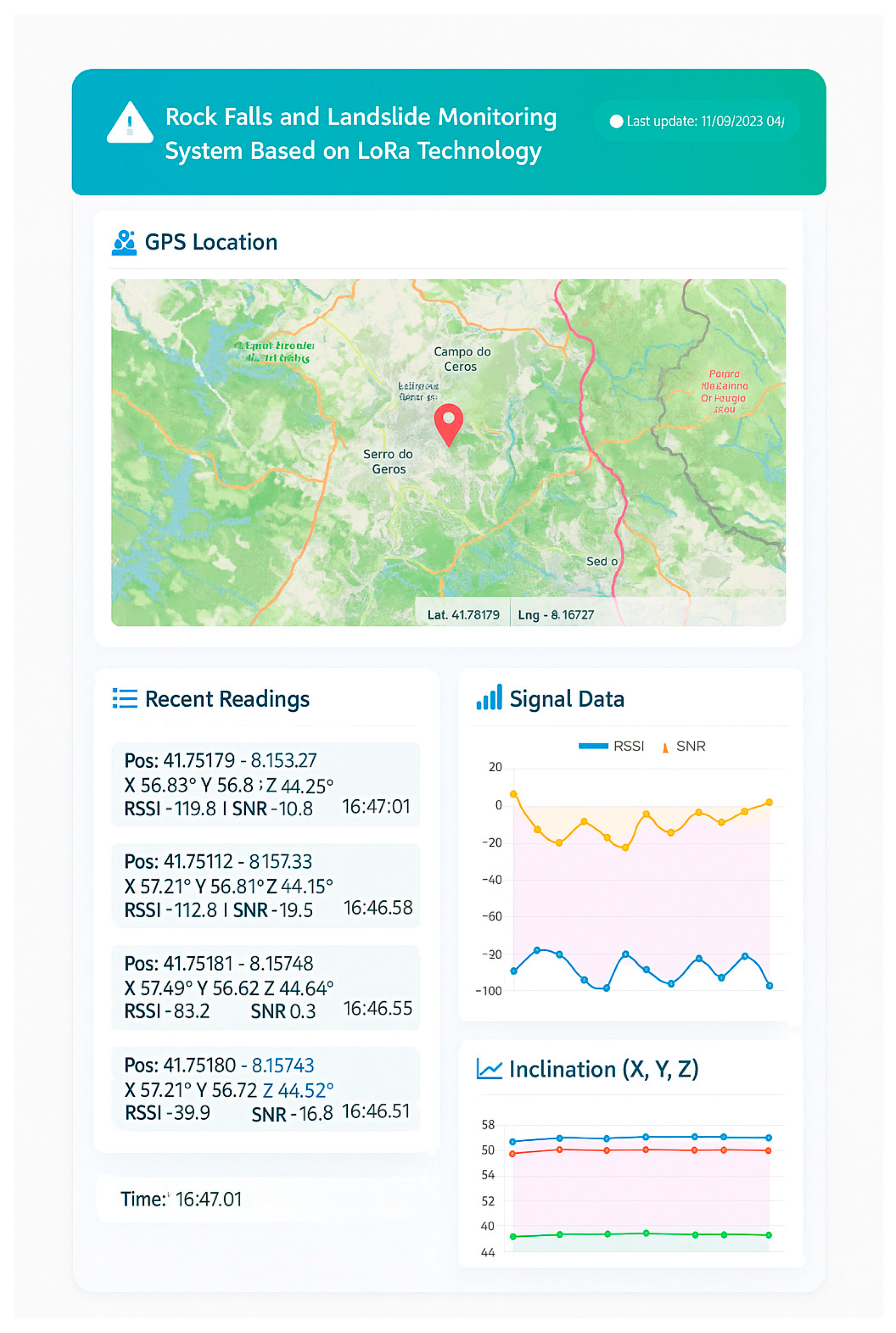
| BEGIN // Stage 1: LoRa Gateway Receiver INITIALIZE Serial(115200) INITIALIZE LoRa transceiver with frequency, SF, BW, CR, and CRC enabled LOOP continuously: IF LoRa packet received THEN payload: LoRa.readPacket() rssi: LoRa.packetRssi() snr: LoRa.packetSnr() PRINT “Received packet ‘<payload>’ with RSSI <rssi> and SNR <snr>“ ENDIF END LOOP // Stage 2: Data Bridge and Processing Server (Python/Flask-SocketIO) CREATE Flask web server INITIALIZE SocketIO module for real-time communication TRY open serial port (e.g., COM5, 115,200 baud) IF successful THEN START background thread read_serial: LOOP indefinitely: IF serial data available THEN serial.readline().decode().strip() EMIT SocketIO event ‘novo_dado’ with {“mensagem”: line} ENDIF END LOOP ENDIF DEFINE web route “/” → render HTML dashboard (index.html) START SocketIO server at host 0.0.0.0, port 5000 // Stage 3: Real-Time Web Dashboard (HTML and JavaScript) ON browser page load: INITIALIZE Leaflet map centered at default coordinates INITIALIZE Chart.js plots for signal metrics (RSSI, SNR) INITIALIZE Chart.js plots for inclination metrics (INC_X, INC_Y, INC_Z) CONNECT to Socket.IO server ON event ‘new_data’ received: current time UPDATE “last update” indicator with now // Parse MCU log line: MATCH “Received packet ‘(.*)’ with RSSI ([\-0–9.]+) and SNR ([\-0–9.]+)” IF match valid THEN packet: match.group(1) rssi: float(match.group(2)) snr: float(match.group(3)) PARSE packet fields “LAT:<val>,LNG:<val>,INC_X:<val>,INC_Y:<val>,INC_Z:<val>” UPDATE map marker and coordinates display APPEND values to recent readings list UPDATE charts for RSSI/SNR and tilt (INC_X, INC_Y, INC_Z) IF |INC_Y| > threshold THEN DISPLAY alert (e.g., barrier movement) ELSE HIDE alert ENDIF ENDIF // Stage 4: Data Flow Summary /* LoRa Node (sensor) send to Gateway (Arduino), after via Serial Port send to Flask/SocketIO Server and display in Web Dashboard (Map, Charts and Alerts) */ END |
4. Results
4.1. Experiment Scenarios
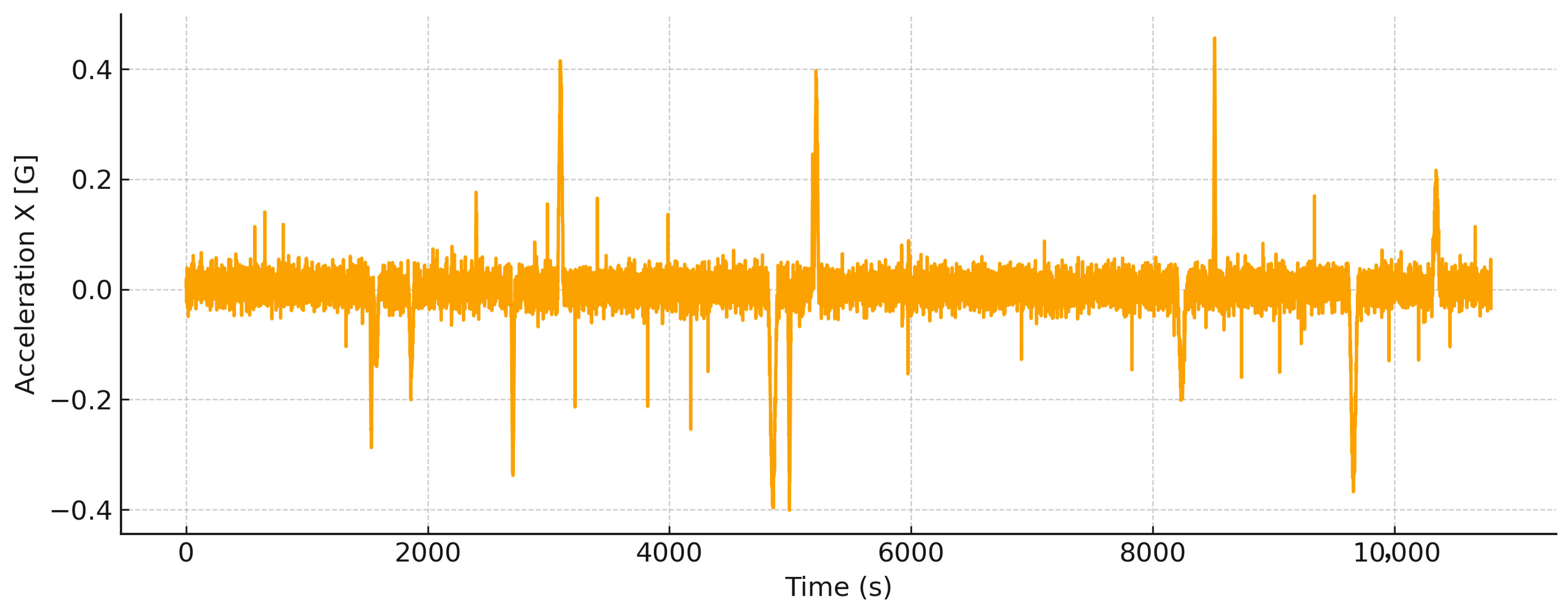
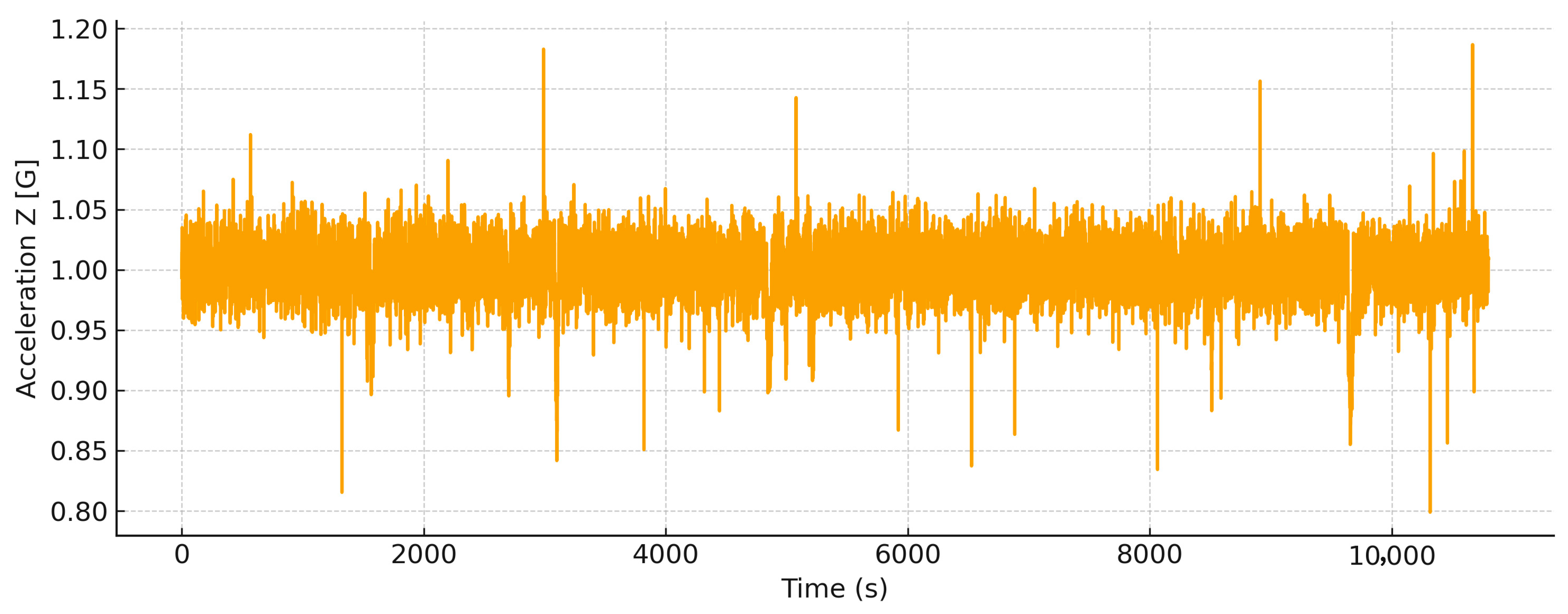
4.2. Accelerometer Tests
4.3. LoRa Radio Tests
4.4. Dashboard
4.5. Consumption
5. Conclusions and Future Work
Author Contributions
Funding
Data Availability Statement
Conflicts of Interest
Abbreviations
| ADC | Analog-to-Digital Converter |
| AWSs | Amazon Web Services |
| BLE | Bluetooth Low Energy |
| BW | Bandwidth |
| CRC | Cyclic Redundancy Check |
| CR | Coding Rate |
| CSS | Chirp Spread Spectrum |
| EEPROM | Electrically Erasable Programmable Read-Only Memory |
| GNSS | Global Navigation Satellite System |
| GPS | Global Positioning System |
| HTML | HyperText Markup Language |
| I2C | Inter-Integrated Circuit |
| IoT | Internet of Things |
| LoRa | Long Range |
| LoRaWAN | Long-Range Wide-Area Network |
| MCU | Microcontroller Unit |
| NMEA | National Marine Electronics Association |
| RAM | Random Access Memory |
| ROM | Read-Only Memory |
| RSSI | Received Signal Strength Indicator |
| SF | Spreading Factor |
| SNR | Signal-to-Noise Ratio |
| SPI | Serial Peripheral Interface |
| SRAM | Static Random Access Memory |
| ToA | Time-on-Air |
| TTN | The Things Network |
| UART | Universal Asynchronous Receiver/Transmitter |
| USB | Universal Serial Bus |
References
- Autoridade Nacional de Emergência e Proteção Civil. Avaliação Nacional de Risco—Revisão 2023. Available online: https://prociv.gov.pt/media/h4fgmxul/anr2023_revis%C3%A3o_ultima.pdf (accessed on 13 March 2025).
- EuroNews. Deslizamentos de Terras na Serra da Estrela. Available online: https://pt.euronews.com/2022/09/13/deslizamentos-de-terras-na-serra-da-estrela (accessed on 13 March 2025).
- AiKo. LoRa Technology Overview. Available online: https://aiko.digital/lora/ (accessed on 13 March 2025).
- Gokhale, P.; Bhat, O.; Bhat, S. Introduction to IoT. Int. Adv. Res. J. Sci. Eng. Technol. 2018, 5, 41–44. [Google Scholar]
- Farooq, M.U.; Waseem, M.; Mazhar, S.; Khairi, A.; Kamal, T. A Review on Internet of Things (IoT). Int. J. Comput. Appl. 2015, 113, 1–7. [Google Scholar] [CrossRef]
- Statista. IoT Connected Devices Worldwide 2019–2030. Available online: https://www.statista.com/statistics/1183457/iot-connected-devices-worldwide/ (accessed on 9 May 2025).
- Mohammadi, M.; Al-Fuqaha, A.; Sorour, S.; Guizani, M. Deep Learning for IoT Big Data and Streaming Analytics: A Survey. IEEE Commun. Surv. Tutor. 2018, 20, 2923–2960. [Google Scholar] [CrossRef]
- Sagiroglu, S.; Sinanc, D. Big Data: A Review. In Proceedings of the 2013 International Conference on Collaboration Technol-ogies and Systems (CTS), San Diego, CA, USA, 20–24 May 2013; pp. 42–47. [Google Scholar] [CrossRef]
- Ragnoli, M.; Scarsella, M.; Leoni, A.; Ferri, G.; Stornelli, V. Wireless Sensor Network-Based Rockfall and Landslide Monitoring Systems: A Review. Sensors 2023, 23, 7278. [Google Scholar] [CrossRef] [PubMed]
- Ragnoli, M.; Leoni, A.; Barile, G.; Ferri, G.; Stornelli, V. LoRa-Based Wireless Sensors Network for Rockfall and Landslide Monitoring: A Case Study in Pantelleria Island with Portable LoRaWAN Access. J. Low Power Electron. Appl. 2022, 12, 47. [Google Scholar] [CrossRef]
- Muladi, M.; Amarda, S.Y.; Mahamad, A.K.; Prasetyo, S.D.; Harsito, C. LoRaWAN and IoT-Based Landslide Early Warning System. In Advanced Geotechnical Monitoring and Hazard Mitigation, 1st ed.; Prasetyo, S.D., Muladi, M., Eds.; Acadlore Publishing Services Limited: Hong Kong, China, 2024; Volume 3, pp. 106–122. [Google Scholar]
- Muladi; Wirawan, I.M.; Lestari, D.; El Raka, S.C.; Leksono, A.B.; Qodri, F.A.; Prasetyo, S.D. Chirpstack-Based LoRaWAN Platform for Land-Sliding Monitoring System. In Instrumentation Mesure Métrologie, 1st ed.; IIETA, Ed.; IIETA: Online, 2025; Volume 24, pp. 73–79. [Google Scholar]
- Wang, C.; Guo, W.; Yang, K.; Wang, X.; Meng, Q. Real-Time Monitoring System of Landslide Based on LoRa Architecture. In Frontiers in Earth Science, 1st ed.; Oommen, T., Ed.; Frontiers Media S.A.: Lausanne, Switzerland, 2022; Volume 10, p. 899509. [Google Scholar]
- Ragnoli, M.; Esposito, P.; Stornelli, V.; Barile, G.; De Santis, E.; Sciarra, N. A LoRa-Based Wireless Sensor Network Monitoring System for Urban Areas Subjected to Landslide. In Proceedings of the 2023 8th International Conference on Cloud Computing and Internet of Things, Okinawa, Japan, 22–24 September 2023; ACM: New York, NY, USA, 2023; pp. 91–97. [Google Scholar]
- Bagwari, S.; Roy, A.; Gehlot, A.; Singh, R.; Priyadarshi, N.; Khan, B. LoRa Based Metrics Evaluation for Real-Time Landslide Monitoring on IoT Platform. IEEE Access 2022, 10, 46392–46407. [Google Scholar] [CrossRef]
- Gamperl, M.; Singer, J.; Thuro, K. Internet-of-Things Geosensor Network for Cost-Effective Landslide Early Warning Systems. Sensors 2021, 21, 2609. [Google Scholar] [CrossRef] [PubMed]
- Ragnoli, M.; Esposito, P.; Barile, G.; Ferri, G.; Stornelli, V. An Autonomous Multi-Technological LoRa Sensor Network for Landslide Monitoring. Proceedings 2024, 97, 11. [Google Scholar] [CrossRef]
- Ioannides, M.G.; Stamelos, A.P.; Papazis, S.A.; Stamataki, E.E.; Stamatakis, M.E. Internet of Things-Based Control of Induction Machines: Specifics of Electric Drives and Wind Energy Conversion Systems. Energies 2024, 17, 645. [Google Scholar] [CrossRef]
- LILYGO. T-Beam—ESP32 LoRa/GPS Development Board; Product Page; Shenzhen Xinyuan Electronic Technology Co., Ltd.: Shenzhen, China, 2025; Available online: https://lilygo.cc/products/t-beam?srsltid=AfmBOoqI2NdWZ6ygo87pIPBxoDN7r5e61jrLHtovKJPujVNijX8ESZA8 (accessed on 28 October 2025).
- Semtech. SX1276/77/78/79—137 MHz to 1020 MHz Low Power Long Range Transceiver; Datasheet, Rev. 5; Semtech Corporation: Camarillo, CA, USA, 2016; Available online: https://www.mouser.com/datasheet/2/761/sx1276-1278113.pdf?srsltid=AfmBOoo_BWQqnOJi9DW8V_OUMfktcZUvheplPc1lnJ0NOIHJpl5aWOcN (accessed on 28 October 2025).
- u-blox. NEO-6—U-blox 6 GPS Modules; Data Sheet GPS.G6-HW-09005-E; u-blox AG: Thalwil, Switzerland, 2011; Available online: https://content.u-blox.com/sites/default/files/products/documents/NEO-6_DataSheet_%28GPS.G6-HW-09005%29.pdf (accessed on 28 October 2025).
- Analog Devices. ADXL335—Small, Low Power, 3-Axis ±3 g Accelerometer; Data Sheet Rev. B; Analog Devices, Inc.: Norwood, MA, USA, 2010; Available online: https://www.analog.com/media/en/technical-documentation/data-sheets/adxl335.pdf (accessed on 28 October 2025).
- Panasonic Energy Co., Ltd. NCR18650B—Lithium-ion Rechargeable Battery Cell; Datasheet; Panasonic Energy Co., Ltd.: Moriguchi, Japan. Available online: https://www.tme.eu/Document/3e0170a1e089819f286f7066e69035b4/NCR18650B.pdf (accessed on 28 October 2025).
- SparkFun Electronics. Arduino Pro Mini 328 (5 V/16 MHz); Product Page; SparkFun Electronics: Niwot, CO, USA, 2025; Available online: https://www.sparkfun.com/arduino-pro-mini-328-5v-16mhz.html (accessed on 28 October 2025).
- Hope Microelectronics (HOPERF). RFM95W—LoRa Module; Product Page/Datasheet; Shenzhen Hope Microelectronics Co., Ltd.: Shenzhen, China, 2019–2024; Available online: https://www.hoperf.com/modules/lora/RFM95W.html (accessed on 28 October 2025).
- Intel Corporation. Intel in California—Headquarters Information; Intel Corporation: Santa Clara, CA, USA, 2025; Available online: https://www.intel.com/content/www/us/en/corporate-responsibility/intel-in-california.html (accessed on 28 October 2025).
- Espressif Systems. ESP32 Series—Wi-Fi & Bluetooth SoC; Datasheet v3.9; Espressif Systems (Shanghai) Co., Ltd.: Shanghai, China, 2024; Available online: https://www.espressif.com/sites/default/files/documentation/esp32_datasheet_en.pdf (accessed on 28 October 2025).
- Cadence Design Systems, Inc. Xtensa LX6 Processor Core Architecture; Technical Overview; Cadence Design Systems, Inc.: San Jose, CA, USA, 2017; Available online: https://arxiv.org/pdf/2106.10652 (accessed on 28 October 2025).
- Microchip Technology Inc. ATmega328P—8-bit AVR Microcontroller with 32KB Flash, 1KB EEPROM, and 2KB SRAM; Datasheet Rev. 7810D–AVR–01/15; Microchip Technology Inc.: Chandler, AZ, USA, 2015; Available online: https://ww1.microchip.com/downloads/en/DeviceDoc/ATmega328P-Data-Sheet-7810D.pdf (accessed on 28 October 2025).
- Pedley, M. Tilt Sensing Using a Three-Axis Accelerometer; Freescale Application Note AN3461, Rev. 6; Freescale Semiconductor, Inc.: Austin, TX, USA, 2007; Available online: https://www.nxp.com/docs/en/application-note/AN3461.pdf (accessed on 28 October 2025).
- Luczak, S.; Oleksiuk, W. Increasing Accuracy of Tilt Measurements. Eng. Mech. 2007, 14, 143–154. Available online: https://www.engineeringmechanics.cz/pdf/14_3_143.pdf (accessed on 28 October 2025).
- Thalmann, T.; Zechner, M.; Neuner, H. Accelerometer Triad Calibration for Pole Tilt Compensation Using Variance Based Sensitivity Analysis. Sensors 2020, 20, 1481. [Google Scholar] [CrossRef] [PubMed]
- Semtech Corporation. LoRa® and LoRaWAN® Technology Overview; Semtech Corporation: Camarillo, CA, USA, 2025; Available online: https://www.semtech.com (accessed on 28 October 2025).
- Semtech Corporation. AN1200.22—LoRa™ Modulation Basics; Application Note, Rev. 2; Semtech Corporation: Camarillo, CA, USA, 2015; Available online: https://www.semtech.com/products/wireless-rf/lora-connect/sx1278 (accessed on 28 October 2025).
- Rabaça, A.F.B. Aplicação de Tecnologia LoRaWAN à Monitorização de Redes de Distribuição de Energia. 2018. Available online: https://fenix.tecnico.ulisboa.pt/cursos/meec/dissertacao/1972678479054034 (accessed on 20 May 2025).
- The Things Network. Spreading Factors|The Things Network. Available online: https://www.thethingsnetwork.org/docs/lorawan/spreading-factors/ (accessed on 12 May 2025).
- Etiabi, Y.; Jouhari, M.; Amhoud, E.M. Spreading Factor and RSSI for Localization in LoRa Networks: A Deep Reinforcement Learning Approach. arXiv 2022, arXiv:2205.11428. [Google Scholar] [CrossRef]
- XTAR. 18650 2600 mAh Li-Ion Rechargeable Battery; XTAR: Shenzhen, China, 2025; Available online: https://www.xtar.cc/product/xtar-18650-2600mah-battery-69.html (accessed on 28 October 2025).
- Inconshreveable, Inc. Ngrok—Secure Introspectable Tunnels to Localhost; Inconshreveable, Inc.: San Francisco, CA, USA, 2025; Available online: https://ngrok.com (accessed on 28 October 2025).






| Article | Platform/MCU | IoT Network | Used Sensors | Power/ Battery Capacity | Cost per Node |
|---|---|---|---|---|---|
| [10] | STM32L071 | LoRa SX1272 (868 MHz); Portable LoRaWAN (ChirpStack) | LIS3DH, MMA8451, BMP180 | Solar 5 W Li-Po 2200 mAh | Medium |
| [11] | STM32F103 | LoRa SX1276 (868 MHz); LoRaWAN (TTN backend) | MPU6050, DHT22, YL-69 | Solar 10 W Li-Ion 3000 mAh | High |
| [12] | ESP32-WROOM | LoRa SX1278 (868 MHz); Portable LoRaWAN (ChirpStack) | BME280, ADXL345, SW-420 | Solar 3 W Li-Po 2500 mAh | Medium |
| [13] | STM32L0 | LoRa SX1276 (433 MHz) | MPU6050, BMP280, DS18B20 | Battery 3.7 V Li-Ion 2400 mAh | Medium |
| [14] | ATmega328P | LoRa RFM95W and LoRaWAN (868 MHz) | ADXL345, BME280 | Solar 5 W Li-Ion 2000 mAh | Medium |
| [15] | ESP32-WROOM | LoRa SX1278 (868 MHz); P2P e LoRaWAN (RAK7249) | MPU6050, YL-69, DS18B20, SW-420 | Solar 3 W Li-Po 2500 mAh | Low |
| [16] | ESP8266 | LoRa (868 MHz); RFM95W; TTN | MPU9250, BME280, DS18B20 | Solar 2 W Li-Ion 2200 mAh | Medium |
| [17] | nRF52832 (BLE) | LoRa SX1276 (868 MHz) + BLE (dual stack); LoRaWAN + 4G | LIS3DH, PKLCS1212E, VH400, GPS NEO-6M | Solar 5 W LiFePO4 3.2 V (BQ25570) | Very High |
| This work | Tx: ESP32-LILYGO T-Beam Rx: Arduino Pro mini | Tx: SX1276 (868 MHz) Rx: LoRa RFM95 (868 MHz); P2P Ngrok dashboard | ADXL335 GPS NEO-6M | Battery 3.7 V Li-Ion 2600 mAh | Very Low (academic prototypes with off-the-shelf components, MCUs, sensors, common transceivers) |
| Component | Description | Model Used |
|---|---|---|
| Motion sensor | Used to detect movement or vibrations in the ground | ADXL335 |
| Battery | Power source for autonomous operation | Battery 18650 |
| GPS module | Responsible for recording the exact location of the site | GPS module NEO-6M |
| Microcontroller | Responsible for processing the acquired data | LillyGO T-Beam |
| LoRa transceiver | Responsible for sending the acquired data using the LoRa modulation technique | SX1276 |
| Component | Description | Model Used |
|---|---|---|
| LoRa Receiver | Responsible for wireless communication with the remote sensor (IoT detection node) | RFM95 |
| Microcontroller | Responsible for receiving data from the IoT detection node and processing it | Arduino Pro Mini |
| Laptop | It is responsible for converting electrical signals into readable data | Intel i3 8G RAM |
| Pins | Function | Values |
|---|---|---|
| CFG_COM0 | Configures the communication interface (protocol and baud rate) |
|
| CFG_COM1 | Complete Communication Setup |
|
| CFG_GPS0 | Sets the GPS power mode |
|
| Parameter | Value/Details |
|---|---|
| Battery chemistry | Li-ion |
| Voltage | 3.6 V |
| Typ. capacity | 2600 mAh (typical)/2550 mAh (min) |
| Discharge current—A | 5.20 |
| Battery version | Button top |
| Dimensions | 68.5 mm (height) × 18.4 mm (diameter) |
| Parameter | Value |
|---|---|
| Operating voltage [V] | 1.8~3.6 |
| Operating current [μA] | 350 |
| Detection range | ±3 g (full scale) |
| Temperature range | −40 to +85 °C |
| Sensing axis | 3 axes |
| Sensibility [mV/g] | 270 a 330 (ratiometric) |
| Shock resistance | Up to 10,000 g |
| Dimension | 4 mm × 4 mm × 1.45 mm |
| Component | Nominal Consumption |
|---|---|
| Motion Sensor (ADXL335) | 350 µA |
| GPS Module (NEO-6M) | 22 µA |
| Microcontroller (ESP32) | 39 mA |
| LoRa Transmitter (SX1276) | 120 mA (1% of communication time) |
Disclaimer/Publisher’s Note: The statements, opinions and data contained in all publications are solely those of the individual author(s) and contributor(s) and not of MDPI and/or the editor(s). MDPI and/or the editor(s) disclaim responsibility for any injury to people or property resulting from any ideas, methods, instructions or products referred to in the content. |
© 2025 by the authors. Licensee MDPI, Basel, Switzerland. This article is an open access article distributed under the terms and conditions of the Creative Commons Attribution (CC BY) license (https://creativecommons.org/licenses/by/4.0/).
Share and Cite
Pires, L.M.; Veiga, I. Design of a Low-Cost and Low-Power LoRa-Based IoT System for Rockfall and Landslide Monitoring. Designs 2025, 9, 144. https://doi.org/10.3390/designs9060144
Pires LM, Veiga I. Design of a Low-Cost and Low-Power LoRa-Based IoT System for Rockfall and Landslide Monitoring. Designs. 2025; 9(6):144. https://doi.org/10.3390/designs9060144
Chicago/Turabian StylePires, Luis Miguel, and Ileida Veiga. 2025. "Design of a Low-Cost and Low-Power LoRa-Based IoT System for Rockfall and Landslide Monitoring" Designs 9, no. 6: 144. https://doi.org/10.3390/designs9060144
APA StylePires, L. M., & Veiga, I. (2025). Design of a Low-Cost and Low-Power LoRa-Based IoT System for Rockfall and Landslide Monitoring. Designs, 9(6), 144. https://doi.org/10.3390/designs9060144