Article

Multi-Objective Optimization of a Two-Stage Helical Gearbox Using MARCOS Method

1
East Asia University of Technology, Trinh Van Bo Street, Hanoi City 12000, Vietnam
2
Faculty of Mechanical Engineering, Vinh Long University of Technology Education, 73 Nguyen Hue Street, Ward 2, Vinh Long City 85110, Vietnam
3
Faculty of Mechanical Engineering, Ha Noi University of Industry, Bac Tu Liem District, Ha Noi City 143315, Vietnam
4
Viet Tri University of Industry, 09 Tien Son Street, Viet Tri City 35100, Vietnam
5
School of Engineering and Technology, Duy Tan University, 03 Quang Trung Street, Hai Chau Ward, Da Nang City 550000, Vietnam
6
Faculty of Mechanical Engineering, Thai Nguyen University of Technology, 3/2 Street, Tich Luong Ward, Thai Nguyen City 251750, Vietnam
*
Author to whom correspondence should be addressed.
Designs 2024, 8(3), 53; https://doi.org/10.3390/designs8030053

Submission received: 15 April 2024 / Revised: 20 May 2024 / Accepted: 29 May 2024 / Published: 5 June 2024

Abstract

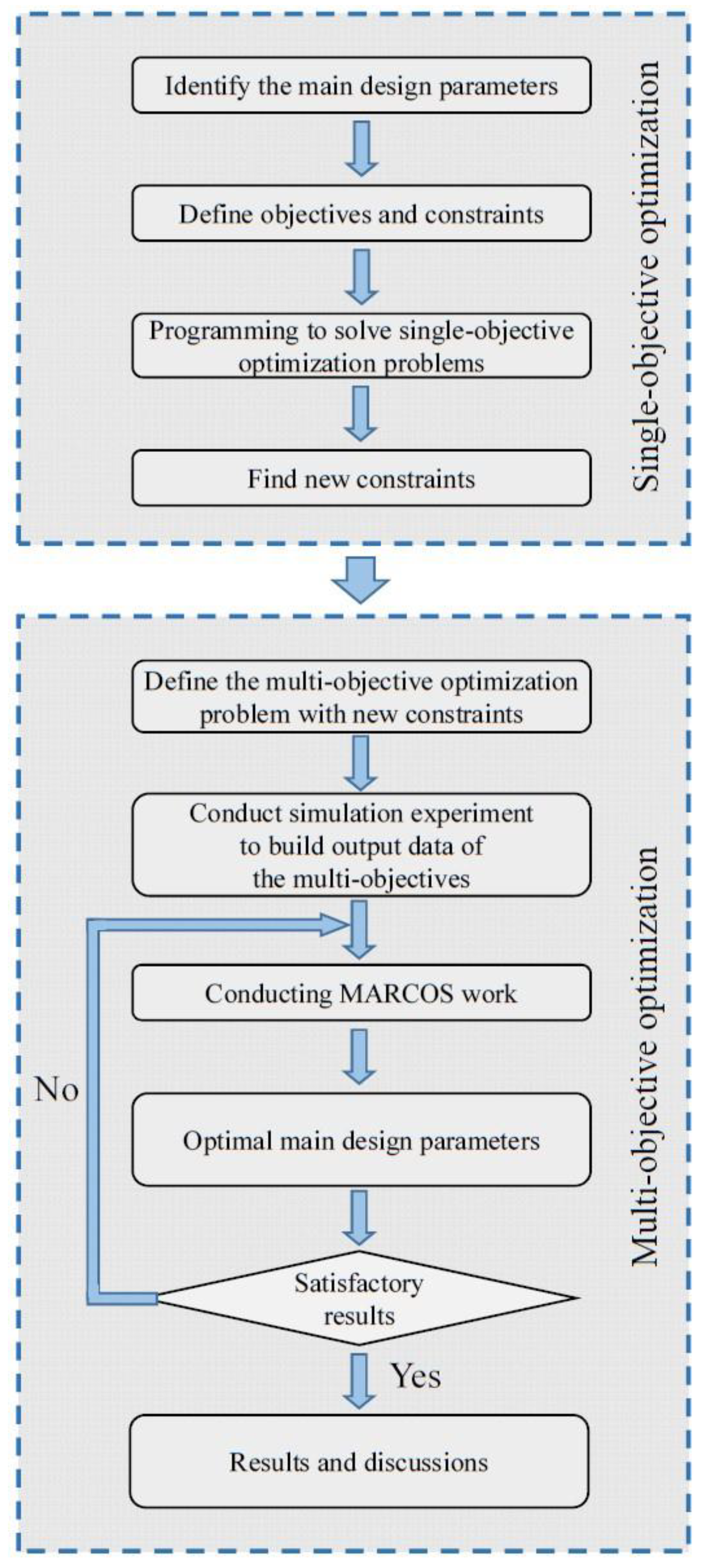
In order to address the Multi-Objective Optimization Problem (MOOP) in building a two-stage helical gearbox, this work presents a novel application of the Multi-Criterion Decision-Making (MCDM) method. The aim of the study is to determine the optimal primary design factors that will increase gearbox efficiency while decreasing gearbox volume. Three main design parameters were chosen for assessment in this work: the first stage’s gear ratio, and the first and second stages’ Coefficients of Wheel Face Width (CWFW). In addition, the MOOP is divided into two phases: phase 1 solves the single-objective optimization problem to reduce the gap between variable levels, and phase 2 solves the MOOP to determine the optimal primary design factors. Furthermore, the Entropy approach was picked to compute the weight criteria, and the MARCOS method was chosen as an MCDM method to handle the multi-objective optimization issue. The following are important characteristics of the study: Firstly, the MCDM method (MARCOS technique) was successfully applied to solve a MOOP for the first time. Secondly, this work has looked into power losses during idle motion to calculate the efficiency of a two-stage helical gearbox. The results of the study were used in the design of a two-stage helical gearbox in order to identify the optimal values for three important design parameters.
Keywords: helical gearbox; multi-objective optimization; gear ratio; gearbox efficiency; gearbox volume; MARCOS method helical gearbox; multi-objective optimization; gear ratio; gearbox efficiency; gearbox volume; MARCOS method