
Design Methods for Compliant Mechanisms: A Systematic Review Supported by Bibliometric Analysis
 , , ,
, , , 
Abstract
1. Introduction
1.1. Overview
1.2. Historical Background
1.3. Aim of This Work
2. Materials and Methods
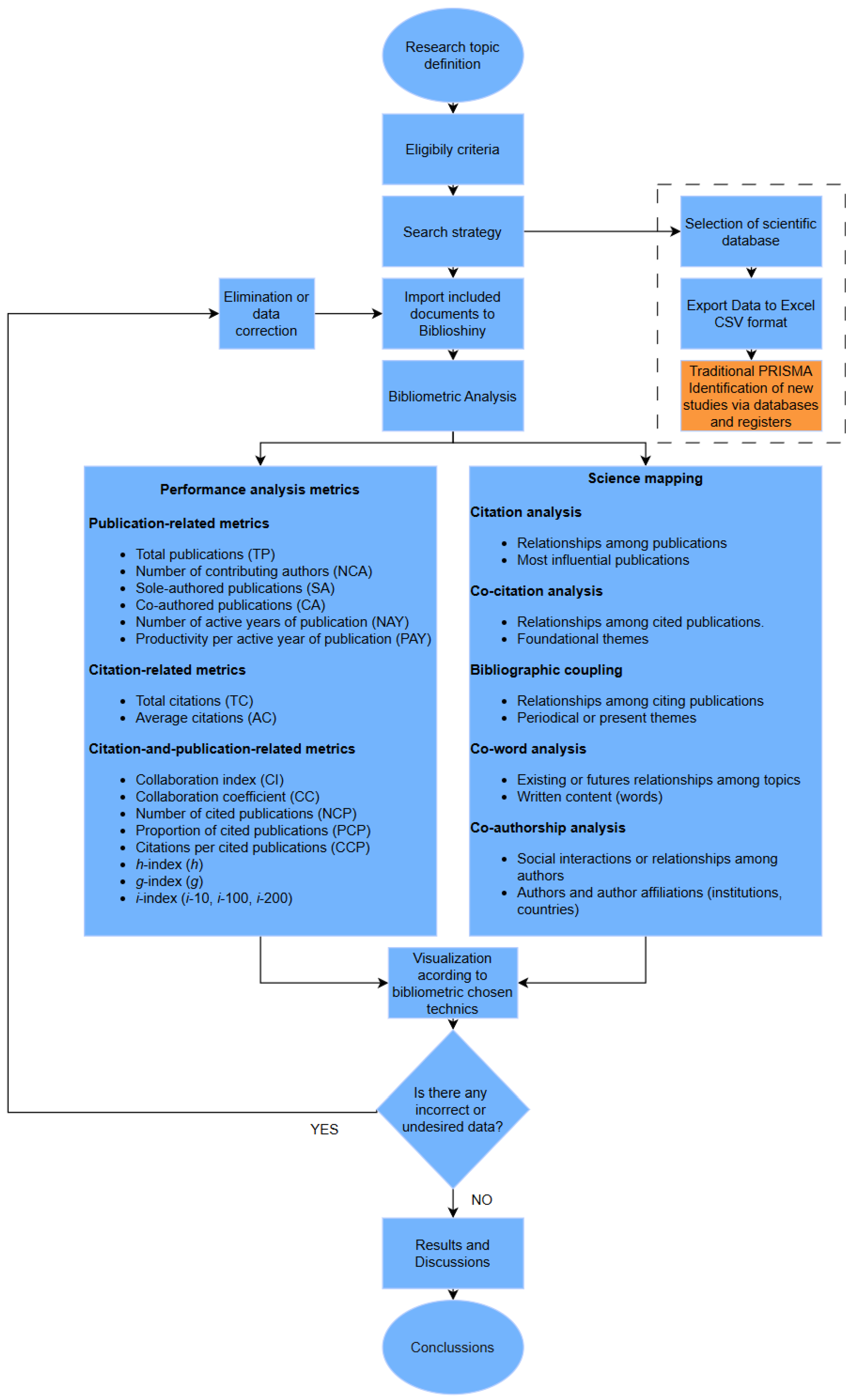
2.1. Bibliometric Analysis Guided by PRISMA
- ➢
- RQ1: How productive and relevant is research on design methods for flexible mechanisms?
- ➢
- RQ2: What are the primary design methodologies for flexible mechanisms?
- ➢
- RQ3: What are the principal applications for flexible mechanisms?
- ➢
- RQ4: Which design techniques, authors, and key works are most recommended when conducting studies in these application areas?
2.1.1. Eligibility Criteria (BA Data Collection)
- A list of keywords was compiled from the Scopus platform that, in the authors’ judgment, had a low probability of being genuinely related to compliant mechanisms.
- These keywords were filtered in the “Author Keyword” column.
- Subsequently, the results filtered by author keyword were further screened in the “Title” column for terms such as “compliant” or “mechanism”.
- Results from the previous step that did not address compliant mechanisms or their applications were then checked manually by reviewing their abstracts to decide whether they should be excluded from the selection.
- Steps 1 to 3 were repeated, beginning with the “Index Keywords” column.
2.1.2. Bibliometric Techniques and Software Tools
3. Results and Discussion
3.1. Performance Analysis
3.1.1. Publication-Related Metrics
3.1.2. Citation-Related Metrics
3.1.3. Citation and Publication-Related Metrics
3.2. Science Mapping
3.2.1. Citation Analysis

| Author/Year | Title | Local Citations | Global Citations | Ref. |
|---|---|---|---|---|
| Sigmund O, 1997 | On the Design of Compliant Mechanisms Using Topology Optimization | 404 | 1438 | [121] |
| Howell L.L., 1994 | A Method for the Design of Compliant Mechanisms with Small-Length Flexural Pivots | 286 | 552 | [1] |
| Frecker M.I., 1997 | Topological Synthesis of Compliant Mechanisms Using Multi-Criteria Optimization | 232 | 546 | [122] |
| Howell L.L., 1995 | Parametric Deflection Approximations for End-Loaded, Large-Deflection Beams in Compliant Mechanisms | 228 | 431 | [133] |
| Howell L.L., 1996 | Evaluation of Equivalent Spring Stiffness for Use in a Pseudo-Rigid-Body Model of Large-Deflection Compliant Mechanisms | 165 | 307 | [134] |
| Cannon R.H., 1984 | Initial Experiments on the End-Point Control of a Flexible One-Link Robot | 157 | 876 | [123] |
| Nishiwaki S., 1998 | Topology optimization of compliant mechanisms using the homogenization method | 150 | 396 | [125] |
| Siciliano B, 1988 | A Singular Perturbation Approach to Control of Lightweight Flexible Manipulators | 147 | 443 | [124] |
| Howell L.L., 1996 | A Loop-Closure Theory for the Analysis and Synthesis of Compliant Mechanisms | 147 | 231 | [135] |
| Pedersen C.B.W., 2001 | Topology synthesis of large-displacement compliant mechanisms | 146 | 492 | [126] |
| Bruns T.E., 2001 | Topology optimization of non-linear elastic structures and compliant mechanisms | 143 | 1331 | [127] |
| Hopkins J.B., 2010 | Synthesis of multi-degree of freedom, parallel flexure system concepts via Freedom and Constraint Topology (FACT)—Part I: Principles | 133 | 321 | [136] |
| Lobontiu N., 2003 | Analytical model of displacement amplification and stiffness optimization for a class of flexure-based compliant mechanisms | 128 | 344 | [137] |
| Xu Q., 2011 | Analytical modeling, optimization and testing of a compound bridge-type compliant displacement amplifier | 100 | 278 | [128] |
| Kota S., 1995 | Designing compliant mechanisms | 100 | 247 | [129] |
| Kota S., 2001 | Design of Compliant Mechanisms: Applications to MEMS | 98 | 209 | [131] |
| Ananthasuresh G.K., 1994 | Strategies for systematic synthesis of compliant mems | 97 | 193 | [132] |
| Midha A., 1994 | On the Nomenclature, Classification, and Abstractions of Compliant Mechanisms | 96 | 166 | [138] |
| Benosman M., 2004 | Control of flexible manipulators: A survey | 95 | 353 | [139] |
| Wang F., 2011 | On projection methods, convergence and robust formulations in topology optimization | 94 | 1715 | [130] |
| Author/Year | Reference | Local Citations | Ref. |
|---|---|---|---|
| Howell L 1995 | Parametric Deflection Approximations for End-Loaded Large-Deflection Beams in Compliant Mechanisms | 20 | [133] |
| Bourdin B., 2001 | Filters in Topology Optimization | 17 | [147] |
| Pedersen C.B.W., 2001 | Topology Synthesis of Large-Displacement Compliant Mechanisms | 17 | [126] |
| Burns R., 1965 | The Kinetostatic Synthesis of Flexible Link Mechanisms | 13 | [26] |
| Howell L 1996 | Evaluation of Equivalent Spring Stiffness for Use in a Pseudo-Rigid-Body Model of Large-Deflection Compliant Mechanisms | 12 | [134] |
| Wang P., 2018 | Design and Modeling of Constant-Force Mechanisms: A Survey | 12 | [148] |
| Chen Q., 2019 | Topology Optimization of Bistable Mechanisms with Maximized Differences Between Switching Forces in Forward and Backward Direction | 12 | [149] |
| Howell L., 1995 | Parametric Deflection Approximations for End-Loaded Large-Deflection Beams in Compliant Mechanism | 11 | [133] |
| Pucheta M.A., 2010 | Design of Bistable Compliant Mechanisms Using Precision-Position and Rigid-Body Replacement Methods | 11 | [150] |
| Rahimi H.N 2014 | Dynamic Analysis and Intelligent Control Techniques for Flexible Manipulators: A Review | 10 | [151] |
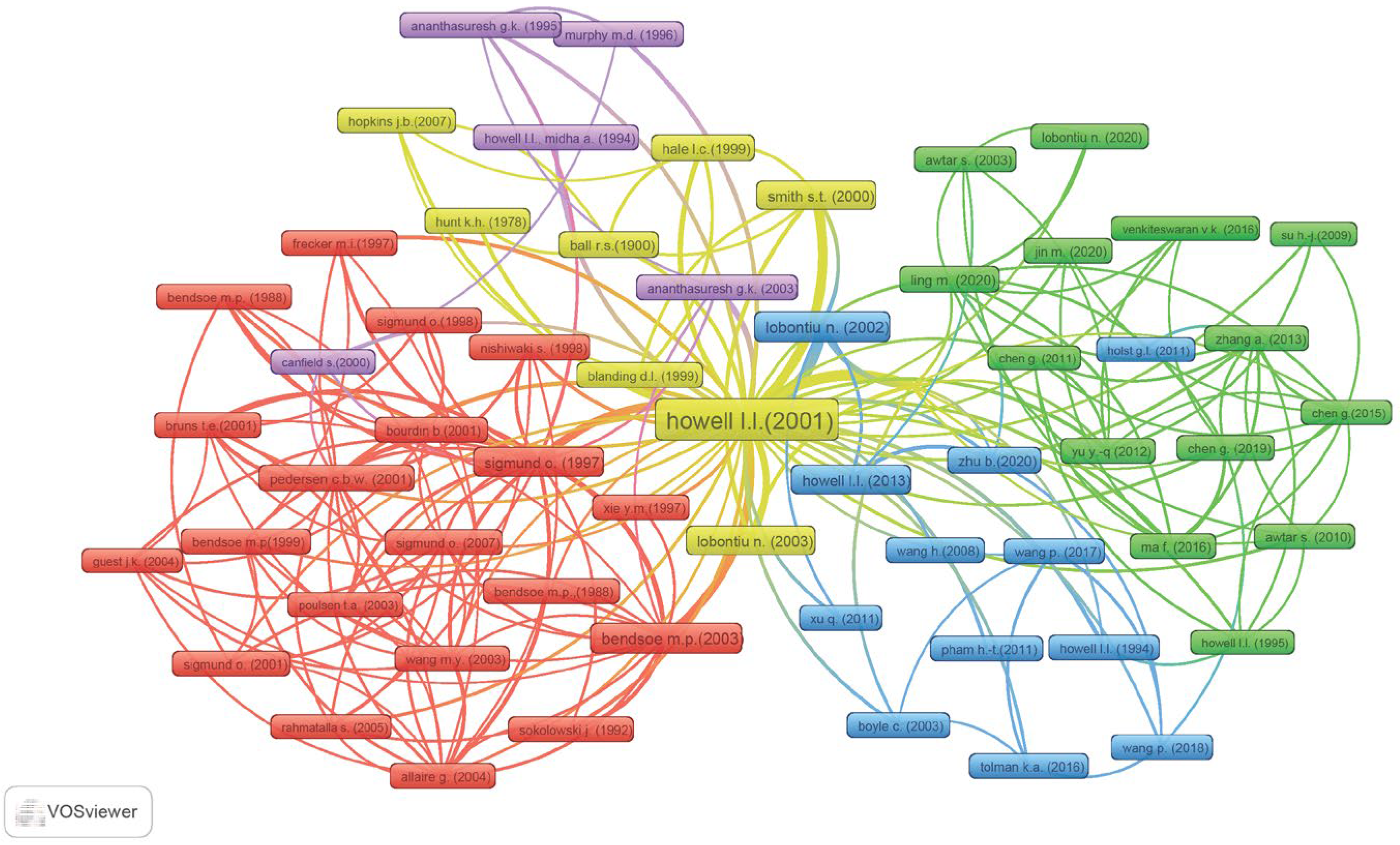
3.2.2. Co-Citation Analysis
| Node | Cluster | Links | Citations | Interpretation | Reference |
|---|---|---|---|---|---|
| Bendsoe M.P. (2003) | 1 | 37 | 116 | Foundations of topology optimization and its application to continuum compliant mechanism synthesis | [144] |
| Sigmund O. (1997) | 1 | 35 | 110 | [121] | |
| Pedersen C.BW. (2001) | 1 | 29 | 40 | [126] | |
| Ling M. (2020) | 2 | 30 | 39 | Nonlinear modeling of large deflections in flexible links | [159] |
| Ma F. (2016) | 2 | 28 | 23 | [166] | |
| Zhang A. (2013) | 2 | 27 | 24 | [163] | |
| Lobontiu N. (2002) | 3 | 42 | 165 | Lumped compliance mechanism design methods based on pseudo-rigid-body modeling | [8] |
| Zhu B. (2020) | 3 | 27 | 58 | [167] | |
| Howell L.L. (2013) | 3 | 32 | 70 | [145] | |
| Howell L.L. (2001) | 4 | 59 | 1237 | Fundamental principles of compliant mechanisms and flexural hinges, and design fundamentals | [5] |
| Howell L.L. (2013) | 4 | 40 | 244 | [142] | |
| Smith S.T. (2000) | 4 | 26 | 109 | [10] | |
| Ananthasuresh G.K. (2003) | 5 | 16 | 35 | Synthesis and design of flexible mechanisms for MEMSs | [168] |
| Canfield S. (2000) | 5 | 23 | 15 | [169] | |
| Murphy M.D. (1996) | 5 | 14 | 24 | [170] |
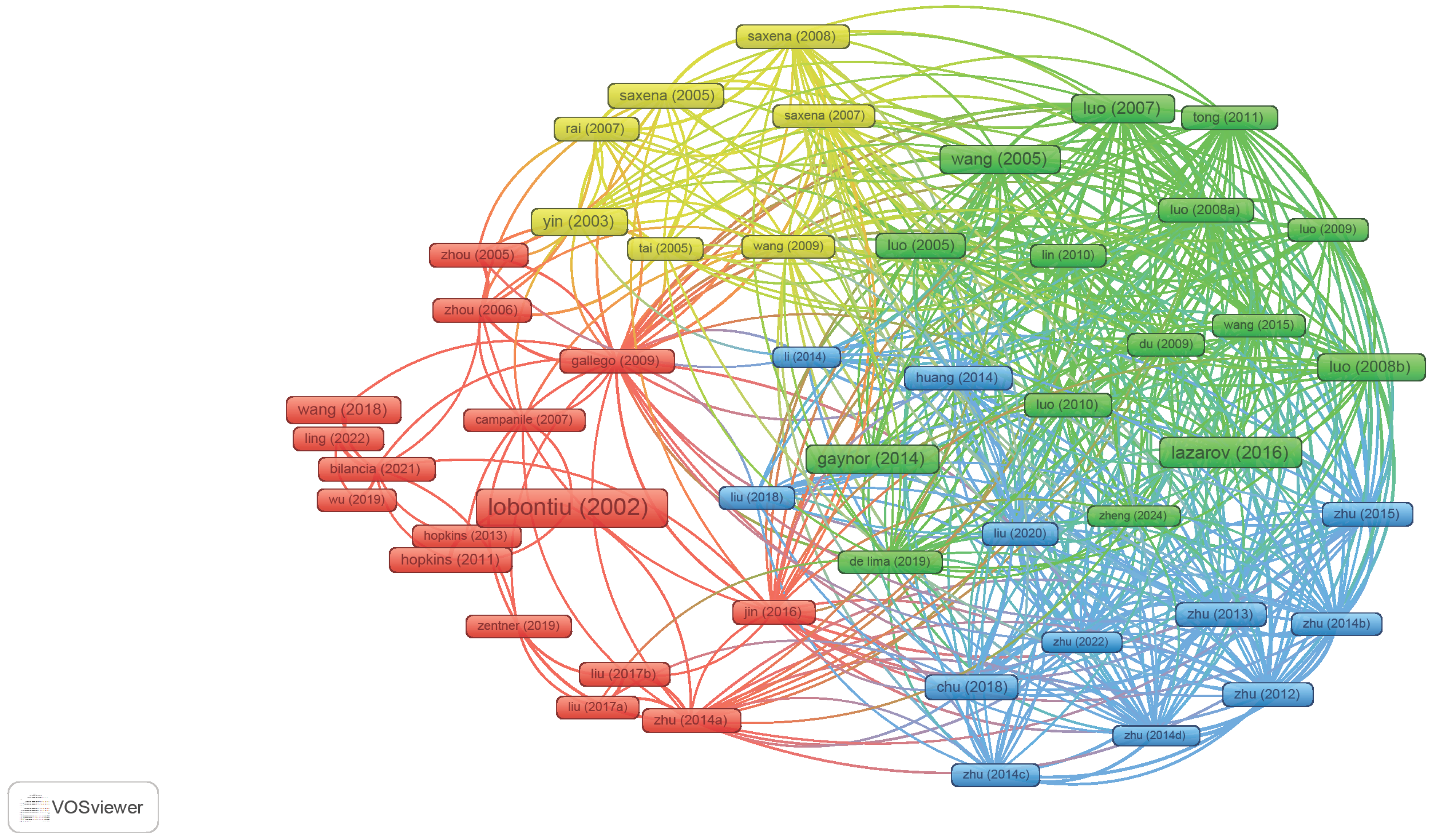
3.2.3. Bibliographic Coupling
| Label | Cluster | Links | Citations | Interpretation | Ref. |
|---|---|---|---|---|---|
| Lobontiu (2002) | 1 | 47 | 841 | Non-conventional geometries and shape optimization as optimal solutions in the design of compliant mechanisms and their elements | [8] |
| Wang (2018) | 1 | 46 | 177 | [148] | |
| Hopkins (2010) | 1 | 47 | 94 | [136] | |
| Liu (2017 b) | 1 | 49 | 91 | [172] | |
| Lazarov (2016) | 2 | 42 | 288 | Topology optimization for manufacture of distributed compliant mechanisms | [190] |
| Gaynor (2014) | 2 | 49 | 267 | [180] | |
| Wang (2005) | 2 | 49 | 224 | [175] | |
| Luo (2007) | 2 | 49 | 212 | [176] | |
| Chu (2018) | 3 | 49 | 103 | Topology optimization formulations for hinge-free designs of distributed compliant mechanisms | [187] |
| Zhu (2013) | 3 | 49 | 66 | [186] | |
| Huang (2014) | 3 | 49 | 60 | [183] | |
| Zhu (2012) | 3 | 49 | 57 | [185] | |
| Yin (2003) | 4 | 48 | 160 | Nonlinear large deformations and path generation of distributed compliant mechanisms through topology optimization using evolutionary algorithms | [191] |
| Saxena (2005) | 4 | 48 | 97 | [192] | |
| Rai (2007) | 4 | 49 | 60 | [193] | |
| Saxena (2008) | 4 | 49 | 54 | [194] |
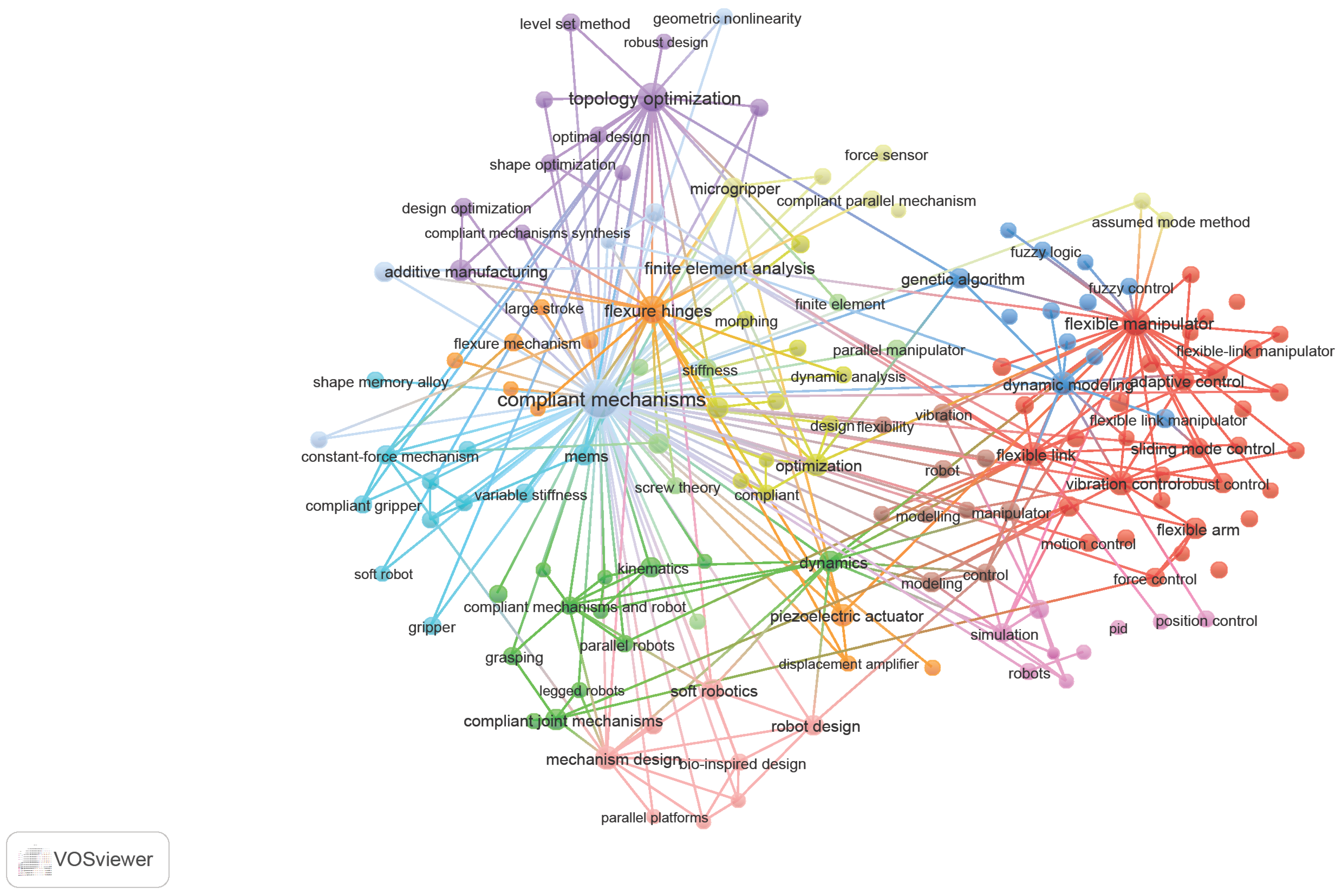
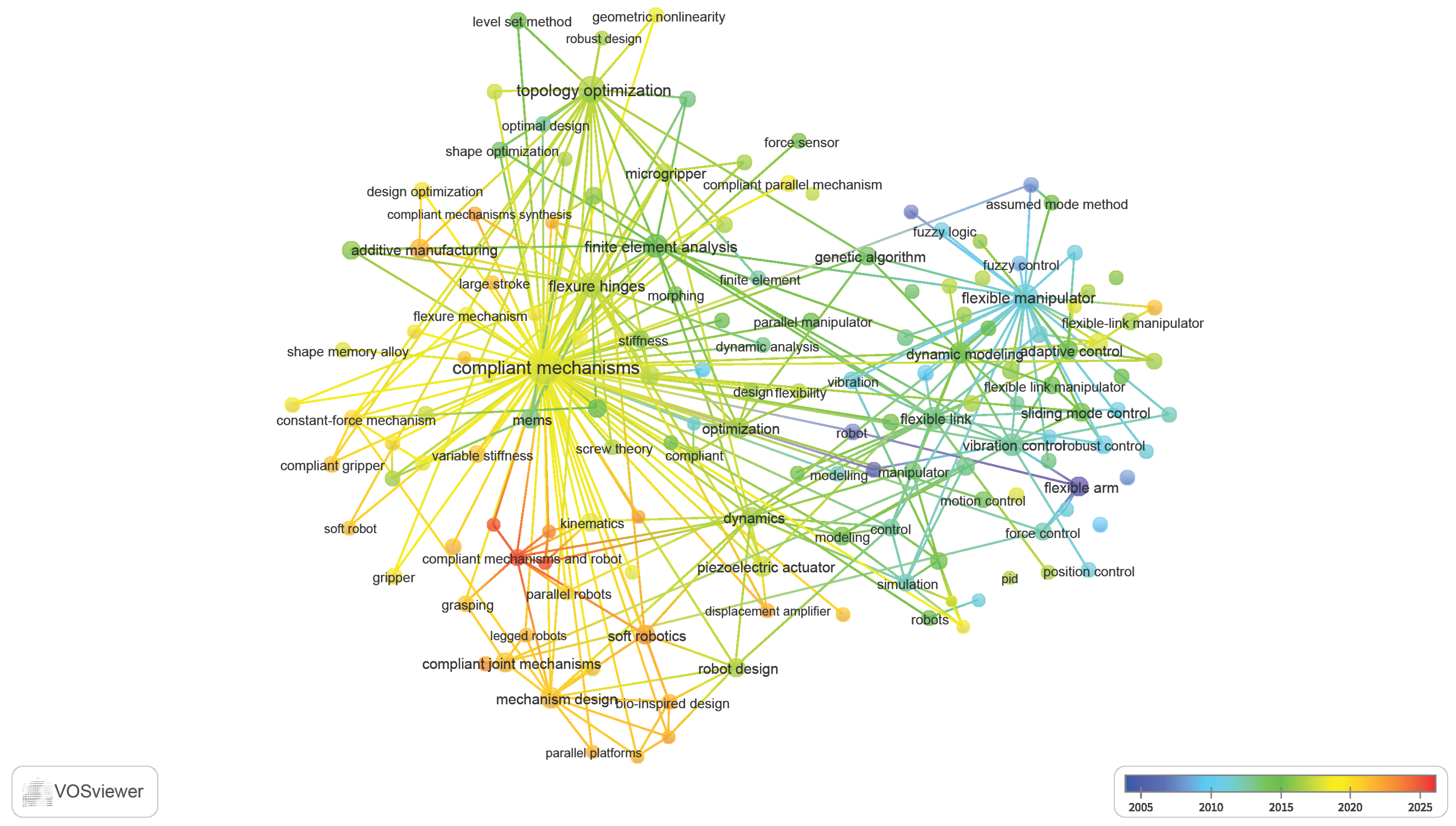
3.2.4. Co-Word Analysis
3.2.5. Co-Authorship Analysis
4. Trends and Perspectives
- (a)
- The integration of intelligent, multifunctional, and self-sensing materials to enable adaptive and autonomous compliant systems;
- (b)
- The application of digital design methodologies, machine learning, and artificial intelligence for topology synthesis, motion optimization, and performance prediction;
- (c)
- The expansion of additive and 4D manufacturing techniques for scalable, reconfigurable, and functionally graded compliant mechanisms;
- (d)
- The exploration of emerging application domains, including biomechanics, aerospace morphing structures, precision instrumentation, and soft robotic systems.
5. Conclusions
- ➢
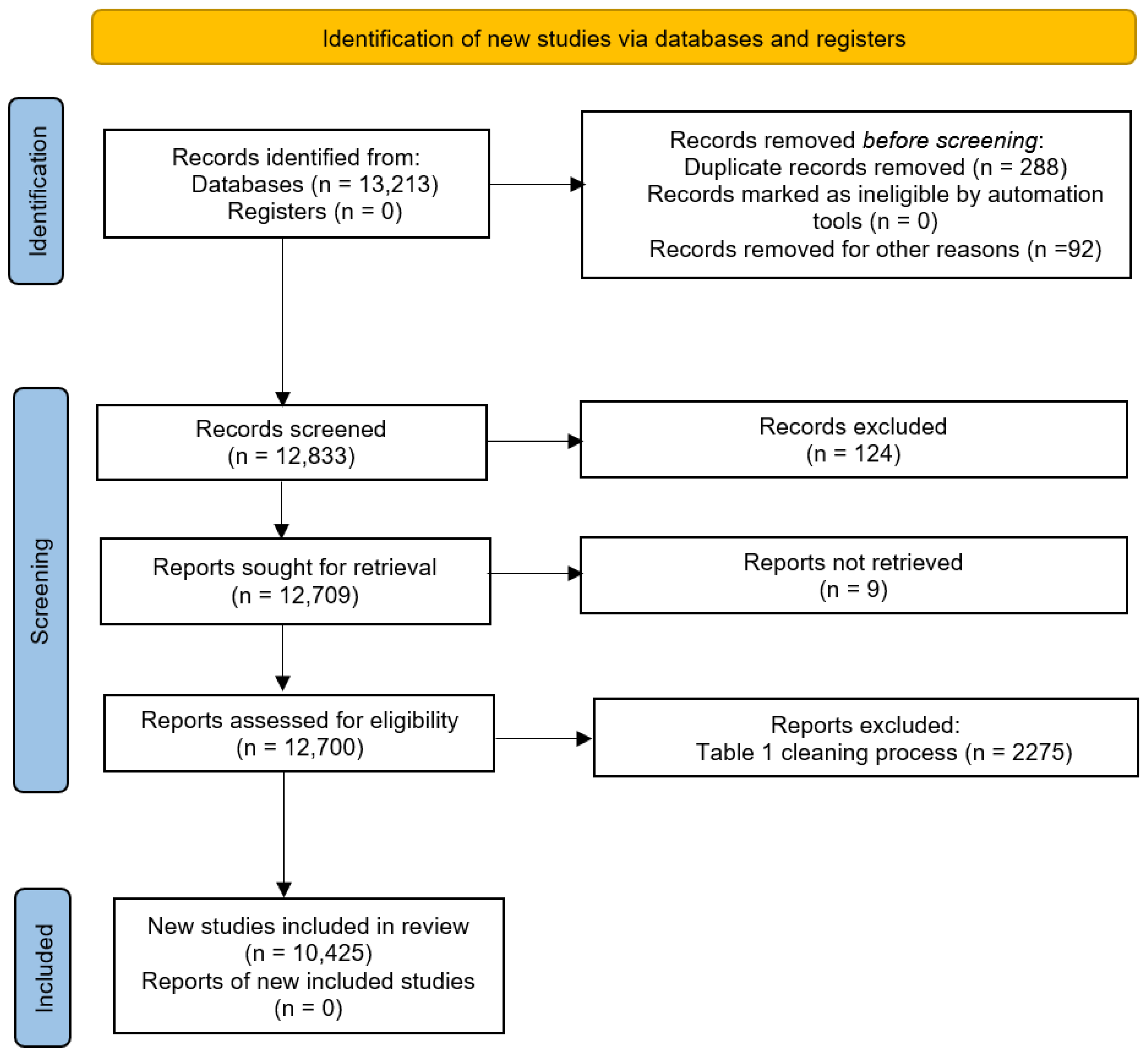
- The application of PRISMA principles led to the design of an optimized preprocessing strategy that identified and corrected metadata inconsistencies and duplicate records. This approach yielded a refined dataset of 10,425 documents retrieved from Scopus, thereby supporting the reliability of the results. The methodology also proved useful for identifying innovative studies that illustrate the versatility of compliant mechanisms, such as the simulation of DNA origami nanoactuators and nanostructures inspired by flexible mechanisms.
- ➢
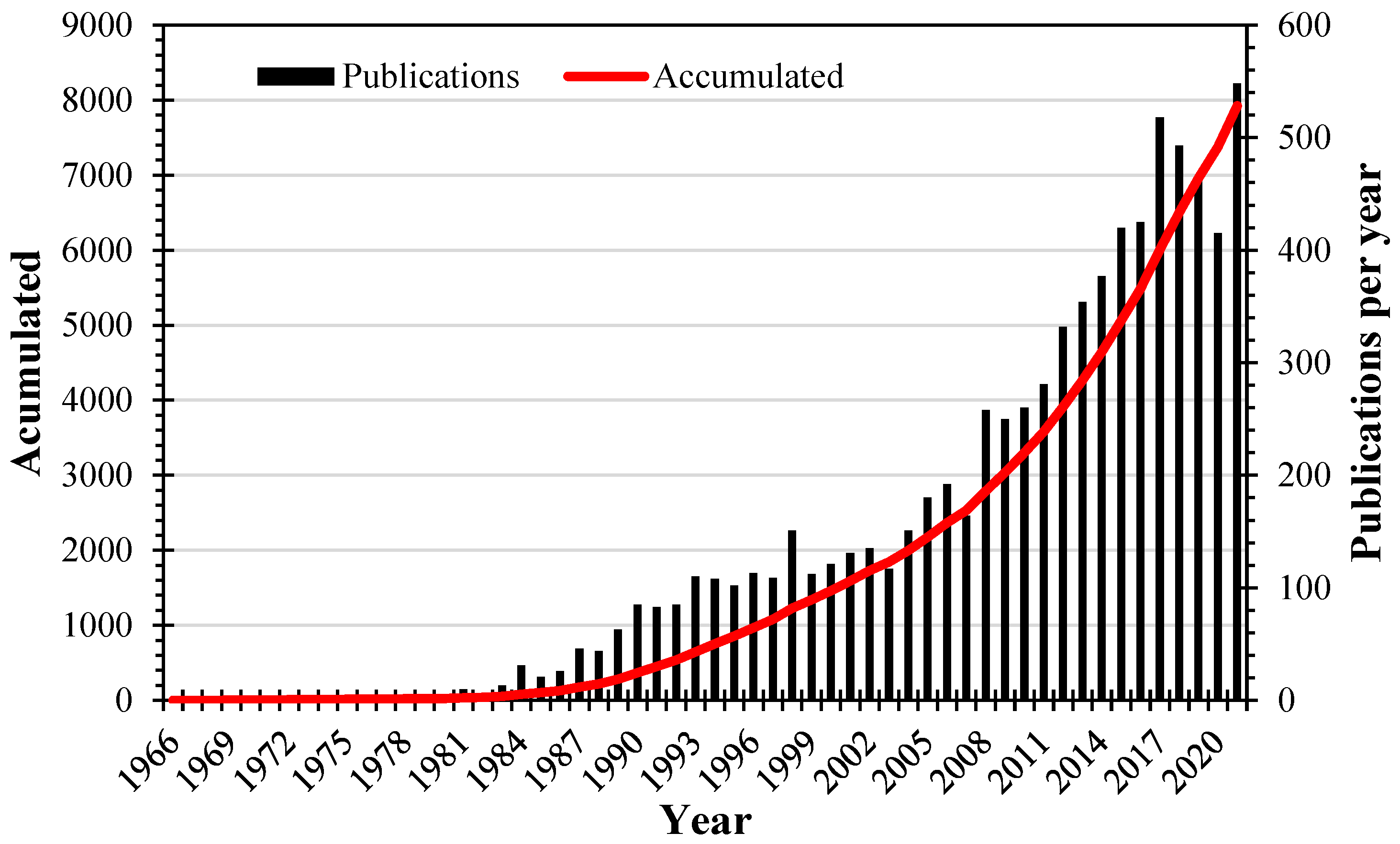
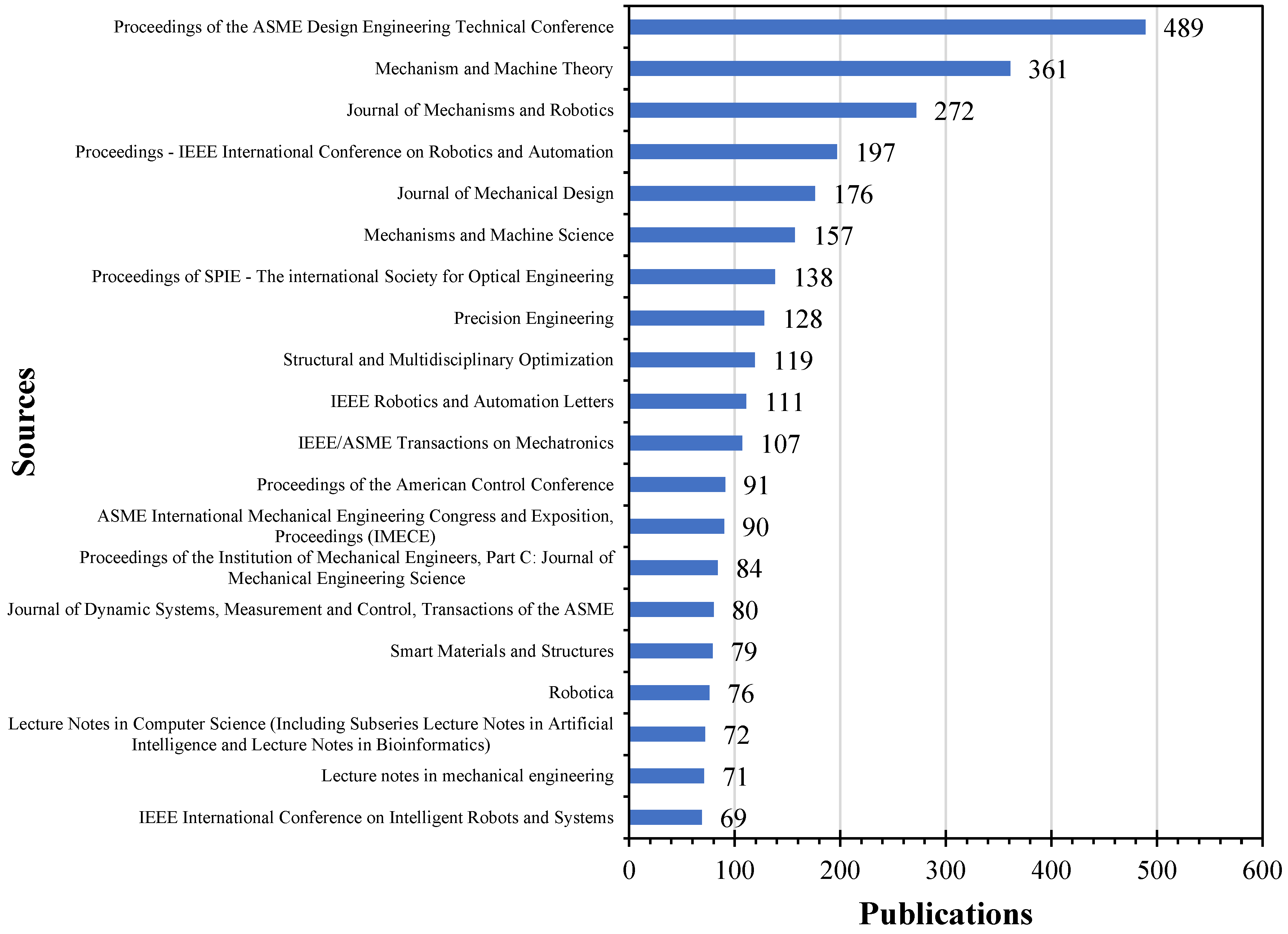
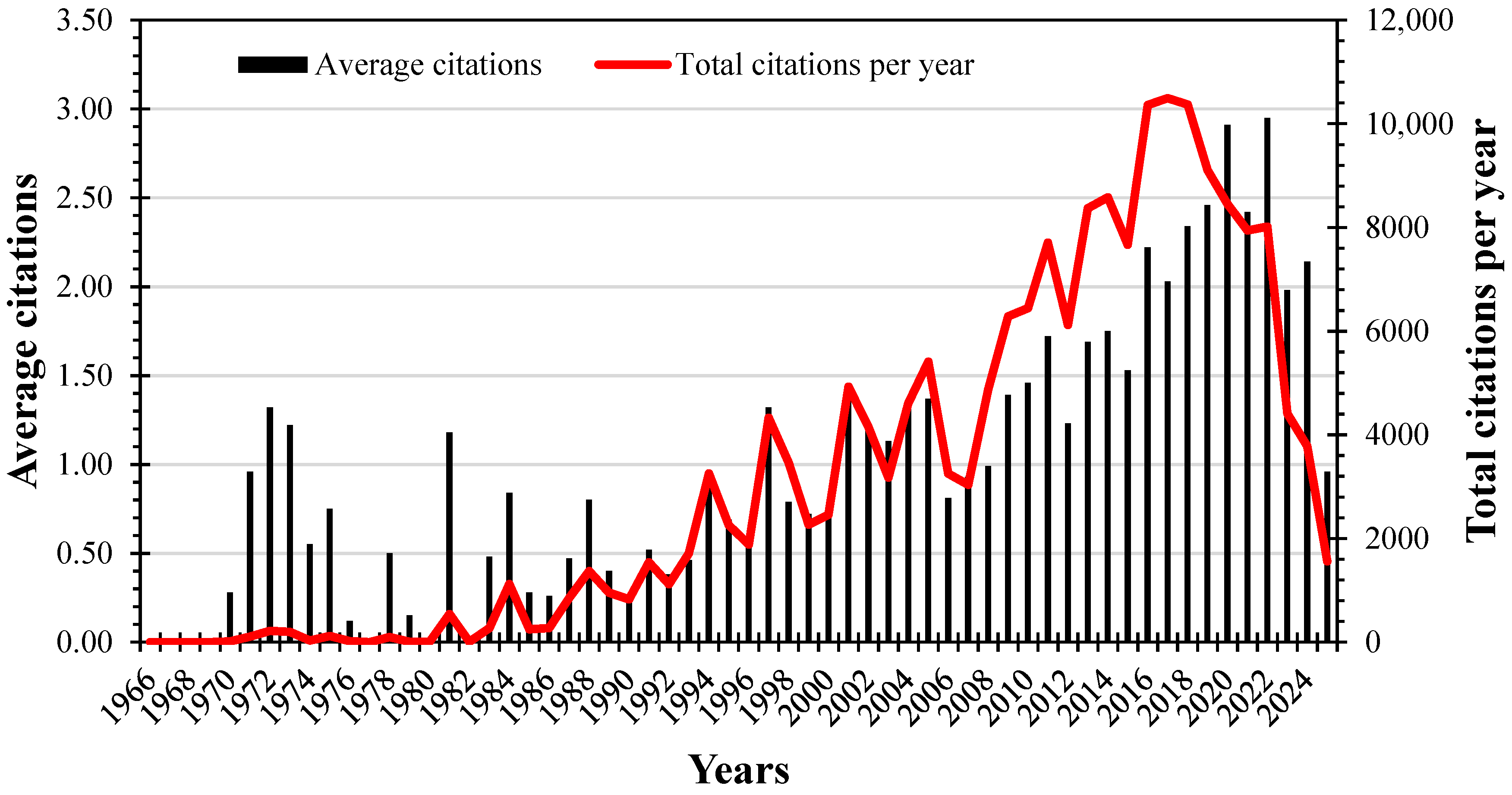
- The cumulative publication trend from 1966 to 2025 confirms that research on compliant mechanisms remains a vigorous and expanding field, with an average annual growth rate of 12.02%. The main sources of dissemination are Proceedings of the ASME Design Engineering Technical Conference (486 publications), Mechanism and Machine Theory (361), and Journal of Mechanisms and Robotics (272), reflecting a strong preference for specialized engineering venues.
- ➢
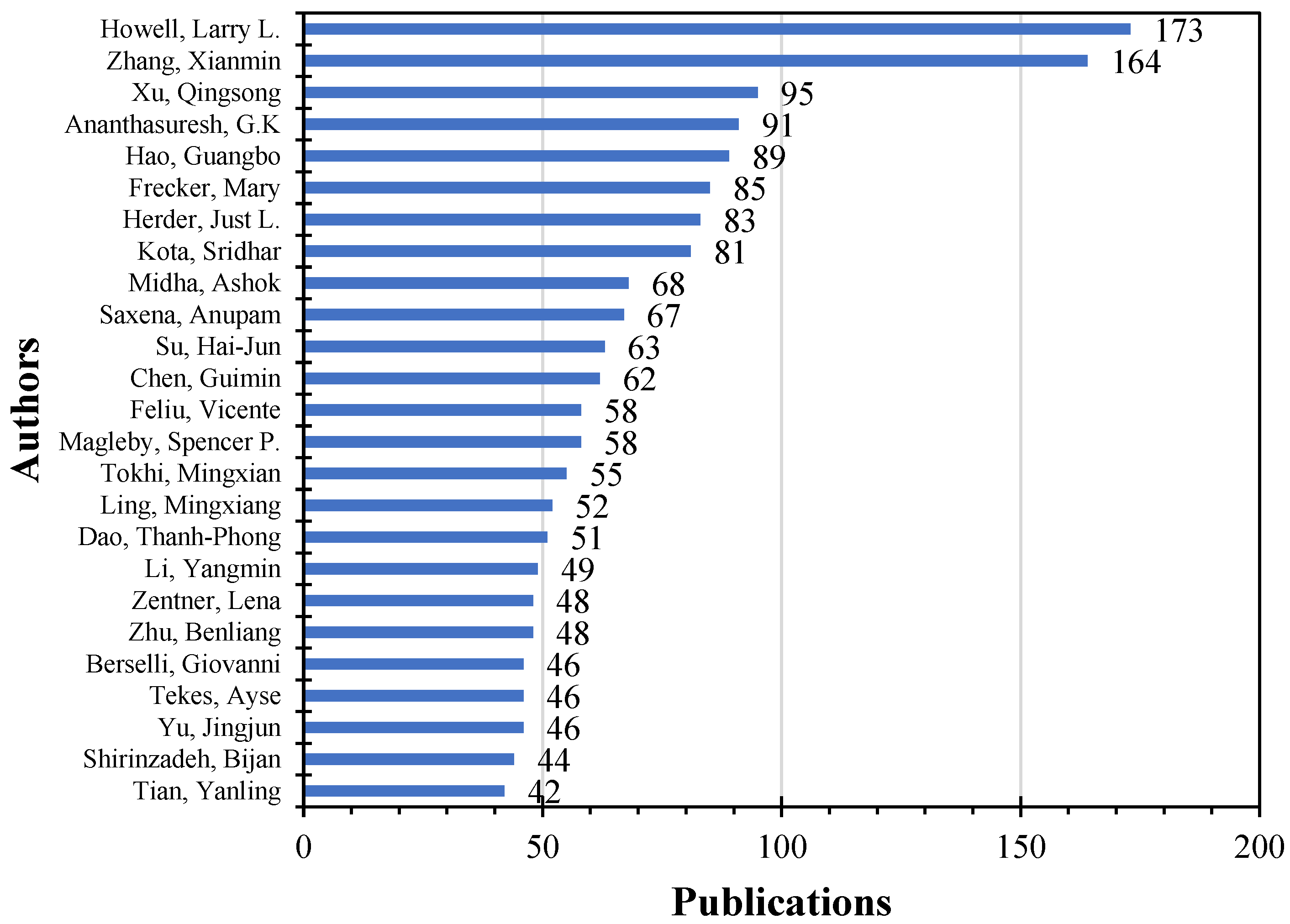
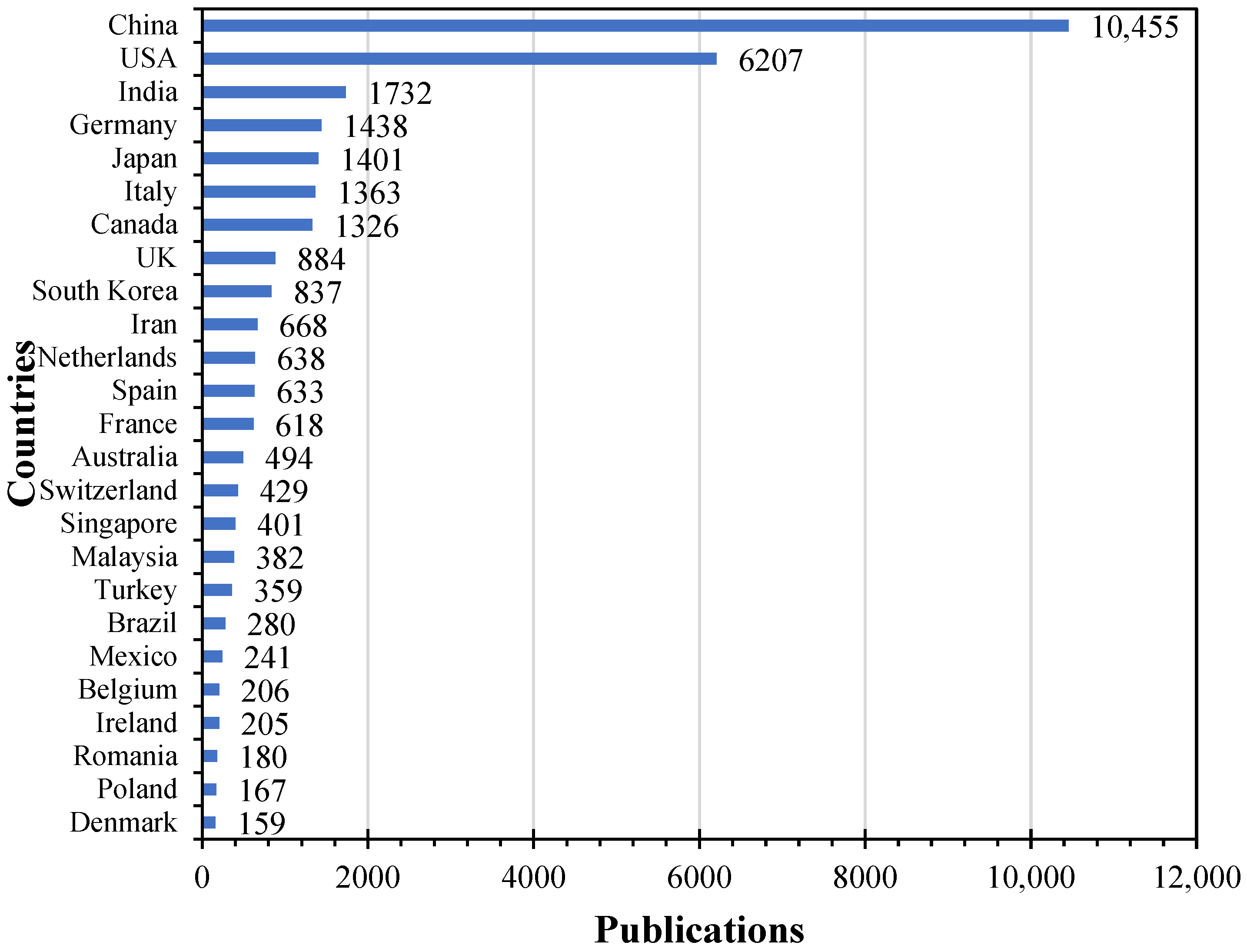
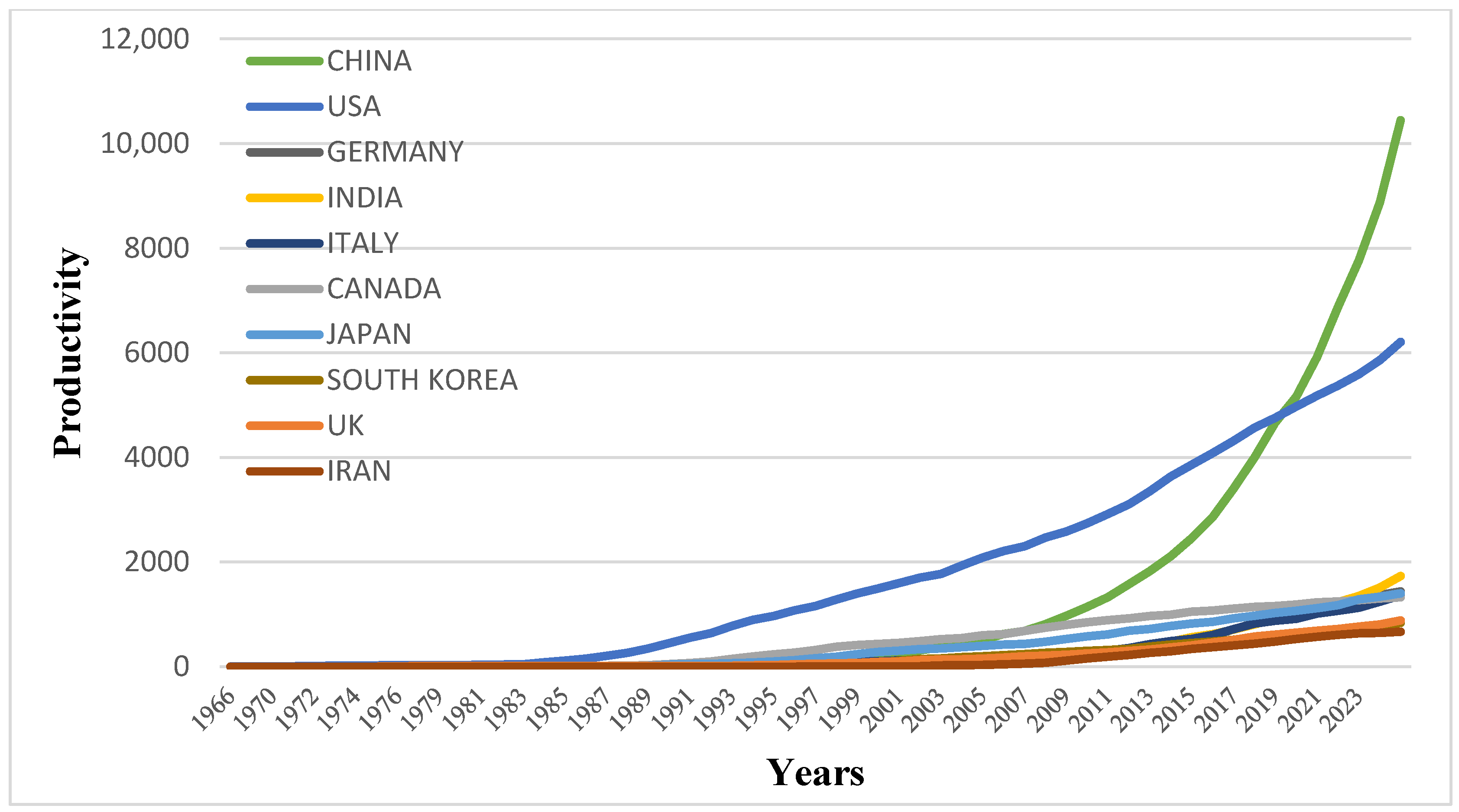
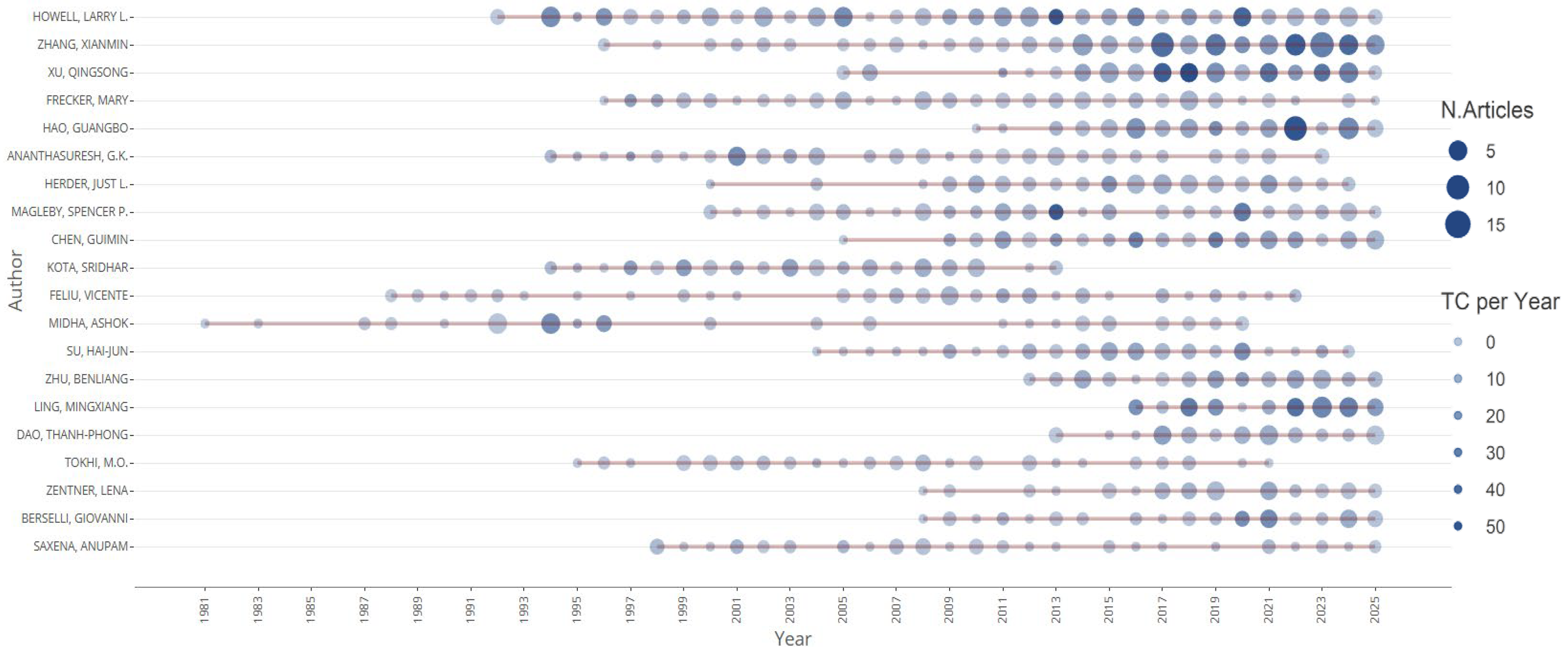
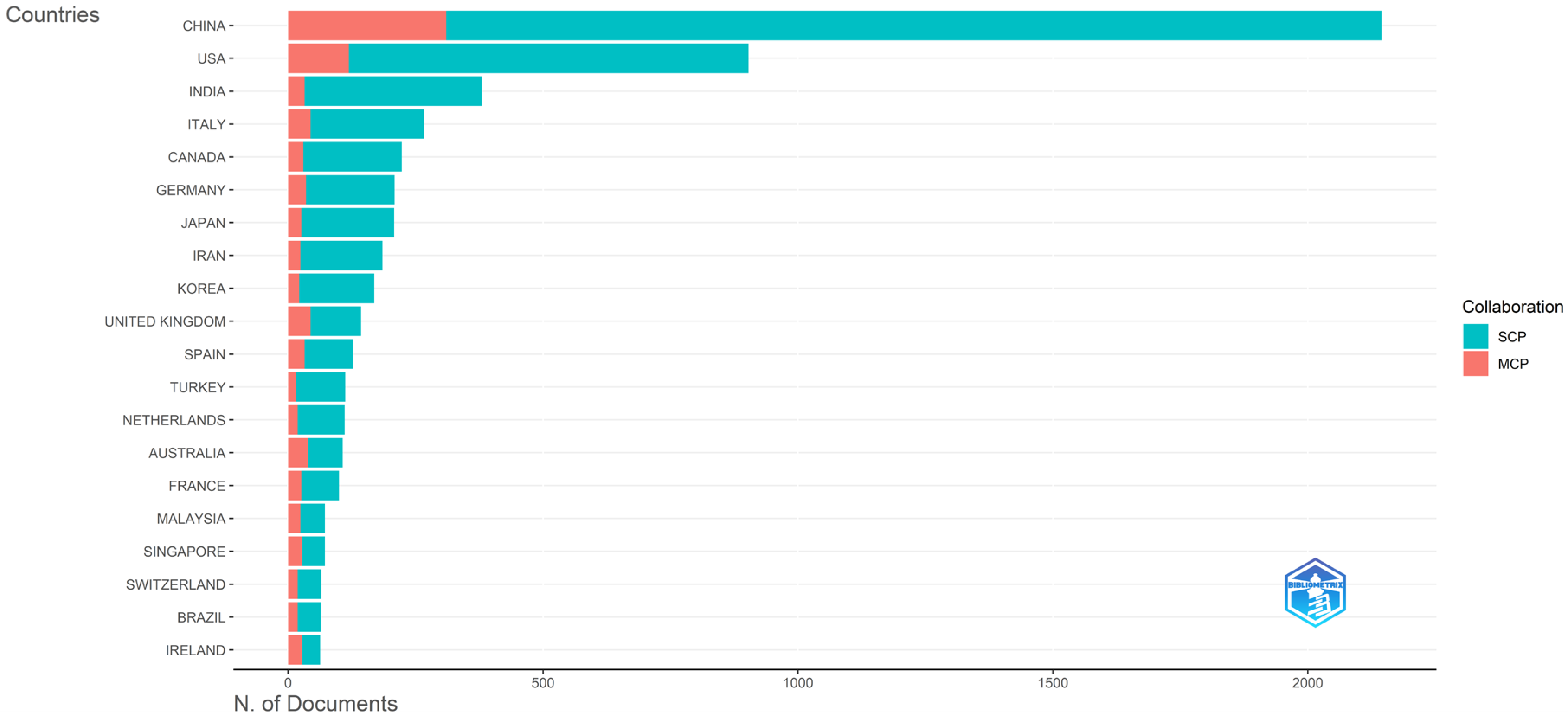
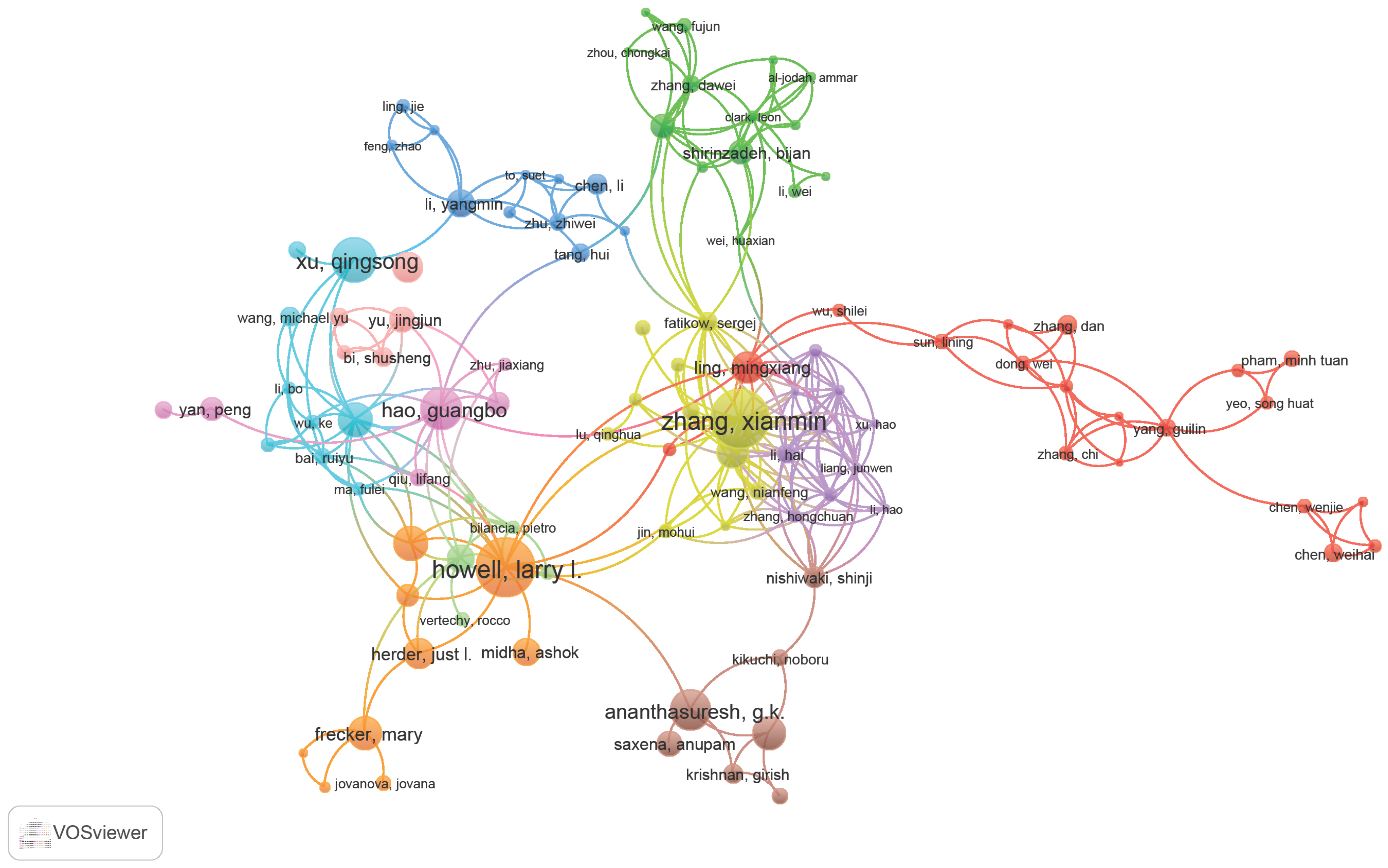
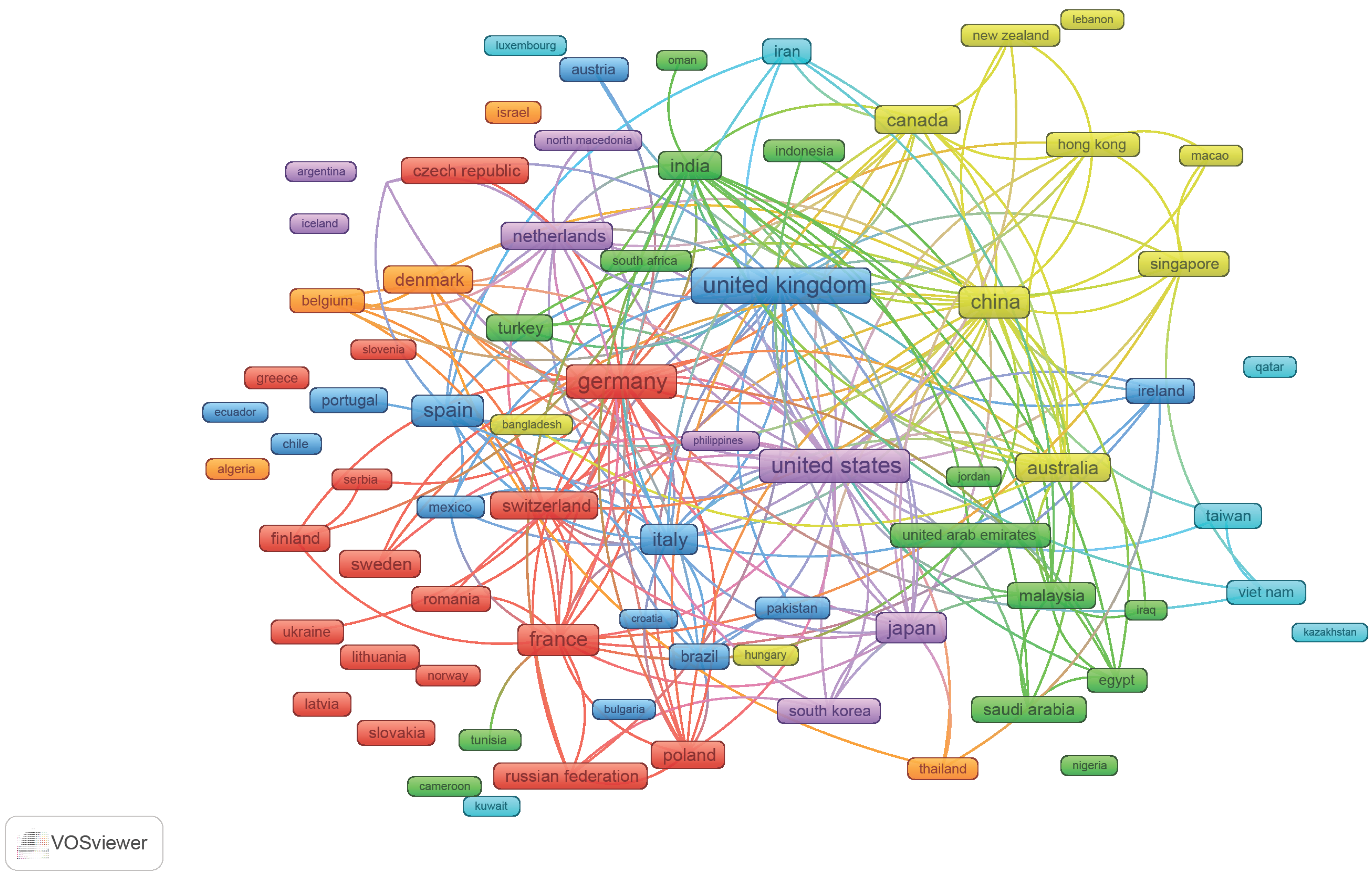
- From a geographical perspective, China and the United States dominate global productivity, contributing 10,455 and 6207 publications, respectively. They are followed by India, Germany, Japan, Italy, and Canada, each with over 1000 publications. This pattern aligns with the nationality of the two most prolific authors in the field: Larry Howell (USA, 173 publications) and Xianmin Zhang (China, 164 publications), who have shaped the development of analytical and optimization-based design approaches for compliant mechanisms.
- ➢
- The citation and reference analyses revealed the foundational works that define the discipline’s conceptual core. Seminal contributions by Sigmund [121], Howell [1,5], and Frecker [122] remain the most influential, alongside key monographs by Smith [10] and Lobontiu [8]. Early works, such as those by Burns [26], continue to be recognized for establishing the theoretical basis of flexible link synthesis. The inclusion of such classical and gray literature demonstrates the methodological robustness of this review and its capacity to capture the field’s historical continuity.
- ➢
- Co-citation and bibliographic coupling analyses revealed five and four original thematic cores, respectively, that structure the intellectual evolution of compliant mechanism design: the foundations of topology optimization and its application to continuum compliant mechanism synthesis, nonlinear modeling of large deflections in flexible links, lumped compliance mechanism design methods based on pseudo-rigid-body modeling, fundamental principles of compliant mechanisms and flexural hinges and design fundamentals, and synthesis and design of flexible mechanisms for MEMSs.
- ➢
- More recent analyses show the emergence of application-oriented subfields integrating topological optimization, multimaterial systems, and metamaterials. Current research emphasizes parallel manipulators, hinge elimination, additive manufacturing, and finite element modeling, reflecting a steady evolution toward computational and multifunctional design paradigms.
- ➢
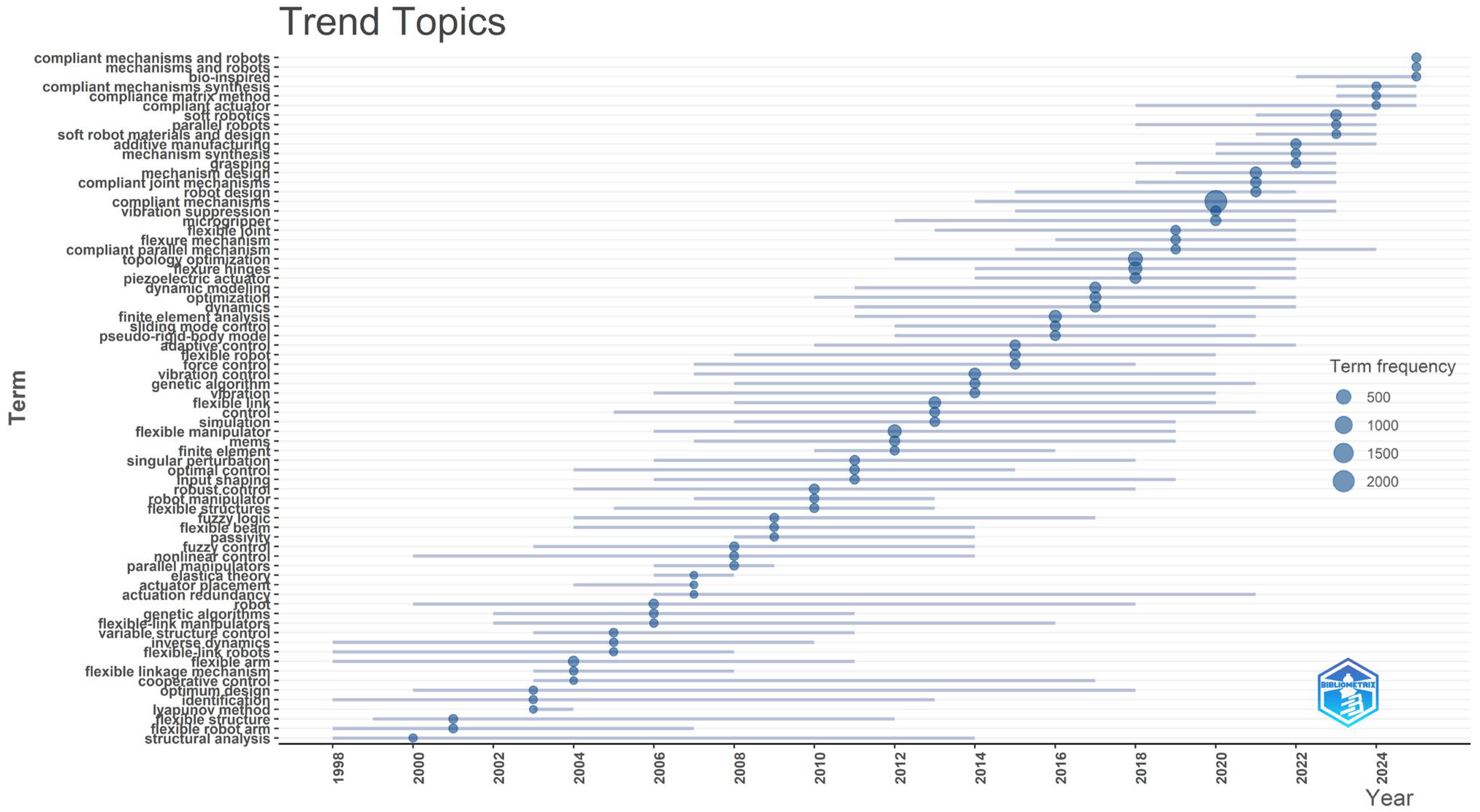
- The co-word analysis identified 13 keyword clusters representing consolidated and emerging research fronts. Mature areas (average publication year ≤ 2015) include vibration control, parallel mechanism dynamics, flexure-based mechanisms, and energy harvesting. Meanwhile, emerging areas (average year ≥ 2020) highlight soft robotics, microgrippers, 4D-printed compliant mechanisms, transfer matrix methods, microactuators, and variable-stiffness structures. These topics exemplify the ongoing convergence between compliant mechanisms, smart materials, and digital fabrication technologies.
- ➢
- The bibliometric evidence thus confirms that the field has not reached saturation but continues to diversify and evolve by integrating intelligent materials, additive manufacturing, and advanced computational techniques. The methodology developed in this study can be replicated or adapted to shorter time spans or to the emerging keywords identified here, allowing researchers to track new research frontiers as they grow.
- ➢
- Finally, compliant mechanisms represent a mature yet rapidly evolving field characterized by methodological innovation, theoretical depth, and broad applicability. The combination of flexible structural elements, distributed compliance, and emerging smart materials redefines the design paradigm of mechanical and mechatronic systems. The outcomes of this study provide both a conceptual map for understanding the field’s past and present and a strategic framework for guiding future investigations toward intelligent, adaptive, and sustainable mechanical design.
Author Contributions
Funding
Data Availability Statement
Conflicts of Interest
References
- Howell, L.L.; Midha, A. A Method for the Design of Compliant Mechanisms With Small-Length Flexural Pivots. J. Mech. Des. 1994, 116, 280–290. [Google Scholar] [CrossRef]
- Page, M.J.; McKenzie, J.E.; Bossuyt, P.M.; Boutron, I.; Hoffmann, T.C.; Mulrow, C.D.; Shamseer, L.; Tetzlaff, J.M.; Akl, E.A.; Brennan, S.E.; et al. The PRISMA 2020 statement: An updated guideline for reporting systematic reviews. BMJ 2021, 372, n71. [Google Scholar] [CrossRef] [PubMed]
- van Eck, N.J.; Waltman, L. Software survey: VOSviewer, a computer program for bibliometric mapping. Scientometrics 2010, 84, 523–538. [Google Scholar] [CrossRef] [PubMed]
- Aria, M.; Cuccurullo, C. bibliometrix: An R-tool for comprehensive science mapping analysis. J. Informetr. 2017, 11, 959–975. [Google Scholar] [CrossRef]
- Howell, L. Compliant Mechanisms, 1st ed.; John Wiley & Sons, Inc.: Hoboken, NJ, USA, 2001. [Google Scholar]
- De Matias Aguilar, F.; Martínez Trinidad, J.; Jiménez Martínez, M.; Torres Cedillo, S.G. Aplicaciones de mecanismos flexible utilizando impresión 3D. In La Era de la Impresión 3D en la Ingeniería. Oportunidades y Desafíos; Torres Cedillo, S.G., Jiménez Martínez, M., Eds.; Alfaomega Grupo Editor: Mexico City, Mexico, 2024; Volume Chapter 8, pp. 133–161. [Google Scholar] [CrossRef]
- Paros, J.M.; Weisbord, L. How to design flexure hinges. Mach. Des. 1965, 151. [Google Scholar]
- Lobontiu, N. Compliant Mechanisms, Design of Flexure Hinges, 1st ed.; CRC Press: Boca Raton, FL, USA, 2003. [Google Scholar] [CrossRef]
- Lobontiu, N. Compliant Mechanisms, Design of Flexure Hinges, 2nd ed.; CRC Press: Boca Raton, FL, USA, 2021. [Google Scholar] [CrossRef]
- Smith, S.T. Flexures, Elements of Elastic Mechanisms, 1st ed.; CRC Press: Boca Raton, FL, USA, 2000. [Google Scholar] [CrossRef]
- Her, I.; Midha, A. A Compliance Number Concept for Compliant Mechanisms, and Type Synthesis. J. Mech. Transm. Autom. Des. 1987, 109, 348–355. [Google Scholar] [CrossRef]
- Midha, A.; Her, I.; Salamon, B.A. A Methodology for Compliant Mechanisms Design: Part I—Introduction and Large-Deflection Analysis. In 18th Design Automation Conference: Volume 2—Geometric Modeling, Mechanisms, and Mechanical Systems Analysis; American Society of Mechanical Engineers: New York, NY, USA, 1992; Volume 2, pp. 29–38. [Google Scholar] [CrossRef]
- Her, I.; Midha, A.; Salamon, B.A. A Methodology for Compliant Mechanisms Design: Part II—Shooting Method and Application. In 8th Design Automation Conference: Volume 2—Geometric Modeling, Mechanisms, and Mechanical Systems Analysis; American Society of Mechanical Engineers: New York, NY, USA, 1992; Volume 2, pp. 39–45. [Google Scholar] [CrossRef]
- Hain, K. Der Federausgleich von Lasten. In Grundlagen der Landtechnik-Konstrukteurhefte; Universität Hohenheim: Stuttgart, Germany, 1952; pp. 38–50. [Google Scholar]
- Livermore, D.F. The Determination of Equilibrium Configurations of Spring-Restrained Mechanisms Using (4 × 4) Matrix Methods. J. Manuf. Sci. Eng. 1967, 89, 87–93. [Google Scholar] [CrossRef]
- Artobolevski, I.I. Mechanisms in Modern Engineering Design: A Handbook for Engineers, Designers and Inventors; MIR: Moscow, Russia, 1976; Volume 2. [Google Scholar]
- Artobolevski, I.I. Mechanisms in Modern Engineering Design, Vol 4 Cam and Friction Mechanisms Flexiblelink Mechanisms; MIR: Moscow, Russia, 1980; Volume 4. [Google Scholar]
- Artobolevski, I.I. Mechanisms in Modern Engineering Design; MIR: Moscow, Russia, 1981; Volume 5. [Google Scholar]
- Sieker, K.H. Getriebe mit Federnden Gliedern. In Getribetechnlk; VDI-Verlag GmbH: Berlin, Germany, 1941; pp. 37–40. [Google Scholar]
- Sieker, K.H. Federgelenke und Federnde Getriebe. In Getriebetechnik; VDI-Verlag GmbH: Berlin, Germany, 1951; pp. 141–148. [Google Scholar]
- Barkan, P. Calculation of High-Speed Valve Motion with a Flexible Overhead Linkage. SAE Trans. 1953, 61, 687–700. [Google Scholar]
- Meyer zur Capellen, W. Der Kurbeltrieb als Schwingungsfaehiges System. In Getriebetechnik; VDI-Verlag GmbH: Berlin, Germany, 1941; p. 130. [Google Scholar]
- Meyer zur Capellen, W. Belastungen und Schwingungen in Kurbeltrieben durch Massenkraefte. Konstruction 1960, 12, 17–19. [Google Scholar]
- Meyer zur Capellen, W. Beigungsschwingungen In der Koppel einer Kurbelschwinge. Ing.-Archiv. 1962, 16, 23. [Google Scholar]
- Meyer zur Capellen, W. Biegungs- und Lagerschwingungen in Kurbeltrieben. In Forshungsberichte des Landes Nordrhein-Westfalen; Springer Nature: Dordrecht, The Netherlands, 1962. [Google Scholar]
- Burns, R.H. The Kinetostatic Synthesis of Flexible Link Mechanisms; Yale University: New Haven, CT, USA, 1965. [Google Scholar]
- Boronkay, T.G.; Mei, C. Analysis and design of multiple input flexible link mechanisms. J. Mech. 1970, 5, 29–40. [Google Scholar] [CrossRef]
- Davidson, J.K. Analysis and synthesis of a slider-crank mechanism with a flexibly-attached slider. J. Mech. 1970, 5, 239–247. [Google Scholar] [CrossRef]
- Shoup, T.E.; McLarnan, C.W. A survey of flexible link mechanisms having lower pairs. J. Mech. 1971, 6, 97–105. [Google Scholar] [CrossRef]
- Winfrey, R.C. Elastic Link Mechanism Dynamics. J. Eng. Ind. 1971, 93, 268–272. [Google Scholar] [CrossRef]
- Erdman, A.G.; Sandor, G.N. Kineto-elastodynamics—A review of the state of the art and trends. Mech. Mach. Theory 1972, 7, 19–33. [Google Scholar] [CrossRef]
- Erdman, A.G.; Sandor, G.N.; Oakberg, R.G. A General Method for Kineto-Elastodynamic Analysis and Synthesis of Mechanisms. J. Eng. Ind. 1972, 94, 1193–1205. [Google Scholar] [CrossRef]
- Her, I. Methodology for Compliant Mechanisms Design; Purdue University: West Lafayette, IN, USA, 1986. [Google Scholar]
- Ananthasuresh, G.K. A New Design Paradigm for Micro-Electro-Mechanical Systems & Investigations on the Compliant Mechanisms Synthesis; The University of Michigan: Ann Arbor, MI, USA, 1994. [Google Scholar]
- Frecker, M.I. Optimal Design of Compliant Mechanisms; The University of Michigan: Ann Arbor, MI, USA, 1997. [Google Scholar]
- Pritchard, A. Statistical bibliography or bibliometrics. J. Doc. 1969, 25, 348. [Google Scholar]
- Debackere, K.; Glänzel, W.; Thijs, B. Springer Handbook of Science and Technology Indicators; Springer International Publishing: Cham, Switzerland, 2019. [Google Scholar] [CrossRef]
- Donthu, N.; Kumar, S.; Mukherjee, D.; Pandey, N.; Lim, W.M. How to conduct a bibliometric analysis: An overview and guidelines. J. Bus. Res. 2021, 133, 285–296. [Google Scholar] [CrossRef]
- Passas, I. Bibliometric Analysis: The Main Steps. Encyclopedia 2024, 4, 1014–1025. [Google Scholar] [CrossRef]
- Flores, P. The journal of Mechanism and Machine Theory: Celebrating 55 years since its foundation. Mech. Mach. Theory 2019, 142, 103599. [Google Scholar] [CrossRef]
- Flores, P. A bibliometric overview of Mechanism and Machine Theory journal: Publication trends from 1990 to 2020. Mech. Mach. Theory 2022, 175, 104965. [Google Scholar] [CrossRef]
- Chen, D.-Z.; Lee, Y.-Y. Longitudinal Analysis of Mechanism and Machine Theory: Geospatial Productivity, Journal Citation Networks, and Researcher Communities. J. Mech. Des. 2016, 138, 032301. [Google Scholar] [CrossRef]
- García-León, R.A.; Martínez-Trinidad, J.; Campos-Silva, I. Historical Review on the Boriding Process using Bibliometric Analysis. Trans. Indian Inst. Met. 2021, 74, 541–557. [Google Scholar] [CrossRef]
- Jaramillo, H.Y.; Vasco-Echeverri, O.H.; Moreno-Pacheco, L.A.; García-León, R.A. Biomaterials in Concrete for Engineering Applications: A Bibliometric Review. Infrastructures 2023, 8, 161. [Google Scholar] [CrossRef]
- Huxman, C.; Butler, J. A Systematic Review of Compliant Mechanisms as Orthopedic Implants. J. Med. Devices 2021, 15, 040802. [Google Scholar] [CrossRef]
- Hermoza Llanos, E.; Corves, B.; Huesing, M.; Saxena, A. Systematic mapping of synthesis methods for compliant grippers using PRISMA. Mech. Mach. Theory 2025, 206, 105900. [Google Scholar] [CrossRef]
- Pham, X.-L.; Le, T.T. Bibliometric Analysis and Systematic Review of Research on Expert Finding: A PRISMA-guided Approach. Int. Arab J. Inf. Technol. 2024, 21, 661–674. [Google Scholar] [CrossRef]
- Zupic, I.; Čater, T. Bibliometric Methods in Management and Organization. Organ. Res. Methods 2015, 18, 429–472. [Google Scholar] [CrossRef]
- Martín-Martín, A.; Orduna-Malea, E.; Thelwall, M.; Delgado López-Cózar, E. Google Scholar, Web of Science, and Scopus: A systematic comparison of citations in 252 subject categories. J. Informetr. 2018, 12, 1160–1177. [Google Scholar] [CrossRef]
- Pranckutė, R. Web of Science (WoS) and Scopus: The Titans of Bibliographic Information in Today’s Academic World. Publications 2021, 9, 12. [Google Scholar] [CrossRef]
- Gusenbauer, M. Google Scholar to overshadow them all? Comparing the sizes of 12 academic search engines and bibliographic databases. Scientometrics 2019, 118, 177–214. [Google Scholar] [CrossRef]
- Falagas, M.E.; Pitsouni, E.I.; Malietzis, G.A.; Pappas, G. Comparison of PubMed, Scopus, Web of Science, and Google Scholar: Strengths and weaknesses. FASEB J. 2008, 22, 338–342. [Google Scholar] [CrossRef] [PubMed]
- Mongeon, P.; Paul-Hus, A. The journal coverage of Web of Science and Scopus: A comparative analysis. Scientometrics 2016, 106, 213–228. [Google Scholar] [CrossRef]
- van Eck, N.J.; Waltman, L. Accuracy of citation data in Web of Science and Scopus. arXiv 2019, arXiv:1906.07011. [Google Scholar]
- How Do I Search in Scopus? Available online: https://service.elsevier.com/app/answers/detail/a_id/34325/ (accessed on 15 May 2025).
- Page, M.J.; Moher, D.; Bossuyt, P.M.; Boutron, I.; Hoffmann, T.C.; Mulrow, C.D.; Shamseer, L.; Tetzlaff, J.M.; Akl, E.A.; Brennan, S.E.; et al. PRISMA 2020 explanation and elaboration: Updated guidance and exemplars for reporting systematic reviews. BMJ 2021, 372, n160. [Google Scholar] [CrossRef] [PubMed]
- Haddaway, N.R.; Page, M.J.; Pritchard, C.C.; McGuinness, L.A. PRISMA2020: An R package and Shiny app for producing PRISMA 2020-compliant flow diagrams, with interactivity for optimised digital transparency and Open Synthesis. Campbell Syst. Rev. 2022, 18, e1230. [Google Scholar] [CrossRef] [PubMed]
- PRISMA Flow Diagram. Available online: https://estech.shinyapps.io/prisma_flowdiagram/ (accessed on 12 May 2025).
- Klein, J.A.; Zuo, L. Design and Experimental Study of a Velocity Amplified Electromagnetic Vibration Energy Harvester; Park, G., Ed.; SPIE: Bellingham, WA, USA, 2017; p. 101642O. [Google Scholar] [CrossRef]
- Wang, X.; Yan, Y.; Zhang, K.; Liu, C. Prescribed Vibration Control for Long Slender Remote Systems in Nuclear Decommissioning; Springer Nature: Cham, Switzerland, 2025; pp. 231–243. [Google Scholar] [CrossRef]
- Klein, J.; Zuo, L. A velocity-amplified electromagnetic energy harvester for small amplitude vibration. Smart Mater. Struct. 2017, 26, 095057. [Google Scholar] [CrossRef]
- Fukui, R.; Kanayama, G.; Kato, Y.; Takahashi, R.; Warisawa, S. Development of an Intersection Module for a Modularized Rail Structure–Implementation of Compliant Mechanisms for a Replacing Task of Movable Parts–. J. Robot. Mechatron. 2018, 30, 467–476. [Google Scholar] [CrossRef]
- Giacometti, P.; Diamond, S.G. Compliant head probe for positioning electroencephalography electrodes and near-infrared spectroscopy optodes. J. Biomed. Opt. 2013, 18, 027005. [Google Scholar] [CrossRef] [PubMed]
- Ma, N.; Monk, S.; Cheneler, D. Design, Prototyping and Test of a Dual-Arm Continuum Robot for Underwater Environments. In 2022 7th International Conference on Robotics and Automation Engineering (ICRAE); IEEE: Piscataway, NJ, USA, 2022; pp. 158–164. [Google Scholar] [CrossRef]
- Al-saedi, M.I.; Wu, H.; Handroos, H. Intelligent controller of a flexible hybrid robot machine for ITER assembly and maintenance. Fusion Eng. Des. 2014, 89, 1795–1803. [Google Scholar] [CrossRef]
- Penetro, O.S.; Martell, L.G.B.; López, J.C.; Rubio, M.F.; Muñoz, J.L.R.; Mora, G.P.; Montero, A.R.G.; López, F.E.H.; Hernández, A.P.S.; Pérez, N.L.Z.; et al. Nitinol biomimetic compliant mechanism for deep space exploration tested onboard the ISS on MISSE platform. In Proceedings of the International Astronautical Congress, IAC; International Astronautical Federation (IAF): Paris, France, 2023. [Google Scholar]
- Leishman, L.C.; Ricks, D.J.; Colton, M.B. Design and Evaluation of Statically Balanced Compliant Mechanisms for Haptic Interfaces. In ASME 2010 Dynamic Systems and Control Conference; ASMEDC: New York, NY, USA, 2010; Volume 1, pp. 859–866. [Google Scholar] [CrossRef]
- Vertechy, R.; Bergamasco, M.; Berselli, G.; Parenti Castelli, V.; Vassura, G. Compliant actuation based on dielectric elastomers for a force-feedback device: Modeling and experimental evaluation. Frat. Ed. Integrità Strutt. 2012, 7, 47–56. [Google Scholar] [CrossRef]
- Hawks, J.C.; Colton, M.B.; Howell, L.L. A Variable-Stiffness Straight-Line Compliant Mechanism. In Volume 5A: 39th Mechanisms and Robotics Conference; American Society of Mechanical Engineers: New York, NY, USA, 2015. [Google Scholar] [CrossRef]
- Fernandez-Montoya, M.; Yu, H.; Gallego, J.A.; Aguirre, M.E. A Multimodal Fully Compliant Mechanism With Tunable Force Transmission for Laparoscopic Grasping. J. Mech. Robot. 2025, 17, 101014. [Google Scholar] [CrossRef]
- Zinelli, L.; Pagnanelli, G.; Bianchi, M. Human-inspired compliance discrimination with a multi-degrees of freedom robotic manipulator. In 2025 34th IEEE International Conference on Robot and Human Interactive Communication (RO-MAN); IEEE: Piscataway, NJ, USA, 2025; pp. 2465–2470. [Google Scholar] [CrossRef]
- Truong, Q.-D.; Tran, N.-D.-K.; Wang, D.-A. Design and characterization of a mouse trap based on a bistable mechanism. Sens. Actuators A Phys. 2017, 267, 360–375. [Google Scholar] [CrossRef]
- Zirbel, S.A.; Aten, Q.T.; Easter, M.; Jensen, B.D.; Howell, L.L. Compliant Constant-Force Micro-Mechanism for Enabling Dual-Stage Motion. In Volume 4: 36th Mechanisms and Robotics Conference, Parts A and B; American Society of Mechanical Engineers: New York, NY, USA, 2012; Volume 4, pp. 191–198. [Google Scholar] [CrossRef]
- Zhou, L.; Marras, A.E.; Su, H.-J.; Castro, C.E. DNA Origami Compliant Nanostructures with Tunable Mechanical Properties. ACS Nano 2014, 8, 27–34. [Google Scholar] [CrossRef] [PubMed]
- Shi, Z.; Castro, C.E.; Arya, G. Conformational Dynamics of Mechanically Compliant DNA Nanostructures from Coarse-Grained Molecular Dynamics Simulations. ACS Nano 2017, 11, 4617–4630. [Google Scholar] [CrossRef] [PubMed]
- Yu, Z.; Baptist, A.V.; Reinhardt, S.C.M.; Bertosin, E.; Dekker, C.; Jungmann, R.; Heuer-Jungemann, A.; Caneva, S. Compliant DNA Origami Nanoactuators as Size-Selective Nanopores. Adv. Mater. 2024, 36, e2405104. [Google Scholar] [CrossRef] [PubMed]
- Zhou, L.; Marras, A.E.; Su, H.-J.; Castro, C.E. Direct Design of an Energy Landscape with Bistable DNA Origami Mechanisms. Nano Lett. 2015, 15, 1815–1821. [Google Scholar] [CrossRef] [PubMed]
- Yong, Y.K.; Lu, T.-F.; Handley, D.C. Loop Closure Theory in Deriving Linear and Simple Kinematic Model for a 3-DOF Parallel Micromanipulator; Chiao, J.-C., Hariz, A.J., Jamieson, D.N., Parish, G., Varadan, V.K., Eds.; SPIE: Bellingham, WA, USA, 2004; p. 57. [Google Scholar] [CrossRef]
- Su, H.-J.; Castro, C.E.; Marras, A.E.; Zhou, L. The Kinematic Principle for Designing Deoxyribose Nucleic Acid Origami Mechanisms: Challenges and Opportunities1. J. Mech. Des. 2017, 139, 062301. [Google Scholar] [CrossRef]
- Boscariol, P.; Gasparetto, A.; Zanotto, V. Model Predictive Control of a Flexible Links Mechanism. J. Intell. Robot. Syst. 2010, 58, 125–147. [Google Scholar] [CrossRef]
- Bhargav, S.D.B.; Jorapur, N.; Ananthasuresh, G.K. Micro-scale composite compliant mechanisms for evaluating the bulk stiffness of MCF-7 cells. Mech. Mach. Theory 2015, 91, 258–268. [Google Scholar] [CrossRef]
- Larsen, U.D.; Signund, O.; Bouwsta, S. Design and fabrication of compliant micromechanisms and structures with negative Poisson’s ratio. J. Microelectromechan. Syst. 1997, 6, 99–106. [Google Scholar] [CrossRef]
- Abdalla, M.; Frecker, M.; Gürdal, Z.; Johnson, T.; Lindner, D.K. Design of a piezoelectric actuator and compliant mechanism combination for maximum energy efficiency. Smart Mater. Struct. 2005, 14, 1421–1430. [Google Scholar] [CrossRef]
- Zhang, Q.; Zhao, J.; Shen, X.; Xiao, Q.; Huang, J.; Wang, Y. Design, Modeling, and Testing of a Novel XY Piezo-Actuated Compliant Micro-Positioning Stage. Micromachines 2019, 10, 581. [Google Scholar] [CrossRef] [PubMed]
- Mattson, C.A.; Howell, L.L.; Magleby, S.P. Development of Commercially Viable Compliant Mechanisms Using the Pseudo-Rigid-Body Model: Case Studies of Parallel Mechanisms. J. Intell. Mater. Syst. Struct. 2004, 15, 195–202. [Google Scholar] [CrossRef]
- Kim, K.; Ju, J. Mechanical metamaterials with 3D compliant porous structures. Compos. Struct. 2015, 132, 874–884. [Google Scholar] [CrossRef]
- Yu, S.; Xie, M.; Wu, H.; Ma, J.; Wang, R.; Kang, S. Design and control of a piezoactuated microfeed mechanism for cell injection. Int. J. Adv. Manuf. Technol. 2019, 105, 4941–4952. [Google Scholar] [CrossRef]
- Cai, S.; Zhang, W. An adaptive bubble method for structural shape and topology optimization. Comput. Methods Appl. Mech. Eng. 2020, 360, 112778. [Google Scholar] [CrossRef]
- Wang, P.; Xu, Q. Design and Testing of a Flexure-Based Constant-Force Stage for Biological Cell Micromanipulation. IEEE Trans. Autom. Sci. Eng. 2018, 15, 1114–1126. [Google Scholar] [CrossRef]
- Zhang, X.; Ma, J.; Li, M.; You, Z.; Wang, X.; Luo, Y.; Ma, K.; Chen, Y. Kirigami-based metastructures with programmable multistability. Proc. Natl. Acad. Sci. USA 2022, 119, e2117649119. [Google Scholar] [CrossRef] [PubMed]
- Wu, Z.; Xu, Q. Design of a structure-based bistable piezoelectric energy harvester for scavenging vibration energy in gravity direction. Mech. Syst. Signal Process. 2022, 162, 108043. [Google Scholar] [CrossRef]
- Dong, W.; Chen, F.; Yang, M.; Du, Z.; Tang, J.; Zhang, D. Development of a highly efficient bridge-type mechanism based on negative stiffness. Smart Mater. Struct. 2017, 26, 095053. [Google Scholar] [CrossRef]
- Howell, L.L.; DiBiasio, C.M.; Cullinan, M.A.; Panas, R.M.; Culpepper, M.L. A Pseudo-Rigid-Body Model for Large Deflections of Fixed-Clamped Carbon Nanotubes. J. Mech. Robot. 2010, 2, 034501. [Google Scholar] [CrossRef]
- Zhang, D.; Gao, Z. Performance analysis and optimization of a five-degrees-of-freedom compliant hybrid parallel micromanipulator. Robot. Comput. Integr. Manuf. 2015, 34, 20–29. [Google Scholar] [CrossRef]
- DiBiasio, C.M.; Culpepper, M.L.; Panas, R.; Howell, L.L.; Magleby, S.P. Comparison of Molecular Simulation and Pseudo-Rigid-Body Model Predictions for a Carbon Nanotube–Based Compliant Parallel-Guiding Mechanism. J. Mech. Des. 2008, 130, 042308. [Google Scholar] [CrossRef]
- Alavandar, S.; Jain, T.; Nigam, M.J. Bacterial Foraging Optimized Hybrid Fuzzy Precompensated PD Control of Two Link Rigid-Flexible Manipulator. Int. J. Comput. Intell. Syst. 2009, 2, 51–59. [Google Scholar] [CrossRef]
- Alavandar, S.; Jain, T.; Nigam, M.J. Hybrid bacterial foraging and particle swarm optimisation for fuzzy precompensated control of flexible manipulator. Int. J. Autom. Control 2010, 4, 234–251. [Google Scholar] [CrossRef]
- Ping, Z.; Zhang, T.; Gong, L.; Zhang, C.; Zuo, S. Miniature Flexible Instrument with Fibre Bragg Grating-Based Triaxial Force Sensing for Intraoperative Gastric Endomicroscopy. Ann. Biomed. Eng. 2021, 49, 2323–2336. [Google Scholar] [CrossRef] [PubMed]
- Li, H.; Liang, H.; Tse, Z.T.H. Compliant Mechanism Needle Guidance With Smartphone Magnetic Tracking. IEEE Trans. Med. Robot. Bionics 2025, 7, 1389–1392. [Google Scholar] [CrossRef]
- Proulx, S.; Plante, J.-S. Design and Experimental Assessment of an Elastically Averaged Binary Manipulator Using Pneumatic Air Muscles for Magnetic Resonance Imaging Guided Prostate Interventions. J. Mech. Des. 2011, 133, 111011. [Google Scholar] [CrossRef]
- Proulx, S.; Miron, G.; Girard, A.; Plante, J.-S. Experimental Validation of an Elastically Averaged Binary Manipulator for MRI-Guided Prostate Cancer Interventions. In Volume 2: 34th Annual Mechanisms and Robotics Conference, Parts A and B; ASMEDC: New York, NY, USA, 2010; pp. 409–418. [Google Scholar] [CrossRef]
- Sawicki, G.S.; Khan, N.S. A Simple Model to Estimate Plantarflexor Muscle–Tendon Mechanics and Energetics During Walking With Elastic Ankle Exoskeletons. IEEE Trans. Biomed. Eng. 2016, 63, 914–923. [Google Scholar] [CrossRef] [PubMed]
- Özkale, B.; Parreira, R.; Bekdemir, A.; Pancaldi, L.; Özelçi, E.; Amadio, C.; Kaynak, M.; Stellacci, F.; Mooney, D.J.; Sakar, M.S. Modular soft robotic microdevices for dexterous biomanipulation. Lab Chip 2019, 19, 778–788. [Google Scholar] [CrossRef] [PubMed]
- Chen, W.; Wang, R.; Liu, K. Active compliant mechanisms for optimized actuation by LCE-based artificial muscles. Mech. Mater. 2024, 189, 104879. [Google Scholar] [CrossRef]
- Erdman, A.G.; Loftness, P.E. Synthesis of linkages for cataract surgery: Storage, folding, and delivery of replacement intraocular lenses (IOLs). Mech. Mach. Theory 2005, 40, 337–351. [Google Scholar] [CrossRef]
- López-Martínez, J.; Blanco-Claraco, J.L.; García-Vallejo, D.; Giménez-Fernández, A. Design and analysis of a flexible linkage for robot safe operation in collaborative scenarios. Mech. Mach. Theory 2015, 92, 1–16. [Google Scholar] [CrossRef]
- Liberati, A.; Altman, D.G.; Tetzlaff, J.; Mulrow, C.; Gøtzsche, P.C.; Ioannidis, J.P.; Clarke, M.; Devereaux, P.J.; Kleijnen, J.; Moher, D. The PRISMA statement for reporting systematic reviews and meta-analyses of studies that evaluate healthcare interventions: Explanation and elaboration. BMJ 2009, 339, b2700. [Google Scholar] [CrossRef] [PubMed]
- Smith, P.G.; Morrow, R.H.; Ross, D.A. Types of intervention and their development. In Field Trials of Health Interventions, a Toolbox, 3rd ed.; Oxford University Press: Oxford, UK, 2015; pp. 5–18. [Google Scholar]
- Cobo, M.J.; López-Herrera, A.G.; Herrera-Viedma, E.; Herrera, F. Science mapping software tools: Review, analysis, and cooperative study among tools. J. Am. Soc. Inf. Sci. Technol. 2011, 62, 1382–1402. [Google Scholar] [CrossRef]
- Moral-Muñoz, J.A.; Herrera-Viedma, E.; Santisteban-Espejo, A.; Cobo, M.J. Software tools for conducting bibliometric analysis in science: An up-to-date review. Prof. Inf. 2020, 29, e290103. [Google Scholar] [CrossRef]
- Büyükkidik, S. A Bibliometric Analysis: A Tutorial for the Bibliometrix Package in R Using IRT Literature. Egit. Psikol. Olcme Deger. Derg. 2022, 13, 164–193. [Google Scholar] [CrossRef]
- Pacheco Barros, M.C.; Hernández Meza, Y.Y.; Torres Ortega, J.M. Análisis bibliométrico de la producción científica sobre alfabetización financiera en jóvenes, 2018-2023: Una aplicación con el paquete de lenguaje R ‘Bibliometrix. Rev. Cienc. Educ. Deporte 2024, 2, 7–19. [Google Scholar] [CrossRef]
- Aria, M.; Misuraca, M.; Spano, M. Mapping the Evolution of Social Research and Data Science on 30 Years of Social Indicators Research. Soc. Indic. Res. 2020, 149, 803–831. [Google Scholar] [CrossRef]
- Aria, M.; Cuccurullo, C.; D’Aniello, L.; Misuraca, M.; Spano, M. Thematic Analysis as a New Culturomic Tool: The Social Media Coverage on COVID-19 Pandemic in Italy. Sustainability 2022, 14, 3643. [Google Scholar] [CrossRef]
- Cuccurullo, C.; Aria, M.; Sarto, F. Foundations and trends in performance management. A twenty-five years bibliometric analysis in business and public administration domains. Scientometrics 2016, 108, 595–611. [Google Scholar] [CrossRef]
- Belfiore, A.; Cuccurullo, C.; Aria, M. IoT in healthcare: A scientometric analysis. Technol. Forecast. Soc. Change 2022, 184, 122001. [Google Scholar] [CrossRef]
- Belfiore, A.; Scaletti, A.; Lavorato, D.; Cuccurullo, C. The long process by which HTA became a paradigm: A longitudinal conceptual structure analysis. Health Policy 2023, 127, 74–79. [Google Scholar] [CrossRef] [PubMed]
- Sahoo, S. Big data analytics in manufacturing: A bibliometric analysis of research in the field of business management. Int. J. Prod. Res. 2022, 60, 6793–6821. [Google Scholar] [CrossRef]
- Kumar, R.; Singh, S.; Sidhu, A.S.; Pruncu, C.I. Bibliometric Analysis of Specific Energy Consumption (SEC) in Machining Operations: A Sustainable Response. Sustainability 2021, 13, 5617. [Google Scholar] [CrossRef]
- Waltman, L. A review of the literature on citation impact indicators. J. Informetr. 2016, 10, 365–391. [Google Scholar] [CrossRef]
- Sigmund, O. On the Design of Compliant Mechanisms Using Topology Optimization*. Mech. Struct. Mach. 1997, 25, 493–524. [Google Scholar] [CrossRef]
- Frecker, M.I.; Ananthasuresh, G.K.; Nishiwaki, S.; Kikuchi, N.; Kota, S. Topological Synthesis of Compliant Mechanisms Using Multi-Criteria Optimization. J. Mech. Des. 1997, 119, 238–245. [Google Scholar] [CrossRef]
- Cannon, R.H.; Schmitz, E. Initial Experiments on the End-Point Control of a Flexible One-Link Robot. Int. J. Rob. Res. 1984, 3, 62–75. [Google Scholar] [CrossRef]
- Siciliano, B.; Book, W.J. A Singular Perturbation Approach to Control of Lightweight Flexible Manipulators. Int. J. Rob. Res. 1988, 7, 79–90. [Google Scholar] [CrossRef]
- Nishiwaki, S.; Frecker, M.I.; Min, S.; Kikuchi, N. Topology optimization of compliant mechanisms using the homogenization method. Int. J. Numer. Methods Eng. 1998, 42, 535–559. [Google Scholar] [CrossRef]
- Pedersen, C.B.W.; Buhl, T.; Sigmund, O. Topology synthesis of large-displacement compliant mechanisms. Int. J. Numer. Methods Eng. 2001, 50, 2683–2705. [Google Scholar] [CrossRef]
- Bruns, T.E.; Tortorelli, D.A. Topology optimization of non-linear elastic structures and compliant mechanisms. Comput. Methods Appl. Mech. Eng. 2001, 190, 3443–3459. [Google Scholar] [CrossRef]
- Xu, Q.; Li, Y. Analytical modeling, optimization and testing of a compound bridge-type compliant displacement amplifier. Mech. Mach. Theory 2011, 46, 183–200. [Google Scholar] [CrossRef]
- Kota, S.; Ananthasuresh, G.K. Designing compliant mechanisms. Mech. Eng. 1995, 117, 93–97. [Google Scholar]
- Wang, F.; Lazarov, B.S.; Sigmund, O. On projection methods, convergence and robust formulations in topology optimization. Struct. Multidiscip. Optim. 2011, 43, 767–784. [Google Scholar] [CrossRef]
- Kota, S.; Joo, J.; Li, Z.; Rodgers, S.M.; Sniegowski, J. Design of Compliant Mechanisms: Applications to MEMS. Analog. Integr. Circuits Signal Process. 2001, 29, 7–15. [Google Scholar] [CrossRef]
- Ananthasuresh, G.K.; Sridhar, K.; Noboru, K. Strategies for Systematic Synthesis of Compliant Mems; Dynamic Systems and Control Division (Publication) DSC; American Society of Mechanical Engineers: New York, NY, USA, 1994; pp. 677–686. [Google Scholar]
- Howell, L.L.; Midha, A. Parametric Deflection Approximations for End-Loaded, Large-Deflection Beams in Compliant Mechanisms. J. Mech. Des. 1995, 117, 156–165. [Google Scholar] [CrossRef]
- Howell, L.L.; Midha, A.; Norton, T.W. Evaluation of Equivalent Spring Stiffness for Use in a Pseudo-Rigid-Body Model of Large-Deflection Compliant Mechanisms. J. Mech. Des. 1996, 118, 126–131. [Google Scholar] [CrossRef]
- Howell, L.L.; Midha, A. A Loop-Closure Theory for the Analysis and Synthesis of Compliant Mechanisms. J. Mech. Des. 1996, 118, 121–125. [Google Scholar] [CrossRef]
- Hopkins, J.B.; Culpepper, M.L. Synthesis of multi-degree of freedom, parallel flexure system concepts via Freedom and Constraint Topology (FACT)—Part I: Principles. Precis. Eng. 2010, 34, 259–270. [Google Scholar] [CrossRef]
- Lobontiu, N.; Garcia, E. Analytical model of displacement amplification and stiffness optimization for a class of flexure-based compliant mechanisms. Comput. Struct. 2003, 81, 2797–2810. [Google Scholar] [CrossRef]
- Midha, A.; Norton, T.W.; Howell, L.L. On the Nomenclature, Classification, and Abstractions of Compliant Mechanisms. J. Mech. Des. 1994, 116, 270–279. [Google Scholar] [CrossRef]
- Benosman, M.; Le Vey, G. Control of flexible manipulators: A survey. Robotica 2004, 22, 533–545. [Google Scholar] [CrossRef]
- Noruzi, A. Hot papers in library and information science from the point of view of research methods. Webology 2017, 14, 1–5. [Google Scholar]
- Bornmann, L.; Ye, A.Y.; Ye, F.Y. Identifying ‘hot papers’ and papers with ‘delayed recognition’ in large-scale datasets by using dynamically normalized citation impact scores. Scientometrics 2018, 116, 655–674. [Google Scholar] [CrossRef] [PubMed]
- Howell, L.L.; Magleby, S.P.; Olsen, B.M. Handbook of Compliant Mechanisms; Wiley: Hoboken, NJ, USA, 2013. [Google Scholar]
- Dwivedy, S.K.; Eberhard, P. Dynamic analysis of flexible manipulators, a literature review. Mech. Mach. Theory 2006, 41, 749–777. [Google Scholar] [CrossRef]
- Bendsoe, M.P.; Sigmund, O. Topology Optimization Theory, Methods, and Applications; Springer: Berlin/Heidelberg, Germany, 2003. [Google Scholar]
- Howell, L.L. Compliant Mechanisms. In 21st Century Kinematics; Springer: London, UK, 2013; pp. 189–216. [Google Scholar] [CrossRef]
- Meirovitch, L. Analytical Methods in Vibrations; Macmillan: London, UK, 1967. [Google Scholar]
- Bourdin, B. Filters in topology optimization. Int. J. Numer. Methods Eng. 2001, 50, 2143–2158. [Google Scholar] [CrossRef]
- Wang, P.; Xu, Q. Design and modeling of constant-force mechanisms: A survey. Mech. Mach. Theory 2018, 119, 1–21. [Google Scholar] [CrossRef]
- Chen, Q.; Zhang, X.; Zhang, H.; Zhu, B.; Chen, B. Topology optimization of bistable mechanisms with maximized differences between switching forces in forward and backward direction. Mech. Mach. Theory 2019, 139, 131–143. [Google Scholar] [CrossRef]
- Pucheta, M.A.; Cardona, A. Design of bistable compliant mechanisms using precision–position and rigid-body replacement methods. Mech. Mach. Theory 2010, 45, 304–326. [Google Scholar] [CrossRef]
- Rahimi, H.N.; Nazemizadeh, M. Dynamic analysis and intelligent control techniques for flexible manipulators: A review. Adv. Robot. 2014, 28, 63–76. [Google Scholar] [CrossRef]
- Gmür, M. Co-citation analysis and the search for invisible colleges: A methodological evaluation. Scientometrics 2003, 57, 27–57. [Google Scholar] [CrossRef]
- Bendsøe, M.P.; Kikuchi, N. Generating optimal topologies in structural design using a homogenization method. Comput. Methods Appl. Mech. Eng. 1988, 71, 197–224. [Google Scholar] [CrossRef]
- Bendsøe, M.P.; Sigmund, O. Material interpolation schemes in topology optimization. Arch. Appl. Mech. 1999, 69, 635–654. [Google Scholar] [CrossRef]
- Boyle, C.; Howell, L.L.; Magleby, S.P.; Evans, M.S. Dynamic modeling of compliant constant-force compression mechanisms. Mech. Mach. Theory 2003, 38, 1469–1487. [Google Scholar] [CrossRef]
- Pham, H.-T.; Wang, D.-A. A constant-force bistable mechanism for force regulation and overload protection. Mech. Mach. Theory 2011, 46, 899–909. [Google Scholar] [CrossRef]
- Wang, P.; Xu, Q. Design of a flexure-based constant-force XY precision positioning stage. Mech. Mach. Theory 2017, 108, 1–13. [Google Scholar] [CrossRef]
- Wang, H.; Zhang, X. Input coupling analysis and optimal design of a 3-DOF compliant micro-positioning stage. Mech. Mach. Theory 2008, 43, 400–410. [Google Scholar] [CrossRef]
- Ling, M.; Howell, L.L.; Cao, J.; Chen, G. Kinetostatic and Dynamic Modeling of Flexure-Based Compliant Mechanisms: A Survey. Appl. Mech. Rev. 2020, 72, 030802. [Google Scholar] [CrossRef]
- Yu, Y.-Q.; Feng, Z.-L.; Xu, Q.-P. A pseudo-rigid-body 2R model of flexural beam in compliant mechanisms. Mech. Mach. Theory 2012, 55, 18–33. [Google Scholar] [CrossRef]
- Su, H.-J. A Pseudorigid-Body 3R Model for Determining Large Deflection of Cantilever Beams Subject to Tip Loads. J. Mech. Robot. 2009, 1, 030802. [Google Scholar] [CrossRef]
- Chen, G.; Xiong, B.; Huang, X. Finding the optimal characteristic parameters for 3R pseudo-rigid-body model using an improved particle swarm optimizer. Precis. Eng. 2011, 35, 505–511. [Google Scholar] [CrossRef]
- Zhang, A.; Chen, G. A Comprehensive Elliptic Integral Solution to the Large Deflection Problems of Thin Beams in Compliant Mechanisms. J. Mech. Robot. 2013, 5, 021006. [Google Scholar] [CrossRef]
- Awtar, S.; Sen, S. A Generalized Constraint Model for Two-Dimensional Beam Flexures: Nonlinear Load-Displacement Formulation. J. Mech. Des. 2010, 132, 081008. [Google Scholar] [CrossRef]
- Chen, G.; Ma, F. Kinetostatic Modeling of Fully Compliant Bistable Mechanisms Using Timoshenko Beam Constraint Model. J. Mech. Des. 2015, 137, 022301. [Google Scholar] [CrossRef]
- Ma, F.; Chen, G. Modeling Large Planar Deflections of Flexible Beams in Compliant Mechanisms Using Chained Beam-Constraint-Model1. J. Mech. Robot. 2016, 8, 021018. [Google Scholar] [CrossRef]
- Zhu, B.; Zhang, X.; Zhang, H.; Liang, J.; Zang, H.; Li, H.; Wang, R. Design of compliant mechanisms using continuum topology optimization: A review. Mech. Mach. Theory 2020, 143, 103622. [Google Scholar] [CrossRef]
- Ananthasuresh, G.K. Optimal Synthesis Methods for MEMS; Springer Science + Business Media: Berlin/Heidelberg, Germany, 2003. [Google Scholar]
- Canfield, S.; Frecker, M. Topology optimization of compliant mechanical amplifiers for piezoelectric actuators. Struct. Multidiscip. Optim. 2000, 20, 269–279. [Google Scholar] [CrossRef]
- Murphy, M.D.; Midha, A.; Howell, L.L. The topological synthesis of compliant mechanisms. Mech. Mach. Theory 1996, 31, 185–199. [Google Scholar] [CrossRef]
- Zhou, H.; Ting, K.-L. Shape and Size Synthesis of Compliant Mechanisms Using Wide Curve Theory. J. Mech. Des. 2006, 128, 551–558. [Google Scholar] [CrossRef]
- Liu, M.; Zhang, X.; Fatikow, S. Design and analysis of a multi-notched flexure hinge for compliant mechanisms. Precis. Eng. 2017, 48, 292–304. [Google Scholar] [CrossRef]
- Bilancia, P.; Berselli, G. An Overview of Procedures and Tools for Designing Nonstandard Beam-Based Compliant Mechanisms. Comput.-Aided Des. 2021, 134, 103001. [Google Scholar] [CrossRef]
- Ling, J.; Ye, T.; Feng, Z.; Zhu, Y.; Li, Y.; Xiao, X. A survey on synthesis of compliant constant force/torque mechanisms. Mech. Mach. Theory 2022, 176, 104970. [Google Scholar] [CrossRef]
- Wang, M.Y.; Chen, S.; Wang, X.; Mei, Y. Design of Multimaterial Compliant Mechanisms Using Level-Set Methods. J. Mech. Des. 2005, 127, 941–956. [Google Scholar] [CrossRef]
- Luo, Z.; Tong, L.; Wang, M.Y.; Wang, S. Shape and topology optimization of compliant mechanisms using a parameterization level set method. J. Comput. Phys. 2007, 227, 680–705. [Google Scholar] [CrossRef]
- Luo, J.; Luo, Z.; Chen, S.; Tong, L.; Wang, M.Y. A new level set method for systematic design of hinge-free compliant mechanisms. Comput. Methods Appl. Mech. Eng. 2008, 198, 318–331. [Google Scholar] [CrossRef]
- Wang, Y.; Luo, Z.; Wu, J.; Zhang, N. Topology optimization of compliant mechanisms using element-free Galerkin method. Adv. Eng. Softw. 2015, 85, 61–72. [Google Scholar] [CrossRef]
- de Lima, C.R.; Paulino, G.H. Auxetic structure design using compliant mechanisms: A topology optimization approach with polygonal finite elements. Adv. Eng. Softw. 2019, 129, 69–80. [Google Scholar] [CrossRef]
- Gaynor, A.T.; Meisel, N.A.; Williams, C.B.; Guest, J.K. Multiple-Material Topology Optimization of Compliant Mechanisms Created Via PolyJet Three-Dimensional Printing. J. Manuf. Sci. Eng. 2014, 136, 061015. [Google Scholar] [CrossRef]
- Earmme, T.M. The Role of the Wavelet Basis in Multiscale Topology Optimization; School of Mechanical and Aerospace Engineering, Seoul National University: Seoul, Republic of Korea, 2001. [Google Scholar]
- Poulsen, T.A. A new scheme for imposing a minimum length scale in topology optimization. Int. J. Numer. Methods Eng. 2003, 57, 741–760. [Google Scholar] [CrossRef]
- Huang, X.; Li, Y.; Zhou, S.W.; Xie, Y.M. Topology optimization of compliant mechanisms with desired structural stiffness. Eng. Struct. 2014, 79, 13–21. [Google Scholar] [CrossRef]
- Li, Y.; Huang, X.; Xie, Y.M.; Zhou, S.W. Evolutionary topology optimization of hinge-free compliant mechanisms. Int. J. Mech. Sci. 2014, 86, 69–75. [Google Scholar] [CrossRef]
- Zhu, B.; Zhang, X. A new level set method for topology optimization of distributed compliant mechanisms. Int. J. Numer. Methods Eng. 2012, 91, 843–871. [Google Scholar] [CrossRef]
- Zhu, B.; Zhang, X.; Wang, N. Topology optimization of hinge-free compliant mechanisms with multiple outputs using level set method. Struct. Multidiscip. Optim. 2013, 47, 659–672. [Google Scholar] [CrossRef]
- Chu, S.; Gao, L.; Xiao, M.; Luo, Z.; Li, H. Stress-based multi-material topology optimization of compliant mechanisms. Int. J. Numer. Methods Eng. 2018, 113, 1021–1044. [Google Scholar] [CrossRef]
- Liu, M.; Zhan, J.; Zhu, B.; Zhang, X. Topology optimization of compliant mechanism considering actual output displacement using adaptive output spring stiffness. Mech. Mach. Theory 2020, 146, 103728. [Google Scholar] [CrossRef]
- Zhu, B.; Wang, R.; Liang, J.; Lai, J.; Zhang, H.; Li, H.; Li, H.; Nishiwaki, S.; Zhang, X. Design of compliant mechanisms: An explicit topology optimization method using end-constrained spline curves with variable width. Mech. Mach. Theory 2022, 171, 104713. [Google Scholar] [CrossRef]
- Lazarov, B.S.; Wang, F.; Sigmund, O. Length scale and manufacturability in density-based topology optimization. Arch. Appl. Mech. 2016, 86, 189–218. [Google Scholar] [CrossRef]
- Yin, L.; Ananthasuresh, G.K. Design of Distributed Compliant Mechanisms. Mech. Based Des. Struct. Mach. 2003, 31, 151–179. [Google Scholar] [CrossRef]
- Saxena, A. Synthesis of Compliant Mechanisms for Path Generation using Genetic Algorithm. J. Mech. Des. 2005, 127, 745–752. [Google Scholar] [CrossRef]
- Rai, A.K.; Saxena, A.; Mankame, N.D. Synthesis of Path Generating Compliant Mechanisms Using Initially Curved Frame Elements. J. Mech. Des. 2007, 129, 1056–1063. [Google Scholar] [CrossRef]
- Saxena, A. A Material-Mask Overlay Strategy for Continuum Topology Optimization of Compliant Mechanisms Using Honeycomb Discretization. J. Mech. Des. 2008, 130, 082304. [Google Scholar] [CrossRef]
- Guo, S.; Cai, W.; Zhang, Y.; Zhang, H.; Liu, J.; Ye, X.; Geng, Q. An intelligent control method for a flexible-link manipulator with uncertain backlash and model uncertainty. Eng. Res. Express 2024, 6, 025524. [Google Scholar] [CrossRef]
- Lou, J.Q.; Wei, Y.D. Vibration Control of a Space Flexible Robot Manipulator Using PZT Actuators. Appl. Mech. Mater. 2011, 66–68, 1142–1148. [Google Scholar] [CrossRef]
- Hu, Q.; Zhang, J. Maneuver and vibration control of flexible manipulators using variable-speed control moment gyros. Acta Astronaut. 2015, 113, 105–119. [Google Scholar] [CrossRef]
- Qiu, Z.; Li, C.; Zhang, X. Experimental study on active vibration control for a kind of two-link flexible manipulator. Mech. Syst. Signal Process. 2019, 118, 623–644. [Google Scholar] [CrossRef]
- Mirzaee, E.; Eghtesad, M.; Fazelzadeh, S.A. Maneuver control and active vibration suppression of a two-link flexible arm using a hybrid variable structure/Lyapunov control design. Acta Astronaut. 2010, 67, 1218–1232. [Google Scholar] [CrossRef]
- Zheng, K.; Hu, Y.; Yu, W. A novel parallel recursive dynamics modeling method for robot with flexible bar-groups. Appl. Math. Model. 2020, 77, 267–288. [Google Scholar] [CrossRef]
- Shan, X.; Birglen, L. Modeling and analysis of soft robotic fingers using the fin ray effect. Int. J. Robot. Res. 2020, 39, 1686–1705. [Google Scholar] [CrossRef]
- Ghoul, A.; Djeffal, S.; Wang, H.; Kara, K.; Hadjili, M.L. Enhancing Surgical Robotics: A Dynamic Model and Optimized Control Strategy for Cable-Driven Continuum Robots. J. Mech. Robot. 2025, 17, 021002. [Google Scholar] [CrossRef]
- Black, C.B.; Till, J.; Rucker, D.C. Parallel Continuum Robots: Modeling, Analysis, and Actuation-Based Force Sensing. IEEE Trans. Robot. 2018, 34, 29–47. [Google Scholar] [CrossRef]
- Zang, X.; Wang, C.; Zhang, P.; Liu, G.; Zhang, X.; Zhao, J. A Novel Design of a Multi-Fingered Bionic Hand With Variable Stiffness for Robotic Grasp. J. Mech. Robot. 2023, 15, 045001. [Google Scholar] [CrossRef]
- Li, Y.; Ge, S.S.; Wei, Q.; Gan, T.; Tao, X. An Online Trajectory Planning Method of a Flexible-Link Manipulator Aiming at Vibration Suppression. IEEE Access 2020, 8, 130616–130632. [Google Scholar] [CrossRef]
- Ghommam, J.; Derbel, N.; Zhu, Q. (Eds.) New Trends in Robot Control; Springer: Singapore, 2020; Volume 270. [Google Scholar] [CrossRef]
- Ata, A.A.; Haraz, E.H.; Rizk, A.E.A.; Hanna, S.N. Optimal Trajectory of Flexible Manipulators Using Genetic Algorithms. Appl. Mech. Mater. 2012, 232, 648–656. [Google Scholar] [CrossRef]
- Abe, A. Trajectory planning for residual vibration suppression of a two-link rigid-flexible manipulator considering large deformation. Mech. Mach. Theory 2009, 44, 1627–1639. [Google Scholar] [CrossRef]
- Xin, P.; Rong, J.; Yang, Y.; Xiang, D.; Xiang, Y. Trajectory planning with residual vibration suppression for space manipulator based on particle swarm optimization algorithm. Adv. Mech. Eng. 2017, 9, 1–16. [Google Scholar] [CrossRef]
- Seltmann, S.; Hasse, A. Topology optimization of compliant mechanisms with distributed compliance (hinge-free compliant mechanisms) by using stiffness and adaptive volume constraints instead of stress constraints. Mech. Mach. Theory 2023, 180, 105133. [Google Scholar] [CrossRef]
- Narang, Y.S.; Degirmenci, A.; Vlassak, J.J.; Howe, R.D. Transforming the Dynamic Response of Robotic Structures and Systems Through Laminar Jamming. IEEE Robot. Autom. Lett. 2018, 3, 688–695. [Google Scholar] [CrossRef]
- Ibhadode, O.; Fu, Y.-F.; Qureshi, A. FreeTO—Freeform 3D topology optimization using a structured mesh with smooth boundaries in Matlab. Adv. Eng. Softw. 2024, 198, 103790. [Google Scholar] [CrossRef]
- Zheng, J.; Zhu, S.; Soleymani, F. A new efficient parametric level set method based on radial basis function-finite difference for structural topology optimization. Comput. Struct. 2024, 297, 107364. [Google Scholar] [CrossRef]
- Kashiri, N.; Laffranchi, M.; Caldwell, D.G.; Tsagarakis, N.G. Dynamics and Control of an Anthropomorphic Compliant Arm Equipped With Friction Clutches. IEEE/ASME Trans. Mechatron. 2016, 21, 694–707. [Google Scholar] [CrossRef]
- Takezawa, A.; Nishiwaki, S.; Kitamura, M. Shape and topology optimization based on the phase field method and sensitivity analysis. J. Comput. Phys. 2010, 229, 2697–2718. [Google Scholar] [CrossRef]
- Schmidt, M.-P.; Couret, L.; Gout, C.; Pedersen, C.B.W. Structural topology optimization with smoothly varying fiber orientations. Struct. Multidiscip. Optim. 2020, 62, 3105–3126. [Google Scholar] [CrossRef]
- Liu, C.-H.; Chen, Y.; Yang, S.-Y. Topology Optimization and Prototype of a Multimaterial-Like Compliant Finger by Varying the Infill Density in 3D Printing. Soft Robot. 2022, 9, 837–849. [Google Scholar] [CrossRef] [PubMed]
- Zolfagharian, A.; Denk, M.; Bodaghi, M.; Kouzani, A.Z.; Kaynak, A. Topology-Optimized 4D Printing of a Soft Actuator. Acta Mech. Solida Sin. 2020, 33, 418–430. [Google Scholar] [CrossRef]
- Fu, Y.-F.; Long, K.; Rolfe, B. On Non-Penalization SEMDOT Using Discrete Variable Sensitivities. J. Optim. Theory Appl. 2023, 198, 644–677. [Google Scholar] [CrossRef]
- Nikoobin, A.; Hassani Niaki, M. Deriving and analyzing the effective parameters in microgrippers performance. Sci. Iran. 2012, 19, 1554–1563. [Google Scholar] [CrossRef]
- Wang, J.-Y.; Lan, C.-C. A Constant-Force Compliant Gripper for Handling Objects of Various Sizes. J. Mech. Des. 2014, 136, 071008. [Google Scholar] [CrossRef]
- Pluimers, P.J.; Tolou, N.; Jensen, B.D.; Howell, L.L.; Herder, J.L. A Compliant On/Off Connection Mechanism for Preloading Statically Balanced Compliant Mechanisms. In Proceedings of the ASME 2012 International Design Engineering Technical Conferences and Computers and Information in Engineering Conference, Chicago, IL, USA, 12–15 August 2012; American Society of Mechanical Engineers: New York, NY, USA, 2012; Volume 4, pp. 373–377. [Google Scholar] [CrossRef]
- Belfiore, N.P.; Bagolini, A.; Rossi, A.; Bocchetta, G.; Vurchio, F.; Crescenzi, R.; Scorza, A.; Bellutti, P.; Sciuto, S.A. Design, Fabrication, Testing and Simulation of a Rotary Double Comb Drives Actuated Microgripper. Micromachines 2021, 12, 1263. [Google Scholar] [CrossRef] [PubMed]
- Gan, J.; Xu, H.; Zhang, X.; Ding, H. Design of a compliant adjustable constant-force gripper based on circular beams. Mech. Mach. Theory 2022, 173, 104843. [Google Scholar] [CrossRef]
- Wu, Z.; Xu, Q. Design, Fabrication, and Testing of a New Compact Piezo-Driven Flexure Stage for Vertical Micro/Nanopositioning. IEEE Trans. Autom. Sci. Eng. 2019, 16, 908–918. [Google Scholar] [CrossRef]
- Zhu, W.-L.; Zhu, Z.; Guo, P.; Ju, B.-F. A novel hybrid actuation mechanism based XY nanopositioning stage with totally decoupled kinematics. Mech. Syst. Signal Process. 2018, 99, 747–759. [Google Scholar] [CrossRef]
- Kenton, B.J.; Leang, K.K. Design and Control of a Three-Axis Serial-Kinematic High-Bandwidth Nanopositioner. IEEE/ASME Trans. Mechatron. 2012, 17, 356–369. [Google Scholar] [CrossRef]
- Chen, L.; Niu, Y.; Yang, X.; Zhu, W.-L.; Zhu, L.-M.; Zhu, Z. A Novel Compliant Nanopositioning Stage Driven by a Normal-Stressed Electromagnetic Actuator. IEEE Trans. Autom. Sci. Eng. 2022, 19, 3039–3048. [Google Scholar] [CrossRef]
- Zhang, Q.; Liu, X.; Cai, G. Dynamics and Control of a Flexible-Link Flexible-Joint Space Robot with Joint Friction. Int. J. Aeronaut. Space Sci. 2021, 22, 415–432. [Google Scholar] [CrossRef]
- Gao, H.; He, W.; Zhou, C.; Sun, C. Neural Network Control of a Two-Link Flexible Robotic Manipulator Using Assumed Mode Method. IEEE Trans. Ind. Inform. 2019, 15, 755–765. [Google Scholar] [CrossRef]
- Subedi, D.; Tyapin, I.; Hovland, G. Dynamic Modeling of Planar Multi-Link Flexible Manipulators. Robotics 2021, 10, 70. [Google Scholar] [CrossRef]
- Sheng, L.; Li, W.; Wang, Y.; Yang, X.; Fan, M. Rigid-flexible coupling dynamic model of a flexible planar parallel robot for modal characteristics research. Adv. Mech. Eng. 2019, 11, 1687814018823469. [Google Scholar] [CrossRef]
- Zhou, X.; Wang, H.; Wu, K.; Zheng, G. Fixed-time neural network trajectory tracking control for the rigid-flexible coupled robotic mechanisms with large beam-deflections. Appl. Math. Model. 2023, 118, 665–691. [Google Scholar] [CrossRef]
- Milind, J.S.; Arunkumar, G.; Manjunath, T.C. PID Control of a Double Link (2-link) Flexible Robotic Manipulator (2-DOF) in the 3 DE Space. In 2018 4th International Conference for Convergence in Technology (I2CT); IEEE: New York, NY, USA, 2018; pp. 1–7. [Google Scholar] [CrossRef]
- Lin, H.; Tekes, A.; Tekes, C. Design, development and modelling of single actuated, compliant and symmetrical multi link hopping mechanism. J. Mech. Sci. Technol. 2020, 34, 555–563. [Google Scholar] [CrossRef]
- Bai, M.; Zhou, D.H.; Schwarz, H. Adaptive augmented state feedback control for an experimental planar two-link flexible manipulator. IEEE Trans. Robot. Autom. 1998, 14, 940–950. [Google Scholar] [CrossRef]
- Feliu, V.; García, A.; Somolinos, J.A. Gauge-Based Tip Position Control of a New Three-Degree-of-Freedom Flexible Robot. Int. J. Rob. Res. 2001, 20, 660–675. [Google Scholar] [CrossRef]
- Ayankoso, S.A.; Habib, M.K. Development of Data-Driven Model and Control Techniques for a Two-Link Flexible Manipulator (TLFM). In 2021 IEEE 30th International Symposium on Industrial Electronics (ISIE); IEEE: New York, NY, USA, 2021; pp. 1–7. [Google Scholar] [CrossRef]
- Chen, B.; Jiang, H.; Liu, J.; Lu, S. Joint Equivalence Design and Analysis of a Tensegrity Joint. J. Mech. Robot. 2021, 13, 040904. [Google Scholar] [CrossRef]
- Wen, K.; Burgner-Kahrs, J. Modeling and Analysis of Tendon-Driven Parallel Continuum Robots Under Constant Curvature and Pseudo-Rigid-Body Assumptions. J. Mech. Robot. 2023, 15, 041003. [Google Scholar] [CrossRef]
- Chen, Z.; Rahimi Nohooji, H.; Chew, C.-M. Development of Topology Optimized Bending-Twisting Soft Finger. J. Mech. Robot. 2022, 14, 051003. [Google Scholar] [CrossRef]
- Lotfiani, A.; Zhao, H.; Shao, Z.; Yi, X. Torsional Stiffness Improvement of a Soft Pneumatic Finger Using Embedded Skeleton. J. Mech. Robot. 2020, 12, 011016. [Google Scholar] [CrossRef]
- Liu, C.-H.; Chiu, C.-H.; Chen, T.-L.; Pai, T.-Y.; Hsu, M.-C.; Chen, Y. Topology Optimization and Prototype of a Three-Dimensional Printed Compliant Finger for Grasping Vulnerable Objects With Size and Shape Variations. J. Mech. Robot. 2018, 10, 044502. [Google Scholar] [CrossRef]
- Liang, K.; Zhu, D.; Liu, J. Topology optimization of a spatial compliant parallel mechanism based on constant motion transmission characteristic matrix. Mech. Mach. Theory 2023, 180, 105125. [Google Scholar] [CrossRef]
- Zhang, X.; Xu, Q. Design and testing of a novel 2-DOF compound constant-force parallel gripper. Precis. Eng. 2019, 56, 53–61. [Google Scholar] [CrossRef]
- Pu, M.; Luo, C.; Wang, Y.; Yang, Y.; Zhao, R.; Tian, L. A configuration design approach to the capacitive six-axis force/torque sensor utilizing the compliant parallel mechanism. Measurement 2024, 237, 115205. [Google Scholar] [CrossRef]
- Zhang, K.; Qiu, C.; Dai, J.S. An Extensible Continuum Robot With Integrated Origami Parallel Modules. J. Mech. Robot. 2016, 8, 031010. [Google Scholar] [CrossRef]
- Wang, R.; Zhang, X. Optimal design of a planar parallel 3-DOF nanopositioner with multi-objective. Mech. Mach. Theory 2017, 112, 61–83. [Google Scholar] [CrossRef]
- Jin, M.; Luo, Y.; Xu, X.; Xie, B.; Wang, W.; Li, Z.; Yang, Z. Normal contact stress analysis of large-deflection compliant mechanisms using a CPRBM-based method. Mech. Mach. Theory 2024, 191, 105524. [Google Scholar] [CrossRef]
- Jin, M.; Ynchausti, C.; Howell, L.L. Zero-curvature deformation properties and 3R pseudo-rigid-body model of large-deflection Euler spiral beams. Mech. Mach. Theory 2023, 183, 105261. [Google Scholar] [CrossRef]
- Kimiaeifar, A.; Tolou, N.; Barari, A.; Herder, J.L. Large deflection analysis of cantilever beam under end point and distributed loads. J. Chin. Inst. Eng. 2014, 37, 438–445. [Google Scholar] [CrossRef]
- Sargent, B.S.; Ynchausti, C.R.; Nelson, T.G.; Howell, L.L. The Mixed-Body Model: A Method for Predicting Large Deflections in Stepped Cantilever Beams. J. Mech. Robot. 2022, 14, 041001. [Google Scholar] [CrossRef]
- Jin, M.; Yang, Z.; Ynchausti, C.; Zhu, B.; Zhang, X.; Howell, L.L. Large-Deflection Analysis of General Beams in Contact-Aided Compliant Mechanisms Using Chained Pseudo-Rigid-Body Model. J. Mech. Robot. 2020, 12, 031005. [Google Scholar] [CrossRef]
- Wang, K.; Wang, D.-H.; Zhao, J.-Y.; Hou, S. A novel piezoelectric-actuated microgripper simultaneously integrated microassembly force, gripping force and jaw-displacement sensors: Design, simulation and experimental investigation. Smart Mater. Struct. 2022, 31, 015046. [Google Scholar] [CrossRef]
- Chen, X.; Tai, K.; Tan, H.; Xie, Z. Design of a two-stage compliant asymmetric piezoelectrically actuated microgripper with parasitic motion compensation. Mech. Syst. Signal Process. 2024, 208, 110950. [Google Scholar] [CrossRef]
- Firoozabadi, A.E.; Ebrahimi, S.; Amirian, G. Dynamic characteristics of a 3-RPR planar parallel manipulator with flexible intermediate links. Robotica 2015, 33, 1909–1925. [Google Scholar] [CrossRef]
- Chen, X.; Deng, Z.; Hu, S.; Gao, X.; Gao, J. Research on three-stage amplified compliant mechanism-based piezo-driven microgripper. Adv. Mech. Eng. 2020, 12, 168781402091147. [Google Scholar] [CrossRef]
- Zhang, X.; Mills, J.K.; Cleghorn, W.L. Investigation of axial forces on dynamic properties of a flexible 3-PRR planar parallel manipulator moving with high speed. Robotica 2010, 28, 607–619. [Google Scholar] [CrossRef]
- Ai, H.; Zhu, A.; Wang, J.; Yu, X.; Chen, L. Buffer Compliance Control of Space Robots Capturing a Non-Cooperative Spacecraft Based on Reinforcement Learning. Appl. Sci. 2021, 11, 5783. [Google Scholar] [CrossRef]
- Zhu, A.; Ai, H.; Chen, L. FSTSMC Compliance Control for Dual-Arm Space Robot With SDBD Capture Satellite Operation. J. Comput. Nonlinear Dyn. 2023, 18, 061006. [Google Scholar] [CrossRef]




| Keyword Used | Records Filtered by “Author Keywords” | Records Related to Compliant Mechanisms Based on “Author Keywords” | New Records Filtered by “Index Keywords” | New Records Related to Compliant Mechanisms Based on “Index Keywords” | Total Records Filtered by Keywords | Records Removed After Review | Reference |
|---|---|---|---|---|---|---|---|
| Animal Cell | 1 | 0 | 118 | 0 | 119 | 119 | --- |
| Nuclear | 25 | 3 | 285 | 4 | 310 | 303 | [59,60,61,62,63,64,65] |
| Protein | 222 | 0 | 618 | 1 | 840 | 839 | [66] |
| Recombination | 0 | 0 | 1 | 0 | 1 | 1 | --- |
| Peptide | 26 | 0 | 26 | 0 | 52 | 52 | --- |
| Mice | 2 | 0 | 24 | 5 | 26 | 21 | [67,68,69,70,71] |
| Mouse | 1 | 1 | 3 | 1 | 4 | 2 | [72,73] |
| Dna | 33 | 4 | 46 | 3 | 79 | 72 | [74,75,76,77,78,79] |
| Binding | 6 | 0 | 31 | 0 | 37 | 37 | --- |
| Chemical | 24 | 0 | 274 | 35 | 298 | 263 | [80,81,82,83,84,85] |
| Cell | 81 | 33 | 156 | 88 | 236 | 116 | [86,87,88,89,90] |
| Affinity | 0 | 0 | 3 | 0 | 3 | 3 | --- |
| Molecular | 43 | 2 | 107 | 18 | 150 | 130 | [91,92,93,94,95] |
| Carboxy | 5 | 0 | 19 | 0 | 24 | 24 | --- |
| Amino | 2 | 0 | 10 | 0 | 12 | 12 | --- |
| Escherichia | 2 | 0 | 4 | 2 | 6 | 4 | [96,97] |
| Cancer | 2 | 1 | 6 | 3 | 8 | 4 | [98,99,100,101] |
| Metabolism | 1 | 0 | 8 | 1 | 9 | 8 | [102] |
| Drug | 10 | 0 | 29 | 5 | 39 | 34 | [103,104,105] |
| Blockchain | 51 | 0 | 7 | 0 | 58 | 58 | --- |
| Security | 64 | 0 | 69 | 1 | 133 | 132 | [106] |
| Privacy | 30 | 0 | 11 | 0 | 41 | 41 | --- |
| Description | Results |
|---|---|
| Timespan | 1966:2025 |
| Sources (Journals, Books, etc.) | 2665 |
| Documents | 10,425 |
| Annual Growth Rate % | 12.02 |
| Document Average Age | 12.8 |
| Average Citations per Doc | 18.29 |
| References | 358,843 |
| Document Contents | |
| Keywords Plus (ID) | 37,309 |
| Author’s Keywords (DE) | 16,200 |
| Authors | |
| Authors | 19,139 |
| Authors of Single-Authored Docs | 515 |
| Author Collaboration | |
| Single-Authored Docs | 686 |
| Co-Authors per Doc | 3.4 |
| International Co-Authorships % | 15.12 |
| Document Types | |
| Article | 5849 |
| Book | 12 |
| Book Chapter | 196 |
| Conference Paper | 4298 |
| Review | 69 |
| Short Survey | 1 |
| Author | h_Index | g_Index | m_Index | Total Citations | Number of Publications | PY_Start |
|---|---|---|---|---|---|---|
| Howell Larry L. | 44 | 81 | 1.257 | 7385 | 173 | 1992 |
| Xu Qingsong | 32 | 53 | 1.455 | 2984 | 95 | 2005 |
| Zhang Xianmin | 31 | 44 | 1.000 | 2828 | 164 | 1996 |
| Kota Sridhar | 27 | 61 | 0.818 | 3729 | 67 | 1994 |
| Ananthasuresh G.K. | 25 | 56 | 0.758 | 3246 | 85 | 1994 |
| Hao Guangbo | 25 | 37 | 1.471 | 1678 | 89 | 2010 |
| Herder Just L. | 25 | 37 | 0.926 | 1601 | 83 | 2000 |
| Magleby Spencer P. | 25 | 49 | 0.926 | 2543 | 81 | 2000 |
| Ling Mingxiang | 24 | 37 | 2.182 | 1441 | 55 | 2016 |
| Shirinzadeh Bijan | 24 | 42 | 1.091 | 2255 | 42 | 2005 |
| Sigmund Ole | 24 | 26 | 0.800 | 7324 | 26 | 1997 |
| Chen Guimin | 23 | 47 | 1.045 | 2986 | 68 | 2005 |
| Su Hai-Jun | 23 | 38 | 1.000 | 1531 | 58 | 2004 |
| Tian Yanling | 23 | 46 | 1.211 | 2164 | 46 | 2008 |
| Feliu Vicente | 22 | 37 | 0.564 | 1543 | 63 | 1988 |
| Frecker Mary | 21 | 47 | 0.677 | 2362 | 91 | 1996 |
| Zhu Benliang | 20 | 30 | 1.333 | 991 | 58 | 2012 |
| Jensen Brian D. | 19 | 37 | 0.633 | 1404 | 39 | 1997 |
| Korayem M.H. | 19 | 29 | 0.543 | 890 | 34 | 1992 |
| Midha Ashok | 19 | 50 | 0.413 | 2505 | 62 | 1981 |
| Zhang Dawei | 18 | 29 | 1.000 | 1817 | 29 | 2009 |
| Li Yangmin | 17 | 39 | 0.773 | 1597 | 44 | 2005 |
| Liu Jinkun | 17 | 42 | 1.133 | 1101 | 32 | 2012 |
| Saxena Anupam | 17 | 34 | 0.586 | 1208 | 48 | 1998 |
| Wang Michael Yu | 17 | 27 | 0.739 | 1624 | 27 | 2004 |
| Country | Articles | SCP | MCP | MCP % |
|---|---|---|---|---|
| China | 2145 | 1835 | 310 | 14.5 |
| USA | 903 | 784 | 119 | 13.2 |
| India | 380 | 348 | 32 | 8.4 |
| Italy | 267 | 223 | 44 | 16.5 |
| Canada | 223 | 193 | 30 | 13.5 |
| Germany | 209 | 174 | 35 | 16.7 |
| Japan | 208 | 182 | 26 | 12.5 |
| Iran | 185 | 161 | 24 | 13.0 |
| Korea | 169 | 147 | 22 | 13.0 |
| United Kingdom | 143 | 99 | 44 | 30.8 |
| Spain | 127 | 95 | 32 | 25.2 |
| Turkey | 112 | 96 | 16 | 14.3 |
| Netherlands | 111 | 92 | 19 | 17.1 |
| Australia | 107 | 68 | 39 | 36.4 |
| France | 100 | 74 | 26 | 26.0 |
| Malaysia | 72 | 48 | 24 | 33.3 |
| Singapore | 72 | 45 | 27 | 37.5 |
| Switzerland | 65 | 46 | 19 | 29.2 |
| Brazil | 64 | 45 | 19 | 29.7 |
| Ireland | 63 | 36 | 27 | 42.9 |
| Author/Year | Title | Local Citations | Ref. |
|---|---|---|---|
| Howell L.L., 2001 | Compliant Mechanisms | 1270 | [5] |
| Howell L.L., 2013 | Handbook of Compliant Mechanisms | 250 | [142] |
| Lobontiu N. 2002 | Compliant Mechanisms: Design of Flexure Hinges | 179 | [8] |
| Dwivedy S.K., 2006 | Dynamic analysis of flexible manipulators, a literature review | 138 | [143] |
| Bendsoe M., 2003 | Topology Optimization: Theory, Methods, and Applications | 118 | [144] |
| Sigmund O., 1997 | On the design of compliant mechanisms using topology optimization mechanics of structures and machines | 112 | [121] |
| Smith S.T., 2000 | Flexures: Elements of Elastic Mechanisms | 111 | [10] |
| Lobontiu N. 2003 | Compliant Mechanisms: Design of Flexure Hinges | 99 | [8] |
| Howell L., 2013 | Compliant Mechanisms: 21st Century Kinematics | 73 | [145] |
| Meirovitch L. | Analytical Methods in Vibrations | 64 | [146] |
| Words | Occurrences | Words | Occurrences | Words | Occurrences |
|---|---|---|---|---|---|
| compliant mechanisms | 2251 | kinematics | 62 | neural network | 36 |
| topology optimization | 457 | pseudo-rigid-body model | 61 | optimal control | 36 |
| flexible manipulator | 321 | modeling | 57 | flexure mechanism | 35 |
| flexure hinges | 318 | parallel mechanism | 57 | sensitivity analysis | 35 |
| finite element analysis | 218 | robust control | 57 | parallel manipulator | 34 |
| flexible link | 169 | control | 53 | level set method | 33 |
| vibration control | 158 | trajectory tracking | 53 | motion control | 33 |
| mechanism design | 152 | constant-force mechanism | 50 | compliant mechanisms and robots | 32 |
| dynamic modeling | 127 | vibration | 50 | grasping | 32 |
| optimization | 119 | variable stiffness | 49 | gripper | 32 |
| piezoelectric actuator | 117 | flexible link manipulator | 47 | origami | 32 |
| soft robotics | 93 | force control | 47 | compliant parallel mechanism | 31 |
| compliant joint mechanisms | 90 | manipulator | 44 | compliant gripper | 30 |
| dynamics | 89 | simulation | 44 | multi-objective optimization | 30 |
| additive manufacturing | 80 | flexible | 43 | robotics | 30 |
| compliance | 80 | large deflection | 42 | compliant | 29 |
| adaptive control | 78 | singular perturbation | 42 | design | 29 |
| vibration suppression | 76 | flexible-link manipulator | 41 | mechanical design | 29 |
| mems | 74 | stiffness | 41 | stability | 29 |
| flexible arm | 73 | active vibration control | 39 | bistable mechanisms | 28 |
| flexible robot | 71 | mechanism synthesis | 37 | dynamic analysis | 28 |
| microgripper | 70 | robot | 37 | screw theory | 28 |
| robot design | 69 | shape optimization | 37 | system identification | 28 |
| sliding mode control | 69 | design optimization | 36 | fuzzy control | 27 |
| genetic algorithm | 68 | flexible joint | 36 | input shaping | 27 |
| Label | Cluster | Links | Avg. Pub. Year | Avg. Citations | Interpretation | Ref. |
|---|---|---|---|---|---|---|
| flexible manipulator | 1 | 66 | 2011.7 | 21.9 | Vibration Control and Automation in Flexible Manipulators | [195] |
| flexible link | 61 | 2013.5 | 15.8 | [196] | ||
| vibration control | 58 | 2013 | 26.1 | [197] | ||
| sliding mode control | 45 | 2015.3 | 17.9 | [198] | ||
| adaptive control | 44 | 2014.7 | 20.5 | [199] | ||
| dynamics | 2 | 65 | 2016.3 | 16.6 | Advanced Compliant Mechanisms and Bio-Inspired Robotics | [200] |
| kinematics | 48 | 2017.8 | 18.7 | [201] | ||
| compliant mechanisms and robots | 30 | 2024.8 | 3 | [202] | ||
| grasping | 25 | 2020.7 | 27.4 | [203] | ||
| continuum robot | 21 | 2022.2 | 6.9 | [204] | ||
| dynamic modeling | 3 | 56 | 2015.5 | 16.3 | Evolutionary Optimization and Dynamic Modeling of Flexible Systems | [205] |
| genetic algorithm | 33 | 2013.9 | 21.8 | [206] | ||
| flexible link manipulator | 28 | 2014.8 | 12.5 | [207] | ||
| particle swarm optimization | 27 | 2017 | 23.3 | [208] | ||
| fuzzy control | 23 | 2008.8 | 26.3 | [209] | ||
| optimization | 4 | 61 | 2016.3 | 11.6 | Fundamentals of Mechanical Design and Structural Compliance | [210] |
| compliance | 39 | 2017 | 27.9 | [211] | ||
| design | 30 | 2016.2 | 17.7 | [212] | ||
| dynamic analysis | 22 | 2013.4 | 9.6 | [213] | ||
| compliant | 21 | 2016.6 | 12.7 | [214] | ||
| topology optimization | 5 | 51 | 2016.6 | 39.6 | Advanced Structural and Topology Optimization | [215] |
| additive manufacturing | 25 | 2021.6 | 17.2 | [216] | ||
| design optimization | 23 | 2019.7 | 14.3 | [217] | ||
| shape optimization | 20 | 2013.9 | 44.3 | [218] | ||
| sensitivity analysis | 18 | 2013.5 | 34.8 | [219] | ||
| mems | 6 | 29 | 2013.5 | 25.5 | Constant-Force Mechanisms, Variable Stiffness, and Bistable Devices | [220] |
| variable stiffness | 29 | 2020.7 | 12.4 | [221] | ||
| constant-force mechanism | 22 | 2020 | 30.9 | [222] | ||
| bistable mechanisms | 20 | 2017.3 | 23.8 | [223] | ||
| gripper | 19 | 2019.3 | 25.8 | [224] | ||
| flexure hinges | 7 | 70 | 2017.1 | 23 | Micro-Flexure Hinges and Nanopositioning Guidance Systems | [158] |
| piezoelectric actuator | 36 | 2017.3 | 26.8 | [225] | ||
| flexure mechanism | 19 | 2018.7 | 13.6 | [226] | ||
| mechanical design | 18 | 2018.7 | 26.7 | [227] | ||
| large stroke | 14 | 2021.1 | 11.1 | [228] | ||
| modeling | 8 | 48 | 2015.4 | 13.4 | Classical Modeling of Robotic Frameworks and Simulation | [229] |
| control | 41 | 2013 | 18.1 | [230] | ||
| manipulator | 36 | 2013.8 | 15.8 | [231] | ||
| robot | 31 | 2007.1 | 11.2 | [232] | ||
| vibration | 31 | 2011.7 | 11.9 | [233] | ||
| simulation | 9 | 34 | 2012.5 | 10.7 | Closed-Loop Position Control and Kinematic Simulation | [234] |
| flexible | 29 | 2015.4 | 10.8 | [235] | ||
| robots | 28 | 2014.7 | 22.7 | [236] | ||
| position control | 21 | 2011.1 | 13.3 | [237] | ||
| lqr | 17 | 2016.7 | 14.6 | [238] | ||
| mechanism design | 10 | 49 | 2020.8 | 17.9 | Soft Robotics and Kinematic Mechanism Synthesis | [239] |
| robot design | 43 | 2016.7 | 12.4 | [240] | ||
| soft robotics | 43 | 2022.2 | 21.9 | [241] | ||
| mechanism synthesis | 25 | 2020.1 | 12.9 | [242] | ||
| bio-inspired design | 20 | 2021.7 | 13.9 | [243] | ||
| parallel mechanism | 11 | 32 | 2014.9 | 15 | Parallel Mechanisms and Structural Stiffness Profiling | [244] |
| stiffness | 27 | 2015.9 | 20.5 | [245] | ||
| parallel manipulator | 25 | 2015.1 | 21.2 | [246] | ||
| compliant joint | 19 | 2018.4 | 11.7 | [247] | ||
| finite element | 17 | 2012.9 | 23.8 | [248] | ||
| compliant mechanisms | 12 | 121 | 2017.9 | 20.1 | Compliant Mechanism Theory and Pseudo-Rigid-Body Modeling | [249] |
| finite element analysis | 70 | 2015 | 12 | [250] | ||
| large deflection | 21 | 2016 | 15.1 | [251] | ||
| pseudo-rigid-body model | 19 | 2015.9 | 25.3 | [252] | ||
| geometric nonlinearity | 10 | 2018.1 | 20.3 | [253] | ||
| microgripper | 13 | 26 | 2016.9 | 25.7 | Micromanipulation, Workspace Characterization, and Analytical Approximations | [254] |
| micromanipulation | 18 | 2016.4 | 16.6 | [255] | ||
| workspace | 16 | 2017.2 | 23.5 | [256] | ||
| compliant parallel mechanism | 15 | 2018.7 | 11.3 | [257] | ||
| assumed mode method | 11 | 2015.2 | 13.3 | [258] |
Disclaimer/Publisher’s Note: The statements, opinions and data contained in all publications are solely those of the individual author(s) and contributor(s) and not of MDPI and/or the editor(s). MDPI and/or the editor(s) disclaim responsibility for any injury to people or property resulting from any ideas, methods, instructions or products referred to in the content. |
© 2026 by the authors. Licensee MDPI, Basel, Switzerland. This article is an open access article distributed under the terms and conditions of the Creative Commons Attribution (CC BY) license.
Share and Cite
De Matias-Aguilar, F.; Martínez-Trinidad, J.; Jiménez-Martínez, M.; Torres-Cedillo, S.G.; Moreno-Pacheco, L.A.; Alonso-Cruz, F.; García-León, R.A. Design Methods for Compliant Mechanisms: A Systematic Review Supported by Bibliometric Analysis. Designs 2026, 10, 70. https://doi.org/10.3390/designs10040070
De Matias-Aguilar F, Martínez-Trinidad J, Jiménez-Martínez M, Torres-Cedillo SG, Moreno-Pacheco LA, Alonso-Cruz F, García-León RA. Design Methods for Compliant Mechanisms: A Systematic Review Supported by Bibliometric Analysis. Designs. 2026; 10(4):70. https://doi.org/10.3390/designs10040070
Chicago/Turabian StyleDe Matias-Aguilar, Franciso, José Martínez-Trinidad, Moisés Jiménez-Martínez, Sergio G. Torres-Cedillo, Luis A. Moreno-Pacheco, Fernando Alonso-Cruz, and Ricardo A. García-León. 2026. "Design Methods for Compliant Mechanisms: A Systematic Review Supported by Bibliometric Analysis" Designs 10, no. 4: 70. https://doi.org/10.3390/designs10040070
APA StyleDe Matias-Aguilar, F., Martínez-Trinidad, J., Jiménez-Martínez, M., Torres-Cedillo, S. G., Moreno-Pacheco, L. A., Alonso-Cruz, F., & García-León, R. A. (2026). Design Methods for Compliant Mechanisms: A Systematic Review Supported by Bibliometric Analysis. Designs, 10(4), 70. https://doi.org/10.3390/designs10040070