
Optimization and Material Enhancement Framework for Improving PSC Motor Efficiency Toward IE2/IE3 Standards

 ,
,  ,
,  , and
, and 
Abstract
1. Introduction
2. Literature Review and Theoretical Background
2.1. PSC Motor Characteristics and Efficiency Influences
2.2. Design of Experiments (DOE) and Taguchi Method in Motor Design
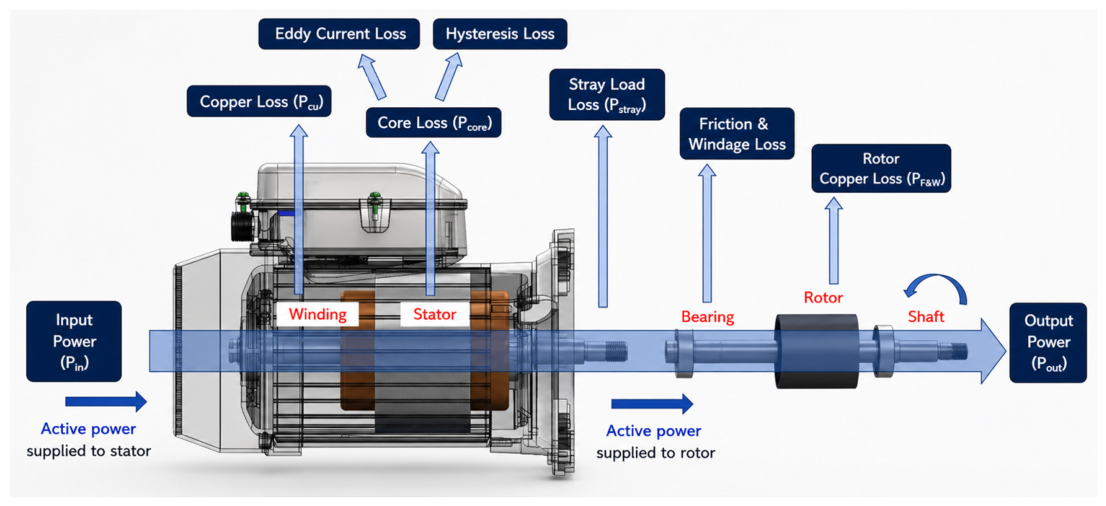
2.3. Loss Mechanisms and Efficiency Modeling in PSC Motors
2.4. Material and Structural Influences on Motor Efficiency
2.5. Research Gap and Motivation
3. Methodology
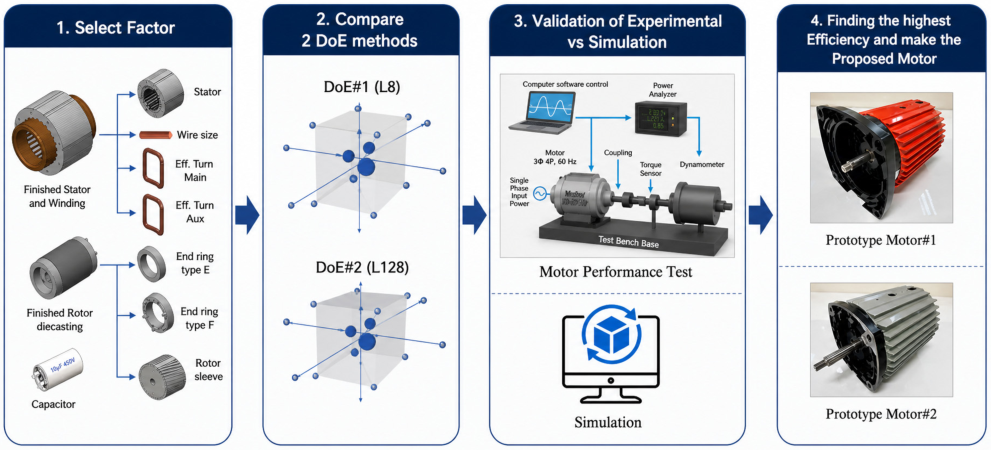
3.1. Development Framework
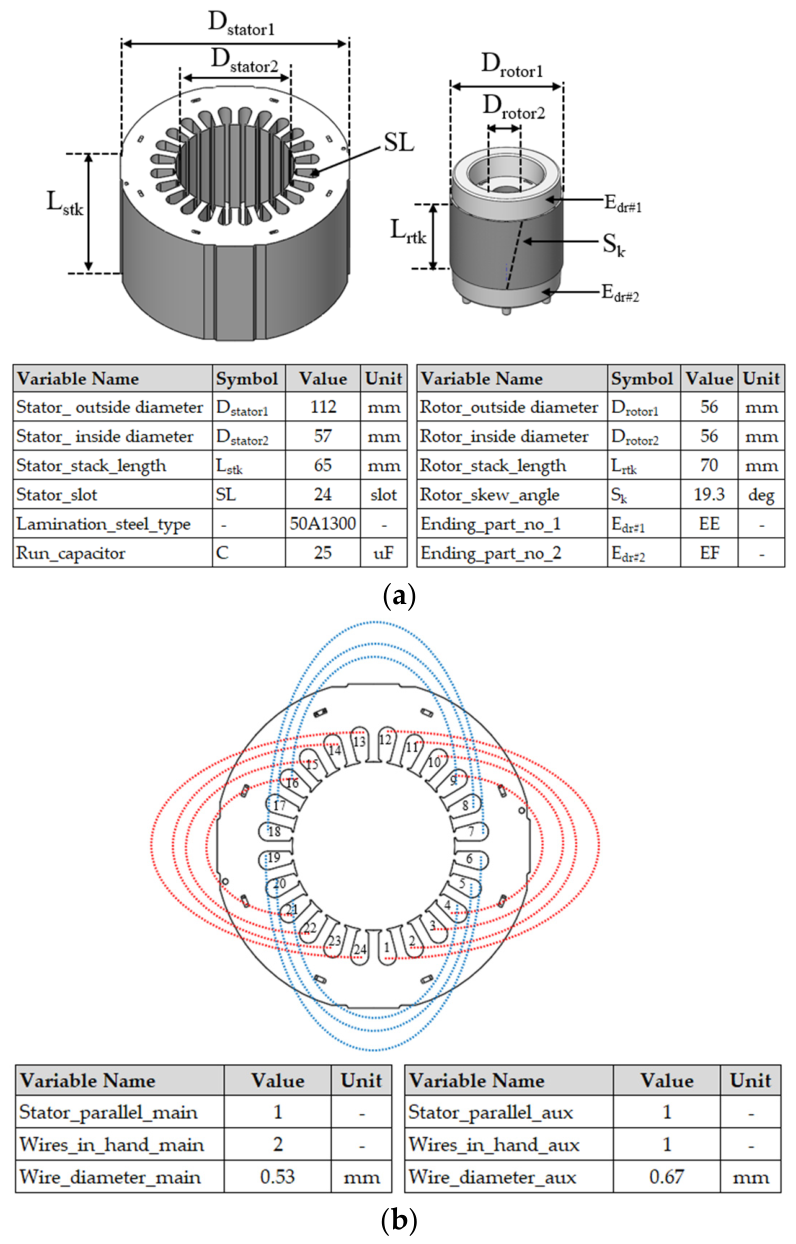
3.2. Design of Experiments (DOE) Setup and Parameter Definition
3.3. Statistical Analysis Using ANOVA
3.4. Simulation Methodology
3.5. Simulation Experimental Setup
3.6. Design Constraints and Practical Considerations
4. Results and Discussion
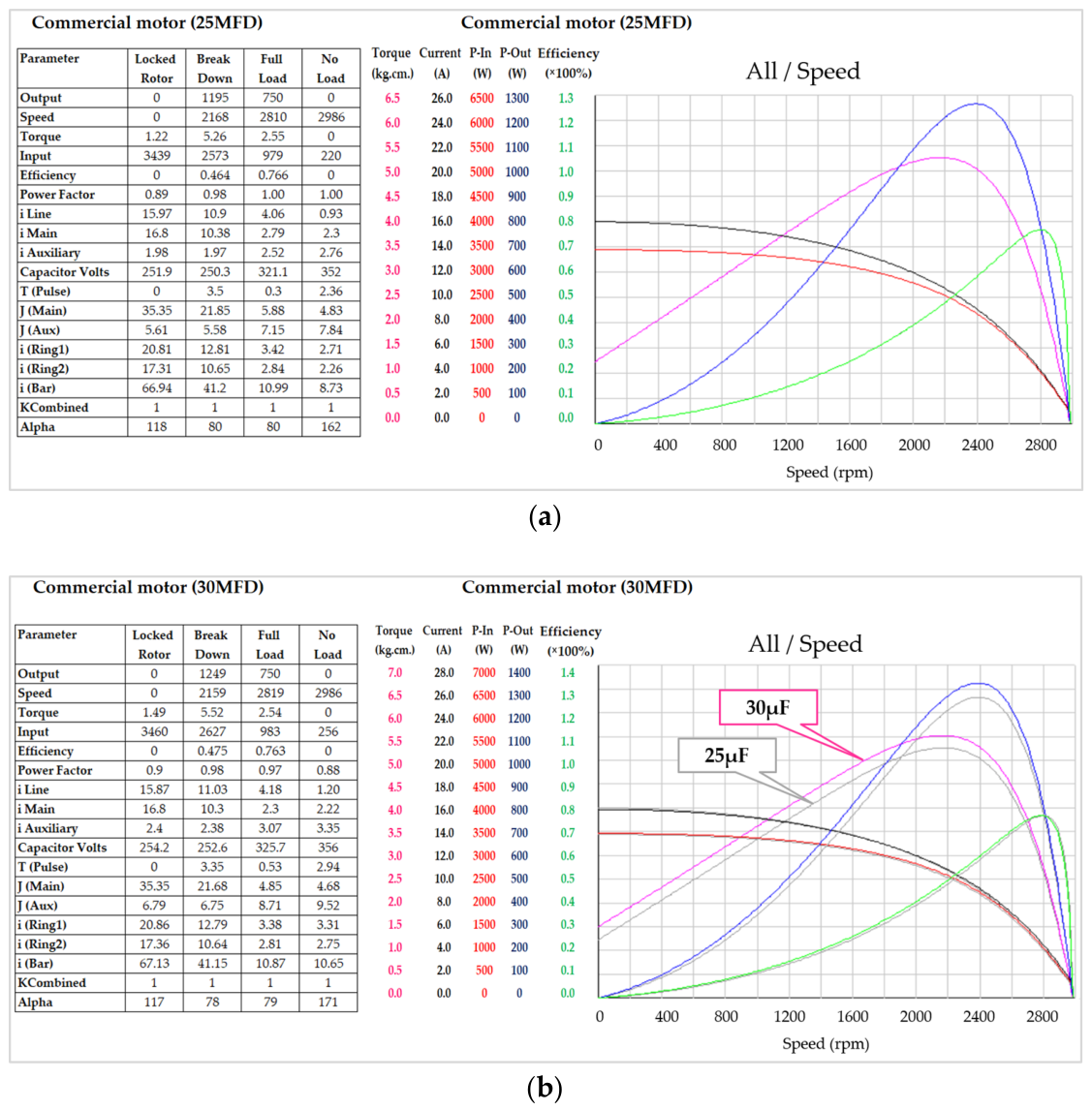
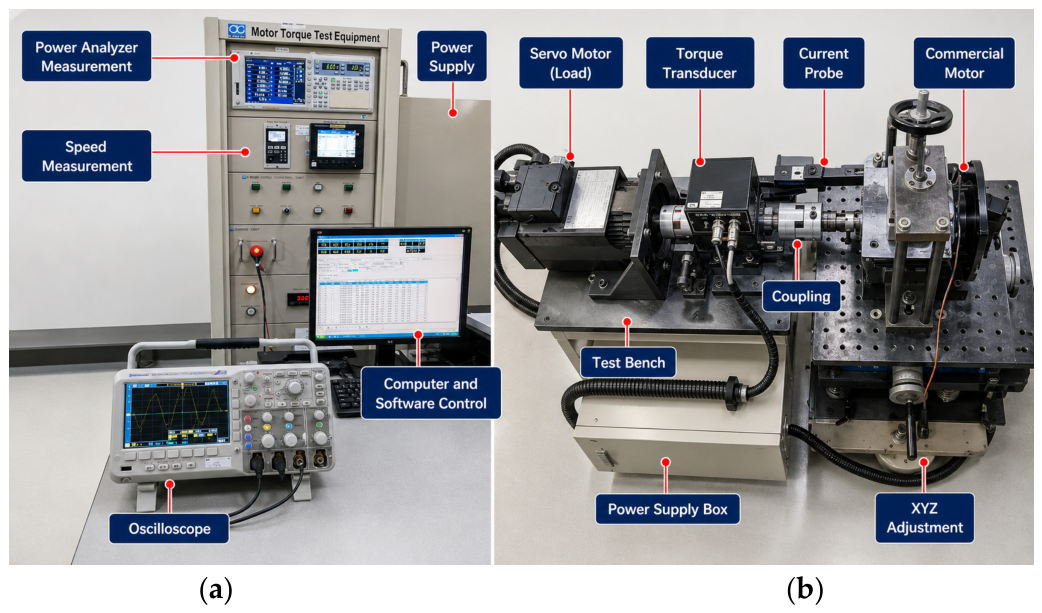
4.1. Validation of Baseline (Commercial) Motor Performance (Experimental vs. Simulation)
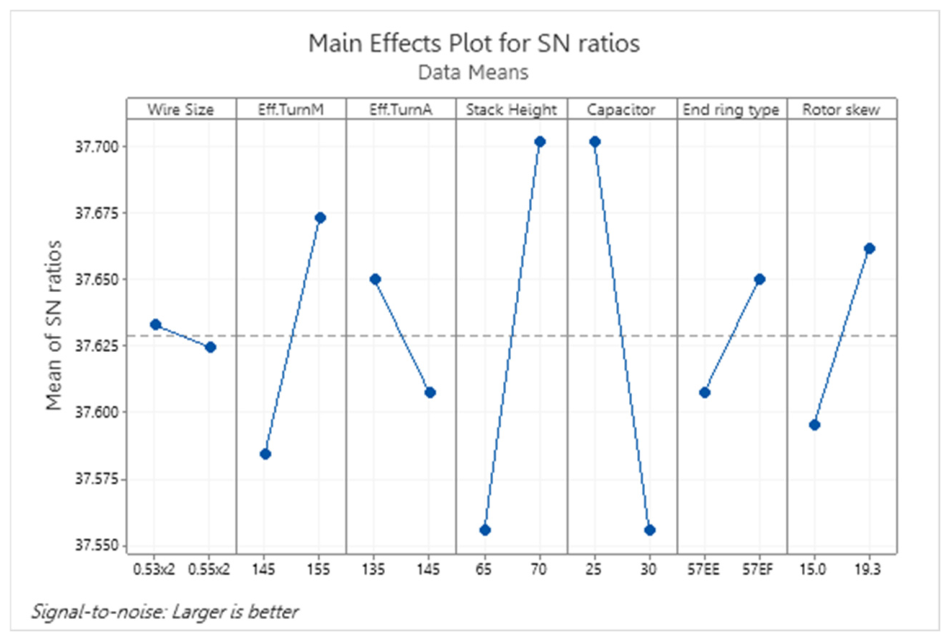
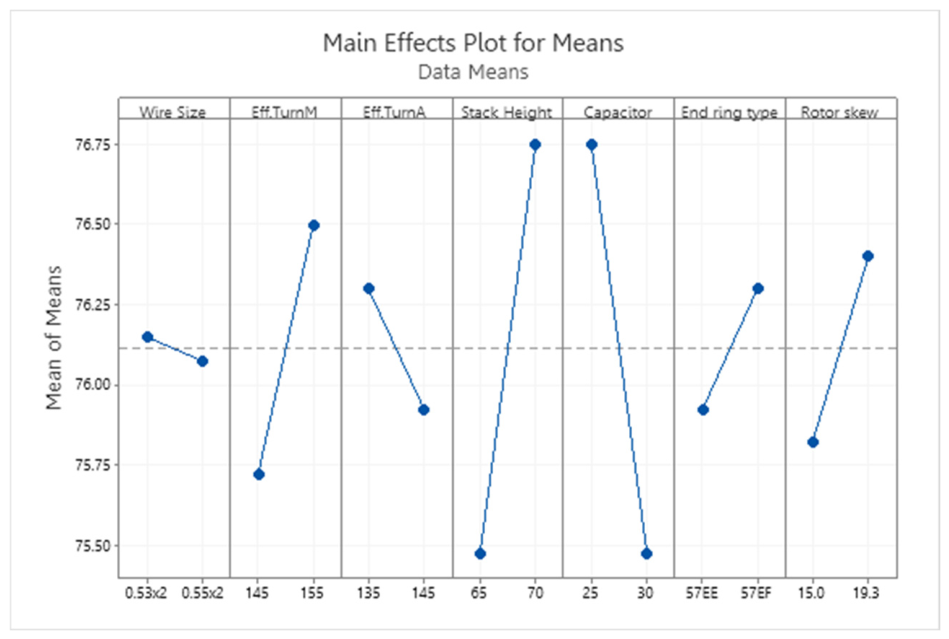
4.2. DOE Analysis for Prototype Motor #1
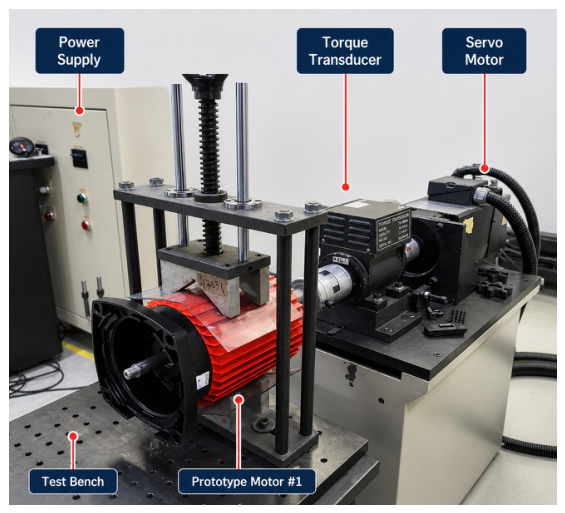
4.3. Design and Experimental Validation of Prototype Motor #1
4.4. DOE Analysis for Prototype Motor #2 (Material Optimization)
4.5. Performance Validation Under Multi-Load Conditions
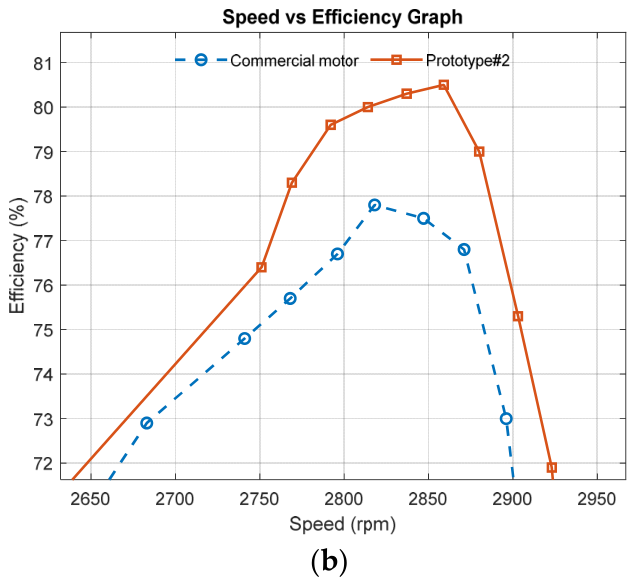
4.5.1. Speed vs. Efficiency Characteristics
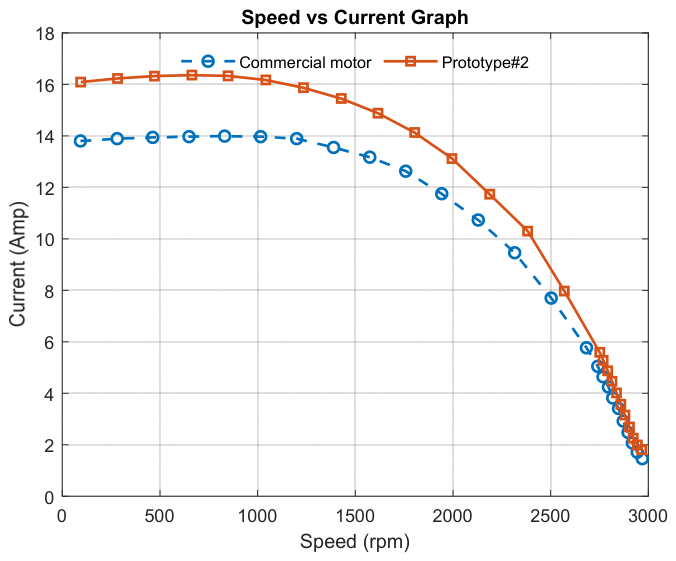
4.5.2. Speed vs. Current Characteristics
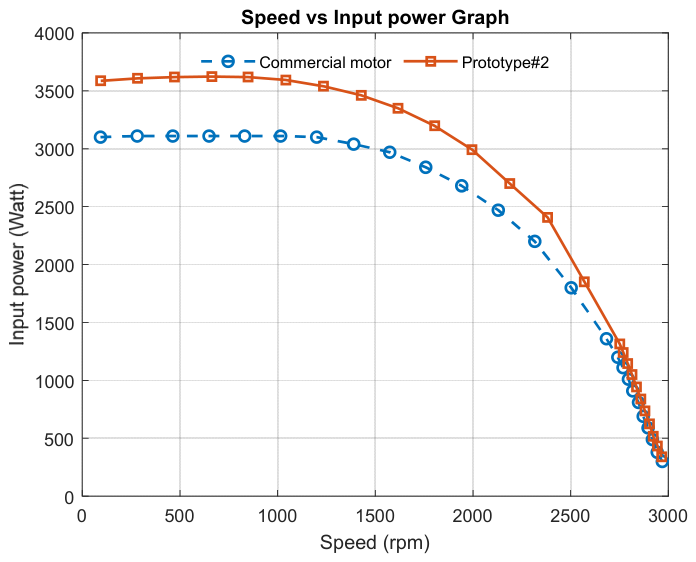
4.5.3. Speed vs. Input Power Characteristics
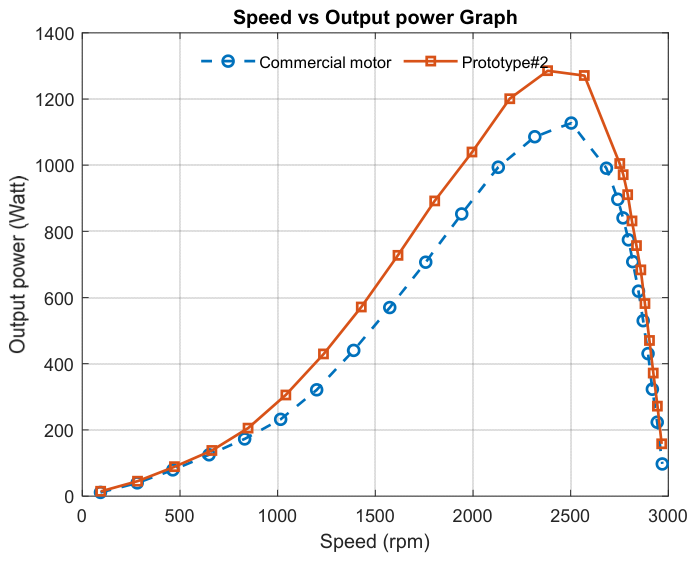
4.5.4. Speed vs. Output Power Characteristics
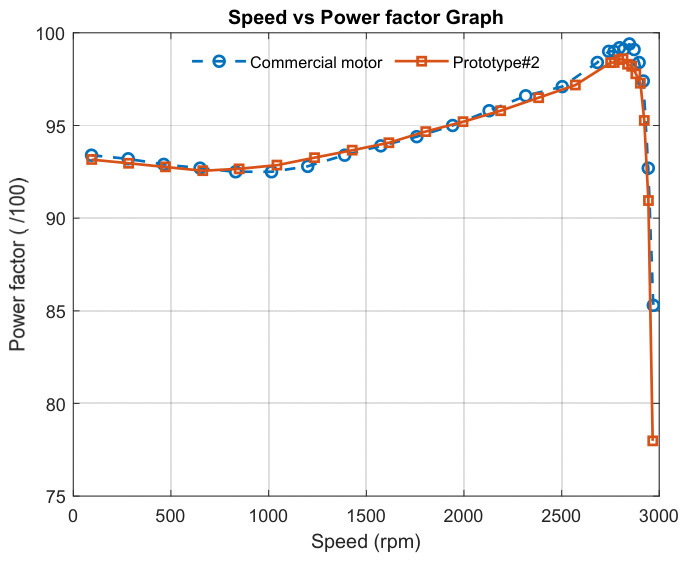
4.5.5. Speed vs. Power Factor Characteristics
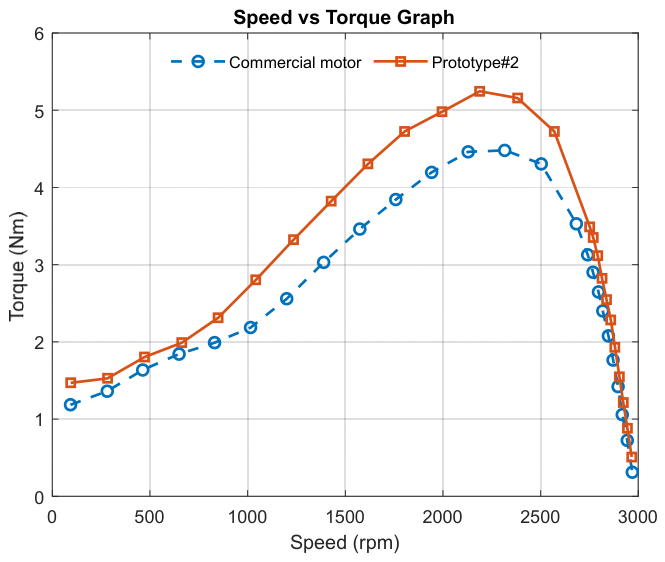
4.5.6. Speed vs. Torque Characteristics
4.5.7. Engineering Insight and Generalization
- Material optimization (silicon steel grade) primarily reduces core losses
- Geometric optimization (stack height) enhances magnetic flux linkage
- Electrical optimization (capacitor value) improves torque and phase balance
4.6. Response Surface Modeling for Predictive Efficiency Analysis
4.6.1. Model Formulation
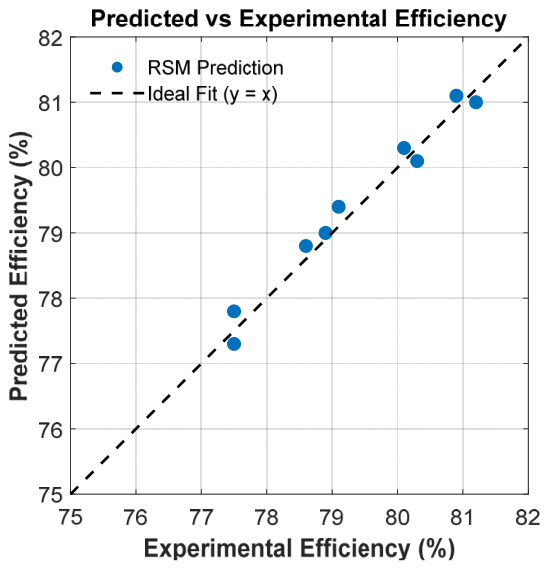
4.6.2. Model Fitting and Validation
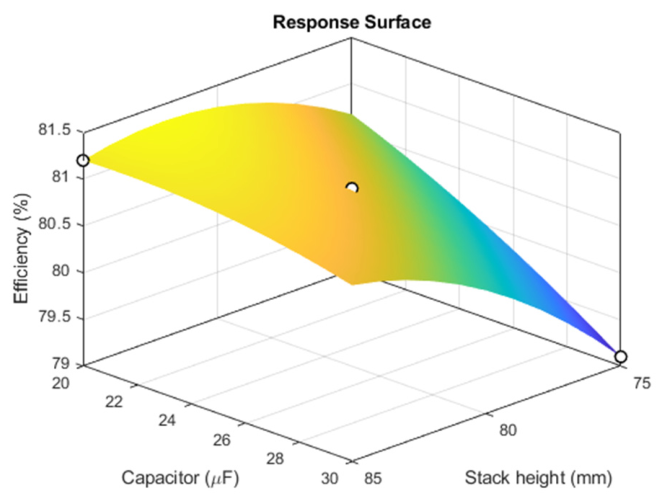
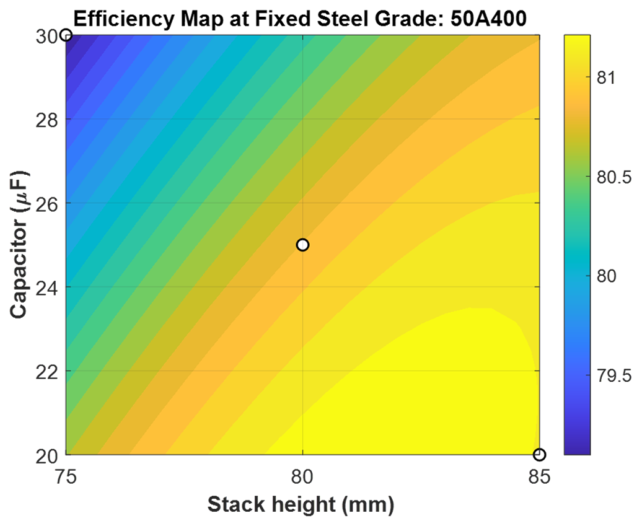
4.6.3. Response Surface Interpretation
4.6.4. Engineering Implication
4.7. Limitations
5. Conclusions
Author Contributions
Funding
Data Availability Statement
Acknowledgments
Conflicts of Interest
References
- IEC 60034-30-1; Rotating Electrical Machines-Part 30-1: Efficiency Classes of Line Operated AC Motors (IE Code). IEC: Geneva, Switzerland, 2014.
- Deveci, U.M.; Ayçiçek, E. Cost-effective IE2 high-efficiency single-phase induction motor design and prototyping. Eng. Sci. Technol. Int. J. 2025, 61, 101921. [Google Scholar] [CrossRef]
- Asizehi, Y.E.; Omokhafe, T.J.; Ambafi, J.G.; Agbachi, E.O. Permanent split capacitor (PSC) alternating current induction motor. Leonardo Electron. J. Pract. Technol. 2015, 26, 163–176. [Google Scholar]
- Yin, P.; Pate, M.B. An energy and life-cycle cost comparison of residential PSC and ECM blower systems operating at excess pressures due to restrictive ducts. J. Build. Eng. 2019, 22, 305–313. [Google Scholar] [CrossRef]
- Younas, M.B.; Khalid, H.A.; Javed, A.; Arkan, M. Performance enhancement of single-phase induction motor using GA-based multi-objective optimization. Int. J. Electron. 2021, 109, 1–14. [Google Scholar] [CrossRef]
- Antheesh, R.; Bhat, S.; Ballal, R. Performance investigation of single-phase capacitor start–capacitor run induction motor drive. IOP Conf. Ser. Mater. Sci. Eng. 2021, 1065, 012043. [Google Scholar] [CrossRef]
- Sarac, V.; Atanasova-Pacemska, T. Multiparameter analysis for efficiency improvement of single-phase capacitor motor. Math. Probl. Eng. 2019, 2019, 5131696. [Google Scholar] [CrossRef]
- Isaka, S.; Yoshida, T. Improving the starting characteristics of single-phase induction motors with an auxiliary-winding current control. IEEJ J. Ind. Appl. 2020, 9, 11–16. [Google Scholar] [CrossRef]
- Costa, U.P.; Pelizari, A.; Costa, E.C.M.; Bruzinga, G.R. Comparative analysis in single-phase induction motors: Analytical, numerical, and load tests. IEEE Access 2025, 13, 3622064. [Google Scholar] [CrossRef]
- Hsiao, C.-Y.; Htet, S.M. Multi-Step Design Optimization for the Improvement of an Outer-Rotor Brushless Direct Current Motor. Appl. Sci. 2024, 14, 4302. [Google Scholar] [CrossRef]
- Sorgdrager, A.; Wang, R.-J.; Grobler, A. Taguchi method in electrical machine design. SAIEE Afr. Res. J. 2017, 108, 150–164. [Google Scholar] [CrossRef]
- Ma, D.; Sun, C.; Li, Y.; Tian, B.; Wang, L.; Pei, R. Study of magnetic properties of electrical steels with difference Si considering the effect of temperature. AIP Adv. 2023, 13, 025044. [Google Scholar] [CrossRef]
- Karami, R.; Butler, D.; Tamimi, S. Manufacturing of non-grain-oriented electrical steels: Review. Int. J. Adv. Manuf. Technol. 2024, 133, 1083–1109. [Google Scholar] [CrossRef]
- Arinze, I.I.; Simeon, C. Energy efficiency improvement of industrial induction motor systems through integrated electrical and mechanical loss optimization. World J. Adv. Eng. Technol. Sci. 2026, 18, 566–574. [Google Scholar] [CrossRef]
- Seo, U.-J.; Kim, D.-J.; Chun, Y.-D.; Han, P.-W. Mechanical cutting effect of electrical steel on the performance of induction motors. Energies 2020, 13, 6314. [Google Scholar] [CrossRef]
- Mahmouditabar, F.; Baker, N. A Review on the Effect of Electrical Steel Manufacturing Processes on the Performance of Electric Machines. Energies 2023, 16, 7954. [Google Scholar] [CrossRef]
- Sharma, U.; Singh, B. Design and Development of Energy Efficient Single Phase Induction Motor For Ceiling Fan Using Taguchi’s Orthogonal Arrays. IEEE Trans. Ind. Appl. 2021, 57, 3562–3572. [Google Scholar] [CrossRef]
- Gope, D.; Goel, S.K. Design optimization of permanent magnet synchronous motor using Taguchi method and experimental validation. Int. J. Emerg. Electr. Power Syst. 2021, 22, 9–20. [Google Scholar] [CrossRef]
- Hüner, E. Optimization of axial flux permanent magnet generator by Taguchi experimental method. Bull. Pol. Acad. Sci. Tech. Sci. 2020, 68, 3. [Google Scholar] [CrossRef]
- Balci, S.; Akkaya, M. Reduction of the core size and power losses by using soft magnetic material for a single-phase induction motor. Measurement 2022, 198, 111421. [Google Scholar] [CrossRef]
- Kabir, M.A.; Jaffar, M.Z.M.; Wan, Z.; Husain, I. Design, Optimization, and Experimental Evaluation of Multilayer AC Winding for Induction Machine. IEEE Trans. Ind. Appl. 2019, 55, 3630–3639. [Google Scholar] [CrossRef]
- Chasiotis, I.D.; Karnavas, Y.L.; Scuiller, F. Effect of Rotor Bars Shape on the Single-Phase Induction Motors Performance: An Analysis toward Their Efficiency Improvement. Energies 2022, 15, 717. [Google Scholar] [CrossRef]
- Liu, C.-T.; Chen, H.-Z.; Wu, P.-Y.; Chao, P.-Y. Winding Magnetization Design of Single-Phase Capacitor-Run Induction Motor for Submersible Pump Application. IEEE Trans. Magn. 2023, 59, 8203405. [Google Scholar] [CrossRef]
- Juhaniya, A.I.S.; Ibrahim, A.A.; Zainuri, M.A.A.M.; Zulkifley, M.A. An Analytical Model of Induction Motors for Rotor Slot Parametric Design Performance Evaluation. Int. J. Adv. Comput. Sci. Appl. 2022, 13, 12. [Google Scholar] [CrossRef]
- Hirose, K.; Asano, F.; Yasui, I.; Baba, M.; Yamada, N.; Yamazaki, W.; Chikahisa, K.; Kumagai, K.; Arakawa, H. Experiment and numerical investigation of windage loss of an electric motor with narrow gap. Prog. Eng. Sci. 2026, 3, 100248. [Google Scholar] [CrossRef]
- Xu, Z.; Xu, Y.; Yang, S.; Wang, Y.; Wang, Y. A novel electromagnetic-thermal-fluid bidirectional coupled model considering multiple factors for temperature rise and loss calculation of high current density motor. Int. J. Therm. Sci. 2026, 220, 110330. [Google Scholar] [CrossRef]
- Fuchs, E.F.; Masoum, M.A.S. Modeling and analysis of induction machines. In Power Quality in Power Systems; Academic Press: Cambridge, MA, USA, 2023; pp. 197–297. [Google Scholar] [CrossRef]
- Xu, H.; Zhao, J.; Xiong, Y.; Duan, Y. Analysis and calculation of the winding loss and rotor loss of solid rotor induction motors for flywheel energy storage system considering the influence of inverter power supply. J. Energy Storage 2025, 128, 117224. [Google Scholar] [CrossRef]
- Bhowmick, D.; Chowdhury, S.K. Estimation of induction motor equivalent circuit parameters and losses from transient measurement. ISA Trans. 2025, 157, 573–590. [Google Scholar] [CrossRef] [PubMed]
- Tameemi, A.; Degano, M.; Di Nardo, M.; Gerada, C. Power loss and performance analysis of a permanent magnet synchronous for actuator applications. In Proceedings of the 2022 International Conference on Electrical Machines, Valencia, Spain, 5–8 September 2022. [Google Scholar] [CrossRef]
- Gundabattini, E.; Kuppan, R.; Solomon, D.G.; Kalam, A.; Kothari, D.P.; Bakar, R.A. A review on methods of finding losses and cooling methods to increase efficiency of electric machines. Ain Shams Eng. J. 2021, 12, 497–505. [Google Scholar] [CrossRef]
- Tabora, J.M.; Tostes, M.E.L.; Matos, E.O.; Soares, T.M.; Bezerra, U.H. Voltage Harmonic Impacts on Electric Motors: A Comparison between IE2, IE3 and IE4 Induction Motor Classes. Energies 2020, 13, 3333. [Google Scholar] [CrossRef]
- Goman, V.V.; Prakht, V.; Kazakbaev, V.; Dmitrievskii, V. Comparative Study of Induction Motors of IE2, IE3 and IE4 Efficiency Classes in Pump Applications Taking into Account CO2 Emission Intensity. Appl. Sci. 2020, 10, 8536. [Google Scholar] [CrossRef]
- Rajendran, G.; Raute, R.; Caruana, C.; Andriukaitis, D. Bridging Innovation and Sustainability: The Strategic Role of High-Efficiency Motors in Advancing Industry 5.0. Energies 2026, 19, 1003. [Google Scholar] [CrossRef]
- Aldaikh, S.O.; Rawashdeh, M.O.; Hussianat, L.H.; Shchur, T. Study of starting modes of single-phase induction motors when changing the parameters of the stator windings. Inform. Autom. Pomiary Gospod. Ochr. Sr. 2024, 14, 34–41. [Google Scholar] [CrossRef]
- Ajamloo, A.M.; Ghaheri, A.; Afjei, E. Multi-objective Optimization of an Outer Rotor BLDC Motor Based on Taguchi Method for Propulsion Applications. In Proceedings of the 2019 10th International Power Electronics, Drive Systems and Technologies, Shiraz, Iran, 12–14 February 2019; pp. 34–39. [Google Scholar] [CrossRef]
- Xie, K.; Zheng, K.; Wang, T.; Li, S.; Liu, J. Efficiency optimization of hybrid stator motor based on silicon steel and amorphous materials. J. Phys. Conf. Series. 2025, 3043, 012115. [Google Scholar] [CrossRef]
- Zanini, F.; Pellizzari, M.; Molinari, A.; Gelfi, M. Laser powder bed fusion process optimization for the production of high-performance and efficient high-silicon steel electrical motor components. Prog. Addit. Manuf. 2025, 10, 6581–6592. [Google Scholar] [CrossRef]
- Sarac, V.; Minovski, D.; Janiga, P.; Aneva, S. Towards Energy Efficiency at Induction Motors-Technical and Economic Aspects. TEM J. 2025, 14, 1917–1927. [Google Scholar] [CrossRef]
- Konuhova, M. Modeling of Induction Motor Direct Starting with and without Considering Current Displacement in Slot. Appl. Sci. 2024, 14, 9230. [Google Scholar] [CrossRef]
- Kechida, R.; Gacem, A.; Romdhane, M.; Naoui, M.; Almalaq, Y.; Alturki, M.; Albaker, A.; Guesmi, T. High-efficiency predictive torque control of induction motors in PV water pumping using GTO-optimized PI controller. Sci. Rep. 2026, 16, 13428. [Google Scholar] [CrossRef]


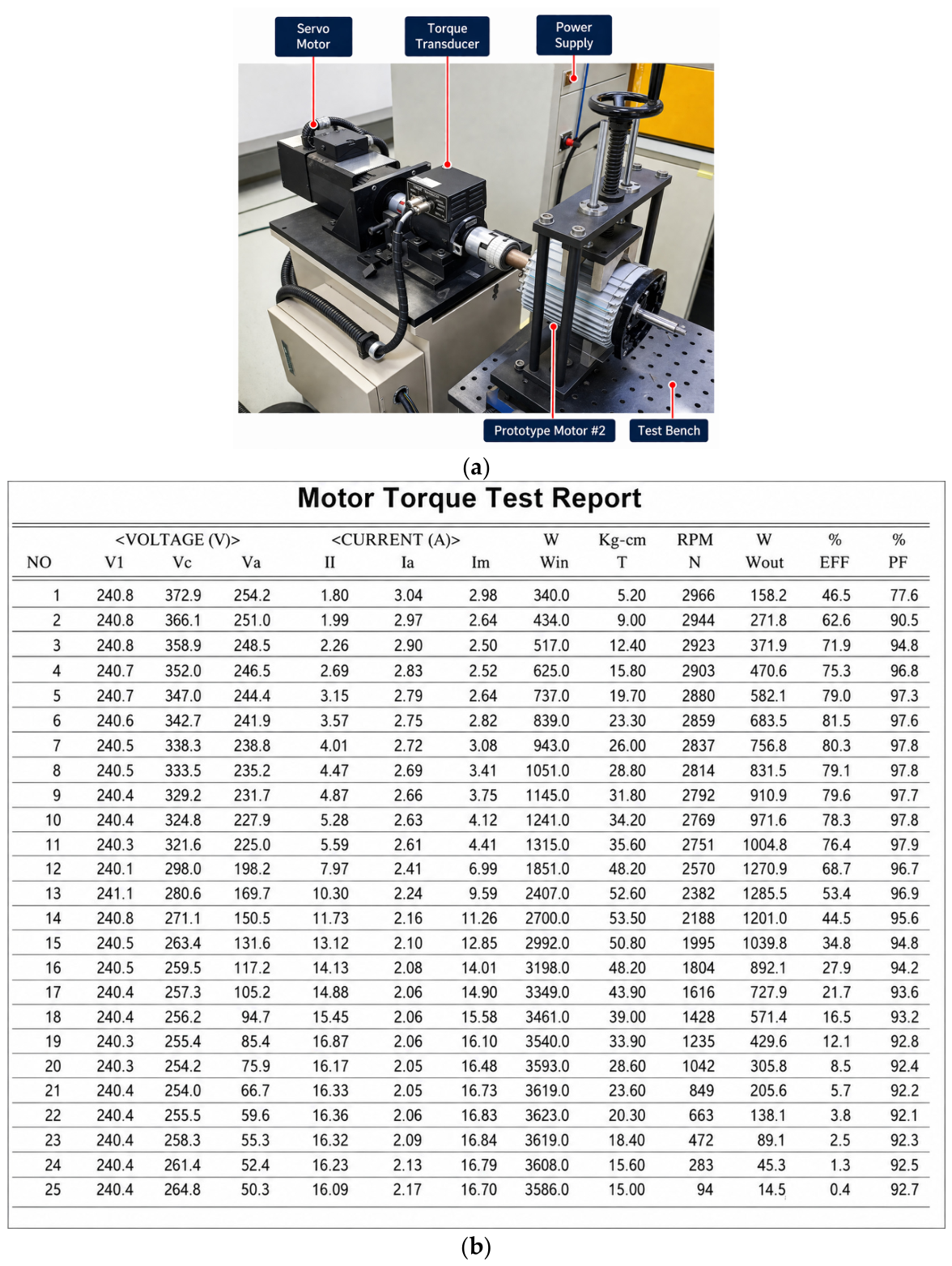





| Performance Required | Commercial Motor | Proposed Motor | Design Change/Reason |
|---|---|---|---|
| Power Output (W) | 750 | 750 | -- |
| Voltage (V) | 240 | 240 | -- |
| Frequency (Hz) | 50 | 50 | -- |
| Pole (p) | 2 | 2 | -- |
| Full load Speed (rpm) | 2800 | 2820 | Improve flow rate |
| Efficiency at full load (%) | 76.1 | 80.4 | DOE optimization |
| Full load Current (A) | 4.17 | 4.10 | Reduced copper loss |
| Power Input (W) | 985 | 933 | Improved efficiency |
| Parameter | Commercial Motor | Proposed Motor | Impact |
| Copper loss | High | Reduced | Larger wire/ optimized turns |
| Core loss | High | Reduced | 50A400 material |
| Total loss | High | Lower | Combined effect |
| DOE Parameter | Affected Loss Component | Physical Mechanism | Impact on Efficiency |
|---|---|---|---|
| Wire size | Copper loss () | Resistance reduction () reduces I2R loss | Larger wire → lower → higher efficiency |
| Main/Aux turns | Copper + Stray loss | Affects current distribution and MMF balance | Improves flux balance, reduces harmonic loss |
| Stack height | Core loss () + Copper loss | Changes magnetic flux path and loading | Optimal height reduces flux density and loss |
| Capacitor value | Copper + Stray loss | Controls phase shift between windings | Better phase angle → lower current → lower loss |
| Silicon steel grade | Core loss () | Material-dependent hysteresis and eddy current loss | Higher grade (e.g., 50A400) → lower core loss |
| Rotor skew | Stray load loss () | Reduces harmonic flux and torque ripple | Lower stray loss → smoother operation |
| Parameter | Descriptions |
|---|---|
| Wire size (mm) | Diameter of the copper conductor used in the stator winding |
| Eff. Turn Main (Turns) | Number of turns in the main winding |
| Eff. Turn Aux (Turns) | Number of turns in the auxiliary winding |
| Stack height (mm) | Axial length of the stator core |
| Capacitor (µf) | Capacitance value of the run capacitor |
| End-ring type | Structural configuration of the rotor end-ring |
| Rotor skew | Skew angle of rotor slots |
| Parameter | Lower Limit | Upper Limit |
|---|---|---|
| A. Wire size (mm) | 0.53 × 2 | 0.55 × 2 |
| B. Eff. Turn Main (Turns) | 145 | 155 |
| C. Eff. Turn Aux (Turns) | 135 | 145 |
| D. Stack height (mm) | 65 | 70 |
| E. Capacitor (µf) | 25 | 30 |
| F. End-ring type | EE | EF |
| G. Rotor skew | 15 | 19.3 |
| Constraint | Consideration in This Study |
|---|---|
| Efficiency | Maximized using DOE-based optimization |
| Power Factor | Maintained within acceptable range |
| Current | Limited to avoid excessive increase |
| Temperature rise | Indirectly controlled via current |
| Torque behavior | Ensured through design selection |
| Manufacturing cost | Considered in material selection |
| Performance Parameter | Simulation | Actual | Error (%) |
|---|---|---|---|
| Power Output (W) | 750 | 750 | 0% |
| Voltage (V) | 240 | 240 | 0% |
| Frequency (Hz) | 50 | 50 | 0% |
| At Capacitor 25 µF | |||
| Full load Speed (rpm) | 2810 | 2800 | 2.6% |
| Efficiency at full load (%) | 76.6 | 76.1 | 0.7% |
| Full load Current (A) | 4.06 | 4.17 | 2.6% |
| Power Input (W) | 978 | 985 | 0.7% |
| At Capacitor 30 µF | |||
| Full load Speed (rpm) | 2819 | 2810 | 0.3% |
| Efficiency at full load (%) | 76.3 | 75.4 | 1.2% |
| Full load Current (A) | 4.18 | 4.21 | 0.7% |
| Power Input (W) | 983 | 994 | 1.1% |
| Run | Current | Runs. | Current | Runs. |
|---|---|---|---|---|
| 1 | 4.32 | 982 | 2811 | 76.4 |
| 2 | 4.06 | 981 | 2806 | 76.4 |
| 3 | 4.17 | 1003 | 2842 | 74.8 |
| 4 | 4.05 | 977 | 2825 | 76.7 |
| 5 | 4.06 | 970 | 2799 | 77.3 |
| 6 | 4.22 | 987 | 2817 | 75.9 |
| 7 | 4.08 | 979 | 2826 | 76.6 |
| 8 | 4.15 | 1002 | 2840 | 74.8 |
| Run | Current | Runs. | Current | Runs. |
|---|---|---|---|---|
| 1 | 4.32 | 982 | 2811 | 76.4 |
| 2 | 4.32 | 981 | 2812 | 76.4 |
| 3 | 4.32 | 982 | 2809 | 76.3 |
| 4 | 4.32 | 982 | 2809 | 76.3 |
| 5 | 4.09 | 970 | 2803 | 77.3 |
| 6 | 4.09 | 968 | 2804 | 77.3 |
| … | … | … | … | … |
| … | … | … | … | … |
| 124 | 4.15 | 1003 | 2837 | 74.8 |
| 125 | 4.15 | 1002 | 2831 | 74.9 |
| 126 | 4.15 | 1001 | 2832 | 74.9 |
| 127 | 4.15 | 1002 | 2828 | 74.8 |
| 128 | 4.16 | 1002 | 2830 | 74.8 |
| Factor | DOF | SS | MS | F-Ratio | Contribution (%) |
|---|---|---|---|---|---|
| Eff.TurnM | 1 | 1.20125 | 1.20125 | 47.25 | 21.27 |
| Capacitor | 1 | 0.81000 | 0.81000 | 31.86 | 14.34 |
| Stack Height | 1 | 0.49000 | 0.49000 | 19.27 | 8.67 |
| Error (pooled) | 3 | 0.07625 | 0.02542 | - | - |
| Total | 7 | 5.64875 | - | - | 100 |
| Design Parameter | Value | Unit | Impact on Performance |
|---|---|---|---|
| A. Wire size | 0.55 × 2 | mm | Reduces copper loss by lowering winding resistance |
| B. Eff. Turn Main | 155 | Turns | Improves magnetic field strength and torque capability |
| C. Eff. Turn Aux | 135 | Turns | Enhances phase balance and reduces harmonic loss |
| D. Stack height | 70 | mm | Improves magnetic flux distribution and reduces core saturation |
| E. Capacitor | 25 | µf | Optimizes phase angle, reducing current and improving efficiency |
| F. End-ring type | EF | -- | Reduces rotor resistance variation and improves electromagnetic stability |
| G. Rotor skew | 19.3 | degree | Minimizes torque ripple and reduces stray load loss |
| Performance Parameter | Simulation | Actual Test | Error (%) |
|---|---|---|---|
| Power Output (W) | 750 | 750 | - |
| Voltage (V) | 240 | 240 | - |
| Frequency (Hz) | 50 | 50 | - |
| Capacitor (µF) | 25 | 25 | - |
| Full load Speed (rpm) | 2799 | 2800 | 0.03% |
| Full load Efficiency (%) | 77.3 | 76.8 | 0.65% |
| Full load Current (A) | 4.06 | 4.12 | 1.45% |
| Power Input (W) | 970 | 971 | 0.10% |
| Silicon Steel Grade | 50A1300 | 50A600 | 50A400 |
|---|---|---|---|
| Loss: W15/50 (W/kg) | 13.0 | 6.0 | 4.0 |
| Magnetic induction: B50 (T) | 1.74 | 1.67 | 1.64 |
| Thickness (mm) | 0.50 | 0.50 | 0.50 |
| Expected core loss impact | High core loss | Moderate core loss | Low core loss |
| Efficiency implication | Lower efficiency | Moderate efficiency | Higher efficiency |
| Item | Unit | Level 1 | Level 2 | Level 3 | Physical Relevance |
|---|---|---|---|---|---|
| Stack height | mm | 75 | 80 | 85 | Affects magnetic flux path and core loss |
| Capacitor | µf | 20 | 25 | 30 | Controls phase angle and current balance |
| Silicon steel grade | - | 50A1300 | 50A600 | 50A400 | Determines core loss (hysteresis and eddy current) |
| Item | L9 (3 × 3) Orthogonal Array | Current (A) | Pinput (W) | Speed (rpm) | Efficiency (%) | ||
|---|---|---|---|---|---|---|---|
| A | B | C | |||||
| 1 | 1 | 1 | 1 | 4.05 | 968 | 2845 | 77.5 |
| 2 | 1 | 2 | 2 | 4.00 | 951 | 2849 | 78.9 |
| 3 | 1 | 3 | 3 | 3.94 | 948 | 2854 | 79.1 |
| 4 | 2 | 1 | 2 | 3.92 | 934 | 2836 | 80.3 |
| 5 | 2 | 2 | 3 | 3.85 | 928 | 2843 | 80.9 |
| 6 | 2 | 3 | 1 | 4.16 | 968 | 2849 | 77.5 |
| 7 | 3 | 1 | 3 | 3.84 | 924 | 2828 | 81.2 |
| 8 | 3 | 2 | 1 | 4.01 | 954 | 2836 | 78.6 |
| 9 | 3 | 3 | 2 | 4.04 | 936 | 2840 | 80.1 |
| Level | Stack Height | Capacitor | Silicon Steel Grade |
|---|---|---|---|
| 1 | 78.50 | 79.67 | 77.87 |
| 2 | 79.57 | 79.47 | 79.77 |
| 3 | 79.97 | 78.90 | 80.40 |
| Delta | 1.47 | 0.77 | 2.53 |
| Rank | 2 | 3 | 1 |
| Stack Height | Capacitor | Silicon Steel Grade |
|---|---|---|
| 85 | 25 | 50A400 |
| Factor | DOF | SS | MS | F-Ratio | p-Value | Contribution (%) |
|---|---|---|---|---|---|---|
| Silicon steel grade | 2 | 10.4289 | 5.2144 | 76.93 | 0.013 | 69.7 |
| Stack height | 2 | 3.4489 | 1.7244 | 25.44 | 0.038 | 23.0 |
| Capacitor | 2 | 0.9489 | 0.4744 | 7.00 | 0.125 | 6.3 |
| Error | 2 | 0.1356 | 0.0678 | - | - | - |
| Total | 8 | 14.9622 | - | - | - | 100 |
| Parameter | Simulation | Actual Test | Error (%) |
|---|---|---|---|
| Power Output (W) | 750 | 750 | - |
| Voltage (V) | 240 | 240 | - |
| Frequency (Hz) | 50 | 50 | - |
| Capacitor (µF) | 25 | 25 | - |
| Full load Speed (rpm) | 2828 | 2839 | 0.39% |
| Full load Efficiency (%) | 81.2 | 80.4 | 1.00% |
| Full load Current (A) | 3.84 | 3.97 | 3.27% |
| Power Input (W) | 924 | 933 | 0.96% |
| Run | Stack Height (mm) | Capacitor (µF) | Silicon Steel Grade | Experimental Efficiency (%) | Predicted Efficiency (%) | Error (%) |
|---|---|---|---|---|---|---|
| 1 | 75 | 20 | 50A1300 | 77.5 | 77.3 | −0.2 |
| 2 | 75 | 25 | 50A600 | 78.9 | 79.0 | +0.1 |
| 3 | 75 | 30 | 50A400 | 79.1 | 79.4 | +0.3 |
| 4 | 80 | 20 | 50A600 | 80.3 | 80.1 | −0.2 |
| 5 | 80 | 25 | 50A400 | 80.9 | 81.1 | +0.2 |
| 6 | 80 | 30 | 50A1300 | 77.5 | 77.8 | +0.3 |
| 7 | 85 | 20 | 50A400 | 81.2 | 81.0 | −0.2 |
| 8 | 85 | 25 | 50A1300 | 78.6 | 78.8 | +0.2 |
| 9 | 85 | 30 | 50A600 | 80.1 | 80.3 | +0.2 |
Disclaimer/Publisher’s Note: The statements, opinions and data contained in all publications are solely those of the individual author(s) and contributor(s) and not of MDPI and/or the editor(s). MDPI and/or the editor(s) disclaim responsibility for any injury to people or property resulting from any ideas, methods, instructions or products referred to in the content. |
© 2026 by the authors. Licensee MDPI, Basel, Switzerland. This article is an open access article distributed under the terms and conditions of the Creative Commons Attribution (CC BY) license.
Share and Cite
Wijittemee, W.; Ratchapan, R.; Chupong, C.; Biansoongnern, S.; Dangeam, S.; Muankhaw, T.; Plangklang, B. Optimization and Material Enhancement Framework for Improving PSC Motor Efficiency Toward IE2/IE3 Standards. Designs 2026, 10, 64. https://doi.org/10.3390/designs10030064
Wijittemee W, Ratchapan R, Chupong C, Biansoongnern S, Dangeam S, Muankhaw T, Plangklang B. Optimization and Material Enhancement Framework for Improving PSC Motor Efficiency Toward IE2/IE3 Standards. Designs. 2026; 10(3):64. https://doi.org/10.3390/designs10030064
Chicago/Turabian StyleWijittemee, Wanwinit, Ritthichai Ratchapan, Charnon Chupong, Somchai Biansoongnern, Sirichai Dangeam, Theerapol Muankhaw, and Boonyang Plangklang. 2026. "Optimization and Material Enhancement Framework for Improving PSC Motor Efficiency Toward IE2/IE3 Standards" Designs 10, no. 3: 64. https://doi.org/10.3390/designs10030064
APA StyleWijittemee, W., Ratchapan, R., Chupong, C., Biansoongnern, S., Dangeam, S., Muankhaw, T., & Plangklang, B. (2026). Optimization and Material Enhancement Framework for Improving PSC Motor Efficiency Toward IE2/IE3 Standards. Designs, 10(3), 64. https://doi.org/10.3390/designs10030064