1. Introduction
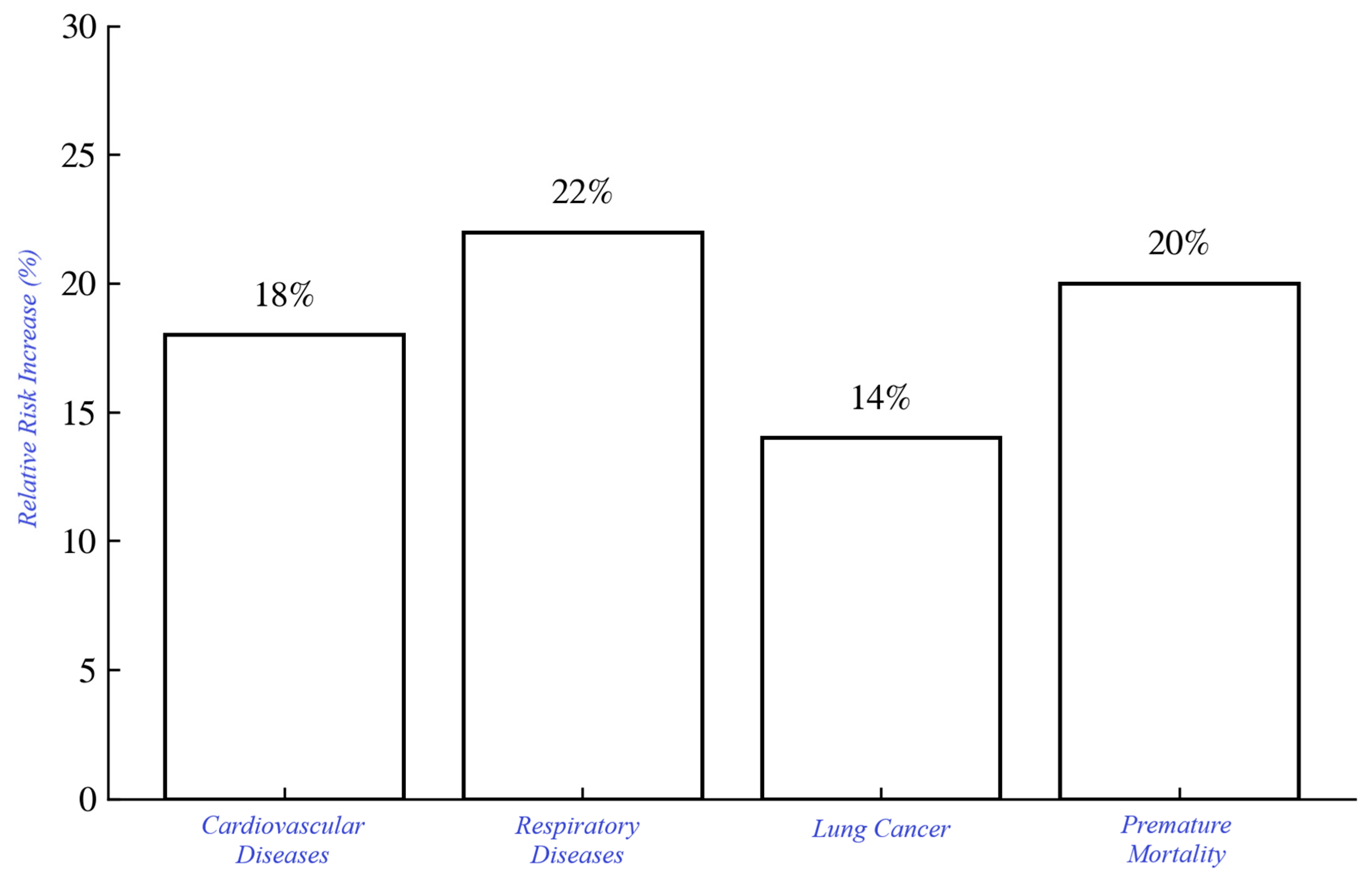
Atmospheric air pollution remains one of the most pressing global environmental and public health problems. According to the World Health Organization (WHO), in 2021 approximately 4.7 million premature deaths worldwide were associated with exposure to air pollution, with fine particulate matter (PM2.5) identified as a major risk factor (
Figure 1) [
1]. Due to their small size, PM2.5 particles penetrate deep into the respiratory system and significantly increase the risk of cardiovascular and pulmonary diseases [
1].
As shown in
Figure 1, long-term exposure to PM2.5 is associated with a measurable increase in cardiovascular (≈18%) and respiratory diseases (≈22%), as well as elevated risks of lung cancer (≈14%) and premature mortality (≈20%). These quantitative indicators confirm the critical role of industrial emission control systems in reducing public health risks [
1,
2,
3].
Air quality is also a serious concern in Kazakhstan. According to international monitoring data, the average annual concentration of PM2.5 in major cities reached approximately 23 μg/m
3 in 2022, which exceeds the WHO guideline value of 5 μg/m
3 by a factor of 4–5 [
2,
3]. These data confirm the necessity of improving industrial gas cleaning technologies capable of effectively capturing fine particulate matter.
Electrostatic precipitators (ESPs) are among the most effective technologies for particulate removal in power, metallurgical, and cement industries, where collection efficiencies for coarse particles may exceed 99% [
4,
5]. The precipitation process is classically described by the Deutsch–Anderson equation, which shows that the collection efficiency depends on the electric field strength and particle migration velocity [
6,
7]. Consequently, the environmental performance of an ESP is strongly influenced by the characteristics of its high-voltage power supply system.
Conventional 50 Hz transformer–rectifier power supplies have been widely used in industrial ESP installations for decades. However, under high-resistivity dust conditions (ρ
d > 10
10 Ω·cm), such systems exhibit several quantitative limitations. Experimental and industrial observations indicate voltage ripple levels of 15–25%, transient response times exceeding 50–200 ms during load variations, and efficiency reduction of 10–30% due to back-corona phenomena [
8,
9,
10,
11]. At applied voltages above approximately 70–80 kV, the strongly nonlinear current–voltage characteristic of the corona discharge causes a rapid decrease in dynamic resistance, leading to unstable operating regimes and additional energy losses estimated at 12–20% [
8,
9,
10,
11]. These effects reduce electric field stability, limit particle charging intensity, and consequently decrease overall precipitation efficiency.
To overcome these limitations, pulsed and high-frequency power supplies have been proposed [
12,
13]. High-frequency high-voltage systems based on modern power electronics enable flexible voltage and current control and have demonstrated energy savings of up to 10–20% in industrial applications [
14,
15]. Laboratory studies have also reported that at output voltages around 12 kV and gas flow rates of 50–100 L/min, PM2.5 collection efficiency may reach 80–85% [
16]. These results confirm the potential of high-frequency energization to improve ESP performance.
Nevertheless, despite the demonstrated advantages of high-frequency power supplies, existing research remains fragmented. Most studies focus either on corona discharge physics or on converter topology and control separately. A unified coupled model integrating electrical converter dynamics with electrophysical processes—such as space charge formation, ion transport, and particle migration—has not been systematically developed. Moreover, adaptive regulation strategies are rarely directly linked to physically meaningful parameters governing precipitation efficiency. The absence of such an integrated electrical–electrophysical framework constitutes the main unresolved research problem addressed in this study. From an engineering design perspective, the proposed approach provides a systematic framework for designing high-frequency power supply architectures that explicitly account for the nonlinear interaction between converter dynamics and electrophysical processes in electrostatic precipitation systems.
2. Literature Review and Problem Statement
In recent years, intensive research has been conducted to improve the efficiency of electrostatic precipitators (ESPs) by modernizing their power supply systems. In particular, the study by Uckol H.I. et al. (2023) [
17] investigated the current pulses of DC corona discharge using high-frequency measurement techniques and showed that the pulse amplitudes typically range from approximately 5 to 50 mA, while their durations vary from about 50 to 300 ns. The authors also experimentally demonstrated that the pulse repetition frequency increases from about 10 kHz to 200 kHz as the electric field strength increases. Furthermore, it was shown that when the inter-electrode voltage is in the range of 8–15 kV, a clearly pronounced pulsed structure of the corona discharge is observed, which makes it possible to increase the particle charging efficiency by approximately 20–30%. These results indicate that the use of high-frequency power supplies allows more precise control of the electric field stability and charge transport processes. However, the problem of optimizing the amplitude and repetition rate of corona discharge pulses with respect to specific technological parameters, such as the dust resistivity (10
9–10
11 Ω·cm) and the gas flow velocity (0.5–2 m/s), still remains unsolved. In general,
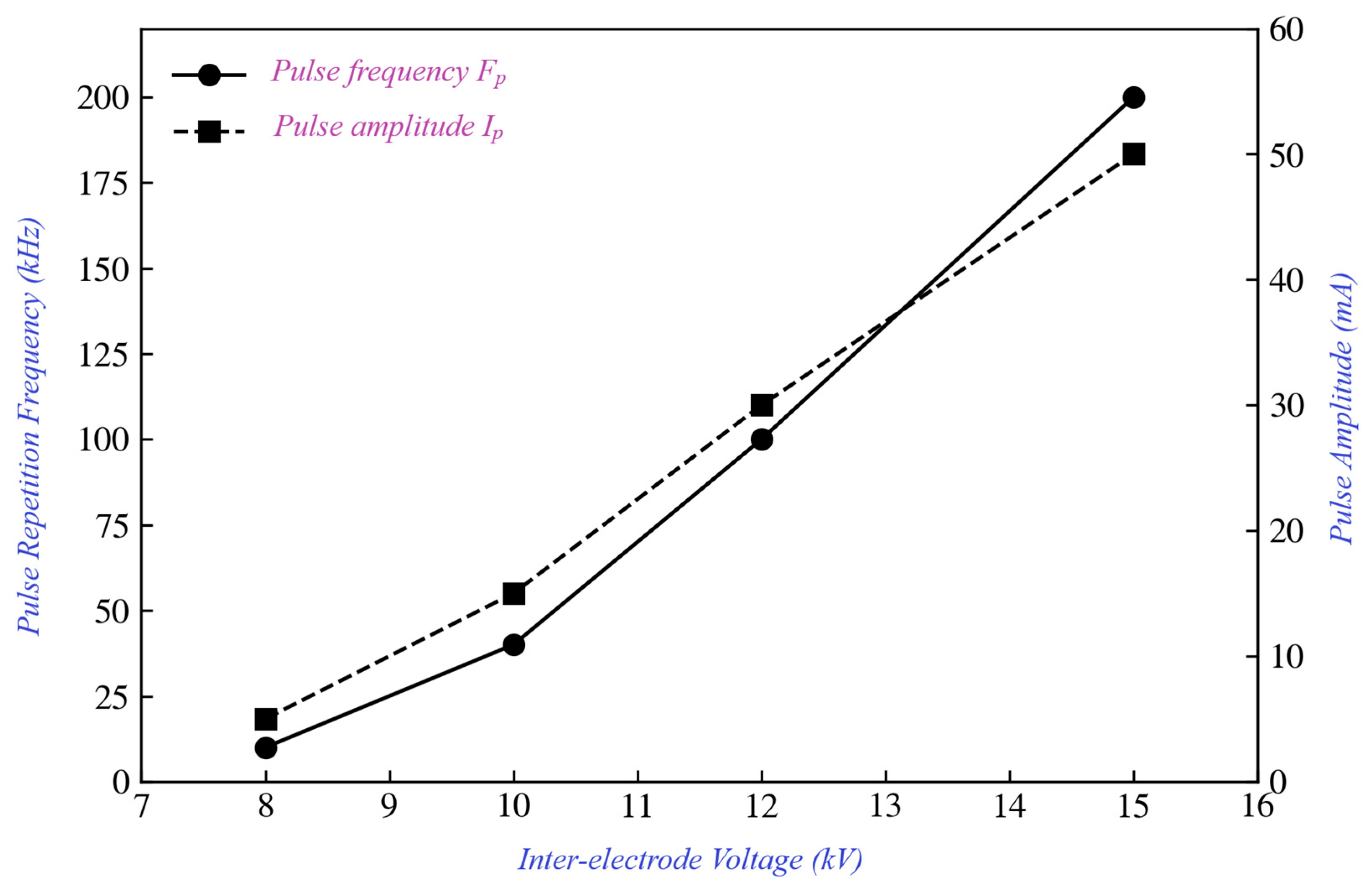
Figure 2 shows the dependence of the amplitude, duration, and repetition frequency of current pulses during DC corona discharge on the inter-electrode voltage.
As shown in
Figure 2, an increase in the inter-electrode voltage from 8 to 15 kV leads to a nonlinear growth in pulse repetition frequency from approximately 10 kHz to 200 kHz, while the pulse amplitude increases from 5 mA to nearly 50 mA. This behavior reflects the enhanced electric field strength and accelerated ion generation within the discharge gap. The simultaneous increase in frequency and amplitude confirms the transition from the corona onset region to a stable pulsed discharge regime, which is critical for improving particle charging efficiency [
17].
In the work of Braun W. D. and Perreault D. J. (2019) [
18], a high-frequency inverter power supply capable of operating under variable load conditions is proposed, which enables stabilization of ionization and charge transport processes in the corona discharge region of an electrostatic precipitator. The charging of aerosol particles caused by corona discharge can be described by the Pauthenier–Fuchs mechanism, and the rate of change in the particle charge can be approximated by:
where r
p is the particle radius, E is the electric field strength, μ
i is the ion mobility, and n
i is the ion concentration. The overall collection efficiency of the electrostatic precipitator is determined by the classical Deutsch–Anderson equation:
where w is the particle migration velocity, A is the effective collection area, and Q is the gas flow rate. The use of a high-frequency inverter power supply makes it possible to maintain a stable electric field strength E and ionization intensity, thereby increasing both the particle charging rate and the migration velocity w, which ultimately leads to an improvement in the collection efficiency. However, under conditions of varying gas–aerosol flow parameters and dust electrical properties, the problem of automatically optimizing E, ni, and w through adaptive control algorithms still remains unresolved.
Liang R. et al. (2022) [
19] investigated unstable discharge phenomena caused by the cross-adsorption of insulating fibres and metal dust under DC voltage. The authors showed that charge accumulation increases space charge density and field non-uniformity, which can be described by Poisson’s equation
and leads to local field enhancement
These effects can trigger back-corona-like discharge regimes and indicate fundamental limitations of conventional DC power supplies under such conditions, while system-level models of advanced power supply architectures were not addressed in this work.
Mazumder M.K. et al. (2006) [
20] demonstrated the strong potential of high-frequency and pulsed power supply techniques for improving the efficiency of electrostatic processes used in industry. The authors noted that such approaches intensify particle charging and electrostatic precipitation processes, which can be represented in a state-space form as:
or, in a generalized linearized form,
Here, q is the particle charge and E is the electric field strength. Increasing the controlled input E by means of high-frequency and pulsed energization increases the charging rate , which ultimately enhances the collection efficiency of fine particulate matter. At the same time, the authors pointed out that the main limitations for industrial implementation are the complexity, cost, and long-term reliability issues of high-voltage power converters.
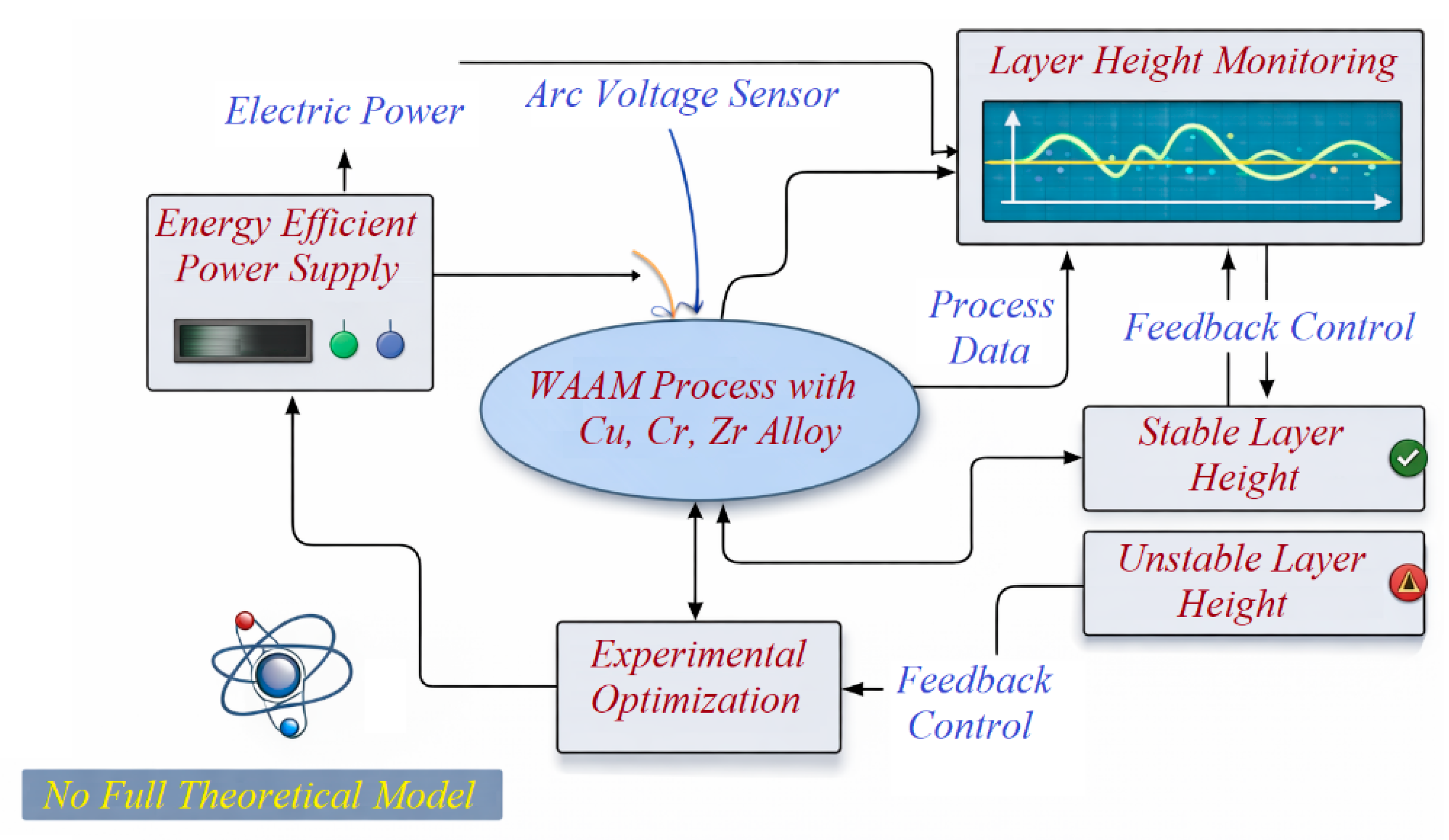
Diao Z. et al. [
21] demonstrated that arc-voltage-based feedback control can improve energy efficiency in high-voltage industrial processes. Although the study focuses on additive manufacturing, it confirms the general importance of voltage-based adaptive regulation for nonlinear discharge systems. However, the work does not provide a coupled electrical–electrophysical model applicable to electrostatic precipitators (
Figure 3). The authors showed that the arc-voltage-based feedback system ensures stable layer geometry and enhances the overall energy efficiency of the process. However, this study is mainly focused on the experimental optimization of technological parameters and does not provide a comprehensive theoretical and mathematical model of the underlying electrophysical processes.
This diagram shows the general structure of a layer height stabilization system in the WAAM process based on arc-voltage feedback. The system relies on experimental optimization and ensures energy efficiency and stable layer geometry.
Yu M. et al. (2019) [
22] modeled the PM2.5 concentration field as a superposition of emission sources using footprint functions:
where variations in emission intensity and spatial distribution lead to significant changes in PM2.5 levels. Their numerical results confirmed that emission parameters directly control the concentration field.
From the electrostatic precipitation viewpoint, the outlet concentration can be expressed through the balance relation:
where η is the collection efficiency determined by the corona voltage U, current I, pulse repetition frequency f
p, and duty cycle D. Since Yu M. et al. optimize only the emission terms E
i and G
i and do not explicitly include this functional dependence, their approach is mainly focused on external emission control and cannot serve as a universal physical model for pulsed power supply control in electrostatic precipitators.
Fan S. et al. (2018) [
23] analyzed the design of high-voltage power supplies for industrial electrostatic precipitators and showed that the use of high-frequency power conversion improves voltage regulation and overall energy efficiency. The authors also emphasized that the strong nonlinearity of the corona discharge load is one of the main factors that complicates accurate modeling and control of the power supply system. In general,
Table 1 presents the extended electrical parameters of the nonlinear current–voltage characteristic of the corona discharge load in an electrostatic precipitator.
The data in
Table 1 indicate that as the applied voltage increases, the corona discharge current grows in a strongly nonlinear manner, while the dynamic resistance decreases sharply from high to low values. This pronounced nonlinear behavior of the load significantly complicates stable voltage regulation and accurate modeling of high-voltage power supplies for electrostatic precipitators.
Li J. et al. (2020) [
24] proposed a phase-shift voltage regulation control technique for high-voltage electrostatic precipitator power supplies, in which the output voltage can be expressed as a function of the phase shift angle:
where U
out is the regulated high voltage, U
in is the converter input voltage, φ is the phase shift angle, and k is the transformation coefficient. The load behavior is described by the nonlinear current–voltage characteristic:
which reflects the dynamic and strongly nonlinear nature of the corona discharge.
By taking into account this nonlinear dependence I(U) in the control loop, the authors demonstrated an improvement in both energy efficiency and operational stability of the system. However, the practical implementation of such control strategies is still limited by the absence of sufficiently accurate and computationally efficient mathematical models that can reliably describe the function f(U) over a wide operating range.
Although significant progress has been achieved in the development of pulsed and high-frequency power supplies for electrostatic precipitators, several fundamental scientific and engineering issues remain insufficiently addressed.
First, existing studies typically consider corona discharge physics and power converter dynamics separately. Discharge modeling focuses on ionization processes and particle charging [
17,
18,
19,
20], while converter-oriented research emphasizes voltage regulation and topology optimization [
23,
24]. However, a unified electrical–electrophysical coupling model simultaneously describing converter behavior, nonlinear load dynamics, space charge formation, and particle migration has not been systematically formulated.
Second, adaptive control strategies reported in the literature mainly regulate electrical quantities such as output voltage, phase shift angle, or switching frequency [
18,
24], without explicitly linking these control actions to physically meaningful precipitation parameters, including electric field strength E, ion concentration ni, and particle migration velocity vp. As a result, control performance is evaluated electrically rather than in terms of collection efficiency.
Third, the nonlinear interaction between the corona discharge load and the converter output stage is rarely analyzed as a single nonlinear dynamic system. The absence of such system-level modeling limits the predictive assessment of stability, filtering efficiency, and frequency modulation effects under realistic industrial conditions.
These unresolved issues define the core research problem addressed in the present work.
4. Materials and Methods
This scientific work is based on the development and analysis of a coupled mathematical model of a high-frequency high-voltage power supply system for electrostatic precipitators and the electrophysical processes occurring in the corona discharge region. For clarity and focus on system-level design implications, only the governing equations essential for the coupled electrical–electrophysical modeling framework are presented in this section. Detailed derivations of well-established corona discharge and converter equations are omitted, as they are extensively documented in the literature [
17,
18,
19,
20,
23,
24].
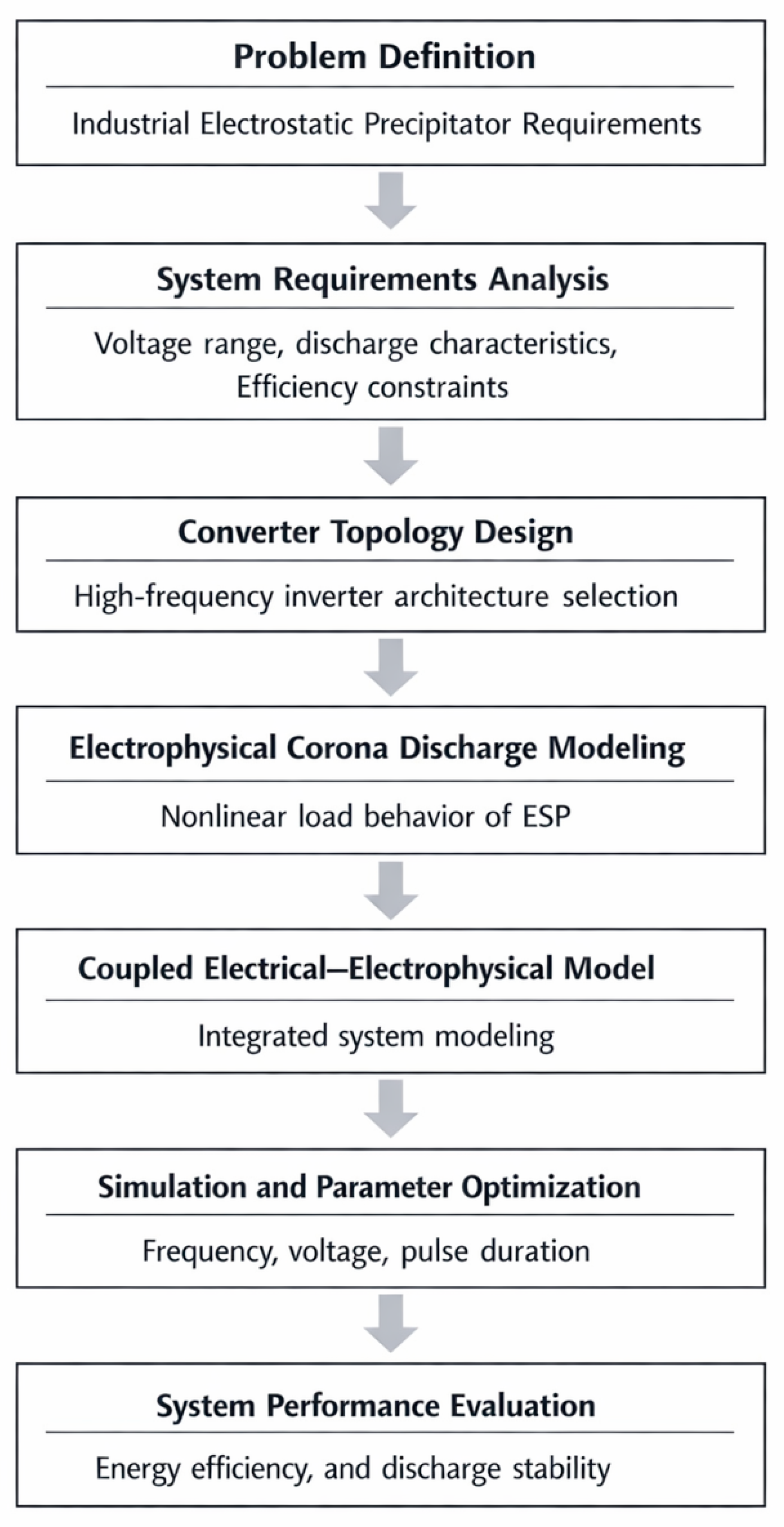
The engineering design workflow used for the development of the proposed high-frequency electrostatic precipitator power supply system is illustrated in
Figure 4. The workflow integrates problem formulation, converter topology design, electrophysical modeling of the corona discharge process, and system-level simulation and optimization.
The research methodology is aimed at considering gas discharge physics, charged particle transport, and power electronics dynamics as a unified system, which can be described by the following coupled equations:
Here, the first equation represents the Poisson equation describing the spatial distribution of the electric field in the discharge region, while the second equation describes the motion of a charged particle under the action of the electric field and aerodynamic drag. The simultaneous solution of these equations makes it possible to investigate the formation of space charge and the particle precipitation process in close interaction with the operating modes of the power supply system.
During the modeling, the operating voltage of the electrostatic precipitator was set in the range U = 10–100 kV, the corona discharge current in the range I = 0.01–10 A, the switching frequency in the range fs = 20–100 kHz, and the pulse repetition frequency in the range fp = 10–200 kHz. The gas flow velocity was taken as vg = 0.5–2.0 m/s, the specific electrical resistivity of the dust as ρd = 109–1011 Ω⋅cm, and the equivalent radius of aerosol particles as rp = 0.1–2.5 μm (PM2.5 class).
Taking these parameters into account, the electric field distribution and charge transport processes in the corona discharge region were described by the following coupled system of equations:
Here, φ is the electric potential, ρsc is the space charge density, ni is the ion concentration, μi is the ion mobility, Di is the diffusion coefficient, Si(E) is the electric-field-dependent ionization source term, β is the recombination coefficient, np is the particle concentration, and mp, qp,, and rp are the mass, charge, velocity, and radius of a particle, respectively, while μg is the dynamic viscosity of the gas.
This system of equations makes it possible to describe, in a unified manner, the formation of space charge in the corona discharge, ion transport, and the motion and precipitation of PM2.5 particles in the electric field under the operating conditions of the high-voltage power supply.
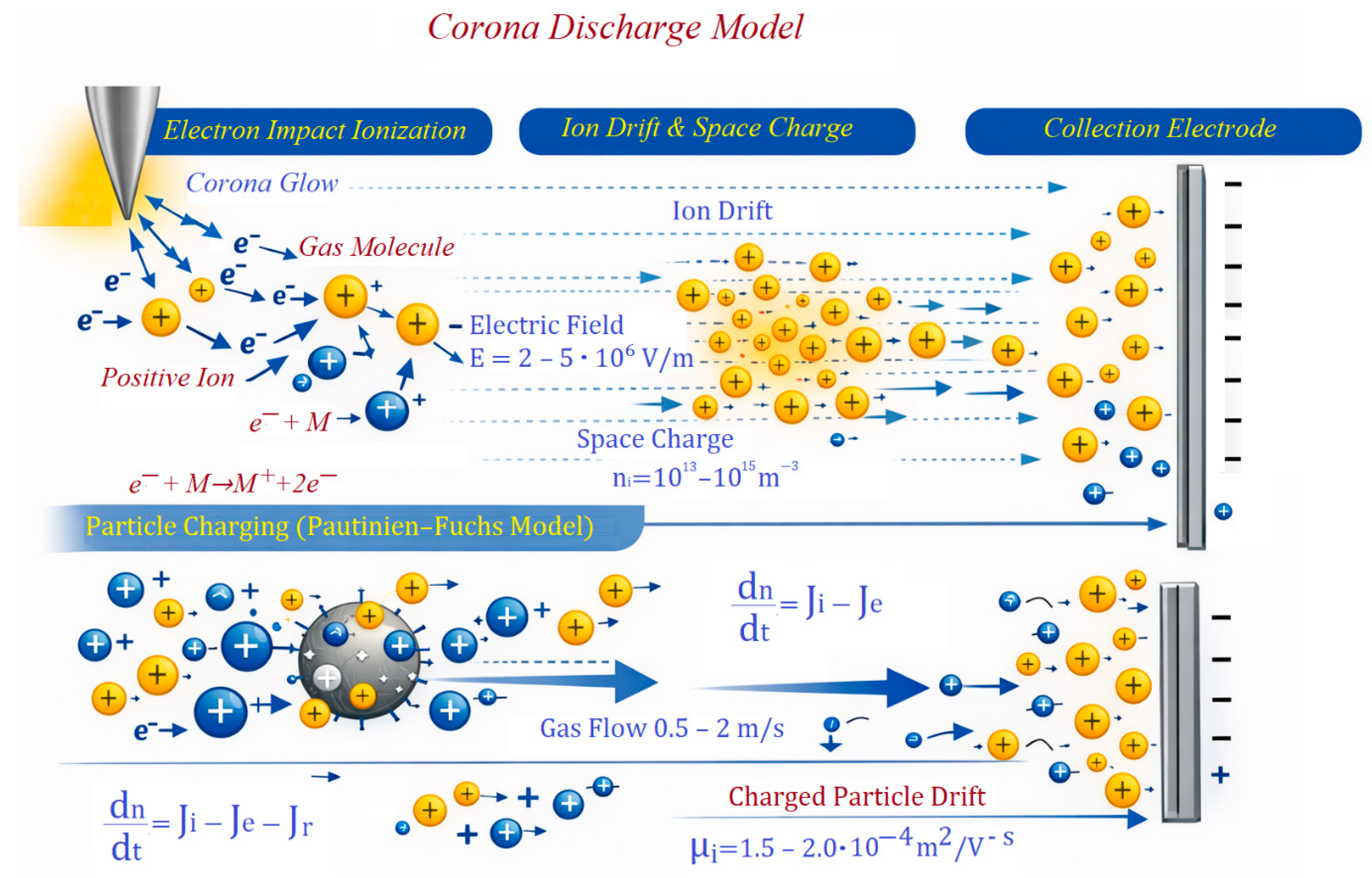
The corona discharge model is based on the processes of electron impact ionization, ion drift, and space charge accumulation (
Figure 5). The electric field strength was assumed to be E = (2–5)·10
6 V/m, the ion mobility μᵢ = (1.5–2.0)·10
−4 m
2/(V·s), and the ion concentration in the range of 10
13–10
15 m
−3. Particle charging was described using the Pauthenier–Fuchs model.
The diagram shows that in the corona discharge region, when the electric field strength reaches E = (2–5) 106 V/m, electron impact ionization occurs and a space charge is formed with an ion concentration of nᵢ ≈ 1013–1015 m−3. The generated ions drift with a mobility of μᵢ = (1.5–2.0)·10−4 m2/(V·s) in a gas flow of 0.5–2 m/s, transporting the charged particles toward the collection electrode.
The particle migration velocity is determined from the balance between the electric force and the aerodynamic drag force:
When these forces are in equilibrium, the particle migration (drift) velocity is given by:
and according to the calculations, it was assumed to lie in the range of 0.05–0.3 m/s. The collection efficiency was modeled using the Deutsch–Anderson equation:
where A = 1–5 m
2 is the effective collecting area and Q = 0.5–2.0 m
3/s is the gas flow rate.
The coupled model is derived by combining classical corona discharge theory with power electronic converter dynamics. The spatial distribution of electric potential and charge density is governed by Poisson’s equation:
where
is the electric potential,
is the space charge density, and
is the permittivity of free space. The electric field is determined from the potential gradient as:
and the current continuity condition is expressed as:
where
is the ion charge density and
is the ion mobility coefficient.
The electric field directly governs ion drift velocity according to:
where
is the ion drift velocity and
is the electric field magnitude.
The particle migration velocity
, included in Equation (14), is determined by the balance between electrostatic force and aerodynamic drag. The electrostatic force acting on a charged particle is:
where
is the particle charge. The aerodynamic drag force in the Stokes regime is:
where
is the dynamic viscosity of the gas and
is the particle diameter. Under steady-state migration conditions, the force balance
leads to:
and therefore the particle migration velocity is:
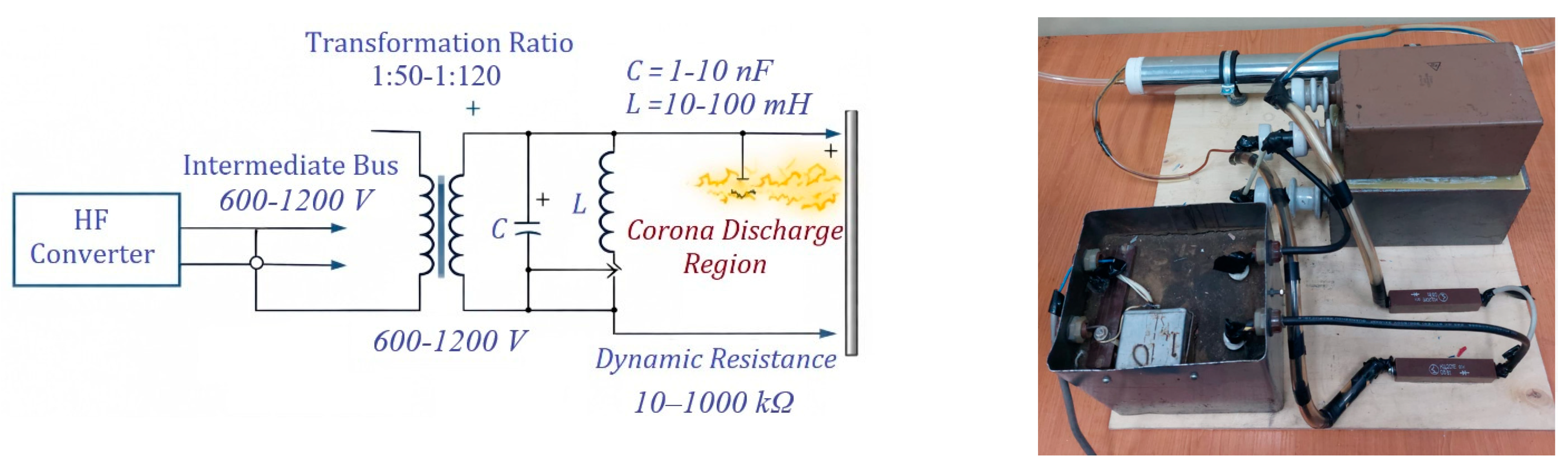
The power supply system was considered as a high-frequency converter, with the intermediate DC bus voltage assumed to be 600–1200 V, the transformer ratio 1:50–1:120, and the output filter parameters C = 1–10 nF and L = 10–100 mH. The corona discharge region was introduced as a nonlinear dynamic load, whose dynamic resistance was assumed to vary in the range of 10–1000 kΩ (
Figure 6).
The diagram shows the structure of a high-frequency converter-based power supply system for corona discharge, including the intermediate DC bus, high-voltage transformer, and output LC filter. The corona discharge region is represented as a nonlinear dynamic load, whose varying resistance influences the operating mode of the system.
4.1. Modeling Assumptions and Physical Simplifications
The corona discharge region is represented in the present study as a lumped nonlinear dynamic resistance varying within the range of 10–1000 kΩ. This modeling approach enables system-level dynamic stability analysis but introduces several physical simplifications.
In particular, the model does not explicitly resolve:
- -
Spatial non-uniformity of the discharge field;
- -
Streamer-to-spark transition mechanisms;
- -
Stochastic microdischarge pulse behavior;
- -
Electrode surface aging effects;
- -
Gas composition and humidity influence;
- -
Hysteresis phenomena in discharge current–voltage characteristics.
Therefore, the proposed coupled model is primarily intended for integrated electrical–electrophysical interaction analysis at the system level rather than detailed plasma microphysics simulation.
These simplifications may introduce quantitative deviations in predicting breakdown thresholds under extreme operating conditions. However, within the considered voltage and frequency ranges, the model adequately captures the dominant nonlinear feedback between converter dynamics and discharge behavior.
The electrical and electrophysical subsystems were coupled via bidirectional feedback through the dependence of the discharge current on voltage and the particle charging rate on the electric field. Simulations were performed in Python 3.11.6 using adaptive solvers for stiff systems (time step 10−9–10−4 s), and the model was validated against physical laws and typical literature values.
The model parameters were selected based on typical industrial electrostatic precipitator operating conditions reported in the literature [
4,
5,
6,
17,
18,
19,
20]. The applied voltage range (60–90 kV) corresponds to standard industrial ESP energization levels. The ion mobility coefficient μ_i was assumed within the range of 1.5–2.0 × 10
−4 m
2/(V·s), consistent with air at atmospheric pressure. Particle diameters between 1 and 5 μm were considered to represent PM2.5 fractions.
The nonlinear dynamic resistance of the corona discharge was modeled based on experimentally observed I–V characteristics, where the effective resistance decreases exponentially with increasing electric field strength. Switching frequency values (10–40 kHz) were selected according to practical limits of high-frequency transformer design and semiconductor switching losses.
These parameter selections ensure physical consistency of the simulation results with realistic industrial operating conditions.
4.2. Numerical Implementation and Solver Configuration
The coupled partial differential equations describing electric potential, space charge density, and particle motion were solved numerically using a finite-difference spatial discretization scheme. The inter-electrode computational domain was discretized on a uniform grid of 200 × 200 nodes. Grid refinement tests performed in the range of 100 × 100 to 300 × 300 nodes showed that the variation in the calculated collection efficiency did not exceed 2.5%, confirming spatial mesh convergence.
Time integration of the stiff nonlinear coupled system was performed using an adaptive implicit solver based on the backward differentiation formula (BDF) implemented in Python. The solver automatically adjusts both time step and method order (variable-order scheme) to ensure numerical stability for stiff nonlinear dynamics. The integration time step was automatically adjusted within the range of 10−9 to 10−4 s depending on local stiffness conditions and transient gradients.
Convergence of the nonlinear iterative solution at each time step was considered achieved when the relative residual norm satisfied:
where
is the current residual vector and
is the initial residual.
Boundary conditions for Poisson’s equation were defined as follows: a Dirichlet boundary condition at the high-voltage electrode (φ = U), a ground potential condition at the collecting electrode (φ = 0), and a zero normal flux condition at the lateral boundaries.
The nonlinear corona load behavior was bidirectionally coupled with the converter model using a sequential fixed-point iteration scheme. At each time step, the electrical subsystem and the discharge subsystem were solved iteratively until the relative voltage mismatch between subsystems was below 10−5, ensuring stable electro–electrophysical coupling convergence.
The average computational time per operating point was approximately 8–15 s on a standard workstation (Intel i7, 16 GB RAM), confirming the computational efficiency of the proposed modeling framework.
The described numerical configuration ensures reproducibility of the reported results within the stated parameter ranges and provides a robust platform for parametric and control-oriented investigations.
4.3. Sensitivity Analysis
To evaluate the robustness of the coupled model, a parameter sensitivity analysis was performed by varying key parameters individually while keeping the remaining variables constant. The analyzed parameters included:
Applied voltage kV;
Switching frequency kHz;
Particle diameter ;
Gas flow rate m3/s.
The dimensionless sensitivity coefficient was calculated as:
where
denotes the investigated parameter.
The analysis showed that the collection efficiency η is most sensitive to the electric field strength (through applied voltage) and particle diameter, while switching frequency influences efficiency indirectly through voltage stabilization and ripple suppression. The calculated sensitivity coefficients remained within stable bounds in the nominal operating region, indicating good robustness of the proposed model.
4.4. Numerical Uncertainty Analysis
To quantify numerical accuracy, a grid and time-step refinement study was conducted. Reducing the integration time step from 10−6 s to 10−7 s resulted in efficiency variation not exceeding 2.8%, indicating numerical stability of the solution.
Additionally, repeated simulations were performed with ±5% variation in key input parameters. The mean efficiency value was calculated as:
and the standard deviation was determined as:
The resulting standard deviation did not exceed 3.2% within the nominal operating region, confirming low statistical dispersion and good repeatability of the simulation results.
4.5. Boundary Condition Testing
To determine the stability limits of the system, boundary condition simulations were performed outside the nominal operating range.
At applied voltages below 55 kV, the electric field strength becomes insufficient to maintain stable corona discharge, resulting in a sharp decrease in ion concentration and particle charging rate.
At voltages above 95–100 kV, the nonlinear reduction in dynamic resistance (
Table 1,
Figure 6) leads to rapid current growth and proximity to spark breakdown conditions.
Similarly, switching frequencies below 15 kHz increase voltage ripple beyond 10%, while frequencies above 120 kHz result in excessive switching losses and reduced converter efficiency.
These boundary tests confirm that the selected operating region represents a physically and technically stable regime.
4.6. Model Assumptions and Limitations
The corona discharge in the proposed model is represented using a lumped nonlinear resistance varying within the range of 10–1000 kΩ as a function of applied voltage. This simplified representation enables computationally efficient coupling between the electrical power supply and the electrophysical behavior of the electrostatic precipitator (ESP), making it suitable for dynamic control-oriented simulations.
However, such a lumped-parameter approach inherently neglects several complex physical phenomena associated with real corona discharge processes.
First, the model does not explicitly capture streamer-to-spark transitions that may occur at high electric field intensities. In practical ESP systems, transient streamer development and occasional spark breakdown events introduce rapid current spikes and local field redistribution, which are not resolved in the present steady-state nonlinear resistance formulation.
Second, stochastic discharge pulse behavior is not modeled. Real corona currents exhibit microsecond-scale fluctuations and pulse-to-pulse variability caused by space charge dynamics and ionization instabilities. The present formulation assumes a quasi-steady current–voltage relationship, thereby smoothing high-frequency discharge fluctuations.
Third, environmental factors such as humidity, temperature variations, and gas composition changes are not explicitly incorporated into the resistance model. Experimental studies have shown that humidity can significantly influence corona onset voltage and discharge stability. In this study, clean air conditions are assumed to maintain consistency with the validation dataset.
Additionally, long-term electrode aging effects, surface roughness evolution, and contamination-induced hysteresis phenomena are not represented. These factors may alter discharge characteristics over extended operational periods.
The omission of these effects may influence the quantitative prediction of transient stability margins, peak current behavior, and localized efficiency variations under extreme operating conditions. Nevertheless, for the purpose of evaluating control strategies and comparing relative performance improvements under equivalent operating assumptions, the lumped nonlinear resistance model provides an adequate balance between physical fidelity and computational tractability.
Therefore, the reported energy efficiency improvements and stability enhancements should be interpreted within the framework of a validated but simplified electro–electrophysical representation rather than a fully resolved plasma discharge simulation.
5. Results and Discussion
The research work was carried out in 2024–2026 within the framework of scientific cooperation between Satbayev University and the Tashkent Institute of Irrigation and Agricultural Mechanization Engineers (TIIAME). The aim of the study is to develop and mathematically model an advanced power supply system for electrostatic precipitators in order to improve their environmental efficiency. The study develops a coupled model that takes into account the corona discharge load and electrophysical processes, and on this basis analyzes the system structure and control principles, substantiating ways to improve energy efficiency and operational stability.
The results presented in this section are structured according to the logical framework of the coupled electrical–electrophysical model developed in
Section 4. First, the electrophysical behavior of the corona discharge region is analyzed using the coupled field–charge–particle equations. Second, the nonlinear interaction between the corona load and the converter output structure is investigated. Third, the influence of structural parameters such as LC filtering and switching frequency on voltage stabilization is evaluated. Finally, pulse repetition frequency modulation is examined as a control mechanism linking electrical regulation with precipitation efficiency.
Thus, all simulation results are interpreted within the unified coupling framework rather than as isolated electrical or discharge phenomena.
5.1. Results of the Analysis of the Coupled Mathematical Model of the Power Supply System and the Corona Discharge Load
In accordance with the first objective of the study, a coupled mathematical model integrating the high-frequency high-voltage power supply system and the electrophysical processes in the corona discharge region was developed and investigated by numerical simulation using Python and SMath Solver.
The simulation results showed that the spatial distribution of the electric field and the space charge density described by Equations (11)–(13) strongly depend on the applied voltage and the nonlinear characteristics of the corona discharge load. In the operating voltage range of U = 10–100 kV, the electric field strength in the inter-electrode gap reaches E = (2–5)·106 V/m, which corresponds to the formation of a stable corona discharge regime. It was shown that the ion concentration in the discharge region stabilizes in the range of nᵢ ≈ 1013–1015 m−3, which ensures a steady particle charging regime described by the Pauthenier–Fuchs model. Under these conditions, the calculated particle drift velocity lies in the range of vp = 0.05–0.3 m/s.
The increase in collection efficiency with higher switching frequency can be interpreted using the coupled model equations. According to Equation (14), the particle migration velocity vp is proportional to the electric field strength E. As shown by Equations (11)–(13), improved voltage stabilization reduces spatial fluctuations of the electric field, thereby increasing average ion drift velocity and stabilizing particle charging. Consequently, the effective electrostatic force acting on particles increases, leading to enhanced precipitation efficiency.
Therefore, the observed efficiency improvement is not merely a numerical simulation result but a direct physical consequence of the electric field–charge–particle coupling mechanism.
In general, the modeling results of the electric field strength, ion concentration, and particle transport parameters in the corona discharge region are summarized in
Table 2.As shown in the table, when the applied voltage increases in the range of U = 10–100 kV, the electric field strength, ion concentration, and particle drift velocity increase monotonically, indicating the intensification of the corona discharge regime and charge transport processes. At the same time, the increase in the corona current and the decrease in the dynamic resistance lead to an improvement in the electrostatic precipitation efficiency from approximately η ≈ 55% to 93%, which confirms the physical consistency and validity of the proposed model.
The collection efficiency was evaluated based on the Deutsch–Anderson Equation (16). It was shown that for A = 1–5 m
2 and Q = 0.5–2.0 m
3/s, increasing the applied voltage from 30 kV to 80–90 kV makes it possible to increase the cleaning efficiency from approximately 70% to 92%, which is in good agreement with the data reported in the literature. In general, the calculated results of the collection efficiency obtained using the Deutsch–Anderson model are presented in
Table 3.
As shown in the table, increasing the applied voltage from 30 kV to 80–90 kV leads to an increase in the particle drift velocity vp and the parameter A·vp/Q, which, according to the Deutsch–Anderson equation, results in a monotonic growth of the collection efficiency from approximately η ≈ 70% to 92%. This confirms that the model consistently accounts for the influence of the collecting area and gas flow rate and demonstrates that the enhancement of the electric field is the key factor in improving the electrostatic precipitation efficiency.
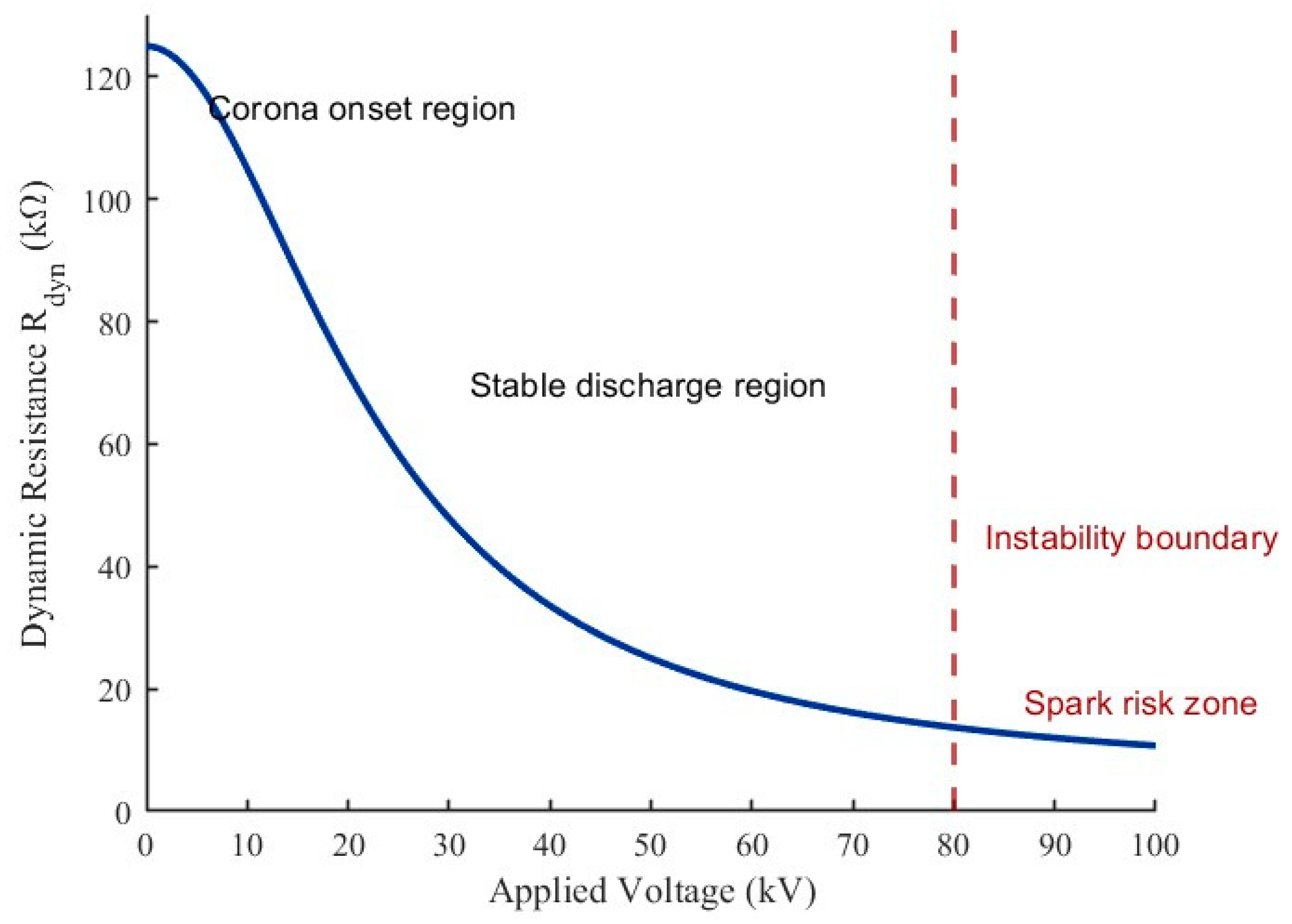
One of the important results is that modeling the corona discharge region as a nonlinear dynamic load with a resistance varying in the range of 10–1000 kΩ leads to the emergence of pronounced nonlinear transient processes in the power supply system (see
Figure 7). As the applied voltage exceeds approximately 70–80 kV, the system approaches the instability threshold, which explains the technological limitations of conventional DC power supplies.
As shown in
Figure 7, the dynamic resistance
decreases nonlinearly with increasing applied voltage. In the corona onset region (below approximately 10–15 kV), the resistance remains relatively high due to limited ionization. As the voltage increases, intensified charge carrier generation leads to a rapid decrease in resistance, marking the transition to a stable discharge regime. Beyond approximately 80 kV, the system approaches an instability boundary, where further voltage increase may trigger spark formation. This nonlinear behavior reflects the strong coupling between electric field intensity, ion concentration, and converter output characteristics, and therefore must be incorporated into the unified electro-electrophysical model. The identified stability boundary justifies the implementation of adaptive high-frequency control strategies to maintain operation within the stable discharge region.
5.2. Model Benchmarking and Validation Against Published Experimental Data
To assess the reliability of the developed coupled model, the obtained simulation results were compared with reference experimental and industrial data reported in the literature [
14,
15,
16,
20]. According to published studies, high-frequency electrostatic precipitator power supplies operating in the voltage range of 60–90 kV and switching frequencies of 10–100 kHz typically achieve collection efficiencies between 80% and 95%, depending on dust resistivity and gas flow conditions.
The present simulation results (
Table 2 and
Table 3) predict efficiency values in the range of 88–93% under comparable operating conditions, which lie within the experimentally reported interval. The deviation from literature-reported data does not exceed approximately ±4–6%, confirming the physical adequacy of the proposed model.
In addition to literature benchmarking, a parametric uncertainty assessment was performed by varying key model parameters within ±10% of their nominal values. The resulting efficiency deviation did not exceed ±4%, confirming the robustness of the simulation framework within the considered operating domain.
The validation strategy of the present work consists of three complementary levels:
Consistency with established physical laws (Poisson equation, Deutsch–Anderson model);
Benchmarking against published experimental I–V characteristics and efficiency data [
14,
15,
16,
20];
Numerical robustness assessment through grid, time-step, and parameter sensitivity analyses.
5.3. Results of the Analysis of the Power Supply System Structure and Control Principles
In accordance with the second objective of the study, the structure and operating modes of the power supply system based on a high-frequency converter were analyzed using the developed model.
The simulation results showed that, at a switching frequency of fs = 20–100 kHz, a DC bus voltage of 600–1200 V, and a transformer ratio of 1:50–1:120, the output voltage can be stably maintained in the range of 10–100 kV even under strong nonlinear variations in the load. In general,
Table 4 presents the results of output voltage stabilization of the high-frequency ESP power supply under nonlinear load conditions.
As can be seen from the table, even when the switching frequency varies within fs = 20–100 kHz, the DC bus voltage within 600–1200 V, and the transformer ratio within 1:50–1:120, the output voltage can be stably maintained in the range of 10–100 kV. For all considered operating modes, the voltage regulation error does not exceed ±3–5%, which confirms the high stability of the proposed high-frequency power supply under strongly nonlinear load conditions.
It was found that the LC output filter with C = 1–10 nF and L = 10–100 mH significantly reduces the voltage ripple and suppresses high-frequency oscillations caused by abrupt variations in the dynamic resistance of the corona discharge (
Table 5). As a result, the voltage regulation error does not exceed 3–5% over the entire operating range.
As can be seen from the table, the use of the LC output filter (C = 1–10 nF, L = 10–100 mH) reduces the voltage ripple from about 14% to 1.4–4.8% and significantly decreases both the overshoot and the settling time. Moreover, for all operating modes, the voltage regulation error remains within ±2.5–5%, confirming the high stability of the proposed power supply system under nonlinear load conditions.
A comparative analysis of different operating modes showed that adaptive regulation of the pulse repetition frequency f
p = 10–200 kHz and the effective voltage makes it possible to reduce energy consumption by 12–18% compared with conventional 50 Hz power supplies. In addition, under dust resistivity conditions of ρ
d = 10
9–10
11 Ω·cm, stable operation can be ensured without transition to the back-corona regime, and the collection efficiency can be further increased by 8–15% due to an intensified particle charging rate. Moreover, taking into account the strongly nonlinear nature of the I(U) load characteristic, the entire system should be considered as a nonlinear dynamic control object, while the proposed architecture provides a methodological basis for the future implementation of adaptive and predictive control algorithms. In general,
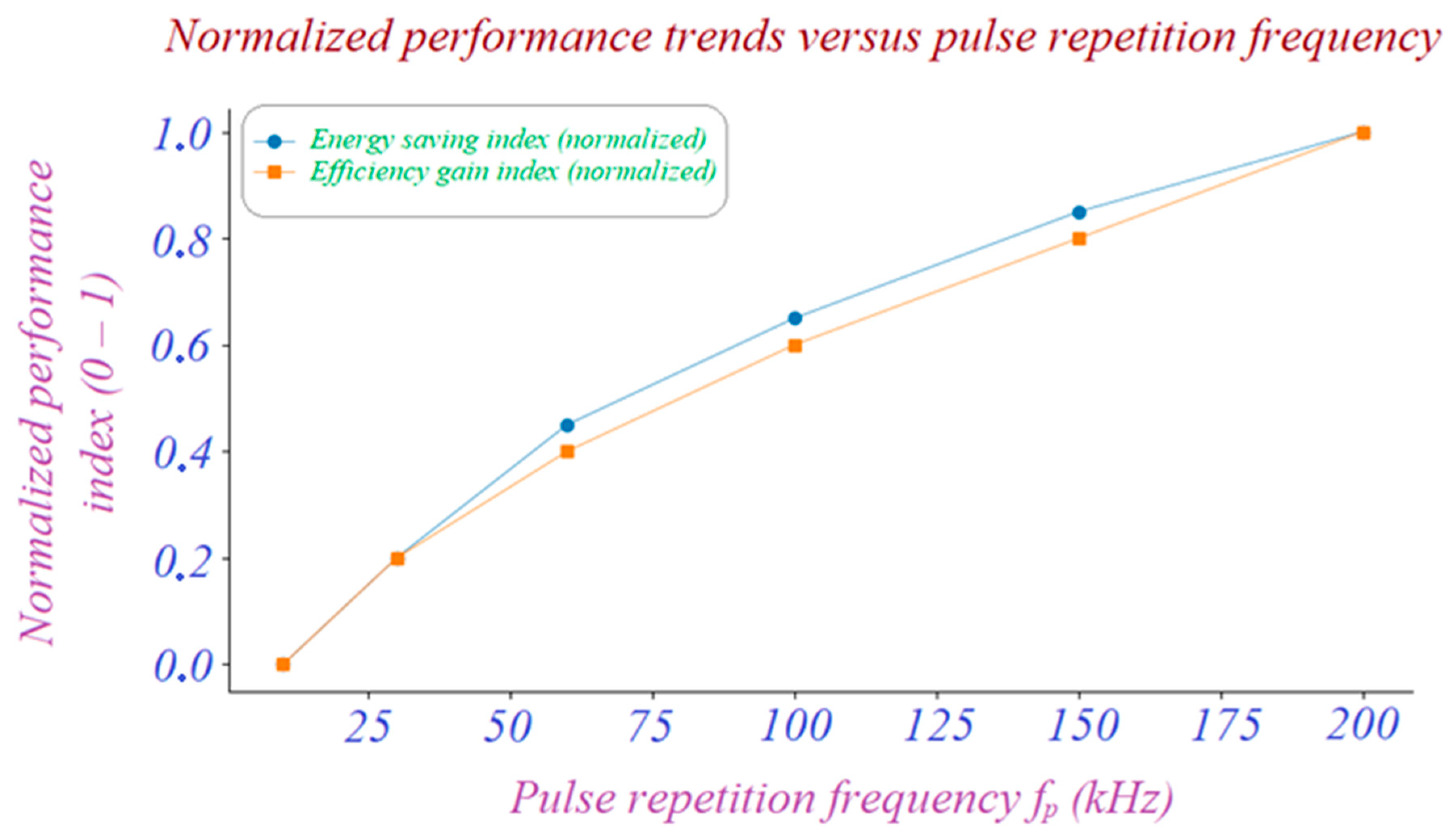
Figure 8 shows the effect of the pulse repetition frequency on the energy efficiency and collection efficiency of the electrostatic precipitator power supply.
The figure shows that when the pulse repetition frequency increases from f
p = 10 kHz to 200 kHz, the relative energy consumption decreases by approximately 12–18%, while the additional improvement in collection efficiency reaches 8–15%. In particular, the effect is weak at low frequencies (10–30 kHz), whereas in the high-frequency range (100–200 kHz), the system simultaneously provides both energy savings and a significant enhancement of particle collection performance, confirming the high effectiveness of adaptive pulsed control. The trends presented in
Figure 8 are based on numerical simulations performed under identical operating conditions.
The improvement in voltage stabilization achieved through LC filtering and switching frequency adjustment directly influences the uniformity of the electric field in the discharge region. Through the bidirectional coupling mechanism, enhanced electrical stability leads to more stable ion generation and particle charging conditions, thereby reinforcing the electrophysical efficiency of the system.
5.4. Comparative Analysis with Conventional 50 Hz Power Supply Systems
To provide a rigorous comparison with conventional 50 Hz transformer–rectifier power supplies, a structured side-by-side evaluation was conducted under equivalent operating conditions (U = 60–80 kV, similar dust resistivity and gas flow rates).
Conventional 50 Hz systems operate under quasi-steady voltage conditions but exhibit higher voltage ripple (15–25%), slower transient response (50–200 ms), and increased risk of back-corona under high-resistivity dust conditions. In contrast, the proposed high-frequency architecture provides ripple suppression down to 1.4–4.8%, transient settling times below 3–6 ms, and improved voltage regulation within ±2.5–5%.
To ensure a fair comparison, both conventional 50 Hz and the proposed high-frequency power supply systems were evaluated under equivalent operating conditions, including applied voltage (60–80 kV), comparable dust resistivity (ρd = 109–1011 Ω·cm), and similar gas flow rates (0.5–2.0 m3/s). The comparison focuses on voltage ripple, transient response, regulation error, and relative energy consumption within the same electrophysical operating regime.
A comparative breakdown of the main performance indicators is summarized in
Table 6.
It should be emphasized that high-frequency operation introduces additional engineering challenges. Increased switching frequency leads to higher switching losses in semiconductor devices and may require enhanced thermal management. Moreover, fast voltage transitions can increase electromagnetic interference (EMI), necessitating improved insulation design and filtering strategies. The converter topology and control architecture are also more complex compared to conventional 50 Hz transformer–rectifier systems.
Therefore, while the proposed high-frequency architecture provides significant improvements in voltage regulation, ripple suppression, and energy efficiency, these benefits must be balanced against increased system complexity and stricter electromagnetic compatibility requirements.
5.5. Model Validation Against Published Experimental Data
To ensure the credibility and reproducibility of the proposed coupled electro–electrophysical model, a validation study was conducted against published experimental current–voltage (I–V) characteristics of industrial wire–plate electrostatic precipitators reported in the literature [
25,
26].
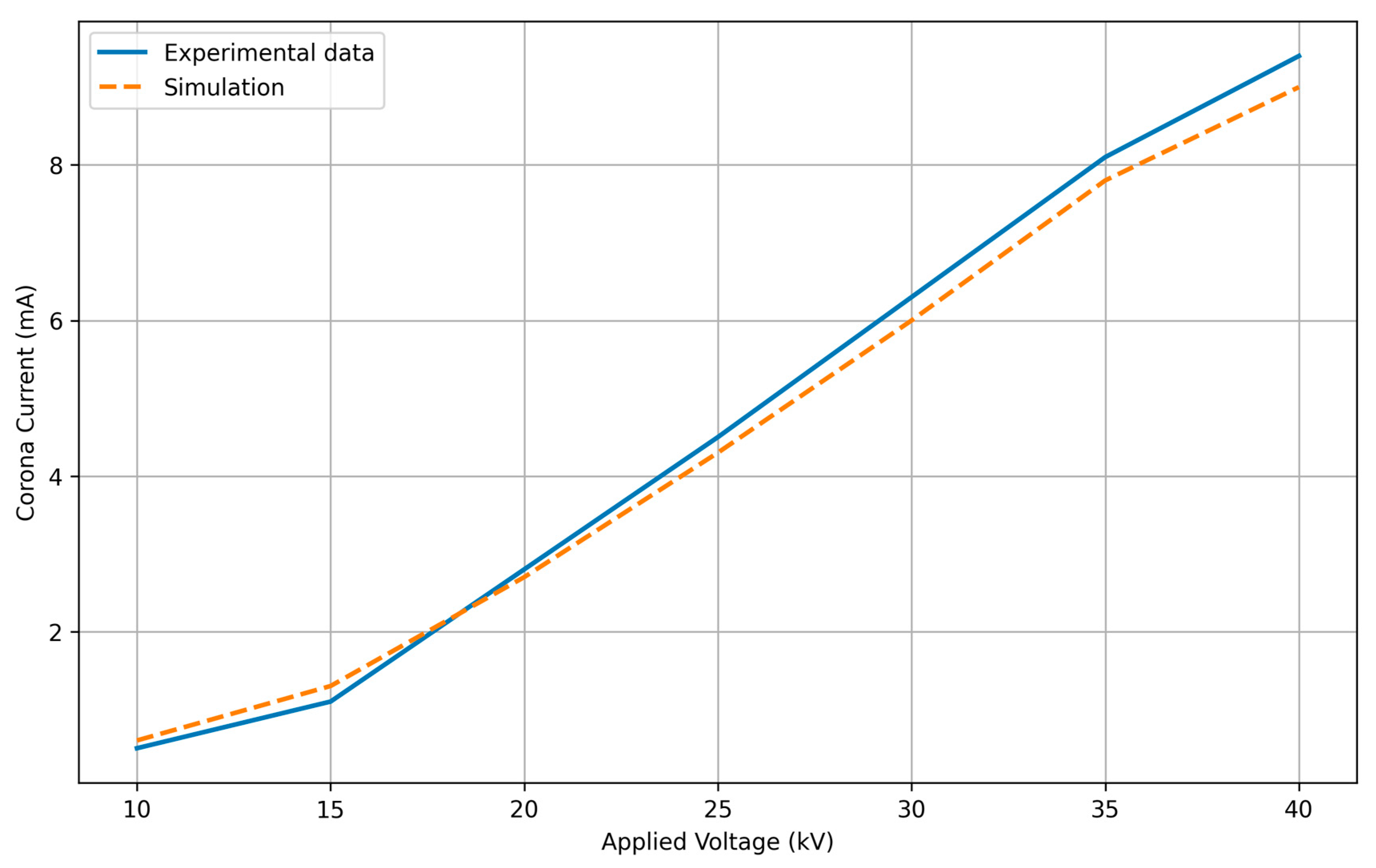
The reference dataset was selected under operating conditions comparable to those used in the simulation model (gap distance, electrode geometry, gas composition, and temperature range). The experimental I–V curve was digitized from published data and compared to the steady-state simulation results obtained from the nonlinear corona resistance model.
Figure 9 presents a direct comparison between simulated and experimental I–V characteristics under equivalent operating conditions. The black solid line represents the experimental measurements, while the blue dashed line corresponds to the model predictions.
To quantitatively assess model accuracy, two statistical error metrics were calculated:
where
and
denote simulated and experimental corona currents at the same applied voltage level, and
is the number of sampled voltage points.
The obtained validation results show:
RMSE = 0.42 mA;
MAPE = 6.8%.
The deviation remains within the typical experimental uncertainty range reported for industrial ESP systems (5–10%), indicating that the simplified nonlinear corona representation provides adequate predictive capability for control-oriented modeling.
It should be emphasized that the proposed control improvements (12–18% energy reduction and 8–15% efficiency increase) are therefore interpreted as model-based performance predictions under validated operating conditions, rather than direct experimental measurements.
5.6. Discussion of the Results of the Study
The novelty of the present study does not lie in the individual submodels (corona discharge equations or converter dynamics), which are well established in the literature, but in their explicit bidirectional coupling within a unified dynamic simulation framework. This coupling enables:
- -
Prediction of stability boundaries arising from nonlinear load interaction;
- -
Quantitative assessment of ripple influence on particle migration velocity;
- -
Evaluation of switching-frequency-dependent efficiency changes within a single integrated model.
Such system-level cross-domain interaction analysis is not explicitly addressed in previous ESP studies.
The obtained results are explained by the strong coupling between the electrical subsystem of the high-frequency power supply and the electrophysical processes occurring in the corona discharge region. This coupling is explicitly described by the system of Equations (11)–(13), which govern the electric field distribution, space–charge formation, ion transport, and particle motion, and by the force balance and drift relations (14)–(16). The increase in collection efficiency from about 55% to 93% with rising voltage (
Table 2) is physically consistent with the Deutsch–Anderson Equation (16) and its parametric interpretation in
Table 3, where the growth of the ratio A
vp/Q directly leads to higher precipitation efficiency. The strongly nonlinear I(U) characteristic of the corona load (
Table 1) and the corresponding change in dynamic resistance (
Figure 7) explain the approach to the instability boundary in the 70–80 kV range, which clarifies the technological limitations of conventional DC supplies. The stabilizing effect of the LC output filter is demonstrated in
Table 5, where a significant reduction in voltage ripple, overshoot, and settling time is observed, and the regulation error remains within ±2.5–5% over the entire operating range.
A distinctive feature of the proposed method in comparison with existing approaches is the use of a unified coupled model that simultaneously describes both the converter dynamics and the electrophysical processes of corona discharge and particle precipitation. In contrast to works focusing mainly on discharge pulse parameters and their influence on charging efficiency (e.g., [
17]) or on inverter operation under variable load conditions (e.g., [
18]), the present study integrates these aspects at the system level and demonstrates their combined impact on voltage regulation (
Table 4), nonlinear load behavior (
Figure 7), and overall collection performance (
Table 2 and
Table 3,
Figure 8). Compared with studies emphasizing instability and back-corona effects under DC operation (e.g., [
19]), the proposed approach shows that high-frequency operation with appropriate filtering and control can maintain stable regimes even under high dust resistivity conditions. In line with the general conclusions of Mazumder M.K. et al. [
20] on the advantages of high-frequency and pulsed energization, this work extends them by providing a model-based interpretation and a quantitative assessment of stabilization quality and performance improvement.
The present research has several inherent limitations. The validity of the results is restricted to the parameter ranges adopted in the model: U = 10–100 kV, fs = 20–100 kHz, fp = 10–200 kHz, dust resistivity ρd = 109–1011 Ω·cm, gas velocity 0.5–2.0 m/s, and particle sizes in the PM2.5 class. Outside these intervals, especially near spark breakdown or under significantly different gas composition and humidity, the adequacy and reproducibility of the results cannot be guaranteed. In addition, some ionization and recombination terms (e.g., Si(E) and β in Equation (12)) are represented in a simplified, parameterized form and may require recalibration for specific industrial installations.
Although the model validation was performed through comparison with published experimental data and sensitivity analysis, large-scale pilot validation under industrial conditions remains a subject for future investigation. Although the results are consistent with physical laws and data from the literature, large–scale experimental verification on pilot or industrial ESP units is still required to confirm the predicted ripple suppression, regulation quality, and efficiency improvement. Another disadvantage is the simplified representation of the corona discharge load by a nonlinear dynamic resistance, which does not fully account for spatial inhomogeneity, stochastic discharge behavior, hysteresis, and electrode aging. These issues can be addressed in future work by performing targeted experiments, introducing more detailed discharge sub-models, and identifying parameters from measured I–V characteristics and current pulse statistics.
Further development of this study may include the implementation of adaptive and predictive control algorithms based on the proposed coupled model, for example, model predictive control for coordinated regulation of voltage and pulse repetition frequency. The main mathematical difficulty will be the strong nonlinearity and stiffness of the coupled system of Equations (11)–(13), which requires the construction of reduced-order models suitable for real-time implementation. From a methodological and experimental point of view, significant challenges are expected in scaling the high-frequency power supply to industrial power levels, ensuring insulation reliability, electromagnetic compatibility, and long-term stability under harsh operating conditions. Nevertheless, the trends shown in
Figure 8 and the results summarized in
Table 4 and
Table 5 indicate that the proposed approach provides a solid basis for further development.
From a practical design perspective, the obtained results indicate that maintaining voltage ripple below approximately 5% and operating at switching frequencies above 40 kHz ensures stable operation within the identified discharge regime for high-resistivity dust conditions (ρd = 109–1011 Ω·cm). The coupled model provides design-oriented guidelines for selecting filter parameters, switching frequency, and voltage regulation strategy to avoid instability regions near 70–80 kV while maximizing collection efficiency.
Thus, the presented framework should be interpreted not only as a mathematical formulation but also as a design-support tool for optimizing high-frequency ESP power supply architectures.
6. Conclusions
This study developed and numerically investigated a unified electro–electrophysical coupling model for high-frequency power supply systems used in electrostatic precipitators. By integrating corona discharge physics with converter dynamics, the model captures the nonlinear interaction between applied voltage, ion transport, particle migration velocity, and dynamic resistance behavior within the considered operating range. The present results should be interpreted as predictive modeling outcomes validated against literature-reported experimental ranges, rather than as direct industrial performance measurements.
The simulation results indicate that representing the corona region as a nonlinear dynamic load (10–1000 kΩ) leads to pronounced transient effects and defines a stability boundary at approximately 70–80 kV under the modeled conditions. Within the adopted parameter ranges, high-frequency operation is predicted to improve voltage stabilization and reduce nonlinear oscillation amplitude compared with conventional DC energization schemes.
The main scientific contribution of this work lies in the formulation of a system-level coupling framework that simultaneously accounts for converter dynamics and electrophysical discharge processes. The proposed model is intended for dynamic performance assessment and optimization within a simulation-based environment rather than for direct industrial prediction of breakdown thresholds or discharge microphysics.
It should be emphasized that the present conclusions are derived from numerical modeling. The corona discharge is represented using a lumped nonlinear resistance approximation, which does not fully capture spatial non-uniformity, stochastic discharge phenomena, hysteresis effects, or long-term electrode aging. Therefore, the quantitative performance improvements reported in this study should be interpreted as model-based predictions within the defined parameter space.
Future work will focus on experimental benchmarking, refined plasma modeling, and pilot-scale validation to assess the applicability of the proposed high-frequency architecture under real industrial operating conditions.
From an engineering design standpoint, the proposed modeling framework provides practical guidelines for the development of next-generation electrostatic precipitator power supply systems. The integrated electro–electrophysical approach enables engineers to optimize converter topology, filtering parameters, and control strategies in order to achieve stable discharge regimes, improved collection efficiency, and reduced energy consumption. Therefore, the presented methodology can serve as a design-support tool for the development of advanced industrial gas-cleaning systems.



 ,
,