Screen Time and Myopia-Related Outcomes in European Children: A Systematic Review

Abstract
1. Introduction
2. Methods
2.1. Search Strategy
2.2. Eligibility Criteria
2.3. Study Selection
2.4. Data Extraction
2.5. Risk of Bias Assessment
2.6. Data Synthesis
2.7. Certainty of Evidence
3. Review
3.1. Screen Exposure and Myopia
3.2. Device Type and Near-Work
3.3. Outdoor Activity, Lifestyle Factors and Parental Myopia
4. Discussion
5. Conclusions
Supplementary Materials
Author Contributions
Funding
Institutional Review Board Statement
Informed Consent Statement
Data Availability Statement
Acknowledgments
Conflicts of Interest
Abbreviations
| AI | Artificial Intelligence |
| PRISMA | Preferred Reporting Items for Systematic Reviews and Meta-Analyses |
| PICO | Population, Intervention/Exposure, Comparison, Outcome |
| D | Dioptres |
| IMI | International Myopia Institute |
| WHO | World Health Organisation |
| COVID-19 | Coronavirus Disease 2019 |
| NOS | Newcastle–Ottawa Scale |
| JBI | Joanna Briggs Institute |
| OR | Odds Ratio |
| CI | Confidence Interval |
| MB/day | Megabytes Per Day |
| UK | United Kingdom |
| n | Number/Sample Size |
| p | p-Value/Statistical Significance Value |
| N/a | Not Applicable |
| OVID MEDLINE | Ovid MEDLINE Database |
| OVID Embase | Ovid Embase Database |
| GRADE | Grading of Recommendations Assessment, Development and Evaluation |
| CENTRAL | Cochrane Central Register of Controlled Trials |
| SE | Spherical Equivalent |
Appendix A

| PICO Element | Description |
|---|---|
| P (Population) | Children and adolescents (<18 years) living in European countries |
| I (Intervention/Exposure) | Digital screen exposure, including screen time, smartphone use, tablet use, computer use, and other digital device use |
| C (Comparison) | Lower screen exposure, reduced digital device use, or no reported exposure |
| O (Outcome) | Development or progression of myopia, including refractive error (spherical equivalent), myopia prevalence/incidence, axial elongation, or worsening visual outcomes |
Appendix B
| Database | Date of Search | Search Terms | Filters | Results |
|---|---|---|---|---|
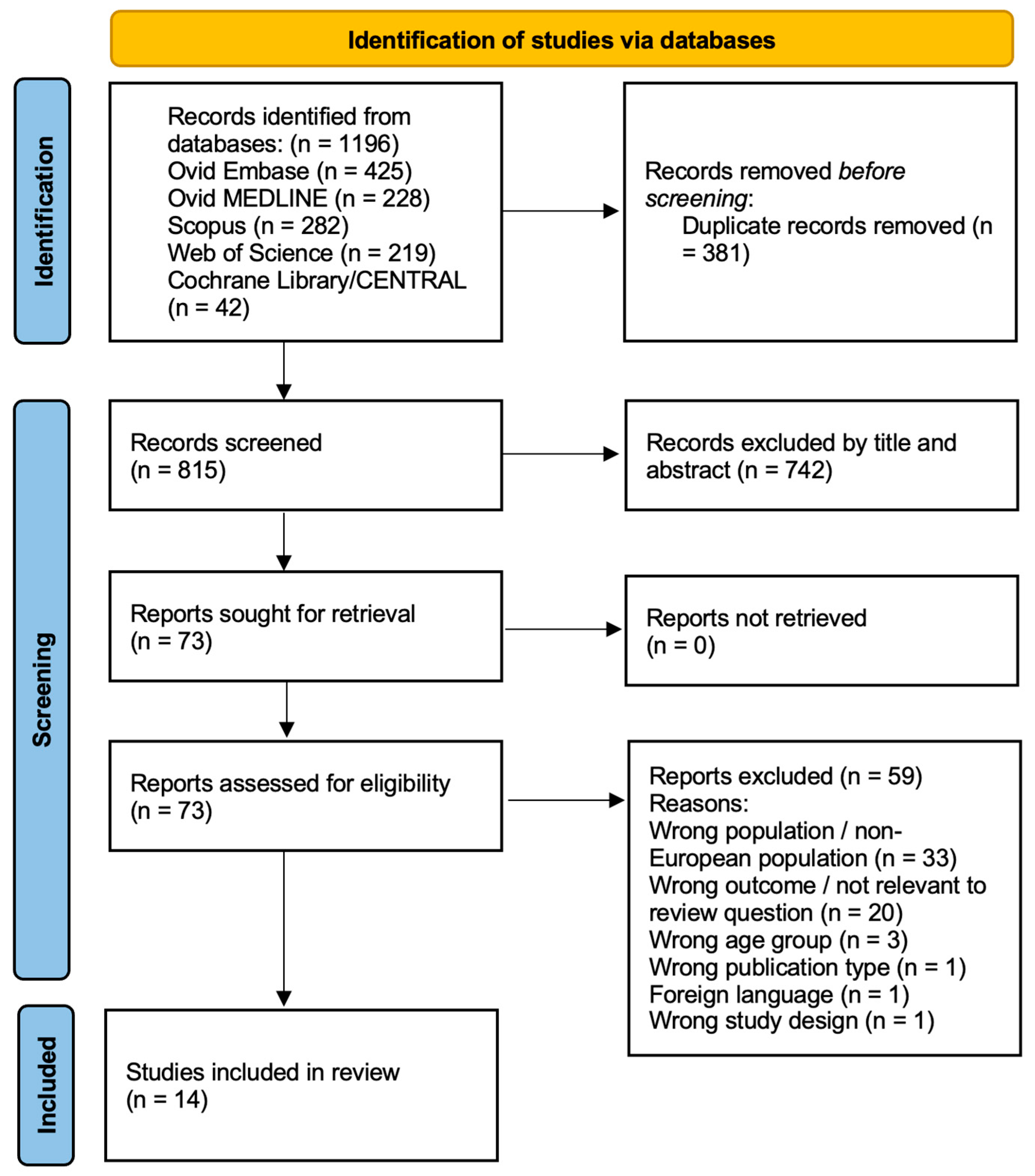
| OVID Embase | January 2026 | (myop* OR near-sightedness OR short-sightedness OR “refractive error”) AND (“screen time” OR smartphone* OR tablet* OR “digital device*” OR “computer use”) AND (adolescent* OR teenager* OR schoolchildren OR child* OR paediatric OR pediatric) | Language: English; publication years: 2016–2026 Age < 18 | 425 |
| OVID MEDLINE | January 2026 | (myop* OR near-sightedness OR short-sightedness OR “refractive error”) AND (“screen time” OR smartphone* OR tablet* OR “digital device*” OR “computer use”) AND (adolescent* OR teenager* OR schoolchildren OR child* OR paediatric OR pediatric) | Language: English; publication years: 2016–2026 Age < 18 | 228 |
| Scopus | July 2026 | TITLE-ABS-KEY (myop* OR “near-sightedness” OR “short-sightedness” OR “refractive error”) AND TITLE-ABS-KEY (“screen time” OR smartphone* OR tablet* OR “digital device*” OR “computer use”) AND TITLE-ABS-KEY (adolescent* OR teenager* OR schoolchildren OR child* OR paediatric OR pediatric) | English language; publication years 2016–2026; article | 282 |
| Web of Science | July 2026 | TS = (myop* OR “near-sightedness” OR “short-sightedness” OR “refractive error”) AND TS = (“screen time” OR smartphone* OR tablet* OR “digital device*” OR “computer use”) AND TS = (adolescent* OR teenager* OR schoolchildren OR child* OR paediatric OR pediatric) | English language; publication years 2016–2026; article | 219 |
| Cochrane Library/CENTRAL | July 2026 | (myop* OR “near-sightedness” OR “short-sightedness” OR “refractive error”) AND (“screen time” OR smartphone* OR tablet* OR “digital device*” OR “computer use”) AND (adolescent* OR teenager* OR schoolchildren OR child* OR paediatric OR paediatric) | Publication years 2016–2026; CENTRAL/trials | 42 |
References
- Flitcroft, D.I.; He, M.; Jonas, J.B.; Jong, M.; Naidoo, K.; Ohno-Matsui, K.; Rahi, J.; Resnikoff, S.; Vitale, S.; Yannuzzi, L. IMI—Defining and Classifying Myopia: A Proposed Set of Standards for Clinical and Epidemiologic Studies. Investig. Ophthalmol. Vis. Sci. 2019, 60, 20–30. [Google Scholar] [CrossRef] [Scilit] [PubMed]
- Fredrick, D.R. Myopia. BMJ 2002, 324, 1195–1199. [Google Scholar] [CrossRef] [Scilit] [PubMed]
- Saw, S.M.; Gazzard, G.; Shih-Yen, E.C.; Chua, W. Myopia and Associated Pathological Complications. Ophthalmic Physiol. Opt. 2005, 25, 381–391. [Google Scholar] [CrossRef] [Scilit] [PubMed]
- Flitcroft, D.I. The Complex Interactions of. Retinal, Optical and Environmental Factors in Myopia Aetiology. Prog. Retin. Eye Res. 2012, 31, 622–660. [Google Scholar] [CrossRef] [Scilit] [PubMed]
- Pan, W.; Morgan, I.G.; Flitcroft, I.; Rose, K.; Ostrin, L.A.; Rosenfield, M.; Govender-Poonsamy, P.; Siu-Villaseñor, D.; Kaymak, H.; Khew, J.M.; et al. The Need to Address the Myopia Pandemic: Summary Report of the Global Myopia Public. Health Summit 2024. Glob. Health Res. Policy 2025, 10, 45. [Google Scholar] [CrossRef] [Scilit] [PubMed]
- Lanca, C.; Saw, S.M. The Association between Digital Screen Time and Myopia: A Systematic Review. Ophthalmic Physiol. Opt. 2020, 40, 216–229. [Google Scholar] [CrossRef] [Scilit] [PubMed]
- Holden, B.A.; Fricke, T.R.; Wilson, D.A.; Jong, M.; Naidoo, K.S.; Sankaridurg, P.; Wong, T.Y.; Naduvilath, T.; Resnikoff, S. Global Prevalence of Myopia and High Myopia and Temporal Trends from 2000 through 2050. Ophthalmology 2016, 123, 1036–1042. [Google Scholar] [CrossRef] [Scilit] [PubMed]
- Saxena, R.; Vashist, P.; Tandon, R.; Pandey, R.M.; Bhardawaj, A.; Menon, V.; Mani, K. Prevalence of Myopia and Its Risk Factors in Urban School Children in Delhi: The North India Myopia Study (NIM Study). PLoS ONE 2015, 10, e0117349. [Google Scholar] [CrossRef] [Scilit] [PubMed]
- Morgan, I.G.; Ohno-Matsui, K.; Saw, S.M. Myopia. Lancet 2012, 379, 1739–1748. [Google Scholar] [CrossRef] [Scilit] [PubMed]
- Rose, K.A.; Morgan, I.G.; Ip, J.; Kifley, A.; Huynh, S.; Smith, W.; Mitchell, P. Outdoor Activity Reduces the Prevalence of Myopia in Children. Ophthalmology 2008, 115, 1279–1285. [Google Scholar] [CrossRef] [Scilit] [PubMed]
- Huang, H.M.; Chang, D.S.; Wu, P.C. The Association between Near Work Activities and Myopia in Children. PLoS ONE 2015, 10, e0140419. [Google Scholar] [CrossRef] [Scilit] [PubMed]
- Tideman, J.W.L.; Polling, J.R.; Jaddoe, V.W.; Vingerling, J.R.; Klaver, C.C. Environmental Risk Factors Can Reduce Axial Length Elongation and Myopia Incidence in 6- to 9-Year-Old Children. Ophthalmology 2019, 126, 127–136. [Google Scholar] [CrossRef] [Scilit] [PubMed]
- Wang, J.; Li, Y.; Musch, D.C.; Wei, N.; Qi, X.; Ding, G.; Li, X.; Li, J.; Song, L.; Zhang, Y.; et al. Progression of Myopia in School-Aged Children after COVID-19 Home Confinement. JAMA Ophthalmol. 2021, 139, 293–300. [Google Scholar] [CrossRef] [Scilit] [PubMed]
- Foreman, J.; Salim, A.T.; Praveen, A.; Fonseka, D.; Ting, D.S.W.; He, M.G.; Bourne, R.R.A.; Crowston, J.; Wong, T.Y.; Dirani, M. Association between Digital Smart Device Use and Myopia: A Systematic Review and Meta-Analysis. Lancet Digit. Health 2021, 3, e806–e818. [Google Scholar] [CrossRef] [Scilit] [PubMed]
- Page, M.J.; McKenzie, J.E.; Bossuyt, P.M.; Boutron, I.; Hoffmann, T.C.; Mulrow, C.D.; Shamseer, L.; Tetzlaff, J.M.; Akl, E.A.; Brennan, S.E.; et al. The PRISMA 2020 Statement: An Updated Guideline for Reporting Systematic Reviews. BMJ 2021, 372, n71. [Google Scholar] [CrossRef] [Scilit] [PubMed]
- Enthoven, C.A.; Tideman, J.W.L.; Polling, J.R.; Yang-Huang, J.; Raat, H.; Klaver, C.C.W. The Impact of Computer Use on Myopia Development in Childhood: The Generation R Study. Prev. Med. 2020, 132, 105988. [Google Scholar] [CrossRef] [Scilit] [PubMed]
- Hansen, M.H.; Laigaard, P.P.; Olsen, E.M.; Skovgaard, A.M.; Larsen, M.; Kessel, L.; Munch, I.C. Low Physical Activity and Higher Use of Screen Devices Are Associated with Myopia. Acta Ophthalmol. 2020, 98, 315–321. [Google Scholar] [CrossRef] [Scilit] [PubMed]
- Trovato Battagliola, E.; Mangiantini, P.; D’Andrea, M.; Malvasi, M.; Loffredo, L.; Scalinci, S.Z.; Comberiati, A.M.; Migliorini, R.; Pacella, E. Effect of COVID-19 Lockdown on Refractive Errors in Italian Children Aged 5–12 Years: A Multi-Center Retrospective Study. Eur. J. Ophthalmol. 2023, 33, 112–122. [Google Scholar] [CrossRef] [Scilit] [PubMed]
- Schuster, A.K.; Krause, L.; Kuchenbaecker, C.; Prütz, F.; Elflein, H.M.; Pfeiffer, N.; Urschitz, M.S. Prevalence and Time Trends in Myopia among Children and Adolescents: Results of the German KiGGS Study. Dtsch. Arztebl. Int. 2020, 117, 855–860. [Google Scholar] [CrossRef] [Scilit] [PubMed]
- McCrann, S.; Loughman, J.; Butler, J.S.; Paudel, N.; Flitcroft, D.I. Smartphone Use as a Possible Risk Factor for Myopia. Clin. Exp. Optom. 2021, 104, 35–41. [Google Scholar] [CrossRef] [Scilit] [PubMed]
- Enthoven, C.A.; Polling, J.R.; Verzijden, T.; Tideman, J.W.L.; Al-Jaffar, N.; Jansen, P.W.; Raat, H.; Metz, L.; Verhoeven, V.J.M.; Klaver, C.C.W. Smartphone Use Associated with Refractive Error in Teenagers: The Myopia App Study. Ophthalmology 2021, 128, 1681–1688. [Google Scholar] [CrossRef] [Scilit] [PubMed]
- Alvarez-Peregrina, C.; Sánchez-Tena, M.A.; Martinez-Perez, C.; Villa-Collar, C. The Relationship between Screen and Outdoor Time with Rates of Myopia in Spanish Children. Front. Public Health 2020, 8, 560378. [Google Scholar] [CrossRef] [Scilit] [PubMed]
- Harrington, S.C.; Stack, J.; O’Dwyer, V. Risk Factors Associated with Myopia in Schoolchildren in Ireland. Br. J. Ophthalmol. 2019, 103, 1803–1809. [Google Scholar] [CrossRef] [Scilit] [PubMed]
- Harrington, S.C.; O’Dwyer, V. The Association between Time Spent on Screens and Reading with Myopia, Premyopia and Ocular Biometric and Anthropometric Measures in 6- to 7-Year-Old Schoolchildren in Ireland. Ophthalmic Physiol. Opt. 2023, 43, 505–516. [Google Scholar] [CrossRef] [Scilit] [PubMed]
- Iyer, V.; Hermans, R.; Polling, J.R.; Klaver, C.; Reijneveld, S. Parental Behavior and Near Screen Use in Childhood: A Route to Reduce Screen Induced Myopia. Front. Public Health 2025, 13, 1621687. [Google Scholar] [CrossRef] [Scilit] [PubMed]
- Alvarez-Peregrina, C.; Martínez-Pérez, C.; Villa-Collar, C.; Andreu-Vázquez, C.; Ruiz-Pomeda, A.; Sánchez-Tena, M.Á. Impact of COVID-19 Home Confinement in Children’s Refractive Errors. Int. J. Environ. Res. Public Health 2021, 18, 5347. [Google Scholar] [CrossRef] [Scilit] [PubMed]
- Rudnicka, A.R.; Kapetanakis, V.V.; Wathern, A.K.; Logan, N.S.; Gilmartin, B.; Whincup, P.H.; Cook, D.G.; Owen, C.G. Global Variations and Time Trends in the Prevalence of Childhood Myopia: A Systematic Review and Quantitative Meta-Analysis. Br. J. Ophthalmol. 2016, 100, 882–890. [Google Scholar] [CrossRef] [Scilit] [PubMed]
- Sánchez-Tena, M.Á.; Martínez-Pérez, C.; Andreu-Vázquez, C.; Roque, A.; Alvarez-Peregrina, C. Factors Associated with Myopia in the Portuguese Child Population: An Epidemiological Study. Ophthalmic Physiol. Opt. 2025, 45, 542–549. [Google Scholar] [CrossRef] [Scilit] [PubMed]
- Nieves-Moreno, M.; Carracedo-Rodriguez, G.; Piñero-Llorens, D.P.; Valderas, L.B.; Recalde-Maestre, S.; García-Da-Silva, J.; Díaz-Vega, B.; Llorente-Gonzalez, S.; Alarcón-Tomás, M.; Lovera-Rivas, M.; et al. Prevalence and Risk Factors for Myopia in Primary School Children in Madrid: A School-Based Cycloplegic Refraction Study. Int. J. Environ. Res. Public Health 2025, 22, 1766. [Google Scholar] [CrossRef] [Scilit] [PubMed]
- He, M.; Xiang, F.; Zeng, Y.; Mai, J.; Chen, Q.; Zhang, J.; Smith, W.; Rose, K.; Morgan, I.G. Effect of Time Spent Outdoors at School on the Development of Myopia among Children in China: A Randomized Clinical Trial. JAMA 2015, 314, 1142–1148. [Google Scholar] [CrossRef] [Scilit] [PubMed]
- Wu, P.-C.; Tsai, C.-L.; Wu, H.-L.; Yang, Y.-H.; Kuo, H.-K. Outdoor Activity during Class Recess Reduces Myopia Onset and Progression in School Children. Ophthalmology 2013, 120, 1080–1085. [Google Scholar] [CrossRef] [Scilit] [PubMed]
- Feldkaemper, M.; Schaeffel, F. An Updated View on the Role of Dopamine in Myopia. Exp. Eye Res. 2013, 114, 106–119. [Google Scholar] [CrossRef] [Scilit] [PubMed]
- Xu, L.; Ma, Y.; Yuan, J.; Zhang, Y.; Wang, H.; Zhang, G.; Tu, C.; Lu, X.; Li, J.; Xiong, Y.; et al. COVID-19 Quarantine Reveals That Behavioral Changes Have an Effect on Myopia Progression. Ophthalmology 2021, 128, 1652–1654. [Google Scholar] [CrossRef] [Scilit] [PubMed]
- Pan, C.W.; Ramamurthy, D.; Saw, S.M. Worldwide Prevalence and Risk Factors for Myopia. Ophthalmic Physiol. Opt. 2012, 32, 3–16. [Google Scholar] [CrossRef] [Scilit] [PubMed]
- French, A.N.; Ashby, R.S.; Morgan, I.G.; Rose, K.A. Time Outdoors and the Prevention of Myopia. Exp. Eye Res. 2013, 114, 58–68. [Google Scholar] [CrossRef] [Scilit] [PubMed]
- Martinez-Perez, C.; Alvarez-Peregrina, C.; Villa-Collar, C.; Sánchez-Tena, M.Á. Analysing Myopia in Europe: A Comprehensive Meta-Analysis. Graefe’s Arch. Clin. Exp. Ophthalmol. 2026, 264, 647–665. [Google Scholar] [CrossRef] [Scilit] [PubMed]

| Study | Study Design | Selection | Comparability | Outcome/Exposure | Total NOS Score |
|---|---|---|---|---|---|
| Enthoven et al. (2020) [16] | Cohort study | 4/4 | 1/2 | 3/3 | 8/9 |
| Hansen et al. [17] | Cohort study | 3/4 | 1/2 | 2/3 | 6/9 |
| Trovato Battagliola et al. [18] | Cohort study | 3/4 | 1/2 | 3/3 | 7/9 |
| Study | Criteria for Inclusion Clearly Defined | Detailed Description of Subjects and Setting | Exposure Measured in a Valid and Reliable Way | Condition Measured Using Objective and Standard Criteria | Confounding Factors Identified | Strategies to Deal with Confounding Factors Stated | Outcomes Measured in a Valid and Reliable Way | Appropriate Statistical Analysis | Overall Risk of Bias |
|---|---|---|---|---|---|---|---|---|---|
| Schuster et al. [19] | Yes | Yes | Unclear | No | Yes | Yes | Unclear | Yes | Moderate |
| Mccrann et al. [20] | Unclear | Unclear | Yes | Yes | Unclear | Unclear | Yes | Unclear | Moderate |
| Enthoven et al. (2021) [21] | Yes | Yes | Yes | Yes | Yes | Yes | Yes | Yes | Low |
| Alvarez-Peregrina et al. (2020) [22] | Yes | Yes | Unclear | Yes | Yes | Yes | Yes | Yes | Moderate |
| Harrington et al. [23] | Yes | Yes | Unclear | Yes | Yes | Yes | Yes | Yes | Low |
| Harrington & O’dwyer [24] | Yes | Yes | Unclear | Yes | Yes | Yes | Yes | Yes | Low |
| Iyer et al. [25] | Yes | Yes | Yes | N/a | Yes | Yes | Yes | Yes | Moderate |
| Alvarez-Peregrina et al. (2021) [26] | Yes | Yes | Unclear | Yes | Yes | No | Yes | Yes | Moderate |
| Rudnicka et al. [27] | Yes | Yes | Unclear | N/a | Yes | Yes | Yes | Yes | Moderate |
| Sánchez-Tena et al. [28] | Yes | Yes | Unclear | Yes | Yes | Yes | Yes | Yes | Moderate |
| Nieves-Moreno et al. [29] | Yes | Yes | No | Yes | Yes | Yes | Yes | Yes | Moderate |
| Author | Year | Country | Study Design | Sample Size | Age Group | Exposure | Key Confounders Considered/Adjusted for | Main Findings |
|---|---|---|---|---|---|---|---|---|
| Schuster et al. [19] | 2020 | Germany | Cross-sectional | 17,640 | Children/adolescents | Time trends | Age, sex, time period/survey wave | Myopia prevalence increased |
| McCrann et al. [20] | 2021 | Ireland | Cross-sectional | 402 | Children | Smartphones | Age, sex, refractive status; proxy smartphone data use | Myopes used more smartphone data than non-myopes (1130.7 vs. 613.6 MB/day), suggesting a positive association. |
| Enthoven et al. [21] | 2021 | Netherlands | Cross-sectional | 525 | Adolescents | Smartphones | Age, sex, outdoor exposure, continuous smartphone use | Smartphone use of ≥20 min continuously was linked with more myopic refraction, especially with low outdoor time. |
| Alvarez-Peregrina et al. [22] | 2020 | Spain | Cross-sectional | 7497 | Children | Screens/outdoor time | Age, sex, outdoor time, screen time | Myopia prevalence was 19%; myopic children had more screen time and less outdoor time (p < 0.01), when compared to non-myopic children |
| Enthoven et al. [16] | 2020 | Netherlands | Cohort | 5074 | Children | Computer use | Age, sex, parental myopia, outdoor exposure, near work | Myopia prevalence was 11.5%; computer use and near work increased risk (OR 1.005–1.072). |
| Harrington et al. [23] | 2019 | Ireland | Cross-sectional | 1626 | Children | Near-work/lifestyle | Age, sex, physical activity, screen time, reading/near work | Over half of myopic children exceeded 2 h/day screen time, compared with approximately one-third of the overall population. |
| Harrington & O’Dwyer [24] | 2023 | Ireland | Cross-sectional | 723 | Children | Screens/reading | Age, sex, screen time, reading/near work, physical activity | Higher screen time was linked with more myopic refraction and increased odds of myopia |
| Iyer et al. [25] | 2025 | Netherlands | Cross-sectional | 395 | Children | Handheld screens | Parental myopia, parental awareness, screen-use behaviours | 26.0% used near screens for >2 h/day; myopic parents showed greater myopia awareness and were more likely to reduce children’s screen time. |
| Alvarez-Peregrina et al. [26] | 2021 | Spain | Cross-sectional | 703 | Children | COVID confinement | Age, screen time, near work, outdoor time, confinement-related behaviour | After COVID confinement, mean refraction shifted from +0.66 D to +0.48 D, with more near work and less outdoor time. |
| Hansen et al. [17] | 2020 | Denmark | Cohort | 1442 | Adolescents | Screens/activity | Age, sex, physical activity, screen-device use | Myopia prevalence was about 25%; >6 h/day screen use roughly doubled myopia risk. |
| Trovato Battagliola et al. [18] | 2021 | Italy | Cohort | 180 | Children | COVID lockdown | Age, lockdown-related lifestyle change, refractive status | Children showed a significant myopic shift after lockdown, suggesting worsening refractive error post-confinement. |
| Rudnicka AR et al. [27] | 2016 | UK | Cross-sectional | Multiple Studies | Children | Near-work/outdoor | Age, sex, ethnicity/geographical region, time trends | Childhood myopia varied globally and increased over time, with near work and low outdoor time implicated. |
| Sánchez-Tena et al. [28] | 2024 | Portugal | Cross-sectional | 1992 | Children | Parental myopia, outdoor activity and lifestyle factors | Parental myopia, outdoor activity, lifestyle factors | Myopia prevalence was 12.7%; parental myopia increased risk, while outdoor activity was protective. |
| Nieves-Moreno et al. [29] | 2025 | Spain | Cross-sectional | 2489 | Children | Screen time, outdoor activity, parental myopia | Age/grade, sex, parental myopia, outdoor activity, near work, screen time, socioeconomic status | Myopia prevalence was 6.5% in second grade and 18.7% in sixth grade. Parental myopia was a significant risk factor, outdoor activity was protective, and screen time was not independently associated with myopia after multivariate adjustment. |
Disclaimer/Publisher’s Note: The statements, opinions and data contained in all publications are solely those of the individual author(s) and contributor(s) and not of MDPI and/or the editor(s). MDPI and/or the editor(s) disclaim responsibility for any injury to people or property resulting from any ideas, methods, instructions or products referred to in the content. |
© 2026 by the authors. Licensee MDPI, Basel, Switzerland. This article is an open access article distributed under the terms and conditions of the Creative Commons Attribution (CC BY) license.
Share and Cite
Khalid, H.; Istanaksai, A.; Abbasi, M. Screen Time and Myopia-Related Outcomes in European Children: A Systematic Review. Vision 2026, 10, 43. https://doi.org/10.3390/vision10030043
Khalid H, Istanaksai A, Abbasi M. Screen Time and Myopia-Related Outcomes in European Children: A Systematic Review. Vision. 2026; 10(3):43. https://doi.org/10.3390/vision10030043
Chicago/Turabian StyleKhalid, Hammaad, Ali Istanaksai, and Mishelle Abbasi. 2026. "Screen Time and Myopia-Related Outcomes in European Children: A Systematic Review" Vision 10, no. 3: 43. https://doi.org/10.3390/vision10030043
APA StyleKhalid, H., Istanaksai, A., & Abbasi, M. (2026). Screen Time and Myopia-Related Outcomes in European Children: A Systematic Review. Vision, 10(3), 43. https://doi.org/10.3390/vision10030043