Article

Effect of Aqua Points Level on Speed, Efficiency, and Turn Performance in Youth Swimmers Aged 11–12 Years


by
Alejandro López-Hernández
1,*,
José Francisco Alonso Ramos
1,
Juan Ángel Simón Piqueras
2,
Miriam De la Torre Maroto
3 and
José María González Ravé
1,*
1
Sport Training Laboratory, Faculty of Sports Sciences, University of Castilla-La Mancha, 45071 Toledo, Spain
2
Faculty of Education of Albacete, University of Castilla-La Mancha, 02071 Albacete, Spain
3
Castilla-la-Mancha Swimming Federation, Castilla-la-Mancha, 02001 Albacete, Spain
*
Authors to whom correspondence should be addressed.
J. Funct. Morphol. Kinesiol. 2026, 11(3), 278; https://doi.org/10.3390/jfmk11030278
Submission received: 4 June 2026 / Revised: 9 July 2026 / Accepted: 15 July 2026 / Published: 18 July 2026

Abstract

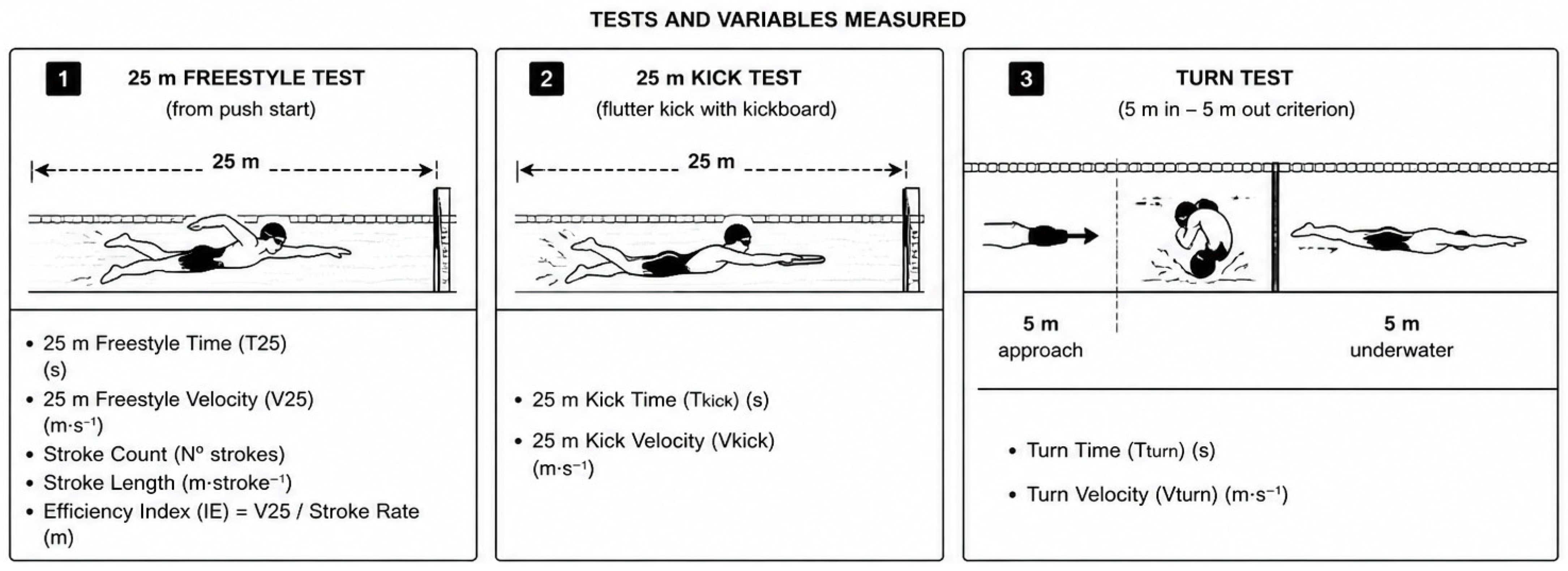
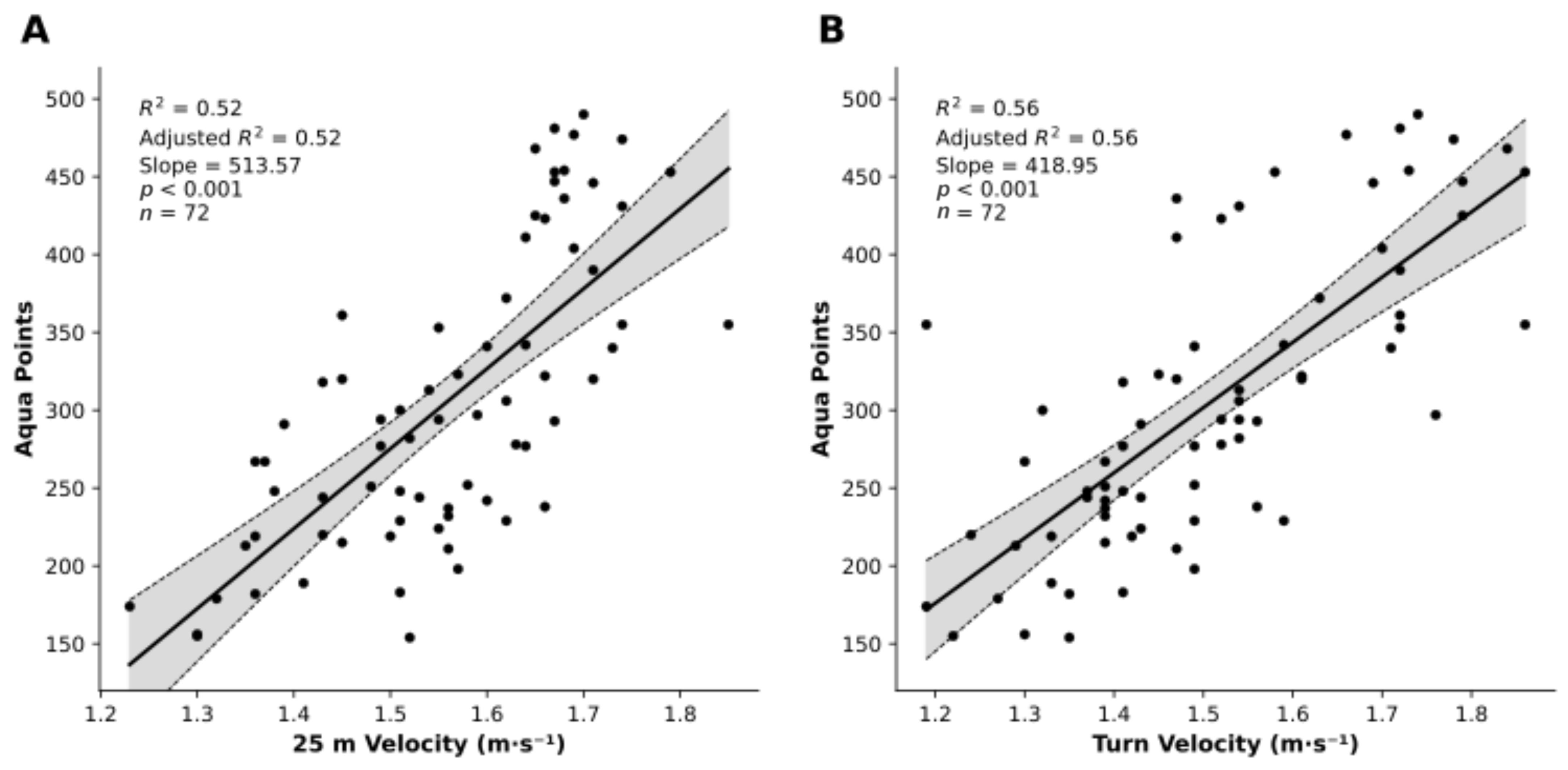
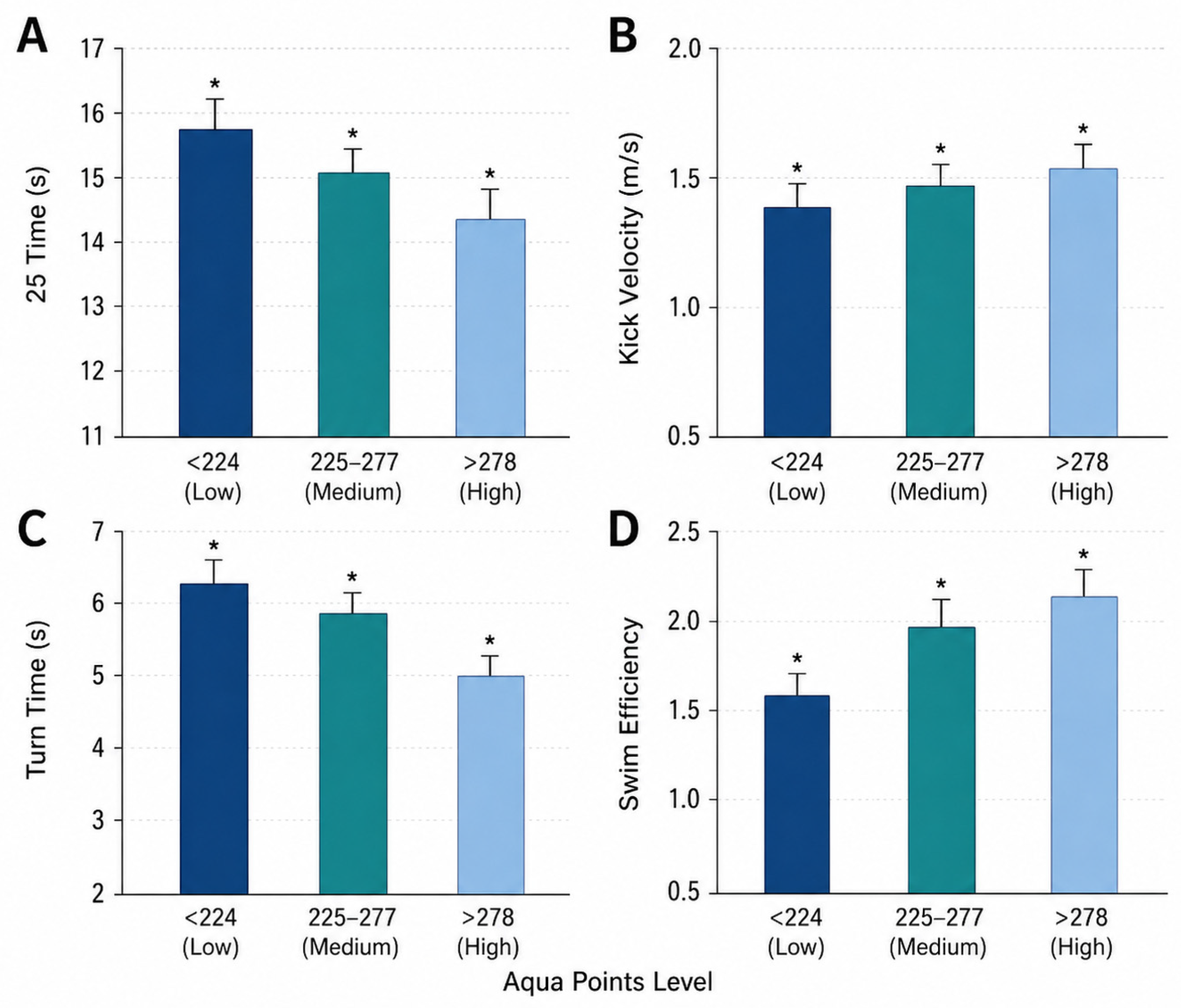
Background: This study aimed to identify the field-based technical and biomechanical variables that best discriminate and predict competitive performance in 11–12-year-old swimmers. Methods: Seventy-two federated swimmers were assessed during a controlled technical evaluation session conducted four weeks prior to the Under-13 (U–13) Regional Championship. Variables measured included 25 m freestyle time and velocity, 25 m kick time and velocity, turn time and velocity using the 5 m in–5 m out criterion, stroke count, stroke length, and swimming efficiency index. Aqua Points were obtained from official championship results held one month after testing. Swimmers were categorized into three performance groups according to Aqua Points classification: low, medium, and high competitive level. A multiple linear regression analysis was performed to identify predictors of competitive performance. Results: Significant differences were observed between competitive levels for 25 m freestyle time and velocity, kick performance, turn time and velocity, and swimming efficiency (p < 0.05), with progressive improvements as Aqua Points increased. Significant differences were also observed for stroke count and stroke length, suggesting that stroke mechanics contributed to performance differentiation within this age group. In the regression analysis, 25 m freestyle velocity and turn velocity emerged as the strongest predictors of competitive performance, while sex was a significant covariate. The final model explained a large proportion of the variance in Aqua Points (R2 = 0.846, adjusted R2 = 0.832, p < 0.001). Conclusions: Competitive level in 11–12-year-old swimmers is strongly associated with technical proficiency, particularly short-distance swimming speed and turn execution. These findings highlight the importance of technical development during formative stages and provide practical insights for coaching strategies.
Keywords: youth swimming; Aqua Points; biomechanics; turn performance; swimming efficiency; competitive level; field-based assessment youth swimming; Aqua Points; biomechanics; turn performance; swimming efficiency; competitive level; field-based assessment