

Effects of Aquatic Therapy on Fatigue, Mobility, Physical Function, and Quality of Life in People with Multiple Sclerosis: A Systematic Review and Meta-Analysis
 , ,
, ,  and
and 
Abstract
1. Introduction
2. Materials and Methods
2.1. Search Strategy
2.2. Eligibility Criteria
2.3. Data Extraction
2.4. Risk of Bias
2.5. Methodological Quality
2.6. Meta-Analysis
2.7. Certainty of Evidence Assessment
3. Results
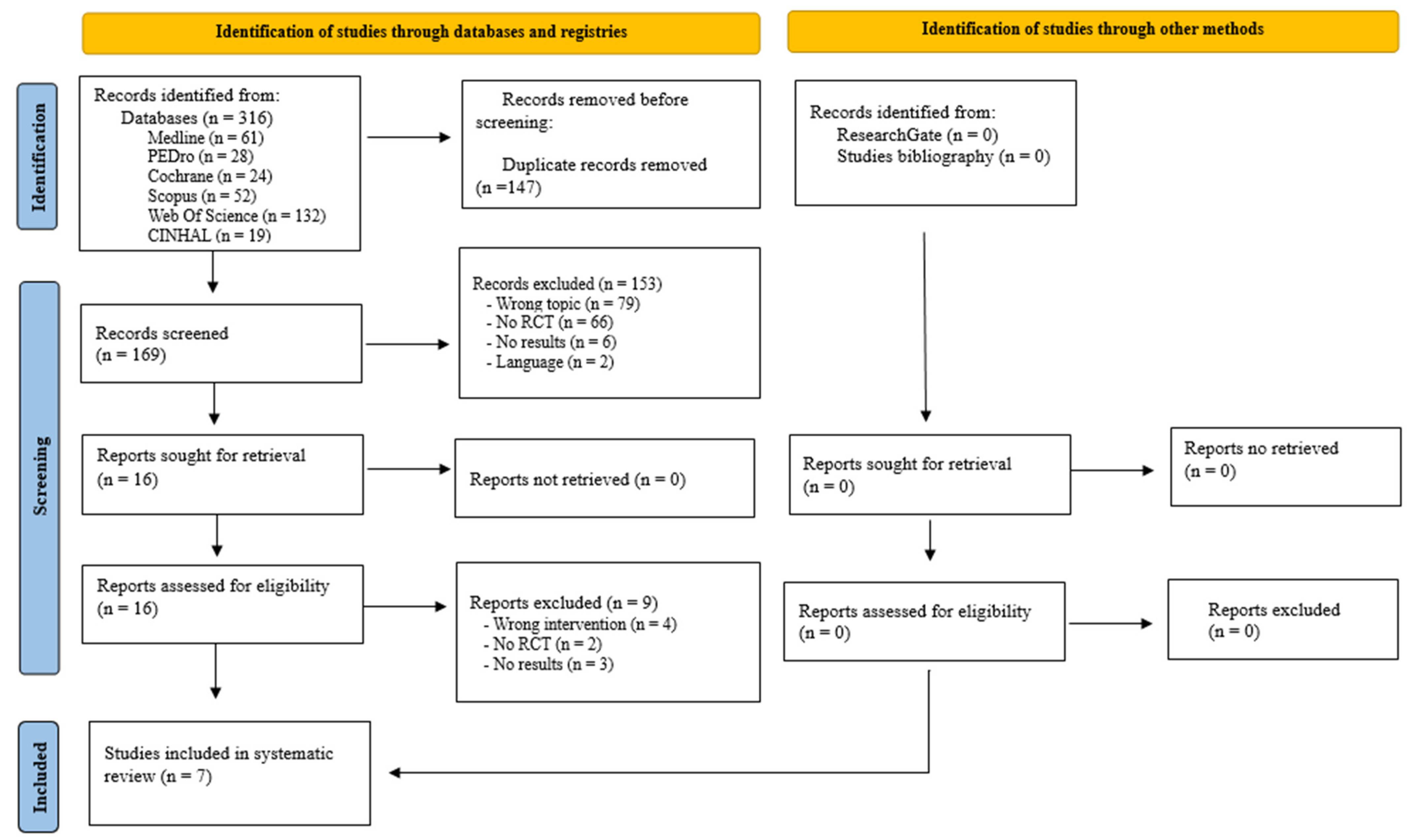
3.1. Study Selection
3.2. Study and Participants Characteristics
3.3. Methodological Quality
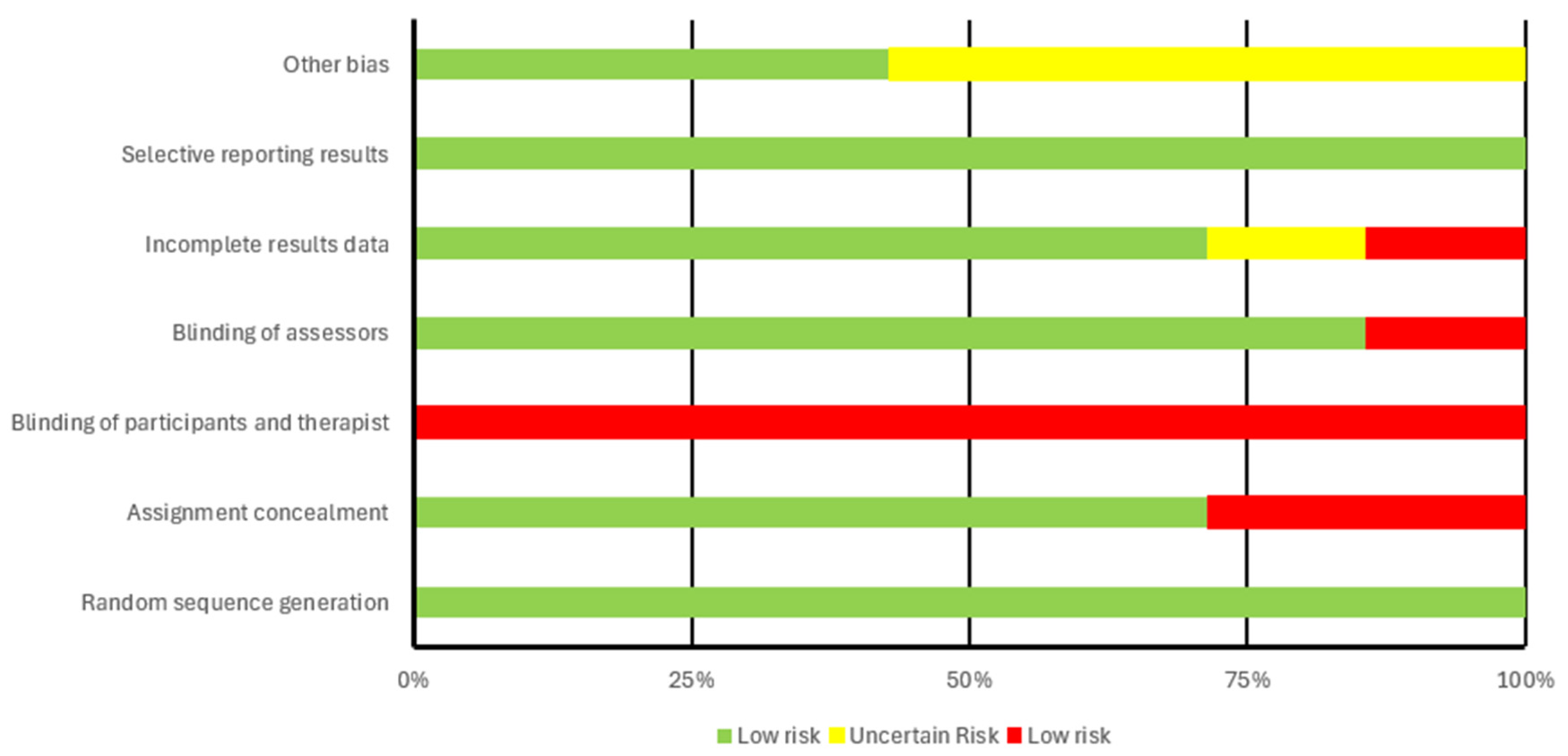
3.4. Bias Assessment
3.5. Meta-Analysis
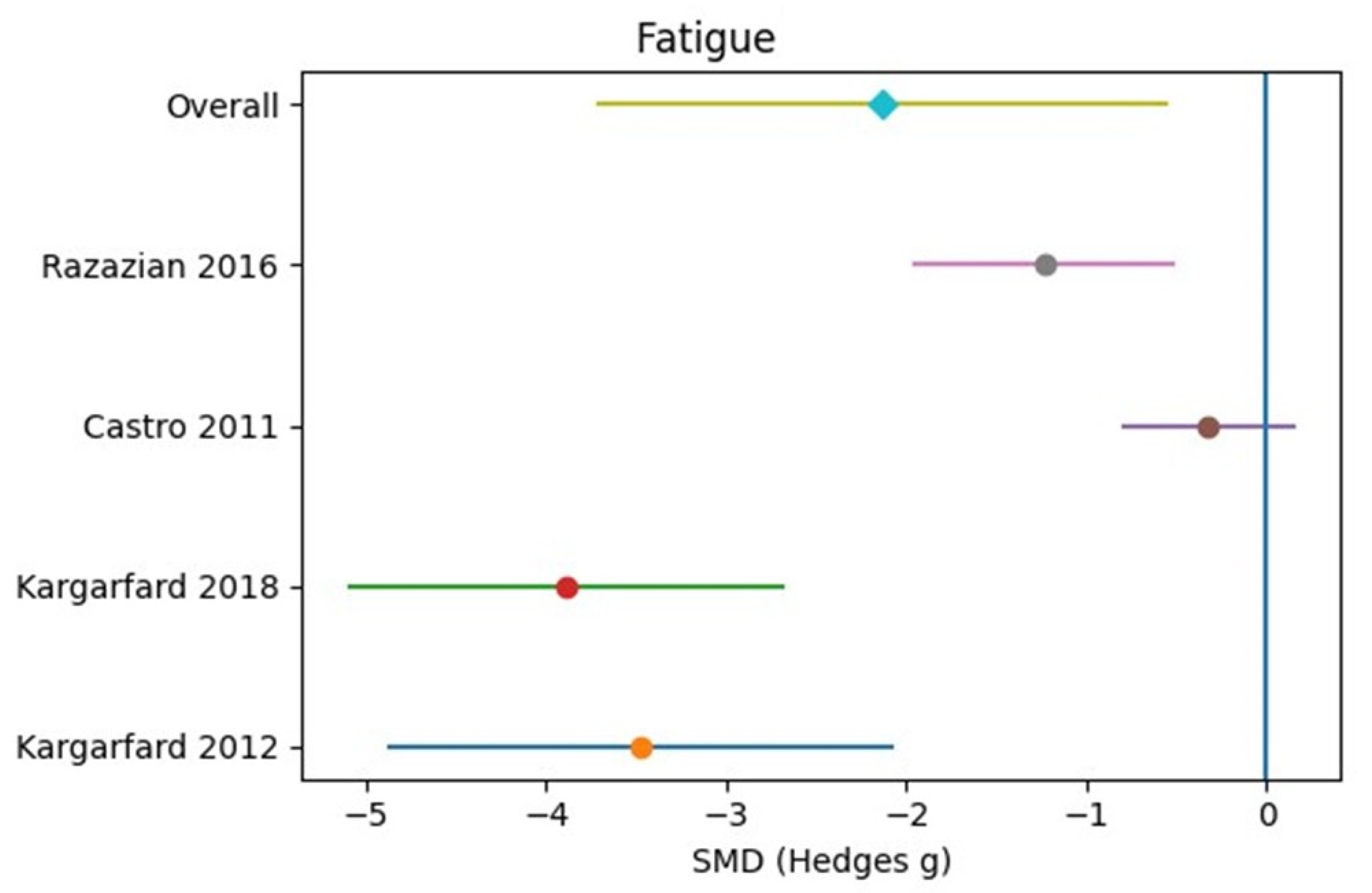
3.5.1. Fatigue
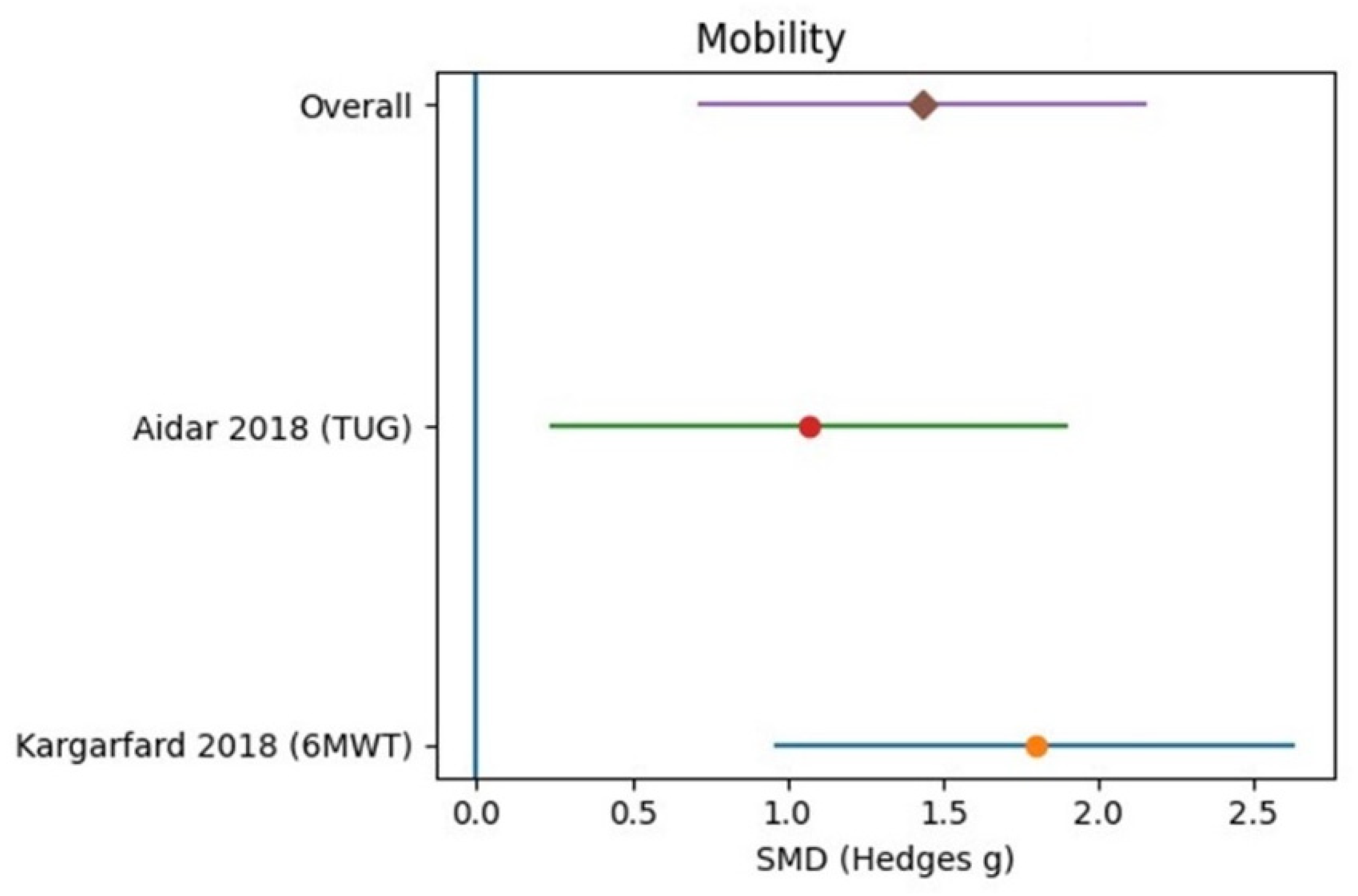
3.5.2. Mobility and Physical Function
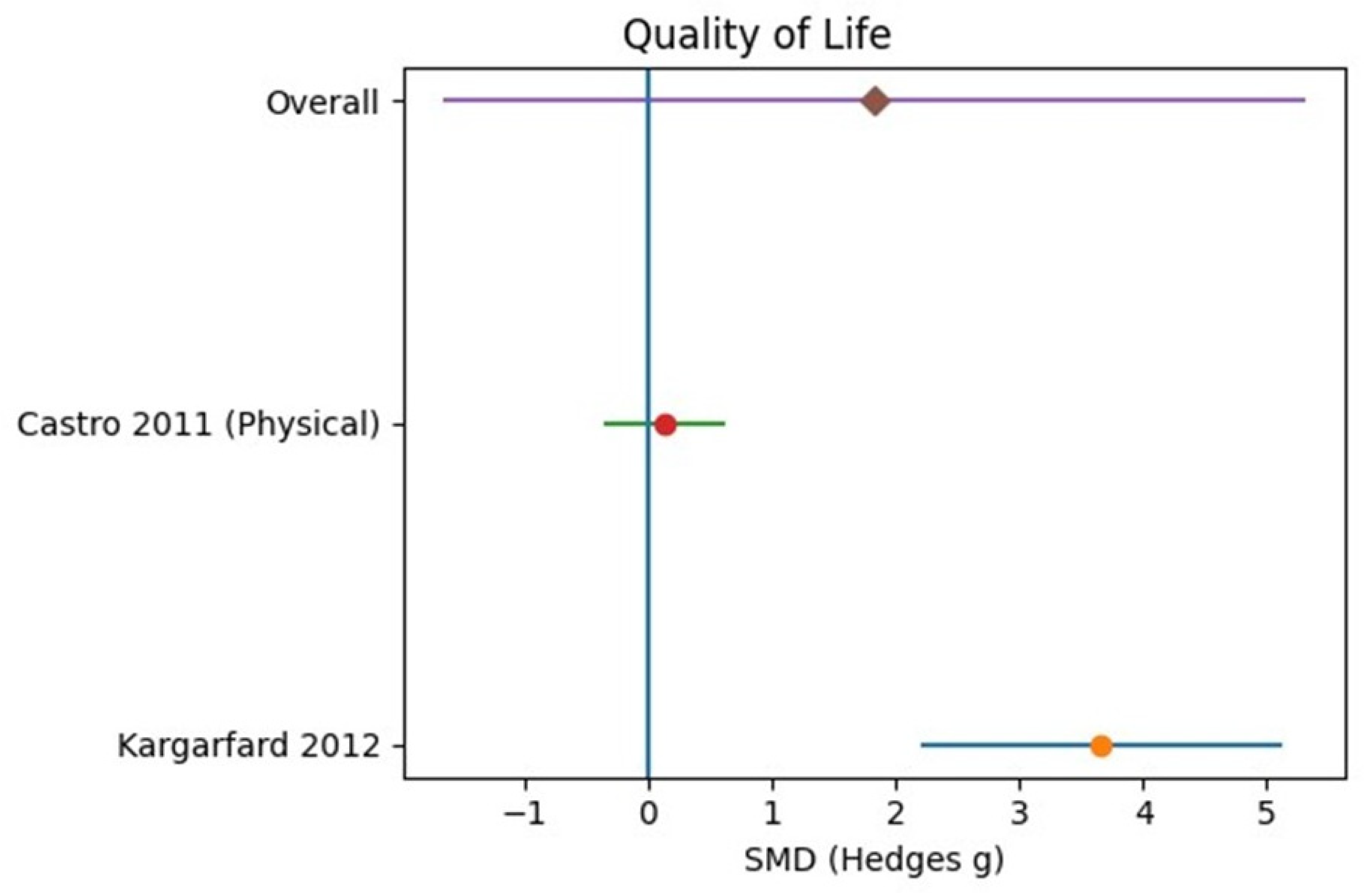
3.5.3. Quality of Life
3.5.4. Additional Outcomes (Qualitative Synthesis)
3.5.5. Overall Interpretation
3.5.6. Certainty of Evidence
4. Discussion
4.1. Integration of Quantitative and Qualitative Findings
4.2. Broader Clinical Effects
4.3. Clinical Implications
4.4. Limitations and Strengths
4.5. Practical Applications
5. Conclusions
Author Contributions
Funding
Institutional Review Board Statement
Informed Consent Statement
Data Availability Statement
Acknowledgments
Conflicts of Interest
Abbreviations
| 6MWT | Six-Minute Walk Test |
| BBS | Berg Balance Scale |
| BDNF | Brain-derived neurotrophic factor |
| CIs | Confidences Intervals |
| EDSS | Expanded Disability Status Scale |
| FSMC | Fatigue Scale for Motor and Cognitive Functions |
| FSS | Fatigue Severity Scale |
| GRADE | Grading of Recommendations Assessment, Development and Evaluation |
| MD | Mean differences |
| MeSH | Medical Subject Headings |
| MFIS | Modified Fatigue Impact Scale |
| MS | Multiple Sclerosis |
| MSIS-29 | Multiple Sclerosis Impact Scale |
| MSQoL-54 | Multiple Sclerosis Quality of Life-54 |
| PEDro | Physiotherapy Evidence Database |
| PRISMA | Preferred Reporting Items for Systematic Review and Meta-Analyses |
| QoL | quality of life |
| RCTs | Randomized Controlled Trials |
| SMD | Standardized mean differences |
| SF-36 | Item Short Form Survey |
| TUG | Timed up and go |
Appendix A

| Section and Topic | Item | Checklist Item | Location Where, Item Is Reported |
|---|---|---|---|
| TITLE | |||
| Title | 1 | Identify the report as a systematic review. | 1 |
| ABSTRACT | |||
| Abstract | 2 | See the PRISMA 2020 for Abstracts checklist. | 1–2 |
| INTRODUCTION | |||
| Rationale | 3 | Describe the rationale for the review in the context of existing knowledge. | 2–3 |
| Objectives | 4 | Provide an explicit statement of the objective(s) or question(s) the review addresses. | 3 |
| METHODS | |||
| Eligibility criteria | 5 | Specify the inclusion and exclusion criteria for the review and how studies were grouped for the syntheses. | 4 |
| Information sources | 6 | Specify all databases, registers, websites, organisations, reference lists and other sources searched or consulted to identify studies. Specify the date when each source was last searched or consulted. | 3–4 |
| Search strategy | 7 | Present the full search strategies for all databases, registers and websites, including any filters and limits used. | 3–4 and 23 |
| Selection process | 8 | Specify the methods used to decide whether a study met the inclusion criteria of the review, including how many reviewers screened each record and each report retrieved, whether they worked independently, and if applicable, details of automation tools used in the process. | 3–4 |
| Data collection process | 9 | Specify the methods used to collect data from reports, including how many reviewers collected data from each report, whether they worked independently, any processes for obtaining or confirming data from study investigators, and if applicable, details of automation tools used in the process. | 4 |
| Data items | 10a | List and define all outcomes for which data were sought. Specify whether all results that were compatible with each outcome domain in each study were sought (e.g., for all measures, time points, analyses), and if not, the methods used to decide which results to collect. | 4 |
| 10b | List and define all other variables for which data were sought (e.g., participant and intervention characteristics, funding sources). Describe any assumptions made about any missing or unclear information. | 4 | |
| Study risk of bias assessment | 11 | Specify the methods used to assess risk of bias in the included studies, including details of the tool(s) used, how many reviewers assessed each study and whether they worked independently, and if applicable, details of automation tools used in the process. | 5 |
| Effect measures | 12 | Specify for each outcome the effect measure(s) (e.g., risk ratio, mean difference) used in the synthesis or presentation of results. | 5 |
| Synthesis methods | 13a | Describe the processes used to decide which studies were eligible for each synthesis (e.g., tabulating the study intervention characteristics and comparing against the planned groups for each synthesis (item 5)). | 5 |
| 13b | Describe any methods required to prepare the data for presentation or synthesis, such as handling of missing summary statistics, or data conversions. | 5 | |
| 13c | Describe any methods used to tabulate or visually display results of individual studies and syntheses. | 5 | |
| 13d | Describe any methods used to synthesize results and provide a rationale for the choice(s). If meta-analysis was performed, describe the model(s), method(s) to identify the presence and extent of statistical heterogeneity, and software package(s) used. | 5 | |
| 13e | Describe any methods used to explore possible causes of heterogeneity among study results (e.g., subgroup analysis, meta-regression). | 5 | |
| 13f | Describe any sensitivity analyses conducted to assess robustness of the synthesized results. | 5 | |
| Reporting bias assessment | 14 | Describe any methods used to assess risk of bias due to missing results in a synthesis (arising from reporting biases). | 5 |
| Certainty assessment | 15 | Describe any methods used to assess certainty (or confidence) in the body of evidence for an outcome. | 5 |
| RESULTS | |||
| Study selection | 16a | Describe the results of the search and selection process, from the number of records identified in the search to the number of studies included in the review, ideally using a flow diagram. | 5–6 |
| 16b | Cite studies that might appear to meet the inclusion criteria, but which were excluded, and explain why they were excluded. | 5–6 | |
| Study characteristics | 17 | Cite each included study and present its characteristics. | 7–9 |
| Risk of bias in studies | 18 | Present assessments of risk of bias for each included study. | 10–11 |
| Results of individual studies | 19 | For all outcomes, present, for each study: (a) summary statistics for each group (where appropriate) and (b) an effect estimate and its precision (e.g., confidence/credible interval), ideally using structured tables or plots. | 7–8 |
| Results of syntheses | 20a | For each synthesis, briefly summarise the characteristics and risk of bias among contributing studies. | 12–14 |
| 20b | Present results of all statistical syntheses conducted. If meta-analysis was done, present for each the summary estimate and its precision (e.g., confidence/credible interval) and measures of statistical heterogeneity. If comparing groups, describe the direction of the effect. | 12–14 | |
| 20c | Present results of all investigations of possible causes of heterogeneity among study results. | 12–14 | |
| 20d | Present results of all sensitivity analyses conducted to assess the robustness of the synthesized results. | 12–14 | |
| Reporting biases | 21 | Present assessments of risk of bias due to missing results (arising from reporting biases) for each synthesis assessed. | 5 |
| Certainty of evidence | 22 | Present assessments of certainty (or confidence) in the body of evidence for each outcome assessed. | 14–15 |
| DISCUSSION | |||
| Discussion | 23a | Provide a general interpretation of the results in the context of other evidence. | 16–17 |
| 23b | Discuss any limitations of the evidence included in the review. | 17 | |
| 23c | Discuss any limitations of the review processes used. | 17 | |
| 23d | Discuss implications of the results for practice, policy, and future research. | 17–18 | |
| OTHER INFORMATION | |||
| Registration and protocol | 24a | Provide registration information for the review, including register name and registration number, or state that the review was not registered. | 3 |
| 24b | Indicate where the review protocol can be accessed, or state that a protocol was not prepared. | 3 | |
| 24c | Describe and explain any amendments to information provided at registration or in the protocol. | 3 | |
| Support | 25 | Describe sources of financial or non-financial support for the review, and the role of the funders or sponsors in the review. | 18 |
| Competing interests | 26 | Declare any competing interests of review authors. | 19 |
| Availability of data, code and other materials | 27 | Report which of the following are publicly available and where they can be found: template data collection forms; data extracted from included studies; data used for all analyses; analytic code; any other materials used in the review. | - |
Appendix B
| Databases | Search Strategy |
|---|---|
| PubMed | (“Multiple Sclerosis” [MeSH] OR “multiple sclerosis”) AND (“Hydrotherapy” [MeSH] OR “aquatic therapy” OR “aquatic exercise” OR “water-based exercise” OR “water-based therapy” OR “pool therapy” OR “aquatic rehabilitation”) |
| PEDro | (“multiple sclerosis”) AND (“aquatic therapy” OR “hydrotherapy” OR “aquatic exercise” OR “water-based exercise” OR “water-based therapy” OR “pool therapy”) |
| Cochrane Library | ([MeSH descriptor] “Multiple Sclerosis” explode all trees) AND (([MeSH descriptor] “Hydrotherapy” explode all trees) OR “aquatic therapy” OR “aquatic exercise” OR “water-based exercise” OR “water-based therapy” OR “pool therapy” OR “aquatic rehabilitation”) |
| Scopus | (TITLE-ABS-KEY (“multiple sclerosis” OR MS) AND TITLE-ABS-KEY (“hydrotherapy” OR “aquatic therapy” OR “aquatic exercise” OR “water-based exercise” OR “water-based therapy” OR “pool therapy” OR “aquatic rehabilitation”)) |
| Web of Science | TS = (“multiple sclerosis” OR MS) AND TS = (“hydrotherapy” OR “aquatic therapy” OR “aquatic exercise” OR “water-based exercise” OR “water-based therapy” OR “pool therapy” OR “aquatic rehabilitation”) |
| CINAHL | ((MH “Multiple Sclerosis+”) OR “multiple sclerosis”) AND ((MH “Hydrotherapy+”) OR “aquatic therapy” OR “aquatic exercise” OR “water-based exercise” OR “water-based therapy” OR “pool therapy” OR “aquatic rehabilitation”) |
Appendix C
| Outcome | Include Studies | Excluded Studies | Reason for Exclusion |
|---|---|---|---|
| Fatigue | Castro-Sánchez 2011 [18]; Kargarfard 2012 [33]; Kargarfard 2018 [32]; Razazian 2016 [35] | Bansi 2013 [43,44] | Insufficient quantitative data for pooling |
| Quality of life | Castro-Sánchez 2011 [18]; Kargarfard 2012 [33] | Bansi 2013 [43,44] | Outcome reporting format not suitable for extraction of mean ± SD values |
| Mobility and physical function | Aidar 2018 [34]; Kargarfard 2018 [32] | None | Not applicable |
References
- Goldenberg, M. Multiple Sclerosis Review. Pharm. Ther. 2012, 37, 175–184. [Google Scholar]
- Guamán Vera, L.A.; Bustamente Flor, E.G. Overview of Multiple Sclerosis. MJ. 2022, 4, 81–91. Available online: https://revista.estudioidea.org/ojs/index.php/mj/article/view/252 (accessed on 25 February 2026).
- García López, F.J.; García-Merino, A.; Alcalde-cabero, E.; de Pedro-Cuesta, J. Incidence and Prevalence of Multiple Sclerosis in Spain: A Systematic Review. Neurología 2024, 39, 639–650. [Google Scholar] [CrossRef] [PubMed]
- Reich, D.S.; Lucchinetti, C.F.; Calabresi, P.A. Multiple Sclerosis. N. Engl. J. Med. 2018, 378, 169–180. [Google Scholar] [CrossRef]
- Dobson, R.; Giovannoni, G. Multiple Sclerosis—A Review. Eur. J. Neurol. 2019, 26, 27–40. [Google Scholar] [CrossRef]
- Fołta, J.; Rzepka, Z.; Wrześniok, D. The Role of Inflammation in Neurodegenerative Diseases: Parkinson’s Disease, Alzheimer’s Disease, and Multiple Sclerosis. Int. J. Mol. Sci. 2025, 26, 5177. [Google Scholar] [CrossRef] [PubMed]
- Hauser, S.L.; Cree, B.A.C. Treatment of Multiple Sclerosis: A Review. Am. J. Med. 2020, 133, 1380–1390.e2. [Google Scholar] [CrossRef]
- Haki, M.; Al-Biati, H.A.; Al-Tameemi, Z.S.; Ali, I.S.; Al-Hussaniy, H.A. Review of Multiple Sclerosis: Epidemiology, Etiology, Pathophysiology, and Treatment. Medicine 2024, 103, e37297. [Google Scholar] [CrossRef]
- Snook, E.M.; Motl, R.W. Effect of Exercise Training on Walking Mobility in Multiple Sclerosis: A Meta-Analysis. Neurorehabil. Neural. Repair. 2009, 23, 108–116. [Google Scholar] [CrossRef]
- Manjaly, Z.M.; Harrison, N.A.; Critchley, H.D.; Do, C.T.; Stefanics, G.; Wenderoth, N.; Lutterotti, A.; Müller, A.; Stephan, K.E. Pathophysiological and Cognitive Mechanisms of Fatigue in Multiple Sclerosis. J. Neurol. Neurosurg. Psychiatry 2019, 90, 642–651. [Google Scholar] [CrossRef]
- Pérez-Carmona, N.; Fernández-Jover, E.; Sempere, Á.P. Epidemiology of Multiple Sclerosis in Spain. Rev. Neurol. 2019, 69, 32–38. [Google Scholar] [CrossRef] [PubMed]
- Asano, M.; Finlayson, M.L. Meta-Analysis of Three Different Types of Fatigue Management Interventions for People with Multiple Sclerosis: Exercise, Education, and Medication. Mult. Scler. Int. 2014, 2014, 798285. [Google Scholar] [CrossRef]
- Lublin, F.D.; Reingold, S.C.; Cohen, J.A.; Cutter, G.R.; Sørensen, P.S.; Thompson, A.J.; Wolinsky, J.S.; Balcer, L.J.; Banwell, B.; Barkhof, F.; et al. Defining the Clinical Course of Multiple Sclerosis: The 2013 Revisions. Neurology 2014, 83, 278–286. [Google Scholar] [CrossRef] [PubMed]
- Vister, E.; Tijsma, M.E.; Hoang, P.D.; Lord, S.R. Fatigue, Physical Activity, Quality of Life, and Fall Risk in People with Multiple Sclerosis. Int. J. MS Care 2017, 19, 91–98. [Google Scholar] [CrossRef]
- Cameron, M.H.; Nilsagard, Y. Balance, Gait, and Falls in Multiple Sclerosis. Handb. Clin. Neurol. 2018, 159, 237–250. [Google Scholar] [CrossRef]
- Acosta-Benito, M.Á.; Martín-Lesende, I. Frailty in primary care: Diagnosis and multidisciplinary management. Aten. Primaria 2022, 54, 102395. [Google Scholar] [CrossRef]
- Corvillo, I.; Varela, E.; Armijo, F.; Alvarez-Badillo, A.; Armijo, O.; Maraver, F. Efficacy of Aquatic Therapy for Multiple Sclerosis: A Systematic Review. Eur. J. Phys. Rehabil. Med. 2017, 53, 944–952. [Google Scholar] [CrossRef]
- Castro-Sánchez, A.M.; Matarán-Peñarrocha, G.A.; Lara-Palomo, I.; Saavedra-Hernández, M.; Arroyo-Morales, M.; Moreno-Lorenzo, C. Hydrotherapy for the Treatment of Pain in People with Multiple Sclerosis: A Randomized Controlled Trial. Evid. Based. Complement. Altern. Med. 2012, 2012, 473963. [Google Scholar] [CrossRef] [PubMed]
- Latimer-Cheung, A.E.; Martin Ginis, K.A.; Hicks, A.L.; Motl, R.W.; Pilutti, L.A.; Duggan, M.; Wheeler, G.; Persad, R.; Smith, K.M. Development of Evidence-Informed Physical Activity Guidelines for Adults with Multiple Sclerosis. Arch. Phys. Med. Rehabil. 2013, 94, 1829–1836.e7. [Google Scholar] [CrossRef]
- Heine, M.; van de Port, I.; Rietberg, M.B.; van Wegen, E.E.; Kwakkel, G. Exercise Therapy for Fatigue in Multiple Sclerosis. Cochrane Database Syst. Rev. 2015, 2015, CD009956. [Google Scholar] [CrossRef]
- Halabchi, F.; Alizadeh, Z.; Sahraian, M.A.; Abolhasani, M. Exercise Prescription for Patients with Multiple Sclerosis; Potential Benefits and Practical Recommendations. BMC Neurol. 2017, 17, 185. [Google Scholar] [CrossRef]
- Cerqueira, J.J.; Compston, D.A.S.; Geraldes, R.; Rosa, M.M.; Schmierer, K.; Thompson, A.; Tinelli, M.; Palace, J. Time Matters in Multiple Sclerosis: Can Early Treatment and Long-Term Follow-up Ensure Everyone Benefits from the Latest Advances in Multiple Sclerosis? J. Neurol. Neurosurg. Psychiatry 2018, 89, 844–850. [Google Scholar] [CrossRef]
- Scholz, M.; Haase, R.; Trentzsch, K.; Weidemann, M.L.; Ziemssen, T. Fear of Falling and Falls in People with Multiple Sclerosis: A Literature Review. Mult. Scler. Relat. Disord. 2021, 47, 102609. [Google Scholar] [CrossRef] [PubMed]
- Buhse, M. The Elderly Person With Multiple Sclerosis: Clinical Implications for the Increasing Life-Span. J. Neurosci. Nurs. 2015, 47, 333–339. [Google Scholar] [CrossRef] [PubMed]
- Vaughn, C.B.; Jakimovski, D.; Kavak, K.S.; Ramanathan, M.; Benedict, R.H.B.; Zivadinov, R.; Weinstock-Guttman, B. Epidemiology and Treatment of Multiple Sclerosis in Elderly Populations. Nat. Rev. Neurol. 2019, 15, 329–342. [Google Scholar] [CrossRef]
- Rietberg, M.B.; Brooks, D.; Uitdehaag, B.M.J.; Kwakkel, G. Exercise Therapy for Multiple Sclerosis. Cochrane Database Syst. Rev. 2005, 2005, CD003980. [Google Scholar] [CrossRef]
- Plecash, A.; Leavitt, B. Aquatherapy for Neurodegenerative Disorders. J. Huntingtons. Dis. 2014, 3, 5–11. [Google Scholar] [CrossRef] [PubMed]
- Dalgas, U.; Stenager, E.; Ingemann-Hansen, T. Multiple Sclerosis and Physical Exercise: Recommendations for the Application of Resistance-, Endurance- and Combined Training. Mult. Scler. 2008, 14, 35–53. [Google Scholar] [CrossRef]
- Becker, B.E. Aquatic Therapy: Scientific Foundations and Clinical Rehabilitation Applications. PM R 2009, 1, 859–872. [Google Scholar] [CrossRef]
- Mooventhan, A.; Nivethitha, L. Scientific Evidence-Based Effects of Hydrotherapy on Varius Systems of the Body. N. Am. J. Med. Sci. 2014, 6, 199–209. [Google Scholar] [CrossRef]
- Santamaría, G.; Fernández-Gorgojo, M.; Gutiérrez-Abejón, E.; García Gómez, B.; Molina, Á.; Fernández-Lázaro, D. Aquatic Therapy Versus Land-Based Therapy in Patients with Parkinson’s Disease: A Systematic Review. J. Funct. Morphol. Kinesiol. 2025, 10, 170. [Google Scholar] [CrossRef]
- Kargarfard, M.; Shariat, A.; Ingle, L.; Cleland, J.A.; Kargarfard, M. Randomized Controlled Trial to Examine the Impact of Aquatic Exercise Training on Functional Capacity, Balance, and Perceptions of Fatigue in Female Patients With Multiple Sclerosis. Arch. Phys. Med. Rehabil. 2018, 99, 234–241. [Google Scholar] [CrossRef]
- Kargarfard, M.; Etemadifar, M.; Baker, P.; Mehrabi, M.; Hayatbakhsh, R. Effect of Aquatic Exercise Training on Fatigue and Health-Related Quality of Life in Patients with Multiple Sclerosis. Arch. Phys. Med. Rehabil. 2012, 93, 1701–1708. [Google Scholar] [CrossRef]
- Aidar, F.J.; Gama De Matos, D.; De Souza, R.F.; Gomes, A.B.; Saavedra, F.; Garrido, N.; Carneiro, A.L.; Reis, V. Influence of Aquatic Exercises in Physical Condition in Patients with Multiple Sclerosis. J. Sports Med. Phys. Fit. 2018, 58, 684–689. [Google Scholar] [CrossRef]
- Razazian, N.; Yavari, Z.; Farnia, V.; Azizi, A.; Kordavani, L.; Bahmani, D.S.; Holsboer-Trachsler, E.; Brand, S. Exercising Impacts on Fatigue, Depression, and Paresthesia in Female Patients with Multiple Sclerosis. Med. Sci. Sports Exerc. 2016, 48, 796–803. [Google Scholar] [CrossRef]
- Page, M.J.; Moher, D.; Bossuyt, P.M.; Boutron, I.; Hoffmann, T.C.; Mulrow, C.D.; Shamseer, L.; Tetzlaff, J.M.; Akl, E.A.; Brennan, S.E.; et al. PRISMA 2020 Explanation and Elaboration: Updated Guidance and Exemplars for Reporting Systematic Reviews. BMJ 2021, 372, n160. [Google Scholar] [CrossRef]
- Santos, C.M.D.C.; Pimenta, C.A.D.M.; Nobre, M.R.C. The PICO Strategy for the Research Question Construction and Evidence Search. Rev. Lat. Am. Enferm. 2007, 15, 508–511. [Google Scholar] [CrossRef]
- Higgins, J.P.T.; Altman, D.G.; Gøtzsche, P.C.; Jüni, P.; Moher, D.; Oxman, A.D.; Savović, J.; Schulz, K.F.; Weeks, L.; Sterne, J.A.C. The Cochrane Collaboration’s Tool for Assessing Risk of Bias in Randomised Trials. BMJ 2011, 343, d5928. [Google Scholar] [CrossRef]
- Moseley, A.M.; Elkins, M.R.; Van der Wees, P.J.; Pinheiro, M.B. Using Research to Guide Practice: The Physiotherapy Evidence Database (PEDro). Braz. J. Phys. Ther. 2020, 24, 384–391. [Google Scholar] [CrossRef]
- Higgins, J.; Thomas, J.; Chandler, J.; Cumpston, M.; Page, M.; Welch, V. Cochrane Handbook for Systematic Reviews of Interventions, 2nd ed.; John Wiley & Sons: Chichester, UK, 2019. [Google Scholar]
- Higgins, J.P.T.; Thompson, S.G. Quantifying Heterogeneity in a Meta-Analysis. Stat. Med. 2002, 21, 1539–1558. [Google Scholar] [CrossRef]
- Guyatt, G.; Oxman, A.; Vist, G.; Kunz, R.; Falck-Ytter, Y.; Alonso-Coello, P.; Schünemann, H.; Group, G.W. GRADE: An Emerging Consensus on Rating Quality of Evidence and Strength of Recommendations. BMJ 2008, 336, 924–926. [Google Scholar] [CrossRef]
- Bansi, J.; Bloch, W.; Gamper, U.; Kesselring, J. Training in MS: Influence of Two Different Endurance Training Protocols (Aquatic versus Overland) on Cytokine and Neurotrophin Concentrations during Three Week Randomized Controlled Trial. Mult. Scler. 2013, 19, 613–621. [Google Scholar] [CrossRef]
- Bansi, J.; Bloch, W.; Gamper, U.; Riedel, S.; Kesselring, J. Endurance Training in MS: Short-Term Immune Responses and Their Relation to Cardiorespiratory Fitness, Health-Related Quality of Life, and Fatigue. J. Neurol. 2013, 260, 2993–3001. [Google Scholar] [CrossRef]
- Pilutti, L.A.; Paulseth, J.E.; Dove, C.; Jiang, S.; Rathbone, M.P.; Hicks, A.L. Exercise Training in Progressive Multiple Sclerosis: A Comparison of Recumbent Stepping and Body Weight-Supported Treadmill Training. Int. J. MS Care 2016, 18, 221–229. [Google Scholar] [CrossRef]
- Platta, M.E.; Ensari, I.; Motl, R.W.; Pilutti, L.A. Effect of Exercise Training on Fitness in Multiple Sclerosis: A Meta-Analysis. Arch. Phys. Med. Rehabil. 2016, 97, 1564–1572. [Google Scholar] [CrossRef]
- Salem, Y.; Scott, A.H.; Karpatkin, H.; Concert, G.; Haller, L.; Kaminsky, E.; Weisbrot, R.; Spatz, E. Community-Based Group Aquatic Programme for Individuals with Multiple Sclerosis: A Pilot Study. Disabil. Rehabil. 2011, 33, 720–728. [Google Scholar] [CrossRef]
- Scorcine, C.; Veríssimo, S.; Couto, A.; Madureira, F.; Guedes, D.; Fragoso, Y.D.; Colantonio, E. Effect of 12 Weeks of Aquatic Strength Training on Individuals with Multiple Sclerosis. Arq. Neuropsiquiatr. 2022, 80, 505–509. [Google Scholar] [CrossRef]
- Marín Hernández, M.; De la Valle Pérez, M.; Flores Gandolfo, L. ¿Qué Aporta Realmente La Terapia Acuática a La Esclerosis Múltiple? Una Visión Desde La Terapia Ocupacional. Act. Acuáticas 2020, 4, 18–26. [Google Scholar] [CrossRef]
- Learmonth, Y.C.; Motl, R.W. Physical Activity and Exercise Training in Multiple Sclerosis: A Review and Content Analysis of Qualitative Research Identifying Perceived Determinants and Consequences. Disabil. Rehabil. 2016, 38, 1227–1242. [Google Scholar] [CrossRef]
- Diechmann, M.D.; Campbell, E.; Coulter, E.; Paul, L.; Dalgas, U.; Hvid, L.G. Effects of Exercise Training on Neurotrophic Factors and Subsequent Neuroprotection in Persons with Multiple Sclerosis-A Systematic Review and Meta-Analysis. Brain Sci. 2021, 11, 1499. [Google Scholar] [CrossRef]


| Author (Year, Country) | Study Design | Sample Characteristics | Intervention | Outcomes Assessed | Main Results (GI vs. GC) |
|---|---|---|---|---|---|
| Aidar et al. [34] (2018, Brazil) | RCT | n = 28 (final n = 26), EDSS ≤ 7.5 | GI: Aquatic therapy GC: Activities of daily living | Gait speed; BBS; TUG; strength; BMI | ↑ * Gait speed; ↓ * TUG; ↑ * BBS; ↑ * strength; ↓ * BMI |
| Bansi et al. [43] (2013, Switzerland) | RCT | n = 60 (final n = 52), EDSS 1–6.5 | GI: Aquatic cycling GC: Land cycling | Fatigue (FSMC); CPET; biomarkers | ↓ * FSMC; ↔ CPET; ↑ BDNF, TNFα; ↓ IL-6, NGF |
| Bansi et al. [44] (2013, Switzerland) | RCT | n = 60 (final n = 52), EDSS 1–6.5 | GI: Aquatic cycling GC: Land cycling | Fatigue (FSMC, MFIS); QoL (SF-36); CPET | ↓ MFIS; ↓ FSMC; ↑ SF-36; ↑ CPET |
| Castro-Sánchez et al. [18] (2011, Spain) | RCT | n = 73 (final n = 71), PPMS, SPMS, EDSS ≤ 7.5 | GI: Ai-Chi GC: Land therapy | Fatigue (MFIS); QoL (MSIS-29); depression | ↓ * MFIS; ↓ * MSIS-29; ↓ * BDI |
| Kargarfard et al. [33] (2012, Iran) | RCT | n = 32 (final n = 21), RRMS, EDSS ≤ 3.5 | GI: Aquatic therapy GC: Activities of daily living | Fatigue (MFIS); QoL (MSQOL-54) | ↓ * MFIS; ↑ * MSQOL-54 |
| Kargarfard et al. [32] (2018, multicentre) | RCT | n = 40 (final n = 32), RRMS, EDSS ≤ 3.5 | GI: Aquatic therapy GC: Activities of daily living | Fatigue (MFIS); 6MWT; BBS; strength | ↓ * MFIS; ↑ * 6MWT; ↑ * BBS; ↑ * strength |
| Razazian et al. [35] (2016, Iran) | RCT | n = 54, RRMS, SPMS, EDSS ≤ 7.5 | GI: Aquatic therapy; GY: Yoga; GC: Activities of daily living | Fatigue (FSS); Depression (BDI); Paresthesia (VAS) | ↓ * FSS; ↓ * BDI; ↓ * VAS |
| Author (Year) | Intervention Type | Intensity | Temperature (°C) | Frequency | Session Duration | Duration (Weeks) | Supervision |
|---|---|---|---|---|---|---|---|
| Aidar et al. [34] (2018) | Aquatic exercise (walking, cycling, strength) | Not specified | Not controlled | 3/week | 45–60 min | 12 | Yes |
| Bansi et al. [43] (2013) | Aquatic cycling | ~70% HR | 28 | Daily | 30 min | 3 | Yes |
| Bansi et al. [44] (2013) | Aquatic cycling | ~70% HR | 28 | Daily | 30 min | 3 | Yes |
| Castro-Sánchez et al. [18] (2011) | Ai-Chi (aquatic mind–body exercise) | Not specified | 36 | 2/week | 60 min | 20 | Yes |
| Kargarfard et al. [33] (2012) | Multicomponent aquatic therapy | 50–75% HR | 28–30 | 3/week | 60 min | 8 | Yes |
| Kargarfard et al. [32] (2018) | Aquatic therapy (balance and gait) | 50–75% HR | 28–30 | 3/week | 60 min | 8 | Yes |
| Razazian et al. [35] (2016) | Aquatic strength and endurance training | Not specified | 28–30 | 3/week | 60 min | 8 | Yes |
| Study | Item | Total | ||||||||||
|---|---|---|---|---|---|---|---|---|---|---|---|---|
| 1 | 2 | 3 | 4 | 5 | 6 | 7 | 8 | 9 | 10 | 11 | ||
| Aidar et al. [34] 2018 | X | 1 | 0 | 1 | 0 | 0 | 0 | 1 | 1 | 1 | 1 | 6/10 (G) |
| Bansi et al. [43] 2013 | X | 1 | 1 | 1 | 0 | 0 | 1 | 1 | 0 | 1 | 1 | 7/10 (G) |
| Bansi et al. [44] 2013 | X | 1 | 1 | 1 | 0 | 0 | 1 | 1 | 0 | 1 | 1 | 7/10 (G) |
| Castro-Sánchez et al. [18] 2011 | X | 1 | 1 | 1 | 0 | 0 | 1 | 1 | 0 | 1 | 1 | 7/10 (G) |
| Kargarfard et al. [33] 2012 | X | 1 | 1 | 1 | 0 | 0 | 1 | 0 | 1 | 1 | 1 | 7/10 (G) |
| Kargarfard et al. [32] 2018 | X | 1 | 1 | 1 | 0 | 0 | 1 | 1 | 1 | 1 | 1 | 8/10 (G) |
| Razazian et al. [35] 2016 | X | 1 | 0 | 1 | 0 | 0 | 1 | 1 | 0 | 1 | 1 | 6/10 (G) |
| Study | Item | ||||||
|---|---|---|---|---|---|---|---|
| 1 | 2 | 3 | 4 | 5 | 6 | 7 | |
| Aidar et al. [34] 2018 |  |  | | | | | |
| Bansi et al. [43] 2013 | | | | | | |  |
| Bansi et al. [44] 2013 | | | | | | | |
| Castro-Sanchez et al. [18] 2011 | | | | | | | |
| Kargarfard et al. [33] 2012 | | | | | | | |
| Kargarfard et al. [32] 2018 | | | | | | | |
| Razazian et al. [35] 2016 | | | | | | | |
| Outcome | No of Studies | Total Participants (Approx.) | Effect Size (SMD, 95% CI) | Heterogeneity (I2) | Certainty of Evidence (GRADE) | Interpretation |
|---|---|---|---|---|---|---|
| Fatigue | 4 | 160 | −1.20 (−1.90 to −0.60) | High (I2 = 85%) | ⨁⨁◯◯ (Low) | Large reduction in fatigue, although substantial heterogeneity limits confidence in the pooled estimate |
| Mobility | 2 | 58 | 0.70 (0.20 to 1.20) | Low (I2 = 0%) | ⨁⨁⨁◯ (Moderate) | Moderate improvement in mobility with relatively consistent effects across studies |
| Quality of Life | 2 | 92 | 0.45 (0.05 to 0.85) | Low (I2 = 12%) | ⨁⨁◯◯ (Low) | Small-to-moderate improvement in quality of life, although evidence remains limited |
| Strength * | 2 | 58 | Not pooled | — | ⨁⨁◯◯ (Low) | Consistent improvements reported qualitatively |
| Balance * | 2 | 58 | Not pooled | — | ⨁⨁◯◯ (Low) | Improvements observed, although based on limited data |
Disclaimer/Publisher’s Note: The statements, opinions and data contained in all publications are solely those of the individual author(s) and contributor(s) and not of MDPI and/or the editor(s). MDPI and/or the editor(s) disclaim responsibility for any injury to people or property resulting from any ideas, methods, instructions or products referred to in the content. |
© 2026 by the authors. Licensee MDPI, Basel, Switzerland. This article is an open access article distributed under the terms and conditions of the Creative Commons Attribution (CC BY) license.
Share and Cite
Santamaría, G.; Jiménez-Callejo, E.; Rodríguez López, N.; Cacharro, L.M.; Gutiérrez-Abejón, E.; Sánchez-Valdeón, L.; Fernández-Lázaro, D. Effects of Aquatic Therapy on Fatigue, Mobility, Physical Function, and Quality of Life in People with Multiple Sclerosis: A Systematic Review and Meta-Analysis. J. Funct. Morphol. Kinesiol. 2026, 11, 219. https://doi.org/10.3390/jfmk11020219
Santamaría G, Jiménez-Callejo E, Rodríguez López N, Cacharro LM, Gutiérrez-Abejón E, Sánchez-Valdeón L, Fernández-Lázaro D. Effects of Aquatic Therapy on Fatigue, Mobility, Physical Function, and Quality of Life in People with Multiple Sclerosis: A Systematic Review and Meta-Analysis. Journal of Functional Morphology and Kinesiology. 2026; 11(2):219. https://doi.org/10.3390/jfmk11020219
Chicago/Turabian StyleSantamaría, Gema, Elena Jiménez-Callejo, Noelia Rodríguez López, Luis M. Cacharro, Eduardo Gutiérrez-Abejón, Leticia Sánchez-Valdeón, and Diego Fernández-Lázaro. 2026. "Effects of Aquatic Therapy on Fatigue, Mobility, Physical Function, and Quality of Life in People with Multiple Sclerosis: A Systematic Review and Meta-Analysis" Journal of Functional Morphology and Kinesiology 11, no. 2: 219. https://doi.org/10.3390/jfmk11020219
APA StyleSantamaría, G., Jiménez-Callejo, E., Rodríguez López, N., Cacharro, L. M., Gutiérrez-Abejón, E., Sánchez-Valdeón, L., & Fernández-Lázaro, D. (2026). Effects of Aquatic Therapy on Fatigue, Mobility, Physical Function, and Quality of Life in People with Multiple Sclerosis: A Systematic Review and Meta-Analysis. Journal of Functional Morphology and Kinesiology, 11(2), 219. https://doi.org/10.3390/jfmk11020219