
Metabolic, Cardiovascular, and Stress Biomarker Adaptations to Breath-Hold Training in a National-Level Swimmer: A Signal-Generating Single-Case Study

 ,
,  ,
,
Abstract
1. Introduction
2. Materials and Methods
2.1. Participant Characteristics and Screening Procedures
2.2. BHT Intervention
2.3. Mader Incremental Cycling Test
2.4. Pulmonary Function Evaluation (Spirometry and DLCO)
2.5. Cardiopulmonary Exercise Assessment (CPET)
2.6. Salivary Biomarker Collection and Analysis
2.7. Data Processing and Analysis
3. Results
3.1. Participant Characteristics and Baseline Screening
3.2. BHT Protocol Adherence and Individualization
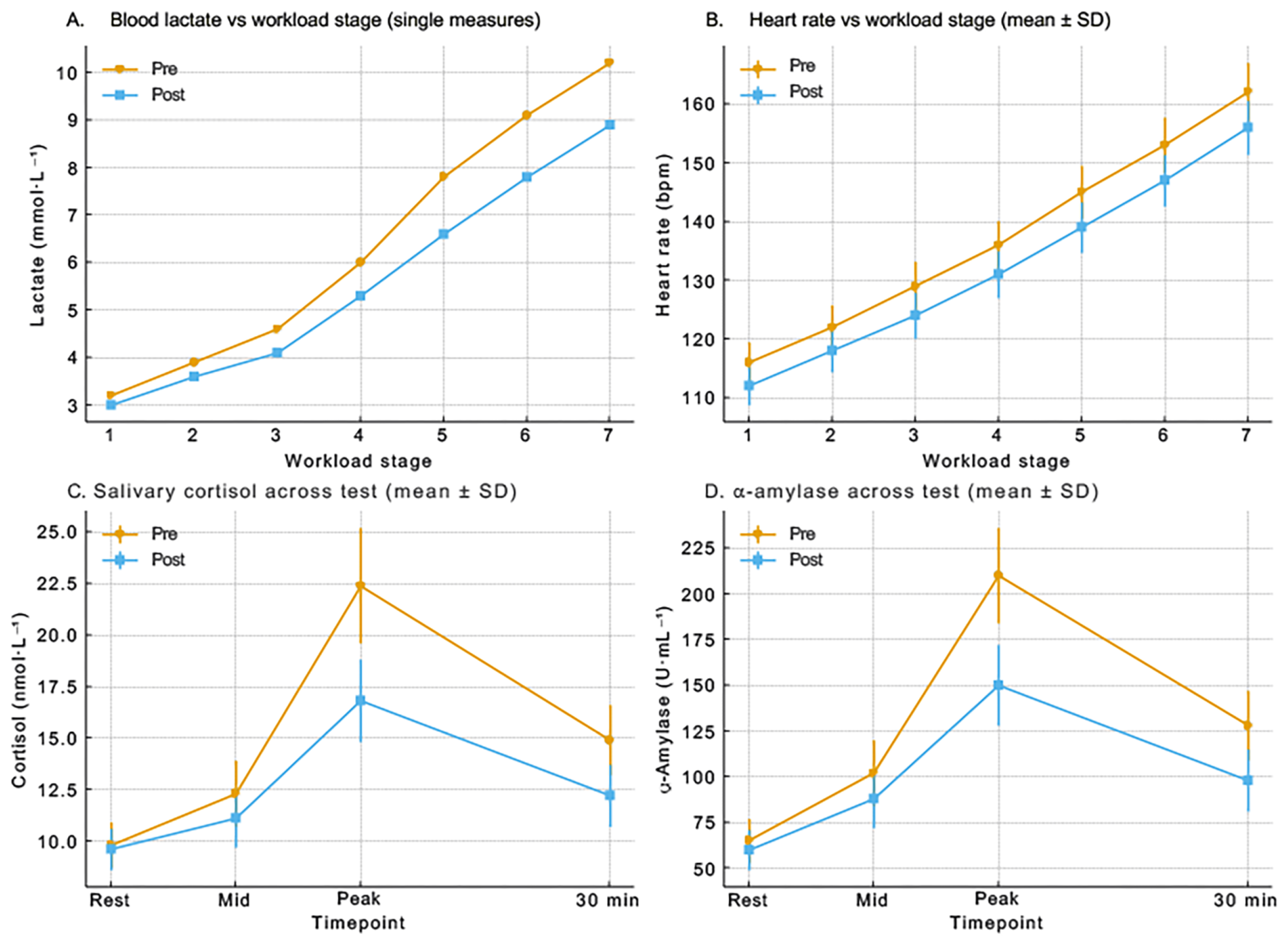
3.3. Functional and Physiological Outcomes
3.3.1. Incremental Cycling Test (Mader Protocol)
3.3.2. Pulmonary Function Testing (Spirometry and DLCO)
3.3.3. Cardiopulmonary Exercise Testing (CPET)
3.3.4. Salivary Biomarkers of Stress (sCort and sAA)
3.4. Reliability and Measurement Uncertainty
4. Discussion
4.1. Metabolic Adaptations and Blood Lactate Accumulation
4.2. Cardiovascular and Autonomic Modulation
4.3. Neuroendocrine Response
4.4. Pulmonary Function and Gas Exchange Efficiency
4.5. Individualization and Practical Implications
4.6. Methodological Considerations and Limitations
5. Conclusions
Supplementary Materials
Author Contributions
Funding
Institutional Review Board Statement
Informed Consent Statement
Data Availability Statement
Acknowledgments
Conflicts of Interest
References
- Schagatay, E. Predicting performance in competitive apnea diving, part II: Dynamic apnoea. Diving Hyperb. Med. 2010, 40, 11–22. [Google Scholar]
- Bruce, C.D.; Vanden Berg, E.R.; Pfoh, J.R.; Steinback, C.D.; Day, T.A. Prior oxygenation, but not chemoreflex responsiveness, determines breath-hold duration during voluntary apnea. Physiol. Rep. 2021, 9, e14862. [Google Scholar] [CrossRef]
- Torres-Peralta, R.; Morales-Alamo, D.; Gonzalez-Izal, M.; Losa-Reyna, J.; Perez-Suarez, I.; Izquierdo, M.; Calbet, J.A. Task failure during exercise to exhaustion in normoxia and hypoxia is due to reduced muscle activation caused by central mechanisms while muscle metaboreflex does not limit performance. Front. Physiol. 2016, 6, 414. [Google Scholar] [CrossRef]
- Navarrete-Opazo, A.; Mitchell, G.S. Therapeutic potential of intermittent hypoxia: A matter of dose. Am. J. Physiol. Regul. Integr. Comp. Physiol. 2014, 307, R1181–R1197. [Google Scholar] [CrossRef] [PubMed]
- Burtscher, J.; Citherlet, T.; Camacho-Cardenosa, A.; Camacho-Cardenosa, M.; Raberin, A.; Krumm, B.; Hohenauer, E.; Egg, M.; Lichtblau, M.; Müller, J.; et al. Mechanisms underlying the health benefits of intermittent hypoxia conditioning. J. Physiol. 2024, 602, 5757–5783. [Google Scholar] [CrossRef]
- Lemaître, F.; Joulia, F.; Chollet, D. Apnea: A new training method in sport? Med. Hypotheses 2007, 68, 313–317. [Google Scholar] [CrossRef] [PubMed]
- Brocherie, F.; Girard, O.; Faiss, R.; Millet, G.P. Effects of repeated-sprint training in hypoxia on sea-level performance: A meta-analysis. Sports Med. 2017, 47, 1651–1660. [Google Scholar] [CrossRef]
- Bouten, J.; Declercq, L.; Boone, J.; Brocherie, F.; Bourgois, J.G. Apnoea as a novel method to improve exercise performance: A current state of the literature. Exp. Physiol. 2025, 110, 1603–1611. [Google Scholar] [CrossRef]
- Lemaître, F.; Seifert, L.; Polin, D.; Joulia, F.; Chollet, D. Apnea training effects on swimming coordination. J. Strength Cond. Res. 2010, 24, 1909–1914. [Google Scholar] [CrossRef] [PubMed]
- Andersson, J.P.A.; Linér, M.H.; Rünow, E.; Schagatay, E.K.A. Diving response and arterial oxygen saturation during apnea and exercise in breath-hold divers. J. Appl. Physiol. 2002, 93, 882–886. [Google Scholar] [CrossRef]
- Nater, U.M.; Rohleder, N. Salivary alpha-amylase as a non-invasive biomarker for the sympathetic nervous system: Current state of research. Psychoneuroendocrinology 2009, 34, 486–496. [Google Scholar] [CrossRef]
- Bosch, J.A.; Veerman, E.C.I.; de Geus, E.J.; Proctor, G.B. α-Amylase as a reliable and convenient measure of sympathetic activity: Don’t start salivating just yet! Psychoneuroendocrinology 2011, 36, 449–453. [Google Scholar] [CrossRef]
- Crewther, B.T.; Cook, C.J.; Cardinale, M.; Weatherby, R.P.; Lowe, T. Two emerging concepts for elite athletes: The short-term effects of testosterone and cortisol on the neuromuscular system and the dose-response training role of these endogenous hormones. Sports Med. 2011, 41, 103–123. [Google Scholar] [CrossRef]
- Neves, R.S.; da Silva, M.A.R.; de Rezende, M.A.C.; Caldo-Silva, A.; Pinheiro, J.; Santos, A.M.C. Salivary markers responses in the post-exercise and recovery period: A systematic review. Sports 2023, 11, 137. [Google Scholar] [CrossRef] [PubMed]
- Dempsey, J.A.; Morgan, B.J. Humans in hypoxia: A conspiracy of maladaptation?! Physiology 2015, 30, 304–316. [Google Scholar] [CrossRef]
- Woorons, X.; Mucci, P.; Richalet, J.P.; Pichon, A. Hypoventilation training at supramaximal intensity improves swimming performance. Med. Sci. Sports Exerc. 2016, 48, 1119–1128. [Google Scholar] [CrossRef]
- Papacosta, E.; Nassis, G.P. Saliva as a tool for monitoring steroid, peptide and immune markers in sport and exercise science. J. Sci. Med. Sport 2011, 14, 424–434. [Google Scholar] [CrossRef]
- Ruiz-Navarro, J.J.; López-Belmonte, Ó.; Gay, A.; Cuenca-Fernández, F.; Arellano, R. A new model of performance classification to standardize the research results in swimming. Eur. J. Sport Sci. 2023, 23, 478–488. [Google Scholar] [CrossRef]
- Lindholm, P.; Lundgren, C.E.G. The physiology and pathophysiology of human breath-hold diving. J. Appl. Physiol. 2009, 106, 284–296. [Google Scholar] [CrossRef] [PubMed]
- Pedersen, T.; Kjendlie, L. The effect of breathing action on velocity in front crawl sprinting. Port. J. Sport Sci. 2006, 6, 75–77. [Google Scholar]
- McCabe, C.B.; Sanders, R.H.; Psycharakis, S.G. Upper limb kinematic differences between breathing and non-breathing conditions in front crawl sprint swimming. J. Biomech. 2015, 48, 3995–4001. [Google Scholar] [CrossRef]
- Mader, A.; Heck, H. A theory of the metabolic origin of “anaerobic threshold”. Int. J. Sports Med. 1986, 7, 45–65. [Google Scholar] [CrossRef] [PubMed]
- Graham, B.L.; Brusasco, V.; Burgos, F.; Cooper, B.G.; Jensen, R.; Kendrick, A.; MacIntyre, N.R.; Thompson, B.R.; Wanger, J. 2017 ERS/ATS standards for single-breath carbon monoxide uptake in the lung. Eur. Respir. J. 2017, 49, 1600016, Erratum in Eur. Respir. J. 2018, 52, 1650016. [Google Scholar] [CrossRef]
- Graham, B.L.; Steenbruggen, I.; Miller, M.R.; Barjaktarevic, I.Z.; Cooper, B.G.; Hall, G.L.; Hallstrand, T.S.; Kaminsky, D.A.; McCarthy, K.; McCormack, M.C.; et al. Standardization of Spirometry 2019 Update. An Official American Thoracic Society and European Respiratory Society Technical Statement. Am. J. Respir. Crit. Care Med. 2019, 200, e70–e88. [Google Scholar] [CrossRef] [PubMed]
- Faude, O.; Kindermann, W.; Meyer, T. Lactate threshold concepts: How valid are they? Sports Med. 2009, 39, 469–490. [Google Scholar] [CrossRef] [PubMed]
- Richardson, R.S.; Noyszewski, E.A.; Kendrick, K.F.; Leigh, J.S.; Wagner, P.D. Myoglobin O2 desaturation during exercise: Evidence of limited O2 transport. J. Clin. Investig. 1995, 96, 1916–1926. [Google Scholar] [CrossRef]
- Buchheit, M.; Laursen, P.B.; Ahmaidi, S. Parasympathetic reactivation after repeated sprint exercise. Am. J. Physiol. Heart Circ. Physiol. 2007, 293, H133–H141. [Google Scholar] [CrossRef]
- Seiler, K.S.; Kjerland, G.Ø. Quantifying training intensity distribution in elite endurance athletes: Is there evidence for an “optimal” distribution? Scand. J. Med. Sci. Sports 2006, 16, 49–56. [Google Scholar] [CrossRef]
- Willie, C.K.; Ainslie, P.N.; Drvis, I.; MacLeod, D.B.; Bain, A.R.; Madden, D.; Dujic, Z. Regulation of brain blood flow and oxygen delivery in elite breath-hold divers. J. Cereb. Blood Flow Metab. 2015, 35, 66–73. [Google Scholar] [CrossRef]
- Dempsey, J.A.; Smith, C.A. Pathophysiology of human ventilatory control. Eur. Respir. J. 2014, 44, 495–512. [Google Scholar] [CrossRef]
- Hackney, A.C. Stress and the neuroendocrine system: The role of exercise as a stressor and modifier of stress. Expert Rev. Endocrinol. Metab. 2006, 1, 783–792. [Google Scholar] [CrossRef] [PubMed]
- Zaccaro, A.; Piarulli, A.; Laurino, M.; Garbella, E.; Menicucci, D.; Neri, B.; Gemignani, A. How breath-control can change your life: A systematic review on psycho-physiological correlates of slow breathing. Front. Hum. Neurosci. 2018, 12, 353. [Google Scholar] [CrossRef]
- Woorons, X.; Gamelin, F.X.; Lamberto, C.; Pichon, A.; Richalet, J.P. Swimmers can train in hypoxia at sea level through voluntary hypoventilation. Respir. Physiol. Neurobiol. 2014, 190, 33–39. [Google Scholar] [CrossRef] [PubMed]
- Hooshmand, F.; Rahmanian, K.; Rahmanian, V.; Shakeri, M.; Sotoodeh Jahromi, A. Effect of competition on the salivary cortisol level in elite boy swimmers. Trends Med. Sci. 2022, 2, e129845. [Google Scholar] [CrossRef]
- Schagatay, E. Human breath-hold diving ability and the underlying physiology. Hum. Evol. 2014, 29, 125–140. [Google Scholar]
- Woorons, X.; Mollard, P.; Pichon, A.; Duvallet, A.; Richalet, J.P.; Lamberto, C. Effects of a 4-week training with voluntary hypoventilation carried out at low pulmonary volumes. Respir. Physiol. Neurobiol. 2008, 160, 123–130. [Google Scholar] [CrossRef]
- Billaut, F.; Smith, K. Prolonged repeated-sprint ability is related to arterial O2 desaturation in men. Int. J. Sports Physiol. Perform. 2010, 5, 197–209. [Google Scholar] [CrossRef]
- Kiviniemi, A.M.; Hautala, A.J.; Kinnunen, H.; Tulppo, M.P. Endurance training guided individually by daily heart rate variability measurements. Eur. J. Appl. Physiol. 2007, 101, 743–751. [Google Scholar] [CrossRef]
- Le Meur, Y.; Hausswirth, C.; Natta, F.; Couturier, A.; Bignet, F.; Vidal, P.P. A multidisciplinary approach to overreaching detection in endurance trained athletes. J. Appl. Physiol. 2013, 114, 411–420. [Google Scholar] [CrossRef]


| Parameter | Value | Ref. Range (Female Athletes) |
|---|---|---|
| Age (years) | 23 | — |
| Height (m) | 1.72 | — |
| Weight (kg) | 63.0 | — |
| BMI (kg/m2) | 22.9 | 18.5–24.9 |
| Phase angle (°) | 7.0 | 5.0–9.0 |
| Resistance (Ω) | 561 | 250–600 |
| Reactance (Ω) | 69 | 30–80 |
| Total body water (%) | 52.3 | 55–65 |
| Fat-free mass (%) | 75.2 | 75–90 |
| Body fat (%) | 24.8 | 12–22 |
| Hemoglobin (g·dL−1) | 13.1 | 12–16 |
| Hematocrit (%) | 37.1 | 35–48 |
| WBC (×103 μL−1) | 4.83 | 3.8–10 |
| C-reactive protein (CRP) (mg·dL−1) | 0.01 | 0–0.5 |
| TSH (μIU/mL) | 0.24 | 0.1–1.0 |
| Albumin (g·dL−1) | 4.11 | 3.5–5.2 |
| Parameter | Value |
|---|---|
| Best 50 m freestyle time (s) | 26.6 |
| Best 100 m freestyle time (s) | 60.4 |
| Training frequency (sessions·wk−1) | 13 |
| Training volume (km·wk−1) | >20 |
| Specialization | Short-distance freestyle (50–100 m) |
| Variable | Pre-BHT | Post-BHT | % Change |
|---|---|---|---|
| (mmol·L−1) | 9.7 | 7.8 | −19.5 |
| Heart rate (bpm) | 130 ± 5.8 a | 125 ± 5.1 a | −3.8 |
| Salivary cortisol (nmol·L−1) | 13.2 ± 2.4 b | 11.1 ± 1.9 b | −15.9 |
| Salivary -amylase (U·mL−1) | 151.3 ± 28.1 b | 110.0 ± 22.0 b | −27.3 |
| W4 workload (W) | 125 | 145 | +16.0 |
| Parameter | Pre-BHT | Post-BHT | % Change |
|---|---|---|---|
| FEV1 (L) | 3.12 | 3.09 | −0.96 |
| FVC (L) | 3.96 | 3.93 | −0.76 |
| VC IN (L) | 3.88 | 4.10 | 5.67 |
| (mmol·min−1·kPa−1) | 9.53 | 10.01 | 5.04 |
| KCO (mmol·min−1·kPa−1·L−1) | 1.72 | 1.78 | 3.49 |
| (mL·kg−1·min−1) | 45.1 | 46.8 | 3.77 |
| O2 Pulse (mL·beat−1) | 16.5 | 18.0 | 9.09 |
| Peak HR (bpm) | 186 | 181 | −2.69 |
| VE/VCO2 slope | 25.2 | 23.9 | −5.16 |
| EqCO2 | 32.5 | 31.0 | −4.62 |
| Domain | Measure | Rationale | Frequency |
|---|---|---|---|
| Metabolic | Lactate kinetics (incremental or submaximal test) | Tracks metabolic efficiency, detects abnormal lactate accumulation patterns | Every 2–4 weeks |
| Cardiovascular | Resting HR and HRV (morning, supine) | Evaluates autonomic balance; reduced HRV may signal maladaptation | Daily or weekly trend |
| Neuroendocrine | Salivary cortisol and -amylase | Non-invasive stress biomarkers; blunted or exaggerated responses indicate dysregulation | Pre/post key training cycles |
| Perceptual | Session-RPE, fatigue and recovery scales | Captures subjective training load and readiness to complement physiological data | Every session |
| Training diary | Workload, apnea duration, recovery intervals | Ensures accurate documentation and supports progressive, individualised load | Every session |
Disclaimer/Publisher’s Note: The statements, opinions and data contained in all publications are solely those of the individual author(s) and contributor(s) and not of MDPI and/or the editor(s). MDPI and/or the editor(s) disclaim responsibility for any injury to people or property resulting from any ideas, methods, instructions or products referred to in the content. |
© 2026 by the authors. Licensee MDPI, Basel, Switzerland. This article is an open access article distributed under the terms and conditions of the Creative Commons Attribution (CC BY) license.
Share and Cite
D’Orsi, G.; Vasco, P.; Marzovillo, R.R.R.; Forte, N.; Scioscia, G.; Cartagena, G.; Marinaccio, L.A.; Torquato, M.L.; Cibelli, G.; Valenzano, A.A. Metabolic, Cardiovascular, and Stress Biomarker Adaptations to Breath-Hold Training in a National-Level Swimmer: A Signal-Generating Single-Case Study. J. Funct. Morphol. Kinesiol. 2026, 11, 213. https://doi.org/10.3390/jfmk11020213
D’Orsi G, Vasco P, Marzovillo RRR, Forte N, Scioscia G, Cartagena G, Marinaccio LA, Torquato ML, Cibelli G, Valenzano AA. Metabolic, Cardiovascular, and Stress Biomarker Adaptations to Breath-Hold Training in a National-Level Swimmer: A Signal-Generating Single-Case Study. Journal of Functional Morphology and Kinesiology. 2026; 11(2):213. https://doi.org/10.3390/jfmk11020213
Chicago/Turabian StyleD’Orsi, Gabriella, Paride Vasco, Raffaella R. R. Marzovillo, Natalia Forte, Giulia Scioscia, Giuseppe Cartagena, Luigi A. Marinaccio, Maria L. Torquato, Giuseppe Cibelli, and Anna A. Valenzano. 2026. "Metabolic, Cardiovascular, and Stress Biomarker Adaptations to Breath-Hold Training in a National-Level Swimmer: A Signal-Generating Single-Case Study" Journal of Functional Morphology and Kinesiology 11, no. 2: 213. https://doi.org/10.3390/jfmk11020213
APA StyleD’Orsi, G., Vasco, P., Marzovillo, R. R. R., Forte, N., Scioscia, G., Cartagena, G., Marinaccio, L. A., Torquato, M. L., Cibelli, G., & Valenzano, A. A. (2026). Metabolic, Cardiovascular, and Stress Biomarker Adaptations to Breath-Hold Training in a National-Level Swimmer: A Signal-Generating Single-Case Study. Journal of Functional Morphology and Kinesiology, 11(2), 213. https://doi.org/10.3390/jfmk11020213