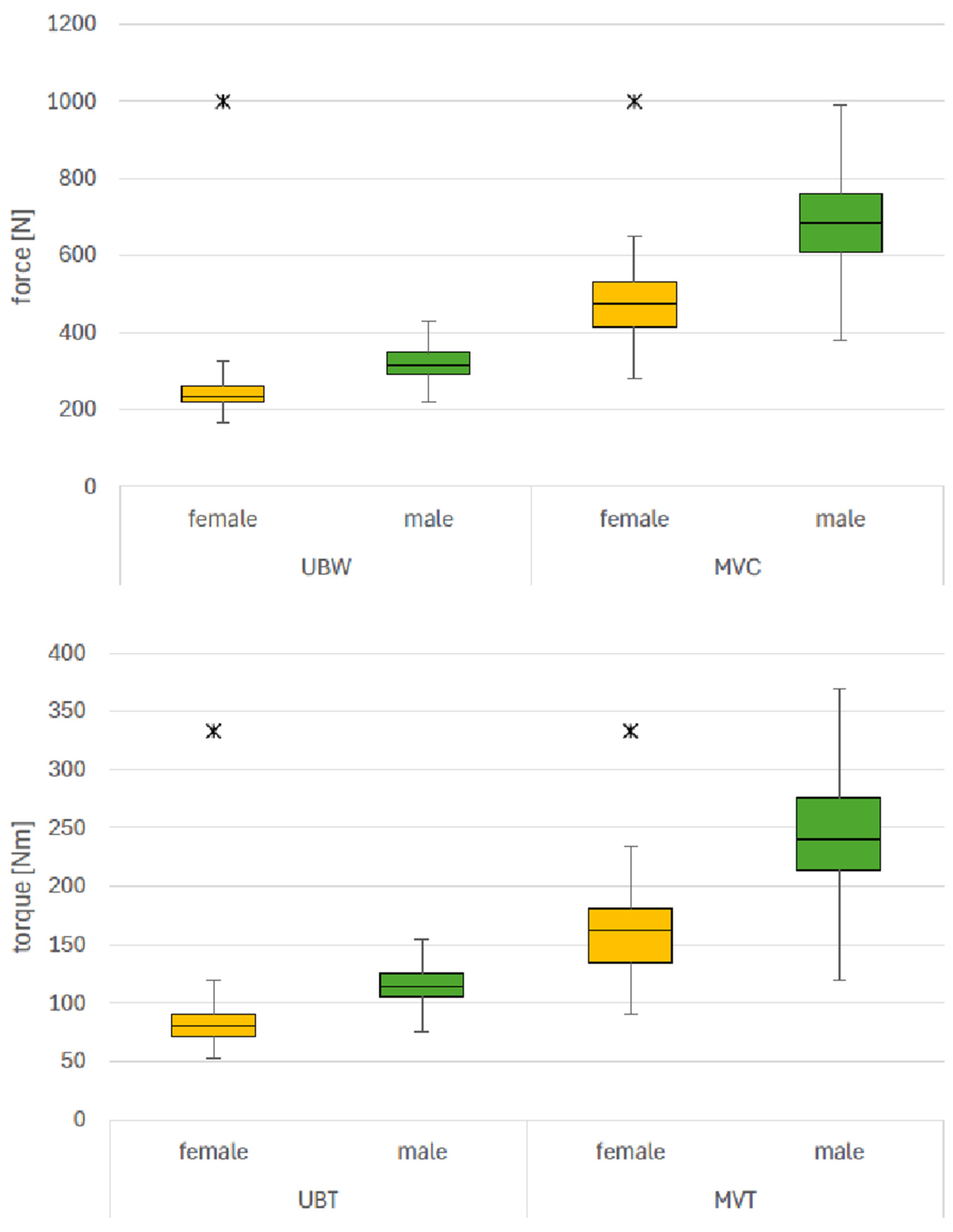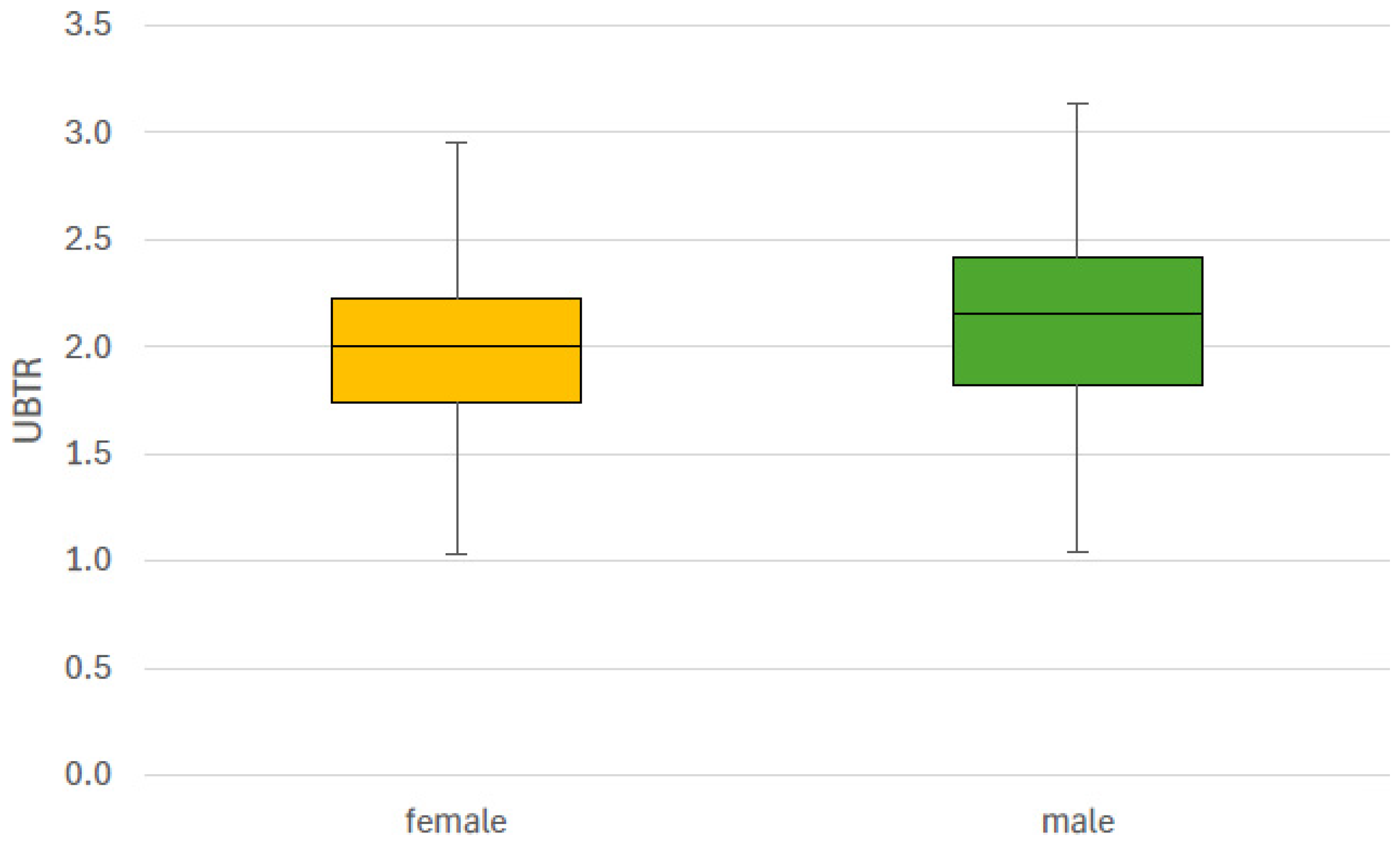

Maximum Force Capacity of Back Extensor Muscles in Healthy Women and Men: Not Different, if Anthropometrically Normalized

 , ,
, ,
Abstract
1. Introduction
2. Methods
2.1. Investigation
2.2. Analyzed Parameters
2.3. Statistics
3. Results
4. Discussion
Limitations
5. Conclusions
Author Contributions
Funding
Institutional Review Board Statement
Informed Consent Statement
Data Availability Statement
Conflicts of Interest
References
- Murphy, W.G. The sex difference in haemoglobin levels in adults—Mechanisms, causes, and consequences. Blood Rev. 2014, 28, 41–47. [Google Scholar] [CrossRef] [PubMed]
- Mauvais-Jarvis, F.; Bairey Merz, N.; Barnes, P.J.; Brinton, R.D.; Carrero, J.J.; DeMeo, D.L.; De Vries, G.J.; Epperson, C.N.; Govindan, R.; Klein, S.L.; et al. Sex and gender: Modifiers of health, disease, and medicine. Lancet 2020, 396, 565–582, Erratum in Lancet 2020, 396, 668. [Google Scholar] [CrossRef]
- Tannenbaum, C.; Zou, J.; Ellis, R.P.; Eyssel, F.A.; Schiebinger, L. Sex and gender analysis improves science and engineering. Nature 2019, 575, 137–146. [Google Scholar] [CrossRef]
- Greil, H. Körpermaße 2000: Aktuelle Perzentilwerte der Deutschen Bevölkerung im Jungen Erwachsenenalter. Available online: http://opus.kobv.de/ubp/volltexte/2005/388/ (accessed on 18 August 2005).
- Jaafar, M.H.; Ismail, R.; Ismail, N.H.; Md Isa, Z.; Mohd Tamil, A.; Mat Nasir, N.; Ng, K.K.; Ab Razak, N.H.; Zainol Abidin, N.; Yusof, K.H. Normative reference values and predicting factors of handgrip strength for dominant and non-dominant hands among healthy Malay adults in Malaysia. BMC Musculoskelet. Disord. 2023, 24, 74. [Google Scholar] [CrossRef]
- Rantanen, J.; Rissanen, A.; Kalimo, H. Lumbar muscle fiber size and type distribution in normal subjects. Eur. Spine J. 1994, 3, 331–335. [Google Scholar] [CrossRef] [PubMed]
- Staron, R.S.; Hagerman, F.C.; Hikida, R.S.; Murray, T.F.; Hostler, D.P.; Crill, M.T.; Ragg, K.E.; Toma, K. Fiber type composition of the vastus lateralis muscle of young men and women. J. Histochem. Cytochem. 2000, 48, 623–629. [Google Scholar] [CrossRef]
- Simoneau, J.A.; Bouchard, C. Genetic Determinism of Fiber-Type Proportion in Human Skeletal-Muscle. FASEB J. 1995, 9, 1091–1095. [Google Scholar] [CrossRef]
- Fryar, C.D.; Gu, Q.; Afful, J.B.A.; Carroll, M.D.; Ogden, C.L. Anthropometric Reference Data for Children and Adults: United States, 2015–2018; National Center for Health Statistics: Washington, DC, USA, 2021; pp. 1–44. Available online: https://stacks.cdc.gov/view/cdc/100478 (accessed on 12 May 2026).
- Gadde, K.M.; Martin, C.K.; Berthoud, H.R.; Heymsfield, S.B. Obesity: Pathophysiology and Management. J. Am. Coll. Cardiol. 2018, 71, 69–84. [Google Scholar] [CrossRef] [PubMed]
- Feng, Q.; Kim, J.H.; Xie, J.; Bešević, J.; Conroy, M.; Omiyale, W.; Wu, Y.; Woodward, M.; Lacey, B.; Allen, N. Use of Sex-Specific Body Mass Index to Optimize Low Correlation with Height and High Correlation with Fatness: A UK Biobank Study. Am. J. Epidemiol. 2024, 193, 296–307. [Google Scholar] [CrossRef]
- Panjabi, M.M. The stabilizing system of the spine. Part I. Function, dysfunction, adaptation, and enhancement. J. Spinal Disord. 1992, 5, 383–389. [Google Scholar] [CrossRef]
- Panjabi, M.M. A hypothesis of chronic back pain: Ligament subfailure injuries lead to muscle control dysfunction. Eur. Spine J. 2006, 15, 668–676. [Google Scholar] [CrossRef] [PubMed]
- Sinaki, M.; Nwaogwugwu, N.C.; Phillips, B.E.; Mokri, M.P. Effect of gender, age, and anthropometry on axial and appendicular muscle strength. Am. J. Phys. Med. Rehabil./Assoc. Acad. Physiatr. 2001, 80, 330–338. [Google Scholar] [CrossRef]
- Hodges, P.; Richardson, C.A. Inefficient muscular stabilization of the lumbar spine associated with low back pain. A motor control evaluation of transversus abdominis. Spine 1996, 21, 2640–2650. [Google Scholar] [CrossRef]
- Panjabi, M.M. Consequences of a subfailure injury. A hypothesis of chronic spine pain. In Proceedings of the IV World Congress of Biomechanics, Calgary, AB, Canada, 4–9 August 2002. [Google Scholar]
- Luomajoki, H.; Kool, J.; de Bruin, E.D.; Airaksinen, O. Movement control tests of the low back; evaluation of the difference between patients with low back pain and healthy controls. BMC Musculoskelet. Disord. 2008, 9, 170. [Google Scholar] [CrossRef] [PubMed]
- McGill, S. Low Back Disorders: Evidence-Based Prevention and Rehabilitation; Human Kinetics: Champaign, IL, USA, 2002. [Google Scholar]
- Hodges, P.; Cresswell, A.; Thorstensson, A. Preparatory trunk motion accompanies rapid upper limb movement. Exp. Brain Res. 1999, 124, 69–79. [Google Scholar] [CrossRef] [PubMed]
- Hodges, P. Is there a role for transversus abdominis in lumbo-pelvic stability? Man. Ther. 1999, 4, 74–86. [Google Scholar] [CrossRef]
- Hodges, P.; Gandevia, S.C. Activation of the human diaphragm during a repetitive postural task. J. Physiol. 2000, 522, 165–175. [Google Scholar] [CrossRef]
- Cholewicki, J.; Juluru, K.; McGill, S.M. Intra-abdominal pressure mechanism for stabilizing the lumbar spine. J. Biomech. 1999, 32, 13–17. [Google Scholar] [CrossRef]
- Hodges, P.W.; Eriksson, A.E.; Shirley, D.; Gandevia, S.C. Intra-abdominal pressure increases stiffness of the lumbar spine. J. Biomech. 2005, 38, 1873–1880. [Google Scholar] [CrossRef]
- Hodges, P.; Kaigle Holm, A.; Holm, S.; Ekstrom, L.; Cresswell, A.; Hansson, T.; Thorstensson, A. Intervertebral stiffness of the spine is increased by evoked contraction of transversus abdominis and the diaphragm: In Vivo porcine studies. Spine 2003, 28, 2594–2601. [Google Scholar] [CrossRef]
- Magnusson, M.L.; Aleksiev, A.; Wilder, D.G.; Pope, M.H.; Spratt, K.; Lee, S.H.; Goel, V.K.; Weinstein, J.N. European Spine Society—The AcroMed Prize for Spinal Research 1995. Unexpected load and asymmetric posture as etiologic factors in low back pain. Eur. Spine J. 1996, 5, 23–35. [Google Scholar] [CrossRef]
- Arendt-Nielsen, L.; Graven-Nielsen, T.; Svarrer, H.; Svensson, P. The influence of low back pain on muscle activity and coordination during gait: A clinical and experimental study. Pain 1995, 64, 231–240. [Google Scholar] [CrossRef] [PubMed]
- da Silva, R.A., Jr.; Arsenault, A.B.; Gravel, D.; Lariviere, C.; de Oliveira, E., Jr. Back muscle strength and fatigue in healthy and chronic low back pain subjects: A comparative study of 3 assessment protocols. Arch. Phys. Med. Rehabil. 2005, 86, 722–729. [Google Scholar] [CrossRef] [PubMed]
- Moseley, G.L.; Hodges, P.; Gandevia, S.C. Deep and superficial fibers of the lumbar multifidus muscle are differentially active during voluntary arm movements. Spine 2002, 27, E29–E36. [Google Scholar] [CrossRef] [PubMed]
- Mannion, A.F. Fibre type characteristics and function of the human paraspinal muscles: Normal values and changes in association with low back pain. J. Electromyogr. Kinesiol. 1999, 9, 363–377. [Google Scholar] [CrossRef]
- Tanner, J. Fallacy of Per-Weight and Per-Surface Area Standards, and Their Relation to Spurious Correlation. J. Appl. Physiol. 1949, 2, 1–15. [Google Scholar] [CrossRef]
- Vera-Garcia, F.J.; Moreside, J.M.; McGill, S.M. MVC techniques to normalize trunk muscle EMG in healthy women. J. Electromyogr. Kinesiol. 2010, 20, 10–16. [Google Scholar] [CrossRef]
- Marras, W.S.; Davis, K.G. A non-MVC EMG normalization technique for the trunk musculature: Part 1. Method development. J. Electromyogr. Kinesiol. 2001, 11, 1–9. [Google Scholar] [CrossRef]
- Dufour, J.S.; Marras, W.S.; Knapik, G.G. An EMG-assisted model calibration technique that does not require MVCs. J. Electromyogr. Kinesiol. 2013, 23, 608–613. [Google Scholar] [CrossRef]
- Nuzzo, J.L. Narrative Review of Sex Differences in Muscle Strength, Endurance, Activation, Size, Fiber Type, and Strength Training Participation Rates, Preferences, Motivations, Injuries, and Neuromuscular Adaptations. J. Strength. Cond. Res./Natl. Strength. Cond. Assoc. 2023, 37, 494–536. [Google Scholar] [CrossRef]
- Jaric, S. Muscle Strength Testing: Use of Normalisation for Body Size. Sports Med. 2002, 32, 615–631. [Google Scholar] [CrossRef]
- Nuzzo, J.L.; Mayer, J.M. Body Mass Normalization for Isometric Tests of Muscle Endurance. J. Strength. Cond. Res. 2013, 27, 2039–2045. [Google Scholar] [CrossRef]
- Dionne, C.E.; Dunn, K.M.; Underwood, M.; Nachemson, A.; Leboeuf-Yde, C.; Hartvigsen, J.; Picavet, H.S.J.; Shekelle, P.G.; Walker, B.F.; Thomas, E.; et al. A Consensus Approach Toward the Standardization of Back Pain Definitions for Use in Prevalence Studies. Spine 2008, 33, 95–103. [Google Scholar] [CrossRef]
- Hagströmer, M.; Oja, P.; Sjöstróm, M. The International Physical Activity Questionnaire (IPAQ): A study of concurrent and construct validity. Public. Health Nutr. 2006, 9, 755–762. [Google Scholar] [CrossRef]
- McNair, P.J.; Depledge, J.; Brettkelly, M.; Stanley, S.N. Verbal encouragement: Effects on maximum effort voluntary muscle action. Br. J. Sports Med. 1996, 30, 243–245. [Google Scholar] [CrossRef] [PubMed]
- Andreacci, J.L.; LeMura, L.M.; Cohen, S.L.; Urbansky, E.A.; Chelland, S.A.; Von Duvillard, S.P. The effects of frequency of encouragement on performance during maximal exercise testing. J. Sports Sci. 2002, 20, 345–352. [Google Scholar] [CrossRef] [PubMed]
- Argus, C.K.; Gill, N.D.; Keogh, J.W.L.; Hopkins, W.G. Acute Effects of Verbal Feedback on Upper-Body Performance in Elite Athletes. J. Strength. Cond. Res. 2011, 25, 3282–3287. [Google Scholar] [CrossRef]
- Plagenhoef, S.; Evans, F.G.; Abdelnour, T. Anatomical Data for Analyzing Human Motion. Res. Q. Exerc. Sport. 1983, 54, 169–178. [Google Scholar] [CrossRef]
- Cohen, J. Statistical Power for the Behavioural Sciences; Lawrence Erlbaum: Hillsdale, NJ, USA, 1988. [Google Scholar]
- Apaza, J.A.S.; Franco, J.V.A.; Madrid, E.; Meza, N.; Loézar, C.; Garegnani, L. Minimal clinically important difference: The basics. Medwave 2021, 21, e8149. [Google Scholar] [CrossRef]
- Norman, G.R.; Sloan, J.A.; Wyrwich, K.W. Interpretation of Changes in Health-related Quality of Life. Med. Care 2003, 41, 582–592. [Google Scholar] [CrossRef]
- Sullivan, G.M.; Feinn, R. Using Effect Size—Or Why the P Value Is Not Enough. J. Grad. Med. Educ. 2012, 4, 279–282. [Google Scholar] [CrossRef] [PubMed]
- Graves, J.E.; Pollock, M.L.; Carpenter, D.M.; Leggett, S.H.; Jones, A.; MacMillan, M.; Fulton, M. Quantitative assessment of full range-of-motion isometric lumbar extension strength. Spine 1990, 15, 289–294. [Google Scholar] [CrossRef] [PubMed]
- Durkin, J.L.; Dowling, J.J. Analysis of Body Segment Parameter Differences Between Four Human Populations and the Estimation Errors of Four Popular Mathematical Models. J. Biomech. Eng. 2003, 125, 515–522. [Google Scholar] [CrossRef]
- Pataky, T.C.; Zatsiorsky, V.M.; Challis, J.H. A simple method to determine body segment masses in vivo: Reliability, accuracy and sensitivity analysis. Clin. Biomech. 2003, 18, 364–368. [Google Scholar] [CrossRef]
- Damavandi, M.; Farahpour, N.; Allard, P. Determination of body segment masses and centers of mass using a force plate method in individuals of different morphology. Med. Eng. Phys. 2009, 31, 1187–1194. [Google Scholar] [CrossRef] [PubMed]
- Pfeifle, C.; Edel, M.; Schleifenbaum, S.; Kühnapfel, A.; Heyde, C.-E. The reliability of a restraint sensor system for the computer-supported detection of spinal stabilizing muscle deficiencies. BMC Musculoskelet. Disord. 2020, 21, 597. [Google Scholar] [CrossRef]
- Greenland, S.; Rothman, K.J.; Senn, S.; Carlin, J.B.; Goodman, S.N.; Poole, C.; Altman, D.G. Statistical tests, P values, confidence intervals, and power: A guide to misinterpretations. Eur. J. Epidemiol. 2016, 31, 337–350. [Google Scholar] [CrossRef]
- Gardner, M.J.; Altman, D.G. Confidence intervals rather than P values: Estimation rather than hypothesis testing. The BMJ 1986, 292, 746–750. [Google Scholar] [CrossRef]
- Pan, F.; Cheng, J.; Kong, C.; Wang, W.; Lu, S. Sex-specific characteristics of the trunk muscle behaviors in an asymptomatic adult cohort. Eur. J. Med. Res. 2025, 30, 471. [Google Scholar] [CrossRef]
- Copay, A.G.; Glassman, S.D.; Subach, B.R.; Polly, D.W.; Schuler, T.C. Understanding the minimum clinically important difference: A review of concepts and methods. Spine J. 2007, 7, 541–546. [Google Scholar] [CrossRef]
- Shetty, G.M.; Munje, P.; Bhan, A.; Jain, S.; Ram, C.S. Normative Reference Values for Trunk Range of Motion and Isometric Muscle Strength in Asymptomatic Young Indian Adults. Indian. J. Orthop. 2021, 56, 49–57. [Google Scholar] [CrossRef]
- Ünver, F.; Büke, M.; Kabul, E.G.; Ünver, B. Trunk Flexor and Extensor Muscle Strength Capacity in Healthy Individuals. Turk. J. Sports Med. 2024, 59, 112–118. [Google Scholar] [CrossRef]
- Smidt, G.; Herring, T.; Amundsen, L.; Rogers, M.; Russell, A.; Lehmann, T. Assessment of abdominal and back extensor function. A quantitative approach and results for chronic low-back patients. Spine 1983, 8, 211–219. [Google Scholar] [CrossRef]
- de Leva, P. Adjustments to Zatsiorsky-Seluyanov’s segment inertia parameters. J. Biomech. 1996, 29, 1223–1230. [Google Scholar] [CrossRef]
- Pearsall, D.J.; Reid, J.G.; Livingston, L.A. Segmental inertial parameters of the human trunk as determined from computed tomography. Ann. Biomed. Eng. 1996, 24, 198–210. [Google Scholar] [CrossRef] [PubMed]
- Winter, D.A. Biomechanics and Motor Control of Human Movement, 4th ed.; Joh Wiley & Sons: New York, NY, USA, 2009. [Google Scholar]
- Wu, Y.; Li, D.; Vermund, S.H. Advantages and Limitations of the Body Mass Index (BMI) to Assess Adult Obesity. Int. J. Environ. Res. Public. Health 2024, 21, 757. [Google Scholar] [CrossRef]
- Am, P.; Jebb, S.A. Beyond body mass index. Obes. Rev. 2001, 2, 141–147. [Google Scholar] [CrossRef] [PubMed]
- Pajoutan, M.; Mehta, R.K.; Cavuoto, L. Obesity effect on isometric strength of the trunk extensors. Proc. Hum. Factors Ergon. Soc. Annu. Meet. 2016, 60, 943–947. [Google Scholar] [CrossRef]
- Delfa-de-la-Morena, J.M.; Paes, P.P.; García-González, M.; Júnior, F.C.A.A.; Murillo, J.J.M.; Feitosa, R.C.; Oliveira, D.S.; Riquelme-Aguado, V. Relationship of Physical Activity Levels and Body Composition with Psychomotor Performance and Strength in Men. Healthcare 2025, 13, 1789, Correction in Healthcare 2025, 13, 2996. [Google Scholar] [CrossRef] [PubMed]



| Height [cm] | Weight [kg] | Age [y] | BMI [kg/m2] | |
|---|---|---|---|---|
| Females (n = 115) | ||||
| MV | 168.9 | 64.6 | 27.6 | 22.6 |
| SD | 6.4 | 9.6 | 8.0 | 3.1 |
| CI | 1.2 | 1.8 | 1.5 | 0.6 |
| Median | 169.0 | 63.0 | 24.0 | 22.1 |
| upp. Q. | 173.5 | 70.4 | 31.0 | 25.2 |
| low. Q. | 164.0 | 57.5 | 22.0 | 20.2 |
| Males (n = 124) | ||||
| MV | 180.8 | 78.5 | 30.7 | 24.0 |
| SD | 5.9 | 9.8 | 7.9 | 2.7 |
| CI | 1.0 | 1.7 | 1.4 | 0.5 |
| Median | 180.0 | 78.0 | 29.0 | 23.6 |
| upp. Q. | 185.0 | 84.6 | 37.0 | 25.8 |
| low. Q. | 177.0 | 72.5 | 24.0 | 22.2 |
| Statistics | ||||
| p-value | <0.0001 | <0.0001 | 0.0030 | 0.0003 |
| ES | 1.920 | 1.421 | 0.388 | 0.470 |
| Relevance | relevant | relevant | Not relevant | Not relevant |
| Diff mean values | 11.86 | 13.81 | 3.083 | 1.346 |
| MID | 3.09 | 4.86 | 3.977 | 1.432 |
| UBT | MVT | UBTR | ||
|---|---|---|---|---|
| 95% CI borders | Females | 84.6/79.3 Nm | 166.1/154.2 Nm | 2.04/1.91 |
| Males | 119.1/113.1 Nm | 252.6/234.9 Nm | 2.19/2.04 | |
| p-value | <0.0001 | <0.0001 | 0.0055 | |
| ES | 2.119 | 1.974 | 0.364 | |
| MID | 8.19 | 21.48 | 0.195 | |
| Diff.MV | 31.72 | 84.81 | 0.142 | |
| Rating | Relevant | Relevant | Not relevant | |
Disclaimer/Publisher’s Note: The statements, opinions and data contained in all publications are solely those of the individual author(s) and contributor(s) and not of MDPI and/or the editor(s). MDPI and/or the editor(s) disclaim responsibility for any injury to people or property resulting from any ideas, methods, instructions or products referred to in the content. |
© 2026 by the authors. Licensee MDPI, Basel, Switzerland. This article is an open access article distributed under the terms and conditions of the Creative Commons Attribution (CC BY) license.
Share and Cite
Anders, C.; Steiniger, B.; Saenger, F.; Marks, M.; Mader, L.; Dukvin, E.; Schneider, A. Maximum Force Capacity of Back Extensor Muscles in Healthy Women and Men: Not Different, if Anthropometrically Normalized. J. Funct. Morphol. Kinesiol. 2026, 11, 212. https://doi.org/10.3390/jfmk11020212
Anders C, Steiniger B, Saenger F, Marks M, Mader L, Dukvin E, Schneider A. Maximum Force Capacity of Back Extensor Muscles in Healthy Women and Men: Not Different, if Anthropometrically Normalized. Journal of Functional Morphology and Kinesiology. 2026; 11(2):212. https://doi.org/10.3390/jfmk11020212
Chicago/Turabian StyleAnders, Christoph, Beatrice Steiniger, Florian Saenger, Martin Marks, Lena Mader, Evgenij Dukvin, and Anna Schneider. 2026. "Maximum Force Capacity of Back Extensor Muscles in Healthy Women and Men: Not Different, if Anthropometrically Normalized" Journal of Functional Morphology and Kinesiology 11, no. 2: 212. https://doi.org/10.3390/jfmk11020212
APA StyleAnders, C., Steiniger, B., Saenger, F., Marks, M., Mader, L., Dukvin, E., & Schneider, A. (2026). Maximum Force Capacity of Back Extensor Muscles in Healthy Women and Men: Not Different, if Anthropometrically Normalized. Journal of Functional Morphology and Kinesiology, 11(2), 212. https://doi.org/10.3390/jfmk11020212