
Peripheral Neuromuscular Fatigue Responses of the Knee Extensors to Distinct Concurrent Training Protocols: A Preliminary Study

 ,
,  , , , ,
  and
and 
Abstract
1. Introduction
2. Materials and Methods
2.1. Study Design
2.2. Participants
2.3. Procedures
2.3.1. Assessment of MVIC and Tetanic Force
2.3.2. Determination of the 6-RM Loads
2.3.3. Determination of the Second Ventilatory Threshold
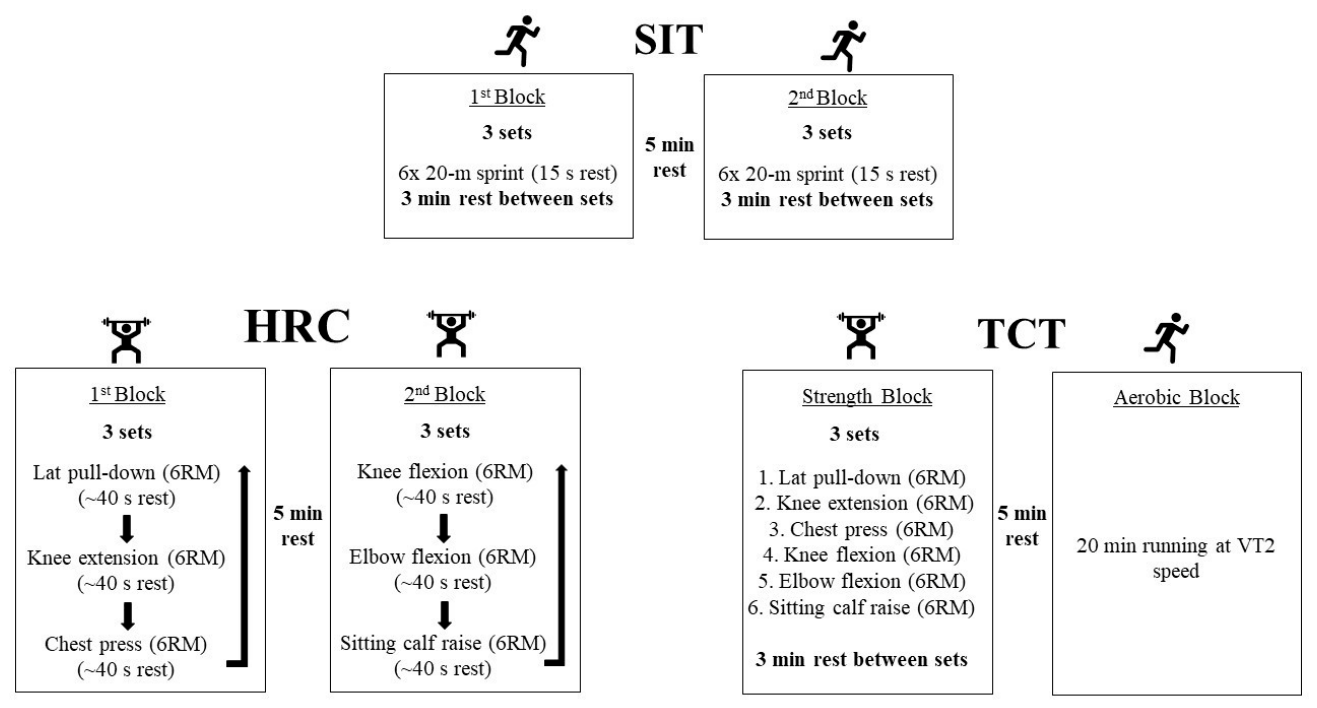
2.3.4. Exercise Protocols
2.4. Statistical Analysis
3. Results
4. Discussion
5. Conclusions
Author Contributions
Funding
Institutional Review Board Statement
Informed Consent Statement
Data Availability Statement
Conflicts of Interest
References
- Karcher, C.; Buchheit, M. On-court demands of elite handball, with special reference to playing positions. Sports Med. 2014, 44, 797–814. [Google Scholar] [CrossRef]
- Bloomfield, J.; Polman, R.; O’Donoghue, P. Physical demands of different positions in FA Premier League soccer. J. Sports Sci. Med. 2007, 6, 63. [Google Scholar]
- Fyfe, J.J.; Bishop, D.J.; Stepto, N.K. Interference between concurrent resistance and endurance exercise: Molecular bases and the role of individual training variables. Sports Med. 2014, 44, 743–762. [Google Scholar] [CrossRef]
- Fyfe, J.J.; Loenneke, J.P. Interpreting adaptation to concurrent compared with single-mode exercise training: Some methodological considerations. Sports Med. 2018, 48, 289–297. [Google Scholar] [CrossRef]
- Deschenes, M.R.; Kraemer, W.J. Performance and physiologic adaptations to resistance training. Am. J. Phys. Med. Rehabil. 2002, 81, S3–S16. [Google Scholar] [CrossRef]
- Suchomel, T.J.; Nimphius, S.; Stone, M.H. The importance of muscular strength in athletic performance. Sports Med. 2016, 46, 1419–1449. [Google Scholar] [CrossRef]
- Coffey, V.G.; Hawley, J.A. Concurrent exercise training: Do opposites distract? J. Physiol. 2017, 595, 2883–2896. [Google Scholar] [CrossRef]
- Guo, Z.; Li, M.; Cai, J.; Gong, W.; Liu, Y.; Liu, Z. Effect of High-Intensity Interval Training vs. Moderate-Intensity Continuous Training on Fat Loss and Cardiorespiratory Fitness in the Young and Middle-Aged a Systematic Review and Meta-Analysis. Int. J. Environ. Res. Public Health 2023, 20, 4741. [Google Scholar] [CrossRef] [PubMed]
- Reeves, N.D.; Narici, M.V.; Maganaris, C.N. Effect of resistance training on skeletal muscle-specific force in elderly humans. J. Appl. Physiol. 2004, 96, 885–892. [Google Scholar] [CrossRef] [PubMed]
- Kelley, D.E.; He, J.; Menshikova, E.V.; Ritov, V.B. Dysfunction of mitochondria in human skeletal muscle in type 2 diabetes. Diabetes 2002, 51, 2944–2950. [Google Scholar] [CrossRef] [PubMed]
- Helgerud, J.; Rodas, G.; Kemi, O.; Hoff, J. Strength and endurance in elite football players. Int. J. Sports Med. 2011, 32, 677–682. [Google Scholar] [CrossRef]
- Jones, T.W.; Smith, A.; Macnaughton, L.S.; French, D.N. Strength and conditioning and concurrent training practices in elite rugby union. J. Strength Cond. Res. 2016, 30, 3354–3366. [Google Scholar] [CrossRef] [PubMed]
- Panissa, V.L.; Fukuda, D.H.; Parmezzani, S.; Campos, E.; Rossi, F.; Franchini, E.; Lira, F. Maximum Strength Development and Volume-Load during Concurrent High Intensity Intermittent Training Plus Strength or Strength-Only Training. J. Sports Sci. Med. 2018, 17, 623–632. [Google Scholar] [PubMed]
- Häkkinen, K.; Alen, M.; Kraemer, W.; Gorostiaga, E.; Izquierdo, M.; Rusko, H.; Mikkola, J.; Häkkinen, A.; Valkeinen, H.; Kaarakainen, E. Neuromuscular adaptations during concurrent strength and endurance training versus strength training. Eur. J. Appl. Physiol. 2003, 89, 42–52. [Google Scholar] [CrossRef] [PubMed]
- MacInnis, M.J.; Gibala, M.J. Physiological adaptations to interval training and the role of exercise intensity. J. Physiol. 2017, 595, 2915–2930. [Google Scholar] [CrossRef]
- Burgomaster, K.A.; Howarth, K.R.; Phillips, S.M.; Rakobowchuk, M.; MacDonald, M.J.; McGee, S.L.; Gibala, M.J. Similar metabolic adaptations during exercise after low volume sprint interval and traditional endurance training in humans. J. Physiol. 2008, 586, 151–160. [Google Scholar] [CrossRef]
- Gibala, M.J.; Little, J.P.; Van Essen, M.; Wilkin, G.P.; Burgomaster, K.A.; Safdar, A.; Raha, S.; Tarnopolsky, M.A. Short-term sprint interval versus traditional endurance training: Similar initial adaptations in human skeletal muscle and exercise performance. J. Physiol. 2006, 575, 901–911. [Google Scholar] [CrossRef]
- Kinnunen, J.-V.; Piitulainen, H.; Piirainen, J.M. Neuromuscular Adaptations to Short-Term High-Intensity Interval Training in Female Ice-Hockey Players. J. Strength Cond. Res. 2019, 33, 479–485. [Google Scholar] [CrossRef]
- Muñoz-Martínez, F.A.; Rubio-Arias, J.A.; Ramos-Campo, D.J.; Alcaraz, P.E. Effectiveness of resistance circuit-based training for maximum oxygen uptake and upper-body one-repetition maximum improvements: A systematic review and meta-analysis. Sports Med. 2017, 47, 2553–2568. [Google Scholar] [CrossRef]
- Alcaraz, P.E.; Perez-Gomez, J.; Chavarrias, M.; Blazevich, A.J. Similarity in adaptations to high-resistance circuit vs. traditional strength training in resistance-trained men. J. Strength Cond. Res. 2011, 25, 2519–2527. [Google Scholar] [CrossRef]
- Romero-Arenas, S.; Blazevich, A.J.; Martínez-Pascual, M.; Pérez-Gómez, J.; Luque, A.J.; López-Román, F.J.; Alcaraz, P.E. Effects of high-resistance circuit training in an elderly population. Exp. Gerontol. 2013, 48, 334–340. [Google Scholar] [CrossRef]
- Martínez-Guardado, I.; Ramos-Campo, D.J.; Olcina, G.J.; Rubio-Arias, J.A.; Chung, L.H.; Marín-Cascales, E.; Alcaraz, P.E.; Timón, R. Effects of high-intensity resistance circuit-based training in hypoxia on body composition and strength performance. Eur. J. Sport Sci. 2019, 19, 941–951. [Google Scholar] [CrossRef]
- Márquez, G.; Romero-Arenas, S.; Marín-Pagán, C.; Vera-Ibañez, A.; FernáNdez Del Olmo, M.; Taube, W. Peripheral and central fatigue after high intensity resistance circuit training. Muscle Nerve 2017, 56, 152–159. [Google Scholar] [CrossRef]
- Goodall, S.; Charlton, K.; Howatson, G.; Thomas, K. Neuromuscular fatigability during repeated-sprint exercise in male athletes. Med. Sci. Sports Exerc. 2015, 47, 528–536. [Google Scholar] [CrossRef]
- Perrey, S.; Racinais, S.; Saimouaa, K.; Girard, O. Neural and muscular adjustments following repeated running sprints. Eur. J. Appl. Physiol. 2010, 109, 1027–1036. [Google Scholar] [CrossRef]
- Pearcey, G.E.; Murphy, J.R.; Behm, D.G.; Hay, D.C.; Power, K.E.; Button, D.C. Neuromuscular fatigue of the knee extensors during repeated maximal intensity intermittent-sprints on a cycle ergometer. Muscle Nerve 2015, 51, 569–579. [Google Scholar] [CrossRef]
- Wasserman, K.; Beaver, W.L.; Whipp, B.J. Gas exchange theory and the lactic acidosis (anaerobic) threshold. Circulation 1990, 81, 14–30. [Google Scholar]
- Freitas, T.T.; Calleja-González, J.; Alarcón, F.; Alcaraz, P.E. Acute effects of two different resistance circuit training protocols on performance and perceived exertion in semiprofessional basketball players. J. Strength Cond. Res. 2016, 30, 407–414. [Google Scholar] [CrossRef] [PubMed]
- Alcaraz, P.E.; Sanchez-Lorente, J.; Blazevich, A.J. Physical performance and cardiovascular responses to an acute bout of heavy resistance circuit training versus traditional strength training. J. Strength Cond. Res. 2008, 22, 667–671. [Google Scholar] [CrossRef] [PubMed]
- Hopkins, W.G.; Marshall, S.W.; Batterham, A.M.; Hanin, J. Progressive statistics for studies in sports medicine and exercise science. Med. Sci. Sports Exerc. 2009, 41, 3–13. [Google Scholar] [CrossRef] [PubMed]
- Cross, R.; Lovell, R.; Marshall, P.W.; Siegler, J. Acute Neuromuscular Response to Team Sports–specific Running, Resistance, and Concurrent Training: A Cross-over Study. Med. Sci. Sports Exerc. 2021, 54, 456–465. [Google Scholar] [CrossRef] [PubMed]
- Baumert, P.; Temple, S.; Stanley, J.; Cocks, M.; Strauss, J.A.; Shepherd, S.O.; Drust, B.; Lake, M.J.; Stewart, C.E.; Erskine, R.M. Neuromuscular fatigue and recovery after strenuous exercise depends on skeletal muscle size and stem cell characteristics. Sci. Rep. 2021, 11, 7733. [Google Scholar] [CrossRef]
- Ribeiro, N.; Ugrinowitsch, C.; Panissa, V.L.G.; Tricoli, V. Acute effects of aerobic exercise performed with different volumes on strength performance and neuromuscular parameters. Eur. J. Sport Sci. 2019, 19, 287–294. [Google Scholar] [CrossRef]
- Twomey, R.; Aboodarda, S.J.; Kruger, R.; Culos-Reed, S.N.; Temesi, J.; Millet, G.Y. Neuromuscular fatigue during exercise: Methodological considerations, etiology and potential role in chronic fatigue. Clin. Neurophysiol. 2017, 47, 95–110. [Google Scholar] [CrossRef]
- Place, N.; Lepers, R.; Deley, G.; Millet, G.Y. Time course of neuromuscular alterations during a prolonged running exercise. Med. Sci. Sports Exerc. 2004, 36, 1347–1356. [Google Scholar] [CrossRef]
- Temesi, J.; Arnal, P.J.; Rupp, T.; Féasson, L.; Cartier, R.; Gergelé, L.; Verges, S.; Martin, V.; Millet, G.Y. Are females more resistant to extreme neuromuscular fatigue? Med. Sci. Sports Exerc. 2015, 47, 1372–1382. [Google Scholar] [CrossRef] [PubMed]
- Lewis, M. It’s a Hard-Knock Life: Game Load, Fatigue, and Injury Risk in the National Basketball Association. J. Athl. Train. 2018, 53, 503–509. [Google Scholar] [CrossRef]
- Carroll, T.J.; Taylor, J.L.; Gandevia, S.C. Recovery of central and peripheral neuromuscular fatigue after exercise. J. Appl. Physiol. 2016, 122, 1068–1076. [Google Scholar] [CrossRef] [PubMed]
- Knicker, A.J.; Renshaw, I.; Oldham, A.R.; Cairns, S.P. Interactive processes link the multiple symptoms of fatigue in sport competition. Sports Med. 2011, 41, 307–328. [Google Scholar] [CrossRef]
- Lloria-Varella, J.; Koral, J.; Ravel, A.; Féasson, L.; Murias, J.M.; Busso, T. Neuromuscular and autonomic function is fully recovered within 24 h following a sprint interval training session. Eur. J. Appl. Physiol. 2023, 123, 2317–2329. [Google Scholar] [CrossRef]
- Glaister, M. Multiple sprint work. Sports Med. 2005, 35, 757–777. [Google Scholar] [CrossRef]
- Collins, B.W.; Pearcey, G.E.; Buckle, N.C.; Power, K.E.; Button, D.C. Neuromuscular fatigue during repeated sprint exercise: Underlying physiology and methodological considerations. Appl. Physiol. Nutr. Metab. 2018, 43, 1166–1175. [Google Scholar] [CrossRef]
- Keeton, R.B.; Binder-Macleod, S.A. Low-frequency fatigue. Phys. Ther. 2006, 86, 1146–1150. [Google Scholar] [CrossRef]
- Venckunas, T.; Krusnauskas, R.; Snieckus, A.; Eimantas, N.; Baranauskiene, N.; Skurvydas, A.; Brazaitis, M.; Kamandulis, S. Acute effects of very low-volume high-intensity interval training on muscular fatigue and serum testosterone level vary according to age and training status. Eur. J. Appl. Physiol. 2019, 119, 1725–1733. [Google Scholar] [CrossRef] [PubMed]
- Girard, O.; Mendez-Villanueva, A.; Bishop, D. Repeated-sprint ability—Part I. Sports Med. 2011, 41, 673–694. [Google Scholar] [CrossRef] [PubMed]
- Fernandez-del-Olmo, M.; Rodriguez, F.; Marquez, G.; Iglesias, X.; Marina, M.; Benitez, A.; Vallejo, L.; Acero, R. Isometric knee extensor fatigue following a Wingate test: Peripheral and central mechanisms. Scand. J. Med. Sci. Sports 2013, 23, 57–65. [Google Scholar] [CrossRef]
- Morel, B.; Lapole, T.; Liotard, C.; Hautier, C. Critical peripheral fatigue thresholds among different force-velocity conditions: An individual-based model approach. Front. Physiol. 2019, 10, 875. [Google Scholar] [CrossRef]
- Rampinini, E.; Martin, M.; Davide, F.; Bosio, A.; Azzolini, M.; Riggio, M.; Maffiuletti, N.A. Peripheral muscle function during repeated changes of direction in professional soccer players. Eur. J. Appl. Physiol. 2022, 122, 2125–2134, Correction in Eur. J. Appl. Physiol. 2022, 122, 2319. [Google Scholar] [CrossRef]
- Ferioli, D.; Rampinini, E.; Bosio, A.; La Torre, A.; Maffiuletti, N.A. Peripheral muscle function during repeated changes of direction in basketball. Int. J. Sports Physiol. Perform. 2019, 14, 739–746. [Google Scholar] [CrossRef] [PubMed]
- Rampinini, E.; Connolly, D.R.; Ferioli, D.; La Torre, A.; Alberti, G.; Bosio, A. Peripheral neuromuscular fatigue induced by repeated-sprint exercise: Cycling vs. running. J. Sports Med. Phys. Fit. 2016, 56, 49–59. [Google Scholar]
- Buckthorpe, M.; Pain, M.T.; Folland, J.P. Central fatigue contributes to the greater reductions in explosive than maximal strength with high-intensity fatigue. Exp. Physiol. 2014, 99, 964–973. [Google Scholar] [CrossRef] [PubMed]
- Maffiuletti, N.A.; Aagaard, P.; Blazevich, A.J.; Folland, J.; Tillin, N.; Duchateau, J. Rate of force development: Physiological and methodological considerations. Eur. J. Appl. Physiol. 2016, 116, 1091–1116. [Google Scholar] [CrossRef] [PubMed]



| HRC | SIT | TCT | ||
|---|---|---|---|---|
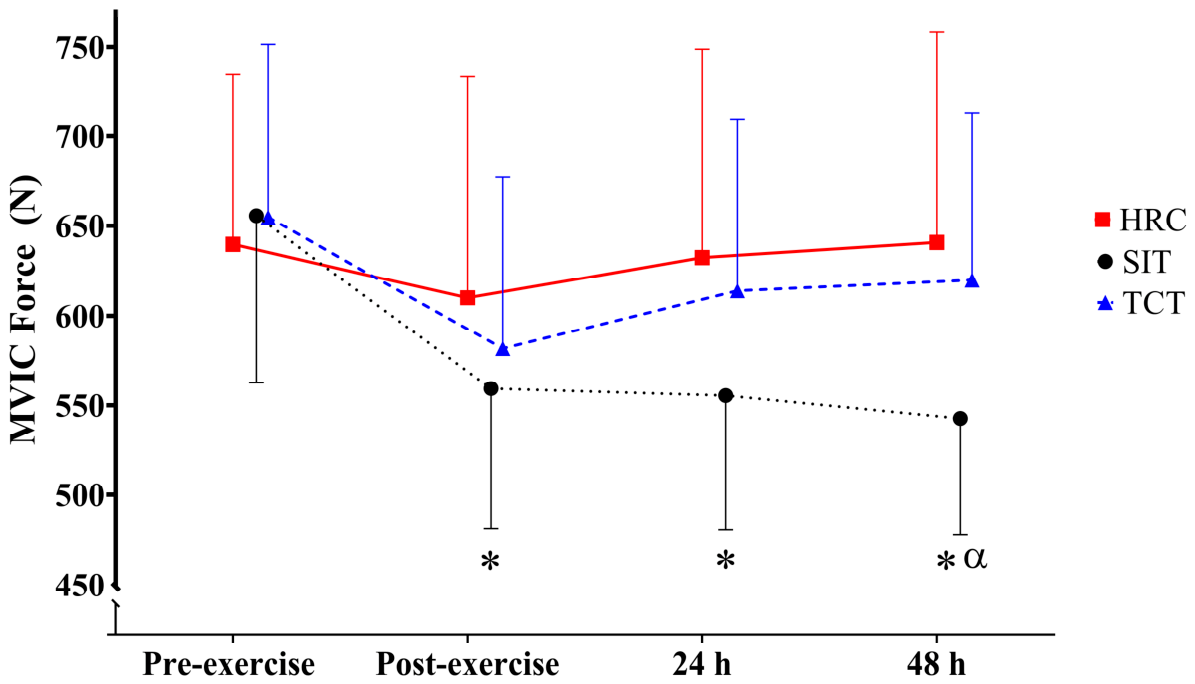
| MVIC force (N) | Pre-exercise | 640 ± 95 | 656 ± 93 | 654 ± 97 |
| Post-exercise | 610 ± 123 | 559 ± 78 | 582 ± 95 | |
| 24 h | 633 ± 116 | 555 ± 75 | 614 ± 96 | |
| 48 h | 641 ± 118 | 543 ± 64 | 620 ± 93 | |
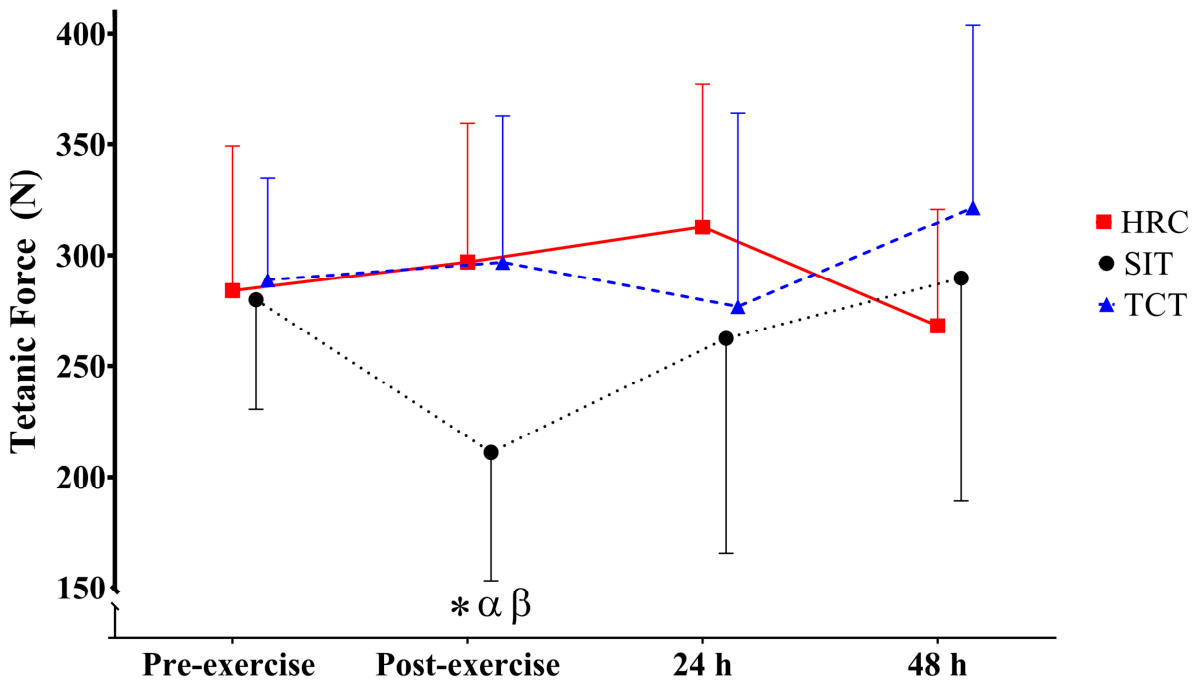
| Tetanic force (N) | Pre-exercise | 284 ± 84 | 280 ± 49 | 289 ± 45 |
| Post-exercise | 297 ± 62 | 211 ± 58 | 297 ± 66 | |
| 24 h | 312 ± 64 | 263 ± 97 | 277 ±87 | |
| 48 h | 268 ± 55 | 289 ± 100 | 321 ± 82 |
Disclaimer/Publisher’s Note: The statements, opinions and data contained in all publications are solely those of the individual author(s) and contributor(s) and not of MDPI and/or the editor(s). MDPI and/or the editor(s) disclaim responsibility for any injury to people or property resulting from any ideas, methods, instructions or products referred to in the content. |
© 2026 by the authors. Licensee MDPI, Basel, Switzerland. This article is an open access article distributed under the terms and conditions of the Creative Commons Attribution (CC BY) license.
Share and Cite
Freitas, T.T.; Marín-Cascales, E.; Marín-Pagán, C.; Chung, L.H.; Martínez-Serrano, A.; Maffiuletti, N.A.; Blazevich, A.J.; Alcaraz, P.E. Peripheral Neuromuscular Fatigue Responses of the Knee Extensors to Distinct Concurrent Training Protocols: A Preliminary Study. J. Funct. Morphol. Kinesiol. 2026, 11, 181. https://doi.org/10.3390/jfmk11020181
Freitas TT, Marín-Cascales E, Marín-Pagán C, Chung LH, Martínez-Serrano A, Maffiuletti NA, Blazevich AJ, Alcaraz PE. Peripheral Neuromuscular Fatigue Responses of the Knee Extensors to Distinct Concurrent Training Protocols: A Preliminary Study. Journal of Functional Morphology and Kinesiology. 2026; 11(2):181. https://doi.org/10.3390/jfmk11020181
Chicago/Turabian StyleFreitas, Tomás T., Elena Marín-Cascales, Cristian Marín-Pagán, Linda H. Chung, Antonio Martínez-Serrano, Nicola A. Maffiuletti, Anthony J. Blazevich, and Pedro E. Alcaraz. 2026. "Peripheral Neuromuscular Fatigue Responses of the Knee Extensors to Distinct Concurrent Training Protocols: A Preliminary Study" Journal of Functional Morphology and Kinesiology 11, no. 2: 181. https://doi.org/10.3390/jfmk11020181
APA StyleFreitas, T. T., Marín-Cascales, E., Marín-Pagán, C., Chung, L. H., Martínez-Serrano, A., Maffiuletti, N. A., Blazevich, A. J., & Alcaraz, P. E. (2026). Peripheral Neuromuscular Fatigue Responses of the Knee Extensors to Distinct Concurrent Training Protocols: A Preliminary Study. Journal of Functional Morphology and Kinesiology, 11(2), 181. https://doi.org/10.3390/jfmk11020181