
An Exploratory Comparison of Pilates and Weight Circuit Training on Body Composition, Pelvic Alignment, and Balance in Obese Middle-Aged Women


Abstract
1. Introduction
2. Materials and Methods
2.1. Participants
2.2. Training Program
2.3. Body Composition
2.4. Pelvic Alignment Analysis
2.5. Pelvic Tilt
2.6. Pelvic Rotation
2.7. Pelvic Inclination
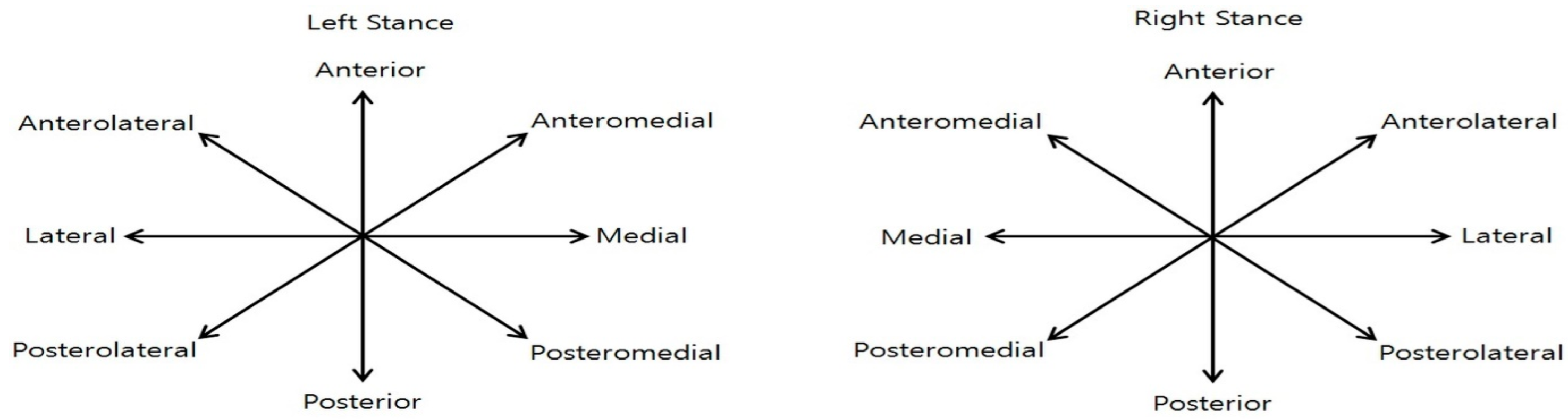
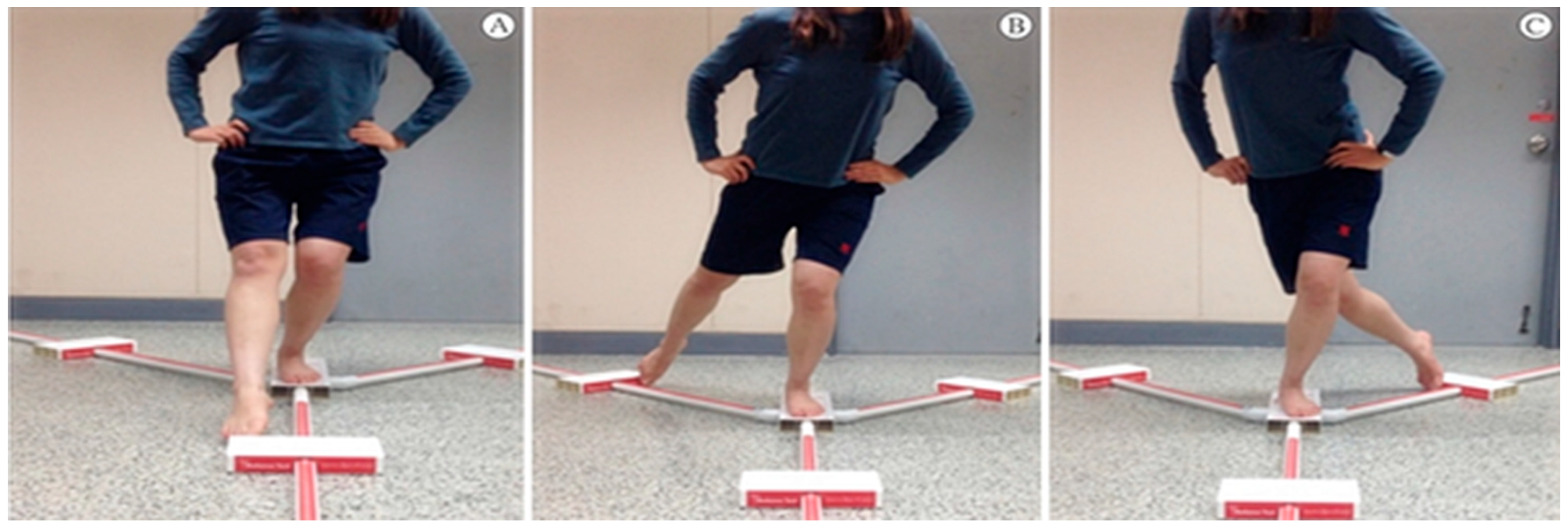
2.8. Y-Balance Test (Dynamic Balance Test)
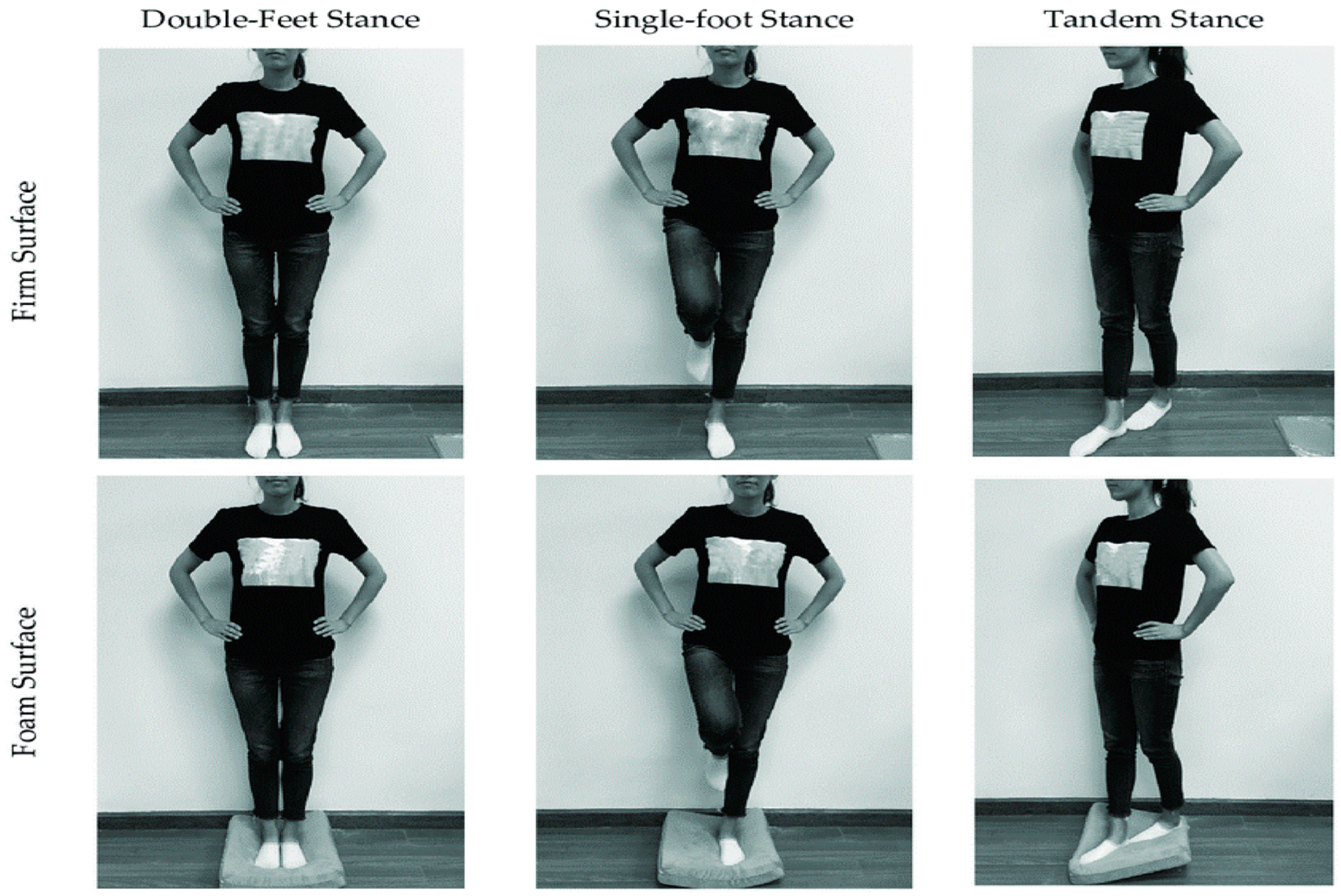
2.9. Balance Error Scoring System (BESS) Test (Static Balance Test)
2.10. Error Classification
- (1)
- Opening the eyes
- (2)
- Lifting the hands off the iliac crests
- (3)
- Stepping, stumbling, or falling
- (4)
- Moving the hip into more than 30° of flexion or abduction
- (5)
- Lifting the forefoot or heel off the testing surface
- (6)
- Remaining out of the testing position for more than 5 s
2.11. Scoring
2.12. Statistics
3. Results
3.1. Body Composition
3.2. Pelvic Alignment
3.3. Balance
4. Discussion
4.1. Body Composition
4.2. Pelvic Alignment
4.3. Balance
4.4. Limitations of the Study
5. Conclusions
Supplementary Materials
Author Contributions
Funding
Institutional Review Board Statement
Informed Consent Statement
Data Availability Statement
Acknowledgments
Conflicts of Interest
References
- Benedetti, M.G.; Furlini, G.; Zati, A.; Mauro, G.L. The effectiveness of physical exercise on bone density in osteoporotic patients. BioMed Res. Int. 2018, 2018, 4840531. [Google Scholar] [CrossRef]
- Kuo, Y.L.; Tully, E.A.; Galea, M.P. Sagittal spinal posture after Pilates-based exercise in healthy older adults. Spine 2009, 34, 1046–1051. [Google Scholar] [CrossRef]
- Castillo-Retamal, M.; Hinckson, E.A. Measuring physical activity and sedentary behaviour at work: A review. Work 2011, 40, 345–357. [Google Scholar] [CrossRef]
- Cancela, J.M.; Oliveira, I.M.; Rodríguez-Fuentes, G. Effects of Pilates method in physical fitness on older adults. A systematic review. Eur. Rev. Aging Phys. Act. 2014, 11, 81–94. [Google Scholar] [CrossRef]
- Hunter, G.R.; McCarthy, J.P.; Bamman, M.M. Effects of resistance training on older adults. Sports Med. 2004, 34, 329–348. [Google Scholar] [CrossRef] [PubMed]
- Buckland, A.J.; Burapachaisri, A.; Stekas, N.; Vasquez-Montes, D.; Protopsaltis, T.; Vigdorchik, J. Obesity alters spinopelvic alignment changes from standing to relaxed sitting: The influence of the soft-tissue envelope. Arthroplast. Today 2020, 6, 590–595.e1. [Google Scholar] [CrossRef] [PubMed]
- Schwab, F.; Lafage, V.; Patel, A.; Farcy, J.P. Sagittal plane considerations and the pelvis in the adult patient. Spine 2009, 34, 1828–1833. [Google Scholar] [CrossRef] [PubMed]
- Alvi, M.A.; Goyal, A.; Kerezoudis, P. Impact of obesity on outcomes following lumbar spine surgery: A systematic review and meta-analysis. Clin. Neurol. Neurosurg. 2018, 177, 27–36. [Google Scholar] [CrossRef]
- Granacher, U.; Gollhofer, A.; Hortobágyi, T.; Kressig, R.W.; Muehlbauer, T. The importance of trunk muscle strength for balance, functional performance, and fall prevention in seniors: A systematic review. Sports Med. 2013, 43, 627–641. [Google Scholar] [CrossRef]
- Kraemer, W.J.; Adams, K.; Cafarelli, E.; Dudley, G.A.; Dooly, C.; Feigenbaum, M.S.; Fleck, S.J.; Franklin, B.; Fry, A.C.; Hoffman, J.R.; et al. Progression models in resistance training for healthy adults. Med. Sci. Sports Exerc. 2002, 34, 364–380. [Google Scholar] [CrossRef]
- American College of Sports Medicine. ACSM’s Guidelines for Exercise Testing and Prescription, 11th ed.; Wolters Kluwer: Mumbai, India, 2021. [Google Scholar]
- Kendall, F.P.; McCreary, E.K.; Provance, P.G. Muscles: Testing and Function with Posture and Pain, 5th ed.; Lippincott Williams & Wilkins: Philadelphia, PA, USA, 2005. [Google Scholar]
- Plisky, P.J.; Rauh, M.J.; Kaminski, T.W.; Underwood, F.B. Star Excursion Balance Test as a predictor of lower extremity injury in high school basketball players. J. Orthop. Sports Phys. Ther. 2006, 36, 911–919. [Google Scholar] [CrossRef]
- Gribble, P.A.; Hertel, J. Considerations for normalizing measures of the Star Excursion Balance Test. Meas. Phys. Educ. Exerc. Sci. 2003, 7, 89–100. [Google Scholar] [CrossRef]
- Bell, D.R.; Guskiewicz, K.M.; Clark, M.A.; Padua, D.A. Systematic review of the Balance Error Scoring System. Sports Health 2011, 3, 287–295. [Google Scholar] [CrossRef] [PubMed]
- Morris, S.B. Estimating effect sizes from pretest–posttest–control group designs. Organ. Res. Methods 2008, 11, 364–386. [Google Scholar] [CrossRef]
- Cohen, J. Statistical Power Analysis for the Behavioral Sciences, 2nd ed.; Lawrence Erlbaum Associates: Hillsdale, NJ, USA, 1988. [Google Scholar] [CrossRef]
- Donnelly, J.E.; Blair, S.N.; Jakicic, J.M.; Manore, M.M.; Rankin, J.W.; Smith, B.K.; American College of Sports Medicine. Appropriate physical activity intervention strategies for weight loss and prevention of weight regain for adults. Med. Sci. Sports Exerc. 2009, 41, 459–471. [Google Scholar] [CrossRef]
- Segal, N.A.; Hein, J.; Basford, J.R. The effects of Pilates training on flexibility and body composition: An observational study. Arch. Phys. Med. Rehabil. 2004, 85, 1977–1981. [Google Scholar] [CrossRef]
- Nasiri, E.; Harsini, A.G.; Arabi, F.; Samadi, A.; Kamak, Z.R. The effects of an 8-week Pilates exercise program on physical performance in overweight and obese women with sedentary lifestyles. Sport Sci. Health 2022, 18, 725–733. [Google Scholar] [CrossRef]
- Wells, C.; Kolt, G.S.; Bialocerkowski, A. Defining Pilates exercise: A systematic review. Complement. Ther. Med. 2012, 20, 253–262. [Google Scholar] [CrossRef]
- Isenmann, E.; Kaluza, D.; Havers, T.; Elbeshausen, A.; Geisler, S.; Hofmann, K.; Flenker, U.; Diel, P.; Gavanda, S. Resistance training alters body composition in middle-aged women depending on menopause-A 20-week control trial. BMC Women’s Health 2023, 23, 526. [Google Scholar] [CrossRef]
- Emery, K.; De Serres, S.J.; McMillan, A.; Côté, J.N. The effects of a Pilates training program on arm-trunk posture and movement. Clin. Biomech. 2010, 25, 124–130. [Google Scholar] [CrossRef]
- Behm, D.G.; Drinkwater, E.J.; Willardson, J.M.; Cowley, P.M. Canadian Society for Exercise Physiology position stand: The use of instability to train the core in athletic and nonathletic conditioning. Appl. Physiol. Nutr. Metab. 2010, 35, 109–112. [Google Scholar] [CrossRef] [PubMed]
- Kibler, W.B.; Press, J.; Sciascia, A. The role of core stability in athletic function. Sports Med. 2006, 36, 189–198. [Google Scholar] [CrossRef]
- Howick, J.; Glasziou, P.; Aronson, J.K. Evidence-based mechanistic reasoning. J. R. Soc. Med. 2013, 106, 433–441. [Google Scholar] [CrossRef] [PubMed]
- Vismara, L.; Cimolin, V.; Galli, M.; Grugni, G.; Parisio, C.; Sibilia, O.; Santovito, C.; Romei, M.; Mauro, A.; Capodaglio, P. Effect of obesity and low back pain on spinal mobility: A cross-sectional study in women. J. Neuroeng. Rehabil. 2010, 7, 3. [Google Scholar] [CrossRef]
- Hue, O.; Simoneau, M.; Marcotte, J.; Berrigan, F.; Dore, J.; Marceau, P.; Teasdale, N. Body weight is a strong predictor of postural stability. Gait Posture 2007, 26, 32–38. [Google Scholar] [CrossRef]
- McGill, S.M.; Grenier, S.; Kavcic, N.; Cholewicki, J. Coordination of muscle activity to assure stability of the lumbar spine. J. Electromyogr. Kinesiol. 2003, 13, 353–359. [Google Scholar] [CrossRef]
- Clark, R.A.; Bryant, A.L.; Pua, Y.; McCrory, P.; Bennell, K.; Hunt, M. Validity and reliability of the Nintendo Wii Balance Board for assessment of standing balance. Gait Posture 2010, 31, 307–310. [Google Scholar] [CrossRef]
- Hertel, J.; Braham, R.A.; Hale, S.A.; Olmsted-Kramer, L.C. Simplifying the star excursion balance test: Analyses of subjects with and without chronic ankle instability. J. Orthop. Sports Phys. Ther. 2006, 36, 131–137. [Google Scholar] [CrossRef]
- Button, K.S.; Ioannidis, J.P.A.; Mokrysz, C.; Nosek, B.A.; Flint, J.; Robinson, E.S.J.; Munafò, M.R. Power failure: Why small sample size undermines the reliability of neuroscience. Nat. Rev. Neurosci. 2013, 14, 365–376. [Google Scholar] [CrossRef]
- Fortin, C.; Feldman, D.E.; Cheriet, F.; Labelle, H.; Parent, S. Clinical methods for quantifying body segment posture: A literature review. Disabil. Rehabil. 2011, 33, 367–383. [Google Scholar] [CrossRef] [PubMed]



| Group (N = 18) | Age (Years) | Height (cm) | Weight (kg) | % Body Fat |
|---|---|---|---|---|
| PCG (n = 9) | 49.44 ± 2.06 | 160.33 ± 7.37 | 58.83 ± 3.29 | 32.88 ± 1.11 |
| WCG (n = 9) | 48.22 ± 3.29 | 159.66 ± 8.01 | 60.21 ± 2.48 | 33.88 ± 1.40 |
| Mode | Muscle | Pilates Circuit (Reformer) | Machine-Based Weight Circuit |
|---|---|---|---|
| Push | Pectoralis major | Seated Chest Press | Seated Chest Press |
| Leg | Femoralis | Seated Leg Press | Plank with leg extension |
| Pull | Latissimus dorsi | Prone Long box Row | Seated Lat Pull Down |
| ABS | Rectus abdominis | Quadruped core stabilization | Machine-based abdominal crunch |
| Push | Deltoids | Prone Long box Shoulder | Seated Shoulder Press |
| Leg | Quadriceps femoris | Supine Longbox Leg Press | Seated Leg Extension |
| Pull | Biceps Brachii | Seated Bicep Curl | Seated Bicep Curl |
| ABS | Erector spinae | Back Extension | Back Extension |
| Push | Triceps | Seated Triceps Extension | Seated Triceps Extension |
| Leg | Biceps femoris | Prone Long box Leg Curl | Lying Leg Curl |
| Variable | Group | Pre | Post | Δ (w) | 95% CI | p | Cohen’s d |
|---|---|---|---|---|---|---|---|
| Body weight (kg) | PCG | 58.83 ± 3.50 | 55.74 ± 3.34 *** | −3.09 | −3.42 to −2.76 | <0.001 | PCG d(w): −0.90 |
| WCG | 60.21 ± 2.63 | 58.21 ± 1.57 ** | −2.00 | −3.28 to −0.72 | 0.007 | WCG d(w): −1.06 | |
| Between-group | - | - | - | −2.47 | −5.08 to 0.14 | 0.062 | d(b): −0.46 |
| LBM (kg) | PCG | 22.39 ± 1.54 | 21.80 ± 1.43 | −0.59 | −0.76 to −0.42 | <0.001 | PCG d(w): 0.06 |
| WCG | 22.64 ± 1.51 | 23.08 ± 2.71 | +0.43 | −2.25 to 1.39 | 0.598 | WCG d(w): 0.19 | |
| Between-group | - | - | - | −1.28 | −3.44 to 0.89 | 0.229 | d(b): −0.21 |
| Fat mass (kg) | PCG | 19.39 ± 1.40 | 17.33 ± 1.38 *** | −2.06 | −2.29 to −1.82 | <0.001 | PCG d(w): −1.47 |
| WCG | 20.27 ± 0.94 | 18.86 ± 1.01 **† | −1.41 | −2.20 to −0.63 | 0.003 | WCG d(w): −1.47 | |
| Between-group | - | - | - | −1.52 | −2.73 to −0.31 | 0.017 | d(b): −0.48 |
| Body fat % | PCG | 32.89 ± 1.19 | 31.04 ± 1.55 *** | −1.84 | −2.29 to −1.40 | <0.001 | PCG d(w): −1.26 |
| WCG | 33.89 ± 1.49 | 32.36 ± 1.67 *** | −1.53 | −2.19 to −0.88 | 0.001 | WCG d(w): −0.95 | |
| Between-group | - | - | - | −1.31 | −2.92 to 0.30 | 0.104 | d(b): −0.94 |
| WHR | PCG | 0.88 ± 0.02 | 0.83 ± 0.01 *** | −0.05 | −0.06 to −0.04 | <0.001 | PCG d(w): −2.70 |
| WCG | 0.90 ± 0.03 | 0.86 ± 0.03 ***†† | −0.04 | −0.05 to −0.02 | 0.001 | WCG d(w): −1.28 | |
| Between-group | - | - | - | −0.04 | −0.06 to −0.02 | 0.002 | d(b): −0.93 |
| Variable | Group | Pre | Post | Δ | 95% CI | p | Cohen’s d |
|---|---|---|---|---|---|---|---|
| Pelvic tilt (°) | PCG | 3.69 ± 0.45 | 2.16 ± 0.72 *** | −1.53 | −1.98 to 1.08 | <0.001 | PCG d(w): −2.57 |
| WCG | 3.31 ± 0.65 | 3.09 ± 0.42 †† | −0.22 | −0.83 to 0.38 | 0.422 | WCG d(w): 0.33 | |
| Between-group | - | - | - | −0.93 | −1.52 to −0.35 | 0.004 | d(b): −3.06 |
| Pelvic rotation (°) | PCG | 4.68 ± 0.37 | 3.21 ± 0.75 *** | −1.47 | −2.06 to −0.87 | <0.001 | PCG d(w): −2.35 |
| WCG | 4.44 ± 0.93 | 3.98 ± 0.35 † | −0.47 | −1.36 to 0.43 | 0.263 | WCG d(w): −0.59 | |
| Between-group | - | - | - | −0.77 | −1.35 to −0.18 | 0.013 | d(b): −1.36 |
| Pelvic inclination (°) | PCG | 8.60 ± 0.59 | 6.36 ± 1.34 ** | −2.24 | −3.36 to −1.13 | 0.002 | PCG d(w): −2.11 |
| WCG | 8.00 ± 0.95 | 7.64 ± 0.79 † | −0.36 | −1.24 to 0.53 | 0.383 | WCG d(w): −0.41 | |
| Between-group | - | - | - | −1.29 | −2.39 to −0.19 | 0.024 | d(b): −2.01 |
| Variable | Group | Pre | Post | Δ | 95% CI | p | Cohen’s d |
|---|---|---|---|---|---|---|---|
| Y-balance Right | PCG | 73.34 ± 0.92 | 84.87 ± 1.66 *** | 11.53 | 10.51 to 12.56 | <0.001 | PCG d(w): 8.94 |
| WCG | 73.45 ± 0.89 | 82.65 ± 1.38 ***†† | 9.19 | 8.48 to 9.91 | <0.001 | WCG d(w): 8.11 | |
| Between-group | - | - | - | 2.23 | 0.70 to 3.75 | 0.007 | d(b): 0.52 |
| Y-balance Left | PCG | 73.33 ± 1.16 | 84.46 ± 1.59 *** | 11.13 | 10.05 to 12.21 | <0.001 | PCG d(w): 8.10 |
| WCG | 73.48 ± 1.27 | 81.50 ± 1.43 ***††† | 8.02 | 9.16 to 6.88 | <0.001 | WCG d(w): 8.11 | |
| Between-group | - | - | - | 2.95 | 1.44 to 4.47 | 0.001 | d(b): 1.13 |
| BESS firm | PCG | 3.67 ± 0.87 | 1.00 ± 0.71 *** | −2.67 | −3.44 to −1.90 | <0.001 | PCG d(w): −3.33 |
| WCG | 3.00 ± 1.22 | 1.56 ± 1.13 *** | −1.44 | −1.85 to −1.04 | <0.001 | WCG d(w): −1.33 | |
| Between-group | - | - | - | −0.56 | −1.50 to 0.39 | 0.229 | d(b): −1.54 |
| BESS foam | PCG | 11.78 ± 1.72 | 7.33 ± 1.50 *** | −4.44 | −5.22 to −3.67 | <0.001 | PCG d(w): −2.78 |
| WCG | 11.89 ± 2.15 | 8.56 ± 0.88 *** | −3.33 | −4.77 to −1.90 | 0.001 | WCG d(w): −1.84 | |
| Between-group | - | - | - | −1.22 | −2.45 to 0.01 | 0.051 | d(b): −0.62 |
Disclaimer/Publisher’s Note: The statements, opinions and data contained in all publications are solely those of the individual author(s) and contributor(s) and not of MDPI and/or the editor(s). MDPI and/or the editor(s) disclaim responsibility for any injury to people or property resulting from any ideas, methods, instructions or products referred to in the content. |
© 2026 by the authors. Licensee MDPI, Basel, Switzerland. This article is an open access article distributed under the terms and conditions of the Creative Commons Attribution (CC BY) license.
Share and Cite
Oh, D.-H.; Lee, J.-K. An Exploratory Comparison of Pilates and Weight Circuit Training on Body Composition, Pelvic Alignment, and Balance in Obese Middle-Aged Women. J. Funct. Morphol. Kinesiol. 2026, 11, 141. https://doi.org/10.3390/jfmk11020141
Oh D-H, Lee J-K. An Exploratory Comparison of Pilates and Weight Circuit Training on Body Composition, Pelvic Alignment, and Balance in Obese Middle-Aged Women. Journal of Functional Morphology and Kinesiology. 2026; 11(2):141. https://doi.org/10.3390/jfmk11020141
Chicago/Turabian StyleOh, Du-Hwan, and Jang-Kyu Lee. 2026. "An Exploratory Comparison of Pilates and Weight Circuit Training on Body Composition, Pelvic Alignment, and Balance in Obese Middle-Aged Women" Journal of Functional Morphology and Kinesiology 11, no. 2: 141. https://doi.org/10.3390/jfmk11020141
APA StyleOh, D.-H., & Lee, J.-K. (2026). An Exploratory Comparison of Pilates and Weight Circuit Training on Body Composition, Pelvic Alignment, and Balance in Obese Middle-Aged Women. Journal of Functional Morphology and Kinesiology, 11(2), 141. https://doi.org/10.3390/jfmk11020141