


Abstract
Background: Current clinical practice still lacks consistent evidence in the physiotherapy management of rotator cuff-related pain syndrome (RCS). The purpose of this trial was to compare the effectiveness of a scapular-focused treatment with and without real-time electromyographic biofeedback (EMGBF) to a control therapy in patients with RCS, in the short-term. Methods: 60 patients with RCS were divided into three groups: the scapular-focused exercise protocol group (P_G n = 20), the scapular-focused exercise protocol with EMGBF group (P+EMGBF_G n = 20), and the control therapy group (CT_G n = 20). Values of pain and function [Shoulder Pain and Disability Index (SPADI) questionnaire, complemented by the Numeric Pain Rating Scale (NPRS) and Disabilities of the Arm, Shoulder and Hand (DASH) questionnaire], scapular stabilizer neuromuscular control (SSNC), scapular stabilizer activation onset (SSAO), dynamic scapular alignment, range of motion (ROM), and glenohumeral flexor and abductor muscle strength (GMS) were assessed at baseline and after 6 weeks and compared within and between groups. Results: There were significant differences in pain and function, SSNC, SSAO, dynamic scapular alignment, ROM, and GMS in all groups between the initial and 6-week assessments. However, the P+EMGBF_G showed superior results in pain and function, SSNC, and dynamic scapular alignment than the CT_G and superior results in SSNC than the P_G. The P_G had superior results in pain and function and dynamic scapular alignment than the CT_G. Conclusions: This trial supports the use of a scapular-focused exercise protocol as a comparative approach that effectively improves pain and function in patients with rotator cuff-related shoulder pain syndrome. These results in pain and function were shown to be independent of the use of EMGBF.
1. Introduction
Rotator cuff disorders are the most frequent group of pathologies affecting the shoulder and represent 50–85% of shoulder conditions treated by health professionals [1]. Rotator cuff-related pain syndrome (RCS) is commonly reported in the general population, and a common cause of disability at work and during daily activities [2,3,4,5]. Shoulder pain can therefore be seen as an important medical and socioeconomic problem in Western society [1].
RCS is characterized by the presence of pain [6,7,8,9], decreased function [5,6,7,8,9], muscle weakness [5,7,8,10,11], altered range of motion (ROM) [5,6,7,9], altered scapula neuromuscular control [7,12], and scapular dyskinesis [8,13,14].
Over time, a variety of physiotherapeutic treatment modalities have been suggested for the treatment of shoulder impingement pain including electrotherapy, exercise therapy, massage, joint mobilization, shockwave treatment, ultrasound or laser treatment, and sling exercise therapy [1,15,16]. Several systematic reviews have evaluated the effectiveness of these modalities in shoulder disorders [15,16,17,18,19,20], however there is limited evidence to support the efficacy of most of these therapeutic interventions on RCS [15,19,21].
The current evidence [1,4,19,22] states that exercise has a statistically and clinically important effect on pain reduction and improved function. In addition, manual therapy seems to augment the effects of exercise, while several studies reported no evidence for the effectiveness of a scapular-focused treatment approach in patients with RCS [16,19,23]. However, other researchers investigating scapular-focused stabilization and motor control exercises to address scapular dyskinesis, reduction in pain [7,8,10,24], and restoration of function [7,8,10], in RCS found it beneficial.
Moreover, dos Santos et al. [7] have suggested that a well-described scapular-focused exercise protocol, with the aid of real-time electromyographic biofeedback (EMGBF) and home-based management, can reduce pain and increase function, as well as scapular neuromuscular activity and control, ROM, and glenohumeral flexor and abductor muscle strength (GMS) in patients with shoulder dysfunctions in the short-term. The long-term results also appear to maintain gains in pain and function, as well as scapular stabilizer activation onset (SSAO), ROM, and GMS gains, but not for scapular stabilizer neuromuscular control (SSNC) or dynamic scapular alignment.
With conflicting research evidence, interventions focused on the scapula should therefore still be considered in treating patients with RCS. However, the effect of adding scapular stabilization exercises to protocols for the progressive strengthening of shoulder complex muscles on a non-multimodal approach remains unclear [1,19].
To advance our understanding of the value of scapular-focused exercise for RCS, a trial was designed with the main objective of comparing pain and function outcomes between three different treatment protocols for patients with RCS, in the short term (6 weeks):
- (1)
- Scapular-focused exercise protocol without EMGBF (P_G);
- (2)
- Scapular-focused exercise protocol supported by real-time EMGBF (P+EMGBF_G);
- (3)
- Control therapy group (CT_G) with manual therapy (glenohumeral joint physiologic and accessory mobilization), massage to reduce upper trapezius (UT) stiffness, and shoulder rotation strengthening into external rotation.
Two hypotheses were put forward:
- The scapular-focused exercise protocol would produce clinically and statistically superior outcomes over the control therapy.
- The scapular-focused exercise protocol with EMGBF would produce clinically and statistically superior outcomes over the control therapy.
2. Materials and Methods
2.1. Study Design
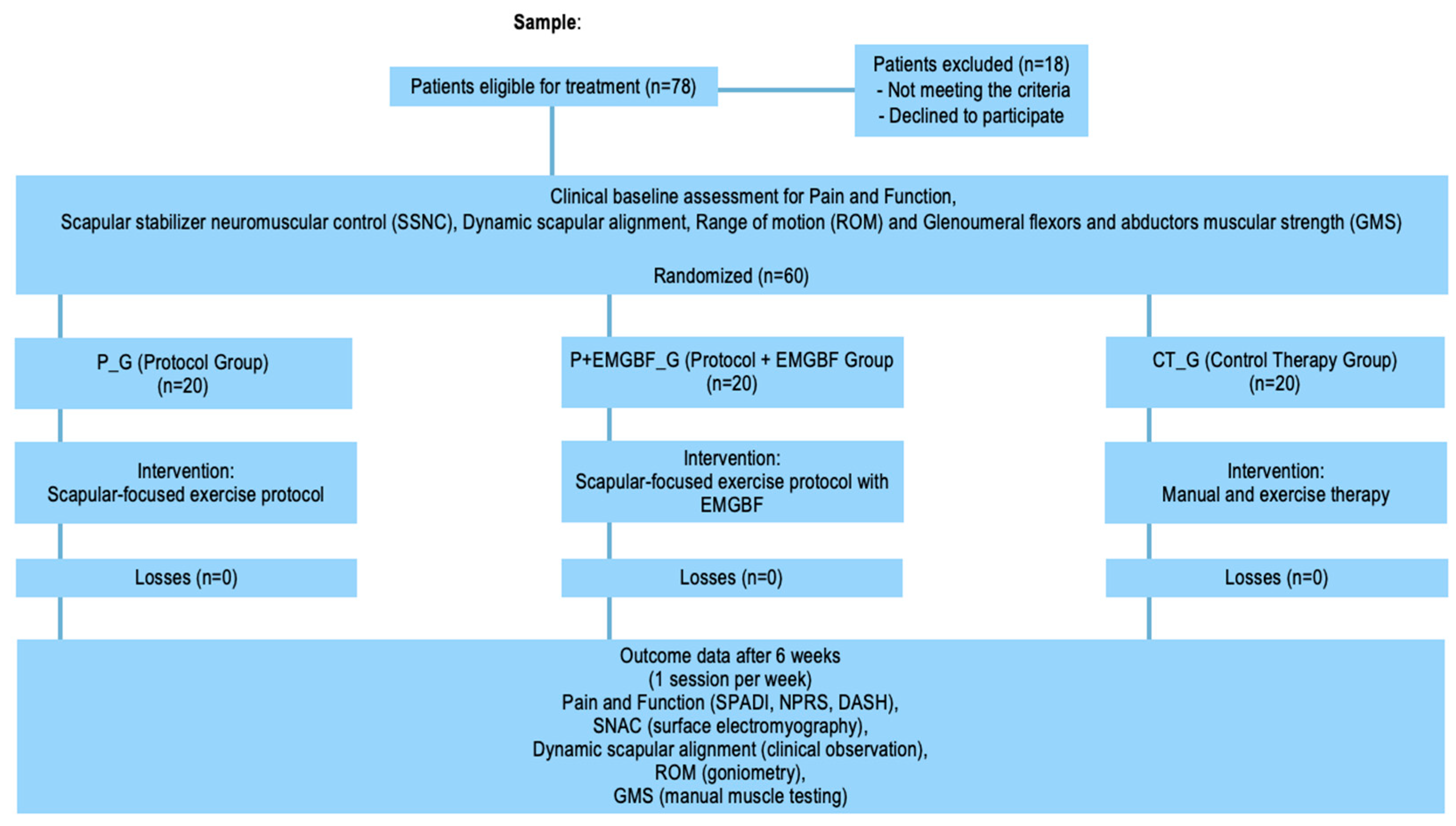
A prospective randomized controlled trial was conducted to compare the outcomes of a scapular-focused exercise protocol [7] with and without real-time EMGBF, and a control therapy group receiving shoulder mobilization, UT massage and general upper limb strengthening, with baseline (initial) and 6-week (final) assessments. The flowchart illustrating subject enrollment, treatment allocation and outcome measurements is summarized in Figure 1. The ethics committee of Alcoitão Superior School of Health gave its approval to this trial (CE-ESSAlcoitão, Approval No. 18/2022) and the study has been registered on ClinicalTrials.gov (ID: NCT05516186, Release Date: 23 August 2022).
Figure 1.
Flowchart illustrating subject enrollment, treatment allocation, and outcome measurements.
2.2. Participants
Participants were recruited through orthopedic physicians and physiotherapists, working in private medical clinics. Diagnosis was based on the presence of current anterolateral acromial area pain [25], pain with active shoulder elevation [26], pain with passive or isometric resisted shoulder external rotation [27,28], and at least two positive results from the Neer test [29], Hawkins test [30], and Jobe/Empty can test [31].
Participants were included based on the following criteria: 1—age between 18 and 60 years; 2—primary complaint of shoulder pain; and 3—RCS clinical diagnosis. The exclusion criteria were: 1—neurological symptoms [32]; 2—positive thoracic outlet syndrome (screened with Allen’s and Adson’s tests) [32,33]; 3—history of shoulder surgery or fracture [26]; 4—structural injuries confirmed by imaging (e.g., ligaments and labrum); 5—symptoms reproduced by cervical examination [26,34]; 6—unable to commit to scheduled treatments; and 7—anti-inflammatory drug use. These inclusion and exclusion criteria were extracted from dos Santos et al.’s [7] scapular-focused exercise protocol. All eligible participants gave written informed consent before data collection, and they were free to renounce from the study at any moment.
The sample size required for a significance level of 0.05 and a power of 0.80 to detect a significant decrease on the NPRS was calculated to be 363 subjects with RCS. However, the power analysis after 20 treated subjects revealed sufficient power (>0.80) for limiting the subject inclusion to 60.
2.3. Randomization and Allocation
From 78 participants recruited, 60 were included and 18 were excluded before starting treatment. These 60 participants were assigned into three groups: P_G, P+EMGBF_G, and CT_G. Each patient was allocated into their group through a computer-generated block randomization process designed to ensure equal sample sizes across groups [35]. The randomization list was prepared by an independent researcher not involved in the assessments or interventions, using random blocks generated in Microsoft Excel. Allocation concealment was maintained by storing the group assignments in sealed opaque envelopes that were opened sequentially and only after each participant had completed baseline assessments. Interventions were delivered by different physiotherapists, each specifically trained and familiarized with the scapular-stability protocol to ensure procedural consistency. Participants were blinded to their group allocation; however, due to the nature of the intervention, therapist blinding was not feasible. Outcome assessors were not blinded, which may introduce a potential risk of performance and detection bias.
All participants’ characteristics are described in Table 1.
Table 1.
Participants’ characteristics.
2.4. Interventions
2.4.1. P+EMGBF_G
The scapular-focused exercise protocol followed the protocol described by dos Santos et al. [7]. The protocol uses the sequential stages of motor relearning (cognitive, associative, and autonomous) as a framework, while promoting the integration of local and global muscle function in weekly sessions divided into three phases. The main purpose of the protocol is to increase scapular neuromuscular activity and control [7].
The real-time EMGBF utilized was the Physioplux system version 1.06. The EMGBF system comprised four pairs of 24 mm-diameter silver chloride gel surface electrodes, a ground electrode of the same type, four electrode pair cables connected to miniaturized differential amplifiers, and a main HUB unit that communicates via Bluetooth™ to a computer. The EMGBF enabled both patients and the physiotherapist to assess, monitor, and correct in real-time the muscular activation and behavior during the exercises. Before placement of the electrodes, patients’ skin was shaved (if necessary) and cleaned with alcohol to reduce skin impedance. Their placement, normalization of electromyographic (EMG) data, and muscle testing positions were the same as those used by dos Santos et al. [7] based on Ekstrom et al. [36] and Hermens et al. [37] (Table 2).
Table 2.
Placement of the electrodes [7].
The scapular-focused exercises used for this study and described in Table 3 were based on and inspired by dos Santos et al.’s [7] scapular-focused exercise protocol.
Table 3.
Scapular-focused exercise descriptions.
The progression rules (Table 4) followed the dos Santos et al. [7] exercise protocol, where the stimulus magnitude and progression (either in the same exercise or to progress to the next exercise or phase) were tailored to each patient’s performance and re-assessment, while operating within the protocol’s structure. The progression evolved: (1) exercise complexity, (2) feedback from the EMGBF and from the physiotherapist, (3) perceived effort, (4) sets, repetitions, and endurance, and (5) resting time between exercises.
Table 4.
Progression guidelines [7].
2.4.2. P_G
The same protocol described above was applied without EMGBF. While the EMGBF was not provided, participants did receive external feedback from the physiotherapist through verbal feedback (verbal commands), manual feedback (manual touching for correcting or maintaining the right position), and visual feedback from a mirror.
2.4.3. CT_G
The control therapy group underwent conservative physical therapy, which included both manual and exercise therapy [16]. Manual therapy consisted of 10 min massage of the shoulder region, with the main goal of relaxing the UT, and 20 min of shoulder mobilization. This mobilization included both accessory and physiological mobilizations of the glenohumeral joint. Longitudinal-caudal and post-anterior accessory mobilizations of the humeral head were performed at a grade (i.e., strength) the therapist judged appropriate for the severity and irritability (i.e., ease of aggravation and time for symptoms to settle based on the description provided in the subjective examination), with the aim of reducing symptoms. Flexion, abduction, and rotation (internal and external) physiological mobilizations were similarly performed based on the therapist’s judgment of the severity, irritability, and extent of each movement impairment with the aim of improving ROM. Exercise therapy comprised internal and external rotation strengthening performed with an elastic band (Thera-Band, Akron, OH, USA), each for 20 min. Participants had to perform three sets of 15 repetitions of internal and external rotation (i.e., a total of six sets), standing with the humerus against the trunk (i.e., neutral position), and with 90° elbow flexion without pain or clear fatigue. All exercises were performed respecting the participant’s pain threshold and under the physiotherapist’s supervision who provided verbal feedback to ensure the correct movement pattern was maintained during the exercise. Between each set of exercises, the participant rested for 2 min. The session ended with UT stretching (2 times for 30 s) and instruction for home exercises. For home exercises, elastic bands (Thera-Band, USA) were given with the instruction to perform the same exercises performed during the face-to-face sessions once a day at a time that was convenient.
In terms of exercise progression, ROM, load, repetitions, and series could be increased as well as resistance. When the patient could perform the repetitions of an exercise without difficulty, the load was progressed to the next stronger color theraband. When the patient ROM improved, the exercise position was also progressed into greater elevation at a load they could manage (i.e., a lighter color theraband if necessary).
Assessments and interventions were performed by three physiotherapists, with two of them specifically trained to use the protocol, with and without EMGBF. All outcomes were assessed prior to the beginning of treatment hereinafter referred to as baseline (initial) and at 6 weeks (final) assessments, respectively (Figure 1). The assessment of pain and function were questionnaires, and the other outcomes were assessed using objective measures, which did not require subjective measurement, with the exception of scapular alignment, where observation was used to assess this outcome. The intervention for each group had an hour mean duration, once a week, for 6 weeks (7 sessions).
2.5. Outcomes Measures
The primary outcome measure of pain and function was the SPADI, complemented by the NRPS and DASH. The secondary outcome measures of scapular neuromuscular activity and control were a combination of:
- •
- Surface electromyography for the P+EMGBF_G (allowing both patients and physiotherapists to assess, monitor, and correct in real-time the muscular activation and behavior during the exercises);
- •
- Clinical observation of the scapula’s medial and inferior borders to detect scapular dyskinesis (classified as present if one or both medial and inferior borders were observed during the glenohumeral movement or classified as absent if no prominence was observed [12]);
- •
- Range of motion (ROM) measured using a standard plastic goniometer (following the procedures for the glenohumeral joint motion measurements [41] recognizing the limitation of measurement without stabilization [42]);
- •
- Graded glenohumeral flexors’ and abductors’ isometric muscle strength (GMS) measured through isometric manual muscle testing (acknowledging the reduced sensitivity compared to dynamometry [42]). Outcome measures are presented in Table 5.Table 5. Resume of the testing procedure [7].
2.6. Statistical Analysis
The statistical analysis was focused on detecting between- and within-group treatment effects (with effect sizes and 95% CIs) at the baseline and 6 weeks (short-term). Data analysis was performed using SPSS software version 1.0.0.1406. The paired-t test was used to compare the pain and function, SSNC, scapular alignment, ROM, and GMS in the same group between the pre- and post-treatment assessments. Independent t tests were used to test the primary outcome pain and function for differences between the groups. McNemar and chi-square tests were used to test the secondary outcomes (scapular neuromuscular activity and control, ROM and GMS). The significance level was set at 0.05. Although a two-way repeated-measures ANOVA could provide a more comprehensive analysis of group × time interactions, t-tests were chosen due to the exploratory nature and limited sample size of this short-term study. This limitation was considered in the interpretation of the findings.
3. Results
3.1. Global Initial and Final Results
At baseline, all three groups had poor levels of pain and function (shoulder pain and disability index—SPADI, numeric pain rating scale—NPRS, and disabilities of the arm, shoulder, and hand—DASH), decreased scapular neuromuscular activity and control (SSNC, SSAO, and scapular alignment), and decreased ROM and GMS, with no significant differences between groups (p > 0.05) (Table 6 and Table 7).
Table 6.
Comparison of primary outcome pain and function within groups and between groups.
Table 7.
Comparison of secondary outcomes within groups and between.
After 6 weeks of intervention, all outcomes improved significantly compared with the baseline (p < 0.05). Pain and function met the Minimal Clinically Important Difference (MCID) criteria.
3.2. Within Groups (Comparing Results Between the Initial and Final Assessments)
Significant differences were found in primary outcome pain and function (SPADI, NPRS, and DASH) and in secondary outcomes (SSNC, SSAO, fynamic scapular alignment, ROM, and GMS) for both the P_G and P+EMGBF_G. The CT_G also had significant differences, with exception of the secondary outcomes SSNC and dynamic scapular alignment (pa < 0.05) (Table 6 and Table 7).
3.3. Between Groups (Comparing Results Between Final Assessments)
3.3.1. P_G vs. P+EMGBF_G
3.3.2. P_G vs. CT_G
3.3.3. P+EMGBF_G vs. CT_G
4. Discussion
In this trial, the results of 6 weeks (7 sessions) of the scapular-focused exercise protocol for patients with shoulder dysfunction [7] were compared to the results of 6 weeks (7 sessions) of the same protocol with EMGBF and results from 6 weeks (7 sessions) of a control therapy.
The results of this trial support other research [4,7,8,24,27,34,50,51,52,53,54] that a progressive scapular-focused approach incorporating feedback and home management can significantly improve pain and function in RCS.
No differences were found in the initial assessments of participants’ characteristics between groups or in outcomes at baseline, demonstrating the homogeneity of participants in all groups on these factors.
At the end of the trial, each group had significant differences in their results comparing baseline with the final assessment. Analyzed separately, each intervention was successful in improving the primary outcome, pain and function, and the MCID value met in each group. The same results were found for the secondary outcomes, scapular neuromuscular activity and control, ROM, and GMS. Apparently, all interventions are effective when judged on these measures. However, when analyzed separately, some differences could be found.
In their systematic review, Pieters et al. [19] highlighted that the evidence for exercise as an intervention for shoulder subacromial pain is increasing. They claim that exercise therapy should be considered as a main intervention in the management of people with RCS and that manual therapy provides further benefit if used in addition to exercise therapy [19]. This was the treatment combination used in the CT_G of this trial. In their systematic review, Ravichandran et al. [55] concluded that for the best clinical outcome for RCS, scapular-focused exercises should be used, either exclusively or as a part of a shoulder program. A critique of recent literature is that optimal type, frequency, dose, load, sets, repetitions, interval or rest time, and speed remain unclear in most studies [1,9]. The specificity in describing these variables (for both P_G and P+EMGBF_G) is a strength of this trial.
4.1. Primary Outcome Pain and Function
Within group analysis, comparing results between the initial and final assessments showed that clinically meaningful changes were achieved for pain and function over time in all three groups with similar and even better results than previous studies incorporating comparable interventions [6,7,8,24,54,56,57,58,59]. The MCID values were met for all three groups; however, despite the good results achieved in each group, significant differences were found between them. The P+EMGBF_G had statistically significant better results over the other two groups, and the P_G had statistically significant better results over the CT_G. The better results found in the two groups that used the scapula-focused exercise protocol corroborates the literature that suggests rehabilitation that incorporates scapular-focused motor control exercises is effective for reducing pain and disability for patients with RCS [6,7,8,19,24,55]. However, it does not corroborate the results of literature that claim better effects in pain reduction with the combination of both manual therapy and shoulder rotation strengthening exercises [9,16,19,20].
4.2. Secondary Outcome Scapular Neuromuscular Activity and Control, ROM, and GMS
The initial SSNC results of decreased activity in lower trapezius (LT) and serratus anterior (SA) muscles support the presupposition that shoulder dysfunction is associated with impaired scapulothoracic stabilizer function [13], consistent with the findings in other studies [7,57]. In contrast, Larsen et al. [60] reported a non-significant tendency to a higher level of mean UT, LT, and SA muscle activity in RCS patients compared to those without RCS. As dos Santos et al. [7] highlighted in their study, these findings support that the diagnostic categorization does not predict muscle function; rather, it is the presence of muscle dysfunction that represents either a risk variable that may contribute to pain and disability, or a central nervous system response to pain and threat [61]. The initial SSNC results may reflect dysfunction in the feedforward processing present [39] even before the onset of movement. This general initial motor plan is expected to be fine-tuned using real-time internal feedback mechanisms [7]. Research has shown that with a planning-control model underpinning the assessment and management of motor control/function, conscious movement can be trained with feedback [61], promoting immediate effects on motor strategies [62], and can restore the force-couple activation [63] in the scapular muscles (stabilizers) [7], consistent with the improvement in LT and SA activity in both P_G and P+EMGBF_G of this trial. The superior results obtained in favor of the P+EMGBF_G may suggest that the EMGBF has an important role in the improvement of this outcome.
Concerning SSAO, the initial and final results of this trial corroborate the findings of dos Santos et al. [7], who highlighted that the pattern of activation alone is not responsible for patients’ symptoms and disability, and it can only be considered a potential predisposing factor that may contribute to some patients’ disabilities depending on their individual lifestyle behaviors and requirements. The non-significant differences found in the 3 groups can lead to an interesting question: How important is it to assess SSAO, if it apparently does not distinguish the presence of dysfunction?
The literature challenges the relationship between scapular alignment and RCS, however in this trial, the use of a scapula-focused exercise protocol (with or without EMGBF) resulted in superior results to the control group that did not incorporate scapular-focused exercise. Comparing both scapula-focused approaches, the results were significantly better for the dynamic scapular alignment outcome, in favor of the P+EMGBF_G, suggesting that the use of EMGBF as an aid to the intervention adds to the improvement of a shoulder strengthening program. However, a kinematics analysis would provide more objective data about this outcome as its data include the displacement and orientation of body segments, joint angles, and spatio-temporal gait parameters [64].
While ROM and GMS had statistically significant improvements in all three groups over 6 weeks, no group was better than the others at improving these outcomes. The GMS finding may be attributed to all three groups receiving rotation strengthening.
The first hypothesis that P_G would produce clinically and statistically superior outcomes over the control therapy was confirmed for the primary outcome, pain and function, and for dynamic scapular alignment. However, no differences were found for the secondary outcomes SSAO, SSNC, ROM, and GMS.
The second hypothesis that P+EMGBF_G would produce clinically and statistically superior outcomes over CT_G was also confirmed for the primary outcome, pain and function, and for the SSNC and dynamic scapular alignment outcomes. However, no differences were found for SSAO, ROM, and GMS outcomes.
4.3. Trial Limitations
Although participants were blinded to group allocation, the physiotherapists delivering the interventions and the outcome assessors were not. This lack of blinding may have introduced potential performance and detection bias, which should be considered when interpreting the results. Although the post hoc power analysis indicated sufficient statistical power with the included sample, the smaller number of participants compared with the initial estimation may limit the reliability and generalisability of the between-group comparisons. While the superior results for both P_G and P+EMGBF_G over CT_G in pain and function (SPADI, NPRS and DASH) and in SSNC for P+EMGBF_G are sufficient to support the inclusion of scapular-focused exercise for RCS, the limitations of standard goniometry and manual muscle testing to measure ROM and GMS, respectively, require the improvements in those outcomes are interpreted cautiously. Similarly, the superior outcome in dynamic scapular alignment for both P_G and P+EMGBF_G over CT_G should be interpreted cautiously given the subjective assessment used for this outcome. The judgment regarding scapular alignment was made easier by providing explicit criteria for classifying the alignment. Nevertheless, a more objective measure was available using instruments such as the Flock of birds® (Ascension Technology Corporation, Burligton, VT, USA) or even apps with cameras for the measurement, would be more accurate [42]. Lastly, practical limitations did not allow for blinding of the outcome measurement. This would have had less effect on the pain and function primary outcome measures (SPADI, NPRS, and DASH), or the secondary objective SSNC measure, but could have influenced ROM, GMS, and scapular alignment measures. Further studies are needed to assess the effectiveness of a scapular-focused protocol against other rehabilitation approaches and possibly examine the value of providing kinematic feedback [65,66]. Research investigating whether clinical assessments, such as those from Lewis [33], can predict which patients will benefit from the inclusion of scapular-focused exercise, may also assist in identifying the clinical relevance of scapular impairments, such as SSNC and dynamic scapular alignment. Lastly, the present study did not evaluate the medium- or long-term effects of the intervention, which limits the generalizability of the findings over time and should be considered when interpreting the results. That said, a follow-up would be helpful to compare the results in short or long-term.
4.4. Trial Strengths and Comparisons with Previous Research
This RCT is distinctive because it compares the effect of a scapular-focused exercise protocol with and without EMBGF, including a control group therapy, increasing the validity of its results. Concerning the scapular-focused protocol, this clinical trial achieved similar results as previous studies reporting the overall benefits of rehabilitation programs for RCS. We believe this study adds to the body of evidence physiotherapists can draw on when developing shoulder rehabilitation for patients with RCS.
5. Conclusions
This trial showed that a scapular-focused exercise treatment approach is more effective, and hence superior, for improving pain and function when compared to a control of manual therapy and shoulder rotation strengthening. This superior result in pain and function was independent of the use of EMGBF. However, SSNC and dynamic scapular alignment improvements were more significant using EMGBF as a complement of the scapular-focused protocol. The results of this clinical trial also showed that the secondary outcomes SSAO, ROM, and GMS improved in all three groups with no differences between interventions.
Author Contributions
Conceptualization, C.d.S. and R.M.; methodology, C.d.S., I.B.d.A. and M.A.J.; formal analysis, C.d.S.; investigation, C.d.S. and I.B.d.A.; writing—original draft preparation, C.d.S. and I.B.d.A.; writing—review and editing, M.A.J.; supervision, R.M. All authors have read and agreed to the published version of the manuscript.
Funding
This research received no external funding.
Institutional Review Board Statement
The study was conducted in accordance with the Declaration of Helsinki and approved by the Ethics Committee of the Alcoitão Superior School of Health (CE-ESSAlcoitão, Approval No. 18/2022, dated 5 April 2022, presided by Doutor Alexandre Castro Caldas).
Informed Consent Statement
Informed consent was obtained from all subjects involved in the study.
Data Availability Statement
The datasets generated and/or analyzed during the current study contain personal health information and are not publicly available due to privacy and ethical restrictions. De-identified data and analysis code may be available from the corresponding author on reasonable request, subject to approval by the Ethics Committee of the Alcoitão Superior School of Health and a data-use agreement.
Acknowledgments
The authors have reviewed and edited the output and take full responsibility for the content of this publication.
Conflicts of Interest
Author Ricardo Matias was employed by Kinetikos. The authors declare that there are no potential conflicts of interest with respect to the research, authorship, and/or publication of this manuscript.
Abbreviations
The following abbreviations are used in this manuscript:
| ABD | Abduction |
| CI | Confidence Interval |
| cm | Centimeters |
| CT_G | Control Therapy Group |
| DASH | Disabilities of the arm, shoulder, and hand |
| EMG | Electromyography |
| EMGBF | Electromyographic Biofeedback |
| EXT ROT | External Rotation |
| F | Flexion |
| GMS | Glenohumeral Flexor and Abductor Muscle Strength |
| HOR ABD | Horizontal Abduction |
| IB | Inferior Border of the Scapula |
| Kg | Kilogram |
| LT | Lower Trapezius |
| MB | Medial Border of the Scapula |
| MCID | Minimal Clinically Important Difference |
| mm | Millimeters |
| ms | Milliseconds |
| MVIC | Maximum Voluntary Isometric Contractions |
| N/A | Non-Applicable |
| NPRS | Numeric Pain Rating Scale |
| P+EMGBF_G | Scapular-Focused Exercise Protocol + EMGBF group |
| P_G | Protocol Group |
| RCS | Rotator Cuff-Related Pain Syndrome |
| ROM | Range of Motion |
| SA | Serratus Anterior |
| SD/sd | Standard Deviation |
| SP | Scapular Plane |
| SPADI | Shoulder Pain and Disability Index |
| SPSS | Statistical Package for the Social Sciences |
| SSNC | Scapular Stabilizer Neuromuscular Control |
| SSAO | Scapular Stabilizer Activation Onset |
| USA | United States of America |
| UT | Upper Trapezius |
| X2 | Chi-Square Test |
References
- Doiron-Cadrin, P.; Lafrance, S.; Saulnier, M.; Cournoyer, E.; Roy, J.; Dyer, J.; Frémont, P.; Dionne, C.; MacDermid, J.; Tousignant, M.; et al. Shoulder Rotator Cuff Disorders: A Systematic Review of Clinical Practice Guidelines and Semantic Analyses of Recommendations. Arch. Phys. Med. Rehabil. 2020, 101, 1233–1242. [Google Scholar] [CrossRef] [Scilit]
- Diercks, R.; Bron, C.; Dorrestijn, O.; Meskers, C.; Naber, R.; de Ruiter, T.; Willems, J.; Winters, J.; van der Woude, H.J. Guideline for Diagnosis and Treatment of Subacromial Pain Syndrome. Acta Orthop. 2014, 85, 314–322. [Google Scholar] [CrossRef] [Scilit]
- Friedman, L.; Lafosse, L.; Garrigues, G. Global Perspectives on Management of Shoulder Instability: Decision Making and Treatment. Orthop. Clin. N. Am. 2019, 51, 241–258. [Google Scholar] [CrossRef] [Scilit]
- Gutiérrez-Espinoza, H.; Araya-Quintanilla, F.; Cereceda-Muriel, C.; Álvarez-Bueno, C.; Martínez-Vizcaíno, V.; Cavero-Redondo, I. Effect of Supervised Physiotherapy versus Home Exercise Program in Patients with Subacromial Impingement Syndrome: A Systematic Review and Meta-Analysis. Phys. Ther. Sport 2020, 41, 34–42. [Google Scholar] [CrossRef] [Scilit]
- Lee, S.; Savin, D.; Shah, N.; Bronsnick, D.; Goldberg, B. Scapular Winging: Evaluation and Treatment. J. Bone Joint Surg. Am. 2015, 97, 1708–1716. [Google Scholar] [CrossRef] [Scilit]
- Bae, Y.; Lee, G.; Shin, W.; Kim, T.; Lee, S. Effect of a Motor Control and Strengthening Exercises on Pain, Function, Strength, and the Range of Motion of Patients with Shoulder Impingement Syndrome. J. Phys. Ther. Sci. 2011, 23, 687–692. [Google Scholar] [CrossRef] [Scilit]
- dos Santos, C.; Jones, M.A.; Matias, R. Short- and Long-Term Effects of a Scapular-Focused Exercise Protocol for Patients with Shoulder Dysfunctions—A Prospective Cohort. Sensors 2021, 21, 2888. [Google Scholar] [CrossRef] [Scilit]
- Wen, M.; Hu, X.; Bao, G. Scapular Dyskinesis-Based Exercise Therapy versus Multimodal Physical Therapy for Subacromial Impingement Syndrome in Young Overhead Athletes with Scapular Dyskinesis: A Randomized Controlled Trial. BMC Sports Sci. Med. Rehabil. 2025, 17, 204. [Google Scholar] [CrossRef] [Scilit]
- Tauqeer, S.; Arooj, A.; Shakeel, H. Effects of Manual Therapy in Addition to Stretching and Strengthening Exercises to Improve Scapular Range of Motion, Functional Capacity and Pain in Patients with Shoulder Impingement Syndrome: A Randomized Controlled Trial. BMC Musculoskelet. Disord. 2024, 25, 192. [Google Scholar] [CrossRef] [Scilit]
- Beaudreuil, J.; Lasbleiz, S.; Richette, P.; Seguin, G.; Rastel, C.; Aout, M.; Vicaut, E.; Cohen-Solal, M.; Lioté, F.; de Vernejoul, M.C.; et al. Assessment of Dynamic Humeral Centering in Shoulder Pain with Impingement Syndrome: A Randomised Clinical Trial. Ann. Rheum. Dis. 2011, 70, 173–179. [Google Scholar] [CrossRef] [Scilit]
- Galace De Freitas, D.; Marcondes, F.; Monteiro, R.; Rosa, S.; Maria de Moraes Barros Fucs, P.; Fukuda, T. Pulsed Electromagnetic Field and Exercises in Patients with Shoulder Impingement Syndrome: A Randomized, Double-Blind, Placebo-Controlled Clinical Trial. Arch. Phys. Med. Rehabil. 2014, 95, 345–352. [Google Scholar] [CrossRef] [Scilit]
- McClure, P.; Greenberg, E.; Kareha, S. Evaluation and Management of Scapular Dysfunction. Sports Med. Arthrosc. 2012, 20, 39–48. [Google Scholar] [CrossRef] [Scilit]
- Kibler, W.; Ludewig, P.; McClure, P.; Michener, L.; Bak, K.; Sciascia, A. Clinical Implications of Scapular Dyskinesis in Shoulder Injury: The 2013 Consensus Statement from the “Scapular Summit”. Br. J. Sports Med. 2013, 47, 877–885. [Google Scholar] [CrossRef] [Scilit]
- Kibler, W.; Ludewig, P.; McClure, P.; Uhl, T.; Sciascia, A. Scapular Summit 2009: Introduction. 16 July 2009, Lexington, Kentucky. J. Orthop. Sports Phys. Ther. 2009, 39, A1–A13. [Google Scholar] [CrossRef] [Scilit]
- Desmeules, F.; Côté, C.; Frémont, P. Therapeutic Exercise and Orthopedic Manual Therapy for Impingement Syndrome: A Systematic Review. Clin. J. Sport Med. 2013, 13, 176–182. [Google Scholar] [CrossRef] [Scilit] [PubMed]
- Kuhn, J.E. Exercise in the Treatment of Rotator Cuff Impingement: A Systematic Review and a Synthesized Evidence-Based Rehabilitation Protocol. J. Shoulder Elbow Surg. 2009, 18, 138–160. [Google Scholar] [CrossRef] [Scilit]
- Dorrestijn, O.; Stevens, M.; Winters, J.; van der Meer, K.; Diercks, R. Conservative or Surgical Treatment for Subacromial Impingement Syndrome? A Systematic Review. J. Shoulder Elbow Surg. 2009, 18, 652–660. [Google Scholar] [CrossRef] [Scilit]
- Haik, M.; Alburquerque-Sendín, F.; Moreira, R.; Pires, E.; Camargo, P.R. Effectiveness of Physical Therapy Treatment of Clearly Defined Subacromial Pain: A Systematic Review of Randomised Controlled Trials. Br. J. Sports Med. 2016, 50, 1124–1134. [Google Scholar] [CrossRef] [Scilit]
- Pieters, L.; Lewis, J.; Kuppens, K.; Jochems, J.; Bruijstens, T.; Joossens, L.; Struyf, F. An Update of Systematic Reviews Examining the Effectiveness of Conservative Physical Therapy Interventions for Subacromial Shoulder Pain. J. Orthop. Sports Phys. Ther. 2020, 50, 131–141. [Google Scholar] [CrossRef] [Scilit] [PubMed]
- Garcia, A.; Munoz, A.; Montilla, J.; Nunez, D.; Hamed, D.; Pruimboom, L.; Ledesma, S. Which Multimodal Physiotherapy Treatment Is the Most Effective in People with Shoulder Pain? A Systematic Review and Meta-Analyses. Healthcare 2024, 12, 1234. [Google Scholar] [CrossRef] [Scilit]
- Faber, E.; Kuiper, J.; Miedema, H.; Verhaar, J. Treatment of Impingement Syndrome: A Systematic Review of the Effects on Functional Limitations and Return to Work. J. Occup. Rehabil. 2006, 16, 7–25. [Google Scholar] [CrossRef] [Scilit]
- Eshoj, H.; Rasmussen, S.; Frich, L.; Hvass, I.; Christensen, R.; Boyle, E.; Jensen, S.L.; Søndergaard, J.; Søgaard, K.; Juul-Kristensen, B. Neuromuscular Exercises Improve Shoulder Function More than Standard Care Exercises in Patients with a Traumatic Anterior Shoulder Dislocation. Orthop. J. Sports Med. 2020, 8, 2325967119896102. [Google Scholar] [CrossRef] [Scilit]
- Reijneveld, E.; Noten, S.; Michener, L.; Cools, A.; Struyf, F. Clinical Outcomes of Scapular-Focused Treatment in Patients with Subacromial Pain Syndrome: Systematic Review. Br. J. Sports Med. 2016, 51, 436–441. [Google Scholar] [CrossRef] [Scilit]
- Struyf, F.; Nijs, J.; Mollekens, S.; Jeurissen, I.; Truijen, S.; Mottram, S.; Meeusen, R. Scapular-Focused Treatment in Patients with Shoulder Impingement Syndrome: A Randomized Clinical Trial. Clin. Rheumatol. 2013, 32, 73–85. [Google Scholar] [CrossRef] [Scilit]
- Dong, W.; Goost, H.; Lin, X.B.; Burger, C.; Paul, C.; Wang, Z.L.; Zhang, T.Y.; Jiang, Z.C.; Welle, K.; Kabir, K. Treatment for Shoulder Impingement Syndrome: A PRISMA Systematic Review and Network Meta-Analysis. Medicine 2015, 94, e510, Erratum in Medicine 2016, 95, e96d5. [Google Scholar] [CrossRef] [Scilit]
- Hung, C.; Jan, M.; Lin, Y.; Wang, T.; Lin, J. Scapular Kinematics and Impairment Features for Classifying Patients with Subacromial Impingement Syndrome. Man. Ther. 2010, 15, 547–551. [Google Scholar] [CrossRef] [Scilit]
- Haik, M.; Alburquerque-Sendín, F.; Silva, C.; Siqueira-Junior, A.; Ribeiro, I.; Camargo, P. Scapular-Kinematics Pre- and Post-Thoracic Thrust Manipulation in Individuals with and without Shoulder Impingement Symptoms: A Randomised Controlled Study. J. Orthop. Sports Phys. Ther. 2014, 44, 475–487. [Google Scholar] [CrossRef] [Scilit]
- Tate, A.; McClure, P.; Young, I.; Salvatori, R.; Michener, L. Comprehensive Impairment-Based Exercise and Manual Therapy Intervention for Patients with Subacromial Impingement Syndrome: A Case Series. J. Orthop. Sports Phys. Ther. 2010, 40, 474–493. [Google Scholar] [CrossRef] [Scilit]
- Neer, C. Anterior Acromioplasty for the Chronic Impingement Syndrome in the Shoulder: A Preliminary Report. J. Bone Joint Surg. Am. 1972, 54, 41–50. [Google Scholar] [CrossRef] [Scilit] [PubMed]
- Hawkins, R.; Kennedy, J. Impingement Syndrome in Athletes. Am. J. Sports Med. 1980, 8, 151–158. [Google Scholar] [CrossRef] [Scilit]
- Jobe, F.; Moynes, D. Delineation of Diagnostic Criteria and a Rehabilitation Program for Rotator Cuff Injuries. Am. J. Sports Med. 1982, 10, 336–339. [Google Scholar] [CrossRef] [Scilit] [PubMed]
- Ludewig, P.; Cook, T. Alterations in Shoulder Kinematics and Associated Muscle Activity in People with Symptoms of Shoulder Impingement. Phys. Ther. 2000, 80, 276–291. [Google Scholar] [CrossRef] [Scilit] [PubMed]
- Lewis, J. Rotator Cuff Tendinopathy/Subacromial Impingement Syndrome: Is It Time for a New Method of Assessment? Br. J. Sports Med. 2009, 43, 259–264. [Google Scholar] [CrossRef] [Scilit]
- Lewis, J. Subacromial Impingement Syndrome: A Musculoskeletal Condition or a Clinical Illusion? Phys. Ther. Rev. 2011, 16, 388–398. [Google Scholar] [CrossRef] [Scilit]
- Kang, M.; Ragan, B.G.; Park, J.-H. Issues in Outcomes Research: An Overview of Randomization Techniques for Clinical Trials. J. Athl. Train. 2008, 43, 215–221. [Google Scholar] [CrossRef] [Scilit]
- Ekstrom, R.; Soderberg, G.; Donatelli, R. Normalization Procedures Using Maximum Voluntary Isometric Contractions for the Serratus Anterior and Trapezius Muscles during Surface EMG Analysis. J. Electromyogr. Kinesiol. 2005, 15, 418–428. [Google Scholar] [CrossRef] [Scilit]
- European Recommendations for Surface Electromyography—Results of the SENIAM Project, Hermens, H., Freriks, B., Merletti, B., Stegeman, D., Blok, J., Rau, G., Disselhorst-Klug, C., Hagg, G., Eds.; 2nd ed.; Roessingh Research and Development: Enschede, The Netherlands, 1999; ISBN 90-75452-15-2. [Google Scholar]
- Desmurget, M.; Grafton, S. Forward Modeling Allows Feedback Control for Fast Reaching Movements. Trends Cogn. Sci. 2000, 4, 423–431. [Google Scholar] [CrossRef] [Scilit]
- Glover, S. Separate Visual Representations in the Planning and Control of Action. Behav. Brain Sci. 2004, 27, 3–78. [Google Scholar] [CrossRef] [Scilit]
- Crow, J.; Pizzari, J.; Buttifani, D. Muscle Onset Can Be Improved by Therapeutic Exercise: A Systematic Review. Phys. Ther. Sport 2011, 12, 199–209. [Google Scholar] [CrossRef] [Scilit]
- Norkin, C.; White, D. The Shoulder. In Measurement of Joint Motion: A Guide to Goniometry, 4th ed.; F.A. Davis Company: Philadelphia, PA, USA, 2009; pp. 57–90. ISBN 978-0803620667. [Google Scholar]
- Celik, D.; Dirican, A.; Baltaci, G.; Layman, J. Intrarater Reliability of Assessing Strength of the Shoulder and Scapular Muscles. J. Sport Rehabil. 2012, 21, 1–5. [Google Scholar] [CrossRef] [Scilit]
- Roach, K.; Budiman-Mak, E.; Songsiridej, N.; Lertratanakul, Y. Development of a Shoulder Pain and Disability Index. Arthritis Care Res. 1991, 4, 143–149. [Google Scholar] [CrossRef] [Scilit] [PubMed]
- Roy, J.; MacDermid, J.; Woodhouse, L. Measuring Shoulder Function: A Systematic Review of Four Questionnaires. Arthritis Rheum. 2009, 61, 623–632. [Google Scholar] [CrossRef] [Scilit]
- Huskisson, E. Measurement of Pain. J. Rheumatol. 1982, 9, 1127–1131. [Google Scholar] [CrossRef] [Scilit]
- Michener, L.; Snyder, A.; Leggin, B. Responsiveness of the Numeric Pain Rating Scale in Patients with Shoulder Pain and the Effect of Surgical Status. J. Sport Rehabil. 2011, 20, 115–128. [Google Scholar] [CrossRef] [Scilit]
- Hudak, P.; Amadio, P.; Bombardier, C. Development of an Upper Extremity Outcome Measure: The DASH (Disabilities of the Arm, Shoulder and Hand) [Corrected]. The Upper Extremity Collaborative Group (UECG). Am. J. Ind. Med. 1996, 29, 602–608, Erratum in Am. J. Ind. Med. 1996, 30, 372. [Google Scholar] [CrossRef] [Scilit]
- Kendall, F.; McCreary, E.; Provance, P. Upper Extremity and Shoulder Girdle Strength Tests. In Muscles: Testing and Function, with Posture and Pain, 4th ed.; Williams & Wilkins: Baltimore, MD, USA, 1993; pp. 235–298. ISBN 978-0781747806. [Google Scholar]
- Aurin, A.; Latash, M. Directional Specificity of Postural Muscles in Feed-Forward Postural Reactions during Fast Voluntary Arm Movements. Exp. Brain Res. 1995, 103, 323–332. [Google Scholar] [CrossRef] [Scilit] [PubMed]
- Bury, J.; West, M.; Chamorro-Moriana, G.; Littlewood, C. Effectiveness of Scapula-Focused Approaches in Patients with Rotator Cuff Related Shoulder Pain: A Systematic Review and Meta-Analysis. Man. Ther. 2016, 25, 35–42. [Google Scholar] [CrossRef] [Scilit]
- Hanratty, C.E.; McVeigh, J.G.; Kerr, D.P.; Basford, J.R.; Finch, M.B.; Pendleton, A.; Sim, J. The Effectiveness of Physiotherapy Exercises in Subacromial Impingement Syndrome: A Systematic Review and Meta-Analysis. Semin. Arthritis Rheum. 2012, 42, 297–316. [Google Scholar] [CrossRef] [Scilit]
- Huang, H.Y.; Lin, J.J.; Wang, W.T.; Chen, Y.J. EMG Biofeedback Effectiveness to Alter Muscle Activity Pattern and Scapular Kinematics in Subjects with and without Shoulder Impingement. J. Electromyogr. Kinesiol. 2013, 23, 267–274. [Google Scholar] [CrossRef] [Scilit] [PubMed]
- Steuri, R.; Sattelmayer, M.; Elsig, S.; Kolly, C.; Tal, A.; Taeymans, J.; Hilfiker, R. Effectiveness of Conservative Interventions Including Exercise, Manual Therapy and Medical Management in Adults with Shoulder Impingement: A Systematic Review and Meta-Analysis of RCTs. Br. J. Sports Med. 2017, 51, 1340–1347. [Google Scholar] [CrossRef] [Scilit]
- Riek, L.M.; Pfohl, K.; Zajac, J. Using Biofeedback to Optimize Scapular Muscle Activation Ratios during a Seated Resisted Scaption Exercise. J. Electromyogr. Kinesiol. 2022, 63, 102647. [Google Scholar] [CrossRef] [Scilit]
- Ravichandran, H.; Janakiraman, B.; Gelaw, A.; Fisseha, B.; Sundaram, S.; Sharma, H. Effect of Scapular Stabilization Exercise Program in Patients with Subacromial Impingement Syndrome: A Systematic Review. J. Exerc. Rehabil. 2020, 16, 216–226. [Google Scholar] [CrossRef] [Scilit]
- Baskurt, Z.; Baskurt, F.; Gelecek, N.; Ozkan, M. The Effectiveness of Scapular Stabilization Exercise in the Patients with Subacromial Impingement Syndrome. J. Back Musculoskelet. Rehabil. 2011, 24, 173–179. [Google Scholar] [CrossRef] [Scilit]
- De Mey, K.; Danneels, L.; Cagnie, B.; Cools, A. Scapular Muscle Rehabilitation Exercises in Overhead Athletes with Impingement Symptoms: Effect of a 6-Week Training Program on Muscle Recruitment and Functional Outcome. Am. J. Sports Med. 2012, 40, 1906–1915. [Google Scholar] [CrossRef] [Scilit] [PubMed]
- Juul-Kristensen, B.; Larsen, C.M.; Eshoj, H.; Clemmensen, T.; Hansen, A.; BoJensen, P.; Boyle, E.; Søgaard, K. Positive Effects of Neuromuscular Shoulder Exercises with or without EMG-Biofeedback, on Pain and Function in Participants with Subacromial Pain Syndrome—A Randomised Controlled Trial. J. Electromyogr. Kinesiol. 2019, 48, 161–168. [Google Scholar] [CrossRef] [Scilit] [PubMed]
- Worsley, P.; Warner, M.; Mottram, S.; Gadola, S.; Veeger, H.; Hermens, H.; Morrissey, D.; Little, P.; Cooper, C.; Cam, A.; et al. Motor Control Retraining Exercises for Shoulder Impingement: Effects on Function, Muscle Activation, and Biomechanics in Young Adults. J. Shoulder Elbow Surg. 2013, 22, e11–e19. [Google Scholar] [CrossRef] [Scilit]
- Larsen, C.; Søgaard, K.; Chreiteh, S.; Holtermann, A.; Juul-Kristensen, B. Neuromuscular Control of Scapula Muscles during a Voluntary Task in Subjects with Subacromial Impingement Syndrome: A Case–Control Study. J. Electromyogr. Kinesiol. 2013, 23, 1158–1165. [Google Scholar] [CrossRef] [Scilit] [PubMed]
- Hodges, P. Pain and Motor Control: From the Laboratory to Rehabilitation. J. Electromyogr. Kinesiol. 2011, 21, 220–228. [Google Scholar] [CrossRef] [Scilit]
- Abiara, S.; Heinrichs, V.; Choroneyko, A.; Lang, A. Acute Effects of Lower Trapezius Activation Exercises on Shoulder Muscle Activation during Overhead Functional Tasks in Symptomatic and Asymptomatic Adults. PeerJ 2025, 6, e19861. [Google Scholar] [CrossRef] [Scilit]
- Tsao, H.; Hodges, P. Persistence of Improvements in Postural Strategies Following Motor Control Training in People with Recurrent Low Back Pain. J. Electromyogr. Kinesiol. 2008, 18, 559–567. [Google Scholar] [CrossRef] [Scilit]
- Lencioni, T.; Carpinella, I.; Rabuffetti, M.; Marzegan, A.; Ferrarin, M. Human Kinematics, Kinetic and EMG Data during Different Walking and Stair Ascending and Descending Tasks. Sci. Data 2019, 6, 309. [Google Scholar] [CrossRef] [Scilit] [PubMed]
- Ferreira, A.L.; dos Santos, C.; Matias, R. A Kinematic Biofeedback-Assisted Scapular-Focused Intervention Reduces Pain and Improves Functioning and Scapular Dynamic Control in Patients with Shoulder Dysfunction. Gait Posture 2016, 49, 277. [Google Scholar] [CrossRef] [Scilit]
- Matias, R.; Jones, M. Incorporating Biomechanical Data in the Analysis of a University Student with Shoulder Pain and Scapula Dyskinesis. In Clinical Reasoning in Musculoskeletal Practice; Elsevier: Amsterdam, The Netherlands, 2019; pp. 483–503. ISBN 9780702059766. [Google Scholar]

Disclaimer/Publisher’s Note: The statements, opinions and data contained in all publications are solely those of the individual author(s) and contributor(s) and not of MDPI and/or the editor(s). MDPI and/or the editor(s) disclaim responsibility for any injury to people or property resulting from any ideas, methods, instructions or products referred to in the content. |
© 2025 by the authors. Licensee MDPI, Basel, Switzerland. This article is an open access article distributed under the terms and conditions of the Creative Commons Attribution (CC BY) license (https://creativecommons.org/licenses/by/4.0/).