

Validation of a Rhythmic Jumping Task for the Assessment of Upper–Lower Limb Coordination: Evidence from High-Level Athletes

 , ,
, ,
Abstract
1. Introduction
2. Materials and Methods
2.1. Participants
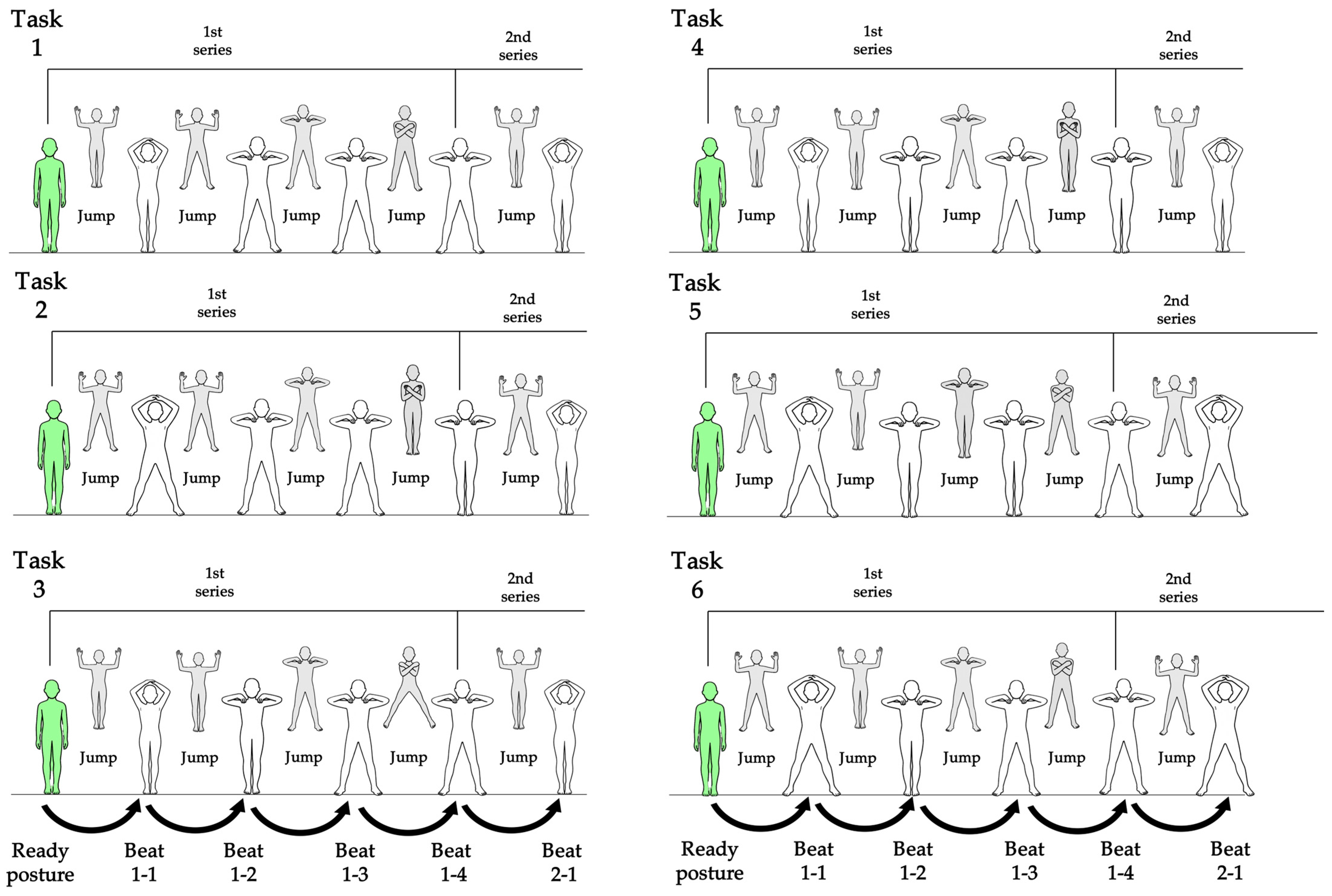
2.2. Task Structure, Motion Definitions, and Implementation Procedure
2.3. Data Processing
3. Results
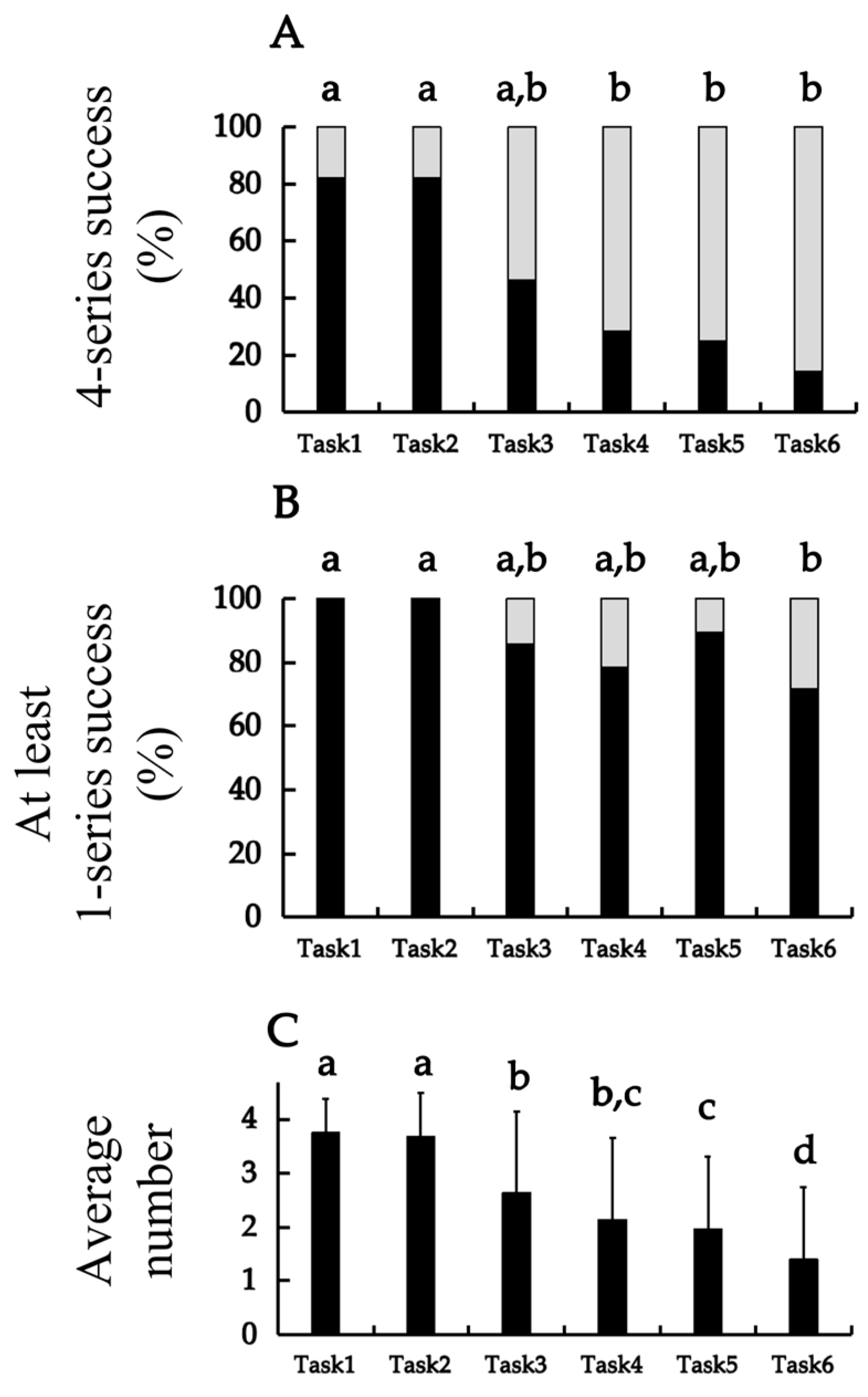
3.1. Comparison of the Task Performance Across the Six Tasks
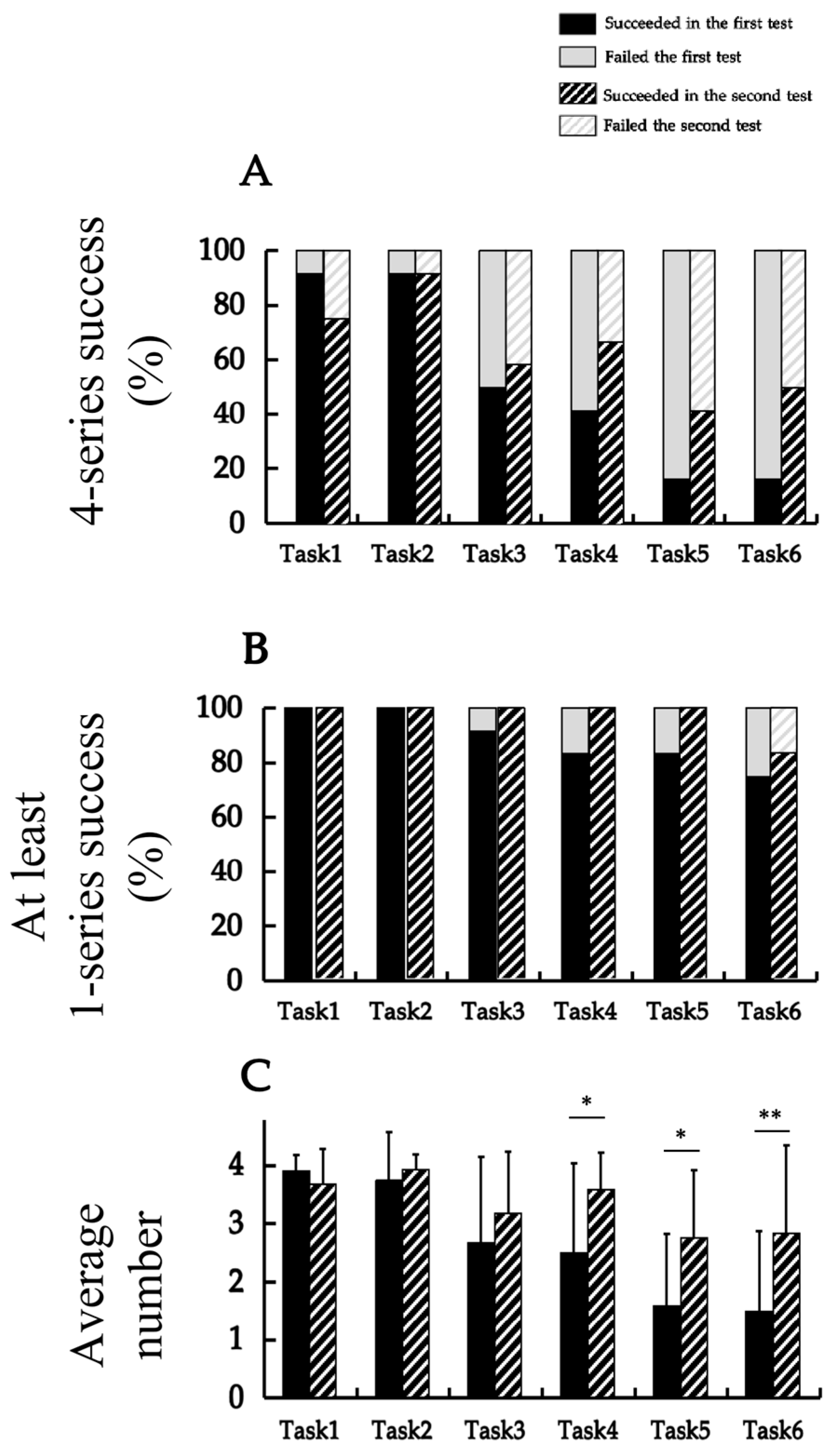
3.2. Comparison of First and Second Session Participants
4. Discussion
4.1. Task Performance in the High-Level Upper and Lower Limb Coordination Group
4.2. Limitations
4.3. Future Directions
5. Conclusions
Author Contributions
Funding
Institutional Review Board Statement
Informed Consent Statement
Data Availability Statement
Acknowledgments
Conflicts of Interest
References
- Kelso, J.A.S. Phase transitions and critical behavior in human bimanual coordination. Am. J. Physiol. 1984, 246, R1000–R1004. [Google Scholar] [CrossRef] [PubMed]
- Kelso, J.A.S. Unifying large-and small-scale theories of coordination. Entropy 2021, 23, 537. [Google Scholar] [CrossRef] [PubMed]
- Latash, M.L. Synergy; Oxford University Press: New York, NY, USA, 2008. [Google Scholar] [CrossRef]
- Newell, K.M. Constraints on the development of coordination. In Motor Development in Children: Aspects of Coordination and Control; Wade, M.G., Whiting, H.T.A., Eds.; Martinus-Nijhoff: Dordrecht, The Netherlands, 1986; pp. 341–360. [Google Scholar] [CrossRef]
- Ivry, R.B.; Richardson, T.C. Temporal control and coordination: The multiple timer model. Brain Cogn. 2002, 48, 117–132. [Google Scholar] [CrossRef]
- Schmidt, R.A.; Lee, T.D. Motor Control and Learning: A Behavioral Emphasis, 5th ed.; Human Kinetics Publishers: Champaign, IL, USA, 2011. [Google Scholar]
- Kochanowicz, A.; Kochanowicz, K.; Niespodziński, B.; Mieszkowski, J.; Zieliński, J.; Błacha, R.; Bujas, P. Coordination motor abilities in competitive sport. Trends Sport Sci. 2009, 16, 11–17. [Google Scholar]
- Narita, K.; Ishikura, T.; Takahashi, K. Relationship between coordination ability and performance level in rhythmic jumping tasks. J. Funct. Morphol. Kinesiol. 2023, 8, 50. [Google Scholar]
- Shimura, K.; Yamaguchi, T.; Yamada, Y. Evaluation of coordination ability in junior athletes using rhythmic tasks. J. Hum. Sport Exerc. 2022, 17, 622–635. [Google Scholar]
- Szabo, D.; Gombocz, J.; Toth, L. Development of coordination skills in children through movement games. Phys. Educ. Sport Pedagog. 2020, 25, 395–408. [Google Scholar]
- Li, R.; Miyazaki, T.; Matsui, T.; Gonno, M.; Nomura, T.; Morihara, T.; Koda, H.; Kida, N. The development and preliminary validation of a rhythmic jumping task for coordination assessment: A task design based on upper and lower limb motor congruency. J. Funct. Morphol. Kinesiol. 2025, 10, 261. [Google Scholar] [CrossRef]
- McKay, A.K.A.; Stellingwerff, T.; Smith, E.S.; Martin, D.T.; Mujika, I.; Goosey-Tolfrey, V.L.; Sheppard, J.; Burke, L.M. Defining training and performance caliber: A participant classification framework. Int. J. Sports Physiol. Perform. 2022, 17, 317–331. [Google Scholar] [CrossRef]
- Repp, B.H. Sensorimotor synchronization: A review of the tapping literature. Psychon. Bull. Rev. 2005, 12, 969–992. [Google Scholar] [CrossRef] [PubMed]
- Repp, B.H.; Su, Y.-H. Sensorimotor synchronization: A review of recent research (2006–2012). Psychon. Bull. Rev. 2013, 20, 403–452. [Google Scholar] [CrossRef]
- Thaut, M.H.; McIntosh, G.C.; Hoemberg, V. Neurobiological foundations of neurologic music therapy: Rhythmic entrainment and the motor system. Front. Psychol. 2015, 5, 1185. [Google Scholar] [CrossRef]
- McKinney, M.F.; Moelants, D. Ambiguity in tempo perception: What draws listeners to different metrical levels? Music Percept. 2006, 24, 155–166. [Google Scholar] [CrossRef]
- Hagan, S.J.; Wilkerson, H.R.; Noble, C.E. Pursuit tracking skill as a joint function of work and rest variables. Percept. Mot. Ski. 1980, 50, 683–697. [Google Scholar] [CrossRef] [PubMed]
- Zemková, E.; Hamar, D. Sports-specific motor coordination and its assessment. Trends Sport Sci. 2019, 26, 111–117. [Google Scholar]
- Myer, G.D.; Faigenbaum, A.D.; Cherny, C.E.; Heidt, R.S.; Hewett, T.E. Neurocognitive training for injury prevention and performance in sport. Int. J. Sports Physiol. Perform. 2019, 14, 331–340. [Google Scholar] [CrossRef]
- Hands, B.; Larkin, D. Physical education and motor skills: The relationship between body mass index and coordination performance. Hum. Mov. Sci. 2006, 25, 50–60. [Google Scholar] [CrossRef]
- Rivilis, I.; Hay, J.; Cairney, J.; Klentrou, P.; Liu, J.; Faught, B.E. Physical activity and motor skill competence in children and adolescents. Res. Q. Exerc. Sport 2011, 82, 377–384. [Google Scholar] [CrossRef]
- Ericsson, K.A. Development of Elite Performance and Deliberate Practice: An Update from the Perspective of the Expert-Performance Approach. Expert Performance in Sports: Advances in Research on Sport Expertise; Starkes, J.L., Ericsson, K.A., Eds.; Human Kinetics Publishers: Champaign, IL, USA, 2003; pp. 49–81. [Google Scholar]
- Wulf, G.; Shea, C.H. Principles derived from the study of simple skills do not generalize to complex skill learning. Psychon. Bull. Rev. 2002, 9, 185–211. [Google Scholar] [CrossRef]
- Newell, K.M. Motor skill acquisition. Annu. Rev. Psychol. 1991, 42, 213–237. [Google Scholar] [CrossRef] [PubMed]
- Swinnen, S.P. Intermanual coordination: From behavioral principles to neural-network interactions. Nat. Rev. Neurosci. 2002, 3, 348–359. [Google Scholar] [CrossRef] [PubMed]
Disclaimer/Publisher’s Note: The statements, opinions and data contained in all publications are solely those of the individual author(s) and contributor(s) and not of MDPI and/or the editor(s). MDPI and/or the editor(s) disclaim responsibility for any injury to people or property resulting from any ideas, methods, instructions or products referred to in the content. |
© 2025 by the authors. Licensee MDPI, Basel, Switzerland. This article is an open access article distributed under the terms and conditions of the Creative Commons Attribution (CC BY) license (https://creativecommons.org/licenses/by/4.0/).
Share and Cite
Li, R.; Koda, H.; Gonno, M.; Morihara, T.; Miyazaki, T.; Matsui, T.; Nomura, T.; Okado, K.; Yamamoto, C.; Kida, N. Validation of a Rhythmic Jumping Task for the Assessment of Upper–Lower Limb Coordination: Evidence from High-Level Athletes. J. Funct. Morphol. Kinesiol. 2025, 10, 473. https://doi.org/10.3390/jfmk10040473
Li R, Koda H, Gonno M, Morihara T, Miyazaki T, Matsui T, Nomura T, Okado K, Yamamoto C, Kida N. Validation of a Rhythmic Jumping Task for the Assessment of Upper–Lower Limb Coordination: Evidence from High-Level Athletes. Journal of Functional Morphology and Kinesiology. 2025; 10(4):473. https://doi.org/10.3390/jfmk10040473
Chicago/Turabian StyleLi, Runjie, Hitoshi Koda, Megumi Gonno, Toru Morihara, Tetsuya Miyazaki, Tomoyuki Matsui, Teruo Nomura, Kohei Okado, Chisato Yamamoto, and Noriyuki Kida. 2025. "Validation of a Rhythmic Jumping Task for the Assessment of Upper–Lower Limb Coordination: Evidence from High-Level Athletes" Journal of Functional Morphology and Kinesiology 10, no. 4: 473. https://doi.org/10.3390/jfmk10040473
APA StyleLi, R., Koda, H., Gonno, M., Morihara, T., Miyazaki, T., Matsui, T., Nomura, T., Okado, K., Yamamoto, C., & Kida, N. (2025). Validation of a Rhythmic Jumping Task for the Assessment of Upper–Lower Limb Coordination: Evidence from High-Level Athletes. Journal of Functional Morphology and Kinesiology, 10(4), 473. https://doi.org/10.3390/jfmk10040473

