Review

A Review of Recent Advances in Micro Heat Exchangers in the Food and Pharmaceutical Industries

by
Muhammad Waheed Azam
1,*,
Fabio Bozzoli
2,
Ghulam Qadir Choudhary
3 and
Uzair Sajjad
4
1
Interdepartmental Center for Industrial Research in Building and Construction, Alma Mater Studiorum—University of Bologna, Viale Risorgimento 2, 40136 Bologna, Italy
2
Department of Industrial Engineering, University of Florence, Via Santa Marta 3, 50139 Florence, Italy
3
Mechanical Engineering Department, Mirpur University of Science and Technology, Mirpur City 10250, Pakistan
4
Interdisciplinary Research Center for Sustainable Energy Systems (IRC-SES), King Fahd University of Petroleum and Minerals, Dhahran 31261, Saudi Arabia
*
Author to whom correspondence should be addressed.
Inventions 2026, 11(2), 27; https://doi.org/10.3390/inventions11020027
Submission received: 29 December 2025 / Revised: 9 March 2026 / Accepted: 11 March 2026 / Published: 16 March 2026
(This article belongs to the Special Issue New Sights in Fluid Mechanics and Transport Phenomena)

Abstract

Micro heat exchangers (MHXs) have emerged as a critical technology for advanced thermal management in the food and pharmaceutical industries due to their high surface area-to-volume ratios, compact design, and precise temperature control. This review provides a systematic and integrated analysis of MHX technology, covering their fundamental principles, classification, design methodologies, performance enhancement techniques, and industrial applications. Unlike existing reviews, the present work establishes a unified framework that links microscale heat transfer mechanisms, such as Brownian motion, surface corrugation effects, and non-dimensional parameters, with practical design choices, manufacturing routes, and the process requirements specific to food and pharmaceutical systems. The subsequent sections explore the key performance-influencing factors, including channel geometry, surface enhancement strategies, nanofluid utilization, and governing non-dimensional numbers (e.g., Nusselt, Reynolds, and Knudsen numbers), which are systematically compared across different operating regimes. Recent advances in materials and fabrication techniques, such as laser ablation, lithography, micro-milling, embossing, and additive manufacturing, are analyzed with respect to their scalability, thermal–hydraulic performance, and industrial feasibility. Furthermore, the review highlights the emerging trends in micro heat exchanger (MHX) optimization, including computational fluid dynamics (CFD)-driven design, smart monitoring systems, and energy-efficient integration within processing lines. Finally, the paper also identifies the key challenges and limitations of micro heat exchangers, including pressure drop, fouling, scaling, manufacturing complexity, and cost constraints. These are critically discussed along with future research directions aimed at improving reliability and sustainability. By consolidating the dispersed research outcomes into a coherent, design-oriented perspective, this review offers new insights and practical guidance for researchers, engineers, and industry practitioners seeking to advance the deployment of MHXs in food and pharmaceutical processing.

1. Introduction

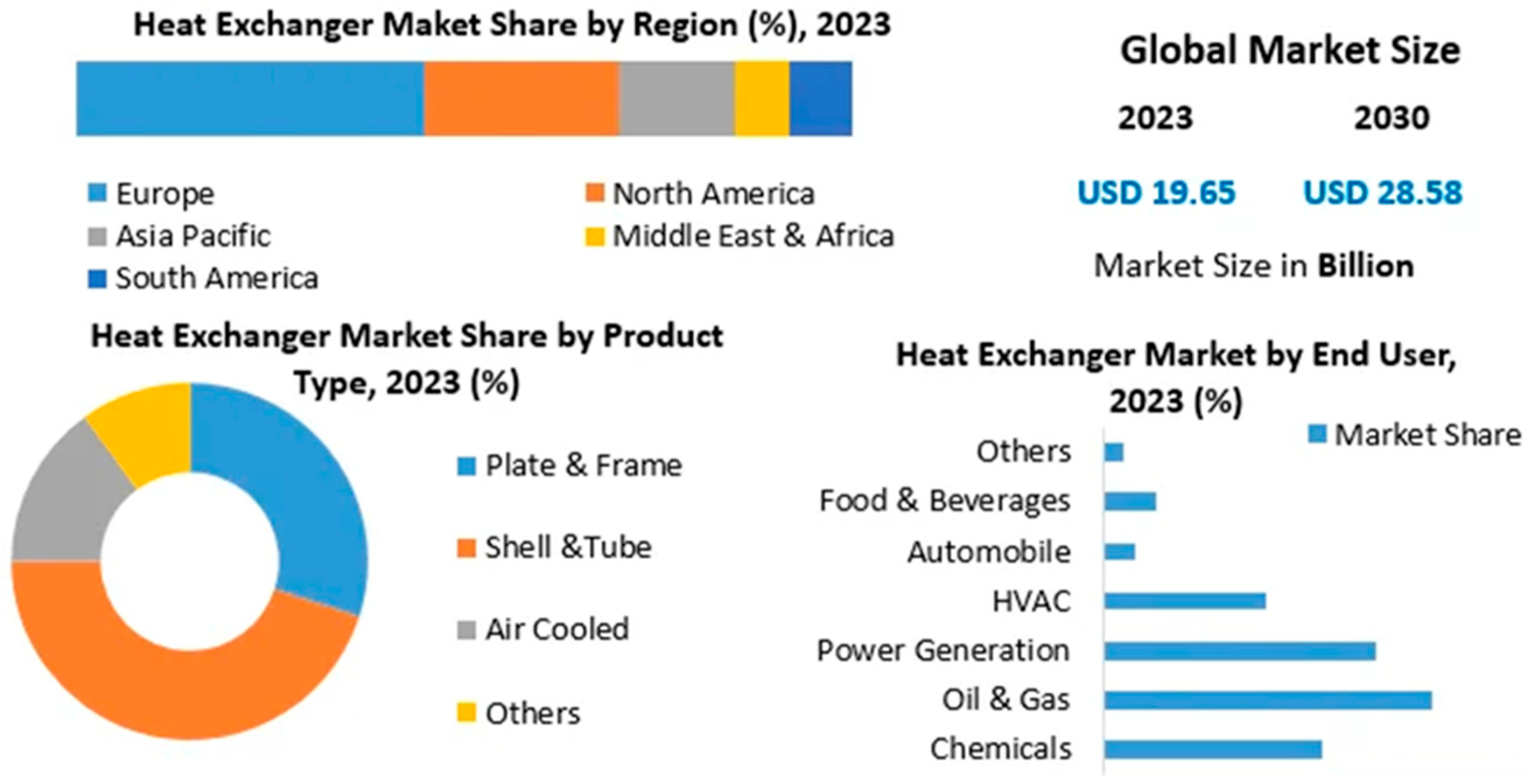
A heat exchanger is a device designed to transfer heat between two or more fluids at different temperatures without allowing them to mix, thereby maximizing the rate of heat transfer. Heat exchangers are used in various cooling and heating processes, during which the fluids may come into direct contact or remain separated by a solid wall. In heat exchangers, heat is transferred from a hot fluid to a cold fluid, typically without a phase change occurring. The process becomes more complex when thermal convection, radiation, and heat conduction are considered. Heat exchangers account for approximately 90% of the heat energy used in production and management. Figure 1 presents an overview of the global heat exchanger market, highlighting the regional market shares, product-type distribution, major end-user sectors, and projected market growth from 2023 to 2030. It has been observed that, in recent years, advances in heat exchanger technology have focused on enhancing efficiency, sustainability, and reliability [1]. The significant role of heat exchangers in various industries (food processing [2], pharmaceutical [3], HVAC (Heating, Ventilation, and Air Conditioning) [4], next generation of nuclear reactors [5] and nuclear hydrogen production [6], solar thermal [7], electronic cooling [8], power generation [9], automotive [10], chemical plants [11], and so on) have made lowering their energy consumption and reducing their emissions increasingly important, to achieve both economic and environmental goals. It is important to note that the role of heat exchangers has a positive impact only when they are accurately designed, installed, and operated. Furthermore, the integration of renewable energy sources and recovery of waste heat in heat exchangers can further the transition to cleaner energy systems. Therefore, their design and operation must be optimized, as energy prices increase with a decreasing supply of fossil fuel resources.
In recent decades, modern heat exchangers have been designed with advanced features, including enhanced surface areas, compact designs, and advanced materials, which have helped to minimize the size, weight, and cost of the equipment [12]. Modern heat exchangers have the following properties [13]:
  • High thermal efficiency;
  • Compactness;
  • Low pressure drop;
  • Corrosion and fouling resistance;
  • Advanced materials;
  • Manufacturing flexibility;
  • Hygienic and clean design;
  • High mechanical strength.
Different kinds of corrosion-resistant materials and fouling-resistant surfaces, such as stainless steel, copper, aluminum, ceramic, and silicon-based coatings, can prolong their service life [14]. Heat exchanger fouling, scaling, and corrosion can also be prevented through regular cleaning, inspection, and maintenance, and deterioration can be avoided with paints and protective coatings. Modern heat exchanger design and the requirement to adapt to different fluid characteristics sometimes result in inefficient arrangements [15]. Sizing and heat exchanger-type errors may reduce performance and increase energy use. Therefore, heat exchangers are essential for effective heat transfer and the preservation of fluid properties in many industries. Moreover, their use highlights the importance of sustainable techniques, product quality, and energy efficiency. However, challenges including fouling, energy recovery, and optimal design continue to exist, requiring the development and application of advanced techniques by industries. Heat exchanger technology and its applications are driven by the industrial objectives of effective, environmentally sustainable heat exchange. The major developments in micro heat exchanger technology and its increasing application in the food and pharmaceutical sectors are the main focus of the present investigation. The characteristics of MHXs provide a solid foundation for their adoption in food and pharmaceutical processing, where operations involving pasteurization, sterilization, fermentation, cooling, and handling of temperature-sensitive products depend on performance improvement, compact design, precise temperature control, and hygienic manufacturing.
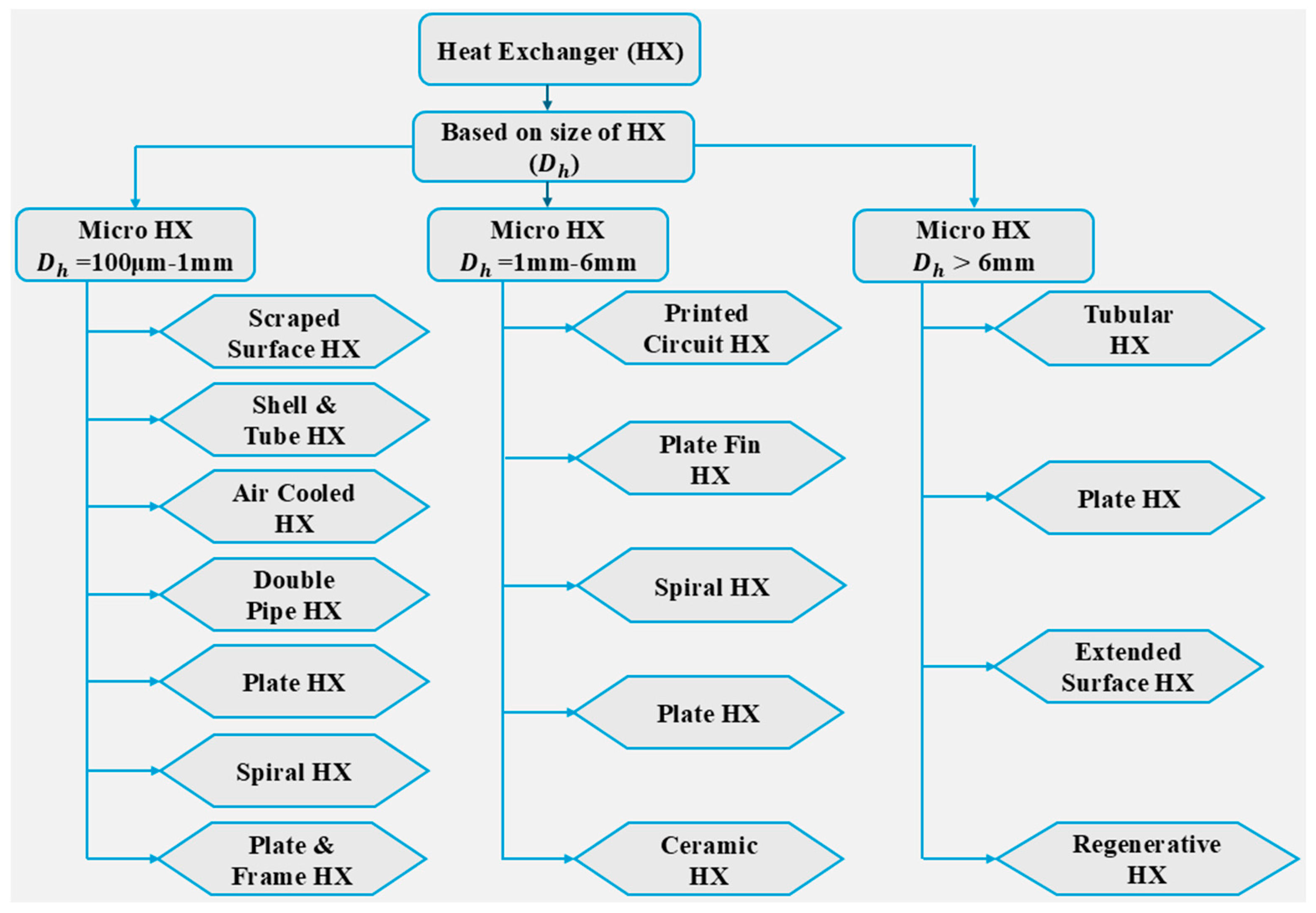
Heat exchangers (HXs) can be classified into different categories based on their flow arrangement, construction, size, heat transfer mechanism, surface compactness, and phase of the fluid process [16]. Figure 2 depicts the classification of heat exchangers by size.
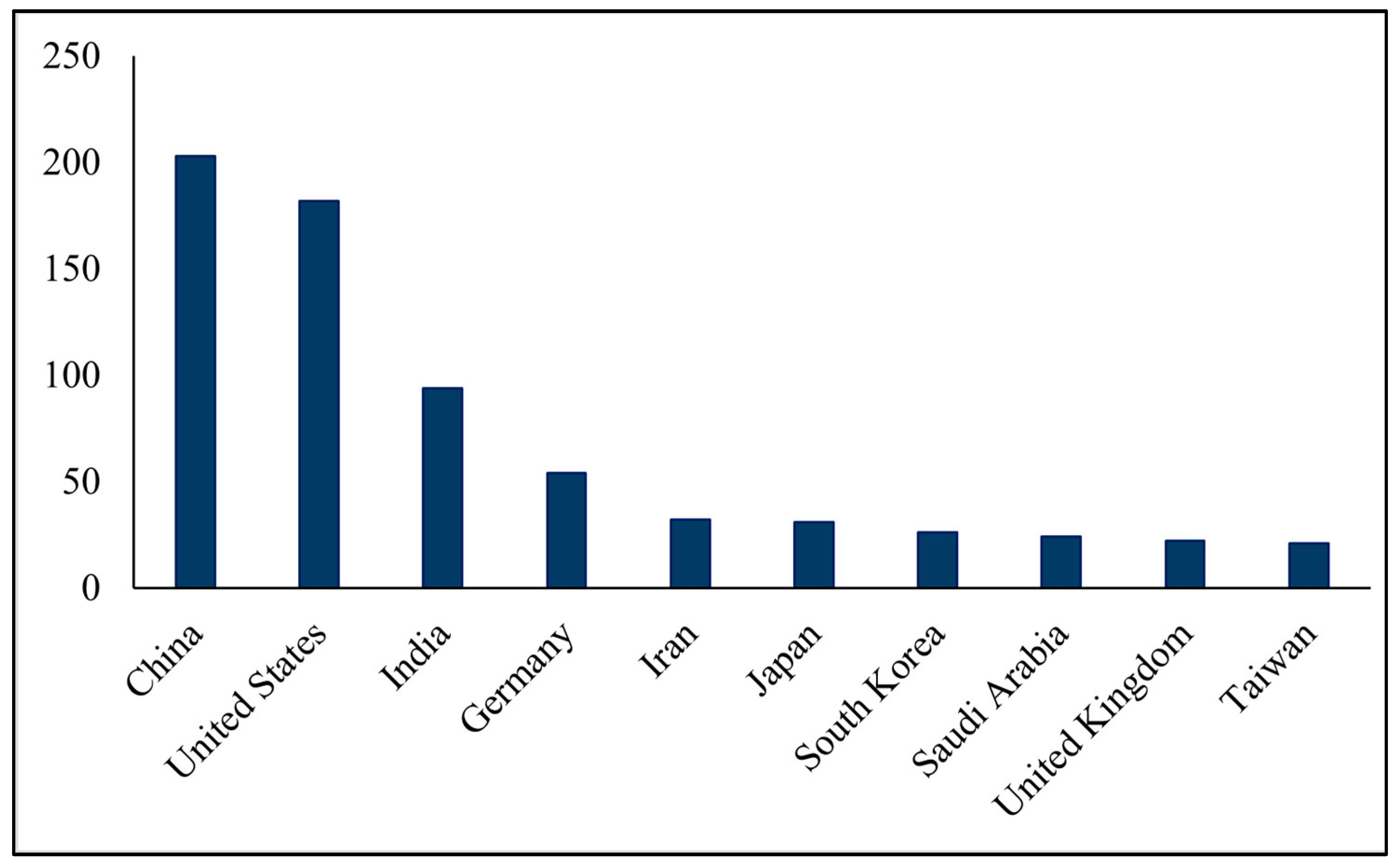
Figure 3 illustrates the bibliographic-based data on the co-occurrence of keywords in the relevant publications collected from Scopus for the years 1988–2025, in order to fully display the author’s interest in the current field of study. In the network visualization, the larger nodes (e.g., microchannel heat exchanger, heat transfer, pressure drop, nanofluids, and two-phase flow) represent the most frequently occurring keywords, indicating dominant research interests within the literature. These highly connected keywords reflect the primary focus of researchers on thermal–hydraulic performance, heat transfer enhancement techniques, and flow behavior in microscale heat exchangers. The smaller nodes correspond to more specialized or emerging topics and act as linking elements between the different clusters, facilitating interaction among the research themes related to performance optimization, numerical and experimental investigations, and application-driven studies. The dense interconnectivity among the nodes demonstrates a high level of collaboration and knowledge integration, highlighting the multidisciplinary and evolving nature of micro heat exchanger research. Additionally, based on the Scopus data, Figure 4 displays the distribution of publications in the field of microchannel heat exchangers by nation. It can be observed that the top two contributors are China and the US; this is attributed to their strong research potential, technical development, and consistent investment in microscale thermal systems. Finally, significant research output is also shown by other countries, such as South Korea, Japan, Germany, and India, highlighting the international and interdisciplinary characteristics of advancements in micro heat exchanger technology.
This review goes beyond providing a general overview of micro heat exchangers (MHXs) by offering a focused and integrated analysis tailored specifically to food and pharmaceutical applications. In addition to systematically reviewing MHXs’ configurations and applications, the paper critically examines the key factors governing their thermal–hydraulic performance and correlates them with modern manufacturing techniques, an aspect that is often treated separately in the existing literature. The review further consolidates the recent advancements in MHX technology, including the use of advanced materials, innovative design strategies, performance optimization methods, system-level integration, and the application of computational fluid dynamics (CFD) for design and optimization. The novelty of this work lies in unifying the performance mechanisms, manufacturing perspectives, and application-specific requirements into a single, coherent framework, thereby providing deeper insight into the current research trends and identifying future opportunities to optimize MHXs in food and pharmaceutical processing. The review paper is organized as follows: Section 1 provides a comprehensive, systematic introduction to heat exchangers, covering their fundamental principles, classifications, and wide-ranging industrial applications. After that, Section 2 provides a detailed critical overview of micro heat exchangers, highlighting their significance in modern thermal systems. Section 3 explores the role of micro heat exchangers in the food and pharmaceutical industries. Then, Section 4 critically examines the key parameters influencing the thermal and hydraulic performance of micro heat exchangers (such as channel geometry, nanofluids, non-dimensional parameters, and Brownian motion effects). Section 5 focuses on the manufacturing techniques used to fabricate micro heat exchangers, while Section 6 discusses the associated challenges, limitations, and practical constraints of MHXs. Section 7 focuses on the recent advancements in micro heat exchangers specifically designed for the food and pharmaceutical industries. Finally, the concluding section highlights the main findings of the study and outlines future recommendations to advance the development and application of micro heat exchangers.

2. Micro Heat Exchangers

In 1981, Tuckerman and Pease [17] first used microchannel heat exchanger (MCHX) technology and predicted that single-phase forced convective cooling in microchannels could potentially remove heat at a rate of the order 1000 W/cm2. At a later stage, Mehendale et al. [18] defined MCHXs as those in which the heat exchanger’s hydraulic diameter is less than 1mm. These represent a unique and specialized category of heat exchangers, distinguished from macroscale ones due to their smaller hydraulic diameters D h . Building on this early research, MCHSs became one of the most basic and extensively researched types of micro heat exchangers [19]. MCHSs are heat sinks with very small extrusions that facilitate heat transfer by allowing the working fluid to pass through them. These systems are made up of a solid structure with arrays of parallel microchannels that allow a coolant to pass through and remove heat from a nearby solid surface. In the beginning, microchannel heat sinks were developed for electronic cooling. These devices operate on similar working principles to those of micro heat exchangers [20]. Therefore, it is considered a foundational subclass of MCHXs.
The effective application of various microchannel geometries, such as circular, rectangular, triangular, and trapezoidal designs, to expand the surface accessible for transferring heat, represents an improvement in the development of microchannel heat sinks [21]. To create microchannel heat sinks, materials with excellent thermal conductivity are used, such as silicon, copper, and aluminum. Moreover, to fix the attachment flaws of electronic chips, a mixture of two materials is also taken into consideration [22]. Kandlikar and Grande [23] categorize heat exchanger channels as follows:
  • Conventional channels: Hydraulic diameter larger than 6 mm;
  • Minichannels: Hydraulic diameter between 200 µm and 3 mm;
  • Microchannels: Hydraulic diameter smaller than 200 µm.
This classification is widely used by researchers and scientists in heat exchanger research. Micro heat exchangers (MHXs) refer to compact heat exchangers that employ microscale flow passages to enhance heat transfer performance. Microchannel heat exchangers (MCHXs) are a specific type of MHX, in which heat transfer occurs through microchannels with hydraulic diameters typically below 200 μm. Therefore, MCHXs can be considered a subset of MHXs based on their channel geometry and flow passage size. Recently, developments in industry and technology have made micro heat exchangers of significant interest, leading to numerous improvements focused on their design, efficiency, and applications [24].
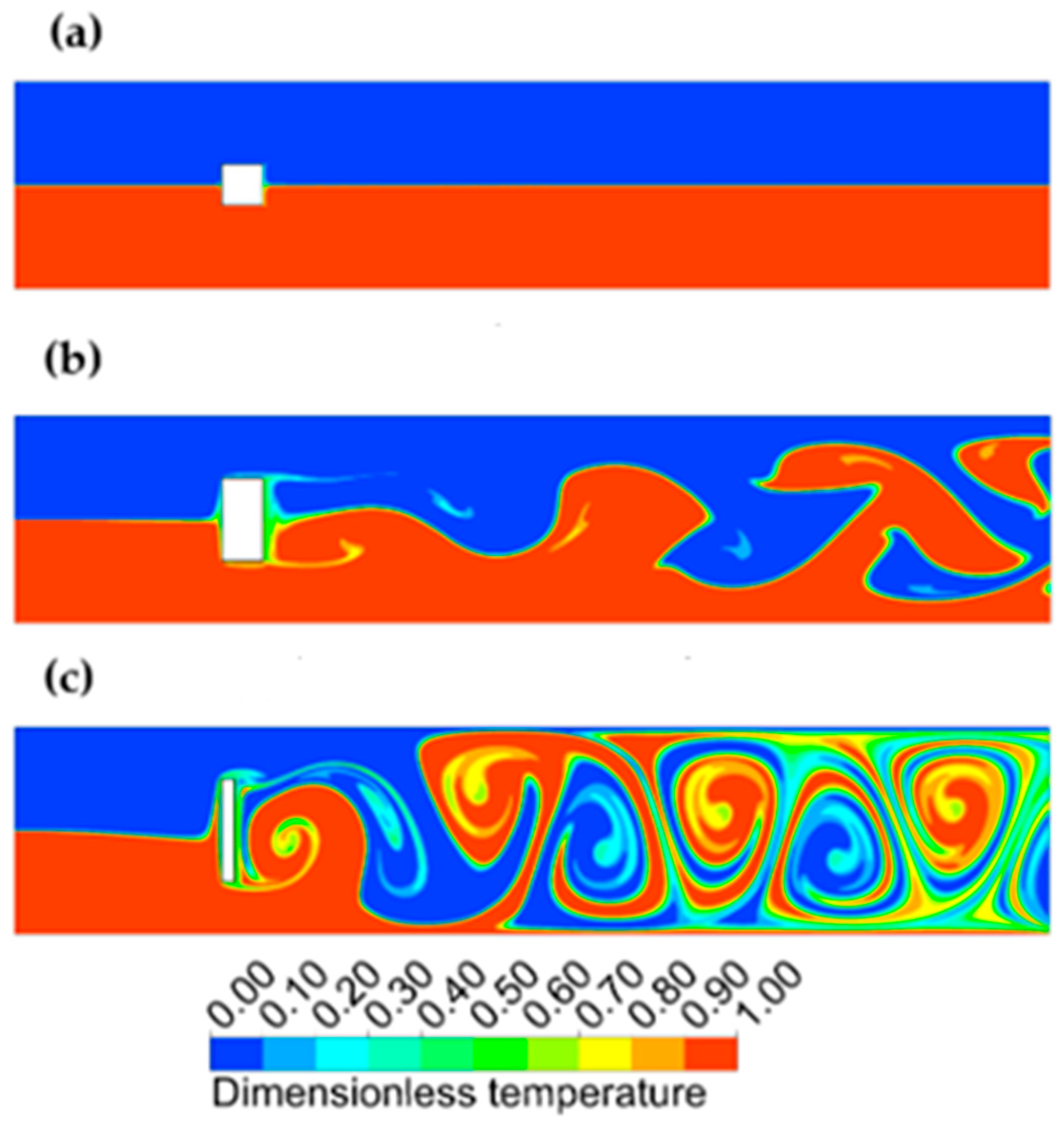
Recent studies on micro heat exchanger design have focused on heat transfer enhancement at the microscale by introducing the vortex shedding phenomenon [25]. According to fluid dynamics, when a body in a certain position has a collision with a fluid flow, such as water or air, at a particular speed, the result is an oscillating flow. In a heat exchanger, this technique has a major effect on the flow field structure due to the collision of fluids and heat transfer improvement [26]. Vortex shedding-based micro heat exchangers use geometric modifications, including ribs, cavities, barriers, or periodic constrictions, to create flow instabilities, unlike conventional straight microchannels. The effect can be observed in Figure 5. In configuration (a), without vortex shedding, the flow is laminar and stable within the microchannels. Molecular diffusion and steady convection are the main factors regulating the heat transfer phenomenon, which indicates less mixing and comparatively poor heat transfer efficiency. In the second configuration (b), the low vortex shedding intensity leads to slight disruptions to the microchannel flows. These slight disruptions enhance the fluid mixing and disrupt the thermal boundary layer; as a result, vortex shedding enhances the heat transfer performance as compared to that without it. In the third configuration (c), strong vortex shedding produces an unsteady flow structure and more mixing in the microchannel; as a result, these vortices substantially thin the thermal boundary layer and increase the convective heat transfer. However, it requires more pumping power and a higher pressure drop as compared to the other configurations, without vortex shedding and low vortex shedding [27]. These methods are very effective when the objective is to improve the heat performance of microchannel devices with small modifications in their design [28,29].
Vortex shedding-based micro heat exchangers in the food industry provide significant benefits, such as improving temperature uniformity and minimizing thermal gradients during processing (such as pasteurization, blanching, and thermal stabilization of liquid foods). In these processes, precise temperature control is very crucial to reduce nutrient loss, eliminate flavor deterioration, and prevent localized warming [30]. Similarly, in pharmaceutical applications, their role is very crucial for precise control of the thermal environment, which is significant for sterilization, formulation heating, and processing of heat-sensitive active pharmaceutical ingredients. The increased mixing caused by vortex shedding increases the thermal homogeneity throughout the microchannels, reducing the risk of temperature non-uniformity that could compromise product stability or efficiency of the required product.
Figure 5. Vortex shedding-based micro heat exchangers: (a) without vortex shedding; (b) low vortex shedding intensity; (c) strong vortex shedding intensity [31].
Inventions 11 00027 g005
Overall, the evolution of micro heat exchangers demonstrates a distinct trend from basic microchannel heat sinks to more complex and efficient designs. Moreover, the application of microchannel heat exchangers is attracting more interest with the innovation in and design of microchannel fabrication techniques, including lithography, electroplating, molding, chemical milling, and femtosecond laser fabrication. High heat transfer rates at the microscale were made possible by early microchannel configurations, while later categories have introduced a variety of geometries appropriate for particular thermal and operational requirements. The limitations of laminar flow can be overcome by controlled flow instabilities and geometric modifications, as demonstrated by more recent developments, such as vortex shedding-based micro heat exchangers, which have resulted in significant improvements in thermal performance.

3. Micro Heat Exchangers in Food and Pharmaceutical Industries

Micro heat exchangers are essential to the food and pharmaceutical industries because they provide a variety of operations, including process efficiency, product quality, and safety [32]. In the food industry, heat exchangers are used mainly for two purposes: in industrial processes (heating and cooling) or in situations where cleanliness and sanitization are required [33]. Similarly, these devices are crucial for maintaining precise thermal conditions in environments where extreme cleanliness and sanitization are required to produce medicines and vaccines in the pharmaceutical industry. Table 1 displays the numerous applications of micro heat exchangers (MHXs) in the food and pharmaceutical industries.
Food industry: In the food industry, heat transfer and thermal processes are crucial to ensure food preservation and prolong shelf life, both of which are important for the safety of consumers. The methods for preserving food vary significantly depending on the procedure. Conventional thermal processing involves heating, cooling, and holding to reach the required temperature changes. Systems for alternative preservation procedures involve exposing a food product to a treatment for the period necessary to decrease the product’s degradation reactions. Every processing system has a different design depending on the food product being processed [45]. Thermal processes in the food industry that consume energy involve understanding how heating and cooling operations impact overall energy use.
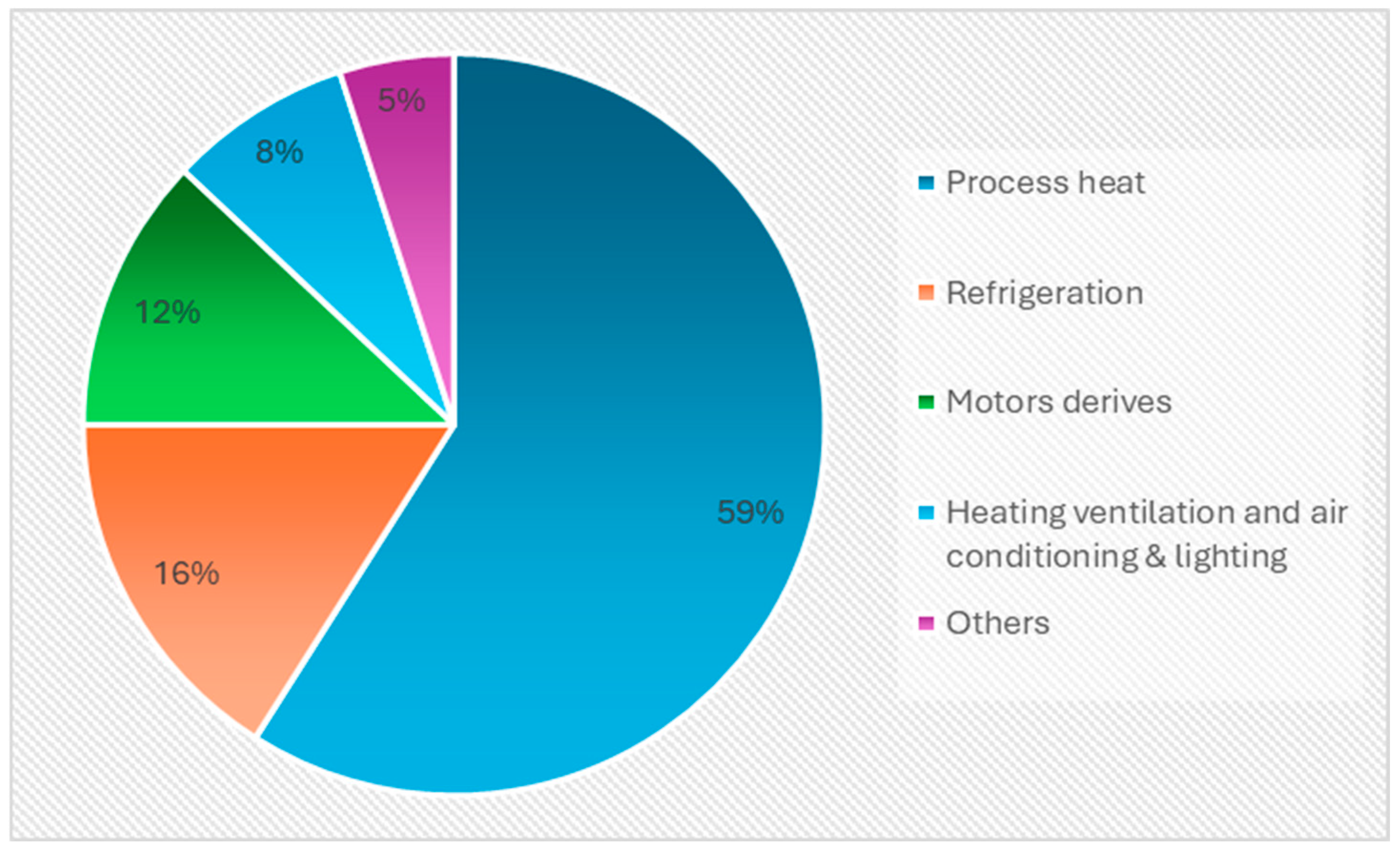
The global food system is highly energy-intensive and is responsible for approximately one-third of global greenhouse gas emissions [46]. By 2050, with the world’s population expected to exceed 9 billion, there will be a significant increase in the demand for food [47]. The food industry consumes a lot of energy in the various operations necessary for food production, preservation, and safety, including cooking, HVAC, heating, and cooling. Figure 6 shows the energy consumption of different sectors in the food industry. A significant proportion of energy consumption occurs in the process heat sector.
The following are the essential applications of micro heat exchangers (MHXs) in the food industry.
Pasteurization: Pasteurization is a physical technique that involves applying heat to minimize the microorganisms in liquid and solid foods by controlling the temperature and period. This technique can eliminate microorganisms that affect food safety or cause food spoilage. Moreover, food is heated to less than 100 °C for a few minutes or seconds and then rapidly cooled. Heat exchangers are crucial to pasteurization because they allow for food products to be heated and cooled down quickly and uniformly, removing harmful pathogens while maintaining quality [49]. The advantages of HXs over in-container processing are uniform heat treatment, low space requirements, better control over pasteurization conditions, higher energy efficiency, and flexibility for different products. Most commonly, tube or plate heat exchangers are used on a larger scale, when pasteurizing low-viscosity liquids such as fruit juices, milk, milk products, beers, and wines [50].
Sterilization: Sterilization is the process by which all viable organisms are destroyed or eliminated by using chemicals, radiation, heat, or physical cell elimination. Typically, the product is sterilized by quickly heating it to 130–145 °C, holding it there for the necessary time, and then cooling it down. Micro heat exchangers help achieve high temperatures to ensure sterility, preventing bacterial contamination and extending shelf life. The sterilization procedure is often carried out with advanced-designed heat exchangers, including plate, tube, or scraped surface [51].
Heating and cooling: These two processes, which account for the most expensive heat-related costs in the food sector, are among the most important. MHX technology contributes significantly to achieving this objective by providing efficient temperature regulation for food safety and product quality. Moreover, perishable food products (such as dairy products, fruits, vegetables, and bakery products) need specific temperatures, humidities, and ventilation before and after preparation. In addition, MHXs are used in cooling applications to lower the temperature of spicy foods, including sauces, soups, and cooked food, which helps maintain the flavor, texture, and nutrient consistency while preventing microbial growth and spoilage. They are also utilized in heating applications that increase the temperature of fats and oils to the required temperatures for different stages of processing, such as blending or emulsification. Furthermore, heat exchangers increase their energy efficiency by using the heat that is recovered from hot products to warm incoming cold products. As a result, operating costs and energy consumption decrease significantly [52].
Fermentation: Food fermentation is a food processing method that uses microorganisms’ growth and metabolic activities to stabilize and transform perishable food products. It is used to preserve a variety of meals made from plants, fish, and animals, including cheese, cultured milk, and fermentation-based milk products. Heat exchangers are essential for maintaining regular fermentation conditions in beer, yogurt, and other fermented foods. Precise temperature control is essential in fermentation operations for multiple reasons. The most common heat exchangers used in the fermentation process are double pipe, shell and tube, and plate [53].
Drying: Drying is another fascinating food preservation technique in the food industry for various processes, such as drying vegetables, fruits, and instant coffee. Micro heat exchangers (MHXs) are used in drying procedures to heat food products to reduce their moisture content, helping to preserve them and make them lighter for transportation. Precise control of temperatures is essential for preventing overheating, which may damage food quality, and to ensure that drying is a reliable and energy-saving procedure [54].
Meat processing: The key factor is temperature, which affects microbial growth in meat products, and is therefore the most controlled and monitored parameter for food safety in the meat industry. Three fundamental processes are involved in the production of heat-treated meat products: cooling, heat treatment, and meat matrix preparation [55]. As an example, higher cooking temperatures can reduce cooking times; however, they can also lead to more cooking loss and a less nutritious texture. They are employed in processing ready-to-eat foods, such as hams and sausages, because they ensure consistent cooking and rapid cooling, thus preventing the growth of bacteria [56].
Bakery products: MHXs are used in the baking and bread industries to control the temperature of the ingredients and proofing environments precisely. They help to ensure that ingredients are not too hot or cold during the mixing process, which helps preserve the finished product’s proper texture and structural integrity. Plate heat exchangers are commonly used for heating and cooling bakery products [57].
MHXs are utilized in other food-related processes, including processing dairy products, vegetables, sauces and dressings, oil and fat processing, seafood, beverage production, sugar evaporation and concentration, heat recovery, and sugar refining and freezing.
Pharmaceutical industry: The pharmaceutical industry is a sensitive sector that produces products that are critical for human health. Micro heat exchangers (MHXs) in the pharmaceutical industry are essential for maintaining precise temperature control during various processes, such as sterilization, crystallization, evaporation, heating, and cooling, ensuring product quality, cost reduction, environmental impact, and optimizing energy efficiency. When compared with other industries, various pharmaceutical processes require special attention to prevent contamination, including precise temperature control and pressure, to ensure the safety and efficiency of the final product [58].
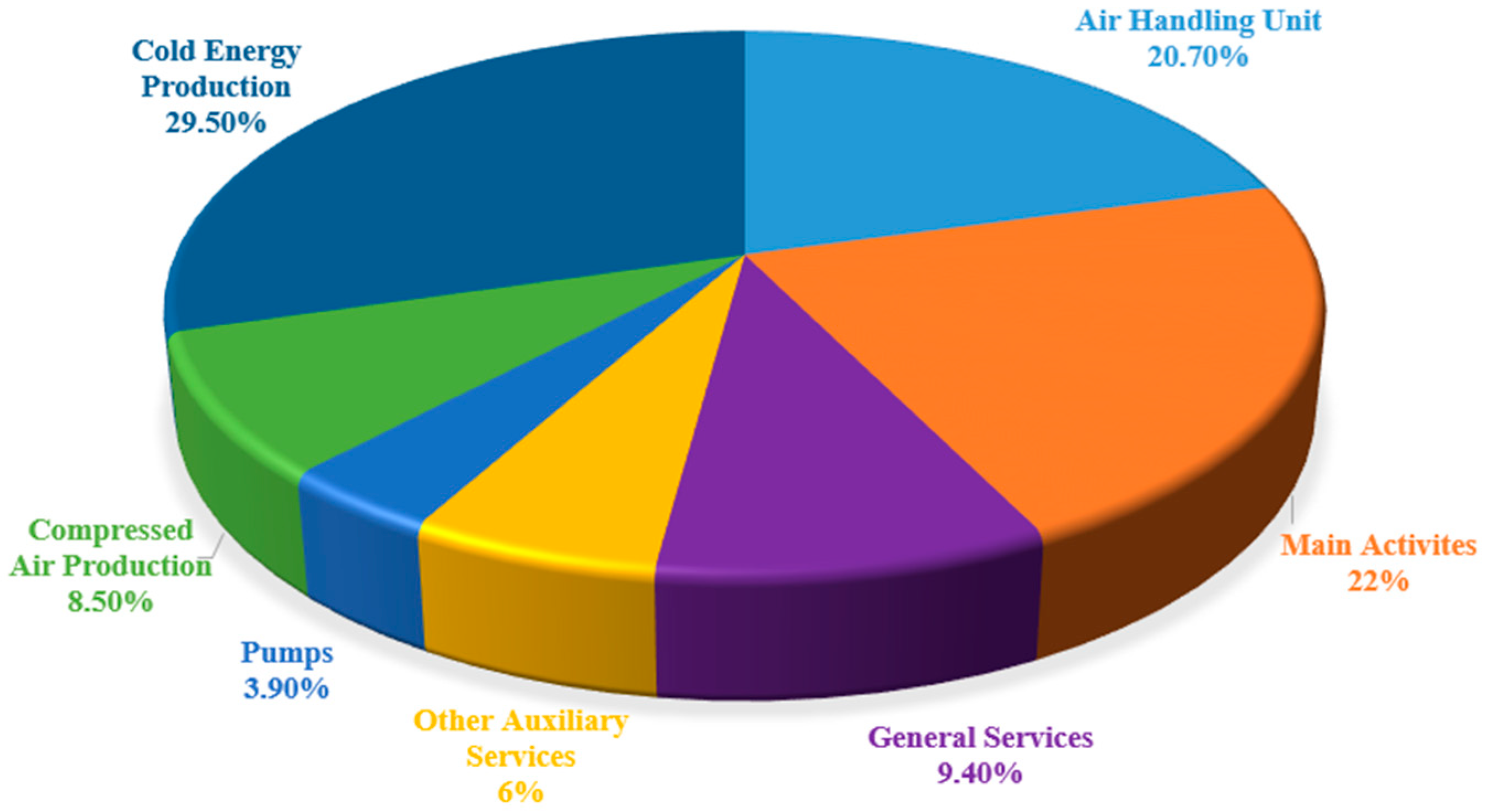
As shown in Figure 7, the energy consumption of manufacturing lines in the pharmaceutical industry accounts for just 18.2% of the total. On the other hand, cold production units and air handling units account for 29.5% and 20.75%, respectively. If such organizations focused on implementing efficient energy management and heat transfer processes, they could enhance their production rates, product quality, and efficiency while saving up to 30% on costs. The application of renewable energy is a crucial step to further reduce costs, as technologies such as wind turbines and solar thermal systems provide sustainable energy alternatives that could improve the pharmaceutical industry’s emissions balance [59].
The following are the important applications of micro heat exchangers (MHXs) in the pharmaceutical industry [61].
Sterilization: The pharmaceutical industry uses various sterilization processes, including microbial destructive methods, permanent microbial inactivation methods, filtration methods, and thermal sterilization processes. Moist heat sterilization is the most efficient biocidal agent. Micro heat exchangers are essential to the sterilization process in the pharmaceutical industry because they provide consistent and efficient heat transfer, which is necessary to remove all traces of microbiological life from products, equipment, and solutions. For efficient sterilization, these devices maintain a high temperature and uniform heat transfer.
Distillation: Distillation is a long-standing process in the pharmaceutical industry, known for its effectiveness as well as its simplicity. Micro heat exchangers (MHXs) are essential to the pharmaceutical industry’s production of high-purity distilled water because they provide precise temperature control, effective heating and cooling, and increased energy efficiency. The pharmaceutical industry needs very pure water because even a single contaminant can react with other materials, triggering chemical reactions. Moreover, distilled water can be used to produce cosmetics, such as moisturizers, creams, shampoos, deodorants, and many more. Additionally, distilled water is utilized to sterilize and clean syringes and vials to avoid any contamination that would compromise the safety of the injections.
Air conditioning and environmental control: In the pharmaceutical industry, micro heat exchangers (MHXs) are employed in air conditioning applications to maintain temperature and humidity at a controlled environment for manufacturing operations and storage facilities. These devices help in the prevention of microbiological development, the degradation of sensitive chemicals, and ensuring compliance with regulatory standards for the stability and safety of products by controlling the temperature and air quality.
Crystallization: Crystallization plays a crucial role in the production and purification of 70-80% small-molecule active pharmaceutical ingredients for medical applications due to its high purity and lack of impurities. There are different factors that affect the crystallization process, including the rate of cooling, temperature of crystallization, impurities and additives, and suspended particles. Therefore, heat exchangers play an important role in controlling these factors. Moreover, these devices are also used during the crystallization process to accurately control the solution or suspension temperature, providing the optimum conditions for the growth of crystals.

4. Factors Affecting the Performance of MHXs

4.1. Channel Geometry

In recent years, many researchers have investigated the efficiency of micro heat exchangers using different methods. Microchannel heat exchangers (MCHXs) can be manufactured with channels of different geometries, as depicted in Figure 8. Researchers have frequently searched for the ideal geometry, which could result in a small pressure drop and increased heat transfer. The various channel sizes, types, and shapes in MCHXs significantly impact the heat exchangers’ thermal and hydraulic performance. Moreover, the geometry of the microchannel is also crucial when introducing vortex shedding into microchannel heat exchangers [62]. The impact of channel geometry on micro heat exchangers’ (MHXs’) thermal performance is highlighted in Table 2.
In this regard, Hasan et al. [64] researched the impact of channels’ size and shapes on the performance of counter-flow micro heat exchangers. They conducted investigations on several channel configurations: square, wavy, ribs, V-shaped ribs, dimple, convergent, divergent, rectangular, circular, and iso-triangle. The results indicated that a circular shape offers the best overall performance of both hydrodynamic and thermal aspects, and square channels offer the second-best overall performance. Moreover, the heat transfer, pressure drop, and pumping increased when the volume of each channel decreased or the number of channels increased. Similarly, Yang et al. [65] conducted an experimental study on three different shapes of channels in micro heat exchangers, which were designed with a macro heat transfer enhancement concept, including chevron channels, long offset strips, and short offset strips for high heat flux. For comparison, a straight-channel heat exchanger was also designed. The results indicated that the three micro heat exchangers had higher heat transfer enhancements and lower thermal resistance than the straight-channel heat exchangers. Moreover, the performance of the short-strip micro heat exchanger was better than that of the long-strip micro heat exchanger. The third micro heat exchanger, designed with a chevron channel, provided lower thermal resistance but five times higher pressure drops. Huang et al. [66] increased the heat transfer and decreased the pressure drop in microchannel heat exchangers by introducing two different shapes of cavities and lengths of expansion and contraction sections. Microchannels were created using dry etching-based microfabrication techniques, and they were then used in fabricating single-crystal silicon for microelectromechanical systems. The result indicated that, due to the added cavity in the microchannels, the heat transfer was improved and the pressure drop was minimized as compared to the straight microchannel. Conversely, for devices sensitive to increased pressure drop and pumping power consumption, cavities could be used instead of ribs, resulting in a greater pressure drop.
Integrating vortex generators with microchannel heat sinks in various arrangements can improve the heat transfer by up to 70%. But the drawback of this heat transfer enhancement is that it produces a pressure drop (ΔP) and, in certain conditions, when low pumping power is crucial, the pressure drop could result in restrictions [67,68]. Chaitanya et al. [69] conducted an experimental study to improve the heat transfer by introducing multiple twisted tapes inside circular microchannels. The experiments performed at different twist ratios for single, twin, and times twisted tape inserts were 2.5, 3 and 3.5. The results revealed that there was an increase in the pressure drop, but a greater heat transfer was calculated by the 2.5 twist ratio compared to the smooth channel. They also developed a correlation for the Nusselt number and friction factor as a function of Reynolds number with respect to the twist ratio.
Chen et al. [70] conducted research to optimize the microchannel structure to improve microplate heat exchanger (MPHX) performance based on three evaluation parameters, the heat transfer coefficient, pumping power consumption, and effectiveness. They designed an optimized microchannel structure for an MPHX based on a minimum pressure drop and maximum heat transfer coefficient. The results revealed that the optimized MPHX has a 2.81 times higher effectiveness than the comparison structure. Moreover, the pumping power and heat transfer coefficient were better than those of three contrast structures. The performance of a microplate heat exchanger with a trapezoid-shaped cavity was examined by Yufeng et al. [71] in terms of heat transfer, pressure, and flow characteristics. The flow characteristics are a major parameter that affects the heat transfer characteristics and pressure drop characteristics of heat exchangers. The geometry, such as the height, width, coincidence degree, number, and distribution of cavity, also influences the performance of MPHXs. The heat transfer capacity of the microplate heat exchanger, with and without the trapezoid-shaped cavity, decreased initially with an increase in the flow rate before increasing once the flow rate reached its optimal level. At a higher flow rate, the MPHX with a trapezoid-shaped cavity experienced a lower pressure drop than a conventional micro heat exchanger. Therefore, cavities could be useful instead of using ribs to improve the performance of heat exchangers.
Table 2. Effect of channel geometry on the thermal performance of micro heat exchangers (MHXs).
AuthorsGeometry TypeType of InvestigationWorking MediumKey Findings
Hasan et al. [64]Circular, square, rectangular, iso-triangular, trapezoidalExperimentalWater
Circular channels show the best overall performance.
Smaller channels: higher heat transfer, but higher pressure drop.
Yang et al. [65]Straight, chevron, offset strip microchannelExperimentalDeionized water
Shorter strips have better performance than longer strips.
Chevron channels: high heat transfer rate but higher pressure drop.
Huang et al. [66]Straight microchannel and microchannel with fan-shaped reentrant cavitiesExperimentalDeionized water
Cavities reduce pressure drop compared with straight channels.
Larger cavity radius improves overall performance.
Zhang et al. [67]Vortex generatorsNumericalAir
Vortex generators enhance heat transfer.
Larger airflow angle reduces pressure drop.
Javed et al. [68]Vortex generators and magnetic fieldNumericalAg–water, Al2O3–water nanofluids
Heat transfer increases by about 20% compared with a simple channel.
VG effect is stronger than the magnetic field (MHD) effect.
Chaitanya et al. [69]Circular tube with twisted tape insertsExperimentalWater
Twisted tape inserts enhance heat transfer but increase pressure drop.
Counter-swirl inserts provide the highest thermal performance.
Chen et al. [70]Optimized plate microchannel structureExperimentalWater
Structural optimization improves heat transfer and reduces pumping power.
Optimized design reduces pressure drop.
Yufeng et al. [71]Plate microchannel with isosceles trapezoid-shaped reentrant cavitiesNumericalWater
Reentrant cavities enhance fluid mixing and heat transfer performance.

4.2. Nanofluids

Nanofluids are a powerful technique for enhancing heat exchanger performance. An increase in the temperature of a nanofluid will cause the nanoparticles to move more energetically, increasing the amount of energy transferred. The impact of nanofluids on heat transfer enhancement in micro heat exchangers (MHXs) is presented in Table 3. Dustin et al. [72] conducted an experimental and numerical study to analyze the performance of three different nanofluids, copper oxide, silicon dioxide, and aluminum oxide, in microplate heat exchangers. They also reduced the size and pumping power and increased the heat flux of the heat exchanger with the use of nanofluids as compared to a macro heat exchanger. Three crucial parameters, the mass flow rate, heat transfer rate, and pumping power, were used for comparison with the plate heat exchanger. The results indicated that the aluminum oxide nanofluid produced better results than the others. The improvement in the overall and convective heat transfer coefficient was 4.85% and 11%, respectively. Moreover, it also reduced the pumping power by 6.65%, demonstrating the energy-saving potential of nanofluids. Mehdi and Ali [73] investigated the effect of different nanofluid shapes on the performance of a microplate heat sink. The shapes of nanoparticles had various forms, such as brick, blade, platelet, oblate spheroid, and cylinder, and were 1% of their concentration. The findings indicated that the platelet-shaped nanoparticles produced the maximum heat flux and convective heat transfer coefficient as compared to the others. The highest effectiveness was shown by the nanofluid having an oblate spheroid shape, after which came the solutions containing nanoparticles shaped like bricks, blades, cylinders, and platelets. Dharmakkan et al. [74] investigated the performance of microplate heat exchangers with hybrid nanofluids at various temperatures and flow rates. The nanofluids analyzed were ZnO/ethylene glycol, TiO2/ethylene glycol, and hybrid nanofluids with varying nanoparticle volume fractions. The study demonstrated that the thermal conductivity of composite nanofluids was significantly improved by both increasing the volume fraction of solid particles and raising the fluid temperature. Additionally, the thermal conductivity of nanofluids was shown to increase with an increase in the particle velocity and particle collisions with one another in the base fluid.
Simulating the flow and heat transfer in heat exchangers using computational fluid dynamics (CFD) and other commercial software is widely used among researchers and scientists. Consequently, Garud et al. [75] used a CFD approach with different-shaped nanofluids to investigate a microplate heat exchanger utilizing hybrid nanofluids, Al2O3/Cu, and single particles, Al2O3. The results obtained by using different shapes of nanofluids were compared by the first and second laws of thermodynamics. Different shapes of hybrid nanofluids and single particles were platelet, blade, cylinder, oblate spheroid, brick, and prolate spheroid. According to first and second law characterizations, the results showed that for single particles and hybrid nanofluids, an oblate spheroid shape has a better performance index, and a prolate spheroid shape has a lower performance index at different temperatures and mass flow rates for both hot and cold fluids. The OS-shaped nanoparticles demonstrated maximum values of 0.913 for the Bejan number and 4.07 for the performance index. Furthermore, as the volume fraction increased, the characteristics of the first and second laws became better. The research conducted by Arie et al. [76] developed a computational fluid dynamics (CFD) model to calculate the heat transfer rate in a microchannel plate heat exchanger (MPHX). They also used a hybrid technique to develop an MPHX, which has the advantage of requiring less computation time than a fully computational fluid dynamics model. There was good agreement found between the hybrid method results and the experimental and computational fluid dynamics work. Moreover, an approximation-based optimization technique was applied, and found that the optimized microchannel plate heat exchanger was superior to chevron plate heat exchanger designs in terms of heat transfer performance. A systematic numerical study conducted by Meis et al. [77] investigated the effect of heat transfer and pressure drop produced in a laminar regime (between 600 and 1200 Reynolds number) by vortex methods in a liquid flow microchannel. They used three different designs to assess the effect of vortex, namely, circular, rectangular, and triangular, at various aspect ratios. The results revealed that, due to flow disruption and the development of vortex flow, the heat transfer increased with the blockage ratio, although this enhancement was accompanied by a higher pressure drop. In microchannels, various types of vortex generators can be used, with different shapes and sizes (including delta winglet, rectangular winglet, and trapezoidal vortex generators), depending on the specific application.
Table 3. Effect of nanofluids on heat transfer enhancement in micro heat exchangers (MHXs).
AuthersNanofluidsType of InvestigationsBase FluidKey Findings
Dustin et al. [72]Al2O3, CuO, SiO2 nanoparticlesExperimental/numerical40% ethylene
glycol, 60%
water
Convective heat transfer coefficient increased by about 9–11% for Al2O3 nanofluid.
Mehdi and Ali [73]Boehmite aluminaNumerical (CFD simulation)50% ethylene
glycol, 50%
water
Particle shape significantly affects heat transfer performance.
Platelet-shaped nanoparticles provide the highest heat transfer rate.
Dharmakkan et al. [74]TiO2/ethylene glycol
ZnO/ethylene glycol
ExperimentalEthylene glycol (EG)
Hybrid nanofluid significantly enhances thermal conductivity.
Overall heat transfer coefficient increases with nanofluid volume fraction.
Garud et al. [75]Hybrid nanofluid (Al2O3 + MWCNT)NumericalWater
Hybrid nanofluid improves heat transfer and thermodynamic performance.
Hybrid nanofluid performs better than single nanoparticle fluids.
Meis et al. [77]Circular and rectangular vortex generators in a microchannelNumerical (CFD)Al2O3–water nanofluid
Al2O3 nanofluid increases heat transfer by about 15.7% with small pressure penalty.

4.3. Non-Dimensional Parameters

There are three effective dimensionless parameters, the Nusselt (Nu), Reynolds (Re), and Knudsen (Kn) numbers, that affect the performance of micro heat exchangers. With regards to these, Hosseini et al. [78] investigated the effect of nanofluid on the performance of a micro heat exchanger in the presence of magnetic fluid. According to the researchers, the particle size of the nanoparticles in a nanofluid correlates with the Nusselt number. A decrease in the size of the nanoparticles leads to a reduction in the temperature differential between the wall and coolant, resulting in an increased Nusselt number. They also reported that Al2O3 has a better Nusselt number than copper oxide, CuO. Sidik and Abubakar [79] numerically researched heat transfer enhancement by utilizing nanofluid in a rectangular microchannel heat sink. The average diameter was 13 nm, and they employed an Fe2O3–water nanofluid with varying volume percentages of 0.4%, 0.6%, and 0.8%, respectively. It was observed that the Nusselt number increased with an increase in the Reynolds number and volume fraction of Fe2O3 nanofluid. Therefore, the Nusselt number improves with an increase in the volume percentage of nanofluids.
Baek et al. [80] developed a new measurement method that was implemented in order to investigate the properties of heat transfer on the wall of a microchannel, with a particular focus on the conduction phenomenon across the channel walls. This model predicts that the wall temperature varies across a location from the end of a heater to a certain distance away from it. The outcome showed that, for Reynolds numbers below 300, the Nusselt number is independent of the Reynolds number under a laminar flow regime. Mohammed et al. [81] investigated the performance of microchannel heat exchangers with respect to various factors, including the shape of the microchannel, the Reynolds number, and types of nanofluids. They utilized four different nanofluids, silver, titanium dioxide, aluminum oxide, and silicon dioxide, with volume percentages of 2%, 5%, and 10%, respectively. According to the results, an increased Reynolds number caused a decrease in effectiveness and an increase in the pumping power due to the higher shear stress along the channel walls. When the Reynolds number increased, the average temperature of the hot fluid increased, but the average temperature of the cold fluid decreased. Seyf et al. [82] compared the hydraulic and thermal performance of a counter-flow micro heat exchanger with and without nanofluids to investigate the effects of various parameters, such as the Reynolds number, volume fraction, efficiency, pressure drops, Brownian motion, and consumption of pumping power on a micro heat exchanger. There were two types of nanofluids used, both with three different volume fractions: water–Al2O3, with a mean diameter of 47 nm; and water–CuO, with a mean diameter of 29 nm. According to the results, the pumping power, efficiency, and performance index significantly drop as the volume percentage of nanoparticles rises. The efficiency and performance index rise while the pressure drops and the pumping power declines as the Reynolds number drops. Moreover, the performance index for Al2O3 is higher than that of CuO with an increase in the Reynolds number. Wang et al. [83] experimentally and numerically investigated the performance of a microchannel heat sink with various shapes of pin fins, including ellipsoidal, diamond, rectangular, backward, and forward triangular. They concluded that various pin fins significantly improve the heat transfer enhancement by disrupting the boundary layer. The performance of a microchannel heat sink improves in terms of Nusselt number with an increase in the Reynolds number; however, the friction factor also increases, which is a drawback of the improvement. Moreover, below a 300 Reynolds number, the rectangle pin fin was found to have the maximum friction factor, while above a 300 Reynolds number, the backward pin fin was found to have the maximum friction factor.
In a microchannel, the Kn number is inversely proportional to the length (L), and directly proportional to the mean free path length (λ); therefore, a shorter microchannel length leads to an increase in the Kn number. This number greatly affects different parameters, such as the pressure drop, velocity profile, and heat transfer [24]. Maqableh et al. [84] reported the effect of Knudsen number on the performance of a parallel and counter-flow micro heat exchanger with heat conduction on the wall of the microchannel. The results indicated that with an increase in the Kn number and the thermal resistance, the temperature on the microchannel wall increases. On the other hand, the number of unit (NTU) increases as the Kn number and the thermal resistance decrease. Oh et al. [85] reported the effects of three different Kn numbers at high speed with variations in the channel heights on the microchannel flows. The aspect ratio was constant between the length and height of the microchannels. The results indicated that with an increase in the Kn number, the angle and thickness increase at the entrance of microchannels. Moreover, temperature jumps and velocity slips were also observed and found at the entry point of microchannels.

4.4. Brownian Motion

Another factor that affects the performance of microchannel heat exchangers is Brownian motion. The random movement of particles suspended in a liquid or gas as a result of collisions with the fast-moving molecules of fluids is known as Brownian motion. Seyf and Nikaaein [86] numerically examined the effect of Brownian motion on the thermal and cooling performance of microchannel heat sinks by utilizing various nanofluids. Brownian motion plays a significant role in the enhancement of thermal conductivity of nanofluids. They found that the thermal enhancement depends on various factors, such as the nanofluid diameter, nanoparticle shape, and Brownian motion. Wang et al. [87] conducted a comprehensive study on the enhancement of thermal conductivity of nanofluids. The size of a nanoparticle is subjected to several forces, such as the Van der Waals force, the electrostatic force produced by the electric double layer at the particle surface, the hydrodynamic force, and the stochastic force that causes the Brownian motion of particles. They found that when the distance between particles becomes sufficiently small, Van der Waals forces dominate. There are two factors that improve the thermal conductivity and the heat transfer of nanofluids—the structure of nanoparticles and Brownian motion.
Mohammad et al. [88] reported the impact of viscous dissipation, the trapezoidal structure of channel, and Brownian motion on heat transfer enhancements for a microchannel heat sink. The findings obtained demonstrate that the diffusion coefficient of Brownian particles decreases with an increase in the nanoparticle diameter. Moreover, it increases as the temperature and volume percentage of nanoparticles rise. Moreover, the other parameters, such as the volume percentage of nanoparticles and viscous dissipation, increase, as a result of the heat transfer decrease.
It can be concluded that various parameters, including nanofluids, channel geometry, and dimensionless numbers, have a significant effect on the performance of micro heat exchangers. The use of nanofluids increases the effective thermal conductivity and microscale energy transmission, while the channel design is crucial for improving the heat transfer through boundary layer disruption and better flow mixing. Moreover, the fundamental framework with which to characterize flow regimes, heat transfer behavior, and rarefaction effects in microchannels is provided by important dimensionless parameters, the dimensionless numbers ( N u , R e ,   a n d   K n ) . The effective utilization of micro heat exchangers in the food and pharmaceutical industries depends on the combined optimization of these parameters, which is necessary to achieve high thermal efficiency while maintaining acceptable pressure decreases.

5. Manufacturing Techniques

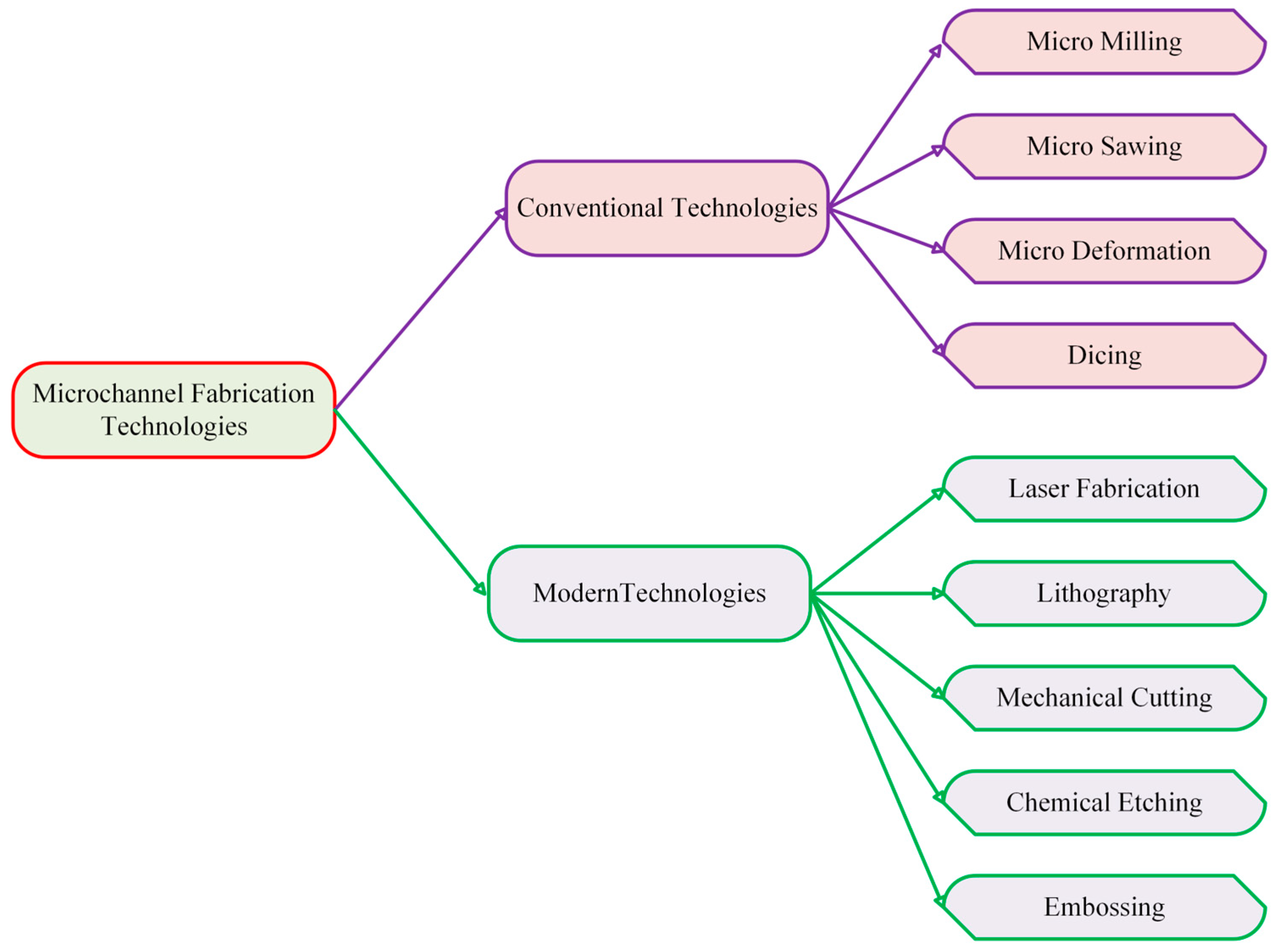
Currently, it is challenging to manufacture microchannels for heat exchangers utilizing a variety of materials; therefore, more research is needed to find more effective manufacturing techniques as well as precise microchannel shapes. Typically, different types of materials are utilized to manufacture microchannels, such as metallic, polymeric, ceramic, glass, semiconductors, and composite materials. These materials are preferred due to their unique properties, such as excellent thermal conductivity, high strength, hardness, light weight, corrosion resistance, high melting point, thermal stability, and so forth. Therefore, further research is needed to select efficient materials, the precise geometry, and more efficient fabrication techniques. The fabrication techniques for manufacturing microchannels are classified into two different types, conventional and modern technologies, as depicted in Figure 9. These fabrication methods have been used to develop microchannels with precisely measured geometries and dimensions, significantly enhancing microchannels’ performance.

5.1. Laser Fabrication

Laser fabrication is an innovative technique in which a high-powered laser is used to perform various operations quickly and with high precision and accuracy. Almost every type of substrate material can be processed with laser technology, which also has the advantage of being very flexible and requiring short processing times. This technology utilizes powerful laser beams to perform a range of operations, including cutting, engraving, welding, and surface modification, on a variety of materials, including metals, polymers, ceramics, glass, semiconductors, and composites. The advantages of laser techniques over other techniques are that they are easy to use, scrapless, and environmentally friendly.
In recent years, laser processing of microchannels has been developed and researched by various scientists. Heng et al. [89] did a simulation-based study to investigate the surface roughness of and improvement in microchannels with the excimer laser fabrication method. It was found that the excimer laser’s fluence has a significant impact on determining the microchannel surface roughness because both the surface roughness and the depth of the microfluidic channel increase as its concentration increases. It is possible to significantly reduce the surface roughness of microfluidic channels by excimer laser polishing. The surface roughness decreases as the irradiation time frame increases; however, if the irradiation time is too long, some flimsy stripes will form on the corners of the edges, worsening the surface roughness. Similarly, another study by Hong et al. [90] utilized a novel technique, CO2 laser beams, for scribing microchannels. The results demonstrated that by using a CO2 laser beam during the scribing process, a smooth channel wall can be achieved without the requirement of a post-machining annealing operation. Moreover, this laser fabrication is a cost-effective and adaptable way to prototype polymethylmethacrylate-based microfluidic devices quickly. Recently, Jianlei et al. [91] used a UV nanosecond laser processing machine to conduct an experimental investigation into fabricating a microchannel composed of diamond material having high thermal conductivity. However, it is a big challenge to manufacture a straight microchannel by utilizing diamond material. They manufactured a 1600 μm deep collecting groove with a smooth bottom geometry by combining an improved multi-feed technique with a grid path spacing of 1 μm.

5.2. Micro-Mechanical Cutting

One of the key techniques for creating microchannels is micro-mechanical cutting, which enhances heat transfer in microchannels by providing a better surface finish and channel accuracy using high-precision machine tools. The advantages of micro-mechanical cutting, as compared to laser fabrication techniques, is that it does not require a particularly expensive piece of equipment; therefore, microchannels are easily manufactured at a low cost. Furthermore, a wide range of materials can be fabricated, including steel, aluminum, brass, plastics, and polymers. Commonly, there are two types of micro-mechanical cutting: micro-milling and micro cutting. Recently, using micro-milling techniques, Zhou et al. [92] fabricated rectangular copper microchannels and investigated their burr formation and surface roughness characteristics at various feed rates, spindle speeds, and depths of cut. They also investigated how burr formation occurs within microchannels through simulations and experiments. The findings indicated that, by changing the micro-milling parameters, the surface roughness variations in the microchannel bottoms and sidewalls generally correlated with the top burr size on the down-milling side. It was observed that, during micro-milling of microchannels, the top burr formation and its size on the down-milling side were significantly larger than those on the up-milling side. Moreover, various micro-milling processes, such as a thin depth of cut, high spindle speed, and medium feed rate, enhanced the surface quality of the microchannels, emphasizing the selection of an optimum cutting-edge radius. Similarly, Vázquez et al. [93] analyzed the effects of various micro-milling processes, such as spindle speed, feed per tooth, depth of cut, and coolant application during the fabrication of metallic microchannels (aluminum and copper). These parameters significantly influenced the quality of the finishing surface and the precise dimensions of microchannels. It is important to determine which process factors have the greatest influence on the final product quality and how much altering them would impact it. The outcome showed that, at high feed rates, the aluminum microchannel width was more controllable during manufacturing than that of copper. Moreover, utilizing a coolant provided higher quality in terms of average microchannel width and bottom surface roughness of both the aluminum and copper materials. A mechanical cutting force model was proposed by Lee et al. [94] to estimate the cutting force accurately in micro-end milling under specific conditions. Based on the measured cutting forces, the cutting forces coefficients represent the effects of most cutting mechanisms utilized in micro-end milling, including the influence of the minimum chip thickness.
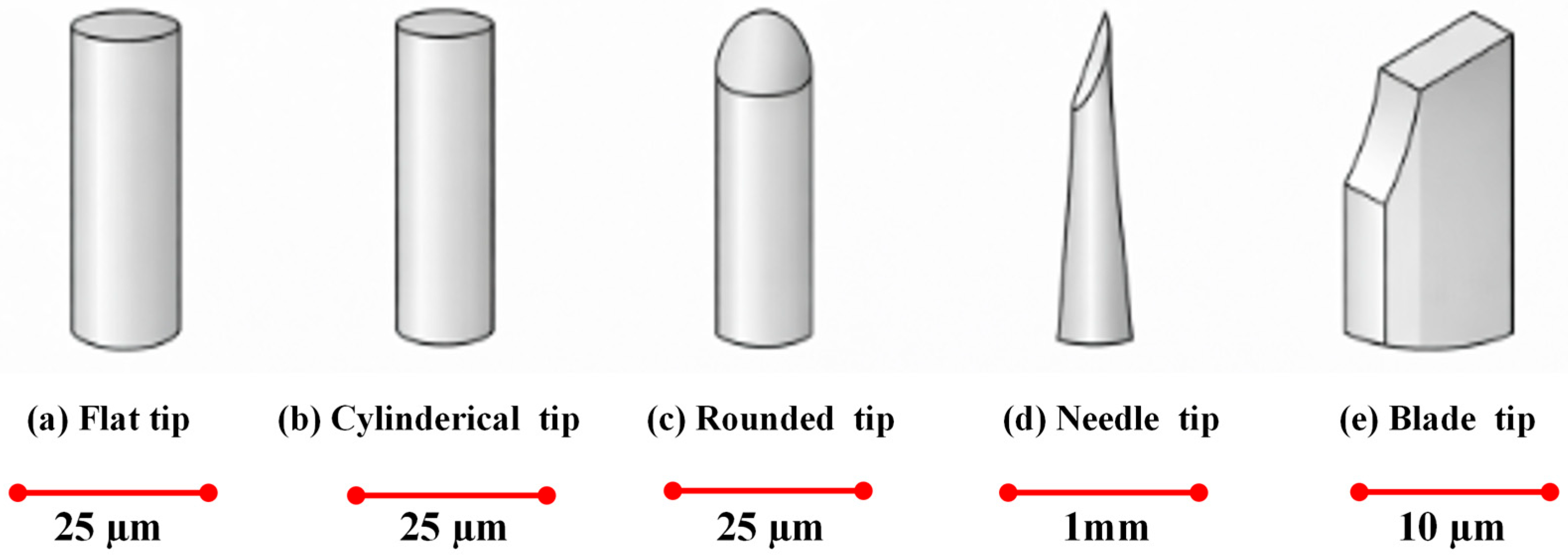
The size and surface quality of microstructures depend on precision cutting tools and machine tools, which are essential to micro-mechanical cutting operations. Various mechanical cutting tools are shown in Figure 10. Hyuk et al. [95] carried out research to confirm precise accuracy and economic efficiency by fabricating an aluminum mold using two different techniques, micro cutting and microelectromechanical systems (MEMS). They found that micro cutting was 15 times cheaper than MEMS techniques for manufacturing aluminum microchips. Therefore, micro-mechanical cutting is simple, fast, and cheaper for manufacturing microchips. Jingwei et al. [96] developed a copper microchannel micro rolling process. They performed annealing operations at different temperatures (400 °C, 500 °C, 600 °C, 700 °C, and 800 °C) on copper foil having a thickness of 0.1mm. The results revealed that an optimum annealing temperature (500 °C) was made possible by the refined microstructure and texture, which also improved the accuracy of microchannel formation during micro rolling.

5.3. Lithography

One of the main methods for designing microchannels is lithography. It is difficult to generate a wide variety of topographies using other fabrication techniques, but lithography makes it possible. High resolution and precision are two major benefits of lithography-based microfabrication, but the complex structure of the fabrication process requires a clean-room environment and costly equipment [97]. Photolithography is the most common technique within lithography. In this regard, Sungyoung and Je-Kyun [98] researched two-step photolithography, and demonstrated the usage of the method for creating multilayer microchannels in microfluidic applications. They investigated how the thickness of printed microchannel features varied in a photoresist using two-step photolithography. The thickness and width of the specified photoresist pattern in the first step and the spin-coated photoresist film’s thickness in the second step determined the final photoresist thickness. Chen et al. [99] demonstrated gray-scale lithography in a photoresist, creating a photomask with fluids. The produced photoresist pattern for a specific microfluidic photomask can be predicted based on the photomask and dye concentration dimensions.
According to Kandlikar et al. [24], lithography, electroplating, and molding (LIGA) offer all the benefits of X-ray lithography. By projecting highly directed X-rays through a unique X-ray mask, LIGA can expose a thick photoresist that is almost diffraction-free. This method can produce structures with aspect ratios of more than 100:1 and maintain submicron requirements. Recently, Haruki et al. [100] used ultraviolet (UV) nanoimprint lithography to manufacture complex polymer microchannels. The findings demonstrated that the nanoimprint UV lithography approach quickly creates hybrid microchannels on a single resistance layer. Furthermore, the collected cells within a channel can be imaged using a UV-curable polymer, since its refractive index is nearly equal to that of water. Similarly, Azrena et al. [101] manufactured multiple-size microchannel (1, 3, and 5 μm diameter)-based micro sorting devices by utilizing the ultraviolet lithography technique. The findings demonstrated that direct laser writing is an appropriate technique for fabricating an IP-L porous microchannel, and the Polydimethylsiloxane (PDMS) microchannel adhesion of the IP-L makes it suitable as a photoresist.

5.4. Chemical Etching

Etching is typically used as a type of subtractive technique in various micromachining processes. Usually, the materials used to make microchannel devices are typically metallics, polymers, semiconductors, and ceramics; however, these materials cannot withstand temperatures higher than 300 °C. Therefore, constructing such devices using materials that can withstand higher temperatures is crucial because many chemical reactions function at temperatures above 300 °C. Rao and Deepak [102] manufactured microchannels having depths of nearly 200 µm with stainless steel by applying wet chemical etching. The etchant was made of various concentrations of HCl, FeCl3, and HNO3 mixed with water, and utilized to etch microchannels on substrates made of stainless steel. The results revealed that the etch rate and etch factor increased as the concentration of HCl in the etchant increased, but the roughness was affected more adversely. Additionally, the channel depth and etch factor were highly influenced by the operating temperature and etchant composition. Rodrigo et al. [103] performed a chemical etching process by using a femtosecond laser to create microchannels with a rectangular shape in order to develop three-dimensional structures. During the engraving process, the femtosecond laser energy and the sample were etched in acid to determine the final microchannel width. The control procedure involved increasing the laser power and concentration, developing the recording program, and etching the material to allow for different structural shapes for diverse purposes in order to maximize line-by-line imprinting.

5.5. Embossing or Imprinting

In the 1990s, the Institute for Microstructure Technology at Forschungszentrum Karlsruhe used the embossing technique for the first time to recreate or replicate microstructures. Hot embossing is the term for an embossing technique that is especially helpful in the replication process and typically requires a high degree of temperature that is comparable to the temperature of polymer molding. Additionally, wires are utilized for imprinting on plastic surfaces. It was discovered in recent research that silicon stamps are superior imprinting tools for manufacturing microchannels.
Chung Lin et al. [104] investigated how the molding conditions affect the precision of microfeature replication. The findings indicated that the embossing load, temperature, and embossing time all have a substantial influence on the accuracy of the microchannel depth and width. Moreover, the position has an impact on the quality of imprint replication; higher replication accuracy is produced closer to the center of molded components. Similarly, Deshmukh et al. [105] did research on the improvement of the accuracy of hot embossing, using an embossed microchannel with a laser-patterned copper mold to replicate their design. A fiber laser machine was used to manufacture a positive-feature micro-patterned mold for hot embossing. They also investigated the impact of three different parameters, the embossing temperature, embossing pressure, and embossing time. At the optimal conditions, the depth of the embossed microchannel increased from 28.6 µm to 46.5 µm, and the replication accuracy improved from 59.34% to 96.33% compared to the initial parameter levels. Moreover, the embossing temperature played a significant role in the replication accuracy, accounting for 70.52% of the process overall.

6. Challenges and Limitations of Micro Heat Exchangers (MHXs)

Micro heat exchangers (MHXs) offer significant advantages for food and pharmaceutical industries due to their high heat transfer coefficients, compact size, and ability to achieve rapid heating and cooling, which are essential for processes such as pasteurization, sterilization, fermentation, and precise thermal control of sensitive products. However, several challenges and limitations affect their performance and industrial applicability. The majority of research studies have primarily concentrated on evaluating model outputs, such as the pressure drop, thermal efficiency, and heat transfer rate. One of the most critical issues is the high pressure drop inherent to microscale channels [106]. The small hydraulic diameters result in strong viscous effects, increasing the pumping power requirements. This limitation is particularly relevant in food and pharmaceutical applications, where fluids often exhibit high viscosity; non-Newtonian behavior; or contain suspended particles, such as dairy products, juices, syrups, and biological media. An excessive pressure drop not only increases energy consumption but may also cause mechanical stress or product degradation [107].
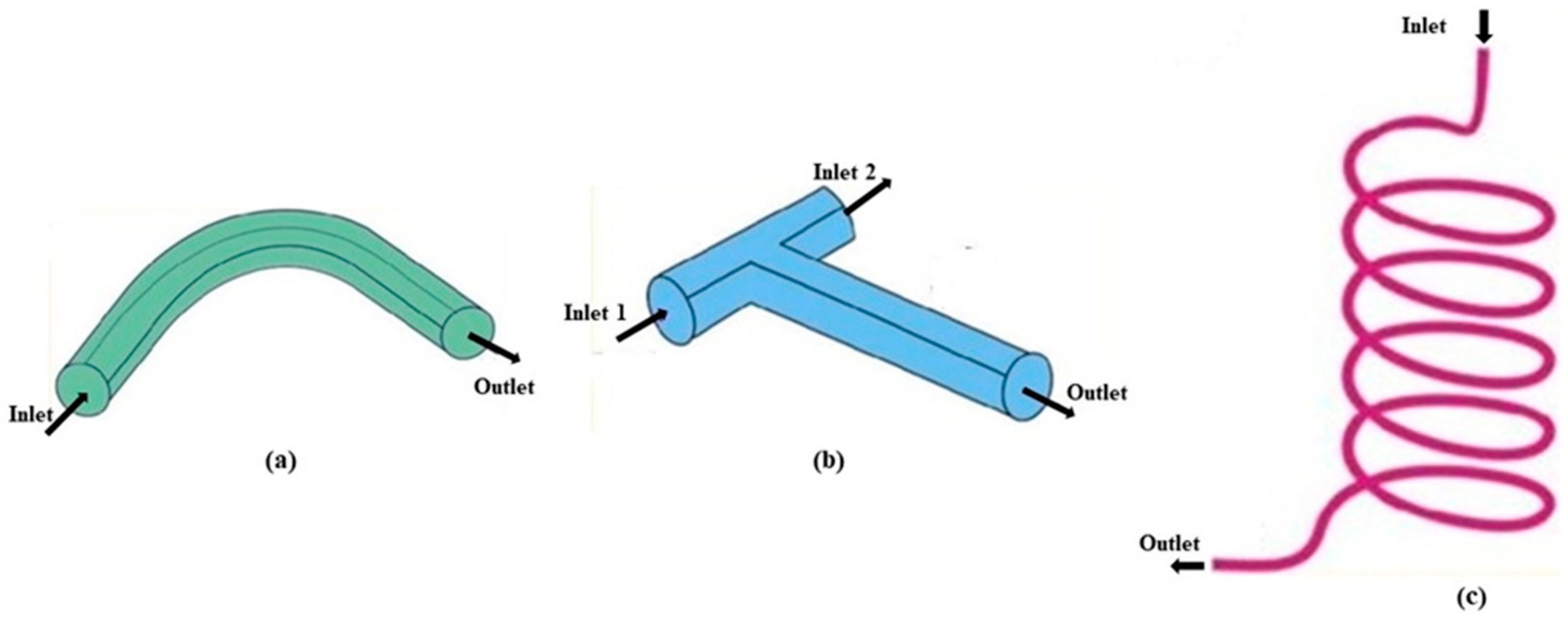
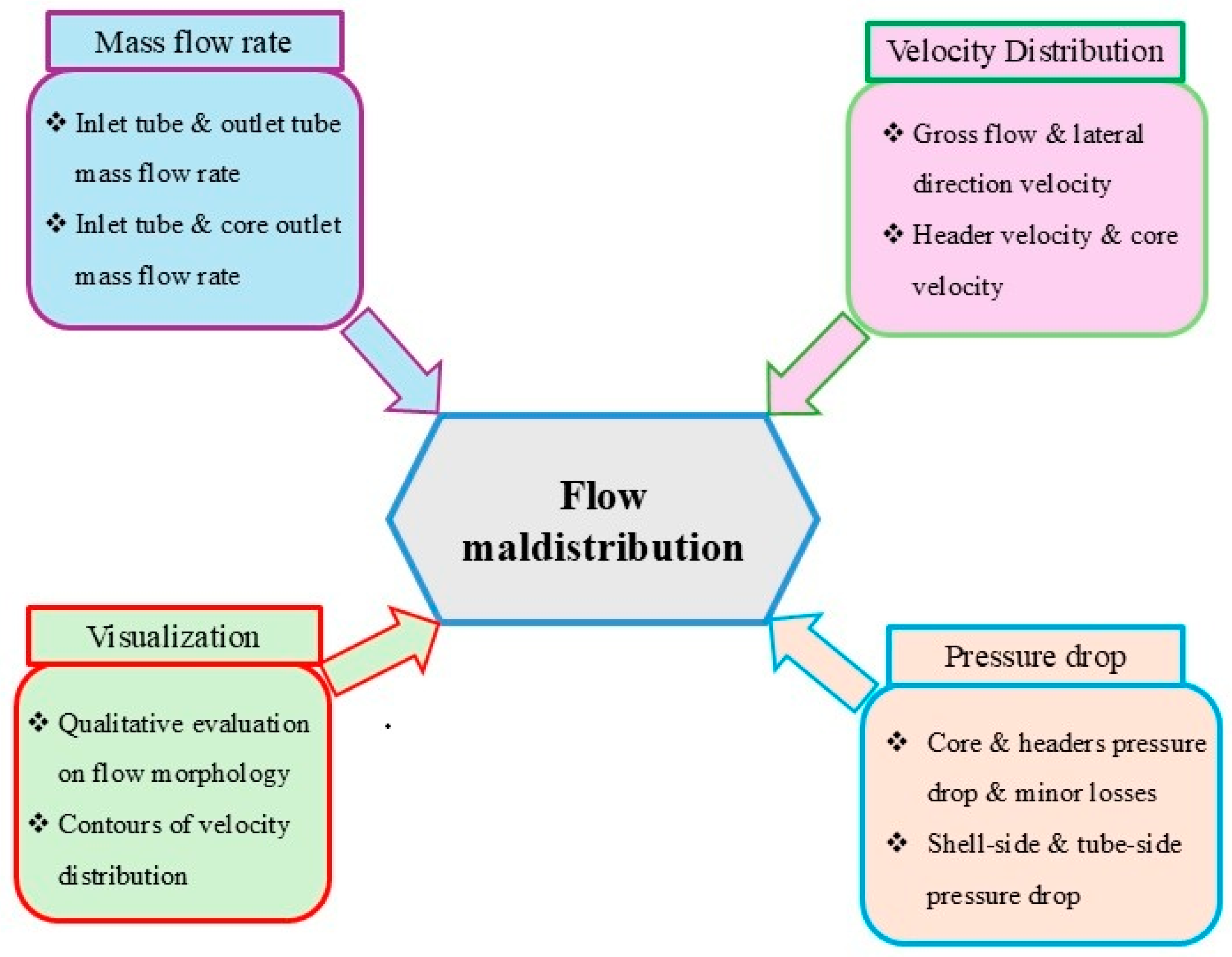
Flow maldistribution is another important factor that is commonly referred to as the uneven distribution of fluid flow among parallel channels or passages that influences MHX performance. As depicted in Figure 11, flow maldistribution is influenced by a variety of parameters used to characterize a flow field, including the mass flow rate, velocity distribution, and pressure drop. These parameters are crucial for directly improving thermal performance, flow uniformity, and system efficiency. Particularly, the mass flow rate demonstrates how uneven flow distribution can result from poor manifold or header design by highlighting variations between the inlet and outlet mass flow rates in the tubes and the core. While the former covers fluid flow across an entire device, the latter provides measurements of different units in the core areas, with the fluid passing through each unit collected separately [108]. The velocity distribution parameters highlight the combined effects of lateral and streamwise (gross flow) velocities. Moreover, untimely geometric changes often lead to changes in the transverse velocity components, which cause flow deviation and channel-to-channel instability. The flow structure can be easily measured with the help of visualization [109]. In the meantime, photographic methods can be used to identify the velocity distribution contours and assess the maldistribution patterns within micro heat exchangers. Meanwhile, the pressure drop demonstrates that the main cause of maldistribution is differences in pressure losses between the headers, core, and shell sides. In shell-and-tube HXs, the pressure drop is measured separately on both the shell side and the tube side to evaluate the flow resistance in each fluid path [110]. As an example, in a parallel microchannel heat exchanger used for pharmaceutical sterilization, an inappropriately designed inlet header may result in the outer microchannels receiving a higher flow rate than the central channels. Consequently, there is more convective transfer of heat in the outer channels and less heating in the central channels, which results in an uneven temperature distribution that could lead to insufficient sterilization. Similar consequences could happen in food processing applications, such as microscale pasteurization systems, where flow maldistribution may result in product under-processing or localized overheating. Moreover, localized hot spots or under-processed regions are particularly critical in sterilization and pasteurization applications, where strict regulatory standards must be met.
Fouling and clogging are among the most severe operational challenges for MHXs in food and pharmaceutical environments. The presence of proteins, fats, sugars, minerals, and microorganisms promotes fouling, biofilm formation, and crystallization within microchannels. Due to the extremely small channel dimensions, even minor fouling can lead to substantial deterioration in heat transfer performance and a sharp increase in the pressure drop. Moreover, the cleaning-in-place (CIP) procedures commonly used in food and pharmaceutical plants are difficult to implement effectively at the microscale, raising concerns regarding hygiene, cross-contamination, and long-term reliability.
The thermal performance is also limited by axial heat conduction and conjugate heat transfer effects, which become pronounced in micro heat exchangers. In applications involving temperature-sensitive food products, vaccines, enzymes, or pharmaceutical solutions, unwanted heat conduction through the channel walls can reduce temperature gradients and compromise precise thermal control. This limitation is particularly relevant in fermentation and biochemical processing, where narrow temperature windows are required to maintain product stability and biological activity.
From a manufacturing perspective, MHXs face additional constraints that are especially critical for food and pharmaceutical applications. Microfabrication techniques, such as photolithography, chemical etching, laser micromachining, and micro-milling demand high dimensional accuracy and surface quality. Small deviations in the channel geometry or surface roughness can significantly alter the flow behavior and enhance fouling tendencies. The material selection further complicates manufacturing decisions; metals provide excellent thermal conductivity and mechanical strength but are often costly and difficult to fabricate at the microscale. On the other hand, polymers, although easier to process and chemically resistant, suffer from low thermal conductivity and limited temperature resistance. Ceramics offer good thermal stability but are brittle and challenging to manufacture. Moreover, the high cost of metallic additive manufacturing (AM) and metal powders remains a significant barrier to the widespread adoption of microchannel heat sinks (MCHSs).
Joining, sealing, and surface finishing present further challenges, as food and pharmaceutical standards require leak-free operation, smooth surfaces, and biocompatibility. Bonding techniques, such as diffusion bonding, brazing, or adhesive bonding, may introduce additional thermal resistance, alignment errors, or contamination risks. Finally, scalability and production costs remain significant barriers to industrial adoption. Many MHX fabrication approaches are derived from microelectronics manufacturing and are not yet optimized for large-scale, hygienic, and cost-effective production. Although additive manufacturing offers promising opportunities for complex microchannel designs and rapid prototyping, the current limitations regarding surface finish, dimensional accuracy, and cleanability restrict its widespread use in regulated food and pharmaceutical industries. Table 4 summarizes the key performance benefits and major limitations of micro heat exchangers, highlighting the trade-offs between enhanced thermal efficiency and the operational and manufacturing challenges associated with their application in food and pharmaceutical industries.

7. Advancements in Micro Heat Exchangers

Currently, researchers are focused on several key areas to improve the efficiency, cost-effectiveness, reliability, and applicability. Some of these key areas are as follows:
  • Advanced materials;
  • Design and fabrication;
  • Performance optimization;
  • Cost optimization;
  • Fouling resistance
  • Digitalization and smart monitoring;
  • Integration with other technologies;
  • Energy efficiency and sustainability;
  • CFD (computational fluid dynamics) modeling.
Table 5 summarizes the key research focus areas on micro heat exchangers and highlights their respective impacts on food and pharmaceutical industry applications.
The research focuses on biocompatible and food-grade materials and nanomaterials to enhance heat transfer and minimize thermal resistance in micro heat exchangers. Biocompatible and food-grade materials, such as advanced stainless steels, polymers, and ceramics, exhibit remarkable resistance to corrosion and fouling. These materials contribute to longer equipment lifetimes and lower maintenance costs, while also maintaining the safety and hygiene standards required in both industries. Nanomaterials like graphene and carbon-based nanomaterials are being used in micro heat exchangers. These materials have high thermal conductivity, enabling more efficient heat transfer across exchangers and improving overall performance and reducing energy consumption. The effects of nanomaterials are briefly explained in the above section [127].
Microstructure design refers to the design of structures with specific shapes, sizes, and functions at the microscopic scale. In recent years, modifying the surface geometry of microchannels has been focused on to further improve the mixing performance. Complex microchannel structures are constructed with high accuracy and precision by employing cutting-edge design and production methods, including additive manufacturing, 3D printing, and microfabrication. These techniques enable the manufacture of heat exchangers with improved heat transfer efficiency, better surface area-to-volume ratios, and compact designs that are ideal for integration into existing processing systems. Regarding 3D printing, it is an additive manufacturing technology that creates complex three-dimensional solid objects by stacking materials layer by layer. Currently, 3D printing technology for manufacturing microchannels offers a fast and cost-effective method without the need to consider complex three-dimensional structures.
To optimize the heat transfer efficiency, researchers have investigated various flow patterns, surface treatments, and microchannel designs. The different sizes, forms, and patterns of the channels that fluids pass through in a micro heat exchanger are referred to as microchannel configurations. Pin fin, serpentine, zigzag, and straight channels are common configurations. The objective is to find the ideal balance between fluid resistance and heat transfer efficiency, as each configuration has a different impact on the fluid flow and heat transfer characteristics.
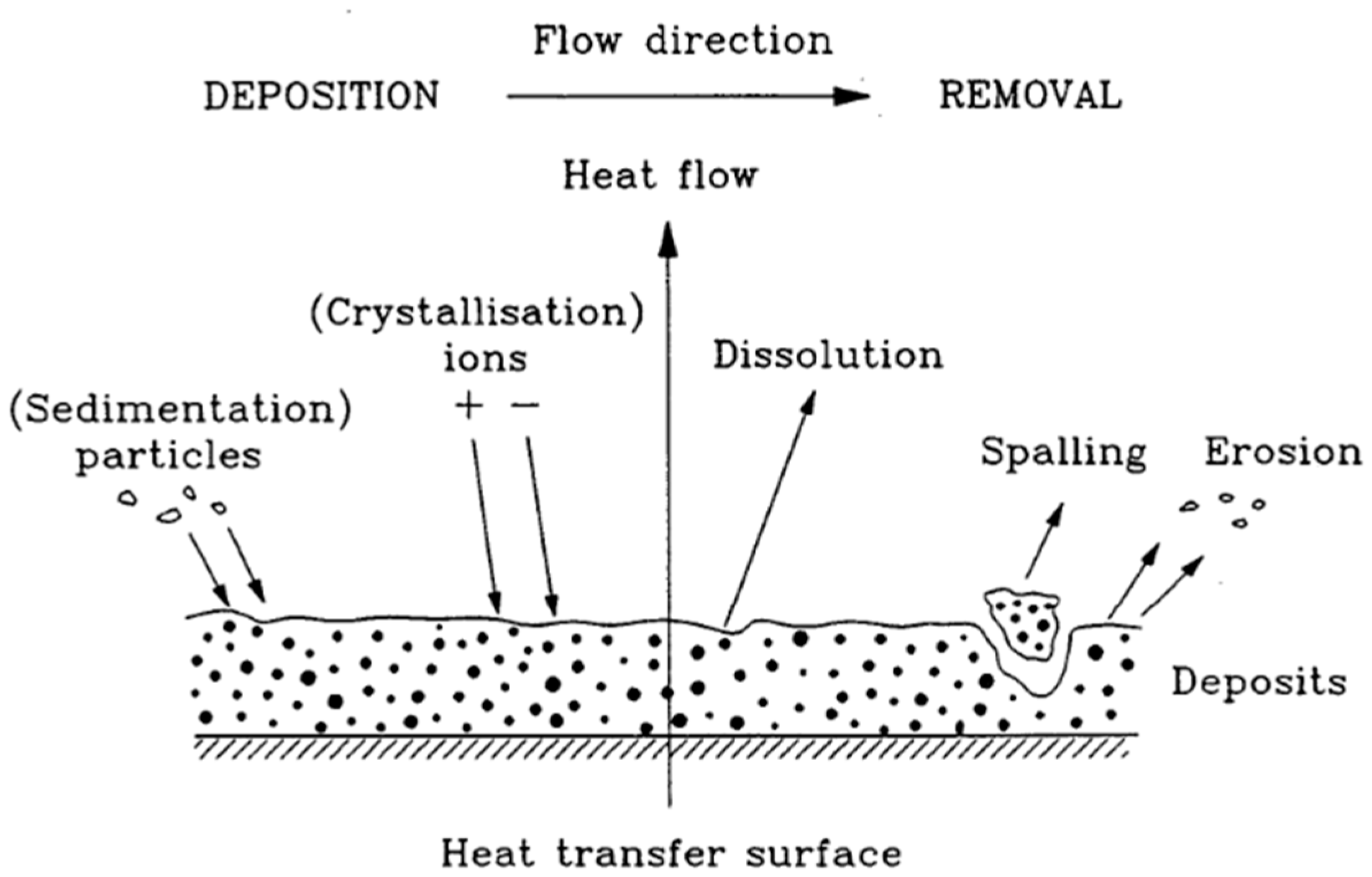
Surface treatments require modifying the internal surfaces of a microchannel to improve the heat transfer. The heat transfer performance can be improved by using surface treatment methods, such as adding micro- or nanostructures to promote fluid mixing, roughening the surface to induce turbulence, or coating the channels with thin films of highly thermally conductive materials. Furthermore, fouling or scaling is becoming a major barrier to achieving high heat transfer exchange between two fluids, and is mostly found on tubes because it combines several contaminants; it is challenging to determine the type of scale production [128]. Figure 12 illustrates possible deposition and removal procedures for a typical system. The deposition rates depend on the modifications caused by deposits, such as increased flow velocity and surface roughness, but they are not affected by the amount of deposition. On the other hand, the removal rates often rise as the deposit amounts do. Moreover, the fluid passing through most heat exchangers contains some dirt, oil, grease, and organic or chemical deposits, which lowers the heat transfer coefficient. Therefore, the deposition issue has to be the focus for future advancements in micro heat exchangers.
During the design and optimization stages, CFD is used for a variety of heat exchangers to solve problems like fouling, pressure drop, thermal analysis, and fluid flow maldistribution. In microchannel systems, flow maldistribution is a common issue that can lead to poor performance due to uneven fluid distribution. To obtain a more uniform flow distribution, researchers refine the microchannel geometry using CFD simulations to predict and identify areas of maldistribution. In micro heat exchangers, advanced computational fluid dynamics (CFD) models are used to simulate various designs and operating conditions, thereby optimizing performance before physical prototypes are constructed. Moreover, machine learning algorithms play a vital role in analyzing operational data generated from micro heat exchangers. Machine learning algorithms can forecast performance trends, identify anomalies, and provide design changes by analyzing patterns and correlations from their data [130].
To improve their overall performance and increase their applications, microscale heat exchangers are integrated with other technologies, such as hybrid systems, phase change materials, smart sensors and monitoring, nanofluids, and hybrid nanofluids [131]. The use of IoT (Internet of Things), along with smart sensor integration for remote monitoring and predictive maintenance to detect temperature, flow rates, and pressure drops, improves their efficiency and reliability [132]. They enable precise control over heat management procedures and provide real-time data. Real-time data is very useful for keeping a heat exchanger operating at its maximum effectiveness and avoiding overcooling or overheating. Micro heat exchangers are maintained at the proper temperatures for processing and storage by smart sensors, which are essential in the food and pharmaceutical industries where accurate temperature control is essential. They aid in the efficient management of heat dissipation in electronics cooling, protecting expensive components from thermal harm. With advances in sensor technology and the integration of AI and IoT, smart sensors are now being used in micro heat exchangers. These developments will allow them to become more efficient and diverse in their applications.

8. Conclusions

Micro heat exchangers (MHXs) have demonstrated substantial potential for advanced thermal management in the food and pharmaceutical industries, where compact design, rapid thermal response, and precise temperature control are essential. Their superior surface area-to-volume ratio and enhanced heat transfer characteristics make them well-suited for applications such as pasteurization, sterilization, fermentation, crystallization, and temperature-sensitive product processing.
The performance of MHXs is strongly influenced by the channel geometry; surface modification techniques; working fluids (including nanofluids); and key non-dimensional parameters, such as the Reynolds, Nusselt, and Knudsen numbers. Geometrically enhanced designs—such as corrugated channels, cavity-based structures, pin fins, and vortex-inducing features—have produced significant improvements in convective heat transfer by promoting controlled flow instabilities and boundary layer disruption. These passive enhancement strategies are particularly valuable for processing heat-sensitive materials, as they enable higher thermal efficiency while maintaining moderate flow velocities and manageable pressure drops.
The integration of nanofluids has further contributed to improving thermal conductivity and overall heat transfer performance at the microscale. However, increases in pumping power, potential stability concerns, and economic considerations must be carefully evaluated before large-scale industrial implementation.
Recent advances in manufacturing technologies—including micro-milling, lithography, laser micromachining, embossing, and additive manufacturing—have improved fabrication precision and expanded design flexibility. These developments have enhanced scalability and industrial feasibility, although challenges related to surface finish, cost, material selection, and hygienic requirements remain significant barriers.
Despite their advantages, MHXs face critical limitations, including high pressure drops, flow maldistribution, fouling and clogging, axial heat conduction effects, manufacturing complexity, and cost constraints. In food and pharmaceutical applications, these issues are particularly critical due to strict hygiene standards, non-Newtonian fluid behavior, and regulatory compliance requirements. Addressing these challenges requires an integrated approach that combines optimized design, material innovation, advanced fabrication techniques, and intelligent operational control.
Future research should focus on:
  • Development of novel biocompatible and high-conductivity materials with enhanced fouling resistance;
  • Advanced surface engineering techniques to improve cleanability and long-term reliability;
  • Integration of smart sensors, digital monitoring systems, and AI-based predictive maintenance;
  • Coupled thermal–process optimization to improve sustainability and energy efficiency;
  • Scalable and cost-effective fabrication methods suitable for industrial deployment.
Overall, micro heat exchangers represent a promising and transformative solution for high-efficiency thermal management in food processing, pharmaceutical manufacturing, and other precision-based industries. Continued interdisciplinary research and technological innovation will be essential to overcome the current limitations and enable broader commercial adoption.

Author Contributions

Writing—original draft preparation, M.W.A.; writing—review and editing, F.B., G.Q.C. and U.S.; literature review, M.W.A., G.Q.C. and U.S.; conceptualization, M.W.A. and F.B.; supervision, F.B. All authors have read and agreed to the published version of the manuscript.

Funding

This research received no external funding.

Data Availability Statement

The original contributions presented in this study are included in the article. Further inquiries can be directed to the corresponding author(s).

Conflicts of Interest

The authors declare no conflicts of interest.

Abbreviations

The following abbreviations are used in this manuscript:
APIActive pharmaceutical ingredient
AMAdditive manufacturing
AIArtificial intelligence
CFDComputational fluid dynamics
EGEthylene glycol
HXHeat exchanger
HVACHeating, ventilation, and air conditioning
IoTInternet of things
KnKnudsen number
LIGALithography, electroforming, and molding (Lithographie, Galvanoformung, Abformung)
MEMSMicroelectromechanical system
MCHSMicrochannel heat sink
MPHXMicroplate heat exchanger
MHXsMicro heat exchangers
MCHXsMicrochannel heat exchangers
NuNusselt number
ReReynolds number
UVUltraviolet

References

  1. Patin, M.; Rousse, D.R. Optimizing economic performances of foundation earth-to-air heat exchangers for low-technology residential air-conditioning. Energy Build. 2024, 328, 115250. [Google Scholar] [CrossRef]
  2. Azam, M.W.; Cattani, L.; Malavasi, M.; Bozzoli, F. Experimental Study of the Corrugation Profile Effect on the Local Heat Transfer Coefficient. Energies 2023, 16, 7181. [Google Scholar] [CrossRef]
  3. Keller, T.; Wolf, M.; Pröll, T. Enhancing energy efficiency in pharmaceutical freeze drying: Adapting to EU legislation on fluorinated gases. Int. J. Thermofluids 2025, 28, 101304. [Google Scholar] [CrossRef]
  4. Azam, M.W.; Chaudhary, G.Q.; Sajjad, U.; Abbas, N.; Yan, W.M. Performance investigation of solar assisted desiccant integrated Maisotsenko cycle cooler in subtropical climate conditions. Case Stud. Therm. Eng. 2023, 44, 102864. [Google Scholar] [CrossRef]
  5. Öztürk, M.; Çiftçi, E. Progress in Nuclear Energy Numerical analysis of a helically coiled tube heat exchanger performance utilized in molten salt nuclear reactors for molten salt and He-CO2 working fluid conditions. Prog. Nucl. Energy 2025, 187, 105844. [Google Scholar] [CrossRef]
  6. Yari, M.; Zare, A.A.D. Thermodynamic and economic analysis of a nuclear-based, zero-carbon multi-generation system with sorption enhanced reforming. Energy 2025, 338, 138965. [Google Scholar] [CrossRef]
  7. Rios, M.S.B.-D.L.; Rivera-Solorio, C.I.; Nigam, K. An overview of sustainability of heat exchangers and solar thermal applications with nanofluids: A review. Renew. Sustain. Energy Rev. 2021, 142, 110855. [Google Scholar] [CrossRef]
  8. Jung, G.; Kim, J.; Choi, H.; Lee, H. Multi-objective optimization of an offset strip fin heat exchanger applied to fuel cell electric vehicles for cooperative cooling. Appl. Therm. Eng. 2025, 268, 125832. [Google Scholar] [CrossRef]
  9. Park, J.H.; Kim, J.; Kwon, J.G. 50 kWe R1336mzz(Z) ORC power generation system for industrial waste heat recovery: System design and commissioning test results. Energy 2025, 323, 135698. [Google Scholar] [CrossRef]
  10. Crystal, R.V.; Crittenden, T.; Glezer, A.; Garimella, S. Enhancement of air-side heat transfer in crossflow heat exchangers using auto-fluttering reeds. Appl. Therm. Eng. 2025, 258, 124617. [Google Scholar] [CrossRef]
  11. Burmana, A.D.; Alexander, V.; Tambun, R.; Al Fath, M.T.; Hasibuan, D.R.; Wicaksana, F.; Elboughdiri, N. Investigation of the heat transfer coefficient in a plate heat exchanger for cooling product before storage: Based on a biodiesel plant case. Case Stud. Therm. Eng. 2025, 72, 106411. [Google Scholar] [CrossRef]
  12. Cheng, L.; Liu, Z.; Gu, H.; Wu, J.; Chen, Y.; Sunden, B. Recent advances of helical baffle heat exchangers: Principles, structural optimization, application and beyond. Appl. Therm. Eng. 2025, 274, 126390. [Google Scholar] [CrossRef]
  13. Kumar, M.S.; Abraham, S. Experimental and numerical studies of detailed heat transfer and flow characteristics in the rib turbulated annulus of a double pipe heat exchanger. Int. J. Therm. Sci. 2025, 207, 109382. [Google Scholar] [CrossRef]
  14. Nithyanandam, K.; Kant, K.; Kondaiah, P.; Pitchumani, R. Technoeconomics of a molten salt/supercritical carbon dioxide heat exchanger with fractal-textured corrosion resistant coatings for concentrating solar thermal systems. Energy Convers. Manag. 2025, 341, 120028. [Google Scholar] [CrossRef]
  15. Yang, Z.; Pan, T.; Zhang, S.; Chang, C.L.; Zhang, N.; Smith, R. Automated multi-stream spiral-wound heat exchanger design and optimization. Appl. Therm. Eng. 2026, 284, 128914. [Google Scholar] [CrossRef]
  16. Saito, S.; Baba, S.; Kinoshita, K.; Takada, N.; Someya, S. Thermal–hydraulic performance of additively manufactured crossflow minichannel heat exchangers. Appl. Therm. Eng. 2025, 274, 126543. [Google Scholar] [CrossRef]
  17. Tuckerman, D.B.; Pease, R.F.W. High-Performance Heat Sinking for VLSI. IEEE Electron Device Lett. 1981, 2, 126–129, Correction in IEEE Electron Device Lett. 1981, 2, 213–213. [Google Scholar] [CrossRef]
  18. Mehendafe, S.S.; Jacobi, A.M.; Shah, R.K. Fluid Flow and Heat Transfer at Micro- and Meso-Scales With Application to Heat Exchanger Design. Appl. Mech. Rev. 2000, 53, 175–193. [Google Scholar] [CrossRef]
  19. Darbari, B.; Kefayati, G.; Wang, X.; Vafai, K. Application of micro-channel heat sinks for thermal management of electric vehicle components: A comprehensive review. Energy Convers. Manag. 2026, 347, 120507. [Google Scholar] [CrossRef]
  20. Zhou, F.; Gu, W.; Ma, G. Microchannel heat sinks for cold plate liquid cooling in data centers: Advances, evaluations and prospects. Renew. Sustain. Energy Rev. 2026, 230, 116729. [Google Scholar] [CrossRef]
  21. Barmavatu, P.; Heeraman, J.; Das, M.K.; Mangalaraja, R.V.; Srinivasnaik, M. Synergistic integration of micro-channels and thermal storage systems for energy efficiency enhancement in heat transfer applications-a critical review. J. Therm. Anal. Calorim. 2025, 151, 1097–1119. [Google Scholar] [CrossRef]
  22. Jiang, W.; Tan, C.; Su, E.; Lu, J.; Shi, H.; Wang, Y.; Song, J.; Wang, K. Advanced Electronic Materials for Liquid Thermal Management of Lithium-Ion Batteries: Mechanisms, Materials and Future Development Directions. Coatings 2026, 16, 59. [Google Scholar] [CrossRef]
  23. Kandlikar, S.G.; Grande, W.J. Evolution of microchannel flow passages-thermohydraulic performance and fabrication technology. Heat Transf. Eng. 2003, 24, 3–17. [Google Scholar] [CrossRef]
  24. Montes, M.J.; D’Souza, D.; Bubelis, E.; Perez-Martin, S. Thermo-economic optimization and design of the heat exchangers in the feedwater line of the power conversion system coupled to DEMO fusion reactor. Fusion Eng. Des. 2026, 222, 115512. [Google Scholar] [CrossRef]
  25. Jamshed, S.; Tiwari, N. Passive control techniques for heat exchangers: Permeability-driven modulation of vortex shedding and heat transfer enhancement. Int. Commun. Heat Mass Transf. 2025, 162, 108619. [Google Scholar] [CrossRef]
  26. Granados-Ortiz, F.J.; Garcia-Cardosa, M.; Ortega-Casanova, J. Effect of wall modifications in a vortex shedding-based mechanical micromixer for heat/mass exchange. Eur. J. Mech. B/Fluids 2022, 92, 174–190. [Google Scholar] [CrossRef]
  27. Granados-Ortiz, F.J.; Ortega-Casanova, J. Mechanical characterisation and analysis of a passive micro heat exchanger. Micromachines 2020, 11, 668. [Google Scholar] [CrossRef]
  28. Mentzelopoulos, A.P.; Fan, D.; Sapsis, T.P.; Triantafyllou, M.S. Variational autoencoders and transformers for multivariate time-series generative modeling and forecasting: Applications to vortex-induced vibrations. Ocean. Eng. 2024, 310, 118639. [Google Scholar] [CrossRef]
  29. Vishnu, R.; Selvakumar, R.D.; Vengadesan, S. Effect of electrode configuration on minichannel heat sink with EHD vortex generators. Appl. Therm. Eng. 2024, 238, 122138. [Google Scholar] [CrossRef]
  30. Renfer, A.; Tiwari, M.K.; Meyer, F.; Brunschwiler, T.; Michel, B.; Poulikakos, D. Vortex shedding from confined micropin arrays. Microfluid. Nanofluidics 2013, 15, 231–242. [Google Scholar] [CrossRef][Green Version]
  31. Granados-Ortiz, F.J.; Garcia-Cardosa, M.; Ortega-Casanova, J. Predicting the Behaviour of a Vortex Shedding-Based Passive Mechanical Micro Heat Exchanger. J. Phys. Conf. Ser. 2021, 1730, 012098. [Google Scholar] [CrossRef]
  32. Malavasi, M.; Bozzoli, F.; Cattani, L.; Pagliarini, L.; Azam, M.W.; Rainieri, S. Infrared thermography applied to the study of the local heat transfer enhancement in a wall corrugated tubular heat exchanger for food applications. J. Phys. Conf. Ser. Inst. Phys. 2025, 2940, 012013. [Google Scholar] [CrossRef]
  33. Azam, M.W.; Malavasi, M.; Cattani, L.; Bozzoli, F.; Rainieri, S. Local heat-transfer coefficient estimation in cross-helix corrugated tubes under turbulent regime. J. Phys. Conf. Ser. 2024, 2685, 012042. [Google Scholar] [CrossRef]
  34. Mathys, A. Perspective of Micro Process Engineering for Thermal Food Treatment. Front. Nutr. 2018, 5, 24. [Google Scholar] [CrossRef]
  35. Maleki, N.M.; Pourahmad, S.; Tavousi, E.; Perera, N.; Talebizadehsardari, P.; Keshmiri, A. Thermal-frictional behavior of solid magnetic strip turbulator and helical coiled wire turbulator inside a double tube heat exchanger. Int. Commun. Heat Mass Transf. 2025, 161, 108406. [Google Scholar] [CrossRef]
  36. Rawat, A.; Benyathiar, P.; Ozadali, F.; Mishra, D.K. Novel rapid cooling system design and modeling for continuous flow food processing systems. LWT 2022, 165, 113752. [Google Scholar] [CrossRef]
  37. Law, R.; Harvey, A.; Reay, D. Opportunities for low-grade heat recovery in the UK food processing industry. Appl. Therm. Eng. 2013, 53, 188–196. [Google Scholar] [CrossRef]
  38. Latorre-Pérez, A.; Vilanova, C.; Alcaina, J.J.; Porcar, M. Thermoelectric heat exchange and growth regulation in a continuous yeast culture. Microbiologyopen 2018, 8, e00648. [Google Scholar] [CrossRef]
  39. Mayer, M.; Bucko, J.; Benzinger, W.; Dittmeyer, R.; Augustin, W.; Scholl, S. The impact of crystallization fouling on a microscale heat exchanger. Exp. Therm. Fluid Sci. 2012, 40, 126–131. [Google Scholar] [CrossRef]
  40. Armenante, P.M.; Akiti, O. Sterilization processes in the pharmaceutical industry. In Chemical Engineering in the Pharmaceutical Industry; Wiley: Hoboken, NJ, USA, 2019; pp. 311–379. [Google Scholar] [CrossRef]
  41. Abla, K.K.; Mehanna, M.M. Freeze-Drying as a Tool for Preparing Porous Materials: From Proof of Concept to Recent Pharmaceutical Applications. AAPS PharmSciTech 2025, 26, 159. [Google Scholar] [CrossRef]
  42. Ungureanu, N.; Vlăduț, N.-V.; Biriș, S.-Ș.; Gheorghiță, N.-E.; Ionescu, M. Biomass Pyrolysis Pathways for Renewable Energy and Sustainable Resource Recovery: A Critical Review of Processes, Parameters, and Product Valorization. Sustainability 2025, 17, 7806. [Google Scholar] [CrossRef]
  43. Losetty, V.; Lakkaboyana, S.K.; Chappidi, H.Y.; Venkateswarlu, K.; Trilaksana, H.; Koduru, J.R.; Yuzir, A.; Atanase, L.I.; Seepana, P.K.; Knani, S. Transformative Applications of Polymer-Based Metal Oxide Nanocomposites in Medicine, Industry, and Environmental Remediation: A Review. J. Inorg. Organomet. Polym. Mater. 2025, 36, 64–96. [Google Scholar] [CrossRef]
  44. Kruzel, M.; Bohdal, T.; Dutkowski, K.; Wołosz, K.J.; Robakowski, G. The Heat Transfer Coefficient During Pool Boiling of Refrigerants in a Compact Heat Exchanger. Energies 2025, 18, 4030. [Google Scholar] [CrossRef]
  45. Taner, O.O.; Mercan, H.; Çolak, A.B.; Radulovic, J.; Taner, T.; Dalkılıç, A.S. Application of artificial intelligence techniques for heat exchanger predictions in food industry. In Advanced Materials Based Thermally Enhanced Phase Change Materials: Fundamentals and Applications; Elsevier: Amsterdam, The Netherlands, 2024; pp. 269–325. [Google Scholar] [CrossRef]
  46. Crippa, M.; Solazzo, E.; Guizzardi, D.; Monforti-Ferrario, F.; Tubiello, F.N.; Leip, A. Food systems are responsible for a third of global anthropogenic GHG emissions. Nat. Food 2021, 2, 198–209. [Google Scholar] [CrossRef]
  47. Duro, J.A.; Lauk, C.; Kastner, T.; Erb, K.H.; Haberl, H. Global inequalities in food consumption, cropland demand and land-use efficiency: A decomposition analysis. Glob. Environ. Change 2020, 64, 102124. [Google Scholar] [CrossRef]
  48. de la Rue du Can, S.; Pudleiner, D.; Pielli, K. Energy efficiency as a means to expand energy access: A Uganda roadmap. Energy Policy 2018, 120, 354–364. [Google Scholar] [CrossRef]
  49. İnanlar, B.; Altay, F. Digital twin technology in AI-operated metaverse for food processing: A pathway to sustainability, efficiency and innovation. Trends Food Sci. Technol. 2026, 168, 105491. [Google Scholar] [CrossRef]
  50. Medjahdi, K.; Didouh, N.; Araujo, R. Pasteurized milk: A highlight on potential sources of contamination by aerobic spore-forming bacteria. Food Control 2025, 171, 111134. [Google Scholar] [CrossRef]
  51. Kelly, A.L.; Waldron, D.S.; Datta, N.; O’Shea, N. Heat Exchangers, Pasteurizers and UHT Equipment—Design and Operation. In Encyclopedia of Dairy Sciences, 3rd ed.; Academic Press: Cambridge, MA, USA, 2022; Volume 5, pp. 321–335. [Google Scholar] [CrossRef]
  52. Foster, A.M.; Brown, T.; Gigiel, A.J.; Alford, A.; Evans, J.A. Air cycle combined heating and cooling for the food industry. Int. J. Refrig. 2011, 34, 1296–1304. [Google Scholar] [CrossRef]
  53. Deokar, G.S.; Pathak, V.A.; Kshirsagar, S.J.; Al-Asmari, F.; Nirmal, N. Enhancement of vitamin B12 in plant-based food through microbial fermentation-a sustainable food system. Food Chem. 2025, 484, 144437. [Google Scholar] [CrossRef]
  54. Cheng, Z.; Yang, J.; Yan, R.; Wang, B.; Bai, Y.; Miao, Z.; Sun, J.; Li, H.; Wang, X.; Sun, B. Interactive mechanism-guided microbial interaction dynamics in food fermentations: Lactic acid bacteria and yeasts as a case example. Food Biosci. 2025, 68, 106453. [Google Scholar] [CrossRef]
  55. Cepeda, J.F.; Weller, C.L.; Negahban, M.; Subbiah, J.; Thippareddi, H. Heat and Mass Transfer Modeling for Microbial Food Safety Applications in the Meat Industry: A Review. Food Eng. Rev. 2013, 5, 57–76. [Google Scholar] [CrossRef]
  56. Xu, Y.; Wang, L.; Yang, P.; Wang, J.; Zhang, H.; Wang, T.; Zhang, Z.; Wei, W.; Zhang, C. Heat transfer enhancement mediated by moisture diffusion improves the volatile profiles of meat stir-fried with high-temperature short-time. Meat Sci. 2025, 223, 109770. [Google Scholar] [CrossRef] [PubMed]
  57. Hitlamani, V.; Inamdar, A.A. Technology processing strategies to reduce the Acrylamide formation in wheat-based bakery products and future prospects: A review. Food Control. 2024, 162, 110437. [Google Scholar] [CrossRef]
  58. Galata, D.L.; Péterfi, O.; Ficzere, M.; Szabó-Szőcs, B.; Szabó, E.; Nagy, Z.K. The current state-of-the art in pharmaceutical continuous film coating—A review. Int. J. Pharm. 2025, 669, 125052. [Google Scholar] [CrossRef]
  59. Smith, M.I.; Turley, A.T.; Fournier, E.; Amura, I.F. Reducing Solvent Intensity of Nanofiltration Processes for Pharmaceutical Purification Using Inline Analytical Monitoring. Sep. Purif. Technol. 2025, 378, 134548. [Google Scholar] [CrossRef]
  60. Bruni, G.; Martini, C.; Martini, F.; Salvio, M. On the Energy Performance and Energy Saving Potential of the Pharmaceutical Industry: A Study Based on the Italian Energy Audits. Processes 2023, 11, 1114. [Google Scholar] [CrossRef]
  61. Patel, A. Heat Exchangers in Industrial Applications: Efficiency and Optimization Strategies. Int. J. Eng. Res. Technol. 2023, 12. [Google Scholar] [CrossRef]
  62. Ismail, M.; Ali, A.M.; Pereira, S.C.C. Vortex generators in heat sinks: Design, optimisation, applications and future trends. Results Eng. 2025, 25, 104216. [Google Scholar] [CrossRef]
  63. Afzal, M.J.; Tayyaba, S.; Ashraf, M.W.; Khan, M.I.; Javaid, F.; Basher, M.K.; Hossain, M.K. A review on microchannel fabrication methods and applications in large-scale and prospective industries. Evergreen 2022, 9, 764. [Google Scholar] [CrossRef]
  64. Hasan, M.I.; Rageb, A.A.; Yaghoubi, M.; Homayoni, H. Influence of channel geometry on the performance of a counter flow microchannel heat exchanger. Int. J. Therm. Sci. 2009, 48, 1607–1618. [Google Scholar] [CrossRef]
  65. Yang, C.Y.; Yeh, C.T.; Liu, W.C.; Yang, B.C. Advanced micro-heat exchangers for high heat flux. Heat Transf. Eng. 2007, 28, 788–794. [Google Scholar] [CrossRef]
  66. Huang, B.; Li, H.; Xia, S.; Xu, T. Experimental investigation of the flow and heat transfer performance in micro-channel heat exchangers with cavities. Int. J. Heat Mass Transf. 2020, 159, 120075. [Google Scholar] [CrossRef]
  67. Zhang, J.; Hu, X.; Li, W.; Wang, J.; Qi, L.; Bi, J. Effects of airflow direction on the thermal-hydraulic performance of louvered fin-common flow up vortex generator. Case Stud. Therm. Eng. 2024, 59, 104500. [Google Scholar] [CrossRef]
  68. Derakhshandeh, J.F.; Gharbia, Y. The influence of magneto-hydrodynamics and vortex generators on nanofluids heat transfer. J. Magn. Magn. Mater. 2024, 597, 171987. [Google Scholar] [CrossRef]
  69. Vashistha, C.; Patil, A.K.; Kumar, M. Experimental investigation of heat transfer and pressure drop in a circular tube with multiple inserts. Appl. Therm. Eng. 2016, 96, 117–129. [Google Scholar] [CrossRef]
  70. Chen, C.; Yang, S.; Pan, M. Microchannel structure optimization and experimental verification of a plate heat exchanger. Int. J. Heat Mass Transf. 2021, 175, 121385. [Google Scholar] [CrossRef]
  71. Pan, M.; Zhong, Y.; Xu, Y. Numerical investigation of fluid flow and heat transfer in a plate microchannel heat exchanger with isosceles trapezoid-shaped reentrant cavities in the sidewall. Chem. Eng. Process. Process Intensif. 2018, 131, 178–189. [Google Scholar] [CrossRef]
  72. Ray, D.R.; Das, D.K.; Vajjha, R.S. Experimental and numerical investigations of nanofluids performance in a compact minichannel plate heat exchanger. Int. J. Heat Mass Transf. 2014, 71, 732–746. [Google Scholar] [CrossRef]
  73. Bahiraei, M.; Monavari, A. Thermohydraulic characteristics of a micro plate heat exchanger operated with nanofluid considering different nanoparticle shapes. Appl. Therm. Eng. 2020, 179, 115621. [Google Scholar] [CrossRef]
  74. Dharmakkan, N.; Srinivasan, P.M.; Muthusamy, S.; Jomde, A.; Shamkuwar, S.; Sonawane, C.; Sharma, K.; Alrubaie, A.J.; El Shafay, A.; Panchal, H. A case study on analyzing the performance of microplate heat exchanger using nanofluids at different flow rates and temperatures. Case Stud. Therm. Eng. 2023, 44, 102805. [Google Scholar] [CrossRef]
  75. Garud, K.S.; Hwang, S.G.; Lim, T.K.; Kim, N.; Lee, M.Y. First and Second Law Thermodynamic Analyses of Hybrid Nanofluid with Different Particle Shapes in a Microplate Heat Exchanger. Symmetry 2021, 13, 1466. [Google Scholar] [CrossRef]
  76. Arie, M.A.; Shooshtari, A.H.; Dessiatoun, S.V.; Al-Hajri, E.; Ohadi, M.M. Numerical modeling and thermal optimization of a single-phase flow manifold-microchannel plate heat exchanger. Int. J. Heat Mass Transf. 2015, 81, 478–489. [Google Scholar] [CrossRef]
  77. Meis, M.; Varas, F.; Velázquez, A.; Vega, J.M. Heat transfer enhancement in micro-channels caused by vortex promoters. Int. J. Heat Mass Transf. 2010, 53, 29–40. [Google Scholar] [CrossRef]
  78. Hosseini, S.R.; Sheikholeslami, M.; Ghasemian, M.; Ganji, D.D. Nanofluid heat transfer analysis in a microchannel heat sink (MCHS) under the effect of magnetic field by means of KKL model. Powder Technol. 2018, 324, 36–47. [Google Scholar] [CrossRef]
  79. Baru, P.A.; Abubakar, S.B.; Sidik, N.A.C. Numerical Prediction of Laminar Nanofluid Flow in Rectangular Microchannel Heat Sink. J. Adv. Res. Fluid Mech. Therm. Sci. 2015, 7, 29–38. [Google Scholar]
  80. Baek, S.; Radebaugh, R.; Bradley, P.E. A new method for heat transfer coefficient measurements of single-phase fluids during laminar flow in microchannels. Int. J. Heat Mass Transf. 2020, 157, 119891. [Google Scholar] [CrossRef]
  81. Mohammed, H.A.; Bhaskaran, G.; Shuaib, N.H.; Abu-Mulaweh, H.I. Influence of nanofluids on parallel flow square microchannel heat exchanger performance. Int. Commun. Heat Mass Transf. 2011, 38, 1–9. [Google Scholar] [CrossRef]
  82. Seyf, H.R.; Mohammadian, S.K. Thermal and hydraulic performance of counterflow microchannel heat exchangers with and without nanofluids. J. Heat Transf. 2011, 133, 9. [Google Scholar] [CrossRef]
  83. Wang, G.; Wang, Z.; Lai, L.; Xie, D.; Zhu, Y.; Ding, G.; Xu, Q. Experimental and numerical investigation of hydrothermal performance of a microchannel heat sink with pin fins. Case Stud. Therm. Eng. 2024, 60, 104631. [Google Scholar] [CrossRef]
  84. Hasan, M.I.; Hasan, H.M.; Abid, G.A. Study of the axial heat conduction in parallel flow microchannel heat exchanger. J. King Saud Univ. Eng. Sci. 2014, 26, 122–131. [Google Scholar] [CrossRef]
  85. Oh, C.K.; Oran, E.S.; Sinkovits, R.S. Computations of high-speed, high Knudsen number microchannel flows. J. Thermophys. Heat Trans. 1997, 11, 497–505. [Google Scholar] [CrossRef]
  86. Seyf, H.R.; Nikaaein, B. Analysis of Brownian motion and particle size effects on the thermal behavior and cooling performance of microchannel heat sinks. Int. J. Therm. Sci. 2012, 58, 36–44. [Google Scholar] [CrossRef]
  87. Wang, X.; Xu, X.; Choi, S.U.S. Thermal Conductivity of Nanoparticle—Fluid Mixture. J. Thermophys. Heat Transf. 2012, 13, 474–480. [Google Scholar] [CrossRef]
  88. Fani, B.; Kalteh, M.; Abbassi, A. Investigating the effect of Brownian motion and viscous dissipation on the nanofluid heat transfer in a trapezoidal microchannel heat sink. Adv. Powder Technol. 2015, 26, 83–90. [Google Scholar] [CrossRef]
  89. Heng, Q.; Tao, C.; Tie-chuan, Z. Surface roughness analysis and improvement of micro-fluidic channel with excimer laser. Microfluid. Nanofluidics 2006, 2, 357–360. [Google Scholar] [CrossRef]
  90. Hong, T.F.; Ju, W.J.; Wu, M.C.; Tai, C.H.; Tsai, C.H.; Fu, L.M. Rapid prototyping of PMMA microfluidic chips utilizing a CO2 laser. Microfluid. Nanofluidics 2010, 9, 1125–1133. [Google Scholar] [CrossRef]
  91. Cui, J.; Kang, H.; Dou, J.; Dong, X.; Wang, Z.; Fan, Z.; Wang, W.; Mei, X. High-quality fabrication of diamond straight microchannels heat sink with large aspect ratio microchannels using UV nanosecond laser based on multi-feed method. Opt. Laser Technol. 2024, 171, 110429. [Google Scholar] [CrossRef]
  92. Chen, L.; Deng, D.; Pi, G.; Huang, X.; Zhou, W. Burr formation and surface roughness characteristics in micro-milling of microchannels. Int. J. Adv. Manuf. Technol. 2020, 111, 1277–1290. [Google Scholar] [CrossRef]
  93. Vázquez, E.; Rodríguez, C.A.; Elías-Zúñiga, A.; Ciurana, J. An experimental analysis of process parameters to manufacture metallic micro-channels by micro-milling. Int. J. Adv. Manuf. Technol. 2010, 51, 945–955. [Google Scholar] [CrossRef]
  94. Lee, H.U.; Cho, D.W.; Ehmann, K.F. A mechanistic model of cutting forces in micro-end-milling with cutting-condition-independent cutting force coefficients. J. Manuf. Sci. Eng. 2008, 130, 0311021–0311029. [Google Scholar] [CrossRef]
  95. Kang, H.J.; Ahn, S.H. Fabrication and characterization of microparts by mechanical micromachining: Precision and cost estimation. Proc. Inst. Mech. Eng. Part B J. Eng. Manuf. 2007, 221, 231–240. [Google Scholar] [CrossRef]
  96. Zhao, J.; Wang, P.; Ma, L.; Liu, Z.; Jiang, Z.; Dobrzański, L.A.; Lee, C.S.; Ma, X. A study on the forming of microchannels by micro rolling of copper foils. Mater. Charact. 2023, 200, 112900. [Google Scholar] [CrossRef]
  97. Fantoni, A.; Krauß, J.; Ammann, T.; Melchior, P.; Nees, D.; Frauenlob, M.; Liska, R.; Baudis, S. Bridging the gap between performance and biocompatibility: Non-toxic, multifunctional aliphatic photoinitiators based on α-ketoesters for lithography-based manufacturing applications. Mater. Adv. 2025, 6, 9243–9256. [Google Scholar] [CrossRef]
  98. Choi, S.; Park, J.K. Two-step photolithography to fabricate multilevel microchannels. Biomicrofluidics 2010, 4, 046503. [Google Scholar] [CrossRef]
  99. Chen, C.; Hirdes, D.; Folch, A. Gray-scale photolithography using microfluidic photomasks. Proc. Natl. Acad. Sci. USA 2003, 100, 1499–1504. [Google Scholar] [CrossRef]
  100. Matsumoto, H.; Okabe, T.; Taniguchi, J. Microchannel fabrication via ultraviolet-nanoimprint lithography and electron-beam lithography using an ultraviolet-curable positive-tone electron-beam resist. Microelectron. Eng. 2020, 226, 111278. [Google Scholar] [CrossRef]
  101. Abu Bakar, A.; Nakajima, M.; Yue, T.; Hu, C.; Takeuchi, M.; Maruyama, S.; Fukuda, T. Micro-sorting device by a micro-channel with multiple-size pores. In Proceedings of the 2013 International Symposium on Micro-NanoMechatronics and Human Science, MHS 2013, Nagoya, Japan, 10–13 November 2013. [Google Scholar] [CrossRef]
  102. Rao, P.N.; Kunzru, D. Fabrication of microchannels on stainless steel by wet chemical etching. J. Micromechanics Microengineering 2007, 17, N99. [Google Scholar] [CrossRef]
  103. Fiorin, R.; Da Costa, L.N.; Abe, I.; Chiamenti, I.; De Moura, C.C.; Kalinowski, H.J. Manufacturing of microchannels in soda-lime glass by femtosecond laser and chemical etching. In Proceedings of the SBMO/IEEE MTT-S International Microwave and Optoelectronics Conference Proceedings, Rio de Janeiro, Brazil, 4–7 August 2013. [Google Scholar] [CrossRef]
  104. Lin, M.C.; Yeh, J.P.; Chen, S.C.; Der Chien, R.; Hsu, C.L. Study on the replication accuracy of polymer hot embossed microchannels. Int. Commun. Heat Mass Transf. 2013, 42, 55–61. [Google Scholar] [CrossRef]
  105. Deshmukh, S.S.; Kar, T.; Som, S.; Goswami, A. Investigation of replication accuracy of embossed micro-channel through hot embossing using laser patterned copper mold. Mater. Today Proc. 2022, 60, 2222–2229. [Google Scholar] [CrossRef]
  106. Ma, C.; Guo, Y.; Kong, D.; Liu, X. The analysis of flow and heat transfer characteristics in spiral microchannel heat sinks. Int. J. Heat Fluid Flow 2026, 117, 110106. [Google Scholar] [CrossRef]
  107. Azam, M.W.; Sajjad, U.; Maqbool, F.; Sempirini, G. Enhancing Heat Exchanger Performance through Passive Techniques: A Comprehensive Review. Front. Heat Mass Transf. 2026, 24, 1–10. [Google Scholar] [CrossRef]
  108. Kumaraguruparan, G.; Kumaran, R.M.; Sornakumar, T.; Sundararajan, T. A numerical and experimental investigation of flow maldistribution in a micro-channel heat sink. Int. Commun. Heat Mass Transf. 2011, 38, 1349–1353. [Google Scholar] [CrossRef]
  109. Muneeshwaran, M.; Kim, H.J.; Tayyab, M.; Li, W.; Nawaz, K.; Yang, C.M. Flow maldistribution in plate heat exchangers—Impact, analysis, and solutions. Renew. Sustain. Energy Rev. 2025, 207, 114905. [Google Scholar] [CrossRef]
  110. Tsai, Y.C.; Liu, F.B.; Shen, P.T. Investigations of the pressure drop and flow distribution in a chevron-type plate heat exchanger. Int. Commun. Heat Mass Transf. 2009, 36, 574–578. [Google Scholar] [CrossRef]
  111. Rao, Y.; Zhang, Y.; Xiao, K. Experimental and numerical study of thermal performance of an additively manufactured microchannel heat exchanger. Therm. Sci. Eng. Prog. 2025, 62, 103572. [Google Scholar] [CrossRef]
  112. Huang, Z. Recent Development in Optimization of Flow and Heat Transfer Performance for Microchannel Heat Sinks. Appl. Comput. Eng. 2025, 159, 32–41. [Google Scholar] [CrossRef]
  113. Aselmeyer, F.; Augustin, W.; Scholl, S. Investigation of blocking phenomena in cleaning of micro heat exchangers. Heat Mass Transf. 2025, 61, 73. [Google Scholar] [CrossRef]
  114. Ramesh, K.N.; Sharma, T.K.; Rao, G.A.P. Latest Advancements in Heat Transfer Enhancement in the Micro-channel Heat Sinks: A Review. Arch. Comput. Methods Eng. 2021, 28, 3135. [Google Scholar] [CrossRef]
  115. Pandey, V.K.; Choudhary, V.; Ranganayakulu, C.; Aneesh, A.M. Thermal Hydraulic Performance and Characteristics of a Microchannel Heat Exchanger: Experimental and Numerical Investigations. ASME J. Heat Mass Transf. 2025, 147, 021801. [Google Scholar] [CrossRef]
  116. Zhang, J.; Zou, Z.; Fu, C. A Review of the Complex Flow and Heat Transfer Characteristics in Microchannels. Micromachines 2023, 14, 1451. [Google Scholar] [CrossRef] [PubMed]
  117. Khatri, S.; Bhattacharyya, S.; Kumar, S. Conventional Methods for Enhancing Heat Transfer Relevant to Heat Exchangers. In Advanced Applications in Heat Exchanger Technologies: AI, Machine Learning, and Additive Manufacturing; Routledge: Oxford, UK, 2025; pp. 64–97. [Google Scholar] [CrossRef]
  118. Sohrabi, S.; Hajshahvaladi, L.; Ahmadzadeh, H.; Ojagh, S.M.A.; Heidarpoor, F.; Dana, F.; Sohrabi, E.; Moraveji, M.K. Micro Heat Exchanger: Design, Operation and Economics. Chem. Eng. Technol. 2025, 48, e202400084. [Google Scholar] [CrossRef]
  119. Filho, E.P.B.; Castrillo, E.D.R.; Martins, G. Experimental investigation of thermal performance in multi-microchannel heat exchangers with ultra-low concentration graphene nanofluids. Appl. Therm. Eng. 2025, 280, 128323. [Google Scholar] [CrossRef]
  120. Nguyen, D.H.; Nguyen, P.Q.; Rehman, R.U.; Kim, J.F.; Ahn, H.S. Optimizing the effect of micro-surface on the thermal hydraulic performance of plate heat exchanger. Appl. Therm. Eng. 2024, 239, 122172. [Google Scholar] [CrossRef]
  121. Netsch, A.; Sen, S.; Horn, H.; Wagner, M. In Situ Biofilm Monitoring Using a Heat Transfer Sensor: The Impact of Flow Velocity in a Pipe and Planar System. Biosensors 2025, 15, 93. [Google Scholar] [CrossRef]
  122. Aselmeyer, F.; Spiegel, C.; Augustin, W.; Scholl, S. An Experimental Approach to Overcome the Fouling Issue in Micro Heat Exchangers. Chem. Ing. Tech. 2024, 96, 1394–1403. [Google Scholar] [CrossRef]
  123. Sun, J.; Li, W.; Liu, Z. Experimental study of crystallization fouling under flow boiling conditions in MMC heat exchangers. Int. Commun. Heat Mass Transf. 2025, 169, 109531. [Google Scholar] [CrossRef]
  124. Akhtar, S.; Hui, Y.; Yu, J.; Yu, A. Heat transfer performance analysis of hydrogen-ammonia combustion in a micro gas turbine for sustainable energy solutions. Int. J. Hydrogen Energy 2025, 105, 619–631. [Google Scholar] [CrossRef]
  125. Martínez-García, F.M.; García, A.M.; Alarcón, M.; de León, F.C.G.; Robles, J.S. Implementation of digitalization technologies for optimizing energy efficiency and thermal management in steam industrial processes. Renew. Sustain. Energy Rev. 2025, 217, 115783. [Google Scholar] [CrossRef]
  126. Wu, W.; Zhao, L.; Dong, H. Study on enhanced heat transfer of a micro-channel radiator with flexible microcolumn clusters by CFD. Appl. Therm. Eng. 2025, 264, 125445. [Google Scholar] [CrossRef]
  127. Qu, B.; Xiao, Z.; Luo, Y. Sustainable nanotechnology for food preservation: Synthesis, mechanisms, and applications of zinc oxide nanoparticles. J. Agric. Food Res. 2025, 19, 101743. [Google Scholar] [CrossRef]
  128. Wang, P.; Liu, Q.; Xu, D.; Jiang, G.; Peng, W.; Liu, F.; Hou, J. Research progress on the deposition mechanisms and mitigation of particulate and crystallization fouling in heat exchangers. Int. J. Heat Mass Transf. 2026, 256, 128183. [Google Scholar] [CrossRef]
  129. Angelopoulou, P.; Giaouris, E.; Gardikis, K. Applications and Prospects of Nanotechnology in Food and Cosmetics Preservation. Nanomaterials 2022, 12, 1196. [Google Scholar] [CrossRef]
  130. Abdollahi, S.A.; Basem, A.; Alizadeh, A.; Jasim, D.J.; Ahmed, M.; Sultan, A.J.; Ranjbar, S.F.; Maleki, H. Combining artificial intelligence and computational fluid dynamics for optimal design of laterally perforated finned heat sinks. Results Eng. 2024, 21, 102002. [Google Scholar] [CrossRef]
  131. Luo, J.; Qi, C.; Li, Y. Research progress of the application of microchannels, bionic structures and nanofluids in the thermal management of electronic components. J. Therm. Anal. Calorim. 2026, 151, 2063–2084. [Google Scholar] [CrossRef]
  132. Dera, P.; Talaśka, T.; Długosz, R. A new, cost-efficient modular sensor platform for IoT and predictive maintenance in industrial applications. J. Comput. Appl. Math. 2026, 473, 116777. [Google Scholar] [CrossRef]
Figure 1. Global heat exchanger market overview.
Inventions 11 00027 g001
Figure 2. Classification of heat exchangers (HXs).
Inventions 11 00027 g002
Figure 3. Bibliographic-based data on co-occurrence of keywords in Scopus database.
Inventions 11 00027 g003
Figure 4. Country-wise distribution of publications on microchannel heat exchangers (1988–2025).
Inventions 11 00027 g004
Figure 6. Typical energy consumption in the food industry [48].
Inventions 11 00027 g006
Figure 7. Energy consumption in the pharmaceutical industry [60].
Inventions 11 00027 g007
Figure 8. Various microchannels: (a) curved circular, (b) T-shaped circular, (c) curved spiral [63].
Inventions 11 00027 g008
Figure 9. Classification of microchannel fabrication techniques.
Inventions 11 00027 g009
Figure 10. Various micro cutting tools.
Inventions 11 00027 g010
Figure 11. Effect of various parameters on flow maldistribution.
Inventions 11 00027 g011
Figure 12. Different deposition and removal processes during fouling [129].
Inventions 11 00027 g012
Table 1. Applications of MHXs in the food and pharmaceutical industries.
IndustryApplicationPurposeBenefitsExamples
Food IndustryPasteurization [34]Heating liquids to eliminate harmful microorganisms.Precise temperature control, energy efficiency.Milk, juice, liquid eggs
Sterilization [35]Destruction of all microorganisms.High heat transfer rates, reduced processing time.Canned foods, sauces, baby food
Cooling [36]Rapid cooling of processed food products.Consistent product quality, reduced energy consumption.Dairy products, beverages, ready-to-eat meals
Concentration [37]Removing water from liquid food products.Enhanced evaporation rates, compact design.Fruit juices, sauces, purees
Fermentation [38]Controlling temperature during fermentation processes.Precise temperature control, improved product consistency.Yogurt, beer, wine
Crystallization [39]Formation of crystals in products like sugar or chocolate.Uniform crystal size, enhanced product quality.Sugar production, chocolate processing
Pharmaceutical IndustrySterilization [40]Elimination of microorganisms in drug formulations.High heat transfer efficiency, precise temperature control.Injectable drugs, ophthalmic solutions
Lyophilization (Freeze-Drying) [41]Removal of moisture while preserving structure.Efficient heat transfer, energy savings.Vaccines, antibiotics, probiotics
Reactor Temperature Control [42]Maintaining specific temperatures in chemical reactors.Accurate control, enhanced reaction consistency.API synthesis, biochemical processes
Extraction and Purification [43]Temperature control during extraction and purification.Efficient heat transfer, reduced solvent usage.Herbal extracts, essential oils, protein purification
Cooling [44]Rapid cooling of heat-sensitive pharmaceutical products.Preserved product stability, improved shelf life.Biopharmaceuticals, vaccines, heat-sensitive formulations
Table 4. Performance benefits and limitations of micro heat exchangers (MHXs).
Performance BenefitsLimitations/Challenges
Compact size and enhanced heat transfer performance through advanced channel geometry.High pressure drops due to small hydraulic diameters [111].
High heat transfer effectiveness with optimization of flow and channel design.Flow maldistribution and non-uniform thermal profiles [112].
Fast thermal response and effective heat convection in confined microstructures.Fouling and blocking phenomena reduce performance and reliability [113].
Large surface area-to-volume ratio, promoting improved convective transfer.Cleaning challenges due to small microchannel dimensions and deposit swelling [114].
Potential for enhanced volumetric heat transfer with engineered channel features.Manufacturing complexity and fabrication constraints (e.g., precision, cost) [115].
Design flexibility enabling tailored thermal performance.Difficulty in handling particulate or high-viscosity fluids without clogging [116].
Efficient thermal exchange per unit volume, reducing overall fluid inventory.Axial conduction and microscale thermal interactions affect gradient efficiency [117].
Table 5. Key research focus areas for advancing micro heat exchangers.
Research Focus AreaDescription (Key Points)Impact on Food IndustryImpact on Pharmaceutical Industry
Advanced Materials [118]Corrosion-resistant materials
Hygienic surface coatings
Reduced fouling
Improved food safety
Chemical compatibility
Sterile operation
Design & Fabrication [119]Optimized microchannels
Advanced manufacturing
Compact pasteurization units
Rapid thermal processing
High-precision fabrication
Controlled bioprocessing
Cost Optimization [118]Material optimization
Simplified fabrication
Reduced capital cost
Lower operating expense
Cost-effective production
Improved process economics
Performance Optimization [120]Enhanced heat transfer
Uniform flow
Low pressure drops
Higher thermal efficiency Improved product qualityAccurate temperature control
Process stability
System Integration [121]Sensors & control systems
Continuous processing
Smart processing lines
Continuous heat treatment
Automated manufacturing Continuous drug production
Fouling Resistance [122,123]Anti-fouling surfaces
Optimized flow design
Reduced cleaning cycles
Stable performance
Maintained sterility
Extended operation time
Energy Efficiency & Sustainability [124]Optimized designs
Waste heat recovery
Lower energy consumption
Reduced operating cost
Sustainable production
Green compliance
Digitalization & Smart Monitoring [125]Real-time sensors
Data-driven control
Process monitoring
Quality consistency
Digital validation
Automated quality control
CFD Modeling [126]Flow analysis
Heat transfer prediction
Virtual design optimization
Reduced prototyping
Performance validation
Sterile process assessment
Disclaimer/Publisher’s Note: The statements, opinions and data contained in all publications are solely those of the individual author(s) and contributor(s) and not of MDPI and/or the editor(s). MDPI and/or the editor(s) disclaim responsibility for any injury to people or property resulting from any ideas, methods, instructions or products referred to in the content.