

Conceptual Study on the Implementation of NRTA for Industrial Applications

Abstract
1. Introduction
2. Neutron Resonance Transmission Analysis (NRTA)
2.1. Principle and Experimental Conditions
2.2. Resolution Function
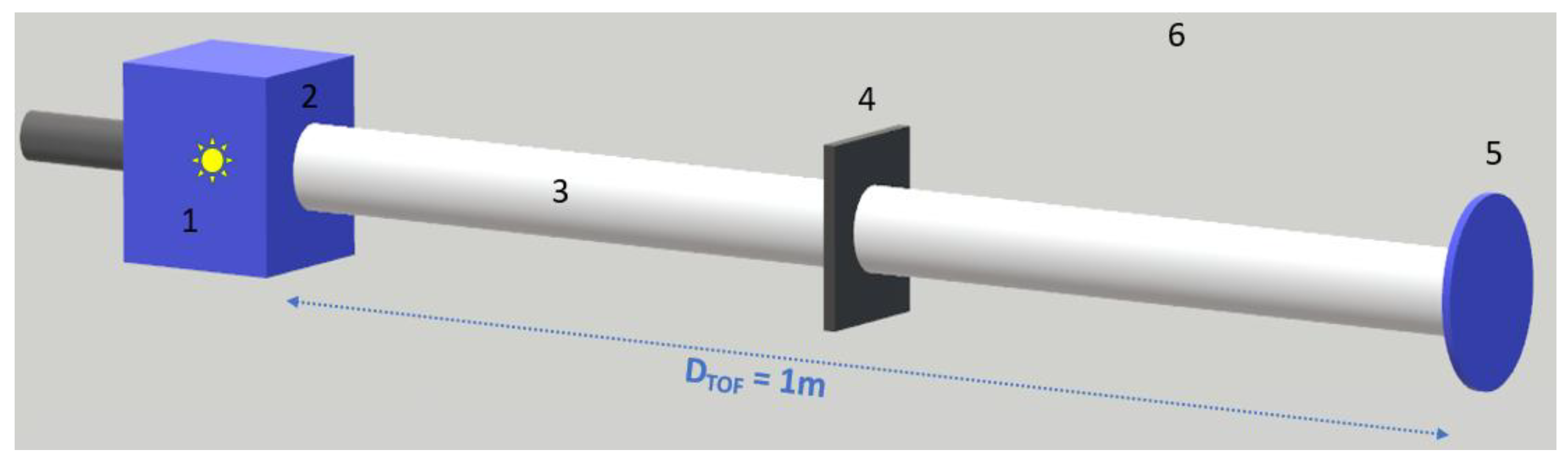
- Pulsed source: 14 MeV neutrons produced by a pulsed neutron generator (D–T), with a 0 µs duration, positioned at the center of the moderator.
- Moderator block: slowing down neutrons to reach the resonance energies of the target isotopes (<100 eV, epithermal range). The moderator is modeled as a 20 × 20 × 20 cm3 polyethylene block.
- Collimation tube: serving as a perfect neutron guide by removing all off-axis neutrons.
- Sample: where thermalized neutrons interact with the sample nuclei, producing absorption signatures characteristic of each isotope. The sample is modeled as a metallic disc of 14 cm in diameter and variable thickness, ranging from 0.1 mm to 1 cm depending on the studied case.
- Detector: where neutron energy is detected using the time-of-flight method (). In the simulations, the detector is modeled as an ideal circular disk with the same diameter as the sample, ensuring perfect collection of all transmitted neutrons without any efficiency loss.
- Air (shown in grey on Figure 1): the surrounding area where no neutrons are simulated.
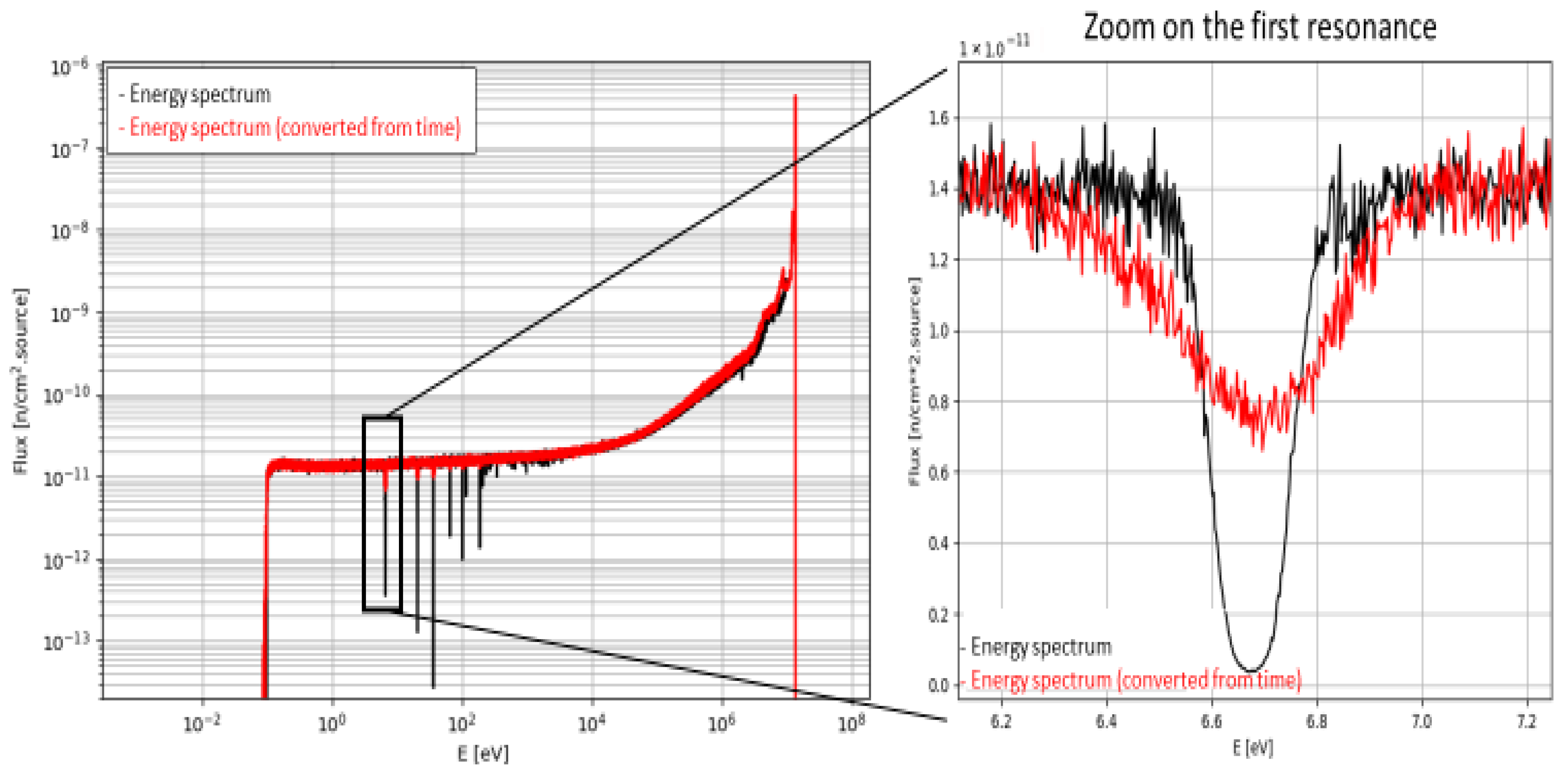
- Resonances appear broadened and shallower, making auto-absorption corrections impossible;
- Resonances from other isotopes may overlap significantly.
- The source pulse width, which introduces temporal spreading (not simulated here);
- The moderating process, which scatters the neutron arrival times for a given energy.
- The sample is perpendicular to a parallel incoming neutron beam.
- All detected neutrons have passed through the sample.
- Neutrons scattered by the sample are not registered by the neutron detector.
3. Methodology
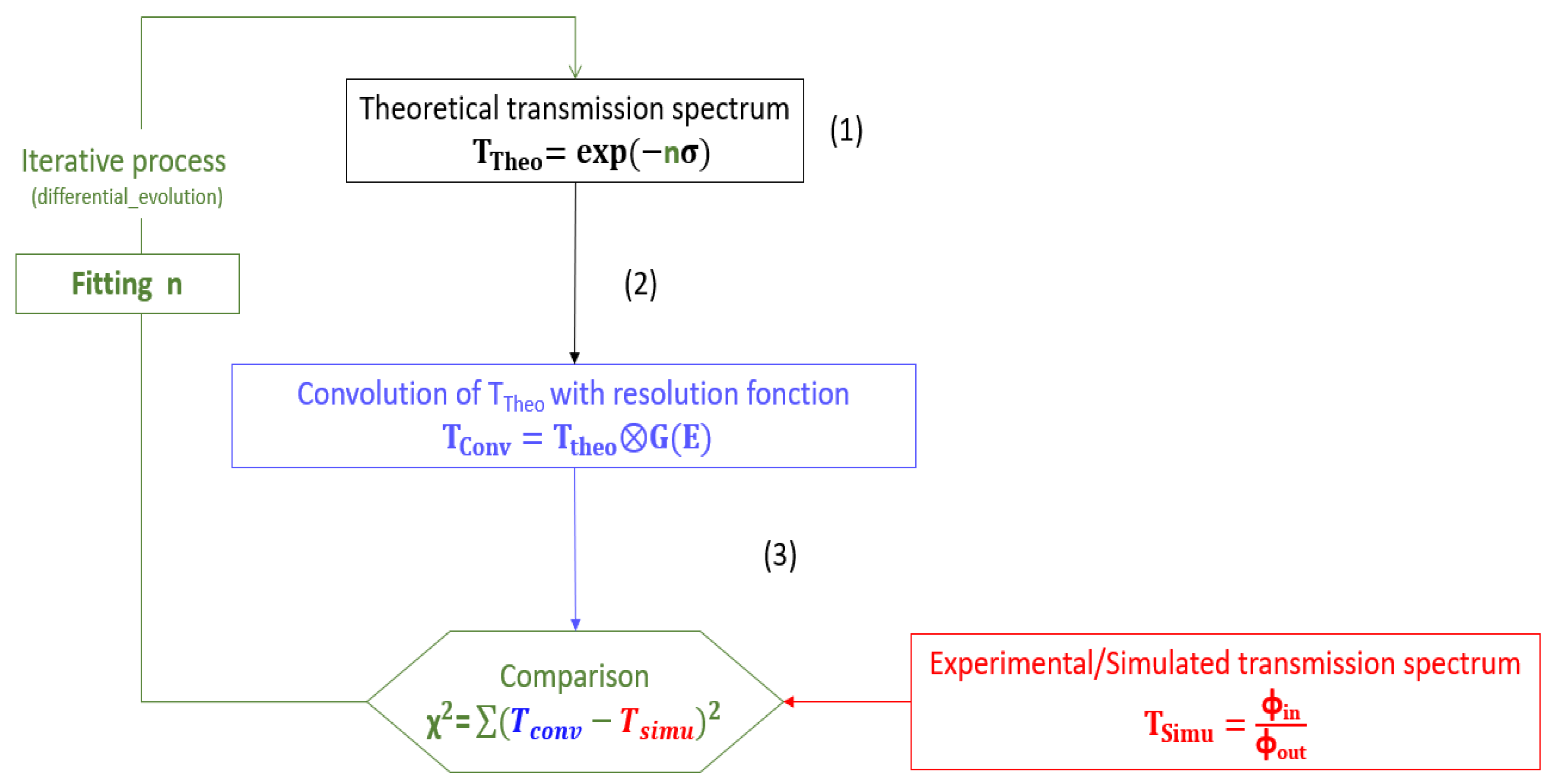
- Generation of theoretical transmission spectra: The theoretical transmission spectra were calculated using microscopic neutron total cross sections from the ENDF/B-VIII.0 library at 293.6 K, according to the Beer–Lambert law (Equation (1)), based on the assumed isotopic composition and areal densities of the sample. For the calculation, initial bounds are set for each material quantity (n), which are then iteratively refined using the differential evolution algorithm (implemented in SciPy library [21]) to fit the theoretical spectrum to the simulated (or experimental data).
- Spectral degradation using a resolution function: the theoretical transmission spectrum is convoluted with a resolution function representing the characteristics of the NRTA system. This function accounts in particular for the moderation process and the flight path length. The goal is to obtain a theoretical spectrum comparable to the simulated or experimental spectrum.
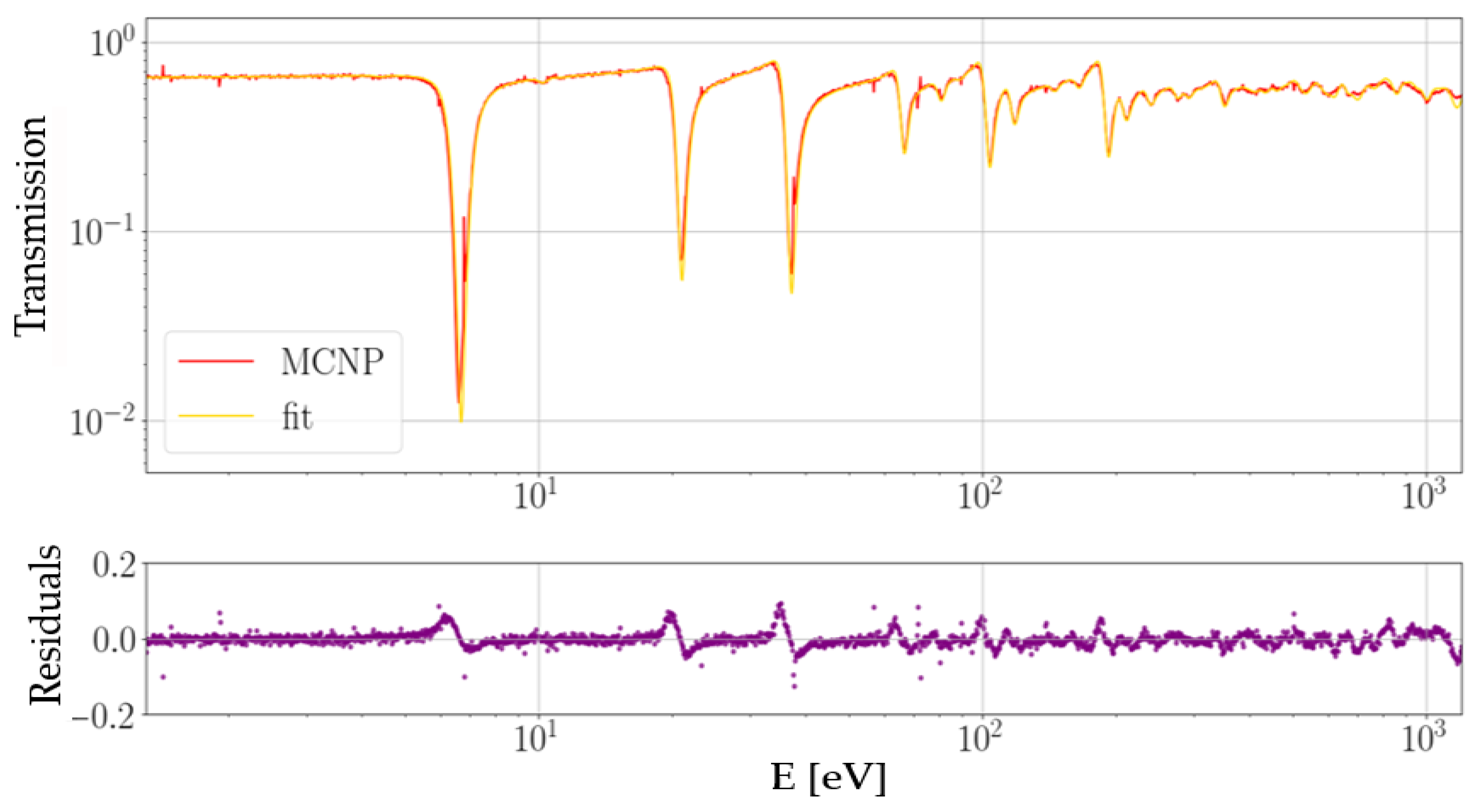
- Comparison of theory vs. data (from Monte Carlo simulation or experiment): the data spectrum is compared in each energy bin to the theoretical spectrum. A global minimum is determined using the differential evolution algorithm, which iteratively adjusts the material quantities (n) to achieve the best agreement between theory and simulation, as illustrated in Figure 3.
4. Results
5. Conclusions
Author Contributions
Funding
Data Availability Statement
Conflicts of Interest
References
- OCDE; Agence Pour L’Énergie Nucléaire. Cycles du Combustible Nucléaire Avancés et Gestion des Déchets Radioactifs; Développement de L’Énergie Nucléaire; OECD: Paris, France, 2006; ISBN 978-92-64-02487-8. [Google Scholar]
- Orano Recyclage. Rapport d’Information du Site Orano la Hague; Orano Recyclage: Paris, France, 2023. [Google Scholar]
- Benjamin, M. Focus: France seeks strategy as nuclear waste site risks saturation point. Reuters. 3 February 2023. Available online: https://www.reuters.com/business/environment/france-seeks-strategy-nuclear-waste-site-risks-saturation-point-2023-02-03 (accessed on 30 October 2025).
- Krachler, M.; Alvarez-Sarandes, R.; Van Winckel, S. Challenges in the quality assurance of elemental and isotopic analyses in the nuclear domain benefitting from high resolution ICP-OES and sector field ICP-MS. J. Radioanal. Nucl. Chem. 2015, 304, 1201–1209. [Google Scholar] [CrossRef] [PubMed][Green Version]
- Benefits and Drawbacks of Non-Destructive Assay (NDA) for Nuclear Safeguards—An Overview—European Commission. Available online: https://esarda.jrc.ec.europa.eu/publications/benefits-and-drawbacks-non-destructive-assay-nda-nuclear-safeguards-overview_en (accessed on 30 October 2025).[Green Version]
- Paradela, C.; Alaerts, G.; Becker, B.; Heyse, J.; Kopecky, S.; Moens, A.; Mondelaers, W.; Schillebeeckx, P.; Wynants, R.; Harada, H.; et al. Characterization of nuclear material by Neutron Resonance Transmission Analysis. Nuovo C. C Geophys. Space Phys. C 2016, 38, 176. [Google Scholar] [CrossRef]
- Behrens, J.W.; Johnson, R.G.; Schrack, R.A. Neutron Resonance Transmission Analysis of Reactor Fuel Samples. Nucl. Technol. 1984, 67, 162–168. [Google Scholar] [CrossRef]
- Schillebeeckx, P.; Becker, B.; Danon, Y.; Guber, K.; Harada, H.; Heyse, J.; Junghans, A.R.; Kopecky, S.; Massimi, C.; Moxon, M.C.; et al. Determination of Resonance Parameters and their Covariances from Neutron Induced Reaction Cross Section Data. Nucl. Data Sheets 2012, 113, 3054–3100. [Google Scholar] [CrossRef]
- Schillebeeckx, P.; Borella, A.; Emiliani, F.; Gorini, G.; Kockelmann, W.; Kopecky, S.; Lampoudis, C.; Moxon, M.; Cippo, E.P.; Postma, H.; et al. Neutron resonance spectroscopy for the characterization of materials and objects. J. Instrum. 2012, 7, C03009. [Google Scholar] [CrossRef]
- Moxon, M.C.; Ware, T.C.; Dean, C.J. REFIT-2009: Multilevel Resonance Parameter Least Squares Fit of N Transmission, Capture, Fission & Self Indication Data; NEA-0914; OECD Nuclear Energy Agency: Paris, France, 2009. [Google Scholar]
- Larson, N.M. Updated User’s Guide for Sammy: Multilevel R-Matrix Fits to Neutron Data Using Bayes’ Equations; Oak Ridge National Laboratory (ORNL): Oak Ridge, TN, USA, 2008. [Google Scholar]
- Archier, P.; Jean, C.D.S.; Kopecky, S.; Litaize, O.; Noguère, G.; Schillebeeckx, P.; Volev, K. Recent Developments in the CONRAD Code regarding Experimental Corrections. EPJ Web Conf. 2013, 42, 02004. [Google Scholar] [CrossRef]
- Klein, E.A. Neutron Resonance Transmission Analysis of Nuclear Material Using a Portable D-T Neutron Generator. Ph.D. Thesis, Massachusetts Institute of Technology, Cambridge, MA, USA, 2023. [Google Scholar]
- McDonald, B.S.; Danagoulian, A.; Gilbert, A.J.; Klein, E.A.; Kulisek, J.A.; Moore, M.E.; Rahon, J.M.; Zalavadia, M.A. Neutron resonance transmission analysis prototype system for thorium fuel cycle safeguards. Nucl. Instrum. Methods Phys. Res. Sect. Accel. Spectrometers Detect. Assoc. Equip. 2024, 1062, 169148. [Google Scholar] [CrossRef]
- Tsuchiya, H.; Kitatani, F.; Maeda, M.; Toh, Y.; Kureta, M. Development of Neutron Resonance Transmission Analysis as a Non-Destructive Assay Technique for Nuclear Nonproliferation. Plasma Fusion Res. 2018, 13, 2406004. Available online: https://www.jstage.jst.go.jp/article/pfr/13/0/13_2406004/_article/-char/en (accessed on 30 October 2025). [CrossRef]
- Guembou Shouop, C.J.; Tshuchiya, H. Monte Carlo and experimental assessment of the optimal geometry of the source and collimator for a table-top NRTA system for small nuclear material measurement. Nucl. Instrum. Methods Phys. Res. Sect. Accel. Spectrometers Detect. Assoc. Equip. 2025, 1072, 170189. [Google Scholar] [CrossRef]
- E-Journal of Advanced Maintenance (EJAM). Available online: https://www.jsm.or.jp/ejam/Vol.11No.1/AA/AA156/AA156.html (accessed on 30 October 2025).
- Toh, Y.; Ohzu, A.; Tsuchiya, H.; Furutaka, K.; Kitatani, F.; Komeda, M.; Maeda, M.; Koizumi, M. Development of active neutron nondestructive assay system. EPJ Web Conf. 2025, 329, 06001. [Google Scholar] [CrossRef]
- Pelowitz, D.B.; Goorley, J.T.; James, M.R. MCNP6 User’s Manual; Technical Report LA-CP-13-00634; Los Alamos National Laboratory: Los Alamos, NM, USA, 2013. [Google Scholar]
- Paradela, C.; Wynants, R.; Kopecky, S.; Salamon, L.; Kureta, M.; Alaerts, G.; Harada, H.; Tsuchiya, H.; Koizumi, M. Neutron Resonance Analysis: System Requirements; Publications Office of the European Union: Luxembourg, 2016; ISBN 978-92-79-63918-0. [Google Scholar]
- Storn, R.; Price, K. Differential Evolution—A Simple and Efficient Heuristic for global Optimization over Continuous Spaces. J. Glob. Optim. 1997, 11, 341–359. [Google Scholar] [CrossRef]



| Samples | Thickness | Areal Number Density (at/b) | Ratio | ||
|---|---|---|---|---|---|
| Simulated (S) | Analyses (M) | (S/M) | |||
| 238U | 0.1 mm | 4.830 × 10⁻⁴ | 4.637 × 10⁻⁴ | 1.042 | |
| 238U | 1 cm | 4.830 × 10⁻² | 4.492 × 10⁻² | 1.075 | |
| 238U 238Pu | 50% | 0.1 mm | 2.415 × 10⁻⁴ | 2.222 × 10⁻⁴ | 1.087 |
| 50% | 2.222 × 10⁻⁴ | 1.087 | |||
| 238U 235U | 50% | 1 mm | 2.415 × 10⁻³ | 2.502 × 10⁻³ | 0.965 |
| 50% | 2.391 × 10⁻³ | 1.01 | |||
Disclaimer/Publisher’s Note: The statements, opinions and data contained in all publications are solely those of the individual author(s) and contributor(s) and not of MDPI and/or the editor(s). MDPI and/or the editor(s) disclaim responsibility for any injury to people or property resulting from any ideas, methods, instructions or products referred to in the content. |
© 2025 by the authors. Licensee MDPI, Basel, Switzerland. This article is an open access article distributed under the terms and conditions of the Creative Commons Attribution (CC BY) license (https://creativecommons.org/licenses/by/4.0/).
Share and Cite
Azzoune, M.; Mathieu, L.; Trinh, N.D.; Aïche, M.; Villatte, L.; Piquemal, F.; Tondut, L.; Pelletier, S. Conceptual Study on the Implementation of NRTA for Industrial Applications. Instruments 2025, 9, 30. https://doi.org/10.3390/instruments9040030
Azzoune M, Mathieu L, Trinh ND, Aïche M, Villatte L, Piquemal F, Tondut L, Pelletier S. Conceptual Study on the Implementation of NRTA for Industrial Applications. Instruments. 2025; 9(4):30. https://doi.org/10.3390/instruments9040030
Chicago/Turabian StyleAzzoune, Melissa, Ludovic Mathieu, Ngoc Duy Trinh, Mourad Aïche, Laurence Villatte, Fabrice Piquemal, Lionel Tondut, and Sylvain Pelletier. 2025. "Conceptual Study on the Implementation of NRTA for Industrial Applications" Instruments 9, no. 4: 30. https://doi.org/10.3390/instruments9040030
APA StyleAzzoune, M., Mathieu, L., Trinh, N. D., Aïche, M., Villatte, L., Piquemal, F., Tondut, L., & Pelletier, S. (2025). Conceptual Study on the Implementation of NRTA for Industrial Applications. Instruments, 9(4), 30. https://doi.org/10.3390/instruments9040030