
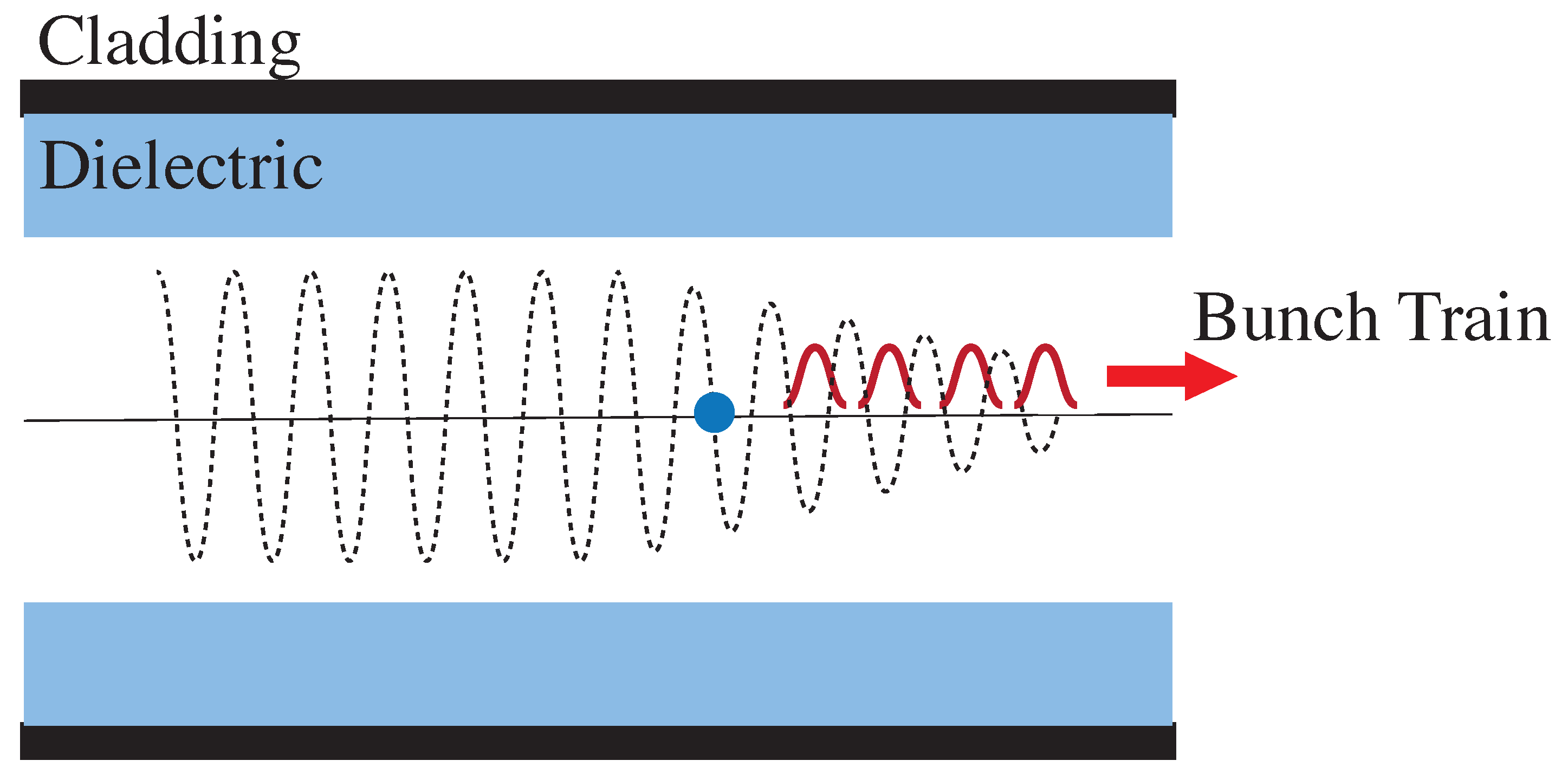
Drive Bunch Train for the Dielectric Trojan Horse Experiment at the Argonne Wakefield Accelerator

 ,
, 
Abstract
1. Introduction
2. Materials and Methods
3. Results
4. Discussion
5. Conclusions
Author Contributions
Funding
Data Availability Statement
Acknowledgments
Conflicts of Interest
References
- Hidding, B.; Pretzler, G.; Rosenzweig, J.; Königstein, T.; Schiller, D.; Bruhwiler, D. Ultracold Electron Bunch Generation via Plasma Photocathode Emission and Acceleration in a Beam-Driven Plasma Blowout. Phys. Rev. Lett. 2012, 108, 035001. [Google Scholar] [CrossRef] [Scilit]
- Deng, A.; Karger, O.S.; Heinemann, T.; Knetsch, A.; Scherkl, P.; Manahan, G.G.; Beaton, A.; Ullmann, D.; Wittig, G.; Habib, A.F.; et al. Generation and acceleration of electron bunches from a plasma photocathode. Nat. Phys. 2019, 15, 1156. [Google Scholar] [CrossRef] [Scilit]
- Hunt-Stone, K.; Ariniello, R.; Doss, C.; Lee, V.; Litos, M. Electro-optic sampling beam position monitor for relativistic electron beams. Nucl. Instrum. Methods Phys. Res. Sect. A Accel. Spectrom. Detect. Assoc. Equip. 2021, 999, 165210. [Google Scholar] [CrossRef] [Scilit]
- Scherkl, P.; Knetsch, A.; Heinemann, T.; Sutherland, A.; Habib, A.F.; Karger, O.S.; Ullmann, D.; Beaton, A.; Manahan, G.G.; Xi, Y.; et al. Plasma photonic spatiotemporal synchronization of relativistic electron and laser beams. Phys. Rev. Accel. Beams 2022, 25, 052803. [Google Scholar] [CrossRef] [Scilit]
- Hidding, B.; Assmann, R.; Bussmann, M.; Campbell, D.; Chang, Y.Y.; Corde, S.; Cabadağ, J.C.; Debus, A.; Döpp, A.; Gilljohann, M.; et al. Progress in Hybrid Plasma Wakefield Acceleration. Photonics 2023, 10, 99. [Google Scholar] [CrossRef] [Scilit]
- Marchetti, B.; Grudiev, A.; Craievich, P.; Assmann, R.; Braun, H.H.; Catalan Lasheras, N.; Christie, F.; D’Arcy, R.; Fortunati, R.; Ganter, R.; et al. Experimental demonstration of novel beam characterization using a polarizable X-band transverse deflection structure. Sci. Rep. 2021, 11, 3560. [Google Scholar] [CrossRef] [Scilit]
- Pacey, T.; Saveliev, Y.; Xia, G.; Smith, J. Simulation studies for dielectric wakefield programme at CLARA facility. Nucl. Instrum. Methods Phys. Res. Sect. A Accel. Spectrom. Detect. Assoc. Equip. 2018, 909, 261–265. [Google Scholar] [CrossRef] [Scilit]
- Nie, Y.; Assmann, R.; Dorda, U.; Marchetti, B.; Weikum, M.; Zhu, J.; Hüning, M. Potential applications of the dielectric wakefield accelerators in the SINBAD facility at DESY. Nucl. Instrum. Methods Phys. Res. Sect. A Accel. Spectrom. Detect. Assoc. Equip. 2016, 829, 183–186. [Google Scholar] [CrossRef] [Scilit]
- O’Shea, B.D.; Andonian, G.; Barber, S.K.; Fitzmorris, K.L.; Hakimi, S.; Harrison, J.; Hoang, P.D.; Hogan, M.J.; Naranjo, B.; Williams, O.B.; et al. Observation of acceleration and deceleration in gigaelectron-volt-per-metre gradient dielectric wakefield accelerators. Nat. Commun. 2016, 7, 12763. [Google Scholar] [CrossRef] [Scilit]
- Andonian, G.; Williams, O.; Wei, X.; Niknejadi, P.; Hemsing, E.; Rosenzweig, J.B.; Muggli, P.; Babzien, M.; Fedurin, M.; Kusche, K.; et al. Resonant excitation of coherent Cerenkov radiation in dielectric lined waveguides. Appl. Phys. Lett. 2011, 98, 202901. [Google Scholar] [CrossRef] [Scilit]
- Tsakanov, V.M. On collinear wake field acceleration with high transformer ratio. Nucl. Instrum. Methods Phys. Res. Sect. A Accel. Spectrom. Detect. Assoc. Equip. 1999, 432, 202–213. [Google Scholar] [CrossRef] [Scilit]
- Andonian, G.; Campese, T.; Cook, M.; Lynn, W.; Majernik, N.; Rosenzeig, J.; Yu, V.; Doran, S.; Ha, G.; Power, J.; et al. Dielectric Wakefield Acceleration With A Laser Injected Witness Beam. In Proceedings of the 12th International Particle Accelerator Conference, Campinas, Brazil, 24–28 May 2021; Volume A15, p. 481. [Google Scholar]
- O’Shea, B.D.; Andonian, G.; Barber, S.K.; Clarke, C.I.; Hoang, P.D.; Hogan, M.J.; Naranjo, B.; Williams, O.B.; Yakimenko, V.; Rosenzweig, J.B. Conductivity Induced by High-Field Terahertz Waves in Dielectric Material. Phys. Rev. Lett. 2019, 123, 134801. [Google Scholar] [CrossRef] [Scilit]
- Adelmann, A.; Arbenz, P.; Ineichen, Y. A fast parallel Poisson solver on irregular domains applied to beam dynamics simulations. J. Comput. Phys. 2010, 229, 4554–4566. [Google Scholar] [CrossRef] [Scilit]
- Catani, L.; Chiadroni, E.; Cianchi, A.; Tazzari, S.; Boscolo, M.; Castellano, M.; Di Pirro, G.; Ferrario, M.; Fusco, V.; Filippetto, D.; et al. Design and characterization of a movable emittance meter for low-energy electron beams. Rev. Sci. Instrum. 2006, 77, 093301. [Google Scholar] [CrossRef] [Scilit]
- Li, C.; Gai, W.; Jing, C.; Power, J.G.; Tang, C.X.; Zholents, A. High gradient limits due to single bunch beam breakup in a collinear dielectric wakefield accelerator. Phys. Rev. Spec. Top. Accel. Beams 2014, 17, 091302. [Google Scholar] [CrossRef] [Scilit]
- Manahan, G.G.; Deng, A.; Karger, O.; Xi, Y.; Knetsch, A.; Litos, M.; Wittig, G.; Heinemann, T.; Smith, J.; Sheng, Z.M.; et al. Hot spots and dark current in advanced plasma wakefield accelerators. Phys. Rev. Accel. Beams 2016, 19, 011303. [Google Scholar] [CrossRef] [Scilit]
- Frame, E.; Marzouk, A.A.; Chubenko, O.; Doran, S.; Piot, P.; Power, J.; Wisniewski, E. Opportunities for Bright-Beam Generation at the Argonne Wakefield Accelerator (AWA). Instruments 2023, 7, 48. [Google Scholar] [CrossRef] [Scilit]
- Li, R.K.; Musumeci, P. Single-Shot MeV Transmission Electron Microscopy with Picosecond Temporal Resolution. Phys. Rev. Appl. 2014, 2, 024003. [Google Scholar] [CrossRef] [Scilit]



| Parameter | Value |
|---|---|
| Electron Bunch | |
| Beam Energy () | 59.5 MeV |
| Bunch Charge (Q) | 4 nC |
| Bunch Duration () | 3 ps |
| Normalized Emittance () | 39 mm mrad (single bunch) |
| Spot Size at DWA () | 40 m |
| Number of Bunches (N) | 4 |
| Bunch Spacing () | 3 mm |
| Projected Emittance | 67 mm mrad (all bunches) |
| Dielectric Waveguide | |
| Inner Diameter (a) | 500 m |
| Outer Diameter (b) | 1500 m |
| Relative Permittivity () | 3.85 |
| Length (L) | 2 cm |
Disclaimer/Publisher’s Note: The statements, opinions and data contained in all publications are solely those of the individual author(s) and contributor(s) and not of MDPI and/or the editor(s). MDPI and/or the editor(s) disclaim responsibility for any injury to people or property resulting from any ideas, methods, instructions or products referred to in the content. |
© 2024 by the authors. Licensee MDPI, Basel, Switzerland. This article is an open access article distributed under the terms and conditions of the Creative Commons Attribution (CC BY) license (https://creativecommons.org/licenses/by/4.0/).
Share and Cite
Andonian, G.; Burger, N.; Cook, N.; Doran, S.; Hodgetts, T.; Kim, S.; Ha, G.; Liu, W.; Lynn, W.; Majernik, N.; et al. Drive Bunch Train for the Dielectric Trojan Horse Experiment at the Argonne Wakefield Accelerator. Instruments 2024, 8, 28. https://doi.org/10.3390/instruments8020028
Andonian G, Burger N, Cook N, Doran S, Hodgetts T, Kim S, Ha G, Liu W, Lynn W, Majernik N, et al. Drive Bunch Train for the Dielectric Trojan Horse Experiment at the Argonne Wakefield Accelerator. Instruments. 2024; 8(2):28. https://doi.org/10.3390/instruments8020028
Chicago/Turabian StyleAndonian, Gerard, Nathan Burger, Nathan Cook, Scott Doran, Tara Hodgetts, Seongyeol Kim, Gwanghui Ha, Wanming Liu, Walter Lynn, Nathan Majernik, and et al. 2024. "Drive Bunch Train for the Dielectric Trojan Horse Experiment at the Argonne Wakefield Accelerator" Instruments 8, no. 2: 28. https://doi.org/10.3390/instruments8020028
APA StyleAndonian, G., Burger, N., Cook, N., Doran, S., Hodgetts, T., Kim, S., Ha, G., Liu, W., Lynn, W., Majernik, N., Power, J., Pronikov, A., Rosenzweig, J., & Wisniewski, E. (2024). Drive Bunch Train for the Dielectric Trojan Horse Experiment at the Argonne Wakefield Accelerator. Instruments, 8(2), 28. https://doi.org/10.3390/instruments8020028