Abstract
The Trans-Iron Galactic Element Recorder (TIGER) family of instruments is optimized to measure the relative abundances of the rare, ultra-heavy galactic cosmic rays (UHGCRs) with atomic number (Z) Z ≥ 30. Observing the UHGCRs places a premium on exposure that the balloon-borne SuperTIGER achieved with a large area detector (5.6 m2) and two Antarctic flights totaling 87 days, while the smaller (∼1 m2) TIGER for the International Space Station (TIGERISS) aims to achieve this with a longer observation time from one to several years. SuperTIGER uses a combination of scintillator and Cherenkov detectors to determine charge and energy. TIGERISS will use silicon strip detectors (SSDs) instead of scintillators, with improved charge resolution, signal linearity, and dynamic range. Extended single-element resolution UHGCR measurements through 82Pb will cover elements produced in s-process and r-process neutron capture nucleosynthesis, adding to the multi-messenger effort to determine the relative contributions of supernovae (SNe) and Neutron Star Merger (NSM) events to the r-process nucleosynthesis product content of the galaxy.
1. Introduction
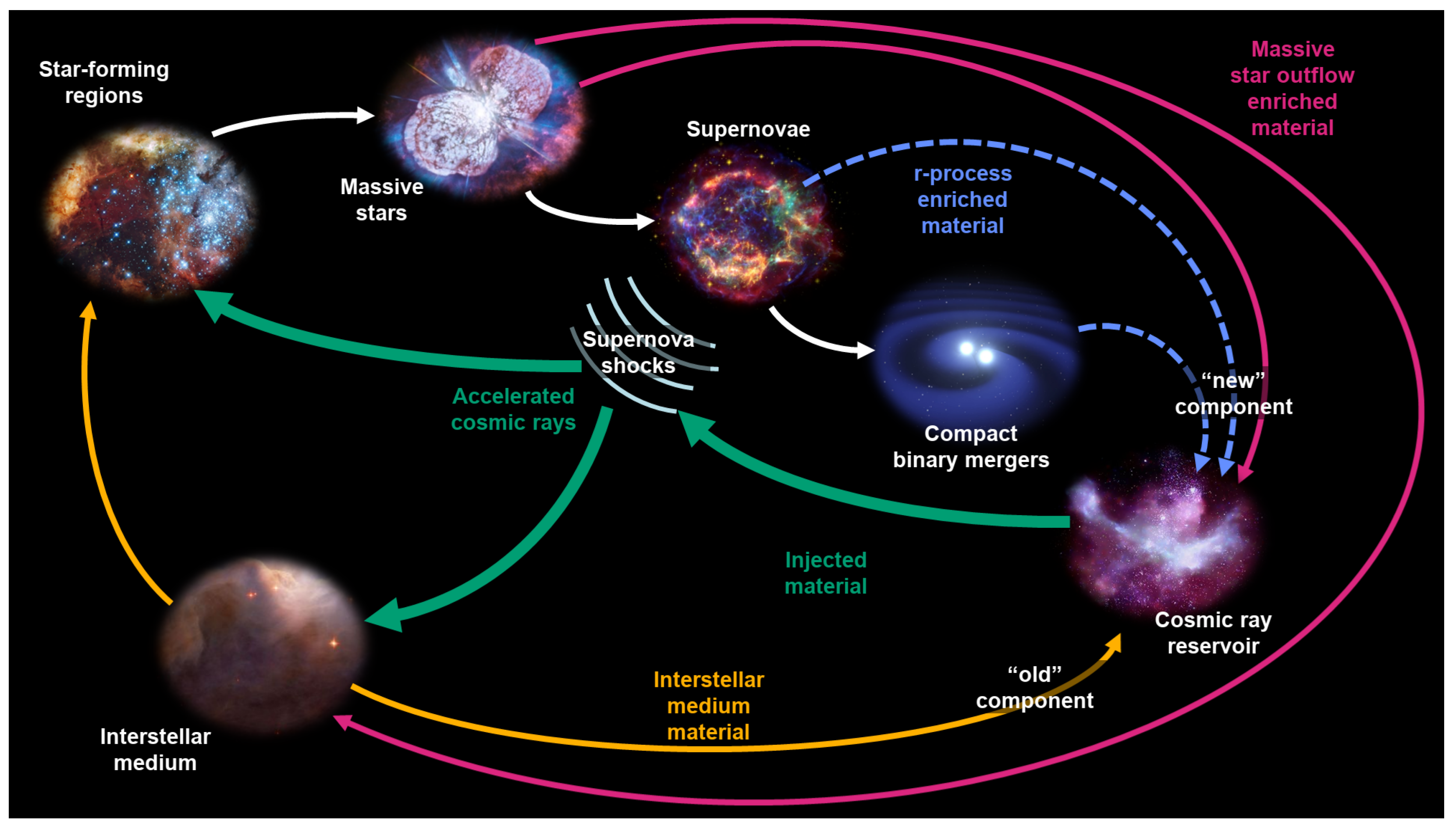
Ultra-heavy galactic cosmic rays (UHGCRs) are the very rare nuclei above 28Ni produced in neutron capture nucleosynthesis, making them more than three orders of magnitude less abundant than those produced in stellar fusion. Measuring the UHGCRs requires the greatest possible detector exposure, which is proportional to detector area multiplied by observation time. The Super Trans-Iron Galactic Element Recorder (SuperTIGER) stratospheric balloon-borne instrument has made the best single-element resolution UHGCR measurements to date through 56Ba [1,2,3,4] with a large 5.6 m2 detector on a record-breaking 55-day flight. The Trans-Iron Galactic Element Recorder for the International Space Station (TIGERISS) will improve upon these measurements and extend them through 82Pb [5,6], achieving comparable exposure in one year of observations following its planned 2026 launch with a ∼1 m2 detector area. These measurements of the UHGCRs can address questions about the grand cycle of matter in the galaxy, depicted in Figure 1, in which material from galactic cosmic ray (GCR) sources (GCRSs) is injected into the accelerator. In a picture that has been pieced together from cosmic ray elemental and isotopic composition and energy spectra measurements, the GCRs then help energize galactic magnetic fields through their electric currents and feed back into the process of new star formation, leading to more GCRs. UHGCR measurements can provide the relative abundances of r- and s-process neutron capture elements in the GCRSs as well provide clues into how this material is accelerated to cosmic ray energies.
Figure 1.
The grand cycle of galactic matter: massive star-forming regions give rise to SNe and NSMs, producing heavy nuclei that, along with ISM, are spread out into the galaxy by stellar winds and SN shocks.
GCR measurements, including UHGCR abundances through 40Zr by TIGER and SuperTIGER, have implied a GCRS drawn primarily from older interstellar media (ISM) with fresh nucleosynthetic products of younger stars mixed in and acceleration by shock waves from stellar deaths. Supernovae (SNe) were long thought to be responsible for cosmic ray acceleration, and the r-process neutron capture nucleosynthesis of the heavier elements in the cycle is shown in Figure 1; however, recent evidence suggests that binary neutron star mergers (BNSMs) play a major role in r-process synthesis and may contribute to cosmic ray acceleration. Multi-messenger follow-up observations of a kilonovae identified in gravitational waves [7] provided broader electromagnetic spectral observations [8] that gave strong evidence for BNSM r-process nucleosynthesis of the heaviest elements. Extended SuperTIGER measurements providing the first single-element resolution UHGCR measurements through 56Ba show that something is missing from the GCRS model, supported by measurements through 40Zr. Superior UHGCR measurements by TIGERISS through 82Pb with unprecedented resolution will address important scientific questions about GCRSs and the cosmic ray accelerator, which are discussed in more detail in [9].
No single instrument has been capable of measuring the GCRs from 1H to 92U, and their abundances must be pieced together using measurements made by multiple detectors. It is difficult to simultaneously measure the high flux of 1H and 2He that comprise ∼99% of the GCRs with an instrument having the dynamic range and exposure needed to resolve the UHGCRs. Instruments like the CAlorimetric Electron Telescope (CALET) [10] and the Dark Matter Particle Explorer (DAMPE) [11] are capable of measuring abundances from 1H into the UHGCRs, but since they are not optimized for UHGCR measurements, they do not have the best resolution for them. Instruments designed to measure the GCRs above 2He can better optimize resolution and/or dynamic range for UHGCR measurements, including SuperTIGER (16 ≤ Z ≤ 56) [3], TIGERISS (5 ≤ Z ≤ 82), and the Advanced Composition Explorer Cosmic Ray Isotope Spectrometer (ACE-CRIS) (6 ≤ Z ≤ 38) [12,13], which has also made the only UHGCR isotope measurements through 38Sr. Measurements of the UHGCR abundances through 83Bi have been made by the third High-Energy Astronomy Observatory (HEAO-3) Heavy Nuclei Experiment (HNE) [14] and by the Ariel 6 [15] satellite missions that could not resolve individual elements and measured charge groups. Passive nuclear track detectors that have measured UHGCR abundances for the heaviest elements (Z ≥ 70) with better resolution include the TREK instrument flown on the Soviet Mir Space Station [16,17] and the Ultra-Heavy Cosmic Ray Experiment (UHCRE) at the Long Duration Exposure Facility (LDEF) [18].
2. SuperTIGER
SuperTIGER was designed to be the largest UHGCR detector that can be flown on a 39.9 million cubic foot (MCM) zero-pressure stratospheric balloon within the allowed launch envelope. The instrument was developed by a collaboration of scientists from Washington University in St. Louis (WUSTL), the National Aeronautics and Space Administration (NASA) Goddard Space Flight Center (GSFC), California Institute of Technology (Caltech), the NASA Jet Propulsion Laboratory (JPL), and the University of Minnesota. The University of Maryland Baltimore (UMBC) and Northern Kentucky University (NKU) have joined the effort under a later award, while the University of Minnesota has dropped out with the passing of Professor Cecil J. Waddington. SuperTIGER has had two successful Antarctic flights, the first for 55 days from 8 December 2012 to 1 February 2013 [19,20] and SuperTIGER-2.3 for 32 days from 15 December 2019 to 17 January 2020 [21], and a brief (∼7 h), unsuccessful SuperTIGER-2.2 flight on 20 December 2018 [22]. It is the successor to the TIGER Long-Duration Balloon (LDB) payload that flew twice from Antarctica, first for 32 days from 21 December 2001 to 21 January 2002 [23,24] and again for 18 days from 17 December 2003 to 4 January 2004 [25,26]. TIGER LDB was in turn based on the original TIGER instrument that flew from Lynn Lake, Manitoba, Canada for 2.75 h on 26 August 1995 [27] and Fort Sumner, NM for 23.25 h on 25 September 1997 [28], demonstrating the instrument concept [29]. SuperTIGER uses the same two fundamental charge identification techniques demonstrated in TIGER: vs. Cherenkov and acrylic Cherenkov vs. silica aerogel Cherenkov.
2.1. Instrument Design
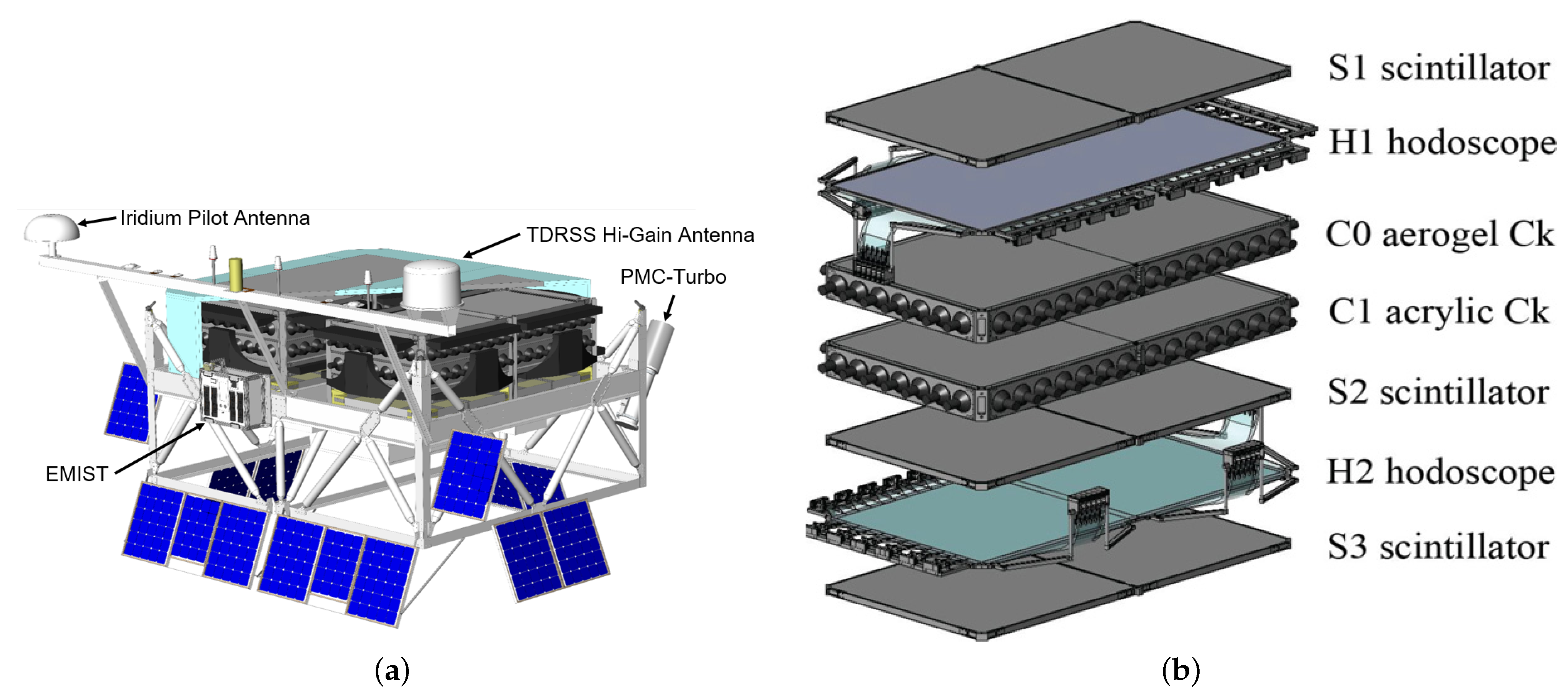
Figure 2a shows a technical model of the full SuperTIGER-2.1 (2017–2018)/SuperTIGER-2.2 (2018–2019) payload comprising two instrument modules. SuperTIGER-2.3 had a 180-cell solar panel array instead of the pictured 160-cell array to support the four piggyback instruments it carried: the Advanced Particle-astrophysics Telescope (APT) prototype APTlite [30,31] and Balloon Air Sampler (BAS) [32] in addition to the Exposing Microorganisms in the Stratosphere (E-MIST) [33] and Polar Mesospheric Cloud Turbulence (PMC-Turbo) [34] pictured. An expanded view of an instrument module is shown in Figure 2b, with each module being a stack of seven detectors. Three large-area compact wavelength-shifter bar readout scintillator detectors (S1, S2, and S3) measure light production dependent on ionization energy losses (Z2) and contribute to charge (Z) measurement, identification of interacting particles, and the instrument trigger. Top (H1) and bottom (H2) scintillating fiber hodoscopes provide trajectory determination for path length and areal response corrections. At the middle of the stack are two Cherenkov detectors that measure light production as a function of Z and velocity (). Above is a silica aerogel detector (C0), with three quarters of the radiators having an index of refraction (n) n = 1.043 (KE ≳ 2.5 GeV/amu) and one quarter n = 1.025 (KE ≳ 3.3 GeV/amu); below is an acrylic detector (C1) with n = 1.49 (KE ≳ 0.3 GeV/amu). The combined effective geometry factor of the SuperTIGER modules after accounting for interactions is 2.9 m2sr, which is 7.2 times that of the preceding TIGER LDB instrument [35].
Figure 2.
(a) Technical model of SuperTIGER-2.1/SuperTIGER-2.2. (b) Expanded view of a SuperTIGER module.
2.2. UHGCR Science
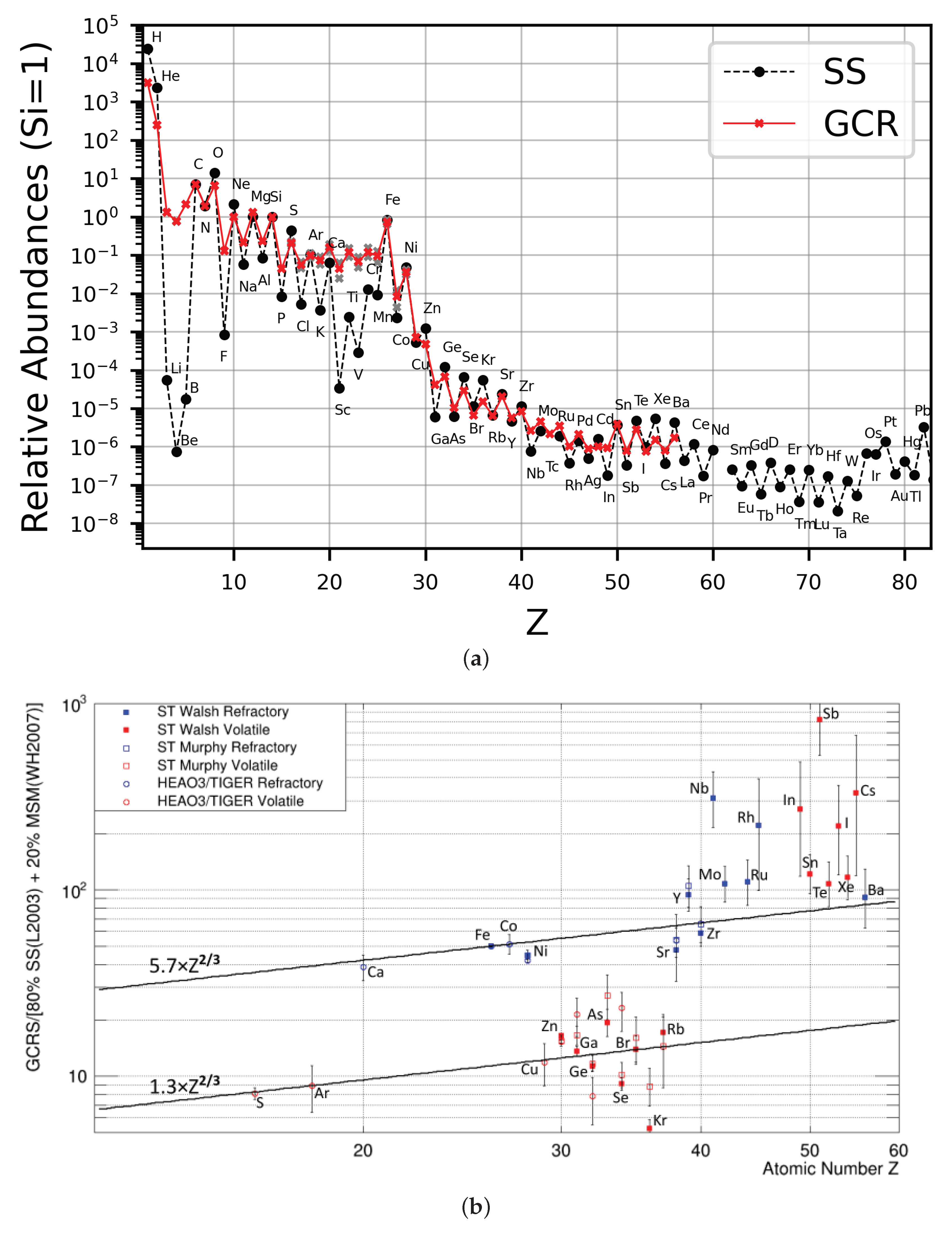
Figure 3a shows single-element resolution GCR abundance measurements at ∼2 GeV/amu through 56Ba [1,36,37,38] compared with Solar System (SS) abundances [39] through 82Pb, both normalized to 14Si = 1. The differences between GCR and SS abundances for the more abundant elements below 26Fe are understood to arise largely from spallation in GCR propagation from the source, a process that increases less abundant primary element abundances through erosion of more abundant ones. The GCR composition, and particularly that of the UHGCR elements not produced in stellar fusion, provides clues about the GCRS reservoirs and the acceleration mechanism.
Figure 3.
(a) SS [39] (dashed black line) and GCR at ∼2 GeV/amu (solid red line) relative abundances normalized to 14Si. GCR data sourced for 1 ≤ Z ≤ 2 from [36], Z = 3 from [37], 4 ≤ Z ≤ 28 from [38], and 16 ≤ Z ≤ 56 from [1]. Gray dots depict overlapping measurements from [1,38]. (b) GCR measurements corrected for galactic propagation back to the source relative to a GCRS model of 80% SS [39] and 20% MSM [40] versus atomic number. Refractory elements (blue) and volatile elements (red). HEAO-3-C2 (Z ≤ 28) [38] and SuperTIGER (Z ≥ 26) [2,3,4,20] through 56Ba showing that the existing model is insufficient for elements above 40Zn.
TIGER made the first UHGCR measurements with single-element resolution through 40Zr [25,26], which supported a model of GCR origins with a major component from OB associations. In this model, the GCRS is composed of ∼80% ISM represented by SS material [39] and ∼20% massive star material (MSM) from OB associations, including stellar winds and SN ejecta [40]. Figure 3b shows the ratio of the GCR measurements corrected for galactic propagation to the GCRS model abundances as a function of Z, with refractory elements more likely to condense onto dust grains in blue and more volatile ones in red. GCR measurements through 40Zr fall around refractory and volatile lines, with the refractory elements being ∼4.4 times more abundant. The Z2/3 slope is proportional to the nuclear cross section, which supports an acceleration model with preferential injection of elements that sputter off of superthermal dust grains [41]. SuperTIGER measurements through 40Zr [19,20] with greater statistics and improved resolution agreed with the TIGER results, but further SuperTIGER analysis pushing the UHGCR measurement through 56Ba [1,2,3,4] shows that the model breaks down above 40Zr. This hints at a potential new GCRS component, and TIGERISS will make measurements through 82Pb with superior charge reconstruction and resolution to search for new source signatures.
2.3. Future Prospects
SuperTIGER is mostly still on the high plateau in East Antarctica ( S, E, 6629 feet), with only a high-priority item recovery on January 21, 2020 and a data recovery on November 6, 2021. Full recovery of the payload has been delayed by the global COVID-19 pandemic, and it is now almost entirely drifted over. Recovery was initially planned for the 2022–2023 Antarctic season before being deferred to the 2023–2024 season due to limited support resource availability. With the uncertain future disposition of the payload and current backlog of Antarctic flight requests, SuperTIGER has no plans for future flights. Fortunately for the franchise, extended UHGCR analysis from the first record-breaking 55-day SuperTIGER flight hinting at new science supported a successful proposal for its successor instrument.
3. TIGERISS
TIGERISS is a UHGCR detector selected in the second round of the NASA Astrophysics Pioneers Program being developed for launch to the International Space Station (ISS) in 2026. This experiment will carry forward the UHGCR science of TIGER [26] and SuperTIGER [35] and seek an explanation for GCRS model-breaking SuperTIGER results. The TIGERISS collaboration, like the instrument, has also evolved from SuperTIGER, building on the core of WUSTL and NASA GSFC and later on UMBC and NKU additions with Pennsylvania State University (PSU) and Howard University.
TIGERISS will, in one year, measure the UHGCR abundances through 56Ba with comparable statistics to SuperTIGER, while having the extended dynamic range for the first preliminary single-element charge-resolution measurements through 82Pb by an active detector. Extended operations would allow TIGERISS to make more significant UHGCR measurements that will cover a wider range of elements produced in s-process and r-process neutron capture nucleosynthesis, adding to the multi-messenger effort to determine the relative contributions of SNe and Neutron Star Merger (NSM) events to r-process nucleosynthesis.
3.1. Instrument Concept
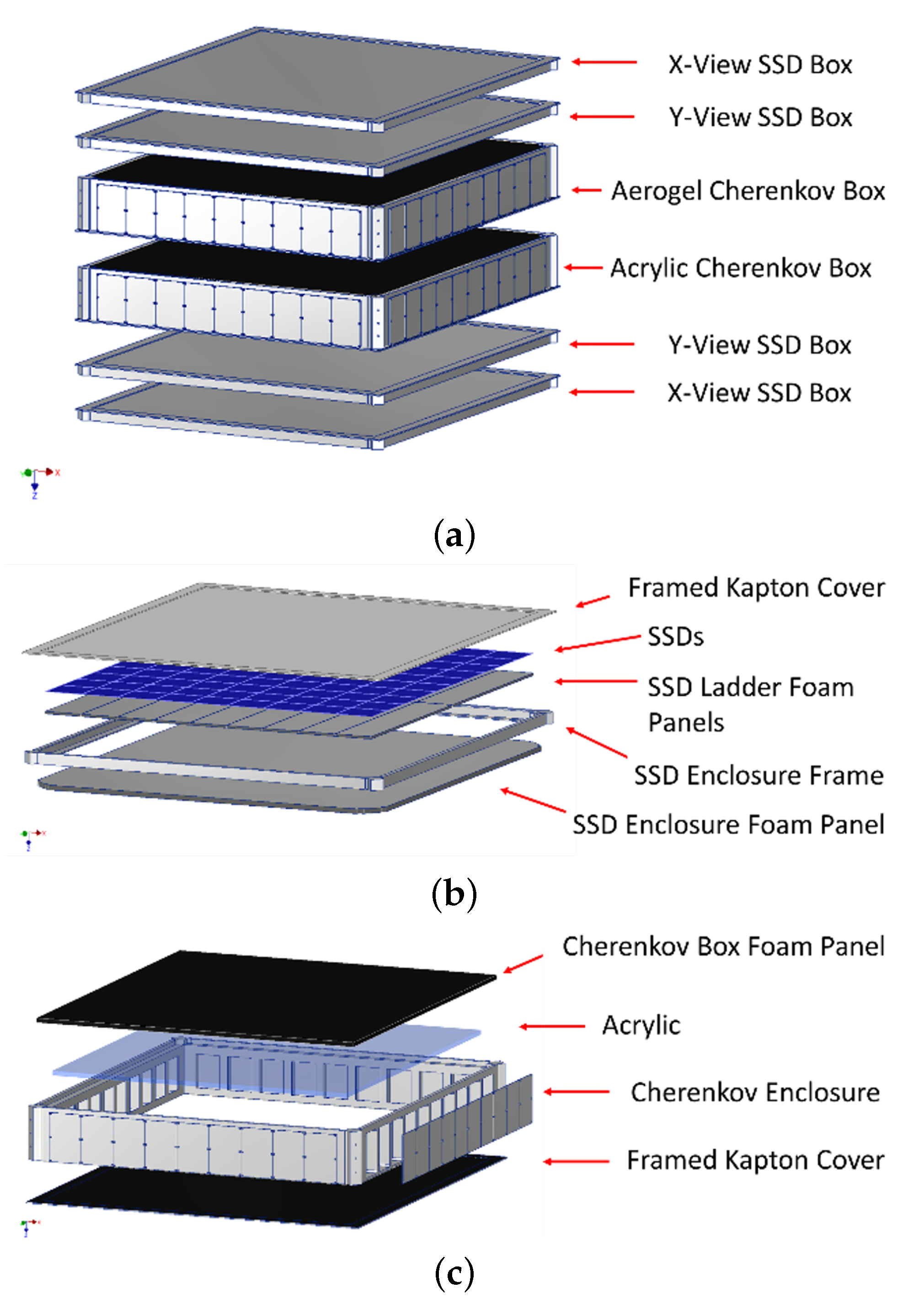
TIGERISS will use the same fundamental charge identification techniques used by TIGER/SuperTIGER: vs. Cherenkov and acrylic Cherenkov vs. silica aerogel Cherenkov, as well as multiple , but with improved detectors. Figure 4a gives an expanded view of the TIGERISS instrument stack, with pairs of orthogonal silicon strip detector (SSD) layers above and below the aerogel (, ≥ 0.95, KE ≳ 2.12 GeV/amu) and acrylic (, ≥ 0.67, KE ≳ 325 MeV/amu) Cherenkov light-collection boxes. Figure 4b shows an expanded view of an SSD layer, which will provide both measurements (∝Z2) and trajectory determination in place of the large-area compact wavelength-shifter bar readout scintillator detectors (dL/dx) and scintillating optical fiber hodoscopes (trajectory) used in the balloon-borne instruments. The more compact readout allowed by the SSDs and silicon photomultiplier (SiPM) modules TIGERISS will use on the Cherenkov detectors instead of photomultiplier tubes (PMTs) lets us build the largest possible instrument within the allowed payload envelope. An expanded view of a TIGERISS Cherenkov detector in Figure 4c shows that the Cherenkov-light radiators, in this case acrylic, will be at the top of the detector boxes to improve light collection over the bottom placement used in the balloon-borne instruments.
Figure 4.
(a) Expanded view of the standard TIGERISS payload technical model. (b) SSD expanded view. (c) Acrylic Cherenkov detector expanded view.
3.2. Payload Model Development
There are similarities and major differences in the design requirements for balloon and space payloads. SuperTIGER was designed to operate in the very low atmospheric pressure at stratospheric altitudes, as well as to deal with major shocks in excess of 10 g experienced when the parachute opens following termination and on landing. TIGERISS will need to operate in hard vacuum, will experience shocks during launch, and will undergo acoustic and vibration loads that SuperTIGER did not. Analysis of TIGERISS detector component and payload models for launch environment conditions will be followed by some component model tests to address specific Technology Readiness Level (TRL) concerns, and ultimately by the full payload being put through thermal-vacuum, acoustic, and vibration tests.
All TIGERISS systems must meet TRL standards for launch and the ISS environment that exceed those of balloon payloads, and systems that are changed from SuperTIGER particularly benefit from heritage with other instruments. Silicon detectors have been used on many space missions, including ACE-CRIS [42], Light Imager for Gamma-ray Astrophysics (AGILE) [43], Alpha Magnetic Spectrometer (AMS-02) [44], Energetic Particles: Acceleration, Composition, and Transport investigation (EPACT) on the Global Geospace Science (GGS) Wind satellite [45], Fermi-Large Area Telescope (Fermi-LAT) [46], Payload for Antimatter Matter Exploration and Light-nuclei Astrophysics (PAMELA) [47], Parker Solar Probe [48], and the Solar Terrestrial Relations Observatory (STEREO) [49]. TIGERISS will use daisy-chained detector ladders that are particularly similar to those used in AMS-02 [44] and Fermi-LAT [46]. TIGERISS SiPM components are similar to those used on two CubeSat missions, Ionospheric Neutron Content Analyzer (INCA) [50] and BurstCube [51], using carrier and summing electronics for SiPM arrays developed for APT [52] and the Antarctic Demonstrator for the Advanced Particle-astrophysics Telescope (ADAPT), Solar Neutron TRACking (SONTRAC) [53], and the High-Energy Light Isotope eXperiment (HELIX) [54]. TIGERISS will use a data acquisition (DAQ) system based on field-programmable gate arrays (FPGAs) based on that flown on the HyperAngular Rainbow Polarimeter (HARP) CubeSat [55] and in development for the HARP2 instrument on the Plankton, Aerosol, Clouds, ocean Ecosystem (PACE) mission [56].
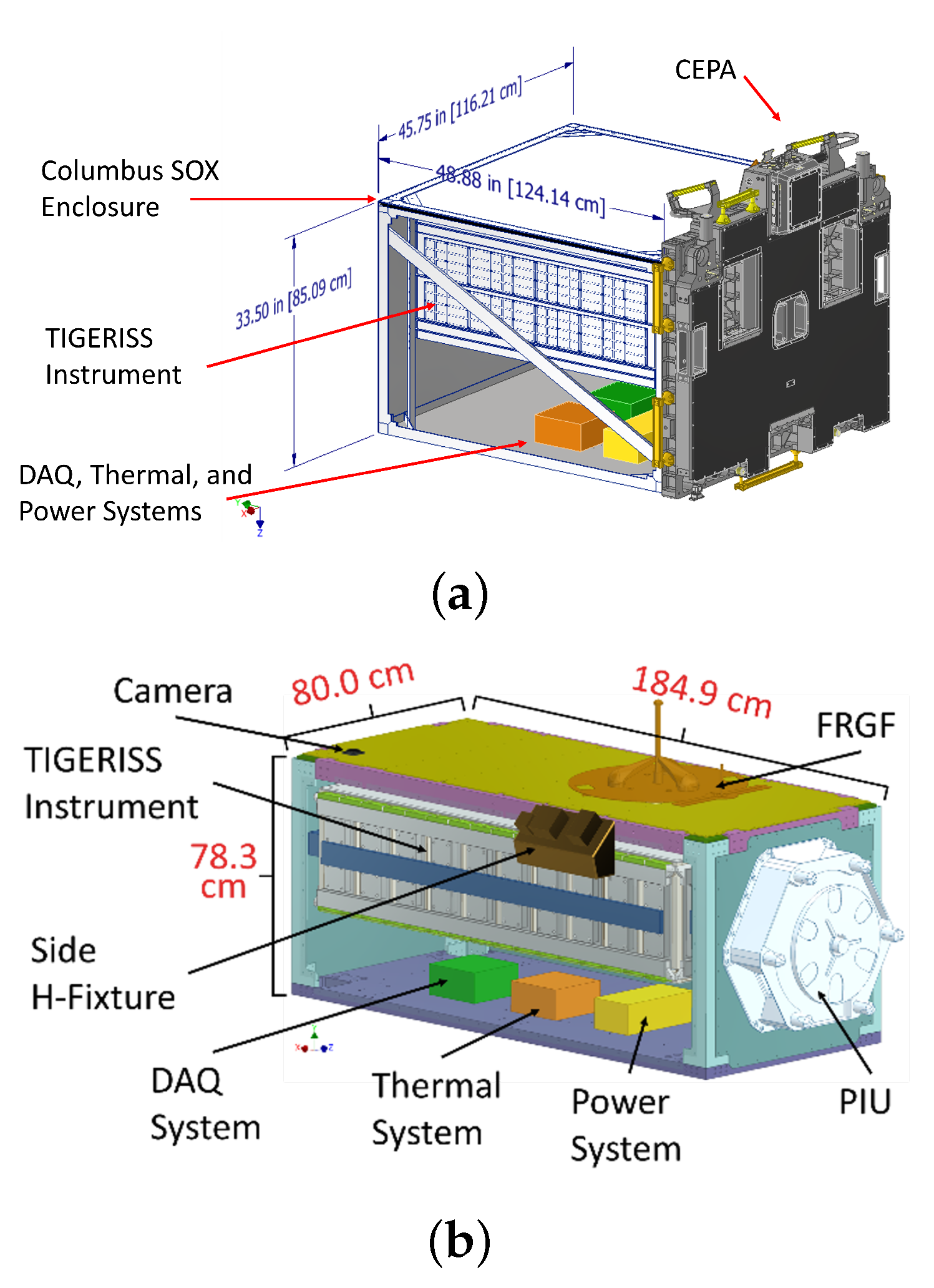
The Japan Aerospace Exploration Agency (JAXA) Japanese Experiment Module (JEM) “Kibo” Exposed Facility Unit 10 (EFU10) location originally proposed for TIGERISS is now expected to be occupied by ECOsystem Spaceborne Thermal Radiometer Experiment on Space Station (ECOSTRESS) [57] when TIGERISS is planned to launch to the ISS in June 2026, and we were directed to investigate all possible ISS external payload accommodation sites. Until August 13, 2023, these included JEM-EFU6 and JEM-EFU7, as well as the European Space Agency (ESA) Columbus Laboratory external payload Starboard Overhead X-Direction (SOX) location. We have been notified by the ISS Program Office that the Global Ecosystem Dynamics Investigation (GEDI) payload [58] is planned until the end of the ISS for JEM-EFU6. None of the zenith-facing NASA EXpedite the PRocessing of Experiments to the Space Station (ExPRESS) Logistics Carrier (ELC) locations are expected to be available for TIGERISS. Detailed payload technical models for the SOX (Figure 5a) and JEM-EF (Figure 5b) locations are under development, including a standard JEM-EF model configuration and one 0.2 m wider for JEM-EFU7 that would require a JAXA waiver. Table 1 gives instrument dimensions and geometry factors for these models and the one used in the proposal.
Figure 5.
(a) Columbus SOX TIGERISS payload technical model. (b) JEM-EF standard TIGERISS payload technical model.
Table 1.
TIGERISS instrument dimensions and geometry factors.
3.3. Thermal Analysis
The thermal environment on the ISS is significantly different than for stratospheric-balloon payloads. SuperTIGER was able to maintain all detector and electronics systems within acceptable temperature ranges with the use of insulation and thermostat-triggered heaters on the most sensitive electronics. It also used a rotator system to point the solar array toward the sun, which introduced a fixed thermal gradient from the hot to cold sides. The widely varying solar illumination and Earth albedo conditions TIGERISS will experience require both active heating and radiator heat dissipation.
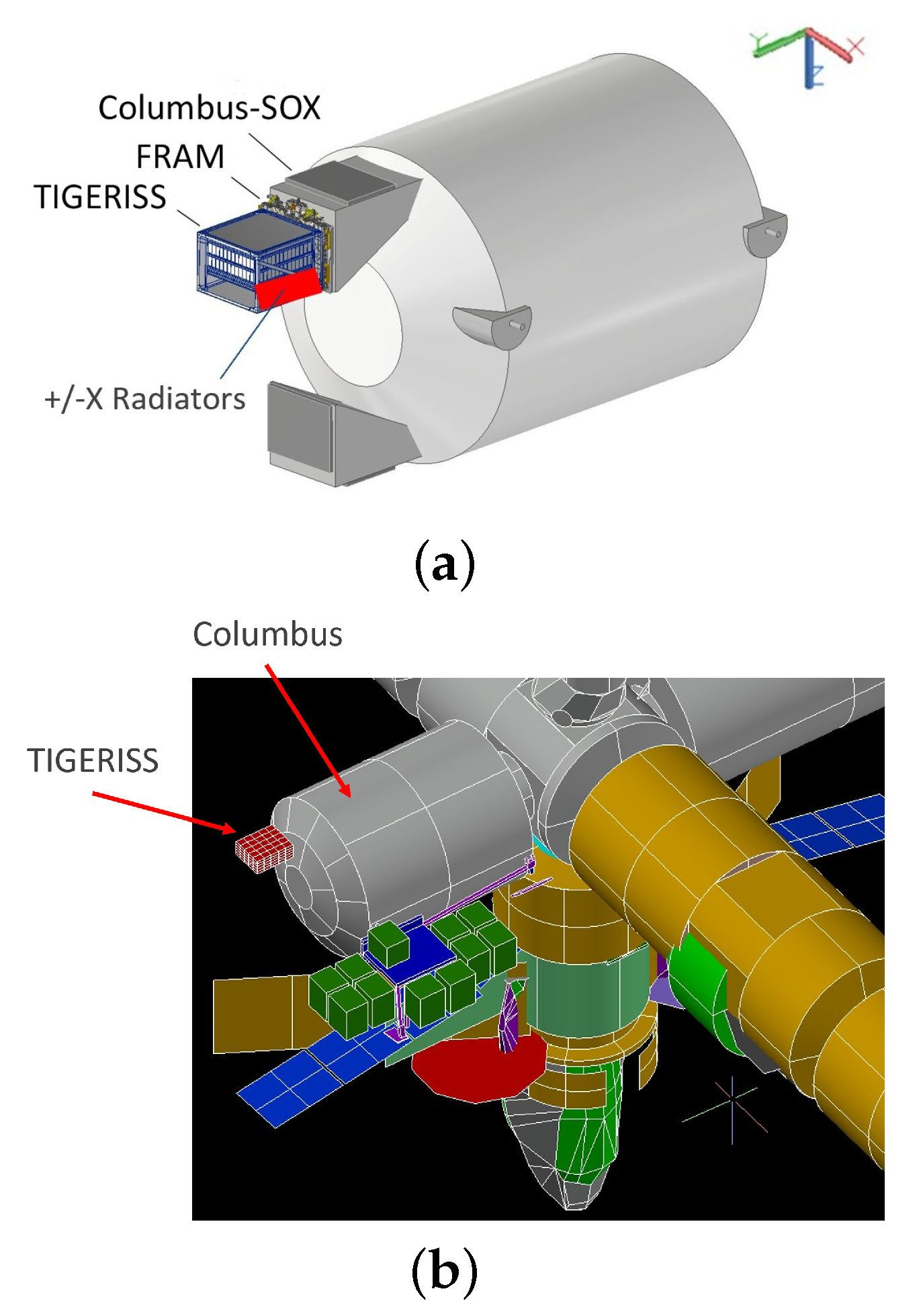
TIGERISS thermal analysis efforts have been carrying both Columbus SOX and JEM-EF payload configurations. With the elimination of the JEM-EFU6 location with an active coolant loop, just the JEM-EFU7 and Columbus SOX locations remain, which only have passive thermal control and heaters. Integrated ISS thermal modeling for a range of orbital conditions has been performed, with a focus on hot and cold cases to assess radiator sizing and heater power budget needs. Figure 6a shows the TIGERISS SOX mechanical model, including thermal radiators mounted to Columbus Laboratory, and Figure 6b shows the payload as part of the Integrated ISS thermal model. The launch and orbital cases where limited power is available for survival heaters, as well as the up to seven hours without power during installation, are also being studied. Current modeling finds that expected thermal conditions will be within TIGERISS component tolerances and that heater power and radiator space needs are safely within limits. As with SuperTIGER, TIGERISS will correct for time-varying detector gain responses from changing temperatures by normalizing detector signals using 26Fe and/or other of the more abundant cosmic ray nuclei species.
Figure 6.
(a) Columbus SOX TIGERISS payload technical model showing radiators. (b) Columbus SOX TIGERISS payload thermal model.
3.4. Predicted TIGERISS Measurements
Predictions for TIGERISS event statistics incorporate cosmic ray spectra and corrections for geomagnetic screening, instrument thresholds, and interactions in the instrument based on a method originally developed for the CALET [59]. For elements from 5B to 32Ge, energy spectra have been measured by the ACE-CRIS at the L1 Lagrange Point [60]. For UHGCR elements for which energy spectra have not been measured, the 26Fe spectrum is scaled using SuperTIGER relative abundances for elements through 40Zr [20]. The predictions between 40Zr and 60Nd are based on the assumed 20% odd/80% even splitting of charge pairs measured by HEAO-3-HNE [14], which agree reasonably with the SuperTIGER measurements [2], and abundances of elements in charge groups above 60Nd are scaled by SS abundances [39]. The level of solar modulation does not have a strong impact on the TIGERISS UHGCR measurements due to significant geomagnetic screening in the ISS inclination orbit.
3.4.1. Statistics from One Year
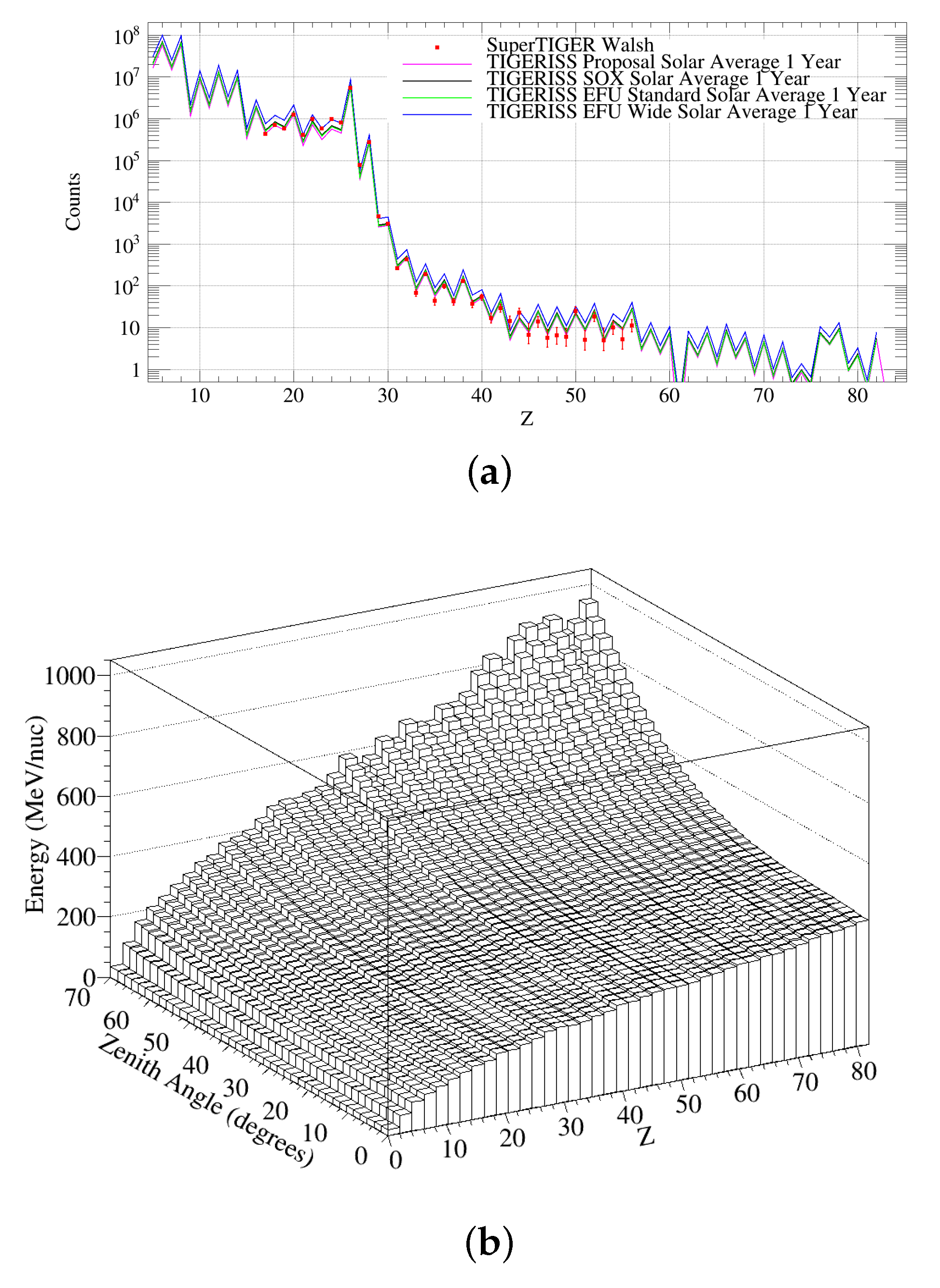
TIGERISS GCR statistics for ISS observations have been generated for the new instrument models under study [6]. Figure 7a gives predicted one-year TIGERISS measurements for the proposed JEM-EF model (pink), Columbus SOX model (black), current JEM-EF standard model (green), and JEM-EF wide model (blue) configurations [6] compared with those from the first SuperTIGER flight (red) [1,2,3,4]. The expected TIGERISS one-year statistics are comparable to or better than those for SuperTIGER where their sensitive ranges overlap.
Figure 7.
(a) Predicted abundances measured by TIGERISS after one year of operation [6] compared to those measured by SuperTIGER over its first 55-day long-duration balloon flight [1,2,3,4]. (b) Incident threshold energy (MeV/amu) required to trigger TIGERISS as a function of Z and zenith angle () [6].
Table 1 shows that only the wide JEM-EF model has a larger geometry factor than the proposed TIGERISS instrument, but Figure 7a shows that all of the new models are expected to outperform it. Addressing subsystem interface requirements to constrain the mechanical model design envelopes for needed electronics, cabling, and thermal systems resulted in the standard JEM-EF instrument configuration in the proposal being downsized by 17 cm in length and 7 cm in width, as shown in Table 1. The superior performance of the newer models is due to the calculations used in the proposal only accepting events above a conservative energy threshold [61]. The current calculations [6] use the angle-dependent threshold energies derived for each element from Geant4 simulations, shown in Figure 7b. These results show that TIGERISS instrument models with higher confidence of design after the first year of development can deliver the scientific results promised in the proposal.
3.4.2. Statistics from Extended Observations
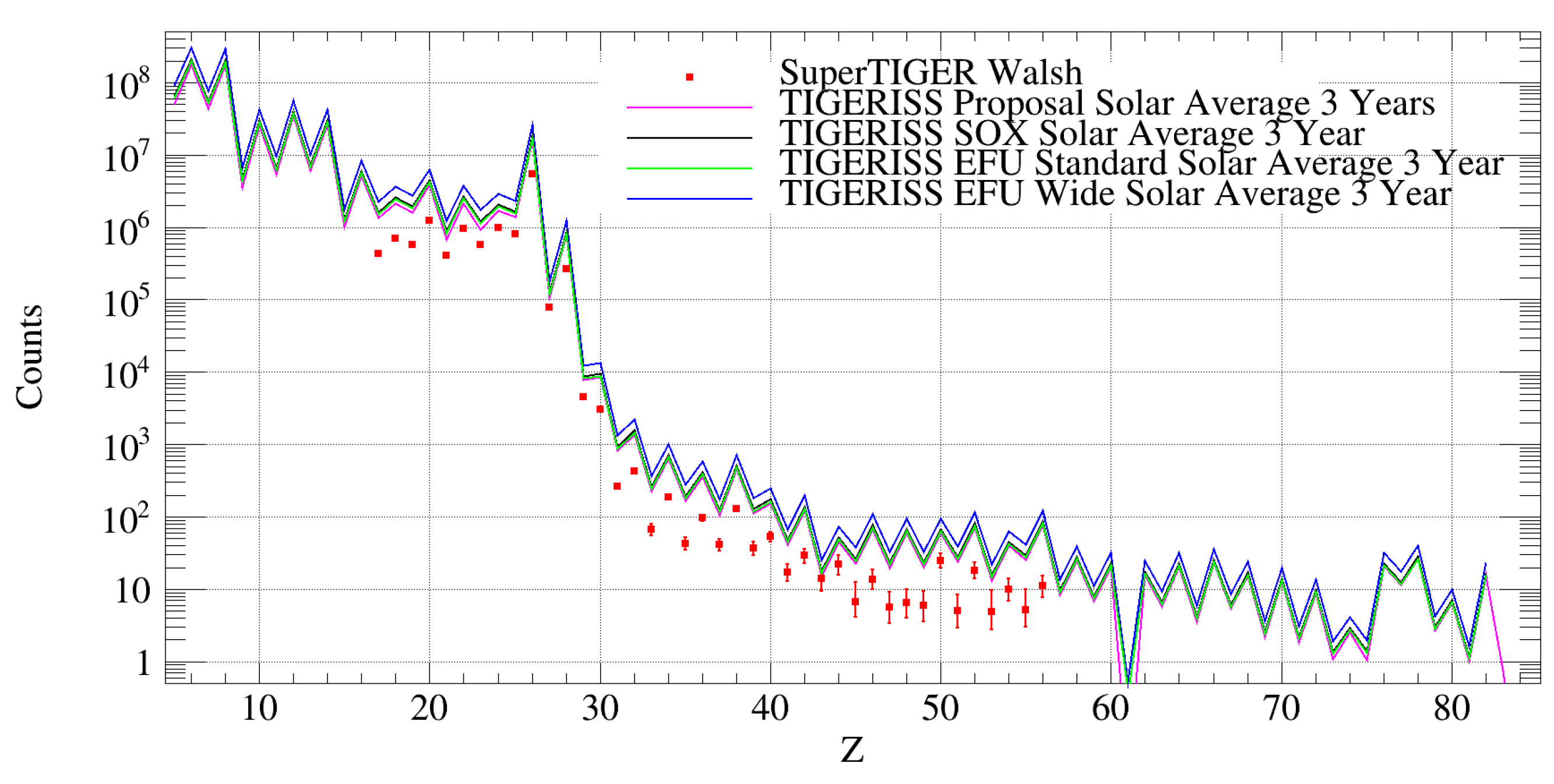
The ISS is now planned to operate through 2030, and if TIGERISS delivers as planned, its operations may be extended through the end of the ISS. Expected TIGERISS statistics from three years of observations under average solar modulation are shown in Figure 8 for the same payload configurations shown in Figure 7a. The increased UHGCR statistics from extended TIGERISS operations will resolve most even and many odd-Z elements, including the important 76Os, 78Pt, and 82Pb abundances, with greater statistical significance.
Figure 8.
Predicted abundances measured by TIGERISS after three years of operation [5,6], compared to those measured by SuperTIGER over its first 55-day long-duration balloon flight [1,2,3,4].
4. Conclusions
The stratospheric balloon-borne SuperTIGER instrument has made the best single-element resolution UHGCR measurements to date through 56Ba; the TIGERISS instrument, with a planned 2026 launch, will extend these to 82Pb with superior resolution. Switching from scintillator detectors to SSDs for position and charge measurement will provide better charge resolution and linearity for TIGERISS, allowing it to measure all GCRs from 5B to 82Pb with a single instrument. SuperTIGER results have shown that there is something missing from the OB Association GCRS model, and TIGERISS will probe for other GCRS signatures and test GCR acceleration models through 82Pb. With the one year of observations possible under the five-year performance period of the Astrophysics Pioneers Program, TIGERISS will test SuperTIGER measurements with different systematics. If these measurements agree, they will effectively double the UHGCR single-element resolution statistics through 56Ba. Regardless, TIGERISS will provide the first single-element resolution UHGCR measurements from 56Ba to 82Pb, measuring further up the periodic table the relative contributions of r- and s-process neutron capture sources to the GCRs.
Author Contributions
All authors with † supported SuperTIGER, and all authors with ‡ have supported the conceptualization and design of TIGERISS. Conceptualization, L.P.W., J.V.M., B.F.R., W.V.Z., W.R.B., R.F.B., R.G.B., T.J.B., D.L.B., J.H.B., N.W.C., S.C., P.F.D., M.H.I., J.F.K., L.L., M.P.M., R.A.M., J.G.M., J.W.M., S.A.I.M., G.A.d.N., S.N., N.E.O., I.M.P., K.S., M.S., S.S., H.A.T., N.E.W., D.W.; methodology, L.P.W., B.F.R., W.V.Z., W.R.B., S.C., M.H.I., M.K., J.F.K., A.W.L., W.L., M.P.M., J.G.M., J.W.M., S.A.I.M., R.P.M., S.N., N.E.O., I.M.P., K.S., M.S., S.S., H.A.T., N.E.W., D.W.; software, L.P.W., J.V.M., B.F.R., W.V.Z., Y.A., R.F.B., R.G.B., N.W.C., J.F.K., A.W.L., W.L., S.A.I.M., R.P.M., S.N., M.A.O., N.E.O., I.M.P., K.S., M.S., H.A.T., N.E.W., D.W.; validation, L.P.W., J.V.M., R.M.C., B.F.R., W.V.Z., Q.A., R.F.B., R.G.B., D.L.B., P.F.D., M.K., W.L., L.L., M.P.M., J.G.M., S.A.I.M., R.P.M., S.N., M.A.O., N.E.O., I.M.P., M.S., S.S., H.A.T., N.E.W., D.W., A.T.W.; formal analysis, B.F.R., W.V.Z., N.W.C., S.C., M.K., J.F.K., A.W.L., W.L., M.P.M., R.A.M., S.A.I.M., R.P.M., S.N., N.E.O., K.S., M.S., S.S., H.A.T., N.E.W.; investigation, L.P.W., J.V.M., R.M.C., B.F.R., W.V.Z., Q.A., Y.A., W.R.B., R.F.B., R.G.B., T.J.B., D.L.B., J.H.B., N.W.C., S.C., P.F.D., M.H.I., M.K., J.F.K., A.W.L., W.L., L.L., M.P.M., R.A.M., J.G.M., J.W.M., S.A.I.M., R.P.M., S.N., M.A.O., N.E.O., I.M.P., K.S., M.S., S.S., H.A.T., N.E.W., J.E.W., D.W., A.T.W.; resources, J.V.M., R.M.C., B.F.R., W.R.B., J.H.B., N.W.C., S.C., J.F.K., L.L., R.A.M., J.G.M., J.W.M., S.A.I.M., G.A.d.N., S.N., S.S.; data curation, W.V.Z., N.W.C., J.F.K., M.A.O.; writing—original draft preparation, B.F.R., W.V.Z.; writing—review and editing, L.P.W., J.V.M., R.M.C., B.F.R., Q.A., Y.A., W.R.B., R.F.B., R.G.B., T.J.B., D.L.B., J.H.B., N.W.C., S.C., P.F.D., M.H.I., M.K., J.F.K., A.W.L., W.L., L.L., M.P.M., R.A.M., J.G.M., J.W.M., S.A.I.M., R.P.M., G.A.d.N., S.N., M.A.O., N.E.O., I.M.P., K.S., M.S., S.S., H.A.T., N.E.W., J.E.W., D.W., A.T.W.; visualization, L.P.W., B.F.R., W.V.Z., Y.A., W.R.B., D.L.B., N.W.C., S.C., J.F.K., W.L., M.P.M., S.A.I.M., R.P.M., S.N., N.E.O., K.S., M.S., H.A.T., N.E.W., J.E.W., D.W.; supervision, J.V.M., B.F.R., W.V.Z., W.R.B., R.F.B., R.G.B., T.J.B., J.H.B., N.W.C., S.C., P.F.D., M.H.I., M.K., J.F.K., L.L., R.A.M., J.W.M., R.P.M., G.A.d.N., S.N., M.S., S.S., N.E.W., J.E.W.; project administration, B.F.R., W.V.Z., W.R.B., N.W.C., S.C., J.F.K., L.L., R.A.M., J.W.M., G.A.d.N., S.N., M.S., S.S., J.E.W.; funding acquisition, J.V.M., B.F.R., W.V.Z., W.R.B., R.G.B., T.J.B., N.W.C., S.C., P.F.D., M.H.I., J.F.K., R.A.M., J.W.M., G.A.d.N., S.N., M.S., N.E.W. All authors have read and agreed to the published version of the manuscript.
Funding
SuperTIGER has been funded by NASA under grant numbers NNX09AC17G, NNX14AB25G, NNX15AC23G, and 80NSSC20K0405. TIGERISS is funded by NASA under cooperative agreement number 80NSSC22M0299.
Data Availability Statement
No new data were created or analyzed in this study. Data sharing is not applicable to this article.
Acknowledgments
SuperTIGER was supported by Cecil J. Waddington at the University of Minnesota until he passed on 1 October 2020. SuperTIGER has also been supported by M. E. Wiedenbeck. SuperTIGER and TIGERISS efforts at Washington University in St. Louis have also been supported by the McDonnell Center for the Space Sciences and the Peggy and Steve Fossett Foundation.
Conflicts of Interest
The authors declare no conflicts of interest.
Abbreviations
The following abbreviations are used in this manuscript:
| MDPI | Multidisciplinary Digital Publishing Institute |
| ACE | Advanced Composition Explorer |
| ADAPT | Antarctic Demonstrator for the Advanced Particle-astrophysics Telescope |
| AGILE | Light Imager for Gamma-ray Astrophysics |
| AMS | Alpha Magnetic Spectrometer |
| APT | Advanced Particle-astrophysics Telescope |
| BAS | Balloon Air Sampler |
| BNSM | binary neutron star merger |
| Caltech | California Institute of Technology |
| CALET | CALorimetric Electron Telescope |
| COVID-19 | coronavirus disease 2019 |
| CR | cosmic ray |
| CRIS | Cosmic Ray Isotope Spectrometer |
| DAMPE | Dark Matter Particle Explorer |
| DAQ | data acquisition |
| EAS | extensive air shower |
| ECOSTRESS | ECOsystem Spaceborne Thermal Radiometer Experiment on Space Station |
| EFU | Exposed Facility Unit |
| ELC | ExPRESS Logistics Carrier |
| E-MIST | Exposing Microorganisms in the Stratosphere |
| EPACT | Energetic Particles: Acceleration, Composition, and Transport investigation |
| ESA | European Space Agency |
| ExPRESS | EXpedite the PRocessing of Experiments to the Space Station |
| FPGA | field-programmable gate array |
| GCR | galactic cosmic rays |
| GEDI | Global Ecosystem Dynamics Investigation |
| GGS | Global Geospace Science |
| HARP | HyperAngular Rainbow Polarimeter |
| HEAO | High-Energy Astronomy Observatory |
| HELIX | High-Energy Light Isotope eXperiment |
| HNE | Heavy Nuclei Experiment |
| INCA | Ionospheric Neutron Content Analyzer |
| ISM | interstellar media |
| ISS | International Space Station |
| JAXA | Japan Aerospace Exploration Agency |
| JEM | Japanese Experiment Module |
| LAT | Large-Area Telescope |
| LDB | Long-Duration Balloon |
| LDEF | Long-Duration Exposure Facility |
| NASA | National Aeronautics and Space Administration |
| NKU | Northern Kentucky University |
| NSM | Neutron Star Merger |
| PACE | Plankton, Aerosol, Clouds, ocean Ecosystem |
| PAMELA | Payload for Antimatter Matter Exploration and Light-nuclei Astrophysics |
| PMC-Turbo | Polar Mesospheric Cloud Turbulence |
| PMT | photomultiplier tube |
| PSU | Pennsylvania State University |
| SiPM | silicon photomultiplier |
| SN | supernova |
| SNe | supernovae |
| SONTRAC | Solar Neutron TRACking |
| SOX | Starboard Overhead X-Direction |
| SS | Solar System |
| SSD | silicon strip detector |
| STEREO | Solar Terrestrial Relations Observatory |
| SuperTIGER | Super Trans-Iron Galactic Element Recorder |
| TIGER | Trans-Iron Galactic Element Recorder |
| TIGERISS | Trans-Iron Galactic Element Recorder for the International Space Station |
| TRL | Technology Readiness Level |
| UHCRE | Ultra-Heavy Cosmic Ray Experiment |
| UHECR | ultra-high energy cosmic ray |
| UHGCR | ultra-heavy galactic cosmic ray |
| UMBC | University of Maryland Baltimore County |
| WUSTL | Washington University in St. Louis |
References
- Walsh, N.E. SuperTIGER Elemental Abundances for the Charge Range 41≤Z≤56. Ph.D. Thesis, Washington University, St. Louis, MI, USA, 2020. [Google Scholar]
- Walsh, N.E.; Akaike, Y.; Binns, W.; Bose, R.; Brandt, T.; Braun, D.; Cannady, N.; Dowkontt, P.; Hams, T.; Israel, M.; et al. SuperTIGER Abundances of Galactic Cosmic Rays for the Atomic Number (Z) Interval 30 to 56. In Proceedings of the 37th International Cosmic Ray Conference (ICRC2021), Berlin, Germany, 12–23 July 2021; Volume 395. [Google Scholar] [CrossRef]
- Walsh, N.E.; Akaike, Y.; Binns, W.R.; Bose, R.G.; Brandt, T.J.; Braun, D.L.; Cannady, N.W.; Dowkontt, P.F.; Hams, T.; Israel, M.H.; et al. SuperTIGER instrument abundances of galactic cosmic rays for the charge interval 41 ⩽ Z ⩽ 56. Adv. Space Res. 2022, 70, 2666–2673. [Google Scholar] [CrossRef]
- Walsh, N.E. SuperTIGER Abundances of Galactic Cosmic Rays for the Atomic Number (Z) Interval 40 to 56. In Proceedings of the 38th International Cosmic Ray Conference (ICRC2023), Nagoya, Japan, 26 July–3 August 2023; Volume 444, p. 053. [Google Scholar] [CrossRef]
- Rauch, B.F.; Zober, W.V.; Borda, R.F.; Bose, R.G.; Braun, D.L.; Buckley, J.; Calderon, J.; Cannady, N.W.; Caputo, R.; Coutu, S.; et al. The Trans-Iron Galactic Element Recorder for the International Space Station (TIGERISS). In Proceedings of the 38th International Cosmic Ray Conference (ICRC2023), Nagoya, Japan, 26 July–3 August 2023; Volume 444, p. 171. [Google Scholar] [CrossRef]
- Rauch, B.F.; Zober, W.V.; Borda, R.F.; Bose, R.G.; Braun, D.L.; Buckley, J.; Calderon, J.; Cannady, N.W.; Caputo, R.; Coutu, S.; et al. Modeling Expected TIGERISS Observations. In Proceedings of the 38th International Cosmic Ray Conference (ICRC2023), Nagoya, Japan, 26 July–3 August 2023; Volume 444, p. 172. [Google Scholar] [CrossRef]
- Abbott, B.P.; Abbott, R.; Abbott, T.D.; Acernese, F.; Ackley, K.; Adams, C.; Adams, T.; Addesso, P.; Adhikari, R.X.; Adya, V.B.; et al. GW170817: Observation of Gravitational Waves from a Binary Neutron Star Inspiral. Phys. Rev. Lett. 2017, 119, 161101. [Google Scholar] [CrossRef] [PubMed]
- Abbott, B.P.; Abbott, R.; Abbott, T.D.; Acernese, F.; Ackley, K.; Adams, C.; Adams, T.; Addesso, P.; Adhikari, R.X.; Adya, V.B.; et al. Multi-messenger Observations of a Binary Neutron Star Merger. Astrophys. J. Lett. 2017, 848, L12. [Google Scholar] [CrossRef]
- Zober, W.V.; Rauch, B.F.; Borda, R.F.; Bose, R.G.; Braun, D.L.; Buckley, J.; Calderon, J.; Cannady, N.W.; Caputo, R.; Coutu, S.; et al. Science Objectives and Goals of the TIGERISS mission. In Proceedings of the 38th International Cosmic Ray Conference (ICRC2023), Nagoya, Japan, 26 July–3 August 2023; Volume 444, p. 144. [Google Scholar] [CrossRef]
- Marrocchesi, P. CALET: A calorimeter-based orbital observatory for High Energy Astroparticle Physics. Nucl. Instrum. Methods Phys. Res. Sect. A 2012, 692, 240–245. [Google Scholar] [CrossRef]
- Sun, H.; Alemanno, F.; Altomare, C.; An, Q.; Azzarello, P.; Barbato, F.C.T.; Bernardini, P.; Bi, X.J.; Cagnoli, I.; Cai, M.S.; et al. Measurement of Heavy Nulei beyond Iron in Cosmic Rays with the DAMPE Experiment. In Proceedings of the 38th International Cosmic Ray Conference (ICRC2023), Nagoya, Japan, 26 July–3 August 2023; Volume 444, p. 174. [Google Scholar] [CrossRef]
- Israel, M.H.; Lave, K.A.; Wiedenbeck, M.E.; Binns, W.R.; Christian, E.R.; Cummings, A.C.; Davis, A.J.; de Nolfo, G.A.; Leske, R.A.; Mewaldt, R.A.; et al. Elemental Composition at the Cosmic-Ray Source Derived from the ACE-CRIS Instrument. I. 6C to 28Ni. Astrophys. J. 2018, 865, 69. [Google Scholar] [CrossRef]
- Binns, W.R.; Wiedenbeck, M.E.; von Rosenvinge, T.T.; Israel, M.H.; Christian, E.R.; Cummings, A.C.; de Nolfo, G.A.; Leske, R.A.; Mewaldt, R.A.; Stone, E.C. The Isotopic Abundances of Galactic Cosmic Rays with Atomic Number 29 ≤ Z ≤ 38. Astrophys. J. 2022, 936, 13. [Google Scholar] [CrossRef]
- Binns, W.R.; Garrard, T.L.; Gibner, P.S.; Israel, M.H.; Kertzman, M.P.; Klarmann, J.; Newport, B.J.; Stone, E.C.; Waddington, C.J. Abundances of Ultraheavy Elements in the Cosmic Radiation: Results from HEAO 3. Astrophys. J. 1989, 346, 997. [Google Scholar] [CrossRef]
- Fowler, P.H.; Walker, R.N.F.; Masheder, M.R.W.; Moses, R.T.; Worley, A.; Gay, A.M. Ariel 6 Measurements of the Fluxes of Ultra-heavy Cosmic Rays. Astrophys. J. 1987, 314, 739. [Google Scholar] [CrossRef]
- Price, P.B.; Lowder, D.M.; Westphal, A.J.; Wilkes, R.D.; Brennen, R.A.; Afanasyev, V.G.; Akimov, V.V.; Rodin, V.G.; Baryshinikov, G.K.; Gorshkov, L.A.; et al. Trek-a Cosmic-Ray Experiment on the Russian Space Station MIR. Astrophys. Space Sci. 1992, 197, 121–143. [Google Scholar] [CrossRef]
- Westphal, A.J.; Price, P.B.; Weaver, B.A.; Afanasiev, V.G. Evidence against stellar chromospheric origin of Galactic cosmic rays. Nature 1998, 396, 50–52. [Google Scholar] [CrossRef]
- Donnelly, J.; Thompson, A.; O’Sullivan, D.; Daly, J.; Drury, L.; Domingo, V.; Wenzel, K.P. Actinide and Ultra-Heavy Abundances in the Local Galactic Cosmic Rays: An Analysis of the Results from the LDEF Ultra-Heavy Cosmic-Ray Experiment. Astrophys. J. 2012, 747, 40. [Google Scholar] [CrossRef]
- Murphy, R.P. Identifying the Origin of Galactic Cosmic Rays with the SuperTIGER Instrument. Ph.D. Thesis, Washington University, St. Louis, MI, USA, 2015. [Google Scholar]
- Murphy, R.P.; Sasaki, M.; Binns, W.R.; Brandt, T.J.; Hams, T.; Israel, M.H.; Labrador, A.W.; Link, J.T.; Mewaldt, R.A.; Mitchell, J.W.; et al. Galactic Cosmic Ray Origins and OB Associations: Evidence from SuperTIGER Observations of Elements 26Fe through 40Zr. Astrophys. J. 2016, 831, 148. [Google Scholar] [CrossRef]
- Rauch, B.F.; Walsh, N.E.; Zober, W.V. SuperTIGER Ultra-Heavy Galactic Cosmic Ray Atmospheric Propagation Corrections and Uncertainty Analysis. In Proceedings of the 37th International Cosmic Ray Conference (ICRC2021), Berlin, Germany, 12–23 July 2021; Volume 395, p. 089. [Google Scholar] [CrossRef]
- Rauch, B.F.; Bose, R.G.; West, A.T.; Lisalda, L.; Abarr, Q.; Akaike, Y.; Binns, W.; Brandt, T.; Braun, D.L.; Dowkontt, P.; et al. SuperTIGER-2 2018 Flight Payload Recovery and Preliminary Instrument Assessment. In Proceedings of the 36th International Cosmic Ray Conference (ICRC2019), Madison, WI, USA, 24 July–1 August 2019; Volume 358, p. 131. [Google Scholar] [CrossRef]
- Link, J.T. Measurements of Ultra-Heavy Galactic Cosmic Rays with the TIGER Instrument. Ph.D. Thesis, Washington University, St. Louis, MI, USA, 2003. [Google Scholar]
- Link, J.T.; Barbier, L.M.; Binns, W.R.; Christian, E.R.; Cummings, J.R.; de Nolfo, G.A.; Geier, S.; Israel, M.H.; Mewaldt, R.A.; Mitchell, J.W.; et al. Measurements of the Ultra-Heavy Galactic Cosmic-Ray Abundances between Z = 30 and Z = 40 with the TIGER Instrument. In Proceedings of the 28th International Cosmic Ray Conference, Tsukuba, Japan, 31 July–7 August 2003. [Google Scholar]
- Rauch, B.F. Measurement of the Relative Abundances of the Ultra-Heavy Galactic Cosmic Rays (30≤Z≤40) with the Trans-Iron Galactic Element Recorder (TIGER) Instrument. Ph.D. Thesis, Washington University, St. Louis, MI, USA, 2008. [Google Scholar]
- Rauch, B.F.; Link, J.T.; Lodders, K.; Israel, M.H.; Barbier, L.M.; Binns, W.R.; Christian, E.R.; Cummings, J.R.; de Nolfo, G.A.; Geier, S.; et al. Cosmic Ray origin in OB Associations and Preferential Acceleration of Refractory Elements: Evidence from Abundances of Elements 26Fe through 34Se. Astrophys. J. 2009, 697, 2083–2088. [Google Scholar] [CrossRef]
- Lawrence, D.J. The trans-iron galactic element recorder: A detector that will measure the elemental abundances of the ultra-heavy cosmic rays. Ph.D. Thesis, Washington University, St. Louis, MI, USA, 1996. [Google Scholar]
- Sposato, S.H. The 1997 balloon flight of the trans-iron galactic element recorder. Ph.D. Thesis, Washington University, St. Louis, MI, USA, 1999. [Google Scholar]
- Lawrence, D.J.; Barbier, L.M.; Beatty, J.J.; Binns, W.R.; Christian, E.R.; Crary, D.J.; Ficenec, D.J.; Hink, P.L.; Klarmann, J.; Krombel, K.E.; et al. Large-area scintillating-fiber time-of-flight/hodoscope detectors for particle astrophysics experiments. Nucl. Instrum. Methods Phys. Res. A 1999, 420, 402–415. [Google Scholar] [CrossRef]
- Hughes, Z.; Buckley, J.; Bergström, L.; Binns, W.; Buhler, J.; Chen, W.; Cherry, M.; Funk, S.; Hooper, D.; Mitchell, J.; et al. Report of 2019 APTlite balloon flight. In Proceedings of the 236th American Astronomical Society Meeting, online, 1–3 June 2020; Volume 236, p. 142.04. [Google Scholar]
- Hughes, Z.D. Toward an Understanding of High-Mass Gamma-Ray Binaries: An Investigation Using Current Observatories and the Development of a Future GeV Instrument. Ph.D. Thesis, Washington University, St. Louis, MI, USA, 2021. [Google Scholar]
- Meshik, A.; Kehm, K.; Pravdivtseva, O.; Rauch, B. Measurements of Atmospheric Noble Gases in Antarctica Captured by Autonomous Balloon Sampling. In Proceedings of the AGU Fall Meeting Abstracts, Chicago, IL, USA, 12–16 December 2022; Volume 2022, p. P54A–02. [Google Scholar]
- Smith, D.J.; Thakrar, P.J.; Bharrat, A.E.; Dokos, A.G.; Kinney, T.L.; James, L.M.; Lane, M.A.; Khodadad, C.L.; Maguire, F.; Maloney, P.R.; et al. A Balloon-Based Payload for Exposing Microorganisms in the Stratosphere (E-MIST). Gravit. Space Res. 2022, 2, 70–80. [Google Scholar] [CrossRef]
- Williams, B.P.; Kjellstrand, B.; Jones, G.; Reimuller, J.D.; Fritts, D.C.; Miller, A.; Geach, C.; Limon, M.; Hanany, S.; Kaifler, B.; et al. The PMC-Turbo Balloon Mission to Study Gravity Waves and Turbulence through High-Resolution Imaging of Polar Mesospheric Clouds. In Proceedings of the AGU Fall Meeting Abstracts, New Orleans, LA, USA, 11–15 December 2017; Volume 2017, p. SA24A–08. [Google Scholar]
- Binns, W.R.; Bose, R.G.; Braun, D.L.; Brandt, T.J.; Daniels, W.M.; Dowkontt, P.F.; Fitzsimmons, S.P.; Hahne, D.J.; Hams, T.; Israel, M.H.; et al. The SUPERTIGER Instrument: Measurement of Elemental Abundances of Ultra-Heavy Galactic Cosmic Rays. Astrophys. J. 2014, 788, 18. [Google Scholar] [CrossRef]
- Sanuki, T.; Motoki, M.; Matsumoto, H.; Seo, E.S.; Wang, J.Z.; Abe, K.; Anraku, K.; Asaoka, Y.; Fujikawa, M.; Imori, M.; et al. Precise Measurement of Cosmic-Ray Proton and Helium Spectra with the BESS Spectrometer. Astrophys. J. 2000, 545, 1135–1142. [Google Scholar] [CrossRef]
- Aguilar, M.; Alcaraz, J.; Allaby, J.; Alpat, B.; Ambrosi, G.; Anderhub, H.; Ao, L.; Arefiev, A.; Arruda, L.; Azzarello, P.; et al. Isotopic Composition of Light Nuclei in Cosmic Rays: Results from AMS-01. Astrophys. J. 2011, 736, 105. [Google Scholar] [CrossRef]
- Engelmann, J.J.; Ferrando, P.; Soutoul, A.; Goret, P.; Juliusson, E.; Koch-Miramond, L.; Lund, N.; Masse, P.; Peters, B.; Petrou, N.; et al. Charge composition and energy spectra of cosmic-ray nuclei for elements from Be to Ni - Results from HEAO-3-C2. Astron. Astrophys. 1990, 233, 96–111. [Google Scholar]
- Lodders, K. Solar System Abundances and Condensation Temperatures of the Elements. Astrophys. J. 2003, 591, 1220–1247. [Google Scholar] [CrossRef]
- Woosley, S.E.; Heger, A. Nucleosynthesis and remnants in massive stars of solar metallicity. Phys. Rep. 2007, 442, 269–283. [Google Scholar] [CrossRef]
- Lingenfelter, R.E. The Origin of Cosmic Rays: How Their Composition Defines Their Sources and Sites and the Processes of Their Mixing, Injection, and Acceleration. Astrophys. J. Suppl. Ser. 2019, 245, 30. [Google Scholar] [CrossRef]
- Stone, E.C.; Cohen, C.M.S.; Cook, W.R.; Cummings, A.C.; Gauld, B.; Kecman, B.; Leske, R.A.; Mewaldt, R.A.; Thayer, M.R.; Dougherty, B.L.; et al. The Cosmic-Ray Isotope Spectrometer for the Advanced Composition Explorer. Space Sci. Rev. 1998, 86, 285–356. [Google Scholar] [CrossRef]
- Prest, M.; Barbiellini, G.; Bordignon, G.; Fedel, G.; Liello, F.; Longo, F.; Pontoni, C.; Vallazza, E. The AGILE silicon tracker: An innovative γ-ray instrument for space. Nucl. Instrum. Methods Phys. Res. A 2003, 501, 280–287. [Google Scholar] [CrossRef]
- Rapin, D.; AMS-Tracker Collaboration. The AMS-02 silicon tracker: First year on ISS in space. Nucl. Instrum. Methods Phys. Res. A 2013, 718, 524–526. [Google Scholar] [CrossRef]
- von Rosenvinge, T.T.; Barbier, L.M.; Karsch, J.; Liberman, R.; Madden, M.P.; Nolan, T.; Reames, D.V.; Ryan, L.; Singh, S.; Trexel, H.; et al. The Energetic Particles: Acceleration, Composition, and Transport (EPACT) investigation on the WIND spacecraft. Space Sci. Rev. 1995, 71, 155–206. [Google Scholar] [CrossRef]
- Atwood, W.B.; Abdo, A.A.; Ackermann, M.; Althouse, W.; Anderson, B.; Axelsson, M.; Baldini, L.; Ballet, J.; Band, D.L.; Barbiellini, G.; et al. The Large Area Telescope on the Fermi Gamma-Ray Space Telescope Mission. Astrophys. J. 2009, 697, 1071–1102. [Google Scholar] [CrossRef]
- Straulino, S.; Adriani, O.; Bonechi, L.; Bongi, M.; Castellini, G.; D’Alessandro, R.; Gabbanini, A.; Grandi, M.; Papini, P.; Ricciarini, S.; et al. The PAMELA silicon tracker. Nucl. Instrum. Methods Phys. Res. A 2004, 530, 168–172. [Google Scholar] [CrossRef]
- Wiedenbeck, M.E.; Burnham, J.A.; Cohen, C.M.S.; Cook, W.R.; Crabill, R.M.; Cummings, A.C.; Davis, A.J.; Kecman, B.; Labrador, A.W.; Leske, R.A.; et al. Thin silicon solid-state detectors for energetic particle measurements-Development, characterization, and application on NASA’s Parker Solar Probe mission. Astron. Astrophys. 2021, 650, A27. [Google Scholar] [CrossRef]
- Mewaldt, R.A.; Cohen, C.M.S.; Cook, W.R.; Cummings, A.C.; Davis, A.J.; Geier, S.; Kecman, B.; Klemic, J.; Labrador, A.W.; Leske, R.A.; et al. The Low-Energy Telescope (LET) and SEP Central Electronics for the STEREO Mission. Space Sci. Rev. 2008, 136, 285–362. [Google Scholar] [CrossRef]
- Mitchell, J.G.; Bruno, A. Performance Characteristics of the Ionospheric Neutron Content Analyzer (INCA). In Proceedings of the 36th International Cosmic Ray Conference (ICRC2019), Madison, WI, USA, 24 July–1 August 2019; Volume 36, p. 53. [Google Scholar] [CrossRef]
- Perkins, J.S.; Brewer, I.; Briggs, M.S.; Bruno, A.; Burns, E.; Caputo, R.; Cenko, B.; Cucchiara, A.; De Nolfo, G.; Dumonthier, J.; et al. BurstCube: A CubeSat for gravitational wave counterparts. Proc. SPIE 2020, 11444. [Google Scholar] [CrossRef]
- Buckley, J.; Alnussirat, S.; Altomare, C.; Bose, R.G.; Braun, D.L.; Buckley, J.H.; Buhler, J.; Burns, E.; Chamberlain, R.D.; Chen, W.; et al. The Advanced Particle-astrophysics Telescope (APT) Project Status. In Proceedings of the 37th International Cosmic Ray Conference (ICRC2021), Berlin, Germany, 12–23 July 2021; Volume 395, p. 655. [Google Scholar] [CrossRef]
- de Nolfo, G.A.; Mitchell, J.G.; Suarez, G.; Ryan, J.M.; Bruno, A.; Dumonthier, J.; Legere, J.; Messner, R.; Tatoli, T.; Williams, L. Next-generation SOlar Neutron TRACking (SONTRAC) instrument. Nucl. Instrum. Methods Phys. Res. A 2023, 1054, 168352. [Google Scholar] [CrossRef]
- Jeon, H. The Design and Status of the HELIX Ring Imaging Cherenkov Detector and Hodoscope Systems. In Proceedings of the 38th International Cosmic Ray Conference (ICRC2023), Nagoya, Japan, 26 July–3 August 2023; Volume 444, p. 121. [Google Scholar] [CrossRef]
- Martins, J.V.; Fernandez-Borda, R.; McBride, B.; Remer, L.; Barbosa, H.M.J. The Harp Hype Ran Gular Imaging Polarimeter and the Need for Small Satellite Payloads with High Science Payoff for Earth Science Remote Sensing. In Proceedings of the 2018 IEEE International Geoscience and Remote Sensing Symposium (IGARSS 2018), Valencia, Spain, 22–27 July 2018; pp. 6304–6307. [Google Scholar] [CrossRef]
- Remer, L.A.; Knobelspiesse, K.; Zhai, P.W.; Xu, F.; Kalashnikova, O.V.; Chowdhary, J.; Hasekamp, O.; Dubovik, O.; Wu, L.; Ahmad, Z.; et al. Retrieving Aerosol Characteristics From the PACE Mission, Part 2: Multi-Angle and Polarimetry. Front. Environ. Sci. 2019, 7. [Google Scholar] [CrossRef]
- Hulley, G.; Hook, S.; Fisher, J.; Lee, C. ECOSTRESS, A NASA Earth-Ventures Instrument for studying links between the water cycle and plant health over the diurnal cycle. In Proceedings of the 2017 IEEE International Geoscience and Remote Sensing Symposium (IGARSS), Fort Worth, TX, USA, 23–28 July 2017; pp. 5494–5496. [Google Scholar] [CrossRef]
- Dubayah, R.; Blair, J.B.; Goetz, S.; Fatoyinbo, L.; Hansen, M.; Healey, S.; Hofton, M.; Hurtt, G.; Kellner, J.; Luthcke, S.; et al. The Global Ecosystem Dynamics Investigation: High-resolution laser ranging of the Earth’s forests and topography. Sci. Remote Sens. 2020, 1, 100002. [Google Scholar] [CrossRef]
- B. F. Rauch for the CALET Collaboration. Predicted CALET measurements of ultra-heavy cosmic ray relative abundances. Adv. Space Res. 2014, 53, 1444–1450. [Google Scholar] [CrossRef]
- George, J.S.; Lave, K.A.; Wiedenbeck, M.E.; Binns, W.R.; Cummings, A.C.; Davis, A.J.; de Nolfo, G.A.; Hink, P.L.; Israel, M.H.; Leske, R.A.; et al. Elemental Composition and Energy Spectra of Galactic Cosmic Rays During Solar Cycle 23. Astrophys. J. 2009, 698, 1666–1681. [Google Scholar] [CrossRef]
- Rauch, B.F.; Walsh, N.E.; Zober, W.V. Determination of Expected TIGERISS Observations. In Proceedings of the 37th International Cosmic Ray Conference (ICRC2021), Berlin, Germany, 12–23 July 2021; Volume 395, p. 088. [Google Scholar] [CrossRef]
Disclaimer/Publisher’s Note: The statements, opinions and data contained in all publications are solely those of the individual author(s) and contributor(s) and not of MDPI and/or the editor(s). MDPI and/or the editor(s) disclaim responsibility for any injury to people or property resulting from any ideas, methods, instructions or products referred to in the content. |
© 2024 by the authors. Licensee MDPI, Basel, Switzerland. This article is an open access article distributed under the terms and conditions of the Creative Commons Attribution (CC BY) license (https://creativecommons.org/licenses/by/4.0/).